Category Archives: 1st through 3rd

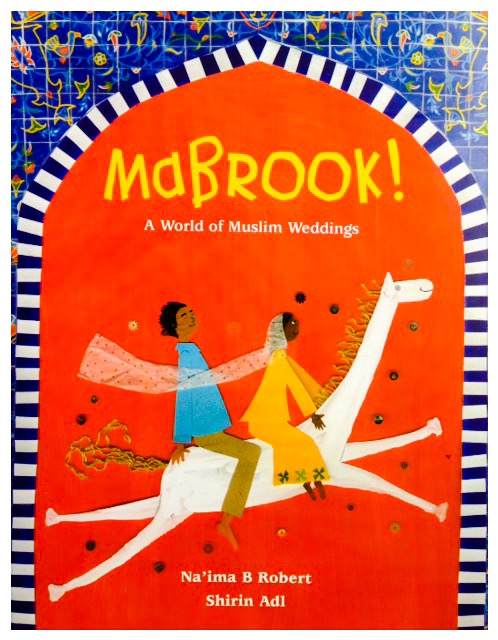
Mabrook! A World of Muslim Weddings by Na’ima B. Robert illustrated by Shirin Adl

Standard
Mabrook! A World of Muslim Weddings by Na’ima B. Robert illustrated by Shirin Adl

mabrook1

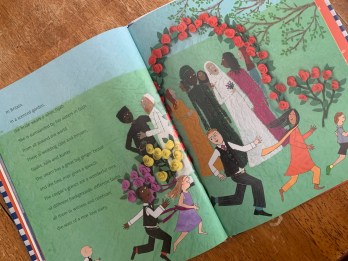
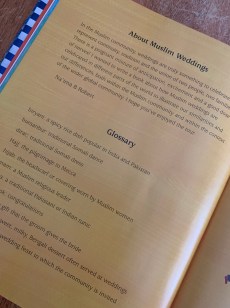
This 32 page lyrical 9 x 11 hardback book with playful illustrations is a celebration on the similarities of all Muslim weddings and the cultural distinctions that make them unique.  Four countries are highlighted: Pakistan, Morocco, Somalia, and Great Britain, and I really wish there were more.  The book is written on an early elementary level, but would make a great wedding present, or even a text to be shared at interfaith gatherings that focus on traditions and women’s rights.  It is joyous and informative complete with a glossary and info blurb at the end.

img_3449

The book starts out with verse 30:21, Chapter ar-Rum in the Holy Qur’an and then jumps in to jubilations of mabrook, congratulations.  It establishes what countries will be explored and that Muslims get married sharing religious rites, but different celebrations.

img_3451

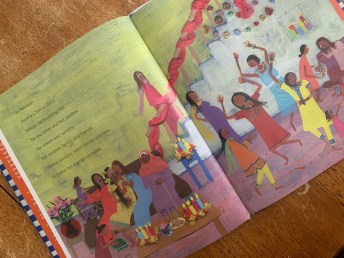
In Pakistan there’s a henna party and the groom rides in on a horse.  The brides are adorned with bangles of gold and guests enjoy biriyani and rasmalai.

img_3450

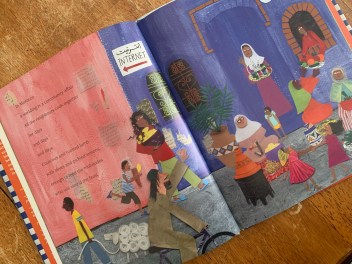
In Morocco the entire neighborhood helps prepare couscous and roasted lamb with olives and pickled lemons.  At the waleemah the bride is carried in on a chair, and changes outfits seven times.

img_3452

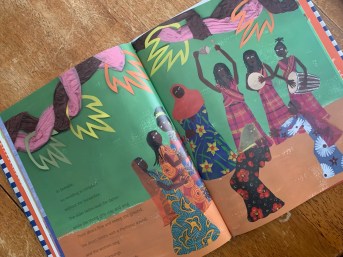
In Somalia, buraanbur is danced and blessings are sung to the mother of the bride.

img_3453

In England the ginger bearded imam marries the groom to his hijab wearing bride in white.  There are people of all faiths and backgrounds there to celebrate and wish them well.

img_3454

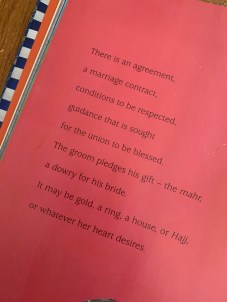
But before all of that, there are meetings with families, prayers, important conversations, agreement to the marriage contract, the woman is given a mahr and guidance is sought.

img_3455

The Muslims: Book 1: The Test by Ahmad Philips

Standard
The Muslims: Book 1: The Test by Ahmad Philips

the muslims

This is the first anime comic book in an eight book series aimed at early elementary readers.  Often books have lessons, this however, simply presents as an illustrated moral.  There is a situation that contains the lesson that one should always try their best for the sake of Allah swt and that is about it.  The knowledge isn’t tested a few additional times or in different situations, it is just 22 pages to illustrate the concept of doing things for the right reason, in this case studying after a failed test.  There isn’t anything wrong with the bright colorful book, the brother sister duo read authentic as they try and recall Islamic teachings, and get each other in trouble by accident, the diverse family is supportive and understanding, it just seems that it would apply to a specific lesson in a home or classroom and then sit on a shelf unasked for and not very memorable.

img_2858

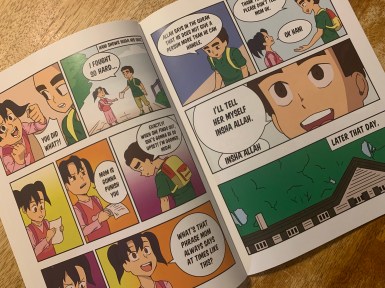
The book starts with seven year old Hani trying his best on a multiple choice test that he didn’t study for.  He battles the personified Quiz Monster to no avail and on the way home from school confesses all to his little sister, Huda.  She reassures him that Allah swt doesn’t give us more than we can handle and agrees to not tell their parents.  Hani plans to tell them himself, inshaAllah.

img_2859

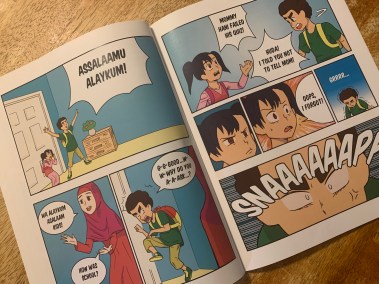
When they get home though, she slips, and spills the news to their mom.  Their dad comes home soon after and everyone knows.  The parents he imagines will turn into evil monsters themselves, but rather they laugh and remind him that he should have the intention of pleasing Allah swt in all things, so that he will assuredly never fail.  That if he makes that his goal, then he will inshaAllah find success.  Hani decides that he isn’t going to be careless in his studying and keeps focused.  He has a nightmare that he studies the wrong material, but alhumdulillah it is just a dream and he is ready, inshaAllah.

img_2860

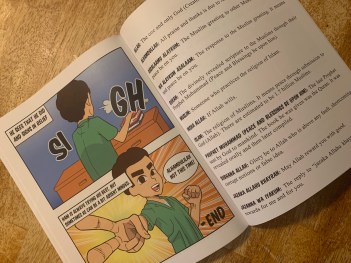
The Islamic lesson and the situational allegory isn’t super clear, and I feel some discussion will need to take place to connect all the dots and convey the lesson in a way to be succinct and memorable.  Had he maybe made dua or intention before he studied, then the message would have been put in to practice, not just something the father talked to him about.  It is admirable that Hani was honest, that he didn’t try and hide is score, which I wish would have been praised.  Additionally, a little resolution between the siblings to show all was forgiven would have been nice.  The mom wears hijab even in the home, and there is a glossary at the end as well.

Salaam: Mindfulness for Muslims by Humera Malik illustrated by Najwa Awatiff

Standard
Salaam: Mindfulness for Muslims by Humera Malik illustrated by Najwa Awatiff

img_3300

I had planned to wait until the physical book comes out on the 15th to offer up my thoughts, but the Kindle version has released and I want to help put it on everyone’s radar.  My own kids went back to school today and emotions and feelings are all over the place: excitement, nerves, anxiety, worry.  Changes in general cause heightened feelings, throw in Covid cases on the rise, puberty, friends, more open discussions about mental health, etc., and kids need tools to be successful.  Alhumdulillah, the Qur’an and Sunnah offer guidance, reassurance, and direction, and this book helps organize and present coping tools for ages seven to adult.  Thirteen emotions over 85 pages follow a pattern of a title page, a “Remember” page with an ayat from the Qur’an (except in one case it is a hadith), then an affirmation to be said that is either a verse, a dua, or dhikr, followed by an adorably illustrated spread of simple activities to do and try in a checklist manner.  Not only will young Muslims find reassurance and direction in the text provided, but inshaAllah, they will also be comforted knowing that what they are experiencing is very human and that Allah swt and Prophet Muhammad saw have provided insight and acknowledgement of such emotions.

The 13 emotions highlighted are: afraid, angry, disappointed, grief, jealous, lonely, overwhelmed, sad, shy, sorry, upset worried, grateful.  There is an author note to parents at the beginning that mentions that the book is meant to be read “cover to cover in peaceful times and to be dipped into to find specific advice” when needed, and I couldn’t agree more.  There is also a note for the readers normalizing big emotions and reassuring them that Allah swt does not want them to despair.

The diverse character illustrations are absolutely heartwarming and I hope that they will be made in to pictures or charts to be purchased so they can be hung.  They are really well done, and the visual mapping will help kids retain and put the tips in to practice.  I’m not sure what the sizing will be in the physical paper back book, but I hope it is large enough for them to be properly enjoyed.


Ahmed and the Very Stuck Teapot by Sarah Musa illustrated by Rania Hassan

Standard
Ahmed and the Very Stuck Teapot by Sarah Musa illustrated by Rania Hassan

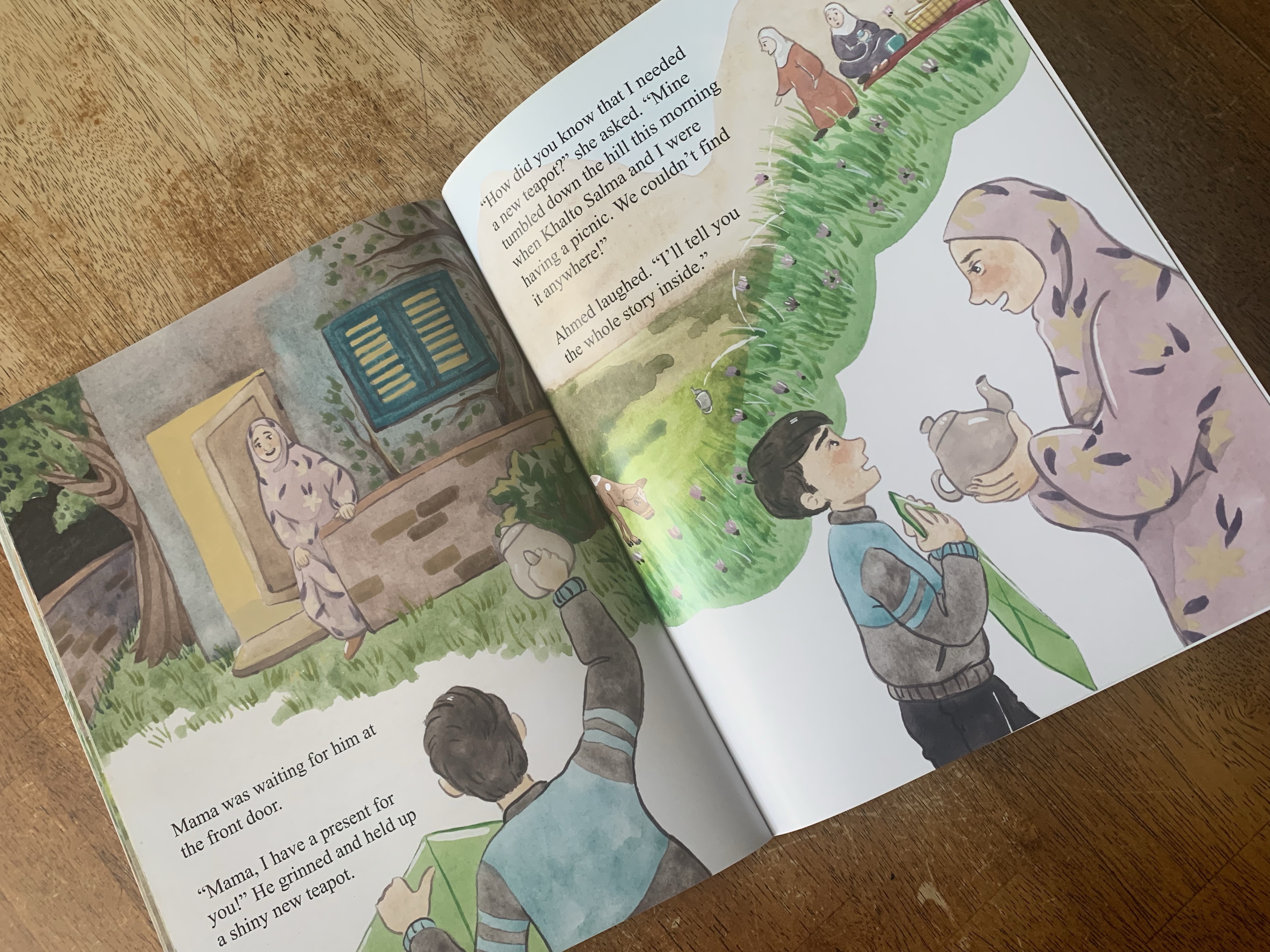
This 36 page early elementary book is packed full of choices and lessons packaged in a sweet story that kids and adults will enjoy reading and discussing over and over. My only real critique is the title. I’ve had this book sitting on my shelf for nearly a year thinking it was just a silly book about a calf with a teapot on her hoof that is stuck and would probably involve different people and methods and attempts to get it off. But the teapot is off by the tenth page, and the story is really just getting started. Like all Ruqaya’s Bookshelf picture books, the large thick shiny pages with a stiff soft cover binding make the story a great choice for storytime and bedtime alike. There are Islamic threads and references, but the story overall is universal.

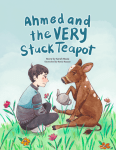
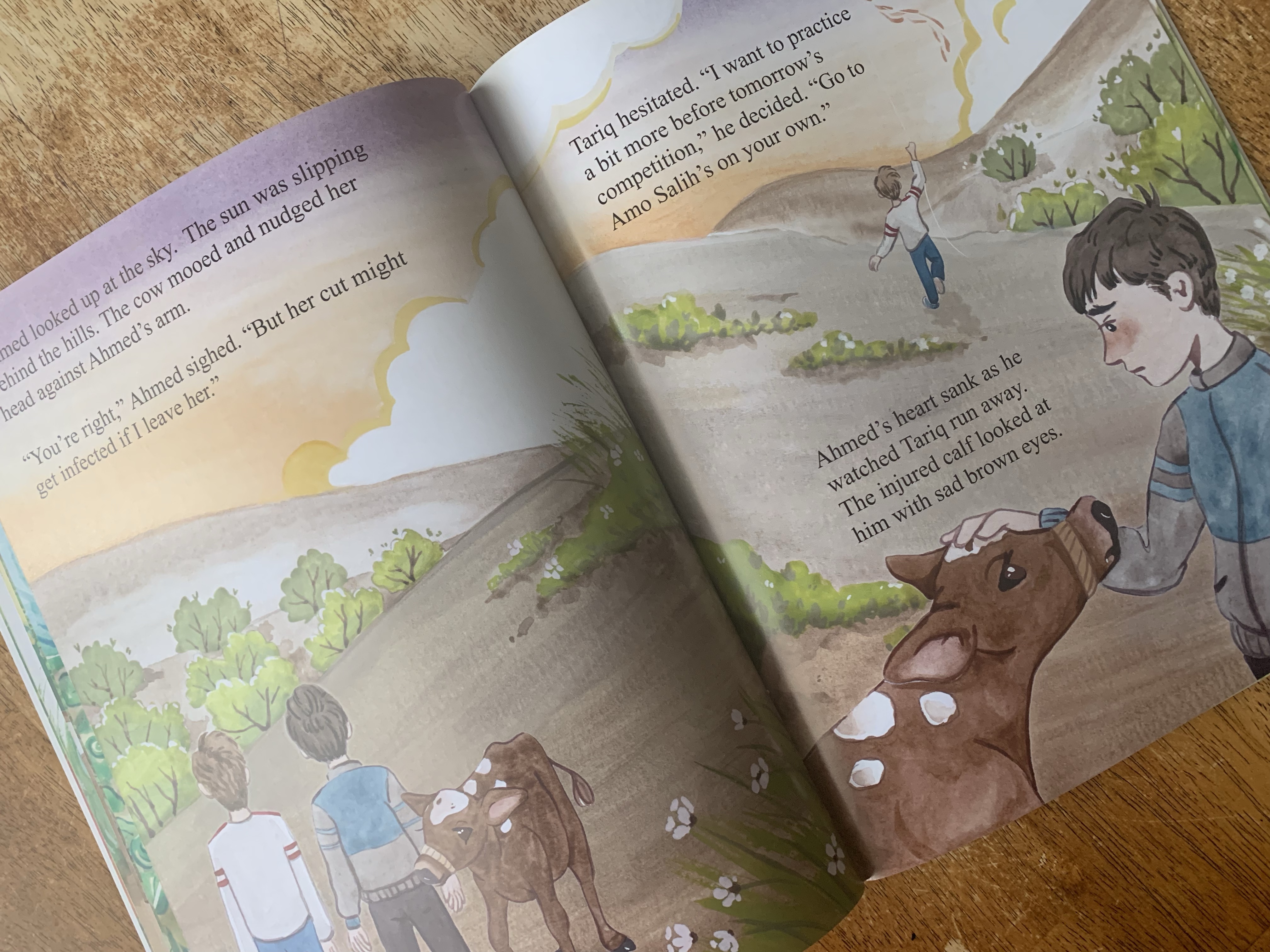
Ahmed and his friend Tariq are practicing their kite flying skills for tomorrow’s annual competition, when Ahmed’s kite gets destroyed in a tree. Heartbroken Tariq suggests he hurry to buy a new one before the store closes at Maghrib. As the boys rush off they come across a brown calf with a teapot on her hoof. Ahmad recognizes the teapot as his mother’s and feels like he should help the poor animal. Tariq keeps reminding him that the shop will close, but Ahmed decides to take the cow to Amo Waseem’s to get help.

Amo Waseem, is able to help the cow get free, but in the process, the cow get’s hurt. The cow needs help from a shepard, Amo Salih, but Amo Waseem can’t go, and Tariq wants to practice more. Ahmed knows the cow can’t be left untreated, and takes the little cow to get help. The cow then needs to get to his owner, and the story continues until the shop is closed, and Ahmed realizes he won’t have a kite for the competition. He goes to the mosque for salat and starts to feel better, he knows that he did the right thing, and inshaAllah Allah will reward him in some other way. His reward comes quickly, however, much to Ahmed’s surprise and in gratitude he also manages to find a way to help his mother.

I love the gentleness of the lessons of doing what needs to be done, even when you don’t really want to, and your friends are not supporting you. Ahmed had chances to walk away, but he didn’t and he was at peace with the outcome. His friend wasn’t mean or bad, he just made different choices. There are discussion questions at the end as well. I think this book would foster great conversation with even the littlest listeners, and I can’t wait to share it at our masjid’s storytime.

Talaal and the Whispering Worrier by Shereeza Boodhoo illustrated by Khalif Koleoso

Standard
Talaal and the Whispering Worrier by Shereeza Boodhoo illustrated by Khalif Koleoso

talaal

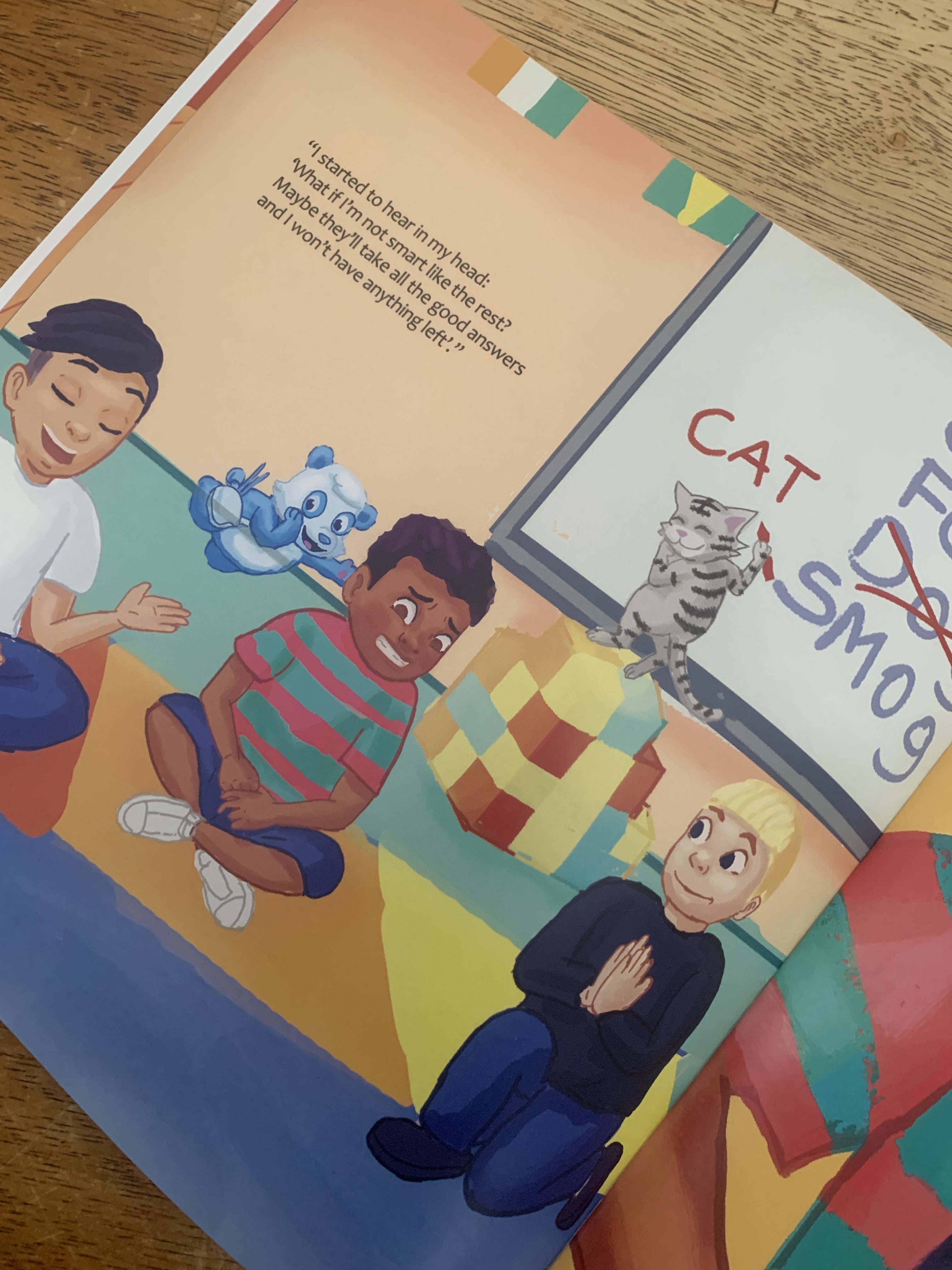
This 38 page book addresses anxiety and self confidence with Islamic tips and tools to help kids cope and feel less alone in their struggles.  The rhyming text on some pages is flawless, and elsewhere falters and distracts from the text.  Similarly, the panda that personifies the “Whispering Worrier” is at times a compliment to the story, and at other times seems to muddle the seriousness being discussed (I don’t understand the ever-present watering can).  The book is long and the text small, but overall the message is good and presentation sufficient.  Books like this by qualified professionals are incredibly valuable and important.  The use of Quran and trust in Allah swt to feel confident and at ease is something we need to share with our young ones early, often, and regularly. 

img_2530

Talaal comes home from school and declares that he feels sick and is not going back to school.  His parents can’t seem to find anything wrong and send him to go do his homework.  He passes his older sister who is praying and seems so relaxed, when she is done she comes and talks to him.  He explains how he felt when the teacher asked them to share and how the fear and nerves felt like his heart was being beat on.  She reassures him that she feels the same way at times and that a Whispering Worrier whispers unhelpful thoughts to tear us down.

img_2531

She suggests countering the negative thoughts with helpful positive ones.  She also suggests reciting Qur’an.  She then has him practice some ayats.  He recites the begining of Surah Ikhlas, and starts to feel better.  Talaal excitedly goes to tell his parents what is going on, and the suggestions his sister has given him for coping and overcoming his stresses.  They let him know that they too get nervous.  His mom, goes a bit off topic and explains various wonders that Allah swt has created and they reassure Talaal that he too is beautifully made.  Talaal starts practicing and finds over time, in different situations, he starts to calm his Whispering Worrier.
img_2533

I like that the advice is rooted in Islamic concepts and that his sister, not an adult, is who coaches him and guides him, making it seem normal and not a punishment.  I like that it isn’t an instant fix, but something to work out and be consistent with over time.  The end has a note to caregivers and some tips.  I think reading the book and having discussions is the first step and inshaAllah if your child or student is struggling that professional help will be sought, so that children don’t have to suffer needlessly.  
img_2534

I read this to a group of early elementary students to try and normalize the topic and encourage them to talk to a parent or teacher if they felt similar to Talaal.  Unfortunately, the book had a hard time keeping their attention and I think, in retrospect, it might be a better selection for smaller groups or one-on-one so that discussion and feedback can safely occur.

img_2539

Eid al-Adha: Festivals Around the World by Grace Jones

Standard
Eid al-Adha: Festivals Around the World by Grace Jones

nonfic eid

I had hoped to go through all the recently published non fiction hajj and Eid al-Adha books at my local library, the same way I went through the Ramadan and Eid al-Fitr ones to check for errors and accuracy, but they really didn’t have many, and those that they did have were not published in the last few years.  I did find this book from 2017 and because it has some errors: saying Eid is in September every year, not mentioning all the parts of Hajj, which is ok, but overly stressing the stoning at the jamarat, pronouncing Hajj as Harj, etc.,  I thought to share it with you all, so that you too can contact the publisher and your local library and/or bookstore to see about pulling it if you are so inclined (booklifepublishing.com)

img_2345

The 24 page non fiction book is a large 9.5×12 horizontal layout with beautiful pictures of diverse Muslims worshipping and celebrating.  A little cartoon character, Noor, guides you to word pronunciation with a glossary at the end.img_2346The book starts out with a two page spread defining what a festival is.  The next two pages define Islam.   Page 8 then states that “Eid al-Adha is a festival celebrated by Muslims in September of every year.”  And page 9 of the book says we throw pebbles at a wall, not that we throw pebbles at three representative pillars.  It also says that Eid is celebrated for two to four days depending on the country.  Religiously, it should say it is a three day holiday.

img_2347It then tells the Story of Eid al-Adha aka Ibrahim (as) being to told to sacrifice his son.  I’m not sure why the book doesn’t says that Muslim’s consider Ibrahim a Prophet (peace and blessings be upon him), and instead call him a wise man.  Indeed he was, but it seems very awkward to not mention how Muslims regard him, and seems to go out of its way to not say he is a prophet in Islam.

img_2348

The next section is about Hajj which tells that it is performed in the last month of the Islamic year and that we walk around the kaaba seven times.  No other info is given, but in the next section it again mentions the throwing of pebbles,  really dismissing any other steps and making the sacrifice and stoning rituals seem to be the whole of Hajj which is incredibly misleading and erroneous.

The book shows that those not at Hajj, pray in congregation wearing new clothes, give and receive gifts and giving charity.  In the section about Festive Food it only Buriyani from India is featured, it seems random.  It should have been stronger that one third of the sacrifice goes to the poor, one third to friends and family, and one can be kept for oneself.  This would show that meat is the highlighted festival foods in any culture celebrating.  On the “Noor Says” page at the end, it has Hajj pronounced as “harj” which is wrong, it is Hajj, or possibly hadj.

My standards have dropped considerably, and would sadly not consider much of this major.  But, it does provide another example of how involved and aware we need to be in our representation in mainstream nonfiction publications.

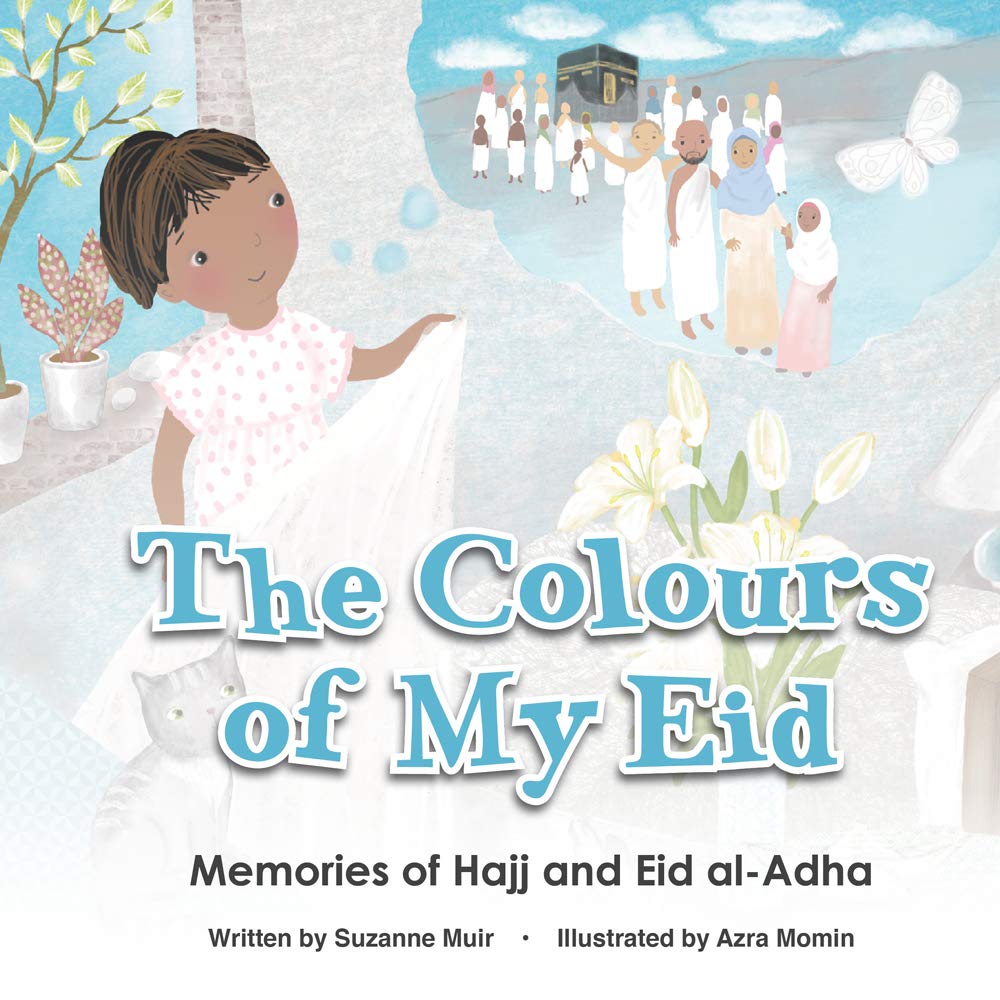
The Colours of My Eid: Memories of Hajj and Eid al-Adha by Suzanne Muir illustrated by Azra Momin

Standard
The Colours of My Eid: Memories of Hajj and Eid al-Adha by Suzanne Muir illustrated by Azra Momin


colour


At 18 pages, this 8 x 8 book focused around colors contains a lot more information than what initially meets your eyes.  The warm beautiful, full page pictures fall opposite a highlighted color and a description of that color in the child’s world that reminds the characters of their time at Hajj or celebrating Eid al-Adha.  On each of the fun text pages is a light green text box at the bottom with factual information that older children or adults will benefit from and be able to share with younger listeners.  The main text is ideal for toddlers and up, and older kids up to 3rd grade will benefit from the nonfiction highlights that can educate or remind Muslims and non Muslims alike, about the importance of Hajj and Eid al-Adha.  

The book starts with an introduction about the Islamic language and perspective used, and clarifies that the colours emphasized are to help visualize the point being made, it also gives information about Eid al-Adha.

The colors highlighted are: white, black, brown, green, grey, yellow, and purple.  The large simple text takes something relatable such as the monkey bars, or balloons, or the sky and corresponds it to a memory of Arafat, or ihram, or the hills of Safa and Marwa.

The nonfiction text gives specific dimensions of the Ka’aba, the story of Hajar and baby Ismail, the requirement of Hajj and some of the steps.  There is a lot of information conveyed which at times is incredibly detailed, and sometimes, rather vague and generic, i.e. Tawaf is when Muslim pilgrims circle the Ka’aba as part of the Hajj rituals. Overall, this little book packs a punch, and I was equally impressed at how it held my five year old’s attention with the colors, and my interest with the facts detailed below.


I Can Help by Reem Faruqi illustrated by Mikela Prevost

Standard
I Can Help by Reem Faruqi illustrated by Mikela Prevost

i can help cover

This 44 page early elementary book is absolutely beautiful: the message, the relatability, the representation, the heartfelt author note.  Reem Faruqi is brilliant.  Once again she takes something so personal to her and allows the readers to see pieces of themselves in her OWN voice narrative.  This book at it’s core is about peer pressure, but the way it stays with the reader will resonates deeply and powerfully.  Readers will remember the choice Zahra made and the way it changed not only her relationship with Kyle, but also her own view of herself, while forgetting the names of the classmates that teased her and made her question herself.  It is not the outside reprimanding that gives this book it’s strength, but the guilty conscious that such a young character has to come to terms with as she moves forward.

  i can help 3

There are 18 kids in Zahra’s class in early fall, when the leaves are about to be the color of Nana’s spices.  One of the kids is Kyle.  Kyle often needs a helper, and Zahra is happy to help him with his cutting and gluing and writing.  The two have become friends.  Kyle is funny and nice and shares his cookies.

i can help 2

Zahra also likes the praise she gets for being such a good helper.  One day when the leaves have darkened, Zahra is climbing a tree and hears some of the girls making fun of Kyle.  She doesn’t want to listen, but her ears want to hear.  When she comes down, they ask her why she helps him.  She doesn’t really know.

i can help1

When she is helping him later, she sees the girls staring at her, and she snaps at Kyle.  The next day Ahmed helps Kyle instead.  Zahra misses being around Kyle, but he says that she is mean and he doesn’t know her any more.  Zahra doesn’t know herself any more either.

i can help 5

The next year finds Zahra at a new school, and when the opportunity presents itself for her to help someone, she jumps to offer herself as a helper remembering Kyle and finding her voice, one that she recognizes.

i can help8

The book is inspired by the author’s own experience, and the rawness and relatability shines through.  The illustrator also relates to the book and needing help with physical limitations.  There is nothing overtly religious or cultural other than the mention of the spices, Zahra’s and Ahmed’s names, and the term for Zahra’s grandfather.  The diverse kids in the classroom and the universal messaging make this book a must read for every kid and big person.  Be kind, always be kind.

i can help 9

The Olive Tree by Elsa Marston illustrated by Claire Ewart

Standard
The Olive Tree by Elsa Marston illustrated by Claire Ewart

olive tree


Set in Lebanon, this 32 page book for kindergarten to second graders uses the ever important olive tree as a point of contention between two neighbors. Muna’s family moved away during the conflict because they were not like the others in the village, and while they were gone, Sameer’s family cared for the olive tree on their neighbor’s property, and collected the olives that fell on their side of the wall. But now that the neighbors have returned, Sameer is not only disappointed that they don’t have a boy his age to play with, but also clashes with Muna when she says that he shouldn’t take their olives. By the end of the book, olive branches of peace will be referenced and hope hinted at in this brightly illustrated book with a lesson.

img_1647

I like that why Muna’s family left is not abundantly clear, saying that “For many years the house next to Sameer’s had stood empty. . . that the family who lived there had gone away during the troubles because they were different from most of the people int he village.”  Lebanon is a diverse place and the illustrations seem to show both Mom’s wearing head scarves, the text does not detail if they are unlike each other because of religion, or culture, or some other reason, and I kind of like that it is left vague so that children learn in the end perhaps, it doesn’t matter.  

img_1648

When the family moves back home, Sameer watches them and recalls the ways his mom prepares the best olives in Lebanon.  The neighbors are polite, but not friendly.  They don’t ever say much and they don’t return visits.  One day when the ripe olives have fallen on the ground, Sameer heads out with his basket to collect them.   Muna, who has never looked over at Sameer, watches him and tells him that they are her olives, and that the tree has been in her family for a hundred years.

The two bicker about who has rights to the olives on Sameer’s side of the wall and in anger, Sameer dumps his basket of olives on Muna’s side and walks off.  After that, no one on Sameer’s side collects the olives on the ground.  One night there is a storm and the olive tree and part of the stone wall are destroyed.  The adults gather to survey the damage, but walk off without saying anything.  The two children are left to decide what to do next about their beloved tree, and their relationship with one another.

img_1649

I like that the resolution is subtle, but thought provoking and that the adults don’t seem to interfere too much.  I can’t imagine that they don’t have opinions about their neighbors and the olives, but the book stays on the children and the assumptions, stubbornness, and unsaid words that have created such a divide, and must ultimately be resolved as a result.


Never Give Up: A Story about Self-Esteem by Kathryn Cole illustrated by Qin Leng

Standard
Never Give Up: A Story about Self-Esteem by Kathryn Cole illustrated by Qin Leng

img_9838

This first through third grade teaching series highlights different life lessons and concepts and features diverse characters. I reviewed a book in the series earlier with a Muslim character, not realizing that there was also one with Nadia in the lead. The 24 pages show her in hijab both at the park and at home although she wears short sleeves and is much younger than puberty, when covering becomes required. Neither the author, nor the illustrator seem to be Muslim, and religion is not present in the book, other than Nadia’s scarf. It is worth mentioning that Nadia crosses her fingers and makes a wish that her plan works, something most Muslims would say inshaAllah for and possibly want to be made aware of in a book like this. Overall the message is strong, and would be a great book to read and discuss with a child, Nadia and her friend Shaun have noteworthy traits that we can all learn from.

Nadia is heading to the park to practice jumping with her new rope. She stops when she sees her friend Shaun riding his bike with training wheels. She has been riding on two wheels for a while, and even on training wheels Shaun is struggling. Kamal, Joseph, Lin, and William start teasing Shaun, and Nadia is upset, but not brave enough to do anything about it.

After crashing a few times, the crowd grows tired of laughing at Shaun and Nadia goes down the hill to check on him. She apologizes that the other kids were teasing him, he takes it in stride and thanks her for not joining in. He also lists off things he is good at. He is determined, and Nadia has an idea. The two agree to meet back at the park the next day.

Nadia is upset when she gets home. She tells her dad the whole story and how she wishes she was a better friend. She then talks to her dad about her plan, and gets him to agree to help, her dad checks it off with Shaun’s parents and the next day they all meet at the park to take off the training wheels and teach Shaun how to ride with two wheels.

After multiple attempts and lots of cheering, Shaun is riding his two wheeler. He didn’t give up! Now it is Nadia and her dad’s turn to try jump roping, and after some struggles, it is the kids cheering on Nadia’s dad and encouraging him to try again.

The end of the book has Tips for Grown-Ups about how to develop and support children’s self-esteem.