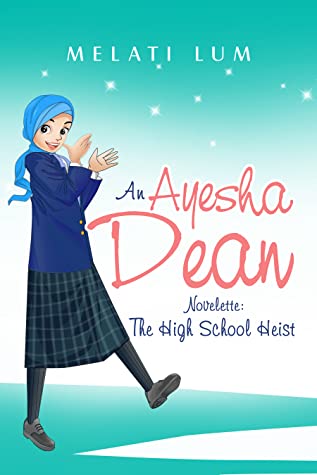
An Ayesha Dean Novelette: The High School Heist by Melati Lum

Standard
An Ayesha Dean Novelette: The High School Heist by Melati Lum

ayesha deen mg

If you are a long time fan of Ayesha Dean and you have been waiting for some children in your life to grow up just a little, so you can share the strong Muslim detective books with them, you are in for treat.  This book is a short novelette for middle grade readers!  It isn’t a prequel detailing her personal backstory, but it does show how she got her first taste of sleuthing at age 13.  If you are new to the series: the book like all the others is Islam centered, fast paced, authentically voiced, and an overall fun read.  Unique to this book is that it is for ages 8 and up, and takes place in Ayesha’s home country of Australia.

SYNOPSIS:

Ayesha is at a new school, she has recently started wearing hijab and she just wants to settle in to it all with friends Jess and Sara.  Things have been going missing from year eight lockers, but it isn’t until Ayesha is a victim does the concern really hit home.  Add to that getting paired with the jerk Dylan Wyley for a project in Indonesian class, and Ayesha is not having a good day.  When she senses some suspicious activity, she is on the case: ready to get her stolen book back, take down a bully, put her Tae Kwon Do training to use, and make it to the library to pray her salat on time.

WHY I LIKE IT:

I really enjoyed the relatable voice of young Ayesha, having read all of the other books in the series, it was sweet to get a peek of her in her younger school days.  I love how much Islam is in the book, and not in a preachy way, but rather in a ‘I’m Muslim and this is how I see the world and this is what I do’ sort of way. I’m not going to lie though, I wanted more backstory on how she became friends with Jess and Sara, how she settled in to living with Uncle Day when her parents died, and all the backstory four books solving crimes around the world just couldn’t get to.  But I fully realize, that is just something I may never get (hint, hint) and will have to be content with the fast paced, culture and Islam rich stories that we thankfully get.  I’m not complaining, I just get overly invested.

To all my arrogant ignorant readers out there, that like me, might be a bit confused about Australian schooling and culture- I embarrassed and humbled myself and annoyed the ever gracious author to learn more about Ayesha’s world.  In Australia the lockers are located in the students’ homeroom classrooms (tute rooms), hence they don’t often padlock them.  High school refers to ages 12-17, and sometimes 11th and 12th grade are called senior school, and “How did you go” is a phrase in Australian English.  See, aren’t you glad I asked, now we know, and can widen our view together.

The only thing that I think I would have liked to see would have been a bit of pause before Ayesha got into a fight.  It is high energy, and she does it to help someone, but I feel like at 13 years old, in a book for 8 year olds, and as someone familiar with Tae Kwon Do, it should have been more articulated that she was nervous to engage in a physical altercation, and was only doing it because she could not diffuse the situation, get the victim away, and thus had to step in.  I recognize that pulling out of the scene might have made it lose momentum, but I felt a little off celebrating a school fight without that pause of introspection.

FLAGS:

Fighting, stealing, bullying, Islamohobia, racism, bigotry.

TOOLS FOR LEADING THE DISCUSSION:
The book is short and for a younger age than I meet with, but I look forward to purchasing the book on February 20, 2022 to have available in the school library for anyone to pick up and read, inshaAllah.

The Sleepy Farmer: The Farmer Who Almost Missed Fajr by Shazia Afzal illustrated by Ingy Hamza

Standard
The Sleepy Farmer: The Farmer Who Almost Missed Fajr by Shazia Afzal illustrated by Ingy Hamza

The Sleepy Farmer_

This adorable board book combines animal sounds, team work, appreciation, and getting to the masjid on time for fajr.  Oh ya, and it is silly too.

img_5554

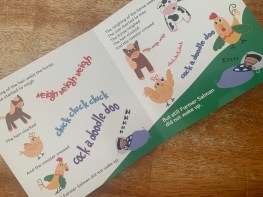
Farmer Salman stayed up late and doesn’t wake up in the morning when the rooster crows. The crowing wakes the hen who starts to cluck, the clucking wakes the horse who starts to neigh…and before you know it, it awakens the entire farm.

img_5553

But, Farmer Salman still doesn’t wake up, so the animals get louder, and louder, and finally the cat in the house wakes up and meows in the farmer’s face.  The meowing wakes Salman up and he makes wudu and heads to the masjid, just in time for fajr salat.

img_5555

He returns from the masjid, thanks the animals and gives them their breakfast, alhumdulillah.

The book is only 10 pages and some pages are text heavy.  I think a few more pages to reduce the text on some of the pages would really make an already fun book, incredible.

Hakim’s Odyssey: Book 2: From Turkey to Greece by Fabien Toulme’

Standard
Hakim’s Odyssey: Book 2: From Turkey to Greece by Fabien Toulme’

hakimcover

It is easy to assume that refugee stories are all the same, but in my experience, the more I read about the journeys people take in desperation for safety, the more I realize it doesn’t matter if “parts” are similar, the individual experience should never be dismissed or become commonplace.  I try to make a point to read them, and spend time with them, and be affected by them, so as to not grow apathetic.  I have not read the first book in this series, but this book, the second book can stand alone, and I hope that you will keep an eye out for it when it is published, and spend time with Hakim and his son Hadi.  In much of the way the middle grade novel When Stars are Scattered, swept me up and consumed me, this book also enveloped me in the characters’ emotions and left me sobbing and heartbroken more than once.  The framing of the story, gratefully shows that Hakim survives, but the power of the words, illustrations, and experience, still physically move you and make you imagine how truly horrific situations must be that force people to risk it all to leave their homes and start over.  This 264 page book focuses on the part of his story that takes Hakim from Turkey to Greece, but references to Syria and his life there allow for a fleshed out understanding and appreciation for the trials he has faced, and continues to face, subhahAllah.  Suitable for mature teens, at least 16  or 17 and up.

SYNOPSIS:

The book starts out with the author/illustrator heading off with his daughter to interview Hakim.  His young daughter has heard a lot about Hakim and his family, but never met them.  They “recap” the first part of his journey, the first book, and settle in to hear more of his life and the extraordinary circumstances that he has faced to reunite with his family since fleeing the war in Syria.

The birth of his son Hadi is a definite high point in Hakim’s life and the daily struggle of selling enough goods on the streets of Turkey to provide for his son keep Hakim looking forward.  With his wife, Najmeh, and her family around them, they crave stability, but are managing.  As the days stretch on though, Hakim is prevented from selling without the proper permissions, and his father-in-law is still unable to find work. Hakim’s wife and family are granted permission to relocate, but Hakim and Hadi cannot legally join them.  The tearing apart of the family is devastating.  And carrying for his young son alone while trying to earn enough to survive is incredibly challenging.  When Hakim has exhausted all the legal ways to join his family in France, he considers illegal methods.

An Iraqi neighbor offers him the money needed to hire smugglers, so Hakim is faced with deciding what risks he and his young son are willing to take to “start living.”  The step in to the unknown, the crossing of the sea in an inflatable life raft, brings them closer, but with one more book in the series, and not knowing who the children are in the present time scenes, your heart will be made incredibly fragile as you hope that young Hadi survives.

WHY I LIKE IT:

I love that you get to know the characters and can see why they make the decisions they make, or rather why the choose to do what they choose based on the information they have, and the impossible choices before them.  I also love that it shows so much humanity.  You see Hakim’s story brought to life and you see him and his family as whole people, not just numbers or nameless, faceless victims.  You see the joy and devastation, the testament to human strength and mental anguish, it is moving and powerful.  I also love that you see the side characters, see the little mercies, and the horrific injustices, often in the same scene. The graphic novel format allows the subtleties to show without the words, it adds to the connection of emotions and truly putting yourself in the character’s shoes.

I like that it should how happenstance much of the journey was for Hakim, at times he didn’t know who to talk to, where to go, what to expect.  I was a little confused about the payment to the smugglers, and how it had to be handled after he arrived.  I don’t know if my own understanding of how shady the smugglers are based on the media is making it muddled, or if I just missed something in the telling.

There is not a lot of Islam in the book, they don’t stop and make salat or say Bismillah, but they reference thanking Allah swt, and praying to Allah in desperation.  Hakim’s mother in law and wife wear hijab.

FLAGS:

Fear, smoking, cheating, lying, illegal immigration acts.  There is nothing obscene, the older audience recommendation is because of the weight of the subject matter, and the lingering effects of war and escaping.

TOOLS FOR LEADING THE DISCUSSION:

This would be an amazing high school book club read.  The characters, the relatability, the empathy, it would be great to share it with a group of students that might have similar experiences and provide them with a platform to share with those that might not.

My World of Hamd: A Reflective Book on Gratitude by Lateefah Binuyo

Standard
My World of Hamd: A Reflective Book on Gratitude by Lateefah Binuyo

hamd

This thick hardback 46 page book is a great next step after teaching your kids to say “Alhamdulillah” to helping them to understand what it truly means.  Meant for second graders and up, this book is text heavy and encourages deeper thought, reflection, and practice.  It is not a quick read, and some children may struggle to sit through the entire book, but any time spent, I think, will be incredibly beneficial as it strives to move from the habit of just saying “Alhamdulillah” to being intentional in our appreciation and gratitude.  The thick inside pages, warm large illustrations, and colorful reflections are well done and enjoyable.  I only wish the cover better conveyed the content within.

img_6093

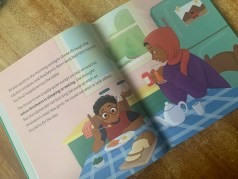
The book begins with ayat 18 from Surah Nahl stating: “If you tried to count Allah’s blessings, you would never be able to number them.  Indeed, Allah is All-Forgiving, Most Merciful. With the tone set, the fictionalized story begins with Ibraheem and his mum having breakfast.

img_6090

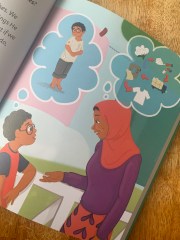
Ibraheem is a curious boy that is only ever quiet when he is sleeping or eating.  When his mum reminds him to say Alhamdulillah after he finishes eating, he gets to wondering, “What does Alhamdulillah mean?”

img_6092

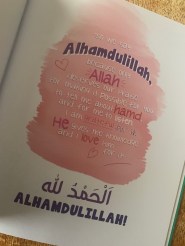
Mum explains that the hamd in Alhamdulillah means praise and gratitude, and it is for Allah swt alone.  Ibraheem then wants to know how can he feel “hamd all the time?”  He and his mum discuss that hamd has to be felt within the heart, and it isn’t just saying it after a meal, but appreciation that you have food to eat.  Appreciation when you wake up in the morning, because many do not, etc.  The two discuss small and large aspects in a day that provide opportunities to truly appreciate the gifts of Allah swt.

img_6094

The book covers topics such as: sneezing and appreciating your muscles, getting dressed and recognizing the blessing of clothing, awards at school, losing your backpack, happy times and sad times too.  Along the way mum passes on information about how when we are grateful Allah swt gives us more, about how even in sad times we have so much to learn about patience and asking Allah for help, that we can fill our days with hamd.

img_6095

The book touches on never feeling sad in Jannah, Allah’s name Al-Hameed, and explaining how we have to still thank people and show appreciation to them because Allah sends his blessings through people as well.

The book concludes with teaching duas about hamd one word at a time, a glossary, and tips for using the book.  There are a lot of hadith and ayats explained on a child’s level and overall really answers and provides insights about saying Alhamdulillah and feeling Hamd.

10 Steps to Us by Attiya Khan

Standard
10 Steps to Us by Attiya Khan

steps

I try really hard to keep an open mind when reading Islamic YA romance books knowing that certain standards are probably not going to exist to move the story along, and of course I’m fully cognizant that Islam is practiced in a myriad of ways and chances are, I will disagree with a fair amount of any book in this genre.  This particular book though, was hard to read.  Ultimately I just didn’t like the protagonist, she was shallow and flimsy and her grasp on reality seemed lacking at times.  The premise of the book is that you can have a boyfriend, if the boyfriend is Muslim.  So by not agreeing with the very foundation; made the rest of the book hard to wrap my head around.  The book is largely about hijab, and the author starts the book thanking the individuals that “educated her about the hijab,”  yes, the article “the” is often used, and thus so much of the nuanced lived OWN voice experience of wearing hijab, is lacking.  The book features language, lying, kissing, making out, talk of wanking, condoms, groping, and a scene that nearly concludes with sex, but stops short, barely.  Perhaps high school seniors and college age teens could read this 231 page book, but I don’t know that the book is worth their time.  Practicing Muslims will be irritated by the lack of mirroring, cultural readers will be annoyed that the protagonist didn’t push back on toxic assumptions, and non religious readers will be left confused at what the book hopes to accomplish by including religion and culture to no real definitive purpose in a romance novel.

SYNOPSIS:

High school student Aisha wears hijab much to her parents protests, and tries to avoid the Islamophobic aggressions that she endures in her white Kent neighborhood.  She learns more about Islam than cultural superficiality from a family friend, an aunty, and she goes through her daily life largely unnoticed.  She has a close friend, who is popular and likes to party, but Aisha doesn’t go out much, yet Isabelle still finds ways to include her.  Everything starts to change however, when Darren moves in to town, defends Aisha at the bus stop and seems to be interested in being more than just friends.  Aisha doesn’t date, but reasons if Darren were a Muslim, nothing would stop her.  She devises a 10 step plan to make it all work, she just has to convert him.

While she sets her plan in motion, she finds herself lying to Isabelle, who has a crush on Darren, lying to her parents so that she can sneak around with Darren, and lying to Shafqat Aunty about her relationship with Darren.  Along the way, she will lose her friendship with Isabelle, uncover dangers of equating culture and religion, remove and reconsider her hijab, nearly lose her virginity, and have to decide where her boundaries are.  By the end of the book, nothing is clearly articulated for Aisha’s future or what she has decided regarding her relationship with Islam, hijab, and future boyfriends.

WHY I LIKE IT:

I struggled with the book.  I like the flipped stereotype of the family not supporting hijab, but Aisha wearing it for her self anyway, unfortunately, I never felt that I understood why she felt strong enough to wear it, what brought her closer to Islam, and learning about Islam, and what the catalyst of it all was.  I think knowing more of Aisha’s backstory might have made her more like-able.  Throughout the book Shafqat Aunty is her whole Islamic touchstone.  She doesn’t seem to have any other way of learning, or studying Islam.  It seems that to come to Islam in high school would mean a level of maturity would exist that the character simply does not exhibit.  I started wearing hijab at 16, I was the first in my family, I did it for me, I was actively trying to be a better Muslim and understand Islam, and hijab was simply a physical, tangible manifestation of that.  So to see a character so passive in the learning, was a bit of a disconnect for me.  I’m not saying that everyone has an experience like mine, but her grasp of basic Islamic tenants seems so weak, and she doesn’t seem to have a way to acquire understanding, or even a desire to obtain it.  Often Darren seems to know more about Islam than she does.

I really struggled with the conceptual thread that her hijab prevents her from feeling comfortable making-out with Darren, so she hides it when clothing starts falling off.  Shouldn’t hijab be the reminder to not have gotten in that situation in the first place? Perhaps if she would have had some depth, or the relationship wasn’t “love at first sight” I would feel a bit more invested in her trying to sort out her beliefs while in the midst of such strong lust, but it wasn’t developed to that level.

I liked the initial idea of sorting through cultural and religious views on divorce especially considering the woman involved is being abused, but I didn’t think the book exerted a strong enough stance that divorce in Islam is absolutely ok, that abuse is not ok, and anything otherwise is backwards culture.  The book set itself up to make a strong statement, but then it abandoned it.  I’m not sure why the author didn’t get up on a soap box and preach, I mean it would have given the book something really powerful to highlight and given Aisha some growth in understanding where culture has undermined the power of women’s rights in Islam.

The book dismisses understanding one’s faith, and falls into predictable troupes despite setting itself up to be “different,” when  Aisha fears being shipped off to Pakistan when her parents find out about her and Darren.  The writing feels forced at times, and a few times He when referencing God is not capitalized.  I appreciate that some surahs, and duas, and Ramadan are included, but they don’t seem to shape Aisha, it seems like she is simply going through the motions.

The book ends on a “cliff hanger” of her either placing her scarf in the hamper or the garbage.

FLAGS:

Language, talk of sex, fairly vivid make-out scene that stops short of sex when they pause to acquire a condom and then Aisha changes her mind.  There is a lot of lying, normalizing relationships if both are Muslim, even if both are not, talk of domestic violence, slut-shaming, hickies, crude jokes.

TOOLS TO LEAD THE DISCUSSION:

There is no way I would encourage this book in an Islamic school setting.

Nana Asma’u by Aaliyah Tar Mahomed illustrated by Winda Lee

Standard
Nana Asma’u by Aaliyah Tar Mahomed illustrated by Winda Lee

nana asmau

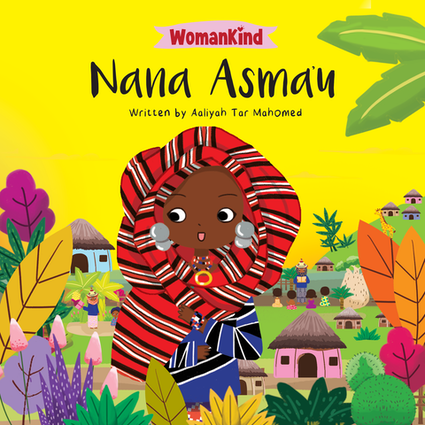
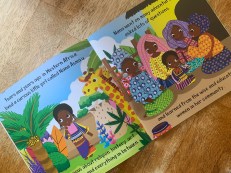
This book may only have 14 pages of text and be meant as an introduction for early preschool aged children and up, but I learned so much, or rather was made aware of so much that I knew nothing about, that I’m now eager to research her and the Sokoto Caliphate and the impact of Jajis.  The beautiful, bright, engaging pictures, the simple deliberate text, and the inspiring content matter make this a great book to share with little ones, and to keep on the shelf for repeated readings and reminders to learn more about this remarkable woman for older children.  My only wish was that there were some reference notes or sources included to give that extra reassurance of authenticity.

img_6076

The book tells about Nana Asma’u’s life starting from being a curious child and asking questions to the wise women in her community.  By the time she grew up she had memorized the Quran and spoke four languages amongst many other things, and Nana loved to write poetry.

img_6077

During this time, there was a lot of conflict in Western Africa, and Nana’s father, Shehu Usman resolved the issues and created the Sokoto Caliphate.  With peace, Nana wanted to help educate the people. She thought long and hard about how to do it.

img_6078

She eventually brought together women from different regions of the Caliphate and taught them through poetry, she then sent the women back to their homes to share what they had learned.  These women were known as Jajis, and this tradition still exists today.

img_6079

I didn’t love the phrasing that she had learned all about Islam, seeing as one can always learn more.  And I would have like Prophet to have been capitalized and salawat given for respect.  Overall, a great book that alhumdulillah I was able to purchase from Crescent Moon Store.

The Unexpected Friend: A Rohingya Children’s Story by Raya Rashna Rahman illustrated by Inshra Sakhawat Russell

Standard
The Unexpected Friend: A Rohingya Children’s Story by Raya Rashna Rahman illustrated by Inshra Sakhawat Russell

friend

I have mixed feelings about this book. On the surface I am thrilled that there is a story highlighting the plight of the Rohingya for children and that it includes some character depth and relatability to global readers. On the flip side, the book is very vague and could be any refugee in any camp and is not Rohingya specific. Additionally, I feel that it is too idyllic. I am no expert by any means, I wouldn’t even say that I am well-versed, but the book paints an impression of a thriving organized camp with medical help, orderly food lines and a vibrant school. Yes, it talks about the lines being long, and naturally if you are out collecting firewood, it is a bit rugged, but I don’t know that the lasting impression is a humanitarian crises. I understand that in a 36 page, kindergarten to 2nd grade book, political complexities and horrors are not a natural platform, but I worry that the aim of bringing attention to the situation will miss its mark by not capturing its truth more clearly.

img_5377

Faisal has just finished his afternoon prayer and while outside the mosque he hears a faint chirping and discovers a small bird with a hurt wing.  He and his friend Rahim take the bird to the learning center to be cared for while the boys head to the forest to collect firewood.

img_5378

The forest can be dangerous, but in order to cook, they must have wood to burn.  While in the forest, the boys encounter an elephant and remark on how they are depleting the animals’ natural habitat.  When leaving Faisal trips and falls, scattering his collected firewood and breaking his arm.

img_5379

Rahim offers to share his firewood with Faisal and the two head back to camp to get Faisal to the doctor.    Like the bird, who’s wing has been bandaged, Faisal now too has a hurt appendage.  The two spend every minute together for weeks, and when both have healed, Faisal admits he doesn’t want to let the bird free. He knows it is the right thing to do and alas allows the bird to go.

img_5380

The book has an afterword regarding Cox’s Bazar and information about the author and Save the Children Foundation.

Hello! A Welcoming Story by Gina K. Lewis illustrated by Maria Jose’ Campos

Standard
Hello! A Welcoming Story by Gina K. Lewis illustrated by Maria Jose’ Campos

img_5289

This 62 page early elementary story is told from two perspectives, you flip the book to read each parallel story from two points of view, the refugee children’s and the children welcoming them.  Overall, I feel it is very well-intentioned and gets a lot right, but I found myself not feeling comfortable with some of the messaging regarding the visibly Muslim character included.

img_5290

I love that there are characters of all skin tones both welcoming the refugees and the refugees themselves. And I love the vague universalness that binds all the refugees together being expressed:  that they love their home, they had to flee, the journey was dangerous, they left everything behind, etc..

img_5291

I also love the warmth and genuine compassion that comes from the welcoming children.  They are reassuring, open, and seem to truly want to provide confidence to their new classmates.  The simple text really conveys a lot of emotion albeit very idyllic, that provides ways that readers in similar situations can also mimic when welcoming anyone new.

img_5292

On one of the two story sides a map is included showing that the refugee kids come from all over the world, the side that did not have the map I worry might confuse young readers.  They might not realize that the five children do not all come from the same country.  There should be a map on both sides, ideally.

img_5295

The illustrations that show how the welcoming kids understand the refugee stories is clever in the showing of their understanding.  The images are similar, but the different style is a great emphasis on how we process from our point of reference facts that others have lived.

img_5293

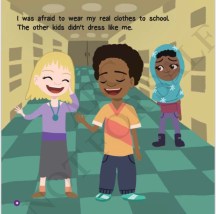
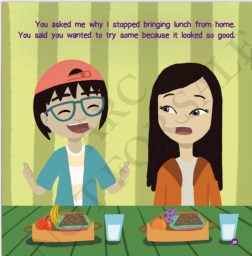
The concept of a new kid finding everything so different and not fitting in, is a great concept to explore in terms of clothing and food and language, but for some reason I didn’t like how the girl in hijab was presented.  I’m ok that she took off her hijab to fit in, and that her classmates encouraged her to be herself, and put it back on, but the text is too over reaching, to an erroneous end.

img_5294

It says on one page, “No one looked like me, but most people smiled.”  Really, NO ONE? No other Muslims exist in your new home? It then says, “I was afraid to wear my real clothes to school.  The other kids didn’t dress like me.”  In the illustration her clothes are EXACTLY THE SAME, the only thing that changes is she has a scarf on. Hijabs are a religious article of clothing, they are not unique or country specific.  And what does real clothing even mean?

img_5296

I also didn’t like the text reading, “This is my journey’s end.”  That seems to imply that you leave the horrors behind, you build bridges, this is your home now, and that is it.  This is a children’s book, the message should be that there is so much more to you and to your life, and you will find welcoming people and be the one welcoming in the future.  I don’t like that it seems to carry the weight of finality to a person’s story.  People, all of us, are more than just a label.

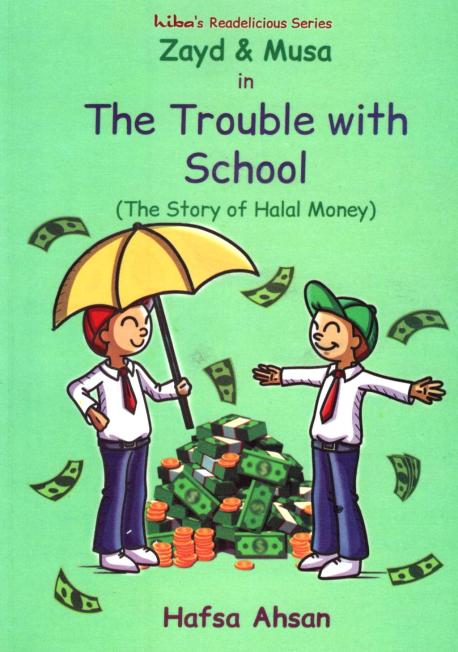
Zayd & Musa in The Trouble with School (The Story of Halal Money) by Hafsa Ahsan illustrated by Yusra bint Absar Kazmi and Urooj Khan

Standard
Zayd & Musa in The Trouble with School (The Story of Halal Money) by Hafsa Ahsan illustrated by Yusra bint Absar Kazmi and Urooj Khan

money

This delightful 70 page early chapter book is filled with humor, Islam, and a sweet story that ties it all together.  The book definitely has a teaching agenda, but it carries it with hilarious banter and relatable examples, all while covering a topic not often discussed in children’s books: money.  The book has a few grammar, vocabulary, and consistency concerns, but they are easy to overlook for readers 2nd grade and up.

SYNOPSIS:

Twins Zayd and Musa are very, very different.  Both boys enjoy cricket, but Zayd is more focused and enjoys homework, whereas Musa tends to daydream and often says something funny, but unintentionally.  When Musa makes the case in Science class that food, water, shelter, and money are all needed to survive, the class finds him hysterical.

Musa knows not to argue, his teacher is his elder and he knows he should have taqwa and be respectful, but he doesn’t give up on his idea either.  When the boys’ mom talks about halal money and gives them Islamic references for how money should be handled, Musa has a great idea: kids should be paid to go to school.

Once again, the whole school finds him funny, but Saeed Uncle, a neighbor who helps feed the poor at a roadside stand, doesn’t dismiss Musa’s idea and tells him, in some places kids are paid. And offers to take him and show him.

With references to sahabas who had great wealth and examples of how wealth can be used for good, Musa and Zayd learn numerous lessons, and share them with those around them, in a fun, engaging manner.

WHY I LIKE IT:

I get that the book is preachy, but in my mind, it is a story built around a teaching concept, so it doesn’t bother me.  I love the jokes and the tone.  At times the book is written quite formally, but being the author lives in Karachi, Pakistan, I assume that part of it, is just different standards.  I appreciate the Quran Circle table that lists where the Quran mentions wealth and the glossary.  I didn’t quite get all of the random facts included throughout, as some were about money, others about school, but I think kids will enjoy them none-the-less.  The illustrations are enjoyable, the text bubbles often hilarious (once again, a few I didn’t get).

I liked that it mentioned not drawing faces, and not going somewhere alone with someone you aren’t close with.  It is said in passing, but I love that those little nuggets exist in a book that is about something more, but normalizes and takes advantage of the opportunity to remind children of basic safety and Islamic concepts.

There are some awkward tense changes, and a few gaps in the story, but overall, I really enjoyed it and need to find the first one in the series.

FLAGS:

None

TOOLS TO LEAD THE DISCUSSION:
This would be a great book to use in a middle grades Islam class as a starting point to having students research the Quran and Sunnah to find information on a topic.  The humor will keep kids engaged, and the concept is an important one.  I plan to make all my kids read it, so that we can discuss as a family, and benefit from the lessons presented.

Nour’s Secret Library by Wafa’ Tarnowska illustrated by Vali Mintzi

Standard
Nour’s Secret Library by Wafa’ Tarnowska illustrated by Vali Mintzi

library

Set in Daraya, and based on a real events in Syria, as well as the author’s own life in Lebanon, this 32 page elementary and up story does an amazing job of showing relatable childhood adventures and ingenuity shining through even in the most horrific of environments.  The book is inspiring and warm, but the backdrop of war is very much present.  Some young children may be bothered by the images and text, while others will benefit from understanding the humanity that is affected by such violence.  I know the book says the pages are not final, but I wanted to put it out to help drum up interest.  I feel this story would best work in intimate settings where discussion, compassion, and gratitude can all intuitively transpire.

library1

Nour’s best friend is her cousin Amir, they love to read and imagine adventure and secret societies.  As their dream to create a secret club, complete with a secret password and handshake, for them and their friends starts to come to fruition, war arrives first. 

Families are forced to seek shelter away from the bullets at night in their basements, and only are allowed to venture out when absolutely necessary.  Every time Amir goes out, he collects any books he finds, and encourages his friends to do the same.  

library2

They begin sorting the books, and trying to decide what to do with them, when Nour has an idea to create a secret library.  Everyone pitches in when an empty, half destroyed basement is located, and the books are moved and set up on discarded planks of wood.  A boy next door is entrusted with the secret handshake and becomes the deputy librarian.

As word spreads, everyone from boys and girls to soldiers and rescuers, collect books to stock the shelves and checkout books to keep their minds busy.  The library, named Fajr, is open every day from morning to evening and closed during Jummah.  It becomes the city’s best kept secret and a source of hope for the community.

library3

There are references at the back that tell about the true story of the Secret Library in Syria, the author’s memories of hiding in the basement in Lebanon, a glossary of terms, information about Syria, the illustrator’s research, information about the war, and famous libraries in the Middle East.

library4