Samir and Yonatan by Daniella Carmi

Standard
Samir and Yonatan by Daniella Carmi

samirandyon

I saw this book at the library and was shocked: a Palestinian pov story written by an Israeli.  I checked it out, braced myself, and got ready to rage.  Except it isn’t blatant, and I can’t just chop it up to obvious hate, but that isn’t to say that the 183 page middle school book should be shared and deemed harmless: it subtly minimizes the occupation of an entire people, it in many ways glosses over the apartheid taking place.  It gives the inequity lip service, and I’m sure many western non Muslim, non Palestinian readers will find the book balanced, but I never could quite shake the looming shadow throughout, of trivializing the oppressive regime that is Israel.  I don’t know if the undermining is intentional, and I couldn’t find anything with a Google search to see how the book was received by Israelis in 1994 when it was published (it was translated in 2000), but either way it provides a great example as to why OWN voice books are so much more powerful.  This is not the oppressors’ story to tell.  I’m not saying the author isn’t sympathetic to the Palestinian struggles or that she actively supports encroachment of Palestinian homes, I honestly don’t know her stance.  I do know that the lived experiences of Palestinians though, is best left to be told by people that live it, have lived it, and those that feel loss because of it.  It is not a narrative to be told by the force that is causing the pain.  My biggest worry is that readers will take away from the story that the situation isn’t that bad, that Israelis are taking care of this poor injured Palestinian boy out of the goodness of their hearts so they must be nice, and at the end of the day the two sides are just two opposing forces, but the people once they get to know each other, bond over the fact that they pee the same and can be friends.  It waters down that it is, and was, major international powers backing the Israelis and that it is not, nor has it ever been, a simple disagreement between two equal sides. No I don’t expect every book about the region to detail the specifics, but don’t tell me that killing of children, a life of checkpoints, curfews, and fear can all disappear over a few months when the “enemy” provides medical care, regular meals, and arts and craft times. I’m not Palestinian and I can see the short-sided reality of that real quick.  It leaves young impressionable readers with a very skewed view, no matter how diplomatic the author attempts to be on the surface.  And I cannot support it.

SYNOPSIS:

Palestinian boy Samir injures his leg in a bicycle accident, quite seriously, and his mother who cleans for an Israeli lawyer is able to get him a special permit to be taken to the Jew’s hospital to be cared for by a visiting American surgeon.  He speaks broken Hebrew, but understands quite a bit as he has worked in a Jewish grocery store in the past.  When he gets to the hospital, he is placed in a room with other children to wait.  He stays there for weeks until the doctor can arrive and then even after the procedure he stays for physical therapy for weeks before he can return home.

While he is there, he gets to observe and know, in some ways, the other patients.  Yonatan is always buried in a book, but at night, when the other kids go to sleep he talks to Samir and plots with him a trip to Mars.  Yonatan’s mom lives in American, he lives with his dad who is an astronomy professor.  He also ethically is a vegetarian and saves his kabobs and chicken from his meals to give to Samir.  There is a girl that was hit by her father and refuses to see him, and one that is like a princess that doesn’t like to eat.  Tzahi wears a colostomy bag and is always jumping around and causing trouble.  His brother is a paratrooper in the Israeli army and he hates Palestinians.  It is hard for Samir when the brother comes to visit, the fear is real.

Samir’s younger brother Fadi was recently killed by Israeli soldiers and the memory, horror, and anguish is still very fresh for Samir and his entire family.

WHY I LIKE IT:

At first I really couldn’t articulate the saccharin taste the book was causing to form in my mouth as I read.  The curfews, and check points and loss of Fadi was being discussed and contrasted to the luxury of the Israeli hospital, and then it began to occur to me that, it was almost worse than just being blatantly hateful.  The placating and sugar coating slowly diminishes the horrors of reality.  At the beginning Samir doesn’t want to go to the hospital, he would rather have a limp, but the narrative slowly becomes about the kids in the hospital also have stressing and hard lives, and that seems sweet, except, their issues while specific, are universal.  Samir’s leg is as well, but the oppression of his people is systemic and helping him doesn’t erase that the same people running the hospital killed his brother, dictate his reality, and his future opportunities.  It is not enough for the “anti Palestinian child” to have a surgery that corrects his ability to urinate and at the very end, they pee in to the planters.  It might work on the surface, but it trivializes too much. If Samir would have gotten to tell them about his life and his pains, and his experiences, and they would have accepted them as valid, maybe I could see bridges being built, but bonding over basic human functions, and celebrating that an Israeli boy finally talks to a Palestinian, isn’t compassion, it is arrogance.

The only real positive takeaway I had of the book was that even in the tiniest human kindnesses Yonatan showed Samir it was something for Samir to contrast with his life long friendship with Adnan.  That growth of realizing what makes a good friend was more humanizing and affectionate than any other storyline in the book.

FLAGS:

Murder, fear, harassment, oppression, bullying, teasing, violence, gun violence, abuse, talk of urinating, showering in front of others.

TOOLS FOR LEADING THE DISCUSSION:

No way, I will never have Palestinian children read about their life experiences from an Israeli person speaking through a Palestinian character.

Jamal the Giant and the Largest Lesson by Mariam Hakim illustrated by Nesba Yoosef

Standard
Jamal the Giant and the Largest Lesson by Mariam Hakim illustrated by Nesba Yoosef

jamal

My initial thoughts of this 32 page Islamic fiction, fable-style book, is that it needed to be tested on children, lots and lots of children.  It should have been read aloud to catch all the grammar, syntax, and diction errors, and young readers and listeners should have been asked what they learned or understood from the story, BEFORE, being published.  The message is sweet, the illustrations cute, but it feels unrefined and reads underdeveloped: pictures and concepts are not enough to carry a book if the writing is poor.

I have looked forward to obtaining the book since its launch, so as soon as it was available from a US stockist (@crescentmoonstore), I didn’t even hesitate to purchase it.  I knew the book was available for free online as a read aloud on YouTube, but because I truly love supporting Muslim authors and publishers, I wanted to wait until I had a physical copy in my hand.  These opinions are my own, all my reviews are.  I mean no malicious will to anyone, I’ve spent my money on something, and once I’ve done so, I am completely justified to have an opinion.  You don’t have to like it, or agree with it, but it isn’t personal.  I’ve given reasonings for my opinions, and I stand by them.

Jamal the Giant isn’t necessarily mean, but he is careless, young, and selfish.  He scares the animals in the woods, destroys their homes, ruins farmers’ crops, and steals from the village.  One night, he wants to steal some juice and in the process overhears the community members discussing how different he is from his kind parents, and that he must be forced to leave.  He tries to mend his ways before he is driven from his home, but to no avail.  Unsure how to fix things, it is the advice of a tiny mouse that sets his reform in motion and conveys the message from the Quran, surah 11 ayat 114, “Good deeds cancel out bad deeds.  This is a reminder for the mindful.” He learns he must apologize, make amends and be kind.

The message is accurate, but I have some concerns at how it is conveyed.  Why was the responsibility on the giant to learn how to behave.  Yes if he knew better, he should do better, but it is made clear that he is the last of his kind and his parents died when he was really young.  If the villagers aren’t going to try and teach him, who is?  It isn’t necessarily victim blaming, but if you don’t know better, and have no one to teach you, you definitely are a victim of neglect in some ways.  To have them going from enabling him out of a promise to his parents to threatening to kick him out from his home, is a little abrupt.

Story-wise there are some points that gave me pause.  Why is there an owl flying off in the daytime, sure there are some diurnal owls, but most kids are taught owls are nocturnal, why not change it to a woodland bird that is active in the day, don’t confuse kids.  It doesn’t specify a timeframe that the story takes place in, but it feels like a fable with talking animals a giant and a clear message.  There is a baker, a farmer, an imam, a greengrocery, it is all very quaint, but then the imam is holding a cell-phone, wait what? I do appreciate that the farmer is female though, and that some of the women cover and some do not, it seems representative.

I’m curious who taught the giant to read, and how come he writes his “s” backwards, there seems to be a bit of disjointedness to the upbringing of the giant, his age, even in giant terms.  A lot it seems the author assumes the reader knows about giants or their stereotypes perhaps, because the book doesn’t address them, and the result isn’t a fun moral story, but one that seems to miss things.

The little mouse teaching the big giant, carries some Lion and the Mouse-Aesop fable vibes, but really it is the proof-reading of the book that is disappointing.  When you read it aloud, commas are abundantly missing (even in the online reading pauses are placed where commas are not written).  Why is the B in Baker capitalized, and if it is the Baker’s house, as in last name is Baker, then an apostrophe is missing.  Many of the lines are just awkward and halting, even if not particularly erroneous.  The diction is questionable at times, Jamal “always” thinks about that day at the lake, woah, doesn’t reflect on it, but it haunts him “always.”  Jamal “‘really’ didn’t have to steal,” seems to imply he was justified in stealing a little, this should be a black and white issue in a children’s book, no?

There are questions at the end of the book, and a whole page of information about the author and illustrator as well.  In a case like this I don’t know if the publisher didn’t do justice to the author’s work, or if the author should have refined it more, before coming to the publisher, but it is unfortunate because clearly a lot of effort went in to the illustrations and promoting of the book.

Wrong Side of the Court by H.N. Khan

Standard
Wrong Side of the Court by H.N. Khan

court

I don’t know what it is about male protagonist sports novels, but they often seem to be overly crass and crude.  Perhaps that is the real life environment that inspires such writings, or perhaps it is just male voiced YA books, but in this one in particular it seemed to stand out because the storytelling by-and-large is really enjoyable, it just has a lot of flags, A LOT.  Beside the language, sexual innuendos, drug use, violence and romance, it also has a few religious and cultural concerns that are possibly just specific to the niche that I review for, but did have me shaking my head out of confusion and sighing in disappointment. To its credit there is a decent amount of Islam featured, some male friendships that are quite heartwarming, and some emotional depth that presents really well.  The 312 page book is marketed to readers 12 and up, but there is no way I would encourage the book for anyone that young, Muslim or not.  For Muslim youth specifically I would say 17 plus.

SYNOPSIS:

The book is told from the perspective of fifteen year old Fawad who lives in Regent Park with his mom and sister.  He dreams of being the first Pakistani NBA player and the linear story bounces in time at the start and he sometimes even speaks to the reader, but the story is all his.  Regent park is a poor part of town pressed right up against a wealthy part of Toronto and the neighborhood is rough.  Fawad is a good kid: he doesn’t go out much after dark since his father died, he helps his mom, doesn’t run with a gang, he gets good grades, loves basketball, and doesn’t have a girlfriend, not yet anyway.  The story starts with him reliving the final minutes of a summer league basketball game where he opted to pass out of fear of the ever looming threat of Omar, rather than take the shot himself.  Omar ends up missing and they lose, oh yeah and Omar is the imam’s son.  Under the protection of Abshir, Fawad’s friend Yousuf’s older brother: Omar, Yousuf, and Arif have someone looking out for them on the streets.  Arif has some help from the Bengali crew, and Yousuf is Somali, but there are not enough Pakistani’s to make a stand or demand respect when out and about.  When Abshir gets murdered, Yousuf retreats into himself his music and smoking joints, Arif keeps his playboy ways to take his mind off things when he isn’t reciting Quran beautifully in classes at the masjid, and Fawad makes the high school basketball team and finds a girlfriend. Things with Omar physically escalate as well, while things at home have his mom putting in to action plans for Fawad to marry his cousin in Pakistan.

WHY I LIKE IT:

I really like that Islam and culture are presented powerfully with OWN voice strength and detail.  Things are not defined or over explained and if you don’t know what haram or Ramadan or an imam are, figure it out.  I rarely find myself wishing the ending of books were different.  You hear a lot about that in movies, that they didn’t screen well or something, and so the ending was changed, and that is how I feel about this book.  *SPOILERS* Fawad and Omar should not have resolved their issues so easily, it was more than a respect thing, there was blood and hospitalizations.  We never even knew why they had issues in the first place. Arif and Nermin should not have hooked up. The whole book she comes across as the strong Muslim hijabi that blurs the lines by side hugging her guy friends, but not being ok with it, then she shows up to a dance, and then hooks up with Arif, didn’t like that at all.  I get the mixed signals of Fawad having a girlfriend from his mom, and while he seems to be connected to the mosque it never shares that he understands Islam more than just I have to do this and I can’t do this, but I didn’t like him going back to Ashley and wanted him to choose his own self-worth and respect over accepting her apology and going back to her.  I do not understand why Fawad waited so long to tell his mother about Nusrat. It was nothing that would upset his mom, I don’t get why he dragged it out.  I do love that the cousins were friends or friendly, but were fronting to their parents, but it was unnecessarily dragged out, and the more it got dragged out, the more complicated and intertwined it got with Fawad having a girlfriend.

I did not get the mom and sister relationship at all.  The mom seems to have just given up on her, but they seem to spend a lot of time together, so that was a disconnect for me.  At first I kind of liked the twist on the stereotype that the boy was not allowed freedoms to go out, but the sister was, but it kind of unraveled in the logic department.  I am desi, (half anyway) and the stereotype is that the boys are earning before they get married.  So to be arranging Fawad’s wedding at age 15 is bonkers.  To be arranging anybody’s wedding at that age is, but it is so contrary to custom, that I couldn’t even ignore it and move on, it was constantly blocking the story from being smooth.  The mom’s rationale is that she wants a daughter-in-law to take care of her.  Again kind of bogus, but maybe there is some truth there, unfortunately there is the big gaping hole that she, the mom, doesn’t take care of her in-laws, so why the difference of expectation.  Suffice it to say the mom and sister are both road bumps in the story for me.

I was impressed at how much basketball play-by-play was in the book and how it didn’t get boring.  I love that there were plenty of male role models in the community and that the three boys really looked out for each other, supported each other, were connected to each other’s families, etc..  I didn’t like the abusive religious imam trope.  I’m glad that Omar’s dad wasn’t blind to his son, but to be abusive was uncalled for.

I don’t know why Nermin is called, “Arabic,” at one point, that is clearly erroneous and I wish that the condom talk and sexual innuendos were greatly reduced.  There isn’t a lot of resolution regarding who killed Abshir, if Fawad caused any permanent damage by playing, or what the future holds for any of the characters and their relationships, but it was a quick read and held my intention and I did quite enjoy the writing.

FLAGS:
Lying, violence, murder, physical assault, kissing, making out, talk of arousal, talk of condoms and sex and getting physical.  Drugs and alcohol and addiction.  Child abuse, theft, stealing, threats.

TOOLS FOR LEADING THE DISCUSSION:

There is no way I could teach this to middle school or high school in an Islamic school.

What if Dinosaurs Were Muslims? by Rabia Bashir illustrated by Laila Ramadhani

Standard
What if Dinosaurs Were Muslims? by Rabia Bashir illustrated by Laila Ramadhani

This rhyming Islamic tale wonders what dinosaurs would do if they were Muslim and alive today.  For littlest Muslim readers this repetitive tale ponders how they would eat, pray, love their mothers, respect their neighbors, dream, and feel, by tying all those things back to how Muslims behave.  The adorable illustrations kept my 6 year old glued to the story and the simple text held my 2 year old’s attention.  A fun book with wonderful supplements at the end to engage children in activities that everyone does compared to those that just Muslims do, a Fun Fact about (Muslim) dinosaurs and mums in Islam.  As well as extra activities, valuable information, and details about donations made with the purchase of this book.

The book takes place in London and imagines if dinosaurs were alive and if they were Muslim what day-to-day life would be like.  The refrain starts out “If dinosaurs were alive today and if they were Muslims too,” before stating what they would do and having it conclude with “just like me and you.”

In a similar vein as the ever popular How do Dinosaurs series by Jane Yolen, the book teaches kids how to behave by teaching the dinosaurs.  The book is short, and the humor comes from the illustrations, primarily the facial expressions of the parents, more than from the text, but I think the wildness of Dinosaurs living today will get most little kids smiling.

The only real concern I have with the book is the text when they are in the masjid praying and it reads, “they would try their best to pray five times a day.”  I know we don’t demand our littlest ones to pray all five salat, but I don’t know if it would imply that trying to pray is sufficient even when you are older.

From start to finish I found myself smiling while reading this book aloud to my kids, even after the fourth time in a row, alhumdulillah.

Beta & Sensitivity Reading with MBR

Standard

Color of blue background #80A7E2 Color of yellow font #FDD24E

Muslim Book Reviewers is a collective of four book reviewers that have joined forces to offer BETA READING and SENSITIVITY READING SERVICES.  

When you hire us, you don’t just get one person’s feedback on your manuscript.  Instead you get four experienced, knowledgeable, enthusiastic perspectives before you publish.  

Please contact us at muslimbookreviewers@gmail.com or on Instagram @muslimbookreviewers to discuss specific details and get more information.

We are happy to work with large publishers, self publishers, and everyone in between.

BETA READING:

Beta reading is the final step before publication. Alpha readers read early manuscripts and help shape the formation of the text, the story, the presentation, and the development. Beta readers are the last set of outside eyes (not including the author and publisher) before a book goes for printing. We look for specific errors of continuity, illustration accuracy, illustration and text alignment, target audience reception, and overall specific fixable literary mistakes.  Books need to have already been professionally edited before seeking our services.

SENSITIVITY READING:

We also serve as sensitivity readers to help ensure accurate representation, portrayal of Muslims, Islamic teachings, and some cultural perceptions.  Our team specializes in ​​Pakistani, Desi, South African, Albanian, Balkan, Syrian, Middle Eastern, American, and Canadian cultures.  We have linguistic knowledge of Arabic, Albanian, Urdu, and English.

PLEASE NOTE:

  • This service is NOT an editing service and the MBR will NOT do line edits or rewrite words of the manuscript.
  • This service does NOT take the place of a scholar verifying and approving Islamic content and representation.
  • This service should NOT be sought until the following steps have been taken:
    • Manuscript has been through multiple revisions
    • Manuscript has been professionally edited for grammar and content
    • Illustrations have been completed and are just awaiting final approval
    • Nonfiction concepts have been sourced

To check out the website of the individual members or find them on Instagram:

https://www.muslimmommyblog.com @muslimmommyblog

https://www.muslimkidsbooknook.com @muslimkidsbooknook

https://linktr.ee/bintyounus @bintyounus

https://islamicschoollibrarian.com @Islamicschoollibrarian

Inventors of the Golden Age (Just like) by Umm Laith and Muhammad Khaider Syafei (Proud Little Muslims)

Standard
Inventors of the Golden Age (Just like) by Umm Laith and Muhammad Khaider Syafei (Proud Little Muslims)

img_6450

Usually when you purchase a personalized book, the charm is that you get to see a name of your choosing in the story, and that you can make the main character look a certain way.  So imagine my surprise when this book arrived, and yeah sure my son’s name and likeness was included, but the story and information contained was also really well done and engaging.  This book, even without the personalization, is a solid story highlighting Fatima al-Fihri, Abbas ibn Firnas, al-Zahrawi, al-Idrisi, and their skills of generosity, persistence, kindness, and adventure as they shaped the world as we know it.

img_6418

The fourth wall is broken as the book speaks to the reader encouraging them to come on an adventure in to the Golden Age.  A time when scientists, engineers, explorers, doctors, and astronomers were making remarkable advancements.

The first stop is Morocco to learn about Fatima al-Fihri and how she established the first university.  Her generosity in building and creating a place of Islam and learning is what set her apart and made her so remarkable.  It is then on to Abbas ibn-Firnas in Spain and his attempts at flying.  He failed often, but his mistakes helped him as he persisted and continued to learn and understand and make flight of humans possible.

img_6419

Al-Zahrawi, the surgeon, is who is detailed next, as his knowledge, skill, and inventions he made are still used today.  His regard for his patients fear and nerves and his kindness is what the book stresses before moving on to the mapmaker al-Idrisi.  Al-Idrisi was adventurous as he traveled the world making his maps and switching the poles.

img_6420

The book then focuses on the reader encouraging them to be generous and adventurous, kind and persistent, in making the future better like those mentioned from the past.

The book is horizontal, the pages thick, the faceless illustrations warm and detailed and the rhyming text flowing and appropriate for preschool aged children and up.

img_6421

Squire by Sara Alfageeh and Nadia Shammas

Standard
Squire by Sara Alfageeh and Nadia Shammas

squire

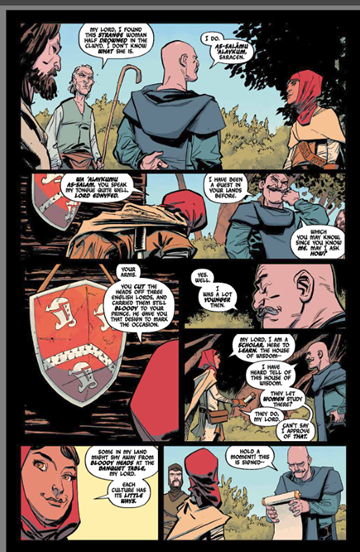
This 336 page YA graphic novel set in a fictitious world draws on the authors’ Arab culture and creates relatability for universal readers everywhere.  Themes of coming of age, war, family honor, discrimination, classism, deceit, and friendship, all interweaves with rich illustrations and warmth.  With a few unnamed #muslimsintheillustrations the story shows a lot of heart and with some language, violence, death, and oppression would be best suited for 9th grade and up.

SYNOPSIS:

Aiza and her family belong to the Ornu tribe and are treated as second class citizens in the Bayt-Sajji Empire.  With their traditional arm tattoos and seemingly more plentiful food, they are greatly disliked by the larger community and oppressed at every opportunity.  Aiza dreams of joining the army, rising in ranks, earning citizenship for her family and changing their future.  She also dreams of being a hero.  When she finally convinces her family to allow her to enlist, they also encourage her to hide her identity, and just like that, she is off.

Once in training she is pushed to excel or risk being sent to the front lines.  As she navigates new friendships, harsh instructors, and the shadowy General Hende, Aiza learns there is so much more to war and politicking than meets the eye.  Her life, her loyalties, her understanding of the world will all be tested, as Aiza must decide which path is for her.

WHY I LIKE IT:

The text and illustrations are seamless in conveying a united story, I was a little nervous with two authors, and I like that the story has twists and multitudes.  I loved seeing strong women in the military, as the authors’ say tough girls with swords.  While reading it I was completely submerged in the story and the characters, but writing this review a few days later, I’ve largely forgotten the characters names and quirks.  I’m not sure if it is because I read a digital version, or because the character building is a little lacking.  I don’t know that I was emotionally invested in some of the major plot points because I was not seeing the struggles it was requiring of the character to endure.  Admittedly I have not read a lot of fantasy graphic novels, so I don’t know that I have a lot to compare it to, but I do plan to read a physical copy when I can, and read follow up books in the series, to see if my impression changes.

FLAGS:

Some language, bullying, oppression, violence, death, killing.

TOOLS FOR LEADING THE DISCUSSION:

There is nothing religious in the text, so I wouldn’t use it as a book club selection, but I would definitely shelve it in a school library, classroom, and keep it in mind for readers that love these kind of books.

The Boy Who Met a Whale by Nizrana Farook

Standard
The Boy Who Met a Whale by Nizrana Farook

whale

I have a vague memory of being told that this book features a Muslim family when I reviewed the author’s first book, but I can’t find the message, nor recall who sent it and to where.  The text does not suggest any religion by any of the characters, but that being said there are “Islamic” names present in this 195 page middle grades book by a Muslim author and set in Serendib, the old Arabic name for Sri Lanka.  The fast paced story pulls you in and sets three kids up for adventure, overcoming fears, outsmarting adults, and becoming heroes along the way.  I didn’t love this book as much as The Girl Who Stole an Elephant, but it probably isn’t fair to compare them.  The book was released last year in the UK and will release shortly here in the US, I don’t know that I would rush out to purchase it, but I would definitely put it on hold at the library.  It is an adventure filled read from a boy protagonist perspective, it starts with a mutiny, features treasure, plotting, close encounters with a whale, and bringing justice to murderers and thieves.

SYNOPSIS:

Zheng has never had much of a family, and when his Captain’s First Mate and the cook poison their merchant ship crew and leave them to die, Zheng escapes.  He washes up on the shore of Serendib, not far from Galle, and is found by local fisherboy Razi.  Razi is a fisherboy that doesn’t fish, or rather no longer fishes, not since his father was killed by the sea.  Razi just tries to help get Zheng some food and get him out of the sun, but when Marco and Cook question him about the whereabouts of Zheng, he protects the boy and gets himself involved.  Promising not to tell anyone about Zheng, he immediately tells his twin sister Shifa.  Shifa is the rational one int he group and doubts Zheng’s adventure stories.  Her quick thinking and clever sneakiness provides time-and-time again in the book, a chance for the three kids to rescue each other, find the treasure, and return it.  

WHY I LIKE IT:

I love that the book is so fast past and unapologetic.  The descriptions of the island, and the plants and sea life, really is impressive and insightful into a country and culture not often explored in children’s books.  My mommy heart did not like that the kids would just leave for days at a time, and they never even thought that she might be worried, spoiler, she was! 

I like how subtly the grief and loss of the father manifested in Razi.  How he had to reconcile his emotions and start to move forward.  It isn’t in your face, but I would imagine that any child who has gone through something similar, would be reassured by seeing a fictional character experiencing something similar.  It is reinforced by Zheng’s lack of family and his need to find a “home.”

I felt like a few plot holes were too quickly glossed over in the heat of action.  I don’t know that it is a result of carelessness, I think it was more to keep the story fast moving and appropriate for the target audience, but I could have used a little filling in of the gaps: the ease of pulling people in to boats, where Zheng was going at the end and how it was all figured out, how Cook and Marco found Zheng, how everyone in Galle immediately recognized the dagger, why the kids were never killed even though numerous people were drugged at the beginning without a second thought, what the praise was for the returning of the dagger, what the oxen cart owner’s response was to the damaged cart, etc..

I wish there would have been a prayer to Allah swt at some point, or a bismillah, or an Assalamualaikum. The sister’s name, Shifa, and the medicine man that she trains under, Abdul Cader, imply a tinge of Islam, but I would have liked a tiny bit more, the book sets itself for lots to be sprinkled in, the children nearly die multiple times, but it was never there.  

FLAGS:

Death, lying, sneaking, near death experiences, grief, loss, theft.

TOOLS FOR LEADING THE DISCUSSION:

This would be a fun elementary read-a-loud with the short chapters and fast paced action.

Click to access The-Girl-Who-Stole-an-Elephant-Comprehension-worksheet.pdf

Birmingham Boy by Kate Rafiq

Standard
Birmingham Boy by Kate Rafiq

birminghamboy

This 36 page ‘day-in-the-life-of’ book, follows a young boy and his mom on a day out and about in his city of Birmingham, England. Told in rhyme a few Urdu words are sprinkled in as general city observations are made, fun is had, and kindness is shown. The book touches on homelessness and protests, and the illustrations take the story deeper and show support for Black Lives Matter and Palestine, multiple hijab wearing women (#muslimsintheillustrations) throughout the city (including a burkini swimming mama), storefront signs acknowledging a diverse community, street artists, and different races, religions, and cultures everywhere.

img_6412

The book starts off with Birmingham Boy waking up, based on the Arabic signage in his room, I’d guess his name is Zakariya, everything is quiet and still- except for a giant that he sees outside his window.   He refers to the homeless man throughout the story as a giant, it doesn’t seem to be a negative description, nor is the boy scared, he shares food with him at one point, it is just what he refers to him as. 

img_6413

He then heads downstairs for breakfast of toast and dudhu (milk), before getting in a pram and heading out in the town.  They go past the deli and the flower show, and the giant on his cardboard mat.  They see someone getting their hair cut at the barbershop and they arrive at the swimming pool.

img_6414

The mom and son swim and play and Birmingham boy takes a nap in his stroller as his mom and he head off to their next location.  He wakes up to the sounds of the masjid and sees his mom praying.  He plays and then joins her in salat.

img_6415

After the masjid it is off to a cafe for cakes and tea, which they share with the giant, before they head off to a rally for justice and peace.  The book carries on in this sweet style of visiting places and interacting with the community until ending with a bath and dinner and getting tucked in to bed for the night.

img_6416

Being American and living in Birmingham, Alabama, my kids and I also learned about the sights of a different Birmingham and they got to learn some British words such as pram and wellies.  I loved the inclusion of Islam in their daily life and the joyful illustrations.

Good Intentions by Kasim Ali

Standard
Good Intentions by Kasim Ali

good intentions

There is a reason that I read juvenile fiction: from board books to YA, but lately the “New Adult” category has really been tempting me.  Muslamic romance novels, often really need the protagonist to be looking to get married to make the plot work with some authenticity,  which means the main character usually needs to be a bit older than in their teens.  I decided to start my tiptoeing into the genre with this book, because I was intrigued at the racial and mental health themes that the blurb teased.  Sadly after reading the 288 page story, I still was waiting for more racial and mental health insight or enlightenment or perspective or deeper appreciation or anything really.  I kept reading hoping for more character growth, and to find out if the relationship worked.  I understand after finishing, that the book was intentionally more subtle and nuanced, and part of me appreciates it, but I still felt the book ultimately provided too little in either regard for me to feel satisfied or content that I had spent time with the characters.  The abruptness and harshness of the first few chapters, seemed disjointed from the dialogue filled introspective remainder of the book that showed so much potential, but left me feeling strung along for no real purpose.  The book covers mature themes of sexuality, drug use, racism, co-habitation, relationships, culture, mental health, and more.  The characters’ identify as Muslim, but aside from Eid prayers, iftar, and mentioning once that they should pray more, there is nothing religious practiced, mentioned, or contained in the story.

SYNOPSIS:

Told in a variety of timelines that all follow the relationship of Nur and Yasmina, the story begins with Nur finally after four years getting up the nerve to tell his desi parents that he has a Black girlfriend, and wants to marry her.  He leaves out that they have been living together for years, and the book then flips back to how they met and bounces around filling in the gaps that bring them back to the big reveal.

While in college, Nur had just broken up with Saara, but still goes to her fairly regular house parties.  At one such party he meets Yasmina, as a small group at the party sneak off to smoke pot, and he is immediately crushing.  His hungover broken-hearted gay friend Imran calls him out on it immediately, and his roommate Rahat chastises him for going to his ex’s parties.  Nearly all the main characters are met early on, and the rest of the book focuses on Nur and Yasmina growing closer through college, after school, through their early years of jobs and grad school, and the overshadowing of the fact that Nur has yet to tell his family about Yasmina, while Yasmina’s family is fully aware and fully supportive that they are living together.

All the characters are Muslim, but practice is pretty minimally detailed.  Yasmina tells Nur at their first meeting that she wishes she prayed more, and later it is mentioned that her parents were raised strict so they have raised their own children less so.  It is possible that Nur’s mom wears a scarf, but not clear either way, and they don’t seem to be bothered that she is living with her boyfriend.  Nur on one of his visits home goes for Eid prayers with his father, his mother and sister do not go, and it mentions that they are fasting.  Rahat does not find dating is for him, and wants to have a traditional arranged marriage, but it does not disclose if this is because of religious or cultural views.  Imran discusses his family praying and that he had to square away his sexuality with Allah swt more or less.

Nur and Yasmina’s younger sister have mental health afflictions.  Nur has anxiety attacks, and Hawa severe depression.  It does not label or identify or diagnose, this is my assumption, it does detail their experiences though, and how they affect those around them.

WHY I LIKE IT:

I actually enjoyed the writing style and the ease in which it flowed-save the beginning of the book. The beginning was a little crass, almost like the author was trying too hard to get the characters’ environment to read that they were in college.  The crude talking about sex and them talking about their parents’ intimacy and smoking and drinking and being vulgar, was in such contrast to the very subtle nuanced rest of the book that tried to show the layers of Nur and Yasmina’s relationships and lives.  Once I got through it, I genuinely wanted to know if they could make the relationship work.  No I’m not going to spoil it, but that really is why I kept reading.

I was disappointed that the book didn’t draw mental health out in the open.   I also wanted some religious based push back on racism.  It is a big thing in our communities and the book really could have had the characters argue it and make their points, right or wrong, for the disconnect between faith and culture.  It didn’t have to be preachy, or even mean that anyone changed their opinions, but it mentions numerous times, something to the effect of Nur’s parents being racist, but doesn’t detail why that is the suffocating presence in disclosing his relationship.  In four years I would imagine the opportunity to correct his parents way of thinking would have arisen, and he could have challenged it.  I get that might negate Yasmina’s point that Nur is racist, but I think it should have been made more clear then that he didn’t speak up when opportunities presented, otherwise it just seems unexplored and we, the reader, are expected to just accept the characters on face value, when the book really very easily could have nudged us, to self reflect and look inward.

FLAGS:

There is sex, and drugs, and lying, and racism, and all the other flags that adult books often have.  There is one “steamy scene” between Nur and Yasmina, but the rest of the relationship is very mild.  Nothing else is graphic in detailing their day-to-day living, or the day-to-day relationships of the other characters in the book: gay or straight.

TOOLS FOR LEADING THE DISCUSSION:

No. Would never, could never encourage unmarried Muslims living together, fictionally or otherwise.