My First Book About Ramadan: Teachings for Toddlers and Young Children by Sara Khan illustrated by Ali Lodge

Standard
My First Book About Ramadan: Teachings for Toddlers and Young Children by Sara Khan illustrated by Ali Lodge

ramadan

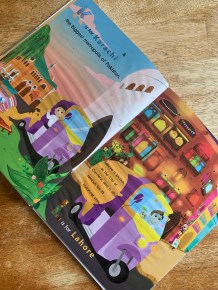
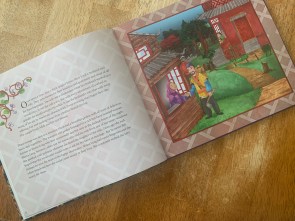
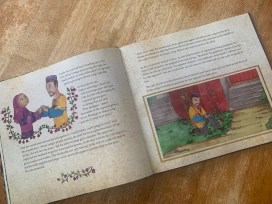
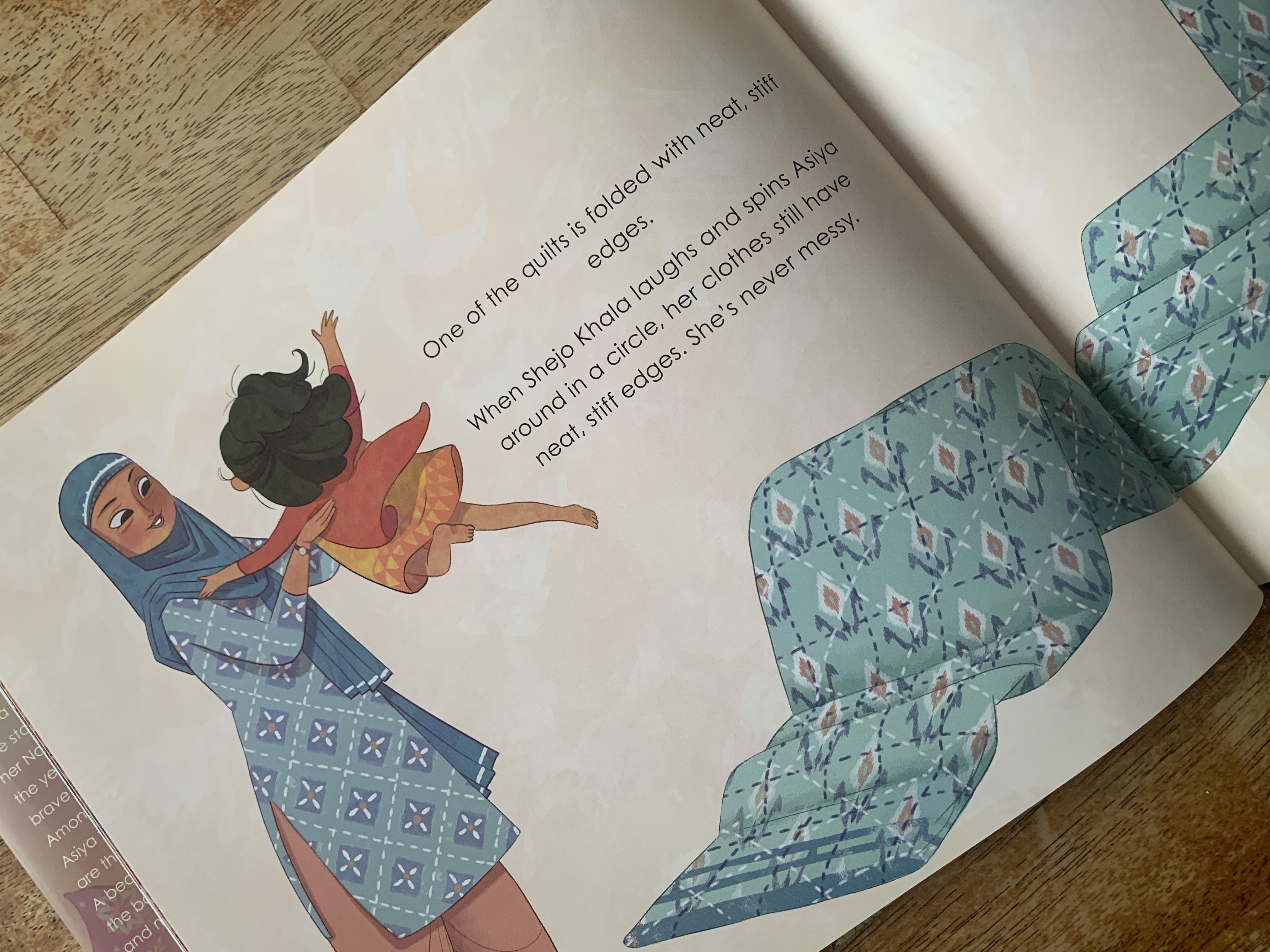
Once again, Sara Khan pushes the standard of what can be conveyed and presented in a toddler board book.  This book on Ramadan not only introduces concepts of the blessed month to our littles Muslims, but also provides details that will allow the book to stay relevant even as a child grows.  The soft, yet colorful pages allow the book to be engaging and attention holding for ages 2 and up, and provides a great way to get young children looking forward to Ramadan, as well as be read repeatedly during the month.  The 26 thick pages have a facts and questions about Ramadan at the end which make the book shareable with non Muslims and the many shapes, colors, cultures, and ages that make up our Muslim communities fill the pages that radiate with joy and love.

img_7070

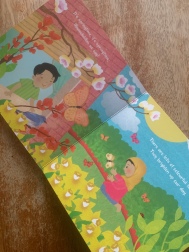
The book starts out expressing the excitement of Ramadan, the new moon, and the anticipation.  It then talks about how Allah swt wants us to fast from dawn until sunset.  It mentions the five pillars, and fasting in Ramadan being one of them, and what it means to fast.

img_7071

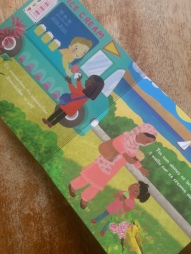
It focuses on doing good deeds to make Allah swt happy.  It also dedicates a two page spread to showing who doesn’t have to fast, which answers that inevitably next question that people ask.  The book then says that even if you aren’t fasting, there are still blessings everyone enjoys in the month and spends a few pages detailing those activities and acts of worship.

img_7072

It mentions that Ramadan is the month of the Qur’an and that Laylat al-Qadr is the night of power, but doesn’t give much detail about either. Eid is celebrated at the end and a dua is made referencing a hadith in Bukhari about entering through the gate of Ar-Rayyan.

I love that the book’s tone is that this is what Allah swt wants us to do, and this is what makes Him happy.  Even with numerous Ramadan books out there, this one still manages to find a way to be unique, and truly the entire series is enjoyable and beneficial, alhumdulillah.


Zahra’s Blessing by Shirin Shamsi illustrated by Manal Mirza

Standard
Zahra’s Blessing by Shirin Shamsi illustrated by Manal Mirza

Screen Shot 2021-11-18 at 11.57.45 AM

Just when you think all the Ramadan stories have been told, you flip open a new book, hold your breath as the stage of predictability is set, and alhumdulillah in this case, you squeal with delight when the big reveal in a children’s book swept you up and surprised you too.  This 32 page richly illustrated story for elementary readers is heartfelt, culture rich, informative, and embracing.  The book doesn’t dwell on the details of Ramadan, fasting, and Eid, but intentionally focuses on some of the feelings, blessings, and acts that make the month extra special.

Screen Shot 2021-11-18 at 11.58.04 AM

Zahra looks up at the Ramadan moon as she hugs her teddy bear and sends a prayer up asking for a little sister. The next day Mama is packing up beloved clothes, and ones that the family has out grown to be donated.  They discuss giving without hoping for anything in return and once again Zahra asks her mama for a little sister. To which her mother lovingly replies that she should be patient.

Screen Shot 2021-11-18 at 11.58.11 AM

When Teddy goes missing, Zahra can’t help but think a little sister would help her find it.  Iftar that night are all of Zahra’s favorite desi foods and prayer after is her asking for a sister and Teddy.  The following day Mama and Zahra take the collected donation items to the shelter and Zahra realizes how sad she is about losing Teddy and these refugees have lost everything.

Screen Shot 2021-11-18 at 11.58.28 AM

Zahra spends time with the children at the shelter and gets to know them.  She wishes she could find Teddy to gift to a young girl named Haleema.  Some days Ramadan crawls slow, and other days fast.  The family reads Quran together, fasts during the day and prays at night.  The night before Eid, Zahra’s dad whispers a secret to Zahra, one that she keeps close to her all through Eid prayers the next day.

Not going to spoil it, although I’m sure you can guess what is going to happen.  There are hints in the remaining illustrations, but I think kids will enjoy not having the heads up.  The book concludes with some informational blurbs and details about the Muslim author and Muslim illustrator.

Screen Shot 2021-11-18 at 11.58.35 AM

I enjoyed the illustrations, they are bright and bold and festive and unique.  They compliment the text completely as they show praying, reading Quran, making duas, etc.  The text doesn’t get preachy, it doesn’t even mention Allah swt or God, but talks of prayer and blessings.  The combination of the text and illustrations, however, definitely convey a strong unapologetic Ramadan/Muslim centered story.  Overall, it is universal and warm and sweet, and both Muslim and non Muslim children would benefit from reading it.

Screen Shot 2021-11-18 at 11.58.48 AM

My only concern is the page that the family is making dua together, it seems odd that they are all sitting in a line as if they have just prayed, but not prayed with the dad in front and the mom and Zahra behind. I read an electronic arc of the book and I look forward to purchasing a physical copy to add to my bookshelf.

Compass, Vol. 1: The Cauldron of Eternal Life by Robert MacKenzie & Dave Walker illustrated by Justin Greenwood 

Standard
Compass, Vol. 1: The Cauldron of Eternal Life by Robert MacKenzie & Dave Walker illustrated by Justin Greenwood 

compasscoverDo you ever find yourself in the middle of an amazing historical fiction fantasy adventure graphic novel, reading as fast as you can to find out what happens next, while simultaneously having absolutely no clue what is going on? Yeah, I am was confused often in this upper YA/Teen (16+) 136 page book set in Europe during the Islamic Golden Age and starring a female from the renown House of Wisdom.  I’m fairly positive it is my own limitations that made the book confusing, but for those wiser and more versed in graphic novels, I would recommend this book.  It has action, adventure, science, history, philosophy, a strong Muslim character, friendship, wisdom, ingenuity, a bibliography, Mongols, Druids, and a dragon.

compass1

SYNOPSIS:
Shahidah El-Amin is a Compass from the House of Wisdom, she is not a thief, she seeks knowledge which means that she is incredibly educated, fierce, and scrappy: part Indiana Jones, part Tomb Raider perhaps.  She is a hijab wearing, dua invoking, Qur’an quoting, don’t give me alcohol even as you are about to kill me, strong confident Muslim. 

The book opens with her finding an artifact and being betrayed by a fellow scholar and friend, Ling Hua, a Chinese scholar.  The two race to Wales to get to the possibly rumored Calderon of Eternal Life for different reasons and using different methods.  Along the way Shahidah shows her skills in surviving, understanding what her priorities are, and learning about friendship.  She will battle Master Hua, the Khan, a dragon, a bear, the Druids, a leper just to name a few as the fantasy world is developed and built up with historical accuracies thrown in.

compas

WHY I LIKED IT:

I love that the lead is a fierce female Abbasid Muslim from Baghdad and that there are a variety of religions and cultures mentioned and depicted.  It refers to Shahidah as an Arab witch by the enemy and calls Muslims “Mohammedans” which takes a bit of getting used to and I never got comfortable with.  I love the inclusion of ayats in transliterated text of the Arabic, and the concept is wonderful.  I got lost though in some of the world building and plot.  I think the action and illustrations are clear, but the text needed a little clarity in my opinion.  Again, I acknowledge my lack of familiarity with the concepts and format of the book.

I loved the bibliography and the notes included at the beginning and end.  I actually would have liked more information on the House of Wisdom and as always, a map.

FLAGS:

The concept and references make it for more mature readers.  There is also violence, a mention to love making, and depicted death, gore, killing, etc..

compass2

TOOLS FOR LEADING THE DISCUSSION:

Even though it is for older readers, I think it would be great on a library shelf for middle grades and up.  It probably isn’t for everyone, and many wouldn’t be tempted by it even, but the few kids that like this kind of content, will absolutely love the book.

Zahra’s Trip to Misr by Sufiya Ahmed

Standard
Zahra’s Trip to Misr by Sufiya Ahmed

misr

This middle grade series has been highly recommend to me numerous times over the years, and I finally found a copy to read and review.  It is book three in the series, and I have not read the first two, so I may be missing something, but the book didn’t wow me honestly.  The 147 page story published in 2011 has a lot of potential, but I felt like it didn’t know who the audience would be, and thus often felt cumbersome and disjointed to read.  At times it uses Islamic terms (muezzin), other times the Urdu words (namaz), and way too often the english meanings (ablution, peace be upon you, mosque), often all three in a single paragraph.  It is Islamic fiction and stays adventurous, without getting overly preachy and didactic, but there are some cruel life threatening antics by the girls, and some heavy themes of child trafficking, revenge, kidnapping, lying, bullying, gender treatment in Islamic spaces, finance and micro loans, but to its credit, it stays on level and, while as a mom some of the adventure needs adult intervention, I think young readers would support the young girls handling so much on their own.

SYNOPSIS:

Twelve year old Zahra and her classmates from her Islamic boarding school are headed on a class trip from England to Egypt.  For ten days they will be learning about the history, the culture, and connecting to Islam.  A group of first year girls and their chaperones in a foreign country meet with former students, another girls school from the UK, and some of their chaperone’s husbands giving this short book a lot of characters to get to know briefly, and only in passing.

The adventure starts right away as bully Saira locks a claustrophobic girl in the airplane lavatory in revenge of being locked in a freezer and forced to eat spiders earlier in the school year, and the foreshadowing that these battles are not over is set.  Once in Egypt, the girls muddle through worksheets sharing what they have learned, stopping to pray, and enjoying the experience.  Every so often at the hotel however, they see a girl they have dubbed, “sad girl” and the mystery to figure out what is making her so sad will ultimately make this a trip that brings the girls close to danger, and if successful will make them heroes. Toss in a nasheed concert, a runaway camel, and it is going to be a busy week and a half for them all.

WHY I LIKE IT:

The book presents a lot of Islam, and I think most readers will learn something and see Islam practiced authentically.  There is praying, and wearing hijabs, and halal meat, and Islamic history, and the 99 names of Allah all present in the characters naturally.

The book starts with Zahra and her mom and aunt rushing to the airport, they are running late.  Zahra’s aunt is not Muslim and presumably her mom is a convert, there is some really awkward dialogue before the family leaves, and it is called out as being awkward, but it just didn’t seem to fit either.  Why would a girl’s brother tell a non Muslim to wear a scarf? A character that is just in the first scene? I’m hoping there is more to her as a character in the first two books, and maybe this is a reference to something, but it just reads really weird and unrealistic (I hope).

Similarly, I am sure the first two books cover the forcing a bully to eat spiders and why she was locked in a freezer, but to just see that this is the level of the pranks, is a little disturbing.  The book acknowledges that locking a girl in a bathroom who has claustrophobia is dangerous, and that triggering the camel to run-off was similarly potentially deadly, but what about the other cruelties? It doesn’t even hint that there is more there, and I would have liked to see some context to recognize that these aren’t benign pranks, they are pretty big acts.

The child trafficking and kidnapping plot really had me wishing that the girls at least talked to Anu Apa. Having preteens take on such a dangerous situation so haphazardly was a little stressful for me, and I need to find some middle grade readers to help me see the actions through their eyes.

The randomness of the nasheed concert didn’t seem to fit for me, the song she wrote wasn’t that good, the whole thing came together too easily, and then some of the girls taking off their hijabs in wildness seemed such an odd tangent to me.

The biggest obstacle for me was the terminology and diction.  I don’t think it matters if the readers are Muslim or not, use the Islamic terms.  The teachers and students go to an Islamic school, it isn’t a stretch to have them use the proper term of salat instead of namaz, they can remark on the athan, not azan, they can say Assalamualaikum, they don’t need to say in english peace be upon you, and upon you when they greet, it seems so halting to the authenticity of the characters and flow of the story.

I think part of the difficulty in getting these books in the US is they just had one edition printed, and I genuinely hope that at some point the author will revisit the books especially now that she has been published mainstream for her other works, and hopefully grown as an author.  There is a lot of good in the book, it just could use some polishing and updating.

FLAGS:

Child trafficking, revenge, kidnapping, lying, bullying, cruel pranks, physical assault.

TOOLS FOR LEADING THE DISCUSSION:
I wouldn’t go out of my way to get these books on a classroom shelf based on this one book.  If a classroom or library already has them, I wouldn’t remove them.  Utlimately, I don’t know that many readers will stick with the sorting out of all the characters in the beginning of the book, and those that do I think would probably be slightly disappointed, not with the presentation of Islam, but in the side story building details.

Today I’m Strong by Nadiya Hussain & Ella Bailey

Standard
Today I’m Strong by Nadiya Hussain & Ella Bailey

strong

I really liked the way Nadiya Hussain’s book My Monster and Me discussed anxiety and was so eager for this book.   Unfortunately, I didn’t feel as connected to the characters, the little girls dread of dealing with a bully, or the resolution of channelling her imaginary tiger to find her voice strong enough.  With discussion I think the book would be a wonderful way to get young children, to open up about what is upsetting them, but on its own I feel like a bit more is needed to transition from thinking to action, from nerves to confidence, and from understanding what is bothering the little girl to understanding what needs to be done.

img_6852

The story starts with a small girl going back and forth on whether she loves school or doesn’t and revealing that the tiger listens to her and doesn’t say a word.  It then starts the next few pages with the same line: “I love to go to school.  I do,” and detailing what parts of school make her happy.

img_6853

It then transitions to sharing why some days, the little girl doesn’t like school so much.  Days when her voice disappears, Molly laughs at her, or blocks her way to the climbing frame, or takes her cake.

img_6854

She then reinstates that she likes going to school most day, but not always, and then one day when Molly is mean, the little girl, thinks of the tiger, and knows what to do.  How to find her voice, and stand up to Molly. She then carries through on it, and realizes that soon she can be on top of the world.

img_6855

The messaging is universal and great, and while there is no religion shown, it is great to see a brown protagonist dealing with mental health.  The author is Muslim and I’m sure most everyone knows at least of her from the Great British Bake Off.

img_6856

Count by Ibrahim Moustafa with Brad Simpson and Hassan Otsmane-Elhadu

Standard
Count by Ibrahim Moustafa with Brad Simpson and Hassan Otsmane-Elhadu

count

This graphic novel retelling of the classic, Count of Monte Cristo, is for middle school readers and up and is by a Muslim author and illustrator. There is nothing Islamic or cultural in the text of this 136 page sci-fi twist, and there is some kissing, a whole lot of killing, brutality and violence, but I think the swashbuckling tale will appeal to early teens and adults who enjoy fast paced reads whether they have read the original tale or not.

img_6765

SYNOPSIS:

Commoner Redxan Samud is elevated to Captain and marries his beloved, the first few pages of happiness, however, quickly disintegrate as he is framed and wrongfully imprisoned by the jealous powers that be.  Life in the hovering prison are barbaric, but the meeting of Aseyr, provides him with a plan and means to move forward.  First he will have to survive the death battles in the prison, escape the inescapable fortress, before he can locate the Isle of Sorrow, take control of ARU and extract his revenge.  Oh, but his revenge is strong, so very, very strong.

img_6766

WHY I LIKE IT:

I was admittedly hesitant to give the book a try, but when writer Shireen Hakim sent it to me, and my kids saw it, I thought I should read it first before letting them dive in.  I read it in one sitting, the story is engaging and clear.  I never was confused with who was who and why something was happening.  At times though it seemed too quick and that details were glossed over, or impact was minimized because major plot points were not given enough time to be felt.  I would have liked some answers provided of basic logistics and of character’s getting from one place to another, and how plans came to fruition shared in the story.  Additionally, some fleshing out of situations to ground the story a bit and make the revenge and extraction of revenge more cathartic, would have elevated the book and made it a popular choice in my house to be reread again and again.

img_6767

FLAGS:

Death, violence, murder, rage, kissing, torture, plotting, deceit.

TOOLS FOR LEADING THE DISCUSSION:
Not a contender for a book club read, but I would shelve it in a middle school classroom and in the school library for graphic novel and comic book enthusiasts as well as for high school students who might be familiar with the classic it references.

The Lady or the Lion by Aamina Qureshi

Standard
The Lady or the Lion by Aamina Qureshi

lion

I was kind of surprised how well done this YA culture rich 350 page romance story was in holding my attention.  I don’t know that I had any expectations, but I was genuinely engaged in the growth of the protagonist as she began to emerge from her naive political state, and I look forward to some resolution from the cliffhanger conclusion of this the first book in the Marghazar Trials series.  The characters are practicing Muslims who pray and mention Allah swt regularly, they also acknowledge when they make extreme departures from basic Islamic tenants such as drinking, dancing, murdering, exhibiting racist attitudes, and mixing freely with the opposite gender.  It doesn’t stop any of the characters from behaving as they wish, but at least it is noted. The Urdu words and Pakistani setting in this fictional reimagining is filled with warmth and love, and while there are some steamy scenes and outright cruelties, I think 15 year olds and up can handle the contents, and recognize the suspension of reality and moral laxities for the sake of telling a story.

SYNOPSIS:

The book makes clear from the onset that “In the very olden time, there lived a semi-barbaric king. . . This is not his story.” This is the story of 18 year old Durkhanai, an orphaned princess raised by her grandparents, the King and Queen of Marghazar.  Marghazar is a prosperous country that is waging war on two fronts and does not let outsiders in, ever.  When the book begins it is doing so begrudgingly to avoid war with the neighboring districts that are working to unify and have recently been attacked.  With ambassadors arriving to determine the guilt or innocence of the one district unaffected by the terrorist attacks, the foreigners are seeing the inner workings of the kingdom for the first time.  All the ambassadors are females of various ages and experience, save the one from Jardum.  Asfandyar is young, dark, and handsome, and immediately discriminated against by the Badshah for his complexion.  Additionally Shehzadi has been warned by many to stay away from Asfandyar, which naturally makes him a great character for her to be swept away by.  She holds out for a while, but with her people mysteriously getting ill, her betrothed melting in to the background, and cracks in her country making themselves obvious, Durkhanai will find herself struggling to understand her heart, her country, her family, and her future, and with the cliff hanger ending, no simple answers will be given to her, or the reader.

WHY I LIKE IT:
I love that there is a map at the beginning, and lots of supplemental offerings at the end.  There are a lot of Urdu words and phrases and while I am moving away from feeling like all OWN voice books need to include glossaries, I think non Desi readers will be appreciative in this particular book to have one available.  For someone with some knowledge of the language the inclusion of the titles and relations and phrases between the languages is expertly done and delightful. There is also an author Q & A, as well as reader discussion questions.  There is a content warning at the beginning alerting the readers to physical and sexual assault as well as racist behavior and language and makes clear that it is contained to the characters and the story and is not the reflection of the author and publisher.  I like that it is there, and I like that the princess makes a stance against the racism and the sexual assault that she witnesses.

The high school girls at our Islamic School are always wanting “halal” romance books.  Ok so really they just want romance books, but I try and keep their pickings halal, and so I am forever reading these books trying to find new titles to recommend.  The book is very 1990s Bollywood in terms of romance flags.  There is a lot of proximity and caressing of necks and longing, and familiar obligation.  There is some snuggling and kissing, so maybe 2000s Bollywood, but the characters thus far don’t cross “that” line.

I really appreciated that Durkhanai was fleshed out and relatable.  Even though the setting is long ago, and the genre is romance, she didn’t wait to be rescued, even when she was hurting or pining, she was still maintaining her obligations and moving forward.  I also love that it showed some depth to her emotions.  She recognized that Asfandyar would let her speak and would show his support by being there, but he pushed back on her and challenged her too.  Rashid on the other hand would speak for Durkhanai and would fawn over her in a very superficial way almost.  Sure neither relationship was ideal, but from her perspective at least she was able to see how various presentations made her feel.

I was a little lost in some places, but I was reading quick and had distractions so I’m not entirely sure if it is my carelessness or plot holes or if gaps will be filled in future books.  I needed more reasoning though, for why Durkhanai’s cousins, Zarmina and Saifullah, truly hated Asfandyar as much as they did, or what exactly Saifullah was plotting and how it connected to ratting out the princess.  For all that is seemingly going on, the Badshah and Wali always seem available to chat and are often just lounging around.  I know it is not their story, but the negotiations, the plotting, everything seems to be done very slowly and could really use some fleshing out to show some depth to the side characters.  Other than a few voices, the side details are lacking.

FLAGS:
Lying, killing, racism, sexual assault, physical assault, plotting, murder, kissing, manipulation, touching, caressing, sneaking around, theft, cruelty, cursing, romance.

TOOLS FOR LEADING THE DISCUSSION:

The book is not an Islamic story or even a moral one, it is entertainment and it could possibly be used for a book club if the participants relish in these kind of books, but it probably wouldn’t have wide enough appeal and would alienate nearly all the boys from joining.

Horse Diaries #6: Yatimah by Catherine Hapka illustrated by Ruth Sanderson

Standard
Horse Diaries #6: Yatimah by Catherine Hapka illustrated by Ruth Sanderson

yatimah

I love that a reader talked to her mom about this book, and then they brought it to my attention. Published in 2011 it is book six in a popular middle grade series told from the horse’s perspective where each book features a different culture from around the world and is set in different time periods. This book is told from an Arabian horse’s perspective in the 9th century and details her growing up an orphan, trying to understand the Bedouin humans around her, and establishing herself as a war mare.  Allah swt is mentioned quite often, as is Arab hospitality, and some guests at one point are briefly mentioned as they are on their way to Hajj.  My problem with the story is the portrayal of the raids.  I don’t know enough about Bedouin culture in the 9th century to opine on the accuracy of the raiding that would occur between tribes, but when juxtaposed with the humble God fearing, grateful religious people, blatantly stealing from the neighbors, it is hard to cheer for Yatimah and her humans at being thieves.

SYNOPSIS:

The birth of Yatimah takes the life of her mother, the beloved war mare of Nasr.  Her loss puts distance between the Bedouin leader and the foal.  Nasr’s daughter Safiya, however, has a soft heart for Yatimah and the two form a close bond. As Yatimah is accepted to nurse from another mare and grows with the companionship of her colt, Tawil, the two young horses show the reader how when the grazing starts to disappear in the desert, they are fed dates, and when those start to deplete they move to more fertile lands.  Always on the move, they raid other camps to steal sheep, and camels, and horses as needed, and work to prevent other’s from stealing from them.  Since the death of Yatimah’s mom, Nasr has not found a proper war mare, and thus the training of Yatimah begins. The climax is a raid that will give Yatimah a chance to prove herself and win over the still distant Nasr.

WHY I LIKE IT:

I love the illustrations and the detail that often accompanies them.  I also really appreciate the appendix at the end that gives information about Arabian horses, Bedouins, and war mares.  I learned a lot about the specific strengths of Arabian horses, and why the Bedouins favored riding mares over stallions. 

I liked that many of the exhausting stereotypes were not present in this book in regards to women.  Safiya is a young girl at the beginning and then starts to wear hijab as she grows, but she is still free to come and go as she pleases it seems.  Her father respects her and shows affection and kindness to her throughout.  I just find the premise a little off that we readers, are hoping that Yatimah becomes the lead thieving horse.  It mentions that it doesn’t make sense to the horses, but to have that be the whole point of the story, leaves a bad taste in my mouth, especially when the story could have been developed in so many other ways to focus on something a little bit more positive.

img_6527

FLAGS:

Stealing, thieving, death, loss.

TOOLS FOR LEADING THE DISCUSSION:

I think the book would be fine on a classroom bookshelf, but I wouldn’t highlight it unless I was prepared to discuss with young readers the culture and why perhaps this was such a part of the lifestyle.  I would not want to perpetuate any stereotypes of Muslims, or provide a negative impression on readers that are drawn to these books because of their love of horses.  I learned a lot by reading the books, but I worry what a 8 to 10 year old would take away about a culture and religion after reading such a story, I fear the word barbaric may arise.

Spirit of the Cheetah: A Somali Tale by Karen Lynn Williams & Khadra Mohammed illustrated by Julia Cairns

Standard
Spirit of the Cheetah: A Somali Tale by Karen Lynn Williams & Khadra Mohammed illustrated by Julia Cairns

cheetah

This timeless 40 page tale of a young boy as he prepares for his right of passage into adulthood is rich with wisdom, culture, and tradition.  So many gentle lessons can be found in the book, as it leaves deeper understanding and connection to be felt and explored long after the book has been closed and returned to the shelf.  There are seemingly hijab wearing #muslimsintheillustrations, and the author’s name would suggest she is also a Muslim, but with the line, “Called on the spirit of Shabelle,” and talk of the “Spirit of the cheetah,” it is hard to know for sure if the main character is.

The story starts with Roblay running everywhere in preparation for an upcoming race where he hopes to place in the top three, and prove he is a man and no longer a boy.  On the day of the race he races his fastest, but he does not come out at the top.

img_6579

His grandfather, his Awoowo, tells him that to be successful he needs to capture the spirit of their people and leave his thumbprint on a cheetah’s coat.  His grandfather then tells him about the cheetahs long ago and how the river is named after them.  He explains that thumbprints on a cheetah’s fur honor those that have proven themselves.

Roblay trains and searches for many days.  He wonders if it is enough to mark a cub.  But his grandfather asks him if he wants to remain a cub.  This motivates Roblay to work harder.  When a year has passed and the race is about to take place again, he finally touches his cheetah.

img_6580

He lines up for the race strong, proud and sleek, and he has the chance again to prove he is a man and make his family proud.  Nope, not going to tell you how it ends.

img_6583-2

The book starts with an Author’s notes from both authors and concludes with Notes on the Cheetah.

Moonlight Hope: A Muslim American Coming of Age Story by Nora Salam

Standard
Moonlight Hope: A Muslim American Coming of Age Story by Nora Salam

moonlight hope

This 354 page New Adult read is truly Islamic fiction, and as long as you know what you are getting in to, you probably will thoroughly enjoy it.  It is Islamic centered, it is preachy, it is idyllic, it counters many stereotypes about Muslims and various cultures, while simultaneously falling into other tropes that define the genre, it has mature framing that is not suitable for younger readers, but doesn’t detail anything that is super “haram.”  If you are looking for a potentially halal romance between YA and Adult ages with Islamic messaging this book is a solid choice.  If however, you will be annoyed by any of the aforementioned labels, this book will not hold your attention or beg to be finished.  It reminds me a lot of Umm Zakiyyah’s If I Should Speak and A Voice books where the story has its own twists and character arcs but it spends a lot of time preaching and setting itself up to tout an Islamic perspective, or concept as well.  I wanted to read two books in the “New Adult” category and see if I could spread my reviews to include them, and with this being the second,  I think I should resist the temptation, and stick to what my library background familiarized me with.

SYNOPSIS:

Told in alternating voices of Intisar and Majed, two individuals in New York City, at different places in their life, but finding that when they hit rock bottom, Islam is the answer.

Intisar is graduating nursing school when the story opens and has only one goal in mind, get married.  She has strict Sudanese parents and has put all of her dreams on finding freedom in the perfect spouse.  She meets a guy at a friend’s house and they secretly date, kiss, and hold hands.  When he ghosts her, she is devastated and reluctantly finds herself agreeing to marry a much older man of her parent’s choosing.  Loosing herself in the idea of marriage, she finds herself heartbroken, ostracized and falling apart.  She starts to put herself back together slowly by finding Islam, her confidence, and some much needed perspective.

Majed has a famous family: his mother a model, his father and siblings singers, and he manages their careers.  After passing out from drugs and alcohol more than once he really starts to examine his life and the road he is on.  He sneaks away to rehab and in the process stumbles on to Islam.  He is Egyptian, but the family is not religious at all, and infact stop talking to him when he converts.  The trials of being a Muslim in New York with no family are not easy, but he feels it is worth it and his journey to Hajj and through loss brings him closer to Allah (swt).

The two stories are parallel and collide slightly in the periphery, but the book ends with them finally coming together and the ever dreaded words of “to be continued,” leaving the reader hanging.

WHY I LIKE IT:

I do like that the story shows struggles when one comes (back) to Islam, it isn’t always a walk in the park, it has challenges and stresses.  The book starts each chapter with a verse from the Quran and is very open about what it is.  So, while at times, the preachiness did get to me, it was very clear what type of book it was from the beginning and I kept reading.

Some of the side characters I felt needed to be fleshed out a bit.  I didn’t understand many of the random friends, how they affected the main character often seemed off, or completely underdeveloped in what was revealed about them: particularly Izzedine, Parita, the girl that married Mansour, the uncle at the Masjid that thought Majed was a spy, etc..  I also really struggled with the presentation of Uncle Munir and his calling Majed, baby, and how he just happened to bump in to him outside the bar, and the kisses.  I’m guessing it was meant to show him as over the top affectionate, but it just read as odd.

I like that the book addresses hypocrisy, mental health, and expectations.  It doesn’t paint all Muslims as good or bad, nor society at large.  The book reads as a journey, and many characters are given a chance to correct their errors and be seen in a new light.

The majority of the book is written well, but right away the book gave me pause as Intisar and her friends chat all through the Jummah khutbah, I get that it is trying to show her disregard for intentional practice of her faith and her “boy crazy/marriage” obsession, but you cannot speak during the khutbah, it isn’t just dirty looks, you truly cannot talk for it to count, and it isn’t even remarked upon, and it made me skeptical of the book for a while.  There is a word missing from a sentence on page 161 and at one point a brother in the prayer hall aims a shoe to throw.  But you wouldn’t be wearing shoes in the room where you pray, and the mosque has hallways and a glassed off section for women, so this seemed like an obvious oversight that should be fixed.

FLAGS:

Drugs, alcohol, lying, overdose, sneaking out, kissing, hooking up, physical affection, violence, temptation, sexual predatory behavior, it is an adult book, so I’m not going to continue listing everything. Nothing haram is overtly detailed or glorified. Ages 17 and up, could handle it.

TOOLS FOR LEADING THE DISCUSSION:
Too mature for my book club crew, but I wouldn’t mind it on a shelf in the school library.