Tag Archives: UK

Tyger by SF Said illustrated by Dave McKean

Standard
Tyger by SF Said illustrated by Dave McKean

I don’t know that I’ve ever read a book like this 304 page middle grade fantasy, dystopian, highly illustrated adventure. It delves into philosophy, alternate universes, slavery, racism, politics, magic, identity, friendship, betrayal, human rights, education, following your dreams, saving the world, and a talking immortal tiger. It started a little stilted for me, but as the book progressed, I began to see that a lot of detail about all the above mentioned threads would make for a very adult, very lengthy read, and this is meant for 9-12 year olds, albeit they would need to be able to handle the darkness of the book at times, and caregivers, be aware there is a public hanging of a child. The author is Muslim, and the protagonist and a side character identify as Muslim.  There is not much about Islam, or shown in practice, but that they are afraid to learn and practice their faith is mentioned briefly. I think kids will enjoy the read, and not get hung up on threads unexplored as I did.  The illustrations really make it a book that feels exciting to spend time with, and one that will linger with the reader.  I look forward to sharing it when it releases soon in the US, as it was published in 2022 in the UK.

SYNOPSIS:

In short the book is about a boy, Adam, living “in an alternate London where the British Empire hasn’t ended and slavery was never abolished.” In a partitioned off Ghetto as a minority from the vague “Middle East,” who is unable to go to school, or even draw, he makes deliveries for his family to help keep them afloat. During one such delivery he encounters a tiger, an animal like so many others that is extinct, her name is Tyger, and she speaks.  She is an immortal searching for Guardians to help her heal and open a portal to the city.  When Adam, who is immediately connected to her, cannot find a Guardian, she begins to train him, time is short and when he discovers his friend Zadie, short for Scheherazade, has some training from her father, the two set out to open the doors of perception, imagination, creation, and  revelation, to save the day.

WHY I LIKE IT:

I really like that this book opens up larger discussions about society, self, literature, imagination etc, and can really be adapted to mean different things depending on what the reader brings to it. The book addresses these themes in a way that doesn’t talk down to the reader, and in many ways allows the simple bad guy of the story to not be the takeaway point, but rather the journey of understanding perspective, points of view, empathy, creating something, and hope to be far more important.

The identity of the characters being Muslim initially was just a label, one that just made Adam and Zadie more “other,” but a few cleverly crafted sentences about hiding their names, their skin color, and whether it worked or not, allow the reader to reflect on if denying yourself to appease others is effective or not, or rather more importantly knowing when and in which situations it could be a benefit or a selling out of who you are.  Zadie and her father seem to practice, and one point Solomon ( Suleiman), offers his prayers, he says Assalamualaikum and Bismilliah. Adam and his family on the other hand, have hidden their faith so as to fit in better, and thus it is simply an identity label.

I liked that the illustrations weren’t just stunning in their own right, but also highlighted the mood, and metaphysical elements of the story.  I feel like I could teach not just a few lessons on this book, but dozens, and who knows if they would be correct, but I think this book would be fantastic as a read aloud in a classroom for the story at hand and for the discussions.  The darkness, the excitement, the hope, really gripped me, and while I could opine on plot holes and lack of articulation, in some key scenes, I appreciate that over explanation would take away from all that the book gets right.

FLAGS:

Racism, oppression, colonialism, slavery, hanging, power imbalance, betrayal, lying, sneaking, fighting, killing, magic, fantasy elements.

TOOLS FOR LEADING THE DISCUSSION:

Where to even start, this book needs an educators guide, stat. I looked online and couldn’t find one and I hope that will be corrected soon because if you read my thought above, you know there is a lot to discuss.

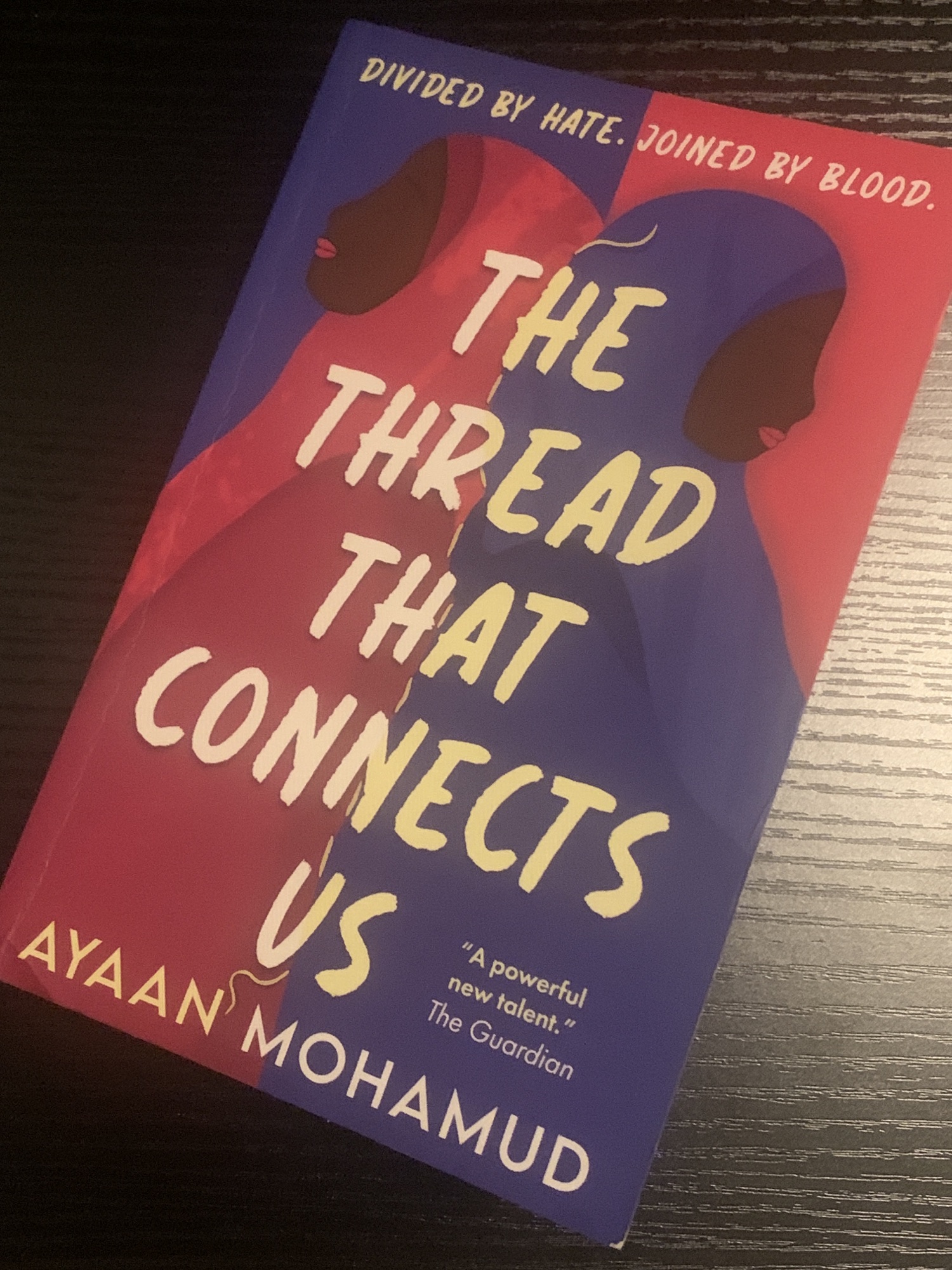
The Thread that Connects Us by Ayaan Mohamud

Standard
The Thread that Connects Us by Ayaan Mohamud


At just over 400 pages this book expertly blends the stresses of school, bullies, and friends in the UK with the twists and secrets of broken families, shattered hearts, and a past that needs to be reckoned with.  Told in dual perspectives from girls thrown together by the actions of their parents, Safiya and Halima maintain distinct voices that are rich with Somali culture, Islam, vulnerability, and ultimately love and hope.  The book is YA, but the premise is a bit mature and is better suited to older teens in my opinion, I think a high school book club would be wise to consider this book, as once you start reading, it is difficult to put the book down. 

SYNOPSIS:

Safiya is mature beyond her years.  Since her father abandoned her and her mother five years prior, she has managed the bills, the upkeep of the home, and for the most part her grades. Hooyo checked out and is rarely more than a silent being curled up unable to care for herself, much less her daughter.  With the the help from the community, particularly her best friends and neighbors Muna and Yusuf, Safiya has a found family that helps her weather the tough times.  When her dad moves back to London with his new family from Somalia, Safiya is forced to deal with not only all the painful memories of her past, but also the very real presence of her family living in her neighborhood, showing up to Eid prayers, and taking over the safe haven that school has often served as when home life has been so cold and lonely.

Halima’s father died when she was young, and life with her Hooyo in Mogadishu was good until her mother remarried, Safiya’s dad.  Her two younger half brothers that came further added to the rift between her and her mother, and now that they are moving to England with the husband, despite her protests, has her plotting a way to return to her home.  The language, the culture, the weather, are all added stresses to finding her way, and are compounded when she gets paired up to have Safiya show her around and help translate for her in school.  

The two girls hate each other, at least they have that in common, but their inability to avoid each other forces them to interact more than either wish to do.  As questions, and secrets are voiced, the two girls realize that they might have to work together to get what they want, and figure out their past.

WHY I LIKE IT:
I really enjoyed the owning of the characters’ language and culture and faith and how easy it was to be invested in their world.  Nothing pulls you out of the story, it is rich and lush and the reader can figure out why even though there is a crush, nothing is going to happen, and why they are wearing hijabs, and waking up to pray fajr, the balance is both inviting and educating, without the reader even realize it is happening, because hello, we are to busy trying to figure out what these two girls’ parents have done. 

The story has layers, and the emotional attachment I feel to both these girls, made me glad the story was over, they deserve some peace, but also desperate to know that they are going to be ok in the future too.  I can’t say too much without the risk of spoiling, but the writing is strong, the plot solid, the details intentional and relatable, and the characters very real.

FLAGS:

Lying, bullying, fighting, assault, crush, drug use, arrest, accusation, gossip, abandonment, relationships, edibles, affairs.

TOOLS FOR LEADING THE DISCUSSION:
This would be such a great upper high school read, the way the story unfolds will keep readers hooked from the first page and motivate those that start, to finish.  Students will see themselves in the characters, and be sleuths themselves trying to uncover what secrets are true and how do the pieces of the puzzle fit together.


Hidden Fires by Sairish Hussain

Standard
Hidden Fires by Sairish Hussain

I will not be getting over this book any time soon. It broke my heart, and all my other critical organs, in the most delightfully well-done way possible, and undoubtedly I am better for it. I don’t read a lot of adult fiction these days, and with some diabetic retinopathy concerns, I couldn’t read the 384 page adult book about generational trauma, partition, the Grenfell Tower fire, family dynamics, bullying, self-harm, and resilience, but was pulled in to the audio book version instead. The Desi-British voices of Yusuf, Rubi, and Hassan were refreshing to my American ears.  The multi-perspective book told in parts richly develops the characters, their relationships, and their current, past, and future struggles.  The author is Muslim, as are the characters, and while they all practice in their own way, it is undoubtedly who they are, and their Islamic identity is not questioned, feared, blamed, or apologized for.

SYNOPSIS:
The book weaves three distinct voices. Yusuf, is an 80 year old an immigrant who lived through partition, raised his family in the UK, has lost his wife a year prior, and is struggling with haunting memories of the past, failing health, regular loss of friends, and loneliness.  Hassan, Yusuf’s youngest son is a workaholic who is married to a non Muslim, non Desi who is suffering from fibromyalgia and who’s mother unexpectedly passes away in Spain.  Rubi, is Hassan’s 16 year old girl who is overweight, bullied, lonely and about to take her GCSE exams when she is dumped on her grandfather Yusuf’s door while her parents head to Spain.  The book opens in Ramadan the night of the Grenfell Tower fire and the horrific event affects them all, stirs memories, and shapes futures.  From there the layers of each character slowly unravel as they cope with the swiftly changing present as they desperately work to break free from the past.  As dementia plagues Yusuf, Rubi finds purpose in being needed, and Hassan is forced to re-prioritize his life before it is too late.

WHY I LIKE IT:
The book takes a slow approach to building up the characters and their back stories. It is almost feels like world building as a book would if it were a fantasy, it doesn’t info dump, but at some point the hooks are so deeply embedded that you really cannot leave the characters and their world and you have to finish the book, just to ensure they are ok.  Because I listened to the book, I feel like there might have been some Islamic content that was not completely ok, but again I was having vision issues and couldn’t note where to go back and check.  I think it is fine, and because it is an adult read, I think the audience can discern accuracy, but please know, I’m not 100% green lighting the Islamic rep.  It is undoubtedly well done and fasting and praying are a part of the characters, but their relationship to their faith and their understanding of it, is presented as theirs, it doesn’t get preachy or make broad statements about Muslims everywhere or Islamic doctrine.  

FLAGS:
There is body shaming, self-harm, trauma, death, torture, killing, lying, abuse, fear, guilt, dementia, bullying, assault, physical violence, drug use (mentioned), attempted suicide (mentioned), music, theft, make-up, close male and female relationships, Muslim marrying a non-Muslim, hallucinations.

TOOLS FOR LEADING THE DISCUSSION:
I think mature high school seniors or possibly even juniors could benefit from this book with discussions.  I think Rubi’s voice tied to her father and grandfather, will really open up youngsters perspectives, and provide a great vehicle to hear their thoughts, fears, worries, concerns about body image, self harm, aging grandparents, accessibility to parents, etc..

Kicked Out by A.M. Dassu

Standard
Kicked Out by A.M. Dassu

81h06Amch6L._AC_UF1000,1000_QL80_

The first few chapters of this 336 page middle grade book were rough. It is a stand-alone companion novel, and I have read the previous works, so I don’t know if my expectation of myself to know the characters being introduced, was additionally muddled because the memories were faint, or as I actually suspect, the writing at the beginning is just weak. Like really weak, but I’m stubborn, and I kept reading, and I was rewarded, alhumdulillah. The book found its voice, its pacing, its heart, its relatability, its layers and I am so glad that I didn’t dnf it. The characters, their community, their tenacity, the exploration of family really stays on level with providing the reader insight and messaging to make them reflect on their own lives, without feeling preached to. The focus of football (soccer) keeps the book light and hopeful, while the difficult themes of deportation, Islamophobia, refugees, theft, absent parents, self doubt, forgiveness and second chances with adults, thread in and out. Many of the characters are Muslim, halal food is normalized as is saying salam, it isn’t focused on Islam but the kids make duas before they start a sting operation and when life changes are presented, also they consider Qadr of Allah when things occur. It feels authentic, and Muslim kids will enjoy that the focus isn’t a religious or cultural identity crisis, but just part of who they are as they take on this next chapter of their lives, non Muslims will feel the same.

SYNOPSIS:
Ali, Mark, and Sami are living it up since Mark’s mom won the lottery and they move in to a mansion with a pool. Sami’s brother Aadam starts doing the lawns to help pay for his lawyer fees to appeal his deportation, and things are looking up, expect for Mark’s mom’s new boyfriend though, he seems to be a bit of a racist. It all comes pouring down when Aadam is accused of stealing money, the boys are no longer allowed at the house, and Mark is prevented from hang out with his friends. Ali and Sami are not about to take this treatment without a fight, they have an idea to raise some money for Aadam with a charity football match, and Mark knows his mom is being influenced by her boyfriend and doesn’t abandon his friends. Ali though, is preoccupied, his absent father shows back up, and his step-brother has just been enrolled in their school. It is a lot but together Ali, Sami, and Mark support each other, stand up for what they believe in, and find ways to make sure they and Aadam are not “kicked out.”

WHY I LIKE IT:
I love the commentary on refugees, that it isn’t a political issue, but a human one. The exploration of found family and born family, and giving family second chances impressed me in a middle grade book. I also liked the kids hyping up the community and getting creative to solve a problem, rather than wait for the adults to step in. Whether it was to raise money for legal fees, or solve a mystery and clear someone’s name, these kids really have each other’s backs while dealing with a lot of heavy stresses. They mess up and make mistakes, but the book spending time to show them come back from them is a level of emotional intelligence and maturity that I think readers will benefit from.

I was thrown at a passage that mentioned that Ali can’t go to the mosque because he doesn’t have his dad around. Which made no sense to me as the kid goes to restaurants, parks, stores, on buses, on his bike alone throughout the book. Alhumdulillah, I have wiser folks I can ask concerns to, and my Lit Sister Zainab explained that in fact in the UK some masjids don’t allow women all the time and kids are not encouraged to come unsupervised, so if that stands out to you as well for being completely off, recognize it doesn’t mean it is wrong, like I did.

Truly the book is terrible at the beginning. The barrage of character names, the unlikability of Ali because of how he treats his brother, and the stress of how winning the lottery has made Mark’s life better, is all over the place. I must have read the first three chapters at least four times, before I just decided to plow through and see if the pieces fell in to place, which alhumdulillah, they did.

FLAGS:
Lying, stereotypes, racism, Islamophobia, accusations, theft, lottery, Mark has a crush on Grace, but it is subtle, anger, jealousy.

SPOILER: Ali’s dad was in love with a lady before he married Ali’s mom. His parent’s had him marry Ali’s mom to tame their “wild son” and at some point in the marriage, the dad had a nikkah with the first lady and eventually left Ali, his mom, and two siblings for his other family. The focus is how Ali feels about having his dad leave their family, being jealous of his step brother, and dealing with his return. It doesn’t make it a religious issue or judge if this was permissible, it really stays focused on the parent children relationship and the emotions involved in the leaving, not staying in touch, and the returning. I think middle grade can handle it.


The Magical Moroccan Rug by Naveed Mir illustrated by Anisa Mohammad

Standard
The Magical Moroccan Rug by Naveed Mir illustrated by Anisa Mohammad

img_4186-1

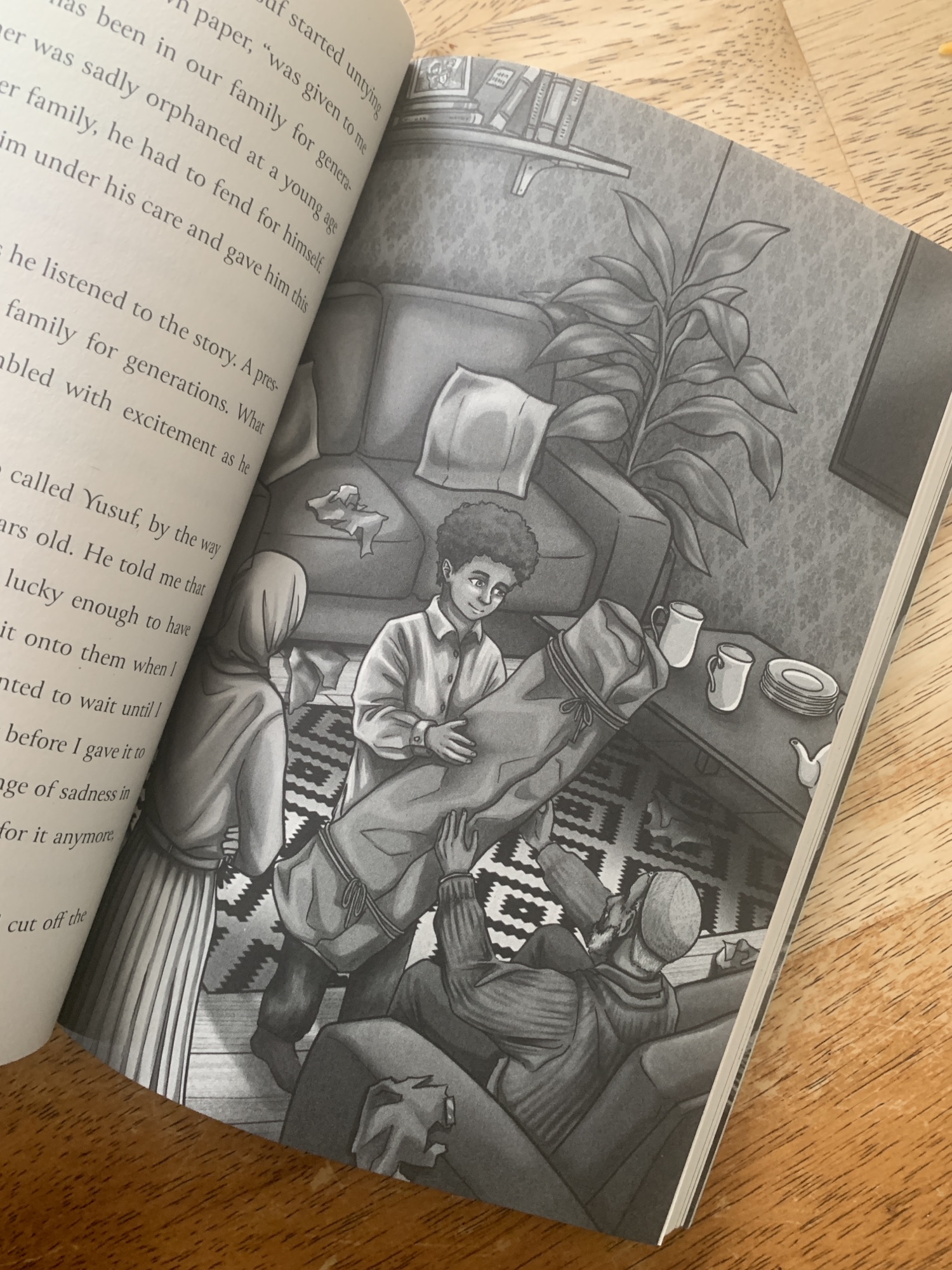
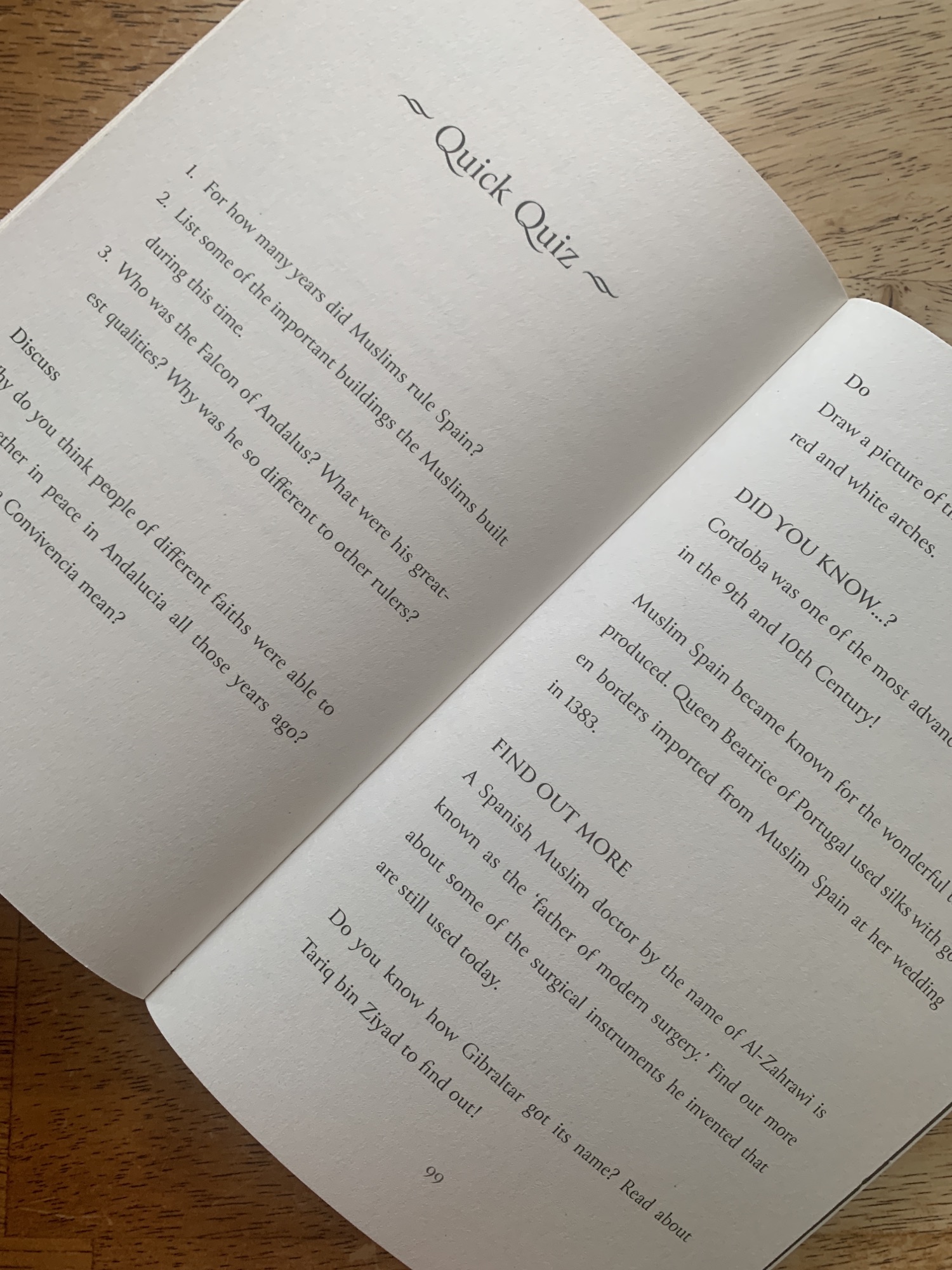
I really like the premise of the book, a Muslim Magic Tree House so to speak, two kids that magically go back in time, in this case to Andalucía. At times the book did make me smile, but really it feels like a missed opportunity.  The writing needs tightening, it feels early reader at 94 pages long with a few full page illustrations, but the vocabulary and text filled pages support the suggested reading level of middle grade.  It takes way too long to build up to the “action,” and when it gets to the plot it doesn’t seem to know what to do with itself.  It is a lot of walking this way only to turn around and walk back for no development, character growth, or enriching reason.  As an adult I had to force myself to keep reading, my eight year old who loves Magic Tree House books had basic foundational questions and couldn’t’ get past page 24.  Honestly it just needed some proof reading and some trimming, which is why I found it so frustrating; it really had so much potential.  Example, if the little boy is so excited to see his grandfather after 8 years, why didn’t he go with his dad to the airport, why did his elderly tired grandfather immediately go to a community event after arriving in the UK from Morocco, why wouldn’t Yusuf go with his beloved grandfather to the masjid.  And this is all within the first few pages.  If the logic isn’t there for the mundane set-up, it is hard to get on board for the fantasy aspect of a flying carpet going back in time.  The historical figures are introduced in passing and don’t leave much of an impression, so yes it is good to give readers a bit of information on people they may not have heard of before, but it doesn’t give them enough connection to make them memorable.  The backmatter sadly is not more information about the three historical figures presented: Abdur Rahman (The Falcon of Andalus), Lubna of Cordoba, and Abbas Ibn Firnas, it is a glossary and a Quick Quiz.  The answers to the quiz are not provided, there are additional facts shared but no sources given, and there is urging to find out more about Muslim Spain, but no directions, links, or book suggestions are provided.  The publisher should have proofed the book, it reads like a pitch, maybe a first draft, and our children and their purchasing adults deserve better.  We have growing options of stories with historical Islamic OWN voice framing, and unfortunately this book had a lot of potential, a few pages of interest, but not ultimately enough intrigue to win me, or my kids over.

img_4187-1

SYNOPSIS:

Yusuf and his friend Jack live in the same neighborhood, but don’t go to the same school.  They spend a lot of time together though, and have known each other since they were babies.  When Yusuf’s grandfather comes to visit from Morocco, he brings an old carpet and gifts it to his 10 year old grandson.  Unsure what to do with it, Yusuf puts it in his room, and feigns gratitude.  With a history project looming, and a dislike for historical study, Yusuf and Jack find themselves heading on a magic carpet ride into the past.

They arrive in Cordoba in 856 CE, disoriented and dizzy, Omar, their guide, greets them, walks them through the mosque answers one question then walks them back to the carpet to take them to a different time, 786 CE and they see diverse people living together peacefully.  They first observe “one of the greatest rulers that Andalus ever had,” The Falcon of Andalus, aka Abdur Rahman.  He is a humble leader that freely interacts with his subjects.  They then head to the 10th century to see Lubna with a crowd of scholars in Cordoba  learning from her in the library.

When Yusuf remembers his history project about flight, Umar guides them to 875 CE with a pit stop in CE 852 to see Abbas Ibn Firnas take flight, well fail and then eventually take flight in 875.  The boys then say their goodbyes and are whisked away home. Where they can’t believe what transpired, and are determined to figure out how to make it happen again.

img_4188-1

WHY I LIKE IT:

I like the concept, and that Jack is not Muslim, and Yusuf is unapologetically Muslim.  Seeing the two interact is enjoyable and both good modeling, and mirroring.  The heart of the book is truly not bad, it is the tangents that get long winded for no advancement of the story that take away from the flow.  As stated above the relationship between Yusuf and his grandfather doesn’t align with what is said and what is shown.  The end suffers the same lack of editing.  How can grandpa and Yusuf live in the same home, but they can never find a moment to talk.  Nothing is gained by delaying their conversation, so why delay it, and go on and on about delaying it?

If the point is to share not just with Yusuf and Jack about key historical figures, but with also the reader.  Then there needs to be more interaction with the characters, not just watching them from afar.  Interact with other observers or students or colleagues, convey information from a “personal level” not just drop a snippet here or there from what feels like a vague Wikipedia page.  If the book is not sourced, why not take some fictional liberties and flesh out Abbas, Lubna and Abdur Rahman, so that they are remembered. Include more information about the three real characters in the backmatter, reinforce the idea that a magic carpet is not real, but these remarkable people were, and they changed the world.

I don’t know that kids will have issues with how the carpet worked, but because the set up was so weak, I had a hard time going along with any of it.  I wanted to know why it had to be a grandson, not a son or daughter, how grandpa or his grandpa figured that out when it wasn’t a relative that gave the first Yusuf the carpet, but a storyteller.  How Umar knew to look for them at that moment.  Why did they go to 856 CE and then go to 786 CE why couldn’t they just meet Umar on the first stop? Seems unnecessarily dragged out, for no reason.  When was grandpa’s last trip? Could you get stuck out of your time? If no one can see or feel the rug, why do they keep hiding it? Can people see and hear them, or only their guide?

I like that Yusuf prays and Jack knows that Yusuf prays, and what a mosque is.   I didn’t like that they hear the athan, and went with everyone to pray, but then just left without praying.  The book seemed to do that a few times.  Have the kids walk through a crowd presumably toward something or for some purpose only to turn around and return to the place of origin having gained nothing, learned nothing, or seen anything, again just drags the book out and frustrates readers.

There really is not conflict in the book, no climax either, there is no really stress about getting back, stress about figuring out how to go on the next adventure, it is there, but not heightened, and it is unfortunate, because the book really could be adventure filled, and it just isn’t.

img_4189-1

FLAGS:
None

img_4190-1

TOOLS FOR LEADING THE DISCUSSION:
If you are learning about Abbas Ibn Firnas, or Lubna, or The Falcon of Andalus or Spain, and have access to supplemental material, the book has value.  I don’t know that if a kid picked it up off the shelf even with interest in history, that they would finish reading the book.  It doesn’t provide a solid feeling of learning or understanding about the time and place and people seen in the time travels, nor is it action packed on its own.  So if you can motivate a child to read it and then look further into it, the book would help connect the past as being interesting and engaging, but on its own, the book does not achieve that.

The Unlovable Alina Butt by Ambreen Butt-Hussain

Standard
The Unlovable Alina Butt by Ambreen Butt-Hussain

img_9079

This middle grade book in many ways reads like a memoir, it isn’t, it is OWN voice fiction, but the chapters often come across like short stories with their own climax or punchline.  The lacking continuity of smaller threads being resolved means if you put the book down, you aren’t necessarily itching to pick it back up to see what happens next.  There isn’t a larger pressing conflict driving much of the book, yes the girl is bullied, but by one kid, and she has a great group of friends and a supportive family, so the intensity is just not present.  I do like the growth of the character toward self-acceptance, but I don’t know that the target audience will get the 90s references of Spice Girls,  CDs, lava lamps, and gel pens.  The book hits most of the stereotypical immigrant tropes of feeling othered by one’s name, clothes, food, and while she works through them to deal with the bully and find her own confidence, she unfortunately never deals with her internalized Islamophobia, which is disappointing.  She puts Islam on her parents as something they practice, and only begrudgingly seems to acknowledge she too is Muslim when she doesn’t eat pizza with non halal meat.  She is embarrassed when her friends see Islamic calligraphy at her house, hear the athan, she doesn’t reply to her parents salaams, she calls her mother “the most devout in our family” as the reason she has to wear tights under her skirt: she only seems to ok with being Muslim when outsiders give their approval.  The book for me is mediocre, nothing to rush out and buy, nor anything to pull from shelves.  I’ll send my copy to the Islamic school library shelves as the book is fairly clean: a few giggles about naked statues at the museum and very lightly hinted at boy/girl crushes. The older sister deals with a boy who wants to date her and harasses her to the point of affecting her personality, but I think if a 10 or 11 year old picked up the book and read it, they would be ok to see the characters finding their voice, good friends, and sibling support.

SYNOPSIS:

Eleven year old Alina Butt is in her fourth school in three years since arriving in England from Pakistan.  She never fits in, and never has friends, but she is determined that if she can keep her last name a secret, she might have a chance.  One the third day of 6th grade though, her last name becomes known and Adam Atkins has his eyes set on giving her a hard time.  With encouragement from her older sister and love from her baby brother, Alina puts herself out there to make friends and when the teacher assigns her a new group, she finds herself among three girls happy to welcome her in.  The new group also puts her sitting across from Adam, but at least now she doesn’t have to face him alone.

At home, she navigates life as an immigrant trying to blend her worlds.  Her loving family lives above the grocery store they own and face Islamophobia and settling in together as they each have to find their strength and voice and resilience to drive, stand up to harassment, and for Alina, to love herself.  Alina gets the courage to try out for the school play, but when she lands the part of Gus in Cinderella, she has to dig deep to be happy for her friend, forgive a bully, and step in to the spotlight.

WHY I LIKE IT:

Alina is likeable enough, and I love that she grows to love herself too, I’m not sure she was ever unlovable though as the title suggests.  I don’t like that potentially really big plot points are mentioned and then abandoned.  She cuts her bangs way too short, her mom says something and no one else ever mentions it, and she never brings it up again.  Her dad is so sick he leaves the truck on the side of the road and sleeps and the mom takes care of everything, and what was wrong with the dad is never revisited.  These are just two examples of rising action that present that they are going to be important that are seemingly undermined by the lack of follow through.

I love that she finds a way to stand up to the bully and she even helps her sister deal with the boy antagonizing her.  It is strong and resonates with the reader, but it should also be noted that as soon as she has friends, they are gossiping and being rude to Adam too.  I’m not saying it isn’t warranted, and he definitely is worse, but if she is modeling behavior she should perhaps at least feel bad teasing him even before she knows that he has a bit of a rocky home life.  Plus he is one kid with two stereotypical sidekicks, yeah he is annoying and mean, but she has friends and family and teachers that are completely on her side too.  And Adam bullies her about her name, but no one else even acknowledges it or asks her about it.

I didn’t quite get the schooling, but it is probably because I am American.  She is in middle school, but she has one teacher all day and they play on the soccer fields at break and her kg aged brother does field day with her?   The 90s references were fine for me, but I don’t know that the target audience will get some of them, and it might be a little annoying to get through for younger readers.

Ultimately, the way Islam was presented was really disappointing.  It feels like we should be past the internalized othering of our faith.  The culture was worked through and appreciated internally for Alina, but for some reason, religion was only ok when the outside influences deemed it acceptable, and I’m not sure that in 2023 this angle of narrative is doing anyone any favors.  She loves her mom, and part of the character arc is seeing and appreciating her mother’s strength, but very early on mom is labeled as “devout” even though they are all Muslim.  And this self othering to be the reason her mom is keeping her from dressing like everyone else left a bitter taste in my mouth.  Never once does it feel that Alina has a connection to Allah swt, no matter what she is going through there is no bismillah, or prayer, or dua to ask for help, and strength, or show appreciation.  I absolutely get that not every story will have that, but the way Islam is presented as something foreign and never circled back on or portrayed as something that she embodies, makes all the mentions of faith seem deliberately othering, and as a Muslim book reviewer, I feel it is an important point to mention about this book. I wonder if it was intentional or an oversight sensitivity reading would have helped resolve.

FLAGS:

Birthdays, music, bullying, harassment, teasing, othering, mention of naked statues, some sneaking and dishonesty.

TOOLS FOR LEADING THE DISCUSSION:

I wouldn’t use this as a book club selection, and as stated above I wouldn’t rush out to buy the book to shelve at home, in a class or school library, but if it found its way to the shelves I would not remove it.  The book has heart, I just feel like along the way the messaging of finding your voice and putting yourself out there to make friends, the book also hints that the Quran on your walls, modesty, the athaan, eating halal, are all things that are weird, unless your friends think it is cool, then it is ok- and that is not messaging I would really want to spread.

The Kingdom Over the Sea by Zohra Nabi

Standard
The Kingdom Over the Sea by Zohra Nabi

kigdom

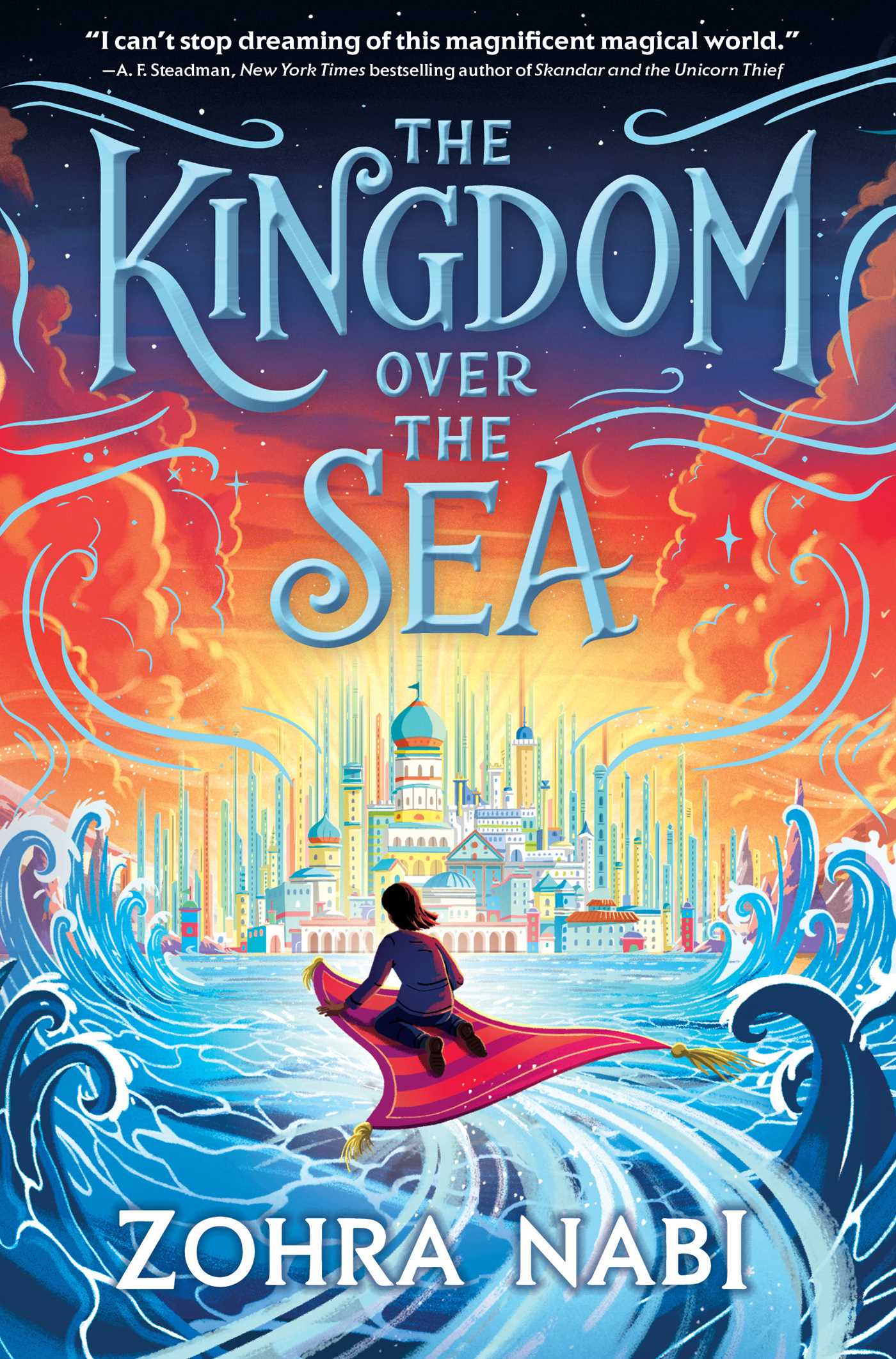
This 336 page middle grade fantasy book had a lot of promise for me, but ultimately fell a little flat.  The protagonist was likeable, there was emotion, the story was compelling, and I know it is widely said that debut novels tend to be a little weak or be underdeveloped or having pacing problems, yet I hesitate these days to use this as an excuse.  I’ve been around the industry a few years and it seems many author’s debut novel, is not, in fact, the first book they’ve written or even the first book they’ve “sold.” Books are written and finalized years before they are released for some genres particularly of late, so I’m trying not to let myself get caught up in the author’s writing journey (I’m sure I’m all sorts of wrong about what I think it would be anyway), and just review the book in front of me. This book has no religion, and I don’t know if the author identifies as Muslim.  There are a hodgepodge of Arab and Desi cultural references in the characters’ names, and in the sprinkling in of salwar qamis, abaya, head scarf, sambusak, and there is a ma’a salama at one point along with the presence of jinn (not religiously referenced). There is also mention of medicinal wine, magic, a lady who has a crush on another lady in her youth, music, and dancing. The book held my interest as I wanted to see how it unraveled, and I recognize that there is a book two, so some of my thoughts might be premature, but I struggled with the premise of the protagonist trying to understand the journey her deceased mother has sent her on, and how the person she was supposed to find for the answers simply won’t talk, even though the two are living together.  It made the story really drag in places and seem underdeveloped.  The world building, the backstories, the adventure at hand, really is imaginative, but the development of the relationships in the story are absolutely non existent, and the book overall suffers because of it. Also the ease in which rising action is resolved is often the kids just throwing an idea out and it being right.  I read and review through a critical lens and many recent middle grade fantasy books have been absolutely incredible, perhaps it isn’t fair to compare, but this book just came up short for me in developing memorable characters and plot, even though all the elements were present, capitalizing on bringing it all together stayed just out of reach unfortunately.

SYNOPSIS:

Yara’s mother has died and when she finds a letter with instructions of what to do and where to go should this moment arrive, she decides to dodge her social worker and journey to a world of magic across the sea.  Unsure of her own background, she thinks she might be Iraqi, but doesn’t speak Arabic, she longs to find a place to belong, and when she arrives in Zehaira and hears the language of her mother, she is hopeful that this Leyla Khatoun, who lives in the third to last house on Istehar Way, will provide her with answers. But alas Leyla is not there, the Sultan’s alchemists are, and Yara is now on the run in a foreign land.  Help finds her and with a little magic she finds Leyla.  Leyla begrudgingly takes her in, but refuses her any insight into her past, her relationship with her mother, or why the letter directed Yara to her.  As the alchemists poison the sorcerers, Leyla and some other kids (friends?) have to find a way to save the settlement and magic in the land.

WHY I LIKE IT:

Yara as a character is likeable, she is plucky, resourceful, determined, and despite her circumstance does not want or need pity or handouts.  She advocates for animals, the poor, is a grassroots organizer, and unapologetic in how she carries herself.  I love that she isn’t whiney or helpless, and that she trusts herself to problem solve and isn’t afraid to think outside the box, while maintaining her kindness and appreciation for those around her.

As someone who doesn’t like Alice in Wonderland type stories, this book grounded the world building in an easily consumable way, so even though it is Yara leaving the UK and stepping into a new world, the functioning of the new world didn’t feel random or surprising.  While this was beneficial for someone like me, it made the focus of the story more on the characters’ relationships in enhancing the plot, and the book wasn’t strong in showing those connections.  Yara meets a map maker for a moment and a cat, and months later recalls the cat and the map maker by name and face.  A boy, Rafi, who is also studying magic and Yara don’t get along, yet are friends because it says so, the book doesn’t show us their bond.  Rafi meets some great uncle and the great uncle is painfully underdeveloped (along with his “friend”) and the tangent weak in reinforcing the major climax. The relationship between Yara and Leyla is the center of the story and so glossed over, there is no tangible connection, or cathartic release when details emerge, it was very disappointing to say the least. Yara and Ajal, the jinn, what is that relationship even, she frees him à la Aladdin freeing the Genie, but they are friends, not friends, he looks out for her, but doesn’t like her, the telling and the showing don’t align.  Even Yara’s relationship with the settlement and the inhabitants is disconnected from the plot of saving magic.  The climax is weak because we, the reader, don’t feel any connection to any magical folk.  The emotion of the mother dying at the beginning and the slight retrospection (I’m not going to spoil it) of the mother’s love at the end, was developed and made me invested in Yara, that same energy did not present itself, sadly, in any other relationships in the book.


FLAGS:

Death, loss, poison, imprisonment, magic, mention of medicinal wine, one line mention of a female character liking another female character as more than a friend, dancing, singing, jinn, torture, male and female friendships, destruction, lying, sneaking.

TOOLS FOR LEADING THE DISCUSSION:

I wouldn’t use this as a book club selection and wouldn’t go out of my way to shelve it in the school library or classroom library.  I will probably read the second book though and see where the series goes and reevaluate. I will also probably read future works from the author as the sparks of good story telling and writing definitely show promise for the author even though this particularly book wasn’t “magical” for me.


Fight Back by A.M. Dassu

Standard
Fight Back by A.M. Dassu

fight back

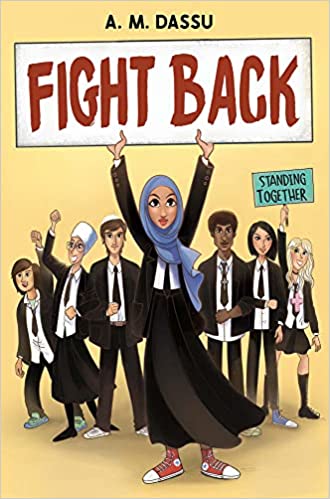
At 384 pages, this middle grades book takes on hijab, terrorism, Islamophobia, finding your voice, and fighting back.  At times the book was insightful and smoothly written, at other times the voice seemed childish and the writing directionless.  The inconsistencies don’t ultimately make the book good or bad for me, but rather very forgettable.  I read the book over the span of three days, but honestly remember very little about the book without looking at my notes.  The writing just isn’t particularly strong.  I never connected with the main character, and no it wasn’t because I didn’t agree with her wearing hijab out of solidarity, I accept that people make the decision for a variety of reasons, somehow I just never felt sympathetic to her as a person, or found myself cheering her on.  Her naivety vacillated too much for me to find her believable, and the pacing of the book made it hard to get revved up.  I think upper MG and middle school readers will be a better fit for the book with hate speech, assault, school bans, concert, musical references, and alt right indoctrination.  I think the book is worth shelving in a classroom/school library and I’m considering it for a book club selection, but I’m skeptical that the book would be finished, even if started, by most readers without some incentive to see it through.

SYNOPSIS:

Aaliyah and her friends are at a K-pop concert when a terrorist attack kills and injures numerous people.  A Muslim takes responsibility and with it coming on the heels of numerous London attacks, Islamophobia is at an all time high.  For 13-year-old Aaliyah, it is a stranger yelling at her mother in a parking lot, her best friend Lisa ignoring her, and her brother getting riled up in retaliation, that gets her to wonder why her mother wears hijab, when she started, and decide to start covering herself, in solidarity. As a result for Aaliyah there is now increased bullying at school which results in physical assault, and teachers turning a blind-eye.  It reaches an all time high when a religious display ban goes in to effect.  Still dealing with trauma from witnessing horrific violence, Aaliyah decides to push back.  Finding her inner strength and finding allies in a few good friends, and a secret cat adoption, she finds enough motivation to keep her plugging forward against the growing hate in her world. When she finally finds her voice will it be enough to overturn the ban and save her brother? Nope, not going to spoil it.  The fight is not a one-and-done, as anyone who has gone up against racism and systemic oppression knows, and this fictional book keeps that integrity and doesn’t give a happy ending, but rather hope and motivation.

WHY I LIKE IT:

I like that the Islam is centered in a consistent and empowering way.  At times it is a perspective that I’m not completely onboard with, but a few pages later the insight is powerful and the messaging clear.  I found it odd that Aaliyah doesn’t know when her mom started covering or why, or anything about hijab, it comes off very immature. The book keeps culture and religion separate, hijab a choice, and I like that it was Aaliyah who wants to cover even when her parents try to talk/force her out of it.  I find it a little off that she doesn’t go to the mosque, but her father consulted with masjid folks when looking for advice for handling the alt right groups.  She prays a few times in the book and it being mentioned is nice.

I like that the kids in the book think for themselves, and that the adults don’t have all the answers.  I enjoyed the passages asserting why the family came to the UK generations ago and why they have stayed, is powerful.   A few of the characters that are really strong at the start don’t ever get mentioned again.  Which is fine, but I did wonder about Harpreet and why Yusuf’s friends weren’t contacted when Aaliyah was sleuthing about.

Loved the literary shout-outs, and the hypocrisy of allowing swim caps and hats but not hijab, but sigh, didn’t love the cat thread.  I think I just don’t like fictional cats, I sound like a broken record.  I think the inclusion was to show how much Aaliyah had to keep hidden in her life and how she needed comfort, but I don’t know, sigh, I found the contrast of tone jarring to the pacing.

There is a glossary at the end, and the definition of Hijab is a bit odd, highlighting Western and South Asian terminology and not the Middle Eastern or even global use of the Arabic word.  I don’t know that the glossary is even needed as the book really tries to establish that the characters are a part of their society and don’t need footnotes and differential treatment, so the inclusion of a glossary for me, diminished the point a bit.

FLAGS:

Assault, hate speech, bullying, fear, death, injuries, bombing, terrorist attack, lying, music, mention of a transgender/gender neutral student, a rainbow pin. sneaking out.  Criticism of police, alt right indoctrination.

TOOLS FOR LEADING THE DISCUSSION:

The book is unique in showing affects of the alt right and not having it all work out in an MG book.  It shows the anxiety and fear that Muslims often feel and the determination of not becoming victims. It also does a good job of showing that something like a religious symbolism ban doesn’t just affect Muslims, but people of various faiths and culture, and thus when common ground is found, there are more allies that one often thinks.  I think it could work for a middle school book club and undoubtedly the discussions would be great, but I am given pause with the main characters view of hijab as not being something in the Quran, but rather done in protest and in solidarity.  I think once I see which kids are interested in book club I can gauge if it is something that we can work through and discuss or not.

Love from Mecca to Medina by S.K. Ali

Standard
Love from Mecca to Medina by S.K. Ali

mecca to medina

This book is a game changer, or better yet: an industry changer.  It is about Muslims, for Muslims, by a Muslim- but it is MAINSTREAM and a huge panoramic window for anyone and everyone to see a “halal” fictional Muslim love story in action.  With every page proudly mirroring various Muslim experiences this sequel-ish standalone-ish book is unapologetically real, without compromising good storytelling, interesting characters, and engaging plot points.  In much the same way Reem Faruqi’s Golden Girl raised the bar for upper MG/lower YA, this book shows that upper YA Muslamic stories can be told.  That the publishing world isn’t always limiting OWN voices, and that it is up to us, the consumers, to purchase these particular books, pre-order them when announced and spread the word so that the message is loud and clear that we want more books like this.  I have no doubt S.K. Ali had to fight for her vision and advocate for her book at every turn, but now that it is here, we need to step up and show support with our purchasing power.  I’ve pre-ordered mine, and I hope you will do the same before the book releases on October 18, 2022, if you cannot, please purchase it when you can, and if that is not an option please request your libraries to shelve the book (and all of her books) and put them on hold so that the gate further opens for mainstream Islamic fiction.

Preorder link on Amazon

SYNOPSIS:

Adam and Zayneb are back after falling in love in Love from A to Z and getting their nikkah done.  They aren’t living together yet, though, and they are worlds apart with Adam jobless in Doha, and Zayneb homeless in Chicago.  When communication breaks down, exes show up, and a trip to Umrah is underway with the couple divided into gender segregated groups, the couple might fall apart in the same fashion that brought them together in the first place.  The steps of Umrah are beautifully highlighted and experienced, and characters from Misfits and A-Z come back to tie it all together and help the couple, keeping hope alive.  Throw in some marvels and oddities, artifacts and interpretive labels, a unifying cat, and a whole lot of love, and you have a sweet conclusion to a Muslamic love story.

WHY I LIKE IT:

So, I obviously love the standard of unapologetic Islam that this book offers on every page while still being accessible to the larger audience.  It took a little bit for me to be sucked in to the 352 page story, but by page 100 or so, I couldn’t put it down.  The steps of Umrah brought tears to my eyes and the awesome Sausun is fierce feminist friendship goals.  I honestly didn’t love the cat narrative that frames the story, but luckily it is sparse so I could see past it. I love that this book exists, I think I love the Misfit based duology a tiny bit more, but loved that this book had crossover characters and gave many of them a final bow of sorts as well. I read the book in two days and will probably re-read it when I receive my physical copy.  It really is remarkable how much Islam is present in a fictionalized story: not a oppressed Muslim story, or biographical memoir, or refugee story, but in a solid fiction story.   There is no “othering,” this is us, and this a love story about a Muslim couple trying to make it work with outside support and stresses, and beautiful writing.  Alhumdulillah, very well done.

FLAGS:

I’d encourage mature, older YA because the characters are married and sexually active and while it isn’t graphic or depicted it is often just the words mentioning them kissing, and sleeping together and sexting.  Nothing titillating or anywhere near inappropriate, but I think a bit of maturity would help it better reflect the values of Islamic marriages and relationships.  There is some minor language and hate speech.

TOOLS FOR LEADING THE DISCUSSION:

I would absolutely use the book for high school book club if it is mostly juniors and seniors.  I think it gives a good look at what a relationship can look like; the characters’ religious lens and lives will resonate with Islamic school students.

Birmingham Boy by Kate Rafiq

Standard
Birmingham Boy by Kate Rafiq

birminghamboy

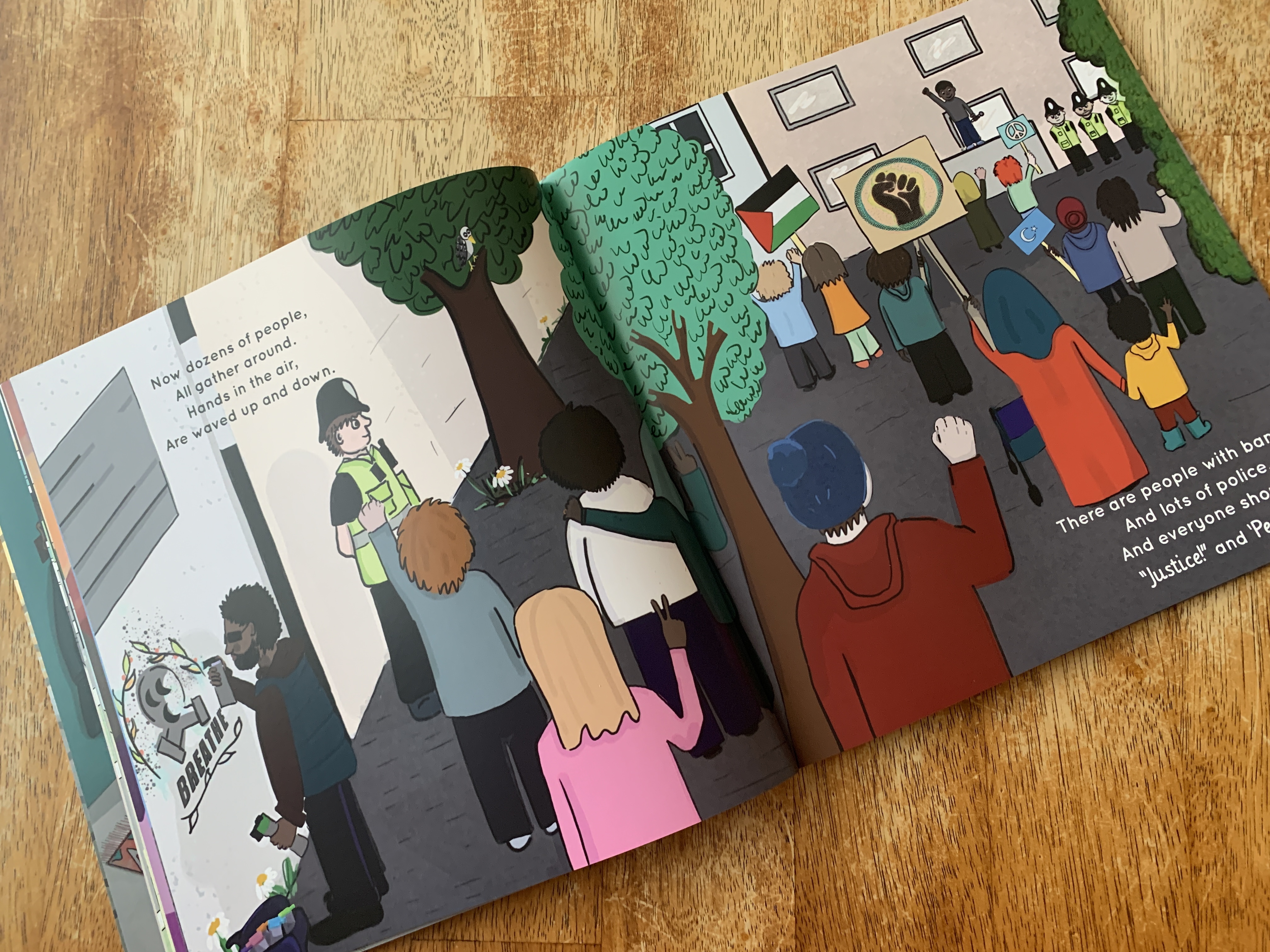
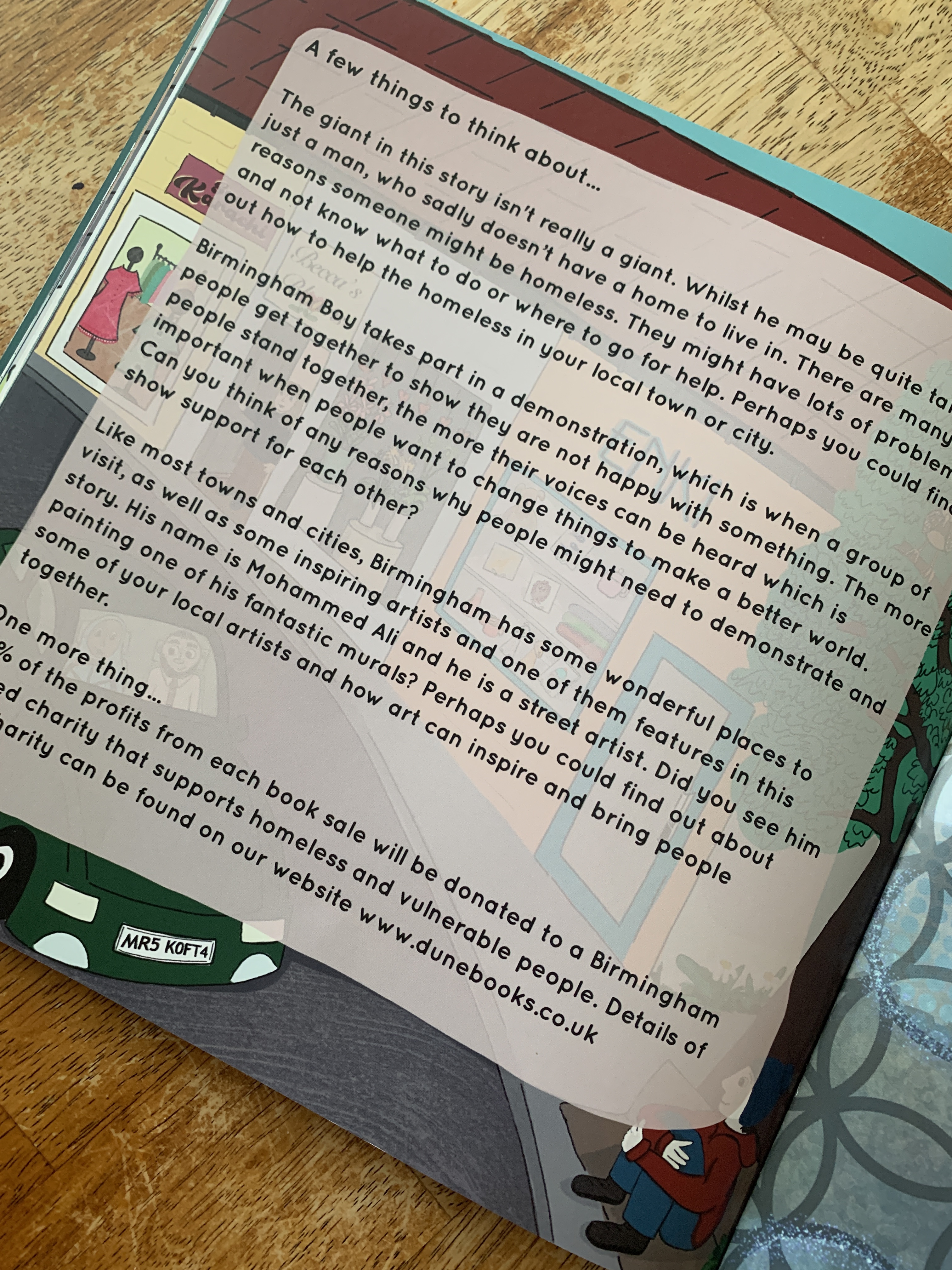
This 36 page ‘day-in-the-life-of’ book, follows a young boy and his mom on a day out and about in his city of Birmingham, England. Told in rhyme a few Urdu words are sprinkled in as general city observations are made, fun is had, and kindness is shown. The book touches on homelessness and protests, and the illustrations take the story deeper and show support for Black Lives Matter and Palestine, multiple hijab wearing women (#muslimsintheillustrations) throughout the city (including a burkini swimming mama), storefront signs acknowledging a diverse community, street artists, and different races, religions, and cultures everywhere.

img_6412

The book starts off with Birmingham Boy waking up, based on the Arabic signage in his room, I’d guess his name is Zakariya, everything is quiet and still- except for a giant that he sees outside his window.   He refers to the homeless man throughout the story as a giant, it doesn’t seem to be a negative description, nor is the boy scared, he shares food with him at one point, it is just what he refers to him as. 

img_6413

He then heads downstairs for breakfast of toast and dudhu (milk), before getting in a pram and heading out in the town.  They go past the deli and the flower show, and the giant on his cardboard mat.  They see someone getting their hair cut at the barbershop and they arrive at the swimming pool.

img_6414

The mom and son swim and play and Birmingham boy takes a nap in his stroller as his mom and he head off to their next location.  He wakes up to the sounds of the masjid and sees his mom praying.  He plays and then joins her in salat.

img_6415

After the masjid it is off to a cafe for cakes and tea, which they share with the giant, before they head off to a rally for justice and peace.  The book carries on in this sweet style of visiting places and interacting with the community until ending with a bath and dinner and getting tucked in to bed for the night.

img_6416

Being American and living in Birmingham, Alabama, my kids and I also learned about the sights of a different Birmingham and they got to learn some British words such as pram and wellies.  I loved the inclusion of Islam in their daily life and the joyful illustrations.