Tag Archives: religion

House of Glass Hearts by Leila Siddiqui

Standard
House of Glass Hearts by Leila Siddiqui

glass hearts

This 278 page magical realism YA book featuring a Muslim family grabs your attention and heart in the prologue, unfortunately it quickly releases it, and until you get over a third of the way in to the story, it is a struggle to read.  Once you accept that half of the book, the storyline set in the present, is going to be terrible, you enjoy the historical narrative and appreciate that the short book with a quick pace spends more time in the subcontinent during partition, than it does with the painfully underdeveloped characters trying to make sense of past secrets and their present day manifestations.  The book doesn’t have any major flags in terms of religious representation, it is just ritual acts of praying and reading Quran, nothing detailed or explored, and relationship-wise there is nothing high school readers can’t handle (spoilers and more details can be read in the FLAGS section).  Despite being a first time author, she works as an editor, so one would really expect the climax to hit harder with clearer writing, the characters to be developed, the details written to serve a purpose, and the protagonist teen’s voice not to read overwhelmingly at the beginning as a five year old.  The overall story concept and historical fiction component are exciting, the development of the characters just really failed an otherwise engaging read. 

SYNOPSIS:

Maera’s brother Asad goes missing in 2011 from their grandfather’s home in Pakistan while they are visiting.  They search and cannot locate him or a body, the loss devastates Maera’s family.  Ten years later, her grandfather passes away, and the next morning a greenhouse appears in their backyard in America.  Not just any greenhouse, her grandfather’s greenhouse from Pakistan.  Maera thinks she is going crazy, her mother doesn’t acknowledge the structure, she doesn’t acknowledge much, not about the reality in front of them, not the night Asad disappeared, or the needs of her daughter. Maera’s aunt (mom’s twin) and cousin come from Pakistan to mourn the loss of the grandfather together, he passed in Pakistan, not sure why Maera and her mom didn’t go there, but I digress.  Cousins Jamal, aka Jimmy, and Maera are the only two that seems determined to figure it all out.  Their grandfather’s journal turns up and with Maera’s friend Sara and Rob, the neighbor and former best friend of Asad, the four of them set out to understand what is going on in the greenhouse.

The greenhouse seems to be alive, and entering it dependent on the whims of something within, a churail,  a shape shifting creature of myth that is more than a witch, a succubus that targets men.  A woman who died violently and was wronged by men, whose feet are turned backward, and who is neither alive or dead.  As the four work through the journal, venture in to the greenhouse, and confront those within, secrets will be unearthed, exposed, and finally dealt with.

The historical interwoven story is that of the grandfather during colonial British rule and partition.  As a young boy Haroon is searching for his father fighting in Burma and the adventures he has along the way. Shah Jehan’s father takes Haroon in at one point, and the girl with an emperor’s name sneaks him out to watch the village deal with the churail who are killing the men in their village.  The incident scars Haroon, but his affection for Shah Jehan and the role she will continue to have in his life is established. The understanding that the subcontinent is being carved up and starved by the colonizers in the name of freedom is made clear in the characters that Haroon encounters and the quickly maturing boy grows in to a young man as he starts to understand the world around him and the larger powers at play.  When the migration and violence between Hindus getting to India and Muslims going to Pakistan occurs, the pieces in the past and present come together to reveal the terrors that the greenhouse houses. 

WHY I LIKE IT:

I loved the commentary both in the text, and explicitly detailed in the afterward about how culturally the past is handled.  How little generations discuss what they have endured and been through.  I have been asked by my father-in-law a few times to try and coax my mother-in-law to detail her journey with their oldest son from India to Pakistan.  She has apparently never clearly told what happened, what she saw, and what they experienced.  She waves it off now, but her own children didn’t even know there was more to the story, and as my inlaws approach their 90s I have little hope of them recalling or sharing their stories.  Recently my son needed to hear some first person accounts of war, so he contacted my American grandfather to learn about his time in the Korean War, much of it I knew, Americans, generally speaking, talk about this type of experience in passing.  My son, also wanted to compare his story to someone who lived as a civilian through a war, and asked my mother-in-law, his Dadi, about her experience living through the Indo-Pakistan War of 1971, not that long ago, and we all sat spellbound as she recalled the sirens and how they kept the children fed and calm and whatnot.  They were stories no one had thought to ask it seemed.  She has seven children and almost thirty grandchildren.  This book struck such a chord with me, I need to actively seek out these stories before it is too late.   Chances are no one else in the family will. Not speaking the language fluently has cost me my chance to learn my own father’s family’s stories and I need to find a way to gather my husband’s family’s stories before it is too late. I love that in the book, The Past is capitalized as if it is a named living person shaping the lives of so many.  It is, and these stories are wonderful reminders and motivators to ask the elders to share their memories.

The present day story thread, however, is chalked full of holes, one dimensional characters, and pointless tangents.  Sara and Maera read like they are early elementary aged.  They are so terribly voiced in the beginning, I have no idea, how an editor author and mainstream publisher did not require correction.  The dialogue, the action, the role of the parents, it is terrible.  Speaking of terrible, the mother and aunt are absolutely flat and useless.  They mope, sleep and sit in the corner.  I don’t understand why you wouldn’t develop them to link the past story to the present one.  I’m not being picky here, it is that bad.  I also wanted to know why the dad left.  Seems like it would flesh out the mom a bit, justify her approach to life.  Sara and Rob are obviously brought in to serve as vessels for the action, and for Maera and possibly Jimmy to play off of.  But their backstories are so pathetic.  How do you not know or see your neighbor for ten years.  Ok, I get that he was Asad’s best friend and your family in their grief and denial pushed him away, but he never checked the mail or took out the trash, or was seen? And Sara offers absolutely nothing to the story other than to be part of the forced crush/romance line pairing off her and Jimmy and Rob and Maera.  Alhumdulillah, it stays tame with the angsty longing and hand holding.  

Random details that serve no purpose reach a pinnacle with the paragraph long time spent on Maera wearing Rob’s tank top.   I have no idea why we should care that she is wearing a tank top.  Sure as a Muslim reviewer it furthered the notion to me, that she is probably more culturally religious, and yes I know Muslim’s dress to different degrees of modesty, but I really couldn’t find any other reason for the emphasis on the black tank top. Overall, all the friendships in the story seem so off: Rob and Asad, and Sara and Maera.  They should be easy plot points, but they don’t connect, or read believable.  

Plot wise: if you had a building magically appear in your back yard along with a journal, would you not read that journal as fast as possible? Sure you would lose sleep and maybe skip a meal or two, but hello, a building just appeared in your back yard that is moving and growing, your grandfather died and your brother’s body was never found: stop what you are doing and read the journal.  It mentions that when Asad went missing there were a lot of other kids, cousins at the house, so where are they now? Why was there no mention of them, and only Jimmy seems to have a vested interest in the grandfather passing, and the growing need to remember Asad.  I did not understand the sacrifice and hair connection and how that was what Maera understand the Churail to be asking for.  I did not understand the end of chapter entitled “The Separation,” it says they entered together, so…. ya?Off and on in the greenhouse there are multiple churail, this seems inconsistent with what we learn from the one churail about leaving.  The whole climax needs a Cliff’s Notes synopsis.  I honestly have no idea what happened.  The churail was scared of the beast, but they all went off together, affectionately? I’m trying not spoil anything here.  Why was the churail so different at the beginning compared to the end, why did she get a growth arc, when the other characters didn’t? Shouldn’t there have been some cathartic reprieve verbalized between the mom and SPOILER (sorry I tried) Asad? I felt deprived.  

There were a few grammar errors, but because I read an ARC, I’m hoping they have been corrected

FLAGS:

There is a little bit of language (F word at least once).  Children are conceived, it isn’t explicit, but the fact that it happened is critical to the story.  There are crushes, angsty/longing, hand holding, hugging.  There is sexual assault implied as a major plot point, but not detailed.  There is death, and killing, often gruesome, some real, (hits harder), some far fetched.  The book is YA and  ok for high school readers and up in my opinion.

TOOLS FOR LEADING THE DISCUSSION:

I would be interested in seeing if some of the muddled passages are cleaned up in the published physical copy, the book’s characters are weak, but the historical fiction component is a story that needs to be shared more and more as we, collectively, seek to understand the past, the impact of colonization, and the emergence of telling our OWN voice stories.  For all the flaws, I haven’t completely written off the book, I’m hopeful that even if this one doesn’t make the cut for a book club, that inshaAllah the author will keep writing and filling in the blanks.

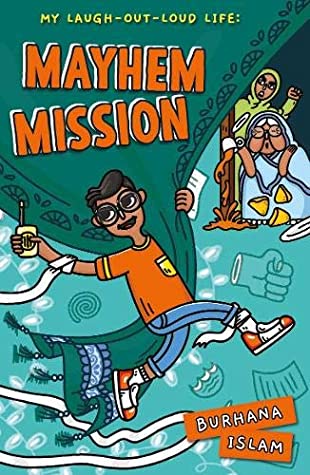
My Laugh-Out-Loud Life: Mayhem Mission by Burhana Islam

Standard
My Laugh-Out-Loud Life: Mayhem Mission by Burhana Islam

mayhem

Fairness aside, any book about a genuine Muslim British boy written in first person with doodles, lists, and hilarity for middle grade readers is going to be compared to the Planet Omar Books, and not only do they have the advantage of being first, but they also have set the bar really high.  This 266 page book is decent and fun, and if your children enjoy Omar, they will enjoy this, but even my kids compared the two and found this one just a bit lacking.  The story is outrageous and funny and has a lot of heart, the writing is sufficient, it just feels like the story gets away from the author.  Information is given for no reason and to no purpose, the story loses its way and fumbles around for a bit in the middle, seems to get off track at points, and is a bit weak in character development.  That being said, would I purchase and read future books in the series? Absolutely! I love that the standard and quality for books with Muslim characters by Muslim authors for our children are at this level.  There is no apologizing for Islamic Bangladeshi culture in this book, and the mainstream publication means Muslim and non Muslim children are seeing a nutty, loving family that they can relate to in a myriad of ways, alhumdulillah.

img_4078

SYNOPSIS:

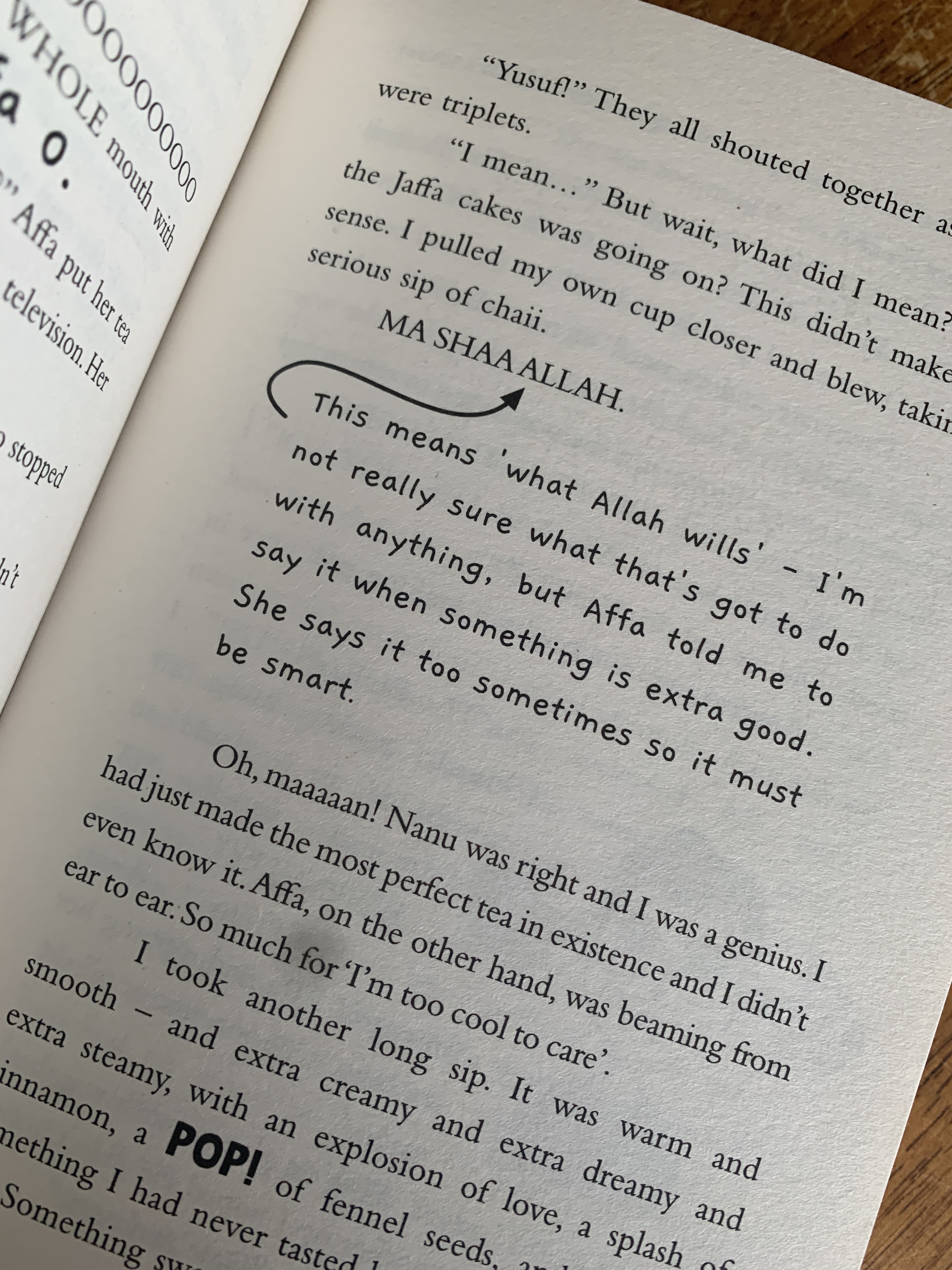
Yusuf’s much older sister is getting married, and she remarks that he now needs to be the man of the house.  Unsure of what that means, he asks Sheikh Google, and is not prepared to do what it entails.  Not at all, he is only nine, but rather than discuss it, he decides instead that he must stop the wedding. So, with a bit of help at times from his cousin Aadam, it is full steam ahead to sabotage the upcoming nuptials.  With little time, he attempts to make his sister unwanted in her inability to cook, keep her hidden in her room by removing all the hijabs in the house, spreading rumors that she has died, ruining her wedding dress, and more, so much more.  It is cringe worthy at times, and hard to put down at others, but alas there is a happy ending, and lucky us, we get to read all about it in Yusuf’s year five what I did over summer vacation essay.

img_4077

WHY I LIKE IT:

I love that the family dynamic is a single mom, her mom, and the two kids.  I think it is important to show some diversity that reflects the family situations of many Muslim children that have thus far been a bit down played.  The book is relatable and contemporary with Marvel references, while tossing in everyday cultural references too.  The family prays, does tasbeh, memorizes Quran, covers, etc.  The book tries to give some depth to the characters, such as Yusuf’s eczema, but it kids don’t get it and the text muddles it to the point, that it misses connecting to the readers.  Also, even kid readers get that a simple conversation could have prevented most everything in the book.  Time is tight, but not that tight for things to get so outrageous.  The book is a British, but I think US readers can handle it, they may, like me, have to Google Jaffa Cakes, but I think they will be fine.
img_4076

FLAGS:

Deceit, sneaking, lying, gossip, destruction of food and property.

TOOLS FOR LEADING THE DISCUSSION:

I don’t think the book would lend itself to a book club, but I think home and classroom and library shelves will benefit from hosting this book.

Beautifully Me by Nabela Noor illustrated by Nabi H. Ali

Standard
Beautifully Me by Nabela Noor illustrated by Nabi H. Ali

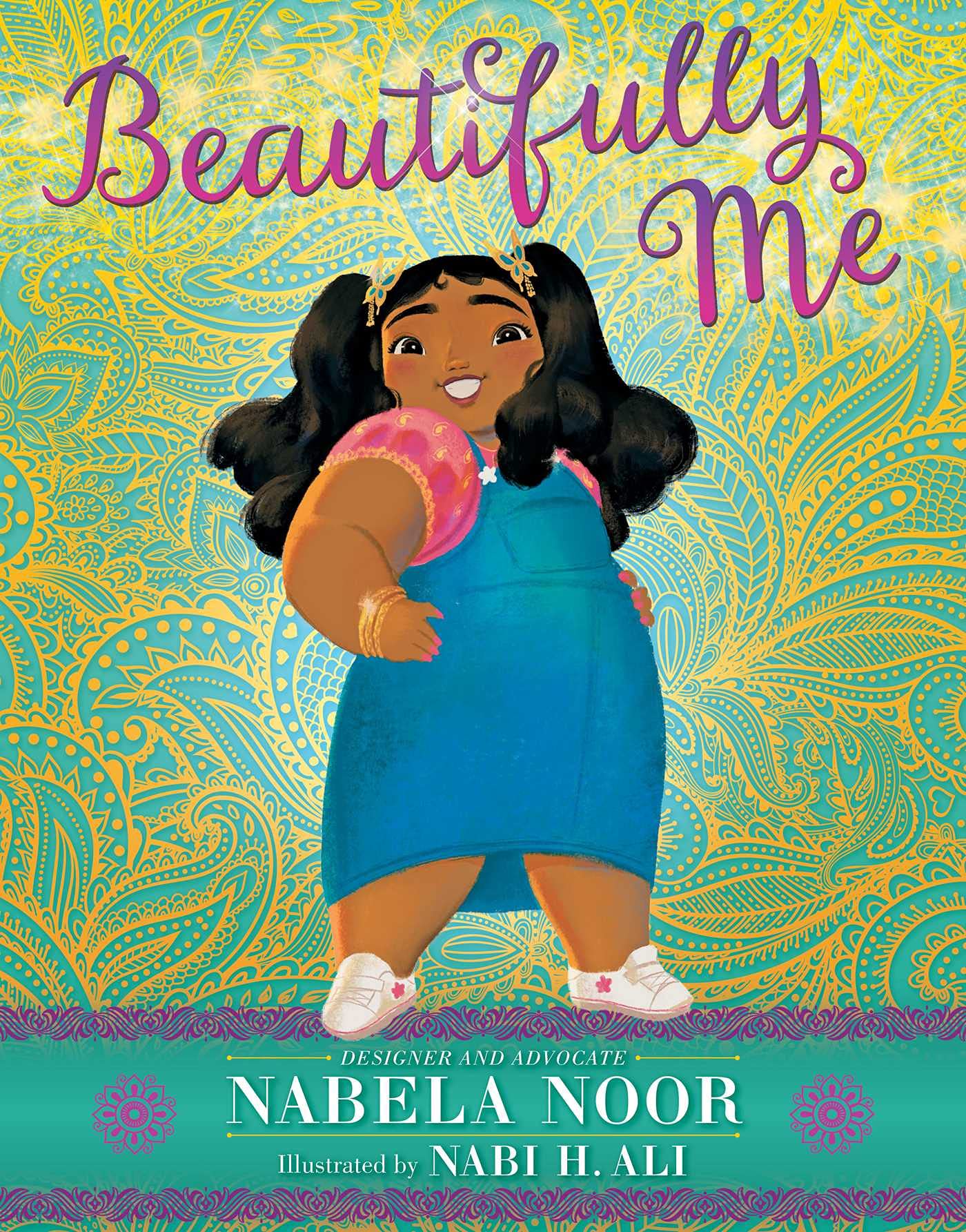
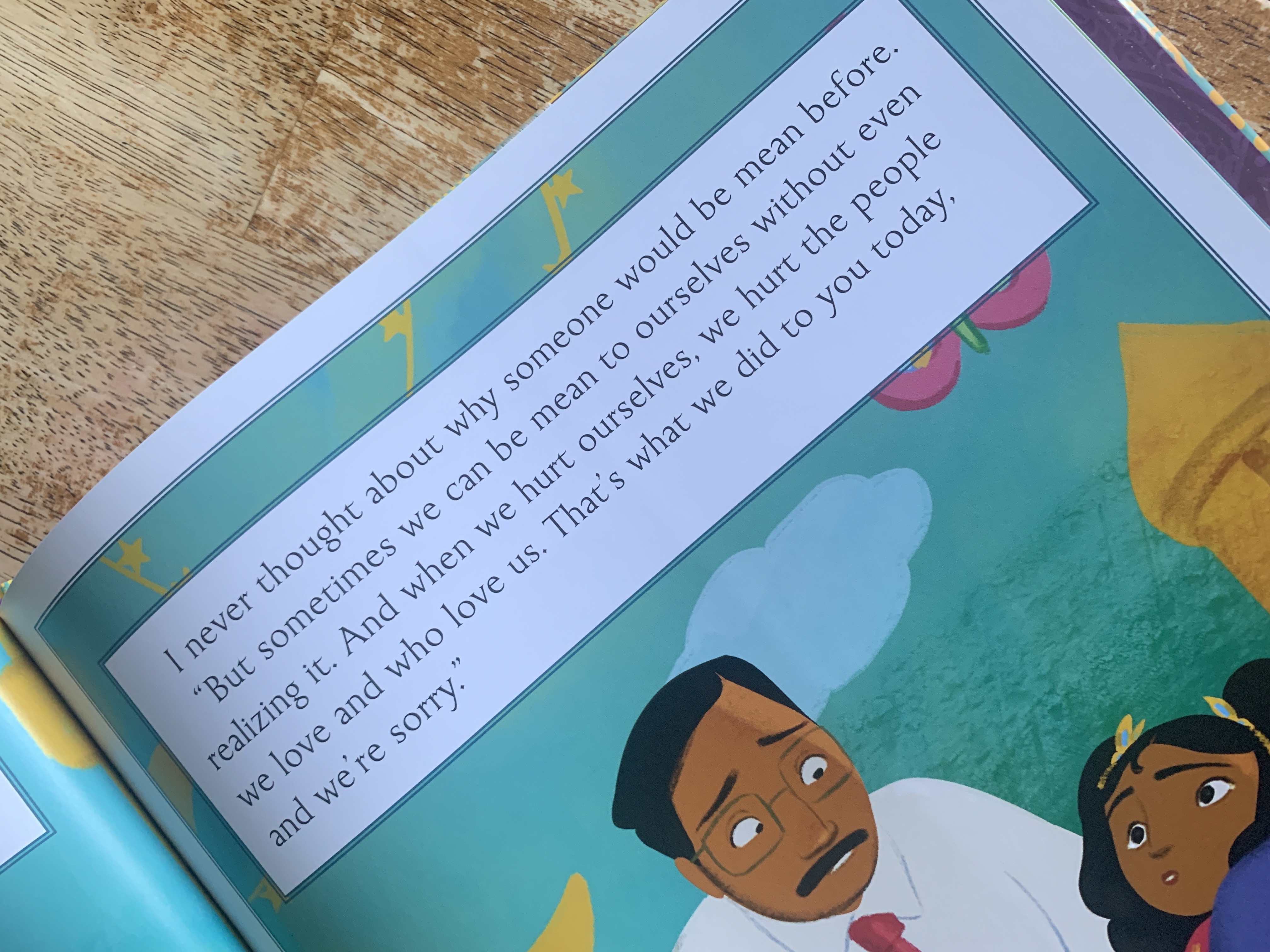
beautifullyThis 40 page glowing OWN voice book bursts with body size positivity, Bangladeshi culture, Islamic terminology, diversity, and a beautiful message.  The illustrations and theme alone make the book worth your time and reveal how few body positive books are out there for our early elementary aged children.  That being said, the book might require or benefit from some child led discussion.  If your child is aware of various body shapes including their own, then this book is a great mirror to build them up and as a tool in emphasizing the critical importance of understanding and knowing people are beautiful just as they are.  If your child doesn’t seem to be aware that society views individuals with a larger body size as being a negative, this book might take a little navigating as the theme is more focused on pushing back on fat shaming than it is on accepting all body types.  The book also opens its self up to discussions about pronoun identity, what beauty means, why people tease or be mean to themselves and others, and being aware of how our words affect those around us.
img_3976

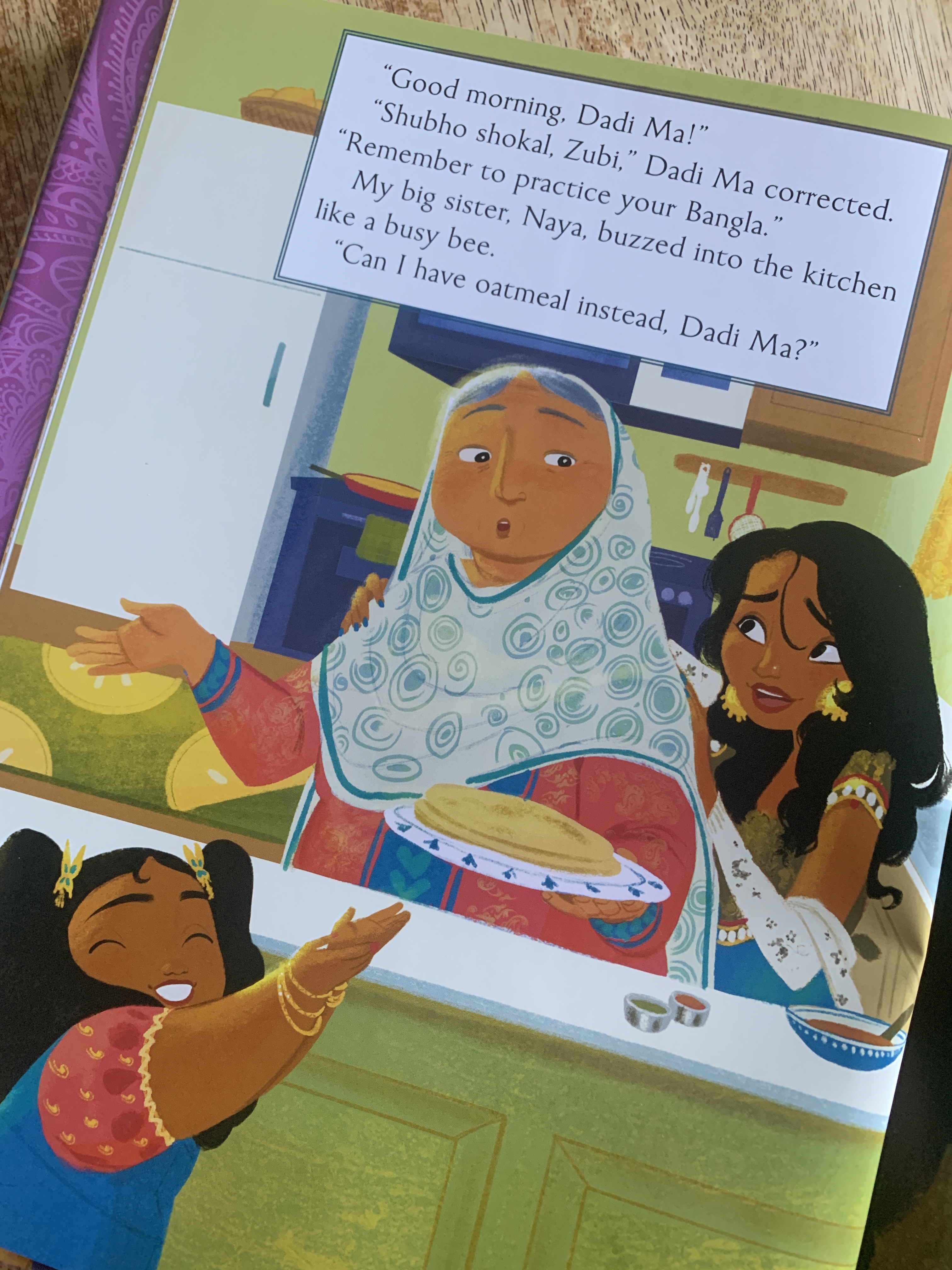
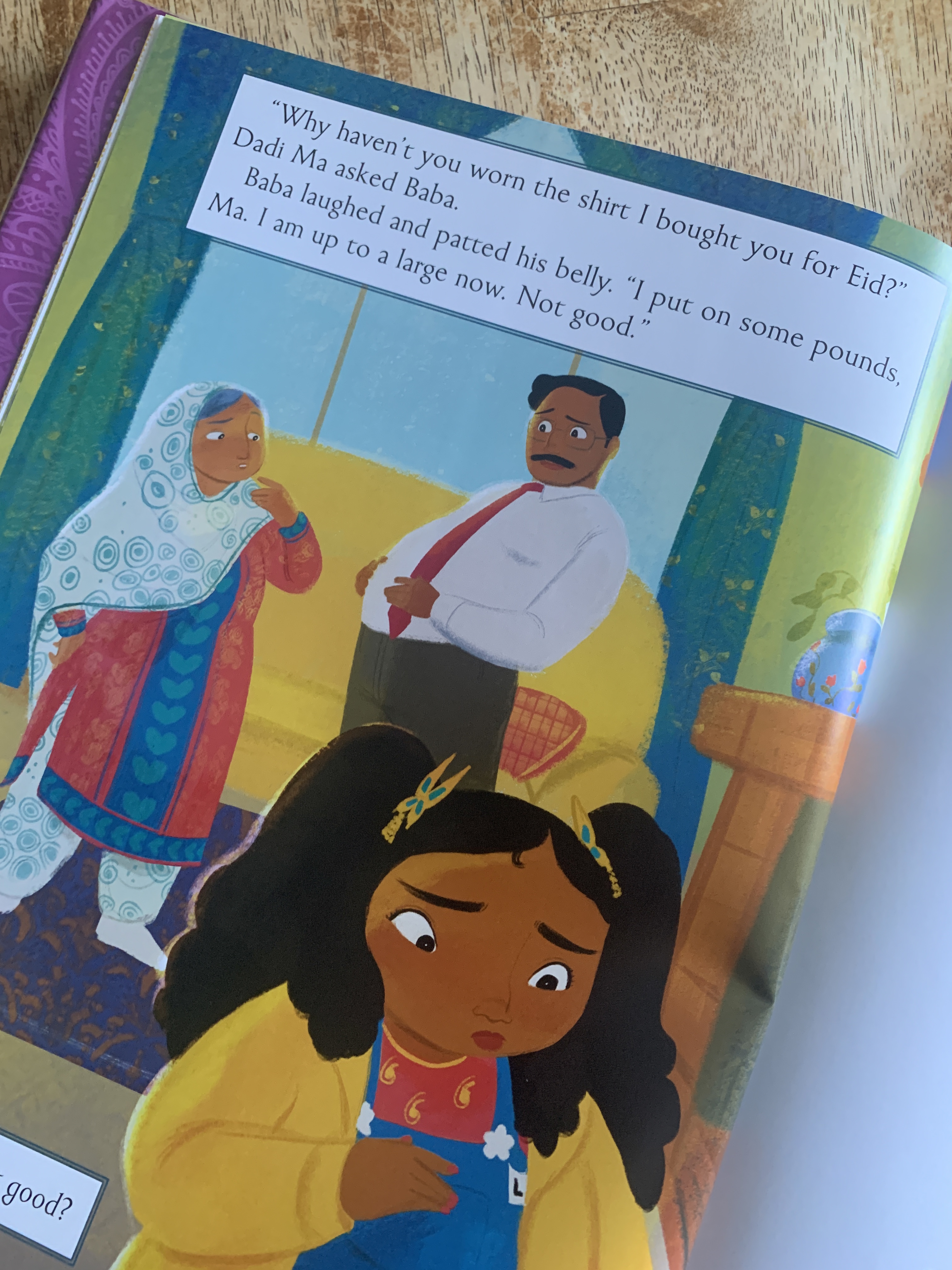
The family is visibly Muslim with Zubi starting with salaam.  The mom wears hijab and a sari, even at home, Dadi also has her head covered.  Eid is mentioned as a time when a gift was given that is too tight to wear, and worth noting from an Islamic perspective- Zubi’s sister is dieting to look pretty at a school dance.  Bangladesh is represented in the foods and some of the phrases the family says, and the clothing mentioned and depicted in the illustrations.  There is a glossary at the back.
img_3977

Zubi is excited for her first day of school, she slides on her dress and shirt her mom had made for her in Bangladesh and her bangles on each arm.  She heads to her parents room to show off her outfit where she finds her mom in a gorgeous yellow sari complaining about her big belly.  At breakfast Dadi has made flaky parathas, but Zubi’s older sister Naya is dieting and would rather have oatmeal. Dad calls the girls to take them to school when his mom asks how come he hasn’t worn the new shirt she got him for Eid.  He embarrassedly admits he has put on some pounds and his size is now a large, not good.

img_3978

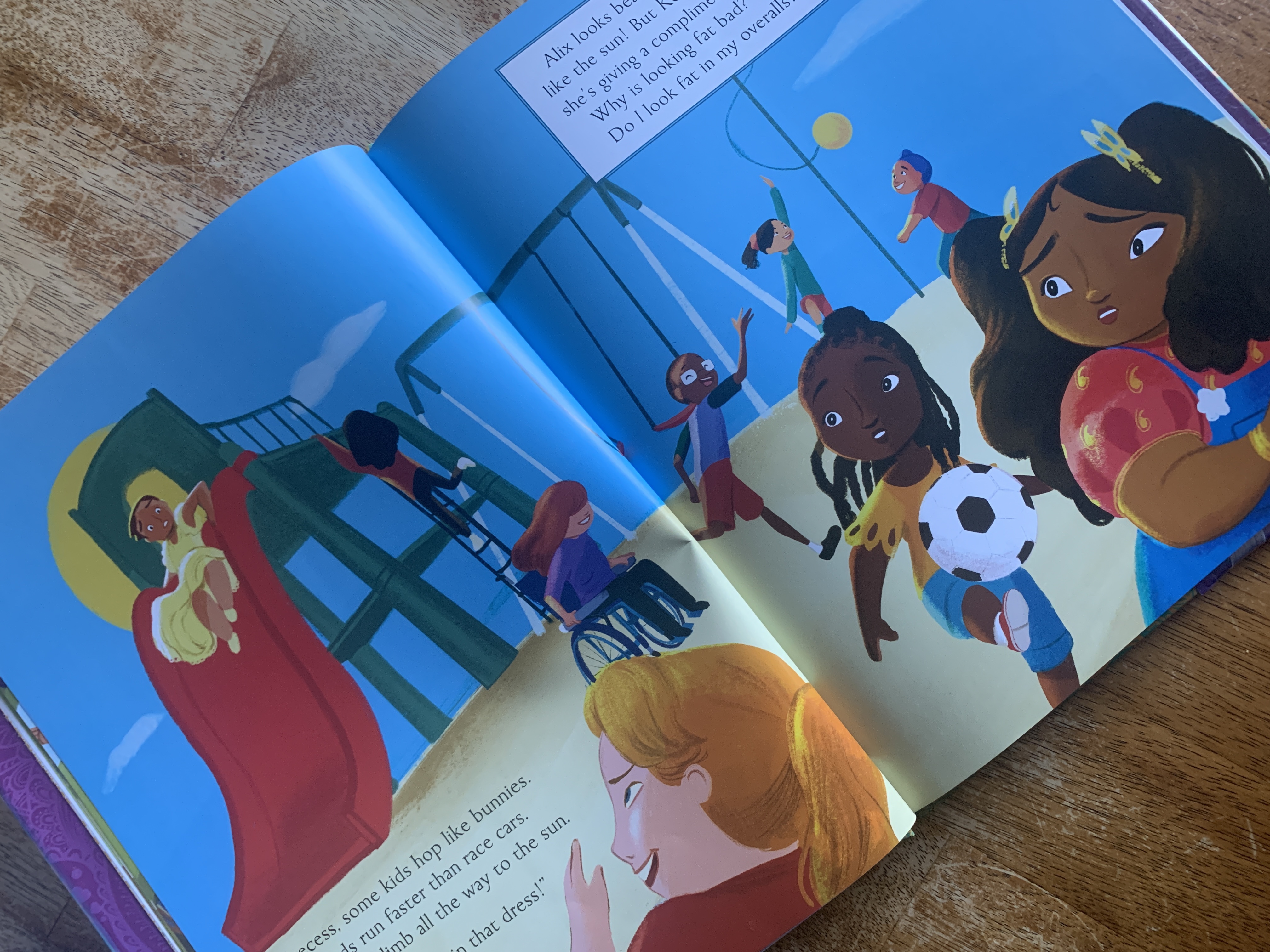
At school she is having fun and even makes a new friend, but at recess some one yells that Alix looks fat.  Alix is wearing a yellow dress that Zubi thinks is beautiful and doesn’t understand why when they are called fat in it, it comes across as negative. After each incident Zubi mulls over what she is hearing and what it means for her, once she is home though she isn’t quite ready to talk to her family about it.  At dinner, it all hits her as she decides she too shouldn’t eat, that she should be on a diet to be pretty.  She heads off to her room, as her family realizes the impact of their own views and words about themselves, have had on Zubi.  The family works to unpack their own mistakes and be better all while making sure the message to Zubi is that you are beautifully you.

img_3979

I like that the book has the dad helping the mom put on her sari, and the dad comes and chats with Zubi about what happened at school.  Mom might be in the medical field, she seems to be wearing a white coat over her sari, which is subtle and impressive that she is going to work in a sari for anyone that has ever tried to wear one and simply get in and out of a car (just me maybe).  I do like that the mom remarks that she should be kind to her body since it housed her daughters.  I think reminding us that bodies serve a miraculous function is important.   I love the diversity in the classroom and how full of life Zubi is in all aspects of her day.   She is proud of her culture, and sees those around her as being bright, kind and funny, not just the shape of their bodies.  Some of her self reflections after an incident do highlight that many kids, including Zubi, don’t see body size as good or bad, its just one’s body.  Hopefully the adults reading the book will also be reminded and realize that is a message worth actively working to maintain, at any age.

img_3980

I think some of the criticism about the book not showing healthy food choices, or overall health is that we sometimes expect one book to do it all when there aren’t a lot to chose from.  The book celebrates being beautiful AND being big.  It doesn’t need to address all the societal and adult baggage that comes from food choices, lifestyle, health, judgement, stereotypes, etc.. And I think if you feel really strongly and defensive about it, then focus on pushing for more books, not one book to do it all.  Encourage illustrators to show a variety of body types on the pages of books in young children’s hands as well as by toy makers, cartoons, movies, tv shows, etc..  Body positivity and being confident in yourself, no matter your size, shape, appearance, benefits everyone. Celebrate being beautiful.

img_3981

It All Comes Back to You by Farah Naz Rishi

Standard
It All Comes Back to You by Farah Naz Rishi

it all comes back to you

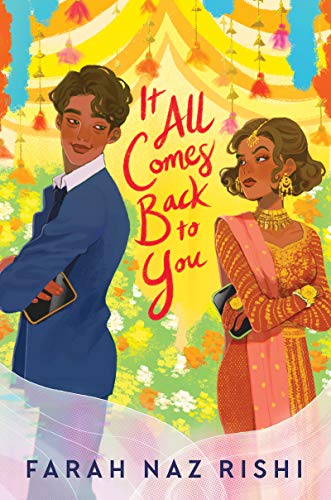
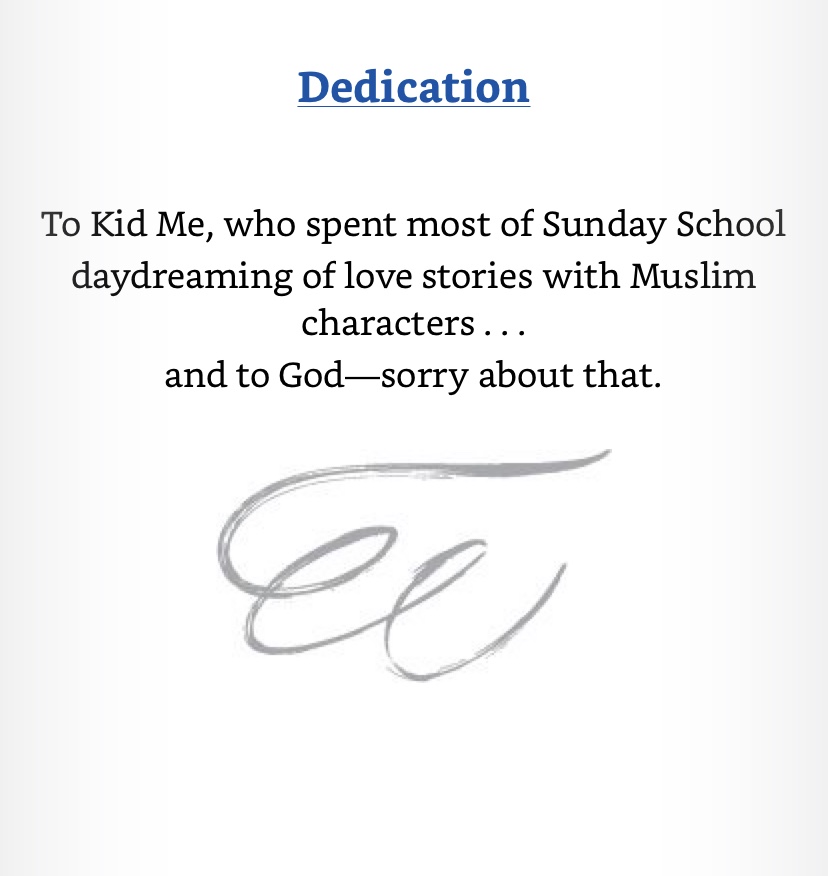
Sometimes you just want a light fun, empty-calorie read, and in that regard I feel like this book really delivered.  The characters are in college, and yet it is published by HarperCollins Children, so I wasn’t entirely sure what to expect, which perhaps added to the lack of expectation and increased forgiveness.  It reads very much like a Bollywood movie, there is dancing, angst, romance, redemption, culture, religion, and a sense that a certain arbitrary line of it all won’t be crossed to earn the book an R rating, and will keep it safe for Muslim high school teens.   I think the book is fine for Muslim’s in 10th/11th grade and will be enjoyed by those in college (and up) as well.  Over 429 pages the highly predictable tropes find their footing in their unique religious and cultural framing.  The plot is perhaps a bit on the nose and overly serendipitous, but individually the characters show range and complexities that will resonate with readers.  They have all made good and bad choices and continue to do so, but the big ones are largely in the past, and what we, the readers, get to see in many ways is them reaching for forgiveness in a contemporary whirlwind culmination of a wedding, overcoming addiction, a past felony, secrets, ex-significant others, familial expectations, loss, change, and school.  The book is not preachy, although there is a like-able imam as a side character and he gets some advice in.  The Muslim characters grapple with their faith as they would their culture; picking and choosing what to practice, but never really escaping it or wanting to completely abandon it either, it is just who they are and part of their identity. I enjoyed the book, reading it in two sittings and not feeling guilty that I lost sleep doing so, but like most rom-coms, the specifics and characters will blur over time.  It has a lot of similarities with Hana Khan Carries On, while not having quite the religious adherance of S.K. Ali’s characters or rawness of Tahira Mafi’s.  One thing that is uniquely it’s own, however, is the author’s beginning dedication, I don’t think I have ever read one quite so perfect, memorable, and possibly guilt causing.  I laughed out loud!

img_3576

SYNOPSIS:

Kiran’s mom passed away a year ago from ALS, and with her older sister Amira in law school at the time, she dealt with her mother’s illness and passing, largely alone as she additionally had just been ghosted by her first and only boyfriend, Deen.  Now that her sister is about to graduate, and Kiran is about to start university, they can finally be roommates and reunite the family.  Except, Amira has met someone, Faisal.  Someone who was there for her when her mom died, and they are planning to move across the country to California in a few months.  Devastated Kiran forces herself to be happy for her beloved older sister, until she finds out that Faisal is Deen’s older brother, and there are some gaping holes in his past.  With her sisters future on the line, promises to her deceased mother haunting her, and a serious lack of communication abilities (more on that later), she is determined to uncover the truth about Faisal and maybe even Deen in the process.

Alternating point-of-view chapters give Deen a chance to provide his side to the story: the reason he had to disappear from Kiran’s life, what happened to his brother, and the unreasonableness of his family.  As he struggles with his own conscious and stumbles around unsure of his own potential and worth, Deen comes across as selfish and arrogant, but ultimately only cares about his brother and making things up to him.  He is determined that Deen deserves to be happy and he is committed to keeping Kiran from destroying it.

In typical desi fashion, appearances matter and while all the behind the scenes sleuthing, plotting, and fighting is taking place, on the surface, wedding plans are being made and dances choreographed.

The book includes pages of texts from three years ago between Deen and Kiran as they meet at Sunday school and sneak behind the mosque.  There are also gaming dialogues between two anonymous fantasy characters that it is pretty obvious are Kiran and Deen.  The reveal isn’t a shock to the readers, only the characters, and proves a nice way to see redeeming traits in characters who’s present real actions aren’t exactly endearing.

WHY I LIKE IT:

The OWN voice representation of Desi culture and Islam is not in addition to the story, it is woven in to the characters and the plot.  The characters are largely liberal as the families are chill with dating, mixed gender hand shaking and dancing, and what not, but their Muslim upbringing is almost always close by.  The characters say “astagfirulllah” after kissing, they acknowledge that some of the Muslims drink and some have left that lifestyle, they miss visiting the mosque, they recognize that they aren’t praying, etc., while many flags are present, they really aren’t sensationalized or given more than a single word in print.  It strikes a pretty solid balance of showing where some thoughts or values come from, and where personal individuality takes over.  I don’t think Muslims will be offended, nor non Muslims confused.

The biggest issue I had with the characters is that it really could have been resolved, all of it, with a few decent sit down conversations.  Kiran and Amira, for example, are terrible at communicating and it blows this whole thing into a ginormous mess.  Sure, there is no book if there is no drama, but they never fix this.  So many lessons are acknowledged and the character arcs are shown or hinted at, this one, not so much, if at all.  They didn’t talk when their mom was sick, when she died, about what they were going through, about their dad, about their future plans, about the wedding, about the concerns with Faisal, about Kiran and Deen having a past, about moving to California,…the list really is exhaustive, and it doesn’t seem to show that they acknowledge their role in escalating everything and vowing to be better.  Sigh.

I read a digital ARC and it had a few spelling errors, it broke down the fourth wall in one paragraph, and I’m hoping the final copy will have resolved these issues.  It mentions that typically the bride and/or her family pay for the wedding in Islam, and this is erroneous, culturally possibly: the brides family would cover the nikkah and ruhksuti, with the groom covering the walima, but to put it on religion is just incorrect.

FLAGS:

Deen talks about “knowing women,” but it isn’t explored, and the groom is teased that he will be loosing his virginity card.   The kisses aren’t usually described, it is just conveyed as something that happened.  There is a bit of detail in the chemistry felt in the dances, but in true Bollywood fashion, they stop short of kissing. There is a stripper called to the bachelor party, but the characters are appalled and she is immediately escorted out. A religious character accidentally drinks alcohol and blacks out.  There is profanity, not excessive, but conversationally.  There is talk and repercussions of addiction to prescription drugs, a felony crime committed and punished for, deceit, lying, bullying, and physical altercations briefly recalled.  There are parties attended, alcohol consumed,and  at one point a female forcefully kisses an unconsenting male.

TOOLS FOR LEADING THE DISCUSSION:

I’ve gone back and forth with suggesting to the high school book club advisor to consider this book.  I think the right group of readers could really opine on the characters actions from the shy Faisal with a huge forgiving enduring heart to the nosey obnoxious Mona Khala, but there are some potential flags that might ultimately keep this book from being entirely Islamic School appropriate even for the highest grades.  Ahh, I’ll keep you posted on what I decide.

Piece by Piece: The Story of Nisrin’s Hijab by Priya Huq

Standard
Piece by Piece: The Story of Nisrin’s Hijab by Priya Huq

piece by

At 224 pages, this graphic novel tells an important OWN voice story in beautiful and powerful illustrations, but despite reading it multiple times, I ultimately found the pacing off, the narrative and plot holes quite large, and the conclusion too forced.  It claims to be for middle grades which would explain the happy ending, but the assault, trauma, mental health, Bengali history, language, and protagonists age (13), make it more suited for upper middle school readers.  I read a digital ARC in predominately black and white images, so I’m hopeful that part of the problem is on me, and that I simply missed or misunderstood parts that seemed to jump around and assume, or that because it was an uncorrected proof, some revisions are still to come.

piece by1

SYNOPSIS:

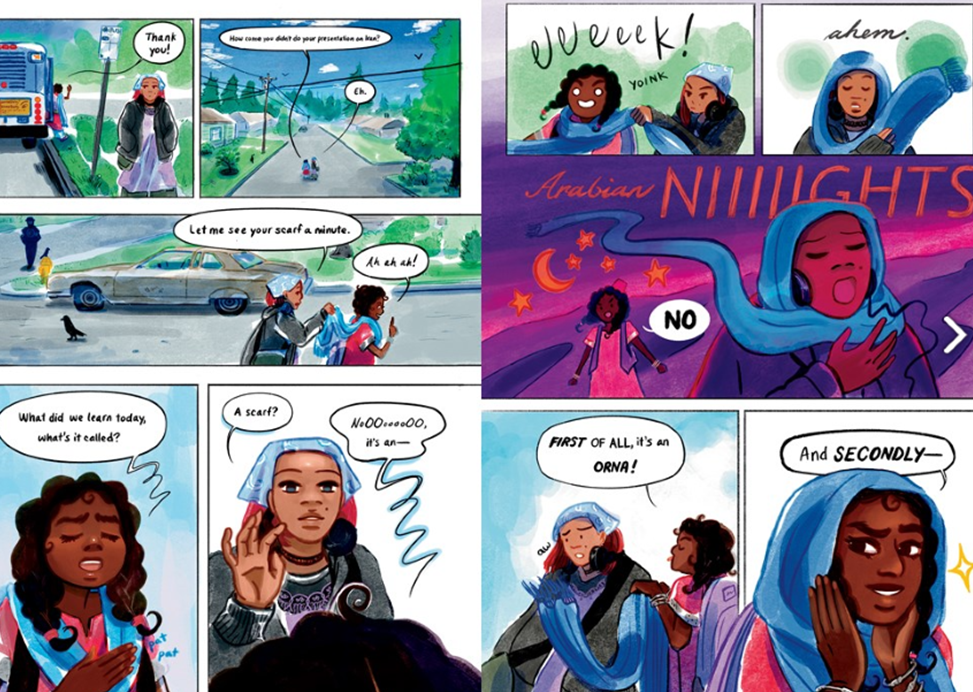
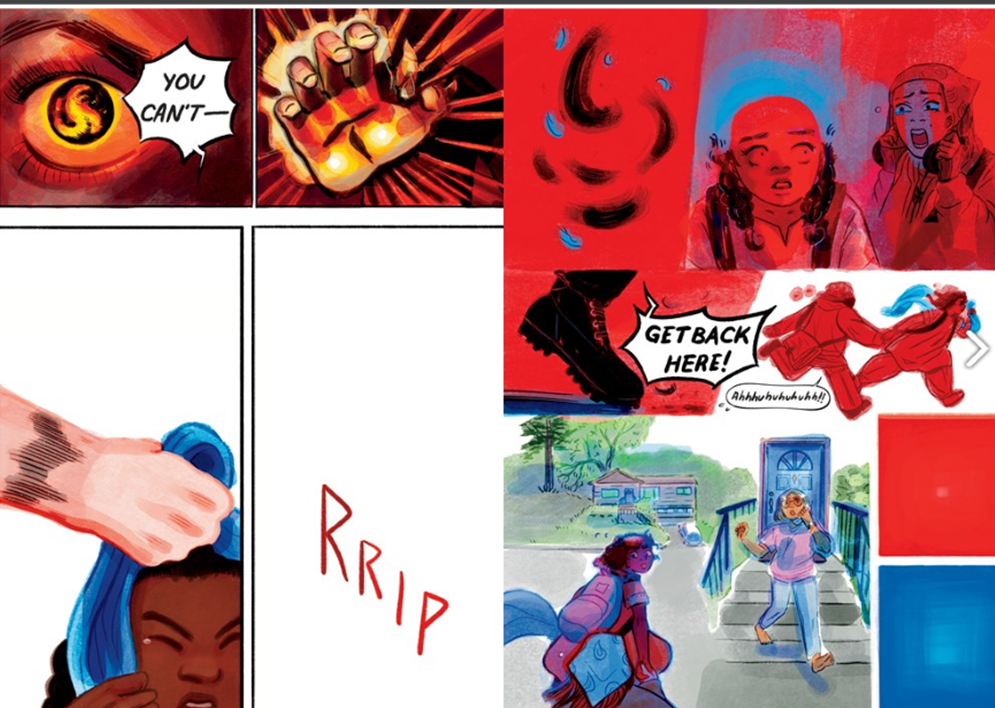
Nisrin is 13 and lives in Oregon with her mother, and maternal grandparents.  Her mom travels a lot and she seems to spend most of her time with her loving Nani, grandmother.  The story opens with Nisrin in 8th grade giving a presentation about her Bangladeshi heritage to her school.  On the way home with a friend, Firuzeh, she is still wearing the cultural clothing and they are playing around with the scarf, when they are violently attacked and the scarf is ripped off of Nisrin’s head.  Her hair is pulled out in the process and the two girls are taken to the hospital and when released maintain professional counseling to process and deal with the assault.  Nisrin fears leaving her house and is increasingly isolated within her home.

pice by 2

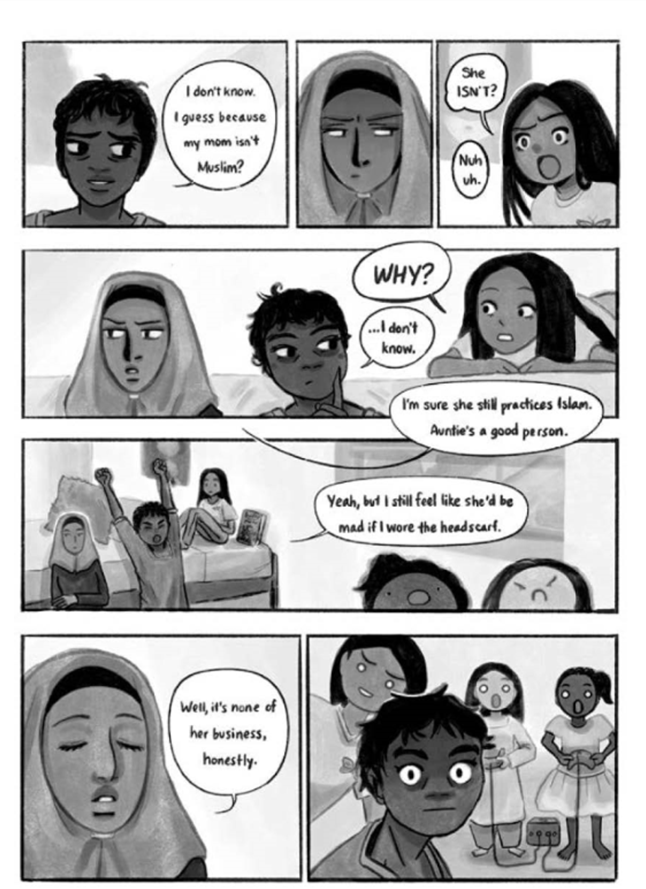
Over the summer we see her and her Nani go over to some cousin’s house where Nasrin is gawked at with her short hair and everyone is unsure how to act around her.  She joins some cousins playing video games where she asks about a cousin in hijab who says that it is essentially her choice between her and Allah (swt), that it isn’t any one else’s business.  A younger cousin tells that she plans to start hijab soon and is surprised to learn that Nisrin’s mom is not Muslim.

As summer comes to an end, Nisrin will be starting high school and exits her room the night before wearing a hijab, or in Bengali, an orna.  Her family freaks out, her Nana, maternal grandfather, is furious claiming that she should have been raised better, and Nisrin is scooted off to her room by her Nani, so that her mom and grandfather can argue.

piece by 3

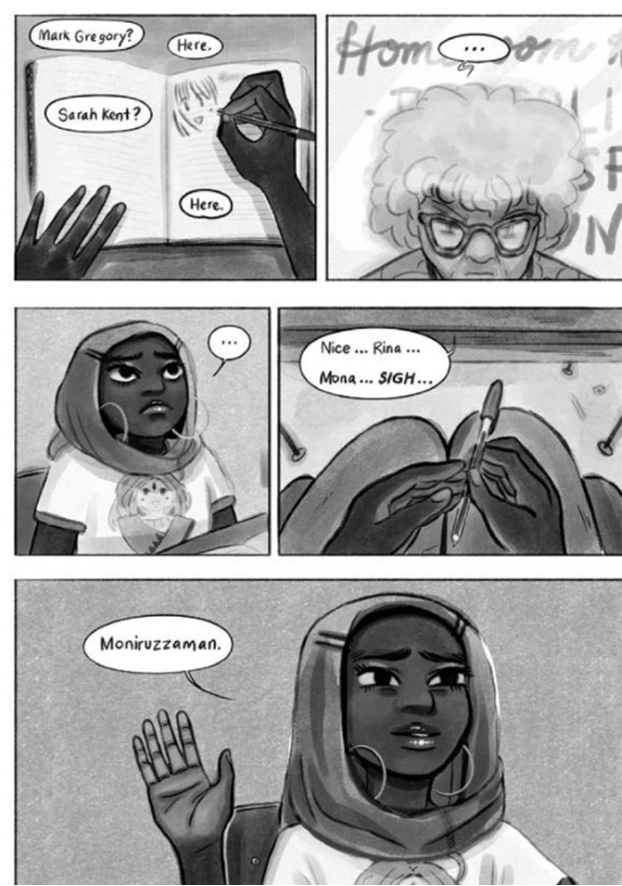
On the first day of school, Nisrin tries to talk to Firuzeh, but once again things are awkward between the two girls.  A teacher refuses to try and say Nisrin’s name and becomes angry and aggressive, and at PE she is called a slut and asked if she will be beat for showing her legs.  Nisrin goes home to research Islam and hijab, but everything is so angry and opinion based that she is more confused than when she started.

The next day she meets a nice girl, Veronica, and the two work on an assignment in class and then have lunch together.  Veronica suggests that Nisrin learns about Islam like she would a school assignment and go research it at the library.  Later at home, Nisrin starts to understand what her grandparents and mother saw and endured in the war of 1971 when Bangladesh became independent from Pakistan.  Her mom and Nana argue over what was seen and Nisrin starts to find her voice in her family.

Nani takes Nisrin shopping for long sleeved clothes and scarves, things are worked out with Firuzeh and Nisrin’s family accepts that Nisrin is not asking permission to wear her scarf, but is hoping they will accept it.

piece by 4

WHY I LIKE IT:

The book is such a flip on the over-used-stereotype that Muslim girls are forced to wear hijab, in truth many are encouraged not to.  At one point Nisrin says, “If I can’t be safe…then can’t I at least be proud.”  She was attacked for just playing with a scarf and putting it on her head, so she reasons, that there is not safety from racism and hate, she might as well be proud of who she is.  I also love the strength in the idea that she doesn’t need anyone’s permission, it is her faith, her head, her choice.

There is a lot of good in the book, but I struggled understanding quite a bit of it.  It mentions that she was at Texas and she loved it, but there was bullying? No idea what it was in reference to or what purpose it served.  At the beginning the two girls seem like they have been friends for a while, but yet Nisrin warns Firuzeh that her Nani will force her to eat.  Nisrin seems to really love her sleep overs, and I don’t know if it is just to show at the end the healing by coming full circle, but it seems a bit juvenile to be that excited about it to me.

The family dynamic and history, left me very confused.  Nisrin doesn’t know her cousin wears hijab, and is confused that her aunt doesn’t.  Nor do her cousins know that Nisrin’s mom isn’t Muslim?  These cousins call Nisrin’s Nani, Dadi, and since there is no father in the picture it is obvious to even none desi folk that these cousins are related through the mom’s family and the cousins father, so why when Nisrin decides to wear hijab is the maternal side so upset? Why does Nasrin’s mom ask if her cousins have put her up to it? Ok if the mom isn’t religious, but does she actively practice another faith? Why in one of the portraits on the wall does the woman seem to have a bindhi? The Bangladesh independence admittedly is something I should know more about, but I don’t, and this book, didn’t really fill me in.  How is the grandfather both siding? He doesn’t like invader nationalism, but I still don’t completely understand why he left, and what that solved.

The pacing and tone at times are off too me too.   I didn’t feel the strain on Nisrin and Firuzeh’s relationship, the text suggests that they are and were best friends, but when Veronica asks if Nisrin’s stress is in part to the cute girl she was staring down, I was curious too if there was more to their relationship.  A lot seems to happen between the attack and Nisrin starting to wear hijab and I wish we were allowed inside Nisrin’s head to know how she feels about her mom, her nana, starting high school, her attack, her desire to wear hijab, it seems a bit rushed.  Which is odd since, the story spends a few pages detailing when Nisrin feels like everyone hates her after Nani picks her up on the first day of school and Nani points out that not everyone hates her, the squirrels don’t, and the dogs don’t, etc..  It seems really childish for the incredible ordeal she has been through.

I like the informative section at the end about Bangledesh. I wish the book would have shared some of what Nisrin learned about Islam in her own research, she goes to the mosque, but doesn’t detail if she plans to pray regularly, fast, etc..

piece by 5

FLAGS:
Language, violence, war imagery, rape mentioned, physical assault. Use of the word slut.

piece by 6

TOOLS FOR LEADING THE DISCUSSION:

I don’t know that this would work for a middle school book club at an Islamic School, graphic novels are often to quick of reads, but I have a few friends from Bangladesh and I really want them, and their daughters, to read it and clue me in to what I am missing, their view of independence and their impression of the book.

Misfits in Love by S.K. Ali

Standard
Misfits in Love by S.K. Ali

misfit

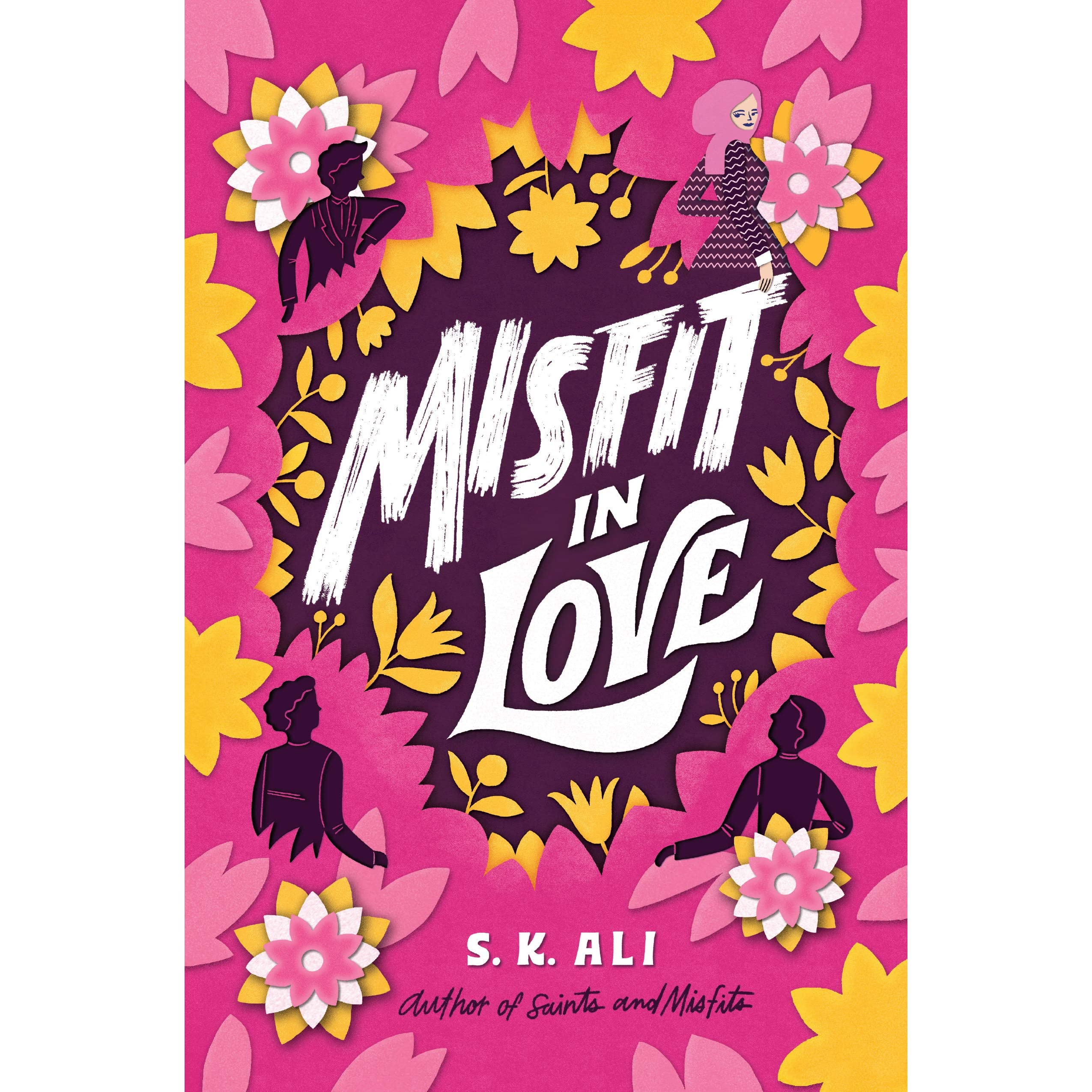
I reread my review of Saints and Misfits before diving in to this sequel that can also work as a stand alone, and imagine my absolute delight when all the things I wanted more of: Muhammed and Sarah, the mom, Jeremy, etc., were explored in this wonderful high school and up, 320 page, romantic comedy story.  The romance stays halal and the comedy light, but seamlessly interwoven into a weekend wedding are very serious notions of racism and prejudice within the Muslim community.  The writing is flawless as I tried to tell the summary to my daughter I realized just how many characters there are in the book, yet while reading, I never once was confused about who someone was or how they fit in to the family, it really is quite remarkable how real and personal the characters all become.  In many ways the story is uniquely an American-Muslim (arguably) one with characters that are half this culture, a quarter that, wearing cultural clothes to coordinate with friends, mutli lingual, multi ethnic, and yet all coming together as friends and family.  We, nor are the characters perfect, but that our weakness is explored in fiction so that we all might benefit in reality, is truly remarkable.  I honestly couldn’t put it down, and my teen and tween children may or may not have had to figure out their own meals, as I hid in the corner to devour this book in a single day. I regret nothing.

SYNOPSIS:

Janna Yusuf has just graduated high school and has been spending the last few weeks at her father’s sprawling house on a lake to help with wedding preparations for her beloved older brother.  What started out with plans to be a small nikkah between Muhammad and Sara, has quickly snowballed into a “wedding” with a few hundred guests and an ever evolving color scheme.  With extended family and friends pouring in over the three days, Janna is anxious to see Nuah and finally tell him that she is ready to return his feelings, reunite with her mom after being apart for weeks, and see who her best friend Tats is bringing as her plus one.  But, Nuah is acting weird, her mom seems to be considering remarrying, and her father is revealing himself to be racist.  There is a lot going on, and in between wedding preparations, possible crushes, family drama, prejudice overtones, and a curious ice cream man, Janna is having an unforgettable weekend.

Janna and Muhammad are close, they are the children of an Indian American non practicing father and an Egyptian American religious mother.  Their parents have been divorced for a while, and their dad and his Greek wife Linda have two little boys and are hosting everyone and the wedding.  The heart of the story is Janna as she thinks she is ready to pursue something halal with Nuah, but is slightly intrigued by Sara’s cousin Haytham and very perplexed by her mother’s potential future new husband’s nephew Layth. Being it is a wedding, and many people are staying at her father’s house and many more at the hotel in town with their own families.  Jana is trying to figure stuff out about Nuah while hanging out with Nuah’s older pregnant sister.  She is constantly thrown together with Layth as she meets his Uncle Bilal, her mom’s college friend that has proposed to her, and who’s own daughters are friends of Sarahs.  Yeah, there is a lot of overlap, a lot.  It’s like real life. As attractions wax and wane in such a short time, it is the relationship Janna has with her own family and the contentment she must find within herself that ultimately matter most.

WHY I LIKE IT:

I love how authentic the story and its characters are.  I come from a small family, but a very close friend has a huge family, and this just reminded me of going to her family events and finding how interconnected and small the world really is.  I absolutely love Janna, she is Muslim by choice through-and-through and is genuine in her understanding and actions that, while the book is meant for Muslims and nonMuslims, she really sets the standard of how fictitious characters can positively affect their readers.  The only slightly forced thread for me was Janna suddenly loving animals and being ready to head to Peru.  I get that she was crushing, but it seemed a little too over the top for an otherwise very plausible plot.

The best part of the book, in my opinion is that it isn’t all fluff and fun, there are some very real issues that get spotlighted.  Like in Saints and Misfits where Janna is sexually assaulted by a seemingly devout, religious, well liked male, this story addresses racism and prejudice within the Islamic community.  Janna’s dad always felt treated as less than by Janna’s mom’s family for not being Arab.  He flat out warns Janna about her feelings for Nuah because he is Black.  Sarah’s Aunt is offended that the mendhi is more Desi than Arab.  The issues aren’t just pointed out, they require active acknowledgement and action.  The author’s note at the end, even discusses the significance and weight of such views at the end.

FLAGS:

There are mentions of the sexual assault that happened to Janna in the first book.  There is mention of periods, a possible affair, racism, and a character who drove while drunk and killed his son as a result.

TOOLS FOR LEADING THE DISCUSSION:

I don’t know that this book would be a great fit for a school book club, but I think a group of high school or college aged girls would thoroughly enjoy reading this and discussing it, and I would totally invite myself to their gathering to do so.

My First Book About the Qur’an: Teachings for Toddlers and Young Children y Sara Khan illustrated by Ali Lodge

Standard
My First Book About the Qur’an: Teachings for Toddlers and Young Children y Sara Khan illustrated by Ali Lodge

img_9014

I had planned to review the Ramadan book in Sara Khan’s My First Book about series, but needless-to-say all of the board books in the collection look remarkably similar and the one on my shelf, that I thought was the Ramadan one is this one, the one about the Qur’an.  Rather than find another Ramadan book, I figured to just go with it, Ramadan is the month of the Qur’an after all, and the book is both informative and engaging for little Muslims.  The soft detailed pictures and sturdy binding introduce toddlers and up to the belief in Allah, the pillars, care for all creation and being good to one another.

img_9015

The book starts out stating the the Qur’an tells us in the beginning there was only Allah, and that He created everything.  His creations are as big as the heavens and the Earth and as small as the creatures we cannot even see.  He created the trees and mountains and the angels and jinn, as well as the people, He made us all special.

img_9017

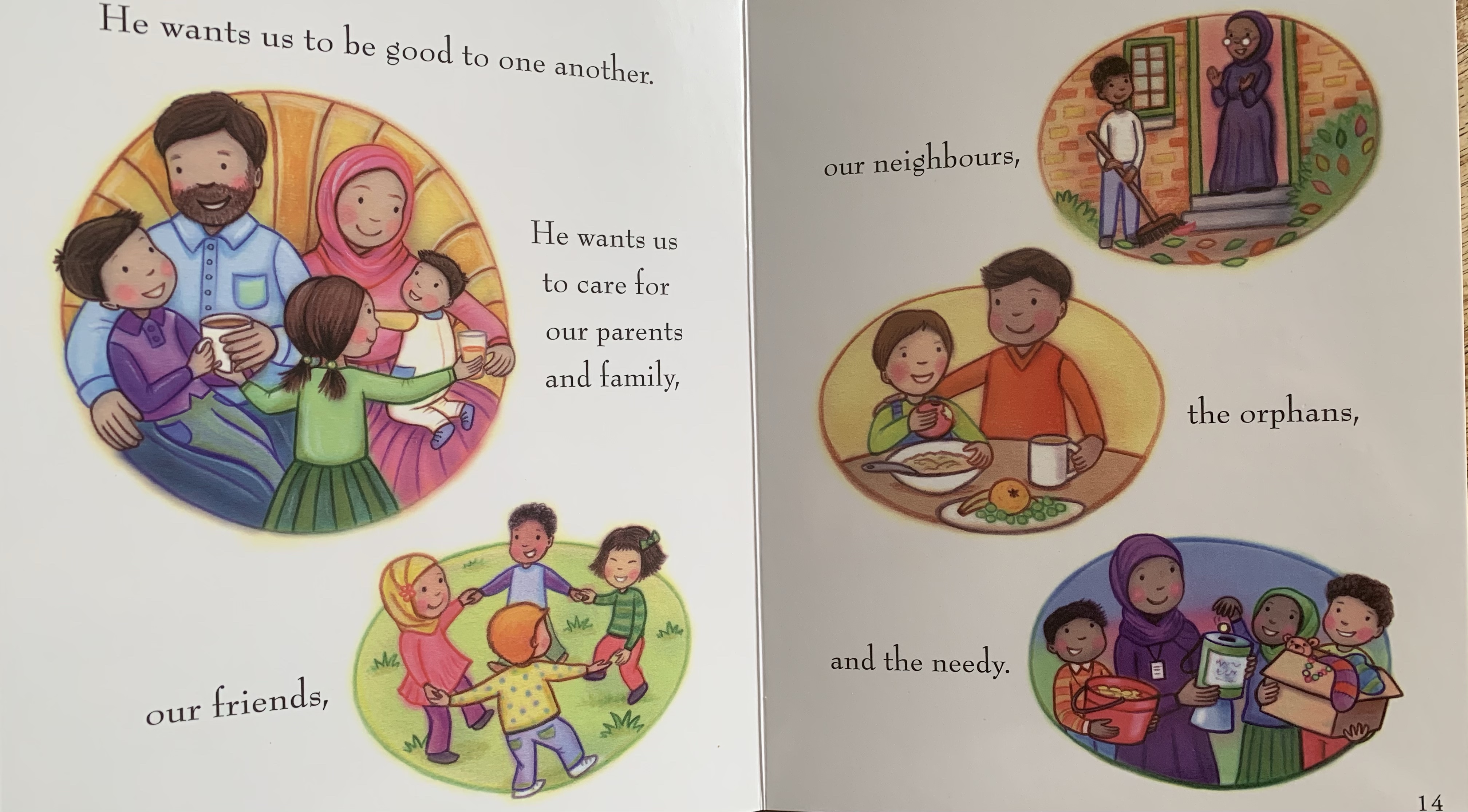
Allah wants us to follow His rules and sent books and Prophets to show us how to act.  He wants us to be good to one another, to be thankful, to look after our world, and everything in it.  Allah wants us to worship Him alone and pray five times a day, fast in Ramadan, give money to the poor, and go for Hajj.

img_9016

He also wants us to have families and to get married and raise our children to be good Muslims, so that when we die we will go to Paradise.  The book ends with facts about the Qur’an and questions and answers that can help further the conversation, increase understanding, and encourage love for the holy book.

Zayan Unlocks the Quran by Najia Syed illustrated by Rizky Dewi

Standard
Zayan Unlocks the Quran by Najia Syed illustrated by Rizky Dewi

img_8703

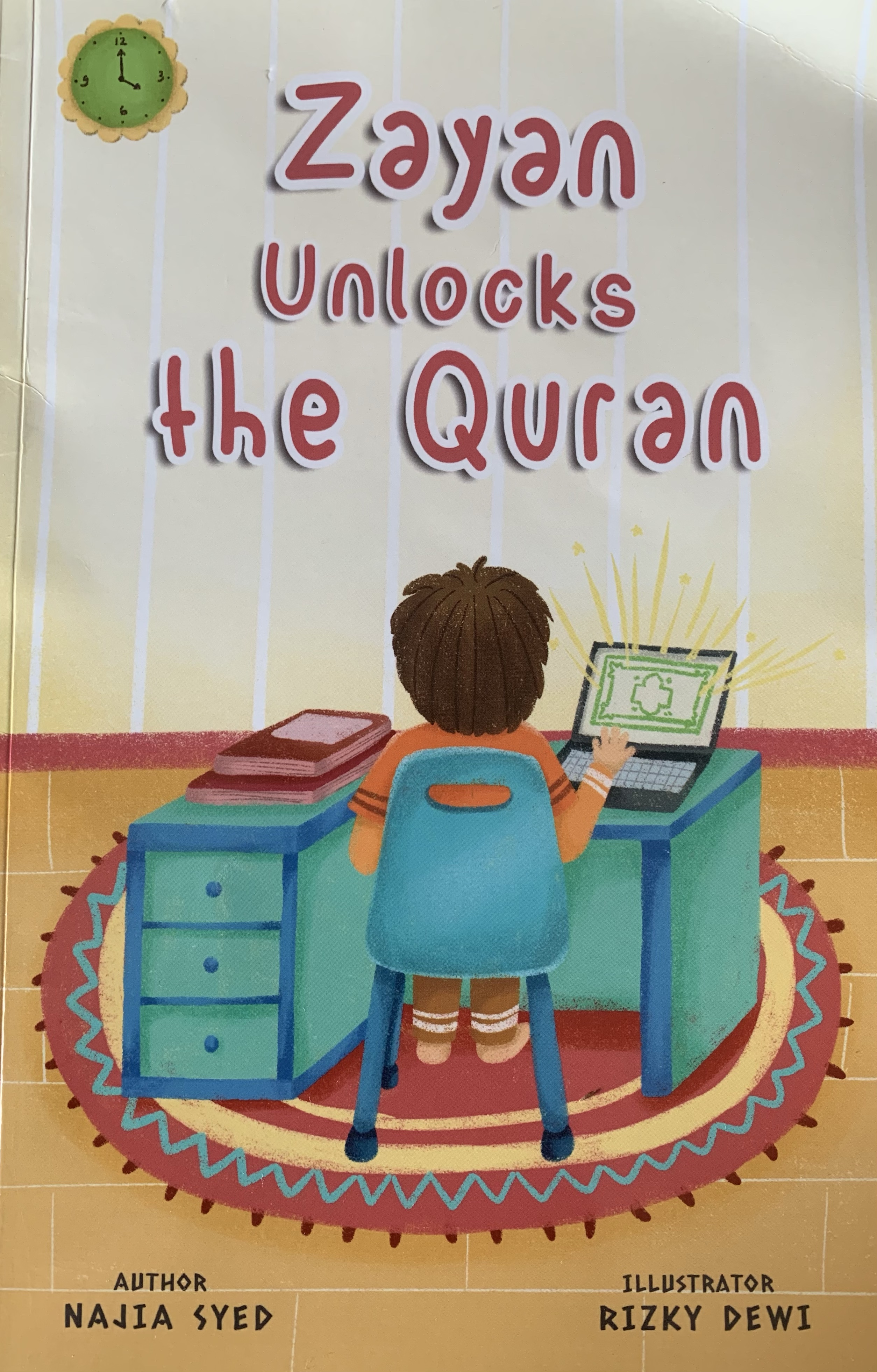
There is a lot of good information and relatable lessons in this 45 page didactic book encouraging children to get to know the Quran, and to not just recite and memorize it, but the presentation just doesn’t do it any favors.   I can’t imagine that seven and eight year olds are going to identify with the five year old protagonist learning how to add and getting in fights over crayons at school, nor that five year olds are going to have the patience for the explanations and understand the story.  The word story in and of itself is a stretch, it is a bunch of ayats from the Quran that are explained to teach young Zayan lessons that reflect his daily life and how he can succeed and inshaAllah earn jannah in the akhira.  The intention is really good, I just wish there was a bit more plot and that the book’s appearance made more sense.  Having the book look and feel like a leveled reader on the outside, but be completely tiny text filled, save a few entire page generic full-color pictures and green bannered meaning of the Quran’s translation, the book and its seven chapters are intimidating.  Space it out, make it an early chapter book in look and feel, revise the premise that a child has no idea what the Quran is, and is completely shook by learning from the kind and patient Qari Sahib that the Quran has lessons and rules to make us better.  It is a stretch to get the book going, it has some wonderful points along the way, and leaves a warm feeling when completed, but I can’t figure out the intended readers age, nor can I imagine many kids will willingly picking it up.  Like the character in the book dreading Quran class, I’m afraid getting kids to read this would similarly be met with dread, which is a shame, because the lessons are strong, the story and presentation just need a bit of polishing.

img_8704

SYNOPSIS:

Zayan does not want to leave his toys for Quran class which he attends one-on-one on the computer with his teacher, Qari Sahib.  Reading the Arabic is hard and confusing, he doesn’t understand what he is reading and he would rather be playing.  He has just built a fort and is afraid if he leaves it for class, his sister will destroy it, (over the first few pages I was convinced his sister was younger than him, and a little confused to learn that both are older).  When he begrudgingly logs on, Qari Sahib can tell he is upset and tells him that being kind to his siblings is a good deed and that many good deeds are in the Quran.  Zayan is shocked.  Qari Sahib offers to read some ayats to him and he can just listen before they resume reading Surah Fatiha.  Zayan is blown away at how pretty the Quran sounds when recited and his eyes sparkle when he learns that the Quran contains directions to get to jannah.

Chapter two explores how the ayats in the Quran about kindness can relate to Zayan’s life.  Being kind to your parents, speaking in a low voice, and not making fun of each other.  Ayats are pulled and connections made so that Zayan can inshaAllah implement his new knowledge in his life.  Zayan returns to playing after class and tests out what he has learned.

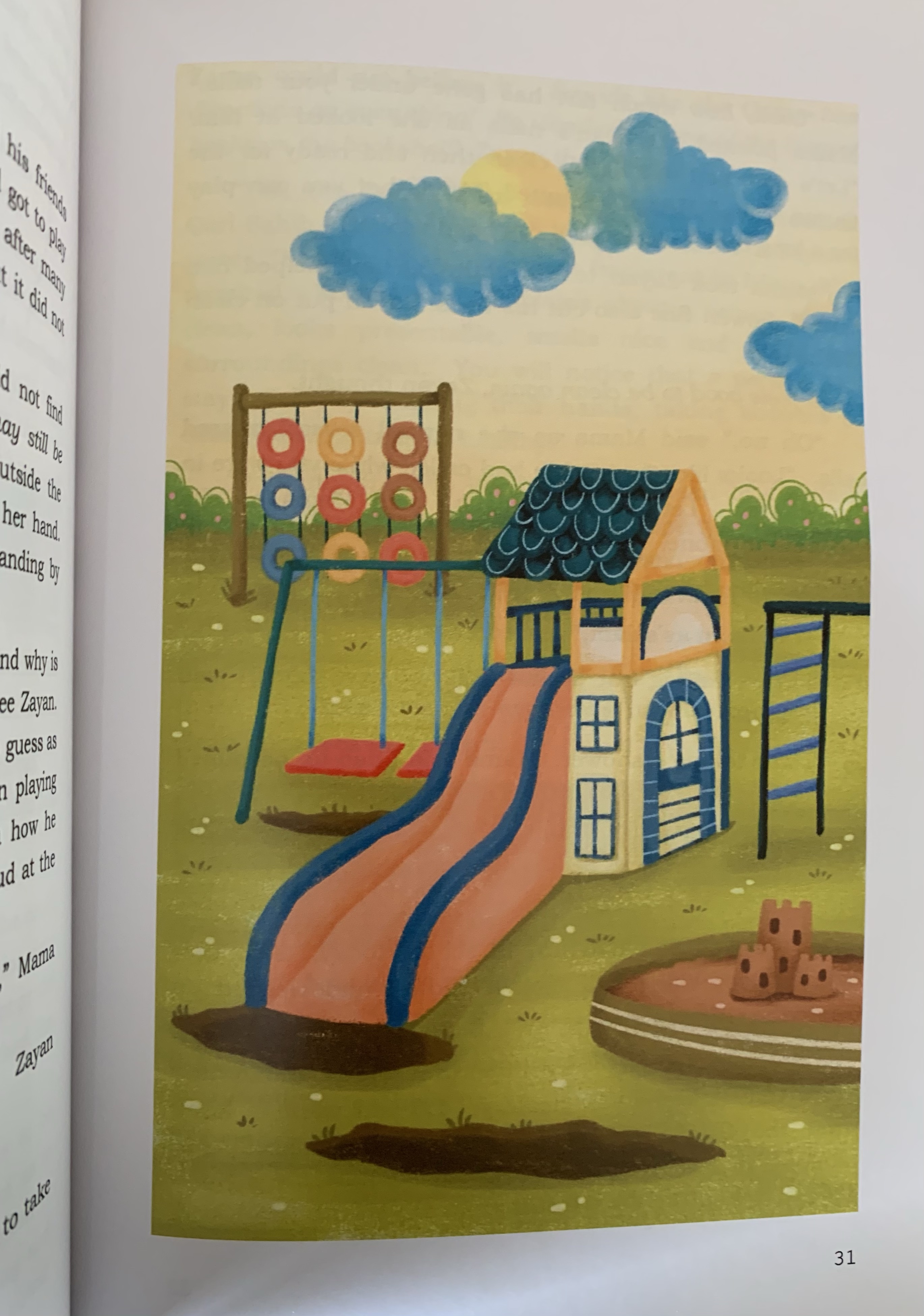
This pattern continues with chapter three discussing respect, then anger and forgiveness, cleanliness, and honesty.  The parables come when he doesn’t listen to his mother about finishing his grapes, a fight at school involving crayons, playing in the mud and lying about feeding his pet cat. At one point he remarks that much of what his teacher explains to him from the Quran are things that his mother also tells him, almost like she has read the Quran.

img_8705

WHY I LIKE IT:

The first few lines are so relatable.  The dread of the child putting the entire family on edge, it is real.  I love that Qari Sahib is kind and gentle and patient.  When the mom mentions things to him about Zayan he finds ways to talk to him about it, without lecturing or reprimanding.  I think the Qari Sahim is the real hero in the book.  I particularly like when he went in to detail about our responsibility to care for animals.  I’m glad Zayan has him to guide him because clearly his parents have failed.  Yes, I’m being judgey.  The kid doesn’t know what the Quran sounds like, doesn’t know why he is being forced to read it in Arabic, doesn’t know what it even is about? I’m not so much judging the fictitious parents, more the inconsistent writing.  If Zayan doesn’t know that his mom has read the Quran how does he know what jannah is and who shaytaan is?

FLAGS:

none

TOOLS FOR LEADING THE DISCUSSION:

Obviously not for a book club selection, but I’ve been trying to figure out if maybe my five year old and I could discuss some of the chapters together.  I wouldn’t want to read the whole book because my child loves the Quran and doesn’t dread reciting, I have five children, I know tomorrow it can change, I’m not naive, I’m just saying for him particularly right now, it isn’t a chore and I think if I presented it as a boring thing, he will start to mimic that frame of mind (my older kids know not to ever bash certain teachers, concepts, spiciness of food etc. in front of their younger siblings for this very reason).  But, while some of the lessons are really well thought out, they are just too much for a five year old.  The pictures don’t engage and the text overbearing.  I asked my 10 year old to read it and he found it really childish and didn’t finish.  If the book works for you, alhumudillah, I’m glad, it is a benefit, I wish it worked for me too.

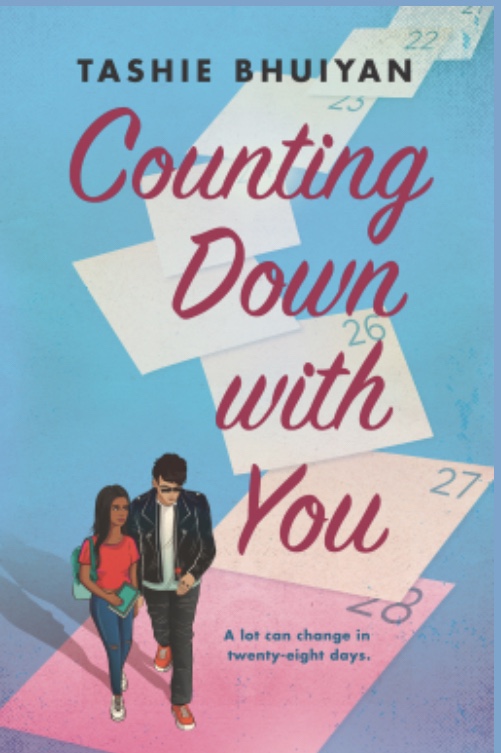
Counting Down with You by Tashie Bhuiyan

Standard
Counting Down with You by Tashie Bhuiyan

img_7940

I have to be honest that this book really held my attention and was hard to put down for about two-thirds of the 416 pages.  I was genuinely invested in the characters and wanted to see how it all resolved.  Sadly, by the end, I was disappointed with the conclusion, the predictability, the stereotypes, and the cliche’ of it all.  The author mentions in the forward that she is representing her story, not a representation of all Bangladeshi- Muslim American girls, but for an OWN voice book with such a clever premise, I really wanted to be shown more than I was told, I wanted to feel the protagonists strength, and cheer her on as she found her happiness on her terms.  But alas I felt that she let other’s fight her battles and she really only threw her religion and culture around as weighted plot oppressors, not as strands of her life that she had to decide to embrace or understand in the process of growing into herself.  There was a lot of potential to discuss mental health and family expectation, but the end unraveled all that the book could have been.  Undoubtedly the author is a good writer, and brown Muslims are not a monolith, but I feel like sometimes we need to square away who we are before we just clamor for what we want.  This book has relationships, it is a romance novel afterall, but whether the characters are straight or LGBTQ+, there isn’t more than kissing and hand holding and would probably be fine for 9th grade and up if you are ok with a Muslim lead lying to her parents and having a boyfriend.

SYNOPSIS:

Karina Ahmed is 16 and expected to be a doctor when she grows up.  Her conservative Muslim parents are immigrants from Bangladesh and very over protective of their oldest child.  Samir her younger brother, a freshman, is a robotics nerd and the pride of their family.  Karina loves English and wants nothing more to major in English in college, but her parents are insistent and despite her struggles with math and science she is determined she has no choice in the matter and must make them proud by being a doctor.  This inability to be what her parents want has caused tremendous anxiety within Karina and when her parents leave for a vacation to Bangladesh for a month, she is hoping to be able to relax and enjoy life for 28 days with her Dadu, paternal grandma, and her friends, Cora and Nandini.

The only extracurricular activities Karina is allowed are Pre-Med Society and tutoring, where she helps others with English.  Her teacher asks her to tutor a classmate one on one to prepare for the end of the year exams, and reluctantly she agrees.  Very reluctantly.  The classmate is brooding resident bad boy Ace Clyde, a beautiful slacker that seems to not care about much.  In Karina’s efforts to get Ace to study and taking advantage of limited parental supervision, Karina goes with Ace to a sweetshop and even ends up at his house where she meets his family.  Ace is not ready to admit to his incredibly wealthy family that he is seeking help from a tutor and instead introduces Karina as his girlfriend.  Ace’s older brother Xander, the Student Body Class President, isn’t buying it, so Ace announces it on social media and shows up the next day with coffee for Karina as he walks her to class determined to convince everyone that they are indeed a couple. Karina is not ok with this, but he does promise her a dozen books a week and he is aware that the “relationship” can only last 28 days, so she is in.   Karina’s friends predict that they will fall hopelessly in love and they are pretty correct.  Over the course of the next three and half weeks the two grow closer, he even comes over and spends time with Dadu and Samir.  She encourages him to fix his relationship with his family, and he encourages her to fix hers.  And somewhere in the midst of pretending they decide to make it real and then Karina’s parents return.  She at this point has been cheered on to stand her ground on confronting them about not wanting to be a doctor by Ace, Cora, Nandini, Dadu and Samir.  The conversation does not go well and Karina goes into a two week slump pushing everyone out before she *spoiler alert* resolves to date Ace in secret as long as he respects her lines, and Dadu stands up to her parents for her.  The story concludes with her going to Jr. Prom and her resolved to just stay strong for a little while longer until she is “free.”

WHY I LIKE IT:

I like that I really didn’t know if the book would turn cliche until it ultimately did.  I really liked the realness and rawness of Karina coping with her anxiety and her friends supporting her in Googling coping mechanisms and helping her test them out.  I feel like it was a missed opportunity for Karina’s parents to not reach out to her, or for Karina to even mention that they were missing it.  I think readers that see themselves in Karina would have hoped to see that story thread play out and give them hope of getting help and support or at least getting it out in the open to normalize it.  I love the growth of Samir once Karina make him aware of the double standard, but I feel like he doesn’t read with a consistent persona.  He has a job, he has friends, he likes a girl, but he reads like he is clueless and maybe 10 years old at best, not in high school.  A bit off for me.  And of course you have to love Dadu, a wise old woman who supports her grandchildren and sticks up for them.  I wish Karina would have taken her cues from her beloved grandmother and stood up to her parents with Dadu in the room rather than let Dadu fight the fight and just stand there.  I thought the big climax would be Karina standing up to her parents, so I felt let down when she let someone else fight her fight.  Yes Karina tried and failed, but I think her grandmother should have backed her up in round two, not taken over.

Karina throughout says she is Bangladeshi-Muslim and uses it as a reason to fear her parents and feel obligated to not date or study English.  She does say she isn’t against religion, and actually likes being a Muslim and praying and knows Allah loves her, but that it is the tradition that blindly is followed that gives her trouble.  Her maternal grandfather is an Imam and her mom is much stricter than her father, but he follows her lead in raising the kids.  My critique isn’t so much to argue with the author’s perspective about religious standards, but more a literary one, when the character says she is Muslim and uses that to reason why she has lines, but yet is never seen praying or wresting with what she wants and what she believes.  Never asking Allah for help with her anxiety or confronting her parents or anything for that matter.  As soon as her parents leave she is in a crop top, so where is the religious line and where is the cultural one?  Where is her understanding of her culture and where it fits in her life and where she wants it to fit in her future? Is she Muslim because her parents are or because she believes it? She won’t eat ham, and eats halal, but later eats meat at Ace’s house? Everyone, even fictional characters, get agency, but in a book where the premise is a fake relationship turned real turned rebellious because of religion and culture, a little introspection seems warranted.

The conclusion after hundreds of pages of being called lionhearted and brave and strong seemed diminished when going to prom and lying to parents and having grandma fight your battle is the happy ending.

FLAGS:

Relationships: The main couple hold hands and kiss. There is a supporting character that is bisexual as is a cousin, one is gay, they hold hands and kiss as well. Nothing more than that or detailed. There is lying and deception.

TOOLS FOR LEADING THE DISCUSSION:

I don’t think I would do this as an Islamic School book club selection because it would imply agreement with lying and going behind your parents backs.  Granted her parents are difficult and her grandma is aware and ok with the situation, but I still think it would send the wrong message to endorse such behavior from a religious school perspective.

My First Book About Allah: Teachings for Toddlers and Young Children by Sara Khan illustrated by Ali Lodge

Standard
My First Book About Allah: Teachings for Toddlers and Young Children by Sara Khan illustrated by Ali Lodge

img_8046

This 26 page non fiction sturdy board book packs in a lot of information in a really simple way that will keep little one’s attention and hopefully encourage them to ask deeper questions as they grow.  The illustrations are soft and alternate between detailed familiar scenes and simple background style scenes that draw attention to the text on the page. It covers the Shahadah, who Allah (swt) is, it mentions that He has 99 names,  that He sent us the Quran and the final messenger is Prophet Muhammad (saw).  The book at times is wordy, and perhaps the vocabulary a bit above a toddlers level, but the flow is smooth and the tone is warm, inviting, and is requested often by my little ones. (It is reasonably priced by at small bookstores, and double the price on Amazon).

img_8047

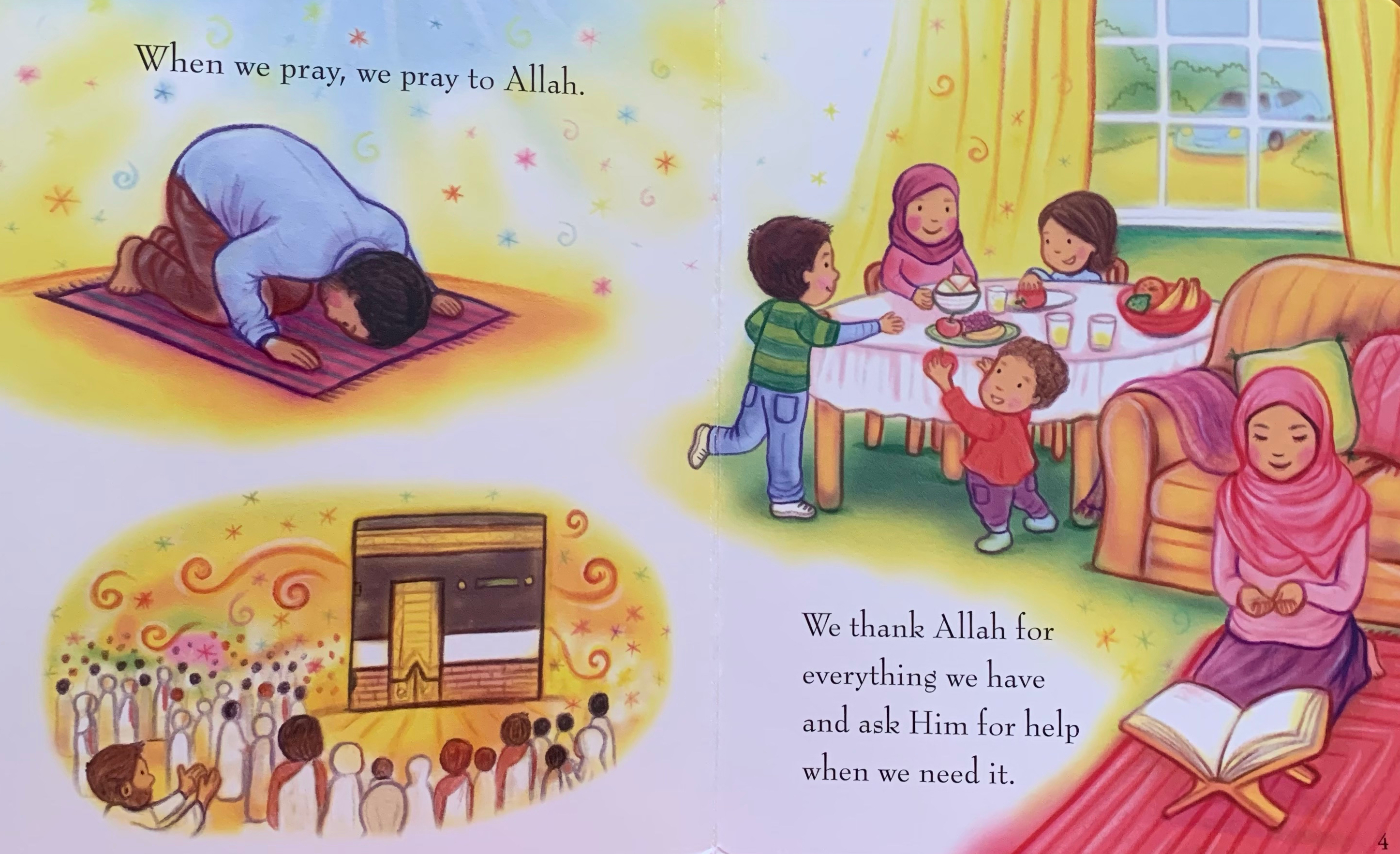
The book starts off by stating that Muslims believe that there is only one God and His name is Allah.  It shows it in Arabic as well on a very muted background.  The next page is much more lively with illustrations showing someone pray, a picture of the ka’aba, a family eating, and a mother reading Quran and making dua.

img_8048

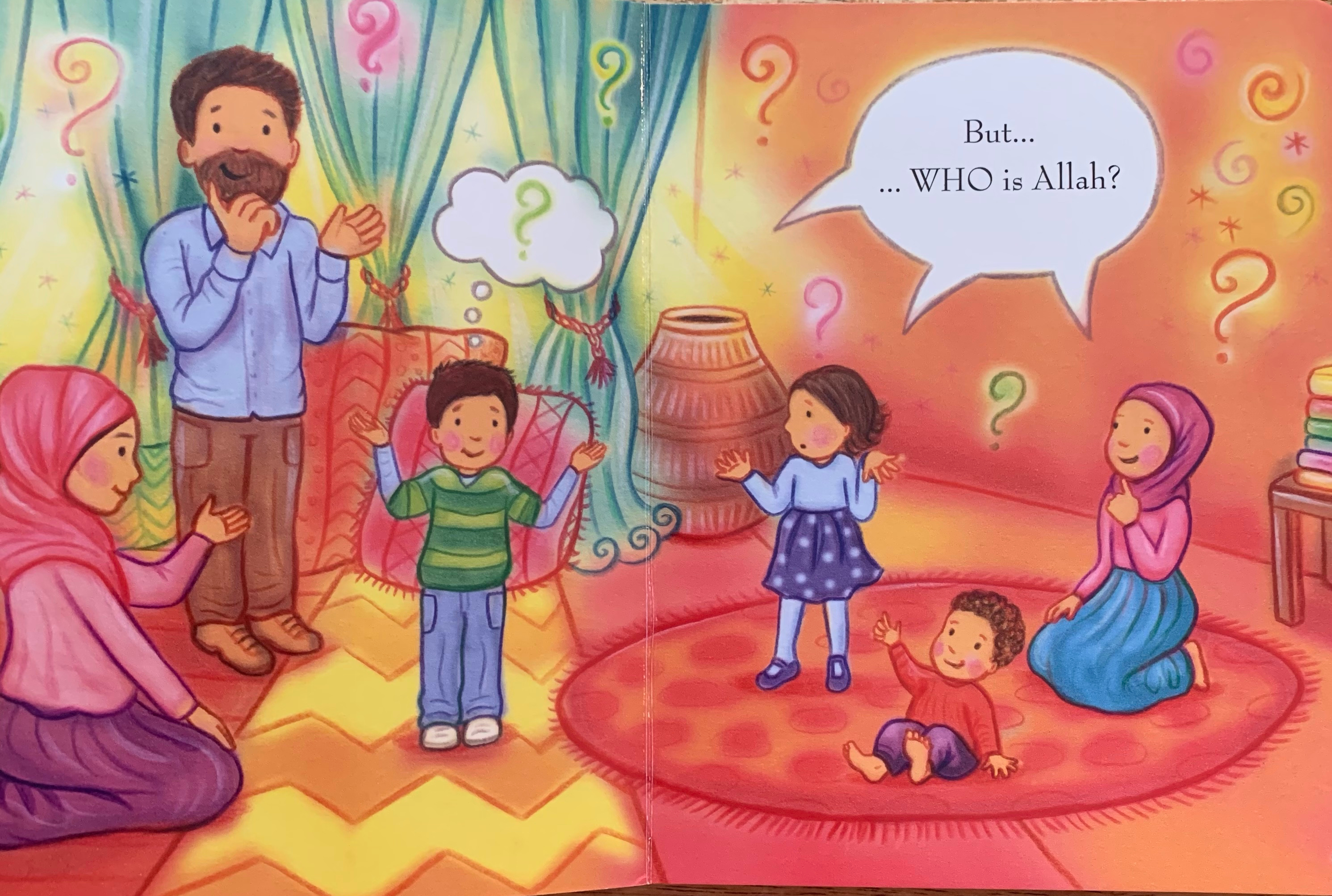
The family is then depicted gathered together with the little children asking “WHO is Allah?” and the book dedicating the next few pages to explaining that Allah swt, is the One who made everything and has power over all. He makes the sun rise and set and everything in the heavens and the earth belong to Him.

img_8049

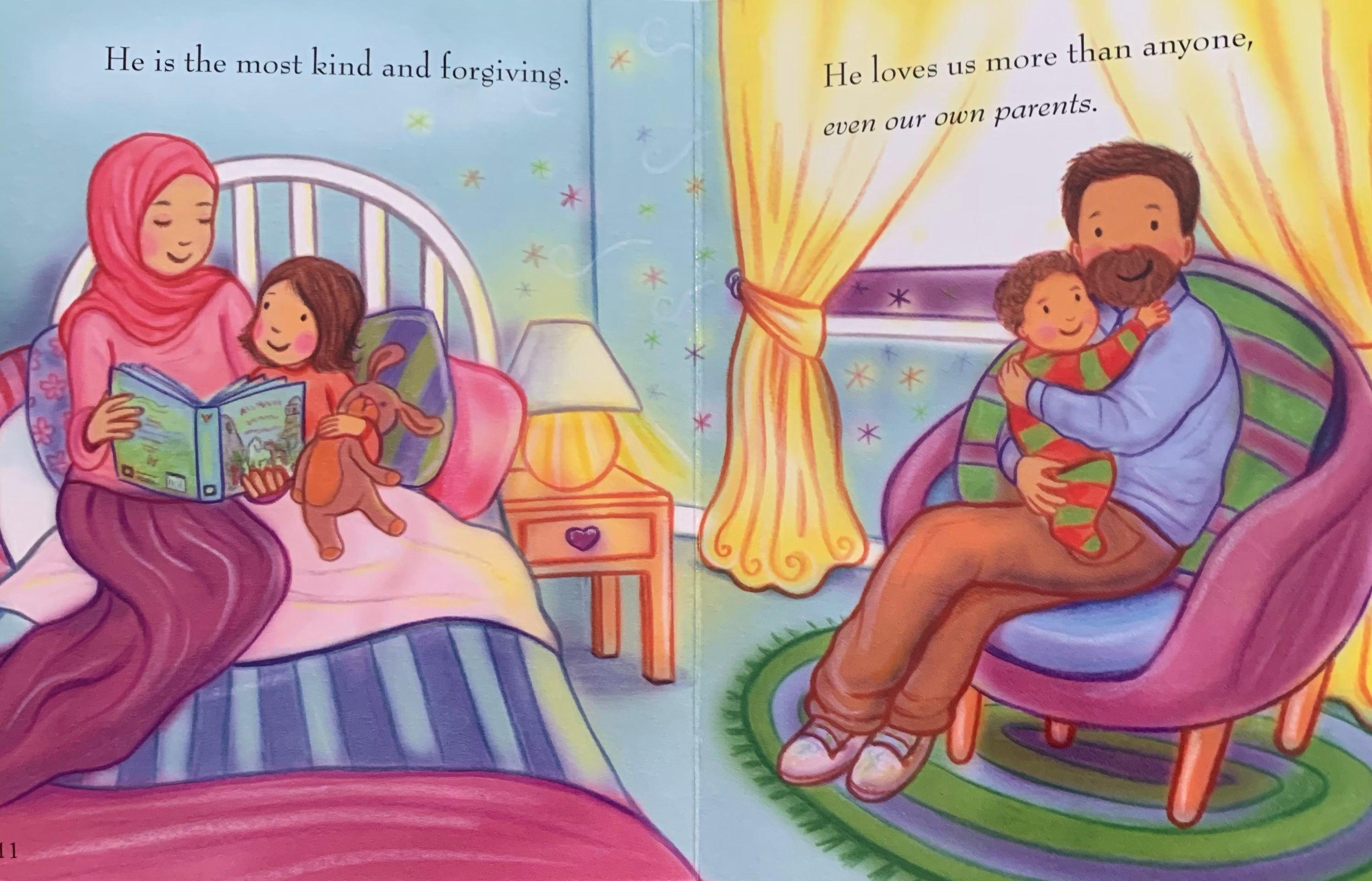
The book explains that Allah even loves us more than our own parents before explaining that Allah has 99 names and Ar-Rahman and Ar-Rahim are the ones we hear the most.  The background has many of the names of Allah written in Arabic.

img_8050

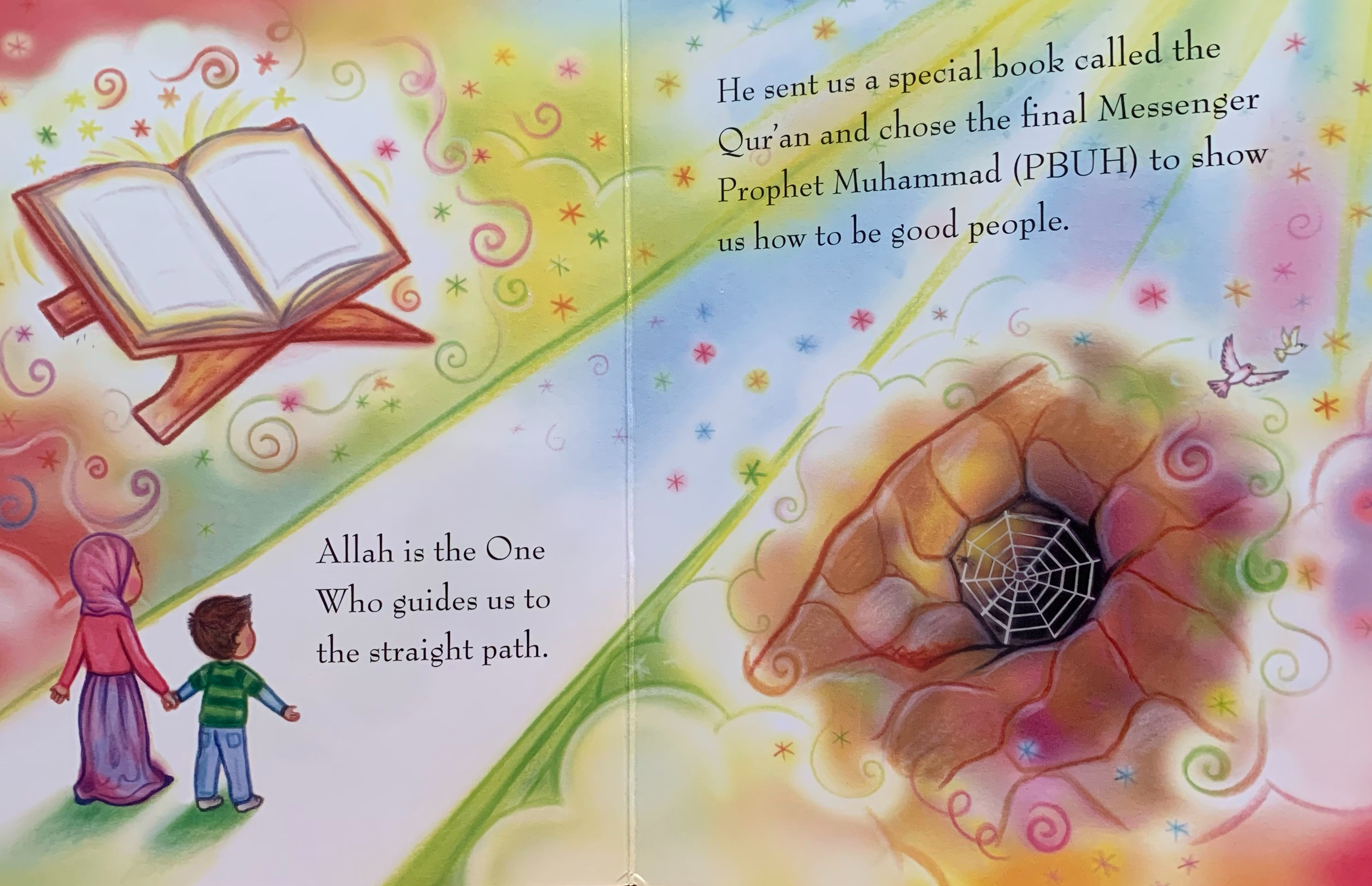
The family prays knowing Allah is All Hearing and All Seeing.  An illustration of a cave with a bird and spiderweb accompany the page that tells us that He sent us the Qur’an and Prophet Muhammad (saw) to show us how to live. InshaAllah if we do as we are supposed to, we are promised paradise and Allah never breaks His promise.

img_8051

The book concludes with Facts about Allah and Questions about Allah (swt). The pages are glossy and 6 x 8 in size.

img_8053