Tag Archives: Muslim Characters

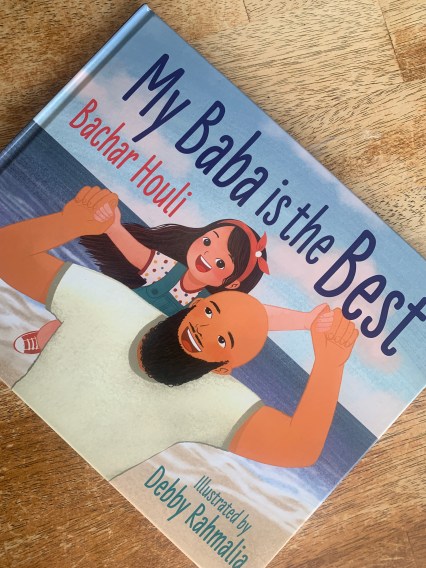
My Baba is the Best by Bachar Houli illustrated by Debby Rahmalia

Standard
My Baba is the Best by Bachar Houli illustrated by Debby Rahmalia

img_7434

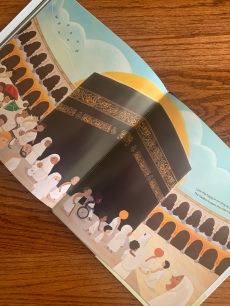
This 32 page horizontal picture book by an Australian footballer starts out much like a list detailing why a little girl loves her Baba, after a few pages though of more superficial delights, the book gets deeper.  It shows the family making duas at bedtime, going to the masjid on Fridays, it even gives a little insight into Eid and fasting before it then takes readers on a camping trip.  There isn’t really a story or plot, but the bouncing around fits the narrator’s point of view and will appeal to the intended target audience.  The book is mainstream published by Penguin in Australia, so I absolutely love the inclusion of Islam, the mom in hijab, the dad’s beard and the love shown between the little girl and her Baba.  Sometimes celebrity books feel a little forced, but having never heard of this athlete, I still found the book incredibly sweet and joyful, and the illustrations by a Muslim illustrator a great amplification of the simple heartfelt text.

The book starts with a little girl rushing to give her Baba a hug on the field as fans cheer in the background.  After all her Baba gives the best hugs, it then mentions that he is always doing something and shows him washing his boat and jumping on a trampoline with the little girl and her younger sister.  The trio garden, exercise, ride bikes, train and go fishing. They also watch movies at the theater or at home with the whole family. At night Baba reads special prayers to protect them while they sleep.

On Fridays, the family goes to the mosque for prayers, and the most special time is when they all go for Eid in their best clothes.  They listen to the imam and give donations to those in need. They open presents and after fasting they eat Lebanese pizza before going to visit teta and jeddo.

The best time is when they go camping.  They all set up the tent, and get sticks to roast marshmallows.  They even see kangaroos eating dinner before heading back to eat theirs.  On many of the pages it is just the girl and her Baba, but even when the whole family is present, the focus is on the strong relationship between the two.

The book is very endearing and as a daddy’s girl myself, I love seeing the relationship unfold on the pages with big things, and little things, fun things, and reflective things, and from the little girl’s point of view.  The book is not readily available in the United States, I purchased mine from Book Depository, where they offer free shipping.

The Night Before Eid: A Muslim Family Story by Aya Khalil illustrated by Rashin Kheiriyeh

Standard
The Night Before Eid: A Muslim Family Story by Aya Khalil illustrated by Rashin Kheiriyeh

img_7123

This 40 page early elementary picture book is set the night before Eid and radiates with love from a boy to his Teita, traditional ka’ak, and the family’s Egyptian culture.  The robust and personal backmatter shares a glimpse into the threads from the author’s real life that the story touches upon, and makes the book extend beyond the pages.  It is worth noting that this book does not articulate if it is for Eid al Fitr or Eid al Adha and thus works for both.   There is nothing religious in the book except a reference to something happening after Eid prayer in a memory, and the shape of the cookie being round like the Ramadan moon, Eid day is not mentioned, it is simply the catalyst for this warm family story about a boy and his grandma making a special treat for the first time and sharing it at school.  The large hardback book with fun illustrations is ideal for both story time and bedtime readings alike.

img_7124

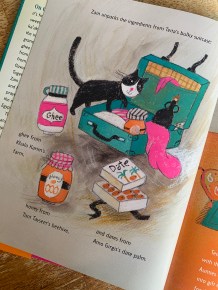
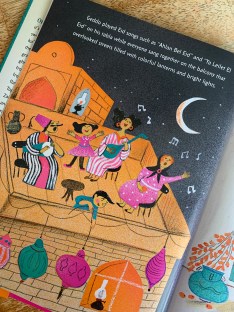
It is the night before Eid and Teita has arrived from Egypt.  Zain can’t wait to make ka’ak to take to school and share with his friends.  The beloved powdered sugar cookies are steeped in tradition, both in Zain’s family and in Egyptian history.  Once the suitcases is unpacked and the special ingredients found, Teita and Mama share memories of baking with cousins, painting henna designs on hands and putting eidiya in envelopes.  The family recalls singing together on the balcony while Geddo played the tabla and lights and lanterns filled the streets below, after Eid prayer they would hand out the ka’ak.

img_7125

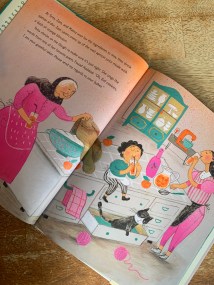
Zain wants the ka’ak to turn out perfectly so his teacher and friends will like them.  Teita tells him that ka’ak is as old as the ancient pharaohs, and that recipes were found in the pyramids.  At one time rulers would even put gold coins in the cookies.  Zain and his Teita mix and add the required ingredients, and drink iced apricot juice as they wait for the dough to be just right.  Getting the cookies pressed with the molds though is harder than it looks, and Zain gets frustrated. Teita’s love and patience and Zain’s clever thinking get the treat making back on track.  The ka’ak doesn’t have a gold coin filling, but they are filled with tradition.

img_7126

The timeline is a bit off for me with the grandma coming before Eid and then the cookies going to school on Monday, and then Monday evening when Zain is writing down the recipe with Teita he is telling her Eid Mubarak and that it is the best Eid ever.  So, it seems that he went to school on Eid, not to Eid prayers, which is fine, just a little sad that there was no Eid celebration or prayers.  I don’t know that kids will be bothered by it, but the lack of mirroring and stressing how joyous Eid is does somehow get lost and mitigated, in my opinion, by skipping acknowledgement of the religious holiday.   In the backmatter the author remarks that she has “outgrown the magic of Eid,” so perhaps it is intentional that the day is not included in the text.

img_7127

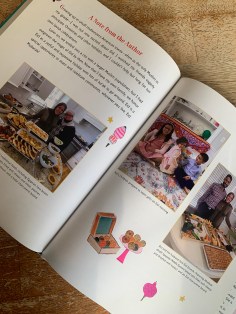
The last six pages of the book are filled with informative and engaging information about What is Eid, Ka’ak Time Line, A Note from the Author with photographs of her and her family celebrating Eid, a Simple Ka’ak Recipe and Additional Resources.

I purchased my copy from Crescent Moon Store where if you put my initials ISL (Islamic School Librarian) in at checkout you will save 10% or is available here on Amazon where the book currently has a coupon for $3.80 off.

The Ramadan Shield by Fadelah Mahmood illustrated by Ayun Sekar

Standard
The Ramadan Shield by Fadelah Mahmood illustrated by Ayun Sekar

img_7028

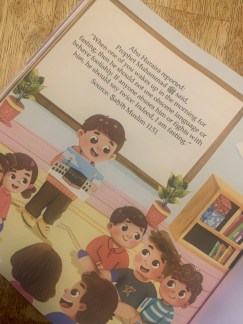
This new 32 page rhyming book focuses on a boy who gets frustrated and often loses his temper and how the onset of Ramadan has his father imparting the lesson that fasting isn’t just staying away from food and drink, but also about behavior and controlling your anger.  He shares the hadith of saying “…I’m fasting, I’m fasting,” which is shared in its entirety and sourced at the end.  The book has a lot of text and scenarios in its moral framed telling that creates a bit of a disconnect between the presentation and the target audience.  The characters are fasting, there is no discussion about why they are fasting or that it is a first time fasting (thank you). the child’s art assignment is pretty advanced, and friends are seen independently out and about, but the rhyming lines and illustrations at the end of the kids on the rug seems aimed at a much younger reader/listener.  For my purpose of story times to children 4-9 it is a great choice, because it can appeal to the large range of relatability and attention spans, but for repeated readings in a home, it might need some shortening or additional explaining to connect as intended.

img_7029

The story starts with Nuh working on an assignment to draw and paint a picture of the Kaba, but it keeps coming out tilted and he crumples and throws page after page.  His dad snuggles him close and explains that Shabaan is over and Ramadan is about to start which means that he needs to go without food and water, but also work on his behavior.  He explains, how to use the advice of saying, “Fasting is my shield; I will not be defeated! I am fasting, I am fasting.”

img_7030

Empowered by the words, Nuh starts his next morning remembering his father’s advice.  When he spills water on his painting he remembers the advice. When a grocery cart collision at the store with his nemesis gets his fist clenching, he remembers his father’s advice.  He even gets a chance to share his knowledge with his friends.

img_7031

When the day is over he is eating iftar with his family and determined to keep his temper at bay throughout he whole month and beyond, inshaAllah, starting with him trying his drawing of the Kaba again.

img_7032

I like that the focus is on behavior, I think that is a good reminder for older kids, and something younger kids that may or may not be fasting need to implement in Ramadan.  I also like that the parents are encouraging and invested, but not controlling the individual situations.  The book is preachy, and when the kid takes the lesson and starts preaching it to him, it is a little heavy handed, but I think it fits with the nature of the book.  I appreciate that the kid knows what Ramadan and fasting is, so that the lesson can go a bit deeper in this Islamic fiction story.

I got my copy from Crescent Moon store, and you can get yours there as well by clicking this link here.  If you use code ISL (Islamic School Librain initials) at checkout you will save 10%,

The Adventure of Faris: Faris & the Curious Case of the Missing Eid Presents by Muhammad and Husna Sattaur illustrated by Farimah Khavarine Zhad

Standard
The Adventure of Faris: Faris & the Curious Case of the Missing Eid Presents by Muhammad and Husna Sattaur illustrated by Farimah Khavarine Zhad

img_6999

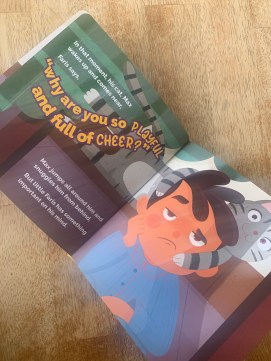
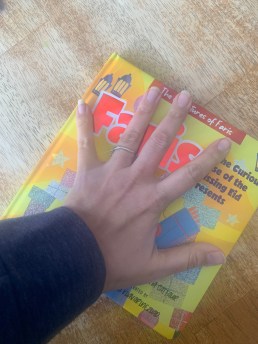
This 22 page padded cover toddler book, is not quite a board book, but the thick cardstock glossy pages are definitely meant for toddler hands.  The book works for both Eid al Fitr and Eid al Adha and my 3 year old finds it silly. My older kids that have walked in and paused to listen to me reading it, as well as myself, feel like a page is missing.  The rhyming story sets the stage of Eid morning and missing presents, but the resolution is abrupt, really abrupt, with no hinting at and the forced rhyme has you wondering who Uncle Sam is in the story.  The 22 pages are bright with Islamic decorations in the house and references to Eid and praying in the text. The excitement and joy are sweet, and the focus is presents, there is nothing about Eid or anything deeper than the story at hand as it stays on level for toddler aged children.

img_7002

The book starts with Faris waking up on a beautiful spring morning, it is Eid and he starts to sing, before tip toing down the stairs in his Eid pjs.  He sees the time and knows they won’t be up til fajr.  So, while kids won’t care, as someone who has read the book now a dozen times, I’m curious how old Faris is that he knows how to tell time, what it means and what time fajr is.  I’m also wondering how it is ok to sing and dance, but then you need to sneak down quietly, and how it is a beautiful morning, if it isn’t fajr yet, it is dark outside.

img_7003

He daydreams in the kitchen before heading off to open presents.  Except the presents are missing. He looks everywhere and imagines a dragon eating them.  I don’t want to spoil where the presents are, but they are found, and he opens them and then his parents wake up.

img_7004

It is a little sad that he opens one at least before his parents come, and I really wish there was a little hinting at what had happened to the presents, it really feels like a page is missing.  The book was published in 2021 so hopefully they will edit the text for a next printing.

img_7001

I got mine from Crescent Moon and you can purchase a copy by clicking this link here, if you use my initials ISL (Islamic School Librarian) at checkout you will save 10%.  


Hunger Alert by Shazia Afzal illustrated by Sania Hussain

Standard
Hunger Alert by Shazia Afzal illustrated by Sania Hussain

img_6919

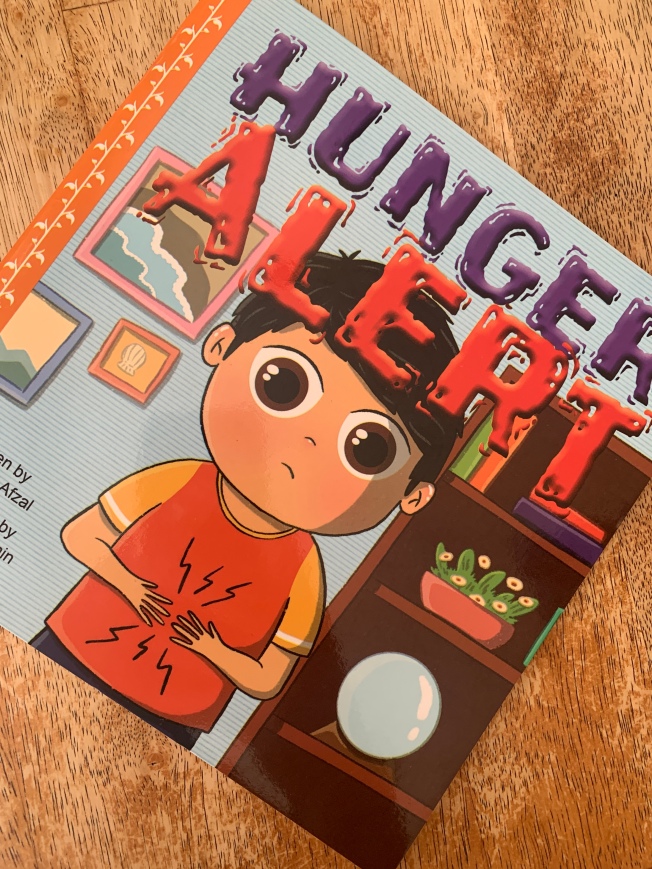
On my first read through, this book came across as a bit text heavy and the presentation didn’t quite fit with the content for the target audience, but when my seven year old read it, then reread it, and my 12 year old picked up and read it and both said, “it’s good,” I realized, the target audience is not little kids, nor is it adults, it is kids who have fasted and have felt the pangs of hunger.  The character is getting through his first day, but the relatability is for kids everywhere fasting for the first time the hundredth time and everywhere in between.  It is Islam centered, I appreciate the healthy food temptations and the unwavering that fasting needs to be done, but as an adult and an educator, so often I wanted to interject Islamic touchstone to getting through the day asking Allah for help, talking your self up and increasing your determination by knowing the Angels are recording your struggles and you will be rewarded in the akhira, and while Quran is read, and a surah loved, and Islamic phrases included, the focus of the book is a little boy in a very idyllic family trying to keep hungry thoughts away. The small 8 x 8 soft back book with 22 thick cardboard pages would be a bit hard to share at story time, but the simple concept story is fine in smaller groups and at bed time.

img_6920

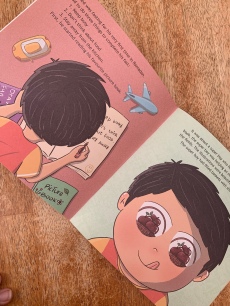
The books starts with Ahmed fasting for the first time in Ramadan, he has a list of things he needs to complete his fast: 1-Keep busy, 2- Don’t think about food, and 3-Stay away from the kitchen.  I found when reading it to my younger kids I would pause here to discuss why we fast, and that we are doing it for the sake of Allah, so we need Him to be successful, not distractions.
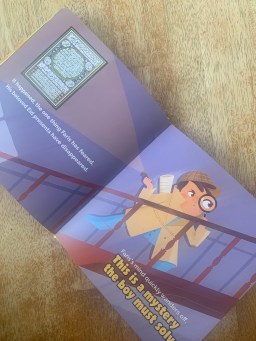
img_6921

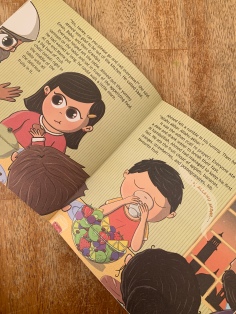
Ahmed starts with reading his favorite book about a charitable boy, the illustrations though had baskets full of shiny, big, read apples.  “Grr, Hunger Alert!” He runs to his brother’s room to keep busy with a soccer video game, but the prize on the screen are big, yellow bananas. “Grr, Hunger Alert!” This continues throughout the day, including while reading Surah Rahman, and the pomegranates trigger yet another Hunger Alert. When Grandpa asks him to take strawberries to his mom and his mom is in the kitchen, each of his rules will have to be broken.

img_6922

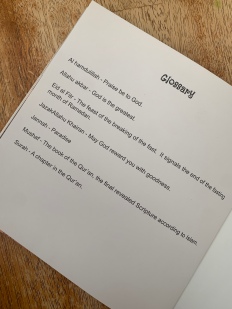
With iftaar approaching and fruit chaat waiting, Ahmed will have to persevere to complete his fast.  There is a glossary at the back and the book you can search online to find where the book is available near you http://www.compassbooks.ca

img_6923

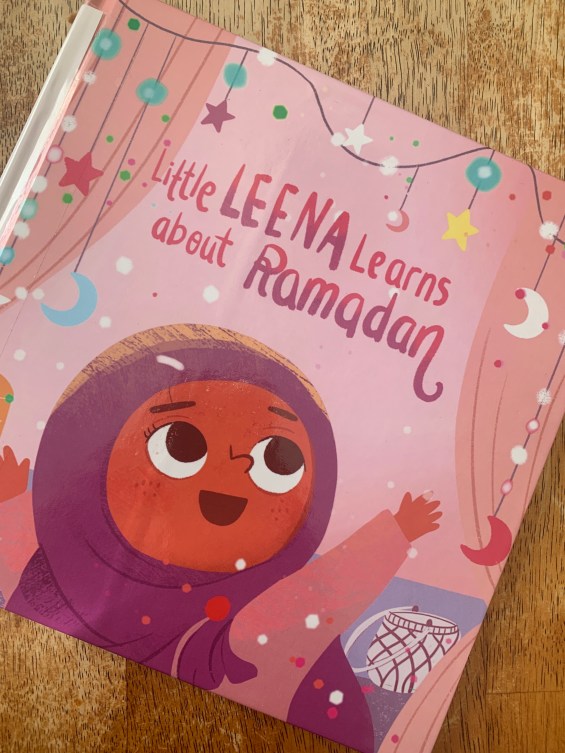
Little Leena Learns about Ramadan by Zainab Fadlallah

Standard
Little Leena Learns about Ramadan by Zainab Fadlallah

img_6913

I was excited to see this 20 page book in my public library, and then once I started reading it I was equal parts frustrated, disappointed, and honestly a little upset.  The book is an example of what I posted a reel about a few days ago, about an over used, unrealistic, textbook fact share of Ramadan from a kid’s perspective in a plotless book.  In this book it is Little Leena waking up from a nap smelling something delicious and finds her family eating and wondering why.  She is told by her sister it is the ninth month of the lunar calendar, the new moon has been sighted.  Oh sure there are some mentions of cakes and cupcakes, but seriously, come on, what three year olds have a working knowledge of moon phases but don’t know what Ramadan is, know what “blessed Ramadan” means but have never heard “Ramadan Mubarak.” Ramadan is explained to be special because we try and be extra kind, and not because it is the month we are told to fast, and we get more blessings for being kind, and the month the Quran was revealed.  Yes I appreciate that hijabs are not worn in the house, but are worn outside, and the excitement and joy are visible, but how can you have a book this centered on Ramadan that contains no Islam in it.  You can’t say on the back that it is learning about “what the occasion is all about” if there are no religious inclusions: it does not say that it is an act of worship, that fasting is prescribed by Allah swt in the Quran, that we pray extra, there is nothing, it doesn’t even attribute Ramadan and Eid to a religion, sigh.  My frustration isn’t just in this book, it is in this growing trend that this book is a part of sadly.  Why have an OWN voice adorably illustrated book claiming to be teaching about Ramadan, when the religion is completely absent? If it was a cultural, or family traditional book of joy with or without Ramadan facts blended in, I might see what it was trying to accomplish, but a book for early elementary, from a toddlers perspective that is so formulaic misses the mark in my opinion, both in educating the target audience or in helping young Muslims feel seen.

img_6914

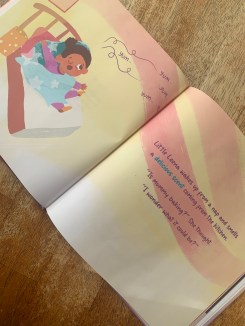
The book starts with Little Leena waking up from a nap and smelling something delicious.  She wonders if mummy has been baking cookies, or cupcakes with sprinkles, or maybe a chocolate cake.  She decides to go have a look and finds colorful lights and decorations and a magnificent chocolate cake.  She also finds her family sharing a meal, she asks what is going on and learns that it is Ramadan.

img_6915

Leena’s sister Safiyya explains that “Ramadan is the ninth month of the Lunar calendar” and “it starts as soon as the new moon is sighted.”  She further explains that “Grown ups fast from when the sun rises till the sun sets”  she says brave kids are welcome to try too.  I’m not sure what being brave has to do with fasting, to me determined or even strong would be better words to use as fasting isn’t scary, and kids are encouraged to try, not forced.

img_6916

Leena then wants her sister to explain what fasting is, and Leena can’t believe it means no food or drink during the day light hours.  Leena asks what makes Ramadan special, and is told, “Ramadan is special because during the month we try to be extra kind and do as many good deeds as we can.”  It does not say why we try and be extra kind though, before reminding that we also “try to remember to be grateful for all the things we have.” It is worth noting that in the illustration on this spread it has a Ramadan sign, that is spelled Ramadhan, not that one transliteration is write or wrong, but to have both in a children’s book is a little confusing.

img_6917

Leena then finds some presents and Saffiya explains that they are for Eid when Ramadan is over and we wear new clothes and get presents.  The two then discusses their love of presents and saying Ramadan Mubarak.

img_6918

The 8.5 inch square book is short, but the image quality and hardback binding in this library edition is nice, it just adds nothing in my opinion to the genre, to conveying to Muslim and non Muslims what Ramadan is and why it is important.  I worry that libraries might think this is good as our Ramadan reads are and not budget to get much better, engaging, reflective stories as a result.

Ramadan Mubarak by Saniyasnain Khan

Standard
Ramadan Mubarak by Saniyasnain Khan

img_6800

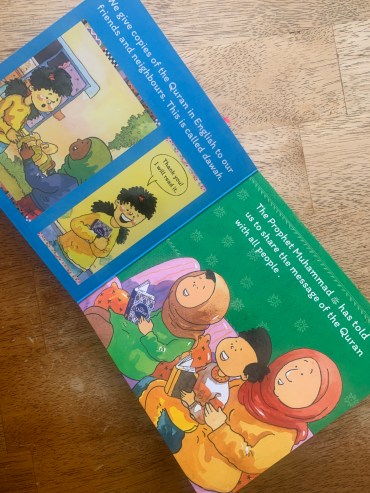
I don’t know how I missed this board book from 2020, possibly because I have the old school original Goodword one I didn’t think to acquire this one, but now that I have it, I’ll share my thoughts.  The illustrations are the same as the original, with a few placement rearranging and color changes, but the text (unfortunately) is completely different and the binding is now a small 5×5 22 page board book.  The book is all over the place with what is included about Ramadan, there is no story, and at times the vocabulary is definitely too advanced for little listeners.  Honestly, the book is great for little hands to carry around and for parents to point out important parts about Ramadan in the illustrations to talk to toddlers and preschoolers about, but the text is really hit and miss.  As my mom, a veteran preschool and ESL teacher would say, “don’t read the story, tell the story.”  I don’t regret buying it, but I doubt I’ll ever read it cover to cover as written to my three year old, he doesn’t grasp the need to hand out Qurans in English to our friends and neighbors, but he benefits from the page before saying that “Ramadan is the month of the Quran” and seeing the smiling Muslim faces praying, caring for others, and praising Allah swt.

img_6802

The book starts with Ramadan starting and bringing joy and happiness as it fills our hearts with peace and love for Allah.  It states we fast from dawn to dusk which makes us hungry and thirsty, but that these feelings “remind us that food and water are great blessings from Allah.”  I love this point about remembering our blessings from Allah, and that it then mentions shukr, and being thankful.  It then says that Ramadan is the month of the Quran and that we read it and need to apply it in our lives.

img_6803

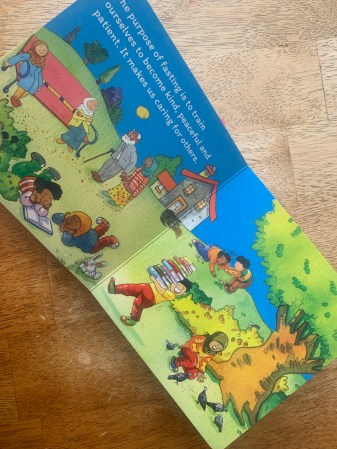
I don’t understand the dawah page, and I wish the following page with a hadith was sourced.  It then returns to the purpose of fasting, this time saying we do it to “train ourselves to be kind, peaceful, and patient.  It makes us caring for others.”  These are great lessons to come from fasting, but we fast because Allah swt prescribed it for us.

img_6804

The book stays on this theme of fasting reminding us about the poor and needy and encouraging us to feed and help them, but doesn’t mention zakat or charity by name.  It then defines taqwa and says fasting helps develop it before spending four pages on Lailatul Qadr, using phrases such as “Night of Destiny,” “innumerable angels” which might need some explanation, and taraweeh was never mentioned.

img_6801

The book concludes with Ramadan ending and Eid al Fitr being celebrated. Goodword seems to recycle and update parts of books every so often, and I hope they will tweak this book to be a better fit for toddlers and preschool aged readers.  Board books are important, the illustrations fun, but the text needs some attention to truly make the book a staple in Muslim homes.

I purchased mine here from Crescent Moon Store if you use my initials ISL (Islamic School Librarian) you can save 10%. Happy Ramadan.

A Little Golden Book: Ms. Marvel by Nadia Shammas illustrated by Janelle Anderson & DK SUPER Readers Meet Ms. Marvel by Pamela Afram

Standard
A Little Golden Book: Ms. Marvel by Nadia Shammas illustrated by Janelle Anderson & DK SUPER Readers Meet Ms. Marvel by Pamela Afram

marvel

This is not a typical review from me, more of my thoughts on Ms. Marvel books inclusion of Islam.  Kamala Khan as Ms. Marvel has been around for a while now, and while I cannot comment on the show, I never watched it, I do appreciate that her faith is still a major part of her character building in books, even in young children’s 2022 and 2023 books about her.  I have some concerns with her choices sure, but that a Little Gold Book and a leveled reader feature Islam as part of her identity, does still make me smile.

Little Golden Book: On the very first page it establishes her Pakistani American background before it explains her super powers and her connection her to Carol Danvers, Captain Marvel.  It then shows Kamala at the masjid making duas and showing her family with text that attributes her Muslim religion for being the foundation of how she learned how to be a good hero and good person. Nakia is consistently across different platforms depicted as wearing hijab, and this children’s book is no different.  The book at the end does conflate her culture with her religion, with the use of the word heritage, but that Islam is positively highlighted in this 24 page children’s book is great representation.

Super Readers Level 3: This meet book introduces 16 characters in the Ms. Marvel series and each two page spread tells about them. On the page about Kamala’s family, her mom is not in hijab, but her brother is wearing a kufi/topi and their names are shared: Aamir, Yusuf and Muneeba.  It also shares that her parents are from Karachi, Pakistan.  It isn’t until Nakia is introduced on page 26 (of 48) that it articulates that Ms. Marvel is Muslim.  “Kamala met Nakia in Kindergarten.  Nakia is a practicing Muslim, just like Kamala.”  The next page shows her hugging her other best friend, a boy named Bruno, so that is a little hard to accept, and it states that the super dog Lockjaw is her pet.  The term Muslim also appears in the glossary.

I found both books at my local library and definitely liked the Little Golden Book representation more, but was happy to see that her religion was not watered down or shied away from for younger readers in both.

The Adventures of Amina Al-Sirafi by Shannon Chakraborty

Standard
The Adventures of Amina Al-Sirafi by Shannon Chakraborty

sirafi

It has been a long time since I have stopped reading a book because I simply do not want it to end.  Clearly I have no self control, so a day later I picked it back up and finished the 496 pages, but oh what a treat to be swept away aboard a magnificent tale with rich history, Muslim characters, Islamic references, developed fantasy world building, complex side characters, excitement, plot, adventure, and everything else you would expect from the author of the Daevabad series.  The book is an adult read, and I really can’t suggest it to YA readers, the protagonist is a middle aged mom with a foul mouth and a bad knee, there is cursing, and killing,  hetero, gay and demon love interests among the main characters, a transgendered character, sex mentioned, drinking, and magic, it is all part of the story, but it isn’t so in your face that older mature Muslim readers will be uncomfortable.  So why am I reviewing it here, I honestly don’t know.  Clearly it is not to be shelved in the Islamic School Library, but there is so much authentic Islamic centering on every single page, that I want to give it space to remind/encourage us all that we don’t have to hide or water down our faith in mainstream books- not if the writing, story, and characters are so incredible.  I really thought a historically set pirate fantasy would be hard to read, that the vocabulary and references would leave me lost and confused, but it is written so beautifully that the pages fly by and you forget you are reading; it is as if you are watching the story unfold in front of you.  Please consider preordering this book so that publishers know support exists for authentic OWN voice Muslim character led books, I have an e-version, but have also preordered a physical hard back copy here.

SYNOPSIS:

It has been a decade since the infamous nakhuda Amina al Sirafi has taken to the Indian Ocean to plunder and sail. The stories of her have grown and traveled in her retirement, but life is now more about protecting her daughter and fixing her leaking roof.  When her previous life finds her and threatens her, however, she must return to her Marawati, call on her old friends, and put together a crew.  Told through a storyteller, with banter between Jamal and Amina, the fourth wall is broken and the reader knows that the hero will survive, yet the adventures of outsmarting Aden’s defenses, peris, demons, Franks, pirates, and marids to prevent the Moon of Saba from being manipulated is a fast paced chaotic adventure that pulls you in from the first page.  The fairly linear story from one point of view (mostly), connects the haunting past to the trials at hand, as the crew and characters are understood through their captain.  I don’t want to give anything away, but the side characters are nuanced and developed in a way that you feel just as close to them as Amina does, and as she becomes frantic to save them, the reader too is invested in their choices and actions.  Pirate adventure, saving the day, a mom as a hero and a missing demon husband refound, yeah, don’t read summaries of this book, just read the book.

WHY I LIKE IT:

I was surprised at the religious redemption arcs and details that were included on truly every page, from the meaning of the translation of Ayat ul Kursi, to acknowledging past sins and striving to not repeat them, Amina al Sirafi practices her Islam in her five daily prayers, regular supplications, regular repentance, and view of the world and her place in it.  She isn’t preachy, and much of what she faces tempts her to drink wine and fornicate again, but her struggles are really refreshing to see.  It isn’t that she is Muslim and that is the framing for the al-ghayb elements alone, it is so part of her and thus of the book, that you can’t help but feel seen.

The gay character’s lover is mentioned, neither are Muslim, but it is only a few lines in the entire book.  The transgendered character starts off uncomfortable with being forced to marry and hints that she doesn’t feel feminine, Amina pieces together what she is saying and then at the end it shows that she is now identifying and carrying herself as a man.  It isn’t a big part of the text, it has a strong effect on the story and it does touch on God’s view of such things, as the character is Muslim.  The demon love interest SLIGHT SPOILER is Amina’s husband that she thought she had killed, she has had a lot of husbands, but when he turns up alive, she realizes technically they are still married.  He asks her quite often to have sex.  It is usually is just that blunt with no romance or longing, and when they do partake in the act, it isn’t overly graphic, it is “closed door.”  There is killing and murder and deceit and lying and drinking, all things assumed would be in a pirate story.  None of it is overly glorified, but it is normalized.

I really just love the characters and the fast paced action, the book leaves off implying there will be more tales to come and I hope there are.  (I keep writing what I love about the book and deleting it, because you know….spoilers, ahh).

FLAGS:

As previously mentioned: cursing, sex, hetero and gay relationships, magic, fantasy, killing, murder, lying, drinking, drugs, jinn, peris, marids, fantasy, occult, demons, death, loss.

TOOLS FOR LEADING THE DISCUSSION:

I would never do this for a school book club, but would do it in a heartbeat for an adult book club!


Amir’s Blue Jacket by Sarah Musa illustrated by Rania Hasan

Standard
Amir’s Blue Jacket by Sarah Musa illustrated by Rania Hasan

This heartfelt elementary picture book does a remarkable job of drawing the reader in to the emotions of the main character, his relationship with his grandfather, and imparting a moral message without being preachy. The illustrations are lovely on their own, but the way the muted tones convey the memories and illustrate the text really ties the book together. Whether it is for a larger story time or a one-on-one bedtime read, the book will offer discussion, comfort, guidance, and a little surprise at the end for Muslim and non Muslims alike. The slightly allegorical book does conclude with a widely known hadith (it is attributed to Prophet Muhammad saw, but is not further cited/sourced) and the family is clearly Muslim with their names mentions of Eid and God, and a hijab clad woman, but the book is universal and a lovely addition to any book shelf.

The book starts with Amir finding his Grandpa’s old blue jacket and recalling wrapping himself in it the day after his beloved Grandpa died. With it smelling like mothballs, he tosses it in the washing machine, but unfortunately when it comes out it has clearly shrunk. Amir is in denial, he says it fits fine and he has no desire for a new one. It is Grandpa’s jacket, and Amir is going to wear it, no matter how tight it is. Amir storms off to sit under the apple tree and recalls picking apples and making applesauce the year before for the whole neighborhood. Grandma shares that she used to keep grandpa’s cane but when someone needed it, she let it go.

Grandma stirs another memory in Amir when she pulls the tray of ka’k out of the oven, of him trying to sneak a whole plate for himself only to have his hiding spot taken over by ants. When he is asked this time to share a plate, every step to the neighbors house reminds him even more of making the trip with his grandfather. Slowly he starts to realize that his memories are with him, not in his grandfather’s things, and Amir makes a decision that would make his grandfather proud, and (inshaAllah) give him more good deeds, even though he is gone.

The idea of sadaqah jariyah is understood through the story, and present in the hadith at the back, but it is never mentioned outright. Just as God is used, not the term Allah (swt). As Amir feels denial, frustration, and eventually peace, nothing is really told, it is shown, which really opens the book up to be a tremendous tool in sharing it with children and asking them to discuss what they understand, what they feel, and what they took away from Amir and his Grandpa’s blue jacket story.

The book is available through the publisher Ruqaya’s Bookshelf as well as HERE at Crescent Moon Bookstore where code ISL will save you 10%.