Tag Archives: Muslim Author

Hidden Fires by Sairish Hussain

Standard
Hidden Fires by Sairish Hussain

I will not be getting over this book any time soon. It broke my heart, and all my other critical organs, in the most delightfully well-done way possible, and undoubtedly I am better for it. I don’t read a lot of adult fiction these days, and with some diabetic retinopathy concerns, I couldn’t read the 384 page adult book about generational trauma, partition, the Grenfell Tower fire, family dynamics, bullying, self-harm, and resilience, but was pulled in to the audio book version instead. The Desi-British voices of Yusuf, Rubi, and Hassan were refreshing to my American ears.  The multi-perspective book told in parts richly develops the characters, their relationships, and their current, past, and future struggles.  The author is Muslim, as are the characters, and while they all practice in their own way, it is undoubtedly who they are, and their Islamic identity is not questioned, feared, blamed, or apologized for.

SYNOPSIS:
The book weaves three distinct voices. Yusuf, is an 80 year old an immigrant who lived through partition, raised his family in the UK, has lost his wife a year prior, and is struggling with haunting memories of the past, failing health, regular loss of friends, and loneliness.  Hassan, Yusuf’s youngest son is a workaholic who is married to a non Muslim, non Desi who is suffering from fibromyalgia and who’s mother unexpectedly passes away in Spain.  Rubi, is Hassan’s 16 year old girl who is overweight, bullied, lonely and about to take her GCSE exams when she is dumped on her grandfather Yusuf’s door while her parents head to Spain.  The book opens in Ramadan the night of the Grenfell Tower fire and the horrific event affects them all, stirs memories, and shapes futures.  From there the layers of each character slowly unravel as they cope with the swiftly changing present as they desperately work to break free from the past.  As dementia plagues Yusuf, Rubi finds purpose in being needed, and Hassan is forced to re-prioritize his life before it is too late.

WHY I LIKE IT:
The book takes a slow approach to building up the characters and their back stories. It is almost feels like world building as a book would if it were a fantasy, it doesn’t info dump, but at some point the hooks are so deeply embedded that you really cannot leave the characters and their world and you have to finish the book, just to ensure they are ok.  Because I listened to the book, I feel like there might have been some Islamic content that was not completely ok, but again I was having vision issues and couldn’t note where to go back and check.  I think it is fine, and because it is an adult read, I think the audience can discern accuracy, but please know, I’m not 100% green lighting the Islamic rep.  It is undoubtedly well done and fasting and praying are a part of the characters, but their relationship to their faith and their understanding of it, is presented as theirs, it doesn’t get preachy or make broad statements about Muslims everywhere or Islamic doctrine.  

FLAGS:
There is body shaming, self-harm, trauma, death, torture, killing, lying, abuse, fear, guilt, dementia, bullying, assault, physical violence, drug use (mentioned), attempted suicide (mentioned), music, theft, make-up, close male and female relationships, Muslim marrying a non-Muslim, hallucinations.

TOOLS FOR LEADING THE DISCUSSION:
I think mature high school seniors or possibly even juniors could benefit from this book with discussions.  I think Rubi’s voice tied to her father and grandfather, will really open up youngsters perspectives, and provide a great vehicle to hear their thoughts, fears, worries, concerns about body image, self harm, aging grandparents, accessibility to parents, etc..

Dear Moon: Inspiration from the Beautiful Wisdom of the Qur’an by Zayneb Haleem

Standard
Dear Moon: Inspiration from the Beautiful Wisdom of the Qur’an by Zayneb Haleem

img_8075-1

At 128 pages, this hard back 7.5 x 8.5 inch book is a beautiful book from start to finish.  If you follow the artist online (@idotdoodle), you know her style and her incorporation of an ayat from the Qur’an or an Islamic sentiment with her signature young girl and nature embellished scenes.  But holding the book in your hands, and pausing on the two page spreads to reflect, and ponder, and be reminded to connect with the love of your creator, is truly a treat. Whether you read it from start to finish, or dip in and spend time with just a few pages at a time, the book will capture the attention of all ages and be enjoyed over and over again, alhumdulillah.

The book starts with a welcome to the reader from the artist, introducing herself, her connection to Islam, her love of art, her expression of emotions through her illustrations, how she picked the verses, where her own thoughts and reflections emerged from, and what she hopes the book will accomplish. 

The book releases in February 2025 and is available wherever you purchase your books.  I hope you will consider preordering to show your support.

Vultures in the House of Silence by A.R. Latif

Standard
Vultures in the House of Silence by A.R. Latif

img_7966-1

This 312 page richly imagined Islamic fantasy is both engaging and compelling.  It is too advanced for me to review as it weaves a complex tale based on history, religion, fantasy, and imagination.  I do know that it was for the most part well written, I have some issue when the character’s diction would include words that felt too contemporary slang, but it didn’t happen too often.  The pacing though, unfortunately for me, was definitely off.  Undoubtedly the author has tremendous skill.  The emotional pulls, the world building, the consistent cliffhangers at the end of each chapter, kept me curious to see what would unfold.  The story beats just dragged more often than they should have for no clear reason in developing the plot, defining character arcs, or adding to the rising action.  I don’t think I ever stopped reading at the end of a chapter, those hooks were well placed, but when I stopped in the middle of the chapter, it often took four or five days for me to be motivated enough to open the book back up.  I truly think it just needs a good editor to help cut certain scenes, and smooth out the tempo.  The idea and layers are great, and if I, as someone who struggles with middle grade fantasy, couldn’t walk away from this YA/Adultish read, I’m sure lovers of fantasy, jinn, monsters, Islamic history, found family, gray characters and action, will find this book an enjoyable read, even the slow parts, that  I struggled with.  So no this is not a negative review,  I am hopeful my teenagers will read it and enjoy it, I just really hope the author will consider working with an editor to elevate the text as it truly has potential.

SYNOPSIS:

I don’t know that I can retell the story, it has a lot going on and I’ll probably inadvertently spoil something, so here is the summary from the back of the book:

“A boy wakes up surrounded by corpses. Unable to move, he is assaulted by vultures who stop pecking at him only when he speaks. To survive this nightmarish ordeal, he tells them the story of how he ended up on their menu…

What follows is the wild tale of the young gardener Khurafa, coping with the aftermath of the Mongol invasion of Baghdad and the death of his parents amidst the bloodshed. After a vivid dream and several supernatural encounters, he becomes convinced that an ancient group of nine sorcerers called the Servants are bent on world domination. Accompanied by his scholarly mentor Shaykh Nariman, and the sly, uncannily perceptive Zakiyya, he seeks saintly help against the Servants, but finds mostly monsters instead.”

WHY I LIKE IT:

I love the opening, it really grabs you, the emotion of Khurafa and the loss of his parents and his predicament with the vultures connects you to him and his vulnerabilities.  The twists are also well developed and keep the book interesting.  I feel like the end needed more, and the middle needed less.  SPOILERS: I didn’t get the cat, or the going from village to village.  All the names, and all the drama at each village, dragged for me.

It appears the book is meant to be a series, so I wonder if many of the characters that died will return, but I feel like the final battle was a little disappointing, and anti-climatic.  All the build up and then it went so quick.  I appreciated the full circle on the House of Silence, and the answering of some of the questions, but for all the emotion  at the start, the end didn’t mirror that in the cathartic way I hoped it would.

I say all this with full acknowledgement that I am not drawn to fantasy, I am not well versed in Islamic history, and it is absolutely possible, that I just don’t get it. In brief, I am not the target audience.

TOOLS FOR LEADING THE DISCUSSION:

I think this book could be a good book club selection, with some motivation to get to the end, I think readers will be happy that they did, and I would imagine they would be willing to read the next book in the series. For many I would imagine it would be the first Islamic fantasy they will have read that has the layers, richness, and intrigue that this book does, and inspire them.

Prince Among Slaves by N.H. Senzai illustrated by Anna Rich

Standard
Prince Among Slaves by N.H. Senzai illustrated by Anna Rich


462575630_1072301494218509_2457799047040333197_n

This 48 page biography tells a story that we all should know, yet are probably hearing for the first time.  The story of how West African Prince, Abdulrahman Ibrahim Ibn Sori, was forcefully taken and sent to America to be a slave on a plantation, what he endured for decades, and how he made his way back to the African continent.  The large emotional illustrations and poignant text tell of his his life in Fouta Djallon, the painful journey to Mississippi, the trials as a slave, the joy of being a husband and father, and his attempts to return home a free man.  With each challenge and at each stage, him additionally showing amazing strength and trust in Allah swt.  The heartbreaking tale unearths so much evil, ignorance, and faith, that the story is not meant to be read once, it begs to be reflected on, pondered over, and shared far and wide. The treatment of Prince Abdulrahman shown in some of the illustrations are difficult to look at, as they should be, there is also a very passionate kiss shown up close between him and his wife.  I think the story’s words and illustrations emphasize the anguish, the strength and the humanity, but I mention the illustrations for each to decide on their own.  There is not a biography or sources in the book, but rather mentions in the Author’s Note the source matter being a film by Unity Production Foundation.  It is not unusual to adapt a biography from a film, and I read an ARC, but I do hope the final copy will be sourced.  The book is for middle grade readers, and I cannot wait to add a physical copy on my own bookshelves, and gift numerous ones to teachers to share in their classrooms.

WARNING: SPOILERS: THE SYNOPSIS CONTAINS A FULL RETELLING, as it is historical, I hope that is ok, but in no way shape or form is my summary taking away from the details, emotion, and writing the actual book contains. 


In 1762, the Fulbe enjoyed prosperity and peace under the king, and when Abdulrahman was seven he started school in Timbo. He loved learning about the Prophets in the Qur’an, and excelled at his studies.  So much so that his father sent him to Timbuktu to continue his studies at age 12. Five years later he returned to train as a warrior, when the first white man, a surgeon, Dr. John Cox appeared injured and lost, they helped heal him and sent him back home to Ireland.

By age 26, Prince Abdurrahman was a warrior, a scholar, soon to be king, a husband and a father of a son.  One day while on patrol, he was captured. He and 170 others were loaded on a ship, for eight months, and sent over 3,000 miles across the Atlantic Ocean.

On August 16, 1788 he arrived starved in Natchez, Mississippi, for $930 he and another man became the property of Colonel Foster.  Resigned that this was his fate, he helped share his knowledge of cotton, and the plantation prospered. In 1975 he married, Isabella.  They had nine children and eight grandchildren.  

In 1807 while selling goods in the market, Abdurrahman sees Dr Cox (subhanAllah), and the doctor pleads with Colonel Foster to free the Prince.  Foster could not be moved and when the doctor died, Abdurrahman once again accepted his fate. 

His story though had started to spread, and a printer, felt a softness to the Prince turned slave and printed often embellished stories trying to help his cause.  He asked the Prince to write a letter, the Prince wrote an ayah from the Quran and the printer passed it to Mississippi senator Thomas Reed explaining the Prince’s desire to return to Africa.  Senator Reed got the letter to Henry Clay, the Secretary of State under John Quincy Adams, who then got the message to the President of the United States.

The letter was written in Arabic, and they assumed Prince Abdurrahman was thus from Morocco.  The Sultan of Morocco was touched by his plight and petitioned for his release, and the Prince kept quiet not wanting the truth of where he was from to remove the help he was receiving.

He was finally freed and able to purchase the freedom of his wife Isabella with the help of those who had heard his story, but the efforts to free his children were not as successful.  The truth about him not being Moroccan became known, and despite extensive travels and pleas, his declining health forced him to leave America with out his children.  He arrived in Monrovia, Liberia, but would die before he could reach his home of Fouta Djallon.

462563778_440473032154161_1815006209353878188_n


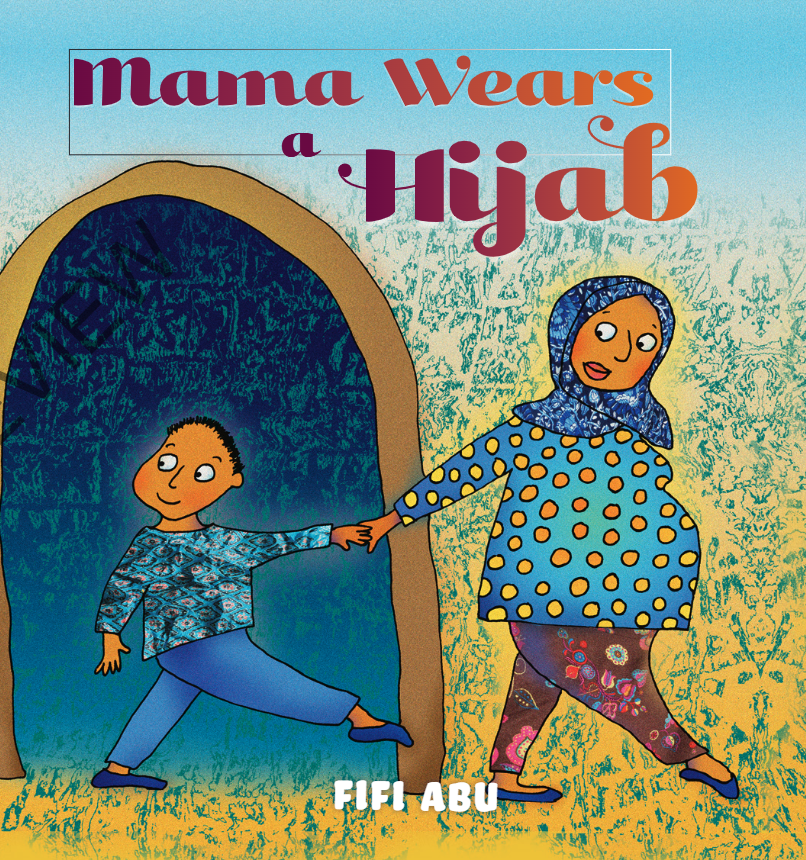
Mama Wears a Hijab by Fifi Abu

Standard
Mama Wears a Hijab by Fifi Abu

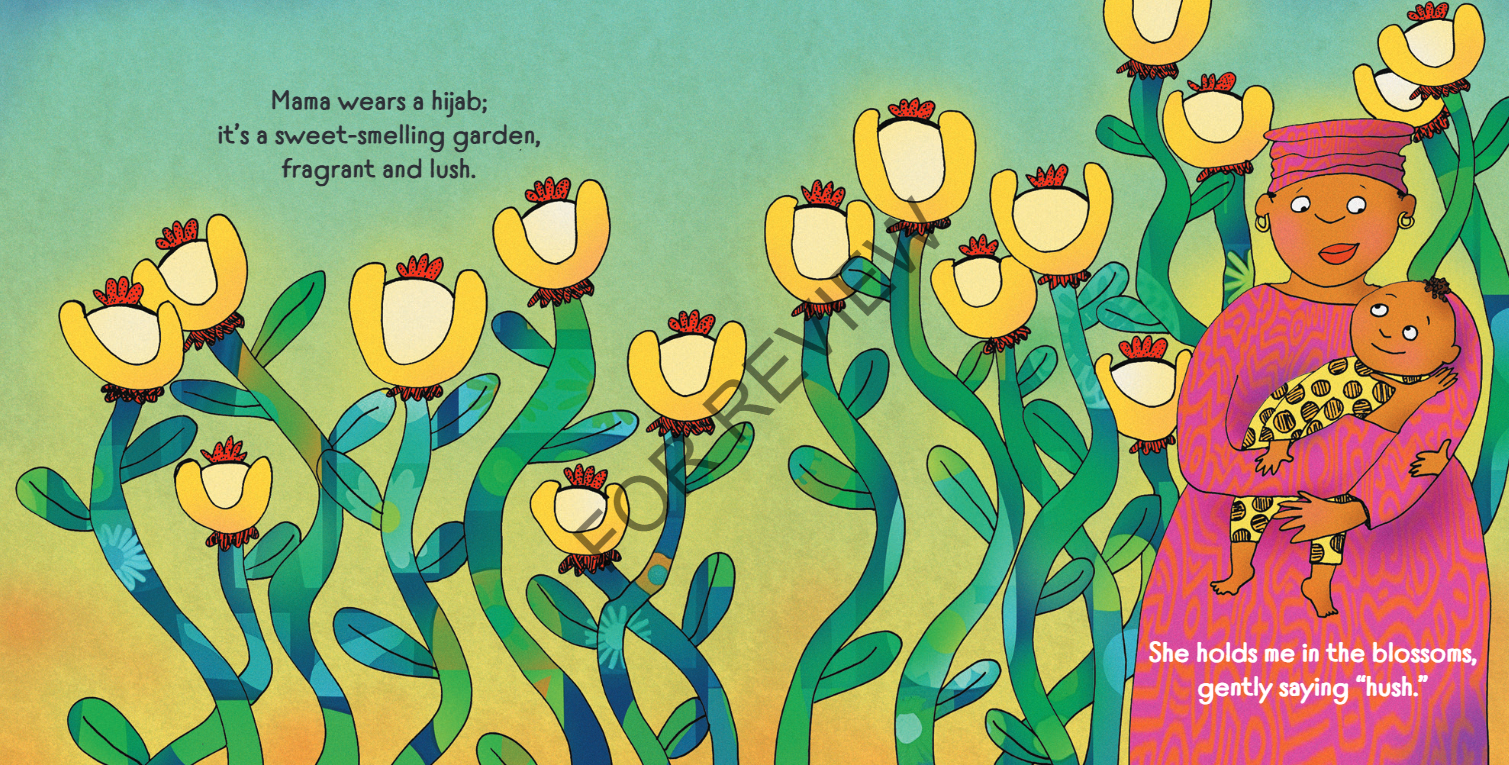
I don’t understand this 24 page 10 x 10 board book. I don’t get it literary wise, or Islamic rep value wise, and if someone can explain it to me, I will be happy to listen.  I’m figuring it is a “me” problem because the author has multiple masters, one in children’s literature and has even been on the Caldecott committee, so I don’t know why I can’t make heads or tales of the metaphors.  At times it seems they are describing the hijab, but maybe the parent child relationship, on one spread the pregnancy, possibly motherhood in general.  A few pages are beautiful, and I like the illustrations, but the continuity is lacking and makes me a little uncomfortable.  Islamically, I understand that women who cover their head often do wear makeup and perfume, but they are not part of hijab, so to have that be articulated is both erroneous and odd.

The illustrations show hijab, niqab, a duputta style, and everything in between.  The characters shown are families in a variety of skin tones, clothing styles, body shapes, and cultural settings.

The book is not a story, it functions in two page spreads of rhyme that take an abstract concept and ground it so to speak, but what the connection is, is by and large lost on me.  I know I have included more inside pages than normal, but I feel that I can’t really review it, so perhaps the least I can do is provide enough peeks for people to come to their own conclusions.

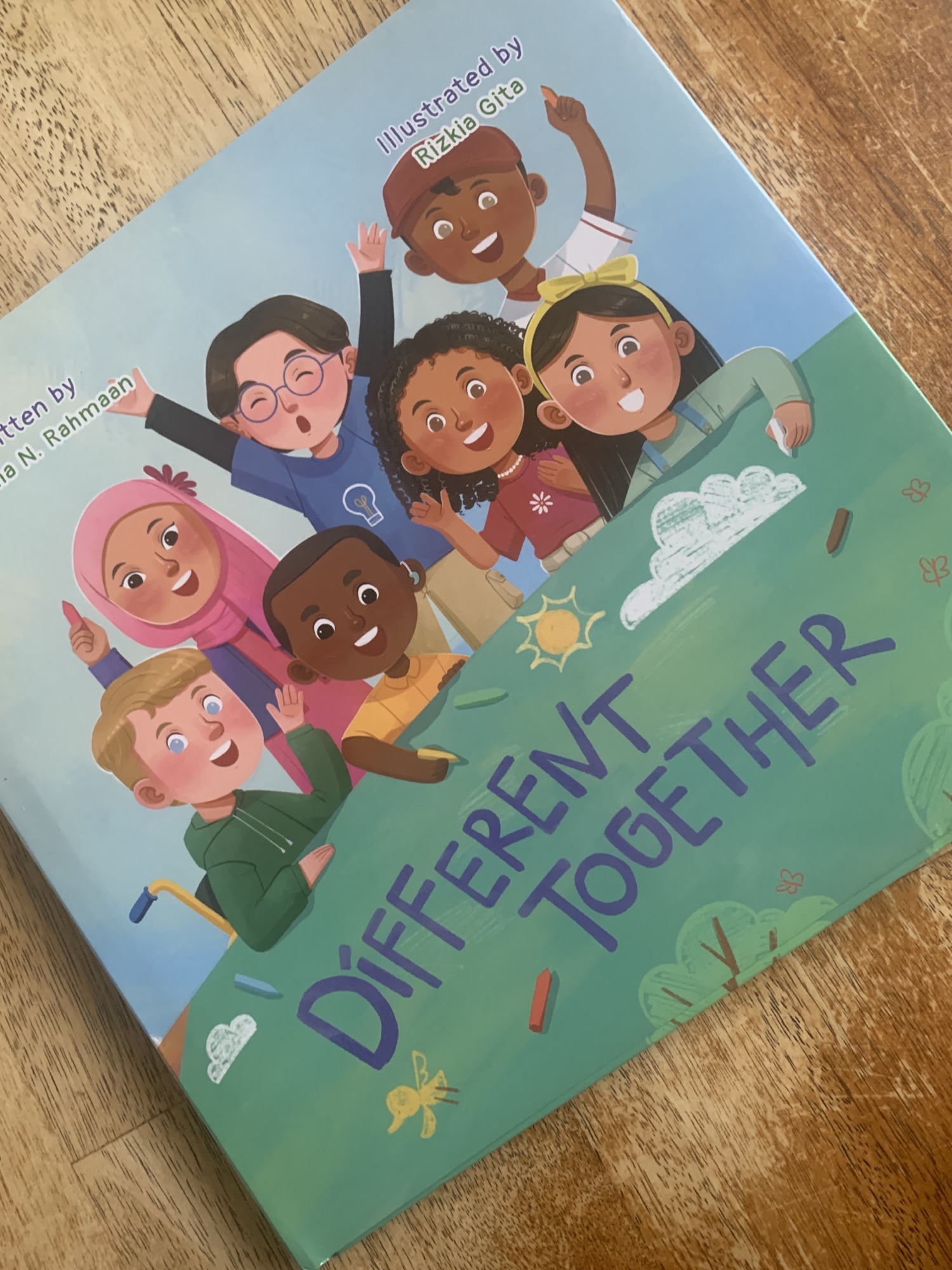
Different Together by Ayesha N. Rahmaan illustrated by Rizkia Gita

Standard
Different Together by Ayesha N. Rahmaan illustrated by Rizkia Gita

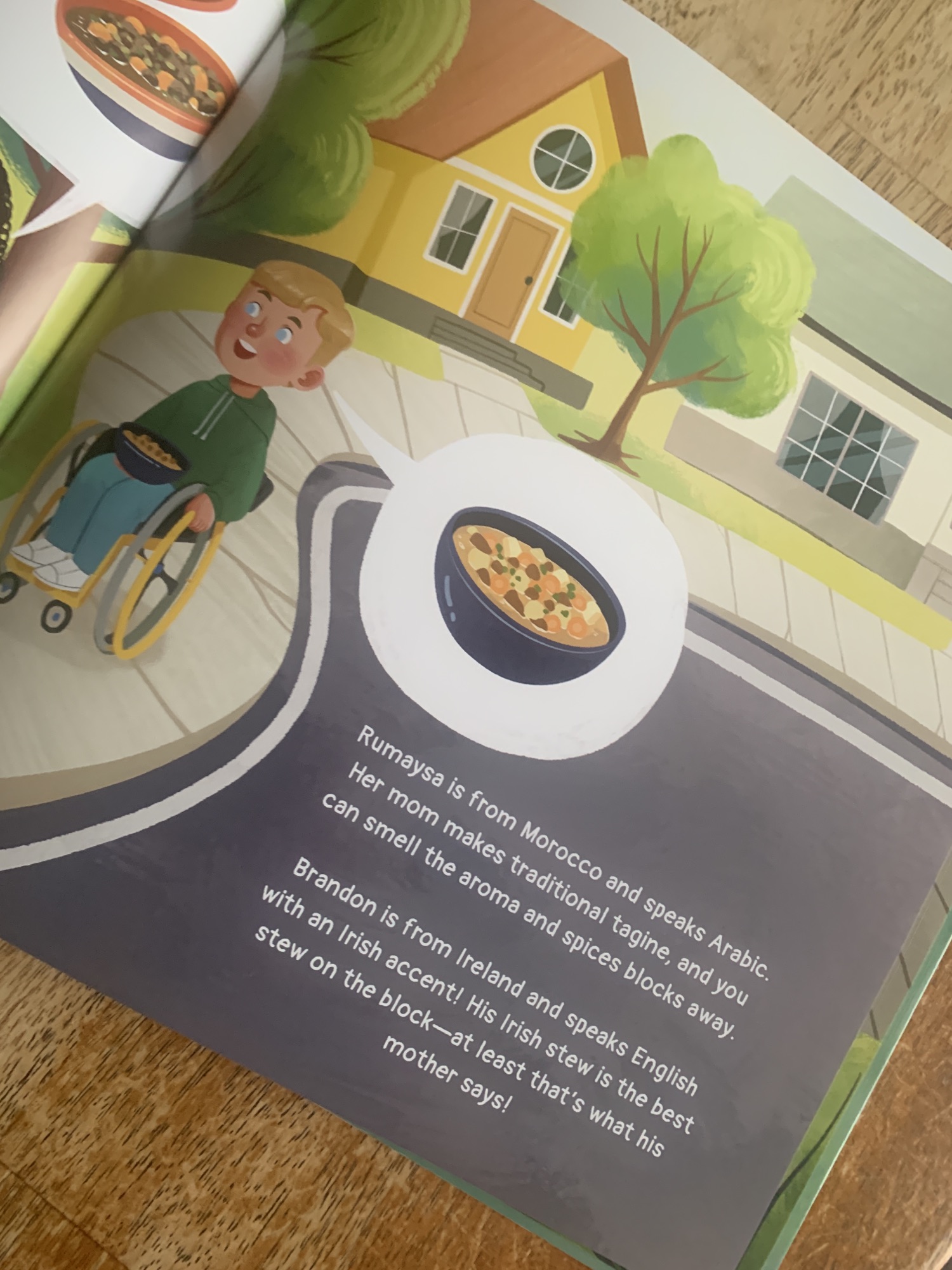
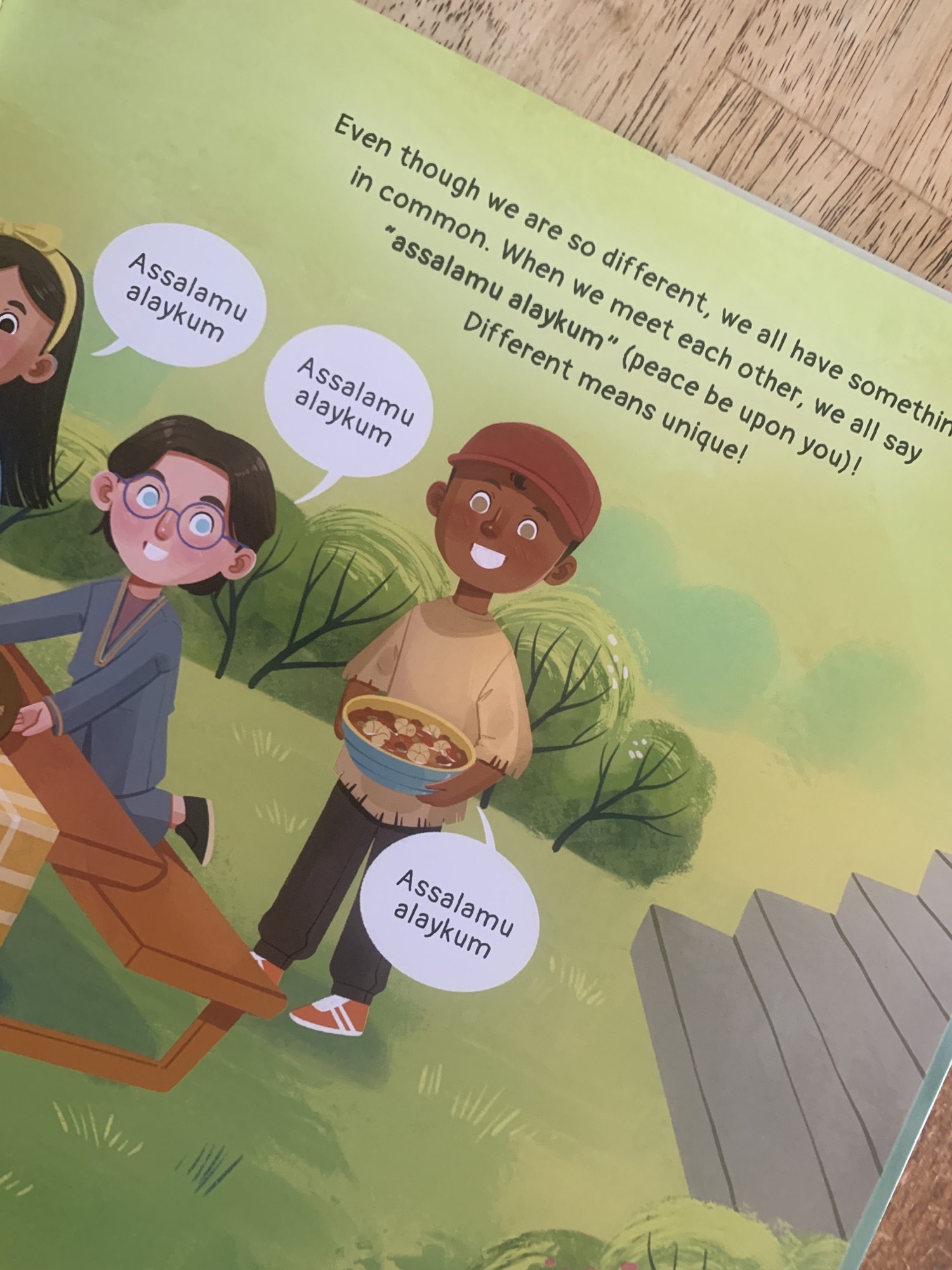
This 32 page large 10 x 10 hardback book explores how we are all different and unique, while also being the same too.  The illustrations and text present a nice way for children to learn that Allah swt created us all to be different in our appearances, what foods we like, how we dress, how we speak, but come together to all say Assalamu alaykum and stand foot-to-foot to pray.  Some of the refrains are a bit abrupt, and it really focuses a lot on physical descriptions and food, the target audience though of preschool to early elementary, will see themselves in the book, probably even a character that looks like them, and expand their understanding of al-Khaliq creating them all.


The book starts with an ayat from Surah al-Hujurat and then starts by asking the audience to imagine a world were everyone is the same.  It highlights that Allah created each of us starting with prophet Adam (as) to be just as we are, with different traits. From there, neighbors are introduced: their names, country of origin and favorite foods that all come together to make a table of sharing.

In school the students look different and play different, in the city the different building types are shown to come together, and in the masjid our hearts are in sync when we pray. The text concludes asking the reader to highlight five ways they are unique and a hadith in Arabic along with its English translation.

Bilal’s Bad Day by Neelum Khan illustrated by Alice Larsson

Standard
Bilal’s Bad Day by Neelum Khan illustrated by Alice Larsson

img_7727-1

I like the concept and presentation of this picture book that involves spinning a spinner at the midway point to determine what page you should “jump” to, to continue the story. I can see this being a great tool to introduce and practice different calming strategies to use when times are tough.  I love that some of the ideas of faith based, and some are not, and that a thorough introduction of how to use the book and strategies precedes the fictional story.  BUT, oh come on you knew it was coming, I don’t know if the information is sound.  Translation, I don’t have to use calming strategies, and the book does not disclose if the author is qualified to be giving them.  I can’t imagine the strategies would cause harm, and we can always benefit for de-escalating and centering, and truth be told I don’t even know if one would have to be “qualified” to give this advice.  I simply put it out there for you all to decide for you and your little ones.

The book starts with Bilal opening his eyes to the sounds of his siblings squabbling, breakfast disappoints when they are out of his favorite cereal, and dad’s joke about his hair is not appreciated.  Top it all off with news that guests with a baby were coming over for lunch, and Bilal knows it isn’t going to be a good day.  With cleaning, itchy clothes, and the smell of food building as the day passes, the doorbell ringing sends him over the edge and mum and dad need to find a calming strategy to help him.  This is when the reader gets to spin the arrow and jump to the page to see what and how to use the different options.

The book has whatever option picked work to calm Bilal down, but notes at the beginning that multiple options and repeats are often more the reality.  The story then has Bilal later that evening reflect on the day before asking the reader to reflect on their own similar experiences as well through six bulleted considerations. The 40 page book concludes with hadiths.

This book needs to be read and discussed before the moment of need arises, and be aware the spinner at bedtime is too much of a distraction.  The book is best with dialogue, understanding, and practice.

The Thirty Before Thirty List by Tasneem Abdur-Rashid

Standard
The Thirty Before Thirty List by Tasneem Abdur-Rashid

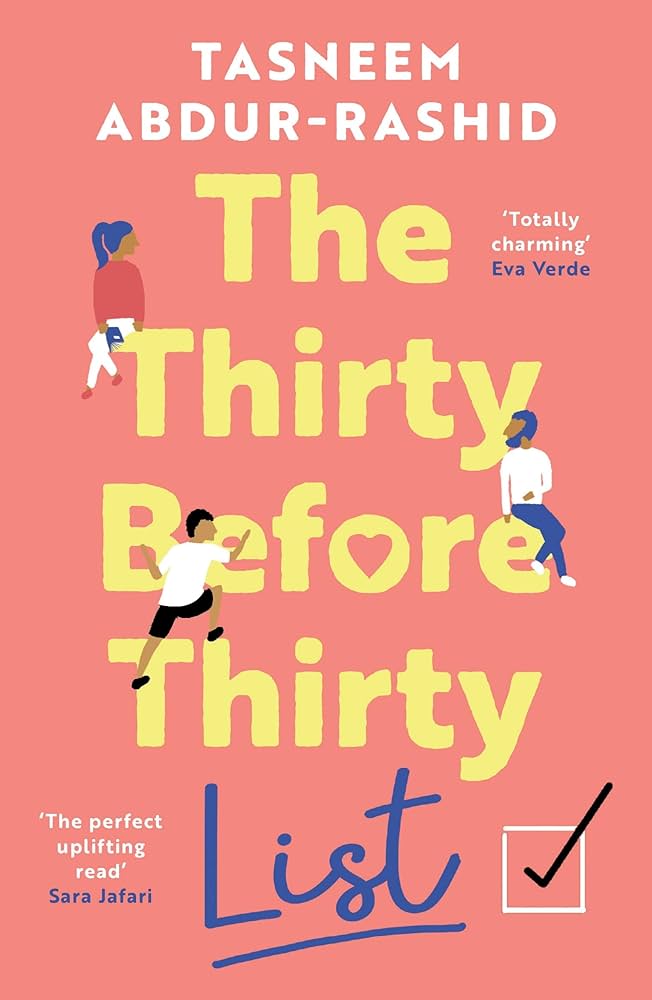
This is the second book I’ve read by the author and while I didn’t do a full review of the first (Finding Mr Perfectly Fine), I am going to do a full review of this one, because the book might not be “halal, halal” or intentionally Islam centered, but with a robust Muslim cast it stays impressively clean and there is a lot of Islam present.  I’m glad I bought a physical copy so my nieces or my daughter can pick it up and enjoy Rana’s growth and antics.  The book is nearly 400 pages long, but they fly by, and if you are 16 and up looking for a rom com style escape book this will fit the bill.  The only thing that really gave me pause is an early label the protagonist slaps on her self as “not being a devout Muslim.”  I get the point is to not let the stereotype of an arranged marriage and strict brown parents overshadow the initial impression of the book, but the author is a better writer than that early statement indicates.  As the story progresses you see her Islam IS very much part of her identity, her environment, her outlook, and the author shows it in relatable nuanced ways that the early “telling” was not needed.  Yes, the book has the protagonist and a different boy or two alone at times, and there is some hand holding and a few hugs, but the intention is always to find a spouse, and religious lines are usually clearly on the character’s radar.  There is some talk about mortgages, and a side Muslim character that has a girlfriend he keeps secret as they go on holiday together, but again, nothing obscene, or defensive, just realistic actions from contemporary characters viewing things their own way and doing the best they can.

SYNOPSIS:

Maya’s life is pretty predictable, she lives at home, goes to work, hangs out with her childhood friend on the weekend, and dodges any attempts to be set up for marriage.  Then one day on the tube a mysterious stranger, Noah, his leather bound notebook, and everyone else in her life moving forward, prompts her to open the notebook and copy his 30 before 30 list.  Adapting what doesn’t make sense at all for her life, she never peeks ahead, but rather takes one adventure at a time.  When people from different circles in her life start interacting, and Noah reenters her life, Maya will have decisions to make and a new list to commit to, her own.

WHY I LIKE IT:

I needed a diversion, I was going to be spending a few consecutive days in waiting rooms at hospitals and knew I’d need something light, easy to read, pause, and return to, and something to make me smile.  Maya is likeable, and her family and friends relatable.  Her Bangladeshi and British culture add depth and I was genuinely surprised and appreciative with how much Islam managed to find its way in to the plot and character arcs.

FLAGS:

Relationships outside of marriage, nude model, lying, hugs, hand holding.

TOOLS FOR LEADING THE DISCUSSION:

This would make a great adult, college, or even 12th grade book club selection, for just a fun book to laugh about and enjoy with friends.  It isn’t that deep, but there are threads that will hit, and to chat about it will bring friends closer together.

The Boy and his Sand Castle: A Journey of Redemption by Zakaria Amara

Standard
The Boy and his Sand Castle: A Journey of Redemption by Zakaria Amara

img_7416-1

This 213 page memoir is sad, so very sad. I don’t have the ability to review it, it is personal, and raw, and not to be forgotten. But “what” it is, is not so easily defined. It is poetry, prose, humor, reality, dreams, heartache, loss, vulnerability, redemption, introspection, faith, advice, hope.  From the introduction written by his sister, to the photographs of his childhood scrapbook, if nothing else, the pages are filled with humanity and a situation that is so unique, illuminated with threads that all readers will see at times themselves in. The book is not excuses, pointing fingers, rage filled or defensive, it transcends that to a place of true reflection and rediscovery through poetry.

SYNOPSIS:

The poetic introspection of the author touches on his marginalization, radicalization, and 17 year imprisonment. It has pieces inspired by events occurring in his life as well as pieces for his daughter, dreams, analytical pieces, and humorous coping anecdotes.  After reading the book, I don’t feel I know the facts about the case, the methods of the radicalization, the other 17 members, the judicial process experienced, or the daily struggles, but I feel some of the lessons, the humanity and surrendering are shared.  The book isn’t linear, it is snapshots of a variety of emotions, that leave the reader feeling similarly vulnerable and humble, subhanAllah.

The book is divided into 10 parts: Desolation, Despair, Hope, Near and Dear, Meaning, Selfhood, Joy, Modernity, Surrender, and Home. There are small images on the pages, some AI, some art, some drawings by fellow prisoners.  There are also some photographs.

This book was nominated for the 2024 Muslim Bookstagram Awards and I am grateful that it was.  I’m better for reading it and I feel I will revisit it in the future, perhaps not reading it from front to back, but thumbing through it, pondering the words, and being reminded out how temporary this world is.

The Boldest White: A Story of Hijab and Community by Ibtikhaj Muhammad and S.K. Ali illustrated by Hatem Aly

Standard
The Boldest White: A Story of Hijab and Community by Ibtikhaj Muhammad and S.K. Ali illustrated by Hatem Aly

The third and final book in the standalone series is finally out and I absolutely love that Islam, salat, and the masjid are front and center. Faizah is once again brought to life through the incredible illustrations that provide all the emotional beats and make the book memorable.  The story though is only just ok, to be honest, it is clunky and disjointed.  I have read the book a half a dozen times to myself and twice aloud and I do not understand the Eid story line.  I doesn’t fit the themes of fitting in, being a leader, being bold, it just seemed to be there to motivate a white hijab being purchased, and it was very distracting to the cadence and continuity of the story. Every time Faizah is self reflecting on her fear, suddenly a conversation about Eid with a friend named Sophie disrupts the story. Even the refrain that “Bravery grows in your mind.  But its roots are in your heart,” sounds lovely, but is never explained or developed, so what are you to water it with? What are the right reasons?  I’m sure most will be fine with the concepts and presentation and not be bothered, but this book is an auto buy for Muslims and non Muslims alike, and while I appreciate the packaging, I wish the story itself was more, well “Bold.”

The book starts with Faizah going to Jummah with her mom and sister, and loving being part of the crowd, she then goes to fencing and loves being part of the crowd, “it feels right.  I feel right,” she says.  But then the coach calls her name and she starts to worry.  She doesn’t like when people stare at her, she worries she did something wrong. The coach has already reminded her to “saber first, then move forward,” so I’m not sure why she worries after if she did something wrong, it is a class, reminders and corrections are what happen in a class.

Then on Sunday, the trio is back at the masjid for salat before Asiya’s fencing lesson.  The coach asks Faizah if she wants to come in for extra practice before the tournament.  Faizah isn’t planning on participating in the tournament though and would rather think about Eid.  Thinking about getting together in the future with Sophie to pick out Eid clothes, is more fun than fencing.  The reader doesn’t know when Eid is, or why Faizah seemed to break into a day dream when asked about fencing.  Furthermore the reader doesn’t feel the worry of being in a competition because Faizah is not shown to be worried.

Later that night Asiya teaches Faizah the moves she learned and Faizah practices alone.  There is then a two page spread that I do not understand, on one page she is saying, “When no one is watching, I ‘m the best fencer in the world,” three lines later it says Even when others are watching, I can do it.  I can be the best.”  What happened in between? I get the following line, “but it’s hard to be my best when I have to stand out to do it,” but the the line in the middle makes no sense.  What is the point of the book if she can do it and knows it at the mid point?  And no, I’m not reading an arc, I checked out this copy from the library.

The family is back at the masjid on Friday and reassuring Faizah as they head to fencing, that she can do it even when people are watching, that bravery will come.  She hasn’t been nervous at class before, and hasn’t signed up for the tournament, so why is she suddenly uncomfortable, when at the start she loved fencing class as she felt she fit in.

Then it is Saturday, and Sophie finally comes, but not to prepare for Eid, just to discuss, how they will prepare for Eid.  At least now we know it will be next week. The next Friday, I know I feel like a calendar should have been included, it is fencing class again and Faizah is called up to demonstrate.  She finds her strength and she is shy, but realizes they are not just looking at her, but looking at what she can do.  She is leading, she is helping, she is being brave.

Finally it is Sunday, and Sophie and Faizah are at the hijab shop, and Faizah picks a white hijab because it matches the fencing clothes, and she is going to the tournament.

Yeah, sorry I spoiled it, I just really am sad that the book wasn’t as great as it could have been.  It connected the dots eventually, but not in a memorable way, and for the team responsible for this book, it really could and should have been amazing.