Tag Archives: Grandma

Sabrena Swept Away by Karuna Riazi

Standard
Sabrena Swept Away by Karuna Riazi

The gorgeous cover of this 205 page middle grade fantasy is a great motivation for kids to pick up the book and dive into a story filled with characters from the One Thousand and One Nights. Descendant from Sinbad, Sabrena’s ailing grandma is sometimes present, and sometimes suffering from dementia, but her stories have power, they always have. As Sabrena battles her own self doubt at her new Islamic school, her ability to find her voice and speak up, and her desire to protect her grandma from being taken from her home, she will be swept off to a world far away, where she must be the hero of her own story to help her new friends and find her way back.  I was nervous to embark on an Alice in Wonderland world building framed story, but the short book, the enjoyable characters, and the consistent presence of Islamic representation actually made me forget that I don’t like that style, until the text itself drew the correlation.  In many ways the story and the predictability should also have been a turn off for me, but I absolutely loved the writing of the prologue and the first two chapters, and then I switched to the audio book, and the story just pulled me in and flew by.  The characters pray, call out to Allah swt when scared, greet one another with salaam, discuss qadr, encounter jinn and ifrits, the women wear hijab, there are mentions of Bangladeshi foods and clothes, but the book is for everyone, it isn’t preachy, it is just who Sabrena is, and in the quick paced fairytale like adventure, you will be glad you spent time with her on her adventure in both worlds.

SYNOPSIS:

The Bhuiyan family loves stories, Sabrena’s grandma spins them, and her father studies and teaches them.  Sabrena feels connected to them, but when water keeps appearing, calling out to her, and showing her visions of palaces and gates, she starts to wonder what is truth and what is just family lore about Sinbad the Sailor.  As grandma’s memory slips, Sabrena and her parents move to be closer, the new Islamic school is nice, but Sabrena seems to get tongue tied when her kind classmates try and include her.  When her mom and aunt fight about what to do about grandma, she hides away dreading their arguments.  When the sea sweeps Sabrena to a new world though, she finds herself “so alone” and forced to step up.  With new friends, a longing to return to her family, and her growing confidence, Sabrena is swept away, but determined to find her voice, save the day, and find her way home.

WHY I LIKE IT:

There weren’t really any twists or surprises for me, other than the beautiful Islamic rep inclusion and the cleanliness of the book.  I think I’ve become so cynical that the bar has dropped, and it was nice to read a tale that was decently written, with characters owning their Islam in way that made them just part of who they are and how they view the world.  Sabrena doesn’t have an identity crisis, or internalized Islamophobia, everyone is just Muslim doing their things and living their lives.  I also felt the voice and tone of the grandmother dealing with her dementia was accurate.  Having my father-in-law in our home battling memory issues, I often find rep in children’s books to be performative and saccharine, this felt grounded and used to serve an important plot point in the text, which I appreciated.

The adventure was ok, honestly nothing super memorable, but I really enjoyed the voice actor on the audio book, and was not worried if the holes were big, or adequately overcome, or probable. I was just enjoying being in the story.

FLAGS:

Mention of music, there is magic, jinn, ifrit, a talking head, some trickery and deceit, and it uses the word harem a few time without going into detail.  Disclaimer with audio books I may have missed something, but I think for the genre there is nothing too ,red flag, it is a fantasy adventure.

TOOLS FOR LEADING THE DISCUSSION:

I think discussion and maybe reading of the original One Thousand and One Nights, and then talking reading, and discussing some of the retellings, and character inspirations of Aladdin, Ali Baba, Scheherazade, Sinbad, Marjana, Duban, etc would be a delightful class or book club plan.  This book is solid middle grade, but depending on the framing, could be used for discussion in broader conversations and enjoyed by readers of all ages.
Aisha’s Colors by Nabila Adani

Standard
Aisha’s Colors by Nabila Adani

img_6445-1

On first glance it seems this 32 page picture book is going to focus on colors from the perspective of a little Muslim girl in Indonesia, but it isn’t a basic color book, in fact only three colors are even explored.  The book is also not religious, aside from the hijab wearing mother and grandmother in the illustrations. And the writing isn’t really noteworthy, but yet, the book is endearing, and I can’t wait for my physical copy to arrive so I can share it with my kids and some classes for story time. The book has a plot, a little girl wishing she was spending her summer vacation seeing and going fun place like her friends.  Instead she is going to her Grandma’s house, the same place they always go.  She throws a bit of a tantrum, and then cools off and gains some perspective.  It is sweet, it is realistic, it shows growth and life lessons of appreciating the beauty around you, and not worrying about other people, all without preaching or talking down to the reader in the simple text.  It is joyful and highlights bits of Indonesian culture with beautiful images by the author-illustrator, a solid addition on bookshelves for ages 3 and up.

The book starts with Aisha bemoaning that her friends are going to fun far away places over the holidays, and she is going where they always go, from their home in Jakarta, to their Grandma’s village.  She tells her parents about her friend Jennie going to see snow this year, and imagines the cold white crispness that she doesn’t know.  Her parents respond by taking her to get es campur.  

She then laments about Dimas floating in turquoise water looking up at a blue sky, to which her father encourages her to look out the window.  When their car breaks down, and Aisha is encouraged to go cool down after her tantrum, her mom works on fixing the car, and a sky of kites shakes Aisha’s melancholy mood.  By the time they arrive at Grandma’s Aisha is seeing her own vacation in a different way, surrounded by colors, love, and family.

The book warms your heart, Aisha is grumpy, but not annoying, and the yellow warmth of Grandma is palpable.  I wish a few more colors were included and more culture shown that way, and I stumbled repeatedly over a few awkward sentences, not that they were wrong, but they just didn’t seem to flow when read aloud.  Overall, a good book. Preorder today, it releases September 3, 2024. 

Safiyyah’s War by Hiba Noor Khan

Standard
Safiyyah’s War by Hiba Noor Khan

safiyyah

A.M.A.Z.I.N.G! SubhanAllah the subject matter is incredible, but the characters, writing, and Islamic inclusion really make this 327 page book a must read for all upper middle grade and lower middle school aged children everywhere. The book is historical fiction, set in Paris during WWII, the Nazis are invading and the Muslims at the Grand Mosque of Paris are covertly helping, hiding, and saving their Jewish neighbors.  Based on real facts, the book does not get lost in politics, or propaganda, or the enemy, the story stays on level for an MG reader with character arcs that are not confined to the atrocities at hand. The familial love, the friendships, the bravery of so many, really lingers long after the last page is read. Knowing that Muslims in France did this and that their stories have by-and-large been lost over time, makes this book all the more important to share with our own children.  This book fills such a void for children in Western countries wondering why WWII lessons in school never mention Muslims, and that this is traditionally published in the UK, soon to be in the USA, really is a benefit to us all.  I do wish the book was more strongly sourced, there are Historical Notes at the end, but I’d love to know where to go to get more facts about it all.  Little kid me would have been obsessed, adult me can’t wait to share this book with teachers and book clubs to discuss, teach, enjoy, and be inspired by, alhumdulillah.

SYNOPSIS:

Safiyyah lives in the apartments in the compound of the Grand Mosque and while Muslims are more-or-less safe from the imminent threat of the Nazi’s, because of their connections to North Africa, their world is still changing quickly. Safiyyah loves maps, helping run errands for her father, Ammo Kader, and Ammo Imam, and spending time with her Setti.  She also loves spending time with her best friend, Isabelle at school and on weekends.  When the Nazi presence is no longer avoidable, Isabelle and her family leave, errands are no longer safe and Setti’s beloved oranges are harder and harder to get. To top it all off, her father starts acting secretive and Safiyyah starts sneaking around to find out what is going on, unraveling a clandestine network helping those needing to get away.  Her family has no intention of involving her, but when soldiers start getting suspicious of the Muslims assisting the Jews, Safiyyah takes on dangerous roles that just maybe a young girl can accomplish without drawing too much attention to herself, the cause, and the Muslim community’s commitment to helping the innocent.

WHY I LIKE IT:

I love that the book is fast paced and the fear of being caught is always present, yet the book is able to flesh out relationships, character growth, and religious understanding.  Little details weave in and out, and the confidence that the writer is in control of all the threads allows the reader to be swept away, completely. The interfaith aspects are not just check marks, the story shows the ease in which the communities work together and their connections are tangible.  There is no internalized Islamophobia or othering, and the way that Islam emboldens the characters’ actions is so beautiful: from the larger commitment for justice, to the personal internal reflections of wearing of hijab, praying, listening to the athan, making duas for the deceased, etc..  Spending time to ruminate on the idea that breaking an unjust law to save lives through an Islamic lens is empowering, and knowing that this is the risk that real Muslims in Paris took is so very humbling. I love that the conflict of France and Algeria is not left out as the Kabyle protagonist and her grandmother note that they are now supporting those wearing French uniforms to fight the Germans.

FLAGS:

Wish making, lying, death, fear, occupation, war, destruction, oath taking on a Quran, tasbeehs, working with wine barrels and smugglers.  There is a strong familiarity with Christian and Jewish holidays, some crossover celebration.  Some Christian angel imagery being used by Safiyyah for Ammo. Sneaking, hiding, forgery, skipping school.

TOOLS FOR LEADING THE DISCUSSION:

Having only ever read one other book on this topic, The Grand Mosque of Paris, that would definitely be a reference I would present when introducing the book.  Whether in a classroom, a library, a home, a book club, I hope this book gets read, passed around, shared, and discussed.  Muslims and non Muslims alike will fall in love with persistent over-eager Safiyyah and hopefully remember the resistance the characters in the book and real life sought with courage and dedication for the good of humanity.

I own my UK copy and have preordered US copies for myself, my mom, my teacher friends and hope you will do the same (you can preorder here).  Please also request your local public libraries to shelve this important book.

The Blessed Pomegranates by A. Helwa illustrated by Dasril Iqbal Al Faruqi

Standard
The Blessed Pomegranates by A. Helwa illustrated by Dasril Iqbal Al Faruqi

img_7482

I hadn’t even heard of this new Ramadan book until @bintyounus reviewed it, so it wasn’t in my 2023 Ramadan Reads Roundup, I apologize, but I’ve bought it, read it, and am sharing it now.  I even hope to include it in my local masjid story time, if it is a smaller crowd as the 8.5 x 8.5 size is a bit small for a larger group to see the illustrations well.  The story itself, though, is nice.  It isn’t the simple list of what Ramadan is, or a first day of fasting hardship, it focuses on giving.  The plot has a predictable story line that works in a few tidbits about Ramadan, but really is more a “feeling” book about the beauty of sharing as the poetic refrain of “It is the holy time of giving” is woven in to the 32 pages that follow two siblings and their grandma as they share their pomegranates with their neighbors to have the blessings return to them.  Preschool to second graders will enjoy the sounds of the pomegranates, the happy ending, and the message of sharing what you love most.

The book starts with siblings Adam and Alyah laying under the pomegranate tree when Grandma Essi challenges them to climb the tree and pick the fruit.  Once gathered they realize they have more than they can eat and they brainstorm who they can share with.

Ramadan is when the Quran was revealed, it is full of love and guidance.  It was shared with us, so we should share too.  So they load up the wagon and head out in to the neighborhood.  When they give Maryam some pomegranates, they go plunk, plunk, plop into the bucket and she knows just what she will do with them.  They wish her a Ramadan Karim and are off to the next house.

img_7485

Uncle Shakir is greeted with salam and also knows just what to do with the juicy fruits.  Mrs. Jones is given pomegranates and the trio explain that it is Ramadan a month of sharing our blessings with others for Muslims, she too knows just what she will do with her gift.

img_7486

After all the pomegranates are distributed, the sun is getting low and the kids are wishing they saved a few fruits for them.  Grandma isn’t worried though, she knows “Allah always rewards kindness with more.”  And Grandma is right.

The book concludes with a glossary of terms and the book is meant for Muslims, but I think non Muslims would grasp the love and messaging and enjoy the story as well.  I wish the book was larger, so the illustrations could be better enjoyed, but for the price point (EDIT: it has increased since I purchased it last week)tone, I was pleasantly surprised with the overall quality and tone of the book.

img_7487

I purchased my paperback version here from Amazon, but it is also available as a hardback.

The Night Before Eid: A Muslim Family Story by Aya Khalil illustrated by Rashin Kheiriyeh

Standard
The Night Before Eid: A Muslim Family Story by Aya Khalil illustrated by Rashin Kheiriyeh

img_7123

This 40 page early elementary picture book is set the night before Eid and radiates with love from a boy to his Teita, traditional ka’ak, and the family’s Egyptian culture.  The robust and personal backmatter shares a glimpse into the threads from the author’s real life that the story touches upon, and makes the book extend beyond the pages.  It is worth noting that this book does not articulate if it is for Eid al Fitr or Eid al Adha and thus works for both.   There is nothing religious in the book except a reference to something happening after Eid prayer in a memory, and the shape of the cookie being round like the Ramadan moon, Eid day is not mentioned, it is simply the catalyst for this warm family story about a boy and his grandma making a special treat for the first time and sharing it at school.  The large hardback book with fun illustrations is ideal for both story time and bedtime readings alike.

img_7124

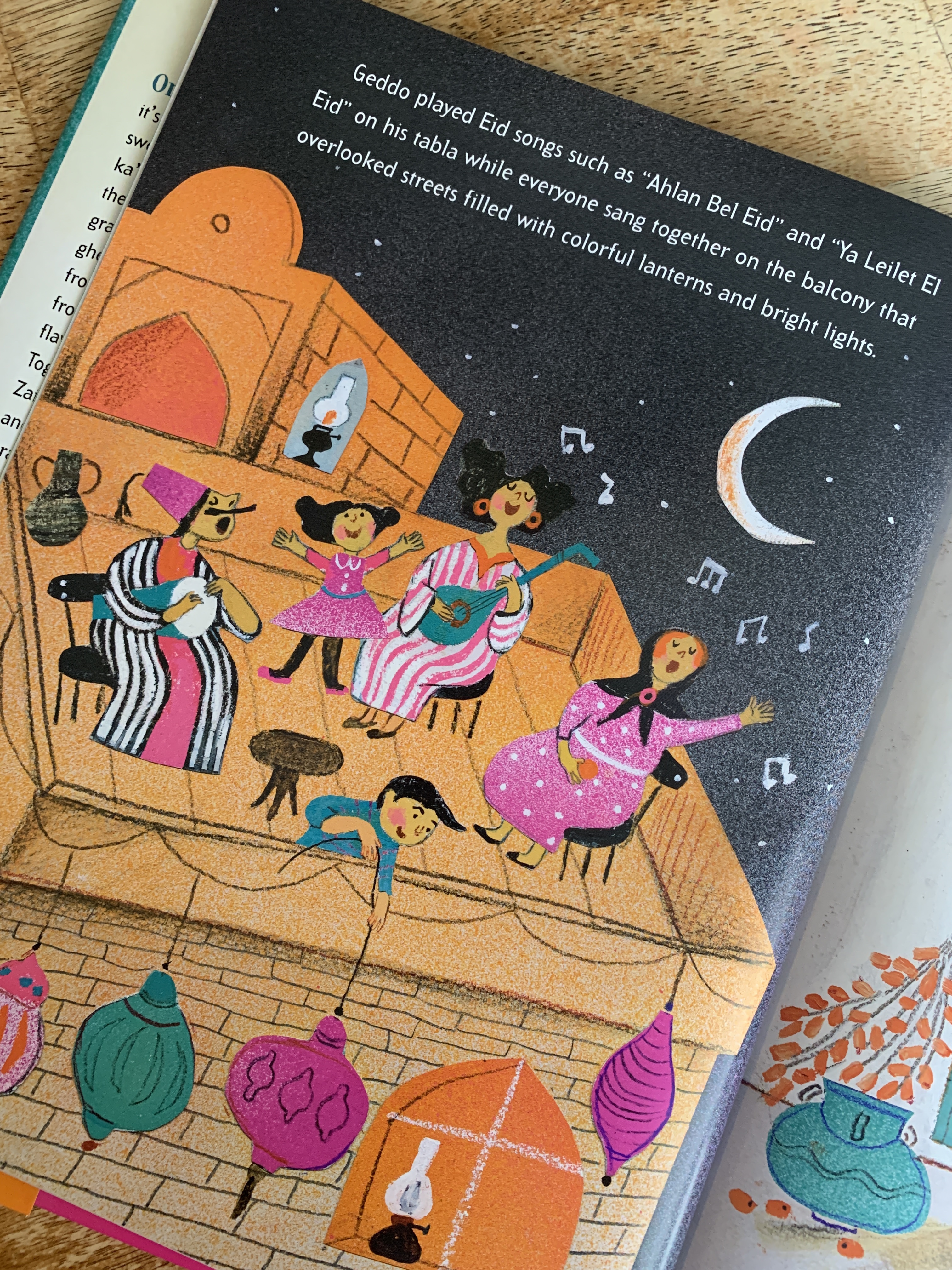
It is the night before Eid and Teita has arrived from Egypt.  Zain can’t wait to make ka’ak to take to school and share with his friends.  The beloved powdered sugar cookies are steeped in tradition, both in Zain’s family and in Egyptian history.  Once the suitcases is unpacked and the special ingredients found, Teita and Mama share memories of baking with cousins, painting henna designs on hands and putting eidiya in envelopes.  The family recalls singing together on the balcony while Geddo played the tabla and lights and lanterns filled the streets below, after Eid prayer they would hand out the ka’ak.
img_7125

Zain wants the ka’ak to turn out perfectly so his teacher and friends will like them.  Teita tells him that ka’ak is as old as the ancient pharaohs, and that recipes were found in the pyramids.  At one time rulers would even put gold coins in the cookies.  Zain and his Teita mix and add the required ingredients, and drink iced apricot juice as they wait for the dough to be just right.  Getting the cookies pressed with the molds though is harder than it looks, and Zain gets frustrated. Teita’s love and patience and Zain’s clever thinking get the treat making back on track.  The ka’ak doesn’t have a gold coin filling, but they are filled with tradition.
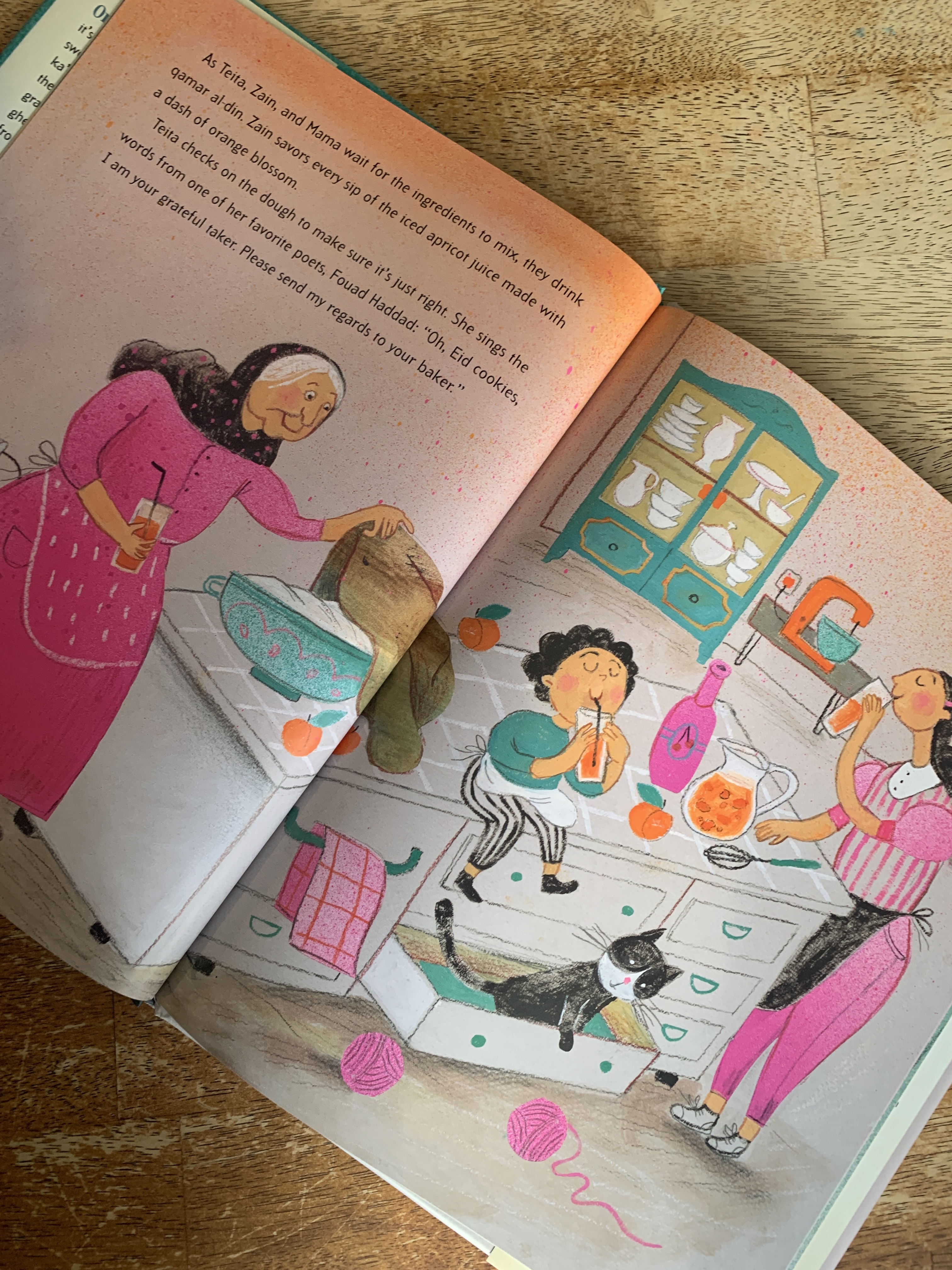
img_7126

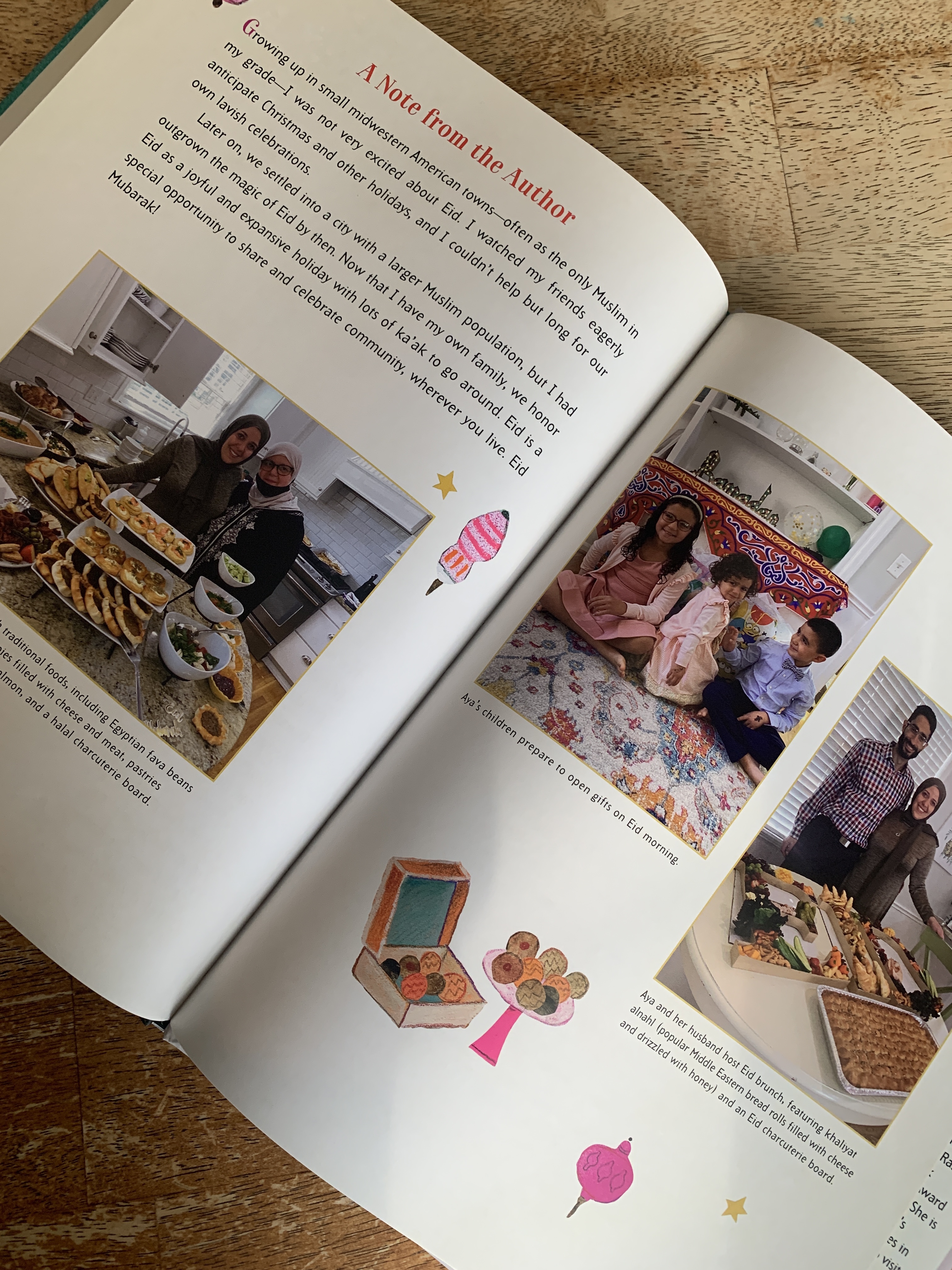
The timeline is a bit off for me with the grandma coming before Eid and then the cookies going to school on Monday, and then Monday evening when Zain is writing down the recipe with Teita he is telling her Eid Mubarak and that it is the best Eid ever.  So, it seems that he went to school on Eid, not to Eid prayers, which is fine, just a little sad that there was no Eid celebration or prayers.  I don’t know that kids will be bothered by it, but the lack of mirroring and stressing how joyous Eid is does somehow get lost and mitigated, in my opinion, by skipping acknowledgement of the religious holiday.   In the backmatter the author remarks that she has “outgrown the magic of Eid,” so perhaps it is intentional that the day is not included in the text.

img_7127

The last six pages of the book are filled with informative and engaging information about What is Eid, Ka’ak Time Line, A Note from the Author with photographs of her and her family celebrating Eid, a Simple Ka’ak Recipe and Additional Resources.

I purchased my copy from Crescent Moon Store where if you put my initials ISL (Islamic School Librarian) in at checkout you will save 10% or is available here on Amazon where the book currently has a coupon for $3.80 off.

Mama Shamsi at the Bazaar by Mohdeh Hassani and Samira Iravani illustrated by Maya Fidawi

Standard
Mama Shamsi at the Bazaar by Mohdeh Hassani and Samira Iravani illustrated by Maya Fidawi

shamsi

At first glance it might seem that this Iranian set book with a chador at it’s core is a political statement.  I do not believe that it is.  The backmatter does state that, “Our wish in writing this book is to add to the growing list of stories for children that demystify this veil (that is too often used as a symbol of hate) and instead present a different view of it as the safe and comforting space we always knew it to be.”  This is an OWN voice authored book, from what I can find online the authors do not cover. It is a warm memory of finding love and humor and safety in the modest coverings worn by a grandmother.   I do wear hijab and I choose to do it based on my understanding of what Allah swt commands, I have never been forced to cover by a person or government, and do not know how that would effect my love of fulfilling a tenant of my faith.  But all that is an aside to make the point that this book to me is not weighing in on Iran’s politics, books are written and slated to be published years before they finally release, and this book is a silly heartfelt picture book about a girl and her chador wearing grandmother heading to the bazaar.

In the bustling city of Tehran, Samira is heading out to buy groceries in the big bazaar for the first time with her grandmother. Samira is nervous that it will be loud, and she might get lost, she asks her grandmother if she can rider under chador on her back. Her grandmother tells her no, she will look like a turtle.

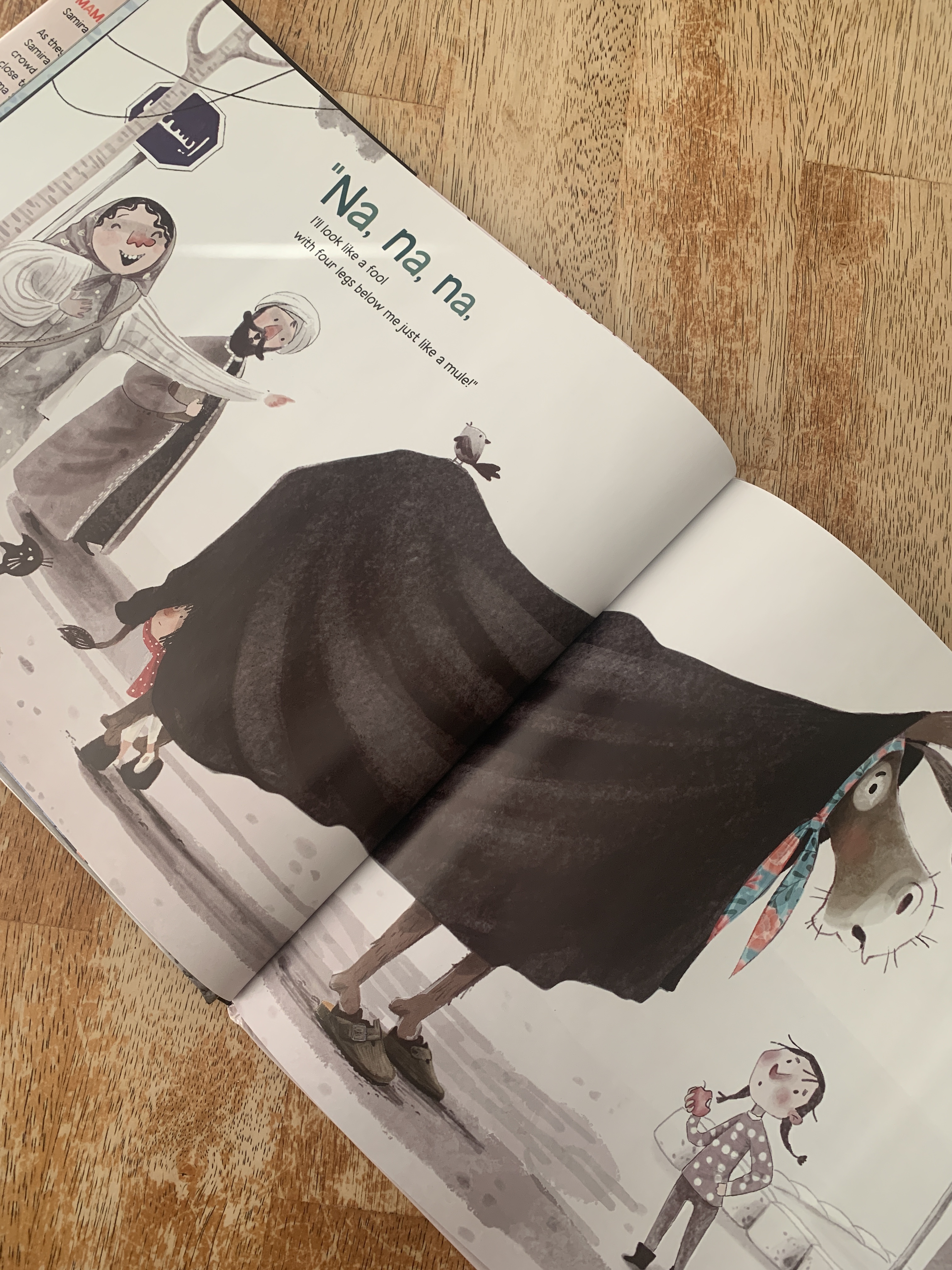
Samira then suggest they walk in a line with grandma in front and her behind.  Grandmother Shamsi says, na, na, na, she doesn’t want to look like a donkey. Various other suggestions involving hiding under the big black chador and staying close to Mama Shamsi are suggested, but all make grandma look like a funny animal, and she declines.

When at last they arrive at the bazaar, Mama Shamsi encourages Samira to not hide but to use her eyes, and ears, and nose to learn about the world around her. Hand in hand, they stick close together, and enter the market.

The love between the two characters is heart warming in the text and truly elevated by the remarkable illustrations.  You love their relationship, you can feel Samira’s nerves, you appreciate Mama Shamsi’s humor to lovingly empower her granddaughter, and at the end you truly long to have your grandma next to you guiding you.

I enjoyed this book and don’t mind one bit reading it over and over again as kids giggle at the pictures and find details they hadn’t noticed before.  The book releases in February, and I hope that presales can reinforce the power of OWN voice authentic tales to be shared.  You can preorder/purchase it here.


Sitti’s Bird: A Gaza Story by Malak Mattar

Standard
Sitti’s Bird: A Gaza Story by Malak Mattar

img_2562

I hate that this book is so timely.  It was written by the author/illustrator recalling the 2014 airstrikes, but alas, has anything changed for the Palestinians’ suffering at the hands of the Israeli occupiers amid the  apathetic silence of the world?  This 32 page picture book shows family love and daily life while Gaza is under siege.  The heartbreak of a young girl’s reality and perception shows the reader, in a simple empathetic, heart-wrenching, real-life example how her dream was limited and caged because she is not free.  The book is not sensationalized, nor graphic, it is written by someone who endured this as a child, and has written the book for children. The theme is not even political, but more hopeful as art is found as a respite and way to keep dreams from completely dying.  May Allah swt ease the suffering of those under occupation and free Palestine, ameen.  

img_2557

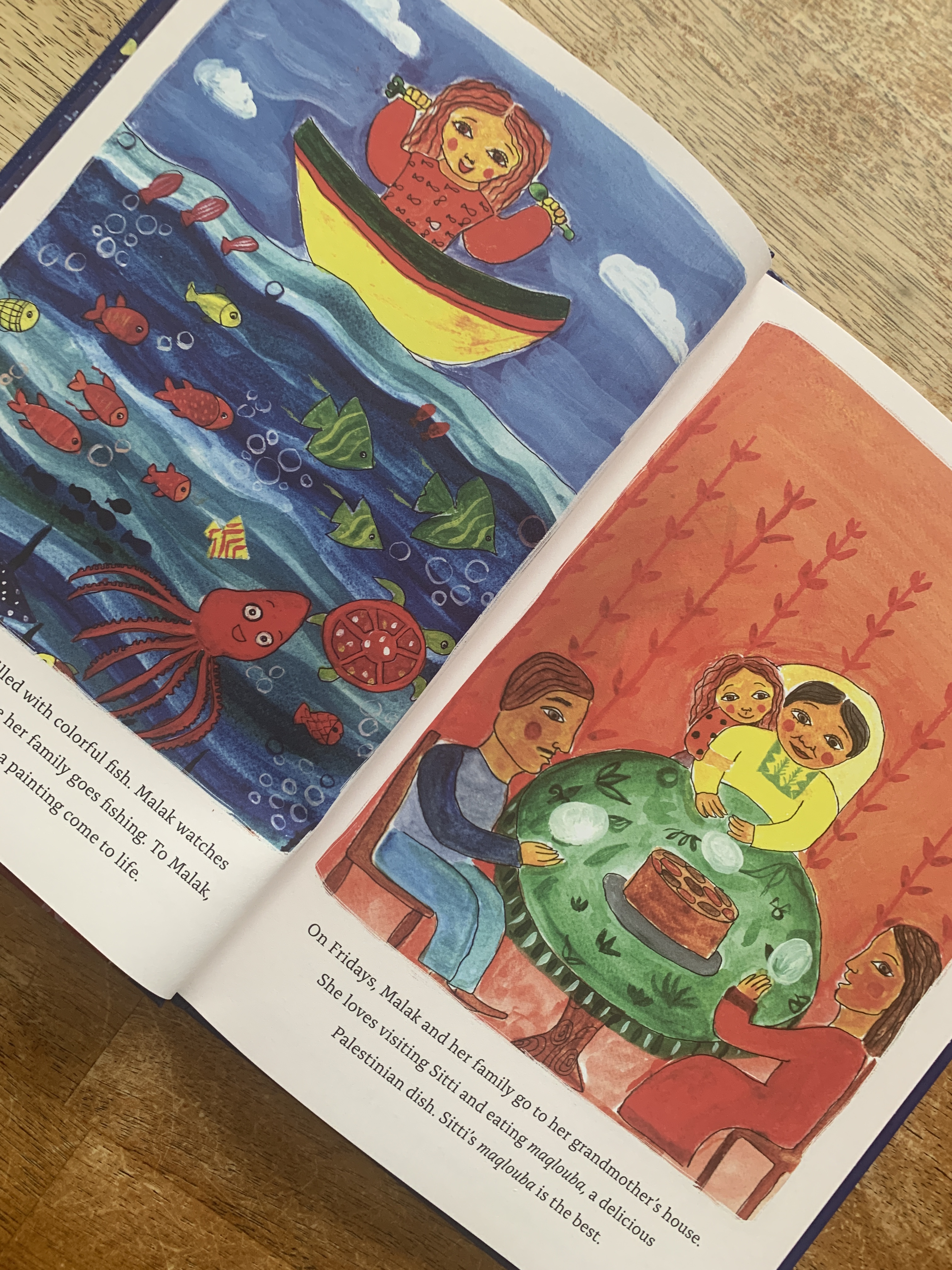
The book starts with a little girl and her parents going to Sitti’s house for the best maqlouba.  Sitti has a beloved bird, Malak wonders if she too is in a cage.  Her grandmother encourages her to fly in her dreams.  At school she is happy with her friends, playing games, listening to stories, but when an explosion sends them all home, she won’t get to return for 51 days.

img_2559

Constant airstrikes keep the family home and in fear.  Malak finds some paints and starts to create.  Sitti’s bird is lost when Sitti’s home is destroyed, but somehow shows up at Malak’s home.  Eventually Malak returns to school and she shows her teacher all her paintings. Her teacher decides to host an exhibit. 

img_2560 

People show up and marvel at her art work.  Months later an international exhibit invites her to attend with her parents, but sadly she must decline.  Gaza is closed.  She cannot leave.  

The book is hopeful, but does not have a happy ending, and I think the weight of that makes this book all the more powerful: because it is timely, because occupation persists, because dreams cannot be made into reality, generation after generation, this story inshaAllah will inspire some change and lots of compassion.

img_2558

There is nothing Islamic in the book, save some #muslimsintheillustrations, the author is Muslim.

Available here at Crescent Moon Book Store https://crescentmoonstore.com/products/sittis-bird?sca_ref=1601585.fIPhoqtScY  

Little Seeds of Promise by Sana Rafi illustrated by Renia Metallinou

Standard
Little Seeds of Promise by Sana Rafi illustrated by Renia Metallinou

seeds

This sweet, well-done 48 page picture book for early elementary aged readers shows the fear associated with being in a new place, the love of an elder family member, and the courage it takes to make new friends.  The story focuses on a young Pakistani girl who has recently moved to a new country and how she tries to remember the wisdom of her Nani to blossom in her new home.  The culture rich story is universal and lyrical, with hints of making duaa, greetings of salam, and the soothing sounds of the athan that make memories of home so foreign to her in her new residence. Young readers will empathize with Maya, and see the symbolism in the seeds she is anxious to plant and cultivate.

img_4475

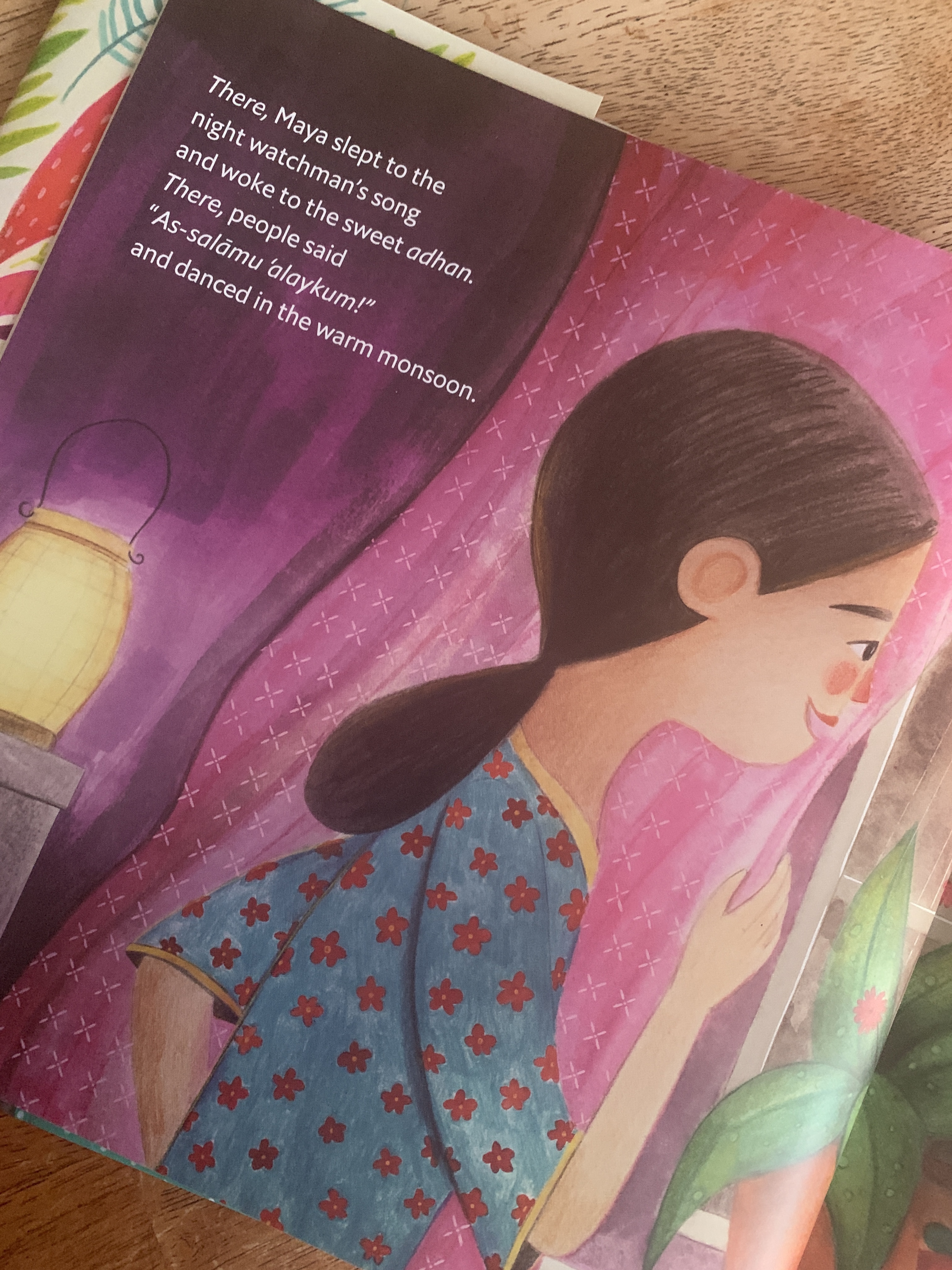
Maya finds her new home unfriendly and cold, she feels different with her food, and clothes, and way she speaks.  Home to her is dancing in the warm mansoon rains, saying As-salamu ‘alykum, and waking up to the sweet athan.  Nani was also there, her old home.  Sweet Nani with her hundred wrinkles, smelling like flowers.  When Maya left, Nani gave her a gift.  Little seeds of promise, so that they and she might bloom where planted.  But Maya doesn’t know where to plant them, she carries them with her everywhere she goes, but like a secret, she keeps them close.

img_4477

Channeling her Nani’s tenderness, she knows that she has to plant them if one day she wants to be surrounded by flowers.  Maya loves flowers, dancing around them, praying among them.  Maya finds a patch of earth.  She longs for rain, she hopes for warmth. She makes way for the rays of the sun.  The text talks of flowers, the illustrations show both the plant and the growing friendships.  For days nothing happens, with the seeds or the classmates.  But Maya remembers that seeds have a long journey from the ground up.

img_4476

Maya nurtures her seed, just the one she dared plant, with love and kindness.  She too feels ready to burst.  Can she be brave enough to plant all the seeds, can she share them, and her self in her new world? Can their be warmth here, like there was over there? Can this too be home?

img_4478

I love the symbolism and juxtaposition of the seeds growth with her own.  The character arc and the transition of home being one place to being the other, is very well done, older readers will feel an aha moment when they grasp it and younger kids will enjoy both the surface story and the dialogue you can have with them about blossoming where planted.

img_4479

Religion is not a strong thread, but Islam is present in her memories of her maternal grandmother and all the warmth and love that those memories contain.  I love that the classmates were never mean, they just didn’t know her either.  I wish there was a bit more diversity of skin tone and mobility in the classroom illustrations and the friend circle she is hoping to join.  Overall, a beautiful OWN voice picture book that will be enjoyed for multiple bedtime, small group, and classroom readings.

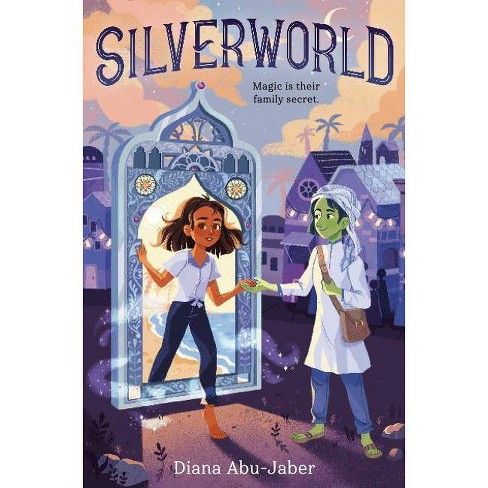
Silverworld by Diana Abu-Jaber

Standard
Silverworld by Diana Abu-Jaber

silverworld

At 304 pages this middle grades fantasy OWN voice book attempts to weave together a granddaughters love for her Teta, with her adventures in a mythical world that only she can save.  In much the same way of Narnia, or Gregor the Overlander, or even Alice in Wonderland, the book takes a realistic character and pushes them, in this case Samara aka Sami, just beyond, into a world filled with mystery, adventure, and lessons.  The Lebanese flavor sprinkled in adds a little depth and uniqueness to the story, and aids a bit in the world building, but it isn’t a strong presence outside of ifrits and character’s names.  Teta is a Beduin that has a prayer rug and tarot cards and a painting of the Virgin Mary that she calls Fatima, and Sami’s deceased dad was American and the house has Christmas lights.  At one point the book remarks that Teta “likes to pick and choose her beliefs.”  The premise starts with Teta showing signs of dementia: speaking in a language no one but Sami can understand, and not eating and seeming present, the resolution as a result could give children the wrong idea about treatments for such real conditions, and adults might want to make sure their middle graders wont be triggered by the decline of a loved one.  The book is written well and holds reader’s interest, the world building is decent and the character’s relatable, I don’t know that it is overly memorable, but it is a fun light magical read with culture and family and friendship at its core that readers will enjoy.

SYNOPSIS:

Sami and her brother Tony, along with their attorney mom Alia and maternal grandmother, Serafina, have just moved to Florida from Ithaca, New York.  The children’s father was killed and the family has moved a few blocks away from his sister to start anew.  Sami is not settling in, and to make matters worse, Teta has stopped talking coherently, and Aunt Ivory and Alia are looking for a nursing home to place her in.  For some reason though, when it is just Sami and her grandma, she can communicate just fine, and Teta tells stories of her adventures with her flicker Ashrafieh in Silverworld.  Sami doesn’t necessarily believe the stories are true, but she gets the idea to use her Teta’s fairy stories to try and save her grandma, but when she finds her Teta’s spell book and peers into an old beloved mirror, Sami is taken to Silverworld and realizes that it is not just her grandmother’s future at risk.

In a world of flickers and shadows, Sami finds two balancers that taker her in and guide her: Dorsom and Natala.  The world is a reflection of the Actual world, but the Shadow Nixie is consuming the land and taking prisoners.  The balance is off, and Sami is convinced that this darkness is what is also harming Teta.  Between shadow spies and giant rotifers, magic and prophesied destinies, Sami must push her fear away and accept that she can be the one to set things right.

WHY I LIKE IT:

I like that Sami has to step in to her own and fight for what she wants, even when she is afraid.  I love the relationship she has with her Teta it is very warm and palpable.  I feel like the “saving Silverworld will save her Teta thread,” however, is lost in the middle of the book, it might be the catalyst and might have worked out that way in the end, but I don’t know that the middle makes the case that the two efforts are one and the same.  I appreciate that there are glimpses of Lebanon in the story with the athan in the background and spinning dervishes, but outside of Teta and a bit of the food, the cultural elements seemed a bit forced and deliberate instead of stemming from a natural flowing place.  A bit odd since it is an OWN voice novel, but maybe I was just wanting more. I would have liked more information about how Teta settled in America, learned English etc., or about her tattoos and Beduin upbringing. Another thing that seemed off to me was the close relationship of Dorsom and Sami at the end.  I hadn’t over nearly 300 pages realized that they were that much closer than Sami and Natala.  I even went back to see if I had missed something, but I couldn’t find that I had.  I wasn’t entirely sure why they were going to see Nixie either, I mean yes it was logical for they type of book it is, but I don’t know that Sami really had a plan for Silverworld or her Teta, she was just going to Nixie’s castle to get there.  There were also a few inconsistencies such as Sami wishing her and Tony could go fishing or surfing, when the book has made it clear that Sami is afraid of the water, particularly the ocean.

FLAGS:

There is magic, killing, death. There is talk of goddesses, there is a female character, a shadow, that has two flicker husbands and children with them both.

TOOLS FOR LEADING THE DISCUSSION:

I don’t think this would appeal to middle school readers, it is a solid middle grade book.  I do think fourth and fifth grade shelves would benefit from having this book available to be picked up and enjoyed.

Sitti’s Olive Tree by Ndaa Hassan illustrated by Soumbal Qureshi

Standard
Sitti’s Olive Tree by Ndaa Hassan illustrated by Soumbal Qureshi

olive trees

This lovely 27 page book is a story infused with love, culture, and olive oil.  The hardbound, large thick pages are richly illustrated as the text, perfect for ages preschool to second grade, tell of the olive harvesting season in Palestine.  The story is framed between a young girl learning about the past from her grandma’s memories and enjoying the olive oil sent by her uncles from their homeland.  The story is warm and informative and does not discuss politics or conflict. There is a key hanging on a map of Palestine in the illustrations, but nothing in the text.

img_1213

Young Reema watches her Sitti make hummus. When a drop of olive oil slips down the side of the bottle and Sitti wipes it up and rubs it in Reema’s hair.  Reema wants to know how olive oil, zeit zaytoun, can be used in such different ways. As Reema is reminded of how far the oil has traveled and recalls that her Sitti never buys olive oil at the store, the two settle in for Sitti to tell Reema some of her memories about the harvest on her ancestral land.

img_1214

Olive harvesting season comes at the end of the year and the families gather to pick the olives and fill the buckets before climbing ladders and catch the falling olives on blankets.  The elders sort them, and at the end of the day they eat and drink tea and coffee and laugh and enjoy each other’s company.

img_1215

They tell stories to pass on to the next generation just like Sitti is doing to Reema, because the olives keep the families together.  Sitti hopes one day Reema will go to Palestine and play among her family’s trees.

I wish there was a bit more detail about the hummus, it seems to imply that the garbanzo beans are whole and not smooshed or blended, also when it lists the other things Sitti’s grandparents would do with the olives, the list is olive oil, olive soap and olives for eating.  I would imagine there are more things to do with the olives, even perhaps detailing the way the olives for eating are pickled, or preserved, or prepared would have been nice.

img_1216

There is a glossary of a few terms at the end.  There is nothing religious in the text, but many of the women wear hijab in the illustrations.

Overall this book is well done and serves an important point in showing a culture that is rich and full, aside from conflict and politics.  It is a sweet story between a grandmother and her granddaughter and shows how stories, traditions, and food help pass on culture and heritage.

.