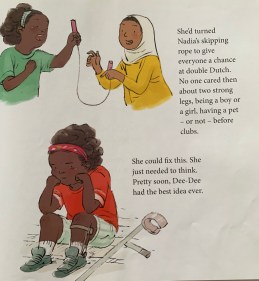
I debated reviewing this book, but seeing as it is one in a series of four, and Nadia a hijab wearing girl of color, is included in them, I thought I should draw attention to these diverse books that teach moral lessons. Over 24 pages this book for preschool to second graders focuses on inclusion and friendship.
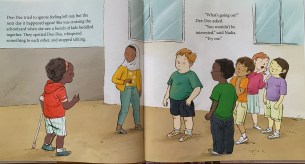
The diverse group of classroom kids (skin color, hair color, body shapes, mobility) have different likes, and exclude Dee-Dee from joining in any of their clubs. One group after another tell her no, even though she knows she is a good friend to all of them.
Dee-Dee decides she has to do something to change this and asks her teacher Ms. Crosby for some art supplies. Curious as to what she needs them for, Dee-Dee lays out her plan and how her friends’ exclusion is making her feel.
Dee-Dee starts the Friendship club where all you have to do is sign up and treat others the way you would like to be treated. You then pick a sign that has an attribute of being a good friend as a reminder or something to work on: be kind, show respect, care, etc.
Everyone realizes they were mean to Dee-Dee, apologizes and phew, the friends are all back together without anyone getting mad, or in trouble, but rather realizing their mistake fixing it and resolving to do better. Great problem solving Dee-Dee!
I love that the group is so diverse. Nadia, the Muslim girl excludes Dee-Dee too, and has to learn to include others. I’m sure everyone will relate to feeling left out, or being the perpetrator of exclusion in the book and learn how to voice how it makes you feel, and how to not do it to others.
And yes Nadia probably doesn’t have to wear hijab, but alas, for reasons unknown to the reader she is wearing it, and is visibly showing her faith at a young age.
I was not expecting to be so absorbed by this 362 page AR 5.4 book. I knew it was about a Syrian refugee in Brussels and his friendship with an American kid living in Europe for a year, so I knew that Islamaphobia and immigration would all be factors. I also knew that as a middle grade book it would be optimistic, and a bit of a stretch at times, but when I had to pause in the first chapter to wipe the tears off my cheek, I knew that while it could be billed as, another refugee story, it really was going to be a poignant story about humanity and friendship and family and making a difference, so I settled in and was swept off to Belgium and the adventure of two determined kids.
SYNOPSIS:
The book opens with 14-year-old Ahmed on a boat with his father hoping to reach Greece from Turkey, when the boat stalls, his father and two other men, the only other people on the dinghy that know how to swim, jump into the sea to drag the boat. When a storm swell hits them, his father is lost and Ahmed, who left Syria when an explosion killed his mom and sisters, is all alone.
Max is 13 and his parents and sister have just arrived in Belgium for a year. Not a great student, Max learns that he will be going to a local school where French is spoken, and will be repeating 6th grade. Less than thrilled with the news, he is additionally hurt that his parents didn’t tell him first.
The two stories start off separate with Max trying to find his footing in school and scouts where he understands very little, and has no desire to learn, and is also getting picked on by a kid named Oscar. He learns about the history of his street and house during World War II from his after school tutor and a police officer that used to live in the house they are renting and makes regular checks on how it is being maintained.
Ahmed has been staying with Ibrahim and his family, another man that tried to drag the boat in the sea, but with news that they are probably going to be forced to return to Iraq, suggests that Ahmed register in as an unaccompanied minor so that he could find a place to stay. Ahmed knows that if he registers in Beligium he will never make it to England, he hires a smuggler for 300 Euros to get him there. When the smuggler steals his money and his phone, Ahmed worries his organs could be next, and jumps out of the moving car,
Ahmed runs through a neighborhood looking for shelter and safety and some warmth from the frigid air. Ahmed finds the basement of a house unlocked, he then finds a wine cellar room that is empty and decides to stay for the night as he figures out his next step. One day turns in to two and before he knows it, he has a routine of finding food upstairs during the night, which he records so that he can repay the family one day, caring for the family’s discarded orchids, and working on his English. Then one day Max goes downstairs and discovers Ahmed living there.
Deciding he isn’t a terrorist, Max decides not to turn Ahmed in nor tell his parents, and the two become friends. The two enlist Farah, a nice Muslim girl at school to help, and they get Oscar too, to forge papers to get Ahmed in to school. While the biggest problem should be keeping a kid hidden in the basement, and keeping him fed and entertained, the situation is compounded as terrorist attacks by Muslim extremist plague the city and Europe, making everyone on high alert. The police keep checking in and anti immigrant sentiment rises. When Ahmed gets accused of being a bomb maker his secret is out, but can his knowledge of how a jewish boy was hidden in the neighborhood during the war keep him free? Nope, I’m not going to spoil it, you have to read it, trust me, you’ll thank me for it!
WHY I LIKE IT:
I love, love, love, the history parallel, and the truth in the story of Albert Jonnart and Ralph Mayer that is woven into this modern fictional story. I love that Max so plainly says that the stories are the same and that laws that aren’t right shouldn’t be followed, yes! The book reads a lot like Refugee by Alan Gratz crossed with The Boy at the Back of the Class by Onjali Q. Rauf with the kids being so heroic and determined and awesome, throw in a dash of The Diary of Anne Frank, switching out a boy for a girl, a Muslim for a Jew, the basement for the attic, and a diary for a fictional story, and you have this book.
I love that the adventure and excitement shows how resourceful kids can be even when they don’t share common language. Max speaks English and is learning French, he is helping Ahmed learn better English and some French, when they talk to Farah who speaks Moroccan Arabic /Berber, they often have to go through Oscar who speaks French and English. Yay, for American television and kids who’s hearts are bigger than the obstacles they are taking on. Additionally, when the kids hit a dead end, they reach out to Jews in America for help, knowing that the two religions have more in common than politicians and the media would like to think. Seriously, kids should rule the world.
Ahmed is a religious boy that prays, refuses meat even when hungry to ensure it is halal, and makes sure that Max knows in Islam kindness and charity are the norm and commands, not the violence that people are doing in the name of his religion. A lot of the moms of the kids at school where hijab, and the author gets the Islam right and believable. It doesn’t get preachy, but a fair amount of information about Islam is shared.
FLAGS:
A lot of lying. Some violence, death, hate speech. There is mention of smoking and the adults I think drink wine at one point.
TOOLS FOR LEADING THE DISCUSSION:
I’m hoping to do this as a middle school book club selection, because it really is so good.
This super cute Eid book works great for ages 5 and up. Written in both Arabic and English, not just translated in to both languages, the book features a Muslim celebrating Eid and a Christian boy working together to try and get Omar’s sister’s cookie recipe so they can be the best cookie cooks ever! The book would work for either Eid and with the adorable illustrations, and included recipe, the book will get lots of requests all year round.
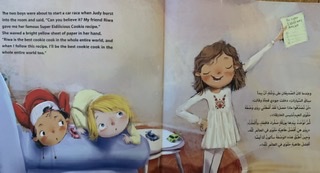
Omar is excited that his friend and neighbor, Oliver, is sleeping over the night before Eid. They boys are playing when Omar’s sister Judy brags that her friend has given her the best cookie recipe in the entire world.
Naturally, Omar and Oliver want to be the best too and offer to help Judy. She refuses, and the quest to get the recipe is on, so that Omar can make them for Eid and Oliver for Christmas.
The boys try to steal it through the kitchen window. But Judy catches them and slams the window shut. They then try binoculars from the stairs, but the boys can’t write fast enough and Judy grabs an umbrella to shield the recipe. Undeterred the boys pull out a drone, but the zoom on the camera isn’t quite good enough.
The boys then see Judy rushing out of the kitchen and run in to see if she left the recipe. They don’t find it, but they peek at the cookies and see that they are golden brown and if left in any longer might burn.
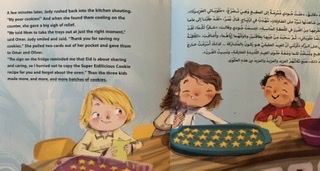
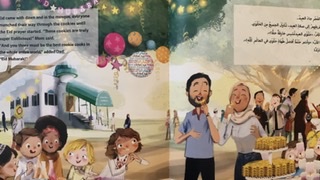
Tempted to let them burn, a sign on the fridge saying, “Eid: a time to share and show we care,” makes the boys realize saving them is the right thing to do. Judy says she too saw the sign and rushed out to copy the recipe for the boys. They then all work together to make lots of Eidilicious cookies and share them with everyone on Eid.
The book starts with some tips for parents on how to present the bilingual book and ends with a cookie recipe, as well as some information about what Muslims and Christians celebrate. I love the illustrations and that they are two page spreads, but the page with the note is the whole resolution and the note is split on the folded binding and honestly I missed it when I read the book myself and when I read it at bedtime to my kids. When I opened the book wide to take pictures it was crystal clear, and if you were reading it to a group you might not have an issue.
I also didn’t love the word, Mashallamazing, I obviously get what it is trying to do, and I feel like it works with Eidilicious, but that Mashallamazing is a stretch. Additionally, if it is claiming to be an interfaith book, a word like that might need some explaining. I got a bit hung up on it, so I had my 13, 11, and 9 year olds read it and they did as well. I also didn’t think the pulling out of the story to ask the reader if the boys were successful in getting the recipe was necessary after each attempt.
Disclaimer: I don’t speak Arabic and cannot comment on that, sorry!
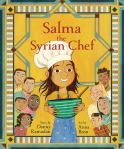
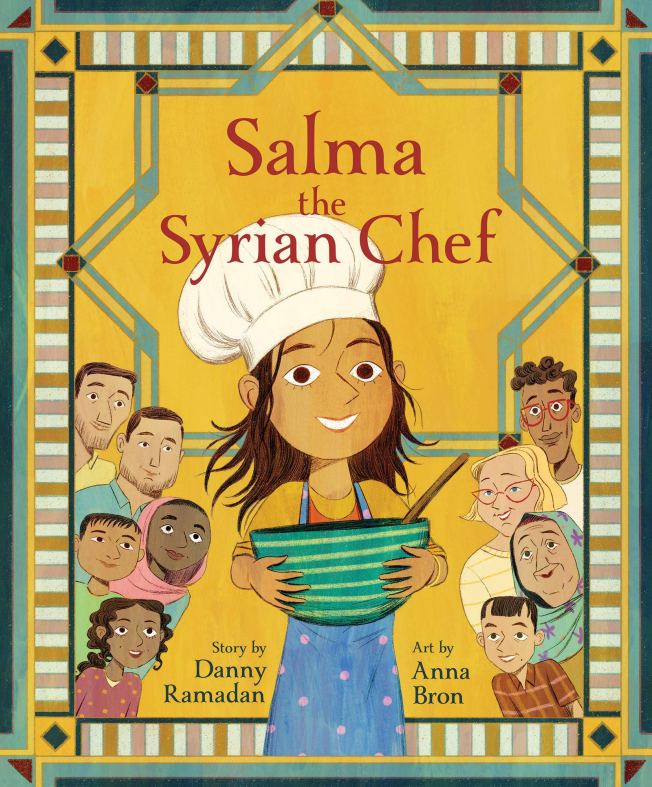
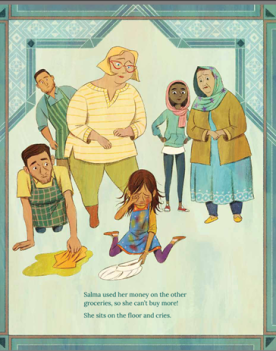
This 40 page picture book meant for 4-7 year old children is full of diversity, community and love. The only thing missing, is a recipe for the dish, foul shami, that Salma recruits everyone at the refugee Welcome Center to help her make to cheer up her mom. Possible flag is there is a gay couple featured in the text and illustrations.
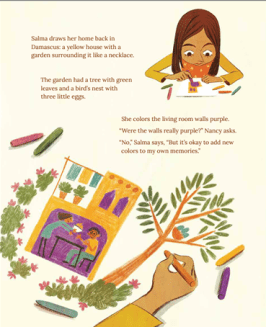
Salma and her mom are refugees from Syria living in Vancouver, and desperately missing Salma’s dad who still has not been able to join them. When Salma shares her sadness with Nancy at the Welcome Center, she is encouraged to draw her good memories. And then Salma has the idea to cook a dish from home for her mom. The other kids at the center mention foods they miss, Ayman from Egypt, Riya from India, Evan from Venezuela. Then the translator, Jad, from Jordan helps her find a recipe online.
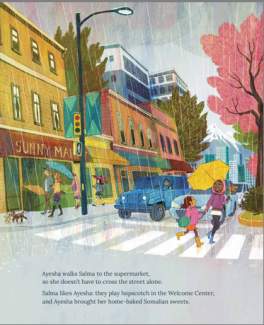
Convincing herself that she can do this, Salma draws a picture for each of the ingredients since she doesn’t know the names in English. She then heads to the market with Ayesha from Somalia, an older girl that helps her cross the street, and get the needed groceries.
Back at the Welcome Center to cook. Malek and Amir, a gay couple from Lebanon help her chop the vegetables and kiss away each others onion tears. The spices make Salma sneeze, but she can’t find the sumac.
Granny Donya from Iran has the missing spice and reassures Salma that she can do this. That is until the olive oil bottle slips and falls and shatters. With no more money and feeling discouraged, it takes Nancy and everyone else to convince Salma not to give up as the dish is made with love and Mama will love it.
Everything is set up to surprise Mama with the dish, but once mama comes home and the door bell rings, it is Salma who is surprised with all her friends coming over to bring her olive oil.
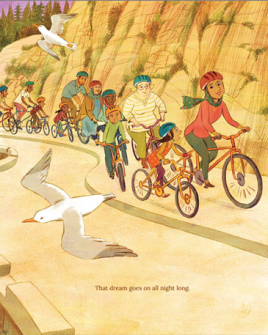
Mama laughs and tells Salma her smile is home, and Salma dreams of riding her bike around the Vancouver seawall laughing with her friends and Mama.
I love the sense of community that it takes to make the dish and that she finds love and support from so many. I also like her determination to make her mother smile along with her willingness to accept help when she needs it.
I’m assuming the family is Muslim, the mom appears to remove a scarf when she returns home, Ayesha and Granny Donya also wear hijab.
This Wonder Woman story of Princess Diana as a young girl is not noteworthy because of its groundbreaking storytelling, but more for the fact that the series and story is by a Pakistani-American Muslim author. I am not sure how authors are assigned or chosen to write these reimagined character series, but I think it is a great compliment to her writing and a great mainstream representation of diversity that we should celebrate. Even more exciting is the subtle addition of Diana’s best friend, Princess Sakina, daughter of Queen Khadijah to the story, and that while they are citizens of fictitious world of Greek gods, they seem to spout Islamic wisdom on occasion, and be equally strong and important to the adventure at hand. The book is meant for middle grades and at 288 pages is a fun light read for girls and boys of all ages.
SYNOPSIS:
Young Diana is anxiously waiting for the start of the yearly Chara Festival, when strong women from all over the world come to her island home of Themyscira to celebrate their different cultures and strengths. Most of all Diana is waiting to spend the week with her best friend Sakina. Frustrated that her mother is not allowing her to train with the other Amazonian women, Sakina listens to her and they hope to persuade Queen Hippolyta that this is the year.
As the women are arriving and gathering in the palace, Diana discovers a boy near the ships, Augustus. Boys are not allowed on Themyscira. There is no exception, but when all the women in the palace are drugged to sleep, her and Sakina are forced to trust him to try and save their loved ones.
Augustus confesses that a demon has hypnotized everyone on his island home, and that he was told to break the spell he needed to bring Princess Diana to the demon. With no options and determined to prove her self, Diana and Sakina and her trusty bird fly off on a chariot to another world.
With tests around every corner, literally, the trio has to work together, to stay alive, gather the ingredients to make a potion to save the people on both islands, and push themselves to be brave.
WHY I LIKE IT:
So the story is ok, it is fun, I’m sure most kids that like superheroes and even many that don’t will enjoy the quick paced plot of the story. There are definitely little nuggets of inspiration and motivation that make the book a positive influence on the reader. The trio discuss bravery and how being scared doesn’t make you less brave, they encourage one another to push themselves and they forgive each other when they make mistakes.
Sakina and her people are scholars and on occasion says deep thoughts. She says at one point, “My mother always says we are supposed to enjoin the right and forbid the wrong.” Which is a general principal, but the word choice sounds a lot like Surah 3 verse 110 “enjoining what is right, forbidding what is wrong,”
FLAGS:
There is talk of Zeus and the other gods. There is lying.
TOOLS FOR LEADING THE DISCUSSION:
I probably wouldn’t do this as a book club book, but I would definitely encourage kids to read it. I think muslim kids will get a kick out of seeing the names Sakina and Khadijah in the book and feel like its a bit of a shoutout, which I think is awesome. It seems like it is book one in a three part series, so I hope to have my kids read them all and make sure the 3rd-5th grade teachers at their school have them as well.
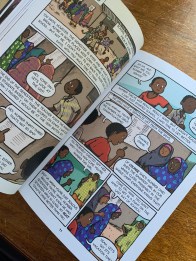
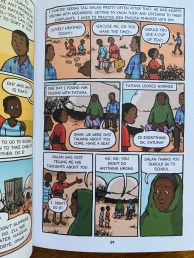
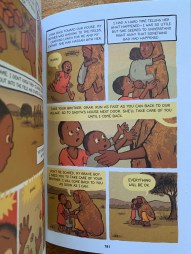
This graphic novel swept me off my feet and left me in tears, not because of the hard life and sadness that life in a refugee camp entails, I had braced myself for that, but because of the hope and humanity and beauty that is so powerfully expressed and conveyed in this 264 page book. Meant for 3rd graders and up, I think kids through middle school should be encouraged to read it. The illustrations and colors are incredibly well done and the story is based on a true story that needs to be told and shared. It is definitely in the top 10 books I’ve read this year and I keep catching my 11 year old re-reading this book repeatedly (like 5 or 6 times).
SYNOPSIS:
Omar Mohamed lives in Dadaab refugee camp in Kenya. His father was killed in the Somali war and his mother has not been seen after she sent Omar and his younger brother Hassan to run with the neighbors to escape the violence. Hasan suffers from seizures and doesn’t speak, save one word, Hooyo, mother in Somali. The two boys have an adopted mom Fatuma, who looks after the boys in the camp as if they were her own. Unable to go to school, Omar spends his days looking after his brother, playing soccer with plastic bags, and waiting in lines for water, food, and news of a better opportunity.
When Omar gets the chance to go to school (5th grade) he has to make the difficult decision of pursuing his own opportunities, with the hope of helping Hassan later, or living day to day and taking care of his younger brother. He is finally convinced that education will help them both, and that if the girls can find a way to do their chores and attend class, he can too.
Each transition from primary, to middle to secondary school requires testing, and only the top get to continue. Determined to stay in school, Omar studies while dealing with life’s many challenges and the daily additional challenges of living with little food and resources.
When Omar and Hassan’s names finally appear on a UN interview lists for resettlement, hope seeps in, but the wait and the uncertainty prove to be yet another test. Along the way there are side characters from the United Nations that show compassion, other families that show how generous and loving humans can be, female classmates show him how to take advantage of his privilege and friendships that move friends to family.
WHY I LIKE IT:
The book is gripping and has heart. I don’t know what I expected, but I truly could not put it down. The character’s stresses are felt and emotions are conveyed so powerfully, that I don’t know that you can read the book and forget it. The most emotional part for me was his honesty in dealing with his brother, the strength of his friends, particularly female, and the bond to Fatuma. Truly their living arrangements and loss of family is gut wrenching, but it was the little things that touched me the most. The honesty of Omar having to decide if he was tempted to not go to school because he was scared. Was he using his brother as an excuse to stay with something he knew. The emotional tipping point of no return for me was when he realized Fatuma would not be able to go to the second interview with the UN and would not be a part of what came after. Of course I knew that, but by that point I was so connected to the character, that when Omar realized it, I broke for him. To feel that connection in a graphic novel was new for me, perhaps a first, and alhumdulillah I am better for it.
The characters are Muslim and behave traditionally with praying and Ramadan and Eid.
FLAGS:
There is talk of khat, something the men chew on the side of the road to forget things. There is some violence, bullying, a young girl getting married before 6th grade and having a baby.
TOOLS FOR LEADING THE DISCUSSION:
Yes! I am hoping if and when we resume school I am starting with this book inshaAllah, for my middle school book club. There is so much to talk about and understand and empathize with.
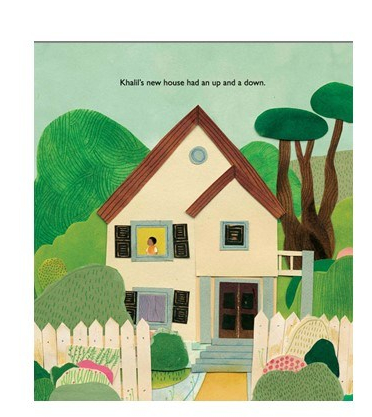
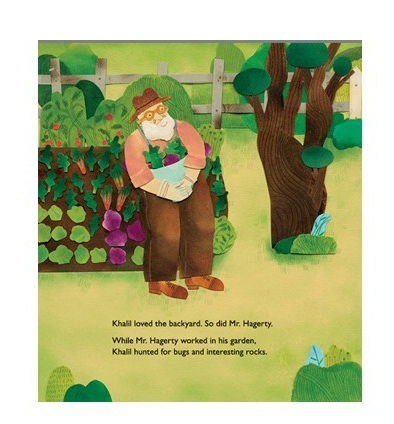
This 32 page book for ages 5-8 is a perfectly presented story about inter-generational and intercultural friendships. Big on sentiment and heart while keeping the text short allows the compassion the two friends have for each other and their actions of showing how they feel toward one another speak volumes. The illustrations appear to be cut paper and add to the thoughtfulness that the story presents.
Khalil and his family live upstairs and are noisy. Mr. Hagerty is quiet and lives downstairs. The two bond over their love of the back yard. While Mr. Hagerty works in his garden, Khalil hunts for bugs and rocks and treasure.
When Khalil doesn’t know a word, Mr. Hagerty teaches him. When Mr. Hagerty can’t remember a word, Khalil helps him.
That summer it is hot, really hot. The carrots are all shriveled, and Khalil can’t dig the hard earth for treasures either. So the two decide to have “refreshments,” which means chocolate cake and milk.
That night, the two friends separately plot to cheer the other up. They put their plan in to action and, no I’m not going to spoil the sweet acts the two do for each other. But it is clever and sweet and all the things that make a feel good story stick with you and remind you that age and culture and color are nothing when two people open their hearts to learn and grow.
There is no reason anyone casually reading the book would think that Khalil is a Muslim, and who knows maybe he isn’t, but the name Khalil caught my attention and the author’s dedication is to a Khalil, Muhammad, Fatima, and Adam. So yes, I totally am claiming it. Even if it isn’t, the old white man, and the young boy of color bonding is a great message in-and-of itself that we need to see more of in literature and real life.
This fabulously fresh and honest book told in alternating OWN voices shows how two seemingly different 6th grade girls discover how much they have in common as they learn about themselves and their families along the way. Sarah is a Muslim Pakistani-American, and Elizabeth is Jewish and has an English immigrant mom, the two come together over food, family stress, discrimination, and middle school social drama to form a solid friendship. But fear not, it isn’t easy and the book will keep upper elementary/ early middle school girls hooked. Not sure if boys will be as drawn to it, but if they can get over the brief mention of having a period, they too will enjoy the story. The 336 page book shows how much we have in common, and how hard fitting in can be for everyone.
SYNOPSIS:
Sarah is starting a new school, a public one, having been at a small Islamic school prior to 6th grade. She is not happy about it and to top it off, her mother is teaching an after-school cooking class at the school that she is required to attend. Hoping to sit in the back drawing and go unnoticed, she finds she can’t sit quiet when her classmates start giving her mom a hard time. Unaware of why she had to leave her previous school, and tired of her mom needing her help with her catering business, Sara also has to help her mom study for her citizenship test, handle two little brothers, deal with no friends at school and not being able to celebrate Halloween.
Elizabeth loves cooking. Her mother does not. She is excited to learn Pakistani food at the cooking club even if her best friend thinks they shouldn’t be learning things from “them.” Elizabeth is admittedly nerdy, and struggling with a life-long friend finding others to spend time with, her life at home is difficult too. Her dad is always traveling for work, and her mom is depressed with the recent passing of her mother in England, to the point of not really functioning. With Elizabeth doing the cooking at home, and trying to get her mom to study for her citizenship test, Jewish holidays and obligations get neglected, and Elizabeth not knowing how to help her new Muslim friend handle racism, is spiraling herself.
When the two girls decide to give each other a chance they find they might be able to be more than just cooking partners, but it seems like one of them always does something to mess it up. Either saying something hurtful, getting defensive, or not sticking up for each other. The girls get their mom’s together to study for their test, but it isn’t so easy for the girls, who are hesitant to trust one another.
An upcoming cooking competition, offers the girls a chance to make a cross cultural fusion dish that can wow the judges, help Sarah’s family’s financial situation, prove to the school that diversity is a good thing, and hopefully give the two girls a solid friendship.
WHY I LIKE IT:
I love how authentic it sounds and feels and how it doesn’t focus on boys or crushes, but on friendship between two girls at an awkward point in their lives and the family stresses they are experiencing. The book is for all readers and does a great job of not going overboard with what the girls face. I love how tolerant they have to learn to be with one another and that they have to learn to drop their defensive guards.
I read the book in two settings and didn’t want to put it down, it has enough pull that you really want to see where the book is going and are happy to overlook the slight repetitiveness of them stressing about the competition, but doing nothing but talking about the stress. Really the competition doesn’t even seem that important at the end, but considering everything going on, that to me is exactly as it should be.
I love the rich culture of Pakistan, England, Islam, and Judaism that seep in and never get preachy or dogmatic, but get celebrated and experienced. This is why OWN voice books are so beautiful and powerful. Admittedly, Elizabeth’s family is not super religious, but a few more similarities would have been nice. Yes her brothers are eating pepperoni Hot Pockets, but a shout out about halal/kosher marshmallows would have really rung true for so many of us that stock up at Passover.
I also love how the side characters have substance and aren’t just used as a foil to show something about the main characters. They get a little flesh on their own, and that enhances the richness of the story. Seeing that they have their own struggles to overcome as well shows how none of us have it all together, and that we are all capable of improving ourselves.
FLAGS:
The girls meet during school hours when Elizabeth lies about her period starting to get out of class. Sarah mentions that hers has already started. Elizabeth mentions that her Jewish grandmother is visiting her son and his husband, nothing more is said, just that. There are some derogatory things said about Sarah and being Muslim and Pakistani, but really mild.
TOOLS FOR LEADING THE DISCUSSION:
I want to find a way to do this book for a middle school book club. I’ve already told my 13 year- old daughter it is required summer reading. The Muslims have diversity within themselves, some wear hijab, Sarah does not. The book is so relatable and the personas sound the age for their views and struggles and perspective. The financial stress, the mental illness, the immigrant experience, the racism, the politics, are all wonderfully woven together, and the food, well, there is a reason I didn’t recommend this book at the beginning of Ramadan, you are welcome. Happy Reading.
This delightful little story about a boy, a lost cat, Ramadan and making friends, has a great lesson in empathy and understanding even when things are hard. The 28 page beautifully illustrated glossy book (8.5 x 11) is set in Ramadan, but is enjoyable for children 5 to 9 all year long.
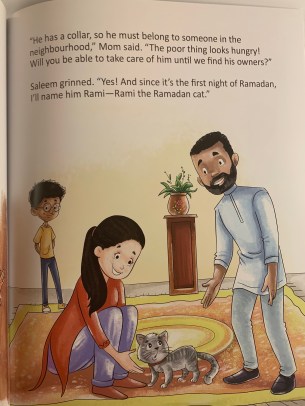
Saleem has just moved to a new city with his parents and doesn’t know anyone. Feeling lonely on the first day of Ramadan he is outside sulking when he sees a lost little cat. He brings it in and his parents help him take care of him until they can find the cat’s owners.
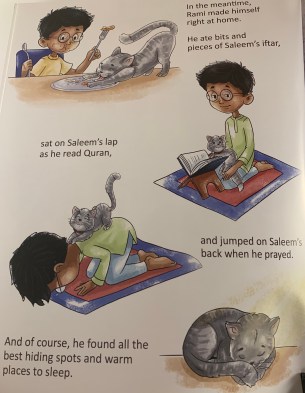
Saleem decides to call the cat, Rami the Ramadan cat for his timely appearance. The next day the family makes flyers to post around to try and find Rami’s owner. But no luck even after a few weeks, and secretly Saleem starts hoping they never find the owners. Rami is his best friend, he jumps on Saleem when he is praying, keeps him company when he reads Quran, even shares his iftar with him.
One night at the mosque, Saleem makes Dua that Rami will stay with him forever. After Taraweeh, Saleem can’t find his father, he waits by the door as everyone leaves, but can’t see him, he checks the shoe rack and his shoes are gone. Feeling scared and alone he wonders if his father left him. When his father returns from the washroom, Saleem is relieved, but wonders if that is how Rami felt that first day of Ramadan.
The next morning Saleem and his mom knock on every door in the neighboorhood until they find Rami’s owner. When they find her, she is a nice lady, and tell Saleem, the cat’s name is Sammy. Rami gives her his address and asks her to contact him if she ever needs someone to cat-sit Rami.
Saleem’s Eid isn’t very fun without his only friend. After prayers, there is a knock at the door, Sammy’s owner has come to offer to let Saleem keep Rami if he promises to bring him around to visit with her and her grandkids sometime. She has other cats and sensed that he was missing Saleem.
Saleem’s parents invite the lady, Mrs. Tompkins and her grand kids in to celebrate eid with them and Saleem and the children play with Rami, the best eid present ever.
The book shows Saleem praying and reading Quran and going to the masjid, but it isn’t preachy. I think even non Muslims would enjoy the book and not be confused by anything Saleem and his family are doing.
I love that the mom so clearly wears hijab out of the house, but not in the house. That there is some skin color diversity in the book, that Mrs. Tompkins is in a wheel chair. I also love that the new friends, and only friends are presumably non Muslim, and that a little gray cat brought them all together, Alhumdulillah.
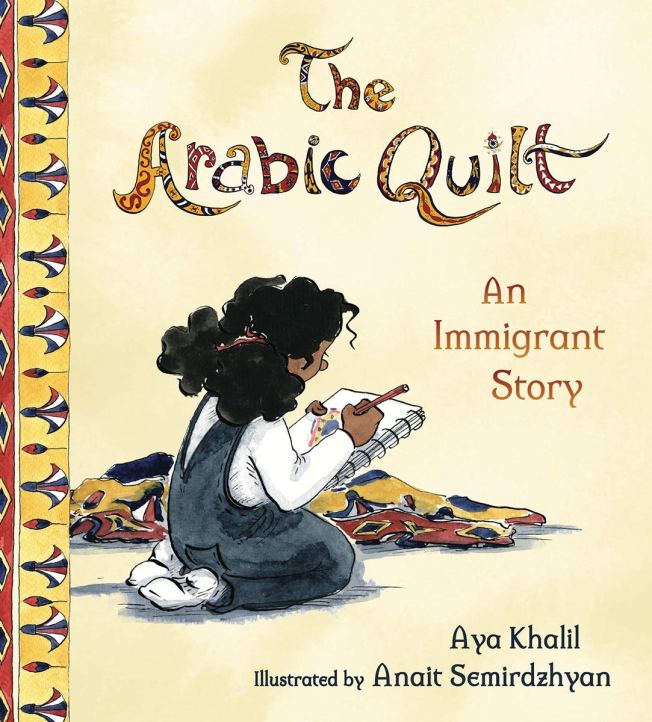
This 36 page picture book tells a beautifully presented story that incorporates events from the author’s real life that convey a story of loving your culture, finding similarities and giving people a second chance. Ideal for students between 2nd and 4th grade, younger children will enjoy having the story read to them, and older kids will benefit from the message as well.
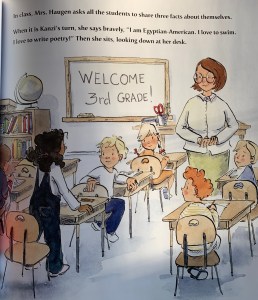
Kanzi is about to start her first day of 3rd grade in a new school. It doesn’t specify if she has just come from Egypt, but being she seems to speak English well, knows that she’d rather have peanut butter and jelly instead of a kofta sandwich and mentions that she got a quilt when she visited her grandmother, in Egypt, she possibly is just starting a new school, not her first in America, but it is considered an immigrant story, so I’m not certain.
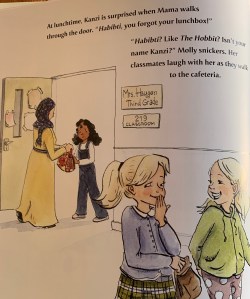
When she arrives in class and introduces herself she bravely says that she is Egyptian-American, but on the way to school she turns down the Arabic music in the car, so the reader sees that she is a little nervous about being seen as “different.” When her hijab wearing mom brings her forgotten kofta sandwich and calls Kanzi ‘Habibti,’ classmate Molly teases her that she is being called a hobbit.
A crying Kanzi tells her teacher and Mrs. Haugen reassures her that “being bilingual is beautiful.” That night Kanzi asks her mom to send her a turkey sandwich for lunch the next day, and before beds she writes a poem as she snuggles in her beloved quilt.
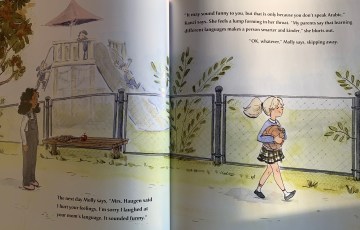
At school Molly apologizes to her and says that it just sounded funny. Kanzi tells Molly it is because she doesn’t speak Arabic and that her mom says that “learning different languages makes a person smarter and kinder.” Molly dismisses the comment and smugly walks off.
Mrs. Haugen sees Kanzi’s poem about her quilt from her grandma in Egypt and asks her to bring her quilt to school. The kids love it, and Friday Kanzi’s mom shows up to help with a special project: an Arabic quilt with the kids names.
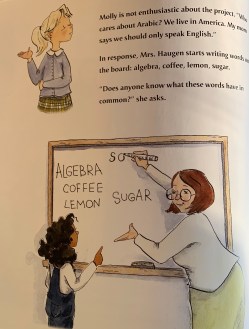
Molly is not enthusiastic and Mrs. Haugen writes English words that come from Arabic on the board: coffee, lemon, sugar, algebra. Telling the kids that “we can speak non-English languages and still be American.”
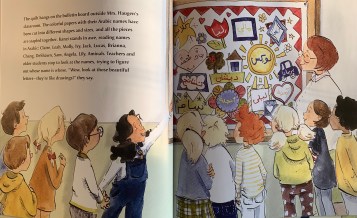
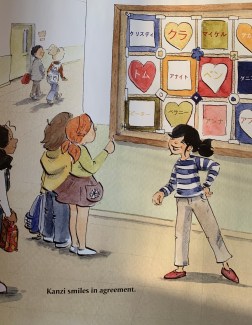
Kanzi and her mom write the kids names down and the children copy them. The teacher cuts them out and makes a quilt to hang in the hall. On Monday when everyone sees the quilt, they love the beautiful letters and colors. Even Molly sincerely apologizes and asks Kanzi to write her mom’s name in Arabic as a gift. The two hug and seemingly will become friends.
Across the hall another quilt is hung with names in Japanese, as another student and teacher were inspired by Kanzi and her quilt. The last page of the story is a letter Kanzi has written to her parents telling them how grateful she is that she has two languages and that she will speak them without guilt.
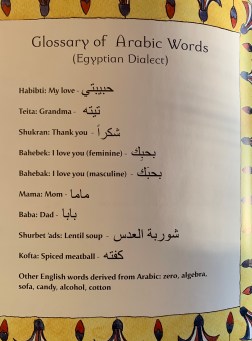
The story is beautifully told and exquisitely illustrated on well-sized 9.5 x 10.5 pages in a hardback binding. The mom wears hijab and it mentions it, but there is nothing religious about the text. It is a universal story of coming to be proud of your roots and inviting those around you to learn and grow. There is a Glossary of Arabic Words at the end and a bit about the author and illustrator.
My kids favorite page by far was reading the names written in Arabic and they all enjoyed the story (ages 13, 10, 9, 4). I actually had an issue when Molly apologized the first time, feeling that Kanzi’s response was a bit pretentious to what seemed like an 8 year old being told to go say she was sorry, but my older three unanimously and fervently disagreed with me, saying that she was obviously insincere and Kanzi knew it. I’d love to hear from other readers if they felt like Molly was sufficient in saying sorry and admitting that it sounded funny and that Kanzi was arrogant in saying that people that know two languages are smarter and kinder, or if Molly was being rude and racist and Kanzi was sticking up for herself.
Irregardless, the book is well done, enjoyable, and will get repeated reads by a large range of readers. My children keep pulling it off the book shelf, and for that I need to thank Gayatri Sethi (@desibookaunty) who generously sent me the book the same day I checked it out from the public library. Her generosity once again is a gift that I hope to pay forward in the future. This book also highlights how amazing teachers can be and often are in facilitating inclusion, understanding, and respect.











 This Wonder Woman story of Princess Diana as a young girl is not noteworthy because of its groundbreaking storytelling, but more for the fact that the series and story is by a Pakistani-American Muslim author. I am not sure how authors are assigned or chosen to write these reimagined character series, but I think it is a great compliment to her writing and a great mainstream representation of diversity that we should celebrate. Even more exciting is the subtle addition of Diana’s best friend, Princess Sakina, daughter of Queen Khadijah to the story, and that while they are citizens of fictitious world of Greek gods, they seem to spout Islamic wisdom on occasion, and be equally strong and important to the adventure at hand. The book is meant for middle grades and at 288 pages is a fun light read for girls and boys of all ages.
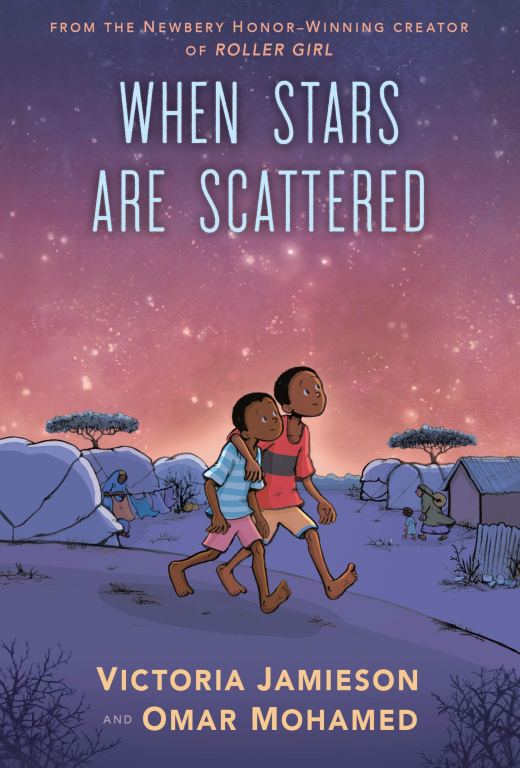 This graphic novel swept me off my feet and left me in tears, not because of the hard life and sadness that life in a refugee camp entails, I had braced myself for that, but because of the hope and humanity and beauty that is so powerfully expressed and conveyed in this 264 page book. Meant for 3rd graders and up, I think kids through middle school should be encouraged to read it. The illustrations and colors are incredibly well done and the story is based on a true story that needs to be told and shared. It is definitely in the top 10 books I’ve read this year and I keep catching my 11 year old re-reading this book repeatedly (like 5 or 6 times).