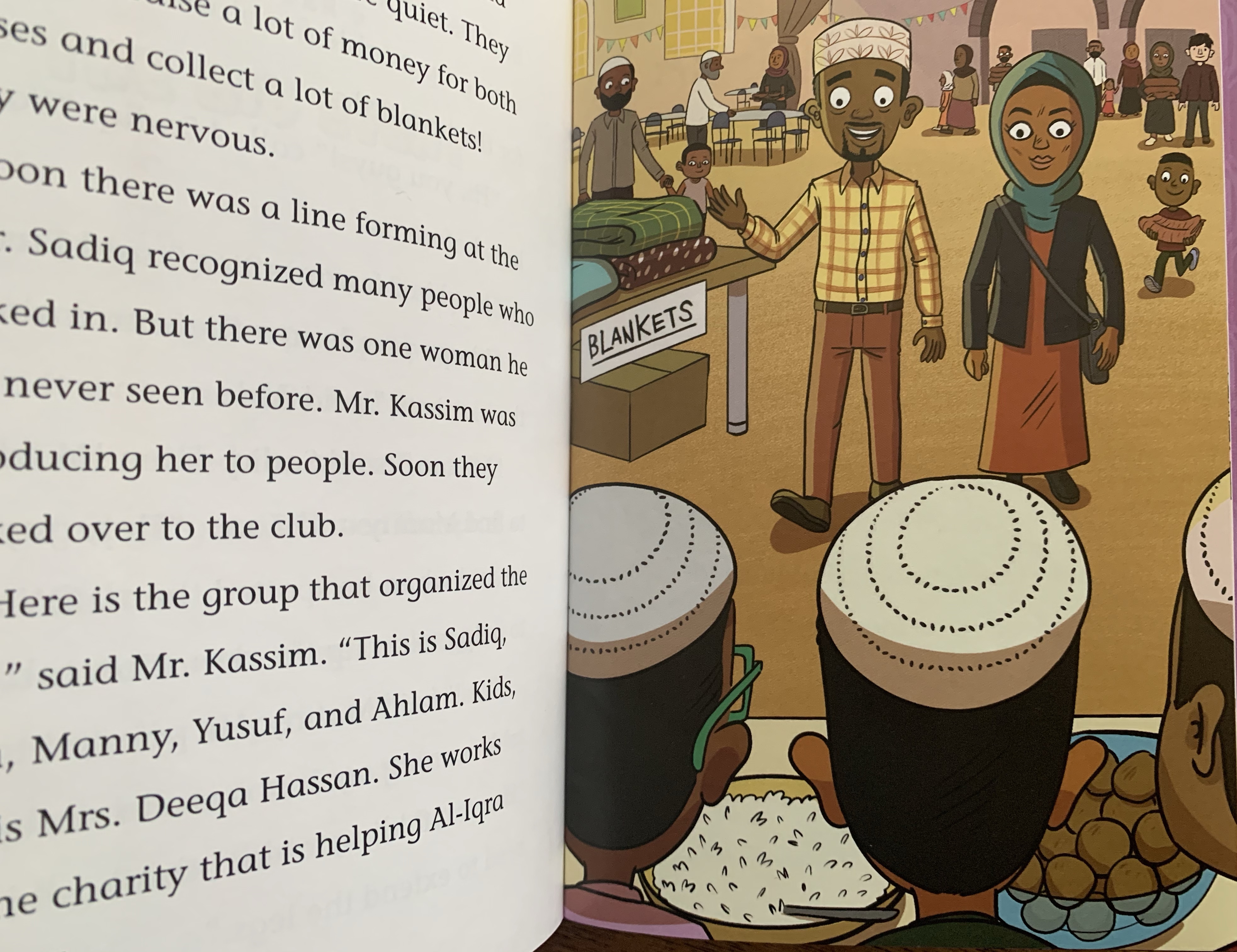
This 65 page early chapter book in the Sadiq Series does a great job of introducing Ramadan, giving a glimpse of Somali culture, and conveying a relatable and engaging story about friends with a lesson/reminder about the values of communication. A group of boys hosting a fundraising iftar to help a school in Somalia have to figure out the logistics, the marketing, the cooking, and the execution, as they become socially aware and active in helping meet the needs of their community, both locally and afar. This OWN voice tale doesn’t shy away from authentically drawing on religion and culture to make characters and a plot that all readers can enjoy. The book is not preachy, but the characters know who they are in their manners, dress, speech, and environment. A great book any time of year for first grade and up.
SYNOPSIS:
With Ramadan starting in a few days, Sadiq and his friends at the Dugsi are reviewing the importance and values of Ramadan. This year the masjid is raising money for a school in Somali and the students are encouraged to help, as sadaqah, or charity, is especially important during Ramadan. The boys decide to host a fundraising iftar at the masjid and with parental help to coordinate with the Imam, the kids have to figure out how to get enough food, get the word out, get set up to take donations and more. They make flyers, set up a website and shoot a small video. The once excited Zaza, however, is no longer very enthusiastic in the Money Makers Club and Sadiq can’t figure out why, but with so much to do and little time to get it done, more friends and family are brought in to help, and things continue on. When Zaza tries to tell Sadiq he wants to do his own fundraiser, Sadiq doesn’t want to listen. I’m not going to spoil if the two friends work it out and how they handle the two ideas, but it is a good lesson in friendship, communication, and charity, Alhumdulillah.
WHY I LIKE IT:
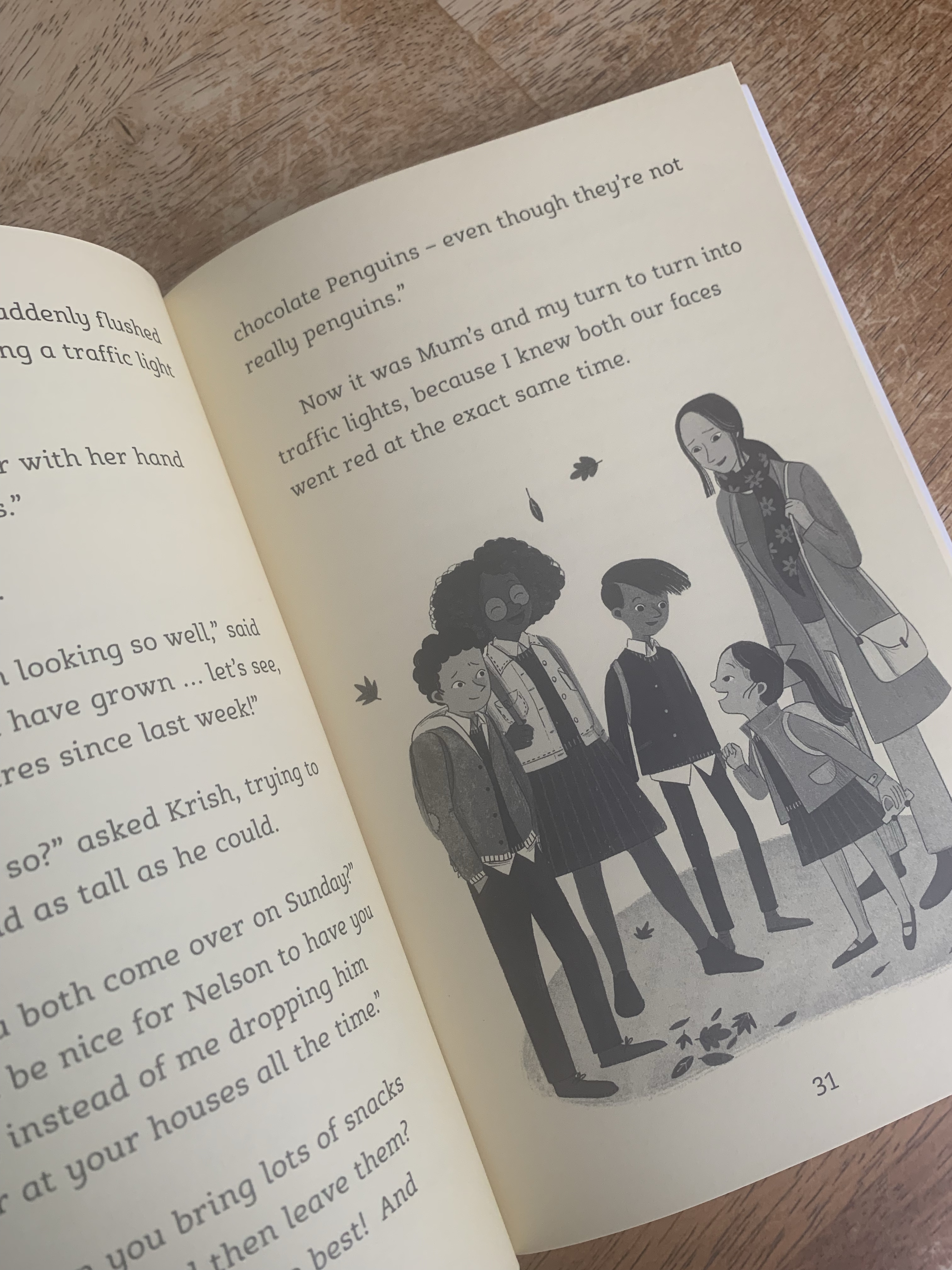
I love that the story starts with information about Somalia and words in Somali as well as a picture of the family. There are activities and questions at the end as well as a glossary of religious, cultural, and English vocabulary words. The book doesn’t assume that the reader knows anything about Islam or Somalia, nor does it assumer that the readers don’t. It strikes a balance of not talking down to the reader or getting too wordy. It simply provides the information needed if you are curious, but allows the story and the boys dilemma to take center stage. The whole series is remarkable in showing diversity and relatability with good quality story telling. I think this is the only book in the series that has a religious theme, I could be mistaken. The illustrations show the boys in kufis and the women in hijab.
FLAGS:
None
TOOLS FOR LEADING THE DISCUSSION:
Every elementary school library and every first through third grade classroom library should have this series. I know my public library has it, and the copies I get from there seem to be worn and loved. The age is too young for a book club, but would be great in small groups or for outside reading with the short chapters and engaging illustrations.
My tween boys read the first two books in the Streetball Crew Series and recommended I read book one because there is a Muslim character and I’m a fan of the basketball all-star author who draws on his own life and experiences growing up in the story. It is 265 pages, an AR 4.5, and while the story is decent, and I enjoyed the majority of it, I didn’t love it. I was not thrilled at the choppiness of the story telling and ultimately the way Islam was presented. Obviously there are plenty of Muslims that will occasionally eat pork and who get violent as they get more religious, but I don’t think it is the norm and definitely isn’t a message most middle grade Muslim readers would identify with, nor want non Muslims assuming about Muslims as a whole. The book randomly has a sudden Muslim chapter toward the end and attributes some threats on the main character as being from Muslims becoming more devout. The main character is not Muslim, this is a side character and her family, and you don’t find out til the book is nearly over that she is Muslim. I worry how younger readers will be affected by the negativity toward Islam, as it really isn’t explored or even part of the story. There is enough going on in 8th grade Theo’s life with out the insertion of religion. I was glad I read it so that I could discuss it with my boys, but I would encourage the book for more middle school aged kids, if at all. The book involves basketball as a subplot, but has larger life lessons and developments away from the game. Do be aware one of the young characters smokes cigarettes, there is female objectification talk among the male characters, racism is discussed, there is some physical assault, and beer, R-rated movies, tattoos, branding, and dating are mentioned in this coming of age book.
SYNOPSIS:
Theo is 13, in 8th grade, and over the summer has grown six inches. He identifies as a science nerd and a geek and is on the Academic Olympic team at his school. He now, however, finds himself on the school basketball team, and has no idea what he is doing. Towering over everyone, he is assumed to be good, but his lanky body and new found size brings him ridicule and teasing. His life long best friend, a fellow geek, can’t figure out why he won’t just quit the basketball team, but Theo is oddly enough, enjoying the concept of team, and suddenly being recognized in the halls. When he joins a pickup game to improve his skills however, he gets in a fight with another kid, get’s threatened by some guys on motorcycles, and teased by a weird girl named Rain.
Outside of school it is just Theo and his police officer dad. Theo’s mom has recently passed away and the two are creating a new normal, that is until Theo finds out his father is giving online dating a try. After the first abysmal basketball game, Theo is forced to go visit his cousin in LA who is a tiny bit older than him, but much rougher. He constantly teases Theo and puts him down. He claims to be a great musician, but no one has ever heard his music, and suddenly on this visit, he seems a bit more insightful, which has Theo confused.
With Theo being pulled in multiple directions, he risks being kicked off the basketball team, moved down to alternate on the Brain Game Team, killed on Friday by the motorcycle gang and to top it all off, a CD of his cousins music has been stolen from Theo’s backpack and band has gone viral with one of the songs.
WHY I LIKE IT:
I like that it is a coming of age book for boys. I feel like there are a lot of girl books out there, but this one really does get into a young males head. It isn’t always pretty, and while women/girls are at times objectified in his thoughts and while chatting with his friends, I think he realizes it and doesn’t treat or talk to women in a negative way. I like that race is discussed as he is one of 14 black kids in his school of 600. There are times when he or his family are treated different for their skin color, but his mom never allowed him to accept it to be a reason for not being the best ‘you’ and she would make them put money in a jar any time they blamed race for something bad happening, a tradition they continue even though she has passed. I like the pop cultural references, a lot of books overdo it, this book makes it pretty smooth and relatable.
*Spoiler Warning* So Rain, turns out to be Matar, Arabic for Rain, she has convinced her aunt and uncle to let her change schools while her parents are in Iraq (her mom is Iraqi, her father a Quaker from Pennsylvania) and call her by her American name and let her wear American clothes (no hijab). The motorcycle villains, are her cousins, who were trying to find her and were threatening Theo to try and find out where she was. Their frustration with her behavior and dress is what prompted them to hit Rain which made her run. Rain and Theo discuss why after September 11, she was tired of being accused of being a terrorist and so she wanted a fresh start. Her uncle and aunt are noted as being nice, but clearly the devout Muslim cousins are what will be remembered. She also discusses sometimes eating pork, that hijab is modesty in the Quran, not a requirement to cover your hair, and that she is Muslim, but doesn’t know if she will be when she is older.
The book didn’t find its flow for me until nearly half way through, maybe about page 100 or so. It seemed to struggle to get all the characters introduced, flesh them out, and then decide what the book should be about. Once it got through all that it flowed better, but still left me confused as to why there was a spontaneous breakfast party, why a lawyer would so quickly get involved in the music case, why Theo was withdrawing from his friends, why Rain wouldn’t just talk to Theo, how Rain had friends she could stay with after just starting at the school, how Rain could switch schools without her parents there. Really the Rain character in general seemed really forced.
FLAGS:
I listed most of the potential concerns in the opening paragraph so that anyone, like me that would think, ‘oh fabulous a middle grade sports book by a Muslim author’ would be aware that there are a few potentially concerning elements.
TOOLS FOR LEADING THE DISCUSSION:
I wouldn’t do this as a book club selection, it is a little all over the place, my 11 year old disagrees and thinks it would be a great book club read, so I’ll leave it to you to decide.
Video interviews with Kareem Abdul-Jabbar about the book:
This middle grades companion book to Amina’s Voice, reads in much of the same way as a lot of Hena Khan books in that I feel she is presenting Pakistani Muslims in America to non Pakistani non Muslims in the west. In the first quarter or so of this 288 page book that takes place in Lahore, I felt a different tone than really spoke to me. Granted I am (half) Pakistani and Muslim, but when Amina says good-bye to her family, I was in tears. It was relatable and powerful and so real to me that I got emotional, the rest of the book, sadly, not so much. It’s not to say that it isn’t well written, I just feel like the majority of the book are borderline issues for many Muslims looking to see themselves in literature: music, school dances, boy/girl friendships, and when presented that a religious family is permitting and celebrating of these issues, it seems to be trying to make us fit in, rather than support us for holding to a different perspective. There is a lot of good in the book about finding your voice, sibling and family relationships, friends, and challenging stereotypes, that I think the book would be great for some 3rd graders and up. However, if your family is against the aforementioned potential flags you may find the book that talks about reading Quran and praying makes the characters harder to separate from your own kids, you may want to hold back in recommending it to them. Don’t get me wrong the book is clean and well done, I just know from personal experience that sometimes when characters do things that you family doesn’t agree with it is easier to say that those things are for them, not us, but when the family doing them looks a lot like your family, you have to be ready to explain the differences.
SYNOPSIS:
Amina is in Lahore exploring the city with her brother and cousins. She is visiting her uncle who had come to visit in Amina’s Voice and as the trip comes to an end, she doesn’t feel like she is the same person that came to Pakistan a month ago. She is closer to her older brother Mustafa, she feels connected to her extended family, and she is growing more comfortable with pieces of her self she didn’t know existed before. Excited to go back to America and tell her friends about her summer, she finds they really aren’t interested, and she is unsure how to keep her promise to her uncle to show the world the beauty of Pakistan.
Once school starts, Amina is assigned a wax museum project in Social Studies that requires her to research and present a person that has changed the world. She picks Malala, but when she explains to her class at a midway check how Malala was shot for going to school, rather than feel inspired, her classmates feel sorrow that Pakistan is so backward and oppressive, the complete opposite of what Amina felt surrounded by such vibrancy and strength while in Pakistan. Determined to set things right, she reaches out to her cousins and uncle in Pakistan, except her uncle is back in the hospital and worry consumes Amina and her family, who are torn with being so far away from their loved ones.
At the same time Amina is feeling like her best friends Emily and Soojin are drifting apart. Emily is in chess club, Soojin is running for class president, and Amina just wants to write music, produce songs and sing. There is a new kid Nico, who is half Egyptian, and has music computer software that when he offers to help Amina produce music she says yes, and he starts spending a lot of time at Amina’s house.
Friends new and old along with immediate and extended family, love and support Amina and cheer her on as she finds her voice to share the beauty of Pakistan, fight for her friendships, and be content with all her pieces that make her unique.
WHY I LIKE IT:
I love that Amina realizes her culture is more important than following rules and her grade. She breaks from the assignment to spread light on more strong, brave Pakistani women than just the one, and is ok with her grade suffering as a result. I love that she realizes the headlines don’t reveal reality and that you have to see more than one side to the story. I love that she is religious and that the imam is cool and that her whole family is service oriented and compassionate. I love that her friends are diverse and their families are close friends as well. The sense of community established is carried over from the first book, and I think it gives the book a level of comfort that is pure and honest.
I have issues with Amina’s family being ok with her going to the school dance. She goes with her female friends, but to me it seems like a conversation is missing or she shouldn’t be going. It is mentioned that Mustafa went alone to a high school dance, but never explains why. Similarly, Amina is nervous about having Nico over and her family at times is bothered by it, but again it never specifies why. I feel like if there was a conversation about why her family would be weird about it or why she is nervous to tell her mom that the friend coming over is a boy then when Amina reminds her mom that her best friend in kindergarten was a boy and everyone was fine with it, or that when her mom asks if there is anything more than friendship going on, the reader would know why it is such a big deal. It seems to skip the explanation part and jumps from the nervous to have a boy who is a friend, to defending the friend being a boy, and skip the why part.
I didn’t get why Nico identifies as Muslim and Christian but never says salam, and I especially didn’t get why Amina’s mom was more relaxed when she thought he might be Muslim.
I also wish that after the whole emphasis on music, that the lyrics would have at least been shared. I was looking forward to it and was let down by it not being shared.
FLAGS: Nothing blatant.
TOOLS FOR LEADING THE DISCUSSION:
I don’t think that this would work level wise or content wise for a middle school Islamic school book club.
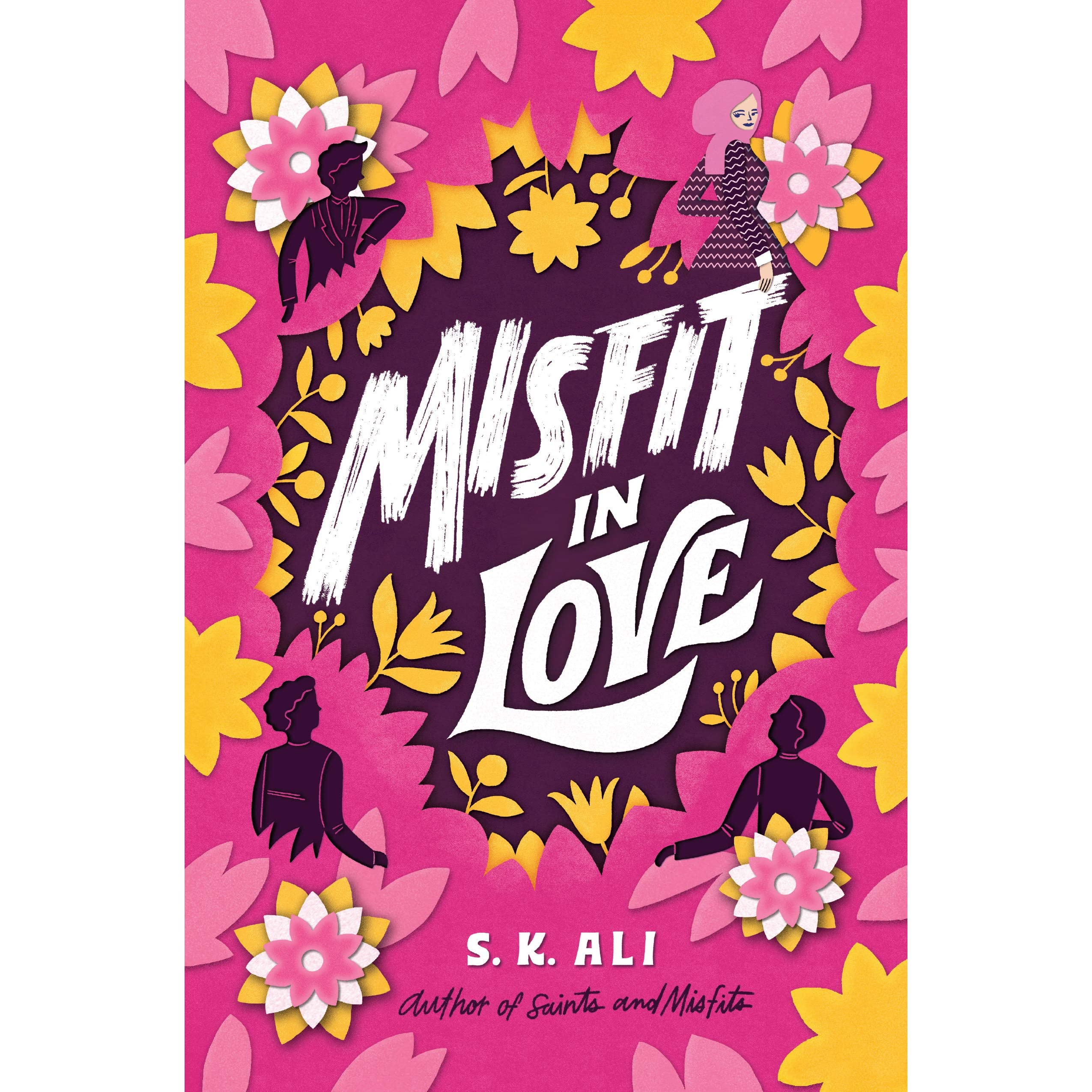
This book is a great OWN voice, middle grade coming of age book that rings with truth and hope in its poetic lines that sweep you up and keep you cheering. Over 352 pages the author’s semi-autobiographic story of coming to Peachtree City, Georgia from Karachi, Pakistan beautifully unfolds. I absolutely loved this book and the way it is told, in verse. The details, often small, ring with such sincerity that even those that have never moved to a new country, or been to a new school will feel for young Nurah Haqq and be inspired by her success, touched by her hardships, and disappointed in her mistakes.
SYNOPSIS:
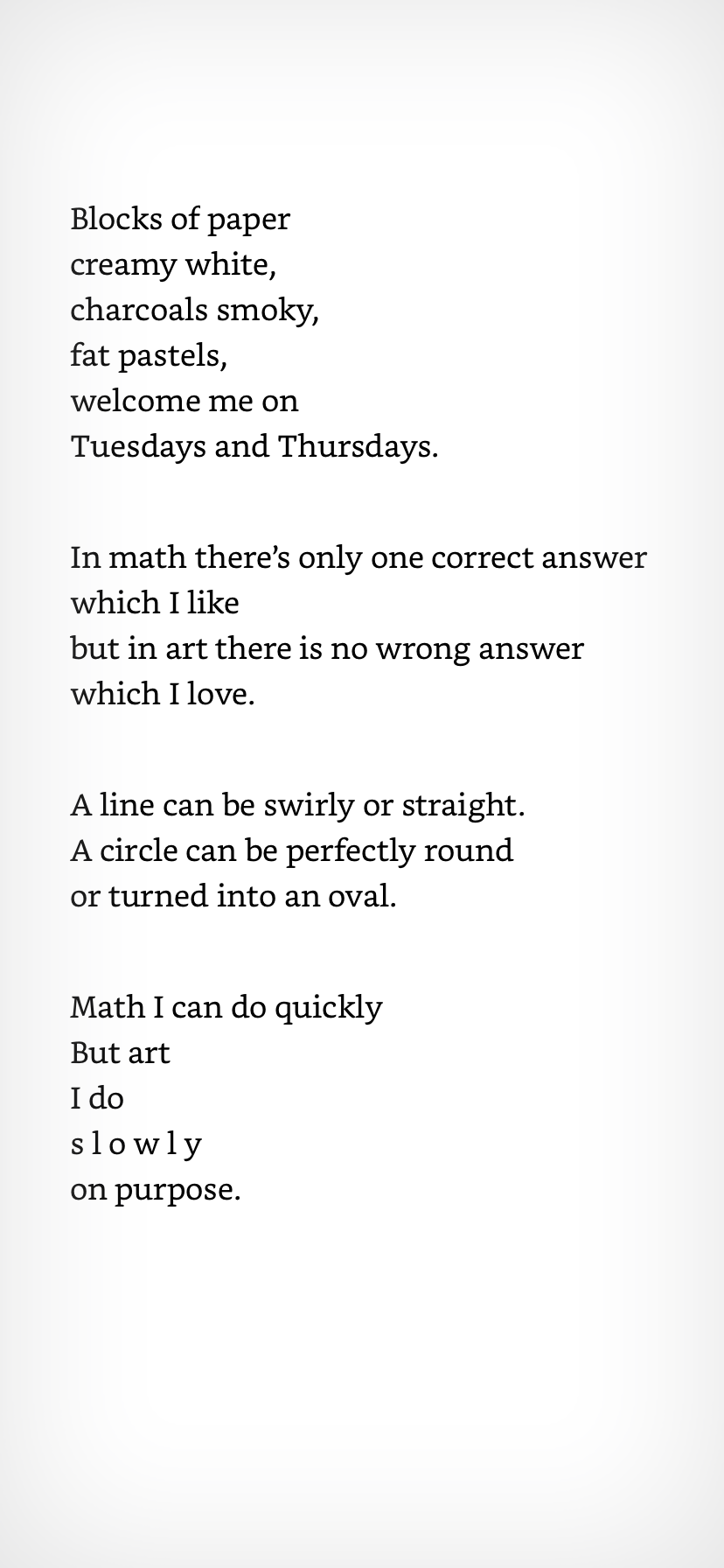
Nurah’s best day is spent on the beach with her best friend Asna, playing in the warm waves and riding camels. However it ends up also being her worst day, when she returns home to her father’s news that they are moving to America. Strong, confident Nurah who spends time with her grandparents, swimming with her older brother Owais, and excelling at math in school is reluctantly leaving it all behind to start anew.
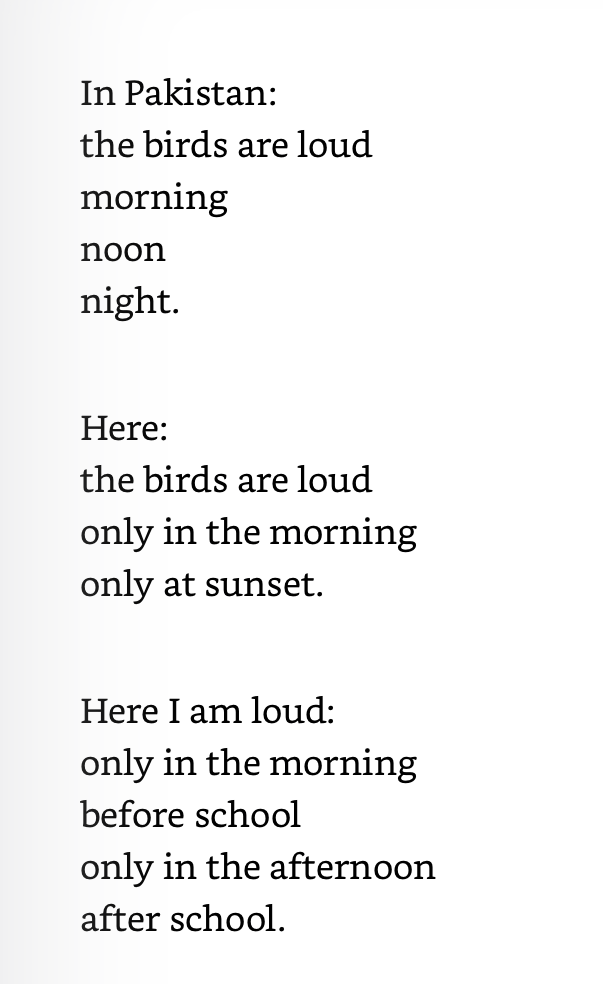
When they arrive in Georgia the family of four settles in a hotel until they find a house. Everything is different and new, and the transition with no friends and family difficult for the entire family. The way words are pronounced, the way the air feels and the birds chirp all make Nurah long for home. When they find a swimming pool at the rec center, things start to slowly change. Owais was a medal winner in Karachi, and will be one here too, people start admiring him, and Nurah tries to bask in his light.
School starts and math is a relief, but people are white, so white, and a boy reaches out to shake her hand. She feels betrayed that she has been told the schools in America are better, and lunchtime, with no one to sit by is a huge stress. She questions her clothing, her appearance, and the weather.
Her and Owais try out for the swim team and make it, and Nurah makes her first friend, Stahr. Stahr lives a few houses down from their new house and when Nurah’s mom has a miscarriage, it is Stahr’s mom who comes to show support and give comfort. The support is reciprocated when Stahr and her mom need help escaping from her abusive father.
As Nurah works to win swimming races and be more like her brother, she works to find her voice and use it to defend others and herself. A terrorist attack committed by someone claiming to be Muslim sets the family up to be targets. In a moment of jealousy, Nurah doesn’t intervene to help her brother and the consequences are huge.
WHY I LIKE IT:
I love the details and how they are articulated. I related to so much of Nurah’s feeling and impressions, that I reached out to the author and found her to be just as endearing as her character. The feeling of being different when swimming because of your decision to be modest, the role of food to comfort you and make you feel at home, the older brother that you so desperately want to resemble and be like: All of it hit close to home for me. I love how religion and culture are so much a part of the story and about the character’s identity, not to be made preachy, just to understand her and her experiences. She goes to the masjid, she prays, she starts to wear hijab. I love how she finds her voice and defends those that can’t, but that her path is not easy. She makes mistakes and she has to challenge herself to do what is right. The backdrop is always trying to “settle” in a new place, but the story has it’s own plot points that are interesting and simply made more impactful by Nurah’s unique perspective.
There are lots of little climaxes and victories for Nurah that show her to be well-rounded and relatable. You cheer for her early on and enjoy the journey. The only slight hiccup I felt was the name confusion of her Nana and Nani (Nana), it is explained, but it was a little rocky for me, it might be based on a real thing in her family, but once that is resolved, the book flows beautifully and smoothly.
FLAGS:
Nothing a 3rd/4th grader would find alarming, but none-the-less:
Crushes: Nurah has a crush on a boy at school when he shakes her hand and picks her for a lab partner, but she moves on from him while still maintaining a crush on her brother’s friend Junaid. Nothing happens, she just thinks they are cute.
Miscarriage: Her mother has a miscarriage and it details a blighted ovum and the mental strain on the mom and family in the aftermath.
Abuse: Stahr’s father is abusive
Hate: There are bullies, discrimination, physical violence.
TOOLS FOR LEADING THE DISCUSSION:
The book is a little below level for my middle school book club, but I think it it was on a bookshelf and a middle schooler picked it up, they wouldn’t set it down until they were done reading it.
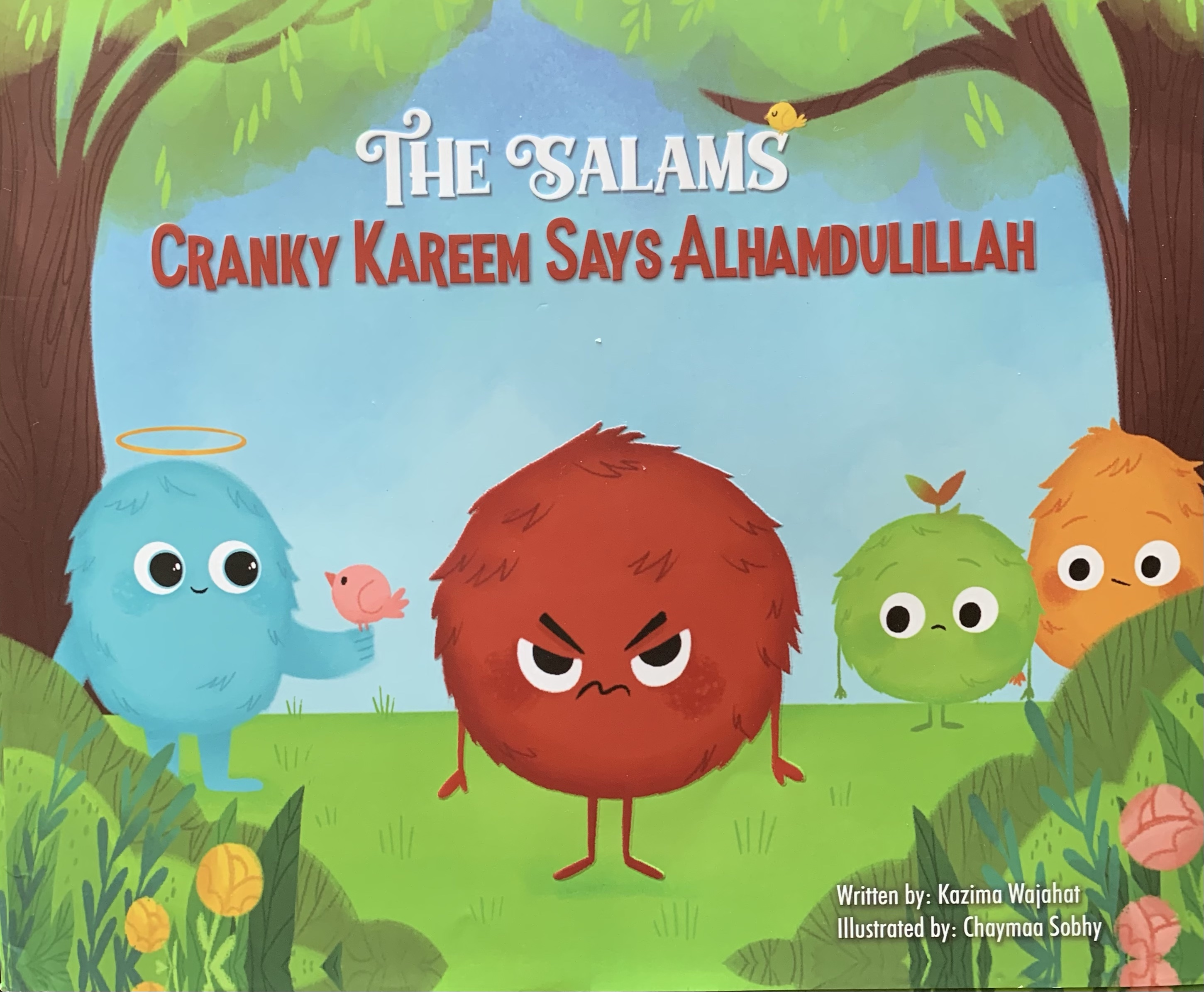
Part of me is tempted to channel my own Cranky Kareem and say how awful this book is, just because I know that the author reads my reviews of her books with bated breath, but alas I cannot lie even in jest as the book is truly adorable. This 40 page book in a new series highlights and starts to fill the gap in children’s Islamic fiction that is so needed. There are a number of books and series for toddlers teaching them to say Bismillah, Assalamualaikum, and MashaAllah and all the praise-filled Islamic expressions, but they are very basic, this book, and hopefully the rest of the series, goes a bit deeper. It shows how to truly mean what you say, how to glorify Allah not just in your words, but in the way you think about things, handle stresses, and carry on. The concepts and amount of text probably will most appeal to mature kindergarteners to early second graders at bedtime or in small groups. I do wish that Cranky Kareem apologized to Happy Hamdi after he relentlessly attacked him at the masjid, but in much the way Oscar the Grouch gets away with being so negative, the characters in the book and the readers alike will have to settle for Kareem finally learning the lesson, in this case, of being grateful to Allah (swt) for everything.
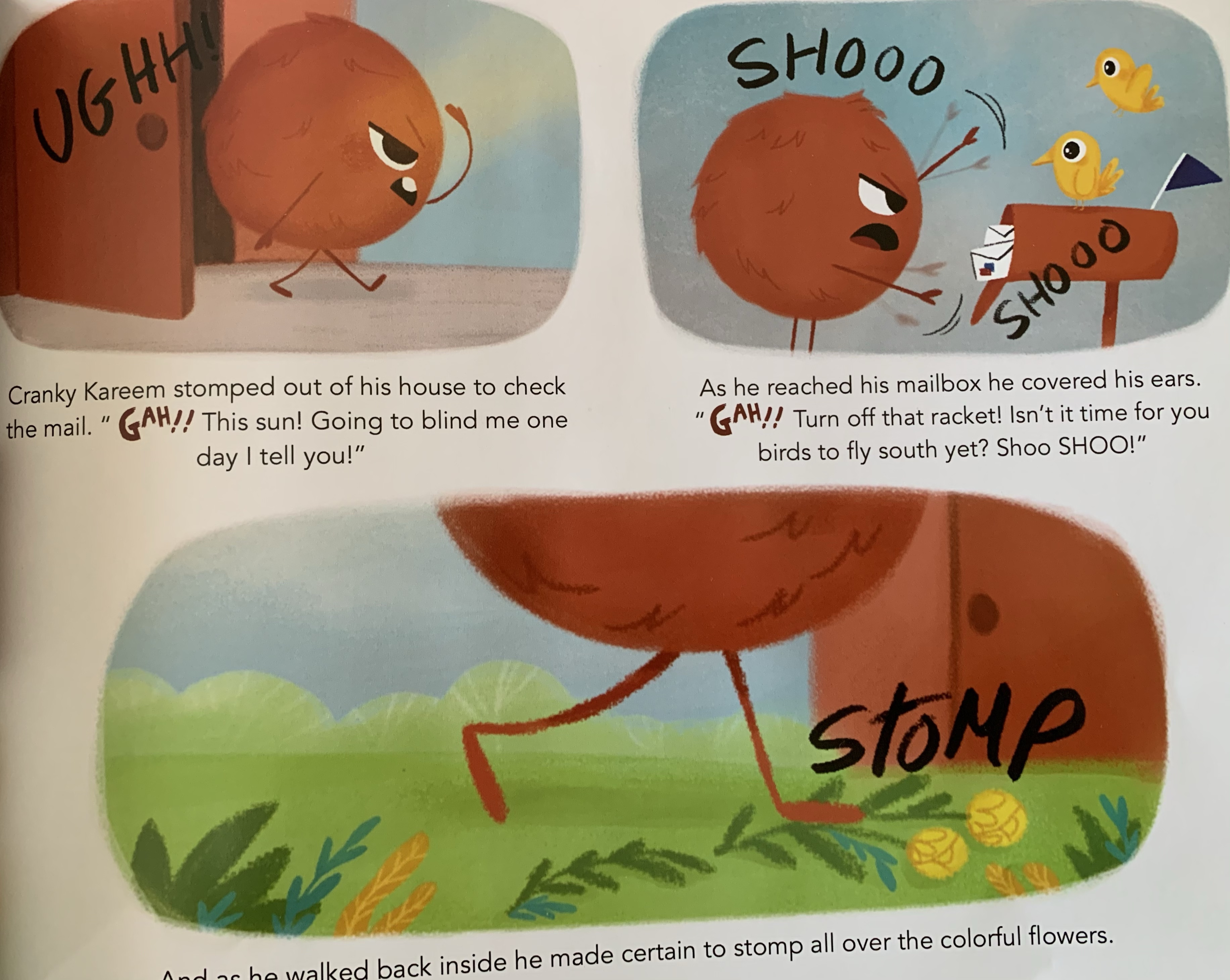
The book starts out with Happy Hamdi waking up in Salamville and praising Allah in appreciation of the fresh air, birds, flowers, and allergy medicine that works. Across town Cranky Kareem is having the opposite kind of morning. The sun is blinding, the birds annoying, coffee bitter, and he’s out of milk for his cereal.
When Kareem finally finds some peace and quiet on a bench at the park he is disturbed by Happy Hamdi and all his happiness. As Hamdi and bounces off to talk to Greedy Gamal and Healthy Hassan, Cranky Kareem gets an idea.
When Happy Hamdi heads to the masjid, Cranky Kareem sticks out his foot to trip him. Hamdi falls and gets a bruise on his nose, but still says Alhumdulillah. He then knocks sticky baklava on him and again he responds with Alhumdulillah, he then dumps a bucket of ice water on Hamdi, and Happy Hamdi says Alhumdulillah once more. When he leaves the masjid, Hamdi’s car is not working and he has to walk home.
Kareem can’t take it anymore and confronts Hamdi. Happy Hamdi explains that he was hungry and didn’t mind the syrup, then the water washed the syrup off and now that he is walking home, his fur is drying. Flabbergasted by Happy Hamdi, Cranky Kareem stomps off.
Convinced that Hamdi’s happiness is an act, Kareem pauses to ponder how his plan failed. Healthy Hassan jogs by and bumps in to him, knocking him off the train track and causing Kareem to twist his ankle, just before a train goes swooshing by.
Realizing that the bump saved his life, Cranky Kareem expresses his appreciation to Allah swt by saying Alhumdulillah.
I love the illustrations and the horizontal layout of the book. The book is cute and I can’t wait to share the rest of the series with my kids. Thank you to Crescent Moon Store for having this, and so many wonderful books available.
This 32 page picture book about friends learning to appreciate each other is both silly and sweet. An AR 2.6 the book is great for preschool through third grade and gives lots of teachable moments along the way if you want to make it more than just a fun book. There is nothing religious, but I believe the author, who is also the illustrator, is Muslim.
Presto and Monty are best friends. Presto is a brilliant magician and Monty is good at singing, eating ice cream and making funny faces. When the carnival comes to town the two decide to put on a show and become famous.
Monty suggests they take turns being the star of the show, and Monty decides to go first. Monty isn’t a magician, so Presto stays behind the scenes to make sure the tricks work. Somehow, this is how it ends up going night after night after night. Presto never gets his turn.
Monty gets bossier and bossier, demanding things of Presto and being rude. Presto is no longer having fun. When Monty signs a contract to go on TV with his magic show, Presto has had enough and leaves.
When showtime rolls around, Monty realizes Presto has left and has to try and learn magic real quick. The show doesn’t get off to a good start when none of the magic tricks work. As the show goes from bad to worse Monty realizes how bad of a friend he has been.
Presto watching from home can no longer bare it and rushes to save the day. Monty promises things will be different and the two of them cook up a new act and realize together their show is perfect.
Set in Morrocco, the fictionalized framing of a children’s story about solar energy and sustainability at the the world’s largest solar plant in Ghassate will appeal to curious children in kindergarten and up. Told through the every day life of Jasmine, a little girl living near the plant, the concepts are not technical, but give a broad overview allowing readers to understand how impressive solar energy is, as well as the disparity that exists in the world. Over 40 pages with factual sidebars and an author’s note at the end, children who enjoy the story and are curious about the reality of it all will find an easy opportunity to learn more.
Jasmine and her friend Nadia live in Morocco between the High Atlas mountains and the huge Sahara desert. It is always sunny where they live.
They talk a lot about making energy from sunshine as they watch trucks going and coming from the world’s largest solar plant. Their teacher likes to ask them about the big changes happening in their world.
As the villagers tend to their sheep and cows, they cook on open fires and bake bread in clay ovens all while keeping an eye on the workers making the largest solar tower in the world. Jasmine’s dad rides a mule to work and many classmates parents work at the state of the art plant. The contrast is obvious.
The next day at school Miss Abdellam the teacher asks the students about sustainability. And the book doesn’t define the concept right away. First the class goes on a field trip to the solar plant.
At the plant the size of 3,500 soccer fields they see the 660,000 mirrors that follow the sun like sunflowers and bounce the rays to the 800 ft tower. The tower gets to a thousand degrees on top and heats water whose steam powers turbines and is turned into electricity.
The kids go home to work on their sustainability homework. With no internet or computers even, they have to think for themselves. The remaining pages define and provide examples of how solar power is changing life for the villagers and improving life for people not just in Morrocco or Northern Africa but potentially the entire world.
I love that the concept of sustainability isn’t just a definition it shows how it is in every day things, and those every day things lead to big things that are both tangible and ideological. The author/illustrator acknowledges his own surprise and bias when he learned that the largest solar power plant was in Nothern Africa. I love that some of the females wear hijab, and some do not, and that the teacher and some of the parents at the solar plant are female. There is nothing religious even mentioned in the book, but the visibly Muslim characters are empowering and honest for a story about science and Morocco.
This 127 page book has a lot of potential, but ultimately didn’t win me over. It is one of those that needs a good editor to encourage the author to flesh out the characters, take advantage of a potentially cathartic resolution, and fill the gaping holes in the story. Meant for ages 8-12 the tiny font, and tight spacing, make the book really dense and intimidating to look at and read. The book, as written, should be well over 200 pages, if spaced appropriately for the target audience. Once you accept the presentation and get in to the story, it isn’t an awful read, it just could have and should have been so much more. I hope the author revisits it and polishes it up- the time travel, the science DNA component, and the death of the protagonist’s parents, offer a lot for Muslim and non Muslim readers to sink their teeth in and be swept away by, but ultimately, I don’t know that most readers will be motivated to finish the book, and those that do, won’t remember anything about it.
SYNOPSIS:
Laila’s dad has recently died, and with her mother having died years earlier, Laila is now 13 and an orphan living with her stepmom and baby sister. Feeling resentful that her dad remarried and had a child that took time away from her in his final span of life, doesn’t make Laila a very kind person at home. Her best friend Beth, even points out how cold she is to her family. With school vacations approaching, Laila is headed for Umrah with her dad’s brother, her uncle, and his wife. While making tawaf, Laila loses her aunt and uncle in the crowd and finds herself transported to 7th century Arabia. She hears a baby crying and learns that the baby’s life is in danger. To save her, she must get the baby, the baby’s mom and baby’s sister from Makkah to Yathrib. The only way to do that is to join a caravan, and they can only join a caravan if they have a male escort. So Laila chops off her hair, acts like a boy, and gets them in the caravan. They meet bandits along the way, but nothing too scary, they arrive in Medina and right before they meet RasulAllah, Laila finds herself back in the present. She is in a hospital, but the doctors do not know what is wrong with her so they release her. She returns to the US, relays the story to Beth, and decides that at an upcoming field trip to study DNA, she is going to submit the baby’s hair that she still has for dating. The results show it is from 1400 years ago and a family heirloom of her step moms reveals that the baby is a great great great great… grandmother of her’s. Resolved to open her heart to her family, Laila is a changed person, alhumdulillah.
WHY I LIKE IT:
I love the premise, it is like Sophia’s Journal and When Wings Expand thrown together and scrambled. Laila is struggling with her faith and is trying to find it, while also finding a way to move forward after losing her father. There are just a lot of things that aren’t answered, are contradictory, or don’t make sense. It says she learned Arabic because her mother spoke it, her dad is desi, but really no hiccups speaking in 7th century Arabia other than forgetting the word for scissors? She at one point said she was a cousin from the north, but while on the caravan mentioned that she had never travelled through the desert. There really should have been more action with the thieves and the regrouping when the men came back. Similarly, her gender reveal should have been a bigger deal than it was. I was hoping there would be a mention of if her hair was long or short when she awoke in the hospital, I don’t think I missed it, but maybe, or maybe it wasn’t there. Once back home, there really needed to be a reunion scene with Laila and her stepmom and half sister, I mean the whole point of the time travel was to save a baby. Really? Nothing? I was disappointed that it was glossed over and mentioned as a retelling to Beth and pushed aside. The second climax is when the DNA testing is being questioned, but I didn’t get the need for the babysitter and everything to be rearranged for a two second conversation with the principal accusing Laila of theft, a phone call should have sufficed, plus when Laila and Beth mention it to the scientist, it seems everyone was questioned, but Beth wasn’t, something wasn’t consistent there either. Overall, the book needed more action for a book that involves time travel and more emotional attachment and character connection for a book that involves a newly orphaned young teen girl.
I like the conveying of Islamic facts and information and history in a fairly smooth way. At the beginning, Umrah being explained was a little text bookish, but it smoothed out as the book progressed. I love the little flashbacks at the beginning of each chapter, I wish there would have been some information about the remarriage of her father and her emotions on the matter at that time. It is one thing to be grieving, but really she is a brat to her step mom, and if the uncle and aunt live right there, not sure where they live, someone should really be working on getting them all some family therapy, not a quality situation for anyone.
FLAGS:
none
TOOLS FOR LEADING THE DISCUSSION:
I wouldn’t use the book as a book club selection, nor would I think it would get read if on a classroom shelf. I might use the premise of going back in time to meet Prophet Muhammad, as a writing prompt though. Would be a good assignment with factual and Islamic references to get kids stretching their imagination to make it all come together and work.
I finished this book, all 512 pages, and before closing it at 12:44 am, I picked up my phone and sent the author a thank you message on instagram. Yes, it was that good and that fun, and so well written and so encompassing that I don’t feel like I read a book, I feel like I got to know a friend. There is abuse, and death and sexual assault, but I think thirteen and up can handle and appreciate the crimes and the severity of them, as they are not taken lightly. The book has magic and royalty, but is so much more about choice and justice and making life meaningful, that Thorn will stay with you as you imagine her life, long after you turn the last page. ***I did not know it was a retelling of Goose Girl by the Brothers Grimm prior to reading the book, and only read it after writing this review, so forgive me for being so swept away by Falada and Kestrin and loathsome to Corbe’ and Valka, if it so irks you that I am.***
SYNOPSIS:
Princess Alyrra is set to marry Prince Kestrin in a neighboring country. Unloved and unwanted by her own mother and abused by her brother, none of the royal family can figure out why the King of Menaiya would be coming to see her and appraise the match. One possibility is because the royal Menaiyan family tends to disappear at alarming rates, and Alyrra might just be a princess that no one will miss. When a Menaiyan mage comes to warn her and is pushed aside by a magic Lady, Alyrra may be leaving an abusive brother, but getting herself a much bigger nightmare to manage.
Alyrra is known for her honesty. She stood up for a servant against a Lord’s daughter and prospective wife for her brother, and since then, the royals despise her and the servants adore her. She spends her time with the holsters and cooks and they keep her aware of her cruel brother’s locations. When the visiting entourage comes, they see her tormentor and give her a security detail, as well as see how she is beloved by the staff.
Once the match is arranged she is off to Menaiya with Valka, the girl she revealed to be a thief. Along the way, the Lady presents herself again and switches Valka and Alyrra’s bodies, to give Valka another chance to be queen and to use the real Valka as a tool to destroy the royal family. The only person in the traveling group aware of the switch, and that can see through it, is Falada a white talking horse, that only speaks to the real Alyrra and refuses to be ridden.
When the girls arrive at the palace, the pretend princess dismisses Alyrra, who has decided to rename herself Thoreena, Thorn. She asks the king if there are any available positions and thus becomes the Goose Girl.
Thorn is still summoned to the castle to write letters home for the imposter and the prince and former security quad find something off with a former lady of the court finding such contentment in manual labor. As she settles in to life with the other employees she finds laughter and companionship and only Falada prods her to reclaim her position as princess and save Prince Kestrin from the Lady.
When Falada is killed, and street justice is called on to avenge the brutal rape and killing of a friend, Thorn must decide to enjoy her quiet life or step up and be the change the people and royals of Menaiya need.
WHY I LIKE IT:
I love that it isn’t a sappy love story, it really could have been, but Thorn is calling the shots and she is enough without anyone or with everyone. I love that she is secure in any role and that her sense of loyalty and obligation comes from within. The writing is seamless, so often things are repeated and forced upon in a first person present tense story, but this read easily and held my interest. I love the titles and some of the sprinkling of made up words, it gave depth and richness, as well as the struggle that Thorn had to go through to speak the language. I loved that she had to work to acquire the skills to communicate and that it was a part of the story, it didn’t just happen, nor did it get swept aside.
Thorn is religious, but no idea what religion or what it means, she seeks going to the temple for peace and clarity, and we know she takes off her shoes, but that is about it. The author is Muslim and the book is superb. I had my daughter read it before I read it, and she in turn made me read it, even watching her younger siblings so I could sneak away.
FLAGS:
Death, murder, public execution, hanging, sexual assault, rape, abuse, violence.
TOOLS FOR LEADING THE DISCUSSION:
I am thinking to do it as a book club book if and when we return to school. It would depend a bit on the group, but I think older middle school could handle it toward the end of the year. There is a lot to discuss, a lot that readers could understand differently regarding the Lady, when her secret identity was blown, the value of love and choice, that I am confident that the conversation would be rich and enlightening.
I debated reviewing this book, but seeing as it is one in a series of four, and Nadia a hijab wearing girl of color, is included in them, I thought I should draw attention to these diverse books that teach moral lessons. Over 24 pages this book for preschool to second graders focuses on inclusion and friendship.
The diverse group of classroom kids (skin color, hair color, body shapes, mobility) have different likes, and exclude Dee-Dee from joining in any of their clubs. One group after another tell her no, even though she knows she is a good friend to all of them.
Dee-Dee decides she has to do something to change this and asks her teacher Ms. Crosby for some art supplies. Curious as to what she needs them for, Dee-Dee lays out her plan and how her friends’ exclusion is making her feel.
Dee-Dee starts the Friendship club where all you have to do is sign up and treat others the way you would like to be treated. You then pick a sign that has an attribute of being a good friend as a reminder or something to work on: be kind, show respect, care, etc.
Everyone realizes they were mean to Dee-Dee, apologizes and phew, the friends are all back together without anyone getting mad, or in trouble, but rather realizing their mistake fixing it and resolving to do better. Great problem solving Dee-Dee!
I love that the group is so diverse. Nadia, the Muslim girl excludes Dee-Dee too, and has to learn to include others. I’m sure everyone will relate to feeling left out, or being the perpetrator of exclusion in the book and learn how to voice how it makes you feel, and how to not do it to others.
And yes Nadia probably doesn’t have to wear hijab, but alas, for reasons unknown to the reader she is wearing it, and is visibly showing her faith at a young age.