Tag Archives: friends

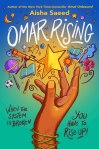
Omar Rising by Aisha Saeed

Standard
Omar Rising by Aisha Saeed

omar rising

This middle grades 224 page read is quick and memorable.  The story is set in Pakistan and the characters are probably Muslim, but there is no religion mentioned until nearly the end, and even then only in passing.  The only culture specific references are the characters’ names, social etiquettes, and the foods mentioned.  By and large, the story is universal and could take place anywhere, and probably does take place everywhere.  While I wish it would have had more cultural and religious references, it is an OWN voice story after all, the book is enjoyable, the characters endearing, and I think young readers will benefit from spending the school year with Omar, seeing classism up close, and cheering for an unjust school system to be challenged.

SYNOPSIS:

Omar is the son of a servant and when he earns a scholarship to a prestiges boy’s school for seventh grade, the entire village is bursting with pride.  When he gets there though, it is hard, really hard.  The scholarship kids aren’t allowed to participate in any extra curriculars, they have to do service hours, and they have to maintain the ridiculously high A plus grade average or be expelled.  It seems that that headmaster is out to get the scholarship kids, and Omar in particular.  As the scholarship students struggle to stay afloat, Omar has to determine if it is all worth it. He spends all his time studying, even when he goes home to visit his mother, and while he doesn’t want to let the village down, he is struggling to find the optimism to keep fighting for his place.  When Omar learns that the system is designed to make the scholarship kids fail, and that those that are kicked out are called “ghost boys,” he has to decide to how hard to push himself and ultimately how hard to push to break down the system that treats him and those like him like second class citizens.  Luckily, Omar has some supportive teachers, some loyal friends, and a whole lot of determination.

WHY I LIKE IT:

I love that the story is universal, it is at times a much tamer version of the YA book Ace of Spades which also explores second class citizens in posh private schools as a theme, and at times I even felt some Dead Poet’s Society vibes.  The cultural setting and names however, to me is a mixed bag.  I’m glad that it didn’t become another story about problems in another country with judgmental overtones, but at the same time, to be so void of cultural references seemed too far of an extreme in the other direction to make the story feel real richness and authenticity.  I love that the story isn’t about bullying and that a number of characters have depth.  I was genuinely confused for a large portion of the book about what the orientation in the summer entailed.  It was clarified much too late that it was a weekend, but I was at a loss trying to figure out how he knew some of the campus, some of the other scholarship kids, had a roommate, yet knew so little of the school and what it would be like.  I am not sure why that information was delayed, but seeing as I read an arc, I hope it is clarified in the final copy.

FLAGS:

Omar and a girl are friends, they hug at the end, but it seems rather innocent, and more sibling like as they were raised together.  

TOOLS FOR LEADING THE DISCUSSION:

This would be a good book on a shelf, and would possibly work as a read aloud to grades four or five.


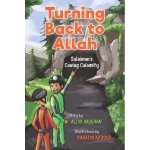
Turning Back to Allah: Sulaiman’s Caving Calamity by Aliya Vaughan illustrated by Rakaiya Azzouz

Standard
Turning Back to Allah: Sulaiman’s Caving Calamity by Aliya Vaughan illustrated by Rakaiya Azzouz

turning back to Allah

Good early elementary books can be tricky: the voice needs to read authentic, the lessons not preachy, and the scenarios relatable, all while not talking down to the reader or talking above their comprehension.  As fabulous middle grade books seem to be popping up at record speed, I find myself reading the same old books with my fourth child who is six.  Alhumdulillah, this book was nominated in the Muslim Bookstagram Awards 2021 competition and I was able to purchase and receive it quickly from Noura at Crescent Moon Store.  My son can read it, although because of the British terminology, he did better when I read it to him, none-the-less, he could explain it, he genuinely understood and related to the main character, and was emotionally connected to the outcome of the story.  The 49 page, color illustrated story is perfect for independent readers first or second grade and up.  The book also contains comprehension questions, etiquettes for du’a, a list of times and places when du’as are answered, and evidence for the story from hadith.  Additionally there are ayats from the Quran at the beginning and end of this well sourced book, alhumdulillah.

img_4985

SYNOPSIS:

Sulaiman is getting ready for an overnight scout trip in some caves.  He is nervous having been stuck in his apartment elevators the summer before and being lost at a park with his family.  His stress has him being mean to his little sister, and his dad tries to mediate, but you can sense that their normal bickering is heightened because this is going to be hard for Sulaiman.  The scouts meet up to board their mini bus and Sulaiman is acting weird, he wants to sit by the window, he wants to read signs, finally he tells Jacob about his worries and the two boys agree to stick together like glue while they are in the caves.  Foreshadowing is set, and when Sulaiman’s batteries roll away and he stops to retrieve them he gets separated from the group and he will have to rely on his faith in Allah swt to feel less alone and brave what is to come.

img_4984

WHY I LIKE IT:

I love that when Sulaiman is arguing with his sister he doesn’t have hadith quoted at him.  Sure it is ideal, but really, as parents we just want the bickering to stop most times and our kids to be nice.  It is often easier to instill morals and lessons in calm times, not in the middle of an emotional kerfuffle.  At the same time, when he is scared, he falls back on the lessons he has been taught from the Quran and sunnah.  I love how it reads realistic.  We want our kids to turn to Allah swt for all things, but sometimes to teach that we encourage them to seek Allah swt in times of happiness and times of hardship.  Sulaiman is scared, really scared, and he turns to Allah swt, and it is heartfelt and emotional.

I’m embarrassed to say, but I was a little confused by the being lost in a park prior story thread.  It either needed more detail, or maybe just more context, but I thought it was the same park they are heading to with scouts, then realized it was a completely separate park and incident, so I would like a bit more framing of that story line.  Also the stress of being stranded in the elevator, doesn’t directly connect to the rest of the story, perhaps bringing up some claustrophobia fears would have helped tie it all together.  As it is, it just seems that Sulaiman seems to be tested a lot and rather traumatically.

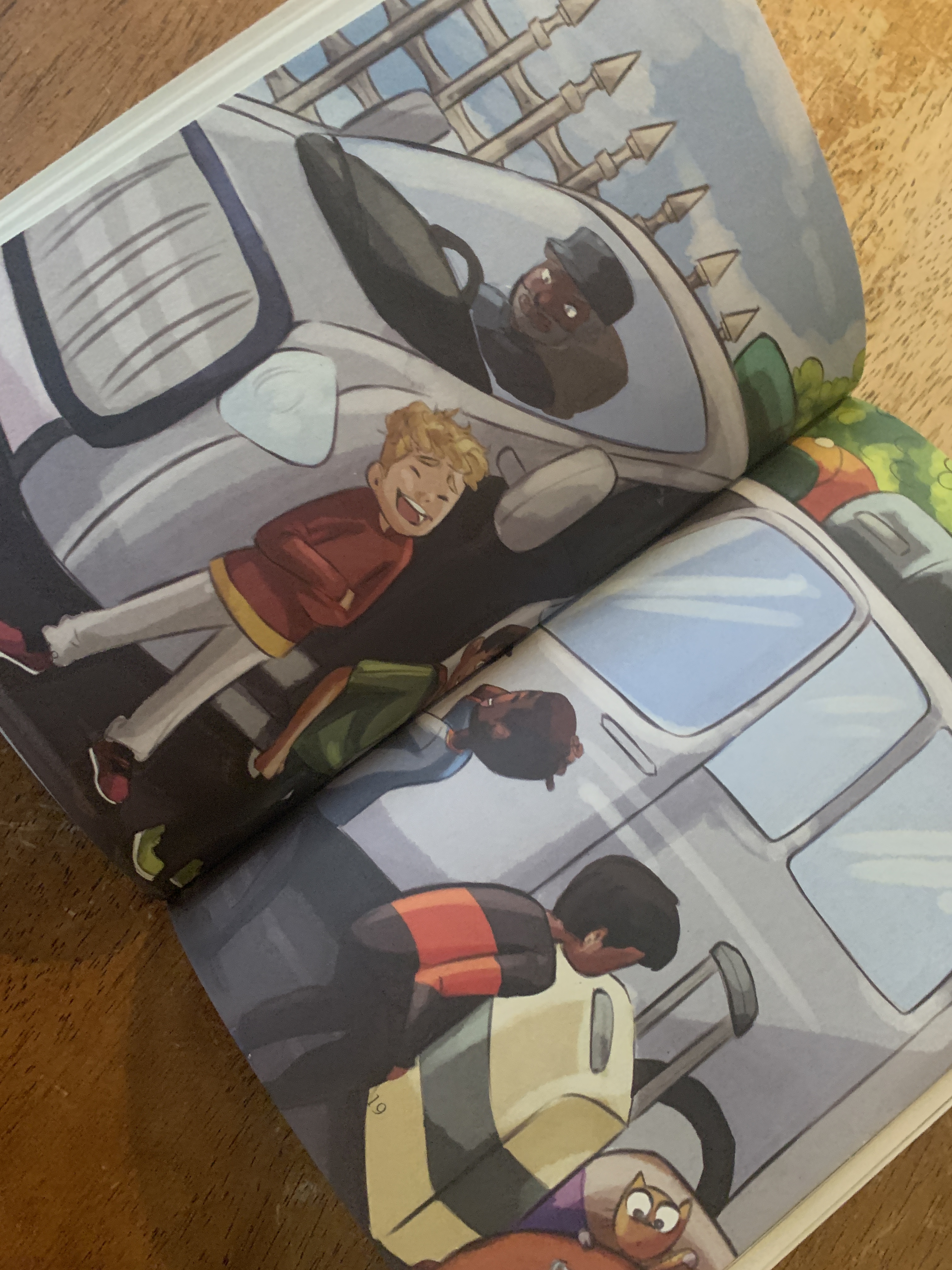
The illustrations being in full color and full page are a welcome surprise in the book.  However, there is one two-page illustration that shows the kids laughing before boarding the minibus, but it isn’t derived directly from the text, and I initially thought Sulaiman was being laughed at for his fears.  I went back, and it doesn’t seem that is the case, but I wonder if I was the only one confused by that illustration.

All-in-all the book physically is appealing to children with the open font, colorful pictures, size, and length.  The story is relevant, and the islamic tie-ins powerful, alhumdulillah.

FLAGS:

Some teasing, possible bullying among siblings.  Some scary moments mentioned and explored: being stuck in an elevator, lost in a park, left alone in a cave.

img_4984

TOOLS FOR LEADING THE DISCUSSION:

This would be a fun read aloud in a second grade class.

Golden Girl by Reem Faruqi

Standard
Golden Girl by Reem Faruqi

golden

I began reading this book not having any idea what it was about. All I knew, or all I cared to know, was that the incredibly amazingly talented Reem Faruqi wrote it, so I wanted to read it. While I know it will be hard for most to avoid knowing the plot, I think it was a blessing that I was able to be swept away so completely and so fully in a story that is wonderful and memorable, and truly sets a higher standard for the way that a story can be told. Faruqi’s voice and authenticity had me in tears. I didn’t even realize my eyes were dripping until my son asked me if I was ok. It wasn’t the plot that had my emotions spilling over, sure it helped, but it was the storytelling, the hadith and deen and snapshot of a life so unlike my own that simultaneously is exactly my own that a physical reaction emerged. It is the power of OWN voice storytelling. It is the power of brilliant writing. It is not just a book about a Muslim character, this book blurs the lines for me between Islamic fiction and fiction with Muslim characters. Middle school readers (mature middle grade readers) will enjoy the book, older readers will enjoy and appreciate the 336 page story told in verse. You can pre-order the book and I hope you will, it helps convey the message to publishers that this book is highly anticipated and that we need voices like this. Additionally, Goodreads currently is hosting a giveaway, you can head there to try and win a free copy.

(If you don’t want to know what the story is about, maybe skip the next section.)

SYNOPSIS:

Aafiyah’s name means well-being, protection, health, money, happiness, everything good, but Aafiyah has secrets too. She is privileged and loved, and she knows it, but sometimes when she sees something she likes she accidentally borrows it. Sometimes it isn’t an accident. Sometimes she doesn’t just borrow. Much of her life is wonderful, a best friend that lives next door, doting parents, tennis, vacations, trips to Pakistan to visit grandparents, and a love of “weird but true facts.” So what happens when all that changes. When her grandfather gets sick and the family wants to bring him to America for treatment, when Aafiyah’s dad gets detained and imprisoned on the way home, and Aafiyah’s secret may be a way to help her family?

WHY I LIKE LOVE IT:

I absolutely love that the characters are so well rounded and developed. Yes, Muslims have vices, and even young practicing Muslims have tests and struggles. The bar has been raised, we aren’t just a monolith, and our only struggles aren’t girl/boy issues, alcohol, not being oppressed and getting an education, we are complex people, we are human. The bulk of the story is Aafiyah growing up: her responsibility within her family, her changing body and appearance, her friendships, her responsibility for her actions, her desire to want to help and improve and step in to her own. I love that all these layers of life somehow are explored in such sparse lines. It doesn’t drag, but it gives the necessary pauses to involve the reader in her logic and view of the world. Aafiyahs’ kleptomaniac tendencies, her father being detained, her grandfather’s illness. they all move the story along, but they are foils for a much more intimate character story. A story that is surprisingly funny and light and impossible to put down.

I absolutely love how Islam is woven in, how she exudes Islam in all that she is, because she is a Muslim completely, the good and the bad. The guilt she feels, the desperation to be forgiven, the knowing that Allah swt sees all. The book is never even close to being preachy, but she proudly owns her identity and the details of her faith are not watered down, or even justified, it is who she is and it isn’t up for debate.

Culture is presented unapologetically as well. She is critical of things she sees in Pakistan, and similarly celebrates and admires good things about Pakistan and Pakistani culture. The book does not seem to have an agenda in presenting Muslims or Pakistan as good or bad, just as Aafiyah sees them. Which isn’t revolutionary on the surface, but it really is refreshing because it highlights how many books simply don’t. It makes the contrast painfully obvious between books that are shy about certain things, when they have their characters deflect and disassociate from certain “realities” and books that confidently uphold their identity and demand that the reader steps up and truly see the characters and their experiences.

There is a beautiful and raw author’s note at the end that shares some of the inspiration for the threads of the book, a glossary, a recipe for Aloo Gosht and resources for help with kleptomania.

FLAGS:

Stealing, lying, chatter about crushes, music, dancing. Being attractive and the reactions that it gets is woven through out.

TOOLS FOR LEADING THE DISCUSSION:

If I have a majority girl group, I will teach this. It isn’t a girl only book, but I think some of the more subtle themes would need a safer girl space to discuss.

Daring Dreamers Club: Piper Cooks Up a Plan by Erin Sodenburg illustrated by Anoosha Syed

Standard
Daring Dreamers Club: Piper Cooks Up a Plan by Erin Sodenburg illustrated by Anoosha Syed

piper

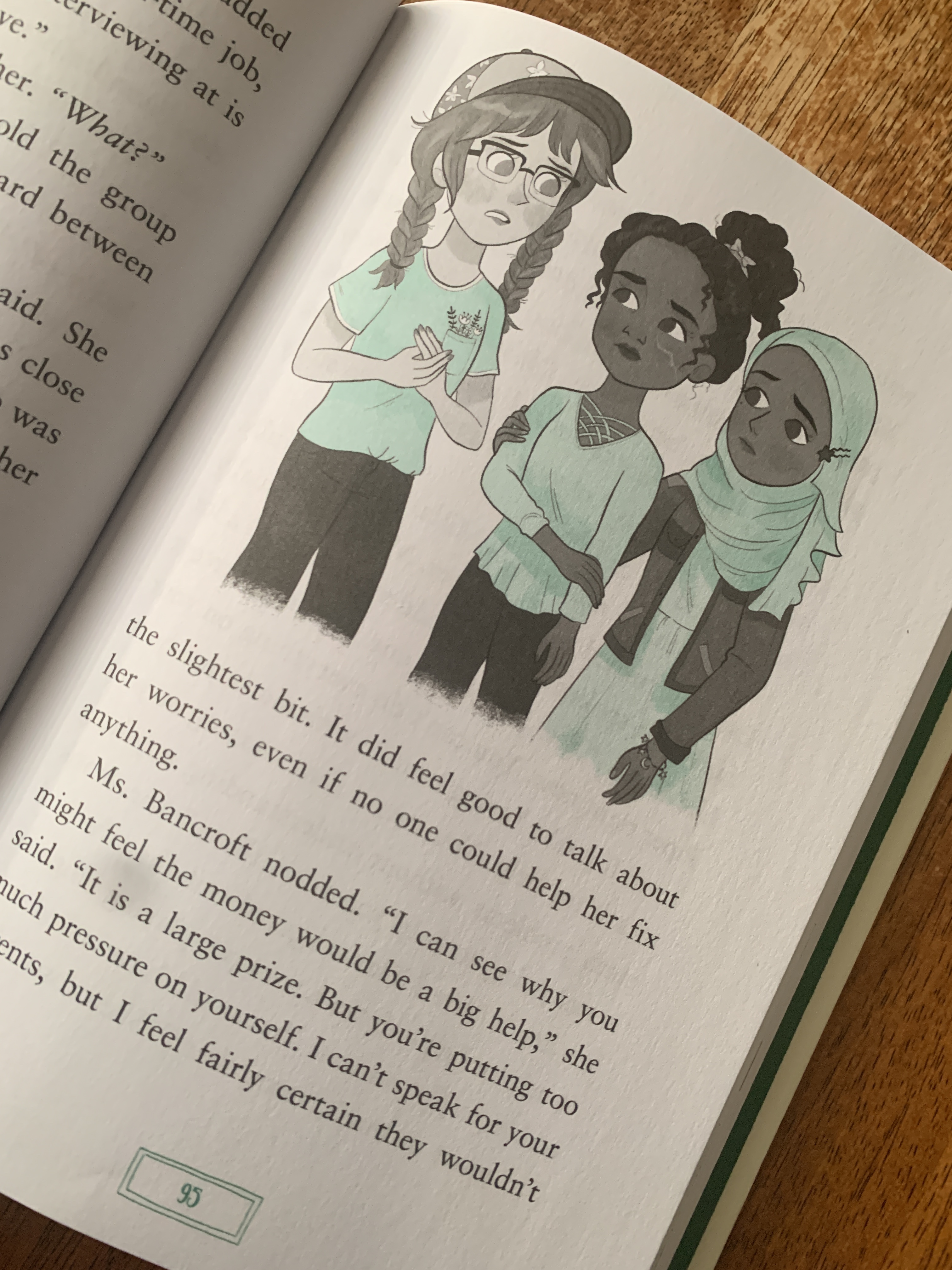
This is book two in the series, I couldn’t get the first book from the library, and I wasn’t willing to wait for the one that focuses on Muslim character, Zahra’s story to be published, it could be a few years.  At 224 pages this middle grades book is fairly formulaic with five diverse girls becoming friends, each book featuring one girl’s story with the others serving as supporting characters, and with the tie-in to Disney Princesses, I really didn’t expect much. Imagine my surprise when I found myself enjoying the characters and their lessons and struggles, sigh.  The book is sweet, the characters like-able, and the author really doesn’t try and force all the characters into every scene.  The book focuses on Piper and the other girls add to her story where it helps, they don’t all have equal time and it doesn’t get confusing because of it.  You can even read the books out of order.  Zahra wears hijab and her Islam is mentioned in a journal entry where she discusses the five pillars, the importance of charity, and getting dirty looks.  There is nothing preachy, but none of the other character’s are defined by their faith and I truly don’t know if I’m bothered by the singling out of Islam being her identity or flattered by it.

img_4279

SYNOPSIS:

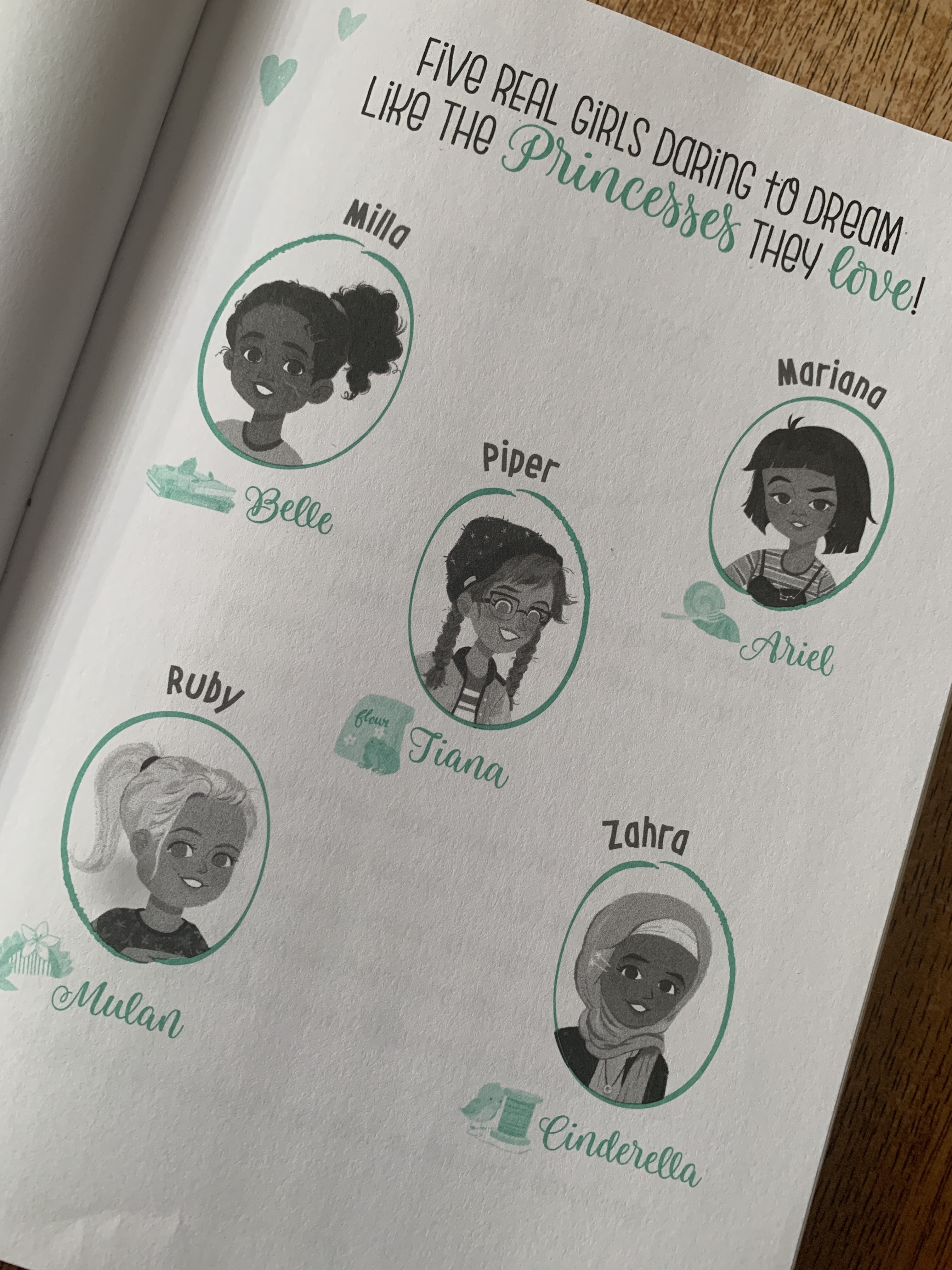
Five girls are grouped together at school in an advisory class to help prepare them for middle school: Milla, Piper, Ruby, Mariana, and Zahra.  Their advisor loves Disney Princesses and in their weekly journal entries has them write about their assigned Princesses as they explore their similarities and how they would tackle challenges, face fears, and the like.  The girls are diverse in family dynamics, race, religion, ability, etc.  Milla is African American with two moms and food allergies.  Zahra is good at art, Muslim, and likes to sew.  Ruby is a twin, her parents are divorced and she is great at sports.  Mariana is hispanic, and is an amazing swimmer.  Piper is Jewish, has dyslexia and loves to cook.  In the book she is struggling with school, while she excels in her food science creations.  She gets accepted to appear in a kids cooking show competition, but will need the help of her Daring Dreamer friends to prepare for the challenges about to be thrown at her during the competition, and to help her from falling behind in school.

Each girl has their journal entry presented in the book which helps to understand more about the different girls, as well as a little bit of introspection to the events happening in the larger story.

WHY I LIKE IT:

I like that the characters are really supportive, and the lessons aren’t so on the nose.  Piper isn’t just told that she doesn’t have to win the competition to have value, you feel it long before she accepts it herself.  Her personality really comes through and it isn’t for attention or for sympathy, she helps a competitor, there is no giant round of applause or moral reflection, she just helps.  I love that even though the story is Piper’s and her dream, there are larger issues woven in and felt, not necessarily preached. Piper is the middle child and feels she has to prove herself, she remarks on how being pulled out of class in early elementary school to get help has made it hard for her to ask for academic help now, the role of confidence and how charity and giving back is important, even while her own family’s financial situation isn’t clear.  I like the role of Piper’s siblings, they are quirky, but loving, and they work through their annoyances to help each other.  It is heartwarming.

I have my own mixed feelings about Disney Princesses, as a child of the 80’s, the 90’s brought all the glory of Jasmine, and Ariel, and Belle, and Mulan, and my friends and I definitely identified with different characters.  I may or may not have tied my hijab up many a days and claimed that I was Mulan in high school, but somehow with my own daughter I didn’t really bring the Princesses in to her day-to-day existence, I don’t think she has even seen all the movies, we read books (we didn’t even have a tv when she was little), she’s 14 now.  It had become too commercialized, I worried about the messaging more.  This book reminded me of what my friends and I as older “kids” channeled the Disney Princesses to be.  It wasn’t all about pink and sparkles, it was battling the bad guy, hanging on to your dreams, and persevering when things were tough.  This book channels those thoughts, it isn’t in your face Disney, it is more muted, and I appreciate that.  It is a solid middle grade read and I think an enjoyable one at that.

img_4283

FLAGS:

In this particular installment, there are no crushes, no holidays, no music, one character has two moms, but in this book, I don’t know that a casual reader would pick up on it. It says “Moms” once, it might be a bigger deal in the story that focuses on Milla, but I haven’t read it to comment.  There is lying and Piper tries to justify it, but I think it is clear and has its own resolution.

img_4284

TOOLS FOR LEADING THE DISCUSSION:

It is much too young for a middle school book club, but I think because it is such an easy engaging read, that in a home, or classroom, the book would be appealing to 3rd graders and up.

The author’s website: https://www.erinsoderberg.com/daring-dreamers-club.html

img_4280

There was an Old Auntie who Swallowed a Samosa by Asmaa Hussein illustrated by Milton Bazerque

Standard
There was an Old Auntie who Swallowed a Samosa by Asmaa Hussein illustrated by Milton Bazerque

samosa

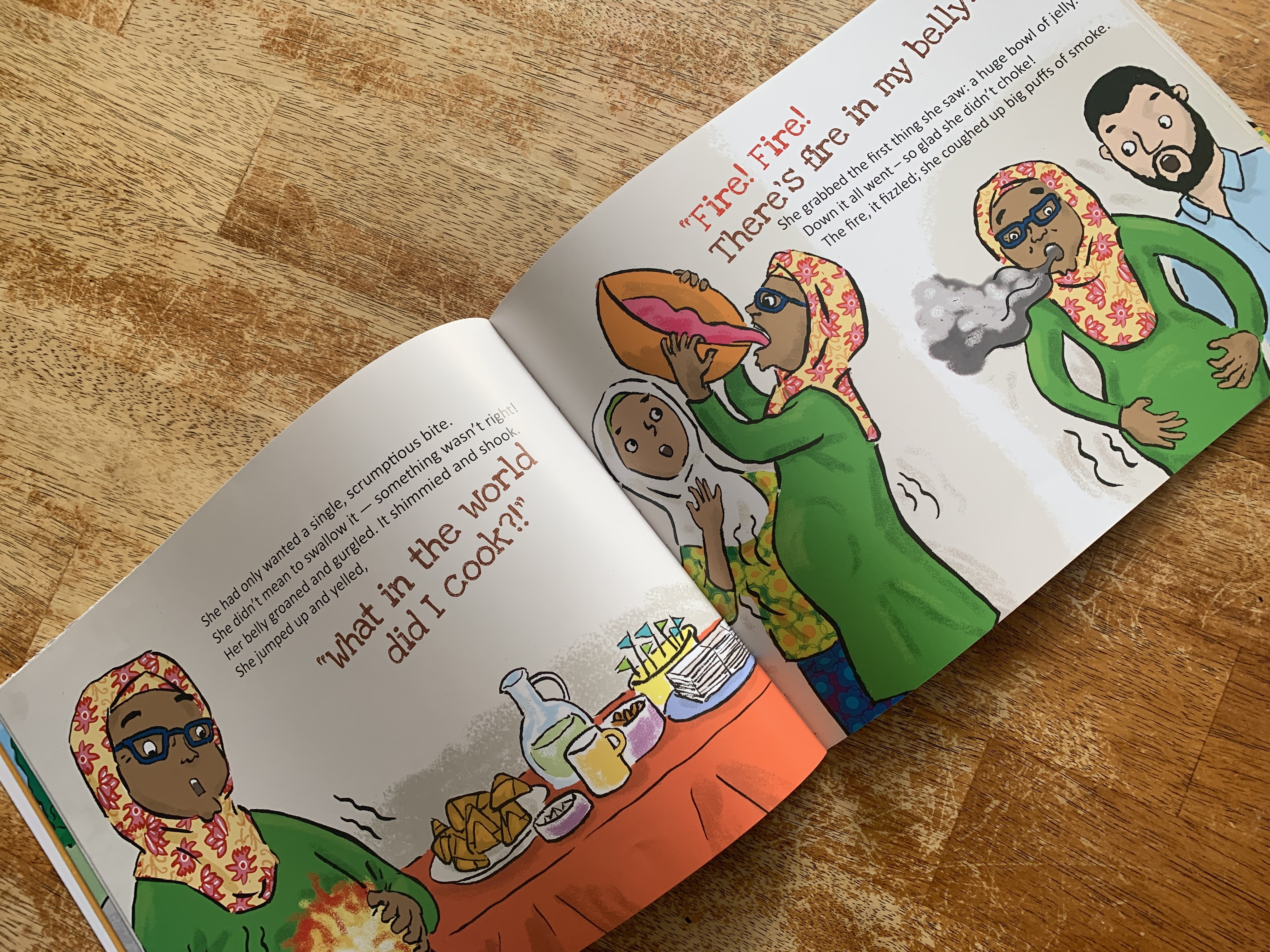
I feel like such a broken record of late (and in the future), of my reviews of books published by Ruqaya’s Bookshelf; the stories are WONDERFUL, but I really struggle with the titles.  I truly thought this was a cultural/religious version of the classic, I Know an Old Lady who Swallowed a Fly.  But it isn’t.  It is an original clever, laugh-out-loud hysterical story for preschool to early elementary.  And one that parents and caregivers will not dread reading over and over again with the well done rhyme, expressive illustrations, a silly conclusion, religious framework, and universal appeal.  The book is on point, the title and cover illustration, sadly for me are not, and don’t, in my opinion, do the story justice.

img_4190

Auntie Sophie is making samosas with some peppers she grew herself.  Under the close company of her kitty, we learn how the Scotch bonnets were grown and cared for.  The doorbell rings and Auntie Eynara has arrived with her beautiful cake to take to the masjid for iftaar.  

img_4191

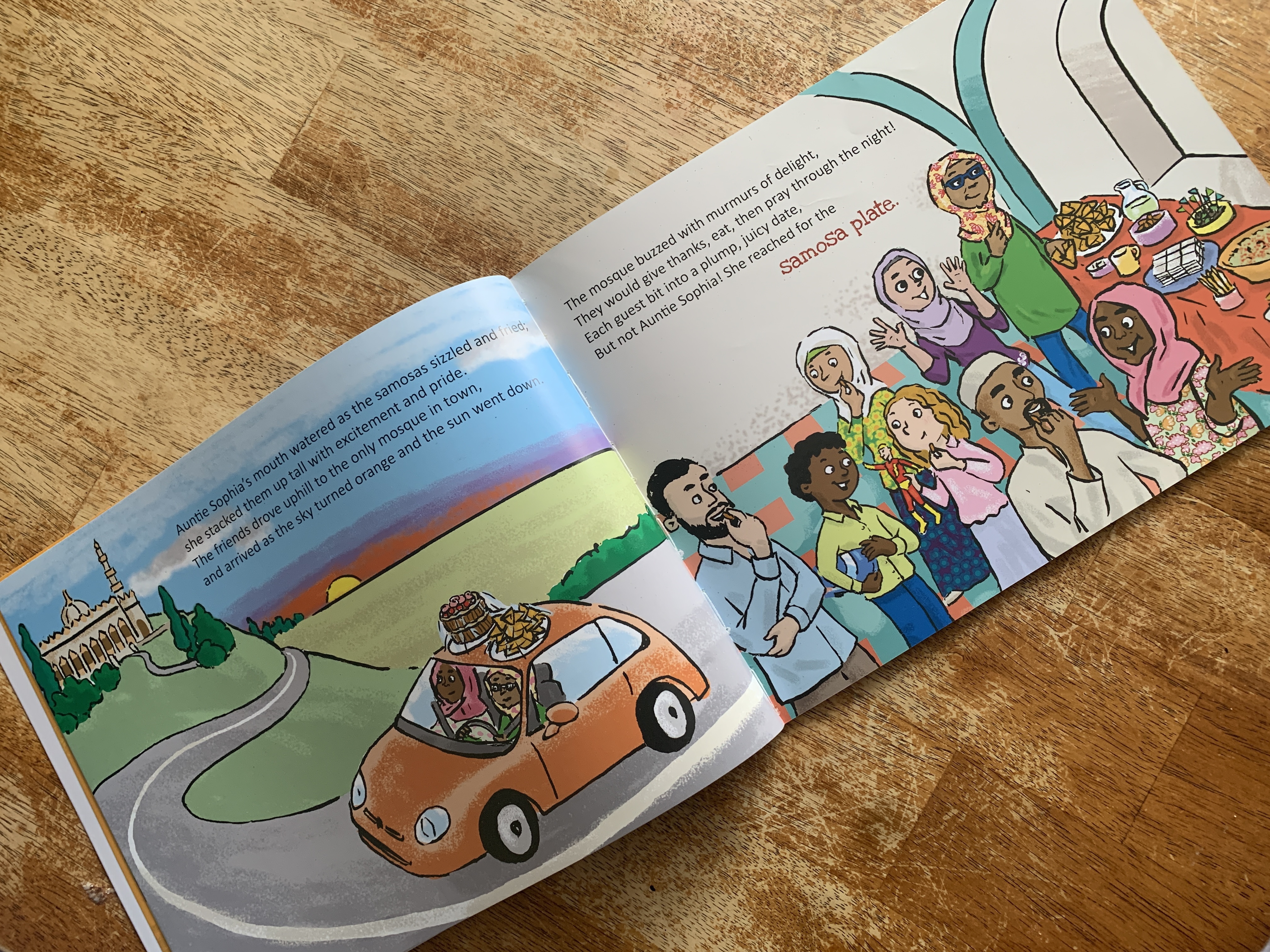
Auntie Sophie  hurries and fries her samosas and the ladies head up the hill to the only mosque in town.  Everyone breaks their fasts with a date, but Auntie Sophia dives in to her samosas.  When the imam’s mic crackles, she swallows the samosa whole and something is terribly wrong.  Her belly is on fire and jelly nor garlic knots nor mint lemonade not rice can cool it down.

img_4193

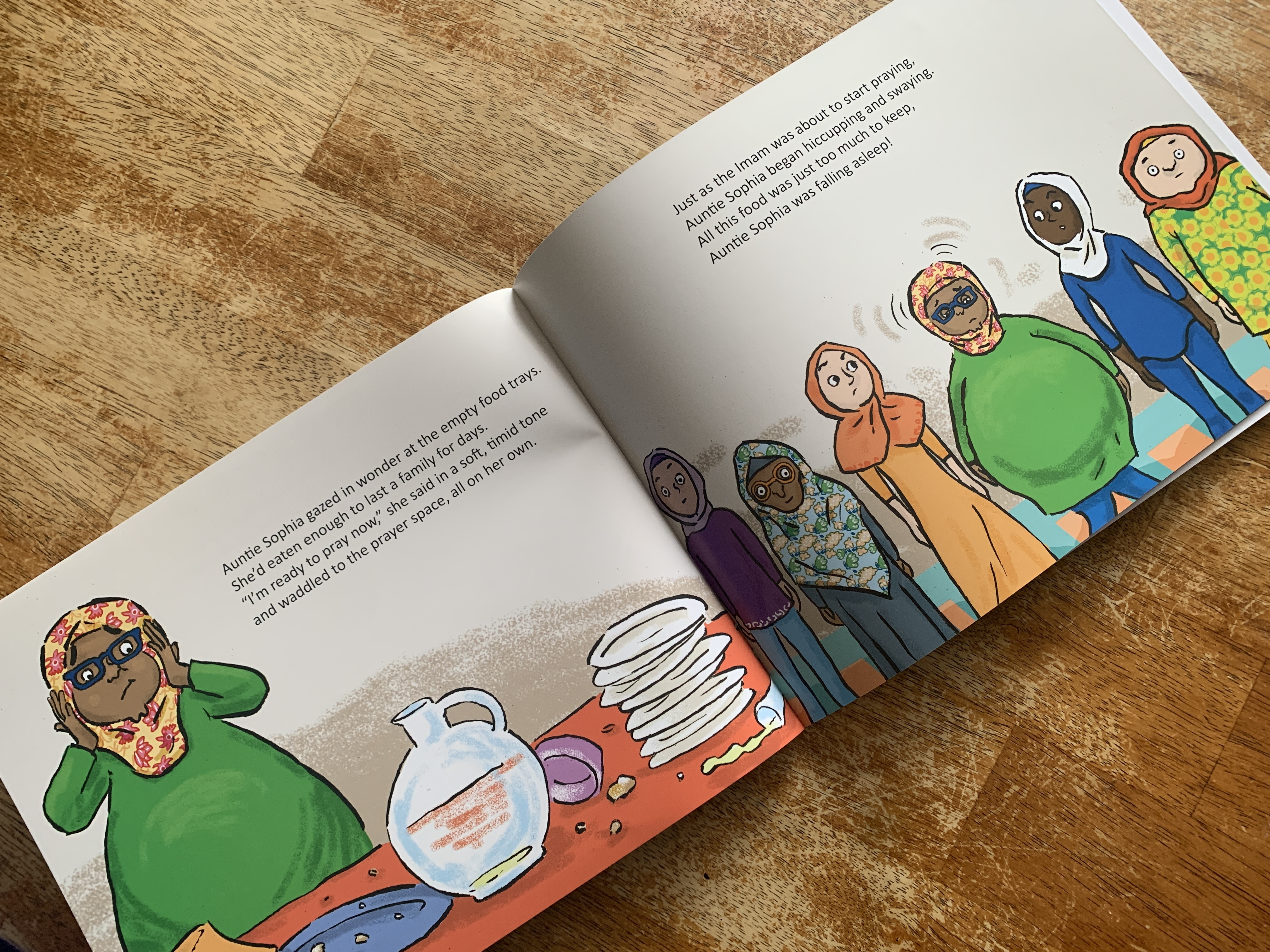
Just when she thinks she is ready to pray, it starts up again, and having eaten everyone’s dinner, Auntie Sophia is getting very tired. As she rolls out the door and down the hill to her house, she figures out what happened to her delicious samosa filling, and calls to have pizza and halal hot wings delivered to the mosque.  She also pledges to grow flowers next year instead!

img_4192

Kids will love the book as it is outrageous, while at the same time being so relatable.  The mosque, iftar, eating something spicy, the book is a favorite at our house for both the two and six year old and the horizontal 8.5 x11 orientation, keep eyes glued to the pages, while the rhyming lines move the story along.  I enjoy being able to talk about the peppers and different foods and smell of garlic with my kids after the 17th reading or so, and I love the diversity of the characters at the mosque. 

Show Yourself by Adeeba Jafri

Standard
Show Yourself by Adeeba Jafri

show yourself

At 98 pages the book claims to be two YA mental health novellas that bring attention to mental health in a relatable and contemporary audience through Muslim characters.  As someone with some experience in loving individuals going through some of the issues addressed in the book, I was thrilled that voices were making it on to the page and in a capacity to increase discussion about self-harm.  Unfortunately, the presentation of the two short stories baffled me and I don’t think the book will find its way in to many YA reader’s hands.  I don’t know why it is two novellas when the characters are the same and it very easily could, and should, have been fleshed out into a single longer novel.  I think it would have shown a better well-rounded understanding on the importance of knowing and recognizing signs of someone struggling with their mental health, how coping skills aren’t often enough and outside help is needed, how assumptions and stereotypes further alienate those suffering, and just overall made the characters deeper and more relatable.  Instead we get two isolated snapshots that subtly try to discuss mental health, but use a very immature cover story that misses the target audience.  The book as is, is better suited for middle school readers, but I think even they would get a limited view of how to help those close to them, or reach out themselves if they are hurting.  It needs to be five short stories with different characters and a unifying theme, or one complete novel.  Unfortunately, as much as I wanted to share this book with my teen daughter so we could discuss, I couldn’t convince her to read it, which is unfortunate, because the author can write, it just isn’t tempting presented as it is.

SYNOPSIS:

The book is two novellas, the first focuses on three female Muslim friends and one’s little sister.  The girls all go to school together, but are of different economic statuses, have different interests but support one an other, and have different family dynamics, that all come in to play.  The close knit community means the parents are social with each other as well, and one parent or another is always picking or dropping them off at each other’s homes.  When Hana gets a new phone, Aliya is clearly jealous, Lena tries to brush it off and keep the peace, but, when Hana’s phone goes missing, even she has to admit that “rebel” Aliya is looking guilty. As the girls search for the phone, Lena spends time with her family, goes to her brother’s robotics tournament and finally confronts Aliya.  Aliya’s mom has disappeared earlier, and with her purple dipped hair, sudden influx of funds for Ubers and new accessories, the girls fight and Aliya pulls away.  When Aliya and her dad don’t attend Hana’s younger sister, Sara’s ice skating performance, it seems the friendships are irreconcilable.  Aliya, however, shows up to the after party things are revealed and amends are made.

The second novella is the story of what happened with Aliya’s parents, particularly her mother.  Similar to Sara, Aliya’s mother was harming herself and eventually abandoned her family.

WHY I LIKE IT:

I like that it shows Muslims suffering, coping, and dealing with mental health issues.  The topic is way too taboo and it effects all swaths of the human population, we need to normalize discussions about it.  I wish the novellas would have stressed getting professional help more, sure it is great that Hana is going to try and put her phone down and pay attention to her younger sister, but that is not always enough.  Aliya mentions that after her mom left her and her dad went to therapy, but the mom claimed to leave to get help and then never came back.  I think there needs to be A LOT more emphasis on what “good” help looks like and what it can do to change lives.

The book is self published it seems through a publisher, so hopefully the author could ramp up the story telling, character building, and messaging, to really make the book shine.  I don’t understand the title, I don’t know why it is under a hundred pages.  I don’t know who the forward is written by.  If you want to write a book about mental health you really need to have done a lot of research, not just necessarily your own experience, and you probably should have a bunch of letters after your name.  Otherwise just write a work of fiction and touch on some of the issues that you want to support discussions about.  The book seems to straddle committing to one or the other, and ultimately it falters because of it.

I do like that the characters are Muslim, the book is not preachy, some seem to be more religious then others, but it isn’t really part of the story.  The characters’ culture and nationalities seem to be left intentionally vague.  It mentions gossip from the ladies at the masjid, which I think should have been drawn out more.  Really if you ask me, this is a great rough draft, it needs fleshing out is all, build it up to 250 pages and set out to reach middle school readers instead, and it will resonate and have the effect I think the author is hoping for.

FLAGS:

Self harm, abandonment, assumptions about a man Aliya seems to be sharing a meal with in a photograph, gossip, lying.

TOOLS FOR LEADING THE DISCUSSION:

Because it doesn’t seem to stress how to help and what help is out there, I don’t know that the book would be a great read for all.  I think if you are looking to open a discussion with a small group of readers or individually, you may be able to assign the book and discuss in a safe environment.

The Great (Food) Bank Heist by Onjali Q. Rauf illustrated by Elisa Paganelli

Standard
The Great (Food) Bank Heist by Onjali Q. Rauf illustrated by Elisa Paganelli

food bank

As an adult setting out to read this book, I imagined that the goal of the book was to bring awareness to a specific issue, food insecurity, and to rally support to help others with this basic need.  The beauty of Muslim author and activist Onjali Q. Rauf, however, is that even with such a clear intent, the storytelling, character building, and  enjoyment of the book makes you connect to the plot and issues and feel the message, not just be told it.  For children seven through 12  with no prior expectation of the book, they will be emotionally effected by the reality shown and feel empathy and compassion for characters that will hopefully translate into their real life.  My 10 and 12 year old boys read the book in about an hour, not realizing what the book was going to be about and hounded me to read it with glowing reviews.  This 103 page middle grades book has diverse characters (none are Muslim), and is a great story, a great educational tool, a great empathy check, and a great resource for how to get involved to start helping food banks, and breakfast clubs, all while being funny, relatable, kind, and engaging.

img_3836

SYNOPSIS:

Nelson, his younger sister Ashley, and their Mum work together to make hard “tricky” months manageable.  They are creative with their meals, they go to breakfast club, and they use their vouchers on Thursdays at the food bank.  Some times though, it isn’t enough, Mum has to pawn her jewelry, they go without meals, and generous friends share their snacks.  When the food bank starts running low, Nelson breaks his secrecy about breakfast club and his close friends Krish and Harriet are determined to help figure out why donated food isn’t reaching the bank and what they can do to make sure it does.

img_3837

WHY I LIKE IT:

I love that it shows how the family has food insecurities on a day-to-day basis and how never feeling full affects so much of the characters’ attention.  I also love that it shows their mom works, she is a nurse and works really hard, they don’t steal or load up on food that is donated, they are very grateful for all assistance given and their friends don’t judge them.  It shed light on a different narrative that many children perhaps don’t think about: that people they know and are close with, might be hungry.  I think the maturity of the kids is a lesson to adults reading the book too, that reminds us that kindness and assistance doesn’t need to come with judgement or arrogance.  The characters are all really likeable, they aren’t perfect, but even though the book is short, you feel your heart being affected by them in their handling of the mystery and the larger concept of hunger.

img_3838

FLAGS:

None

TOOLS FOR LEADING THE DISCUSSION:

I would read this book aloud in a classroom (2nd-5th), and if I get a chance to participate in Lunch Bunch (where a book is read to children while they eat their lunch) at our local Islamic School, I will start off with this book.  I think kids have bigger hearts than we often think they do, and while they might not recall the less fortunate when you want them to finish all the food on their plate, they often notice kids without lunches at school and share without prompting.  

Here’s a great clip and reading by the author: https://www.youtube.com/watch?v=NVYBLh0kODc

Happy Reading!


Baddawi by Leila Abdelrazaq

Standard
Baddawi by Leila Abdelrazaq

Baddawi-cover

This 8.5 x 8.5 middle school graphic novel biography tells a powerful story of a young boy coming of age and striving to find his place in the chaos of the Nakba and its aftermath.  Over 128 pages the reader will learn and be outraged about the displacement and genocide of so many Palestinians as they see the events through Ahmad’s eyes and relate to his dreams and experiences despite the terror around him. The book has violence, destruction, death and mentions rape, yet the humanity shines through as it is also heartfelt and memorable.  I had my 14, 12, and 10 year olds read it and we have discussed it at length in context to what they already know about Palestine and the ethnic cleansing occurring.  It is a seamless mix of history and character driven narratives brought to life by the black and white illustrations of the author/illustrator’s family history.

img_1656

SYNOPSIS:

There are 10 children in the author’s father’s family, and her father, Ahmad, was born in a refugee camp in northern Lebanon, called Baddawi.  The story starts on October 29, 1948 when Safsaf was ethnically cleansed.  Ahmad’s father, the author’s grandfather had been in Akka at the time of the massacre, and her grandmother hid from the Israeli soldiers, the family, once reunited, would escape for a refugee camp, hoping that they would one day return.

We first get to know Ahmad as he starts first grade in Baddawi.  Things do not start well for the little guy as right away he gets teased by other students, his class is too large so he is selected to be joined with a girls class, and he doesn’t have soccer cleats so he isn’t allowed to play soccer, luckily he gets two good crayons, unlike his friend who gets a white one.  Ahmad is identifiable by his striped shirt that he wears throughout as a nod to Handala, the boy depicted with a striped shirt with his hands clasped behind his back and his face not shown.  The artist said his face would be revealed when Palestine was free, sadly the artist, Naji al-Ali passed away, and Palestine is still occupied.

Ahmad desperate to purchase soccer cleats devises a business plan that his mother takes as gambling and quickly puts an end to, in exchange she offers to pay him if he helps her collect and prepare za’atar.  It isn’t as fun, or as lucrative, but they family is busy packing up to return to Palestine.  Unfortunately the Naksa, the setback, the six day war occurs, and more Palestinians are ethnically cleansed and the families cannot return. Ahmad and all those in Baddawi carry on, playing, celebrating Eid, trying to claim normalcy.  The camp however, is not safe and soldiers raid the camp killing PLO leaders and innocent people in their way.  With no option but to keep on keeping on, these acts of violence are often taken in stride. It is so hard to believe, but what else can they do, the children still play, deal with bullies, and cope with universal struggles in addition to being shot by rubber bullets, and fearing cluster bombs and shellings.  At one point Ahmad and his siblings are left in Baddawi to finish school while his parents are in Beirut.

When the family is reunited in Beirut, Ahmad is in a better school, but violence follows as Mossad agents start raiding PLO homes in Lebanon.  Ahmad goes back and forth between Beirut and Baddawi, wherever he can go to school.  His favorite library is the one at the American University in Beirut and he hopes to attend school there, but without connections, he is at a loss to come up with funding.  His intellect finally lands him an opportunity to leave the Middle East to pursue higher education, he ends up in the United States, and when the story ends, readers are left hoping that everything works out even knowing it will be 10 years before he can return home to see his family.

img_1657

WHY I LIKE IT:

I love that the harsh horrific life is not shied away from in a war, but the little things are just as important in shaping and showing Palestinians to be resilient and culture rich.  I love how the concept of Handala is included and amplified.  The book is at times funny, and at other times devastating.  The connection to the characters is pretty remarkable, in such a relatively short book, and I am fairly confident it will be pulled off the shelf and thumbed through often.  I really wanted to know if the girl in the book that Ahmad left behind ended up being the author’s mother, or if he married someone else, but I couldn’t find it by Googling.  This book is truly powerful, and I highly recommend it.  There isn’t a lot of religion, the family is shown praying on Eid and celebrating.  It mentions the diversity in Beirut, but nothing too detailed.  Similarly, there isn’t a lot of political detail.  There is a glossary at the end, some actual photographs of Ahmad and his family.  At the beginning of the book there is a preface about Handala and how Ahmad represents more than just her father’s experience as well as information about the tatreez patterns on the pages and a map.
img_1658

FLAGS:

There is violence, torture, killing, death, bullying, and possibly gambling.  The book mentions that women were raped, but it isn’t detailed.  The war is ever present and depicted, but it isn’t sensationalized.  Ahmad and a girl study together and the family wants them to get married, but Ahmad opts instead to leave for school, nothing inappropriate.

img_1661

TOOLS FOR LEADING THE DISCUSSION:

This book might not work as a book club selection, but I hope middle school children and their teachers or parents will encourage them to read this book and think about it.  Imagine if it was their homes that were taken, imagine what they would do, and how they would manage, and to be aware that it is still going on and that we cannot be silent.

img_1660

Mel and His Trouble with One Thousand Shoes by Somayeh Zomorodi illustrated by N. Broomand

Standard
Mel and His Trouble with One Thousand Shoes by Somayeh Zomorodi illustrated by N. Broomand

The book has a solid premise, although it reads a lot like The Very Greedy Bee, and has lovely 8.5 by 11 pictures on its 24 pages, but unfortunately the text is all over the place. The story contradicts itself, it is overly wordy, and way to rhymy. Yeah, rhymy isn’t even a word, but if it were, this book, would be a great example. I struggled with the font as well, the lowercase f looks like a capital F, and no matter how many times I read it, I’d get tripped up thinking an interior word was being capitalized. The book says that it is based on the ayat in the Quran that reads, “And do not walk on the earth proudly,” and even has two other ayats listed at the end as inspiration, but really it is a single page and a single character that blurts out the ayats from the Quran that talk about walking on the earth proudly and this world being a test. While the illustrations are fun, it just isn’t enough to make the book a solid read to convey humbleness and gratitude. Children will be lost in the text, confused by the inconsistencies, and disappointed in the super quick resolution.

Mel the millipede lives in a farm next to a well. He has one thousand feet and although he doesn’t need shoes, he likes to collect them. He has 950 and is working to find the remaining 50 to complete his collection.

It says, “No one was as happy as Mel; one could tell.” Then on the next page as he cleans his shoes with a blouse it is revealed that he isn’t happy in his heart because he is always alone. But the picture stills shows him smiling.

He finally has his 1,000 shoes, we don’t know how or where he got them, when a small snail tells him that “God says not to walk on the earth proudly. Only He knows best and this world is a test.” There is no explanation, Mel just says “it doesn’t matter, I am better than everyone.”

This whole time walking, Mel has been wearing his shoes although it has mentioned that he can’t wear them because they are heavy and he doesn’t want to get them dirty. As he watches the other bugs fly kites and balloons he is sad that he can’t play because his shoes are too heavy. But he has been walking outdoors and is on a mushroom lamenting with his shoes on. Those flying kites aren’t moving much…one is a worm, one a snail, very inconsistent.

One night a moth knocks on his door warning Mel of a flood. Mel ignores the frantic urgings, fearing that it is a trap to get his shoes. He thinks everyone is jealous of his shoeing. The flood waters sweep him and his shoes out of the house and throughout the night he risks his life multiple times to save his beloved shoes.

When morning arrives, he is still trying to save his shoes, when moth, attempts to save Mel. To get Mel back to his house, he will have to convince him to drop his shoes. Mel is tired and desperate and uninspired so he drops his shoes and is brought to dry land. I don’t think uninspired is the right word, shouldn’t be be grateful and willing to change to save his life? But even that notion is a stretch because in the illustrations he is so close to land. He could just swim over, shoes or no shoes, moth doesn’t need to be flying him to safety. Additionally, when the water recedes, won’t his shoes still be there?

The conclusion is Mel hugging moth and apologizing to the bugs. I’m not sure what he is apologizing to them for, nor is it explained. Since the book claims to be based or inspired by ayats, I feel like this would have been a good place for a moral cathartic lesson, but alas, it just says, “the end.”

Misfits in Love by S.K. Ali

Standard
Misfits in Love by S.K. Ali

misfit

I reread my review of Saints and Misfits before diving in to this sequel that can also work as a stand alone, and imagine my absolute delight when all the things I wanted more of: Muhammed and Sarah, the mom, Jeremy, etc., were explored in this wonderful high school and up, 320 page, romantic comedy story.  The romance stays halal and the comedy light, but seamlessly interwoven into a weekend wedding are very serious notions of racism and prejudice within the Muslim community.  The writing is flawless as I tried to tell the summary to my daughter I realized just how many characters there are in the book, yet while reading, I never once was confused about who someone was or how they fit in to the family, it really is quite remarkable how real and personal the characters all become.  In many ways the story is uniquely an American-Muslim (arguably) one with characters that are half this culture, a quarter that, wearing cultural clothes to coordinate with friends, mutli lingual, multi ethnic, and yet all coming together as friends and family.  We, nor are the characters perfect, but that our weakness is explored in fiction so that we all might benefit in reality, is truly remarkable.  I honestly couldn’t put it down, and my teen and tween children may or may not have had to figure out their own meals, as I hid in the corner to devour this book in a single day. I regret nothing.

SYNOPSIS:

Janna Yusuf has just graduated high school and has been spending the last few weeks at her father’s sprawling house on a lake to help with wedding preparations for her beloved older brother.  What started out with plans to be a small nikkah between Muhammad and Sara, has quickly snowballed into a “wedding” with a few hundred guests and an ever evolving color scheme.  With extended family and friends pouring in over the three days, Janna is anxious to see Nuah and finally tell him that she is ready to return his feelings, reunite with her mom after being apart for weeks, and see who her best friend Tats is bringing as her plus one.  But, Nuah is acting weird, her mom seems to be considering remarrying, and her father is revealing himself to be racist.  There is a lot going on, and in between wedding preparations, possible crushes, family drama, prejudice overtones, and a curious ice cream man, Janna is having an unforgettable weekend.

Janna and Muhammad are close, they are the children of an Indian American non practicing father and an Egyptian American religious mother.  Their parents have been divorced for a while, and their dad and his Greek wife Linda have two little boys and are hosting everyone and the wedding.  The heart of the story is Janna as she thinks she is ready to pursue something halal with Nuah, but is slightly intrigued by Sara’s cousin Haytham and very perplexed by her mother’s potential future new husband’s nephew Layth. Being it is a wedding, and many people are staying at her father’s house and many more at the hotel in town with their own families.  Jana is trying to figure stuff out about Nuah while hanging out with Nuah’s older pregnant sister.  She is constantly thrown together with Layth as she meets his Uncle Bilal, her mom’s college friend that has proposed to her, and who’s own daughters are friends of Sarahs.  Yeah, there is a lot of overlap, a lot.  It’s like real life. As attractions wax and wane in such a short time, it is the relationship Janna has with her own family and the contentment she must find within herself that ultimately matter most.

WHY I LIKE IT:

I love how authentic the story and its characters are.  I come from a small family, but a very close friend has a huge family, and this just reminded me of going to her family events and finding how interconnected and small the world really is.  I absolutely love Janna, she is Muslim by choice through-and-through and is genuine in her understanding and actions that, while the book is meant for Muslims and nonMuslims, she really sets the standard of how fictitious characters can positively affect their readers.  The only slightly forced thread for me was Janna suddenly loving animals and being ready to head to Peru.  I get that she was crushing, but it seemed a little too over the top for an otherwise very plausible plot.

The best part of the book, in my opinion is that it isn’t all fluff and fun, there are some very real issues that get spotlighted.  Like in Saints and Misfits where Janna is sexually assaulted by a seemingly devout, religious, well liked male, this story addresses racism and prejudice within the Islamic community.  Janna’s dad always felt treated as less than by Janna’s mom’s family for not being Arab.  He flat out warns Janna about her feelings for Nuah because he is Black.  Sarah’s Aunt is offended that the mendhi is more Desi than Arab.  The issues aren’t just pointed out, they require active acknowledgement and action.  The author’s note at the end, even discusses the significance and weight of such views at the end.

FLAGS:

There are mentions of the sexual assault that happened to Janna in the first book.  There is mention of periods, a possible affair, racism, and a character who drove while drunk and killed his son as a result.

TOOLS FOR LEADING THE DISCUSSION:

I don’t know that this book would be a great fit for a school book club, but I think a group of high school or college aged girls would thoroughly enjoy reading this and discussing it, and I would totally invite myself to their gathering to do so.