Tag Archives: fasting

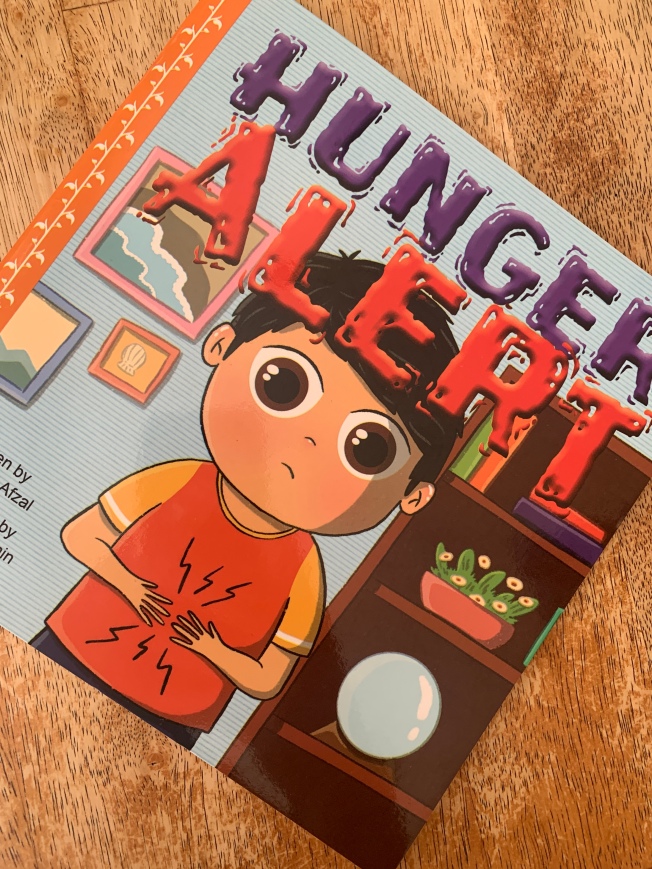
Hunger Alert by Shazia Afzal illustrated by Sania Hussain

Standard
Hunger Alert by Shazia Afzal illustrated by Sania Hussain

img_6919

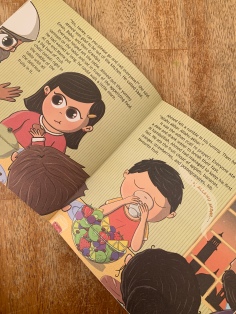
On my first read through, this book came across as a bit text heavy and the presentation didn’t quite fit with the content for the target audience, but when my seven year old read it, then reread it, and my 12 year old picked up and read it and both said, “it’s good,” I realized, the target audience is not little kids, nor is it adults, it is kids who have fasted and have felt the pangs of hunger.  The character is getting through his first day, but the relatability is for kids everywhere fasting for the first time the hundredth time and everywhere in between.  It is Islam centered, I appreciate the healthy food temptations and the unwavering that fasting needs to be done, but as an adult and an educator, so often I wanted to interject Islamic touchstone to getting through the day asking Allah for help, talking your self up and increasing your determination by knowing the Angels are recording your struggles and you will be rewarded in the akhira, and while Quran is read, and a surah loved, and Islamic phrases included, the focus of the book is a little boy in a very idyllic family trying to keep hungry thoughts away. The small 8 x 8 soft back book with 22 thick cardboard pages would be a bit hard to share at story time, but the simple concept story is fine in smaller groups and at bed time.

img_6920

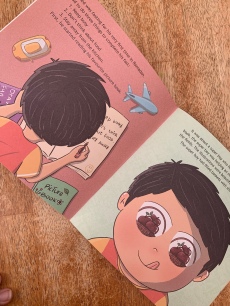
The books starts with Ahmed fasting for the first time in Ramadan, he has a list of things he needs to complete his fast: 1-Keep busy, 2- Don’t think about food, and 3-Stay away from the kitchen.  I found when reading it to my younger kids I would pause here to discuss why we fast, and that we are doing it for the sake of Allah, so we need Him to be successful, not distractions.

img_6921

Ahmed starts with reading his favorite book about a charitable boy, the illustrations though had baskets full of shiny, big, read apples.  “Grr, Hunger Alert!” He runs to his brother’s room to keep busy with a soccer video game, but the prize on the screen are big, yellow bananas. “Grr, Hunger Alert!” This continues throughout the day, including while reading Surah Rahman, and the pomegranates trigger yet another Hunger Alert. When Grandpa asks him to take strawberries to his mom and his mom is in the kitchen, each of his rules will have to be broken.

img_6922

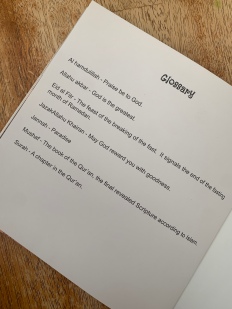
With iftaar approaching and fruit chaat waiting, Ahmed will have to persevere to complete his fast.  There is a glossary at the back and the book you can search online to find where the book is available near you http://www.compassbooks.ca

img_6923

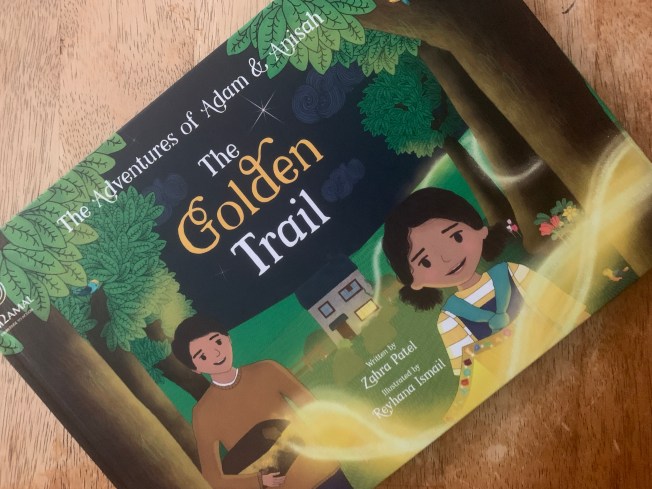
The Adventures of Adam and Anisah: The Golden Trail by Zahra Patel illustrated by Reyhana Ismail

Standard
The Adventures of Adam and Anisah: The Golden Trail by Zahra Patel illustrated by Reyhana Ismail

img_6818

This third book in the Adam and Zahra series, also available with a workbook, focuses on zakat and can be read alone.  Aimed at toddlers to early preschoolers, this rhyming story can also work at story time with slightly older kids as a reminder of zakat and giving to those in needs.  The book has very minimal text and as a result if you overthink it, it could be slightly problematic: there is magic, they are taking and giving something that doesn’t belong to them, Zakat is a portion of your wealth not sharing something you found-even if a note says otherwise.  I think the book is sweet though, and the discussions to have with little ones outweigh the adult concerns I’ve mentioned. It touches on giving to others, on people in need, of people in need living very close to you, that everything being a gift from Allah (swt), it shows siblings working together, sharing, generosity, a lemonade stand for Yemen, giving of food and money, and befriending others.  I think if you liked the other books in the series regarding a “magic” pray rug and a fasting shield, both mentioned in this, you will like the presentation of sharing and the term zakat presented in a similar fantasy laced manner; if those books felt uncomfortable for you and your family, this one probably will as well.

Adam and Anisa start the story in Ramadan, a week before Eid, digging in the sand at the beach.  Adam finds a treasure box and a message in a bottle.  The treasure box is locked and the message says that “My name is Zakat and I’m for someone in need…”  Once the kids get the box home and the lock off, a beam of light shines a path for them to follow.

img_6821

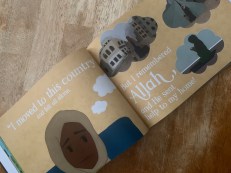
They follow the light out the door and through the field, and past the mosque and their friends, along the way they purchase a pie from the bakery for when they break their fast and keep following the light to the field as the sun starts to set.  They find a house in the forest with a mom, a baby, and a little boy, to whom they give the money and the pie. They learn that they had moved to this country and were all alone, but Allah swt provided for them, and He is never far. They all break their fast together and learn that “Whenever you give, Allah will give you more.”

img_6822

The backmatter of the book contains Context to the Story, Developing Character Strengths, Learning through Practice and a map of their adventure.  I purchased my copy from Crescent Moon Store here and if you use my initials (Islamic School Librarian) ISL at checkout you will save 10%.

img_6823

Nadia and Nadir: Ramadan Cookies by Marzieh A. Ali illustrated by Lala Stellune

Standard
Nadia and Nadir: Ramadan Cookies by Marzieh A. Ali illustrated by Lala Stellune

nadia nadir

This 32 page early reader is part of the Nadia and Nadir series that can be read and purchased as a standalone.  It shows the sibling duo problem solving, working together, sharing, and getting excited for Ramadan.  With the theme of cookies, the book could work as a read aloud in a small group with an activity of making cookies following it, but the small leveled reader size and text volume would make it a hard selection for larger groups.  The setting is Ramadan, the female characters wear hijab (even in the home with just family), but there is not a lot of religious beliefs or practices included in the story. It does detail the lunar calendar and phases of the moon, but thankfully does a decent job of inserting that knowledge from Nadia who has learned about the moon in science class.  There are a few salams, and it mentions that Nadir isn’t fasting because he is young, Nadia gets up for their predawn meal, and snuggles back in to bed after saying her prayers. There is articulation that Ramadan is a month for Muslims and a time to share blessings when the kids share their cookies with the neighbors.  There is a handful of Urdu words sprinkled in and a glossary at the end.  The book shows a family’s traditions and radiates joy, it is a solid addition to Muslim and non Muslim book shelves in showing Ramadan cookie making and excitement in action, but would not inform a lot about the religious aspects, uniqueness, or basic practices about the month.

img_6746

Nadia and Nadir start the book with their binoculars around their necks waiting for Abu to arrive home from work, Ammi is already on the roof and they are determined to spot the Ramadan moon.  The kids are all sorts of confused where to even look in the vast night sky, but once Abu helps them out they find it and declare, “Chand Mubarak.”

img_6748

Nadir wants to know why it isn’t a full moon, and his older sister Nadia explains the cycles, they are then off to make cookies as per their families Ramadan tradition.  The dough is ready, the star cookie cutter has been found, but where is the moon cookie cutter? Nadia has an idea, and sure enough her problem solving skills allow crescent moons to be made.

img_6747

The next morning Nadia has her predawn meal of cookies and milk and when Nadir wakes up he has the same.  The kids pack up bags of cookies with their Ammi to pass to neighbors and friends, with only one left who will get it Nadia or Nadir?

img_6750

The books are available widely at places such as Amazon but for the same price I hope you will support a small Muslim owned bookstore and purchase your copy at Crescent Moon, if you use my initials ISL (Islamic School Librarian) at checkout you will save 10%, link:

Nadia & Nadir Series

img_6749

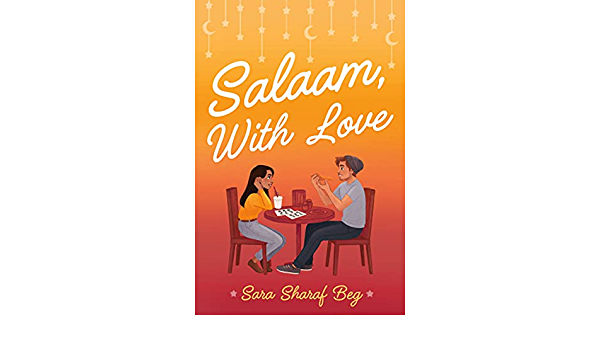
Salaam, with Love by Sara Sharaf Beg

Standard
Salaam, with Love by Sara Sharaf Beg

salaam

This 288 page YA contemporary Islamic romcom is very Islamic centered, and the storyline provides some nice twists along the way.  Unfortunately the writing is terrible.  Not the storytelling or even grammar per se, but the contradictions, errors, underdeveloped characters, and the inconsistencies. Yes I read an uncorrected proof, but this book is a mainstream major publisher presented book coming out in a few weeks, and it is in desperate need of some attention.  I really don’t think it is the author’s fault, it reads as if this was a manuscript that got shopped around and picked up and then never refined, polished, and made to sparkle.  The only saving grace is that as terrible as it is literary wise, once the main character starts to get over her “internalized islamophobia” (thank you @bintyounus for bringing this concept to my attention), the book as a whole presents a lot of unapologetic specific Islamic content on every single page: how Eid salat is different than normal salat,  the beauty of tajweed, the meanings of so many duas and surahs said regularly, the list goes on and on and doesn’t just cover the basics.  The flip side is that the characters are in a band that performs Islamic songs, but with instruments and everyone is fine with it, there are artists in the book drawing faces and portraits hang on walls, it is a romance, but it at most an arm or hand is touched and when tropes about Desi college choices are pushed back on the parents break the stereotype and relent.  There are threads of cultural-ism within Islam, Islamophobia and a violent near death experience, but the book is very clean and  honestly has a lot of potential, I have no idea why it is so sloppy.  SO SLOPPY, and I took notes, so buckle up.

SYNOPSIS:

Seventeen year old Dua is an only child and her doctor father and caterer mom are the only Pakistani and only Muslims in their small Virginia town.  They decide for Ramadan that they are all going to go and stay with family in Queens, New York for the whole month.  They have given Dua less than 48 hours notice to plan to spend the end of her summer with cousins she hasn’t seen in five years.  The parents hope that Dua will benefit from being around family, being closer to other Muslims in the month, and enjoy the cultural environment.  Dua is not excited, but when bear hugs and genuine smiles meet her at the door, she is sucked in to a bustling house and the happiness and drama that is bound to unfold.  Sharing a room with her older, law school bound cousin Mahnoor is by far the hardest relationship to cultivate.  Newly engaged, Mahnoor is quiet, reserved and deeply unhappy.  Dua makes little progress, but with Ramadan starting and her cousins setting goals for the month, Dua is determined to do better in all aspects of her life.  As she gets close to Mahnoor’s best friend, Haya, she also gets closer to Haya’s brother Hassan.   It is Ramadan though, and she isn’t good around boys, but Hassan is a hafiz and is helping her reach her memorization goals for the month, Hassan is also in a band and needs Dua’s help.  When Mahnoor’s engagement is called off to Haya and Hassan’s brother, everything comes to a standstill between the families, but when a cousin is shot, the families come back together to support one another and deal with their decisions and their outcomes.  By the end of Ramadan, every character has changed and grown and is sad the month is over and that Dua and her family are leaving.

WHY I LIKE IT:

Suffice it to say I love how Islam centered it is. I honestly checked the publishing information because of how much Islamic content is included, also for the amount of errors.  The book did not start off well for me with Dua trying to separate herself from her “religious” cousins.  The ones who practice communally and wear hijab.  She was not like “them” and the dichotomy of measuring religiosity as acceptable or not, too much or too little, enrages me.  It sets up that she practices Islam but in a relaxed manner and has been taught by her parents, and it is who she is, but it isn’t a huge part of her life.  As the story progresses, it seems that she just doesn’t know a ton of surahs, she actually is pretty religious, and devout, it is very awkward and not presented clearly, which is why I attributed it more to her being in denial or embarrassed by her identity, not about her level of belief.  Dua is also not like-able, she is incredible privileged and arrogant commenting on the size of houses and rooms, and her shoes.  About half way through she starts to comes across as clumsy, not sure then why is she always wearing heels.  Ultimately she is just not well-developed and often reads like an annoying helpless child.  The framing of Dua being a musician and not being so religious is quickly questioned as she gifts her cousins music paraphernalia, and looks at portraits on their walls.  If most are like me, and both families are praying, fasting, reading Quran, active musicians and artists and ok with hanging pictures, one would assume they are pretty in-syc with one another on their religious views and in practice.

Dua is not the only character that is poorly voiced, fractured, and inconsistent.  Her parents are so unrealistic and awkward in the beginning I physically cringed reading them telling her their reasons for going to New York.  In the car on the way, they even quiz Dua on her cousins names.  She hasn’t seen them in five years, she isn’t a toddler, she should know their names, she has clearly purchased incredibly personalized gifts for them, and is filled with detailed memories of when they all met up in Pakistan together, the whole scene is pointless. One of the cousins, Ibrahim, is blind and Dua says that a few years ago her parents had to explain to her what it meant to be blind.  Seriously?  I get the learning how to let him take the lead and how to interact, but you as a teenager didn’t know what it means to be blind? When you met him in Pakistan you didn’t know he was blind? The four year old cousin is cute and adorable, and has the vocabulary and mannerisms of a seven or eight year old at times, most times.  The 12 year old cousin has the wisdom of an old uncle and why do none of the adults in the book seem to work?  The book probably should have started at chapter five, it seems the book hits a bit of a stride that at least makes it readable.  

A huge plot of the book is the band, Sheikh, Rattle, and Roll, but the details about it are terrible.  Mahnoor is walking out the door and her mom tells her to take Dua.  The reader doesn’t know where they are going, but Mahnoor reluctantly agrees and they head out on the subway.  Mahnoor constantly is telling Dua to hurry so they aren’t late and miss it, when they arrive, the band performs one song and that is when Hassan and Dua and Haya all meet.  But the other two band members are her cousins, she is staying in their house.  What? Rabia is constantly talking, that is her character quirk, how does Dua not know that they are performing? Not know they are in a band?  No way would it not be mentioned.  And why only one song? That is so random.  At the end when they perform again on Eid, it is a concert, it is again only one song.  A concert is not one song.  Do they not practice or load up equipment, how is all this going on in one house and Dua is so clueless? 

The inconsistencies are aplenty.  A few examples: it says her cousin doesn’t wear make-up, a few chapters later has a whole face of make-up, on Eid she even does Dua’s make-up.  When they all are sitting down to write their lists of plans for Ramadan it says they don’t have to share their lists.  Yet a few lines later Dua is singled out in a very creepy way to share hers.  In a single paragraph it says that at home she prays fajr half asleep, or late and in a rush before school, but concludes the description by complaining that praying in congregation is more difficult for her to focus in.  Huh? praying while half asleep or in a rush gives you more focus than praying in jammah?  Even non Muslims are going to be scratching their heads.  At one point as Dua is trying to figure out what she wants to study and if she wants to start an MSA in her high school, since she is the only Muslim, she internally discusses how she wants to prove herself to her parents.  Then when she decides what she wants to do for her, she remarks that she isn’t just doing it to prove to her parents, but because she wants it for her.  The only problem is, no where have we seen or has it been established that her parents are requiring this proof.  

There are odd errors as well.  The athan on a phone goes off, the Uncle reaches in to his pocket for his phone and turns off his iPad.  That is a big pocket indeed.  Dua gifts Hassan a CD, really a CD? What is this 1999? Who gifts CDs in 2021? Dua starts playing a keyboard in someone elses house and no one mentions it other than the two people with her, how big is the house that you can’t hear it? The Uncle gets upset that Dua doesn’t pray Asr right at time, but a lot of people prefer Asr specifically to be prayed later within the time frame.  In a two chapter frame it mentions letting out a breath she didn’t realize she was holding three times, word for word the same.

I was genuinely surprised that music being questionable was not brought up at all, two of the bandmates are huffaz.  The author lets her own qualifiers slip in, perhaps her own desire to not take a stand that could seem alienating.  She says, “allegedly” the time right before iftar is the best time to make dua.  As Dua tries to figure out what is going on with Hassan she often remarks how it is hard or confusing “especially because he is Muslim.” Would a relationship with a non Muslim be ok, less hard, more hard? There is no lowering of any gazes, which for as religious as everyone in the book is, should have at least been mentioned even if not adhered to.  The book puts on odd stress on tasbeehs and kufis, not sure why.  

I do like the genuine love the characters have for Islam, Allah, Ramadan, salat.  It is so much a part of every thing they do, and it is lovely.  I also love Dua’s friend in Virginia, Kat, she is fasting in solidarity and wants to join the MSA even though she isn’t Muslim, but a seemingly amazing friend.

FLAGS:

The on-gain-off-again engaged couple do touch hands at Eid prayer.  Hassan touches Duas arm when she is perceived as helpless.  There are anti Islam protests and an angry man shoots Adam.

TOOLS FOR LEADING THE DISCUSSION:

If the sloppiness gets resolved, the book could be used as a high school book club choice.  Those girls love them some halal romance, and this book is incredibly religious and clean. 
Hannah and the Ramadan Gift by Qasim Rashid illustrated by Aaliya Jaleel

Standard
Hannah and the Ramadan Gift by Qasim Rashid illustrated by Aaliya Jaleel

img_0275

You may have seen this new 40 page Ramadan book that came out yesterday and thought, “another book about what Ramadan, is and a girl being told she is too young to fast, I’ll pass.”  And I’m here to tell you, please reconsider.  This book is wonderful and it is not the same-old-same-old.  I know the title and cover don’t hint at the heartfelt story within, but it really does an amazing job of showing, not just telling, about the feelings and purpose of Ramadan beyond the restraining of food and drink.  The text is a bit heavy, but the illustrations keep even four and five year olds engaged, and the story works for Muslim and non Muslim children alike.  The OWN voice book has a Desi slant with Urdu words, Pakistani clothing and featuring an immigrant family, but the cultural tinges are defined in the text and it flows smoothly.  This would be a great book to share with your children’s class to show how Ramadan is more than just going without food, or being just one day, or one act of kindness, it is an ongoing effort to show kindness to those near and far.  The book shows an authentic Muslim family and presents universal themes, making Ramadan and Islam more relatable and familiar to all readers, and inspiring Muslim children to find their own ways to save the world.

img_0276

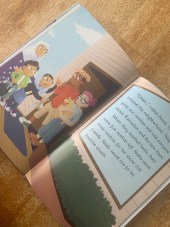
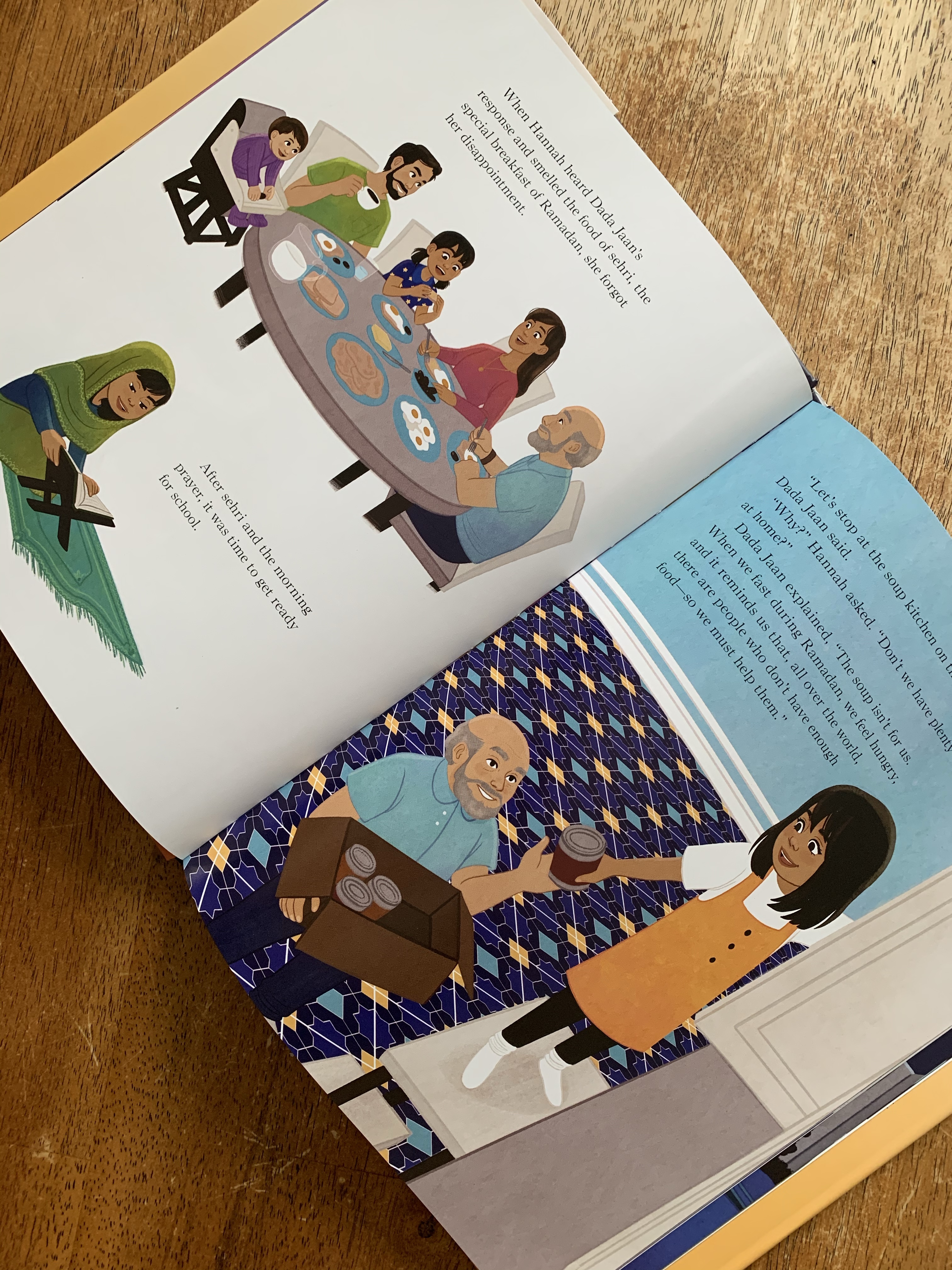
The book starts with Hannah being woken up by her paternal grandfather, Dada Jaan, it is the first day of Ramadan, and she is excited.  She hopes that now that she is eight years old, she is old enough to fast.  Her heart sinks when she is told, “Fasting is for grown-ups, not for growing children,” but her spirits rebound when Dada Jaan tells her that she is going to celebrate Ramadan by saving the world.

The first thing Hannah and Dada Jaan do is collect cans from the pantry to take to the soup kitchen.  Dada Jaan explains what a soup kitchen is, and why it is important to help those that don’t have enough food.  Hannah is worried they won’t be able to help everyone in the whole world, but Dada Jaan encourages her to start with her neighbors.

img_0277

Later in the day, Hannah’s friend loses a beloved family necklace, and when the bell rings she doesn’t want to be late for class, but she remembers that she is supposed to help, so she does.  Hannah finds the necklace, but her teacher is not happy when she comes to class late, and Hannah isn’t even given a chance to explain.

On the 11th day of Ramadan, Hannah and Dada Jaan decide to save the world again before they head off to the science fair.  They are packing up clothes to take to the shelter.  Hannah is worried that the people at the shelter won’t know that they are the ones that donated the clothes.  Dada Jaan says that it is enough to help people out of love and adds that the best superheroes work in secret.

img_0278

At the science fair Hannah sets up her model replica of Abbas ibn Firnas’s flying machine next to her friend Dani.  When Dani runs off to see a robot, his globe rolls off the table and Hannah saves it. Dani ends up winning and she is happy for him, but she is sad that no one knows she saved his project.

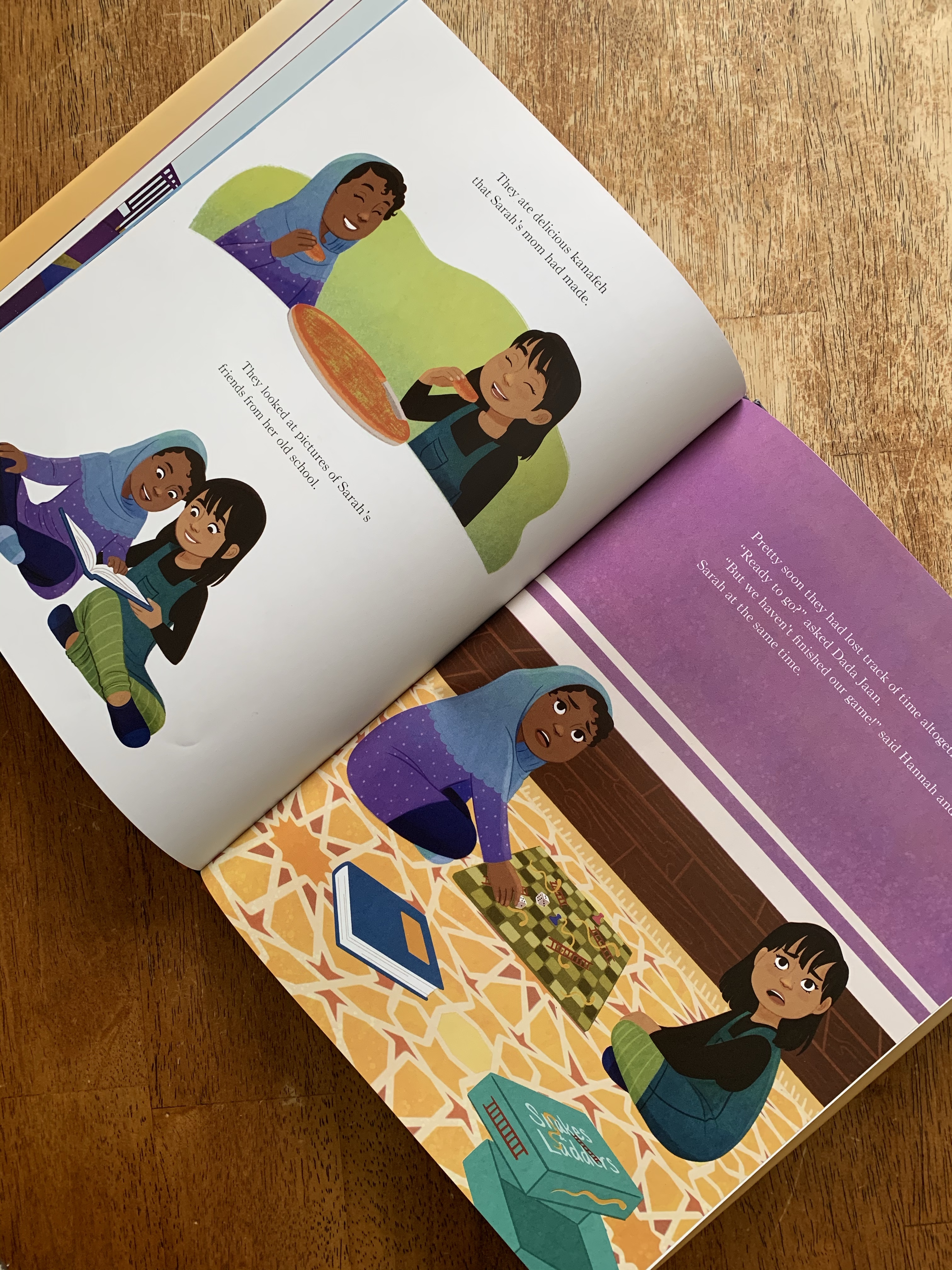
Twenty days in to Ramadan, Hannah has a play date with a girl she has never met before and Hannah does not want to go.  Sarah is new to the neighborhood and Hannah’s mom insists she goes.  Luckily Dada Jaan strikes up a deal that he will take her and they can leave when ever she wants.  Hannah and Sarah have so much fun together, Hannah doesn’t want to leave.

img_0282

When they get home, Dada Jaan shows Hannah old photographs of when he and Dadi Jaan had first come and didn’t even know the language.  They talk about how the kindness of others helped them, that and Dadi’s butter chicken.  The night before Eid, Dada Jaan asks Hannah if she helped make the world a better place, she doesn’t think she did, but he seems to think otherwise.

On Eid day they go to the mosque, then to the cemetery to pay respect to Dadi Jaan, and when they return home they find Hannah’s whole world there to celebrate with her.  Cousins, friends Maria and Dani from the church across the street and the synagog by the mosque, as well as the Sikh family that runs the soup kitchen.  Dada Jaan and Hannah enjoy gulab jamun, kheer, and jalebis as they discuss if Hannah really did help the world this Ramadan.

img_0280

It is hard in my heart to go wrong with a story that focuses on an amazing grandfather/granddaughter relationship that ends with them racing to get the last gulab jamun, so I might be a little bias.  But I was genuinely surprised and delighted by the direction the book took and the way it presented Ramadan in everyday situations that children can relate to and imitate. I was a little disappointed that the book wasn’t larger considering the phenomenal illustrations.  It is just 8.5 x 11.  I love that the characters pray and read Quran, and the mom covers and the neighbors are diverse.

Ramadan by Mari Schuh

Standard
Ramadan by Mari Schuh

ramadan edelweis

This 16 page holiday book is one in a series of six.  It keeps the text simple, the images bright and inviting, and turns the pages in to a search and find activity to increase time spent with the material.  The information is accurate and basic, there is nothing wrong (phew) with this recent addition to the very crowded nonfiction holiday book field.  In fact I appreciate that dates are explained and that the food looks tempting even if non Muslim children aren’t familiar with the dishes.  It shows a child in sajood and explains that he is praying. The realistic pictures show smiling faces and Muslim kids will feel represented. Non Muslim readers will become familiar with Ramadan as a time of fasting, the Quran, and prayer.

The pictures to look for are given at the beginning and again at the end with the “answers.” The limited pages have very minimal text.  The first one mentions a lantern being hung for Ramadan. It then states that Ramadan is a Muslim holy month where people fast, don’t eat or drink.

It shows a picture of the Quran and says it is used to pray, before showing someone praying on a prayer rug. When the sun has set it is time to eat. Dates are a sweet fruit to snack on after dark. It then shows a child and adult making dua and again reiterates that the holy month is for praying and helping others.

Ramadan’s Coming by Rabia Bashir illustrated by Laila Ramadhani

Standard
Ramadan’s Coming by Rabia Bashir illustrated by Laila Ramadhani

img_8785I think the illustrations in this 40 page picture song book are my favorite of the new 2021 books.  They are adorable and expressive and a big part of the story that the text alludes to, but doesn’t detail.  They also are a big part of the activities at the end of the book that encourage children to go back and find different Ramadan and Eid concepts to discuss and further understand.  I absolutely love that there is a glossary and a reference page that details and attributes the hadith implied in the simple sing song-y words.  The chorus is to the tune of jingle bells, and while I struggled to maintain the rhythm, the chorus reappears and if you are able to sing the book, your children will love it even more, haha, my voice and lack of rhythm forced me to read it, but either way it is absolutely delightful and informative for toddlers and up.

img_8787

It starts out with the refrain that Ramadan is here and we will fast and pray and that Allah (swt) will give us more rewards and we will do more good deeds, than on normal days.  It then shares that Ramadan is the month after Shaban when the Qur’an first came down and that we look for the crescent moon to know when Ramadan is here.  It is important to note that the words flow and are so concise you don’t even realize that much information has been conveyed.

img_8788

The chorus repeats and shows a family praying, kids helping vacuum, and giving socks to homeless.  The family then wakes up early for a healthy suhoor, no food or drink, thinking about how the poor must feel and then having iftar with a sticky sweet date and water.  Sometimes you eat so much your belly protrudes (a great vocabulary word for little ones). The next page has salat starting and those that ate too much wishing they would have left space for air and water.

img_8792

The chorus repeats again showing zakat being given, iftars being eaten in segregated large groups, before looking for Laylat ul Qadr takes place and some children read Qur’an in an itikaf tent. Then it is time for Eid hugs, salams, prayer, food and fun.

img_8791

On one page, the grammar of one line seems off, perhaps an extra word was added.  I contacted the author to see if it is an error as it is part of the chorus, but only appears wrong in one place and one time.  Even with the error, I would happily encourage this book for families with toddlers, preschoolers, and kindergarteners.  It will be read multiple times, and the pictures will hopefully offer something new with each reading as understanding increases.

img_8793

The copy I purchased from Amazon is 8.5 by 8.5 paperback, I’m not sure if they will be available from the publisher as a board book or without faces like so many of their books are.

Red Shoes by Karen English illustrated by Ebony Glenn

Standard
Red Shoes by Karen English illustrated by Ebony Glenn

img_8529

This delightful 32 page picture book links two girls, two ends of the world, two cultures and two stories together with a pair of red shoes.  The short sentences pop with action and the perfectly illustrated two-page spreads convey relatable emotion and joy.  The beloved shoes travel on the feet of one character to a wedding, Christmas dinner, and birthdays, they are then are donated and journey to West Africa to be given as a gift for a little girl who fasted half of Ramadan.   The message I hope children ages three and up will get from the story, is that we are more alike than different, that we should take care of our things (amazingly the shoes weren’t worn out), and that we should donate things of good quality that we ourselves value.  I hope it doesn’t lend itself to perpetuate the stereotype that we can send our castaway items to Africa, being the author comments in her bio on the back flap that her husband is from West Africa and that she frequently visits there, I’m hoping that this is just me being overly cautious in the messaging, and nothing is being implied or negatively taken from a casual reader.

img_8530

Malika and her Nana see a pair of dazzling shoes perched in the window, and Malika is enamored. Her grandma later surprises Malika with the shoes.  She quickly tries them on and tests them out.  She keeps them safe from the rain and dances with them on at her Auntie’s wedding.  She kicks her cousin Jamal with them on, under the table at Christmas when he tries to steal her biscuit.

img_8531

She stomps away from her best friend in her red shoes, and jumps double Dutch with them on when she makes up with her friend at her birthday party. But at Nana’s birthday, “the shoes don’t let her forget that her feet have grown.” Nana and Malika take the shoes to the thrift store to be resold.  A sad Malika says goodbye to them, they were her favorite shoes ever.

img_8532

Inna Ziya sees the shoes in the window and knows just the little girl who will love them.  She squeezes them in to her suitcase and they are off to Africa. They wait under a table selling claypots in a market waiting for the girl who fasted half the month of Ramadan.

img_8534

When Amina comes holding her mother’s hand, Auntie Inna Ziya delivers the promised gift.  Amina thinks they are beautiful and lovingly carries them in the box on her lap as they fide the tro-tro home.  Amina’s little sister Halima, can’t wait to see the gift as she too hopes to one day fast in Ramadan.

img_8535

Amina lets her try them on and when she outgrows them she plans to pass them on to her.  Meanwhile, Malika is wondering whatever happened to her beautiful red shoes, and if someone else is wearing them.

img_8536

There is no mention of Islam nor is Ramadan explained.  There are women in hijab in America and in Africa, even in the books in a shop window there is representation.  I particularly love the shout-out in the illustrations to “Mommy’s Khimar.”

img_8533

The front of the book has Malika, and the back, Amira.

img_8537

The Most Powerful Night: A Ramadan Story by Nada Hassan illustrated by Soumbal Qureshi

Standard
The Most Powerful Night: A Ramadan Story by Nada Hassan illustrated by Soumbal Qureshi

the most powerful night

This beautiful poetic book about Laylat Al-Qadr explains in detail and wonder the importance of the most blessed night in the blessed month of Ramadan.  The soft purples and pinks of Laila’s room, and the repetitive refrains set the mood and tone of an informative bedtime story that will convey the awe and mercy of the night to seven and eight year olds.

C2080E23-FF92-40D7-A40A-49F53DD85406

The book is 40 pages, and pretty text heavy, but it flows smooth enough, and the details in the pictures are enough to keep little ones engaged. Younger and older children will also enjoy the story as both an introduction to the night the Quran first came down, and as a reminder of the gifts to be had.

816801CB-54C8-4FDE-836D-C9038DB1B538

Laila is sad that Ramadan is leaving as she peers out the window and sees the moon resmembling a crescent again.  Her mother takes the opportunity to tell her about the blessings of the last ten nights, and Laylat Al-Qadr specifically.

DD841DEB-9591-4305-80E6-CC328CAB45E6

“The Night of Power and Miracles,” Laila’s mother explains is a night like no other, that comes only once a year.  Thousands of angels come down until there isn’t a speck of space that they do not fill.

13B3DC09-7A02-4921-BD9A-9DCBAAAE77D5

The night that is better than a thousand months and all our deeds are multiplied 70 times, the night the Holy Quran was first revealed to Prophet Muhammad (saw).

2F0180A5-B187-4511-A3B8-9DC0F37A55E8

Laila wants to make sure she pronounces it correctly and practices saying Laylat Al-Qadr.  Excited to make sure she is praying and reading Quran that night, she is desperate to know what day it is.  Her mother explains to her that we do not know.  Laila uses this to her advantage to get to stay up past bedtime for each of the last 10 days.

46D932B3-0A00-44AB-B44D-6A9CE84ECD65

The book begins with Surah Al Qadr in Arabic and with the meaning of the translation in English.  It ends with a glossary, more information about Ramadan, and a glimpse of the author’s first book: Ramadan Around the World.

C84423A6-DCE5-4185-ABD7-3F0FF86ED59E

The 9 x 11 hardback binding and font are beautifully done and with there no other books for children that I can think of that discuss Laylat Al-Qadr, I foresee this one being read at least once a year, if not more, for many years to come, alhumduillah.


Khadijah and Cat: Ramadan is Here by Shamsa Ahmed illustrated by Afsaneh Bagherloo

Standard
Khadijah and Cat: Ramadan is Here by Shamsa Ahmed illustrated by Afsaneh Bagherloo

khad and cat

New this year in the Ramadan category is this gorgeous 40 page hardback book that mixes information about the blessed month with personable characters very well.  It stays on track without getting silly, even with a talking cat and a reoccurring super hero dinosaur, but I don’t understand the attempted rhyme scheme.  I’ve read the book over a dozen times trying to map it, and sometimes it is so natural that it makes reading it aloud smooth and lyrical, and sadly a few times it seems so forced that it makes the sentence nonsensical or awkward.  There is so much information, so beautifully paced and illustrated for children 4 and up, that I’m willing to overlook the few sentences that irked me to recommend this book for you and your children to enjoy this Ramadan.  Without a glossary though, it is probably best for Muslim children, or those with someone who can explain words such as: suhoor, iftar, adhan, SubhanAllah, dua, Allah, etc..

47EC69E5-532D-49CE-BA55-31787B8FF517

Khadijah and Cat are looking for the moon to know if it is the start of Ramadan, and once they find it, they rush to spread the news.  Immediately everyone starts decorating and celebrating and sharing delicious food.

663D21CA-B838-4CE3-8205-7CF1561B267E

They then head home to sleep so they can wake up early for suhoor.  They make a point to eat something healthy to sustain them for the whole day, then they pray and go back to sleep.

87F8555A-229B-40B8-8FC3-EAC757057BFE

Cat wakes up ready to eat and is surprised that they have to wait until sunset before they can eat or drink anything.  Khadijah explains that Ramadan is a holy month and one of the five pillars of Islam.  The illustrations show the other pillars, but the explanation of Ramadan is a bit advanced with words such as regression, unpriviledged, compassion, and purifying.

CA7C44AE-AD4B-41EF-BBBF-0B802A42CCC9

The next page continues listing off what Khadijah and Cat are learning about Ramadan, as they spend time praying and reading the Holy Quran.  At the sound of the fourth Adhan they break their fast.  The names of the salat or that they pray five times a day is not mentioned, but lends itself to a great teaching point.

789953D0-E39D-4847-A274-F72BA6BC941A

They then pray and eat and take the neighbors some gifts.  Cat is convinced that the day was good and is ready for the next 30.  The last ten nights are identified as important and Laylat al Qadr is mentioned as being special, but it does not tell why they are unique.

1684103F-25CF-4E67-A13C-50A8D50FAF0D

Khadijah and Cat then invite you to fast and see why Ramadan is so special.  The end of the book has some questions, a Ramadan count down and a coloring page.  I was surprised that there was not a glossary as the Arabic words in the text are enlarged, and often not defined.

C1681A56-BE04-4CE0-917C-7A5F3DFA3F9C

I love the font and binding and horizontal 10 x 11.5 layout.  The illustrations are gorgeous and the details in the decor and Khadijah wearing hijab while out, but not at home are very well executed.  I’m not sure why the Meer-Rex is in the book, he is never identified or given attention, maybe in future books he will have more of a role, inshaAllah.

I ordered mine from Crescent Moon Store and received it within days of placing the order, thank you!