Tag Archives: education

Muzoon: From Refugee to Leader by Muzoon Almellehan illustrated by Asma Enayeh

Standard
Muzoon: From Refugee to Leader by Muzoon Almellehan illustrated by Asma Enayeh

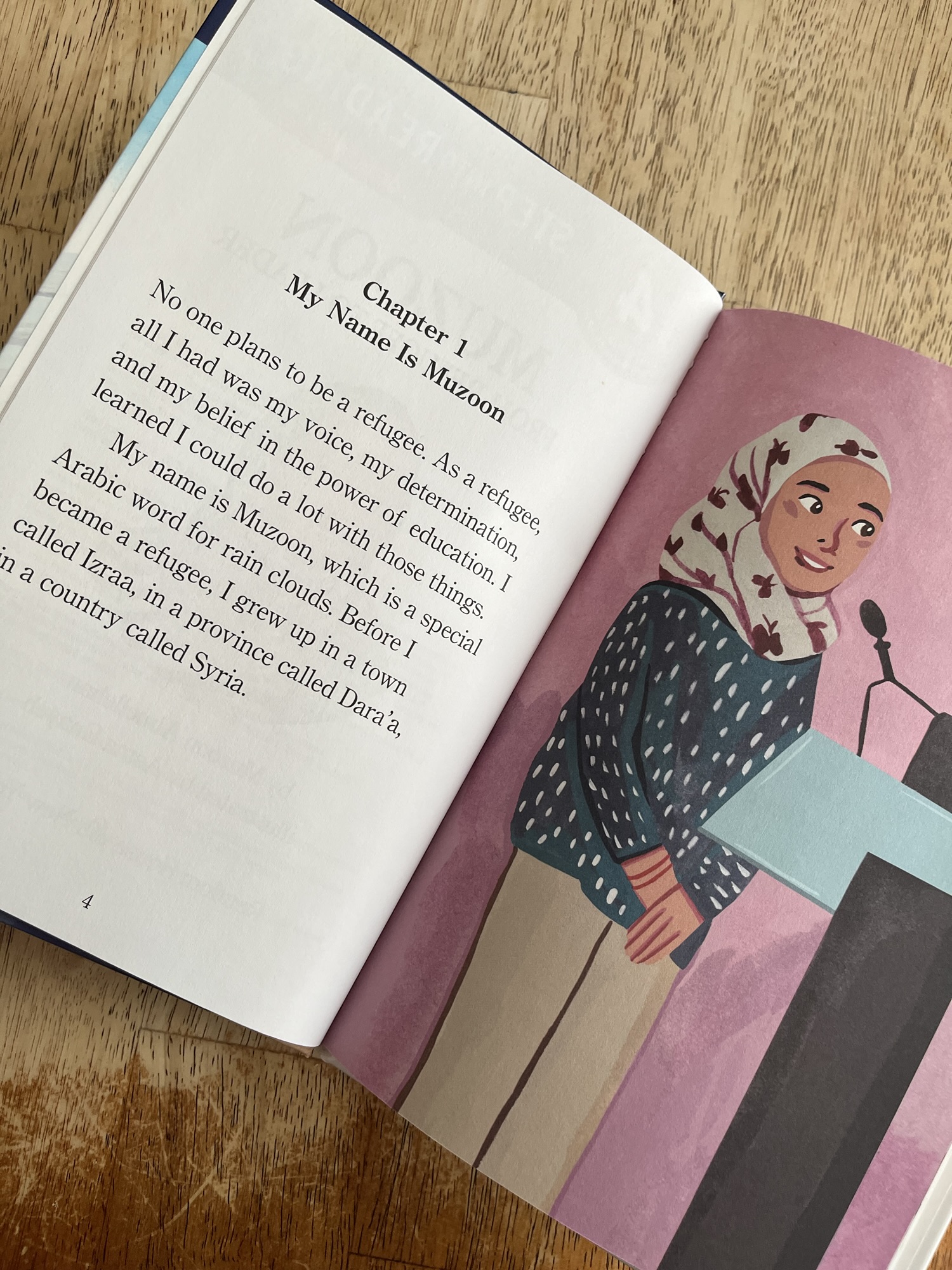
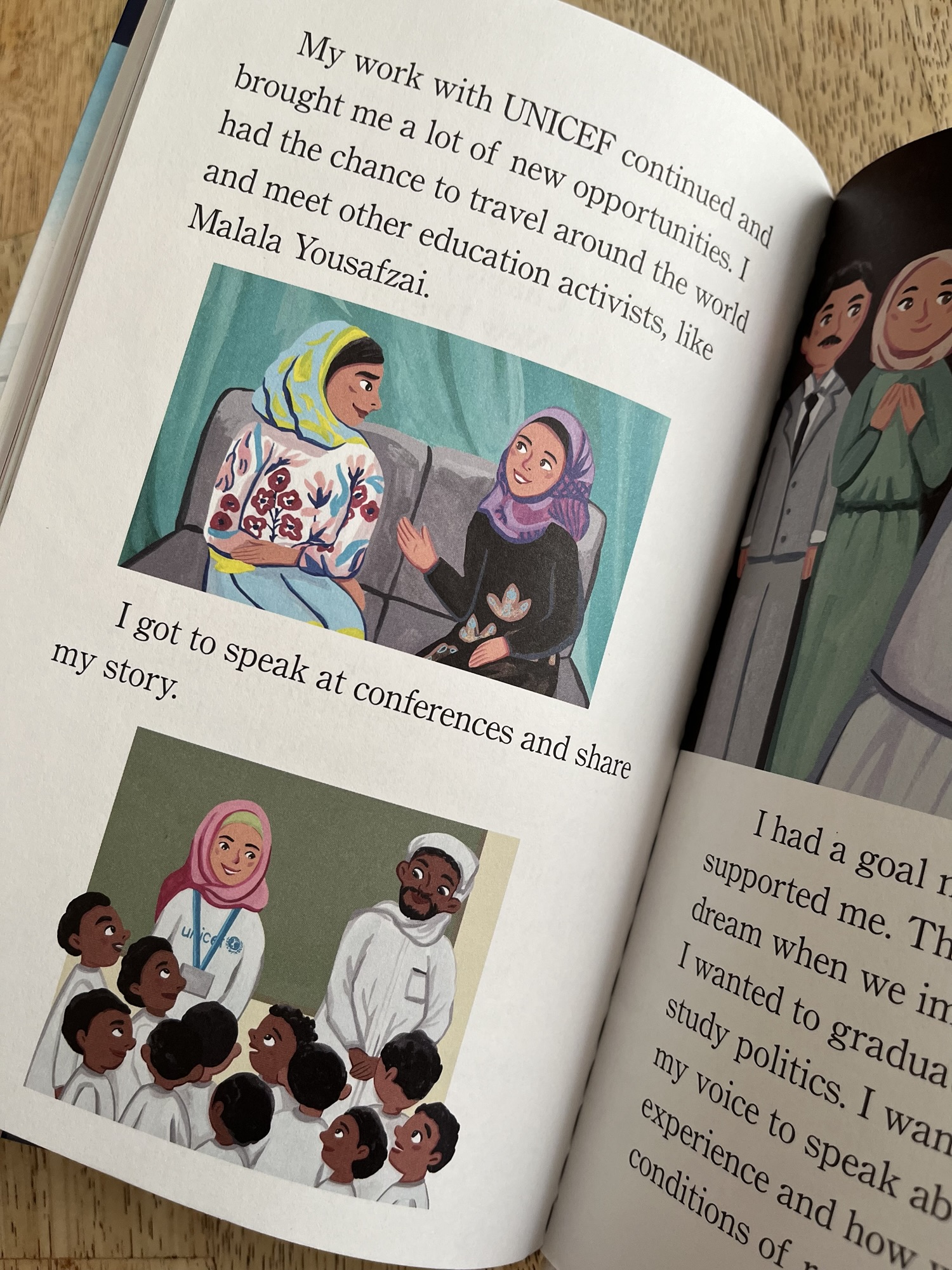
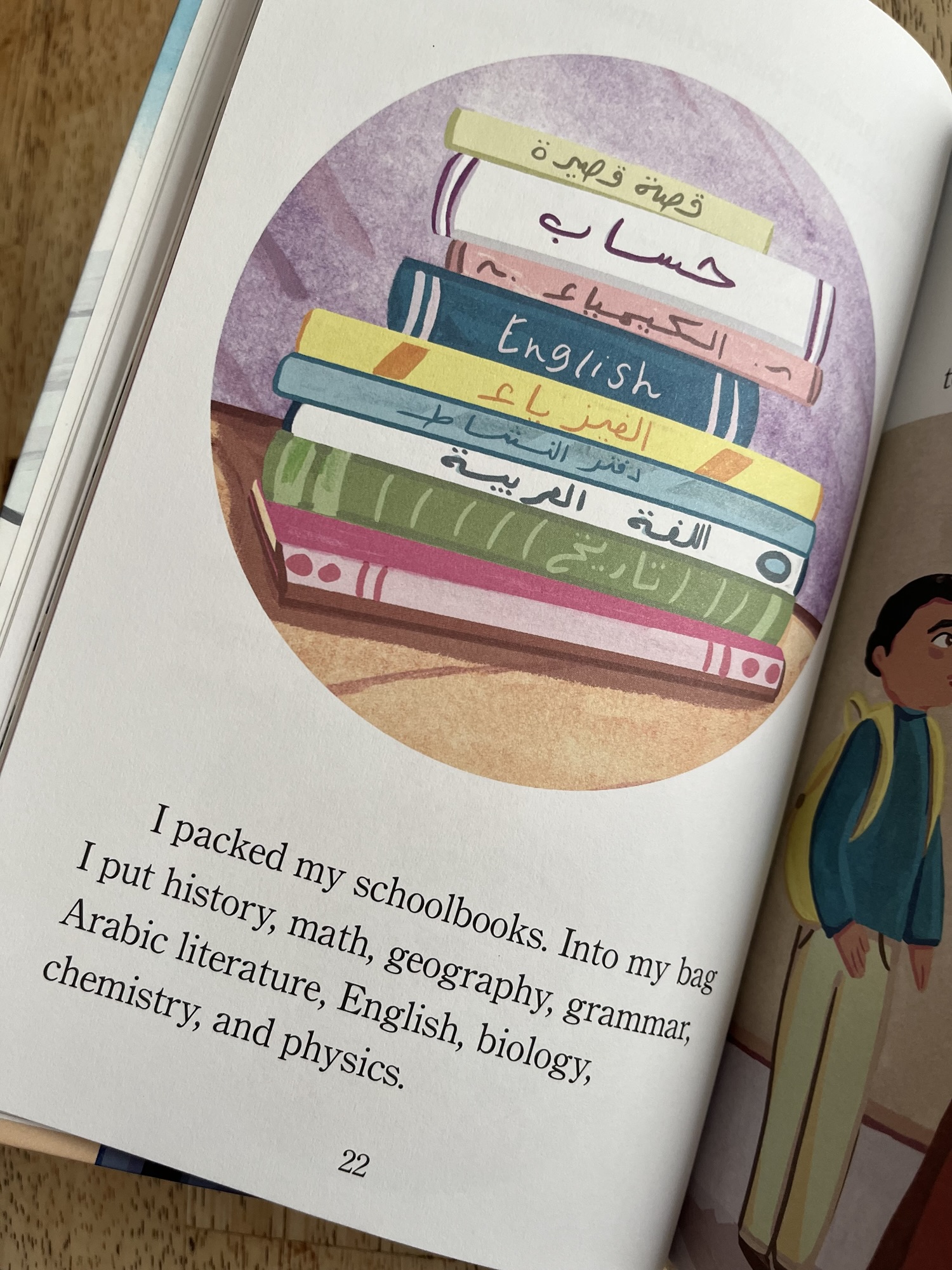
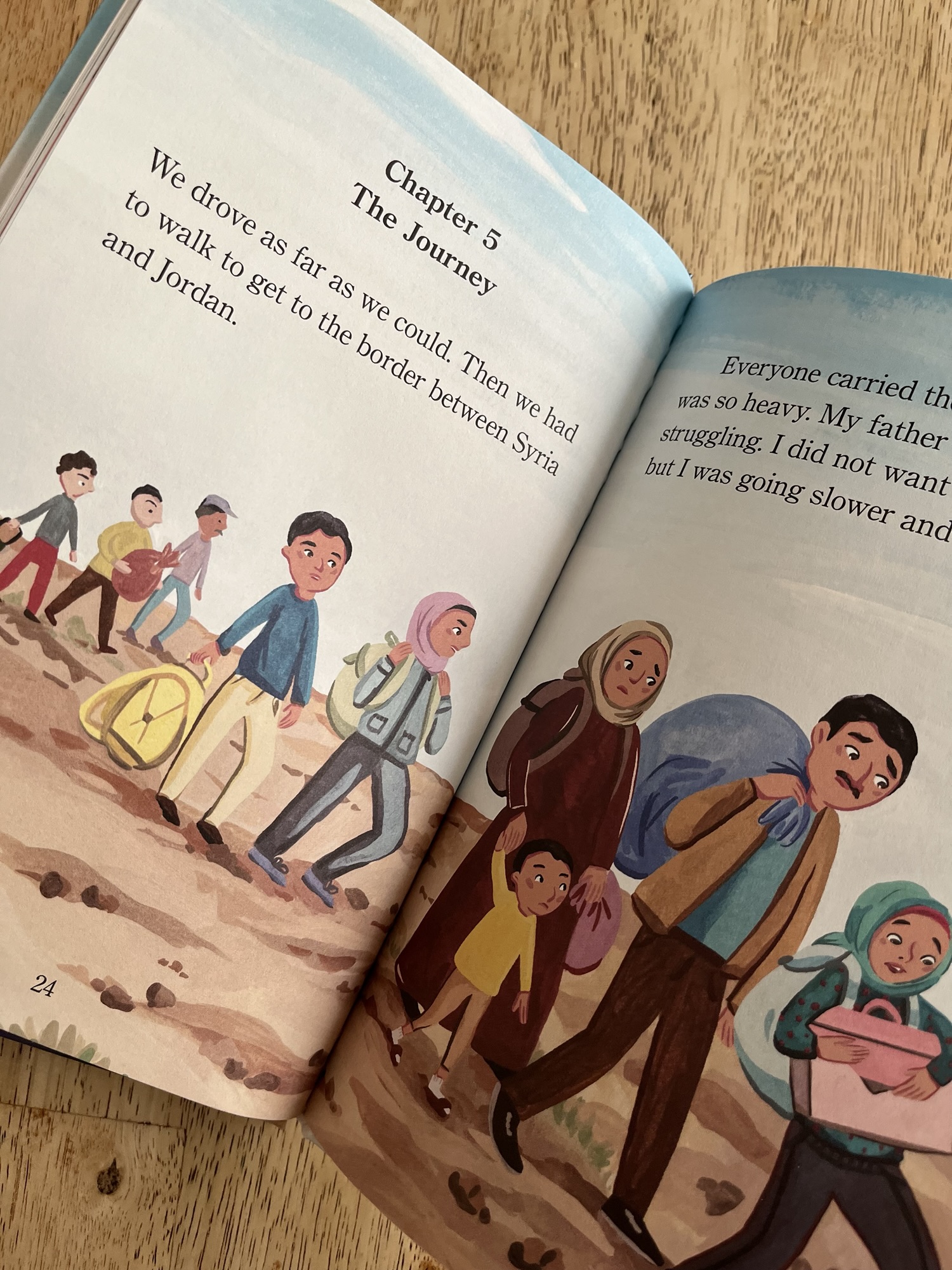
Such a delight to see Muzoon’s story coming to children in the West in the form of a Step into Reading Biography. The approachable format aimed at second and third graders reading paragraphs tells Muzoon’s story with quotations from her middle grade biography, Muzoon: A Syrian Refugee Speaks Out.  From her life with extended family, playing soccer, studying and enjoying Ramadan, to the changes that turned her country unsafe and forced them to become refugees. It follows her to refugee camps trying to find routine and hope and the role education and encouraging other’s to study plays in her life.  Eventually her activism and efforts catch the attention of UNICEF and today she works as a UNICEF Global Goodwill Ambassador and travels the world advocating for education and refugees and rebuilding Syria.

Divided into eight chapters, the 48 page book shows how relatable Muzoon’s life is and how the political events forced her family to abandon all they knew.  The presentation, in both the text and the illustrations, show the unexpected and hardships Muzoon and her family face as they make their way to the refugee camps and work to adjust. The book is not graphic, but the weight is conveyed as readers also see the power education and learning has in providing hope and opportunity. In a fictional story, a protagonist using their voice for the good of society is something to cheer, to see it from a real life person in the middle of a war, is something to admire and be inspired by.

I particularly like the inclusion of Ramadan in the story and the details showing her family joyfully gathering to break their fast together, as well as conveying some details about the Islamic holiday.

Palestine: The Special Edition by Joe Sacco

Standard

img_2164-1

Written between 1993 and 1995, and compiled as a complete set in 2001, this 285 page adult non-fiction graphic novel is not really something I can review, even if I knew how.  As we have passed 100 days of the escalation in Gaza, on top of the ongoing horrors of Israeli occupation, I am hoping to broaden my literary awareness to include not just children’s fiction and non-fiction about Palestine, but also adult works by those living it, those moved by it, and those reporting on it.

This particular “special edition” has a forward by Edward Said, and an introduction by the author and illustrator.  Once I started the actual story, I’ll be honest it took a few attempts to hook me, with the starting being in Cairo and being a little aggressive with alcohol and talk of women, but once I decided to just keep going, the book finds a bit of a rhythm.  It shows the author himself shaping his own opinion as he interviews, and sees, and reports on the events around him.  It is non-fiction, it is written by a journalist, at some points he acknowledges his bias, but the overall picture presented, is heart wrenching.  That the humiliation and torment and occupation of a people has been so well known and documented and ignored, in light of current events, and even in isolation, is devastating.  The exhaustion the writer feels just witnessing it, is palpable, and the complete ignorance of Israeli, former IDF soldiers none-the-less is stark.

The book is both a reflection of the time with internal political factions playing roles differently than they do in todays conflict.  There are also views about Iraq and Saddam Hussein, which might surprise readers today.  But the power of this book is what hasn’t changed, the torture, the imprisonment of children, checkpoints, illegal settlements, humiliation, restrictions from working, from moving, from being treated as equal.

I’m glad I read it, and spent time among the the ink filled pages. I am certain that many of the stories, particularly the ones from inside the prisons will stay with me and haunt me as I read headlines and scroll endlessly through the statistics occurring in real time.  How can we be so blind, for so long, how can a people endure so much and keep fighting, how does any of this make sense?

Nura and the Immortal Palace by M.T. Khan

Standard
Nura and the Immortal Palace by M.T. Khan

nura and the immortal palace

This 272 page unapologetically Muslim MG tale takes on some heavy concepts: child labor, jinn, education, and gulab jamun- I mean greed.  Through the eyes of feisty, determined, clever, and strong Nura, though, the trials of life and society are never without hope, a sense of adventure, and good intentions.  The characters are likeable, the Islam wonderfully present and often centered, the social commentary remarkable, but the framing for me, made it a bit of a struggle to read at times.  It is set up like Alice in Wonderland or even Silverworld, where the characters living in a real world stumble in to an alternate reality, and thus the world building occurs in real-time so to speak.  The reader has no idea what is going on until it is happening, no clue what the rules and constraints of the fantasy world are until some detail is needed to help or hinder the protagonist, and personally I struggle with this wandering style of narrative.  I have mentioned before that as a child I really never read fantasy, and I think this is why, I  need the context to ground the story so that I might lose myself in the adventure at hand.  If you are fine with this framing and at ease with Islamic jinn fantasy, then this book will be a lot of fun.  If you find fantasy “shirk-y” do know that Ayat ul Kursi is used to save the day, but that there is a lot of imagination regarding the beings made of smokeless fire, a casino is present along with dancing, indentured labor, and the fear of death.

The book releases in July 2022, and as always pre-orders help show support for books, authors, and the OWN voice content that they entail, so if this book seems like a good fit for your 3rd/4th grade reader and up you can pre-order it here: https://amzn.to/3MVvxQo

SYNOPSIS:

Nura lives in the small industrial Pakistani city of Meerabagh.  Her father has passed away and her family is too poor to send her to school, instead she must work so that her siblings might eat.  Her mother works in a sweat factory and Nura in the mica mines.  The illegal child labor and cruel owners provide less than ideal working conditions for the children forced to mine the sparkly mineral.  Nura’s mom wants her to quit, Nura herself doesn’t enjoy the torment, but somehow she takes it on as a challenge to be the best miner in Meerabagh, pushing her self deeper into the fragile tunnels.  With bestfriend Faisal always warning her about going too far, she decides to finally listen to her mother and quit the mines, but not after she makes one final effort to find the rumored “Demon’s Tongue” treasure.  She digs too deep though, and the mines collapse, children are lost, Faisal among them. Determined to find her best friend, she plunges in to the fallen mines and finds herself on the pink waters outside the luxurious jinn hotel, the Sijj Palace.

Nura has always been warned about jinn, qareens and the tricks they play on humans, but when a life of luxury is dangled in front of her, Nura pushes her better judgement aside to enjoy a life she has always dreamed of.  It isn’t just the food and clothes, but it is the respect and honor she is given as she wins a food eating contest, gambles in a casino, and gets decorated for a dance party.  It all comes crashing down however, when in an attempt to impress the painted boy, she cuts off his horn.  Status revoked, Nura is sent to the labor force, where she will remain for eternity, imprisoned and at the disposal of the hotel.  What is more, after the three day festival of Eid al Adha, her memories of her life before coming to the jinn world will disappear. Nura is determined to escape, but nothing in the jinn world is easy, and for a 12 year old girl with fading memories, this might be more than she can endure.

WHY I LIKE IT:

I love that Nura is unapologetically Muslim.  Even though she is poor, there is time spent on the pages detailing the feeling of Eid al Adha, the familial togetherness and community festiveness even if it all is meager, it still has value.  I also really like the relationship between Nura and Faisal.  They drive each other crazy and have nothing in common, but they never give up on each other.  They act like siblings, tolerating each other’s annoying quirks, while never wavering on their concern and worry for one another.  It is sweet and well fleshed out.

The threading of education was also done well.  Nura finds the idea of school repulsive, but it grows and changes as the obstacle of being illiterate slows her down, and ultimately she changes her mind.  The growth arc is subtle, but powerful, and Nura’s intellect, cleverness, and ingenuity is never dimmed as a result of her lack of formal schooling.

The characters, even the “bad” ones are given some depth and sympathetic qualities, and Nura has to recognize some of her own flaws and choices as she journeys through the book.  Desi culture is present primarily in food and clothing, but it adds depth to the story and flavor to the experience.

The food eating competition, however, didn’t really impress me.  I get that it was to flesh out the jinn world and show Nura’s smartness, but I thought the jinn in the water were eaten, only to have them reappearing, and the founding premise is that jinn are tricksters, so to have Nura tricking them seems to blur the lines of integrity.  Also the bird was critical, and then never seen again, the scene just didn’t read as tightly edited or as clear as it should have in my opinion.

I didn’t love that a casino either, or that it was so central to the story. If it would have said something about gambling being haram and jinn being free to do what they want, like it did when discussing how Eid is celebrated by non practicing jinn, I might have not been as bothered,  but it seems an odd setting nonetheless, for a middle grade book.

FLAGS:

Gambling, child labor, indentured servitude, magic, fantasy, jinn, destruction, bombing, fire, death, fear.

TOOLS FOR LEADING THE DISCUSSION:

I think this could work as a middle school book club read.  It is a little below level and age, but there is a lot to discuss and connect with, that I think it would be a lot of fun.  Our school is ok with fantasy reads, so for us it definitely deserves a place on the bookshelf in a classroom, school library, and possibly (depending on your views of fantasy) a home library.
Nana Asma’u by Aaliyah Tar Mahomed illustrated by Winda Lee

Standard
Nana Asma’u by Aaliyah Tar Mahomed illustrated by Winda Lee

nana asmau

This book may only have 14 pages of text and be meant as an introduction for early preschool aged children and up, but I learned so much, or rather was made aware of so much that I knew nothing about, that I’m now eager to research her and the Sokoto Caliphate and the impact of Jajis.  The beautiful, bright, engaging pictures, the simple deliberate text, and the inspiring content matter make this a great book to share with little ones, and to keep on the shelf for repeated readings and reminders to learn more about this remarkable woman for older children.  My only wish was that there were some reference notes or sources included to give that extra reassurance of authenticity.

img_6076

The book tells about Nana Asma’u’s life starting from being a curious child and asking questions to the wise women in her community.  By the time she grew up she had memorized the Quran and spoke four languages amongst many other things, and Nana loved to write poetry.

img_6077

During this time, there was a lot of conflict in Western Africa, and Nana’s father, Shehu Usman resolved the issues and created the Sokoto Caliphate.  With peace, Nana wanted to help educate the people. She thought long and hard about how to do it.

img_6078

She eventually brought together women from different regions of the Caliphate and taught them through poetry, she then sent the women back to their homes to share what they had learned.  These women were known as Jajis, and this tradition still exists today.

img_6079

I didn’t love the phrasing that she had learned all about Islam, seeing as one can always learn more.  And I would have like Prophet to have been capitalized and salawat given for respect.  Overall, a great book that alhumdulillah I was able to purchase from Crescent Moon Store.

Be Patient, Abdul by Dolores Sandoval

Standard
Be Patient, Abdul by Dolores Sandoval

I share this book from 1996 to show how far we have come in telling our own stories with accuracy and emotion, as well as to celebrate those that featured Muslims in a positive, unapologetic light when there wasn’t a standard yet established. It is easy to harp on the negative, but truly the only way forward is demanding better of ourselves and of our representation. The book is disjointed-pulling in random details to focus on, and is very text heavy, slow, and dry. It does feature a Muslim family, though, and shows both Abdul (albeit in his underclothes) and his father praying salat. The text even mentions thanking Allah (swt). I honestly have been searching for past Islamic representation or mention in mainstream juvenile fiction, it fascinates me to see where the seeds first were planted: Sport by Louise Fitzhugh (1980) has a one line mention of a character being Muslim, Kiss the Dust by Elizabeth Laird (1991), Habibi by Naomi Shihab Nye (1997), Ruhksana Khan’s The Roses in My Carpets by a Muslim about Muslims(1998), The Hundredth Name (1995) by Shulamith Oppenheim.

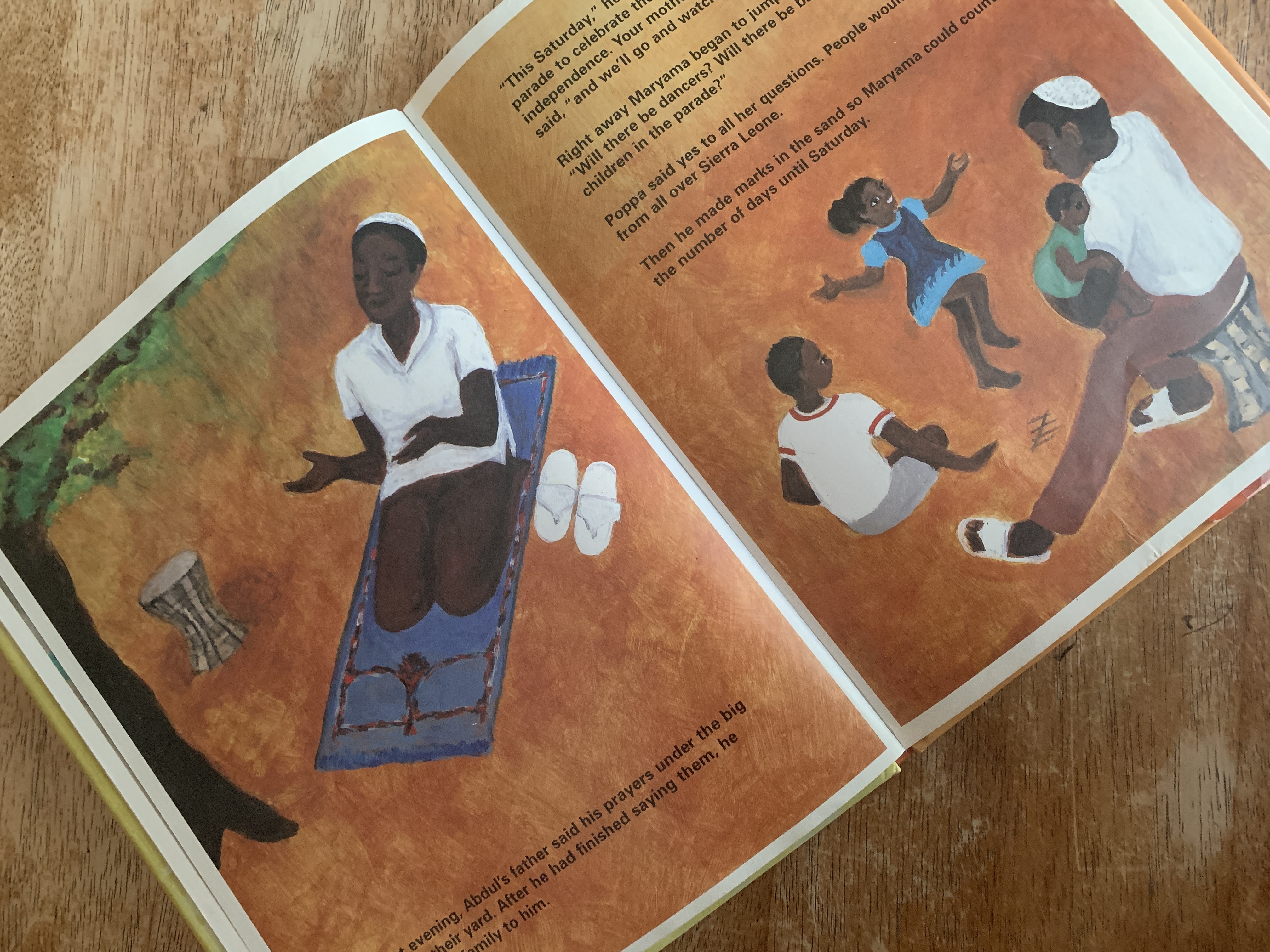
Abdul is a seven-year-old little boy in Freetown, Sierre Leone. He sells oranges so that he can pay for school. School is not free, and selling oranges requires a lot of patience to save up enough to return to the classroom. One day he returns having not sold any, and his grandmother reminds him to be patient and to try a new market. His mother tells him to take his little sister Maryama with him. She is five and slows him down.

img_4810

In the evening Abdul’s father prays in their yard and then tells them about an upcoming parade to celebrate the anniversary of their country’s independence. Abdul’s mom will be in the parade. After more days of low and no sales, Abdul worries that school is a faraway dream. Maryama however, sells some oranges for him and he dares to hope he can sell a lot at the stadium and during the parade.

img_4811

Momma is marching in the parade, the family watches her. Abdul gets tired of waiting for her afterward and walks him. His dad has a good day of driving his taxi for people trying to get to the stadium and home from it. At the end of the day, they count up their money and there is enough for Abdul to return to school.

img_4813

The final page shows Abdul praying and thanking Allah for the oranges to sell, the taxi passengers and for patience. I have no idea why he is wearing an undershirt and underwear while he prayers, clearly his awrah is not covered, nor does it radiate reverence.

img_4814

The point of the book is to humanize another culture and perhaps make western children appreciative of their life, the ability to attend school, and not having to work from such a young age. The book I checked out from the library, doesn’t show that anyone in 1997 until today, or at least whenever the library switched from the stamped dates to electronic ones, ever checked out the book. And while yes it offers very little to the catalogue of memorable books of our time, it does show the early indications of our presence in literature.

img_4812

Roots and Wings: How Shahzia Sikander Became an Artist by Shahzia Sikander and Amy Novesky illustrated by Hanna Barczyk

Standard
Roots and Wings: How Shahzia Sikander Became an  Artist by Shahzia Sikander and Amy Novesky illustrated by Hanna Barczyk

roots and wings

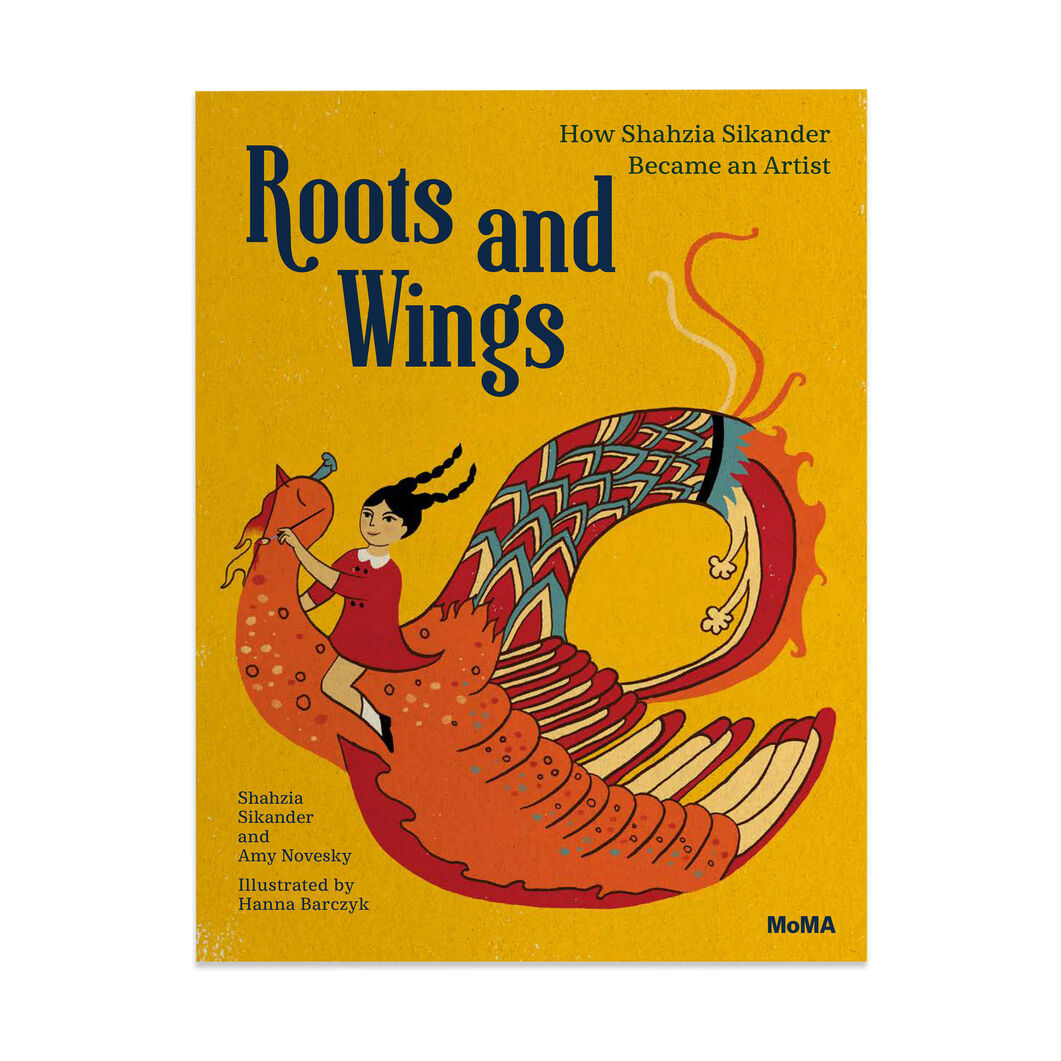
At 40 pages, this biography about Pakistani born artist Shahzia Sikander is filled with culture and experiences.  The story shows the influences of her family, the city of Lahore, her love of math, and her art education have in shaping her in to the artist she is today.  The book features photographs of her work at the end, but I found it odd that she didn’t illustrate the book herself.  The playful blocky pictures and text would appeal to first or second graders with some assistance, but would be better suited for readers a bit older if they are unfamiliar with some of the cultural and artistic vocabulary.  There is no mention of Islam in the book, when researching, it says her family is Muslim.  It seems she went to Catholic school, and a road trip was taken that included visiting the Sistine Chapel.  A few illustrations show people in hijab and it mentions the athan ringing out five times a day.  The book was interesting, but I wish I could have found it at the library, rather than purchasing it.  I don’t know that it will be read more than once, but that speaks more to personal preference, rather than the quality of the book. If you enjoy fine art, are from Lahore, are a fan of Shahzia Sikander’s work, you will definitely enjoy this book.

img_1695

The story starts with a girl stepping in to a painting with many rooms, filled with many people in a joint family.  It is her (Shahzia’s) home, and her family.  The rooms are filled with ancient fables, Russian fairy tales, poetry, English, Urdu, Bollywood songs, and American Westerns.

img_1696

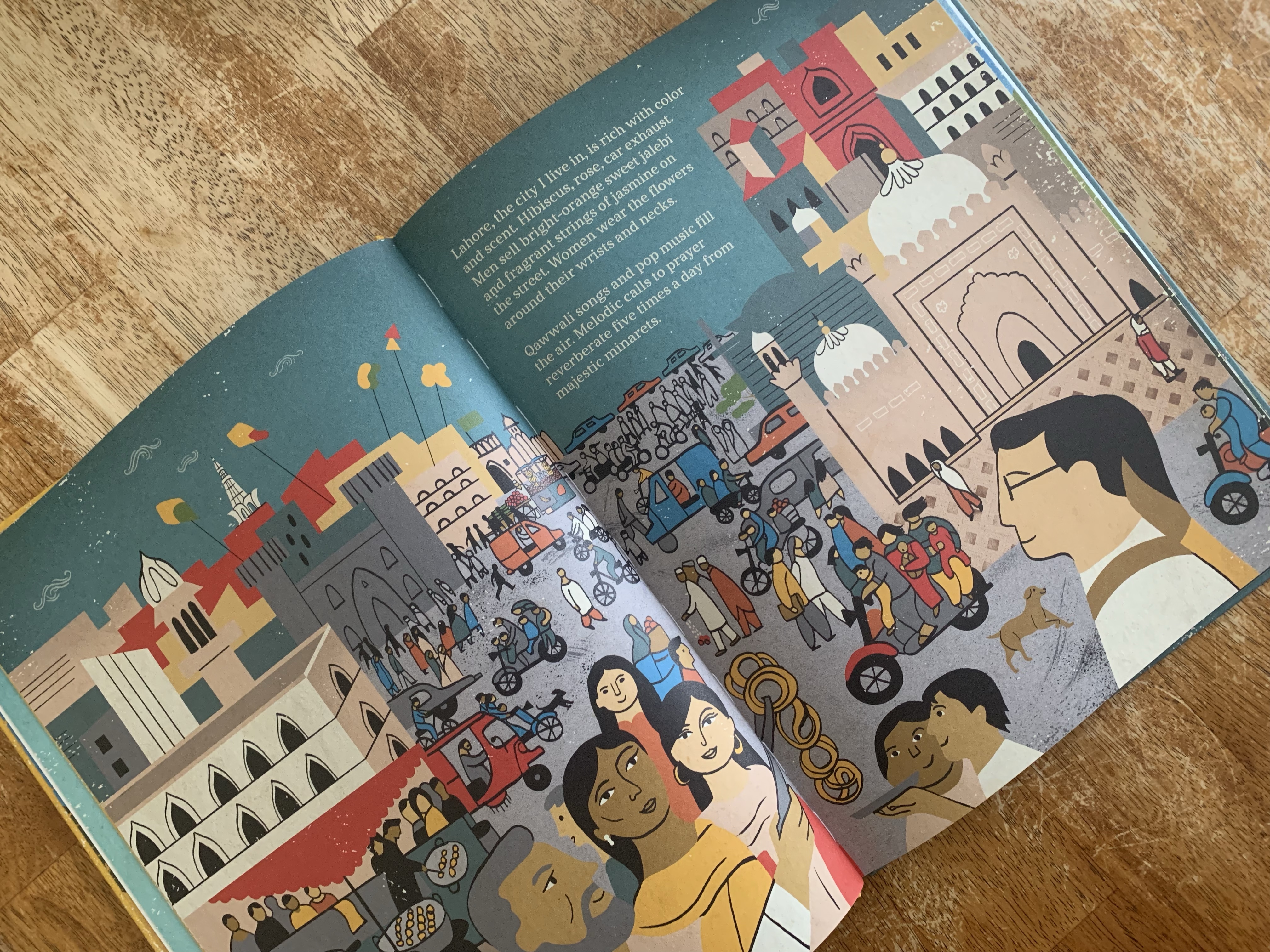
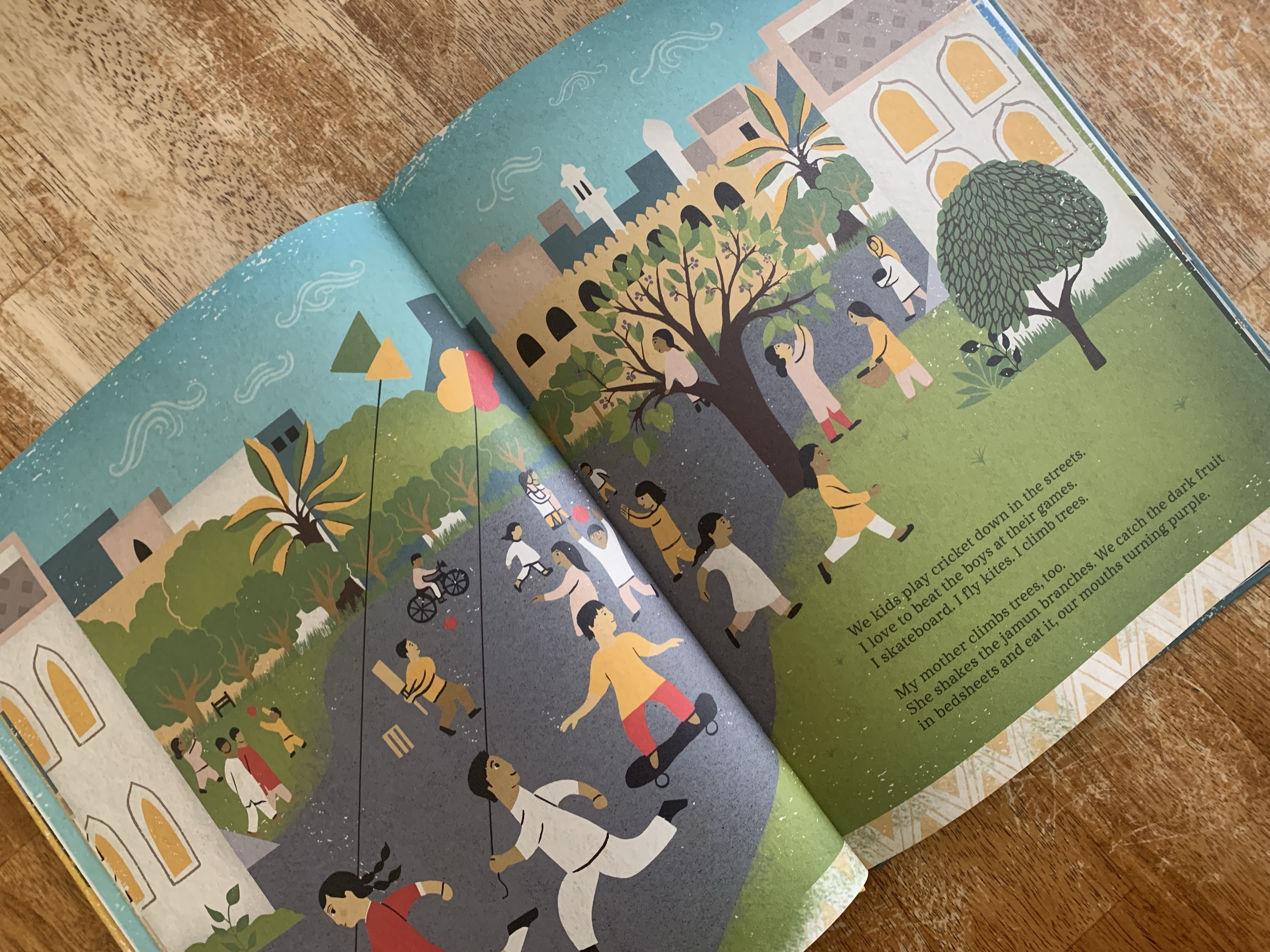
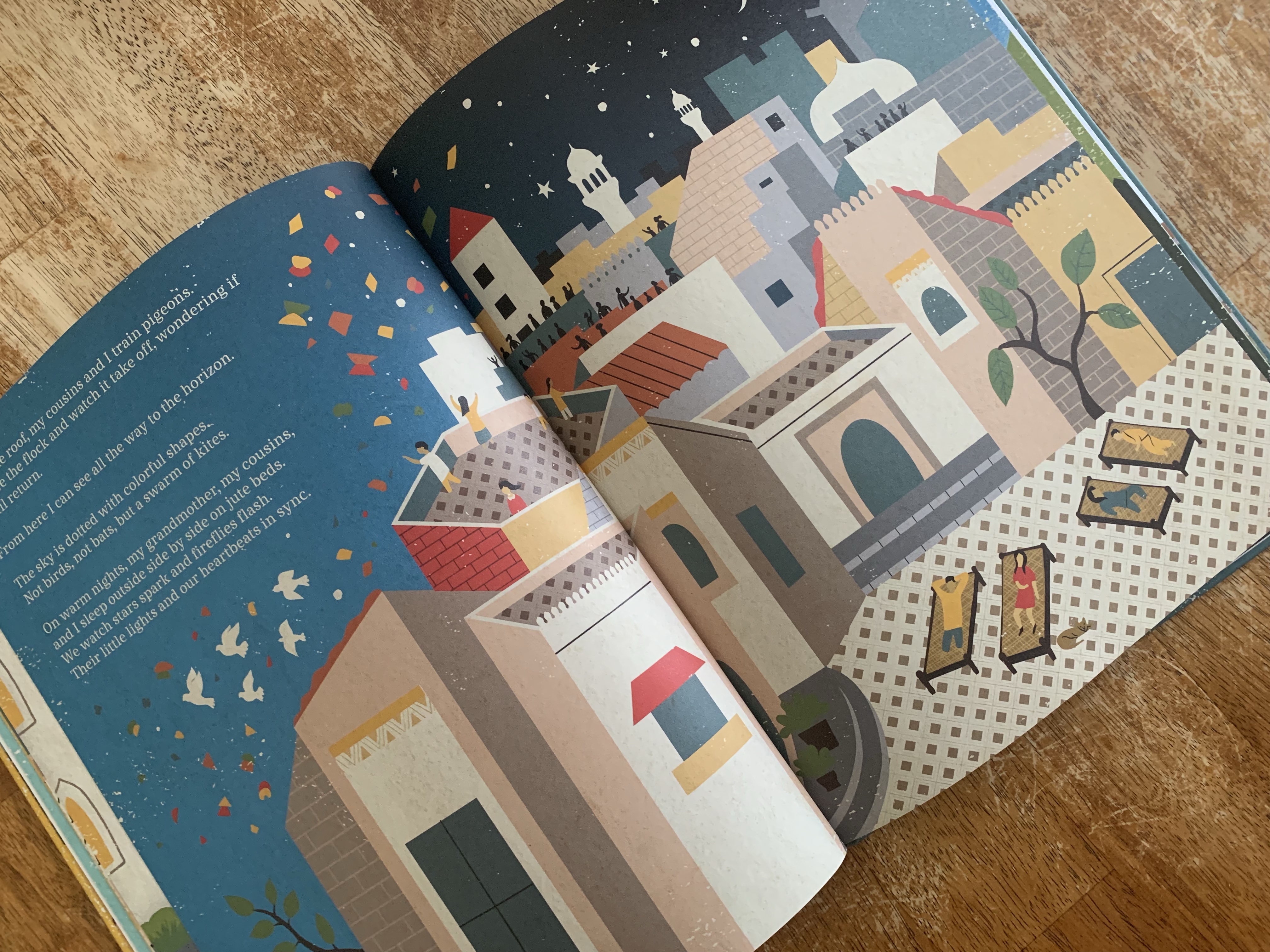
Outside is the city of Lahore, in Pakistan, streets rich in smell and color and sound exist: orange jalebi and strings of jasmine, sounds of Qawwalis and pop music, the melodic call to prayer from the minarets.  As a child she plays cricket and climbs trees and flies kites.  Up on the roof she trains pigeons and looks out at the horizon.  

img_1697

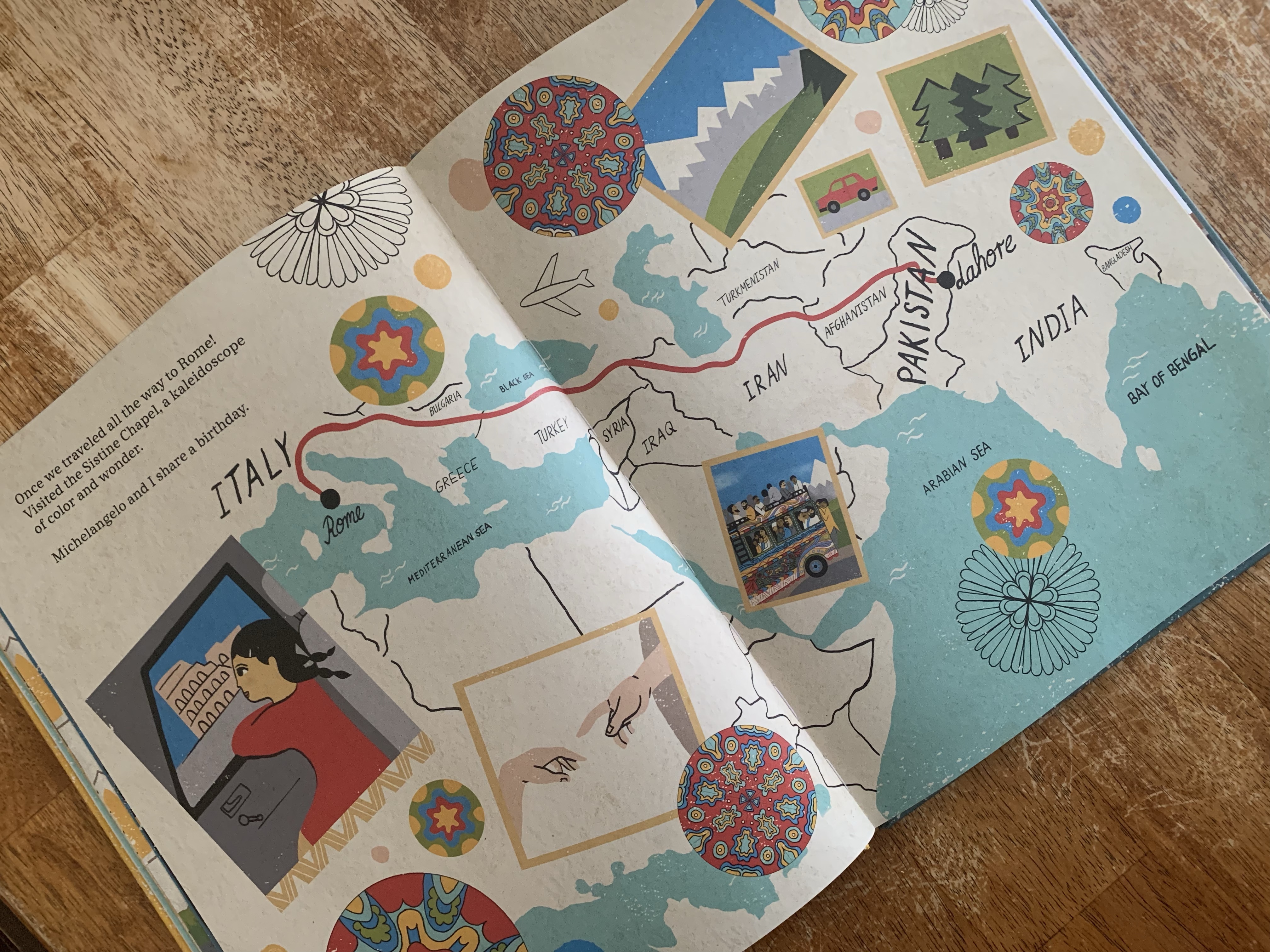
When it gets hot, her family heads north.  They once traveled all the way to Rome.  She visited the Sistine chapel, her and Michelangelo share a birthday.

img_1699

At school she is shy. She loves math, as it is a tool to understand the world.  She finds she is also good at drawing birds, and people.  She studies miniatures with a magnifying glass.  Eventually training in miniature painting with a master.  Art becomes her ticket to new worlds.

img_1698

She heads off for America, taking her roots with her, but once she arrives she cannot leave.  Her passport is the wrong, color.  She lives in New York and cannot return to Pakistan for nine years.  Now she can travel and soar and share her work with the world.

img_1701

There is a glossary at the end and more information about Shahzia and her paintings.


Baddawi by Leila Abdelrazaq

Standard
Baddawi by Leila Abdelrazaq

Baddawi-cover

This 8.5 x 8.5 middle school graphic novel biography tells a powerful story of a young boy coming of age and striving to find his place in the chaos of the Nakba and its aftermath.  Over 128 pages the reader will learn and be outraged about the displacement and genocide of so many Palestinians as they see the events through Ahmad’s eyes and relate to his dreams and experiences despite the terror around him. The book has violence, destruction, death and mentions rape, yet the humanity shines through as it is also heartfelt and memorable.  I had my 14, 12, and 10 year olds read it and we have discussed it at length in context to what they already know about Palestine and the ethnic cleansing occurring.  It is a seamless mix of history and character driven narratives brought to life by the black and white illustrations of the author/illustrator’s family history.

img_1656

SYNOPSIS:

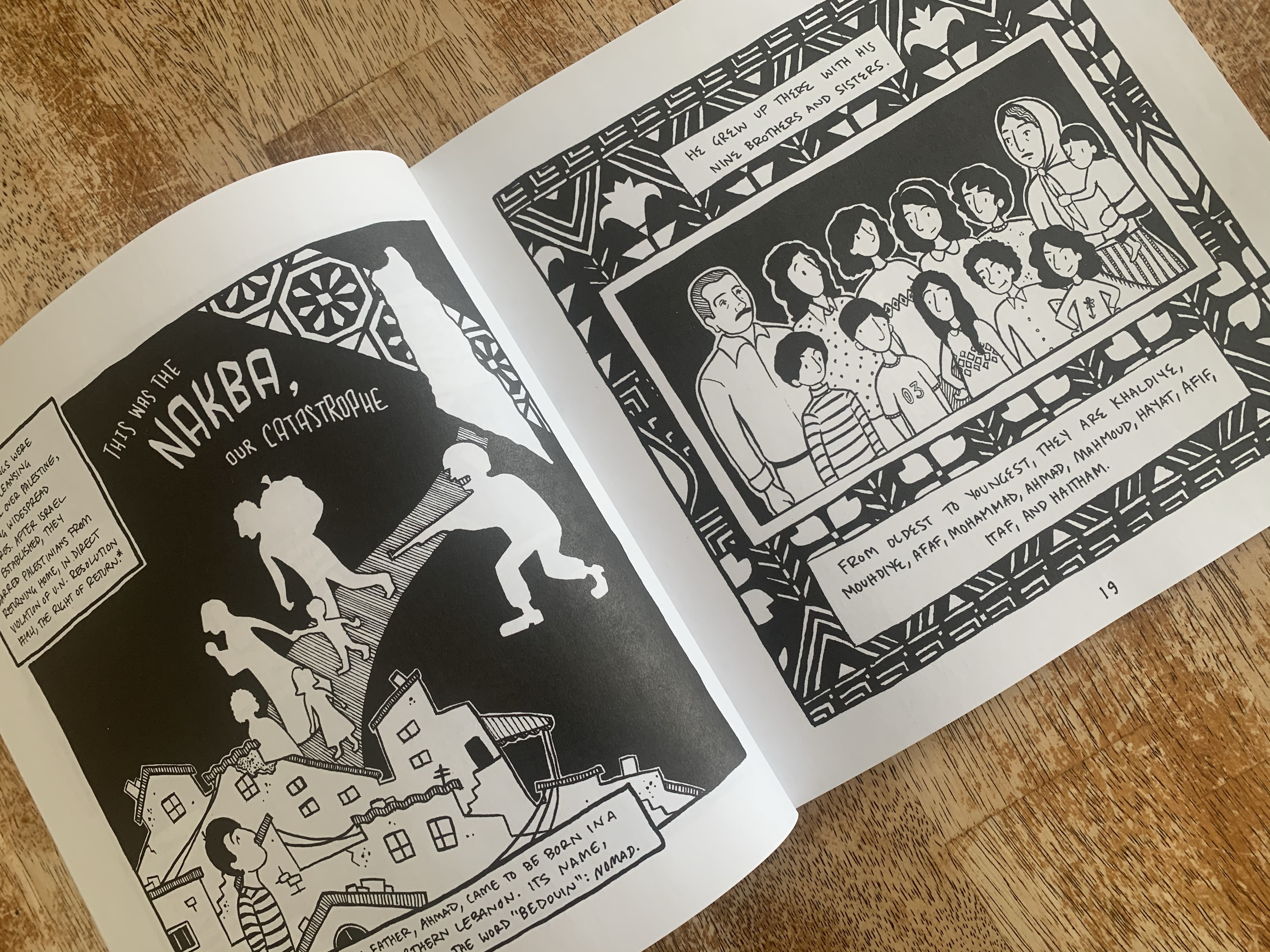
There are 10 children in the author’s father’s family, and her father, Ahmad, was born in a refugee camp in northern Lebanon, called Baddawi.  The story starts on October 29, 1948 when Safsaf was ethnically cleansed.  Ahmad’s father, the author’s grandfather had been in Akka at the time of the massacre, and her grandmother hid from the Israeli soldiers, the family, once reunited, would escape for a refugee camp, hoping that they would one day return.

We first get to know Ahmad as he starts first grade in Baddawi.  Things do not start well for the little guy as right away he gets teased by other students, his class is too large so he is selected to be joined with a girls class, and he doesn’t have soccer cleats so he isn’t allowed to play soccer, luckily he gets two good crayons, unlike his friend who gets a white one.  Ahmad is identifiable by his striped shirt that he wears throughout as a nod to Handala, the boy depicted with a striped shirt with his hands clasped behind his back and his face not shown.  The artist said his face would be revealed when Palestine was free, sadly the artist, Naji al-Ali passed away, and Palestine is still occupied.

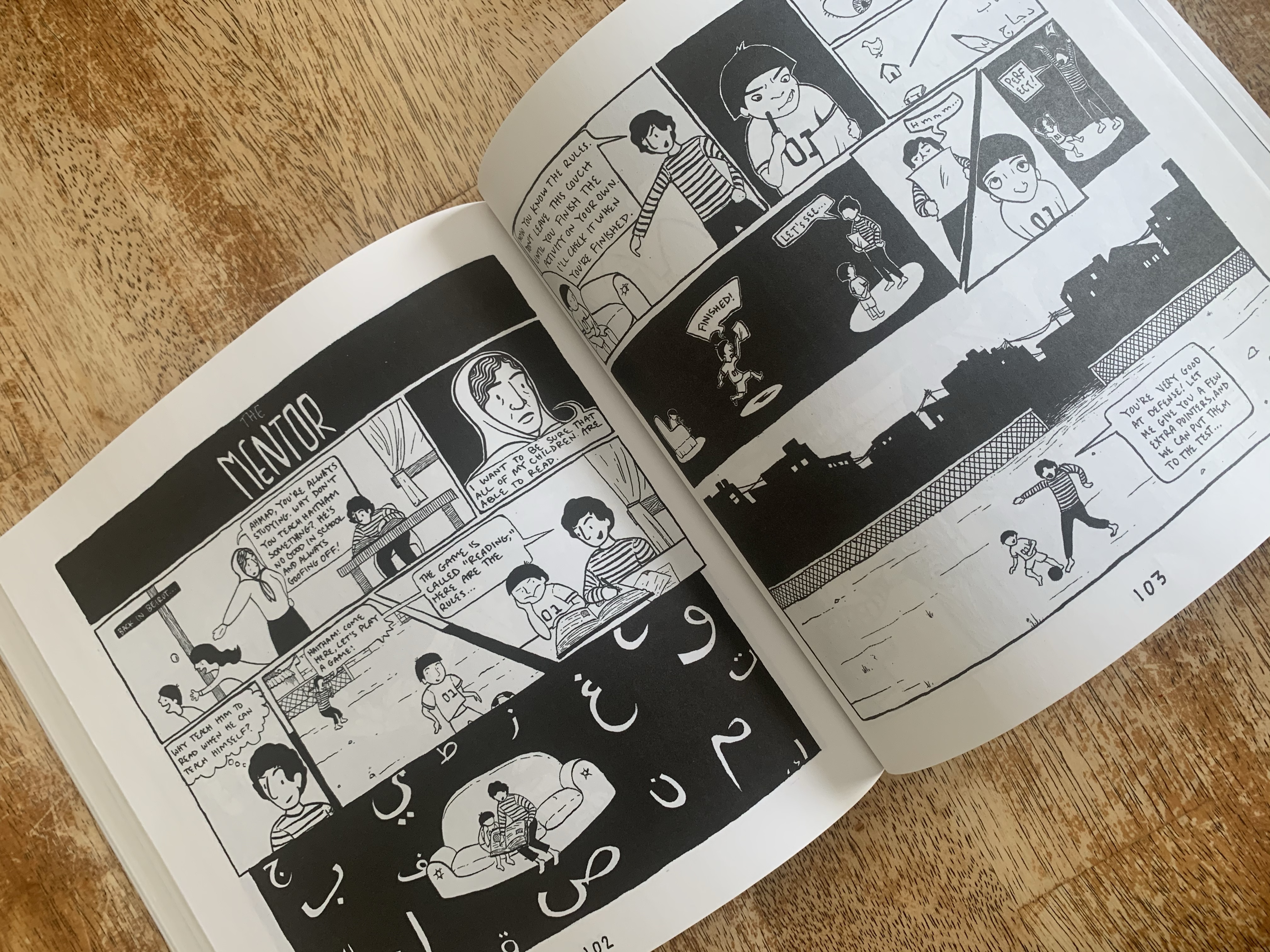
Ahmad desperate to purchase soccer cleats devises a business plan that his mother takes as gambling and quickly puts an end to, in exchange she offers to pay him if he helps her collect and prepare za’atar.  It isn’t as fun, or as lucrative, but they family is busy packing up to return to Palestine.  Unfortunately the Naksa, the setback, the six day war occurs, and more Palestinians are ethnically cleansed and the families cannot return. Ahmad and all those in Baddawi carry on, playing, celebrating Eid, trying to claim normalcy.  The camp however, is not safe and soldiers raid the camp killing PLO leaders and innocent people in their way.  With no option but to keep on keeping on, these acts of violence are often taken in stride. It is so hard to believe, but what else can they do, the children still play, deal with bullies, and cope with universal struggles in addition to being shot by rubber bullets, and fearing cluster bombs and shellings.  At one point Ahmad and his siblings are left in Baddawi to finish school while his parents are in Beirut.

When the family is reunited in Beirut, Ahmad is in a better school, but violence follows as Mossad agents start raiding PLO homes in Lebanon.  Ahmad goes back and forth between Beirut and Baddawi, wherever he can go to school.  His favorite library is the one at the American University in Beirut and he hopes to attend school there, but without connections, he is at a loss to come up with funding.  His intellect finally lands him an opportunity to leave the Middle East to pursue higher education, he ends up in the United States, and when the story ends, readers are left hoping that everything works out even knowing it will be 10 years before he can return home to see his family.

img_1657

WHY I LIKE IT:

I love that the harsh horrific life is not shied away from in a war, but the little things are just as important in shaping and showing Palestinians to be resilient and culture rich.  I love how the concept of Handala is included and amplified.  The book is at times funny, and at other times devastating.  The connection to the characters is pretty remarkable, in such a relatively short book, and I am fairly confident it will be pulled off the shelf and thumbed through often.  I really wanted to know if the girl in the book that Ahmad left behind ended up being the author’s mother, or if he married someone else, but I couldn’t find it by Googling.  This book is truly powerful, and I highly recommend it.  There isn’t a lot of religion, the family is shown praying on Eid and celebrating.  It mentions the diversity in Beirut, but nothing too detailed.  Similarly, there isn’t a lot of political detail.  There is a glossary at the end, some actual photographs of Ahmad and his family.  At the beginning of the book there is a preface about Handala and how Ahmad represents more than just her father’s experience as well as information about the tatreez patterns on the pages and a map.

img_1658

FLAGS:

There is violence, torture, killing, death, bullying, and possibly gambling.  The book mentions that women were raped, but it isn’t detailed.  The war is ever present and depicted, but it isn’t sensationalized.  Ahmad and a girl study together and the family wants them to get married, but Ahmad opts instead to leave for school, nothing inappropriate.

img_1661

TOOLS FOR LEADING THE DISCUSSION:

This book might not work as a book club selection, but I hope middle school children and their teachers or parents will encourage them to read this book and think about it.  Imagine if it was their homes that were taken, imagine what they would do, and how they would manage, and to be aware that it is still going on and that we cannot be silent.

img_1660

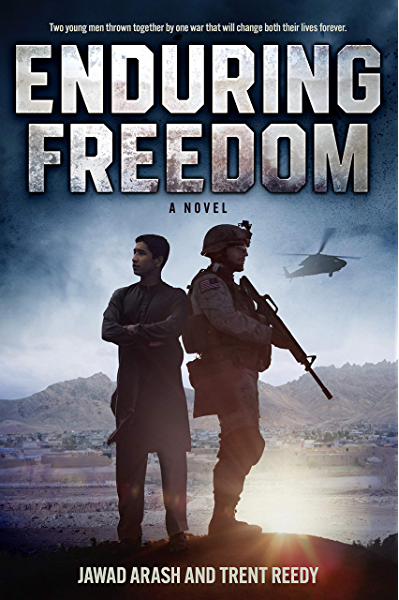
Enduring Freedom by Jawad Arash and Trent Reedy

Standard
Enduring Freedom by Jawad Arash and Trent Reedy

enduring freedom

This isn’t the type of book I am naturally drawn to, and had it not been offered to me as an arc, I didn’t even request it, I probably would not have read it.  So, to say that this young adult OWN voice 246 page post 9/11 war story had a lot to overcome for me personally, is putting it mildly.  I gave in and decided to read it for the simple fact that I was curious to see what the narrative is in today’s literature, as we approach the 20 year anniversary of the attacks on US soil.  The afterward is very clear that the agenda of the two authors, one an Afghan and the other a US veteran, was to show a personal view of growth and assumptions on both sides and how the future of Afghanistan needs to be rooted in education and stability.  I think the book accomplished its goals, and made very clear how the terrorists first victims were their own people, and that extreme ideologies of the Taliban were and are still not reflective of the larger population.  The pacing of the dual narratives, however, was a bit off to me, and I really felt that some of the major plot points didn’t get explored in a meaningful way, that they were simply glossed over and brushed aside to keep the book inline with the authors’ objectives.  The book is not overly political, and the Muslim characters are religious and knowledgeable, but for a book that talked about how even in war the people, the soldiers, are the story, I wanted to see more internal wresting with choices and their outcomes, then what was offered.

SYNOPSIS:

The book is told in alternating view points, one is that of Baheer an Afghan boy living with his large extended family in Kabul next to a Taliban compound.  The family is religious, Baheer’s grandfather, Baba Jan, is well read in poetry and religious text and often quotes the Quran by ayat and surah number.  The family sells carpets, and often hides the latest movies or news recordings in the rolls, so that they can be brought home, the blackout shades pulled and the tapes enjoyed.  They are fearful of being harassed for not having long enough beards, shaved heads, turbans and the like. Baheer and his brother Rahim do not enjoy school with the strict and abusive teachers.  The talibs seem to touch them inappropriately and scold them harshly.  Their older sister is not allowed to attend school and never has even though the family used to live in Pakistan where the boys enjoyed school. It doesn’t explain why they were there or why they returned.  One uncle is assaulted by the Taliban and soon after, a news clip showing the attacks on 9/11 is secretly watched by the family.  As a result they decide to move to Farah, in Western Afghanistan where Baba Jan has family and property, to be away from the impending US attacks and Taliban assaults.

Joe Killian is the other voice.  When the book starts he is sitting in class, his senior year, when news about the attacks on the World Trade Center starts to break.  He had joined the national guard that summer for the college money, and as his classmates sit glued to the televisions in Iowa, he is nervous that he is about to be called up to war.  He doesn’t get called up that day, he graduates, and is studying journalism in college when the call finally comes.  He is preparing for combat, but when he is deployed and discovers it is a reconstruction mission he is angry and annoyed.  A year of helping what he terms barbarians, is not what he signed up for.

The majority of the book reads like a ‘day in the life’ of each of these two voices, as they adapt to life in Farah, as they deal with each other’s presence and as their friendship forces their assumptions to change.  The interactions between Joe and Baheer show the power in getting to know someone to alter perceptions, and the threat of the Taliban on both the average citizen and the US forces on the ground as a unifying enemy to allow the friendship to grow.

The book concludes when Joe’s year of deployment is up, but really the authors’ notes at the end are a better conclusion to the real life friendship and growth of the two authors that resulted in the writing of the book

WHY I LIKE IT:

I love that the family sees the planes hitting the towers and is mortified at the brazen destruction and loss of life.  They immediately start praying for the victims even as they realize they will be the recipients of the backlash. I like that it highlights where practicing Muslims and extremists differ, by having the Quran quoted and explained as opposed to the rhetoric the Taliban is spouting.  Baba Jan’s manner for speaking the ayats is a bit awkward in that most people don’t in daily conversation source and reference their dialogues, but it does grow on you.  I think the book is very simplistic in making the Taliban to unequivocally be the ‘bad guys’ without any context of how they gained traction. It talks about the Soviets, but I think it will leave the readers wondering where this group came from and why the Afghan people allowed it. Unfortunately, there are a lot of nuances and complexities that are overlooked by such a simple narrative, and allow for an inaccurate picture to be formed.

I like that Baheer pushes back on Joe who thinks America is perfect and that Afghanistan is less than, by pointing out the flaws in American society as well as his own.  I was ok with Baheer pushing the cultural limits to talk to a girl, it was innocent and I think understandable. My biggest concern is that I really felt that there needed to be more space on the page dedicated to understanding the repercussions of him being an informant to the Americans, and his brother passing on information to the Talibs.  People were taken in to custody and injured and killed as a result of these boys’ actions and to just chalk it up to something to be forgiven, was not enough for me.  I wanted them to hash it out and wallow in their choices, not forgive and move on so quickly.  I also wanted to know more about their reconstruction efforts.  It seemed rather minimal: relocating explosives, helping a burn victim, sending supplies to a school, I think in a year, that there would be more mixing with the people than the book would suggest.  And finally, I felt like the sister not getting to go to school was handled as an obligation to address, not that any insight or understanding was really given to such a hot button issue.

The book is really slow and dragging at parts, I couldn’t tell you about any of the dozen or so soldiers that are mentioned, I don’t even recall any of their names. I think the book has a lot of potential, and perhaps it does shine in showing the effects of war and terrorism on the Afghan people.  It held my attention while actively reading it, but I just as easily could have put it down and forgotten about it if I wasn’t under obligation to offer an opinion in exchange for an early copy.

FLAGS:

There is language, stereotypes, physical abuse, sexual misconduct, death, killing, violence, acts of war, bloodshed, a crush. Upper middle school and high school can handle it.

TOOLS FOR LEADING THE DISCUSSION:

I don’t think I’d select this book as a book club selection because I’m not sure what would be gained from the book.  The characters assumptions are challenged and evolve, but I think most minorities know that, getting to know someone is often the best way to have their image changed.  I think the book still functions to make Americans feel better about  invading Afghanistan, rather than have us question what the long term affects of our involvement have been.

This is Why We Pray: A Story About Islam, Salah, and Dua by Ameenah Muhammad-Diggins illustrated by Aaliya Jaleel

Standard
This is Why We Pray: A Story About Islam, Salah, and Dua by Ameenah Muhammad-Diggins illustrated by Aaliya Jaleel

this is why we pray

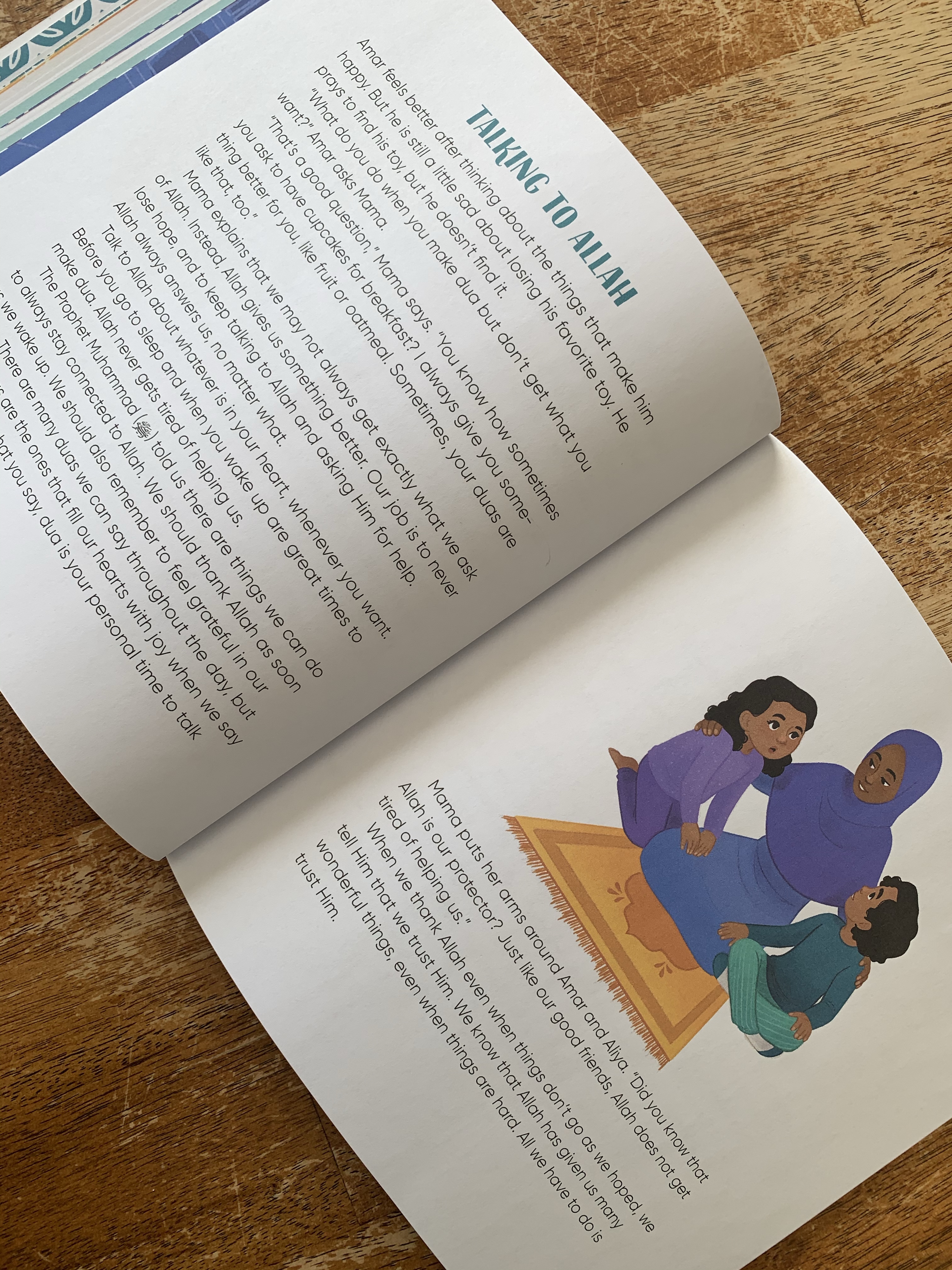
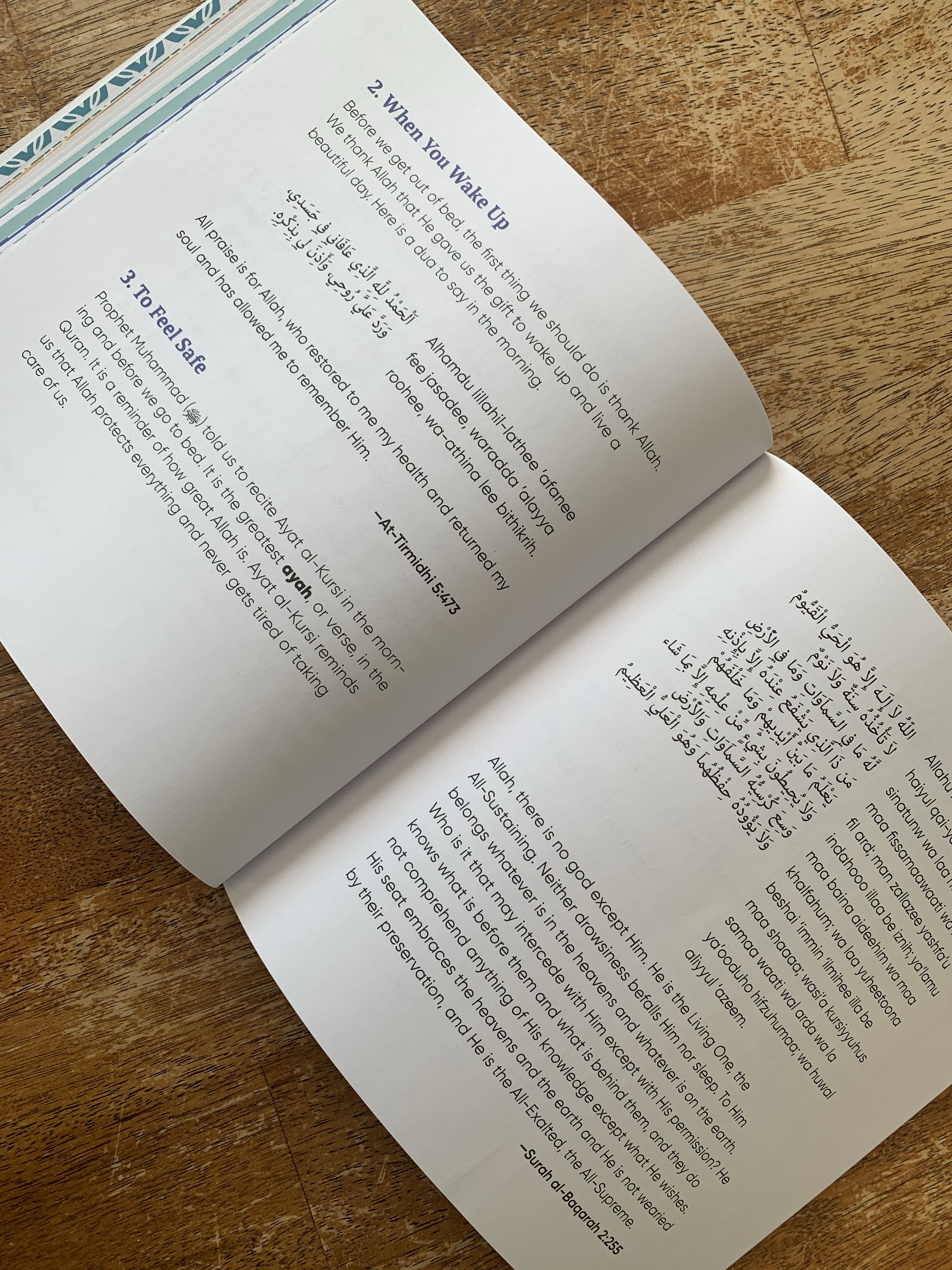
This 8×8 softbound 55 page book for ages 5 to 7 is a great resource for learning the basics about the five pillars, wudu, salah and dua.  It claims that it is a story, but I feel like that is a bit of a stretch.  It has fictionalized framing that is done well, but to call it a story I think is misleading.  It is set up like a children’s Islamic text book, think Islamic School or Sunday School curriculum, where there is a story that highlights Islamic concepts with vocabulary, there are breaks to focus on some specific idea from an outside source, in this case the Quran, there are things to think about, questions to answer, and then the same characters re-emerge in the next chapter to repeat the process. The book has an amazing illustrator, but there are only maybe three full page illustrations, four half page illustrations, and the rest are just small glimpses to compliment the heavily text filled pages.  I can see myself reading the entire book to my five year old, and then it sitting back on the shelf to be pulled out and revised when we need to go over salat, wudu, or need to learn some duas, and understand the five pillars.  I don’t think it will be requested for the “story,” or the pictures, it just isn’t that type of book.  It borders fiction and nonfiction, but I think it is closer to nonfiction, and works well as a tool to engage your children with easy to understand text, quality illustrations to see the steps of salat and wudu, and to see Islam practiced in scenarios that young children will recognize, such as playing games, going to the beach, and losing a favorite toy.

img_0647

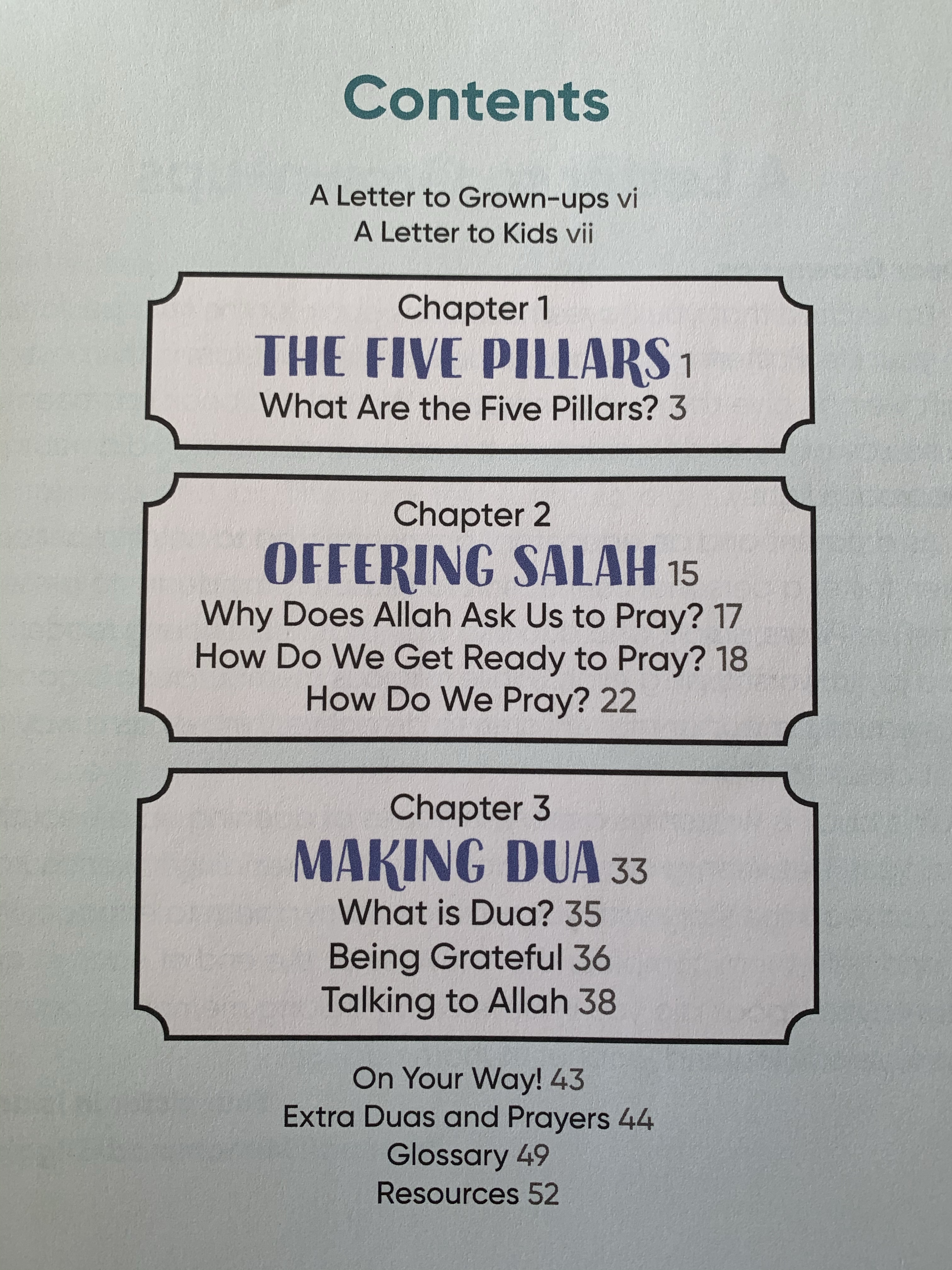
The book is divided in to three chapters: The Five Pillars, Offering Salah, and Making Dua.  Before the chapters there is a letter from the author to grown-ups and then one to kids.  After the final chapter there are reference pages with extra duas and prayers and a glossary.

img_0649

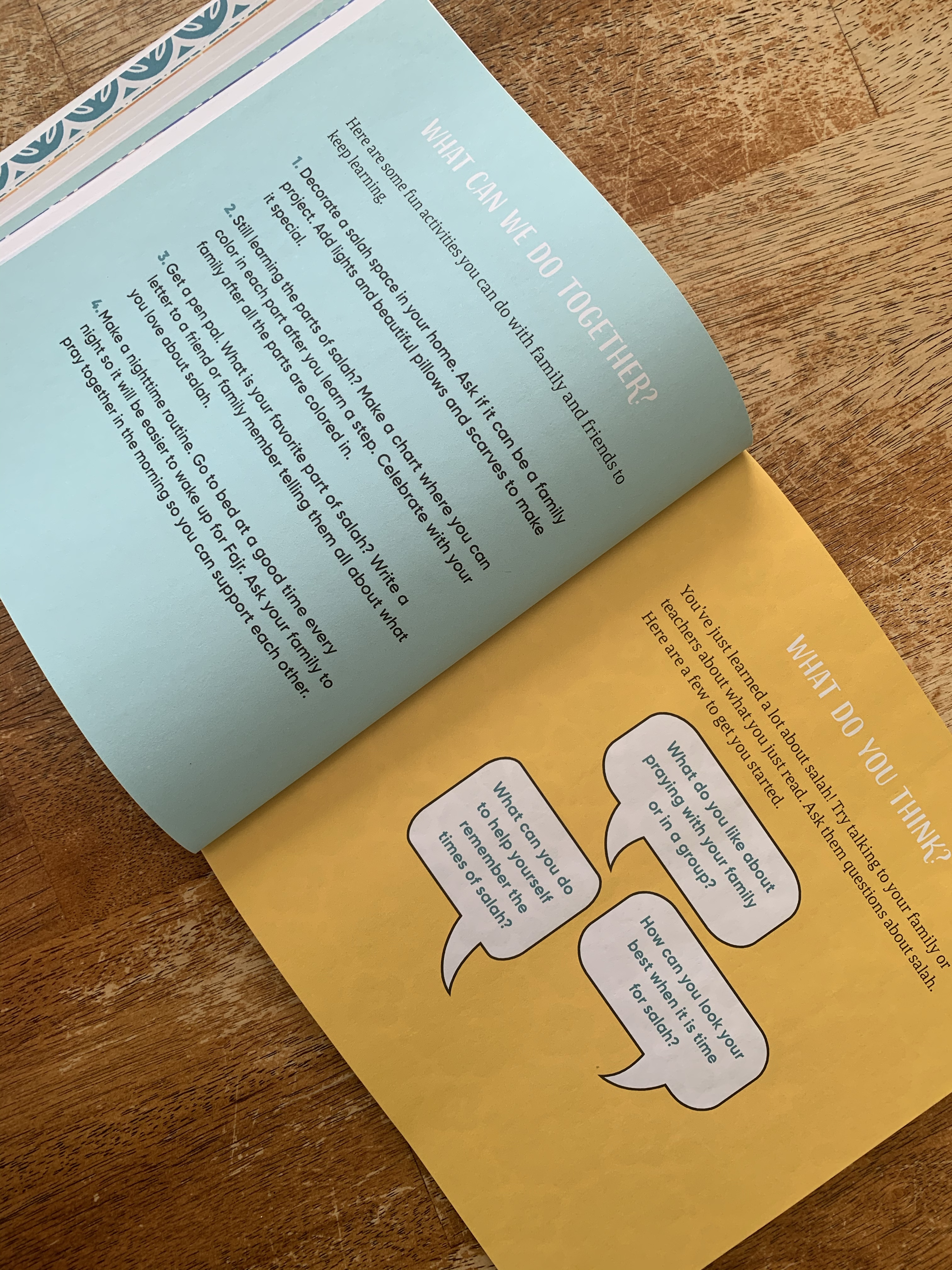
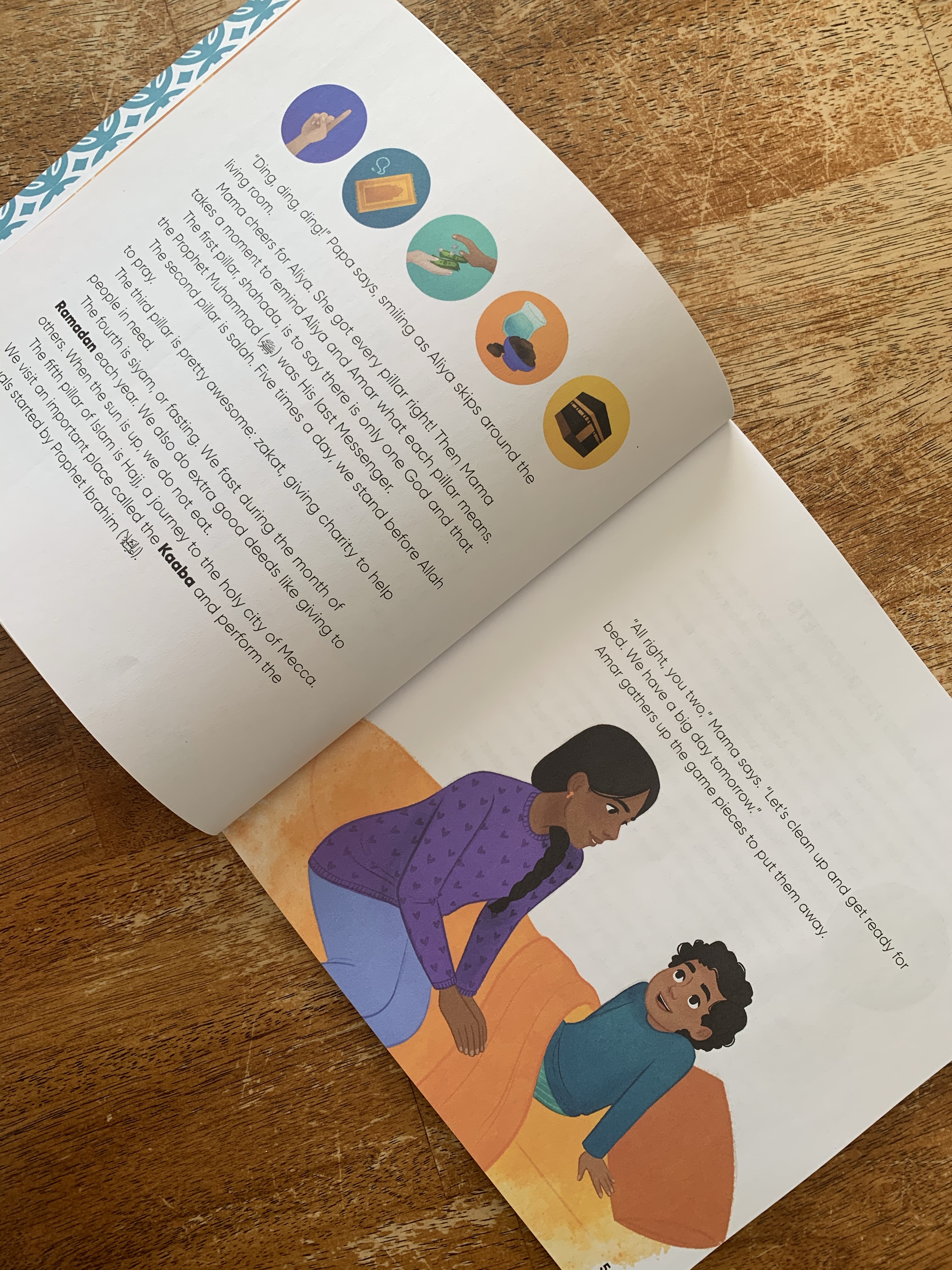
The first chapter opens with the Abdur-Rahman family playing an Islamic question game.  Older sister Aliya knows the five pillars, younger brother Amar needs a little more explaining.  The next morning the kids are heading to the beach, but first they have to get up to pray salah and send some food to the neighbor. As the kids drive they talk about Ramadan and their Uncle Sharif having just gone for Hajj.  There is then a page dedicated to a Quran Story Time that focuses on Allah swt wanting us to ask him for each and everything no matter how big or small. There is an ayat from the Quran as well as a hadith. The next page is a section called, “What We Can Do Together,” to further learn about the five pillars, and then some questions asking the reader, “What Do You Think?”.

img_0654

Chapter two has the family at the beach pausing their fun to pray.  But first they have to make wudu, and the steps are illustrated and detailed with tips and directions.  They then pray, again the steps and words are detailed and illustrated with tips about how to stay focused and the like.  The translation of the Arabic is included and the transliteration is as well.  The Quran Story Time focuses on Fajr and then the questions and ways to further engage with the information concludes the chapter.

img_0648

The third chapter is on Dua and has the kids barely making it to Sunday School on time.  Papa says he made dua that they wouldn’t be late, and even in class the lesson is on dua. After class Amar can’t find his toy even after making dua and is encouraged to be grateful for what he does have.  The Quran Story tells the story of Prophet Muhammad (saw) helping the old woman who is talking bad about the Prophet and how after he helps her and he tells her his name, she converts.  I don’t know that, that is in the Quran, I thought it was a hadith?

img_0655


The kids learn that Allah swt may not answer duas, but will inshaAllah give them something better.  There are four additional duas to learn in the moving on section and the bolded words throughout are defined in the glossary.

img_0651

I’m not sure about the title of the book, it is about more than just prayer, so don’t think that it is limited to just that.  It also doesn’t detail the number of rakats or what breaks wudu, it is specific in somethings, but is more a broad overview than an all encompassing handbook on salat.

img_0656

I think the book is well done and will be useful for most, if not all, Muslim families with young children learning the basics, but it isn’t a picture story book in my opinion, it is more of a fun engaging twist on information that might otherwise be presented in a boring manner.

img_0650


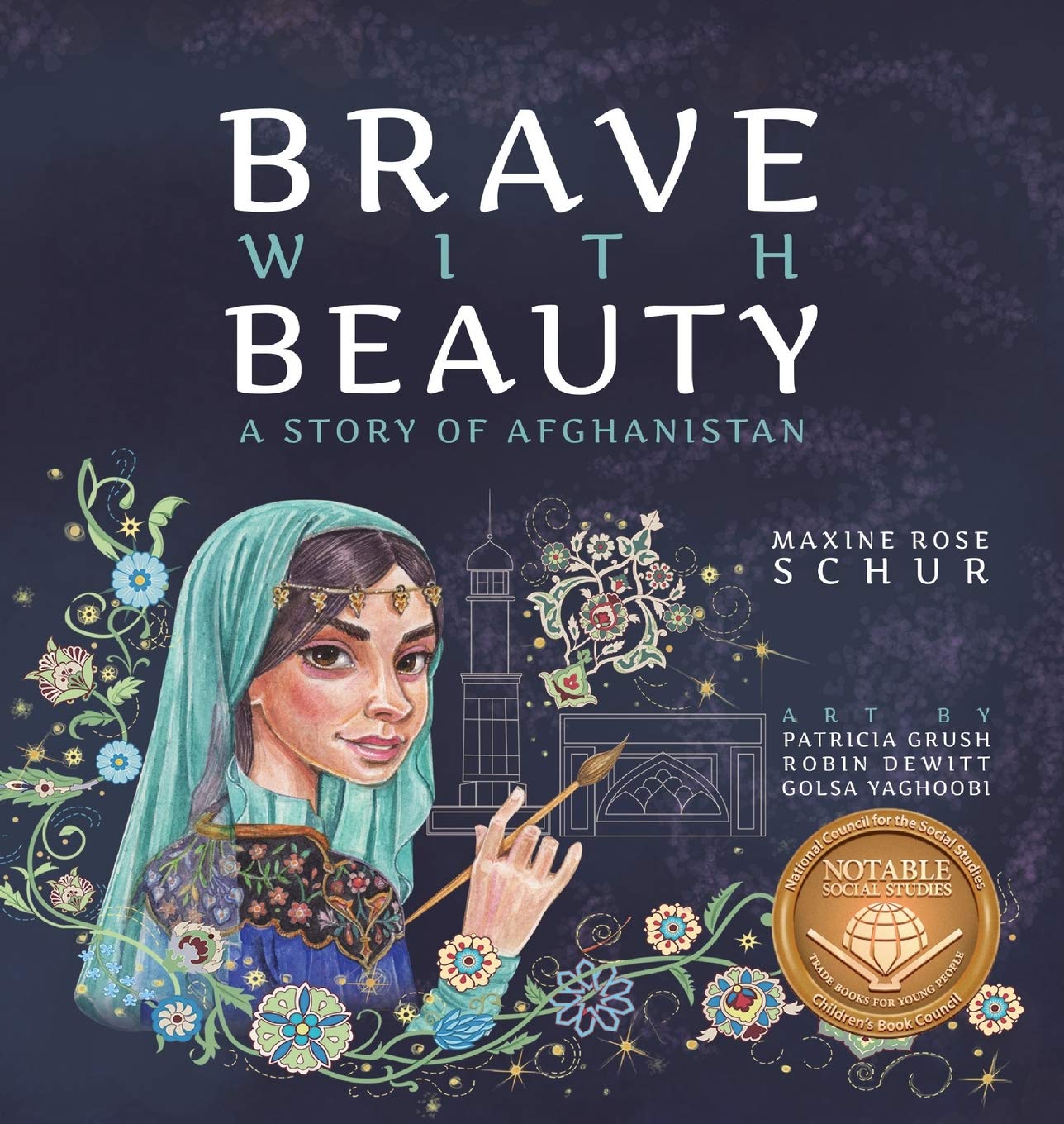
Brave with Beauty: A Story of Afghanistan by Maxine Rose Schur illustrated by Patricia Grush, Robin Dewitt, and Golsa Yaghoobi

Standard
Brave with Beauty: A Story of Afghanistan by Maxine Rose Schur illustrated by Patricia Grush, Robin Dewitt, and Golsa Yaghoobi

brave

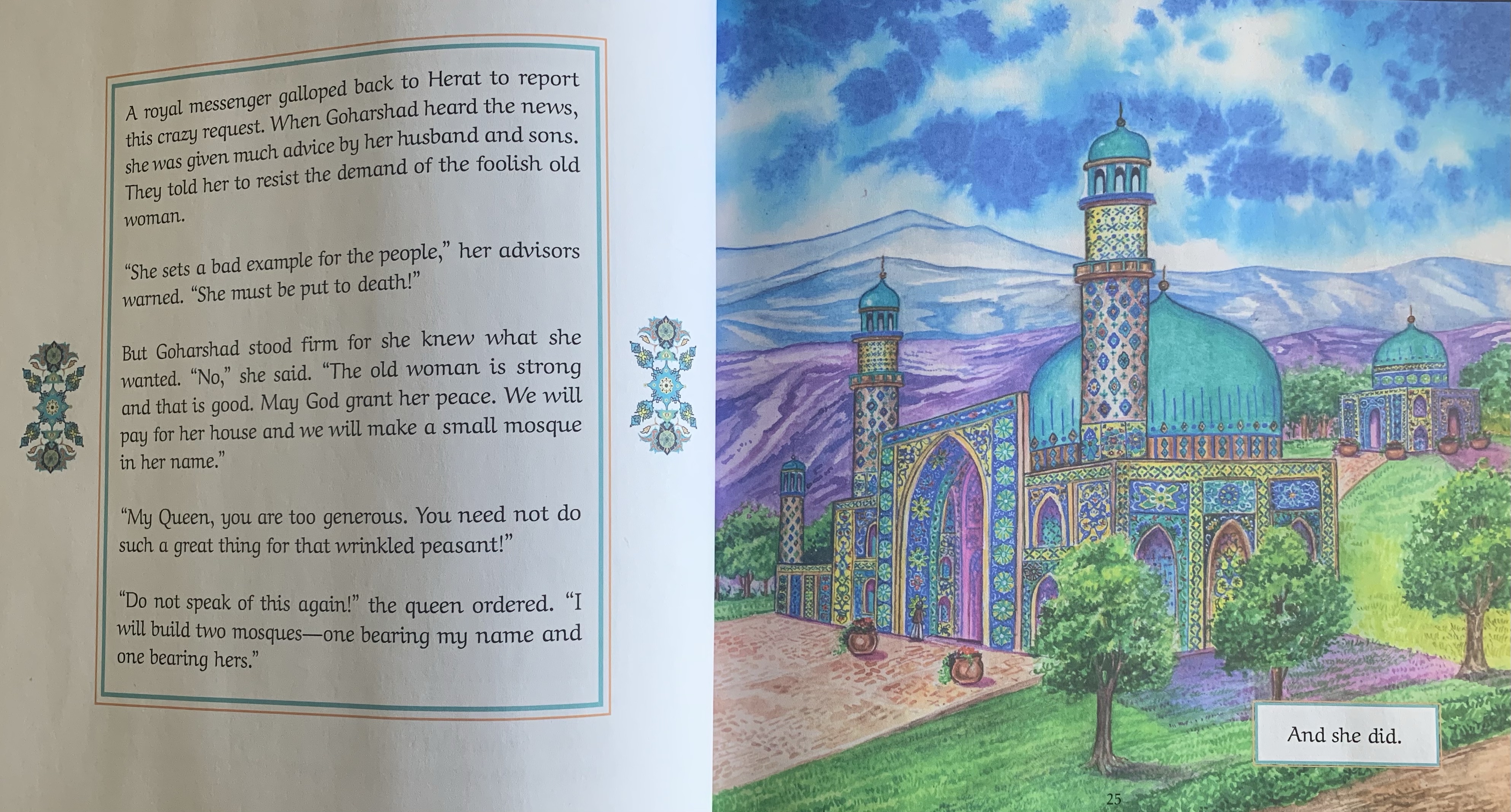
This 44 page fictionalized retelling of Queen Goharshad, a 15th century monarch of the Timurid dynasty in Afghanistan should really be a larger book than 8 x 8 to appreciate the artwork that is detailed and stunning.  The story of Goharshad, wife of Emperor Shah Rukh, and her influence on art, music, culture, higher education, and architecture, is one that we should be more familiar with, but the actual text and manner in which the story is conveyed isn’t consistent for me and I wanted more details about the society she stepped in to to rule,  I know it is fiction, and meant for 2nd to 4th graders, but I would like to think that readers will want to know what obstacles she had and what support she enjoyed and from where.  That they will question if it was a rich kingdom that she could pay musicians to play everywhere, and wonder if families sent their daughters to the University she built, ask why it wasn’t for women to design a  Masjid, and what was the name of the smaller mosque that bore an older woman’s name? The book at times overly summarizes and at other times is haltingly detailed.  It is a good read to reflect a strong woman and her influence on her land, but unless assigned, I don’t know that seven to ten year olds will pick up the book and be inspired by it enough to change their perception of the Afghanistan that they may see on the news.

img_0171

Seven centuries ago Goharshad loved beautiful things such as painting and the texts of Rumi.  Her brothers played at being like Genghis Khan and teased her for not being brave.  She vowed to be brave with beauty even though she didn’t know what that even meant.  At age 14 she was given in marriage to the king, Shah Rukh, in Herat.  She ruled with her husband and had resources and time to spread her beauty by speaking up and being brave.

img_0172

Her first act of beauty was by filling the kingdom with music.  She wanted music every day in the court and beyond. Music that was playful and pious, music that painted pictures in the listeners minds and brought joy like the laughter of God.  She next sketched and designed a beautiful and enchanting garden to be built.  It doesn’t say where it was, but that people came from all around to enjoy it.

img_0173

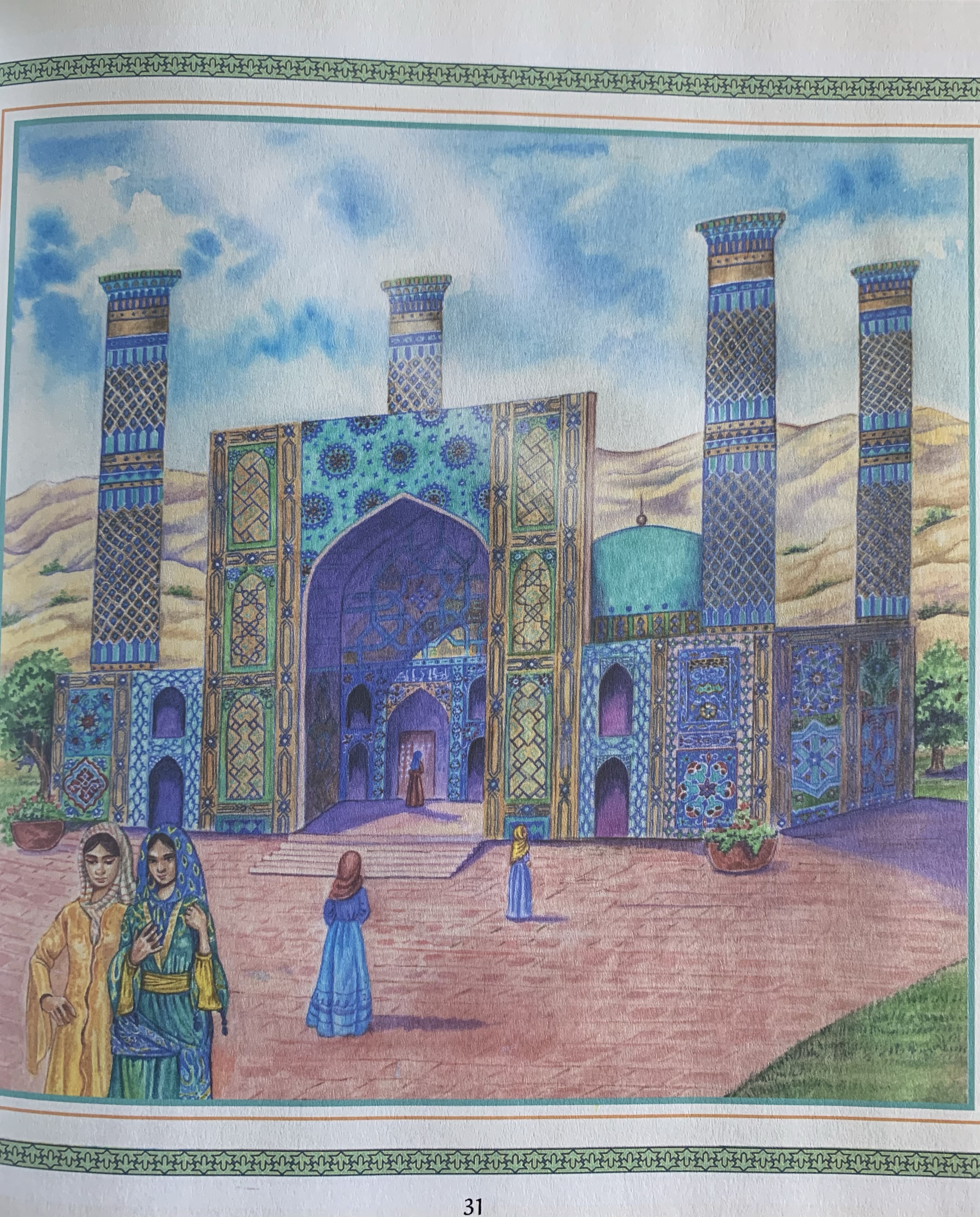
Feeling braver she turned her sights on building a mosque in the western city of Mashhad.  She designed it and called the court architect, Qavam al-Din Shirazi to discuss.  He doubted if it was right for a woman to design such spaces, but she assured him that she had the talent for it, so construction began.  An elderly woman refused to sell her cottage for the new project unless a mosque with her name was built.  The advisors wanted the old woman put to death or imprisoned, Goharshad disagreed appreciating the woman’s strength and instead agreed.  The big mosque was built with Goharshad’s name and a smaller one on the property with the old lady’s.

img_0175

With such an accomplishment complete, the Queen again summoned the architect and expressed her desire to build a great center for learning.  A college for girls, a grand mosque for prayer, and a vast library.  She wanted the structure decorated with paint from precious stones and sold her crown to finance the project.
img_0174

After her husband died Goharshad reigned, but sadly after she died, much of her accomplishments died as well.  Over time, harsh weather and war, nearly all her buildings disappeared and those that remain, do so in ruin.  The book ends with hope that memories of her will endure, A guide to some of the words in the story,  an Author’s note, and a Guide for Parents and Educators.

img_0176

There is not a lot of Islam in the story, just the building of masajid .  Some may take issue with her stress and celebration of music, and likening it to God laughing, but if you look at it as her story, it should be able to be appreciated even if you disagree.

img_0177