Tag Archives: Arabic

Tyger by SF Said illustrated by Dave McKean

Standard
Tyger by SF Said illustrated by Dave McKean

I don’t know that I’ve ever read a book like this 304 page middle grade fantasy, dystopian, highly illustrated adventure. It delves into philosophy, alternate universes, slavery, racism, politics, magic, identity, friendship, betrayal, human rights, education, following your dreams, saving the world, and a talking immortal tiger. It started a little stilted for me, but as the book progressed, I began to see that a lot of detail about all the above mentioned threads would make for a very adult, very lengthy read, and this is meant for 9-12 year olds, albeit they would need to be able to handle the darkness of the book at times, and caregivers, be aware there is a public hanging of a child. The author is Muslim, and the protagonist and a side character identify as Muslim.  There is not much about Islam, or shown in practice, but that they are afraid to learn and practice their faith is mentioned briefly. I think kids will enjoy the read, and not get hung up on threads unexplored as I did.  The illustrations really make it a book that feels exciting to spend time with, and one that will linger with the reader.  I look forward to sharing it when it releases soon in the US, as it was published in 2022 in the UK.

SYNOPSIS:

In short the book is about a boy, Adam, living “in an alternate London where the British Empire hasn’t ended and slavery was never abolished.” In a partitioned off Ghetto as a minority from the vague “Middle East,” who is unable to go to school, or even draw, he makes deliveries for his family to help keep them afloat. During one such delivery he encounters a tiger, an animal like so many others that is extinct, her name is Tyger, and she speaks.  She is an immortal searching for Guardians to help her heal and open a portal to the city.  When Adam, who is immediately connected to her, cannot find a Guardian, she begins to train him, time is short and when he discovers his friend Zadie, short for Scheherazade, has some training from her father, the two set out to open the doors of perception, imagination, creation, and  revelation, to save the day.

WHY I LIKE IT:

I really like that this book opens up larger discussions about society, self, literature, imagination etc, and can really be adapted to mean different things depending on what the reader brings to it. The book addresses these themes in a way that doesn’t talk down to the reader, and in many ways allows the simple bad guy of the story to not be the takeaway point, but rather the journey of understanding perspective, points of view, empathy, creating something, and hope to be far more important.

The identity of the characters being Muslim initially was just a label, one that just made Adam and Zadie more “other,” but a few cleverly crafted sentences about hiding their names, their skin color, and whether it worked or not, allow the reader to reflect on if denying yourself to appease others is effective or not, or rather more importantly knowing when and in which situations it could be a benefit or a selling out of who you are.  Zadie and her father seem to practice, and one point Solomon ( Suleiman), offers his prayers, he says Assalamualaikum and Bismilliah. Adam and his family on the other hand, have hidden their faith so as to fit in better, and thus it is simply an identity label.

I liked that the illustrations weren’t just stunning in their own right, but also highlighted the mood, and metaphysical elements of the story.  I feel like I could teach not just a few lessons on this book, but dozens, and who knows if they would be correct, but I think this book would be fantastic as a read aloud in a classroom for the story at hand and for the discussions.  The darkness, the excitement, the hope, really gripped me, and while I could opine on plot holes and lack of articulation, in some key scenes, I appreciate that over explanation would take away from all that the book gets right.

FLAGS:

Racism, oppression, colonialism, slavery, hanging, power imbalance, betrayal, lying, sneaking, fighting, killing, magic, fantasy elements.

TOOLS FOR LEADING THE DISCUSSION:

Where to even start, this book needs an educators guide, stat. I looked online and couldn’t find one and I hope that will be corrected soon because if you read my thought above, you know there is a lot to discuss.

The City of Jasmine by Nadine Presley illustrated by Heather Brockman Lee

Standard
The City of Jasmine by Nadine Presley illustrated by Heather Brockman Lee

With a release date of May 6, I really wanted to wait to post a review because the images are gorgeous in the electronic version, and I can only imagine how moving and captive they will be presented in a physical format, but alas I know the importance of presales and am sharing to hopefully encourage you to preorder and/or request from your library, this gorgeous 40 page OWN voice book.  A love letter to Damascus, and the sights, sounds, smells, taste, and feelings that the author remembers despite the mountains and oceans that now separate her, are lyrically shared with readers on a journey through the city. The ethereal lilting of words draw readers of all backgrounds in, and the complimentary gorgeous illustrations convey a palpable sense of beauty, love, and memories of home.  Even on a screen, they force you to get lost in their beauty. The cadence of the words allow natural pauses that tug on your eyes and draw them toward something in the images not seen before, forcing the readers and listeners alike to hesitate before turning the page.

The book starts with a little girl telling where she comes from, “the City of Jasmine,” “the Umayyad Mosque,” “Ghouta,” “Damascus,” “Qasioun,” “Qala’at Dimashq,” headers for spreads rich with poetry, wonder, and longing.

Neighborhoods of diverse families gathering, and sharing the foods that bring people together, and quiet bookshops that facilitate travel through time. Family memories built around orchards and fountains and laughter and love.  So far away from the author now, the memories are not lost, they can be touched when the scent of jasmine is “breathed in, and breathed out.”

The book concludes with an author’s note and a glossary.  Those of us who are not Syrian, and who have never been, after spending time with this book will undoubtedly be tempted to add Damascus to our bucket list of travel plans, and inshaAllah as the country rebuilds such trips will come to fruition.

Everything Grows in Jiddo’s Garden by Jenan A. Matari illustrated by Aya Ghanameh

Standard
Everything Grows in Jiddo’s Garden by Jenan A. Matari illustrated by Aya Ghanameh

This sweetly illustrated 32 page rhyming book starts off introducing a little girl living in one place, and having a home in Palestine that she has never been to, but loves.  The book then becomes pretty universal with her and her grandfather talking about what grows, his “green thumb superpowers,” and the magic of planting small trees that change and produce. The pages then add in more Arabic words of what is grown, and then when Jiddo is drying his eyes recounting why he had to flee his home and his roots, I too, found I was emotionally invested in light of everything current and past, and the simple words weaving a heartfelt story of family, connection, and home. I do wish that there was some Islam in the text or illustrations: a dua, a plea to Allah swt, a hijab on a main character not just on background memories, but there is not. There is also nothing overtly political or named in the text. The backmatter does discuss the Nakba without naming names and highlights the author’s inspiration, but inshaAllah nothing that will get the book banned or kept off shelves. The rhyme and cadence are pretty good, it doesn’t feel overly forced, but when reading aloud in a group, as always, I suggest practicing a few times to make the flow consistent.

The book starts with a beautiful spread of a mother and daughter looking through a photo album, and imaging going to Palestine one day, the subsequent pages show how Jiddo’s garden helps bring Palestine to them. The “sour green janarek plums,” “crunchy green khiyar,” and “plump red bandora.” Mama makes warak enab and Teta sings for more.

One day the little girl wonders how her Jiddo learned to grow everything and he shares that he learned from his father how to care for the land.  She then wants to know why they left Palestine, and he says, “our land was taken from us…and our family had to flee.” The hope is to return, the illustrations show the key to their occupied home being held on to, and reinforces the symbolism that Palestinians are like seeds that will flourish wherever they are, reaching toward the light.

The book contains a glossary with words written in English and in Arabic script, and an author’s note in the backmatter with presumably personal photographs of the author and her family.  I read a digital ARC and look forward to release day for my preorder to arrive.

Almost Sunset by Wahab Algarmi

Standard
Almost Sunset by Wahab Algarmi

At 224 pages, this middle grade graphic novel has a whole lot of heart. Seventh grade is not easy for anyone, and Hassan is balancing school, grades, soccer, fasting, and taraweeh every night, while dealing with friends, video games, cousins, and falling asleep in class. I love that this OWN voice book really centers Islam. It doesn’t shy away from showing the stresses that the character and presumably the readers of immigrant kids in public schools might encounter, right alongside stresses with Muslim cousins and friends at the masjid trying to pressure you to do something you don’t want to do.  And as in any coming of age story, young Hassan does not want any special treatment or parents to get involved. SPOILER: Hassan does hide his faith and that he is fasting for Ramadan at school, he also does make mistakes, notably among them is when he breaks his fast in what he is told is a loophole of sorts, but by the end he grows and trusts and realizes he doesn’t have to do it all, all the time, and that he isn’t alone. The book is not heavy, but it has layers that serve as relatable mirrors and windows for kids who are going to thoroughly enjoy this richly illustrated book.

SYNOPSIS:

The story starts with seventh grader, Hassan dreaming about food, drooling on his arm, and then being woken up by his teacher, again.  It is Ramadan and Hassan is fasting, going to taraweeh at night, trying to keep up with school and soccer, and on top of it all, he doesn’t want anyone to know.  He also doesn’t have the latest version of the popular video game that all his friends have, and he has to explain to his childhood friend Rosie why it is no longer appropriate for them to hang out together.  Nights and weekends with family and at the masjid should be a reprieve, but somehow even there he is the odd one out, opting to pray instead of play, and being unsure if closing your eyes while sneaking food really prevents Allah swt from seeing you eating like his cousins claim.  Threaded through it all are soccer practices, games, and falling grades that are going to get him tossed off the team, making this a Ramadan to remember.

WHY I LOVE IT:

Wahoo, some Yemeni representation, I loved the flashback/dream longing for Yemen.  I like that Hassan isn’t expecting adults or others to speak for him, and his heart is really in the right place.  I did feel a bit of a disconnect though when his friends knew he fasted the previous year, why he wouldn’t just explain it was time again for him to do so. Increasingly even the most isolated western cities are aware of Ramadan, so I didn’t feel that hesitation for Hassan to own it, even when a friend explicitly asks.  SPOILER, On a similar thread, his soccer coach is Muslim and their isn’t a huge sigh of relief and immediate kinship when the information is revealed.  If Hassan really feels he is shouldering it alone, why wouldn’t this empower him to step into himself so to speak.  I also didn’t understand why the end of the season pizza party wouldn’t have just been at iftar time. The book really had a chance to model how others can support their Muslim friends, and moving a food based celebration a few hours is an easy accommodation, but the Muslim coach didn’t even do it, so why would non Muslims.  

When Hassan does sneak food during his fast, he gets away with it, but it doesn’t sit right with him and I think it is powerfully done, him coming clean also is not punished as it really is something between Hassan and Allah swt and I love how it is left to that.  Regardless of if you feel it is required of a 7th grade boy or not, the ownership of faith I feel is more important than the getting in trouble by your parents in this case.

FLAGS:

Lying, failing grades, sneaks food during fasting, boy girl friendship, hints at internalized Islamophobia.

TOOLS FOR LEADING THE DISCUSSION:

I wouldn’t do this as a book club, but would absolutely have it on shelves for kids to easily access, and I would absolutely discuss with them, what their takeaways were.

Amina Banana and the Formula for Friendship by Shifa Saltagi Safadi illustrated by Aaliya Jaleel

Standard
Amina Banana and the Formula for Friendship by Shifa Saltagi Safadi illustrated by Aaliya Jaleel

img_8365-1

I have five children, I have taught second grade, I have shelved, recommended, and read aloud a number of early chapter books for the better part of the last 20 years, so when I say that this book changes the standard of what a book (series) for this demographic can and should be, I do not say it lightly. Yes, I am bias, the author is a dear friend, but Amina has layers, growth, insight, struggles, warmth, heart, and all the other glowing adjectives normally associated with beloved books and characters for older readers. This book is the first in a series of four, and each book is somehow better than the previous. At 126 pages with a robust backmatter that includes scientific extensions, a recipe for ful mdamas, and a note from the author, I am confident that children of all ages, everywhere, caregivers, parents and educators alike will all fall in love with Amina, cheer for her, laugh with her, and be enamored with her attitude, perseverance, and joy.

SYNOPSIS:
Amina loves having a plan, a formula in fact, and when she arrives in Indiana as a refugee from Syria she is determined to make friends in 3rd grade.  Things don’t always go as expected, but alhumdulillah Amina doesn’t stay down: classmates, family, and determination combine to help the clever, yellow-loving protagonist find a way to rework her experiments, accept what she can and cannot control, and succeed in making this new country feel a little bit like home.

WHY I LOVE IT:
I adore the humor, unapologetic Islam, the rich Syrian culture woven in, and Amina’s approach to life.  So often early chapter book protagonists are obnoxious, annoying, crude almost, bratty, arrogant, and repetitive, Amina is none of those things.  She is vulnerable and strong, confident, yet nervous, hopeful, but worried, she is tangibly real in a way that readers will see themselves and relate.  I love the humor of idioms being confusing, and the heart of seeing what the parents have sacrificed and are willing to sacrifice by starting over in a new place.  The illustrations add to the experience of drawing reluctant readers in and will help those transitioning from picture books to chapter books be immersed by the story.  As always the author’s writing is impeccable and the story well-crafted.

FLAGS:

There is some teasing, reflections on why Syria was left, the journey to America, and hardship.

TOOLS FOR LEADING THE DISCUSSION:
This book is ideal for classroom, library, and home shelves.  It would be a wonderful classroom read aloud and works equally as well at bedtime.  My children college to elementary have all read and loved Amina, and I highly encourage preordering so that your children will get a chance to fall in love with her too.


The Prophet;s Sunnah by Ayesha N. Rahmaan illustrated by Laila Ramadhani Ritonga

Standard
The Prophet;s Sunnah by Ayesha N. Rahmaan illustrated by Laila Ramadhani Ritonga

This joyful 20 page board book shows our littlest (and biggest) Muslims some of the Prophet’s sunnahs in a way that they can also do in their lives.  The adorable illustrations appeal to kids and the simple text showing the acts are relatable and engaging.  I did cringe at times with the changing size of the basic font and the perspective of some of the lines being told to the reader as “your” and others as “our,” but I’m a bit of a sucker for kid’s books about Rasulullah.  Some of the vocabulary might need some explaining, but overall my little ones enjoyed the book when I read it, and I have caught them looking through it on their own, so yes I’m aware that I’m over looking a few basics.

The book starts with a hadith on the dedication page and is then followed by an ayat in Arabic and English meaning of the translation about following Prophet Muhammad (saw) if you love Allah swt.  It  introduces Prophet Muahmmad saw to the little readers, not stressing the call to Prophethood and revelation, but him as a “neighbor, friend, father, husband, leader and teacher.” Starting with Bismillah, sharing, and helping, visiting the sick, being humble, some pages are filled with multiple images, and others a single scene.  Some have Arabic transliteration and one has Arabic script accompanying the English.

The illustrations show different sizes, colors, abilities.  Some of the girls wearing hijab, some not.  Readers are bound to find someone in the book that looks like them.  The binding quality and page thickness is well done and the 8.5 square size makes it great for story time or reading in small groups.

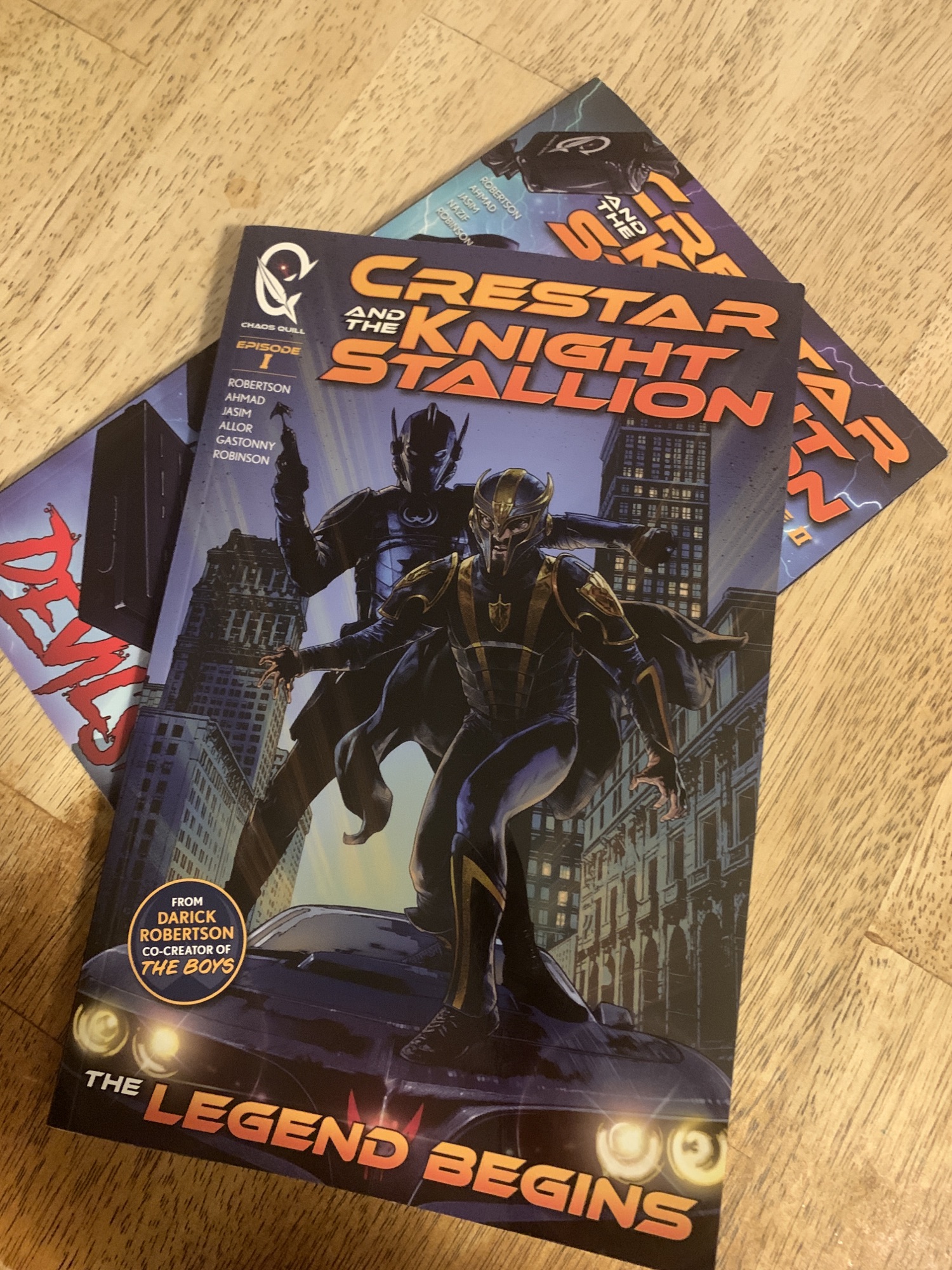
Crestar and the Knight Stallion: The Legend Begins by Robertson, Ahmad, Jasim, Gastonny, and Robinson

Standard
Crestar and the Knight Stallion: The Legend Begins by Robertson, Ahmad, Jasim, Gastonny, and Robinson

This new comic book series combines a lot of exciting elements.  It is a comic book and soon to be live action movie, it is both action and comedic,  it features Desi (Pakistani) and Arab (Iraqi) representation in the title roles, as it is in part written and created by the “characters” themselves. There are Muslim hijabi side characters, cultural Islamic phrases, and a whole lot of saving the day in a plagued Dearborn, Michigan setting.  I admittedly am still very much an outsider to comic books, what all goes in to them, their target audience, and what norms and expectations they carry.  So, I say what I am about to say from a very non critical, simply informative stance, when I say it has what I would consider mature content for elementary aged kids.  The comedy found in the offhand comments, the profanities that are substituted with symbols, surprised me. I anticipated a level of violence and killing, and appreciate that this book doesn’t have the near naked females being shown as many comics do, but I don’t think it is appropriate for younger audiences, probably more middle school and up.  I have not seen the live action, in a different format it might hit different so to speak, but I’m sharing some pictures of the text so that families can decide if the comic books are a good fit for their readers or not.

I love the idea of Muslim rep superheroes, that one is an Iraqi immigrant having to find himself in American society and accept himself, that Crestar is mysterious and his background and motives not known, the cultural and religious infusions, and matchmaking stresses are all amazing subplots to the evil that is destroying the community.  Theft and killings are the norm, Crestar is fighting back, when he discovers Ali has survived an explosion, he begins testing him with the hopes he will join him as the Knight Stallion. The first book is an introduction to the characters, the setting, and the protagonists meeting, it ends hinting that Crestar and the Knight Stallion will be working together, which isn’t much of a surprise given the title of the series, but it sets the stage.

I am not going to write a full review, because I can’t. I just really don’t know if the superhero parts are new and unique or tired and tropey because I don’t know enough about comics to have a valid opinion.  There are trailers online and the first two comic books available are top industry quality in terms of graphics, binding, length etc.

Leena Mo, CEO by Deena Shakir illustrated by Nez Riaz

Standard
Leena Mo, CEO by Deena Shakir illustrated by Nez Riaz

img_5445-1

For ages four to eight this 40 page picture book really introduces great concepts of leadership, business, support systems, and dreaming big.  Before Leena Mo, leads a company though, she thinks up ideas to solve a problem, she turns her ideas into a plan, tests her hypothesis with her prototype, and takes her invention to the next step when demand grows.  Investors, employees, storage, sales, Leena Mo has not only created a product and a company, but she is leading a business, and inspiring others, even back in her Mama’s home in Iraq. With a Mama wearing hijab, a singular mashallah in the text, and the Arabic word for “my dream” Helmy being what she names her snow clearing robot, children everywhere will be inspired and encouraged to think a little bigger than they may have done before.

I love that this business concept is brought down to an early elementary age (and even younger), in a way that they not only will understand, but also be inspired by.  Younger kids might not get the steps, but the fun engaging illustrations, and simple text builds to show that the idea is also growing, and even four and five year olds will grasp that this is exciting.  There are books about science, inventions, even increasingly more about financial literacy, so this is in many ways a next step, that touches on those concepts, but really focuses on the investors, growth and leadership.  The story and concepts weave together, and that culture finds a place as well, is a testament to the quality of this solid, joyful OWN voice read.

The book starts with Leena playing outside in the snow with her friends, when her Mama asks her to shovel before it gets dark.  Leena hates shoveling.  She finds it worse than raking leaves, doing the dishes, and even taking out the garbage.  Instead of complaining though, she starts to dream up an idea of something that would make clearing the snow easier.  She decides on a robot, and gets to work designing and building and testing.

Once it works, a neighbor, Miss Irma, asks to borrow Helmy, and when she returns it, the rest of the neighborhood wants to know where they can purchase one of their own.  When Miss Irma invests in Leena and her team, the next phase begins and as parts turn into products, and equations determine cost, the team of Leena, Olivia, and Lily starts rolling out Helmies.

The sweet ending of inspiring others, will also hopefully inspire readers to think bigger, dream bigger, and recognize the role support,  teamwork, and leadership all play in bringing ideas to life.

The book can be preordered and soon ordered anywhere and everywhere books are sold.

Shiny Misfits by Maysoon Zayid and Shadia Amin

Standard
Shiny Misfits by Maysoon Zayid and Shadia Amin

img_4083-1

I admittedly wanted to read this book because the author is of Palestinian descent. I have seen clips of her standup and I’m not a huge fan, although I do appreciate that she doesn’t deny her culture and Islam, doesn’t let her cerebral palsy keep her from working toward her dreams, and that she is successful.  All good messages for a 256 page middle grade graphic novel that is not autobiographical, but draws on her life none-the-less.  I was surprised, though, that there are no Palestinian references in the book, very few Arab cultural touchstones either, and yet swearing on the Quran and not eating pork are presented fairly often, almost as “bits” to be laughed at.  I truly understand that the character is presented as culturally Muslim more than centering Islam in her identity, but perhaps because the protagonist, Bay Ann, is rather unlikeable, it just rubbed me the wrong way.  I love that the people in Bay Ann’s life do not caudle her, and that she is fierce and dramatic and driven, but she is an awful friend, her obsession with Alyee Maq (yes full names are used throughout) gets annoying, and I worry that some of the humor will be missed for the younger target audience and be taken as Muslim or Arab norms.  The presentation of a disability in a well illustrated graphic novel is empowering, an amazing Arab dad is nice to see, a divorced family co-parenting is important, but the foundation for much of the story is Bay Ann’s crush on Alyee Maq, he does kiss her on the cheek for social media likes, the book starts with Halloween Idol, features dancing throughout, and concludes with a Nondenominational Holiday Spectacular.  Bay Ann’s mom is not very kind or involved, and Alyee Maq’s mom, the only hijabi in the book, also is rather rough.  This is a book where I acknowledge my own overthinking, as both an adult reader and reviewer.  If you are ok with the (random) Islamic rep, kids will benefit from seeing Bay Ann as a fully capable person who happens to have a disability.  I’d suggest seeing if your local library has the book and looking through it first to see if you are comfortable passing it on to your kids.

SYNOPSIS:

Bay Ann is a tap dancer and with Halloween Idol coming up, she plans to win.  Her best friend Michelle is going to do her make-up as a zombie bride, and be her zombie bridesmaid with Davey Matt, the third in their trio, being the dead ring-bearer dog.  They can’t be her backup dancers because she is a one woman show, but she needs them to cheer her on.  When she wins, she has the spotlight stolen from her by Alyee Maq kissing her claiming he is making “a sick girls dream come true.” The clip goes viral, as Alyee Maq is a bit of a celebrity and the competition is on.  Whether it is science fair, social media posts, or the class debate, Bay Ann is determined to knock Alyee Maq down, claim the online spotlight, and  prove her talent is more than her disability.  With each attempt failing, her resolve grows stronger and her tunnel vision pushes those closest to her away, as she joins Alyee Maq with the hopes that if she can’t beat him, she will join him and achieve the fame she seeks.

WHY I LIKE IT:

I know the book is rather intentionally ridiculous, but I wanted to cheer for Bay Ann, and I never really liked her.  I don’t like how she treats Davey Matt, or even Michelle.  If she was better to them at the beginning, I think it would have shown how disconnected her mom Malak is as well as the school administrators, and made it more funny, but it truly just makes her seem like she is awful to everyone, and thus you don’t really find yourself invested in her stardom, her friendships, or her defining her own narrative.

I wish their was some Arab rep, not just a few Arabic words tossed in here and there.  I also wish there was more Islamic centering, or honestly even less. The swearing on the Quran really bothered me, Friday prayer is mentioned in passing, but there is no impact on the characters or the story, so it seemed misplaced.

The pacing of the story is rushed, and at times a bit chaotic.  I think it is intentional, but it makes it hard to connect to the characters or to grasp their motivations.  I don’t know that I truly ever understood why Bay Ann wants the spotlight, or why Alyee Maq is famous, or why Davey Matt hangs around Michelle and Bay Ann when they belittle him. It doesn’t need to be thoroughly explained, but when you finish the book, and feel exhausted, but can’t even articulate what the book was really about other than a girl that wants to be famous for her talent not her shaking, and won’t let anything or anyone get in her way, it seems like some opportunities were missed.

FLAGS:

Close male and female friendships with touching, an unwanted kiss, lying, manipulation.  Swearing on a Quran, disrespect. Using people.

TOOLS FOR LEADING THE DISCUSSION:

I don’t know that I would seek this book out to own, but in an Islamic school library if it found its way in, I would probably not object to it being shelved.

Kareem Between By Shifa Saltagi Safadi

Standard
Kareem Between By Shifa Saltagi Safadi

img_3395-1

It doesn’t matter how many Word documents you read, Goggle docs you add comments to, and screen shots you revise; to hold a physical book in your hands that you have been blessed to observe from the sidelines through numerous revisions, is mind blowing.  Reading the final version from page 1 to page 324, plus the backmatter, has left me at a loss for words with tears streaming down my cheeks. I truly cannot imagine the book any other way. All past drafts and storylines, were just stepping stones to get the book to this version, and as a fan of literature my whole life, to see this metamorphosis in real time has added to my respect and admiration of authors.  Enough about me though, this review is of the middle grade novel in verse that tells the story of Syrian American Kareem, a loveable boy caught in between choices, siblings, friends, labels, and global acts beyond his control.  He makes mistakes, he tries to make things right, and at the center of it all is his Islamic identity, love of football, and genuinely good heart.  I am biased in that I have self appointed Kareem as my nephew, but even after dozens of readings, I was moved to tears three times during the course of this reading.  I made my teens read the book and they loved it, and like them, we hope we get more Kareem in the future.

img_3541-1

SYNOPSIS:

Kareem loves football, particularly the Bears, and dreams of seeing his Arabic name on an American jersey one day in the NFL.  Unfortunately, he hasn’t made the school team, his best and only friend Adam has moved away, and the coach’s son is offering to talk to his dad for Kareem in exchange for some school help.  Add in a new Syrian kid at school, his mom going to Syria to take care of his grandfather, and the fruition of Executive Order 13769 aka the Muslim Ban, and seventh grade has Kareem scrambling on every down to say the least.

img_3543-1

WHY I LOVE IT:

The football framing, the literary inclusions, the Arabic, the Islam, all combine with such tangible heart to create a seamless read both as a compelling story and as an example of literary craft.  The language is on point and intentional, that even if you don’t know the character or novel referenced, the Arabic words included, or football terminology used, you will be invested in the characters and plot, and find yourself cheering for Kareem.  Often debut authors show promise, but their stories have plot holes, or pacing issues, or inconsistencies, that is not the case with this book.  The crumbs are there that tie everything together, the depth of the characters’ personalities reveal how developed they are, and the timeline keeps the book moving forward.  There are no dry or slow spots in the entire novel, it is easily read in one sitting as you find yourself nervous for Kareem, and curious how it will resolve.

Boys and girls, Muslims and non Muslims, Arabs and non Arabs, all will find themselves drawn to this book, and thinking about the characters, particularly Kareem, long after the final page is read.

img_3544-1

FLAGS:

Some stress and anxiety with missing parents.  Death, bullying, cheating, fighting, lying, racism.

img_3540-1

TOOLS FOR LEADING THE DISCUSSION:

The book is a solid middle grade, but the quality of writing and engaging plot makes it work for a middle school book club read as well.  I cannot wait to share this book widely.

Preorders speak volumes and I truly hope if you are able that you will preorder a copy, you can do so here.  Requesting your local public library to shelve the book is also a tremendous help to signal to publishers what type of stories and OWN voice authentic representation consumers will support.