Category Archives: Picture book

The Big Yard Sale: David Learns How to Treat Customers by Tariq Touré illustrated by Anika Sabree

Standard
The Big Yard Sale: David Learns How to Treat Customers by Tariq Touré illustrated by Anika Sabree

img_9753

David Kareem is back and learning how to treat customers at his neighborhood yard sale.  The 26 page rhyming poem, turned children’s book (note there is little punctuation) is brightly illustrated as it follows David on his selling journey.   With Mommy’s baking and guidance on how to treat customers, his Saturday morning offers lots of lessons, mistakes, learning, and entrepreneurship for David and the reader alike.  There is a hint about a smile being charity, an Imam stops by, and David puts on a kufi.  It has good lessons and the same community vibe as the first book David’s Dollar, with visible Muslims in the illustrations and with Muslim names in the text throughout. But there was a page with two typos which disappointed me, a changing number of cinnamon rolls, and when the copy arrived it was pretty damaged and bent (probably/possibly not the fault of the author, but it cost $25 through the preorder Launchgood, so disappointing none-the-less, alhumdulillah you can now purchase it here from Amazon for $12).

David wakes up and hears commotion outside, he thinks he left a toy on, but soon realizes the neighbors have their stuff on tables and are selling things.  David wants in on the action, but can’t figure out what to sell.  He seems to gather up some toys and household items in the early illustrations, but ultimately it is about him selling his mother’s cinnamon rolls.  She is a baker, and is testing them out, but he says he only needs five and is off to peddle his wares.

The first costumer comes, and leaves, he asks his mom what he did wrong, and she advises him to adjust his attitude by smiling.  They look at Brother Naeem as an example. The next costumer comes, but asks if he can warm up the now six cinnamon rolls in the illustrations.  David says no, and once again he turns to his mom to find out why.  She tells him that “the customer is always right” heads off to get a heat lamp, and uses Sister Khadijah selling beads for reference.  When Imam Musa comes, David completes the sale, but Mommy says he needs to learn gratitude.

img_9757

One page has “He’s” when it should be “He,” and “sleep” when it should be “asleep.”  I get the lack of punctuation is stylistic, but I don’t feel like these two on the same page are intentional, they just seem erroneous, and being that they are on the same page, makes it seem like the page was just missed perhaps in editing.

Overall I enjoyed the presentation, representation and content of this book and am glad I preordered it months ago. I wish it had a smidgen more Islam in it, but I think this book would be great in an early elementary story time with recently traditionally published books about business for a similar demographic, including the author’s earlier book, David’s Dollar. Teaching kids about entrepreneurship, ethics, gratitude and doing it with Muslim characters is incredible to see and important to share.

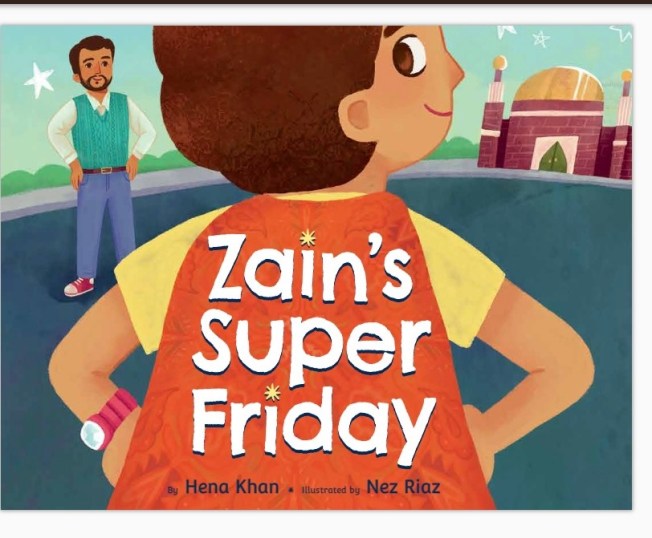
Zain’s Super Friday by Hena Khan illustrated by Nez Riaz

Standard
Zain’s Super Friday by Hena Khan illustrated by Nez Riaz

img_9576

I love the joy and normalizing of mainstream titles celebrating salat, Jummah, and the masjid becoming increasingly available for us to read and share.  This particular book is great for preschool to early elementary aged children that enjoy going to the masjid, but sometimes want to put on a cape and be the hero battling aliens, that know how to behave during salat, but sometimes have a hard time sitting still, and parents that want to play with their kids, but sometimes have to get some work done first.  With  threads of patience, kindness, and determination woven in to masjid activities, the book is both a mirror for Muslim kids and a window for those that wonder what a Friday prayer service looks like.  The 32 page book is unapologetic, joyful, and a great addition to book shelves.

img_9578

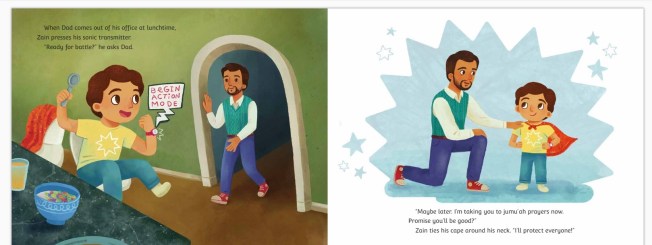
Zain wakes up early Friday morning and is ready to save the world. Dad greets Zain with a “Jum’uah Mubarak,” but has to pass on battling the aliens taking over the kitchen.  At lunchtime, when dad takes a break from work, Zain tries again to engage him in heroic play, but it is time for Jum’uah.  Zain slips on his cape and vows to protect everyone.

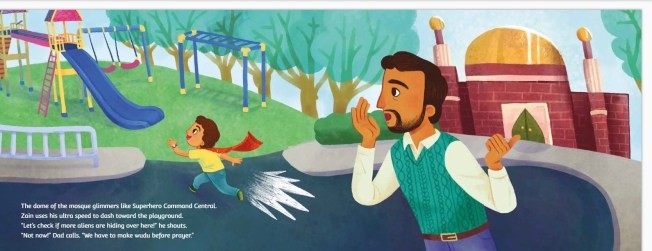
When they get to the mosque, aka command central, Zain tries again, but dad redirects him to make wudu before salat. Heat action dries his feet, but the adhan starts and giant shoes and aliens will have to wait, yet again.  During the khutbah, wiggly Zain sits by his dad, but when the Imam encourages them to stand for salat and fill any gaps, Zain takes it as a call to duty and races to the front announcing, “Here I come, Commander Imam, reporting for duty.”

The kind Imam knows just what to do, and as Zain controls his focus, even dad finds time to be a hero and battle the aliens on this super Friday at the mosque.

img_9580

I love that wudu, athan, khutbah, Imam, are all used without a glossary and that the Author’s Note is informative and unapologetic in tying it all together and making the terms clear.  I wish masjid was used instead of mosque, but I know that is just my personal preference.  I love that the Imam is kind and the dad is gentle and playful.  Even when Zain is not getting to do what he wants, he is not unhappy with being at Jumuah, or making salat, or being redirected, he just wants to indulge his imagination.  The warmth and joy of the illustrations reinforces the tone of the book, and with the inclusion of charity, and the happy ending, I can’t wait to have a physical copy of this book in my hands.

The book releases on October 10, 2023 and can be preordered/ordered here on Amazon and I’m sure will be available once released at Crescent Moon Store, where my initials ISL at checkout will always save you 10%.

img_9582

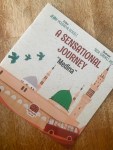
A Sensational Journey “Medina” by Jenny Molendyk Divleli illustrated by Seda Cubukbi Antli

Standard
A Sensational Journey “Medina” by Jenny Molendyk Divleli illustrated by Seda Cubukbi Antli

img_8808

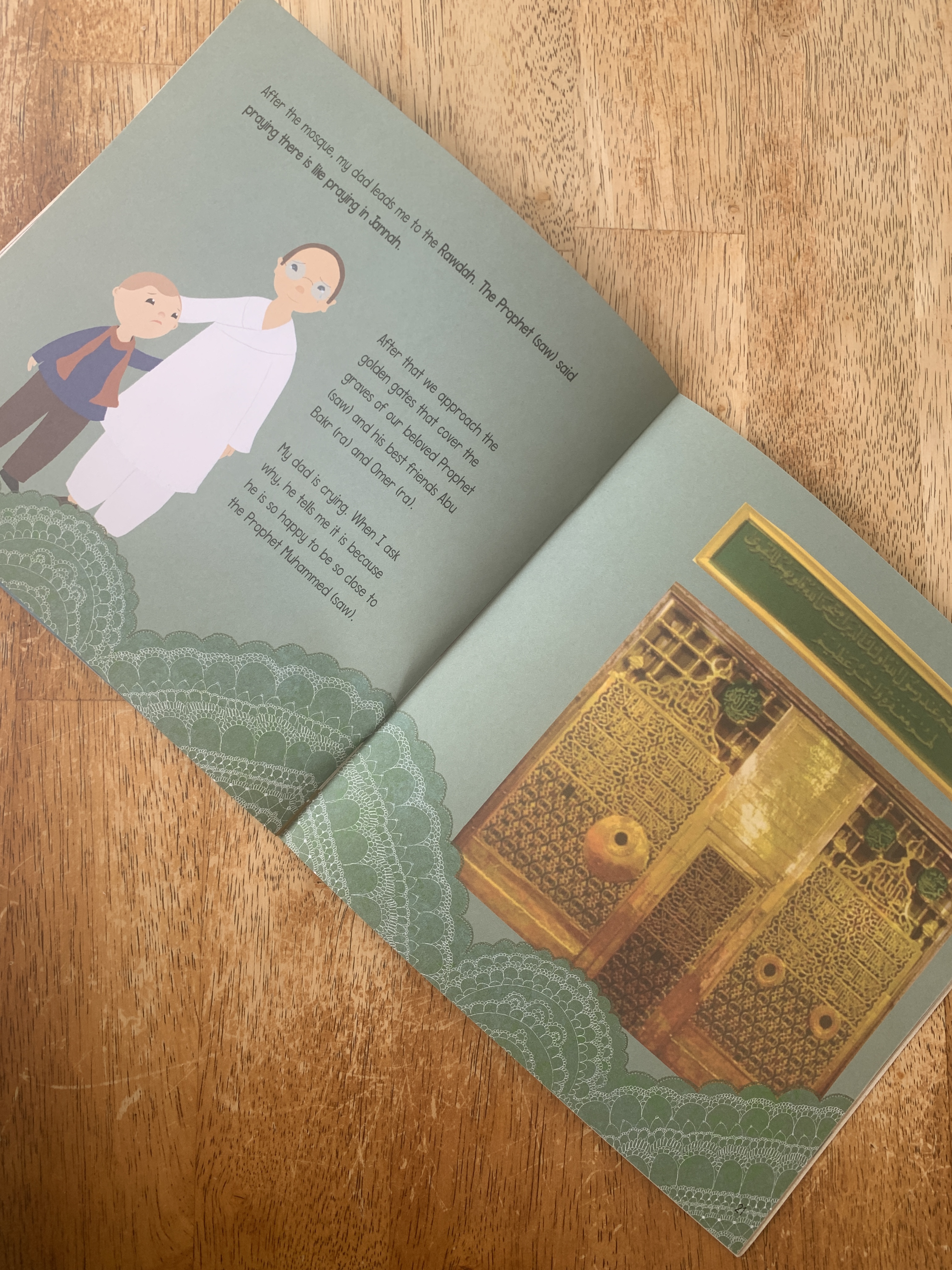
A journey to and through Medina with a focus on the five senses is a lovely concept for a book and the book is an enjoyable read for young children with the internal map, details about he Rawdah, the inclusion of Masjid Quba, Masjid al-Qiblatian, Mount Uhud, Archers Hill, and ajwa dates. The book is a little text heavy, as a decent amount of information is shared, but the illustrations are enjoyable and will help hold the attention of early elementary children.  The use of sight, smell, taste, feel and sound are woven into the story, they are not highlighted or the organizing format of the book.  Bonus material includes a QR code to listen to “Tala ‘al Badru ‘Alayna,” a glossary, and follow up activities.

The book starts with a little boy headed from Mecca to Medina, “the city of Prophet Muhammed’s (saw) mosque and grave, and a hope to find out why “everyone says Medina feels ‘special.'”  As he sees Bedouins in the desert he wonders what they eat and how they survive.  He then sees a gas station lit up like an amusement part.

img_8809

As they get closer to Medina they listen to “Tala’al Badru ‘Alayna.” When they arrive at the hotel they smell oud and fall asleep.  The next morning he wakes up to the sound of the athan and they walk the streets taking in the sights and smells. The color of the green dome is noted and the rose smell of the carpet when they make sujood included.  

The Rawdah and the umbrellas each get their own two page spread, and then a tour guide takes them to Masjid Quba, Masjid Al-Qiblatayn, and Mount Uhud. The tour finishes with a visit to the date orchards and playing and napping in the mosque.

img_8811

I wish it used the word Masjid every time, it uses both, and I’m not sure why it doesn’t just say Fajr instead of the morning prayer.  I appreciate framing it as a story, but the beginning with the Bedouins and the gas station seemed to slow the story down and my littles wanted answers as to why there were so many lights and how the people in the desert survived.  I also would have liked if the backmatter detailed more about Masjid al Quba and Qiblatayn, and Uhud, ultimately I wish there was more showing the little boy feeling why Medina is special and not just saying he now understands.  

 I’m not sure why I only ordered the Medina book and not the Mecca one as well, they are stand alone reads, but the Medina one references that that they have come after being in Mecca so consider if you are getting one to get both.  I ordered mine here. Use code ISL (Islamic School Librarian initials) at checkout to save 10%.

img_8810

A Cat Like Me! A Fun Hajj Tale by Emma Halim illustrated by Aissa Mutiara

Standard
A Cat Like Me! A Fun Hajj Tale by Emma Halim illustrated by Aissa Mutiara

img_8799

A rhyming cat centered book about hajj that has been checked by a Shaykh!  Over 46 pages, preschool aged children and up will be able to see the steps of hajj in a fun, engaging and accurate way.  This book is great for bedtime and small group story time and the reasonable price makes it perfect for sharing too.  The illustrations do not have faces with eyes, but the joy comes through and Bissa the cat makes sure you know how special hajj is.

img_8800

I love that the book identifies what type of hajj is going to be shown and thus signals that there are different ways.  I also love that the book is sourced and the Shaykh is named and qualifications listed.  For so long erroneous information in children’s books has gone unchecked and it really is such an important   verification for something critical in our faith to be sourced and checked. Plus it is reassuring for the reader to feel confident in sharing the information with others.

img_8802

The book radiates with excitement and information and the rhymes and illustrations keep kids engaged.  The book is 8.5 x 8.5 so it might not work in big groups.  I purchased mine from if you use code https://crescentmoonstore.com if you use my initials ISL (Islamic School Librarian) at checkout you will save 10% it is also available here on Amazon.

img_8803

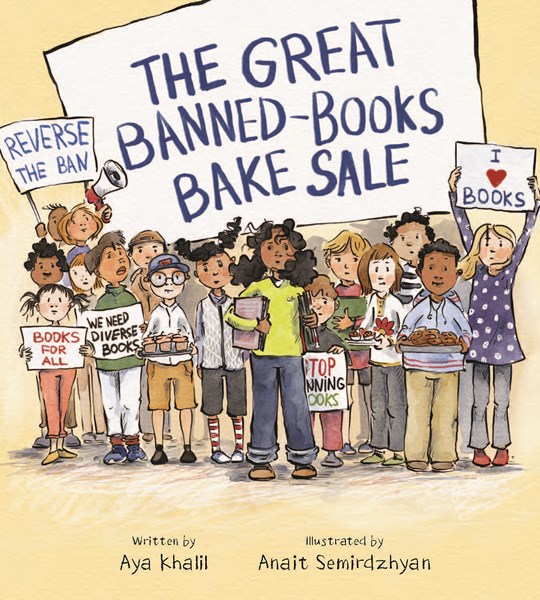
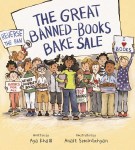
The Great Banned-Books Bake Sale by Aya Khalil illustrated by Anait Semirdzhyan

Standard
The Great Banned-Books Bake Sale by Aya Khalil illustrated by Anait Semirdzhyan

banned

This follow-up picture book to The Arabic Quilt, takes readers back to Kanzi’s school, but also works as a standalone for ages 7-10.  Addressing the hot topic of book banning, the fictional story brings the discussion down to an elementary level and shows kids speaking up and pushing back against something they don’t agree with.  The main character finds a connecting thread to events in Egypt, and with her class and family behind her, she finds her voice and takes the lead.  The story bounces around a bit and feels a little rough and underdeveloped at times, but the subject matter is important and can be used to help guide discussions, encourage peaceful protesting, and taking action.  There is nothing Islamic specific in the text, the main character’s mom and teita wear hijab and are in the illustrations (#muslimsintheillustrations), in a memory of Egypt there is a man holding a cross.  The author is Muslim and mentions it in the Author’s Note at the end.

banned1

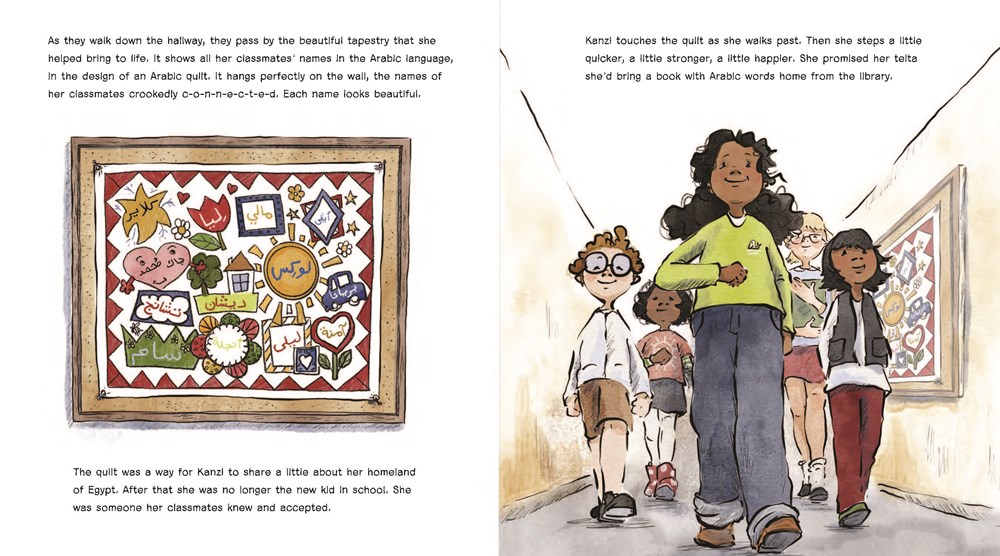
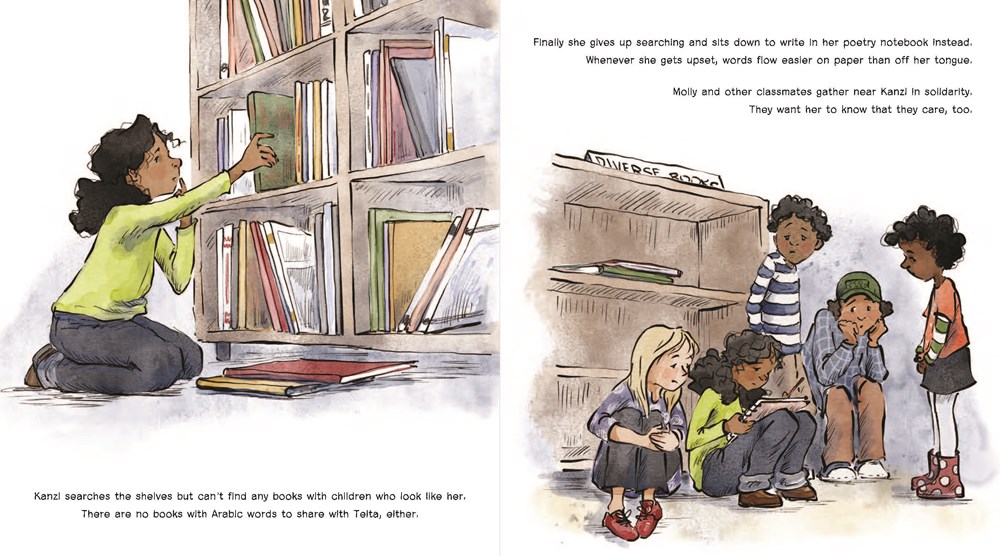
The book starts with Kanzi leading the class to the library, she passes the Arabic quilt she helped bring to life and walks a little taller.  She has promised her Teita she will bring home a book with Arabic words from the library, but when she walks in to the library, the “bookcase where the new diverse books were displayed has been emptied.”  The librarian explains that the books have been banned.  That the school district, like many others around the country, have decided certain books are not allowed. Kanzi is upset, but her classmates “gather near (her) in solidarity. They want her to know that they care, too.”

banned 2

Back in class the teacher opens up the discussion, and Kanzi can’t find her words.  Kareem says it is unfair and when the teacher explains that people are responding by protesting, writing letters, and buying more copies of banned books.  Kanzi finds her voice and suggests a bake sale.  Kareem suggests they raise money to buy books that are banned and call it “The Great Banned-Books Bake Sale and Protest.” Molly adds that they can put the books in Little Free Libraries. The class agrees that Friday will be the day, that baked foods inspired by books that are banned will be sold to raise funds to buy more banned books, and the local news station will be invited to broadcast the protest.

banned 3

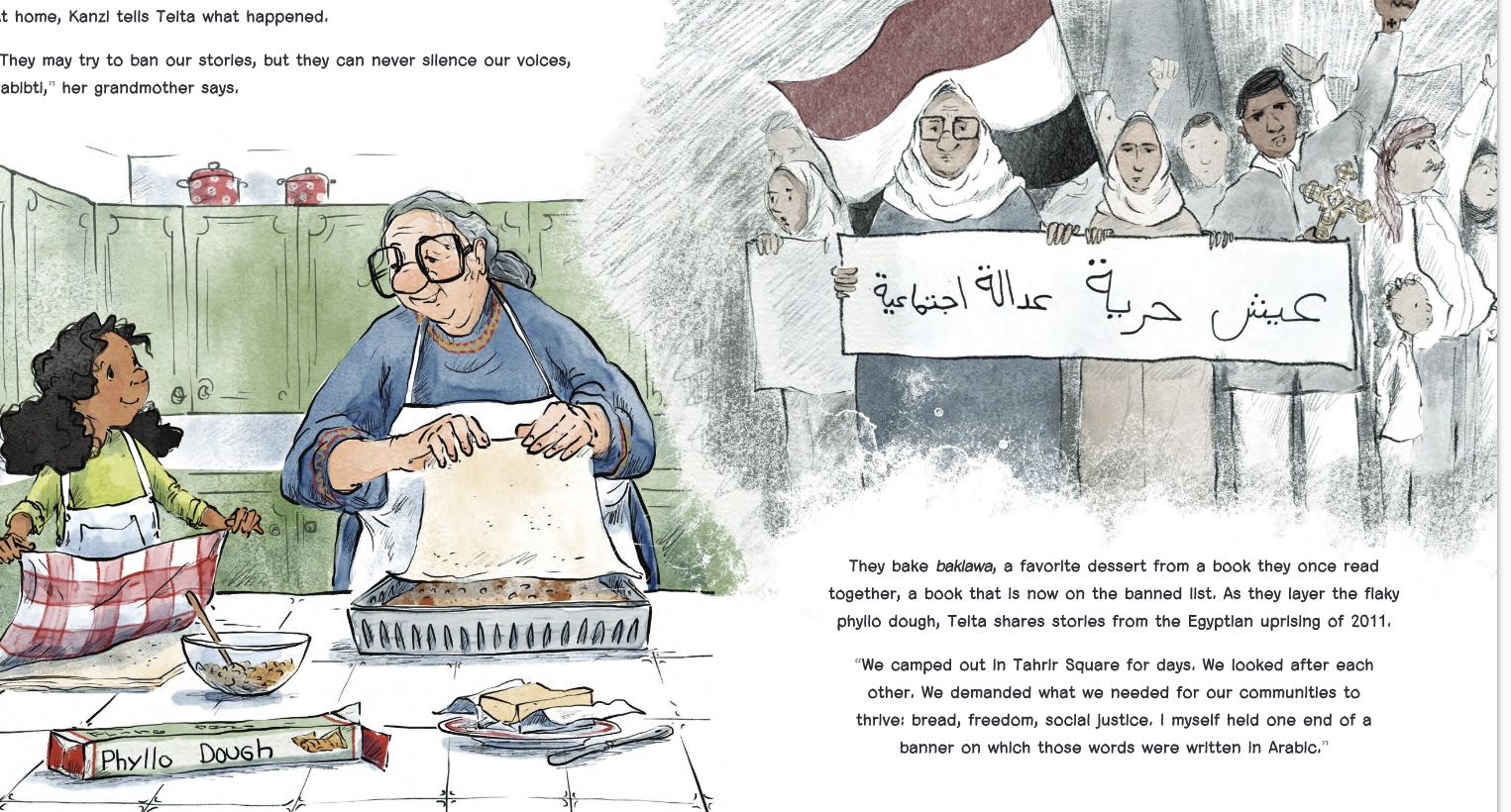
Kanzi helps Teita make baklawa from a book they once read, while her grandma tells her stories of protesting in Tahrir Square.  Teita held a banner and demanded rights for the people of Egypt. Friday comes, and the kids are determined to be heard, as the crowd grows, Kanzi’s nerves also grow, but her strength comes from those that support her and who have also spoken up to be heard.

I enjoyed the illustrations and the backmatter.  The inclusion of a baklawa recipe and insight to how this story came about with the banning of The Arabic Quilt, definitely adds to the book’s appeal.  I felt a little disconnect though from the emotions of the book, and oddly enough, little connection to the characters.

I wish it would have shown her joy when she first saw the diverse book display.  How it made her feel seen and valued and included to see books that reflected her and her classmates.  Then we, the readers,  would feel the pain too, now that they are gone.

I also was a little unsure of the scene when all the kids gather around Kanzi in solidarity, why is she the only one upset? Is it that they care about her or that they care that the books are no longer available? Sure it can be both, but again, as it is written, it isn’t particularly strong.

img_8594

I’m not sure why the three characters named in the book Kanzi, Kareem, and Molly, do not have their names shown on the Arabic quilt pictured in the illustrations, and I also don’t know why it bothered me that the book banned that had baklawa/baklava was not named.  I don’t care that it isn’t a real book, but I wanted a title to make the case of how ridiculous this ban is more articulate.  Additionally, I love Little Free Libraries, but it seemed tossed in without much fleshing out. The book doesn’t explain what Little Free Libraries are, so I’m not sure that kids will even understand the plan.

The book is a decent read, I don’t know that the climax or characters will be memorable on their own, which is unfortunate because connection with the success or failure of this fictionalized book ban really could have radiated out of the book and deeply inspired kids.  The reversal of the boards decision doesn’t directly link to the kids’ actions.  I had to provide that link to my own kid when I read the book to him (he is almost 8).  It is implied, but a line or two about how the kids protest encouraged other people to also speak up, or write letters, or that the school board attended the bake sale, would have shown that when voices amplify it is hard to ignore them.

The book has value on the shelf and can be preordered here https://amzn.to/3C5Baaj

These Olive Trees: A Palestinian Family’s Story by Aya Ghanameh

Standard
These Olive Trees: A Palestinian Family’s Story by Aya Ghanameh

these olive

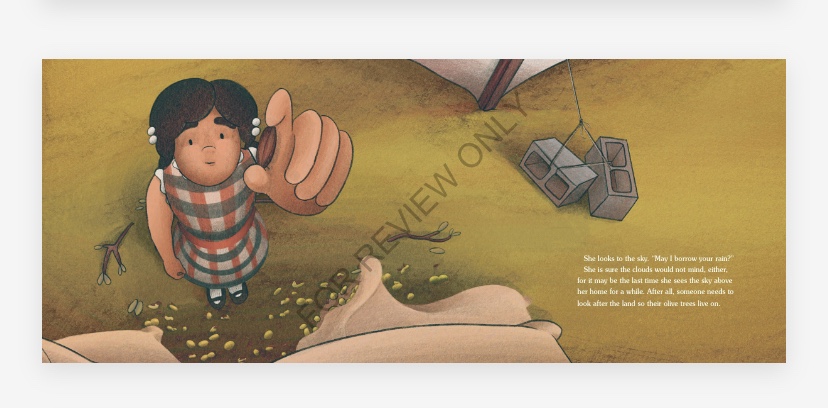
This stunningly illustrated OWN voice Palestinian book for early elementary kids is an important story and I love that it is coming out to the world, but I do have some issues with the literary aspects and target demographic.  The story bounces around from being factual about the brining and curing process of turning the bitter olives into numerous things, to Oraib’s present life in the refugee camp, to memories of the family’s life in Al Tira.  When war once again drives the family from their home in the Balata refugee camp, Oraib, plants seeds and vows to return one day to harvest the fruit.  The language at times is very mature and complicated for ages 5-8, I felt uncomfortable with the family moving being attributed to war and not occupation, and at one point it clearly articulates there are many olive trees located outside the camp and that they are leaving the seeds that would be later planted, so why is the climax her asking the earth permission to plant one more and for the sky to water and care for it until she can return? The backmatter allows the book to be used to spread awareness about Palestine and the process of harvesting olives, but the illustrations will appeal to younger readers, and the concepts contained seem more geared for slightly older ones.  There is nothing religious in the book, there is depiction of the Dome of the Rock in an illustration and I believe the author/illustrator identify as Muslim.

img_8540

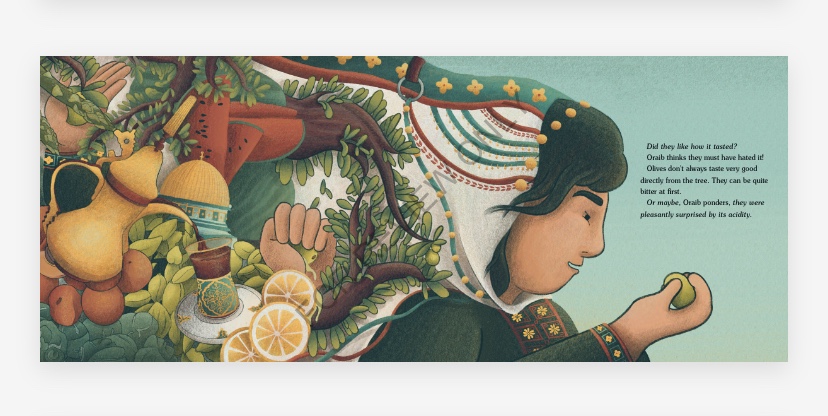
The writing style of the book is fairly surface level with concepts not fleshed out to allow difficult concepts to reach younger readers.  When describing the taste of the fresh olives, Oraib wonders if long ago people were, “pleasantly surprised by its acidity.”  No insight into what that acidity tastes like, or bitterness, or what curing and brining means.  Often the paragraphs seem long winded and repetitive, adding very little to advance the story.

img_8541

There is little lyricism in the text, and the first time some tries to peek out, the metaphor is quickly abandoned, and it is notable that it doesn’t return.  The occasional enjoying of the bitter fresh olives is juxtaposed with the surprising joy occasionally found in the camp, it seems that with the uprooting of the family once again at the end, this thread would have been a natural inclusion to reinforce the patience for something better to occur.

img_8544

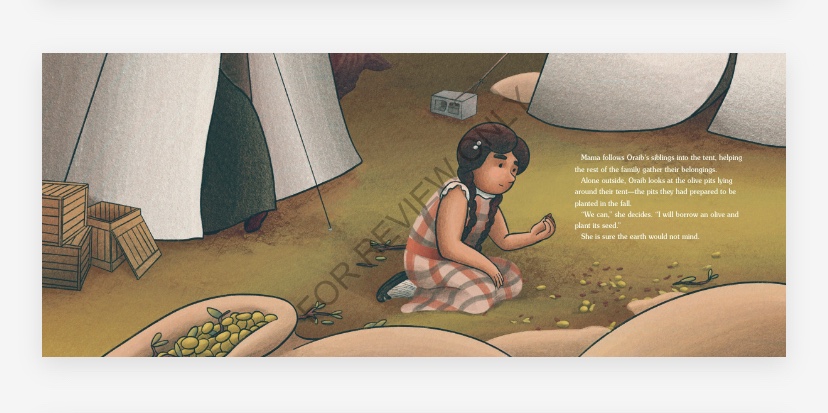
The dramatization of asking the earth and sky when planting a seed upon their departure, didn’t make much sense to me.  It is noted there are olive trees already there, the illustrations show the ground littered with seeds that were to be planted had they stayed, so why not have the little girl pocket some of the seeds to take with her wherever they go.  That is after all what the mother is doing at the beginning.  Why not have the little girl invest in the cause herself and share in that ownership that they will always endure and prosper. The personification of the earth, sky and rain also doesn’t seem to fit the flow of the story, so much is internal observation and reflection of the main character, that this seems like an attempt to bring it back to a child’s level that instead just reads disjointed.

img_8545

I might have missed something as I am not Palestinian, but the book to look at is incredibly beautiful, I just don’t think it will be read and remembered by young children.  One of my first thoughts when reading it was that it was an early draft, but it is to be published soon and this review is based on the most recent version sent to me. I also wondered in the back of my mind if the book was allowed to be used to check a box, and wasn’t given the editing and polishing that it deserved on purpose.  It depresses me to even think that, and I guess I’ll never know, but I would love to hear your thoughts, and I do hope you will request your local libraires to shelve the book as a show of support to authentic Palestinian voices.

img_8546

Salat in Secret by Jamilah Thompkins-Bigelow illustrated by Hatem Aly

Standard
Salat in Secret by Jamilah Thompkins-Bigelow illustrated by Hatem Aly

img_8430

It is quite remarkable in the course of 40 pages that so many themes, layers, emotions, windows, mirrors, and relevance can radiate with ease and entertainment for children four and up.  The authenticity of the text and illustrations create tangible feels in this book, that months after reading it for the first time, I am still moved to tears, both inspired by joy and as a cathartic release of being seen.  The true mastery is that even if you are not Muslim and cannot relate to the nervousness of praying publicly, you understand Muhammad’s hesitancy and feel for him as he battles not just finding a place, but watching onlookers reactions to his father, police proximity, and being brave enough to push yourself even when you are scared.  Usually when asked what my favorite book is, I stumble to narrow it down to just one, but truly this book has raised the bar of not just traditional publishing representation, but Islamic/Muslim literature across the board.  It is a gift to read, to share, to enjoy, and a blessing that such an unapologetic book is available so widely for our children to connect with, and our non Muslim friends to see us through.  Please spend time with this book and make it available to your children, your students, your community, it really is that good, alhumdulillah.
img_8431

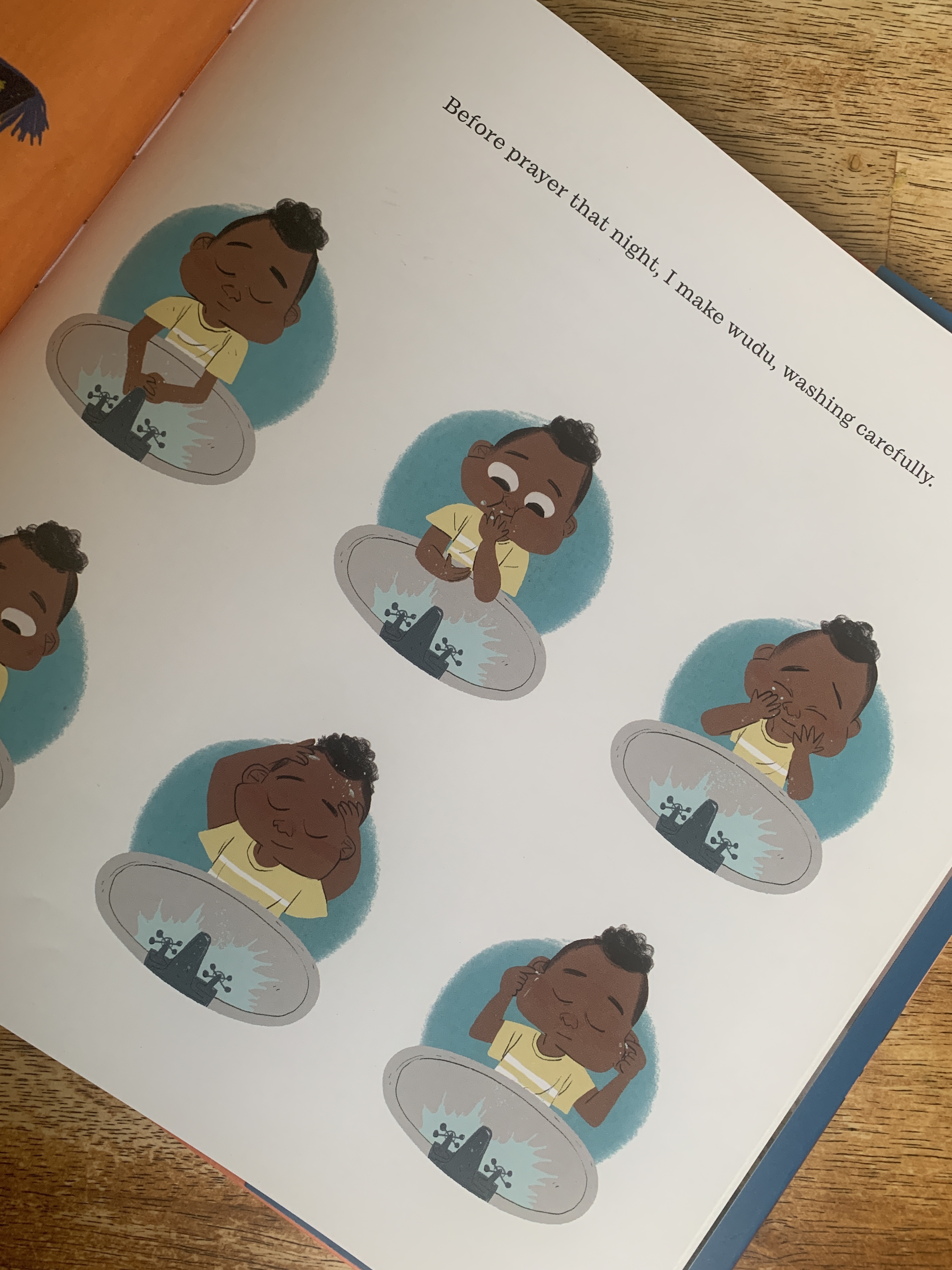
It is Muhammad’s birthday and he is seven, “Old enough to pray five times a day,” his father gifts him a prayer rug, and  Muhammad is ecstatic.  He makes wudu that night and offers salat with full attention.  He says the Sunday school words and shares his most wished for wishes to Allah swt, not even letting little sister, Maryama distract him.

After Fajr the next morning, he is determined to find a secret place at school to pray Dhuhr. Daddy doesn’t need secret places, if prayer time comes he pulls his ice cream truck over and prays on the sidewalk, “never delay salat.”  At school, Muhammad heads to Mrs. Baker to ask for a place to pray, but his confidence waivers and he returns to his seat.

img_8432

Anxiety about where to pray has him looking for spots throughout the morning, but when recess comes he finds he can’t take the prayer rug out from under his jacket.  He lingers when everyone returns to class and rushes through the words and motions in the coat closet.

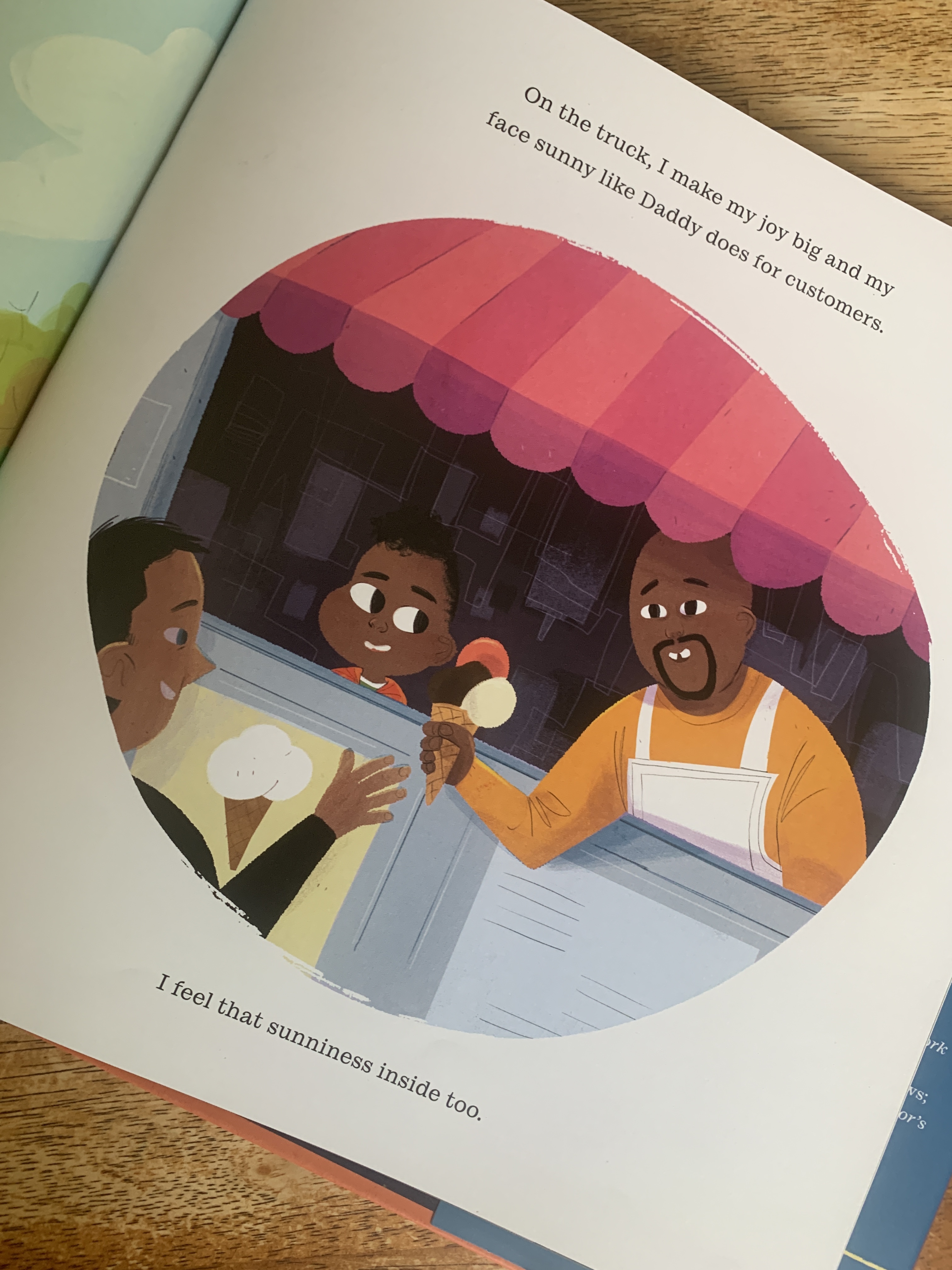
That evening he is with his daddy in the ice cream truck and the sunshine and smiles pour out of the two.  When the sun sets it is Maghrib time and Daddy heads to the sidewalk to pray, reassuring Muhammad that he can pray at home.  Muhammad watches his dad and various events spur him to make his decision.

img_8433

I love love love the way salat is approached with love and excitement and that the dad embodies safety and joy and does not pressure or force Muhammad.  The relationship is beautiful and allows for worship to be seen as both personal, as well as obligatory and merciful.  The duo also show a great parent child dynamic that warms the heart.
img_8434

I like that there really isn’t any “hate” given to anyone praying, it is hinted at, people do not understood, but the focus is not on the outside bystanders- it is what Muhammad thinks and feels.  I’m fairly certain every Muslim who has prayed in public has encountered a wide variety of responses, and this book keeps the gray to reflect and spark conversation.  It is often met with ignorance, with hate, with aggression, but it is also met with respect, apathy, and curiosity which the text and illustrations allow for.

img_8435

There is so much love and joy in the book as well as identity, that I don’t mind one bit that my littles ask me to read it over and over.  It is perfect for groups, one-on-one, and I cannot wait to share it in a story time, there is also an incredibly informative and heartfelt Author’s Note at the end.  If you haven’t preordered it yet, the book releases on June 6, 2023, please pre order it and signal the support for this book and future books that center authentic Muslim joy, Black Muslim representation, and OWN voice author and illustrator accuracy.  Request it at your library, put it on hold at your library, check it out, read it.  If you cannot preorder it, still purchase it when you can, inshaAllah it will be a beloved book in your home as well.
The Together Tree by Aisha Saeed illustrated by LeUyen Pham

Standard
The Together Tree by Aisha Saeed illustrated by LeUyen Pham

img_7924

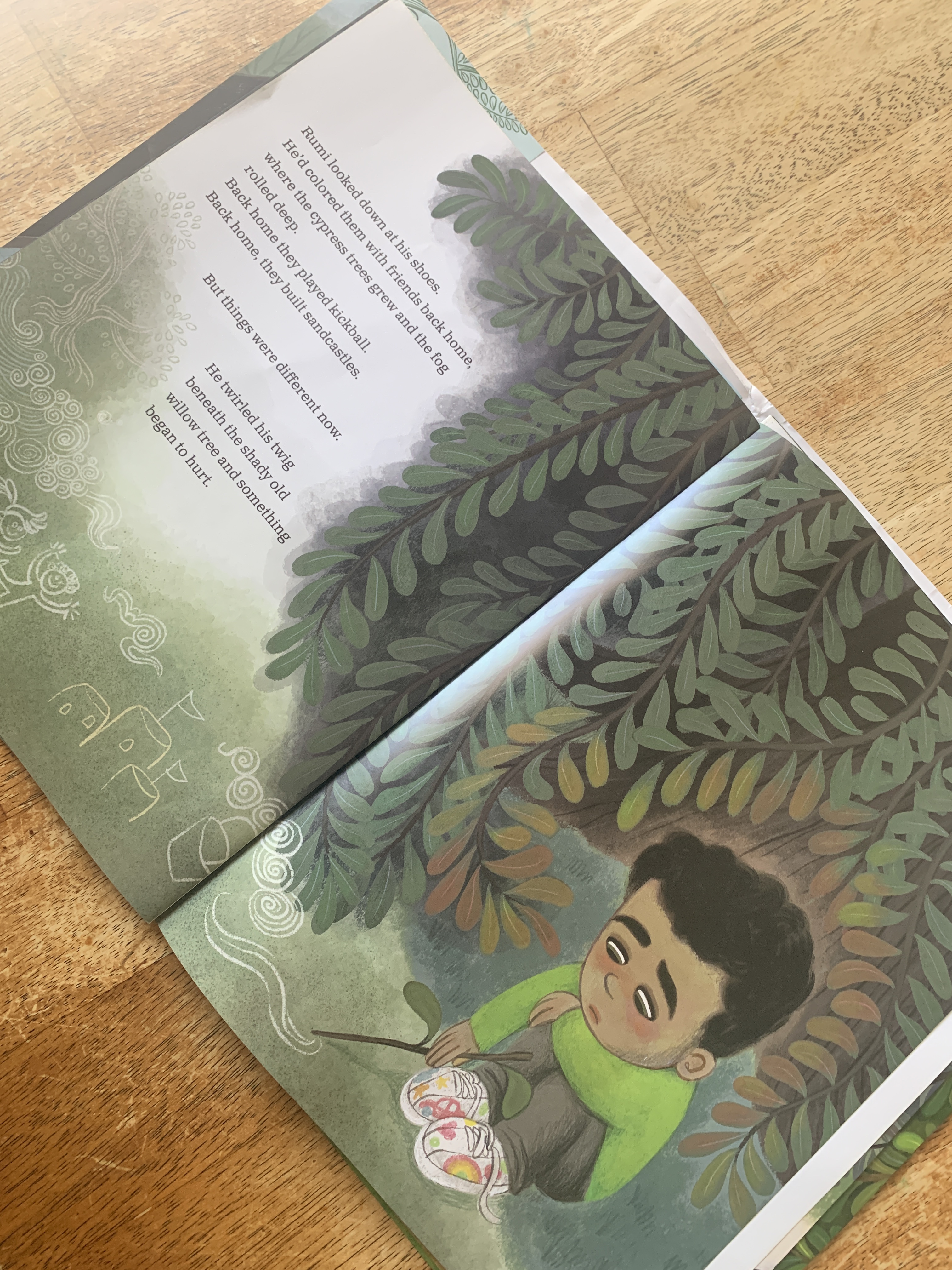
Being the new kid, not having friends, and being teased are not new themes in literature (or life), so if you are going to write a book about them, take a lesson from Muslim author Aisha Saeed and make sure the story is heartfelt, emotional, and well-told.  There is no Islam in the book, no foreign culture, or teasing because of skin color, it is a boy named Rumi who has moved from San Francisco to the other side of America and his shoes, with their drawings and colorings, that cause the kids to stare and start bullying.  Rumi seeks solace under a willow tree and fellow classmate Han has to be brave to put a stop to the mistreatment by finding his voice and not simply staying silent.  The text and illustrations provide a lot of opportunities for children to see themselves in the story, in the various characters, and ruminate over the actions and feelings from different points of view.  The book is lyrical, it is not heavy handed or preachy, and the Author’s Note at the end is equally touching and hopeful.

img_7925

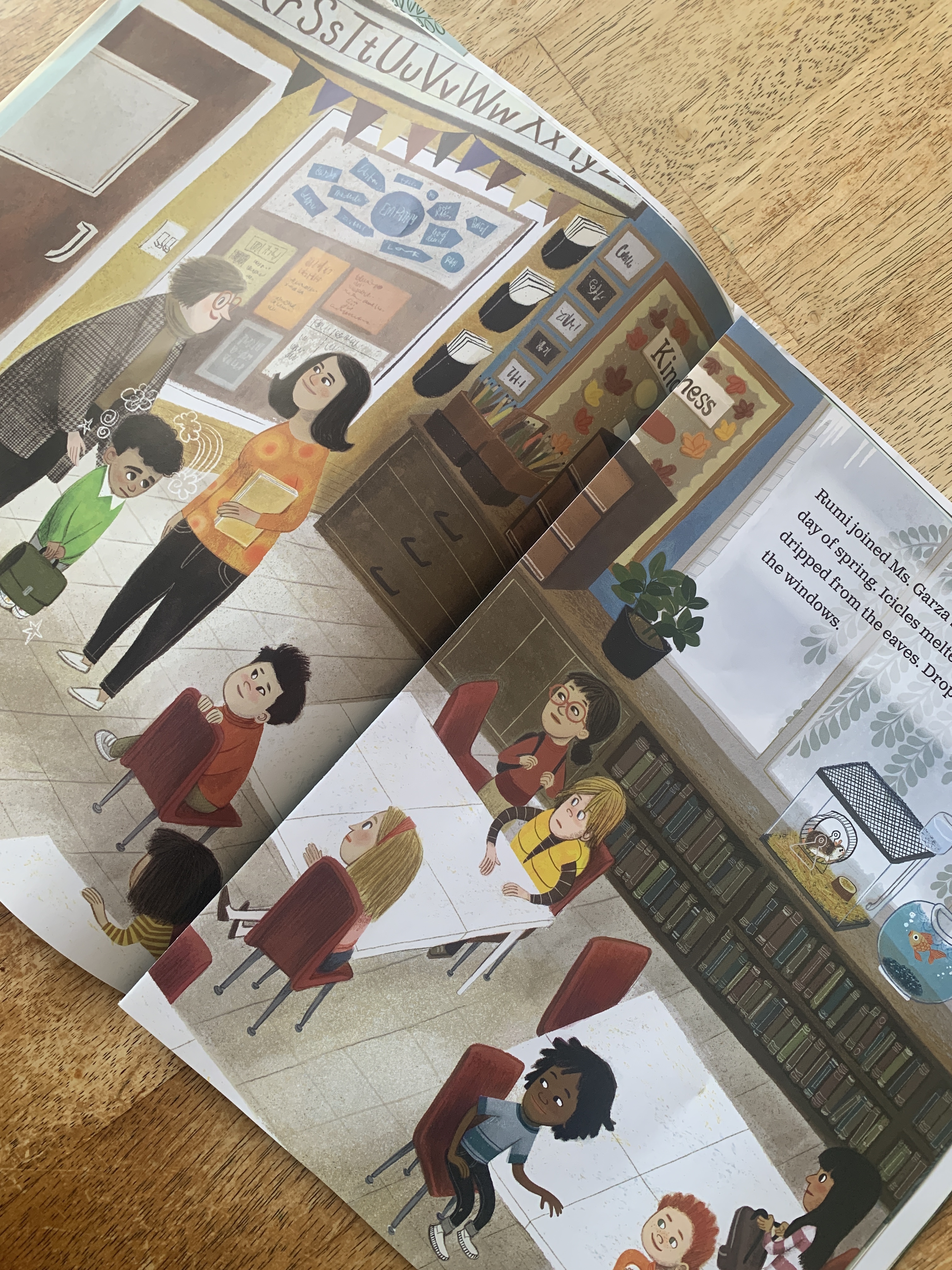
Rumi is quiet, and on his first day in Ms. Garza’s class the kids stare at him as he stares out the window.  At recess he wanders off to sit beneath the willow tree when Asher, Ella and Han leave the swings to see what he is up to.  Asher and Ella start to make fun of Rumi, Han is uncomfortable, but stays quiet.
Rumi recalls coloring his shoes with his friends, and how different it was to where he is now, he picks up a twig to twirl as the hurt grows. In music class when the giggling starts, he tries not to cry.  At recess he retreats to his refuge under the tree.

When the bullying escalates, and tears fall, Han speaks up and breaks the cycle. Others follow and see the world Rumi has created with his twig and are drawn to it and to Rumi.  Forgiveness is asked for, and granted and the tree becomes a place of friendship and togetherness.

img_7928

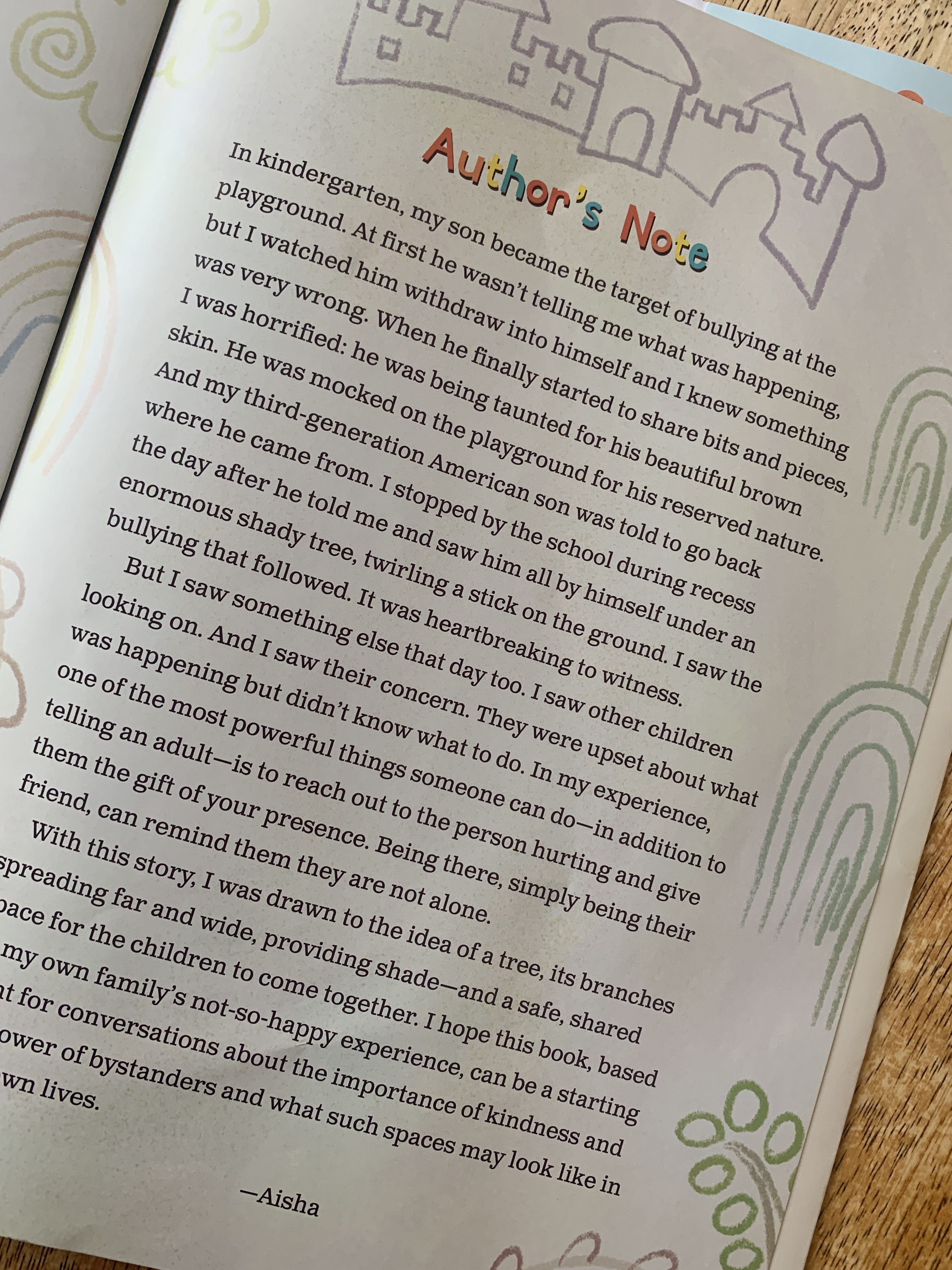
The Author’s Note shares the real life observations of the author about her son in kindergarten and how while heartbreaking, there was also hope in the concern shown by other kids that simply weren’t sure what to do.  I love that even though Rumi is being teased for his shoes and being different, he doesn’t stop wearing his shoes or try and clean the drawings off.

img_7926

I think this book is a must read in classrooms and homes were kids can slowly peel back the pieces and see where they can relate, how they can plan to act, and what parts they identify with.  The book is deliberate and slow, and while a child could read it on their own and enjoy the story and illustrations at hand, the real power it has, is being a catalyst for discussion and empathy and speaking up.

Pre order/order here on Amazon

img_7927


Egyptian Lullaby by Zeena M. Pliska illustrated by Hatem Aly

Standard
Egyptian Lullaby by Zeena M. Pliska illustrated by Hatem Aly

There was a time in college when my friends and I would gift each other Cinderella retellings and versions from all over the world, that was nearly 20 years ago, and I haven’t thought much of it, until this book reminded again of “This is the House that Jack Built.” Having just read and reviewed “The Masjid that Kamal Loves” which is structed similarly, I can confidently say forget Cinderella, I’m loving this new trend, of a repetitive layered story conveying love and excitement and joy to little readers in such an engaging way. This book has more of a story than the original and shows relationships and longing, even though it is primarily a love letter to Cairo.  The swapping out in some verses for Arabic words and English translations, the sound affects and the connections really elevate the OWN voice details in the text and make the book an absolute treat to read and share even for those of us who are not Egyptian and have never visited.  The Auntie who visits wears hijab, the muezzin calling Allah u Akbar is a repeated refrain, their are numerous illustrations of women in hijab and a masjid is shown repeatedly throughout allowing Muslims everywhere to feel seen with this culturally specific story.  The Glossary with the Arabic script and pronunciation guides and Notes from the Author and Illustrator really radiate with love and invite the reader to participate in the celebration on the pages.  I have no doubt children (and their parents) three and up everywhere will fall in love with the 40 page story and delightful illustrations.

Auntie Fatma comes to visit a little girl’s family from Egypt and brings sahlab and changes for two weeks to the home.  Arabic is spoken, and a nightly lullaby of the sounds of Cairo are among the beloved additions to connect the little girl to her Auntie and her culture.

The lullaby begins with the sound of the Nile, the boats floating through the city, the athan calling to prayer, the carts on the streets, the traffic.  The halawa ya battekh, swish, swoosh, swish, Allah u Akbar, beep honk toot, all add layers to the bustle of the city as the little girls memories of the sights and sounds of Egypt soothe her to sleep.  When it is time for Auntie to return the little girl’s sadness is palpable, but Auntie finds a way to reassure her and all those that have drunk from the Nile and long to return.

It is hard to say if the text adds to the illustrations or the illustrations to the story, both combine to make this book impossible to read without smiling.  I love that the mosque is shown in the daytime and at night implying that the call to prayer is not a one time thing without articulating that Muslims pray five times a day. I don’t know if the author identifies as Muslim or if the inclusion of the athan and Allah u Akbar is just an environmental reality of Egyptian daily life and thus featured.  The illustrator could have very well added the hijabs on his own as there is nothing religious or explanatory in the text.  Perhaps it is worth noting that there is a dog in the family’s home that seems to sleep with the little girl.  The book is a cultural heartfelt portrayal, and that Islam is prominently featured so beautifully made for a lovely surprise.

I hope you will consider preordering the book here, requesting it at your library, and sharing it on classroom and home bookshelves.  Happy Reading!

The Masjid Kamal Loves by Ashley Fraklin illustrated by Aaliya Jaleel

Standard
The Masjid Kamal Loves by Ashley Fraklin illustrated by Aaliya Jaleel

img_7811

I don’t normally post about upcoming releases this far in advance (2.5 months), but I am hoping that if I share the link for preorders, I just might help in signaling to the traditional publishing world that books like this are so so so important and that we will support unapologetic, well written, Muslim centered, Muslim and Black joy featured books with our purchasing power.  This book is incredible for toddlers to early elementary in its “This is the House that Jack Built” format.  Muslim kids will giggle with excitement as they see themselves happy to see their friends at Jumu’ah, flinging shoes a little too hard before entering the musallah, splashing a bit when making wudu, playing while helping put out the prayer rugs, and getting a little wiggly or tired during the khutbah.  The happiness and love radiates off the pictures and through the text that even non Muslim readers will feel our connection to our Masjids and the prayers that occur within.  Muslim authored, Muslim illustrated, masjid not mosque, and a beautiful Author’s Note, makes this book a must have on every shelf where young children need books that mirror their experiences and provide windows into the beauty of Islam.

img_7814

The book starts out describing Kamal’s smile and offering the reason for such joy as being Jumu’ah at the masjid. It then starts with describing the masjid and all that is contained with the lines adding on the refrain of “the masjid Kamal loves.”  The friends, the shoes, the feet, the rugs, etc.. Terms such as imam, ummah, salaam are in the text and the illustrations show wudu, salat, khutbah, conveying a Jumu’ah experience.

img_7813

Each page is brightly illustrated across horizontal orientated scenes.  The expressions on the kids faces, are engaging and smile inducing and the lyrical text has a rhythm and strength that makes you feel proud to also have a masjid to love like Kamal.

img_7816

I have an arc, but have preordered a copy for myself here and hope you will do the same. Please also request your public libraries to order it, and if they have already you can place the book on hold, inshaAllah little steps to show support.