Category Archives: OWN Voice

Idrees and the New Old Shoes by Hoda Elmasry illustrated by Tiemoko Sylla

Standard
Idrees and the New Old Shoes by Hoda Elmasry illustrated by Tiemoko Sylla

img_4191-1

This sweet 28 page book keeps the text to a minimum while showing a boy with a lot of heart doing what he knows is right, even when he knows he will be laughed at.  I really love how the story draws readers in and conveys a lot, without over explaining.  Ages preschool and up will understand that Idrees wants new shoes, but second hand shoes are what are available.  That he wants to prove how fast he is at school, but that being a good neighbor is the right thing to do.  Based on the illustrations, the family is Muslim, mom wears hijab when out, but not at home, but there is nothing in the text that articulates the family’s faith.  The author is Muslim and the book is published by Ruqaya’s Bookshelf.

Idrees can’t wait for his new shoes so that he can beat Harris and be the fastest runner at Barton Elementary.  When mama comes home, she has shoes, but they are not new, they are hand-me-downs from the neighbor Mrs. Freeman.  Things are not the same as last year for Idrees and his mom, but with help from the neighbors they get by.  They also look out for Mrs. Freeman who is always forgetting something or another it seems.

Idrees doesn’t think he can beat Harris with these old shoes, and dreads being teased, but with some prodding from mama he tries on the shoes and heads out the door.  He gets to school in record time and things are looking up.  Harris has jokes when he sees the outdated sneakers, but Idrees is confident he can win the race.  When Mrs. Freeman shows up lost though, somehow the race just seem that important.

The book is available here at Crescent Moon Store where my initials ISL will save you 10% at checkout.

Idrees and the New Old Shoes

The Magical Moroccan Rug by Naveed Mir illustrated by Anisa Mohammad

Standard
The Magical Moroccan Rug by Naveed Mir illustrated by Anisa Mohammad

img_4186-1

I really like the premise of the book, a Muslim Magic Tree House so to speak, two kids that magically go back in time, in this case to Andalucía. At times the book did make me smile, but really it feels like a missed opportunity.  The writing needs tightening, it feels early reader at 94 pages long with a few full page illustrations, but the vocabulary and text filled pages support the suggested reading level of middle grade.  It takes way too long to build up to the “action,” and when it gets to the plot it doesn’t seem to know what to do with itself.  It is a lot of walking this way only to turn around and walk back for no development, character growth, or enriching reason.  As an adult I had to force myself to keep reading, my eight year old who loves Magic Tree House books had basic foundational questions and couldn’t’ get past page 24.  Honestly it just needed some proof reading and some trimming, which is why I found it so frustrating; it really had so much potential.  Example, if the little boy is so excited to see his grandfather after 8 years, why didn’t he go with his dad to the airport, why did his elderly tired grandfather immediately go to a community event after arriving in the UK from Morocco, why wouldn’t Yusuf go with his beloved grandfather to the masjid.  And this is all within the first few pages.  If the logic isn’t there for the mundane set-up, it is hard to get on board for the fantasy aspect of a flying carpet going back in time.  The historical figures are introduced in passing and don’t leave much of an impression, so yes it is good to give readers a bit of information on people they may not have heard of before, but it doesn’t give them enough connection to make them memorable.  The backmatter sadly is not more information about the three historical figures presented: Abdur Rahman (The Falcon of Andalus), Lubna of Cordoba, and Abbas Ibn Firnas, it is a glossary and a Quick Quiz.  The answers to the quiz are not provided, there are additional facts shared but no sources given, and there is urging to find out more about Muslim Spain, but no directions, links, or book suggestions are provided.  The publisher should have proofed the book, it reads like a pitch, maybe a first draft, and our children and their purchasing adults deserve better.  We have growing options of stories with historical Islamic OWN voice framing, and unfortunately this book had a lot of potential, a few pages of interest, but not ultimately enough intrigue to win me, or my kids over.

img_4187-1

SYNOPSIS:

Yusuf and his friend Jack live in the same neighborhood, but don’t go to the same school.  They spend a lot of time together though, and have known each other since they were babies.  When Yusuf’s grandfather comes to visit from Morocco, he brings an old carpet and gifts it to his 10 year old grandson.  Unsure what to do with it, Yusuf puts it in his room, and feigns gratitude.  With a history project looming, and a dislike for historical study, Yusuf and Jack find themselves heading on a magic carpet ride into the past.

They arrive in Cordoba in 856 CE, disoriented and dizzy, Omar, their guide, greets them, walks them through the mosque answers one question then walks them back to the carpet to take them to a different time, 786 CE and they see diverse people living together peacefully.  They first observe “one of the greatest rulers that Andalus ever had,” The Falcon of Andalus, aka Abdur Rahman.  He is a humble leader that freely interacts with his subjects.  They then head to the 10th century to see Lubna with a crowd of scholars in Cordoba  learning from her in the library.

When Yusuf remembers his history project about flight, Umar guides them to 875 CE with a pit stop in CE 852 to see Abbas Ibn Firnas take flight, well fail and then eventually take flight in 875.  The boys then say their goodbyes and are whisked away home. Where they can’t believe what transpired, and are determined to figure out how to make it happen again.

img_4188-1

WHY I LIKE IT:

I like the concept, and that Jack is not Muslim, and Yusuf is unapologetically Muslim.  Seeing the two interact is enjoyable and both good modeling, and mirroring.  The heart of the book is truly not bad, it is the tangents that get long winded for no advancement of the story that take away from the flow.  As stated above the relationship between Yusuf and his grandfather doesn’t align with what is said and what is shown.  The end suffers the same lack of editing.  How can grandpa and Yusuf live in the same home, but they can never find a moment to talk.  Nothing is gained by delaying their conversation, so why delay it, and go on and on about delaying it?

If the point is to share not just with Yusuf and Jack about key historical figures, but with also the reader.  Then there needs to be more interaction with the characters, not just watching them from afar.  Interact with other observers or students or colleagues, convey information from a “personal level” not just drop a snippet here or there from what feels like a vague Wikipedia page.  If the book is not sourced, why not take some fictional liberties and flesh out Abbas, Lubna and Abdur Rahman, so that they are remembered. Include more information about the three real characters in the backmatter, reinforce the idea that a magic carpet is not real, but these remarkable people were, and they changed the world.
I don’t know that kids will have issues with how the carpet worked, but because the set up was so weak, I had a hard time going along with any of it.  I wanted to know why it had to be a grandson, not a son or daughter, how grandpa or his grandpa figured that out when it wasn’t a relative that gave the first Yusuf the carpet, but a storyteller.  How Umar knew to look for them at that moment.  Why did they go to 856 CE and then go to 786 CE why couldn’t they just meet Umar on the first stop? Seems unnecessarily dragged out, for no reason.  When was grandpa’s last trip? Could you get stuck out of your time? If no one can see or feel the rug, why do they keep hiding it? Can people see and hear them, or only their guide?
I like that Yusuf prays and Jack knows that Yusuf prays, and what a mosque is.   I didn’t like that they hear the athan, and went with everyone to pray, but then just left without praying.  The book seemed to do that a few times.  Have the kids walk through a crowd presumably toward something or for some purpose only to turn around and return to the place of origin having gained nothing, learned nothing, or seen anything, again just drags the book out and frustrates readers.

There really is not conflict in the book, no climax either, there is no really stress about getting back, stress about figuring out how to go on the next adventure, it is there, but not heightened, and it is unfortunate, because the book really could be adventure filled, and it just isn’t.

img_4189-1

FLAGS:
None

img_4190-1

TOOLS FOR LEADING THE DISCUSSION:
If you are learning about Abbas Ibn Firnas, or Lubna, or The Falcon of Andalus or Spain, and have access to supplemental material, the book has value.  I don’t know that if a kid picked it up off the shelf even with interest in history, that they would finish reading the book.  It doesn’t provide a solid feeling of learning or understanding about the time and place and people seen in the time travels, nor is it action packed on its own.  So if you can motivate a child to read it and then look further into it, the book would help connect the past as being interesting and engaging, but on its own, the book does not achieve that.

My Big Fat Desi Wedding by Prerna Pickett, Aamna Qureshi, Syed M. Masood, Tashie Bhuiyan, Noreen Mughees, Payal Doshi, Sarah Mughal Rana, Anahita Karthik

Standard
My Big Fat Desi Wedding by Prerna Pickett, Aamna Qureshi, Syed M. Masood, Tashie Bhuiyan, Noreen Mughees, Payal Doshi, Sarah Mughal Rana, Anahita Karthik

EDIT: I have been made aware that some/many of the included authors in this anthology have chosen to stay silent or “both side” the ongoing genocide in Palestine. Please be aware and be intentional and informed with your support

This 288 page YA short story anthology features eight stories of Desi weddings threaded together by an auntie with a bob haircut and a mole on her lip that appears and disappears into stories with magical realism, Tamil Brahman vampires, competing food dynasties, high school debate rivals, gorgeous clothes, delicious food, and sparks of romance.  Usually collections are hit or miss with writing quality and interest, but I found this collection enjoyable from start to finish.  My only real critique is that of the YA label and as a result some stories read more juvenile and at least one a bit more mature.  As a whole, the book, particularly for the genre, is fairly clean.  It is YA, it is romance, there are a lot of Muslim characters, with five of the authors being Muslim, but I would not classify any of the relationships or stories as halal.  That being said, I think mature teens 16 and up won’t find anything too alarming in the pages. There is music and dancing, close male female friends, secret relationships, a few kisses, some dances and hand holds, and a few that mention sex, condoms, and LGBTQ+ possibilities in passing, but most focus on weddings, culture, parental relationships, strong women, caste ideology, and hinting at happy every afters.  Many of the stories are simply set during a wedding or wedding prep, others are the bride or groom themselves, I don’t have a favorite or even a least favorite, as each has its own flavor, writing style, and focus.

SYNOPSIS:

Framed from an Auntie embarking on the wedding season, the short stories begin and follow one after another until the Auntie returns to conclude the book.

The Disaster Wedding by Prerna Pickett:  In a family where the words the females speak can come to fruition, an erroneous slip, claiming that her sister’s wedding will be a disaster brings on the challenges for the enemies to lovers side characters trying to not upset the marital couples multicultural Indian/American dream wedding.

A Cynic at a Shaadi by Aamna Qureshi follows a young Muslim girl nursing her broken heart from a recent breakup with her secret boyfriend.  Set during her cousins wedding, an upbeat optimistic boy makes her smile and gives her heart hope.

Sehra by Syed Masood involves a Muslim marrying a non Muslim girl that has the family refusing to attend.  The groom-to-be’s brother is torn and wants to attend, but he never goes against his parents.  His best friend who has grown up with the family and is facing her own community othering because of her “Mickey Mouse” hijab style, is planning to go, and together the two friends help wrap the groom’s turban.

Fates Favorites by Tashie Bhuiyan features magical realism with the words of soul mates appearing on skin.  The words appear and disappear sometimes unseen and possibly even as a result of one’s subconscious, thus the couples don’t always find one another, but when they do, the relationships can be magical.

The Wedding Biryani by Noreen Mughees is possibly the most religious of the short stories with high school debate rivals finding themselves cooking at the masjid for a couple that doesn’t have a family to celebrate the marriage.  Themes of losing a parent to death and simply leaving are present, as well as some internal reflection of boundaries, Allah swt, and body image.  The conclusion is the teens meeting up to dance.

A Confluence of Fates felt like the longest short story, and while many Zoroastrians it notes did come to India, the story focuses on Iranian Zoroastrian culture.  It is almost a story within a story as a couple gets a second chance at their relationship with the backdrop of a marriage play during the wedding unfolding in the background.

A Wedding Recipe for Disaster by Sarah Mughal Rana has competing family businesses: one Punjabi and the other of Pashtun culture, coming to a head when the offspring of the rival companies decide at the girl’s wedding to someone else, that they should be together.  With vibes of a Romeo and Juliet style family feud, the happy ending has readers craving achar and contemplating racism within the community.

And finally, A Very Bloody Kalyanam By Anahita Karthik goes gothic with a Tamil Brahmin vampire wedding occurring when offspring from two enemy cults imprint on each other.  This story is more mature with talk of sex, but has an emotional forgiving between the bride and her parents that makes the vampires lovable.

FLAGS:

It focuses on romance, and none of the stories are “halal.”  Music, relationships, boy girl friendships, Talk of sex, hints at LGBTQ+ identities, mention of condoms, vampires, magic, magical realism.

TOOLS FOR LEADING THE DISCUSSION:

Probably not a book to seek out for an Islamic school shelf, high school can probably handle it and understand it is not halal.

Shiny Misfits by Maysoon Zayid and Shadia Amin

Standard
Shiny Misfits by Maysoon Zayid and Shadia Amin

img_4083-1

I admittedly wanted to read this book because the author is of Palestinian descent. I have seen clips of her standup and I’m not a huge fan, although I do appreciate that she doesn’t deny her culture and Islam, doesn’t let her cerebral palsy keep her from working toward her dreams, and that she is successful.  All good messages for a 256 page middle grade graphic novel that is not autobiographical, but draws on her life none-the-less.  I was surprised, though, that there are no Palestinian references in the book, very few Arab cultural touchstones either, and yet swearing on the Quran and not eating pork are presented fairly often, almost as “bits” to be laughed at.  I truly understand that the character is presented as culturally Muslim more than centering Islam in her identity, but perhaps because the protagonist, Bay Ann, is rather unlikeable, it just rubbed me the wrong way.  I love that the people in Bay Ann’s life do not caudle her, and that she is fierce and dramatic and driven, but she is an awful friend, her obsession with Alyee Maq (yes full names are used throughout) gets annoying, and I worry that some of the humor will be missed for the younger target audience and be taken as Muslim or Arab norms.  The presentation of a disability in a well illustrated graphic novel is empowering, an amazing Arab dad is nice to see, a divorced family co-parenting is important, but the foundation for much of the story is Bay Ann’s crush on Alyee Maq, he does kiss her on the cheek for social media likes, the book starts with Halloween Idol, features dancing throughout, and concludes with a Nondenominational Holiday Spectacular.  Bay Ann’s mom is not very kind or involved, and Alyee Maq’s mom, the only hijabi in the book, also is rather rough.  This is a book where I acknowledge my own overthinking, as both an adult reader and reviewer.  If you are ok with the (random) Islamic rep, kids will benefit from seeing Bay Ann as a fully capable person who happens to have a disability.  I’d suggest seeing if your local library has the book and looking through it first to see if you are comfortable passing it on to your kids.

SYNOPSIS:

Bay Ann is a tap dancer and with Halloween Idol coming up, she plans to win.  Her best friend Michelle is going to do her make-up as a zombie bride, and be her zombie bridesmaid with Davey Matt, the third in their trio, being the dead ring-bearer dog.  They can’t be her backup dancers because she is a one woman show, but she needs them to cheer her on.  When she wins, she has the spotlight stolen from her by Alyee Maq kissing her claiming he is making “a sick girls dream come true.” The clip goes viral, as Alyee Maq is a bit of a celebrity and the competition is on.  Whether it is science fair, social media posts, or the class debate, Bay Ann is determined to knock Alyee Maq down, claim the online spotlight, and  prove her talent is more than her disability.  With each attempt failing, her resolve grows stronger and her tunnel vision pushes those closest to her away, as she joins Alyee Maq with the hopes that if she can’t beat him, she will join him and achieve the fame she seeks.

WHY I LIKE IT:

I know the book is rather intentionally ridiculous, but I wanted to cheer for Bay Ann, and I never really liked her.  I don’t like how she treats Davey Matt, or even Michelle.  If she was better to them at the beginning, I think it would have shown how disconnected her mom Malak is as well as the school administrators, and made it more funny, but it truly just makes her seem like she is awful to everyone, and thus you don’t really find yourself invested in her stardom, her friendships, or her defining her own narrative.

I wish their was some Arab rep, not just a few Arabic words tossed in here and there.  I also wish there was more Islamic centering, or honestly even less. The swearing on the Quran really bothered me, Friday prayer is mentioned in passing, but there is no impact on the characters or the story, so it seemed misplaced.

The pacing of the story is rushed, and at times a bit chaotic.  I think it is intentional, but it makes it hard to connect to the characters or to grasp their motivations.  I don’t know that I truly ever understood why Bay Ann wants the spotlight, or why Alyee Maq is famous, or why Davey Matt hangs around Michelle and Bay Ann when they belittle him. It doesn’t need to be thoroughly explained, but when you finish the book, and feel exhausted, but can’t even articulate what the book was really about other than a girl that wants to be famous for her talent not her shaking, and won’t let anything or anyone get in her way, it seems like some opportunities were missed.

FLAGS:

Close male and female friendships with touching, an unwanted kiss, lying, manipulation.  Swearing on a Quran, disrespect. Using people.

TOOLS FOR LEADING THE DISCUSSION:

I don’t know that I would seek this book out to own, but in an Islamic school library if it found its way in, I would probably not object to it being shelved.

Lion on the Inside: How One Girl Changed Basketball by Bilqis Abdul-Qaadir with Judith Henderson illustrated by Katherine Ahmed

Standard
Lion on the Inside: How One Girl Changed Basketball by Bilqis Abdul-Qaadir with Judith Henderson illustrated by Katherine Ahmed

This nonfiction picture book memoir is about Bilqis Abdul-Qaadir’s love of basketball, accomplishments, and ultimate decision to choose her hijab over her career.  For elementary readers the 40 page book reads like a story, and shows what it means to work hard, be talented, stay true to yourself, and be willing to fight for what you believe in.  As the Massachusetts State high school basketball scoring record holder and the first NCAA hijab wearing Muslim basketball player, she was forced to leave the fight on the court and instead fight to change the rules regarding headgear for women playing international professional basketball.  She won the fight, but unfortunately it was too late for her, she now advocates for Muslim girls in sports to not have to choose to cover or play.

The book has a flow as it starts from her being born into a basketball family, and shooting hoops at three.  She plays with her brothers with her grandma, Mudgie, always cheering her on.  Her mother’s strength grounds her and at age 12 she puts on her mother’s hijab and heads out to play ball.

At 14 she is wearing her own hijab and playing on the high school team, her hijab is her super power, and reminder to be fierce, faithful, and kind. When the ref halts the game and says she can’t wear her hijab, her team stands with her, until the game resumes.

She gets a full scholarship to the University of Memphis and plays her final season at Indiana State.  She meets President Obama and beats him in a game.  When she decides to play international though, again she gets told she can’t unless she removes her hijab. She chooses her faith, and when she finally gets the ban overturned, it is too late for her, but not for other Muslim girls.

The book concludes with some photographs, additional information, discussion questions, and places to discover more.  I appreciate that it shows her praying, but I wish it gave just a little insight as to why Muslim women cover, why it is part of our faith.

I found my copy at the library, it is available to purchase here.

Sister Friend by Jamilah Thompkins-Bigelow illustrated by Shahrzad Maydani

Standard
Sister Friend by Jamilah Thompkins-Bigelow illustrated by Shahrzad Maydani

img_3521-1

After years of teaching, librarian-ing, and mothering, my reviewers are for adults, but with kids in mind. I read in different environments and try and balance what children will think with my more critical literary impressions. But honestly, my first reaction when I see Jamilah Thompkins-Bigelow has a new book out, is not about the children, or their parents, it is incredibly selfish, and I want to read the picture book for me.  It has been about a year since I first read my all time favorite, Salat in Secret, and I still feel all the feels, every time I read the book. I even enjoy handing the book to people and watching them read it for the first time.  So, I was both excited, and nervous to read this new book, not knowing if it would measure up to my expectations or rather hopes, so to speak.  I needn’t have worried, subhanAllah, this book in it’s own right is moving, heartfelt, layered, powerful, hopeful, relatable, tender, and while staying on a kindergarten to second grade level is also unapologetic with its centering of Islam, race, and feeling invisible, being new, and making a friend.  The illustrations and words blend beautifully, and by the second page of the 40 page book, I was already emotionally attached to the little protagonist Ameena.  Good writing is good writing, and as a result this beautiful book works for all ages and will be appreciated on multiple layers even after dozens of readings, alhumdulillah.

img_3522-1

The book begins with Ameena playing a game by herself.  She always plays by herself at school, where she tends to be invisible.  Maybe it is her hair in twists or her brownness, she doesn’t know.  One day a new girl comes, her name is Sundus, she wears hijab like Ameena wears to the masjid.

All day Ameena tries to talk to Sundus, but something always seems to keep them apart.  When they finally meet,  Ameena’s excited words get all tangled, and a misunderstanding occurs.  Ameena decides the next day to transform into a rockstar: red-orange hijab and matching boots. The other kids say she is copying the new girl.  Sundus doesn’t say anything.

img_3523-1

Ameena disappears again at school, but family night at the masjid is her happy place.  Where she doesn’t play alone, and there are lots of browns, and she is seen.  When Mama meets a new sister, and greets her with Assalamu Alaikum, Ameena sees how a greeting and a hug can be the start of sisterhood and friendship. And the next time Sundus and Ameena meet, they know just what to say.

img_3525-1

The joy at the end forces you to smile, just as Ameena playing alone at the beginning tugs at your heart.  It is a great book to see yourself and see others in a beautiful, authentic way.  The universal themes of not being seen, making a friend, and being the new kid, are woven in just as hijab, masjid and Assalamu Alaikum are, making the book powerful for Muslim and non Muslims alike.

img_3524-1

I particularly love that their is no glossary, and that the text uses the word masjid not mosque, hijab not scarf and Assalamu Alaikum not salam.  That the masjid is her safe place to laugh and play, and that this book is mainstream published and will find its way to public spaces and be widely accessible.

You can preorder your copy here on Amazon.

Eliyas Explains + Bite-Size Journal: Why Does Allah Let Bad Things Happen? by Zanib Mian illustrated by Daniel Hills

Standard
Eliyas Explains + Bite-Size Journal: Why Does Allah Let Bad Things Happen? by Zanib Mian illustrated by Daniel Hills

img_3601-1

The book stems from the genocide occurring in Gaza, but expands to cover the more general concepts of qadr (destiny), tests, and sabr.  The book assumes that what is happening in Palestine is known and does not discuss specific details, allowing the book to be both timely, yet universal.  As with all the books in the series, the conversational humorous approach appeals to children as foundational Islamic concepts are broken down and explained.  The book is 73 pages with the journal portion starting on page 33. In some of the other books, the journal feels more of a hands on to already shared information, or an accompanying workbook of sorts.  In this book however, I feel like the second half continues to explain the topic at hand, and convey key components in understanding why Allah swt, lets “hard” things happen, how we should view the tests, approach difficulties, and inshaAllah triumph. The book has been checked by a Shaykh, and I highly recommend this important book for elementary, middle grade, and even middle school children. The concept of qadr is difficult, I struggle to truly grasp what we can and cannot change, but this book helps readers focus on what we can change and how to view terrible things that happen to us and to others.

The book starts with Eliyas introducing himself and his family, and then wondering why “Israel is being able to do what they’re doing in Gaza.  Why isn’t Allah stopping it?” As with all Eliyas books, mom and dad are sought out, food is somehow worked in, and time and space are given to Eliyas and his siblings to be given an answer. His parents start by being glad that Eliyas’s heart is soft for the Palestinians and that he is bothered by what is happening to them, before explaining that a lot of understanding is trusting and truly believing that Allah swt knows best.

img_3625-1

The book uses hadith, ayats from the Quran, it even shouts out other Zanib Mian books, The Mindful Book of Wellbeing, for seeing the bigger picture and Eliyas Explains Why Should I Pray my Salat on how to make yourself strong to get through the struggles of this duniya.

The book talks about why Allah swt didn’t make everyone good, and it is clear in saying that being mad and sad are ok too, as long as we are not questioning Allah swt. There are prompts and questions (with answers) and the book is not heavy, despite the subject matter, the tone and approach stay on level and allow readers to connect, alhumdulillah.

You can get your copy here at Crescent Moon Store.

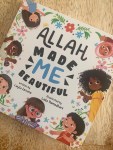
Allah Made Me Different by Maryam Abbas

Standard
Allah Made Me Different by Maryam Abbas

img_3535-1

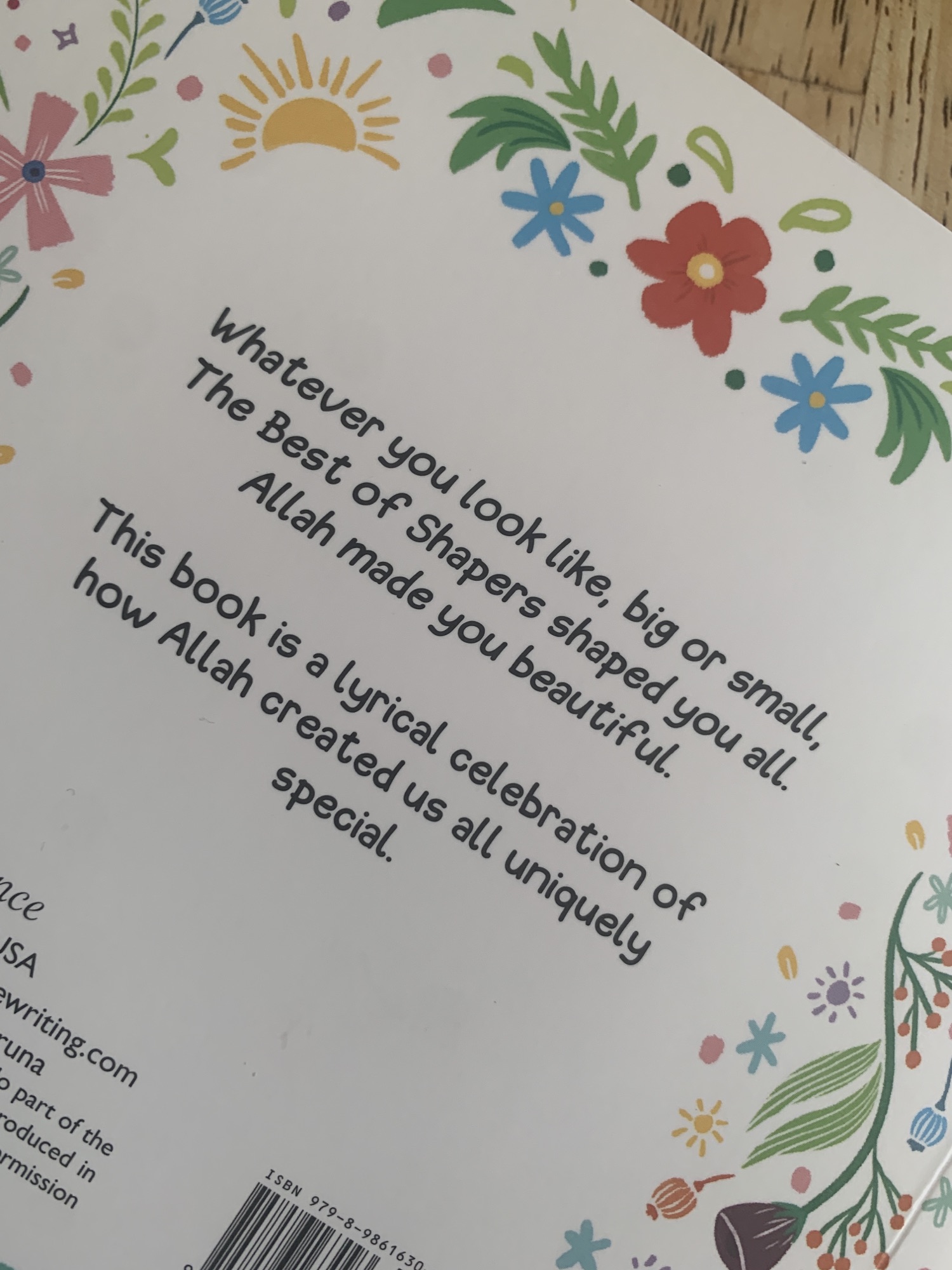
There is nothing revolutionary about this 24 page picture book, but it answers a basic question that children always ask from an Islamic perspective in an engaging and adorable way.  Toddlers and preschoolers will enjoy the rhyming lines, thick pages, and playful illustrations as they learn why they might look different then others. The book concludes with a dua for gratitude and circles back to the reassurance that Allah swt made us each perfect every few pages.  After multiple readings the pages do crease open, and thus I wish it was a board book.  The small size of 8.5 x 8.5 also makes it a little difficult to read to groups, but ideal one-on-one with little Muslims, alhumdulillah.

img_3536-1

The book starts with a child asking mama about the color of eyes and height.  Mama responds that, “Allah made you how you were meant to be.” The remainder of the book is reassurance that He made us with eyes right for us, hair perfect for us, etc..

img_3537-1

That we are different colors, speaking different languages, as Allah made us all unique, but with hearts to be kind.  Celebrating our differences and our similarities both in the text and illustrations.

You can purchase the book here on Amazon or at Crescent Moon Store.

img_3538-1

Come To Prayer by Salwah Isaacs-Johaadien illustrated by Zeynep Yildirim

Standard
Come To Prayer by Salwah Isaacs-Johaadien illustrated by Zeynep Yildirim

img_3530-1

Framed around the five fard prayers, the rhyming 26 pages take readers all around the world with the refrain of “come to prayer, some to salah, come to success, come to falah” appearing after each two page spread.  Reykjavik, Honolulu, Rio, Timbuktu, Kuala Lumpur, and Makkah are shown as families gather to pray in each city.  It is hard to know if the locations were chosen for a specific reason, or to just help with the rhyming lines.  I appreciate the map at the end in showing 18 masjids in the world, but they are not the only ones pictured in the book, so honestly it was not intuitive why they were highlighted. Additional information about the masjids included and where they are located in the world would have been far more beneficial.  The rhyming at times is forced, but for the minimal lines on the pages, and the clear organization of the book, it didn’t bother me too much.  The illustrations compliment the text well and amplify the concept of Islam being a global faith through the connection of Muslims praying everywhere.  The Islamic fiction book is meant for toddlers to early elementary, and with the positive tone of salah being an invitation to success, I think it works well for the audience.

The book starts with little kids waking up in a snowy scene in Reykjavik and heading out with their parents to pray Fajr at the masjid.  Then it is rain in Honolulu that can’t stop a family of five from driving slowly to the masjid for Zuhr.  In Rio a family packs up at the beach to get to Asr salah on time.  For Maghrib, not even a sandstorm across the Sahara can keep a family in Timbuktu from getting to prayer.  And finally a family takes shelter in the masjid for Isha as thunder and lightning in Kuala Lumpur halt their tour. The story ends with everyone entering Makkah in ihraam to pray at the Kaaba.

The book is a thick paperback cover, with glossy 9 x 9.5 inch pages.  It works well for small group story times or bedtime.  It is available on Amazon here or from Crescent Moon Store here.

Kareem Between By Shifa Saltagi Safadi

Standard
Kareem Between By Shifa Saltagi Safadi

img_3395-1

It doesn’t matter how many Word documents you read, Goggle docs you add comments to, and screen shots you revise; to hold a physical book in your hands that you have been blessed to observe from the sidelines through numerous revisions, is mind blowing.  Reading the final version from page 1 to page 324, plus the backmatter, has left me at a loss for words with tears streaming down my cheeks. I truly cannot imagine the book any other way. All past drafts and storylines, were just stepping stones to get the book to this version, and as a fan of literature my whole life, to see this metamorphosis in real time has added to my respect and admiration of authors.  Enough about me though, this review is of the middle grade novel in verse that tells the story of Syrian American Kareem, a loveable boy caught in between choices, siblings, friends, labels, and global acts beyond his control.  He makes mistakes, he tries to make things right, and at the center of it all is his Islamic identity, love of football, and genuinely good heart.  I am biased in that I have self appointed Kareem as my nephew, but even after dozens of readings, I was moved to tears three times during the course of this reading.  I made my teens read the book and they loved it, and like them, we hope we get more Kareem in the future.

img_3541-1

SYNOPSIS:

Kareem loves football, particularly the Bears, and dreams of seeing his Arabic name on an American jersey one day in the NFL.  Unfortunately, he hasn’t made the school team, his best and only friend Adam has moved away, and the coach’s son is offering to talk to his dad for Kareem in exchange for some school help.  Add in a new Syrian kid at school, his mom going to Syria to take care of his grandfather, and the fruition of Executive Order 13769 aka the Muslim Ban, and seventh grade has Kareem scrambling on every down to say the least.

img_3543-1

WHY I LOVE IT:

The football framing, the literary inclusions, the Arabic, the Islam, all combine with such tangible heart to create a seamless read both as a compelling story and as an example of literary craft.  The language is on point and intentional, that even if you don’t know the character or novel referenced, the Arabic words included, or football terminology used, you will be invested in the characters and plot, and find yourself cheering for Kareem.  Often debut authors show promise, but their stories have plot holes, or pacing issues, or inconsistencies, that is not the case with this book.  The crumbs are there that tie everything together, the depth of the characters’ personalities reveal how developed they are, and the timeline keeps the book moving forward.  There are no dry or slow spots in the entire novel, it is easily read in one sitting as you find yourself nervous for Kareem, and curious how it will resolve.

Boys and girls, Muslims and non Muslims, Arabs and non Arabs, all will find themselves drawn to this book, and thinking about the characters, particularly Kareem, long after the final page is read.

img_3544-1

FLAGS:

Some stress and anxiety with missing parents.  Death, bullying, cheating, fighting, lying, racism.

img_3540-1

TOOLS FOR LEADING THE DISCUSSION:

The book is a solid middle grade, but the quality of writing and engaging plot makes it work for a middle school book club read as well.  I cannot wait to share this book widely.

Preorders speak volumes and I truly hope if you are able that you will preorder a copy, you can do so here.  Requesting your local public library to shelve the book is also a tremendous help to signal to publishers what type of stories and OWN voice authentic representation consumers will support.