Category Archives: Muslim Author

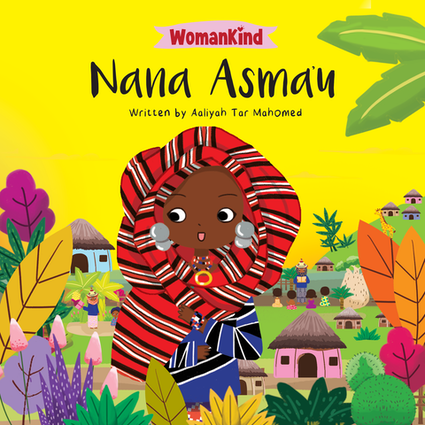
Nana Asma’u by Aaliyah Tar Mahomed illustrated by Winda Lee

Standard
Nana Asma’u by Aaliyah Tar Mahomed illustrated by Winda Lee

nana asmau

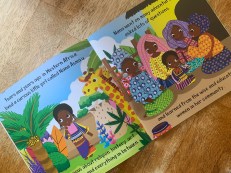
This book may only have 14 pages of text and be meant as an introduction for early preschool aged children and up, but I learned so much, or rather was made aware of so much that I knew nothing about, that I’m now eager to research her and the Sokoto Caliphate and the impact of Jajis.  The beautiful, bright, engaging pictures, the simple deliberate text, and the inspiring content matter make this a great book to share with little ones, and to keep on the shelf for repeated readings and reminders to learn more about this remarkable woman for older children.  My only wish was that there were some reference notes or sources included to give that extra reassurance of authenticity.

img_6076

The book tells about Nana Asma’u’s life starting from being a curious child and asking questions to the wise women in her community.  By the time she grew up she had memorized the Quran and spoke four languages amongst many other things, and Nana loved to write poetry.

img_6077

During this time, there was a lot of conflict in Western Africa, and Nana’s father, Shehu Usman resolved the issues and created the Sokoto Caliphate.  With peace, Nana wanted to help educate the people. She thought long and hard about how to do it.

img_6078

She eventually brought together women from different regions of the Caliphate and taught them through poetry, she then sent the women back to their homes to share what they had learned.  These women were known as Jajis, and this tradition still exists today.

img_6079

I didn’t love the phrasing that she had learned all about Islam, seeing as one can always learn more.  And I would have like Prophet to have been capitalized and salawat given for respect.  Overall, a great book that alhumdulillah I was able to purchase from Crescent Moon Store.

The Unexpected Friend: A Rohingya Children’s Story by Raya Rashna Rahman illustrated by Inshra Sakhawat Russell

Standard
The Unexpected Friend: A Rohingya Children’s Story by Raya Rashna Rahman illustrated by Inshra Sakhawat Russell

friend

I have mixed feelings about this book. On the surface I am thrilled that there is a story highlighting the plight of the Rohingya for children and that it includes some character depth and relatability to global readers. On the flip side, the book is very vague and could be any refugee in any camp and is not Rohingya specific. Additionally, I feel that it is too idyllic. I am no expert by any means, I wouldn’t even say that I am well-versed, but the book paints an impression of a thriving organized camp with medical help, orderly food lines and a vibrant school. Yes, it talks about the lines being long, and naturally if you are out collecting firewood, it is a bit rugged, but I don’t know that the lasting impression is a humanitarian crises. I understand that in a 36 page, kindergarten to 2nd grade book, political complexities and horrors are not a natural platform, but I worry that the aim of bringing attention to the situation will miss its mark by not capturing its truth more clearly.

img_5377

Faisal has just finished his afternoon prayer and while outside the mosque he hears a faint chirping and discovers a small bird with a hurt wing.  He and his friend Rahim take the bird to the learning center to be cared for while the boys head to the forest to collect firewood.

img_5378

The forest can be dangerous, but in order to cook, they must have wood to burn.  While in the forest, the boys encounter an elephant and remark on how they are depleting the animals’ natural habitat.  When leaving Faisal trips and falls, scattering his collected firewood and breaking his arm.

img_5379

Rahim offers to share his firewood with Faisal and the two head back to camp to get Faisal to the doctor.    Like the bird, who’s wing has been bandaged, Faisal now too has a hurt appendage.  The two spend every minute together for weeks, and when both have healed, Faisal admits he doesn’t want to let the bird free. He knows it is the right thing to do and alas allows the bird to go.

img_5380

The book has an afterword regarding Cox’s Bazar and information about the author and Save the Children Foundation.

Zayd & Musa in The Trouble with School (The Story of Halal Money) by Hafsa Ahsan illustrated by Yusra bint Absar Kazmi and Urooj Khan

Standard
Zayd & Musa in The Trouble with School (The Story of Halal Money) by Hafsa Ahsan illustrated by Yusra bint Absar Kazmi and Urooj Khan

money

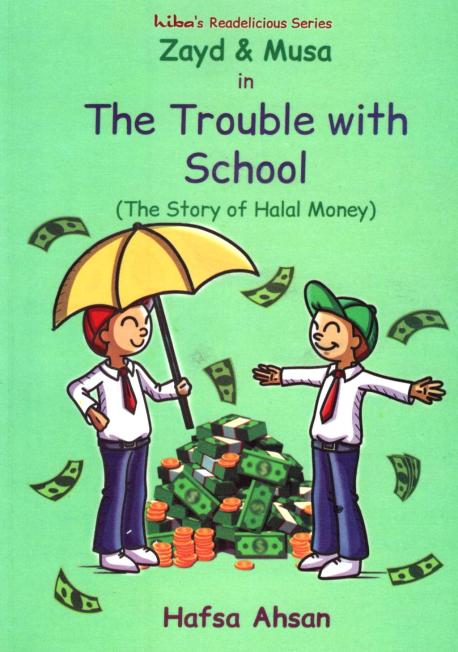
This delightful 70 page early chapter book is filled with humor, Islam, and a sweet story that ties it all together.  The book definitely has a teaching agenda, but it carries it with hilarious banter and relatable examples, all while covering a topic not often discussed in children’s books: money.  The book has a few grammar, vocabulary, and consistency concerns, but they are easy to overlook for readers 2nd grade and up.

SYNOPSIS:

Twins Zayd and Musa are very, very different.  Both boys enjoy cricket, but Zayd is more focused and enjoys homework, whereas Musa tends to daydream and often says something funny, but unintentionally.  When Musa makes the case in Science class that food, water, shelter, and money are all needed to survive, the class finds him hysterical.

Musa knows not to argue, his teacher is his elder and he knows he should have taqwa and be respectful, but he doesn’t give up on his idea either.  When the boys’ mom talks about halal money and gives them Islamic references for how money should be handled, Musa has a great idea: kids should be paid to go to school.

Once again, the whole school finds him funny, but Saeed Uncle, a neighbor who helps feed the poor at a roadside stand, doesn’t dismiss Musa’s idea and tells him, in some places kids are paid. And offers to take him and show him.

With references to sahabas who had great wealth and examples of how wealth can be used for good, Musa and Zayd learn numerous lessons, and share them with those around them, in a fun, engaging manner.

WHY I LIKE IT:

I get that the book is preachy, but in my mind, it is a story built around a teaching concept, so it doesn’t bother me.  I love the jokes and the tone.  At times the book is written quite formally, but being the author lives in Karachi, Pakistan, I assume that part of it, is just different standards.  I appreciate the Quran Circle table that lists where the Quran mentions wealth and the glossary.  I didn’t quite get all of the random facts included throughout, as some were about money, others about school, but I think kids will enjoy them none-the-less.  The illustrations are enjoyable, the text bubbles often hilarious (once again, a few I didn’t get).

I liked that it mentioned not drawing faces, and not going somewhere alone with someone you aren’t close with.  It is said in passing, but I love that those little nuggets exist in a book that is about something more, but normalizes and takes advantage of the opportunity to remind children of basic safety and Islamic concepts.

There are some awkward tense changes, and a few gaps in the story, but overall, I really enjoyed it and need to find the first one in the series.

FLAGS:

None

TOOLS TO LEAD THE DISCUSSION:
This would be a great book to use in a middle grades Islam class as a starting point to having students research the Quran and Sunnah to find information on a topic.  The humor will keep kids engaged, and the concept is an important one.  I plan to make all my kids read it, so that we can discuss as a family, and benefit from the lessons presented.

Eliya’s Explains Miracles by Zanib Mian illustrated by Daniel Hills

Standard
Eliya’s Explains Miracles by Zanib Mian illustrated by Daniel Hills

img_5692

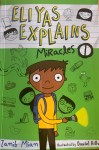
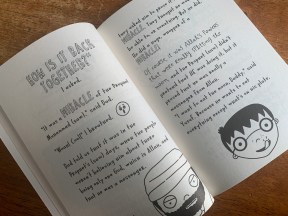
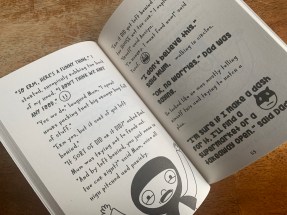
It is quite remarkable how my standards and expectations have grown and evolved.  I anxiously have waited for the next book in the Eliyas series, having loved the Angels book that came out nearly two years ago.  Zanib Mian’s voice makes the reading of nearly all her books enjoyable, whether it is a fictionalized tale or an Islamic knowledge book with fictionalized framing.  This book disappointed me however, because I now expect and crave references and sourcing for books that present facts or at least qualified and named scholarly approval to be mentioned.  I also was not comfortable with the depiction of Buraq on the cover, on a full page illustration within the book, and on the back cover.  The text itself is lovely and informative, and nothing “seemed” off factually in this 92 page early chapter book, but the lacking reassurance of the content contained within prevented me from truly loving the book.

img_5687

SYNOPSIS:

Eliyas has finally convinced his family to go camping.  With a late start and a lot of chaos they will have to set up the tent in the dark, alhumdulillah there is a full moon out.  As they drive to their campsite and marvel at the moon, they begin to discuss the miracle of the moon being split in to two.  As they find a place to settle, they discuss miracles about water, as they collect firewood they talk about the tree where Rasul Allah gave khutbahs from crying when he moved to give the khutbah from elsewhere.

The family of Eliyas, his younger brother, older sister and parents learn and discuss the miracle of the Quran, Prophet Dawud and Prophet Sulaiman peace be upon them both speaking with animals, Buraq and the night journey, Prophet Ibrahim (as) being in the fire, Prophet Musa (as) dividing the sea amongst other things, Prophet Isa (as)’s ability to heal the sick and with Allah’s permission breath life in to a clay bird, and the she camel miracle of Prophet Salih (as).

The camping trip, the siblings bickering and then helping one another, and Eliyas having to admit to forgetting the food, all tie the miracles together in an easy to read and engaging manner.

img_5688

WHY I LIKE IT:

I really love Zani’b Mian’s books, and I genuinely hope that she will consider removing the illustration of Buraq and having the miracles sourced, or the book “approved.”  Kids will read this book over and over again, long after they have grown out of the early chapter book demographic and inshaAllah it will inspire deeper knowledge to be sought.

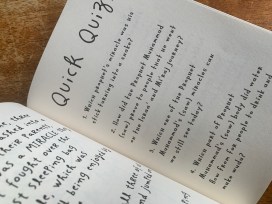
I love the quiz at the end-with answers, playful fonts and doodles throughout the book, the short chapters, and relatable banter between the characters.

img_5690

FLAGS:

Depiction of Buraq

img_5689

TOOLS FOR LEADING THE DISCUSSION:

Even with the depictions it could possibly be used as a read aloud story to first and second grade and up.  If you were a teacher or in a capacity to read the story to the students, so that they might not dwell on the illustrations, the book could be shared.  For reassurance, have someone more knowledgeable than I verify the miracles shared for accuracy though, before sharing.

This book, like so many of the books I review was purchased from http://www.crescentmoonstore.com and no I do not promote the store because it benefits me in any way, I just really the store, the service, the selection, and the prices.

You Truly Assummed by Laila Sabreen

Standard
You Truly Assummed by Laila Sabreen

We need more diverse books, especially within Islamic rep stories.  So I was so excited to receive an arc of this 352 page YA/Teen Black Muslim authored and featured OWN voice story.  I was prepared for rawness and grit and insight and all the feels.  Sadly to say, it is not that.  It is surface level plot points that are unexplored, disjointed, emotionless, and overshadowed by poor writing, contradictory details, and errors. Admittedly I saw an early copy and there is hope that the spelling errors, continuity mistakes and numerous contradictions can be fixed, but I highly doubt the narrative, character arcs, and holes, will or can be rewritten.  It is such a shame, because every time I was ready to put the book aside and claim I could not finish it, a powerful beautiful paragraph or sentence would pull me in and give me hope that the book would turn around and be what its own blurb claimed the book set out to do: “shatter assumptions” and “share truth.” In full disclosure, this book centers the intersection of being Black and Muslim, an experience I do not share firsthand nor claim to know in all of its multitudes and complexities.

SYNOPSIS:

Sabriya, Zakat, Farah: three Black female Muslim 17-year-olds in different parts of America, with different passions, different life experiences, and different dreams, take one alternating chapter at a time to tell their stories with occasional blog posts scattered between.  A terrorist attack in the in the D.C. metro, lots of serendipitous technology events, and a need to find community and the girls come together to create a blog that gathers followers and haters alike in the summer before their senior year.

Sabriya “Bri” is a ballet dance, and often one of two black ballerinas in class.  The book opens with her preparing for the summer intensive audition process when news of the nearby metro attack makes time stand still.  Her mom cannot be reached, and multiple people are killed and many more injured.  Bri and her younger sister Nuri identify like their father, as Muslim, but their mother is not.  It doesn’t seem to be much of an issue, except in that Bri’s mother often cannot relate to experiences her daughter is going through.  Bri asks Allah swt to keep her mom safe, but throughout the entirety of the book it does not mention her praying salat or actively showing she is Muslim aside from wearing an Allah swt necklace and her sorting through her desire to prove to others she is a Muslim versus eventually being content to be enough for her own self.  She does at one point refuse to cook bacon, but she does have a love interest, and Islam reads more of a label to her, than a practiced way of life.  Bri journals as a way to let off steam, and her younger sister Nuri encourages her to move to an app to blog.  Reluctantly Bri agrees, after being reassured that she can keep it private, she names her journal/blog ‘You Truly Assumed’ and accidentally sets it to public.

With the city reeling, the family commits to volunteering every day to provide food to those directly affected.  Bri is placed in a group with her father’s new boss and Hayat, a Muslim boy that she thought was a popular showoff, but is quickly falling for.  The micro aggressions from her father’s boss, who is also the volunteer group leader elevate, and the more she learns about him and his connection with an alt right group, the more she writes about in her journal.  By the time she realizes that it has all gone public, she decides based on the comments that she should keep it up, recruit more contributors, and get someone on board that is tech savvy.

Farah Rose lives in California with her mom.  Even though she knows who her father is, she has never had a relationship with him.  When her mom decides that this summer she should go to Boston to meet him and get away from the tensions following the DC attacks, she reluctantly agrees.  With a passion for tech, Tommy, her father persuades her by registering her for an intro computer science college course and a chance to meet her siblings.  Farah is nervous to leave her boyfriend, and worries about being a summer babysitter, but out of love to her mother, agrees to go.  When she learns about the blog, she joins to help with the tech side.

Once in Boston she struggles to connect with her father and his wife, but is immediately drawn to the children.  Her story provides some insight into the concept of privilege within black communities.  Her father and his family are not Muslim, nor did they seem to know that she was. Presumably the only reason it even comes up is when they serve bacon at breakfast and she mentions she is Muslim and a pescaterian  Farah meets a lesbian Muslim girl in her college class and learns that there has a been a hate crime and taken the life of her new friend’s friend.  Farah offers to help with the vigil and her commitment to the blog increases as hate crimes, and Islamophobes seem to be on the rise.

Zakat “Kat” seems to present the more “conservative” Muslim.  She lives in an idyllic town and attends an all girls Islamic school.  There is also an all boys Islamic school and they are big rivals of the public high school.  Kat loves art and often takes art classes in the Islamic school with music pumping through the halls, unfortunately her parents don’t want her majoring in art at school.  They were the victims of predatory college loans and want her to be more pragmatic in her chose of school and direction of study.  She is more sheltered and even has to go behind her parents’ backs to be a part of You Truly Assumed.  She shares her sketches and comics and art work and loves knowing that people are connecting with her work and messages.

When her quaint town becomes the victim of hate crimes, she has to decide if she is going to step up and use her voice, or blend in as she has always done.  Zakat prays regularly, often at the gender neutral mosque behind a female identifying imam, wears hijab, and deals with jealousy as her best friend becomes friends with a girl who years earlier bullied Kat.

The three girls’ stories intertwine as they become friends, share their own personal lives with one another, and thus the reader, and create a space to be seen and heard through the blog.

WHY I LIKE IT:

The book honestly reads sloppy.  I don’t know why it seems the growing trend is to not properly edit these Islamic OWN voice YA novels, but this is another book that indicates a troubling trend.  I love that these voices are emerging, but it sadly feels that editors are nervous or afraid to question things and demand better.  The book is so much telling and so little showing.  I don’t want to be told that the blog posts are powerful, and moving, I want to read them and feel moved.  I don’t want to read that you had to understand that you had to stop proving your religiosity to others and just live for yourself, I want to see the incidents and reflection that brought on that growth. I don’t want to be told that you are becoming friends with the other two bloggers, I want to see that they understand you when no one else does.  The whole premise of the book is to connect with the reader, but the emotion isn’t in the pages, so there is nothing to connect with unfortunately.  Saying there is a terrorist attack, saying that hate crimes are occurring, does not bring forth an investment to the story if details, context, and cathartic releases are not also included.

There are some basics errors.  Wudu is described in the wrong order, Zakat talks of living in Georgia in a fictitious town, but the landmarks and colleges are all accurate until she mentions looking out over Lake Erie.  I Google mapped it, there is no Lake Erie in Georgia (just the Great Lakes one on the Canada US border), it is only mentioned once, so presumably an oversight, not a fictitious landmark.  There are some spelling errors and grammar errors as extra words enter a few sentences (3%), dinner replace the word diner.  At one point it mentions the girls meeting on a Zoom call, and then the next line refers to it as a Skype call (54%).  The plushness of the Georgia mosque is often commented on, but they have to put down their prayer rugs to pray, this is pre covid, so a little off.

The book contradicts itself at 11% saying that they can drive to North Carolina or New York for auditions, while the rest of the chapter is convincing Bri to volunteer because they cannot. One of the reasons Farah left California was because of the tensions, but Boston is closer to the place of the attacks and also a large diverse bustling city.  When Farah is wanting to talk to Tommy and his wife about the vigil, she walks in to a room and comments on who is there, in the next line, it mentions that it isn’t a good time to have the conversation since Jess is not there.  Jess was just mentioned as being there and the conversation does end up taking place (84%).  When Bri has a blow up with her dad’s boss, Hayat is worried that she hasn’t been delivering meals all week as a result, later in the chapter it mentions that the conversation happened yesterday (77%).   When Bri introduces her friend to Hayat she doesn’t mention that the two girls know his little sister very well, and it seemed unnecessarily awkward.  Zakat stares off in to space and imagines a sketch and remarks that she has never shared a sketch before and it is something she wants to explore.  This is 81% of the way in to the book, she has been sharing her sketches on the blog since she joined.

In terms of Islamic representation, Zakat’s mosque has one entrance and doesn’t divide based on gender, there is a female imam, the steps of wudu are in the wrong order, the girls all seem to focus on their “Islamic” necklaces or rings as if they are such an integral part of the religion.  The girls never pause or hesitate to have boyfriends, kiss them, bring them around their Muslim family.  Even Zakat who reads really naive and young and goes to an all girls Islamic school decides that a logical event is to have a mixed gender party with music and none of the parents have an issue.  It is even held in a Muslim girl’s basement. There are very few salams or mashaAllahs or inshaAllahs, or bismillahs in the book.  There is music, dancing and dating.  Not naive to say that Muslims don’t participate in all these activities, but to not offer any pause, reflection, or clarification, in a book trying to show the life of some one who identifies as Muslim is a little puzzling.  At the beginning it mentions that Black Muslims are “othered” in Islamic gatherings, and I really wish this thread would have been a larger part of the book.  To see where the larger community is racist and lacking, to see where the engagements occur and where they fall short is a very unique lived experience that the book seemed to tease, but ultimately abandoned completely.

Plot points were not fully developed, a book of secrets was not built up or stressed and then became a huge issue without sufficient understanding as to why offered.  The hate crime in Boston that took the life of a young black Muslim girl was also not given enough weight in the story, or how she helped organize the galvanizing vigil.  The blog aspect was just not believable, so much happening by happenstance and then the material not being shown.  Show us the comics, the sketches, the passages.  Let us read the comments and show us your texts back and forth to see your friendship growing.  I loved the parts about Bri and her dad’s boss, about Farah’s father’s family and her interacting, the parts that mentioned Juneteenth and bean pie.  I wanted more immersion in to these characters lives.  To know their back stories and their struggles.  I wanted to feel like I was seeing something that for too long has not been given the space to be authentic and real, but ultimately I finished the book just glad it was over and I no longer needed to exhaust myself trying to imagine the book that it could have been.

FLAGS:

Domestic terrorism, hate crimes, death.  Relationships mentioned, straight and queer.  Transgendered and ungendered masjids, female imams.  Boyfriends both Muslim and non Muslim.  Mixed parties, dancing, music, art with faces, lying, cursing.

TOOLS FOR LEADING THE DISCUSSION:

I don’t think there is enough content to discuss in a book club setting, neither to relate to nor open ones’ eyes to.  I would like to discuss the book if any one has read it, if I am simply so ignorant of the Black Muslim female experience that I don’t get the book, I am happy to learn and listen and change, inshaAllah.

One Sun and Countless Stars by Hena Khan illustrated by Mehrdokht Amini

Standard
One Sun and Countless Stars by Hena Khan illustrated by Mehrdokht Amini

one sun

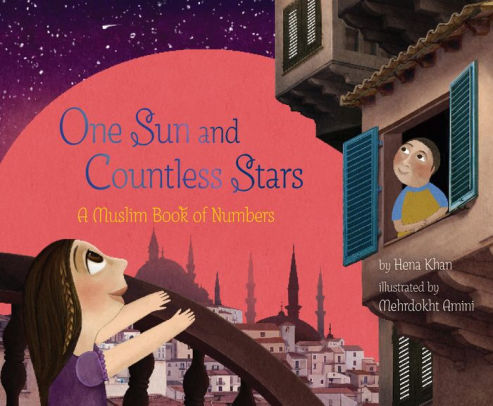
I don’t think that Hena Khan is necessarily a controversial figure, but some days her work feels very polarizing as some praise her ability to share OWN voice desi American Muslim stories while others feel like she waters down the very stories she is sharing to appease the majority.  Irregardless of our nuanced views, many of us first were made aware of her when we we were swept away in 2012 by the mainstream book, Golden Domes and Silver Lanterns.  Since then she also has published a book about shapes in the same format, and now this counting book that reminds me how beautiful and powerful it is to see Islam so unapologetically presented to all children.

Screen Shot 2021-11-10 at 10.25.04 PM

The author’s note at the end is important:

There are many significant numbers in Islam.  They include one for God, five for the pillars of the religion and daily prayers, seven for the circles pilgrims and visitors walk around the Ka’aba during hajj and more.

Mathematics and astronomy were among the intellectual pursuits of early Muslims.  They helped to develop algebra and used geometry to create the elaborate patterns found in Islamic art.

For this book, I chose concrete and illustratable terms rather than abstract concepts.  The representations for each number focus on things we can count in the world around us.

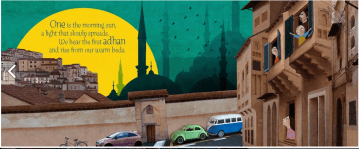
The book counts the diverse and global parts of a practiced faith.  The unique and the mundane, all beautifully illustrated and richly conveyed.  From cups of tea and shoes taken off for prayer to two hands making dua and four lines of a surah being memorized.  The book counts up to nine and then marvels at the countless stars that we see each night.

The first page is possibly a bit problematic in accuracy.  The tone and framing of starting the day with the sun rising and the sound of the adhan is warm and beautiful, but the adhan is not called at sunrise for the first prayer of the day, fajr.  Fajr begins at dawn.  There are only 21 words on the first page, so I’m inferring a lot about the correlation of the sun and athan that may or may not be present.  It is something frequently misrepresented, so it catches my attention. And yes, the seven tawafs mentioned in the author’s note would also apply to umrah, not just hajj.

Overall, the book is lovely and will remind many of us what made us all celebrate Hena Khan and her stories so many years ago.

This Woven Kingdom by Tahereh Mafi

Standard
This Woven Kingdom by Tahereh Mafi

woven

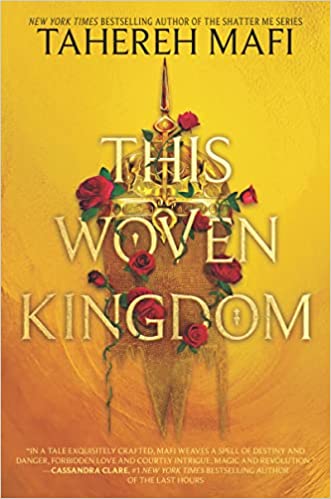
At 512 pages this teen/YA fantasy book immerses you in the lives of two characters pitted against one another that are inevitably, drawn to each other.  The world building is slow, as it seems to spend more time character building and shaping the magical Jinn filled world around the characters, through their eyes, and their interactions, than simply building a world, and then dropping characters in it.  It never seems to drag, but the rising action is not concluded, it in fact ends on a cliff hanger raising the expectation for the next book in the series to take the story toward more action, emotion, and twists.  I absolutely love and applaud the author’s note that articulates and clarifies that this book is not religious in nature and that threads of Islam and Persian culture are just reference points for this completely fictionalized tale.  There is a passionate kiss, and violence, but this book is remarkably clean and an enjoyable read for ages 14 and up.

SYNOPSIS:

The story opens with Alizeh sitting by the fire sewing.  She is freezing, she is always freezing, she is a Jinn, but her veins are ice.  Completely alone, she is working as a maid, but as she is on probation, she lodges in a tiny closet away from the other service members, and is deathly afraid of the dark.  Her loving parents raised her and nourished her, she is educated and strong, but since their deaths she has been on the run, trying simply to survive in a world where Clays forbid Jinn from using their magic.  Alizeh is no ordinary Jinn though, the earth has chosen her to be the future Queen, her ever-changing eyes prove it, but for now, she has no kingdom, no family, no friends, no hope to lead.  Only cryptic riddles given to her by Iblees that she dreads and fears, but warn her of impending dangers.

Kamran is the second storyline that builds the world of Ardunia.  As the crown prince, and future king, he has returned from touring the country and has had his eyes opened to the forces threatening the empire, the inevitable war that is looming, and the shortage of resources that threaten them all.  He is irritable and brooding and acting out of character when he intervenes in an altercation in the streets between a servant girl and a young boy.  This sets off a series of events that will bring Alizeh and Kamran into direct conflict as their worlds intertwine and their passions build.

WHY I LIKE IT:

I love the clarification at the beginning, stating that this is not Islamic and that religious and cultural inspiration was just that, inspiration. It allowed me to get comfortable and enjoy the tale for what it is.  I wasn’t worried about checking things, or worrying about religious impressions and accuracy, it was so freeing, thank you.  I really hope that there is a map in the final physical copy, because I just really like maps.  I liked the Persian numbers and script on the chapters and the references make the book that much richer and fleshed out.

I am admittedly fairly new to fantasy, so I enjoyed the slower pace and character building.  I found it enveloping and smooth, there were small conflicts, but the subtle world building through understanding the characters, and their perspectives, was a nice framing for a story that very easily could have dragged, but in reality flew by.  The only point that I found unrefined, was how much Alizeh knew of her past and the impact it had on her current situation.  There seemed to be a bit of a disconnect in teasing that thread.  The reader knows who she is, so I’m not sure why she seems to not know, and then proves that she does, there is no subtlety in that regard.  And the only character, that seemed underdeveloped was that of Hazan, his banter with the Kamran grated on my nerves, and I didn’t understand the abruptness of his and Alizeh’s relationship, it seemed forced.  Nearly everything else in the book was very organic and gently referenced and established very deliberately, but it almost seemed like I missed a chapter or two, when all of a sudden Hazan emerges as being such a main character in Alizeh’s life.  Undoubtedly it was a surprise for the reader, but some nuance in the revelation through Alizeh’s eyes, would have assisted in the continuity of the character and tone of the book.

FLAGS:
A kiss, and attraction, talk of illegitimate children.  There is killing and violence, attempted assault: physical and sexual, not detailed, but referenced as a fear as she walks alone at night.  There is darkness and talk of the devil, deceit, lying, plotting.  Nothing an early teen could not handle.

TOOLS FOR LEADING THE DISCUSSION:

I would have to delay deciding if I could do this as a book club selection until I read the next book.  There is so much potential, that I truly hope that I can introduce the series to young readers to enjoy, get lost in, and discuss.

Journey of the Midnight Sun by Shazia Afzal illustrated by Aliya Ghare

Standard
Journey of the Midnight Sun by Shazia Afzal illustrated by Aliya Ghare

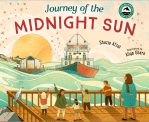
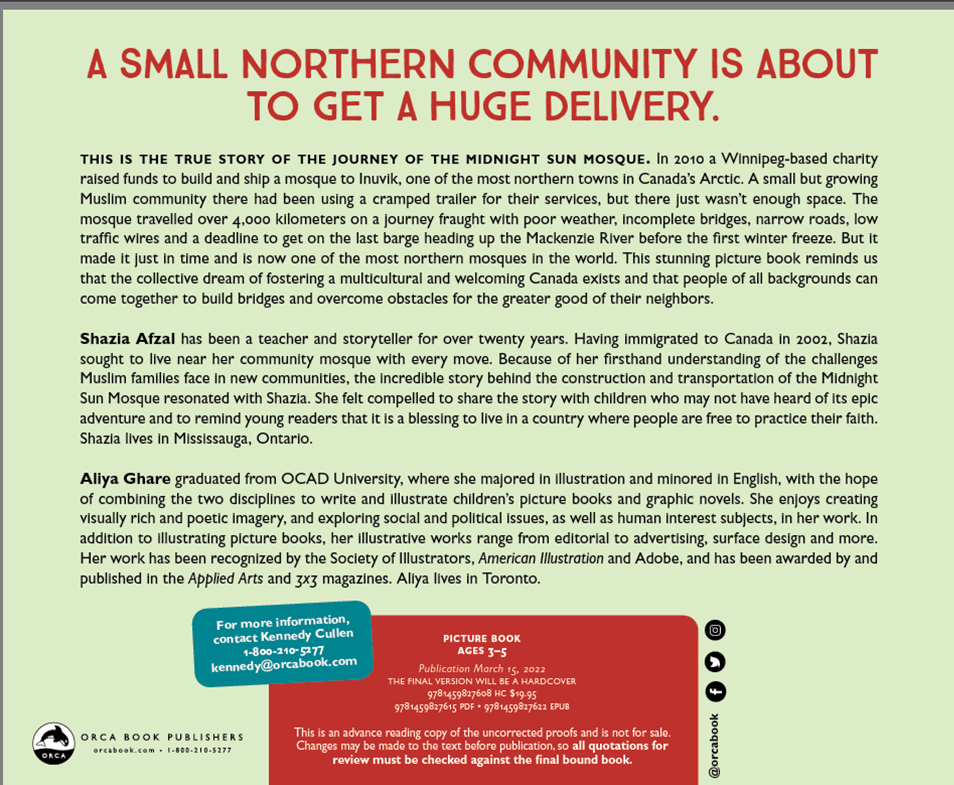
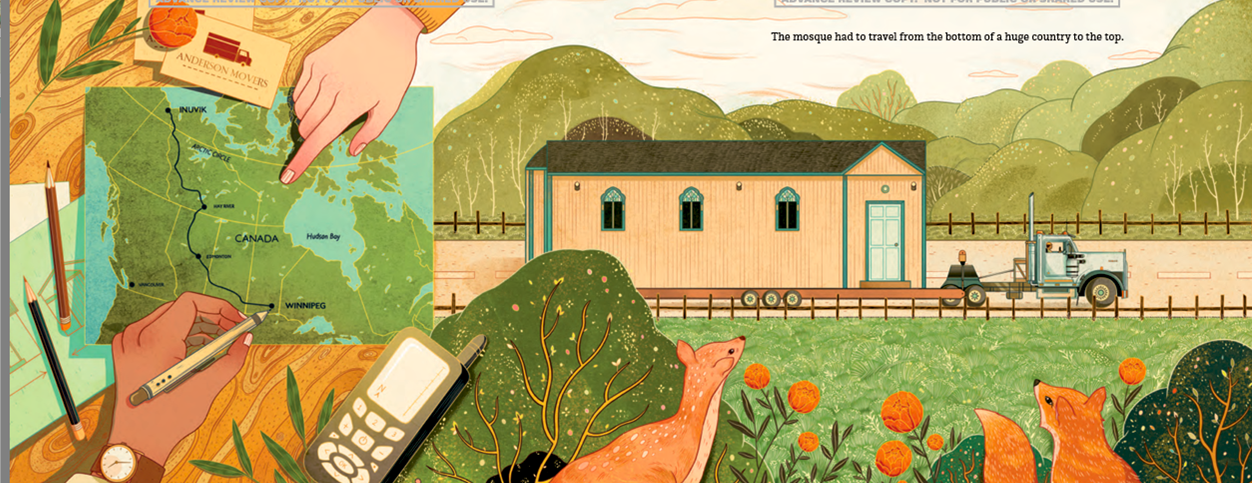
What an absolute joy to learn about something real for the first time in a children’s picture book meant for ages 3-5.  I am baffled that this story wasn’t celebrated and shared by not just Muslim’s everywhere, but Canadians as well.  It is a sweet instance of real life being harder to believe than fiction.  It warms your heart and reminds you that there are so many good people doing selfless things for the benefit of others, every single day, subhanAllah.  As for the 32 page book itself, story inspiration aside- I kind of wish it had more details of the real story in it.  The factual blurb on the back cover was a bit more awe inspiring than the totality of the book.  I think it is because it is meant for such little ones, but I don’t know for sure.  I hope that there will be more books for various ages, about this mosque’s incredible 2010 journey. 

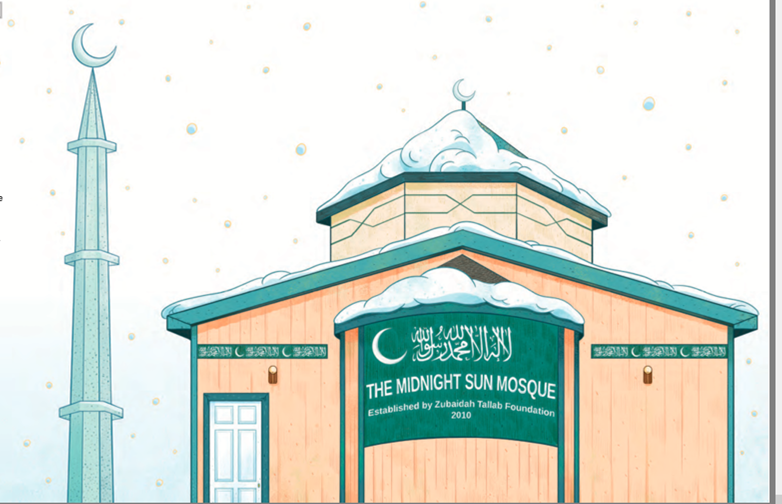
There is a small community in Inuvik, in Northern Canada.  The growing Muslim community has outgrown their one room space and it is more expensive to build a masjid there, than to deliver a pre built masjid from Winnipeg. 

With the help of some non profit and local groups, a masjid is built and sent north, hopefully able to reach its final destination before the river freezes.  The journey is fraught with obstacles: roads are too narrow, bridges not ready, low utility wires. weather concerns, construction, the masjid tipping over, but alas it arrives, alhumdulillah.
The entire community welcomes the new masjid, and the Muslim’s have a new space to pray and gather.

I like that there are maps and indicators of the distance.  And while I like the interfaith aspect in Inuvik being presented, it seems incredibly specific in a very vague book for small children. Why is the imam identified separately, the whole paragraph is just awkward.   Additionally, there is no explanation for why a minaret was needed or if it is critical to a mosque.  Some information other than the children wanted one, would help avoid confusion seeing as this mainstream published book is not targeting only Muslims who would know the function of a minaret, and that they aren’t required structures.

Some links about the event that inspired the story:

https://www.bbc.com/news/world-us-canada-11731017

https://www.thestar.com/news/canada/2010/11/10/north_americas_most_northerly_mosque_officially_opens_in_the_arctic.html

Environmental Sunnahs: Emulating the Prophet One Earth-Friendly Act at a Time by Alia G. Dada illustrated by Sarah Hafeez

Standard
Environmental Sunnahs: Emulating the Prophet One Earth-Friendly Act at a Time by Alia G. Dada illustrated by Sarah Hafeez

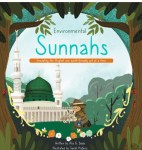
This beautiful book explores how intertwined Islam and caring for the earth are in a kid appropriate manner.  The rhyming lines and fun illustrations are accompanied at the end by very detailed sourcing, references, and tips.  All non fiction or fictionalized fact books should be sourced this well, it really has set the bar, and left most books in the dust.  My only real critique of the book is that I wish it was larger.  The pictures and dancing text need more space to be poured over and enjoyed. The 8×8 size doesn’t do the 36 page book justice.  The inside text should also be a more uniform/consistent in size.  At times the rhyme is off and feels forced, but because there are facts on each page the story isn’t read consecutively.  You break the rhyme scheme to ponder over the “Did you know?” sections, so the beat and cadence isn’t super important.  Overall, a well-done book to share and discuss with children ages 5 and up, and a great reference, resource, and memorable teaching tool to bring us all closer to the prophetic mannerisms we strive to emulate.

img_5042

The book starts off with a message by naturalist, Director of the Art and Wilderness Institute and author of “How to Draw 60 Native CA Plants and Animals, a Field Guide (and my former childhood penpal) Sama Wareh.  It then jumps in to exploring the miracle of nature on land and under the sea. It shows desert landscapes, and mountainous ones, jungles, and farms, valleys and cities.
img_5043

The book talks about water: Zam Zam and wudu and where clean water comes from.  How little water we should use according to hadith and how to respect all living things. It talks about Prophet Sulaiman (as) showing kindness to even an ant. And how planting a tree is charity. It shares information about reusable goods, limiting waste, and understanding eco systems.

img_5044

The book concludes with easy to read Hadith references, Quranic references, a glossary, and action items.

Omar Rising by Aisha Saeed

Standard
Omar Rising by Aisha Saeed

omar rising

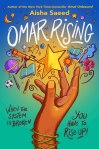
This middle grades 224 page read is quick and memorable.  The story is set in Pakistan and the characters are probably Muslim, but there is no religion mentioned until nearly the end, and even then only in passing.  The only culture specific references are the characters’ names, social etiquettes, and the foods mentioned.  By and large, the story is universal and could take place anywhere, and probably does take place everywhere.  While I wish it would have had more cultural and religious references, it is an OWN voice story after all, the book is enjoyable, the characters endearing, and I think young readers will benefit from spending the school year with Omar, seeing classism up close, and cheering for an unjust school system to be challenged.

SYNOPSIS:

Omar is the son of a servant and when he earns a scholarship to a prestiges boy’s school for seventh grade, the entire village is bursting with pride.  When he gets there though, it is hard, really hard.  The scholarship kids aren’t allowed to participate in any extra curriculars, they have to do service hours, and they have to maintain the ridiculously high A plus grade average or be expelled.  It seems that that headmaster is out to get the scholarship kids, and Omar in particular.  As the scholarship students struggle to stay afloat, Omar has to determine if it is all worth it. He spends all his time studying, even when he goes home to visit his mother, and while he doesn’t want to let the village down, he is struggling to find the optimism to keep fighting for his place.  When Omar learns that the system is designed to make the scholarship kids fail, and that those that are kicked out are called “ghost boys,” he has to decide to how hard to push himself and ultimately how hard to push to break down the system that treats him and those like him like second class citizens.  Luckily, Omar has some supportive teachers, some loyal friends, and a whole lot of determination.

WHY I LIKE IT:

I love that the story is universal, it is at times a much tamer version of the YA book Ace of Spades which also explores second class citizens in posh private schools as a theme, and at times I even felt some Dead Poet’s Society vibes.  The cultural setting and names however, to me is a mixed bag.  I’m glad that it didn’t become another story about problems in another country with judgmental overtones, but at the same time, to be so void of cultural references seemed too far of an extreme in the other direction to make the story feel real richness and authenticity.  I love that the story isn’t about bullying and that a number of characters have depth.  I was genuinely confused for a large portion of the book about what the orientation in the summer entailed.  It was clarified much too late that it was a weekend, but I was at a loss trying to figure out how he knew some of the campus, some of the other scholarship kids, had a roommate, yet knew so little of the school and what it would be like.  I am not sure why that information was delayed, but seeing as I read an arc, I hope it is clarified in the final copy.

FLAGS:

Omar and a girl are friends, they hug at the end, but it seems rather innocent, and more sibling like as they were raised together.  

TOOLS FOR LEADING THE DISCUSSION:

This would be a good book on a shelf, and would possibly work as a read aloud to grades four or five.