Tag Archives: school

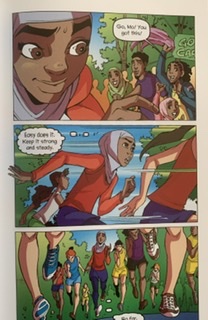
Running Overload by Jake Maddox illustrated by Tina Francisco

Standard
Running Overload by Jake Maddox illustrated by Tina Francisco

5870B613-F406-493B-8203-FAB9869DE555

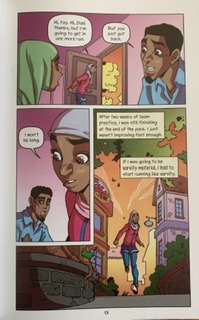
This 72  page graphic novel features a female Muslim protagonist trying to balance her desire to be a great cross country runner and the rest of her life.  Meant for 3rd graders, the lessons are applicable and relevant for readers in middle school as well.

6B290892-6842-45D4-88FE-7FE4D82BAEC6

SYNOPSIS:

Nimo Mohamed has made the varsity track team, and is determined to keep up with the older girls.  She is training too hard which her coaches and parents warn her against, but she doesn’t listen.  As a result she is lying to her family about what she is doing, her grades are suffering, and her body is exhausted to say the least.  After coming dead last in a meet, getting a D on an English test, and injuring her knee, the truth comes out and her dad has her quit the team.  Can she convince him to give her one more chance? Can she learn to pace herself?

253551C1-18E4-4A86-8BD2-315C79A685DA

WHY I LIKE IT:

There is nothing Islamic in the book except for the main character’s family.  The women wear hijab when out, not at home and they have Islamic sounding names.  I like that she is modestly dressed when she runs and that no one seems to care that she is Muslim.  This story is not about her faith, it is a universal story of balance, and the character highlighting the moral is Muslim.  Her parents are divorced, but are on the same page regarding her running and school balancing act, and they come together to support her.  I also like that the book is a sports book and has a female girl of color as the lead.  There is a lot of very intentional diversity in the book and it is refreshing to see.

There are questions at the end, and running vocabulary and tips for running as well.

B555F927-C2E0-433B-8F6B-ED1E58486CD3

FLAGS:

None

F050C711-00AF-4581-93AB-C0E440C1FDD8

TOOLS FOR LEADING THE DISCUSSION:

The book wouldn’t lend itself well to a book club, but would definitely provide one-on-one discussion opportunities.  The short linear story is all about imparting teachable moments on the reader, which isn’t a bad thing, but I think the real strength is that the book is one of a larger series that should really be in every classroom and library to show how balance and integrity and strength and diversity are values that we need to hear over and over, not just in one running book, but from a lot of different sources.


A Place at the Table by Saadia Faruqi and Laura Shovan

Standard
A Place at the Table by Saadia Faruqi and Laura Shovan

a lkace at the table

This fabulously fresh and honest book told in alternating OWN voices shows how two seemingly different 6th grade girls discover how much they have in common as they learn about themselves and their families along the way.  Sarah is a Muslim Pakistani-American, and Elizabeth is Jewish and has an English immigrant mom, the two come together over food, family stress, discrimination, and middle school social drama to form a solid friendship.  But fear not, it isn’t easy and the book will keep upper elementary/ early middle school girls hooked.  Not sure if boys will be as drawn to it, but if they can get over the brief mention of having a period, they too will enjoy the story.  The 336 page book shows how much we have in common, and how hard fitting in can be for everyone.

SYNOPSIS:

Sarah is starting a new school, a public one, having been at a small Islamic school prior to 6th grade.  She is not happy about it and to top it off, her mother is teaching an after-school cooking class at the school that she is required to attend.  Hoping to sit in the back drawing and go unnoticed, she finds she can’t sit quiet when her classmates start giving her mom a hard time.  Unaware of why she had to leave her previous school, and tired of her mom needing her help with her catering business, Sara also has to help her mom study for her citizenship test, handle two little brothers, deal with no friends at school and not being able to celebrate Halloween.

Elizabeth loves cooking. Her mother does not.   She is excited to learn Pakistani food at the cooking club even if her best friend thinks they shouldn’t be learning things from “them.” Elizabeth is admittedly nerdy, and struggling with a life-long friend finding others to spend time with, her life at home is difficult too.  Her dad is always traveling for work, and her mom is depressed with the recent passing of her mother in England, to the point of not really functioning.  With Elizabeth doing the cooking at home, and trying to get her mom to study for her citizenship test, Jewish holidays and obligations get neglected, and Elizabeth not knowing how to help her new Muslim friend handle racism,  is spiraling herself.

When the two girls decide to give each other a chance they find they might be able to be more than just cooking partners, but it seems like one of them always does something to mess it up.  Either saying something hurtful, getting defensive, or not sticking up for each other.   The girls get their mom’s together to study for their test, but it isn’t so easy for the girls, who are hesitant to trust one another.

An upcoming cooking competition, offers the girls a chance to make a cross cultural fusion dish that can wow the judges, help Sarah’s family’s financial situation, prove to the school that diversity is a good thing, and hopefully give the two girls a solid friendship.

WHY I LIKE IT:

I love how authentic it sounds and feels and how it doesn’t focus on boys or crushes, but on friendship between two girls at an awkward point in their lives and the family stresses they are experiencing.  The book is for all readers and does a great job of not going overboard with what the girls face.  I love how tolerant they have to learn to be with one another and that they have to learn to drop their defensive guards.

I read the book in two settings and didn’t want to put it down, it has enough pull that you really want to see where the book is going and are happy to overlook the slight repetitiveness of them stressing about the competition, but doing nothing but talking about the stress. Really the competition doesn’t even seem that important at the end, but considering everything going on, that to me is exactly as it should be.

I love the rich culture of Pakistan, England, Islam, and Judaism that seep in and never get preachy or dogmatic, but get celebrated and experienced.  This is why OWN voice books are so beautiful and powerful.  Admittedly, Elizabeth’s family is not super religious, but a few more similarities would have been nice.  Yes her brothers are eating pepperoni Hot Pockets, but a shout out about halal/kosher marshmallows would have really rung true for so many of us that stock up at Passover.

I also love how the side characters have substance and aren’t just used as a foil to show something about the main characters.  They get a little flesh on their own, and that enhances the richness of the story.  Seeing that they have their own struggles to overcome as well shows how none of us have it all together, and that we are all capable of improving ourselves.

FLAGS:

The girls meet during school hours when Elizabeth lies about her period starting to get out of class.  Sarah mentions that hers has already started.  Elizabeth mentions that her Jewish grandmother is visiting her son and his husband, nothing more is said, just that.  There are some derogatory things said about Sarah and being Muslim and Pakistani, but really mild.

TOOLS FOR LEADING THE DISCUSSION:

I want to find a way to do this book for a middle school book club.  I’ve already told my 13 year- old daughter it is required summer reading.  The Muslims have diversity within themselves, some wear hijab, Sarah does not.   The book is so relatable and the personas sound the age for their views and struggles and perspective.  The financial stress, the mental illness, the immigrant experience, the racism, the politics, are all wonderfully woven together, and the food, well, there is a reason I didn’t recommend this book at the beginning of Ramadan, you are welcome.  Happy Reading.


You Must Be Layla by Yassmin Abdel-Magied

Standard
You Must Be Layla by Yassmin Abdel-Magied

layla

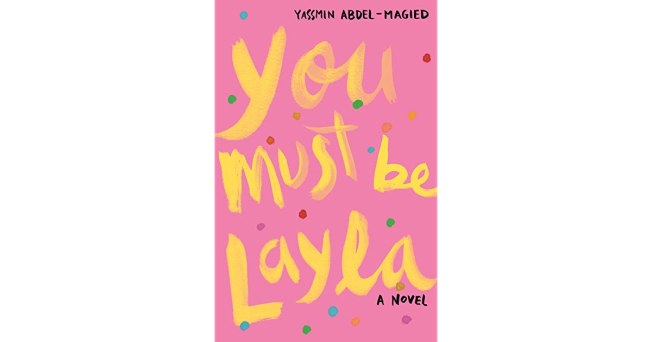
This OWN story, upper middle grades book, is heavy on the pop culture, relatable on the Islamic family presentation and honest in its portrayal of Islamaphobia, yet somehow the tidiness in which everything wrapped up seemed too forced and a bit flat.  At 293 pages, including a three page glossary, the book is a quick read meant mainly for girls.  It involves robotics, academic achievement, and invention, while also discussing crushes, a character coming out to his family and friends, and mention of girls not praying at certain times of the month.

SYNOPSIS:

Layla lives in Australia and goes to the Islamic School of Brisbane. Her Sudanese family: older brother, younger twin brothers, and parents, her Doctor mom and medical machine tech dad, are active Muslims and proud of their culture.  They assimilate to Australian norms in varying degrees, but with all the kids at ISB, Layla doesn’t feel all that different in her school and social life.  Unfortunately she wants more, she wants to be an adventurer, and when she meets Adam over the break and learns about the various opportunities he has it his school, Layla decides she wants to prove herself on a larger stage.  Going in to “shut down” mode Layla has tunnel vision to ace the scholarship and entrance exam and go to a new school.

She gets in to Mary Maxmillion Grammar School and when she goes to meet the board they let her know that the decision to accept a girl like her was not unanimous.  Layla is an immigrant, she is black, she wears hijab, she is loud and proud, and apparently very smart, but as one trustee asks, is she brave?  On the first day of school she arrives late to first period, insults the teacher repeatedly and also makes friends with a group of slightly diverse boys.  At the end of the day however, Peter, a boy who had insulted her earlier, reinforces his disapproval of her being allowed at their school and pushes her.  Standing her ground, she verbal attacks and then head butts the boy in front of a large portion of the school at dismissal.  No one offers any help, nor speaks up when she is suspended for a week, her scholarship and admission put on probation, no one even asks for her side of the story, Peter, is let off completely free, as he is also the son of the Board Chairman.

Layla decides to prove she belongs at the school she is going to win a prestigious robotics competition and since everyone already is on a team, she decides to go for it solo.  The only problem, is she doesn’t know what to invent.  When she returns to school, her friend that she is crushing hard on is acting weird, and she gets caught up in a lie of sorts that serves as both the idea and silliness turned cleverness of the book.  While choking on gummy worms, she says she is working on an edible actuator for her robot, and somehow has to make that come to fruition.

The rest of the book is Layla making a lot of silly errors of judgement: missing classes being in SD mode in the workshop, forgetting to file the paperwork and registration to actually compete in the competition, and leads up to the resolution between her and Peter, learning her crush is gay, and deciding to be herself and proud of it.

WHY I LIKE IT:

I actually like the majority of the book, I really like how Islam is presented and lived.  They pray and say salam and cover, and recite tasbeeha to reflect, and quote hadith very naturally, even how others attack them, and the anger that Layla’s brother Ozzie feels at his inability to get a part time job reads and feels very authentic.  I also like how one of the teacher’s own experience as being a descendant of the forgotten generation and being a first nations ethnicity is woven in.  I felt the side character being gay was added and forced in as an after thought and I don’t know why, as it didn’t show Layla to be a particularly good friend.  She handled his coming out well, but when he was miserable she was wrapped up in her own stuff and didn’t reach out very well, even though he ended up being the spark for her invention.  Her friend at ISB is also an under developed character, that while I get is used to show another side of Layla, in many ways also showed her to be a rather poor friend.

I found the pop culture references annoying, not in and of themselves, but in knowing that they will date and make the book irrelevant in a few short years.  There is a lot of repetition of phrases and ideas that a few times when I put the book down I struggled to re-find my place (I know bookmarks, right?) but certain refrains and paragraphs seem so very similar.  I

There is a lot of good information about Sudan and their food and culture and traditions.  There is also a decent amount about Muslims in Australia.  I like that even within her family there are different views on how much to assimilate, and how much to fight back against perceptions, the fact that there is a lot of gray makes non Muslims and non immigrants reading the book hopefully realize how diverse all people are and to not assume anyone is only one way.  I would have liked more about Layla’s mom and being recruited to come to Australia, and how she was perceived at work, by patients and colleagues.  I also would have liked some sort of resolution about Ozzie and his job search.  Really though my biggest complaint is Layla, herself.  What does it even mean to want to be an adventurer? I like that she is fallible and human and in some ways she does grow, but I felt like her being smart and a go-getter is the foundation of the story, but that she didn’t seem to have much common sense seems a bit off.  Yes she is loud and funny and puts in hard work, but the way she talks to teachers, and misses classes and deadlines, and behaves seems like a disconnect from the pages constantly telling me how smart she is.  To me, part of being smart is knowing when to lash out and when to listen, I don’t feel like her growth arc was all that great, in a nut shell, she changed schools and confronted a bully, that is the story, while not a bad story, it could have been so much more.

FLAGS:

There is crushing, violence, a gay character, mention of alcohol at a party Layla didn’t attend, talk of hooking up in passing and some language.  There is lying but it is acknowledged guiltily, and not familiar with Australian slang, regular use of the phrase, Janey Mack, which according to google is a replacement for Jesus Christ.

TOOLS FOR LEADING THE DISCUSSION:

I don’t know why I wouldn’t use this book as a book club selection.  It just didn’t strike me as something they would benefit from.  I wouldn’t be opposed to someone picking it up and reading it in my house, but I doubt I’ll recommend it to my daughter and she is the ideal reader: she wears hijab, is in 8th grade at an Islamic school, and loves to read.  The book is really not memorable as good or bad, it just fell flat and I doubt I’ll read it again, luckily it only took two sittings to read, so I don’t feel like it was a waste of time, but seeing as I had to pay cover price and international shipping, I kind of regret rushing to buy it.

Teacher guide: https://www.penguin.com.au/content/resources/TR_YouMustBeLayla.pdf
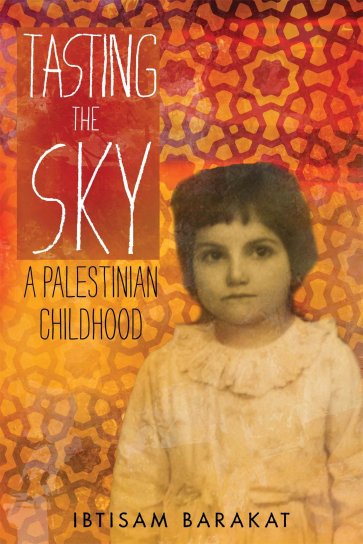
Tasting the Sky: A Palestinian Childhood by Ibtisam Barakat

Standard
Tasting the Sky: A Palestinian Childhood by Ibtisam Barakat

tasting the sky

This memoir may qualify as non fiction, but the majority of this 176 page book is told from the perspective of the author when she was three years old, so much of it reads to me as somewhere between historical fiction and autobiography.  No matter how you categorize it though, this AR 5.8 book is better suited for middle school and up. I love that this is is a Palestinian perspective of the Six-Day War and the immediate aftermath, but after reading it, I’m not haunted by the atrocities of the Israeli occupation so much as, some of the choices her family made.  I got my copy through Scholastic and in excitement, purchased multiple copies that I sadly think will sit in a box as I doubt I’ll find many students that will enjoy this book.

SYNOPSIS:

The book is divided into three parts with the first and third being short letters written in 1981, and the second part being the majority of the story taking place between 1967-1971.

The first part is a high school Ibtisam getting detained at a checkpoint after heading out to check a PO Box that she uses to keep in touch with her pen pals from around the world.  She reveals what life is like and shares the joy of learning about the outside world from her correspondence, but that she rarely talks about her childhood and her life during the war.  Part two is her sharing that.

The Barakat family lives removed from neighbors and a city, but Ibtisam loves her two older brothers and younger sister and at three years old is happy.  When war comes, the family decides to run, in the process Ibtisam doesn’t have time to find a shoe, and then she gets separated from her family and swept up with the people running for the caves to escape the bombings.  Once reunited with her family, they along with numerous other Palestinians make their way to Jordan and some safety.  Safety comes at a cost though and the family is separated as her father leaves to find work.  When the war ends, the family moves from the shelter and finds a small room to rent until they can return home.

Once the family returns home, things do not return to normal as the Israeli army begins training near their house causing Ibtisam’s mom to worry constantly in her attempts to keep the children inside and away from the windows.  Eventually, the mom takes the children and herself to an orphanage in Jerusalem saying that their father cannot keep them safe.  Ibtisam is close to her father and this dramatic change does not sit well with her.

In the orphanage, the boys get separated from the girls and eventually their father promises the mother to build a wall and make repairs to the home and purchase a goat if they come home.  They do, and the kids are grateful to be together again.  The boys then start school and the goat has a baby and life carries on.   Ibtisam grows close to the baby goat and their father promises that he will remain the children’s pet and will not be slaughtered.  But, when the boys are 8 and 9 they get circumcised and the feast involves the goat.

The next major event in young Ibtisam’s life is when she finally gets to go to school.  Incredibly smart, her mother essentially equates her love for her daughter with her success in school and with that motivation and predisposition to learn and excel, she does very well.  One day on the way home, she is sexually assaulted by an older boy, and makes arrangements to always have her brothers with her when walking.  Her parents are not made aware of the offense, and don’t seem to investigate Ibtisam’s change in attitude toward school.  When an Israeli soldier attempts to assault her mother, the family moves once again and part three is a teenage Ibtisam quarreling with her parents and once again excelling at school.

WHY I LIKE IT:

I like that tidbits of memories are woven together to give an overall impression of the author’s childhood.  The book is a quick read and is compelling enough to hold one’s attention.  The family is culturally religious, but the book makes a point that the father prays, not indicating that the rest of them do or even know how.  I love how the freedom and hope that Ibtisam has comes from learning the first letter of the Arabic alphabet, alef.  The love of language and the power found in reading and writing, is celebrated in its reverence to the learning of the letters.

I don’t get the mother, and while I get that war is a horrific time, and she is 24 when Ibtisam is 3 and has like four kids, so her life is definitely not easy, I still find it disturbing to me that she would lose a one shoe-ed daughter, take her kids to an orphanage to live while both parents are alive and well, and be so cold to her daughter.  The father seems to be loving to the kids, but he still slaughtered their pet, and I’m guessing culturally circumcisions are done at that age, because that seems incredibly cruel.

FLAGS:

War, loss, sexual assault, details about the circumcisions.

TOOLS FOR LEADING THE DISCUSSION:

I won’t do the book as a book club selection and while I know the book is in many libraries and classrooms I doubt many kids would be compelled to pick it up and read it based on the cover and synopsis on the back.  I have a few Palestinian friends that I will ask to read the book to see if they find it an accurate representative of life during the six-day war and even today as it could definitely be used to teach about the region, the conflict, and writing a biography about life for others to learn from.


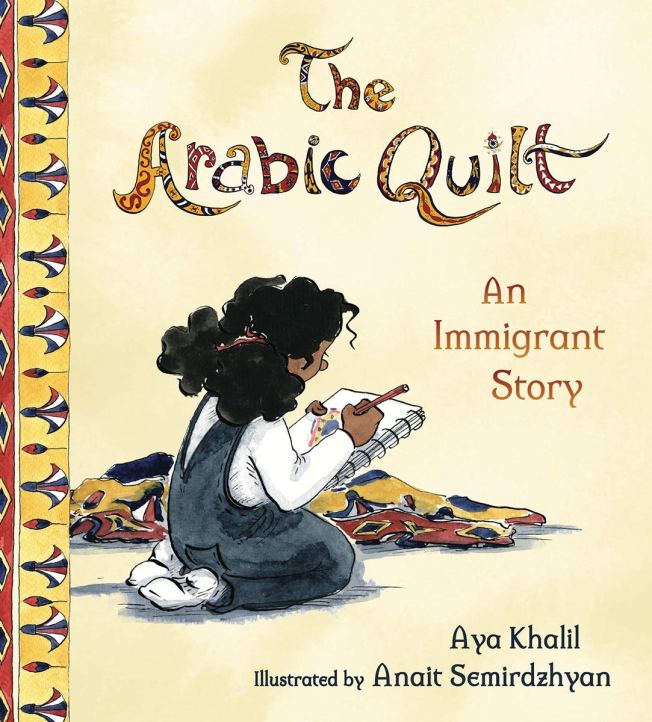
The Arabic Quilt: An Immigrant Story by Aya Khalil illustrated by Anait Semirdzhyan

Standard
The Arabic Quilt: An Immigrant Story by Aya Khalil illustrated by Anait Semirdzhyan


arabic quilt

This 36 page picture book tells a beautifully presented story that incorporates events from the author’s real life that convey a story of loving your culture, finding similarities and giving people a second chance.  Ideal for students between 2nd and 4th grade, younger children will enjoy having the story read to them, and older kids will benefit from the message as well.

7C03525B-A26D-427F-A7EA-591BB3095F10

Kanzi is about to start her first day of 3rd grade in a new school.  It doesn’t specify if she has just come from Egypt, but being she seems to speak English well, knows that she’d rather have peanut butter and jelly instead of a kofta sandwich and mentions that she got a quilt when she visited her grandmother, in Egypt, she possibly is just starting a new school, not her first in America, but it is considered an immigrant story, so I’m not certain. E403D261-438B-4263-A2FB-C3F8693C9D3E

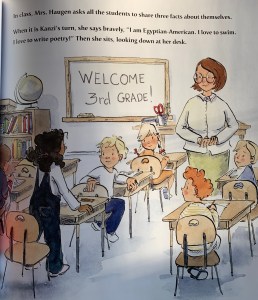
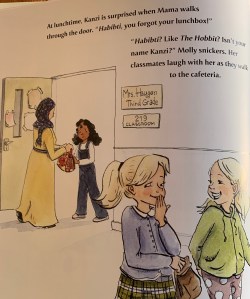
When she arrives in class and introduces herself she bravely says that she is Egyptian-American, but on the way to school she turns down the Arabic music in the car, so the reader sees that she is a little nervous about being seen as “different.”  When her hijab wearing mom brings her forgotten kofta sandwich and calls Kanzi ‘Habibti,’ classmate Molly teases her that she is being called a hobbit.

A crying Kanzi tells her teacher and Mrs. Haugen reassures her that “being bilingual is beautiful.”  That night Kanzi asks her mom to send her a turkey sandwich for lunch the next day, and before beds she writes a poem as she snuggles in her beloved quilt.

76FCD440-0D81-4893-80F3-1CC6033E8461

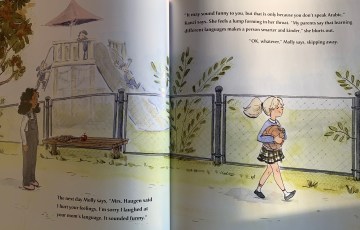
At school Molly apologizes to her and says that it just sounded funny.  Kanzi tells Molly it is because she doesn’t speak Arabic and that her mom says that “learning different languages makes a person smarter and kinder.”  Molly dismisses the comment and smugly walks off.

Mrs. Haugen sees Kanzi’s poem about her quilt from her grandma in Egypt and asks her to bring her quilt to school. The kids love it, and Friday Kanzi’s mom shows up to help with a special project: an Arabic quilt with the kids names.

98E875AE-0FD1-4827-BF39-1CA7B1172843

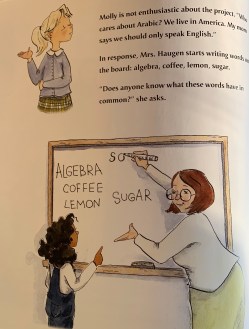
Molly is not enthusiastic and Mrs. Haugen writes English words that come from Arabic on the board: coffee, lemon, sugar, algebra.  Telling the kids that “we can speak non-English languages and still be American.”

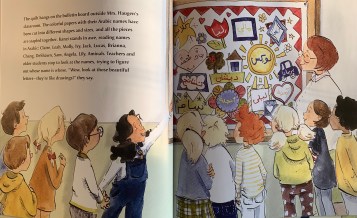
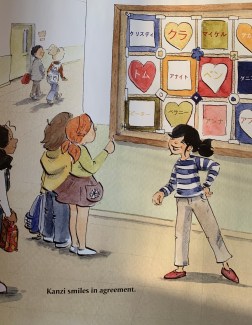
Kanzi and her mom write the kids names down and the children copy them.  The teacher cuts them out and makes a quilt to hang in the hall.  On Monday when everyone sees the quilt, they love the beautiful letters and colors.  Even Molly sincerely apologizes and asks Kanzi to write her mom’s name in Arabic as a gift.  The two hug and seemingly will become friends.

832244F2-1F7E-4C4A-9778-40E0EEC6BE82

Across the hall another quilt is hung with names in Japanese, as another student and teacher were inspired by Kanzi and her quilt.  The last page of the story is a letter Kanzi has written to her parents telling them how grateful she is that she has two languages and that she will speak them without guilt.

BB6797A4-05C9-4CDC-AC70-88273ED3997B

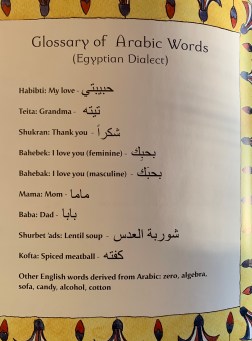
The story is beautifully told and exquisitely illustrated on well-sized 9.5 x 10.5 pages in a hardback binding.  The mom wears hijab and it mentions it, but there is nothing religious about the text.  It is a universal story of coming to be proud of your roots and inviting those around you to learn and grow.  There is a Glossary of Arabic Words at the end and a bit about the author and illustrator.

9AF3D465-F5DA-4F25-8FC1-5BEE16FD9B21

My kids favorite page by far was reading the names written in Arabic and they all enjoyed the story (ages 13, 10, 9, 4).  I actually had an issue when Molly apologized the first time, feeling that Kanzi’s response was a bit pretentious to what seemed like an 8 year old being told to go say she was sorry, but my older three unanimously and fervently disagreed with me, saying that she was obviously insincere and Kanzi knew it.  I’d love to hear from other readers if they felt like Molly was sufficient in saying sorry and admitting that it sounded funny and that Kanzi was arrogant in saying that people that know two languages are smarter and kinder, or if Molly was being rude and racist and Kanzi was sticking up for herself.

CF16ACA2-8EC4-443B-AA8B-2B9EA3D05D6D

Irregardless, the book is well done, enjoyable, and will get repeated reads by a large range of readers.  My children keep pulling it off the book shelf, and for that I need to thank Gayatri Sethi (@desibookaunty) who generously sent me the book the same day I checked it out from the public library.  Her generosity once again is a gift that I hope to pay forward in the future.  This book also highlights how amazing teachers can be and often are in facilitating inclusion, understanding, and respect.

ED8D19BC-96FE-4B8F-8B35-87A1AA885B7F


Amira’s Family by Elliot Riley illustrated by Srimalie Bassani

Standard
Amira’s Family by Elliot Riley illustrated by Srimalie Bassani

amira family

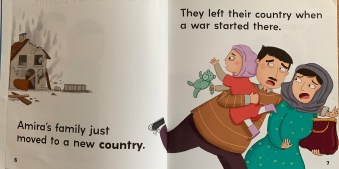
This 24 page, AR 1.5 book, is part of a series for emergent readers about different families.  The other books in the series focus on diverse family models, some that include a single parent, or lots of siblings, one in the series has foster kids, another adoption, one has two moms, so I’m not entirely sure why a refugee family is included in the group.  The family had to leave a dangerous home, but mom and dad and Amira, are not a “diverse” family structure, by the same definition used for the other books.  So, on its own it is nice to have a book for independent kindergarten and 1st grade readers, but as part of the collection, I find it a bit of a stretch.

5BD929BC-5490-4B6B-A729-CD85B227EE60

The book is divided into three chapters, or sections I guess, perhaps so that early readers can gain experience with a Table of Contents at the beginning.  There is also a Picture Glossary at the end along with a page encouraging Family Fun and a bit about the author.

The book starts out introducing Amira, and her parents.  It then explains that they just moved to a new country, America, when a war started in their country.  It notes that Amira was sad to leave her home, and scared to move to a new place.

84893217-FB88-4ABC-8879-DA361636E17E

When Amira starts at school, the classmates welcome her and help her with the language.  It shows her teaching her language too, but it doesn’t look like more than random squiggles.  It then shows she likes recess and swings and slides, allowing the reader to see similarities with the character.

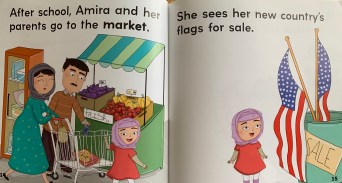
C2E8EF21-AC7B-4594-AA53-68B9764AB84DWhen the family goes shopping, Amira sees an American flag, buys it, and hangs it outside their home.  Amira loves her family and they love her, and it seems like they love their new home too.
C8E3398F-8A1B-4D40-8A79-4E1C52262E89

The illustrations are simple yet expressive, and show Amira and her mom in hijab.  It does not mention religion, or what country they left.

The story is basic, yet introduces young readers to the concept of refuges in a soft way.  It shows how the classmates are kind and the parents supportive of Amira.  I like that it also shows various emotions in the text and illustrations.

It might be making a bit of a political statement with the flag and national identity undertones, but I think it is a good thing to show that refugees can love a new country and be part of society, especially given the current climate toward immigrants.

I think the strength of this book is that it shows a Muslim character, and while meant for all new readers, Muslim children particularly will enjoy seeing themselves in a book they can read.  I’d check the library before buying the 8×8 paperback book, as it isn’t particularly memorable, but for the age group it serves a diverse and an inclusive purpose.

01FAE723-DA90-42EC-AC0D-B274B22515D9


Yes No Maybe So by Becky Ablertalli and Aisha Saeed

Standard
Yes No Maybe So by Becky Ablertalli and Aisha Saeed

yes no

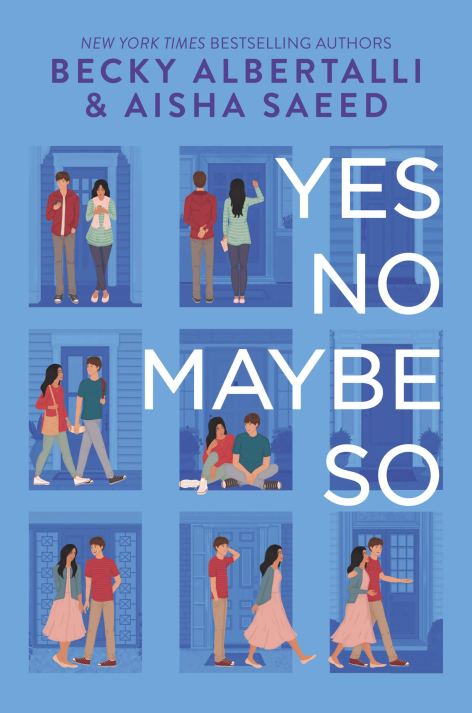
This new rom com in book form with a Muslim female character written by a Muslim author, sets itself apart by being co-written by a Jewish author and the other half of the love story being told by a Jewish boy’s point of view.  This YA book is very relevant as a special election in Georgia served as the catalyst of the two authors coming together and fictionalizing the effects of white supremacy, Islamaphobia, and antisemitism for the book, while real headlines were urging the two to canvas, get involved, and make a change against the increased showing of hate with the election of Trump.  The presentation of Islam is probably realistic, but definitely not ideal, and with the kissing, multiple LGBTQ+ supporting characters, the profanities, and 436 page length, the book is probably best for 15 year old readers and up.

SYNOPSIS:

Jamie Goldberg is 17 and is spending his summer helping his cousin work on a special election campaign for a Democratic candidate in an incredibly red district in Georgia.  A very nervous kid, who hates public speaking and talking to girls in general, he would rather be behind the scenes or hanging out at Target.  His little sister, Sophie’s bat mitzvah is coming and things at home are crazy with pre party planning.  His grandma, an Instagram sensation uses him for tech support and video filming, and his easy going demeanor means he spends a lot of time, being bossed around.

Maya is the 17 year old only child of a lawyer mom and physician dad and has just found out that they are separating.  With her one friend too busy with work and starting at the University of Georgia, US born, Pakistani-American Muslim Maya, is not having a very good Ramadan.  When an interfaith event reunites her with a childhood play-date friend, Jamie, her mom convinces her to help him canvas to keep busy and sweetens the deal by bribing her with a car.

Naturally the two spend a lot of time together vounteering for Jordan Rossum, stuffing envelopes, canvassing, and putting up signs.  Along their way they become good friends, and invested in the election as a House Bill banning head coverings, and antisemitic bumper stickers start getting plastered around town.  The end of Ramadan, the election, the hate the two encounter, and families changing, bring Jamie and Maya together.

Maya’s parents are pretty chill about boys, and only caution her about unnecessary complications by dating in high school, when Maya throws it back on them, that their relationship is pretty complicated, she seems to not find an Islamic reason not to make-out with Jamie.  The whole book is angsty and the two feign cluelessness, but based on the cover of the book alone you know where it is going.  The true climax is how much the relationship can be used for political gain, and if they can get their candidate elected.

WHY I LIKE IT:

I like the political setting, it is a different and very relevant slant.  It might be a little alienating to readers outside the United States, because the political process isn’t really detailed, but the characters involvement in their small slice is a major aspect of the book.  The book is definitely pro Democrat, but addresses the gas lighting, hate speech, and views of those on both sides.

I also like that two minority authors came together to share an OWN voice perspective of life today.  For the most part the story telling is smooth with the two characters getting alternating chapters to tell their story from their point of view.  A few times, I felt details were missing, for example what Maya wore for Eid, when space was given to detail that she didn’t wear ethnic clothes to an iftar, and her picking a dress for Sophie’s bat mitzvah.  Similarly, Maya’s parents seemed flat for their trial separation being a major part of Maya’s stress.  Jamie’s grandma was probably my favorite side character, and one of the most fleshed out.

I am fully aware that some Muslims pick and chose what to follow and that not everyone is strict about boy/girl relations, but I felt like for a book that is set in Ramadan, uses religion as a catalyst for civic action, Maya’s mom wearing hijab, and an opening scene being set at the masjid, there is really nothing Islam in the defining aspects of the characters or story.  It is so watered down and almost catering to non Muslims to feel comfortable, that it left me annoyed.  And I think non Muslims too will wonder why Maya’s mom covers and Maya doesn’t and how that works, or why Maya switches to having one reason for not dating and then a religious one.

The book sets out to do a lot in terms of humanizing the effects of laws and policy on average people, but I don’t know that most Muslims hoping to see a mirror to their experience will find that in Maya.  I can’t speak about Jamie, and the Jewish experience, but Maya is rather forgettable in my opinion.

FLAGS:

There is a lot of cursing, and the F word at that.  In the dialogue set in Ramadan, it becomes a joke to substitute it for something else, but once the month is over, the language resumes.  There is kissing, and making-out with the main characters.  There is talk of hooking up, but nothing explicit.  There are is a side character friend that is gay and he and his boyfriend are affectionate.  After the bat mitzvah Sophie comes out to Jamie.

TOOLS FOR LEADING THE DISCUSSION:

I don’t think that I could do this as a middle school selection, the rationale for Jamie and Maya dating, isn’t ok for an Islamic School message.  I really wish just once, a book like this would have the main character, being like, “nope, sorry.”  It is getting predictable and while I know it is countering the oppressed woman view, it is becoming equally one dimensional in its presentation of Muslim women.


Planet Omar: Unexpected Super Spy by Zanib Mian illustrated by Nasaya Mafaridik

Standard
Planet Omar: Unexpected Super Spy by Zanib Mian illustrated by Nasaya Mafaridik

planet omar

Omar is back, and the nine year old kid with a huge imagination, proves that his heart is even bigger.  Middle graders that loved the first version, The Muslims, and the reboot, Planet Omar: Accidental Trouble Magnet, will undoubtedly love this book’s adventures and the real, relate-abl, presentation of Islam in a Muslim family.  While it references the first book, it can work as a stand alone book too, and can and will be enjoyed by kids and adults, girls and boys, Muslims and non Muslims.  At 217 pages, the large spaces, doodles, playful fonts, and illustrations, make the book fly by and beg to be read again and again.

C95DB8C6-9652-4EB8-8008-112361FAE8DF

SYNOPSIS:

Omar’s family still has their Science Sundays, but they don’t visit a new mosque every Saturday, as they have found a mosque near their home that gives his parents, “secret smiles” and them all a sense of community.  Omar and his sister still bicker, and his little brother Esa is still lovable, and the former bully, Daniel, is now a great friend to Omar and Charlie.  Life is good, Alhumdulillah, but in the midst of the boys planning how to get laser guided Nerf guns and have an all out battle, Omar learns the mosque’s roof is in need of repair and that the congregation will need to come up with 30,000 pounds to cover the costs, and fast.  In an act of selflessness, Omar abandons his dream of a foam gun and donates to the masjid.  Seeing that is not going to be anywhere close to enough he plots and schemes with his friends, his non Muslim friends, on how to raise the funds.  They bake cookies, make origami birds, and get their school to host a talent show to raise the money.  Their teacher and the head teacher coordinate the hall and judges and winning prizes all to help out Omar and the mosque, in the end though, they raise just under 1,500 pounds.  Not enough by themselves, but a great contribution to what other people hopefully are scrounging up.  The worst part however isn’t that they didn’t make enough, but that what they did make, goes missing.  Omar, Charlie, and Daniel, along with the parents and police and school personnel, try and find the money and who might have taken it before time runs out.

0030B40D-17F8-415C-A54A-7874768A5B5D

WHY I LIKE IT:

I love how effortlessly the author adopts a nine-year-old’s voice and persona.  So many of the details, for example, about how the school administration signed off on a fundraiser for a religious building, and how tickets were sold, and the planning took place are left out, as a nine year old, probably wouldn’t know, or be concerned with the logistics of such endeavors.  It seemed like some details should be given, but I doubt readers would feel that way, so I pushed it aside and went along for the ride.

Omar has amazing friends, from the unpredictable old neighbor lady, to his non Muslim friends being so enthusiastic and supportive of saving a mosque.  I love it, and that they are that way because Omar is so unapologetically Muslim first.  They even discuss a hadith about how building a mosque, builds you a house in Jannah, and a mainstream book published this, and it is AMAZING! It isn’t just a kid and his family, who happen to be Muslim, the whole plot of the book is to save a mosque, and the fact that this book exists, seriously is so beautiful, and powerful, and hopeful, Alhumdulillah.

This book has a lot of layers, most kids won’t pick up on the interfaith aspects being so ground breaking, or the beauty of teachers and parents believing and supporting young kids, but will just read it as a funny story with anecdotes and inside jokes that they get as kids, as Muslims, and maybe even as Desis.  It truly is the culmination of an author who can write well, characters that our kids can see themselves in, and an opportunity to tell our OWN stories that make this book work for kids, adults and everyone in between.

3C3DA84E-29F6-4A6D-90FE-0BC134E7E615

FLAGS:

Omar and his sister are mean at times, but alas love each other and look out for each other too.

TOOLS FOR LEADING THE DISCUSSION:

I don’t do an elementary book club, but if I did, I would do this book in a heartbeat.  For middle school it would be too quick of a read, but I think all classrooms and all libraries should have the book, up through middle school.

https://www.alaraby.co.uk/english/society/2020/2/7/planet-omar-pushing-for-muslim-characters-in-childrens-literature

I got my copy here in the US at www.crescentmoonstore.com and as always you cannot beat their customer service and prices.  If you don’t have the first book, you can get it there, too.  Thank you Noura and Crescent Moon Store.

Zainab is Different by Irfana Khan illustrated by Josh Wise

Standard

zainab is different book

This 24 page picture book for kindergarten children and up, is sweet in its handling of being labled “different,” without getting overly negative or caught up in the manifestation of discrimination.  Unfortunately, with so much emphasis on different religions: the places of worship, the holidays celebrated, the manner of dress, etc., faith becomes inadvertantly highlighted as the root cause for the division and discrimination.  Perhaps I am reading too much in to it, and the book just needs a few more examples to make the author’s point that we are all different and unique, but as it is, I didn’t love it, my kids all thought it was cute though, especially my daughter named Zainab.

IMG_0555

Zainab walks to school every morning with her mom.  She says hi to the neighbor and can’t wait to get to school to her best friend Melissa and her amazing teacher Mrs. Sperber.

IMG_0556

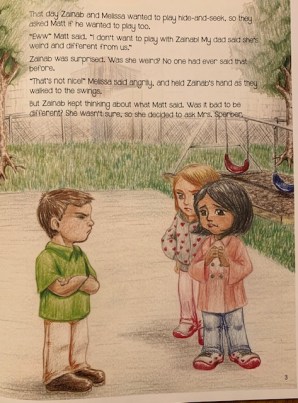
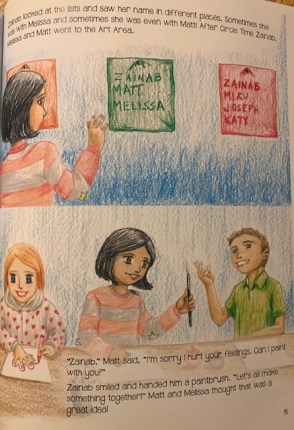
One day Melissa and Zainab want to play hide-and-seek and ask Matt if he wants to play too.  He responds, “Eww, I don’t want to play with Zainab! My dad said she’s weird and different from us.”

IMG_0557

Having never been called that, Zainab is bothered by the words and tells her teacher.  The teacher points out that they have different colored hair, but can see that Zainab is still hurt and tells her not to worry, she has an idea.

IMG_0558

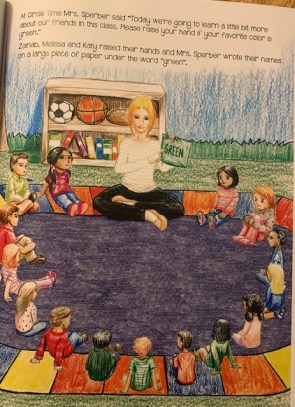
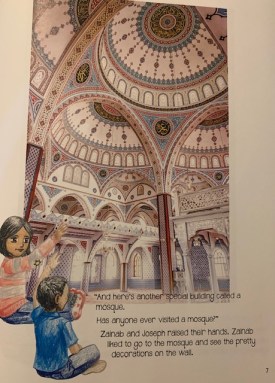
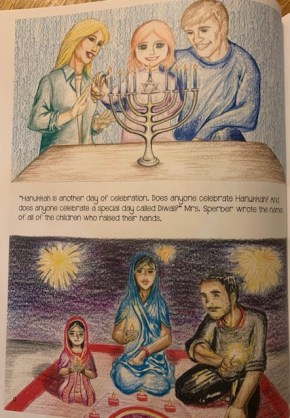
At circle time the teacher starts of by highlighting differences with the kids identifying their favorite color, and her writting their names on the ones they like best.  She then asks about places of worship they visit: churches, mosques, synagogues, temples, and again writes their names on the ones they have been to or frequent.

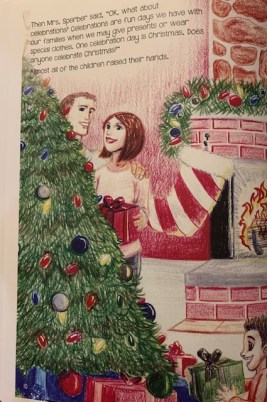
IMG_0559 Next she moves on to holidays celebrated, and then special clothing, only hijab is mentioned though.  The teacher then discusses feelings and how things about us might be different but our feelings are the same.  We like it when we are all nice to each other, and are sad when someone is mean.
IMG_0560

Zainab sees her name with different people’s names on the pictures now hanging up and Matt comes and apologizes for being mean earlier. The teacher also mentions that maybe some haven’t visited any of the buildings discussed.

IMG_0561

The pictures appear to be done in colored pencil and are colorful and detailed with the pictures of the places of worship bein actual images.  The 8.5 by 11 pages are large and would work well at story time or bedtime.

IMG_0562

The fact that Matt’s words are assumed to be about religion seems presumptious to me.  Maybe they are, maybe they aren’t, I feel like there needed to be more there.  A few pages about things other than faith, in my opinion, would make the message of us all being different in some things and the same in other things a bit more powerful.   The pacing too is a bit off. It is a big jump from what is your favorite color to do you go to a church?  The resolution is really quick too, as it is tied into feelings, a little bit more of showing the reader, rather than just telling them, would amplify the process and the message.


Mr. Wolf’s Class by Aron Nels Steinke

Standard
Mr. Wolf’s Class by Aron Nels Steinke

wolf

I know this AR 2.1, 156 page graphic novel probably doesn’t deserve a review, but for as important as OWN voice books are, books with Muslim characters thrown in the mix are important for representation too.  Yes sometimes we are the star and we definitely need to tell our own stories, but we are also friends, and side-kicks and supporters too.  In this case we are a purple duck with a headscarf named Aziza, that thinks she is smarter than the other 4th graders in Mr. Wolf’s class, but fits right in with the quirkiness of the anthrmorphized cast too.  There is nothing mentioned about the scarf or about Aziza’s faith, there is also a boy named Abdi in the class that is a cat and could also be Muslim, but really, in this silly book which is the start of a series, I was just so giddy to see a Muslim included and grateful for the representation.

IMG_0487

SYNOPSIS:

It is the first day of 4th grade and Mr. Wolf is nervous.  Margot is new too, but the other kids seem to know each other already.  Aziza, Abdi, Randy, Sampson, Henry, Penny, Bobby, Lola, Oliver, Stewart, Miguel, Noah, Molly, Lizzy, Oscar, and Johnny are all different animals and all unique.  The book is really just a handful of the characters trying to survive the first day of school.  Whether it be confronting another teacher about stealing your stapler, making a friend on the bus, having rats steal your lunch, falling asleep in a box because your new baby brother kept you up on all night, or trying to figure out why you have to show your work when on a math assessment.  The book will resonate with kids 2-4th grade and make them giggle at the silliness of it all.

IMG_0488

WHY I LIKE IT:

I love that the teacher is more nervous than the kids about the first day of school and that they all seem to be doing the best they can.  Aziza is earily irritated by her classmates who don’t seem to want to do their work, but she is no more annoying than the other students and all seem to have diverse backgrounds and issues at hand.  The author was an educator and the book reads true to any one who has littles or has been in a school environment, making it all the more charming.  There are four books thus far in the series and my kids say Aziza features prominantly in the second book too.  I have had this book in my house for a while now, and for some reason just now paid attention to the cover today when begrudgingly scolding my kids about leaving books out everywhere.  I asked if the duck had on a hijab and two of my boys without budging to put away said book, replied, “yeah it is Aziza.” As if seeing a muhajaba duck is the norm, who knows maybe it is.  So, I sat down to read the book with enthusiasm and 20 minutes later, thought how great it is to be included. Representation does shape perception, and non Muslim kids may not think anything of it, or my own kids who are flooded with Islamic fiction books, but I can only imagine how ecstatic I would have been as a kid to be included as the norm without fanfare or explanation given.

IMG_0489

FLAGS:

They talk about if farts are better or ice cream in the creation of a venn diagram.

IMG_0490

TOOLS FOR LEADING THE DISCUSSION:

Wouldn’t do it for a book club, but would definitely have it in a class library and school library.  Fun book, seemingly fun series, and easy reading for all levels.

https://www.mrwolfsclass.com/interviews-and-press