Tag Archives: school

Teach Us Your Name by Huda Essa illustrated by Diana Cojocaru

Standard
Teach Us Your Name by Huda Essa illustrated by Diana Cojocaru

name cover

This book will resonate and empower anyone who has a “different” name, and hopefully provide insight and awareness for us all.  This 32 page picture book for grades 1st and up has a self empowering message, a confidence building approach, and problem solving tips to achieve a desired goal in a respectful way.  Written by a Muslim author, the book’s text is well done, unfortunately the pictures are inconsistent to me, some are beautiful and detailed, others seem rushed and unfinished.

IMG_0476

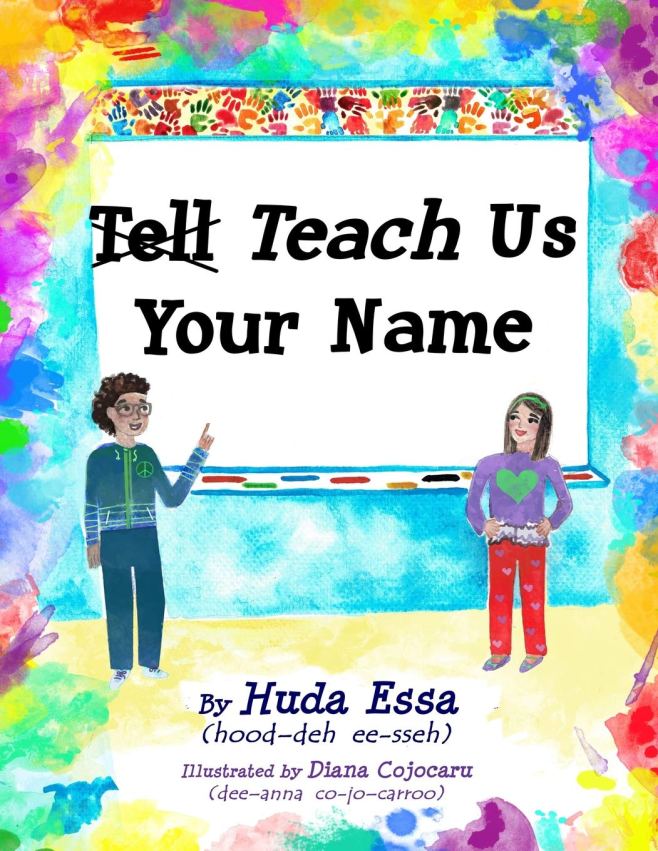
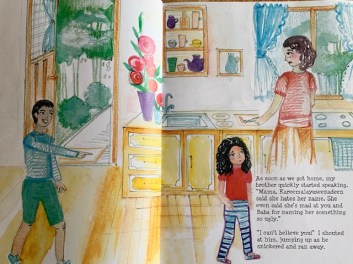
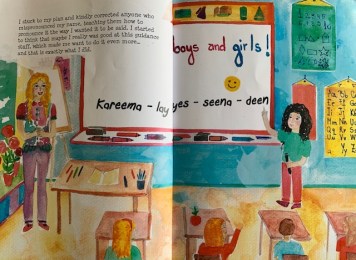
There are 20 letters in Kareemalayaseenadeen’s name, and the first day of school is such a stress for her.  She fears the teacher stumbling over her name, the other children laughing, and her unable to tell them how to pronounce her name correctly.  Her mom tries to explain that for some people the kids at school have hard names, and that for some people her name is easy.

IMG_0477

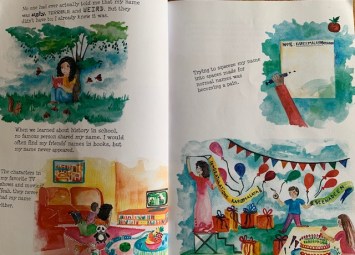
She reflects that in fact no one has ever made fun of her for her name, but that in history class she never sees her name, or on TV or in movies or on key chains.  She can hardly fit her name on her worksheets, and fitting it on banners is impossible too.  Eventually the kids kust call her Karma-Deen and even though she dislikes it, she is too shy to speak up.

IMG_0478

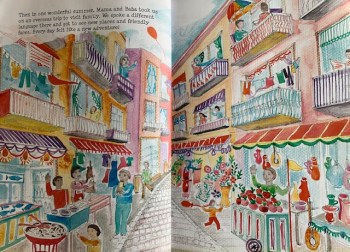
Over the summer, Kareemalayaseenadeen goes on vacation to visit family.  She doesn’t even think much about her name where everyone can pronounce it and say it with ease. Her Sittee though, has heard about her anxiety and sits with her to help her work through it.

IMG_0479

Sittee asks Kareemalayaseenadeen if she knows that her name means “excellent guidance” and that her name is a big part of her.  If she doesn’t like her name she isn’t liking an important part of herself.  She then urges her grandaughter to guide others on the proper way to pronounce her name.

IMG_0480

On the flight home, she ponders her grandma’s words and how to guide others to proper pronouncation, without being rude or settling on them shortening her name.  When she gets home she puts her plan in to action. And it works!

IMG_0481

When Kareemalayaseenadeen grows up, she becomes a teacher and each year she reads this book she has written (the one I’m reviewing) and asks her students to teach her how to say their names.

IMG_0482

The importance of how valuing someones name values the person and their family and culture is really one that as a society we have to keep working on.  We can say  names from Lord of the Rings, and Star Wars and Game of Thrones with no problem, so why can’t we try and pronounce someone’s name who is real and next to us and important to us? We have become lazy, and we need to do better, this book is sweet and kind and should really be read regularly as a reminder to us all, that names are beautiful.

IMG_0483

There is nothing religious about the book or even culture specific. There is a hijabi in the illustration of the market place in the unspecified “overseas country” and the name Kareemalayaseenadeen has Arabic bits, but a lot of names do as well, grandma is refereed to as Sitti, but isn’t defined, so the book is definitely meant for eveyone, especially those who will never find their name on a mug at a gift shop!


Amira Can Catch! by Kevin Christofora illustrated by Dale Tangerman

Standard
Amira Can Catch! by Kevin Christofora illustrated by Dale Tangerman

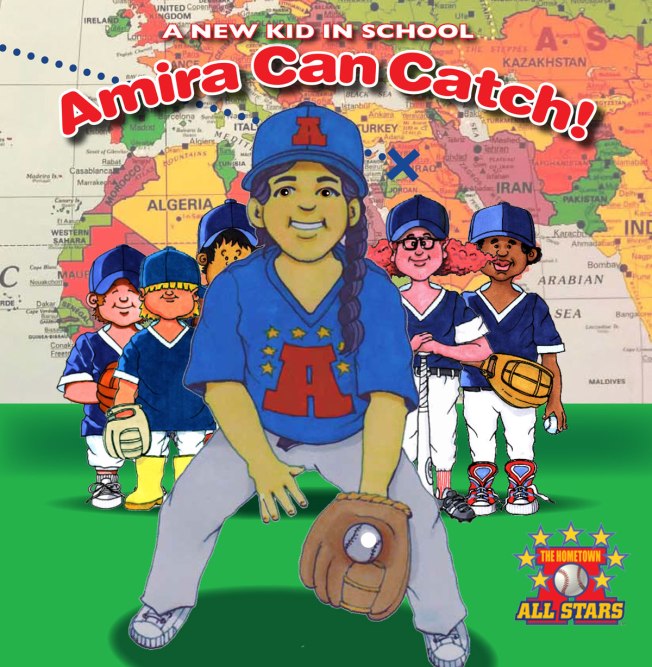
amira_can_catch

This is book four in the Hometown All Stars series aimed at 4-7 year olds.  The purpose of the series is to teach real coaching skills to help children learn about baseball, get out of the house to play, and have fun.  The 34 page book is baseball technique heavy with a fictional storyline to move it along.  Most sports books focus on team work and being a good sport, but this one takes it a step further by emphasizing the basic skills needed to play the game, as well as sneaking in lessons about inclusion and acceptance.  If your child is American and likes sports, the book will be a hit, pun intended, but there is a lot of text on each page and as America’s pastime, there is a lot of space dedicated to what it means to be American.

IMG_0410

A refugee Muslim girl from Syria, Amira, is invited to play on the after school baseball team, but first needs some help at school with spelling and adding.  Luckily the kids in class are super nice and accepting and help her learn about life in America, while similarly listening to her tell about life in Syria and at the refugee camp.  Not only do they all become friends, she also gets everyone to appreciate how much food they have, and the variety, as well as gets everyone to try pickles. Yum! They like them.

IMG_0411

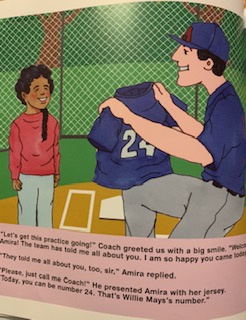
The kids at baseball practice are also incredibly welcoming as they get Amira a jersey, and teach her all about #24 Willie Mays.  From here, it is like a virtual baseball practice, the kids warm up with stretches, running the bases, and practicing their stances.  There are little info headers explaining things such as what hand to wear your mitt on and explaining how to squat, why the coach is using foam balls, and reminding the reader not to throw balls in the house.

IMG_0412

The kids learn three different types of catches.  How to stand, how to position their hands and how to be ready.  They run drills and practice, practice, practice. They find out Amira is really good, and she tells them that they had a lot of time to practice catching and throwing in the refugee camp.

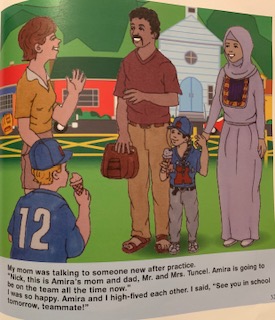
The coach then asks the kids and readers questions before Amira’s parents arrive to pick her up.  With big smiles on their faces, the mom is wearing a hijab and chatting with the narrators mom.

IMG_0415

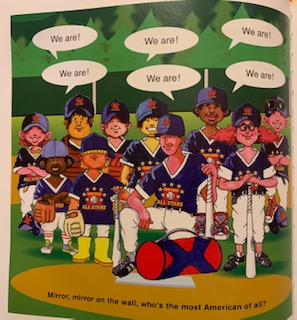
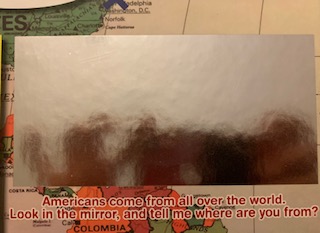
The book ends with a whole page on “What Does It Mean to be American,” a review of new words learned in the book, and all the kids answering who’s the most American of all, with “We are!”  The back cover has a reflective patch with the statement “Americans come from all over the world.  Look in the mirror, and tell me where are you from?”

IMG_0416

The book and series are a great way to learn about a game, that really a lot of kids today may not know much about.  Some of the terms, the skills, and just familiarity is clearly conveyed, with the illustrations providing the visuals and diagrams for what the coach is talking about in the text.  The fact that the author chose to add a refugee to such an “American” book and have the supporting  characters so welcoming, really does show the best of what Americans can be.

IMG_0417

Luv Ya Bunches by Lauren Miracle

Standard
Luv Ya Bunches by Lauren Miracle

bunchesA book about 5th grade friendships told from the perspective of four different girls in a variety of styles: instant messages, chatroom conversations, video scripts, and traditional text.  The author seems to have a checklist of diverse characters and afflictions that all must make an appearance in the 335 page story.  It is written on an AR 4.4, but with one of the main characters having two moms, details of a suicide mentioned, talk of pole dancing, male anatomy joked about, thongs, crushes, and mental illness, four girls coming together to form friendships and take down a bully, might raise more questions for young readers than they are ready to handle.  Yasaman the Muslim girl in the group, also borders on perpetuating more stereotypes than she breaks, and while I definitely don’t think this book is a good fit for 4th and 5th graders, I don’t really recommend it for readers of any age, there are just better books out there.

SYNOPSIS:

Asian American Katie-Rose doesn’t have friends, unless you count her neighbor Max, but she doesn’t.  She dreams of having blond haired Camilla as a best friend, but the Camilla she went to Pioneer camp with is not the Milla at school who hangs out with Modessa (aka Medussa) and Quin, and is popular.  Katie-Rose also dreams about being a cinematographer or director, she isn’t sure yet, but she loves to imagine scenes and scripts and how things ideally should play out, even when in reality they never quite seem to do so.

Milla, isn’t sure if she wants to stay friends with Modessa and Quin, they aren’t nice and she has a lot more fun with Katie-Rose, but somehow she always ends up going back to the popular crowd.  She also has a lot of anxiety and needs various totems with her at all time to feel secure.  When her little plastic turtle goes missing, she struggles to stay composed, and her and her turtle will end up changing a lot at Rivendell Elementary.

Violet, is the new girl at school and she is not liking her life at home or at school.  Her mom is in a mental hospital and she misses her desperately, her dad brings home fast food every night for dinner and life just isn’t the same since she moved to California.  Immediately able to tell who the popular kids are at school, she hasn’t decided which group of friends is the best fit for her, but when she stumbles on Tally the turtle, and doesn’t immediately return it to Milla, she has to understand what that says about her, and figure out if she is strong enough to make things right.

Yasaman is the quiet computer wiz, she is also Turkish-American, Muslim, and a hijabi.  She designs a platform where kids who are too young to join Facebook can chat, stream videos and send cupcakes.  The only problem is, she has no friends to get to join.  When Katie-Rose and her strike up a friendship, the first seeds of the four flower named girls are planted, but it will take all four of them to put Modessa in her place, rescue Tally, and deal with stereotypes, emotions, and family along the way.

WHY I LIKE IT:

I love that a Muslim, muhajaba is included in the quartet, and that her religion, her scarf, her culture, and her belief in Allah, actually are sprinkled in.  I don’t love how in the book’s efforts to include such diversity, that it also seems to fall for a lot of the stereotypes that it on the surface seems to be dispelling.  Katie-Rose asks her if she even knows what YouTube is before being made aware of how computer savvy she is.  All this is to subtly show the assumption that Muslims are not aware of technology and whatnot, and set the record straight, but also regularly thrown in are side comments from Yasaman that her father would never let her wear something, or she wouldn’t be allowed to do that because of her dad, definitely reinforcing a male dominated, authoritarian, out-of-touch patriarchal view.  Even her mother, an artist, is shown to demand a lot of Yasaman and be incredibly strict.  A lot of things aren’t spelled out, they are just dropped in and assumed that the reader get’s it.  But only Yasaman’s parents are portrayed this way.  Milla’s two mom’s are caring, Violet and her dad seem close, and Katie-Rose’s parents are rarely highlighted.  So, I felt like it was noticeable, and not in a positive way.

I’m still completely confused as why pole dancing and male anatomy made appearances in the book.  And the pole dancing reference appeared not once, but twice when Yasaman is talking to an older cousin who is talking about a friend who’s aunt is a pole dancer, and then later when Katie-Rose’s babysitter also mentions the same friend.  They also discuss people as being slutty and boy crazy and skanky.  The male anatomy isn’t spelled out it is hidden with a girl with major orthodontia reading a Wikapedia page on the greek satyrs, discussing their physical pleasures and talents.

There is also a lot of mental health issues that I’m glad are present, but I’m not sure if they are handled seriously enough.  I’m glad they are addressed, because awareness is a good thing, but discussing how someone swallowed pills to commit suicide and even though she changed her mind still died, and not giving any context seems to make the concept come across as a bit trivial to me in its presentation.  Same goes for Camilla’s anxiety and Violet’s mom being in a mental hospital.  These girls have some major stuff going on that their preoccupation with a snotty group of girls, and the obsession of mud being consumed in an ice cream shake, seems a bit off.

Overall, the girls seem incredible perceptive and articulate in their self reflection and understanding of social personas, that I found their banter completely disjointed.  I don’t think the author’s voice is consistent, and the heavy stuff is too much coming from 5th graders in my opinion.

FLAGS:

Stereotypes, and discrimination against Yasaman and her younger sister Nigar.  Possible triggers with talk of suicide.  Milla has two moms, it is never labeled or made an issue, she just refers to them as Mom Abigail and Mom Joyce. Talk of boy private parts and erections, crushes, pole dancing, words such as skanky, and slutty and dingleberry (poop hanging on) used.  There is lying and bullying and retaliation and poetic justice.

TOOLS FOR LEADING THE DISCUSSION:

I wouldn’t use this book for a book club or even have it in the classroom.  I think it gets a bit crass unnecessarily and the cute flowery cover and inside flap, makes it all the more surprising.  You might expect some potty humor in other books, but knowing it is there allows the reader to make a decision to read it or not, I would imagine most Muslim parents would see four diverse girls on the cover, one wearing hijab, get excited and hand the book to their 3rd or 4th or 5th grade daughter and have no idea what the book also includes in passing, with no relevance to the story lines highlighted on the inside flaps and back of the book.

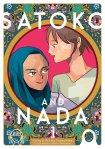
Satoko and Nada 1 by Yupechika

Standard
Satoko and Nada 1 by Yupechika

satoko.jpg

A manga series about two college roommates who have come to America to study, Nada from Saudi Arabia and Satoko from Japan.  Written by a Japanese author and translated into English, there is a lot about Muslims, particularly Muslims from Saudi, as the two characters get to know each other and become friends.  Their interactions work to dispel a lot of stereotypes and promote how rewarding getting to know people different from your self can be.  Volume one (there are three) is 127 pages, read right to left in four panel pages, and is fairly clean for all ages (they do buy underwear and bras at one point), but would most likely appeal to female readers in 4th or 5th grade and up.
8CE09DE5-2BEB-48C0-9157-96B13CC78CD9

SYNOPSIS:

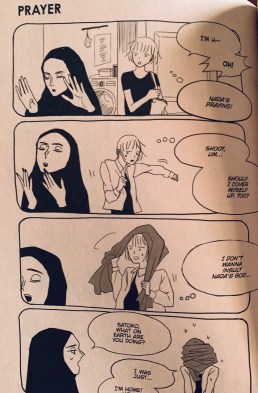
The book is about two girls getting to know each other, learning about each other’s culture, and navigating life in America.  There isn’t really a plot or a story line outside of this basic framework, and with a heading every page or two it reads like a quick scene about the topic expressed in the heading.  So, for example there are headings of Veils, Ramadan, Birthday, MashAllah Choice, etc, and then a few panels showing the girls having an interaction about it, resulting in understanding, humor, or a lesson.

In a bit of a stereotype twist, Nada is more street savvy then Satoko when approached by a stranger for a ride, and thus Nada hasto educate her a bit.  The book brings in a Christian American character and a third generation Japanese character learning Japanese, to further show how assumptions plague as all and how simple conversation and an open mind, can lead to some amazing friendships.

WHY I LIKE IT:

The book is really choppy, but you get used to it and soon you forget that it isn’t a typical story.  I admittedly haven’t read a lot of manga so, I have no idea if this is the norm, or something unique.  I love that its upfront about stereotypes, if it was an American writing it, or a even a Muslim it would probably come across as preachy or arrogant, but somehow it doesn’t seem like the two characters have much baggage, nor feel a need to defend their culture by putting another’s down.  They deal with issues such as women driving in Saudi, differences between hijab, burka, abaya, niqab, being around alcohol,  the joy of a fatwa allowing soy sauce and its alcohol content to be permissible, etc.  Some things are cited for clarity and something are very Saudi, but it really contains a lot of information, about Islam that I am pretty impressed by.  There isn’t a ton about Japanese culture since I would assume it was written for Japanese readers, so it would be redundant, but I did learn, according to Satoko, how religion is viewed by Japanese, how putting age and gender and race on forms seems incredibly personal, and some information about food.

FLAGS:

There is a possible failed abduction, not sure what the guys intention was, but the girls treated it as such.  The girls do go buy undergarments, so they are visually depicted.  There is mention of alcohol.

2DF66805-A246-4150-89BA-E7E1EAF90E90
TOOLS FOR LEADING THE DISCUSSION:

I wouldn’t do this as a traditional book club, but I think I am going to get a copy of the series to pass around my daughters middle school group of friends, to

one- give them a taste of manga

two- see what they think of the Islamic rep from a Japanese paradigm and

three- give us all something to chat about

The book is fun, I got it at the public library and think it might open up a new book type for kids to try and a new point of view for many of us to consider.

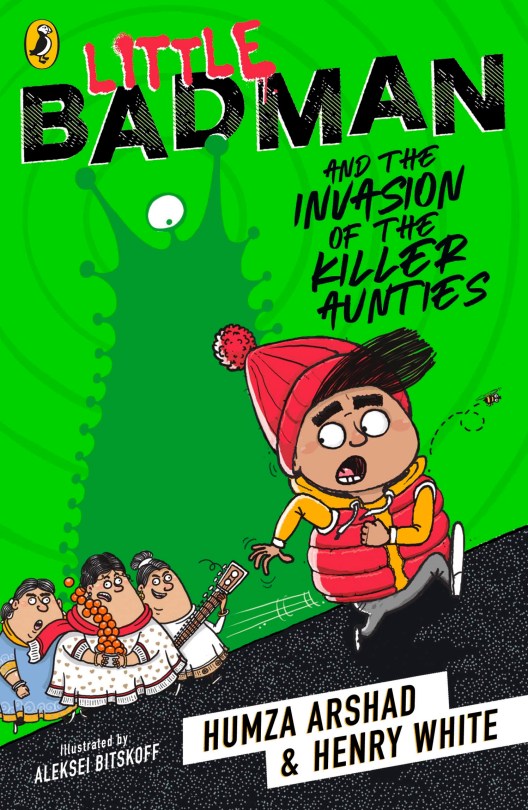
Little Badman and the Invasion of the Killer Aunties by Humza Arshad & Henry White illustrated by Aleksei Bitskoff

Standard
Little Badman and the Invasion of the Killer Aunties by Humza Arshad & Henry White illustrated by Aleksei Bitskoff

badman

It’s been a while since I’ve read such an over the top silly book that has a lot of heart.  It is 352 pages that remind me of the the My Teacher is an Alien book series of my youth smashed up with the Weirder School/Diary of a Wimpy Kid series of today.  Meant for upper elementary with some bad words (hell and damn), the story is Pakistani-British representation with many Muslim named characters, a Muslim author, and a shout out to a KFC in another town that is halal.  Don’t read it if if you want to learn anything, but definitely pick it up if you want to roll your eyes, giggle, and ponder a world where Desi aunties are the perfect disguise for force feeding an entire community delicious food as part of their evil plan to take over the world.

aleksei-bitskoff-little-badman-1

SYNOPSIS:

Humza Mohammed Khan is an 11 year old Pakistani kid in Britain who thinks of himself as the next big rapper, Little Badman.  He dreams big and talks even bigger as he struts around primary school getting in trouble and trying to film his music video on his friend Umer’s extremely old Nokia flip phone.  With a normal enough mom, a hyper exaggerating father, and a handful of their friends known as Aunties and Uncles, Humza gets in trouble regularly enough, but overall seems to have a good heart.

Things at school slowly start to change after their teacher gets stung by a bee named Mustafa, that Umer brought to school to be his pet.  Weird as that might be, it is even more odd, when their teacher is replaced by a volunteer auntie.  Every day it seems like a teacher goes missing, and is replaced by some asian kids’ aunt.  When the supper ladies are replaced and the food improves, no one is complaining.  When every volunteer starts bringing snacks to school, no problem.  Who doesn’t love gulab jams, and samosas, and butter chicken all day long every day?  Well, as the school puts on the pounds and all the teachers and staff are officially missing, Humza, Umer and their former nemesis Wendy, start to get worried.  Humza’s Uncle who he calls Grandpa, claims his wife Auntie Uzma is not really his wife, and helps Humza investigate.

Secret meetings in supermarkets, teachers and grandpa vanishing, and Humza seeing a giant slug coming out of the substitute librarian, means that Little Badman is going to have to run away from cricket practice, not get sent in a crate to Pakistan, face his stage fright, and save the day from the aliens taking over the aunties.

little-badman-inline

WHY I LIKE IT:

I like that it is cultural rep and own voice in its telling.  Humza is Pakistani and his cultural baggage is hilarious and part of him, and no explanations are needed.  In his world people are from lots of places and they all live and play and learn together and they eat caramel apples and toffee and jilabies.  The diversity is great and not articulated, it just is what it is, and they all have to work together to save the day. I think my favorite character is Grandpa, who Humza has to learn to appreciate and not just see as an old almost dead guy and Humza’s dad who exaggerates everything and takes his cricket very seriously.  At the end Humza has to have a heart to heart with his dad and his uncle, Grandpa and it makes this over the top nutty story really kind of sweet too.

There is no “Islam” in it aside from Muslim names and mention in a rap of a halal KFC.  I kind of like that they are Muslim kids and it appeals to a larger audience, sure something praying or something at some point might have been nice, but it isn’t a book that you’d be expecting spiritual nuggets from, so it is ok.

aleksei-bitskoff-little-badman-3

FLAGS:

The words damn and hell are used.  There is disrespect of authority, parents, and teachers as well as lying.

TOOLS FOR LEADING THE DISCUSSION:

I had my ten year old read it and he thought it was ok, but was uncomfortable with the language, which I was glad, but I told him I thought he could handle it, and know what is appropriate to use.  That being said, school libraries should have the book, maybe not classroom libraries though, and I probably wouldn’t do it as a book club.  I will have my other kids read it though, cause like I said, it is silly and fun.

Interview with comedian author Humza Arshad: https://www.booktrust.org.uk/news-and-features/features/2019/march/meet-little-badman/


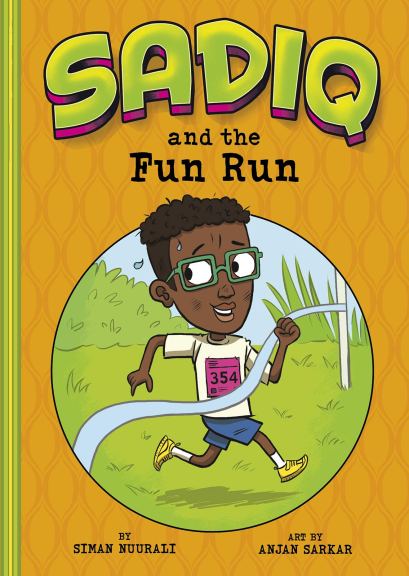
Sadiq and the Fun Run by Siman Nuurali illustrated by Anjan Sarkar

Standard
Sadiq and the Fun Run by Siman Nuurali illustrated by Anjan Sarkar

sadiq

This new series featuring Sadiq, a Somali American living in Minnesota, is great for early chapter book readers looking for representation and diversity.  There are four books about Sadiq, his family, and his friends and classmates in third grade, and all are either an AR 3.6 or AR 3.5.  At 57 pages long, divided into five chapters and filled with bright and colorful illustrations students in grades 1st through fourth, depending on reading level and interest, will enjoy these simple plotted, yet relatable stories.

F905B46F-CCAE-4094-A2C1-C7A66CD4B66F

SYNOPSIS:

Sadiq’s friends are all getting ready to try out for football, but his parent’s say that he is too young for such a rough sport and has to wait until he is 12 like his older brother, Nuurali, did.  Sadiq’s parents and family encourage him to try another sport, and with a new running club starting in a few days coached by a member of the national team, that’s what he opts to do.  Begrudgingly he joins the team, but is hurt when his friends talk about how much fun football is and how much more tough and difficult it is compared to running.  While this is going on, he is getting support from his brother to keep running, and from his teammates, but it is hard and he doesn’t enjoy it.  Slowly, he starts to improve, however, and with the Fun Run the climax of the book he sails across the finish line in first place when he sees his friends have come to cheer him on!

307C04CE-AE9B-4121-9DA0-04BE7302D795

WHY I LIKE IT:

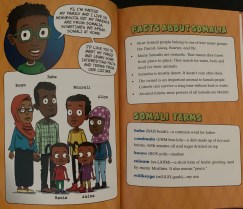
I love that the book/series proudly features a Somali-American-Muslim family.  There is information about Somali at the beginning as well as some Somali terms and a portrait with names for the members of Sadiq’s family.  The mom and older sister wear hijab, “Salaam” is one of the defined words and the characters use it when they meet.  I also love the diversity of skin tones in the illustrations and one of the girls on the track team wears a scarf as well.  There are Muslim named kids and non Muslim named kids in the story, and while Islam isn’t mentioned outright, it is definitely represented through the characters words, names, and appearances.

4F1421B3-B166-4B44-BB86-0DA161F5939F

The story is straightforward and perfect for the age group, the books in the series do not need to be read in any order, and you will get to see the different supporting casts featured more prominently in different books, thus getting to know Sadiq and his world.  I like that he doesn’t get his way, and doesn’t get to do what all his friends are doing, but he makes it work.  He is grumpy and upset, but he doesn’t get obnoxious or overly whiney.  I think this subtly gives readers some tools and insights to model in their own disappointments.  I also like that while he has to put in the work and fix his attitude, he doesn’t have to do it all alone.  His family and coach are supportive, and eventually his friends apologize and support him too.  For the simplicity of the book, you actually do get invested in his little trial and want to see the outcome.

3AC10F17-7A77-40AD-BC46-A57D4359D94F

FLAGS:

None, it is clean.

TOOLS FOR LEADING THE DISCUSSION:

This book is like a boy protagonist version of the Meet Yasmin books, they show a kid of culture in everyday experiences.  The target audience wouldn’t make it work for a school wide book club, but I think early elementary teachers would benefit from having the series in their classrooms and letting kids in small groups discuss if they want. These books would be great for first graders that are way above reading level and parents are struggling to find appropriate books.

The end of the book has some resources as well: a glossary, discussion questions to talk about and some to write down, as well as a home workout guide and information about the author and illustrator.

The Proudest Blue by Ibtihaj Muhammad & S.K. Ali illustrated by Hatem Aly

Standard
The Proudest Blue by Ibtihaj Muhammad & S.K. Ali illustrated by Hatem Aly

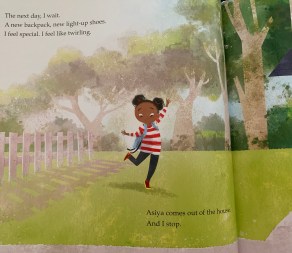
blueLOVE! Yes, usually when I’m so anxious for a book it disappoints, but not this one, it warmed my heart and soul and made me smile.  In 40 pages surrounded with absolutely adorable illustrations, the reader feels the love between siblings, the strength of self confidence, the power of being true to yourself, the beauty of hijab, and the awesomeness of light-up sneakers and five cartwheel recesses.

C7E95032-E080-4057-BC93-6B25CBCAAA29

It is the first day of school for sisters Asiya and Faizah, and Faizah’s first day of wearing hijab.  The book starts out with the girls and their mom picking out a new scarf at the store.

677BD5F0-0C6E-472A-B086-05F93D4F17CC

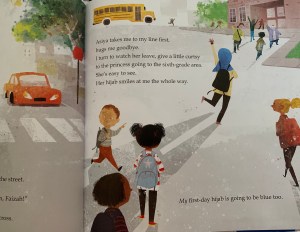
The first day of school has the girls walking to school hand in hand, Asiya in her beautiful blue scarf, and Faizah in her new shoes admiring her sister as if she were a princess.

DB80D90A-289E-4F35-A763-24526723E650

In line a classmate whisper asks Faizah about her sister, and Faizah has to find her voice to speak up about her hijab.  She then likens the blue hijab to the sky, special and regular before recalling that their mom had told them “The first day of wearing hijab is important. . . It means being strong.”

DFA253F0-16BC-464A-B630-BB93AFBFCF94

Throughout the day at school Faizah checks on her sister, sees other kids make fun of her, liken the blue to something beautiful, and then recall something their mom has told them to give her solace and strength.

06E90E71-3375-4E26-9F0A-F31DCA8058C4

As Faizah puts into practice the lessons from her mom about being strong, knowing who you are, and not carrying around hurtful words, she, like her sister finds strength.  A strength which radiates to those around them, and further connects the two girls.

C62B2893-3E2B-4628-BAAE-C195FBD3AB7A

Faizah has an amazingly sweet and authentic voice as she counts her light up steps and looks up to her older sister.  I love that the story stays on track and has its own rhythm of a school incident, a strong declaration about blue, a lesson remembered from Mama and a resolution.  With lots of mini climaxes the reader sees the strong perseverance and how being authentic will be challenged repeatedly.  The subtly of the hijab being whispered about and then proclaimed loudly is really tender and emotion filled.  Little reminders why OWN Voice stories are so important.

The illustrations are absolutely amazing on their two page spreads: the colors, tone, expressions, are perfect and a huge part of the narrative.  I love that when a boy points at Asiya, not just Faizah, but Asiya’s friends too are unhappy with the boy.  I also like that the boys being mean are not depicted clearly, but rather are shown in the shadows, furthering the point that mean words and those that spout them are not worthy of your time.

There are Authors’ Notes at the end and a picture of Ibtihaj  and her two sisters Asiya and Faizah. I think the book should be on every shelf, truly.  To be yourself and be proud of who you are is universal, as is kindness. The book does not discuss religion or mention Islamic reasons for her covering, and girls and boys alike will benefit from multiple readings of the book.
 

Towers Falling by Jewell Parker Rhodes

Standard
Towers Falling by Jewell Parker Rhodes

towers falling


I realize the inherent difficulty of writing books for middle grades about the events of September 11, 2001: the author lived through it, the readers did not.  Yet, it seems like at some point a book regarding it, will just feel right, and I don’t think for this age group, I’ve found it yet.  This AR 3.3, 228 page book is a quick read, and while some of the characters have spunk and personality, a few of the storylines seem incredibly forced and the overall timeline and holes in the story will be ultimately disappointing for most readers.

SYNOPSIS:

Deja is starting a new school now that her family has gotten a room at a homeless shelter.  Immediately her fifth grade classmates are given an assignment about home, with the end goal that eventually this project will transform in to being about the change of New York’s skyline fifteen years ago.  The details regarding the attacks of September 11, are not given forthright and as Deja knows nothing about the attacks, and the fall of the towers, her inability to get answers adds to her frustration at home and school.

Deja is angry as she bares a lot on her young shoulders.  Her dad can’t hold a job, and his moods and ill health put caring for her younger siblings on her.  Her mom works as a waitress and is always tired.  They lost their house, lived in their car for a while, and now occupy one room in a shelter.  Deja refuses to lie about her home life and thus her aggressive attitude is always on guard.  Another new kid, Ben, joins the class and he and Turkish American popular girl, Sabeen, all quickly become really good friends.  Each have something brewing beneath the surface that they are dealing with, but their friendship helps them cope and bonds them together.

As the trio of kids work on their projects together, Ben finally shows Deja online footage of the attacks and clues her in to what everyone else in their Brooklyn class seems to know and has failed to tell her.  Deja links her father’s declining health to that fateful morning and decides she needs to go to Ground Zero and get some answers.

She doesn’t really get answers, but at least it is the catalyst for an overdue conversation with her and her father, and hopefully a start on the road to healing the family rifts.

WHY I LIKE IT:

Much like the book Nine, Ten there seems to be the token Muslim girl in the story to offer her perspective on the Islamaphobia that occurred after the attacks.  In this case Sabeen doesn’t detail anything specific happening to her, other than a clerk at a store telling her to go back to Saudi and her uncle getting screened regularly at the airport.  Of all the characters I feel like Sabeen gets the short end of the stick.  She is incredibly flat, stereotyped and undeveloped.  Her family is Turkish, she is wealthy, her mom wears niqab and they are all overly kind and sweet, which is great, but when Deja goes over for lunch, they ask her if she prays, which seemed so random and off to me.  A lot of the basics about the character the author got right, she says that the terrorists were Muslim, but they weren’t, sharing a sentiment many of us Muslims feel. She wears hijab, and takes it off when she gets home.  I don’t like that the mom speaks English, Arabic and Turkish, but is first introduced having Sabeen translate for her with another parent.  Seems incredibly pretentious and misleading.  Ultimately her storyline is just overly forced.  She has to leave Ben’s house when they talk about September 11, because she is so affected by it.  She wasn’t even alive when it happened, and I get that when it is discussed us Muslims are on guard, but the author makes it seem like it is her whole world and influences everything around her.  If you live in New York, especially, I’d imagine at some point you’ve had to come to terms with it, no?

That’s why I also struggled with Deja’s dad.  He is so debilitated by the events of 9/11 he can’t function, yet they happened 15 years ago, presumably before he met Deja’s mom and they started a family.  So, really she fell in love with him in his current condition and thought having three kids with him was a good idea? He was fine and then wasn’t? For 15 years he hasn’t been able to get some sort of help for his PTSD type symptoms?  Seems like a stretch in the timeline, and one that is hard to excuse even for 3rd and 4th graders.

I really like how Deja’s homelessness is brought out and hopefully readers can learn some empathy from her.  Unfortunately the entire 5th grade class is so idyllic that I don’t know that most if any kids reading the book will relate to such a well behaved, so accepting, forgiving and generous group of kids. I mean yeah that’s the goal, but its way too overdone.  Ben, Sabeen, and Deja are best friends after the first meeting even though Deja is rude, mean, and doesn’t like them.  I’m not even sure what Ben and Sabeen get out of being friends with Deja?  Deja undoubtedly benefits from them, but there aren’t a lot of compelling reasons given why they’d be so drawn to her.

And finally, I struggled with the theme of how being “American” united them all.  It makes sense when discussing it as a class, that it doesn’t matter their color, income, life experience, whether they were immigrants or born in America, but the concept comes up again at a critical point when Ben and Deja are on the subway and seems so misplaced to me.  On the subway there would be plenty of tourists and visitors, that wouldn’t be American, no?

FLAGS:

The book is clean, it does mention some drunk people at the shelter, but nothing specific, just in passing.

TOOLS FOR LEADING THE DISCUSSION:

I wouldn’t do this as a book club selection because the target age is lower than who I meet with.  But, even despite some of my criticisms I’d recommend this book be in classrooms and school libraries as it does offer up a perspective on historical fiction that hopefully could lead to a slightly deeper understanding of the events at a young age.


Piece by Afshan Malik

Standard
Piece by Afshan Malik

Pieces.jpg

This 168 page young adult book from Daybreak Press focuses on a small Muslim family in Texas, that has their own stresses and interpersonal relationships, but are thrown in to a whirlwind when the father of the family returns home from a medical mission to Syria and finds himself in the psych ward broken and troubled.  The effects each of the character’s struggles have on them as well as those they care about, makes for a haunting yet relatable read for fourteen year olds and up.

SYNOPSIS:

The Jamal family is made up of Hannah and her older high school aged sister Noreen and their physician parents Dahlia and Adam.  Hannah runs track and is more introverted in handling friends and her father’s life altering condition.  Noreen on the other hand is ultra organized and rational in her approach to life, much more like her OB mother.  To cope with the stress of her father’s return she commits herself to more clubs at school and staring at her phone.

Hannah doesn’t seem to have a lot of friends, and when the track team understands that Hannah’s dad is dead and Hannah doesn’t correct them until later, her comfortable acquaintances turn on her and she will have to learn to stand up for herself and use her voice in the course of the book.  Noreen’s character arc is a bit more dramatic as her involvement in yearbook club brings new people in to her life, mainly a boy, who might not be as a genuine in his goals as she is, and thus their climax results in a trip to the police station.  Dahlia has a close friend, and Adam has a few as well, but the story really stays pretty streamline in exploring the relationships of the family and how little things and big things affect them all.

WHY I LIKE IT:

I love that the book takes on a serious issue like PTSD and is framed in such reality.  The scene where the dad blurs his past memories with the current real happenings, is done very well.  It conveys how fractured his brain is while showing the stress his situation lends to the mood of the home is powerful. There is also a very real situation of attempted physical and sexual assault that occurs when Noreen finds herself in a position with a male classmate who attempts to take advantage of her.  The book holds back in details, and she is able to defend herself, keeping the book clean, while still implying what his intent was, and how fortunate she is to get away.

More superficially, but also more relatable is the girls bickering and fighting and pushing each other’s buttons, and the mom trying to help, but is alas is frequently at a loss at what to do with them.  The situations the girls face at school are probable and relatable that I think a lot of middle school and high school readers will see themselves trying to balance extra curricular activities, friends, finding a quite place to pray and keeping their hijabs coordinating.  The family is Muslim and they dress the part, talk the talk, and pray together regularly.  Islam is very present, but not preachy, it is just what the characters believe and what they use to shape their view of many of the tests they are facing.

There are a few hiccups that are worth noting, but don’t overly deter for my appreciation of the story.  I struggled with the writing style in the first few chapters.  It took a bit to feel a connection to the characters and get what was going on sorted out.  It is written in 3rd person omniscient (I believe, it’s been a while) with each chapter more or less focusing on one of the four main characters.  As a result a handful of times the narrative gets awkward in explaining what one of the characters is doing or thinking, because the focus is on someone else, or the timeline overlaps a bit.  It doesn’t happen an awful lot, but the book is under 200 pages, so it is annoying that it happens at all, let alone more than once.

Story wise the characters seem oddly isolated.  The book tells us how small the town is, and shows us how everyone knows the parents regularly, the girls seem to be pretty lonely.  There isn’t any warmth from the schools or neighbors in helping them deal with their dad coming home so wounded.  In a town they have lived in for so long, this seems off to me.  Also if the town is so small, and the family so religious, there is an imam who visits once, you’d think there would be more of an Islamic community presence for the mom and girls to find support from.

FLAGS:

There is violence in the remembering of what happened in Syria.  There is some Islamaphobic talk as Hannah endures some verbal bullying and the attempted physical and sexual assault on Noreen.

TOOLS FOR LEADING THE DISCUSSION:

I would consider this as a possible middle school book club choice.   It tackless some big things, and uses Islamic boundaries to talk about mental illness and sexual violence which is a huge plus when addressing our youth.  Noreen isn’t in a relationship or even overtly infatuated with the guy who puts her in a compromising situation.  But even if she was doing something “wrong” what he did is not ok, and the fact that the authorities believe her, and she plans to discuss it with her mom, and she is not further victimized by speaking out, is something our kids need to see and understand.

There are discussion questions at the end and I think males and females will benefit from reading and discussing this book.  Unfortunately, and possibly the only other disappointment in the book is the price.  Nearly twenty bucks for a short YA paperback book makes it hard to buy classroom sets for such activities, and I’m sure will even keep the avid reader debating whether they should purchase it or not.


Yan’s Hajj: The Journey of a Lifetime by Fawzia Gilani illustrated by Sophie Burrows

Standard
Yan’s Hajj: The Journey of a Lifetime by Fawzia Gilani illustrated by Sophie Burrows

yans hajj.jpg

With less than a month until Hajj, this book should definitely start making an appearance in your children’s story selection rotation.  The focus is not on the parts of hajj, but rather the desire and intense yearning to go for the sake of Allah (swt).  Granted, it doesn’t take much to get me to cry these days, but this 27 page book for ages 5 and up, got me emotional.  Going for hajj is always something to plan for and hope for, and the sweetness of the reminder that we plan, and Allah plans and Allah is the best of planners is so beautifully brought to life, that I benefitted from the reminder and my kids from the lesson.

IMG_5485.jpg

Yan is a farmer, a poor farmer, who loves Allah and wants to go for hajj more than anything else.  So he decides to work hard and fill up his money bag so that he may go.  After years of hard work his bag is full and he begins his first steps in his journey proclaiming his love for Allah.  After a few days of walking however, he comes upon some sad children who have recently lost their school to a fire.  Yan, uses his money and time to fix the school and returns back to his farm to start saving up again to go for hajj.IMG_5486.jpg

When his bag is full again and he sets out again, he is met by an injured boy who is being yelled at by his owner.  Yan, once again reaches into his money bag to generously do the right thing, in this case to pay off the boy’s debts and takes the boy home with him to be nursed back to health.

IMG_5487.jpg

After some time he again has a full money bag and sets off for Hajj.  Along the way he finds a village trying to build a mosque and after two months of helping with the funds and offering his own labor, the mosque is complete and Yan returns home.

IMG_5488.jpg

Now Yan is old, and after many years he looks in his money bag and it is not full and he sadly admits he cannot do hajj.  But then the boy he saved, Habeeb, returns with a horse cart to take him for hajj and they pass through the village where he repaired the school and is greeted with rose petals and gifts of ihram, they then pass by the mosque he helped build and the villagers gift him with food and water, they then arrive at Habeeb’s house and he is given a bag filled with money and at long last Yan’s dream comes true as he sees the Kaaba.

IMG_5489.jpg

The book shows how steadfast Yan’s love of Allah is and how generous and patient he is in pursuing that love. The illustrations of him aging are truly touching and gentle.  In some ways it reminded me of Shel Silverstein’s The Giving Tree, but with a happier ending, in bringing a large grown up concept down to size and presenting it in a genuine way.