Tag Archives: Pakistan

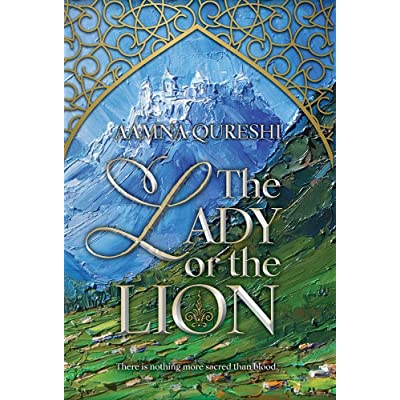
The Lady or the Lion by Aamina Qureshi

Standard
The Lady or the Lion by Aamina Qureshi

lion

I was kind of surprised how well done this YA culture rich 350 page romance story was in holding my attention.  I don’t know that I had any expectations, but I was genuinely engaged in the growth of the protagonist as she began to emerge from her naive political state, and I look forward to some resolution from the cliffhanger conclusion of this the first book in the Marghazar Trials series.  The characters are practicing Muslims who pray and mention Allah swt regularly, they also acknowledge when they make extreme departures from basic Islamic tenants such as drinking, dancing, murdering, exhibiting racist attitudes, and mixing freely with the opposite gender.  It doesn’t stop any of the characters from behaving as they wish, but at least it is noted. The Urdu words and Pakistani setting in this fictional reimagining is filled with warmth and love, and while there are some steamy scenes and outright cruelties, I think 15 year olds and up can handle the contents, and recognize the suspension of reality and moral laxities for the sake of telling a story.

SYNOPSIS:

The book makes clear from the onset that “In the very olden time, there lived a semi-barbaric king. . . This is not his story.” This is the story of 18 year old Durkhanai, an orphaned princess raised by her grandparents, the King and Queen of Marghazar.  Marghazar is a prosperous country that is waging war on two fronts and does not let outsiders in, ever.  When the book begins it is doing so begrudgingly to avoid war with the neighboring districts that are working to unify and have recently been attacked.  With ambassadors arriving to determine the guilt or innocence of the one district unaffected by the terrorist attacks, the foreigners are seeing the inner workings of the kingdom for the first time.  All the ambassadors are females of various ages and experience, save the one from Jardum.  Asfandyar is young, dark, and handsome, and immediately discriminated against by the Badshah for his complexion.  Additionally Shehzadi has been warned by many to stay away from Asfandyar, which naturally makes him a great character for her to be swept away by.  She holds out for a while, but with her people mysteriously getting ill, her betrothed melting in to the background, and cracks in her country making themselves obvious, Durkhanai will find herself struggling to understand her heart, her country, her family, and her future, and with the cliff hanger ending, no simple answers will be given to her, or the reader.

WHY I LIKE IT:
I love that there is a map at the beginning, and lots of supplemental offerings at the end.  There are a lot of Urdu words and phrases and while I am moving away from feeling like all OWN voice books need to include glossaries, I think non Desi readers will be appreciative in this particular book to have one available.  For someone with some knowledge of the language the inclusion of the titles and relations and phrases between the languages is expertly done and delightful. There is also an author Q & A, as well as reader discussion questions.  There is a content warning at the beginning alerting the readers to physical and sexual assault as well as racist behavior and language and makes clear that it is contained to the characters and the story and is not the reflection of the author and publisher.  I like that it is there, and I like that the princess makes a stance against the racism and the sexual assault that she witnesses.

The high school girls at our Islamic School are always wanting “halal” romance books.  Ok so really they just want romance books, but I try and keep their pickings halal, and so I am forever reading these books trying to find new titles to recommend.  The book is very 1990s Bollywood in terms of romance flags.  There is a lot of proximity and caressing of necks and longing, and familiar obligation.  There is some snuggling and kissing, so maybe 2000s Bollywood, but the characters thus far don’t cross “that” line.

I really appreciated that Durkhanai was fleshed out and relatable.  Even though the setting is long ago, and the genre is romance, she didn’t wait to be rescued, even when she was hurting or pining, she was still maintaining her obligations and moving forward.  I also love that it showed some depth to her emotions.  She recognized that Asfandyar would let her speak and would show his support by being there, but he pushed back on her and challenged her too.  Rashid on the other hand would speak for Durkhanai and would fawn over her in a very superficial way almost.  Sure neither relationship was ideal, but from her perspective at least she was able to see how various presentations made her feel.

I was a little lost in some places, but I was reading quick and had distractions so I’m not entirely sure if it is my carelessness or plot holes or if gaps will be filled in future books.  I needed more reasoning though, for why Durkhanai’s cousins, Zarmina and Saifullah, truly hated Asfandyar as much as they did, or what exactly Saifullah was plotting and how it connected to ratting out the princess.  For all that is seemingly going on, the Badshah and Wali always seem available to chat and are often just lounging around.  I know it is not their story, but the negotiations, the plotting, everything seems to be done very slowly and could really use some fleshing out to show some depth to the side characters.  Other than a few voices, the side details are lacking.

FLAGS:
Lying, killing, racism, sexual assault, physical assault, plotting, murder, kissing, manipulation, touching, caressing, sneaking around, theft, cruelty, cursing, romance.

TOOLS FOR LEADING THE DISCUSSION:

The book is not an Islamic story or even a moral one, it is entertainment and it could possibly be used for a book club if the participants relish in these kind of books, but it probably wouldn’t have wide enough appeal and would alienate nearly all the boys from joining.

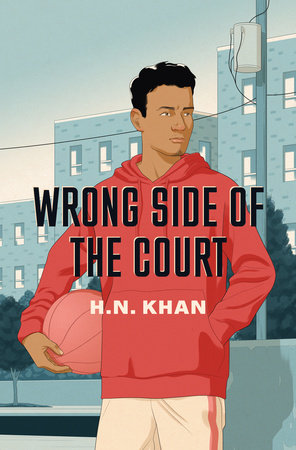
Wrong Side of the Court by H.N. Khan

Standard
Wrong Side of the Court by H.N. Khan

court

I don’t know what it is about male protagonist sports novels, but they often seem to be overly crass and crude.  Perhaps that is the real life environment that inspires such writings, or perhaps it is just male voiced YA books, but in this one in particular it seemed to stand out because the storytelling by-and-large is really enjoyable, it just has a lot of flags, A LOT.  Beside the language, sexual innuendos, drug use, violence and romance, it also has a few religious and cultural concerns that are possibly just specific to the niche that I review for, but did have me shaking my head out of confusion and sighing in disappointment. To its credit there is a decent amount of Islam featured, some male friendships that are quite heartwarming, and some emotional depth that presents really well.  The 312 page book is marketed to readers 12 and up, but there is no way I would encourage the book for anyone that young, Muslim or not.  For Muslim youth specifically I would say 17 plus.

SYNOPSIS:

The book is told from the perspective of fifteen year old Fawad who lives in Regent Park with his mom and sister.  He dreams of being the first Pakistani NBA player and the linear story bounces in time at the start and he sometimes even speaks to the reader, but the story is all his.  Regent park is a poor part of town pressed right up against a wealthy part of Toronto and the neighborhood is rough.  Fawad is a good kid: he doesn’t go out much after dark since his father died, he helps his mom, doesn’t run with a gang, he gets good grades, loves basketball, and doesn’t have a girlfriend, not yet anyway.  The story starts with him reliving the final minutes of a summer league basketball game where he opted to pass out of fear of the ever looming threat of Omar, rather than take the shot himself.  Omar ends up missing and they lose, oh yeah and Omar is the imam’s son.  Under the protection of Abshir, Fawad’s friend Yousuf’s older brother: Omar, Yousuf, and Arif have someone looking out for them on the streets.  Arif has some help from the Bengali crew, and Yousuf is Somali, but there are not enough Pakistani’s to make a stand or demand respect when out and about.  When Abshir gets murdered, Yousuf retreats into himself his music and smoking joints, Arif keeps his playboy ways to take his mind off things when he isn’t reciting Quran beautifully in classes at the masjid, and Fawad makes the high school basketball team and finds a girlfriend. Things with Omar physically escalate as well, while things at home have his mom putting in to action plans for Fawad to marry his cousin in Pakistan.

WHY I LIKE IT:

I really like that Islam and culture are presented powerfully with OWN voice strength and detail.  Things are not defined or over explained and if you don’t know what haram or Ramadan or an imam are, figure it out.  I rarely find myself wishing the ending of books were different.  You hear a lot about that in movies, that they didn’t screen well or something, and so the ending was changed, and that is how I feel about this book.  *SPOILERS* Fawad and Omar should not have resolved their issues so easily, it was more than a respect thing, there was blood and hospitalizations.  We never even knew why they had issues in the first place. Arif and Nermin should not have hooked up. The whole book she comes across as the strong Muslim hijabi that blurs the lines by side hugging her guy friends, but not being ok with it, then she shows up to a dance, and then hooks up with Arif, didn’t like that at all.  I get the mixed signals of Fawad having a girlfriend from his mom, and while he seems to be connected to the mosque it never shares that he understands Islam more than just I have to do this and I can’t do this, but I didn’t like him going back to Ashley and wanted him to choose his own self-worth and respect over accepting her apology and going back to her.  I do not understand why Fawad waited so long to tell his mother about Nusrat. It was nothing that would upset his mom, I don’t get why he dragged it out.  I do love that the cousins were friends or friendly, but were fronting to their parents, but it was unnecessarily dragged out, and the more it got dragged out, the more complicated and intertwined it got with Fawad having a girlfriend.

I did not get the mom and sister relationship at all.  The mom seems to have just given up on her, but they seem to spend a lot of time together, so that was a disconnect for me.  At first I kind of liked the twist on the stereotype that the boy was not allowed freedoms to go out, but the sister was, but it kind of unraveled in the logic department.  I am desi, (half anyway) and the stereotype is that the boys are earning before they get married.  So to be arranging Fawad’s wedding at age 15 is bonkers.  To be arranging anybody’s wedding at that age is, but it is so contrary to custom, that I couldn’t even ignore it and move on, it was constantly blocking the story from being smooth.  The mom’s rationale is that she wants a daughter-in-law to take care of her.  Again kind of bogus, but maybe there is some truth there, unfortunately there is the big gaping hole that she, the mom, doesn’t take care of her in-laws, so why the difference of expectation.  Suffice it to say the mom and sister are both road bumps in the story for me.

I was impressed at how much basketball play-by-play was in the book and how it didn’t get boring.  I love that there were plenty of male role models in the community and that the three boys really looked out for each other, supported each other, were connected to each other’s families, etc..  I didn’t like the abusive religious imam trope.  I’m glad that Omar’s dad wasn’t blind to his son, but to be abusive was uncalled for.

I don’t know why Nermin is called, “Arabic,” at one point, that is clearly erroneous and I wish that the condom talk and sexual innuendos were greatly reduced.  There isn’t a lot of resolution regarding who killed Abshir, if Fawad caused any permanent damage by playing, or what the future holds for any of the characters and their relationships, but it was a quick read and held my intention and I did quite enjoy the writing.

FLAGS:
Lying, violence, murder, physical assault, kissing, making out, talk of arousal, talk of condoms and sex and getting physical.  Drugs and alcohol and addiction.  Child abuse, theft, stealing, threats.

TOOLS FOR LEADING THE DISCUSSION:

There is no way I could teach this to middle school or high school in an Islamic school.

Good Intentions by Kasim Ali

Standard
Good Intentions by Kasim Ali

good intentions

There is a reason that I read juvenile fiction: from board books to YA, but lately the “New Adult” category has really been tempting me.  Muslamic romance novels, often really need the protagonist to be looking to get married to make the plot work with some authenticity,  which means the main character usually needs to be a bit older than in their teens.  I decided to start my tiptoeing into the genre with this book, because I was intrigued at the racial and mental health themes that the blurb teased.  Sadly after reading the 288 page story, I still was waiting for more racial and mental health insight or enlightenment or perspective or deeper appreciation or anything really.  I kept reading hoping for more character growth, and to find out if the relationship worked.  I understand after finishing, that the book was intentionally more subtle and nuanced, and part of me appreciates it, but I still felt the book ultimately provided too little in either regard for me to feel satisfied or content that I had spent time with the characters.  The abruptness and harshness of the first few chapters, seemed disjointed from the dialogue filled introspective remainder of the book that showed so much potential, but left me feeling strung along for no real purpose.  The book covers mature themes of sexuality, drug use, racism, co-habitation, relationships, culture, mental health, and more.  The characters’ identify as Muslim, but aside from Eid prayers, iftar, and mentioning once that they should pray more, there is nothing religious practiced, mentioned, or contained in the story.

SYNOPSIS:

Told in a variety of timelines that all follow the relationship of Nur and Yasmina, the story begins with Nur finally after four years getting up the nerve to tell his desi parents that he has a Black girlfriend, and wants to marry her.  He leaves out that they have been living together for years, and the book then flips back to how they met and bounces around filling in the gaps that bring them back to the big reveal.

While in college, Nur had just broken up with Saara, but still goes to her fairly regular house parties.  At one such party he meets Yasmina, as a small group at the party sneak off to smoke pot, and he is immediately crushing.  His hungover broken-hearted gay friend Imran calls him out on it immediately, and his roommate Rahat chastises him for going to his ex’s parties.  Nearly all the main characters are met early on, and the rest of the book focuses on Nur and Yasmina growing closer through college, after school, through their early years of jobs and grad school, and the overshadowing of the fact that Nur has yet to tell his family about Yasmina, while Yasmina’s family is fully aware and fully supportive that they are living together.

All the characters are Muslim, but practice is pretty minimally detailed.  Yasmina tells Nur at their first meeting that she wishes she prayed more, and later it is mentioned that her parents were raised strict so they have raised their own children less so.  It is possible that Nur’s mom wears a scarf, but not clear either way, and they don’t seem to be bothered that she is living with her boyfriend.  Nur on one of his visits home goes for Eid prayers with his father, his mother and sister do not go, and it mentions that they are fasting.  Rahat does not find dating is for him, and wants to have a traditional arranged marriage, but it does not disclose if this is because of religious or cultural views.  Imran discusses his family praying and that he had to square away his sexuality with Allah swt more or less.

Nur and Yasmina’s younger sister have mental health afflictions.  Nur has anxiety attacks, and Hawa severe depression.  It does not label or identify or diagnose, this is my assumption, it does detail their experiences though, and how they affect those around them.

WHY I LIKE IT:

I actually enjoyed the writing style and the ease in which it flowed-save the beginning of the book. The beginning was a little crass, almost like the author was trying too hard to get the characters’ environment to read that they were in college.  The crude talking about sex and them talking about their parents’ intimacy and smoking and drinking and being vulgar, was in such contrast to the very subtle nuanced rest of the book that tried to show the layers of Nur and Yasmina’s relationships and lives.  Once I got through it, I genuinely wanted to know if they could make the relationship work.  No I’m not going to spoil it, but that really is why I kept reading.

I was disappointed that the book didn’t draw mental health out in the open.   I also wanted some religious based push back on racism.  It is a big thing in our communities and the book really could have had the characters argue it and make their points, right or wrong, for the disconnect between faith and culture.  It didn’t have to be preachy, or even mean that anyone changed their opinions, but it mentions numerous times, something to the effect of Nur’s parents being racist, but doesn’t detail why that is the suffocating presence in disclosing his relationship.  In four years I would imagine the opportunity to correct his parents way of thinking would have arisen, and he could have challenged it.  I get that might negate Yasmina’s point that Nur is racist, but I think it should have been made more clear then that he didn’t speak up when opportunities presented, otherwise it just seems unexplored and we, the reader, are expected to just accept the characters on face value, when the book really very easily could have nudged us, to self reflect and look inward.

FLAGS:

There is sex, and drugs, and lying, and racism, and all the other flags that adult books often have.  There is one “steamy scene” between Nur and Yasmina, but the rest of the relationship is very mild.  Nothing else is graphic in detailing their day-to-day living, or the day-to-day relationships of the other characters in the book: gay or straight.

TOOLS FOR LEADING THE DISCUSSION:

No. Would never, could never encourage unmarried Muslims living together, fictionally or otherwise.

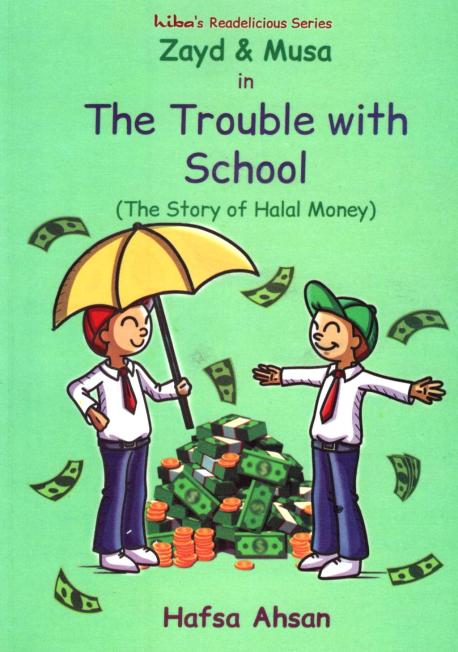
Zayd & Musa in The Trouble with School (The Story of Halal Money) by Hafsa Ahsan illustrated by Yusra bint Absar Kazmi and Urooj Khan

Standard
Zayd & Musa in The Trouble with School (The Story of Halal Money) by Hafsa Ahsan illustrated by Yusra bint Absar Kazmi and Urooj Khan

money

This delightful 70 page early chapter book is filled with humor, Islam, and a sweet story that ties it all together.  The book definitely has a teaching agenda, but it carries it with hilarious banter and relatable examples, all while covering a topic not often discussed in children’s books: money.  The book has a few grammar, vocabulary, and consistency concerns, but they are easy to overlook for readers 2nd grade and up.

SYNOPSIS:

Twins Zayd and Musa are very, very different.  Both boys enjoy cricket, but Zayd is more focused and enjoys homework, whereas Musa tends to daydream and often says something funny, but unintentionally.  When Musa makes the case in Science class that food, water, shelter, and money are all needed to survive, the class finds him hysterical.

Musa knows not to argue, his teacher is his elder and he knows he should have taqwa and be respectful, but he doesn’t give up on his idea either.  When the boys’ mom talks about halal money and gives them Islamic references for how money should be handled, Musa has a great idea: kids should be paid to go to school.

Once again, the whole school finds him funny, but Saeed Uncle, a neighbor who helps feed the poor at a roadside stand, doesn’t dismiss Musa’s idea and tells him, in some places kids are paid. And offers to take him and show him.

With references to sahabas who had great wealth and examples of how wealth can be used for good, Musa and Zayd learn numerous lessons, and share them with those around them, in a fun, engaging manner.

WHY I LIKE IT:

I get that the book is preachy, but in my mind, it is a story built around a teaching concept, so it doesn’t bother me.  I love the jokes and the tone.  At times the book is written quite formally, but being the author lives in Karachi, Pakistan, I assume that part of it, is just different standards.  I appreciate the Quran Circle table that lists where the Quran mentions wealth and the glossary.  I didn’t quite get all of the random facts included throughout, as some were about money, others about school, but I think kids will enjoy them none-the-less.  The illustrations are enjoyable, the text bubbles often hilarious (once again, a few I didn’t get).

I liked that it mentioned not drawing faces, and not going somewhere alone with someone you aren’t close with.  It is said in passing, but I love that those little nuggets exist in a book that is about something more, but normalizes and takes advantage of the opportunity to remind children of basic safety and Islamic concepts.

There are some awkward tense changes, and a few gaps in the story, but overall, I really enjoyed it and need to find the first one in the series.

FLAGS:

None

TOOLS TO LEAD THE DISCUSSION:
This would be a great book to use in a middle grades Islam class as a starting point to having students research the Quran and Sunnah to find information on a topic.  The humor will keep kids engaged, and the concept is an important one.  I plan to make all my kids read it, so that we can discuss as a family, and benefit from the lessons presented.

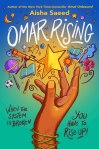
Omar Rising by Aisha Saeed

Standard
Omar Rising by Aisha Saeed

omar rising

This middle grades 224 page read is quick and memorable.  The story is set in Pakistan and the characters are probably Muslim, but there is no religion mentioned until nearly the end, and even then only in passing.  The only culture specific references are the characters’ names, social etiquettes, and the foods mentioned.  By and large, the story is universal and could take place anywhere, and probably does take place everywhere.  While I wish it would have had more cultural and religious references, it is an OWN voice story after all, the book is enjoyable, the characters endearing, and I think young readers will benefit from spending the school year with Omar, seeing classism up close, and cheering for an unjust school system to be challenged.

SYNOPSIS:

Omar is the son of a servant and when he earns a scholarship to a prestiges boy’s school for seventh grade, the entire village is bursting with pride.  When he gets there though, it is hard, really hard.  The scholarship kids aren’t allowed to participate in any extra curriculars, they have to do service hours, and they have to maintain the ridiculously high A plus grade average or be expelled.  It seems that that headmaster is out to get the scholarship kids, and Omar in particular.  As the scholarship students struggle to stay afloat, Omar has to determine if it is all worth it. He spends all his time studying, even when he goes home to visit his mother, and while he doesn’t want to let the village down, he is struggling to find the optimism to keep fighting for his place.  When Omar learns that the system is designed to make the scholarship kids fail, and that those that are kicked out are called “ghost boys,” he has to decide to how hard to push himself and ultimately how hard to push to break down the system that treats him and those like him like second class citizens.  Luckily, Omar has some supportive teachers, some loyal friends, and a whole lot of determination.

WHY I LIKE IT:

I love that the story is universal, it is at times a much tamer version of the YA book Ace of Spades which also explores second class citizens in posh private schools as a theme, and at times I even felt some Dead Poet’s Society vibes.  The cultural setting and names however, to me is a mixed bag.  I’m glad that it didn’t become another story about problems in another country with judgmental overtones, but at the same time, to be so void of cultural references seemed too far of an extreme in the other direction to make the story feel real richness and authenticity.  I love that the story isn’t about bullying and that a number of characters have depth.  I was genuinely confused for a large portion of the book about what the orientation in the summer entailed.  It was clarified much too late that it was a weekend, but I was at a loss trying to figure out how he knew some of the campus, some of the other scholarship kids, had a roommate, yet knew so little of the school and what it would be like.  I am not sure why that information was delayed, but seeing as I read an arc, I hope it is clarified in the final copy.

FLAGS:

Omar and a girl are friends, they hug at the end, but it seems rather innocent, and more sibling like as they were raised together.  

TOOLS FOR LEADING THE DISCUSSION:

This would be a good book on a shelf, and would possibly work as a read aloud to grades four or five.


Sway with Me by Syed M. Masood

Standard
Sway with Me by Syed M. Masood

sway

This author won me over with More Than Just a Pretty Face, and his ability to celebrate and show flaws within our desi cultures while simultaneously presenting relatable Islamic experiences in a romantic comedy.   I have been yet to determine if this YA/Teen 328 page book follows in those footsteps, or cuts a little too critically and close on the Islamic presentation.  Undoubtedly the story is hard to put down, culture and Islam are present, but I don’t know what the lingering taste of Islam would be for a non-Muslim reading the book.  Would they see the faith separate from those that practice or actively don’t practice, would Muslim readers?  Literature is quickly showing how Muslims are not a monolith, but I worry that that nuance might be lost in this particular book, and the takeaway would be far more stereotype affirming, than critically thought provoking.  The packaging of the story is memorable characters and quality writing, even if the plot and purpose is a little shaky at times.  I admit for as much as I crave discussions on representation and twists and defined characters, this book has me at a bit of a loss on how to feel about the book overall.  I think it is possibly the first time I just haven’t seen myself and my experiences mirrored at all in a book with this much Islamic content. As a reviewer it makes me feel useless, but as an American born Muslim, I kind of love the uneasiness and challenge that my head is trying to wrap itself around.  The references, the language, lust, plentiful innuendos and physical abuse make the book a solid high school and up read.

SYNOPSIS:
Arsalan lives with his 100 year old Nana in Sacremento.  His mother has passed away, and his father is out of the picture in Arizona as he attempts sobriety.  Homeschooled and isolated from other kids, technology, and the world around him, he suddenly finds himself in a public high school trying to make his way.  Afraid that when his Nana passes he is going to be all alone in the world, he reaches out to the stepdaughter, Beenish, of the community match maker to see if she can help him with an arranged marriage.  She agrees on one condition, he dances with her at an upcoming competition.  He agrees, but first a makeover is required and before you know it a romance is blooming.  Awkward and formal and ever the gentleman, Arsalan uncovers that there is no competition, the dancing is required to break up Beenish’s sister’s wedding.  The girls’ biological mother was a dancer and the shame it brought on them all as it destroyed her career, her marriage, and the family has made her daughters the black sheep of the family and community.  The stepmom wants to get them out of the house as soon as possible and thus dancing of any kind is forbidden at Qirat’s upcoming nuptials.  Beenish despises the groom and hopes her dancing will not only remind the family that the mom has been banned from attending the wedding, but also hopefully prevent the wedding from taking place.  As the story moves forward with learning to dance, relationships must be reconciled, friendships developed, and growing pains felt, with some sass from Nana at every turn, more than one character will have to learn to make hard decisions and accept the outcomes that result.

WHY I LIKE IT:

Right from the start Arsalan makes it known that he is not a practicing Muslim, that he is “nominally one.”  His Nana has raised him to be a skeptic, his abusive father would beat him when feeling religious and guilty for his alcohol consumption, and his deceased mother was more spiritual than disciplined.  So, for the next few chapters, whenever Islam was mentioned I would snap a picture.  Twenty pages later and dozens of pictures of text made me stop and realize that this coming of age book is not a story about Islam, but rather the characters are dealing with their own identities and Islam just happens to be present, for all of them.  Arsalan remarks how our roots shape us as he quotes hadith, ok paraphrases them, and discusses sahaba, eventually having to accept that knowledge and wisdom and truth must be recognized, even when it comes from a source that he doesn’t favor.  Similarly, the most presenting tough guy, music and sports and appearance obsessed character is always hanging around the mosque, at the MSA, and encouraging Arsalan to come and pray.  The love interest calls out Muslims for their fake religiosity saying that her stepmom wears it as a fancy dress, she owns it, but takes it off when she wants.  Her father came to Islam late, and is relatively strict and conservative as a result, she is Muslim, but more culturally as she doesn’t seem to have sorted it out herself.  The characters dance, which involves touching and immodest clothing, at the end they do kiss.  There is language which is noted as being course and vulgar, and there really is no “model Muslim” or any characters that want to be.  So, similarly there are no haram police commenting when the characters, as individuals seemingly step out of line.  The sister character is quote unquote religious, but I don’t know if she covers, she doesn’t seem to be representative of anyone other than herself and she has her own cultural family issues, so her Islam is just stated, but not explored.  Some only eat halal, that gets included but not really opined on.   It really is the first time I feel like I’ve read so many Muslim characters in one place that represent only themselves, which is very much real life, but also a shift in Muslim rep in literature.

The story has some foundational issues which made me laugh when reading the author’s note that says he, “writes in the dark.”  Meaning he doesn’t know where he is going until he gets there.  I think it might show in this book more than he realizes. Aiza Aunty is shamed as scandalous because of her dancing in Lollywood (Pakistan’s version of Bollywood, which is India’s version of Hollywood) films.  She apparently got her sari a bit too wet in a waterfall scene, and it was too much shame to rebound from.  So why did that ruin her life? I mean any production has rehearsals, and blocking, and post editing, and retakes, why does one scene seem to fall squarely on her shoulders, every single decision maker along the way passed it through.  I’m not buying it.  I also don’t buy the whole wedding is hanging on a single thread of dancing, it tries really hard to make it make sense, and by the end the reader really is just prepared to go along with it, but holding auditions, not planning to tell Qirat, really is expecting the reader to suspend reality just a tad more than the genre should be asking one to do.

The book is smart and it expects the reader to be smart.  The references the character’s personas and need to be seen and loved is not always spelled out, it has to be pieced together and I love it.  The Thanksgiving scene, the misfit members of each family coming together and bonding with Nana and Arasalan is sweet, but actually really sad, and I love that it doesn’t say it, it shows it.

Of all the characters I love Diamond the most, I just wish we knew more about what motivates him.  He reads too nice and too puppy doggish and I wish we got just a bit more to see why he is the way he is.  Truly all the characters are memorable, and I’m pretty sure they will stay with me for a while.

FLAGS:

There is kissing, romance, crude language, lots of sexual innuendos, physical violence, physical abuse, child abuse, death, shaming, manipulation, alcohol addiction, religious zealousness, dancing, intimate dancing, body objectification, music, singing.

TOOLS FOR LEADING THE DISCUSSION:

I could never teach this book, but please, please, please, read it and help me to understand how I feel about it.

Little Seeds of Promise by Sana Rafi illustrated by Renia Metallinou

Standard
Little Seeds of Promise by Sana Rafi illustrated by Renia Metallinou

seeds

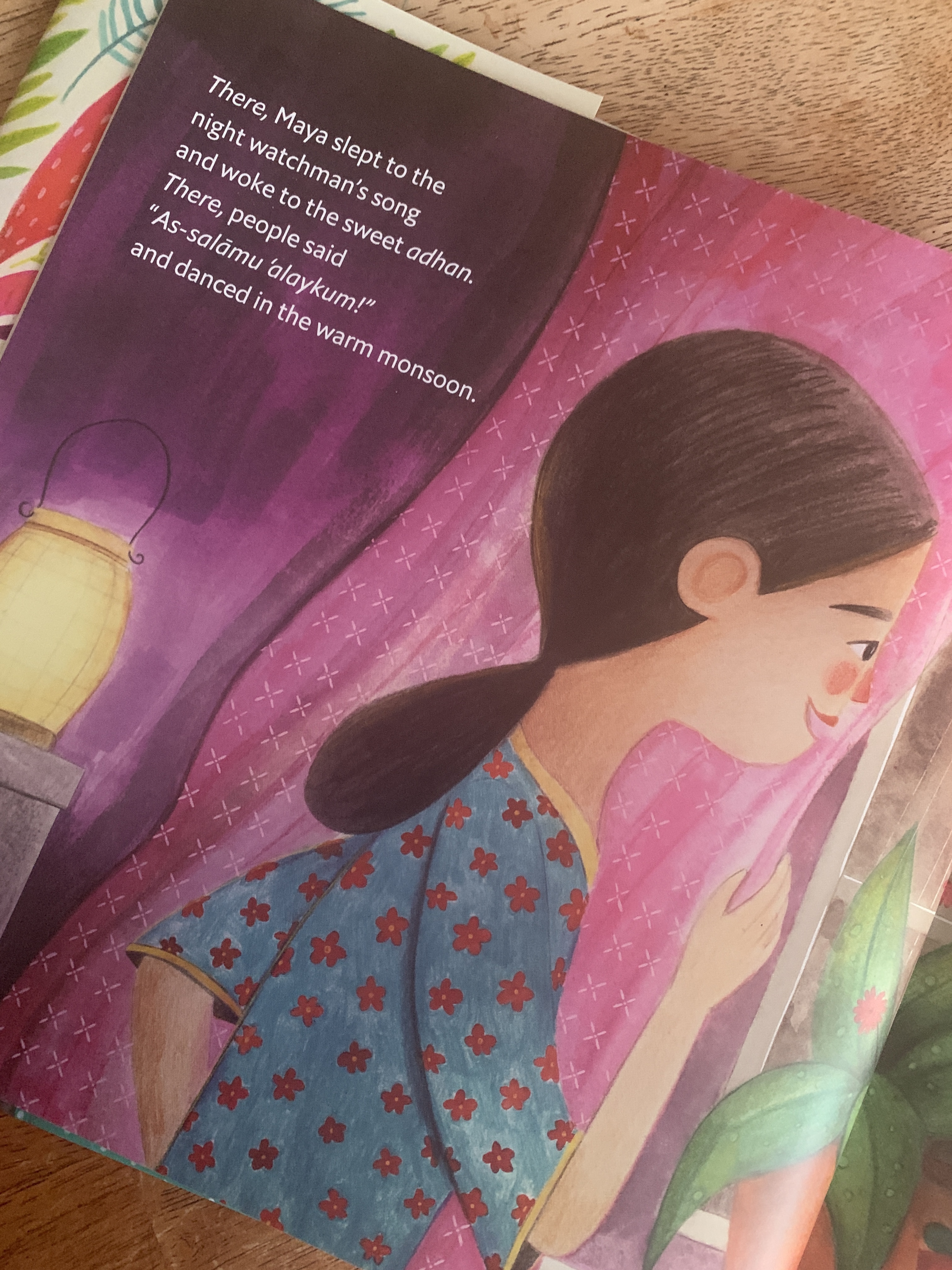
This sweet, well-done 48 page picture book for early elementary aged readers shows the fear associated with being in a new place, the love of an elder family member, and the courage it takes to make new friends.  The story focuses on a young Pakistani girl who has recently moved to a new country and how she tries to remember the wisdom of her Nani to blossom in her new home.  The culture rich story is universal and lyrical, with hints of making duaa, greetings of salam, and the soothing sounds of the athan that make memories of home so foreign to her in her new residence. Young readers will empathize with Maya, and see the symbolism in the seeds she is anxious to plant and cultivate.

img_4475

Maya finds her new home unfriendly and cold, she feels different with her food, and clothes, and way she speaks.  Home to her is dancing in the warm mansoon rains, saying As-salamu ‘alykum, and waking up to the sweet athan.  Nani was also there, her old home.  Sweet Nani with her hundred wrinkles, smelling like flowers.  When Maya left, Nani gave her a gift.  Little seeds of promise, so that they and she might bloom where planted.  But Maya doesn’t know where to plant them, she carries them with her everywhere she goes, but like a secret, she keeps them close.

img_4477

Channeling her Nani’s tenderness, she knows that she has to plant them if one day she wants to be surrounded by flowers.  Maya loves flowers, dancing around them, praying among them.  Maya finds a patch of earth.  She longs for rain, she hopes for warmth. She makes way for the rays of the sun.  The text talks of flowers, the illustrations show both the plant and the growing friendships.  For days nothing happens, with the seeds or the classmates.  But Maya remembers that seeds have a long journey from the ground up.

img_4476

Maya nurtures her seed, just the one she dared plant, with love and kindness.  She too feels ready to burst.  Can she be brave enough to plant all the seeds, can she share them, and her self in her new world? Can their be warmth here, like there was over there? Can this too be home?

img_4478

I love the symbolism and juxtaposition of the seeds growth with her own.  The character arc and the transition of home being one place to being the other, is very well done, older readers will feel an aha moment when they grasp it and younger kids will enjoy both the surface story and the dialogue you can have with them about blossoming where planted.

img_4479

Religion is not a strong thread, but Islam is present in her memories of her maternal grandmother and all the warmth and love that those memories contain.  I love that the classmates were never mean, they just didn’t know her either.  I wish there was a bit more diversity of skin tone and mobility in the classroom illustrations and the friend circle she is hoping to join.  Overall, a beautiful OWN voice picture book that will be enjoyed for multiple bedtime, small group, and classroom readings.

House of Glass Hearts by Leila Siddiqui

Standard
House of Glass Hearts by Leila Siddiqui

glass hearts

This 278 page magical realism YA book featuring a Muslim family grabs your attention and heart in the prologue, unfortunately it quickly releases it, and until you get over a third of the way in to the story, it is a struggle to read.  Once you accept that half of the book, the storyline set in the present, is going to be terrible, you enjoy the historical narrative and appreciate that the short book with a quick pace spends more time in the subcontinent during partition, than it does with the painfully underdeveloped characters trying to make sense of past secrets and their present day manifestations.  The book doesn’t have any major flags in terms of religious representation, it is just ritual acts of praying and reading Quran, nothing detailed or explored, and relationship-wise there is nothing high school readers can’t handle (spoilers and more details can be read in the FLAGS section).  Despite being a first time author, she works as an editor, so one would really expect the climax to hit harder with clearer writing, the characters to be developed, the details written to serve a purpose, and the protagonist teen’s voice not to read overwhelmingly at the beginning as a five year old.  The overall story concept and historical fiction component are exciting, the development of the characters just really failed an otherwise engaging read. 

SYNOPSIS:

Maera’s brother Asad goes missing in 2011 from their grandfather’s home in Pakistan while they are visiting.  They search and cannot locate him or a body, the loss devastates Maera’s family.  Ten years later, her grandfather passes away, and the next morning a greenhouse appears in their backyard in America.  Not just any greenhouse, her grandfather’s greenhouse from Pakistan.  Maera thinks she is going crazy, her mother doesn’t acknowledge the structure, she doesn’t acknowledge much, not about the reality in front of them, not the night Asad disappeared, or the needs of her daughter. Maera’s aunt (mom’s twin) and cousin come from Pakistan to mourn the loss of the grandfather together, he passed in Pakistan, not sure why Maera and her mom didn’t go there, but I digress.  Cousins Jamal, aka Jimmy, and Maera are the only two that seems determined to figure it all out.  Their grandfather’s journal turns up and with Maera’s friend Sara and Rob, the neighbor and former best friend of Asad, the four of them set out to understand what is going on in the greenhouse.

The greenhouse seems to be alive, and entering it dependent on the whims of something within, a churail,  a shape shifting creature of myth that is more than a witch, a succubus that targets men.  A woman who died violently and was wronged by men, whose feet are turned backward, and who is neither alive or dead.  As the four work through the journal, venture in to the greenhouse, and confront those within, secrets will be unearthed, exposed, and finally dealt with.

The historical interwoven story is that of the grandfather during colonial British rule and partition.  As a young boy Haroon is searching for his father fighting in Burma and the adventures he has along the way. Shah Jehan’s father takes Haroon in at one point, and the girl with an emperor’s name sneaks him out to watch the village deal with the churail who are killing the men in their village.  The incident scars Haroon, but his affection for Shah Jehan and the role she will continue to have in his life is established. The understanding that the subcontinent is being carved up and starved by the colonizers in the name of freedom is made clear in the characters that Haroon encounters and the quickly maturing boy grows in to a young man as he starts to understand the world around him and the larger powers at play.  When the migration and violence between Hindus getting to India and Muslims going to Pakistan occurs, the pieces in the past and present come together to reveal the terrors that the greenhouse houses. 

WHY I LIKE IT:

I loved the commentary both in the text, and explicitly detailed in the afterward about how culturally the past is handled.  How little generations discuss what they have endured and been through.  I have been asked by my father-in-law a few times to try and coax my mother-in-law to detail her journey with their oldest son from India to Pakistan.  She has apparently never clearly told what happened, what she saw, and what they experienced.  She waves it off now, but her own children didn’t even know there was more to the story, and as my inlaws approach their 90s I have little hope of them recalling or sharing their stories.  Recently my son needed to hear some first person accounts of war, so he contacted my American grandfather to learn about his time in the Korean War, much of it I knew, Americans, generally speaking, talk about this type of experience in passing.  My son, also wanted to compare his story to someone who lived as a civilian through a war, and asked my mother-in-law, his Dadi, about her experience living through the Indo-Pakistan War of 1971, not that long ago, and we all sat spellbound as she recalled the sirens and how they kept the children fed and calm and whatnot.  They were stories no one had thought to ask it seemed.  She has seven children and almost thirty grandchildren.  This book struck such a chord with me, I need to actively seek out these stories before it is too late.   Chances are no one else in the family will. Not speaking the language fluently has cost me my chance to learn my own father’s family’s stories and I need to find a way to gather my husband’s family’s stories before it is too late. I love that in the book, The Past is capitalized as if it is a named living person shaping the lives of so many.  It is, and these stories are wonderful reminders and motivators to ask the elders to share their memories.

The present day story thread, however, is chalked full of holes, one dimensional characters, and pointless tangents.  Sara and Maera read like they are early elementary aged.  They are so terribly voiced in the beginning, I have no idea, how an editor author and mainstream publisher did not require correction.  The dialogue, the action, the role of the parents, it is terrible.  Speaking of terrible, the mother and aunt are absolutely flat and useless.  They mope, sleep and sit in the corner.  I don’t understand why you wouldn’t develop them to link the past story to the present one.  I’m not being picky here, it is that bad.  I also wanted to know why the dad left.  Seems like it would flesh out the mom a bit, justify her approach to life.  Sara and Rob are obviously brought in to serve as vessels for the action, and for Maera and possibly Jimmy to play off of.  But their backstories are so pathetic.  How do you not know or see your neighbor for ten years.  Ok, I get that he was Asad’s best friend and your family in their grief and denial pushed him away, but he never checked the mail or took out the trash, or was seen? And Sara offers absolutely nothing to the story other than to be part of the forced crush/romance line pairing off her and Jimmy and Rob and Maera.  Alhumdulillah, it stays tame with the angsty longing and hand holding.  

Random details that serve no purpose reach a pinnacle with the paragraph long time spent on Maera wearing Rob’s tank top.   I have no idea why we should care that she is wearing a tank top.  Sure as a Muslim reviewer it furthered the notion to me, that she is probably more culturally religious, and yes I know Muslim’s dress to different degrees of modesty, but I really couldn’t find any other reason for the emphasis on the black tank top. Overall, all the friendships in the story seem so off: Rob and Asad, and Sara and Maera.  They should be easy plot points, but they don’t connect, or read believable.  

Plot wise: if you had a building magically appear in your back yard along with a journal, would you not read that journal as fast as possible? Sure you would lose sleep and maybe skip a meal or two, but hello, a building just appeared in your back yard that is moving and growing, your grandfather died and your brother’s body was never found: stop what you are doing and read the journal.  It mentions that when Asad went missing there were a lot of other kids, cousins at the house, so where are they now? Why was there no mention of them, and only Jimmy seems to have a vested interest in the grandfather passing, and the growing need to remember Asad.  I did not understand the sacrifice and hair connection and how that was what Maera understand the Churail to be asking for.  I did not understand the end of chapter entitled “The Separation,” it says they entered together, so…. ya?Off and on in the greenhouse there are multiple churail, this seems inconsistent with what we learn from the one churail about leaving.  The whole climax needs a Cliff’s Notes synopsis.  I honestly have no idea what happened.  The churail was scared of the beast, but they all went off together, affectionately? I’m trying not spoil anything here.  Why was the churail so different at the beginning compared to the end, why did she get a growth arc, when the other characters didn’t? Shouldn’t there have been some cathartic reprieve verbalized between the mom and SPOILER (sorry I tried) Asad? I felt deprived.  

There were a few grammar errors, but because I read an ARC, I’m hoping they have been corrected

FLAGS:

There is a little bit of language (F word at least once).  Children are conceived, it isn’t explicit, but the fact that it happened is critical to the story.  There are crushes, angsty/longing, hand holding, hugging.  There is sexual assault implied as a major plot point, but not detailed.  There is death, and killing, often gruesome, some real, (hits harder), some far fetched.  The book is YA and  ok for high school readers and up in my opinion.

TOOLS FOR LEADING THE DISCUSSION:

I would be interested in seeing if some of the muddled passages are cleaned up in the published physical copy, the book’s characters are weak, but the historical fiction component is a story that needs to be shared more and more as we, collectively, seek to understand the past, the impact of colonization, and the emergence of telling our OWN voice stories.  For all the flaws, I haven’t completely written off the book, I’m hopeful that even if this one doesn’t make the cut for a book club, that inshaAllah the author will keep writing and filling in the blanks.

Barakah Beats by Maleeha Siddiqui

Standard
Barakah Beats by Maleeha Siddiqui

barakah

I have been waiting for this book for a really long time: a girl leaves an Islamic school for a public middle school and is not just unapologetic, but proud of who she is and of her religion, all while navigating such a huge life change and the day-to-day stresses of school, family, friends, and life. This is it right, the middle grade 288 page book that holds up the mirror to our own experience as a typical Muslim family in the west, that so many of us have been waiting for? Except, sigh, for me it was just ok. Don’t get me wrong, if you are new to seeing mainstream (Scholastic) Muslim protagonists shining and making their salat on time, this book is revolutionary and amazing. But, I’ve been doing this a long time, and I guess I wanted more than a tweak on Aminah’s Voice. I wanted to relate. I’m not a hafiza, nor do I know many 12 year olds that are. I enjoy boy bands, but have never been asked to join one. Sure the details and her decision to follow Islam the way she understands it is a great message, but it doesn’t clearly appear til nearly the end of the book, and until I got there my brain was constantly finding holes in the narrative, to the point I got out a notebook and started taking notes. There is absolutely no reason you shouldn’t read the book, and I know I am clearly in the minority here, so brace yourself this is a long review. If you see this at your child’s book fair and you think it looks cute, grab it, it is. I am cynical and jaded and I’m owning it, so perhaps we can agree to disagree, I’m just sad that I didn’t absolutely love it, so hold on, because I’m going to get it all out so that I can move on, inshaAllah.

SYNOPSIS:

The book opens with Nimra at her Ameen, a celebration to acknowledge her completion of not just reading the entire Quran, but of memorizing it. Her best friend Jenna, her non Muslim neighbor, is there and as everything is explained to her, the readers learn about Surah Yaseen, becoming a hafiza, and the schooling differences that Nimra and Jenna have had. That night when Jenna is sleeping over and the girls are watching Marvel’s Infiniti War, Nimra’s parents inform Nimra that she will be starting public school and that the two girls will finally be together. The news is big, but Jenna shrugs it off, and Nimra senses that something is off between them. When school starts, Jenna is surprised that Nimra is planning to wear her hijab to school, and this is before they have even left in the morning. The rest of the day: comments by Jenna’s friends, purposefully being excluded at lunch by Jenna, and being overwhelmed with a big school and so many teachers, makes Nimra miss her small three person Islamic school. Additionally she loves art, and is always tucked away in a corner with a sketch pad, her parents, however, have made her take Spanish instead of art class, and the frustration is painful. When she asks the principal for a quiet place to pray, another girl Khadijah pipes up that she can pray in the band room where she does. Khadija and her immediately hit it off, but she has already prayed, so Nimra sets off on her own to find the room. As she is about to start, some music starts, so to tune it out and focus on her salat, she recites aloud. When she exits, three boys are in awe at her vocal abilities: Bilal, Waleed, and Matthew, three Muslim boys. Better known as the middle school celebrity boy band, Barakah Beats, the boys beg her to join them. Nimra says she’ll think about it, but as the days show her and Jenna drifting further apart, being in the band might just be the way to get Jenna to pay attention. Unfortunately, Nimra’s family doesn’t believe Islam allows for musical instruments. She acknowledges that it is controversial, but that her family doesn’t play any instruments, attend concerts, or get up and dance. She figures she can join the band, just long enough to get Jenna’s friendship back on track and then dump the band without having to tell her parents. There is just one giant hiccup, they are planning to perform at a refugee fundraiser, oh and she really likes hanging out with the boys and Bilal’s sister Khadijah.

WHY I LOVE IT:

Had I read this book five maybe seven years ago, I’d be gushing, swooning, but when the author says in the forward that she is showing a girl proudly owning her religion, and essentially daring to be her authentic self, I expect something almost radical, revolutionary even. We are all settling in to seeing our Muslim selves in fiction and acknowledging that we are not a monolith, that we are diverse and flawed and valuable, but this premise felt different somehow, and I really wanted to connect with Nimra and her family, so when I didn’t, it hurt. It isn’t just a main character Muslim POV, or an OWN voice book, it is portrayed as being authentic to those of us that love our faith and don’t feel like we need to tone it down to be American. We are second or third generation American Muslim, we know our deen and this is our country, there is no going back to a homeland or assimilating. The book is about her being true to her self, but I don’t know that I know what she wants or what she believes, aside from her parents. The book addresses intergenerational conflict of power and expectation between her parents and grandparents, but other than for Spanish vs Art class, it seems to skim by the music issue, the main issue of the book. The book expects readers to acknowledge the maturity and voice of a 12 year old girl, but that same expectation isn’t given to the readers of nearly the same age. It glosses over any articulate arguments for why musical instruments are or are not allowed. It mentions that some people feel it is ok if the lyrics are not bad, some say it isn’t ok, that there are disagreements, that there are controversies, but it never explicitly answers, why? And readers are going to notice. I found it incredibly odd, that the music controversy is at the heart of this book, but the safe alternative is art and drawing. Drawing faces is a HUGE point of differing opinions among Muslims, perhaps as big, if not bigger than music. Nimra is always sketching and it mentions that she often is drawing super heroes: people, with faces, and possibly (magic) powers! The whole book she is in the band, and she regrets that she is using it to get back at her friend, but there isn’t a whole lot of internal debate if she thinks music is haram like her parents or it is ok, she just stays in the band, and plots how she will leave it so her parents don’t find out. SPOILER: I like that she ultimately makes the decision that is best for her and leaves the band after fulfilling her commitment, but we never see that, that is what her heart is telling her. There is no self exploration or critical thinking, it is just justifying why she is doing it, and then not doing it.

In terms of character development, only Nimra is really explored, the side characters are all pretty flat. Jenna gets some depth, but not much. I mean, how does Nimra’s best friend and neighbor who comes over every day after school not know that she has been working on memorizing the Quran? Not know how to dress at a religious themed celebration, a halter dress, really? Jenna is never shown to be a good friend, or even a nice person, the tone around her is negative from the start. We are told she is a good friend, but we never see it. The conversation about Nimra wearing hijab to school is like two lines, but is made to be a much bigger issue in Nimra’s head as she feels things haven’t been right since then. But, I’m not buying it. The girls go to movies, they go shopping, and she wears hijab, so why would school be so different? All of Jenna’s friends know about Nimra, so she can’t really be that embarrassed by Nimra’s scarf if they go out when she is wearing it and none of the other classmates seem surprised. I also felt off with the portrayal of the character because we so fervently believe that often the best dawah or even method to break down stereotypes and bigotry is to get to know some one personally. Jenna knows all of Nimra’s family and has for nearly her whole life, and she is so hateful and clueless to everything Islam? It is a stretch, the family prays, fasts, dresses Islamically, cares for her, feeds her cultural food, yet she is oblivious to it all. I get that her hate or lack of interest is probably reflective of how a lot of our neighbors are, but there aren’t many non Muslims in this book, and that portrayal is going to linger heavily for young readers.

Nimra is likeable enough on the surface, but the more you think about her, she isn’t really any different than those she is hurt by. She is mad when Julie assumes she doesn’t speak English, but she assumes Matthew isn’t Muslim because he is white. She checks her self in other ways, but this one seems to slip by. Other inconsistencies I noticed are when the first day of school teachers are really mean to her, but then it is never mentioned again. I wanted to know did they keep at it, did she prove them wrong? It was built up and then just abandoned. At her old school there were two other girls doing hifz, but when she meets up with one at Saturday school it seems they both are no longer at the school either. Did they graduate? Did they abandon it? Her Quran teacher comes to see her perform a song, perhaps a little understanding about her point of view in addition to the other Muslim’s in the band would have helped explain the why music is controversial in Islam. Also, does and would ADAMS allow music at an event? I’m genuinely curious. I even tried to Google it. Most masjids probably wouldn’t, but maybe a community center would. Readers are going to be so confused why Nimra is so stressed when the religious teacher and the place of worship are fine with it.

The friends as boys thing is sweet, but a little surprising, having three boys come over to hang out and watch a movie, high fiving them, sure it isn’t shocking, but its a bit inconsistent given the narrative. Plus, Nimra trying to help hook Waleed and Julie up? For as much as the book doesn’t want to sell itself out, little acts like this without a little hesitation or comment or introspection, kind of make it seem like its trying to normalize non Islamic acts as being ok.

I love the pop culture Marvel references, The Greatest Showman songs and the shoutout to Amal Unbound. I even loved the Deen Squad remixes getting acknowledged, but it made me wonder if all the songs of Barakah Beats are Islamic themed. Perhaps it doesn’t matter, but it would be interesting to know since the entire school adores the band, even asking for autographs at one point.

FLAGS:

Nothing a third grader and up couldn’t handle: music, art, lying, bullying, talking about crushes.

TOOLS FOR LEADING THE DISCUSSION:

I think I’d pass on the book as a middle school book club option, as it really is a middle grades read, and the thematic issues brought up for discussion are better found elsewhere. If I had an in person classroom, however, I would have the book on my shelf, it is a quick short read, that I think might encourage a discussion on music to take place, or at least allow readers to see a proud Muslim doing well in different environments.

Mabrook! A World of Muslim Weddings by Na’ima B. Robert illustrated by Shirin Adl

Standard
Mabrook! A World of Muslim Weddings by Na’ima B. Robert illustrated by Shirin Adl

mabrook1

This 32 page lyrical 9 x 11 hardback book with playful illustrations is a celebration on the similarities of all Muslim weddings and the cultural distinctions that make them unique.  Four countries are highlighted: Pakistan, Morocco, Somalia, and Great Britain, and I really wish there were more.  The book is written on an early elementary level, but would make a great wedding present, or even a text to be shared at interfaith gatherings that focus on traditions and women’s rights.  It is joyous and informative complete with a glossary and info blurb at the end.

img_3449

The book starts out with verse 30:21, Chapter ar-Rum in the Holy Qur’an and then jumps in to jubilations of mabrook, congratulations.  It establishes what countries will be explored and that Muslims get married sharing religious rites, but different celebrations.

img_3451

In Pakistan there’s a henna party and the groom rides in on a horse.  The brides are adorned with bangles of gold and guests enjoy biriyani and rasmalai.

img_3450

In Morocco the entire neighborhood helps prepare couscous and roasted lamb with olives and pickled lemons.  At the waleemah the bride is carried in on a chair, and changes outfits seven times.

img_3452

In Somalia, buraanbur is danced and blessings are sung to the mother of the bride.

img_3453

In England the ginger bearded imam marries the groom to his hijab wearing bride in white.  There are people of all faiths and backgrounds there to celebrate and wish them well.

img_3454

But before all of that, there are meetings with families, prayers, important conversations, agreement to the marriage contract, the woman is given a mahr and guidance is sought.

img_3455