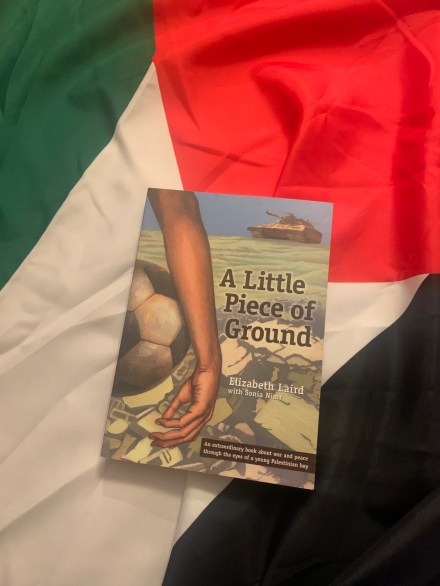
 There are so few Palestinian middle grade books, so on that premise alone this 216 page book has a lot of value. Because I am not Palestinian, I do not live, nor have I ever lived under occupation, I can argue some of the concerns from a point of privilege, and I acknowledge that is not my right. I have been asked numerous times about this book and how it frames the suicide bombing mentioned in the text and blurbed about on the back of the book. It honestly is not a large part of the story, that being said, in my outside privileged view, I do not know that a 10 year old in the west will have context to understand the act of this level of desperation from the oppression and humiliation mentioned in the book. This is why I have held off my review. The truth does not need to be defended or explained, and I fear my reservations will be taken as such, which is not my intention. Would I let me 8 year old read this, yes, but we will read it together and discuss. My children are aware of what is going on in Palestine, but Karim, the 12-year-old protagonist supports the bomber, and that notion is not clearly pushed back on. With discussion, absolutely, I think readers, will truly get Karim’s perspective that something has to be done to change the status quo. The fear when Karim is alone and the target of soldiers, the settlers forcibly seizing the family land, the humiliation of strip searching men at checkpoints, the curfews, and constant fear of attack and imprisonment are all presented through the main character’s eyes, and would also do better with some discussion, so that empathy and duas and action can result. But, the commentary as to the suicide bombing are minimal, there is even a prank package bombing that is presented as rebellion by a side character, and I would worry how a young child, without guidance, would internalize it. Additionally, this is yet another difficult book for me to review, primarily because it was first published in 2003, and because I don’t know how much comes from a western gaze and how much the Palestinian voice played into it. Islam is clear on the prohibition of suicide. In the early 2000 the news out of Israel was often about such attacks, but as an outsider, I honestly do not know if it was simply Israeli propaganda and stereotypes amplifying the idea as part of their public relations strategy or reality, seeing as now that Palestinians have direct outlets to share their daily life under an oppressive occupation, there is rarely talk of suicide bombing attacks. The author states on her website:
“I first visited Israel in 1968, and enjoyed a warm welcome from many Israeli friends. Later, I lived in Beirut with my husband and son during the civil war there, and became aware for the first time of the tragedy of the Palestinian refugees. I visited both Gaza and Ramallah, in the occupied territories, in 2002, while leading workshops for Palestinian writers. I was appalled by the circumstances in which people were living, and became aware that we in the West know very little of what life is like for Palestinians living under military occupation.
I have written A Little Piece of Ground in collaboration with Sonia Nimr, a Palestinian archaeologist, storyteller, writer and translator, who lives in Ramallah. We have tried to make our story as true to life as we can.”
The book is a hard read at times, but the joy is there. Just as we as adults scroll through the devastation, the humanity persists. The world may try and forget that they are attempting to erase a rich culture, but even in this book, their is laughter, and crushes, and sibling squabbles, and soccer games and friendship, and food, and joy. There is a little Islam, not much, the main character is Muslim, a best friend is Christian. It isn’t present in their everyday thoughts and actions, more just in identifying their faith.
SYNOPSIS:
Karim and his friends are not so much different than 12-year-olds everywhere, he loves video games, playing sports, isn’t so sure what he wants to be in the future, wonders what he will look like as he grows up, and is often annoyed with his family who he loves dearly. Karim’s life in Ramallah is also unique, he lives under curfew, he doesn’t have freedom of movement, opportunity, or equal rights, and a simple family outing can be life altering.
The book follows Karim and his group of friend as they discover a patch of land they decide to turn into a soccer field, to claim as their own. They work on it on days they can sneak away after school, in windows of time between curfews, and before long start to take pride in what the land can be. Adopting cats, learning about new friends from the refugee camp next store, teasing siblings about their crushes is all in contrast to Karim watching his father be stripped searched at a check point, being chased off their family land when they are harvesting olives by settlers shooting at them, and pranking soldiers in desperation of fighting back against oppression.
When soldiers roll in and occupy the land the boys have claimed, symbolic of their whole country, Karim gets stuck barricaded in an old abandoned car for days, with soldiers aiming their sights on him, and wondering if he will survive.
FLAGS:
Suicide, systemic abuse, oppression, humiliation, dehumanization, killing, beating, apartheid, genocide, violence, stripping, lying, crushes, occupation, shootings, injuries.
TOOLS FOR LEADING THE DISCUSSION:
This book does not need tools to be discussed. It itself is a tool, to help middle grade kids be aware that this cruelty has been occurring for 75 years, this book took place 20 years ago, and today we just have social media sharing these stories more widely. InshaAllah soon, Palestine will be free.
You can purchase this book here at Crescent Moon Store where code ISL at checkout saves you 10%