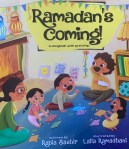
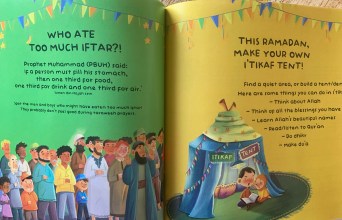
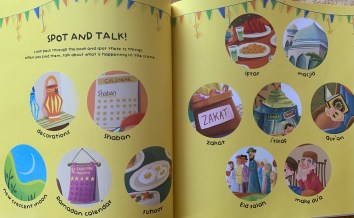
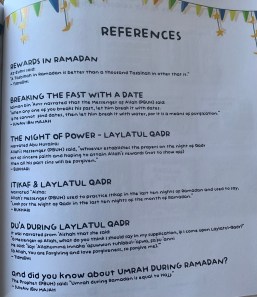
I think the illustrations in this 40 page picture song book are my favorite of the new 2021 books. They are adorable and expressive and a big part of the story that the text alludes to, but doesn’t detail. They also are a big part of the activities at the end of the book that encourage children to go back and find different Ramadan and Eid concepts to discuss and further understand. I absolutely love that there is a glossary and a reference page that details and attributes the hadith implied in the simple sing song-y words. The chorus is to the tune of jingle bells, and while I struggled to maintain the rhythm, the chorus reappears and if you are able to sing the book, your children will love it even more, haha, my voice and lack of rhythm forced me to read it, but either way it is absolutely delightful and informative for toddlers and up.
It starts out with the refrain that Ramadan is here and we will fast and pray and that Allah (swt) will give us more rewards and we will do more good deeds, than on normal days. It then shares that Ramadan is the month after Shaban when the Qur’an first came down and that we look for the crescent moon to know when Ramadan is here. It is important to note that the words flow and are so concise you don’t even realize that much information has been conveyed.
The chorus repeats and shows a family praying, kids helping vacuum, and giving socks to homeless. The family then wakes up early for a healthy suhoor, no food or drink, thinking about how the poor must feel and then having iftar with a sticky sweet date and water. Sometimes you eat so much your belly protrudes (a great vocabulary word for little ones). The next page has salat starting and those that ate too much wishing they would have left space for air and water.
The chorus repeats again showing zakat being given, iftars being eaten in segregated large groups, before looking for Laylat ul Qadr takes place and some children read Qur’an in an itikaf tent. Then it is time for Eid hugs, salams, prayer, food and fun.
On one page, the grammar of one line seems off, perhaps an extra word was added. I contacted the author to see if it is an error as it is part of the chorus, but only appears wrong in one place and one time. Even with the error, I would happily encourage this book for families with toddlers, preschoolers, and kindergarteners. It will be read multiple times, and the pictures will hopefully offer something new with each reading as understanding increases.
The copy I purchased from Amazon is 8.5 by 8.5 paperback, I’m not sure if they will be available from the publisher as a board book or without faces like so many of their books are.
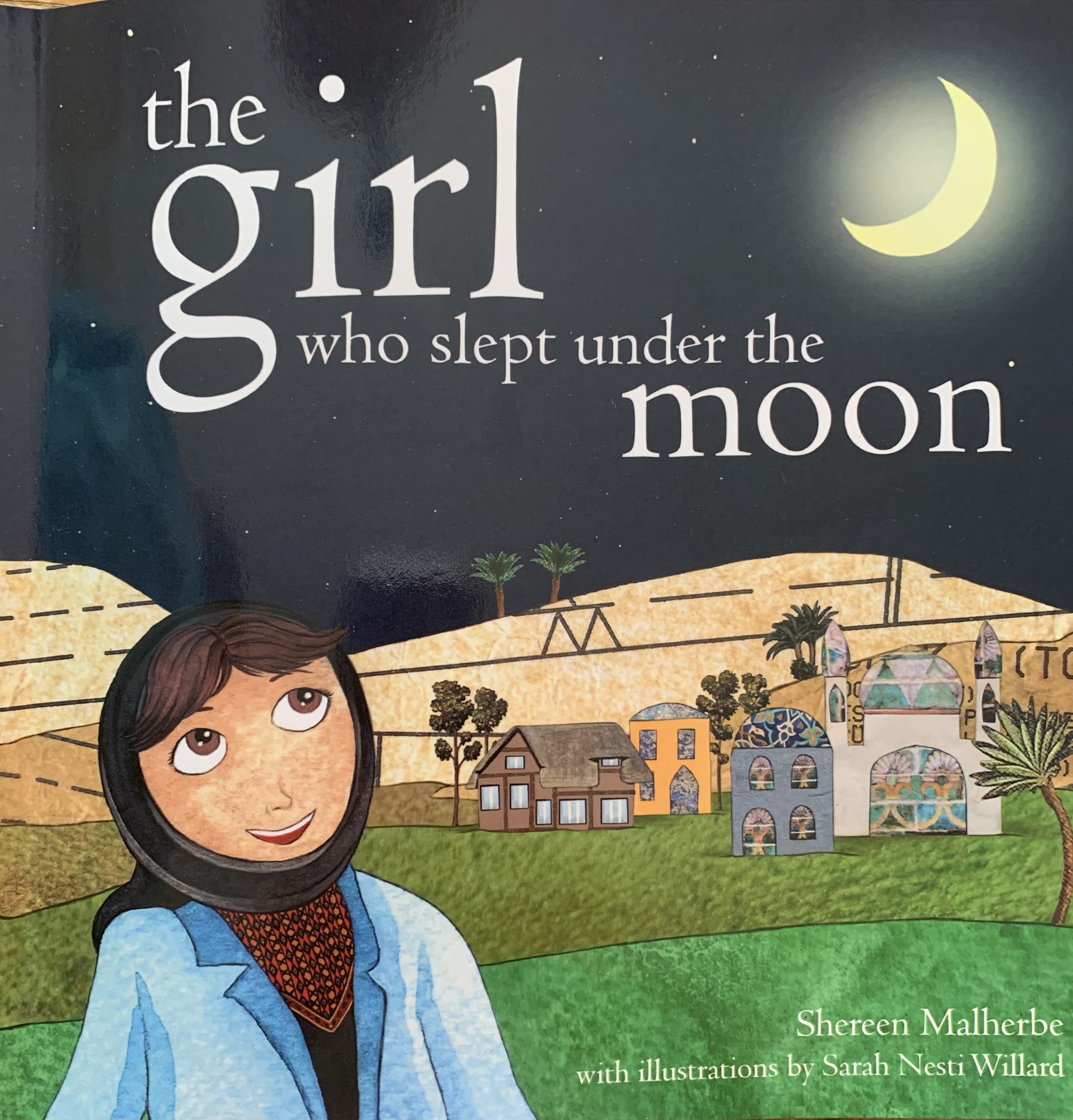
I was really surprised by the number of gaps in this 46 page story that is so adorably illustrated and seemingly planned out. I thought perhaps I was being overly critical, so as always I tested it on my kids, and they too were confused by the main character’s rational and choice of words, the holes in the narrative, and the inconsistency of the characters. The book is wordy, so conciseness cannot be the reason for the holes, and it is published by a publishing company, so I would assume it has been proofed. Really the point of stories connecting us and giving us comfort when we need it, is sadly lost. I had hoped to love this fictional story of a Palestinian girl using prayer to give her comfort in her new home, but alas it seemed to be trying to weave in too much, and as a result the story isn’t fabulous for me unfortunately.
Noor is new at school and stands out. She finds comfort in remembering the things that are the same. 1-Allah could still see and hear her. 2- The Angels were still by her side, and 3-She still slept under the same moon. She also wears clothes that remind her of home and provide an unspoken clue as to where home is for her.
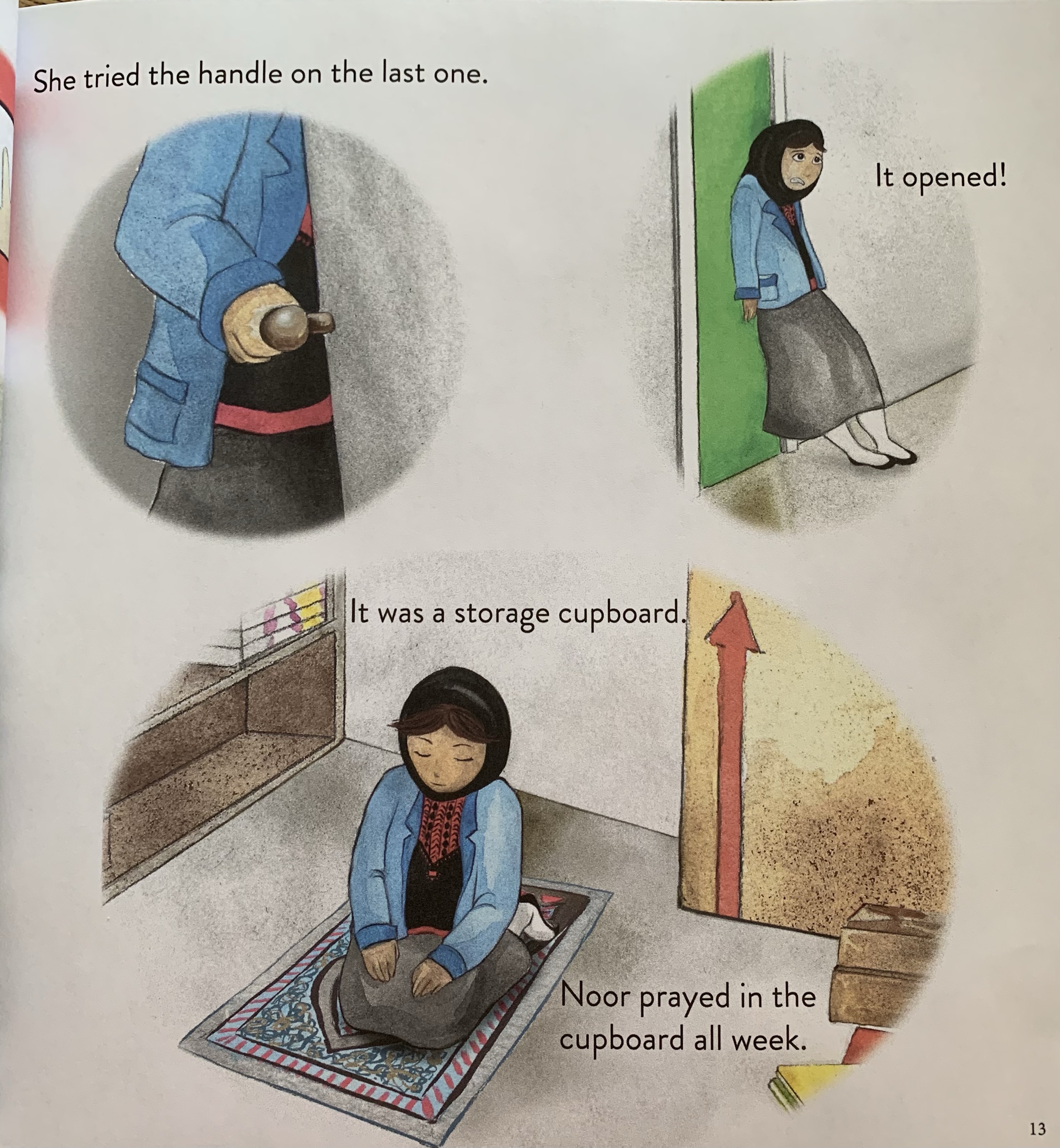
At school Noor has a problem, she needs a place to pray, but at lunch time the kids are not allowed to go inside and the dinner lady guards the door. Noor needs a distraction to sneak in the building and it isn’t clear if she provides the distractions, or just benefits from a baby bird falling out of a nest, a snake being in the grass, and a classmate getting hurt. Either way, when the teacher is occupied, Noor enters the building and finds a closet to pray in.
On one such visit to the closet she finds someone already in there, Hannah. Hannah is there because she doesn’t like being on the playground because she is different. Noor never asks why Hannah feels different, so the reader isn’t made aware either. Hannah asks her why she is there and Noor says she comes “to pray because it reminds me of where I’m from.”
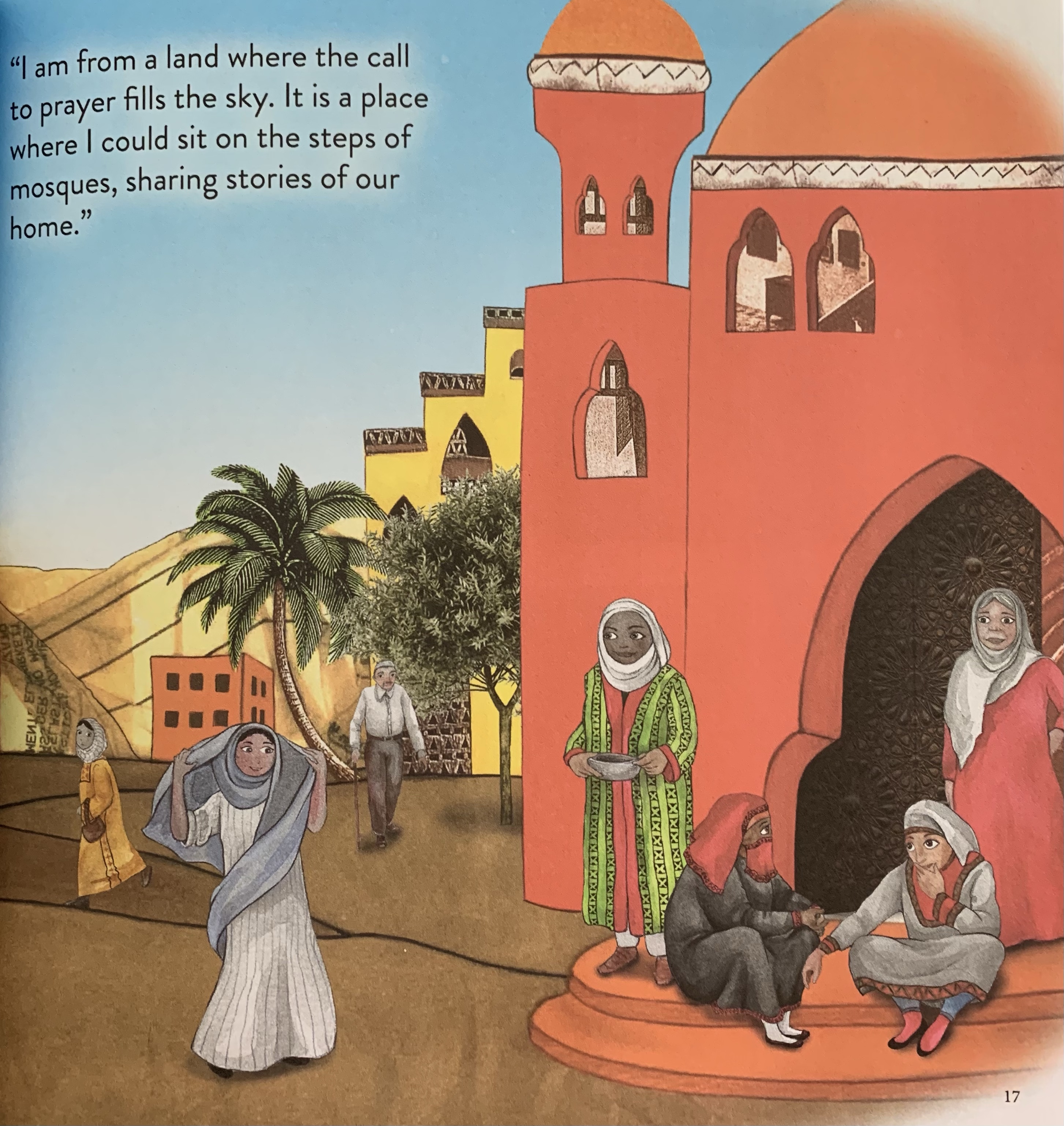
When Hannah asks where she is from, Noor doesn’t just simply answer, she tells her stories about her homeland, the mountains, olive trees, where the athan floats in the air and fisherman return to the shore with their catch. The next day Hannah is there again, and Noor tells her more stories and legends about her culture and lessons of the Prophets. Noor learns that through her stories she feels connected to her old home.
Weeks pass, and one day when she sneaks in to the school, she finds the door locked. With no where to go she heads back to the playground and starts to cry that she won’t be able to pray. She then sees Hannah disappear and she follows her in to the drama studio. When she enters she sees sets built that look like the setting of her stories, of her home. Hannah knew she missed home and built her sets to look like Palestine.
Other kids miraculously enter, and Noor begins telling them her stories, without praying first. The other kids seem to enjoy her stories and Noor learns that she can pray anywhere while holding on to her three reassuring thoughts.
The illustrations are engaging, although I’m not sure where the prayer rug seems to magically come from for Noor to pray on in the closet the first time. Had the book just been about prayer and finding a way to pray, or just about the stories connecting us to our past I think it would have been more powerful. I’m glad that Noor loves salat and that Hannah is a good friend, but I feel like by trying to do too much, the poignancy of the little things was lost.
And as for my questions: Can’t Noor ask for a place to pray? Can’t she pray outside? How is Hannah making the sets all by herself? Noor says she prays because it reminds her of home, she doesn’t pray for the sake of Allah or because it is required of her? Why did Hanna feel different, and why didn’t Noor bother to ask? It says that she needed to distract the dinner lady, isn’t that dishonest even for a good cause? Did she harm the baby bird so that it would need rescuing? Put the snake in the grass? Hurt the little girl so that she could get by the teacher? How was Hanna getting inside at lunch time? How is the school ok with a kid coming inside to build a whole set with school materials, but can’t let another child inside to pray for less than 5 minutes? And if Noor didn’t feel comfortable asking for a space to pray, clearly Hannah had connections to get permission to create a huge scene, couldn’t she have asked, or helped Noor ask?
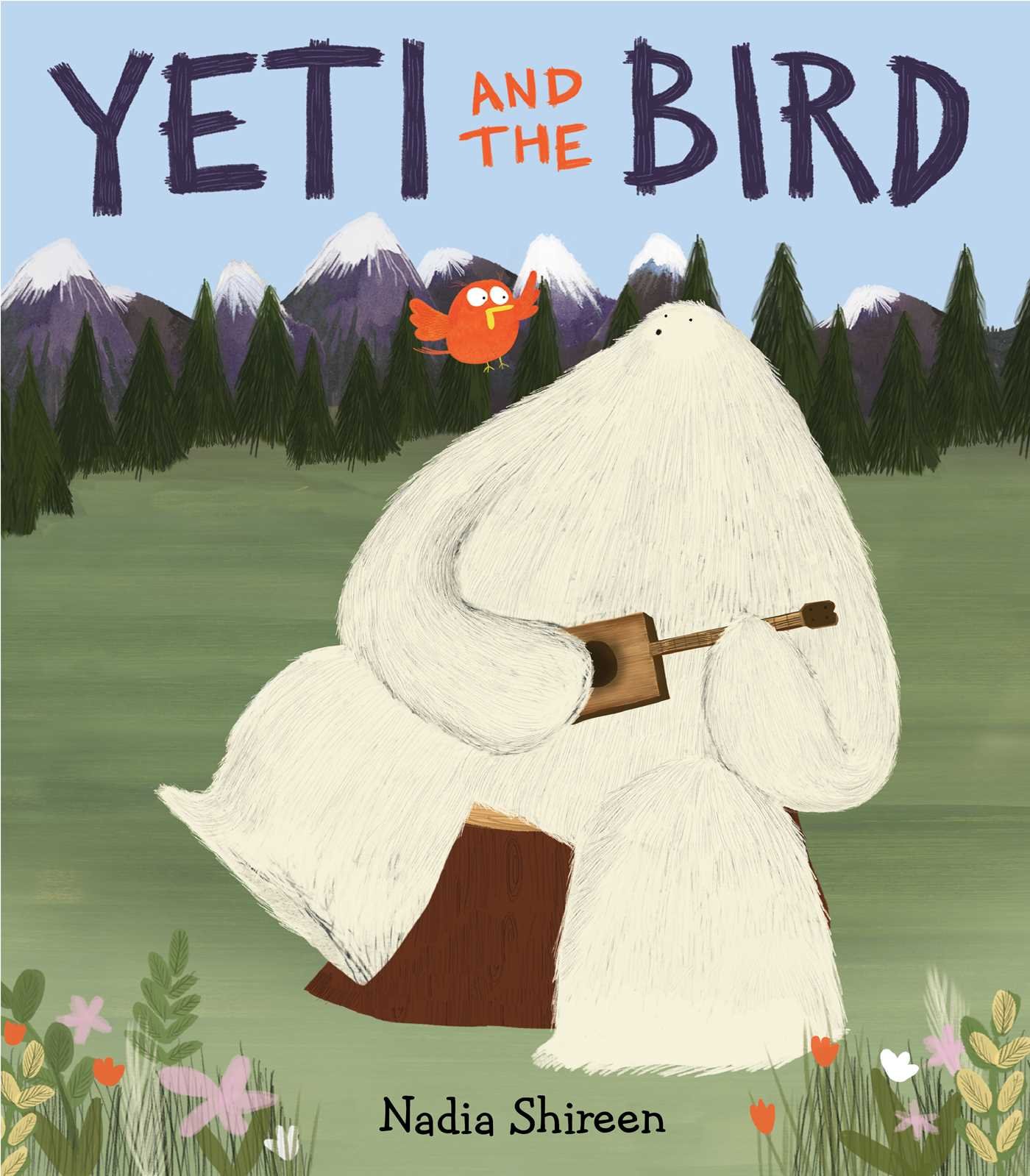
What a sweet story about assumptions, loneliness, friendship and kindness. An AR 2.0, this 32 page simple picture book tells the story of an accidental meeting, making friends, and the opening of hearts of the forest critters as a result. Written and illustrated by a Muslim author, the adorable illustrations make the story come to life and provide smiles for kg-2nd graders along the way.
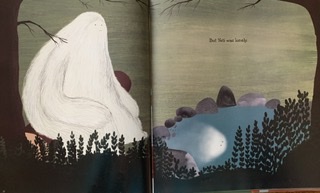
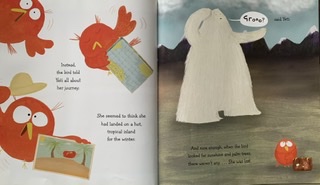
Yeti is the biggest, hairiest, scariest beast anyone has ever seen. So no one comes near him, making him very lonely. But one day a lost bird thunks him on the head. The Yeti growls, but the bird doesn’t get scared. At all. Instead the little bird tells Yeti about her journey and how she was headed to a hot tropical island for the winter.
Yeti doesn’t know what to do with the sad little bird, so he picks her up and takes her home. The next day the two play and laugh. The forest animals look on in surprise and curiosity.
As it gets colder, Yeti knows his new friend will need to leave so he studies the map and helps give her directions for the long journey ahead. Once she leaves, Yeti is even lonelier than before.
But, alas, new friends are ready to play and the little bird stops by to play when she can.
Cute and fun and great for littles, to be brave and give a new friend a chance.
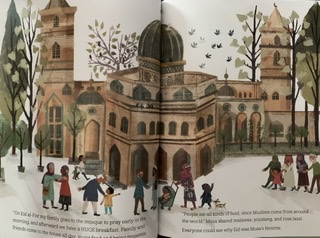
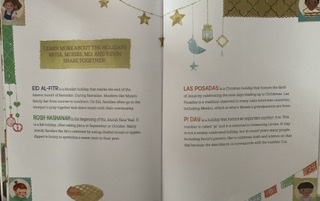
A great book about inclusion for back to school, except well with Corona, we aren’t doing things how we always have. None-the-less this book about the first day of kindergarten for Musa and the friendships and celebrations of diversity (Eid al-Fitr, Rosh Hashanah, Las Posadas, Pi Day) that will take place over the school year, connect the kids and their cultures in a beautiful and heartwarming way. The book is 40 pages with engaging illustrations and text perfect for 5-7 year olds.
It is the first day of school and Ms. Gupta tells the class it is her favorite day of the year. She also tells the children that the people around them will become their best friends. Musa doubts this as he looks around at the strangers at his table.
He also wonders how the first day of school can be any ones favorite day, clearly Eid al-Fitr is the best holiday. Luckily, every show-and-tell will be about someone’s favorite day, so that the class can join together in celebrating it. Moises can’t believe that Christmas isn’t the most fun until he learns that not everyone celebrates it.
When it is Musa’s turn to teach about Eid, his mom and he bring in food and decorations and teach the kids to say Eid Mubarak. They learn what Eid is like and can see why it is his favorite.
Up next is Mo’s turn. He tells everyone about Jewish New Year and how to say Shanah Tovah. On Rosh Hashanah they light candles and share food with friends and family.
Moises explains how Las Posadas is how his family celebrates Christmas. It lasts nine days and there are songs and pinatas and presents.
In the spring it was Kevin’s turn and he shared his love of Pi Day as his family celebrates science. On March 14 (3.14) they make different pies and learn about scientists and their discoveries.
On the last day of school, the children are sad, but their teacher hopes they will remember each other always throughout the year as she hands out calendars for them to keep.
The book concludes with information about each of the four holidays mentioned. It is possible that on the Rosh Hashanah page the family is two gay men with two children, but it could be just two men as well, and doesn’t say anything in the text that suggests who and how the family is comprised.
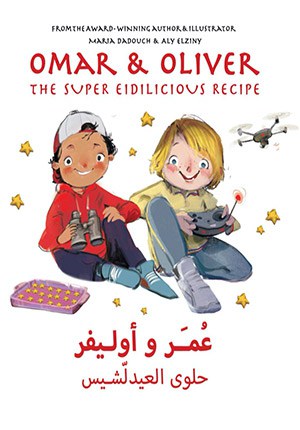
This super cute Eid book works great for ages 5 and up. Written in both Arabic and English, not just translated in to both languages, the book features a Muslim celebrating Eid and a Christian boy working together to try and get Omar’s sister’s cookie recipe so they can be the best cookie cooks ever! The book would work for either Eid and with the adorable illustrations, and included recipe, the book will get lots of requests all year round.
Omar is excited that his friend and neighbor, Oliver, is sleeping over the night before Eid. They boys are playing when Omar’s sister Judy brags that her friend has given her the best cookie recipe in the entire world.
Naturally, Omar and Oliver want to be the best too and offer to help Judy. She refuses, and the quest to get the recipe is on, so that Omar can make them for Eid and Oliver for Christmas.
The boys try to steal it through the kitchen window. But Judy catches them and slams the window shut. They then try binoculars from the stairs, but the boys can’t write fast enough and Judy grabs an umbrella to shield the recipe. Undeterred the boys pull out a drone, but the zoom on the camera isn’t quite good enough.
The boys then see Judy rushing out of the kitchen and run in to see if she left the recipe. They don’t find it, but they peek at the cookies and see that they are golden brown and if left in any longer might burn.
Tempted to let them burn, a sign on the fridge saying, “Eid: a time to share and show we care,” makes the boys realize saving them is the right thing to do. Judy says she too saw the sign and rushed out to copy the recipe for the boys. They then all work together to make lots of Eidilicious cookies and share them with everyone on Eid.
The book starts with some tips for parents on how to present the bilingual book and ends with a cookie recipe, as well as some information about what Muslims and Christians celebrate. I love the illustrations and that they are two page spreads, but the page with the note is the whole resolution and the note is split on the folded binding and honestly I missed it when I read the book myself and when I read it at bedtime to my kids. When I opened the book wide to take pictures it was crystal clear, and if you were reading it to a group you might not have an issue.
I also didn’t love the word, Mashallamazing, I obviously get what it is trying to do, and I feel like it works with Eidilicious, but that Mashallamazing is a stretch. Additionally, if it is claiming to be an interfaith book, a word like that might need some explaining. I got a bit hung up on it, so I had my 13, 11, and 9 year olds read it and they did as well. I also didn’t think the pulling out of the story to ask the reader if the boys were successful in getting the recipe was necessary after each attempt.
Disclaimer: I don’t speak Arabic and cannot comment on that, sorry!
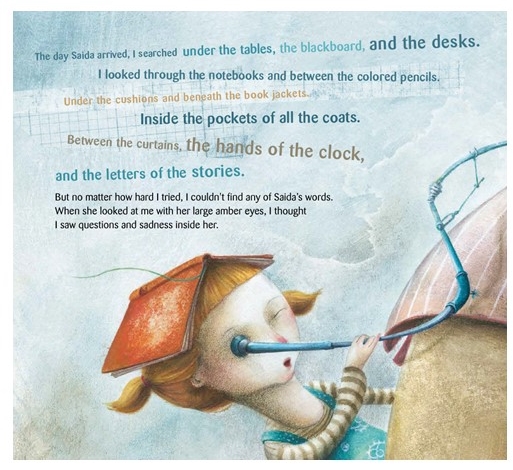
This absolutely gorgeous lyrical book will sweep you up and hold you tight as you imagine a world where more people take the time to get to know one another through the power and beauty of language. Over 32 pages that are exquisitely and whimsically illustrated the words dance and come to life in English and Arabic as a friendship is formed. Perfect for preschool through 3rd graders, older children and adults alike will be softened by the kindness and example shown between two little girls.
Told from the perspective of a little girl that meets a new girl in school named Saida and decides right away that they are going to be friends. Unfortunately Saida speaks only Arabic, and the little girl only English.
But it is no problem, because the little girl is going to help Saida find her words. She is going to look everywhere to let her get rid of her tears and throw away her silence. So that she doesn’t see questions and sadness locked up in her.
That night at home, the little girl’s parents tell her about Morocco and find it on the globe. They explain that Saida’s words don’t work here and that her words wouldn’t work in Morocco.
Undeterred the two girls start teaching each other words in their languages. Some stick, some float away, but the two learn and communicate and connect. They find friendship in learning each other’s words.
They recite a poem by Jacqueline Woodson and tells stories about Marrakesh. The two girls plan to travel the world together. The book concludes with both alphabets shared and the reader wishing to join the little girls on their adventures.
I was blown away by the presentation of the book and the feeling of compassion and cultural appreciation depicted. Such a beautiful approach to welcoming someone different in to your life.
There is nothing Islamic or religious in the book, or really even cultural, aside from language.
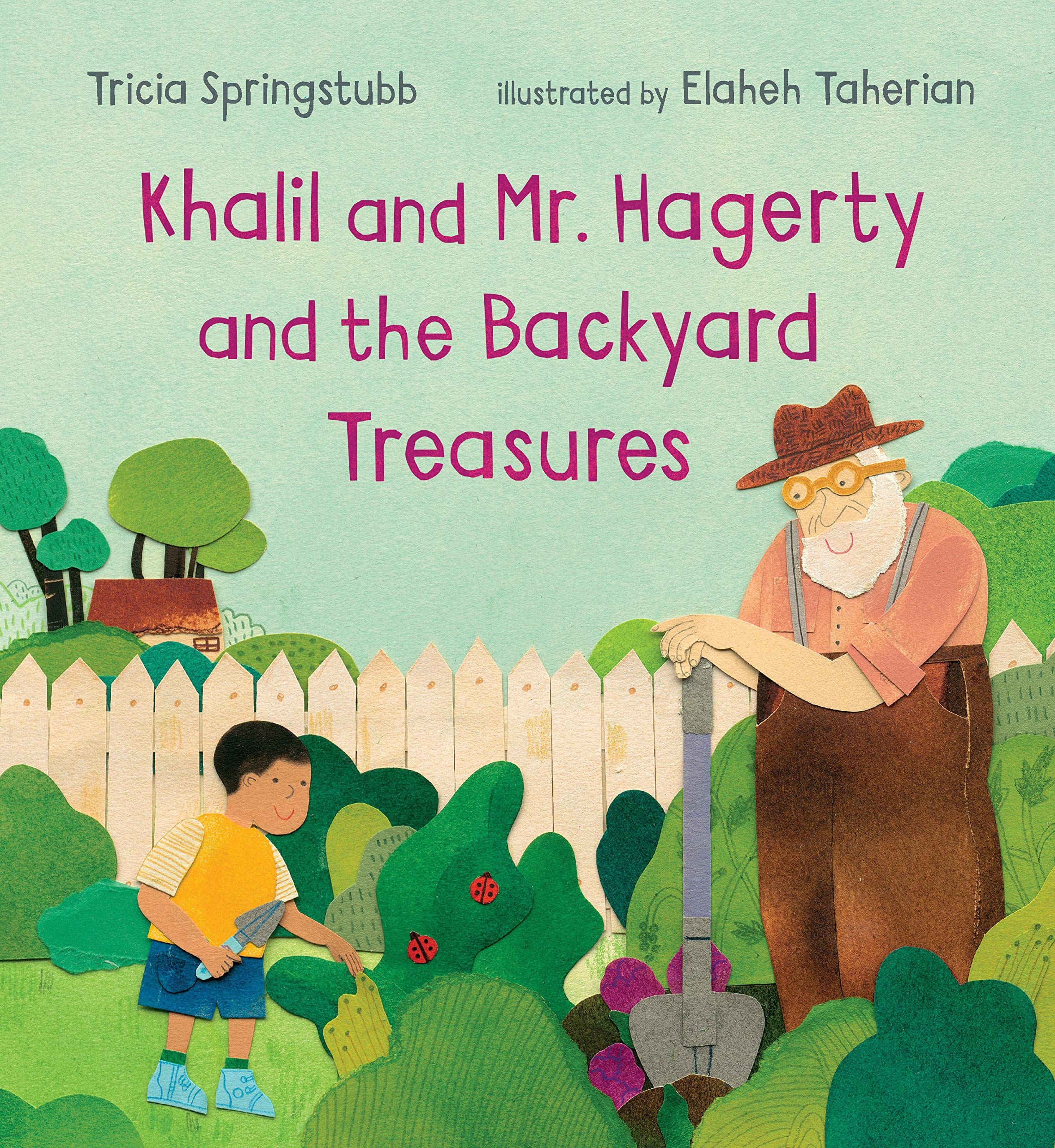
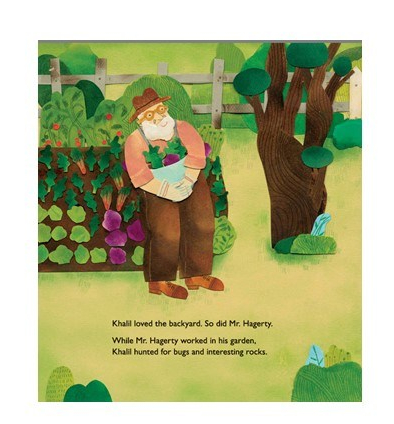
This 32 page book for ages 5-8 is a perfectly presented story about inter-generational and intercultural friendships. Big on sentiment and heart while keeping the text short allows the compassion the two friends have for each other and their actions of showing how they feel toward one another speak volumes. The illustrations appear to be cut paper and add to the thoughtfulness that the story presents.
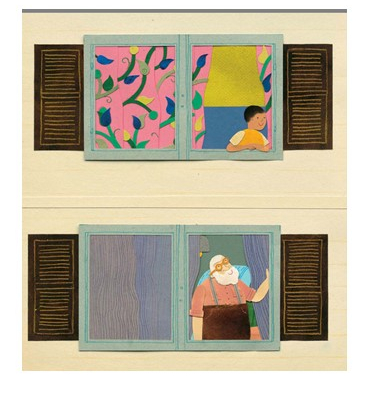
Khalil and his family live upstairs and are noisy. Mr. Hagerty is quiet and lives downstairs. The two bond over their love of the back yard. While Mr. Hagerty works in his garden, Khalil hunts for bugs and rocks and treasure.
When Khalil doesn’t know a word, Mr. Hagerty teaches him. When Mr. Hagerty can’t remember a word, Khalil helps him.
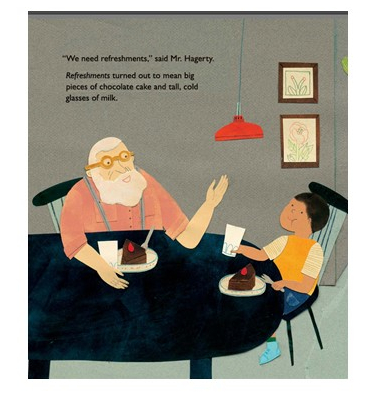
That summer it is hot, really hot. The carrots are all shriveled, and Khalil can’t dig the hard earth for treasures either. So the two decide to have “refreshments,” which means chocolate cake and milk.
That night, the two friends separately plot to cheer the other up. They put their plan in to action and, no I’m not going to spoil the sweet acts the two do for each other. But it is clever and sweet and all the things that make a feel good story stick with you and remind you that age and culture and color are nothing when two people open their hearts to learn and grow.
There is no reason anyone casually reading the book would think that Khalil is a Muslim, and who knows maybe he isn’t, but the name Khalil caught my attention and the author’s dedication is to a Khalil, Muhammad, Fatima, and Adam. So yes, I totally am claiming it. Even if it isn’t, the old white man, and the young boy of color bonding is a great message in-and-of itself that we need to see more of in literature and real life.
The publisher suggests this book for ages 4 and up, but I think it’s a bit long (30 pages) and detailed for that age group, and first grade and up will benefit more from this heartfelt story.
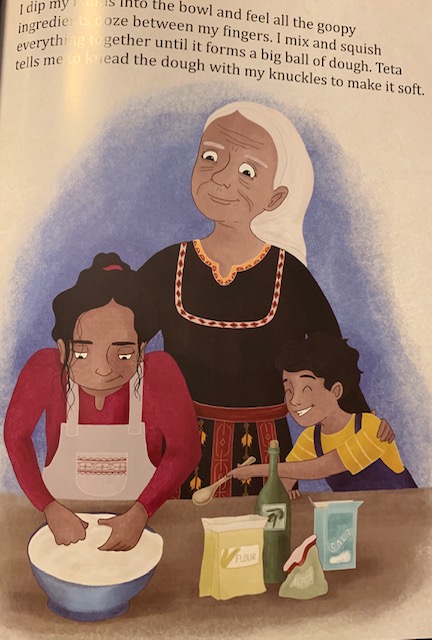
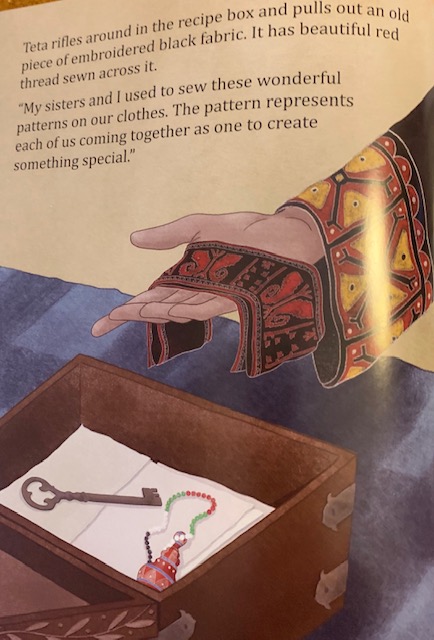
Maha is excited her Teta is moving from Palestine to live with her, her brother Sami, and parents in Canada. Maha dreams of being a chef on a famous cooking show, and her Tata and her secret recipes will be a great way to practice.
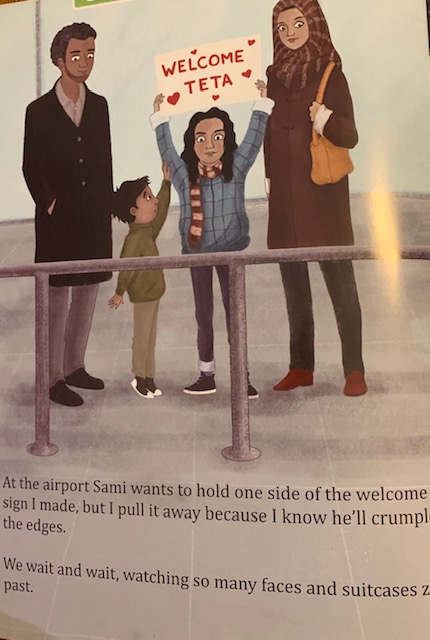
Her little brother Sami is always in the way though. Whether it is wanting to hold a sign Maha has made, or is wanting to cook with her, she is annoyed by him at every turn.
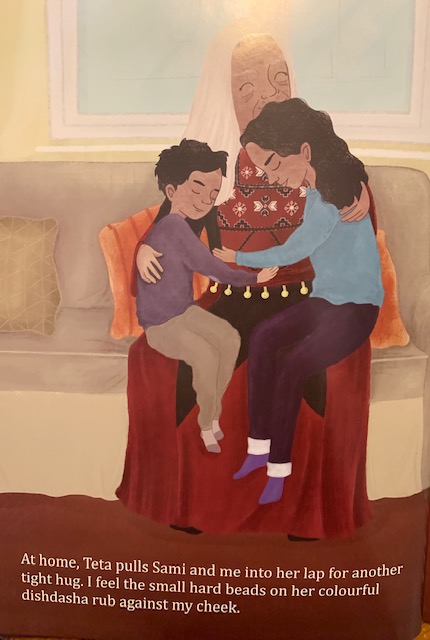
As Maha listens to Teta’s stories and learns about her life in Palestine, she starts to change in her approach to Sami and realizes that family has to take care of each other.
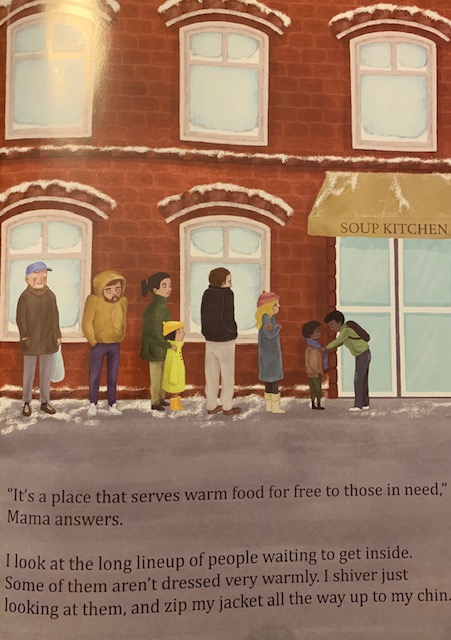
After a day of cooking together, Maha, Sami, and Teta have made too much food and decide to go and share it with those in need at the soup kitchen.
The book addresses kindness, changing, compassion, immigration, taking care of one another, multi generational lessons and love, stories, life lessons, and some highlights of Palestinian culture, food, clothing, and tradition.
The book is warm and well done, with the exception of a few of the pictures which seem a bit off to me. Overall, it is a sweet story that presents with a lot of lessons, but doesn’t force them upon the reader. The character growth is gentle and subtle and will resonate with readers.
The characters mention Halal food, and the grandma wears hijab even in the house, where the mother is shown wearing it at the airport, but not in the home. The book would work for Muslim and non Muslim readers.
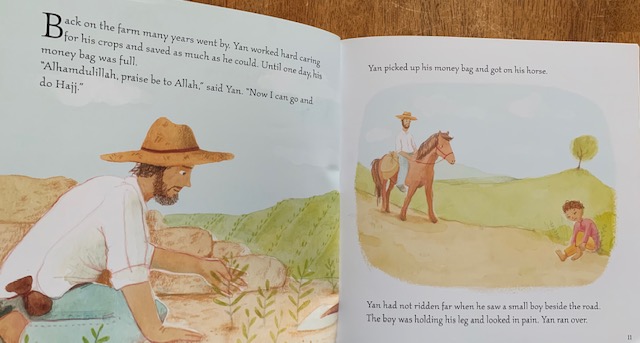
With less than a month until Hajj, this book should definitely start making an appearance in your children’s story selection rotation. The focus is not on the parts of hajj, but rather the desire and intense yearning to go for the sake of Allah (swt). Granted, it doesn’t take much to get me to cry these days, but this 27 page book for ages 5 and up, got me emotional. Going for hajj is always something to plan for and hope for, and the sweetness of the reminder that we plan, and Allah plans and Allah is the best of planners is so beautifully brought to life, that I benefitted from the reminder and my kids from the lesson.
Yan is a farmer, a poor farmer, who loves Allah and wants to go for hajj more than anything else. So he decides to work hard and fill up his money bag so that he may go. After years of hard work his bag is full and he begins his first steps in his journey proclaiming his love for Allah. After a few days of walking however, he comes upon some sad children who have recently lost their school to a fire. Yan, uses his money and time to fix the school and returns back to his farm to start saving up again to go for hajj.
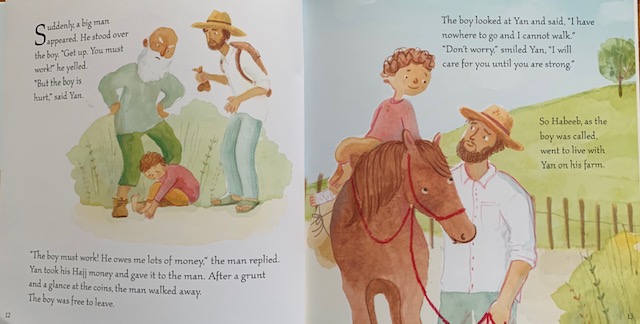
When his bag is full again and he sets out again, he is met by an injured boy who is being yelled at by his owner. Yan, once again reaches into his money bag to generously do the right thing, in this case to pay off the boy’s debts and takes the boy home with him to be nursed back to health.
After some time he again has a full money bag and sets off for Hajj. Along the way he finds a village trying to build a mosque and after two months of helping with the funds and offering his own labor, the mosque is complete and Yan returns home.
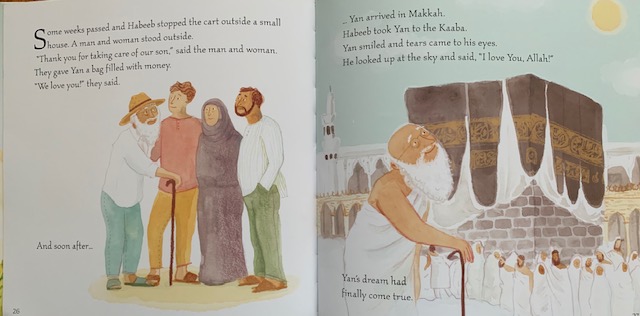
Now Yan is old, and after many years he looks in his money bag and it is not full and he sadly admits he cannot do hajj. But then the boy he saved, Habeeb, returns with a horse cart to take him for hajj and they pass through the village where he repaired the school and is greeted with rose petals and gifts of ihram, they then pass by the mosque he helped build and the villagers gift him with food and water, they then arrive at Habeeb’s house and he is given a bag filled with money and at long last Yan’s dream comes true as he sees the Kaaba.
The book shows how steadfast Yan’s love of Allah is and how generous and patient he is in pursuing that love. The illustrations of him aging are truly touching and gentle. In some ways it reminded me of Shel Silverstein’s The Giving Tree, but with a happier ending, in bringing a large grown up concept down to size and presenting it in a genuine way.
Now that there is legitimately a genre of YA Islamic Romance out there told in Own Voice, the expectations are high that a book is compelling, realistic, and unique somehow. While the author’s first book, Saints and Misfitswas pretty ground breaking, this 342 page was a great read, but not nearly as remarkable or memorable. Granted it is not fair to compare the two books, and each day I do age out of the target demographic, but while the story reads authentic and true, albeit a bit serendipitous, it doesn’t have the teeth or grit I was kind of hoping for, and with a mother who suffers from multiple sclerosis my emotions were pretty invested.
SYNOPSIS:
Told from both Adam and Zayneb’s perspectives by way of their individual “Oddities and Marvels” journals, our two characters are presented by a narrator who keeps their story on track and interjects when their versions of an event differ.
Zayneb is a high schooler and activist who has recently been expelled for threatening a teacher who consistently lets his Islamaphobic beliefs take over the days lessons. In an environment filled with micro aggressions against Muslims, Zeynab’s parents are at a loss at how to keep their daughter from making waves, and thus allow her to leave her Indiana home a week before spring break to visit her aunt in Doha, Qatar.
Adam is at University in London where he has recently been diagnosed with MS and as a result has stopped going to classes, and is literally “making” the most of the time he has by making things. As the term ends and he officially withdraws from school, he heads home to Doha to tell his dad and sister that he has the same disease that took his mother’s life years early.
The two characters meet at the airport briefly and then again on the plane and then at Adam’s house and the needless to say their accidental meetings allow for friendship to grow, attraction to be built upon and a relationship to develop. Both characters have their own lives and own obstacles and own maturity that needs to occur in order for a happy ending to take place, and thus the book keeps you interested, invested and cheering them on.
WHY I LIKE IT:
I love the dynamic of how the book and characters are set up. Both are practicing Muslims, both characters don’t cross a line, both characters have diverse mixed cultural backgrounds, and one is a convert and the other the daughter of a convert. She is fiery and impulsive and emotional, he is pragmatic and calm and quiet. While they have some background in common, their life experiences are rather different and it is very much a story about opposites attracting.
I’ve been waiting for this book to come out, and so I knew my expectations would be too high. That being said the book warns it is a love story and in some ways, that was what I kind of felt was lacking. There was the physical attraction that was mentioned fairly often, but the deep connection of ideas or growing seemed a bit lacking.
I really liked Adam, and his internal stresses and struggles and coming to grips with his disease seemed pretty developed. Somehow though, and I’m probably in the minority, I didn’t love Zayneb. She is impulsive and definitely learned and grew from the start of the book to the end, but I didn’t love her nuances with dealing with the Emmas and her friends back home and unraveling her teacher, it felt kind of forced and I can’t articulate why. I’m glad she matured and she got answers about her grandmother, but maybe I should have felt so much in common with her and when I didn’t, I felt a little irritated. Clearly I get too invested in fictional characters, I’ll admit that.
I like that Islam is presented in a non defensive way. The parents aren’t evil, there is no rebelling, even the awful teacher spawns backlash and allies to Zayneb and her cause. There is no apologizing or overly explaining if the characters are pushing boundaries established by Islam or if they are establishing their own boundaries based on their understanding of Islam. I like this, because it shows that Muslims are not a monolith, we are not one way good or bad. Zayneb covers and prays and has friends that are boys and her family is kept in the loop of what she does, which alone breaks so many of the predominate stereotypes about Muslims. Adam himself converted at age nine and plays the guitar and has friends that are girls, and is close to his sister, and likes dogs. A side character is noted to be incredibly religious, but doesn’t cover. The story takes place in an Islamic majority country, but attitudes at the swimming pool don’t allow Zayneb to dress modestly while she swims.
Overall, the book is a delightful read that manages to keep the religious integrity in the characters and show their personalities as they come of age. It may not be memorable years after reading, but what you do remember will be positive, and while you are reading it, you will have a hard time putting it down.
FLAGS:
There is angsty romance, and talk of sex. The two main characters keep it pretty clean, but the side characters joke about hooking up, being horny, and sneaking off to hotel rooms. The non Muslim aunt has a secret alcohol and cigarette stash that she gets called out on, but nothing more is mentioned about it. I think 9th or 10th grade and up will be perfectly ok to read.
TOOLS FOR LEADING THE DISCUSSION:
There is a lot to unpack in this book and I think if one just listens, teens will naturally add their own opinions and perspectives on EVERYTHING the characters experience, feel, question, and cope with. The book just came out, but I would imagine that over time discussion questions will appear.
 I think the illustrations in this 40 page picture song book are my favorite of the new 2021 books. They are adorable and expressive and a big part of the story that the text alludes to, but doesn’t detail. They also are a big part of the activities at the end of the book that encourage children to go back and find different Ramadan and Eid concepts to discuss and further understand. I absolutely love that there is a glossary and a reference page that details and attributes the hadith implied in the simple sing song-y words. The chorus is to the tune of jingle bells, and while I struggled to maintain the rhythm, the chorus reappears and if you are able to sing the book, your children will love it even more, haha, my voice and lack of rhythm forced me to read it, but either way it is absolutely delightful and informative for toddlers and up.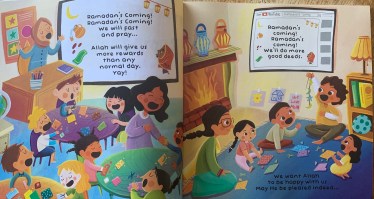














 This absolutely gorgeous lyrical book will sweep you up and hold you tight as you imagine a world where more people take the time to get to know one another through the power and beauty of language. Over 32 pages that are exquisitely and whimsically illustrated the words dance and come to life in English and Arabic as a friendship is formed. Perfect for preschool through 3rd graders, older children and adults alike will be softened by the kindness and example shown between two little girls.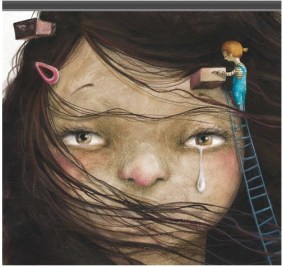












 Islamic School Librarian