Tag Archives: India

Hidden Fires by Sairish Hussain

Standard
Hidden Fires by Sairish Hussain

I will not be getting over this book any time soon. It broke my heart, and all my other critical organs, in the most delightfully well-done way possible, and undoubtedly I am better for it. I don’t read a lot of adult fiction these days, and with some diabetic retinopathy concerns, I couldn’t read the 384 page adult book about generational trauma, partition, the Grenfell Tower fire, family dynamics, bullying, self-harm, and resilience, but was pulled in to the audio book version instead. The Desi-British voices of Yusuf, Rubi, and Hassan were refreshing to my American ears.  The multi-perspective book told in parts richly develops the characters, their relationships, and their current, past, and future struggles.  The author is Muslim, as are the characters, and while they all practice in their own way, it is undoubtedly who they are, and their Islamic identity is not questioned, feared, blamed, or apologized for.

SYNOPSIS:
The book weaves three distinct voices. Yusuf, is an 80 year old an immigrant who lived through partition, raised his family in the UK, has lost his wife a year prior, and is struggling with haunting memories of the past, failing health, regular loss of friends, and loneliness.  Hassan, Yusuf’s youngest son is a workaholic who is married to a non Muslim, non Desi who is suffering from fibromyalgia and who’s mother unexpectedly passes away in Spain.  Rubi, is Hassan’s 16 year old girl who is overweight, bullied, lonely and about to take her GCSE exams when she is dumped on her grandfather Yusuf’s door while her parents head to Spain.  The book opens in Ramadan the night of the Grenfell Tower fire and the horrific event affects them all, stirs memories, and shapes futures.  From there the layers of each character slowly unravel as they cope with the swiftly changing present as they desperately work to break free from the past.  As dementia plagues Yusuf, Rubi finds purpose in being needed, and Hassan is forced to re-prioritize his life before it is too late.

WHY I LIKE IT:
The book takes a slow approach to building up the characters and their back stories. It is almost feels like world building as a book would if it were a fantasy, it doesn’t info dump, but at some point the hooks are so deeply embedded that you really cannot leave the characters and their world and you have to finish the book, just to ensure they are ok.  Because I listened to the book, I feel like there might have been some Islamic content that was not completely ok, but again I was having vision issues and couldn’t note where to go back and check.  I think it is fine, and because it is an adult read, I think the audience can discern accuracy, but please know, I’m not 100% green lighting the Islamic rep.  It is undoubtedly well done and fasting and praying are a part of the characters, but their relationship to their faith and their understanding of it, is presented as theirs, it doesn’t get preachy or make broad statements about Muslims everywhere or Islamic doctrine.  

FLAGS:
There is body shaming, self-harm, trauma, death, torture, killing, lying, abuse, fear, guilt, dementia, bullying, assault, physical violence, drug use (mentioned), attempted suicide (mentioned), music, theft, make-up, close male and female relationships, Muslim marrying a non-Muslim, hallucinations.

TOOLS FOR LEADING THE DISCUSSION:
I think mature high school seniors or possibly even juniors could benefit from this book with discussions.  I think Rubi’s voice tied to her father and grandfather, will really open up youngsters perspectives, and provide a great vehicle to hear their thoughts, fears, worries, concerns about body image, self harm, aging grandparents, accessibility to parents, etc..

All Mixed Up by Raj Tawney

Standard
All Mixed Up by Raj Tawney

all mixed up

The premise of this slightly biographical middle grade book is that of a very multicultural boy, Kamal, finding his voice, with the help of a Pakistani Muslim friend, Jaz, a year after the 9/11 attacks.  It brings in themes of Islamophobia, terrorism, bullying, friendship, alcoholism, immigration, refugees, “legal” and “illegal” citizens, Pakistan and India’s partition, and growing up and feeling alone over 208 pages.  The writing style seems deliberately loose in touching on very complex themes, but not preaching on them, and instead letting the reader draw on their own thoughts and experiences to form their own opinions. It is debatable if enough information is even provider for the reader to ruminate on the themes, or care to, or feel enough of a connection to the characters to want to know how all the dots connect, but none-none-the less it seems to have been done with intent, and with the middle grade POV for some it might get away with key information and the resolution going unexplored.  For me though, honesty I just couldn’t get past one line, one line tossed out with no explanation, no arc, no real purpose, never revisited even, at 16% it says “Allah is stupid.”  Yes, I debated tying the phrase out.  I don’t know why it has this line, it has no real impact on the story and could have easily been replaced for another reason Jaz received a purple nurple from a bully in Pakistan.  Later in the book there is a scene where Jaz has brought a prayer rug to school, he states he doesn’t always pray, but clearly he does practice Islam, not just maintain the label in name only.  I am not saying that the scene is not based on the author’s real life, or that people don’t say stuff of this nature, but it is hard to read in black in white in a book with no discussion.  I don’t know what the author’s intent was in including it, but I think it is a disservice to so many of the themes in the book and does not serve the target audience as a mirror, or a respectable takeaway either. For this one line, I truly don’t feel like I could have this book on my shelf, which is unfortunate.

SYNOPSIS:

Kamal Rao is half Indian, a quarter Puerto Rican, and a quarter Italian living in New York, he is relentlessly bullied at school, has no friends anywhere, and is dealing with a father that drinks a little too much most nights since he lost his job.  When a new boy, Jaz shows up at school, that can pronounce his name, a friend just might be what Kamal needs to find his voice, confidence, and place in the world.  Except Jaz has his own issues, and remains pretty mysterious about his past, his home life, even his name.  When a Halloween terrorist attack occurs, Jaz makes a run for it and Kamal has to decide what his friendship means.

WHY I LIKE IT:

I really can’t decide if I like the writing style or not. I recognize that to stay on a middle grade point of view the banter between Kamala and Jaz is often done when it is just the two of them in a scene, making sense of a world they might not know much about. Unfortunately, that also means a lot of erroneous statements, perspectives, and facts get unchecked, and possibly perpetuated.  It also means that at times the boys seem really worldly and competent: riding across town on their bikes, living pretty independently, but also being really naive about being a brown Muslim kid waving around a gun in public, even if it is pretend.  The inconsistencies often are in relation to Islam, so they particularly stood out to me, for example Kamal knows what a hijab is, but not that Muslim’s pray five times a day.  I think when a book is OWN voice and based on lived experiences, but so much of the plot pivots around someone who is so different from you, some of the details just seem inauthentic.  Admittedly, I was turned off early by that one statement, and I am not the target audience, but it was hard to relate to Jaz because it seemed so forcefully trying to present him in an almost performative way. A place of love no doubt, but overly polished to make the reader accept him and feel a kinship to him as Kamal did.

FLAGS:

Halloween, lying, terrorism, bullying, abuse, alcohol, sneaking

TOOLS FOR LEADING THE DISCUSSION:

I cannot encourage this to be on an Islamic school library or classroom shelf. That line even with discussion can’t really be explained, there is no point to it.  I’d like to assume that as a child he was frustrated with life and was lashing out in fear or grief or desperation even, but there is nothing in the text that would support or suggest that, it is just there.  I read an electronic ARC, and I hope that the line has been removed in the final copy.


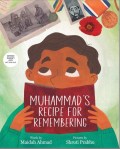
Muhammad’s Recipe for Remembering By Maidah Ahmad illustrated by Shruti Prabhu

Standard
Muhammad’s Recipe for Remembering By Maidah Ahmad illustrated by Shruti Prabhu

img_4274-1

I feel like the idea and heart of this 40 page picture book is decent, but the story, presentation and takeaway are just really poorly executed.  The pitch is a Muslim Desi kid feeling left out when all his friends are rehearsing for the upcoming veterans assembly because he doesn’t have anything to share.  He then starts asking his family, and the Muslims and non Muslims hanging out at the mosque to find out about Muslim and Indian involvement in the World Wars.  A rarely explored topic, considering in the West WWI and WWII are taught from a Western centric perspective, no doubt.  Unfortunately, most early elementary readers, the book’s target audience is 4-7, have limited knowledge of the World Wars, let alone about the subcontinents own politics and that they were occupied themselves under colonial rule at the time, and this book does nothing to explain any of it.  The inconsistencies, plot holes, vocabulary and ultimate lack of sharing a single story from a descendant of someone who fought, make the book rather pointless and forgettable.  Truly the take away is that there were Muslims among the Indian army, they made roti and prayed.  No real idea what they experienced, saw, endured, or gained in return for being forced to fight for Britain on the global stage.

img_4275-2-1

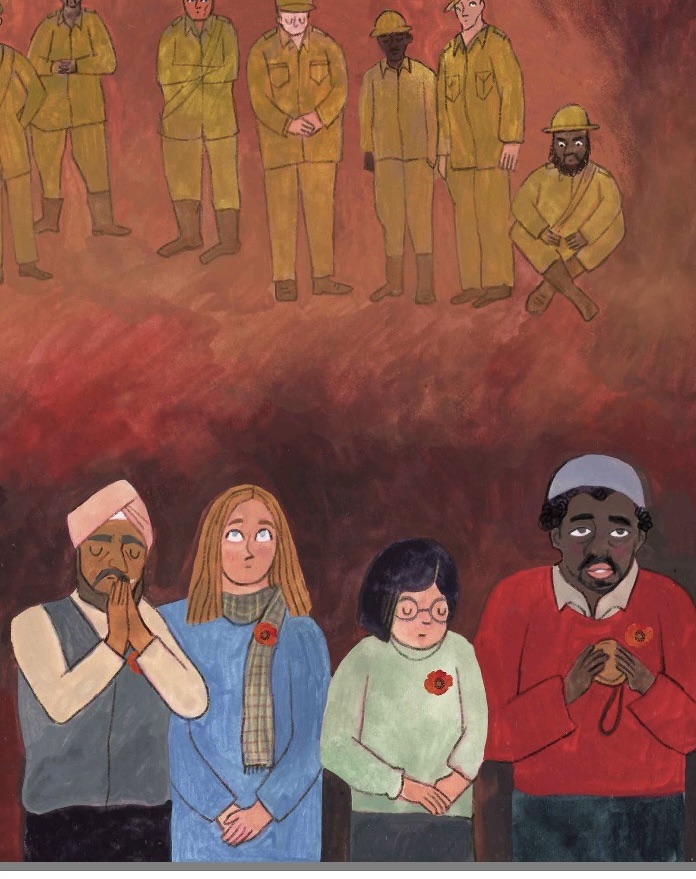
The book starts with Muhammad listening in to his classmates talk about their family members that are veterans and him feeling left out.  At recess they don’t let him battle in the reenactments and instead make him be the cook. When he gets home his dad is making rotis and Muhammad asks his dad if they have veterans in their family, they then go ask his grandfather if his great great grandfather fought in either World Wars.  Dada jaan recalls that “they sent my grandfather to France in World War One.”  But he never spoke about it except to mention that they shared rotis.  He suggests they go to the mosque the next night as that is where, “a kaleidoscope of people gather.” He learns from a Sikh uncle in a turban that whole villages went to fight and from Imam Rafiq that the soldiers fasted in Ramadan, prayed, and celebrated Eid.  No one has any visible tokens of their family’s service as they were lost over time.  Determined not to let the stories be lost, Muhammad shares roti at the assembly.

img_4277-1

Ok, buckle up, I have a lot to point out, but first the positive.  I like that the dad makes rotis.  Mom isn’t in the book, but there are a lot of pictures of a lady hanging on the walls of the house, so possibly she has passed and dad has to cook, no matter, it is nice seeing a Desi dad in the kitchen.  I also like that the mosque is central to the story, I wish it was called a masjid, and that it was explained why people that are not Muslim are hanging out there.  Brown people are generally lumped together and this seems to reinforce that stereotype, which makes me less than thrilled.  It seems like a social environment with ping pong tables and snacks happening, so why not say it is a social hall at the masjid where people of all faiths often gather.  A “kaleidoscope of people” does not explain people of different religions at a mosque to most four year olds.  The book claims the assembly is honoring veterans, so why is Muhammad only curious about WWI and WWII is never explained.  He is teased and forced to be the cook by his friends, with a very negative connotations and depiction in the illustration, but that notion is never pushed back upon, and is actually heightened with rotis being the thread that ties the entire book together.  A missed opportunity to be sure.

img_4279-1

I really struggle with the reality that the majority of Indians were forced to fight, and the book keeps it vague in the text with lines such as “joined the war effort,” and “they sent..” who is they? It sounds nice that Muhammad doesn’t want the stories, like the artifacts to be lost, but WHAT STORIES? If the book is about remembering, and stories are to be shared at the assembly, I feel short changed that the reader doesn’t get a single story about a Muslim or Indian that fought in one of the World Wars.  Isn’t that the point of the book? Yes the book has sources at the end, but it is fictionalized, make up a story, give the reader and Muhammad something to take pride in, to understand through, to imagine, what it was like for his great great grandfather.

img_4280-1

I struggled with the illustrations as well, Imam Rafiq looks off in the final image, I don’t get why Dada jaans memories seem to be on the TV either.  I also didn’t understand why rotis were the thread, but then it is paratha at breakfast that gives the idea, and who really is constantly spreading ghee on paratha or roti let alone at war, or at recess.

img_4278-1

War is not a trivial matter, and I kind of feel like this book reduced it to food, and allowed some racism, classism, and  Islamophobia, to go unchecked along the way.  I like that the backmatter has a recipe and an author’s note, but colonialism, service, war, are all heavy topics that are hard to bring down to an early elementary level picture book, and sadly this book is unable to connect and inform readers about this time in history.

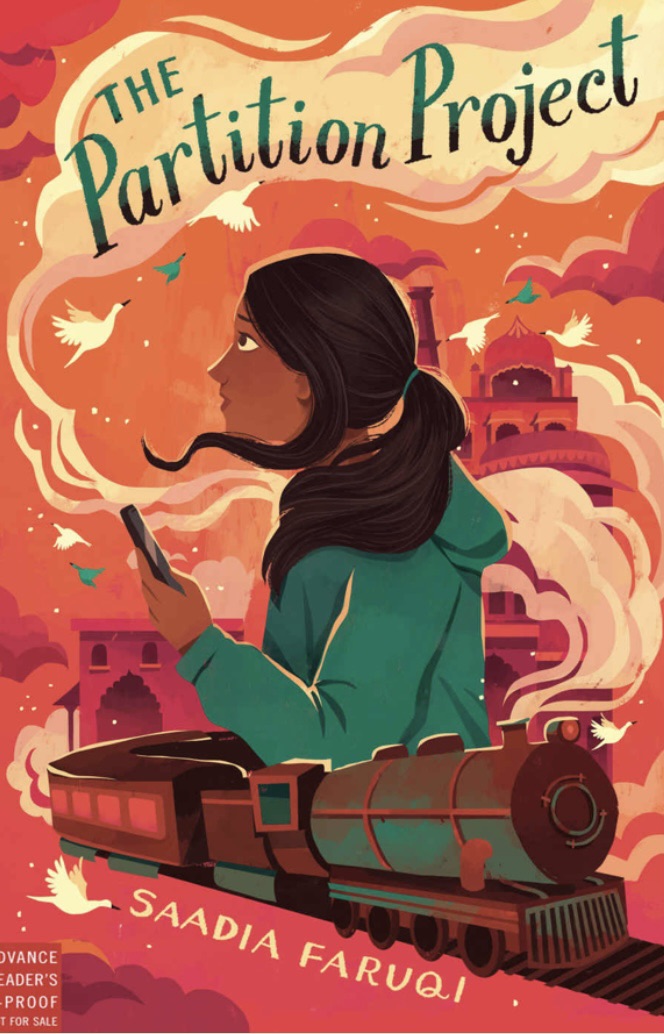
The Partition Project by Saadia Faruqi

Standard
The Partition Project by Saadia Faruqi

Screenshot

I have always maintained that my reviews are not personal, and for over 10 years, I kept to that. I recently made a public exception however, for Palestine. I cannot and have not checked every author, every illustrator, every publisher, or every agent, to see who has spoken up about the genocide, but there are a few prolific authors that are standards in the niche of Islamic fiction literature. Who have elevated our representation with a standard of quality and consistency across multiple age groups over the years, whose stature made their silence, seeming or actual, to the occupation, the apartheid, and the ongoing attempted erasure of a people and culture impossible to miss. No there is no standard or bare minimum, this is all emotion, and if you are thinking who am I to judge, or maybe I missed something, yes you are right. None-the-less it definitely caught my attention that an author who remained silent, wrote a 416 page middle grade book about partition, a historical event impossible to separate from colonization. I know the timeline for books to be published is not quick, but when I read the characters discussing that, “If we only read books by perfect authors, we’d read…nothing, I guess.” It felt a little defensive, and while I never set out to shame anyone, I have written this disclaimer to hold to my word, and to acknowledge that as much as I have set out to write the remainder of this review as I would review any book, my own disappointment in the author, may show through. Literary wise the book is moving, heartfelt even, but the performative othering, the internalized Islamophobia, and the catering to a western gaze, are subtle, but undeniably there. Perhaps the biggest example is the word “British,” the whole reason for partition, is only mentioned a grand total of six times.

SYNOPSIS:
Mahnoor, aka Maha, is in seventh grade, and her whole world has just flipped upside down. Her Dadi, her paternal grandmother, has just moved in from Pakistan, taking her room, and her free time. Plus Dadi is old and grumpy, and Maha is not amused. With parents that are too busy to spend time with her, Dadi slowly but surely starts to fill in a lot of pieces that Maha didn’t know were lacking in her life. Through food and stories and the start of Ramadan, Maha learns about Islam, Pakistan, friendship, and with a school documentary assignment, partition. A historical event she had never heard about before, starts to be all she can think about. It also seems to hang over everything she encounters from a book on a novel study English assignment list, to the train in their neighborhood, everyone at the senior center, and even Texas history. With dreams of being a journalist, Maha’s singular focus because almost obsessive, according to her friend Kim, but the more she learns, the more she changes. And the changes are for the better, even if there are some stumbles along the way, fighting with Kim, making Dadi runaway, calling out her parents preoccupation with work, missed fasts. The book has a happy ending though, as the unlikeable privileged Maha at the beginning, transforms to being someone the reader is cheering for at the end.

WHY I LIKE IT:
I am Pakistani-American, being half Pakistani and half American, the hyphen for me signals both my parents. So I was thrilled a year or so ago when I first heard about this book. I am a bit removed from partition because my father was the first in his family to be born in Pakistan, and my in-laws did not move from India until much later. That being said, I know it is a part of me, as all desis do, and was eager to read this middle grade book. Please note though, I am also white passing American (albeit with a hijab), so I can tell when I am being pandered to as well.

Do I feel the book did the topic justice? Absolutely not, by not discussing colonialism and British occupation, a huge part of the setup is conveniently ignored. It also is very placating of what the Muslims, Seikhs and Hindus seemed to want as Jinnah and Nehru are only name dropped once. Gandhi not at all. I get that the book presumably isn’t about that, but by ignoring it all together, there is some intent there, possible watering down for a white audience, that doesn’t sit right with me.

This book feels like it is written for non Muslims. The dialogues about being a good person even though they don’t follow Islam as they should, and pray and fast and eat halal, seem like internalized Islamophobia, that is trying to normalize not practicing. When the text goes so far as to call those that do fast all 30 days “ultra-religious” it seems to walk back the numerous passages of Maha loving fasting and finding peace in prayer. The takeaway for a Muslim reader will be a little self doubt, for a non Muslim reader it will reinforce the labels of “those Muslims” and “extremists.” It makes what many Muslims find basic faith requirements, come across as optional here in America, like taking off shoes when entering your house. With that being said though, the book does have a lot of heart, and in many places Islam and Pakistani culture are warm, but that warmth often comes through attempts to appeal to a non Muslim western lens. Similarly the stereotypes do as well. Pakistan is considered conservative, which is dismissed as meaning, “code for no swimsuits.” Wow, a whole culture and religion, so easily labeled and stereotyped. Stings a bit, not gonna lie.

Maha’s parents are not religious, so much of Maha’s knowledge of Islam is coming from what she sees her Dadi do, pray, fast, read Quran, etc. Except, Maha knows how to read Quran, and pray, she just needs practice. So explain, how she doesn’t know what inshaAllah means? This is just one example of inconsistency bumps in the text. At one point they eat iftar, and then a few hours later have dinner, I mean sure it is possible, but it seems weird. Her frail grandma runs away on a hiking trail? She wants the archive curators approval for her documentary and not her Dadi’s? Ahmed says he only eats hala, Maha is eating a non halal chicken salad and then they share it. Overall, Maha rarely reads like she is 12. At the start when she is whining, is about it, the rest of the book she reads much much older.

FLAGS:
Boy girl close friendships, angry mobs with guns, death, cholera, internalized islamophobia, talk of gods and demigods in Percy Jackson, mention of J.K. Rowling negative comments on trans community, fear.

TOOLS FOR LEADING THE DISCUSSION:
I cannot in good conscious purchase, recommend, or even check this book out from the library. I received an advanced digital arc, but my heart is too heavy by the author’s silence in the face of the atrocities occurring in front of us regarding Palestine.

Tipu’s Roar: A Freedom Fighter’s Tale by Subia J. Ali illustrated by Gabriel Sorondo

Standard
Tipu’s Roar: A Freedom Fighter’s Tale by Subia J. Ali illustrated by Gabriel Sorondo

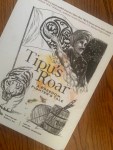
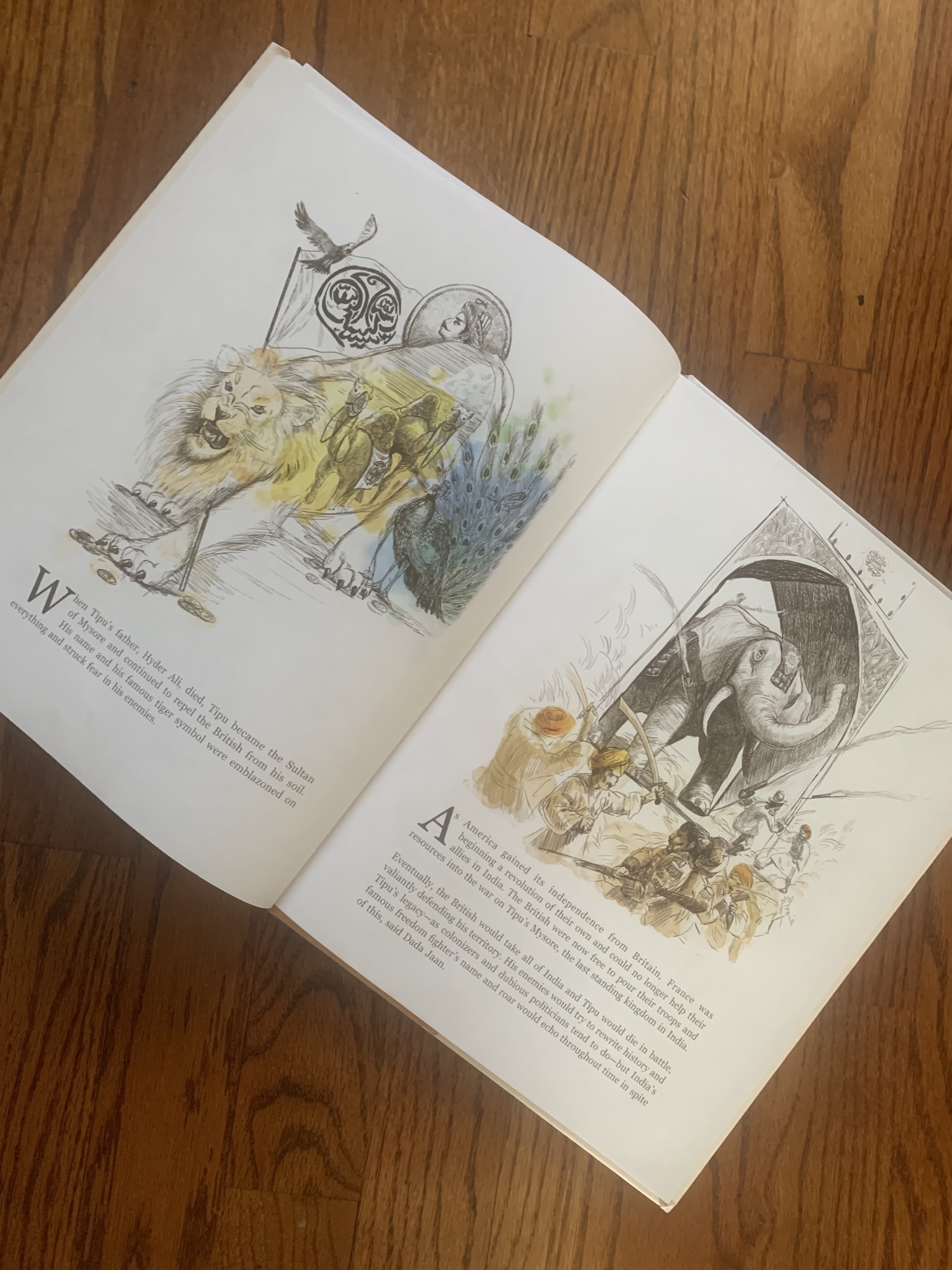
This large (9×11) hardback book is for the most part gorgeously illustrated in sepia tones, but the story is only 11 pages long; a pretty steep price point for 11 pages.  A story nestled with in a story, the premise of bringing to light a not well-known historical figure is admirable, but with no sourcing, it is hard to know what is real, and what is legend.  The concept and angle of being a freedom fighter and resisting colonization is timely, sadly it lacks the inspiration that I feel the author set out to convey.  I read the book a few times, and still had to Google a map of Mysore, Tipu Sultan and the role of the French in the subcontinent in the 1700s.  It would seem a book dedicated to the children of Palestine, defining words of freedom fighter, colonization, and imperialism before the book even begins, would answer the basic questions about the hero at hand.  

The book starts with an old man feeling gentlemanly wearing a bush shirt, chatting with his grand daughter who is being corrected to call him Dada Jaan instead of Grandpa. He then gets lost in thought and begins to tell his grand daughter the power of names to emphasize his point.  Tipu Sultan, known as the Tiger of Mysore, he tells her, “fought the British, who had come to colonize the Indian subcontinent.”

He doesn’t so much as convey the information in an entertaining way, as he lists off details and then pulls out to make sure she is still listening.  He tells her about the British East India Company draining the wealth of the subcontinent by taking tea, cotton, gems and spices.  He tells how Tipu “studied Islam, spoke many languages, and was a pioneer in rocket artillery.”  He credits Tipu’s rockets as revolutionizing warfare all around the world, and connects India, France and America as fighting off their Imperial colonizers, with the French being close allies in India’s struggle against the British.

Once her Dada Jaan’s retelling is through, and Tipu has lost, and Mysore falls, the little girls ponders over the story and years later appreciates her Dada Jaan in his traditional tunic rather than his bush shirt from before.

The book is in many ways needs to be fleshed out, sourced, and the messages articulated for today’s readers. 

The Moon from Dehradun: A Story of Partition by Shirin Shamsi illustrated by Tarun Lak

Standard
The Moon from Dehradun: A Story of Partition by Shirin Shamsi illustrated by Tarun Lak

partition

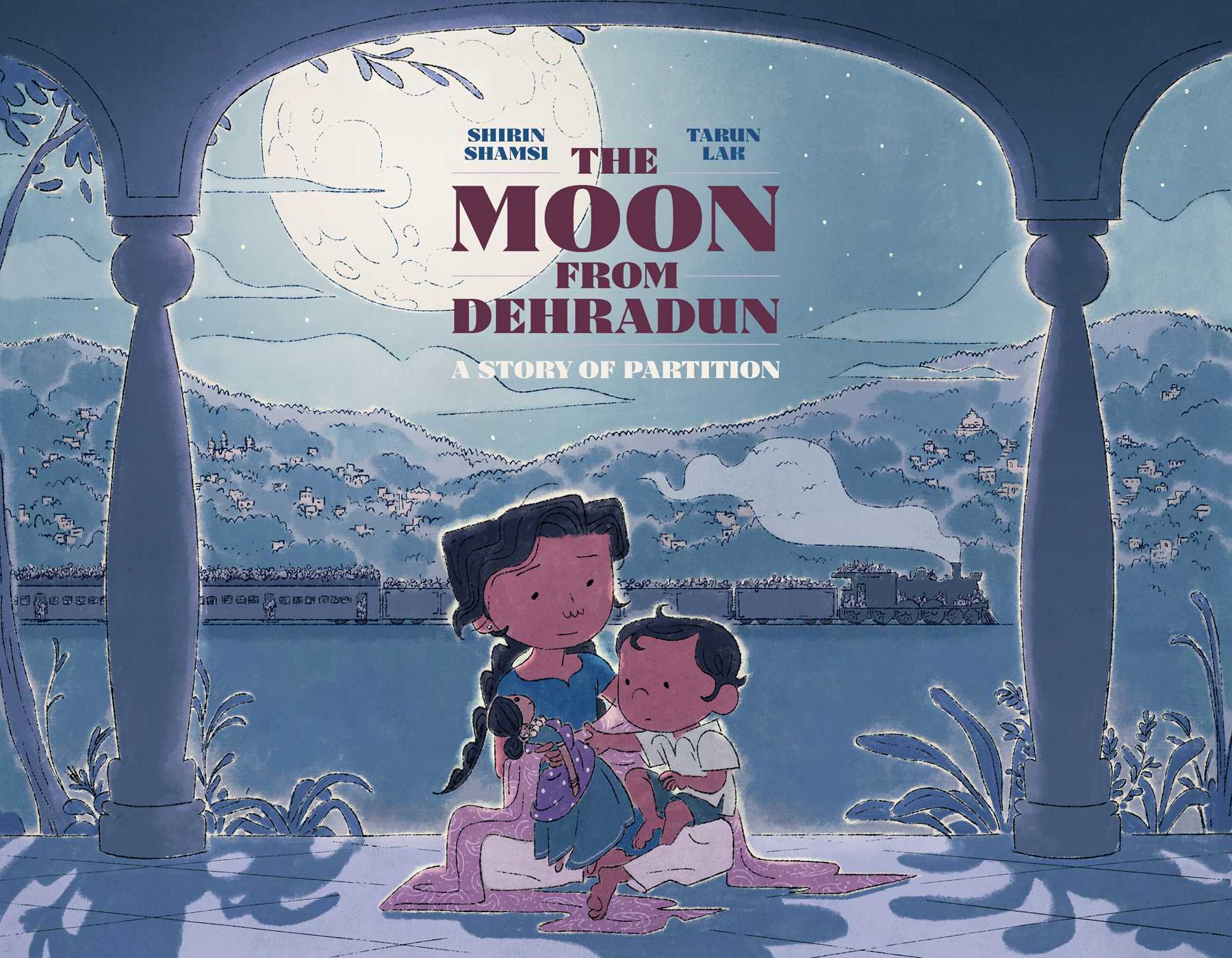
I’ve read this book numerous times: sometimes for the text, sometimes for the tone, sometimes to slowly immerse myself in the pictures. I know the basics of my own family’s journey to Pakistan, and this book added to that understanding. I like that it forced me to slow down and to really appreciate what partition was for both sides, from a child’s perspective. Pakistan and India gained freedom from British rule 75 years ago. Nearly every Pakistani or Indian you know today, has a parent or grandparent that lived through it. It is not history from long ago, it is still very much with us, and no I’m not talking about the lingering effects of colonization, I’m talking family stories, and loss of property and wealth, memories of the journey, the terror, the fear, the relief, the determination. This book is one story, perhaps the first mainstream published in the west, of one family’s experience. There could be a thousand more books and they would all be different, all powerful, all reflective. I love that this book is Pakistani authored, Indian illustrated, I love that it offers pages with no words at all. I love that a child’s perspective for such a monumental event is told for other children. There is a lot there for desi readers to unpack, and consider, there is also a lot there for non desi’s to be made aware of, and I hope that you will seek out this book no matter who you are, and share it.

img_3563

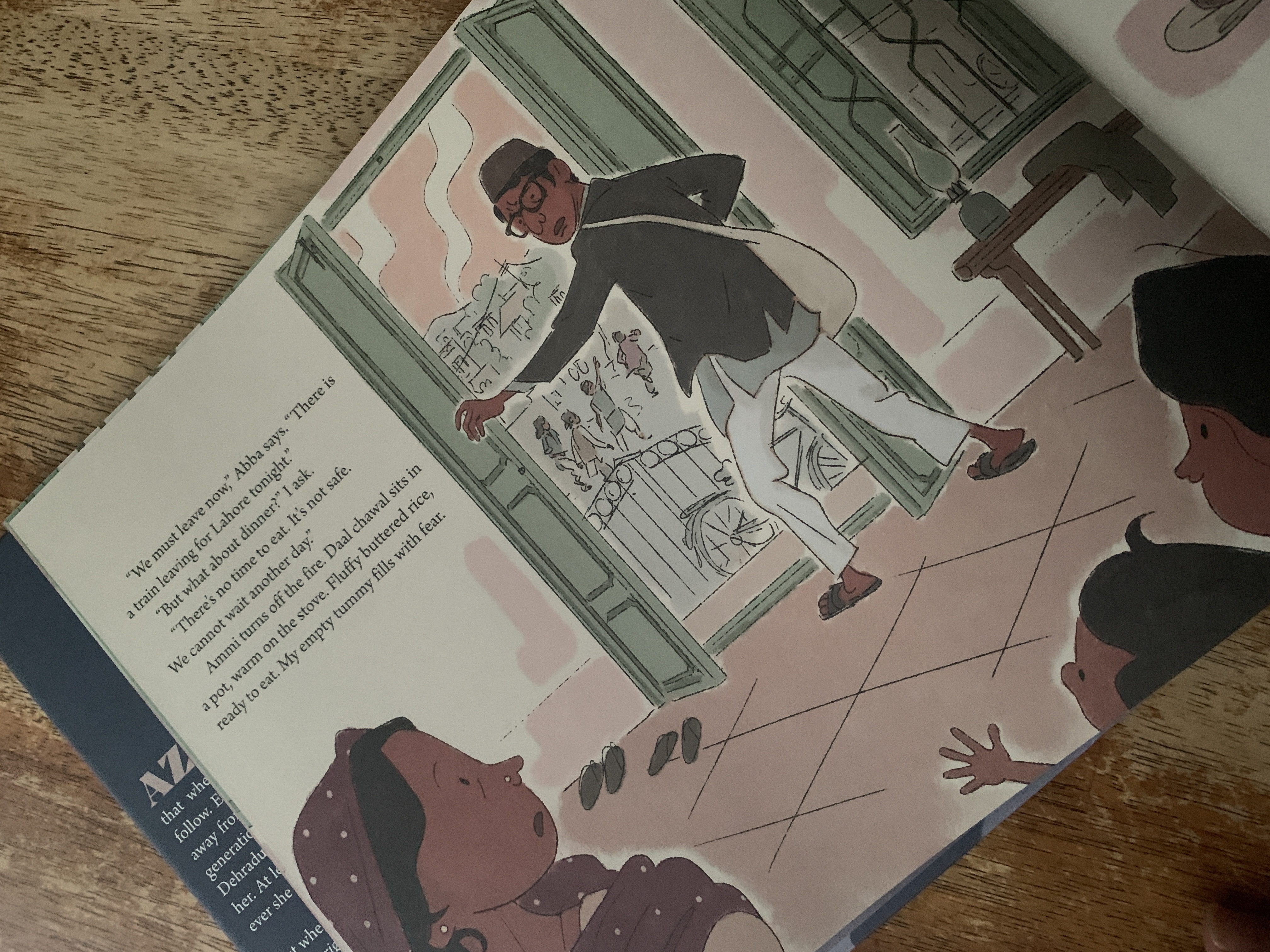
The book starts with excitement from Azra about an upcoming train ride, even though her family has lived in Dehradun, at the base of the Himalayas, for generations. Suddenly though there is yelling outside because people are afraid, and her Abba runs in saying they have to leave now. Ammi, Abba, Azra, and the baby “Chotu,” rush out the door, leaving the cooking dinner still on the stove. When they get to the train, Azra realizes she has left her beloved doll, Gurya behind. They cannot go back for her.

img_3564

Azra blames Chotu, for making her forget her doll, for taking her parent’s attention, yet as the days and nights on the train reveal tired people, sad faces, and fear, Azra finds comfort in her little brother’s embrace.

img_3568

When they arrive in Lahore, they are met with food, and shelter. They are given a house that looks like the owners left in the same manner that they had to flee. There are balls of dough with a rolling pin, laundry strewn about, and even a doll left abandoned under a bed.

img_3565

The book concludes with a map, a glossary, and an informative author’s note addressing pre-partition, partition, and the author’s own family story. There is hardship and frantic upheaval, but peace and welcome too. The illustrations illuminate the text and show the powerful emotion when words sometime simply don’t exist.

img_3566

The book is not political or even religious. There is an Indian flag when they leave and a Pakistani flag when they enter, there are sounds of athan, and packing of a rehl, and a comparison to Eid, and the doll at the end has a bindi on her forehead. The book does not make one side out to be in the right or in the wrong, if you do not know that partition of the subcontinent was a mass migration based on religion and the chaos further exacerbated by the British, this book will not spell it out for you.

img_3567

I preordered mine here and it can now be purchased from all major book sellers.

A Sari for Ammi by Mamta Nainy illustrated by Sandhya Prabhat

Standard
A Sari for Ammi by Mamta Nainy illustrated by Sandhya Prabhat

sari

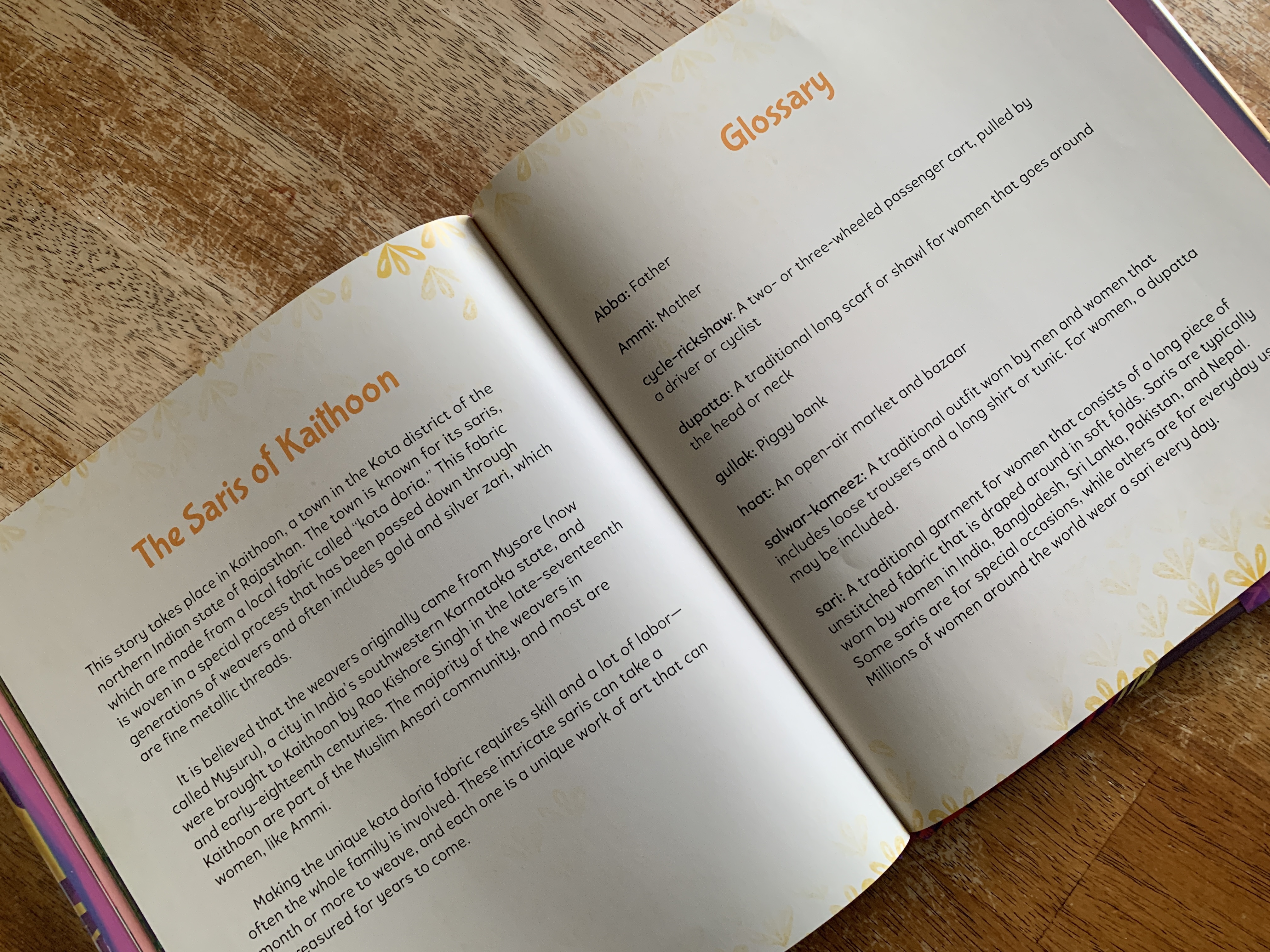
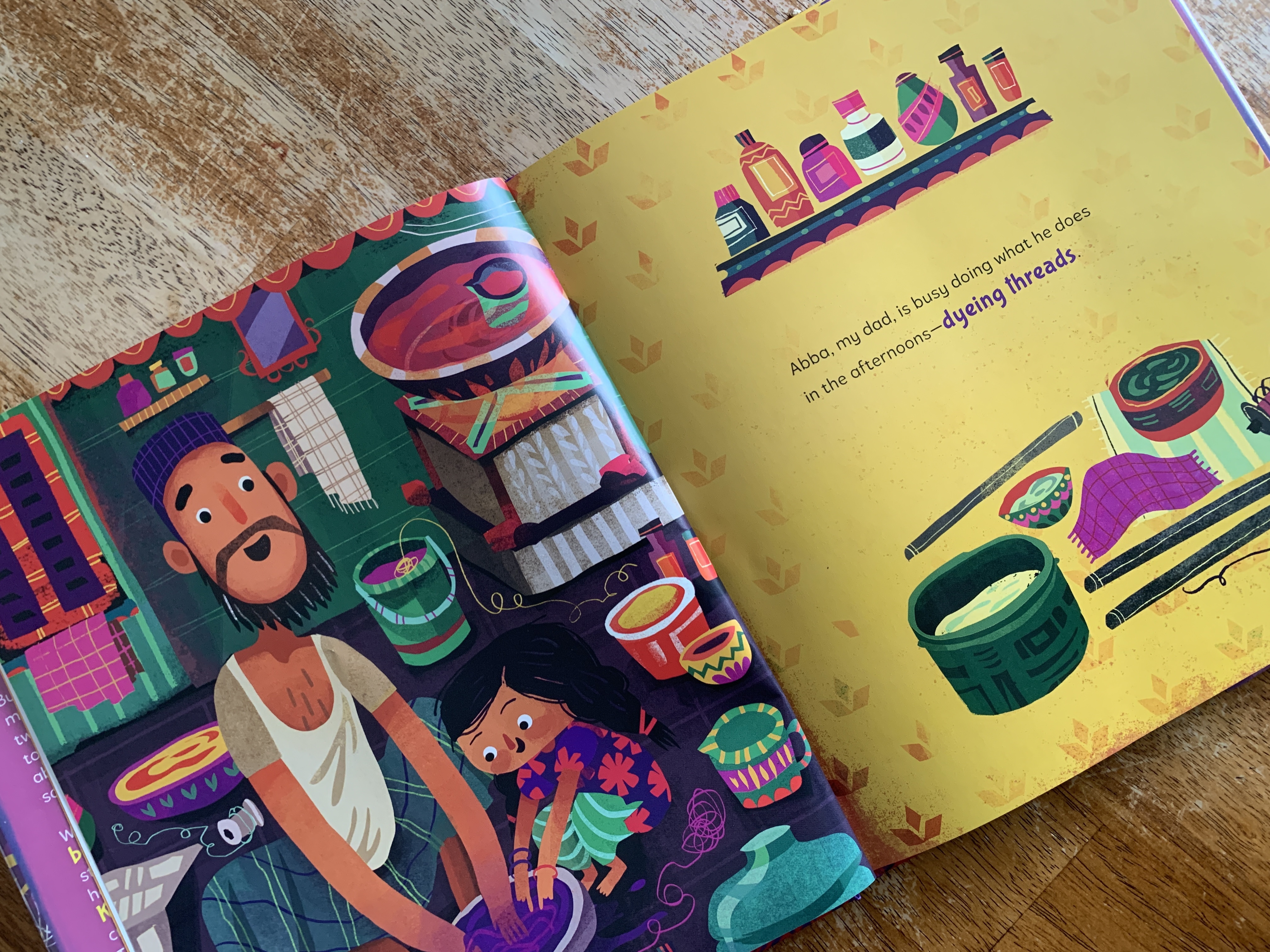
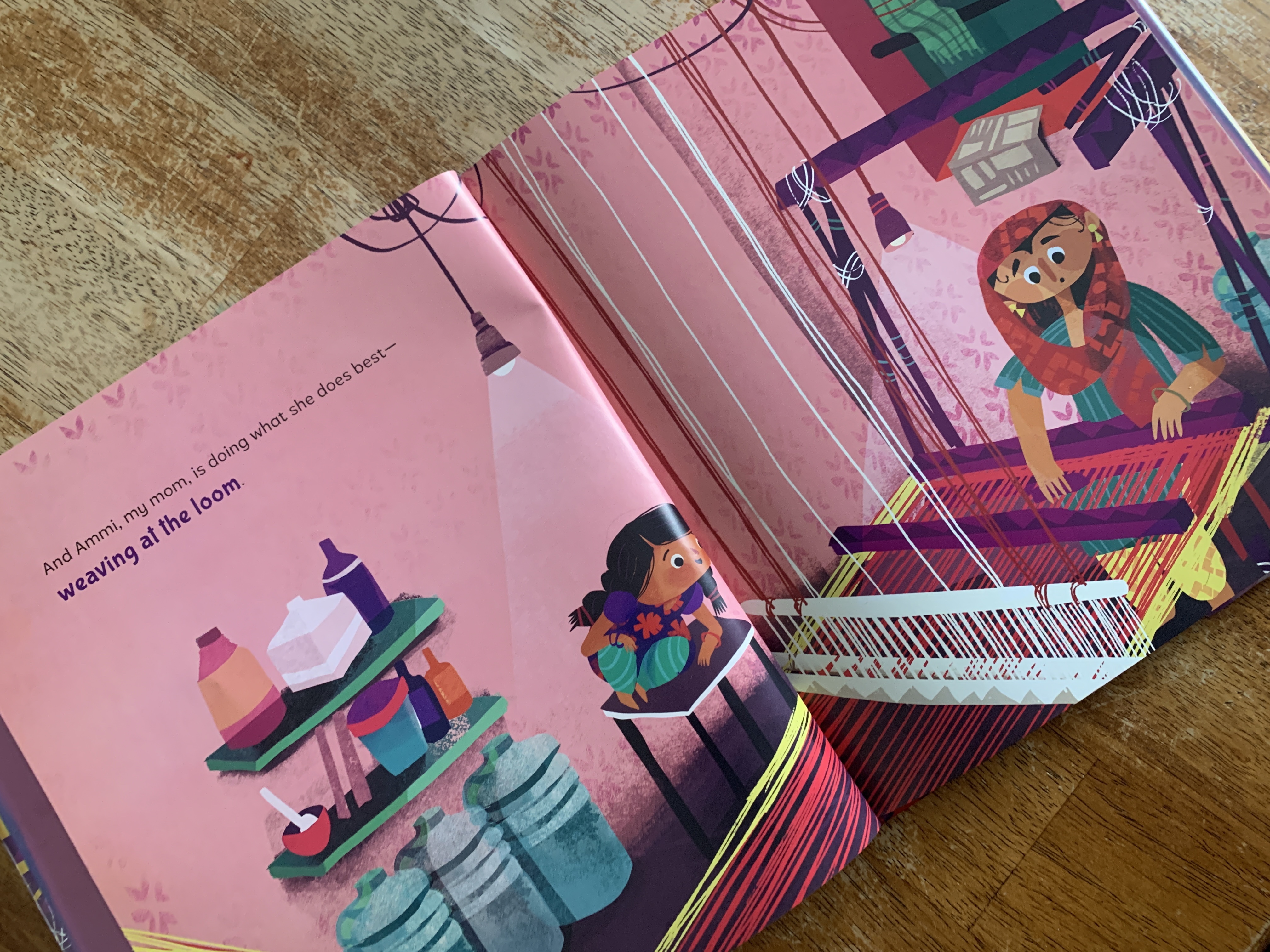
This book combines knowledge with a sweet story and a spunky narrator.  Over 32 brightly illustrated pages the reader learns about the art of dyeing yarn, weaving, and the tradition of weaving saris in India moving from Mysore to Kaithoon in Kota.  The little girl loves it all, helping her father dye the threads, and watching her mother work the loom.  It often takes a month to make a sari, and her mother makes beautiful saris, but she never wears them.  With the help of her older sister Sadaf, the little girl hopes to earn enough money to gift her mother a beautiful sari to wear.  It will take a lot of work, some community help, and some sacrifice, but Ammi is worth it and the girls are up for the challenge.  Preschool to early elementary readers will enjoy learning about the daily life of these amazing Indian Muslim artisans and a craft that they perhaps were not aware existed.

img_4662

The buffalo are sleeping, but in the afternoon Abba is busy dyeing threads, and mama is weaving colors into prints of mangoes, peacocks, birds, leaves, and flowers.  The whole family helps.  Abba goes to the haat to sell the completed saris.  Sometimes Mama goes as well, but she doesn’t wear the saris, she wears worn-out salwar-kameezes.

One day, when Ammi finishes a particularly beautiful sari the little girl asks her to keep it, but her Ammi says, “If we keep the saris, how will we eat?”  The little girl doesn’t understand, they don’t eat saris.

img_4663

Sadaf explains to her little sister that the only way their Ammi will wear a sari is if they buy her one.  So the little girl breaks her bank apart to count the money she has and convinces Sadaf that the things they wanted with the money are nothing compared to how much they want something for their mother.

But Sadaf says they only have enough money for a towel, not a sari, so the girls gather some items to sell to the junk man.  They have enough to buy Ammi a duputta, but still not a sari.

img_4665

They wander home through the wheat field trying to come up with other money raising ideas.  The wheat remind the little girl of worshippers on Eid day- all praying together at the mosque.  The little girl remembers that sometimes their neighbor Amina Khala purchases dyed threads from them and they rush over to see if she has any work for them.  Luckily she does, and they have just enough to buy a sari for Ammi and be rewarded with a smile and tears from their beloved and talented mother.

img_4664

The book has an information page at the end about The Saris of Kaithoon, as well as a glossary.  The story ends a bit abruptly, but the teardrop in the illustrations, the hugging, and the smile, do provide a universal relatability to parents everywhere when their children gift them something so genuinely from the heart.  The illustrations also show women with their heads covered going about their daily life.

img_4666

House of Glass Hearts by Leila Siddiqui

Standard
House of Glass Hearts by Leila Siddiqui

glass hearts

This 278 page magical realism YA book featuring a Muslim family grabs your attention and heart in the prologue, unfortunately it quickly releases it, and until you get over a third of the way in to the story, it is a struggle to read.  Once you accept that half of the book, the storyline set in the present, is going to be terrible, you enjoy the historical narrative and appreciate that the short book with a quick pace spends more time in the subcontinent during partition, than it does with the painfully underdeveloped characters trying to make sense of past secrets and their present day manifestations.  The book doesn’t have any major flags in terms of religious representation, it is just ritual acts of praying and reading Quran, nothing detailed or explored, and relationship-wise there is nothing high school readers can’t handle (spoilers and more details can be read in the FLAGS section).  Despite being a first time author, she works as an editor, so one would really expect the climax to hit harder with clearer writing, the characters to be developed, the details written to serve a purpose, and the protagonist teen’s voice not to read overwhelmingly at the beginning as a five year old.  The overall story concept and historical fiction component are exciting, the development of the characters just really failed an otherwise engaging read. 

SYNOPSIS:

Maera’s brother Asad goes missing in 2011 from their grandfather’s home in Pakistan while they are visiting.  They search and cannot locate him or a body, the loss devastates Maera’s family.  Ten years later, her grandfather passes away, and the next morning a greenhouse appears in their backyard in America.  Not just any greenhouse, her grandfather’s greenhouse from Pakistan.  Maera thinks she is going crazy, her mother doesn’t acknowledge the structure, she doesn’t acknowledge much, not about the reality in front of them, not the night Asad disappeared, or the needs of her daughter. Maera’s aunt (mom’s twin) and cousin come from Pakistan to mourn the loss of the grandfather together, he passed in Pakistan, not sure why Maera and her mom didn’t go there, but I digress.  Cousins Jamal, aka Jimmy, and Maera are the only two that seems determined to figure it all out.  Their grandfather’s journal turns up and with Maera’s friend Sara and Rob, the neighbor and former best friend of Asad, the four of them set out to understand what is going on in the greenhouse.

The greenhouse seems to be alive, and entering it dependent on the whims of something within, a churail,  a shape shifting creature of myth that is more than a witch, a succubus that targets men.  A woman who died violently and was wronged by men, whose feet are turned backward, and who is neither alive or dead.  As the four work through the journal, venture in to the greenhouse, and confront those within, secrets will be unearthed, exposed, and finally dealt with.

The historical interwoven story is that of the grandfather during colonial British rule and partition.  As a young boy Haroon is searching for his father fighting in Burma and the adventures he has along the way. Shah Jehan’s father takes Haroon in at one point, and the girl with an emperor’s name sneaks him out to watch the village deal with the churail who are killing the men in their village.  The incident scars Haroon, but his affection for Shah Jehan and the role she will continue to have in his life is established. The understanding that the subcontinent is being carved up and starved by the colonizers in the name of freedom is made clear in the characters that Haroon encounters and the quickly maturing boy grows in to a young man as he starts to understand the world around him and the larger powers at play.  When the migration and violence between Hindus getting to India and Muslims going to Pakistan occurs, the pieces in the past and present come together to reveal the terrors that the greenhouse houses. 

WHY I LIKE IT:

I loved the commentary both in the text, and explicitly detailed in the afterward about how culturally the past is handled.  How little generations discuss what they have endured and been through.  I have been asked by my father-in-law a few times to try and coax my mother-in-law to detail her journey with their oldest son from India to Pakistan.  She has apparently never clearly told what happened, what she saw, and what they experienced.  She waves it off now, but her own children didn’t even know there was more to the story, and as my inlaws approach their 90s I have little hope of them recalling or sharing their stories.  Recently my son needed to hear some first person accounts of war, so he contacted my American grandfather to learn about his time in the Korean War, much of it I knew, Americans, generally speaking, talk about this type of experience in passing.  My son, also wanted to compare his story to someone who lived as a civilian through a war, and asked my mother-in-law, his Dadi, about her experience living through the Indo-Pakistan War of 1971, not that long ago, and we all sat spellbound as she recalled the sirens and how they kept the children fed and calm and whatnot.  They were stories no one had thought to ask it seemed.  She has seven children and almost thirty grandchildren.  This book struck such a chord with me, I need to actively seek out these stories before it is too late.   Chances are no one else in the family will. Not speaking the language fluently has cost me my chance to learn my own father’s family’s stories and I need to find a way to gather my husband’s family’s stories before it is too late. I love that in the book, The Past is capitalized as if it is a named living person shaping the lives of so many.  It is, and these stories are wonderful reminders and motivators to ask the elders to share their memories.

The present day story thread, however, is chalked full of holes, one dimensional characters, and pointless tangents.  Sara and Maera read like they are early elementary aged.  They are so terribly voiced in the beginning, I have no idea, how an editor author and mainstream publisher did not require correction.  The dialogue, the action, the role of the parents, it is terrible.  Speaking of terrible, the mother and aunt are absolutely flat and useless.  They mope, sleep and sit in the corner.  I don’t understand why you wouldn’t develop them to link the past story to the present one.  I’m not being picky here, it is that bad.  I also wanted to know why the dad left.  Seems like it would flesh out the mom a bit, justify her approach to life.  Sara and Rob are obviously brought in to serve as vessels for the action, and for Maera and possibly Jimmy to play off of.  But their backstories are so pathetic.  How do you not know or see your neighbor for ten years.  Ok, I get that he was Asad’s best friend and your family in their grief and denial pushed him away, but he never checked the mail or took out the trash, or was seen? And Sara offers absolutely nothing to the story other than to be part of the forced crush/romance line pairing off her and Jimmy and Rob and Maera.  Alhumdulillah, it stays tame with the angsty longing and hand holding.  

Random details that serve no purpose reach a pinnacle with the paragraph long time spent on Maera wearing Rob’s tank top.   I have no idea why we should care that she is wearing a tank top.  Sure as a Muslim reviewer it furthered the notion to me, that she is probably more culturally religious, and yes I know Muslim’s dress to different degrees of modesty, but I really couldn’t find any other reason for the emphasis on the black tank top. Overall, all the friendships in the story seem so off: Rob and Asad, and Sara and Maera.  They should be easy plot points, but they don’t connect, or read believable.  

Plot wise: if you had a building magically appear in your back yard along with a journal, would you not read that journal as fast as possible? Sure you would lose sleep and maybe skip a meal or two, but hello, a building just appeared in your back yard that is moving and growing, your grandfather died and your brother’s body was never found: stop what you are doing and read the journal.  It mentions that when Asad went missing there were a lot of other kids, cousins at the house, so where are they now? Why was there no mention of them, and only Jimmy seems to have a vested interest in the grandfather passing, and the growing need to remember Asad.  I did not understand the sacrifice and hair connection and how that was what Maera understand the Churail to be asking for.  I did not understand the end of chapter entitled “The Separation,” it says they entered together, so…. ya?Off and on in the greenhouse there are multiple churail, this seems inconsistent with what we learn from the one churail about leaving.  The whole climax needs a Cliff’s Notes synopsis.  I honestly have no idea what happened.  The churail was scared of the beast, but they all went off together, affectionately? I’m trying not spoil anything here.  Why was the churail so different at the beginning compared to the end, why did she get a growth arc, when the other characters didn’t? Shouldn’t there have been some cathartic reprieve verbalized between the mom and SPOILER (sorry I tried) Asad? I felt deprived.  

There were a few grammar errors, but because I read an ARC, I’m hoping they have been corrected

FLAGS:

There is a little bit of language (F word at least once).  Children are conceived, it isn’t explicit, but the fact that it happened is critical to the story.  There are crushes, angsty/longing, hand holding, hugging.  There is sexual assault implied as a major plot point, but not detailed.  There is death, and killing, often gruesome, some real, (hits harder), some far fetched.  The book is YA and  ok for high school readers and up in my opinion.

TOOLS FOR LEADING THE DISCUSSION:

I would be interested in seeing if some of the muddled passages are cleaned up in the published physical copy, the book’s characters are weak, but the historical fiction component is a story that needs to be shared more and more as we, collectively, seek to understand the past, the impact of colonization, and the emergence of telling our OWN voice stories.  For all the flaws, I haven’t completely written off the book, I’m hopeful that even if this one doesn’t make the cut for a book club, that inshaAllah the author will keep writing and filling in the blanks.

Amira & Hamza: The War to Save the Worlds by Samira Ahmed

Standard
Amira & Hamza: The War to Save the Worlds by Samira Ahmed

amira and hamza

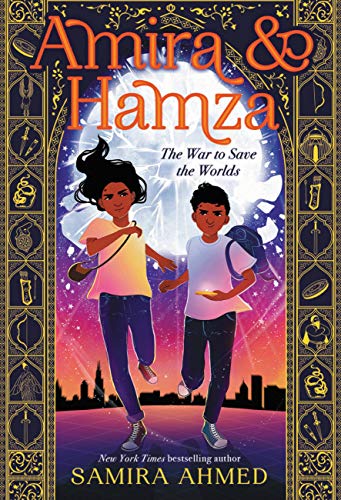
Make sure you are sitting in a comfy spot when you crack open this middle grades fantasy adventure, because it hits the ground running from the very beginning and doesn’t let up over 368 pages.  The like-able and relatable brother sister duo snarkily banter and bicker about everything from cultural Indian (Desi) folklore, religious stories, Marvel, Lord of the Rings, He-Man, Arabic Sesame Street, Star Wars, hygiene, fears, potential science fair projects, and food, all while battling jinn, devs, peris, and reality as they work to save the worlds.  The book is chalked full of STEM concepts, cultural touchstone, Islamic footholds, pop culture, and fun, as one character remarks, it is the ultimate fan fiction. I regularly Googled people, references, and concepts, and ended up learning quite a bit.  And don’t fret if you ever get lost or confused, or something doesn’t make sense, you don’t have to worry that you missed something or that the author left a gap in the narrative, the book moves quick and Amira’s constant dialogue and commentary points out all the ridiculousness of what they are experiencing and the questions that she wishes she had time to ask, explore, and discover.  The author never loses control of the narrative, and keeps the world building on level without skimping on details and understanding.  I have not loved any of the author’s previous books in their entirety, I think this one, however, is her best one yet, and the switch to middle grades is a good fit.  
SYNOPSIS:

Twelve-year-old Amira and her 10-year-old brother Hamza are heading to the Shriner’s Madinah Temple in their hometown of Chicago to explore the exhibit of Ancient Astronomy artifacts, or as Hamza calls it “tools that belonged to dead Muslim Astrologers.”  Hosted by the Islamic Society of Ancient Astronomy corresponds with the eclipse viewing party of the incredibly rare super blood blue moon.  In typical Hamza fashion however, a Nerf gun is brought and things are touched.  When Amira is tasked with bringing her brother up to the roof to learn how to use the telescopes, the two scuffle over a small box with a tiny moon inside, a series of snatching and tussling between the siblings cause the Box of the Moon to break, or rather start working.  As day turns to night, the moon seems to be breaking a part, and everyone in the world is suspended in sleep except for Amira and Hamza, and an entire jinn army is heading their way.

When jinn leaders Abdul Rahman and Maqbool reach the children they must convince them that they are not there to harm them, but rather to recruit them as the chosen ones to save the worlds: Qaf and Earth and the barrier, the moon, that keeps the realms separate from destruction at the hands of Ifrit.  The confusion over there being two of them creeps up, but is squashed as Suleiman the Wise left tests to prove that the chosen one is properly equipped to battle Iftrit as it has been prophesized.  The children must work together to prove themselves they must then actually seek out and defeat Ifrit.  As tests and challenges arise, it becomes clear (pun intended) that the two are not the chosen ones, but with no option of turning back they must forge ahead none-the-less.

“What? We’re Indian, dude, we were basically born half doctor.”

WHY I LIKE IT:

I love Amira and Hamza’s banter.  The references are at times laugh out loud funny.  Similarly, I was impressed by all the historical and STEM concepts intertwined in the story, there is even a tiny bit about mental health.  I learned about parts of the moon, historical figures, folklore, and more.  The characters are Muslim, Amira wears Ayatul Kursi around her neck and they talk of Sunday school.  The book isn’t religious though, in they aren’t saying Bismillah before they embark on things, or supplicating when in danger, but they greet different beings with peace, and the framing is clearly from an Islamic paradigm.  I think the high speed pacing works for most of the book, and somehow you still get to know and connect with the characters, but at times a slight pause to clarify a point would have been nice.  I would have liked to have the kids proving they were the chosen ones a bit more articulate and dramatic before hand rather than in retrospect.  I feel like the jinn transportation of cauldrons could have used a bit of backstory as well.  And a little fleshing out of the scroll, the government structure and communication methods of Qaf, would have helped some of the transitions between the action.  I read a digital ARC and it had a page reserved for a map, and I think when the physical book comes out that will be really helpful, as I didn’t quite fully understand the 18 realms and their locations  in comparison to the locations the children encounter.  

FLAGS:

UPDATE:  I TOOK THIS BOOK AS COMPLETE FICTION. THAT THE ISLAMIC PREMISE WAS A STARTING OFF POINT, AND DIDN’T DWELL TOO MUCH ON THE ACCURACY.  I READ AN ADVANCED READER COPY OF THE BOOK THAT DID NOT HAVE ALL THE SUPPLEMENTAL AUTHOR’S NOTES AND RESOURCES AT THE END.  I WAS UNAWARE THAT THE AUTHOR FELT SHE WAS INCOPERATING FACT AND ACCURACY IN THIS INCREDIBLY FICTIONALIZED BOOK. AND AS A RESULT I AM NERVOUS TO SUGGEST THIS BOOK TO THE MIDDLE GRADE INTENDED AUDIENCE.  IF YOU HAVE A MUSLIM CHILD THAT IS WELL VERSED ON PROPHET SULAIMAN, THE CONCEPT OF FICTION, AND IS OLDER THAN THE IMPRESSIONABLE EIGHT OR NINE YEAR OLD INTENDED AUDIENCE, ONLY THEN PERHAPS WOULD THIS BOOK WORK FOR YOU.  IT WOULD BE VERY MISLEADING IF YOUR CHILD TAKES THE TWISTED STORY AS FACTUAL AND BASED ON THE NOTES AND RESOURCES AT THE END, THIS VERY WELL COULD HAPPEN. To read more about the concerns you can click here and head over to Muslim Mommy Blogs take on the book.

There is magic and magical beings. A transgendered jinn.  It mentions Amira and Hamza celebrating Halloween. Death and fighting.

TOOLS FOR LEADING THE DISCUSSION:

I think this would be a great audio book to listen to with the family or a read aloud in a middle grades classroom.  It is too young for middle school readers to not find it slightly predictable, but if you had it on a classroom or home shelf I am sure it would be picked up, read, enjoyed by middle grades and middle schoolers alike.  It reads much like the Rick Riordan Presents series and I hope that there are more books featuring Amira and Hamza in the future.


Fatima’s Great Outdoors

Standard
Fatima’s Great Outdoors

fatima's great outdoors

As a partially brown person who enjoys camping and does it frequently, I have been anxiously waiting to get my hands on this beautiful 40 page, kindergarten to fourth grade picture book. So, trust me, I’ve read it multiple times to myself, to my children, and even to a Muslim storytime group to try and figure out why I like it, but, unfortunately, really don’t love it. Ultimately, I think it is because there is just too much going on.

Everything about this book is wonderful: the idea to encourage brown people to go camping, to highlight that time in the wilderness is for everyone and doesn’t have to look a certain way, that bullying and micro aggressions are oppressive, that immigrants have diverse and full lives in their home countries and work hard when they come to America, that culture and language and food and music is diverse, yet universal, that learning new skills and trying hard things makes you a super hero, that dad’s can cook and mom’s can be great fire starters and critter catchers, truly it is all so powerful and affirming, it is just a lot for one book.

It could easily be a three book series with just the information and layered themes presented, and I really wish it was spread out. If you are a 4th grade desi kid who has been camping or desperately wants to go camping this book is a great glimpse to mirror your place in the hobby without compromising your unique spin on it, but I think for anyone not in that demographic, many of the little celebrations, messages, themes, and cultural nuggets will simply be lost.

I wanted to hear the campfire stories and jokes, and laugh at the lyrics being belted out, not just told about them. I wanted to feel Fatima’s accomplishment at helping set up the tent and maybe see her struggle and rebound, not just be told she suggested reading the directions. The book has a ton of industry praise and personally came with a lot of expectation for me, so perhaps I’m overly critical, but kids in my storytime were struggling to stay focused when they couldn’t relate to the cultural touchstones being tossed out, they didn’t get the “not being good at math stereotype,” they needed the non text pictures to be explained to grasp their impact on the story, and they wanted to know why of all the Islamic things a Muslim family could do while camping, halal bacon was the only Islamic reference and came with precious little contextual defining.

The story starts with a Fatima and aapa waiting to be picked up after a terrible week of school to go camping for the first time. The Khazi family has immigrated from India and their father has told them that camping is an American pastime. During the week Fatima has been teased for her pronunciation and lunch, had her hair pulled and done poorly on a math test. But when her parent’s pull up with a packed car and the girls jump in to enjoy samosa and Bollywood songs, the weekend holds promise.

When they get to the campsite, Fatima and her dad tackle the setting up of the tent. Dad cannot seem to figure it out, and after the week she has had, Fatima is scared to help, but after a while she suggests looking at the directions and it seems that does the trick. The family enjoys shami kabab and rotis from home for dinner, before the girls climb in the tent.

A spider on the outside of the tent is magnified inside, and has the girls terrified it is a monster. Mom, the ever brave lizard and scorpion disposer in India reassures them that it is nothing and sends them off to brush their teeth before settling in for the night.

The next morning mom shows the girl the small spider keeping the mosquitos out and they all share a laugh while dad is cooking anda and roti on a gas grill. He calls the girls to come out in urdu to attempt a campfire to cook the halal beef bacon on like other American’s do. Dad and Fatima can’t get it to light, so mom, who is from a smaller town in India has to show them how it is done. Along the way Fatima looks at the other campers and is annoyed that they aren’t having trouble and that her family always is so different. The other families it is worth noting are white.

The Khazi family then starts to pack up and then they go for a hike, play in water and when the time to leave comes Fatima is sad. She doesn’t want to go back to the life they live where they are different and teased and her parents have to work two jobs each. But aapa suggests she share her fun at show and tell, and the family reassures her that they will be back.

The book ends with Fatima telling her class she is a superhero because she can build fires and tents and isn’t afraid of spider monsters. There is no glossary to define the urdu words used and spoken, but there is a reference at the end about the author’s @brownpeoplecamping initiative.

I think the book is rather remarkable and ground breaking because of its subject matter. The illustrations are wonderful, and the book a great reminder that camping and being outdoors is for all. I just wish it focused on a theme or two and highlighted them for this Indian American Muslim Family with relate-ability for other types of minority groups. The book set its own standard in what it wanted to achieve and convey, and sadly I think it missed the mark.