Tag Archives: friends

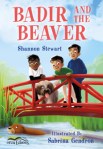
Badir and the Beaver by Shannon Stewart illustrated by Sabrina Gendron

Standard
Badir and the Beaver by Shannon Stewart illustrated by Sabrina Gendron

badir and

This 92 page early chapter book is a great linear story for 1st through 3rd graders.  The size, font, spacing, illustrations, chapter length, and content make it a fun read that incorporates diversity, environmental action, teamwork, information about beavers and acceptance all through the efforts of young Badir, a recent immigrant from Tunisia during the blessed month of Ramadan.

SYNOPSIS:

Badir is new to Canada and while he misses Tunisia, he is joyful and upbeat as we meet his older brother Anis, young twin siblings and classmates.  Out one night before iftar, he sees what he thinks is a giant rat swimming in a lake, but no one believes him.  When he sees it a second time, a lady at the park explains to him that it is a beaver, not a rat, and pulls out a Canadian coin to show him there is a connection between beavers and Canada.  With new knowledge about the difference between a lake and a pond, a rat and a beaver, Badir is fascinated with how beavers build homes, mate for life, and benefit the environment.  He even likens the beaver eating at sunset to his families own Ramadan schedule.

But all is not well for the beaver, as a petition is being circulated to relocate the rodent and save the trees in the park from his sharp teeth.  With new friends, a supportive teacher and classmates, Badir is determined to prevent the beaver from having to leave his home as Badir and his family had to do.

WHY I LIKE IT:

I love that this book is subtle in highlighting the welcoming of immigrants into a community, about having the main character be Muslim and it being Ramadan, and showing that diverse people can come together for a bigger cause and even become friends.  The main story line is naturally to save the beaver and the trees in the park, so the information and facts about beavers is appreciated and well presented.  I think most everyone of every age will learn something new about the common rodent.  But, by the main character being genuinely like-able and infectious, the reader will also realize that any negative stereotypes about Muslims or immigrants really aren’t a factor.  Badir’s family is really nice, the parents prepare food together, they feed their kids’ friends, and invite them over. The author does a good job at accurately making them seem like any other family.

IMG_4808

There isn’t much stress on Badir being Muslim or what that means outside of it being Ramadan, praying, and going to the mosque as a family at night.  The illustrations show the mom in hijab. The book tells a tiny bit about Tunisia, but not why they left, and definitely makes the foods they eat sound delicious.  Overall, it really does a good job of keeping the book about the beaver and finding a solution.

The book is for both non Muslims and Muslims and seems to be written by a non Muslim, and while set in Ramadan it is definitely not limited to being a “Ramadan story.”  There are small pictures on many pages and a full page picture in each of the 12 chapters.

IMG_4806

FLAGS:

None

TOOLS FOR LEADING THE DISCUSSION:

I think this book should be in classrooms and school libraries.  It really is well written, informative, and fun.  I don’t do a story time for the target audience of this book, but I think it would be a candidate for my “Lunch Bunch” meetings, when I read aloud to 4th and 5th graders once a week while they eat lunch.  Even if it is slightly below a 5th grade level, I think even older kids who pick it up and read it, or listen to it being read, will find it interesting, entertaining, and worth their time.

Publisher’s page: https://www.orcabook.com/Badir-and-the-Beaver-P3992.aspx


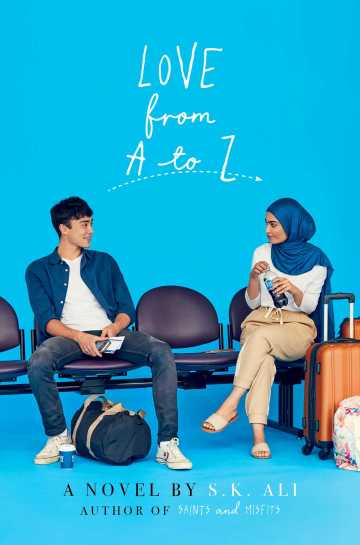
Love from A to Z by S.K. Ali

Standard
Love from A to Z by S.K. Ali

love from a to z.jpg

Now that there is legitimately a genre of YA Islamic Romance out there told in Own Voice, the expectations are high that a book is compelling, realistic, and unique somehow.  While the author’s first book, Saints and Misfits was pretty ground breaking, this 342 page was a great read, but not nearly as remarkable or memorable.  Granted it is not fair to compare the two books, and each day I do age out of the target demographic, but while the story reads authentic and true, albeit a bit serendipitous, it doesn’t have the teeth or grit I was kind of hoping for, and with a mother who suffers from multiple sclerosis my emotions were pretty invested.

SYNOPSIS:

Told from both Adam and Zayneb’s perspectives by way of their individual “Oddities and Marvels” journals, our two characters are presented by a narrator who keeps their story on track and interjects when their versions of an event differ. 

Zayneb is a high schooler and activist who has recently been expelled for threatening a teacher who consistently lets his Islamaphobic beliefs take over the days lessons.  In an environment filled with micro aggressions against Muslims, Zeynab’s parents are at a loss at how to keep their daughter from making waves, and thus allow her to leave her Indiana home a week before spring break to visit her aunt in Doha, Qatar.

Adam is at University in London where he has recently been diagnosed with MS and as a result has stopped going to classes, and is literally “making” the most of the time he has by making things.  As the term ends and he officially withdraws from school, he heads home to Doha to tell his dad and sister that he has the same disease that took his mother’s life years early.

The two characters meet at the airport briefly and then again on the plane and then at Adam’s house and the needless to say  their accidental meetings allow for friendship to grow, attraction to be built upon and a relationship to develop. Both characters have their own lives and own obstacles and own maturity that needs to occur in order for a happy ending to take place, and thus the book keeps you interested, invested and cheering them on.

WHY I LIKE IT:

I love the dynamic of how the book and characters are set up.  Both are practicing Muslims, both characters don’t cross a line, both characters have diverse mixed cultural backgrounds, and one is a convert and the other the daughter of a convert.  She is fiery and impulsive and emotional, he is pragmatic and calm and quiet.  While they have some background in common, their life experiences are rather different and it is very much a story about opposites attracting.  

I’ve been waiting for this book to come out, and so I knew my expectations would be too high.  That being said the book warns it is a love story and in some ways, that was what I kind of felt was lacking.  There was the physical attraction that was mentioned fairly often, but the deep connection of ideas or growing seemed a bit lacking.  

I really liked Adam, and his internal stresses and struggles and coming to grips with his disease seemed pretty developed.  Somehow though, and I’m probably in the minority, I didn’t love Zayneb.  She is impulsive and definitely learned and grew from the start of the book to the end, but I didn’t love her nuances with dealing with the Emmas and her friends back home and unraveling her teacher, it felt kind of forced and I can’t articulate why.  I’m glad she matured and she got answers about her grandmother, but maybe I should have felt so much in common with her and when I didn’t, I felt a little irritated.  Clearly I get too invested in fictional characters, I’ll admit that.

I like that Islam is presented in a non defensive way.  The parents aren’t evil, there is no rebelling, even the awful teacher spawns backlash and allies to Zayneb and her cause. There is no apologizing or overly explaining if the characters are pushing boundaries established by Islam or if they are establishing their own boundaries based on their understanding of Islam.  I like this, because it shows that Muslims are not a monolith, we are not one way good or bad.  Zayneb covers and prays and has friends that are boys and her family is kept in the loop of what she does, which alone breaks so many of the predominate stereotypes about Muslims.  Adam himself converted at age nine and plays the guitar and has friends that are girls, and is close to his sister, and likes dogs.  A side character is noted to be incredibly religious, but doesn’t cover.  The story takes place in an Islamic majority country, but attitudes at the swimming pool don’t allow Zayneb to dress modestly while she swims.  

Overall, the book is a delightful read that manages to keep the religious integrity in the characters and show their personalities as they come of age.  It may not be memorable years after reading, but what you do remember will be positive, and while you are reading it, you will have a hard time putting it down.

FLAGS:

There is angsty romance, and talk of sex.  The two main characters keep it pretty clean, but the side characters joke about hooking up, being horny, and sneaking off to hotel rooms.  The non Muslim aunt has a secret alcohol and cigarette stash that she gets called out on, but nothing more is mentioned about it. I think 9th or 10th grade and up will be perfectly ok to read.

TOOLS FOR LEADING THE DISCUSSION:

There is a lot to unpack in this book and I think if one just listens, teens will naturally add their own opinions and perspectives on EVERYTHING the characters experience, feel, question, and cope with.  The book just came out, but I would imagine that over time discussion questions will appear.

Author’s website: https://skalibooks.com/books/

Interview with the author: https://www.barnesandnoble.com/blog/teen/an-interview-with-s-k-ali-author-of-love-from-a-to-z/


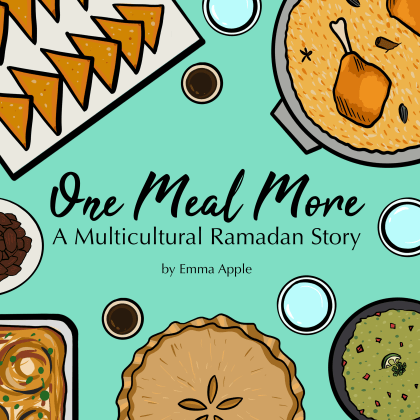
One Meal More: A Multicultural Ramadan Story by Emma Apple

Standard
One Meal More: A Multicultural Ramadan Story by Emma Apple

one meal more.png

Like many of Emma Apple’s books that she writes and illustrates, the concept is simple, the illustrations minimal, the message clear, and the price a tad bit high.

IMG_4409

At 50 pages this $17 soft bound Ramadan counting book is a little disappointing.  Had it been half the price, I would say it was great.  So, now that that is off my chest, let’s dive in.

IMG_4410

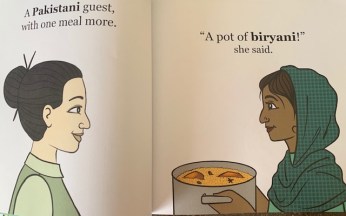
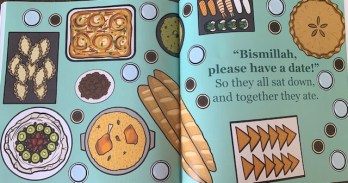
The concept and text follow a pattern that it is Ramadan, the samosas are on the table for the guests and then there is a knock at the door and someone from a different country has arrived with a traditional dish, one meal more, to add to the table for them all to share. They get to 10 and the athan is called, they start with a date and they all eat.

IMG_4411

I love that each of the women that arrive are not just from different countries, but that they are dressed different.  Some are covered, some are not, those that are covered are all wearing their hijabs differently.  The women are all smiling and the book shows diversity.

IMG_4412

One could nitpick and say that many of the visitors do not bring a meal, they bring a drink or a snack, but I think that is besides the point.  The point is that everyone from everywhere shares Ramadan, differently, but the same too.  And this book brings the world down to size on one table and with welcome arms.

IMG_4413

Muslims and non Muslim children ages 3 and up will get something out of it.  Whether it just be counting or hearing different international foods or understanding how Ramadan unites Muslims all over the world, the repetitive words and pictures will illustrate the beauty of the month in a simple way.


Ayesha Dean: The Seville Secret by Melati Lum

Standard
Ayesha Dean: The Seville Secret by Melati Lum

seville.jpg

This is the second middle grade mystery story for globe trotting sleuth, Ayesha Dean, and much like her first adventure in Istanbul, this Spanish setting is infused with rich history, delicious food, relatable characters and quick paced action.  

SYNOPSIS:

Once again Ayesha and her two friends Jess and Sara are tagging along on a business trip with Uncle Dave, Ayesha’s uncle who has raised her since her parent’s passing.  As they wait in line to board the final flight of their lengthy journey from Australia, a young man drops his contents and Ayesha and him chat, later they are seated next to each other on the plane where he discloses his travels from England to Seville are to help locate his missing grandfather.  Ayesha volunteers herself and her friends to help him and they hit the ground in Spain determined to solve the case.

The boy, Kareem, is staying with the friends his beloved grandfather was staying with when he went missing, so that is where the detectives start their work.  In searching his room, Ayesha uncovers a 400 year old diary written in Arabic, and a pamphlet from the Archeology Museum with a necklace circled, the Collar de Pajaros.  Just enough to get them started and set their adventure in motion.

The group of teens rely on Kareem to translate the Arabic in the diary and Ayesha’s wit to decide what to follow up on and how to incorporate their sightseeing with the task at hand.  As they journey through the city of Seville, learning the history and tasting the food, nefarious characters start to notice the group and things get intense.  From Cathedrals, to cafes, to Museums, and even to an ancient city uncovered in Cordobo, Madina Al-Zahra, the chase is on, not only to find Kareem’s grandpa, but to also avoid being caught themselves and maybe even solving a centuries old mystery about treasure and a necklace along the way.

WHY I LIKE IT:

I love that Ayesha in any situation stays true to her self.  She wears hijab, she prays, she is aware of the good looking guy, but doesn’t cross her own line, she is a good friend, an inquisitive person, and confident.  All amazing attributes for a fictitious hero and real ones too.  

Much like Nancy Drew and other middle grade novel series, the books don’t need to be read in order, and while they reference other adventures, they stand alone sufficiently too.  Also, like the aforementioned books there is definitely a formulaic pattern to how the author writes her books.  And while reading it I didn’t notice it intensely, as I write the review I do.  Ayesha travels abroad, she has her sidekicks that are not developed at all and truly have no barring on the story plot wise or as comic relief, they are simply foils to bounce conversation off of, there is a cute boy who could be pursued, but isn’t, someone passes out while she and her friends are sight seeing, and the spouses provide added clues, Ayesha gets locked in a small dark space, there is a twist and a surprise, a trap, and they all live to repeat the adventure in another city another day.  I don’t think I have a problem with it, but maybe because I am not the target audience age, I might get bored with it about book four or so.  As it stands right now, I’m anxiously waiting for book three.

While reading I was a little irked that Sara and Jess weren’t any more developed in Spain than they were in Turkey.  One of them could have been the one to administer CPR or to stumble on the diary in the room, something to give them some plot significance, but alas, the books do not bare their names.  I wish Kareem would have at least said “Salam” on occasion.  I like that the author shows he doesn’t know much about Islam and shows that his grandfather admits its been so long since he has prayed, but the boy is a Morisco and his parents immigrants from Algeria, he translates Arabic, he should say Salam when he meets Ayesha in her hijab wrapped head. 

The author does a much better job in this book staying with the characters and showing the city through their eyes rather than pulling them out of their scenes to convey something.  Only once at the end of a chapter did I feel there was some forced foreshadowing that was not needed, as the book is quick and chapters may end, but the pages still turn until the end is reached.  I had more trouble putting the book down than picking it up, and that is saying something as I read it online and I definitely favor physical books.

I wish there was an afterword or author’s note explaining what was real and what was fiction.  I googled Madinat al-Zahra and found it fascinating, but couldn’t find anything in English about the Collar de Pajaros.  Also a map or two would be great.

FLAGS:

None.  This book is clean and even the fights are not gory or over the top. Yay!

TOOLS FOR LEADING THE DISCUSSION:

I would absolutely do this as an elementary book club selection, and can’t wait to get a copy to my children’s school library and their classrooms.  The book is an easy read and the history and culture is seamlessly interwoven in to the story that kids will enjoy the action and find they learned something about a culture along the way.   I think boys and girls will enjoy it, even if it appeals more to the girls.   The cover, the binding, the font is all spot on for the age group and I eagerly await Ayesha’s next adventure.


Who Will Help Me Make Iftar by Asmaa Hussein illustrated by Saliha Caliskan

Standard
Who Will Help Me Make Iftar by Asmaa Hussein illustrated by Saliha Caliskan

IMG_3796

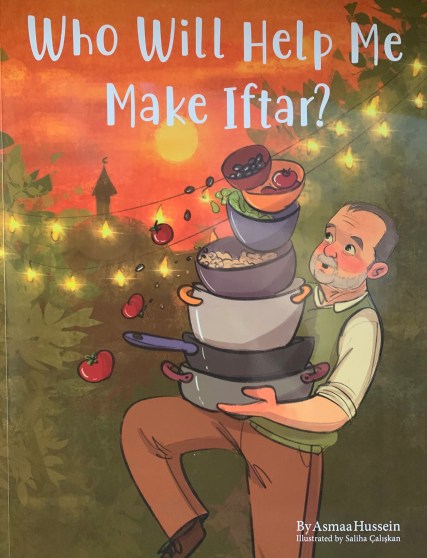
This sweet story shows how even when people refuse to help, we should treat them with kindness, as our actions should be to please Allah alone, and inshaAllah in real life, much like in the story, people will fix their ways and offer their help in return.  This new story reads very much like the old(er) favorite Nabeel’s New Pants, where everyone is too busy to help, but then come around to realizing that helping one another is a way to show people we care.  This 32 page 8.5 x 11 soft back story is well bound with large glossy pages and clear text.  The story works well for ages 4 and up, as they will understand the moral message and inshaAllah feel inspired to find ways to help as well.  

IMG_3797

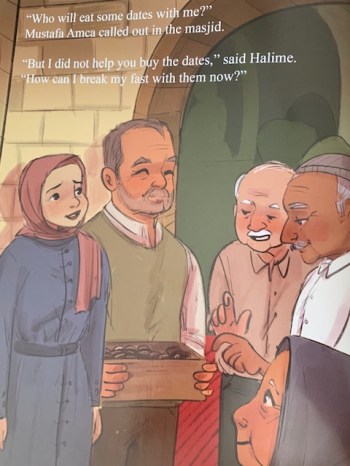
It is a 40 year tradition that Mustafa Amce and his wife Ayse Teyze feed iftar to their friends and families on the first day of Ramadan.  This year, however, Ayse is not well and Mustafa is confident he can enlist the help of neighbors and family to help him keep the tradition alive. 

IMG_3798

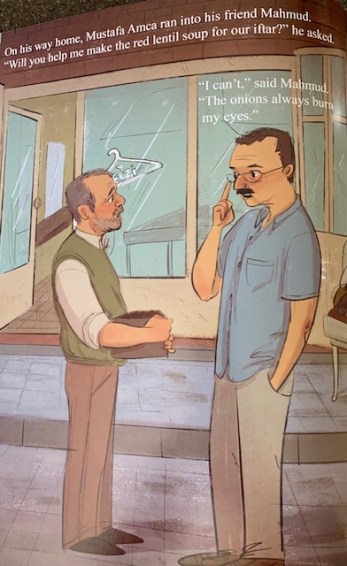
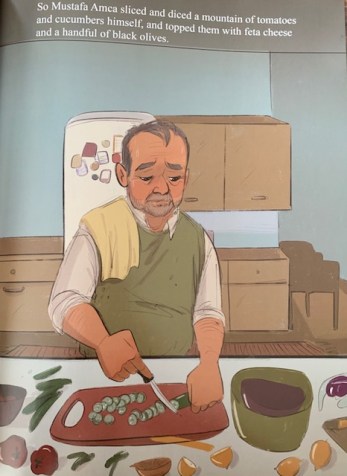
Unfortunately, everyone has an excuse.  His daughter is tired, his grand daughter is too busy with her video games and his neighbor doesn’t want to get his new shirt dirty.  Their sad reasons don’t stop old Mustafa Amce, and he makes the salad, and cooks the rice and beef by himself.

IMG_3799

When iftar time arrives, he offers sweet dates to those at the masjid and invites everyone to come to his courtyard to break their fasts together.  All those that had early refused to assist him feel incredibly guilty and don’t want to take advantage of a lovely meal. Mustafa reminds them that, “God loves those who are generous especially to their families, neighbors, and guests.  and I always want Got to love me.” So they join in the delicious meal.

IMG_3800

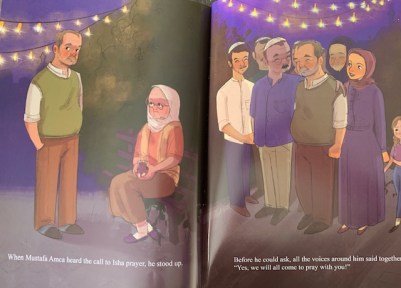
After food Ayse Teyze shows that while she might be ill, she can still save the day when her husband realizes he has forgotten to prepare dessert.  The guests then offer to wash the dishes and sweep the floor and take the leftovers to the poor.  And best of all when the athan for isha prayer calls out they all without prompting stand to join Mustafa Amce in praying salat together.

IMG_3801

The names are Turkish with a pronunciation guide at the end, as well as a paragraph about Ramadan.  The book would work for non Muslims and Muslims alike as the story is set in Ramadan, but more about coming together to help out.  The illustrations are large and detailed and descriptive.  You see the warmth between Mustafa and his wife as well as the apologetic feelings from those that were unwilling to help. 

IMG_3803

Love, Hate & Other Filters by Samira Ahmed

Standard
Love, Hate & Other Filters by Samira Ahmed

love hate and other.jpg

I seriously wish I could get back the few hours I spent reading this 281 page AR 4.8 book.  The blurbs talks about a girl being torn between the world around her and the world her Muslim-Indian-American parents want for her, unfortunately the protagonist is rather unlikeable and her worlds are actual not that different.  Islam is not represented at all, it is just mentioned as a checkpoint almost for the main character to continually justify her identity as “other” and try and illicit sympathy.  It seems to be a part of the story so that the story line of Islamaphobia can be addressed, but the book is cultural at best, and even that is rather lacking.

SYNOPSIS:

Maya Aziz is 17 and missing a dance her senior year to attend a wedding because she is not allowed to go to such events as the daughter of conservative Indian Muslim (dentist) immigrants living in Illinois.  But, immediately the hypocrisy shows itself as at the wedding, a boy, Kareem, deemed suitable by her parents is presented to try and woo Maya and possibly marry her, and the two of them wander off together, and consider meeting up at an after party.  As the reader gets to know Maya and her circle of characters, we meet her “cool” Aunt who lives alone and wants Maya to have a life of boys and partying and going to school in New York.  Her parents are never really defined except to maintain the stereotype of being controlling, focused on food and appearances, and not understanding their only daughter.  At school Maya has a best friend Violet who loves to flirt and remains loyal to Maya throughout, a cute boy Phil, who she has been crushing on for years, and some side figures that stir up some trouble.  

The premise of the book is that Maya loves film and wants to go to NYU to attend film school, her parents, want her to live at home and go to the University of Chicago.  The idea is that because they are immigrants, and culture and religion dictate all, that she get educated and married.  This conflict is intensified by Kareem, her sudden relationship with Phil, and a terrorist act that is first blamed on Muslims occurring hundreds of miles away in Chicago and giving someone at Maya’s school a reason to take out his anger on her and her family.

WHY I LIKE IT:

I don’t like it.  The book is presented as an own voice minority representation piece, but it isn’t.  I get that Islam is personal and that people identify with it and choose different paths, but this isn’t a case of her looking at Islam and saying it isn’t for me, this is a book that is billed as Islamic fiction, yet the character does nothing Islamic, seems to know nothing of Islam and has no moral conscious for anything about the faith.  She says she doesn’t pray or go to the mosque, the parents lament after hate crimes materialize against them, that maybe they should have gone to the mosque at some point.  She wears shorts, and tank tops and a bikini and doesn’t feel a tinge or reflection.  Even if she were to remark that this is an act of rebellion the reader would know, oh because she was perhaps raised with modesty, but no, she wears whatever.  She constantly mentions that she can’t have a boyfriend because she is Muslim, but then makes out with Kareem on like their second meeting, kisses him in her parents living room before deciding she doesn’t like him, repeatedly kisses Phil, practically spends a night with him, and then in the epilogue is kissing a Hindu guy she kind of just met.  Yes, there are Muslims that do this, I’m not judging, but how exactly is being Muslim then stopping you from doing that you want to be doing?  At one point when out with Kareem, he is drinking wine, Maya remarks she has had it before, and that at least it isn’t eating pork.  Misguided and off the mark, yes  some Muslims do drink, but with all build up that she can’t do things like that, only to find out she has, and it isn’t a big deal, and she doesn’t even see it as a deal breaker or worth mentioning to her parents who have set her up on this whole path to semi arranged marriage, seems so off.

Anyone hoping to pick up a pice of Islamic fiction to identify with, are going to be so completely let down.  The book seems to be written for non Muslims to feel good about having read a book with a minority character.  It’s like a coming of age story, except there is no self reflection or understanding of the world, no lessons learned, or wisdom gained, unfortunately.

I kept reading hoping that if even the Islam was poorly done that the love story would be sweet, or the presentation of hate and Islamaphobia would be on point, but it also was shallow.  Really only one kid had it out for Muslims, and yes he got violent with Maya and threw a brick through her parent’s dental practice, but it could have been used to show light on misguided hate and it didn’t, I don’t really even know what it was used to show.  Maya’s parents got scared and wanted to keep her close, thus forbidding her from going to NYU, but they were already on the fence about it.  Yes, maybe it added to the catalyst of her running away from home an in to the arms of Phil, but even that ended up seeming lame, as she left for NYU and was in someone else’s arms by the end of the book.  So, not sure really, what religion at all had to do with anything, and why the author and publishing team would want to advertise the book with such a strong religious angle, or even cultural one for that matter.  The parents are both successful dentists, who let their daughter do whatever, yes they have an opinion on her future, but Maya reads like a brat, I wish I could like her, and take her side against her tyrant parents, but they don’t actually seem written that bad, and Maya doesn’t make any effort, so she really comes across as whiney, privileged, and entitled.  

FLAGS:

Alcohol, lying, hate crime, terrorism, physical altercation, kissing, hand holding, talk of condoms, sneaking out.  I would not let a 4th grader read this or even a 7th grader, based on content.  Quality, I’d encourage most kids to skip it altogether.

TOOLS FOR LEADING THE DISCUSSION:

I wouldn’t consider this as a book club, I considered not even reviewing it, with the fear that people wouldn’t read the whole review and would just assume I was throwing my support behind it.  I am a bit disappointed that the book is available through Scholastic as its back flap reads very different than the text within.  


Be Kind by Pat Zietlow Miller illustrated by Jen Hill

Standard
Be Kind by Pat Zietlow Miller illustrated by Jen Hill

be kind

I usually post chapter books on Fridays, but on this one week anniversary of the horrific Mosque attacks in New Zealand, my fragile heart is being kept together by the pictures and notes shared on social media about the kindness people are bestowing on one another.  Company’s setting up prayer spaces for Muslim employees, communities standing guard outside masjids, friends leaving flowers for their Muslim acquaintances, strangers donning hijabs in solidarity, individuals carrying signs of welcome and unity, truly the list goes on and on.  Muslims and non-Muslims reaching out to one another, Kiwis and the rest of the world coming together.  And yet I know so many people are at a loss at what to do, and how to respond to their feelings in an appropriate manner.  I know I often am.  Thats why books like this one are so important for children to learn how to be kind.  We often tell them to be nice or kind, but what does that mean? What does that look like? How do we know if it worked? As adults we often don’t know, so while this book isn’t written or illustrated by a Muslim, there are Muslims in it, and that is why after seeing another blogger a few weeks ago mention it, I want to share it with all of you.  The illustrations show a little girl saying hi to a desi garbed man named Omar, and two hijab clad girls in her view of the world, amongst so many other diverse faces and characters, because that’s the point right? We are one, each of us responsible to one another to be kind.  

IMG_3389

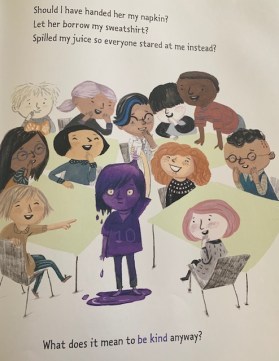
The book starts off with Tanisha spilling grape juice all over her new dress and a classmate being at a loss as to how to console her.  She makes what she thinks is a reassuring comment to Tanisha, but it isn’t received that way, and the little girl ponders and reevaluates what it will take to be kind to Tanisha and what kindness is in general.

IMG_3386

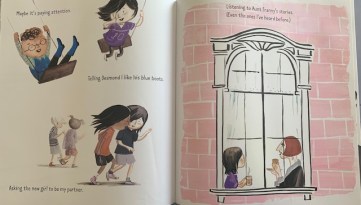
As she works to unravel what kindness is, she explores also what it can look like.  I love that it is seen in terms of action, giving ideas to stay with the reader.  It discusses that sometimes it is easy like saying hello, or not littering, and how important just using a persons name can make someone feel.

IMG_3388

But, it also talks about how sometimes kindness can be hard, requiring patience and a little bravery. I can only imagine how brave people had to be to enter a mosque for the first time and step out of their comfort zones to offer their support.  

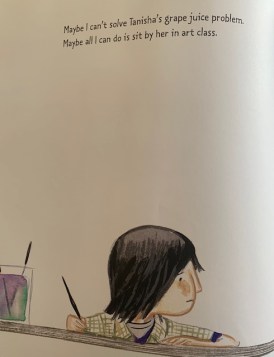
The book then takes an important pause when it acknowledges that maybe all this little girl can do to help Tanisha is to sit by her.  I think Muslims around the world are in awe of the Prime Minister of New Zealand for all she is doing, but also for just showing up and hugging people and listening.  A rare gift in todays wold of soundbites.  

IMG_3390

The little girl then imagines her small acts of kindness joining others and making the world a better place.  My favorite part is actually the end.  Tanisha never smiles and tells the little girl thank you, there is no big praise for being kind.  In fact, I bet the little girl doesn’t even know the power her actions had on the little girl.  We the reader know because we see Tanisha hanging the picture up in her room.  But, that let down is real life.  We can’t be kind because of the reward, we must learn to be kind because it is the right thing to do.  And often when people are kind to us, the effect isn’t instantaneous, its weight manifests in the dark when we are looking for hope and reassurance and for this book to contain all of that, in 32 pages with only few words (AR 2.2) is truly amazing.

IMG_3391

The illustrations are gorgeous and engaging.  The hardback 9×10 format makes this book a great addition to any library and should be read regularly.  It isn’t enough to not be mean, action and intention need to be taught so that we all might be more kind, inshaAllah.


The House of Ibn Kathir: The Competition Begins by S.N. Jalali

Standard
The House of Ibn Kathir: The Competition Begins by S.N. Jalali

IMG_3210

At 254 pages this boarding school story beautifully blends Islamic information, mystery, and compelling characters embarking on a new stage of their lives.  I was pleasantly surprised at how easy and engaging this book for upper elementary aged children reads and would strongly recommend it for grades 3-5.

SYNOPSIS:

Eleven year old Yusif is about to begin his first year at the prestigious Dar Al Ilm Academy a few hours away from his family, friends, and home.  Nervous to be on his own, he is excited to be giving his dream of memorizing the Quran the chance to become a reality.  When he arrives at the old mansion turned beautiful campus, he is paired up with Reda, a student to help him get situated and before you know it the two are fast friends.  When they get put in the same house, Ibn Kathir, with Warsoma and Daud, the four friends embark on a year of adventure and bonding as well as growth and learning.  Along the way they learn some Islamic history, they understand important hadith and Quranic Ayats and are challenged to live according to the sunnah even when tempers and frustrations abound.  When items start to go missing the boys and their house will have to keep their cool, not accuse anyone, but figure out what is going on all at the same time.  When the culprits are uncovered, they will be further tested to hold a grudge, offer forgiveness, or even extend an invitation to friendship. 

IMG_3211

WHY I LIKE IT:

This idyllic story and predictable mystery will appeal to impressionable readers that can’t see what is coming and can still be inspired by the beauty of such a protected environment.  The window might be small for such readers, but well worth the attempt as the book is well written and the characters well developed.  The boys are diverse and kind and helpful and all the things we want our children to be, especially when they are away from us.  Each character has their strengths and weaknesses and the friends accept them and celebrate one another rather than try and force them to change. The four houses and the characters vying for year captain and having fun along the way reminds me of a Harry Potter spinoff, but alas I think that is just my ignorance of the British school system.  I love that the four houses and their namesakes are detailed at the end as well as there being a glossary of terms.  There are illustrations every chapter or so that are appealing and offer a nice visual of the boys’ world.  The text, line spacing, chapter breaks and all are perfect for the demographic and while the fictional story is solid, I am happy to report I learned a number of things as well. 

IMG_3212

FLAGS:

None, alhumduillah

TOOLS FOR LEADING THE DISCUSSION: 

I can’t find much on the author or even on any future books, which is unfortunate because I think it would be great for an elementary book club selection, and I may read it to my 4th and 5th grade Lunch Bunch group after we finish The Great Race to Sycamore Street.  I think it should be in Islamic School Libraries and classrooms as its cover will hold its own and compel kids to pick it up off the shelf.

Book trailer: http://www.ibnkathir.co.uk/trailerfullhd.html

Book website:http://www.ibnkathir.co.uk/index.html


Lulu and the Very Big Meanies by Mac McGooshie illustrated by Alexis Hogwood

Standard
Lulu and the Very Big Meanies by Mac McGooshie illustrated by Alexis Hogwood

Lulu.jpg

I don’t know what is more frustrating: quality books that are poorly packaged (binding, illustrations, font, spacing, etc.) or beautiful books that miss the mark in storytelling and basic writing skills.  Both are equally annoying, and while yes, a good story should be the basis, this book is really well written that the presentation of it just makes me sad.  At 116 pages, the book is perfect for 3rd graders.  My daughter and son read it a few years ago when I first picked it up.  I made them read it.  And last week when I pulled it out to read myself, both remarked that it was a good story.  The fact that they remembered it and remembered liking it are huge pluses, and made the fact that I had to make them read it all the more disheartening.  I’m certain if you can get your kids to read eight maybe 10 pages they will zoom through the rest of the book.  It is the getting them to pick it up and start, that is the tricky part.  The book is paperback, thick and glossy, but the cover looks homemade almost.  If you thumb through it the font is too small, spaced too tight and the illustrations mean well, but don’t deliver.  Unfortunate, because like my children, I too think the story is fun and I’m disappointed that the book was published in 2013 as #1 in the Lulubug’s Week in the Life Series, and no further books have come out.

SYNOPSIS:

Laila (Lulu), and her family are American Muslims living in Southern Virginia.  Lulu’s mom is a lawyer and a convert, her dad is from Egypt and owns an Italian restaurant, and her older twin brothers are 12 and keep an eye on her.  Being incredibly bright Lulu has skipped third grade and is having trouble with some bullies in her new fourth grade class: Veronica B. and Veronica C.  aka the Veries.  Using help from her brothers, her neighbor and friend Toni, and some friends in class, a trap is set to get the bullies to confess to their evil mischief, but that unfortunately isn’t the only thing Lulu is going through this week.  Throw in her parent’s sudden decision to move closer to the masjid in another city, a litter of kittens abandoned on the side of the road, and some weird noises coming from the woods behind their house, and Lulu has a lot to deal with.

WHY I LIKE IT:

I love that it shows the day-to-day of a typical Muslim family in a normal presentation.  They pray together, they watch what they eat, they know their neighbors and worry about each other.  It doesn’t idolize the family, making them better than anyone or preachy, but makes them very relatable and likable in a realistic way.  When bees are discovered or the kittens need carrying for, sunnahs and ayats are identified, but very seamlessly, that non Muslim kids will learn a bit about Islam and Muslim kids will be excited to see themselves.  My favorite scene regarding this is when the mom finds out there will be a middle-school dance, and even though the boys are not planning to go, know that it isn’t for them, and don’t even seem tempted by it, they still have a family meeting about it, to discuss.  I also like that at one point Lulu meets another Muslim girl and they don’t hit it off right away, the girls work through it, but it is nice to see some diversity in even the way Muslims are presented and possibly misunderstood even amongst one another.

There is a lot going on in the book in terms of action items, but there still is a lot of character development and dimensions to Lulu.  Lulu has to navigate relationships with her family and friends that ring true and aren’t over simplified.  Her friend and neighbor, Toni, expects Lulu to act different at school now that they are in the same class, but returns to her silly self once they are home.  Lulu clashes a lot with her mom, but can smile and get her way super easy with her dad and manipulates that a lot.  She has to balance her sassiness with her teacher and principal, pick her battles with the Veries, and abide by other adults’ rules and expectations.  The book reads in a similar vein as Junie B. Jones, or Clementine, just maybe a more mature and less obnoxious reincarnation.

I wish the adventure involving the backyard noises, was a bit more dramatic, and maybe even the unveiling of the trap involving the dye was more resolved.  At times the book seemed rushed to wrap up all the stories introduced and I think they deserved a little more time to be explored and enjoyed.  If the font and spacing and pictures could be tweaked I think the book would really speak to kids in a fun way.  Third and fourth graders can easily handle a 150-160 page book that has good pacing and is packaged in a tempting, non intimidating way.  I’m holding out hope that maybe the author will write some more, tweak this one, and give it the chance at reaching an audience that would benefit from the smart, fun, grounded life of Lulu.

FLAGS:

Clean, it does mention that Toni likes a boy, but Lulu thinks that boys are trouble.

TOOLS FOR LEADING THE DISCUSSION:

If I still did an elementary book club, I think this book would work.  I think kids need a nudge to give it a try, but once the book gets going, girls and boys alike will enjoy it.  I may read it for a Lunch Bunch choice (I read once a week to 4th and 5th graders while they eat their lunch).  Kids will love seeing themselves, their stresses, their families, and their faith presented well.

An Ember in the Ashes by Sabaa Tahir

Standard
An Ember in the Ashes by Sabaa Tahir

Our local library automatically renews books, so I’ve had this 446 page AR 5.0 novel sitting on my night stand since October.  I got the online version when I went overseas, and I even downloaded the audio book.  Needless to say, I never opened it, in any form.  And then four days ago, I did.  I read the first page and then the second, and soon enough I knew that I would quickly be annoyed by my children needing food, and clean clothes and rides to school because, I was no longer present in the day-to-day functions of my life, I was in Serra hoping for happy endings and being really angry, like ready to contact the Muslim author during certain scenes, as I felt tears reminiscent of when Cedric Diggory was killed in book 4 of Harry Potter brimming.  The book was amazing, and yes, my kids are fairly well cared for, but there are two more books in the series out, and the fourth one apparently in the works.  I hope to read the series, but I have a feeling, this epic fantasy series will not be a happy read, it is dark, and violent, and definitely more suited for high school readers because of content then the AR level would suggest.  

SYNOPSIS:

Told from two different characters ‘perspectives: Laia and Elias, the world of Serra has tastes of the Roman Empire, current political headlines, Middle Eastern names, subcontinent ideas and lots of action.  Laia is a Scholar, an oppressed people who a half a millennium ago crumbled beneath the Martial invasion.  Her parents led a resistance and were killed a long with a sister.  She and her brother, Darin, are now raised by the grandparents: gentle people who heal others, keep their heads down, and don’t make waves.  The story quickly advances with Martials raiding the family home and Masks, the elite warriors of the Martials, killing Laia’s grandparents and imprisoning Darin.  Laia escapes by running, but hates herself for not staying and fighting for her brother, the only family she has left.

Elias on the other hand is a Martial soldier about to graduate as a Mask from Blackcliff Academy, a brutal (that’s putting it mildly) nearly all boy’s military school.  Abandoned by his mother as a baby, Elias is contemplating running away from the school, as his soul and conscience can no longer be pushed aside to complete the acts he is expected to do.  The complications abound, however, as the Commandant, is his mother, who wants nothing more than to see him dead, the penalty for desertion is death, but the penalty for most every infraction is a severe beating, and if death happens in the process, so be it.

The two characters come together as Laia reaches out to the Resistance to find help in rescuing her brother and in exchange is assigned to be the Commandant’s personal slave.  As the Empire is on the cusp of change, a new emperor is to be selected from the top four of the current graduating class, Elias, is the top of his class.  The four trials will leave one triumphant and the new leader, second place will be the Blood Shrike, the emperors blood bonded butcher, the others will be killed. 

The trails are named: Courage, Cunning, Strength and Loyalty and are administered by immortal, mind reading, cave dwelling Augurs.  The trails are vicious and cruel and evoke not only putting friends against friends, and test one’s fears, but they are amplified by creatures such as jinns, efrits, ghuls and wraiths.

WHY I LIKE IT:

The book is incredibly well written.  The way the author builds her characters’ worlds is seamless and smooth.  I didn’t get lost or confused, I never once felt bored by explanations or felt that something didn’t make sense, a feeling that makes fantasy stories cumbersome and daunting to me, and what I feared all those months looking at the book, too afraid to open it and dive in. 

The action and characters are well developed.  While the book is fast paced, I felt every character was given some nuance and depth.  It really isn’t a good vs. evil story.  Each character has more than one trait at any given time, and it makes them delightful to interact with and mull over.  There are strong females and sprinkled in ethnic names like Sana, Illyas, Tariq, Afya Ara-Nur, Mazen, Zain, Zara.  The subcontinent concept of Izzat, honor, is prominent among the Resistance and Scholars which is a nice bit of resonance in this fictional world as well.  And the concept of jinns, and the stories about their role in the book, reads like Arab folklore.

FLAGS:

The book has profanity, not a lot, but it is there, especially when talking about women.  The violence is incredibly graphic, killings, beatings, brutality, whippings, suffering, and death are on nearly every page.  The Martials are ruthless not only with those they occupy, but even amongst themselves: the students fight to their death, they lock their own children in cages without food so that only the strong of their society survive.  But even worse is that many of the people outside of the ruling elite are taken as slaves, and thus women are seen as property and rape abounds.  Rape by name is mentioned a lot, but it isn’t graphic, save one or two climactic points, if anything it is more disturbing because it is the norm and is accepted.  Prostitutes are mentioned, again, nothing detailed, but mentioned that the boys at the academy visit the docks to see prostitutes.  As Laia is being sold to a slave master, he considers placing her in the brothels rather than at the school.  Laia is nearly raped by a student, and a simmulated rape saves her at another time, in both instances the higher ups dismiss that there is anything wrong with raping a slave and the winner of the third trial is even given a slave for the night.  When the Masks kill Laia’s grandparents, one says he will rape Laia before he kills her.  So it is very much a part of the culture of the book, but it isn’t defined, just the words are used, which means I think high school kids could handle it, because it is not celebrated or graphic, but younger than that will have too many questions that can’t be swept away easily given the environment of the book.  

TOOLS FOR LEADING THE DISCUSSION:

This book could work for a high school book club, because there is so much to talk about.  It won’t work for middle school, and I will keep my daughter from reading it until she is in 9th or 10th grade probably, even though she has read Hunger Games and the Divergent series.  Just want her a little older to handle all the rape references, in more mature way.

As for teaching or presenting this book, this series has a HUGE fandom, you can find everything on the book online and with little effort (maps, character lists, chat groups etc.).

The Author’s website: https://www.sabaatahir.com/

Teaching Books: https://www.teachingbooks.net/tb.cgi?a=1&tid=42018&s=n

One of many book trailers: https://www.youtube.com/watch?v=sbvyCrkVT7M

Enjoy! Happy Reading!