Tag Archives: Family

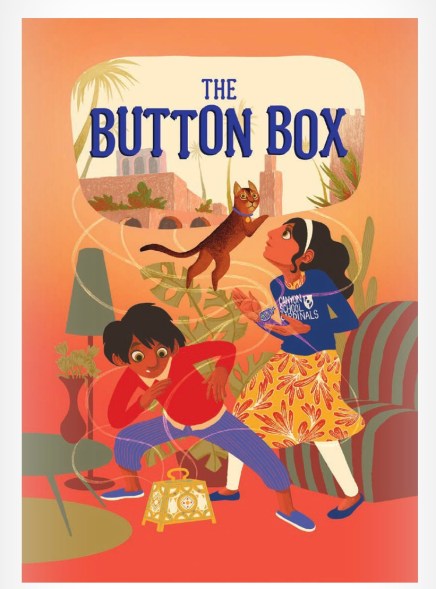
The Button Box by Bridget Hodder & Fawzia Gilani-Williams

Standard
The Button Box by Bridget Hodder & Fawzia Gilani-Williams

img_8336

This 152 page book reads like a historical fiction interfaith Magic Treehouse for middle grades tale, and I thoroughly enjoyed it! I learned about Sephardic Jews, the language of Ladino, Prince Abdur Rahman, and a tiny bit about the Abbasids overthrowing the Ummayads.  I love that it starts with a map and ends with sources, facts about what information is real in the book and what is fiction, and a bit about Muslims and Jews and how to be an ally if you witness prejudice.  The book is co-authored, and in many ways the Jewish narrative does take the majority of the focus, but the Islamic phrases sprinkled in, the Islam practiced by a major character, and the setting, allow for both religions to shine and combine to make a compelling magical time traveling story for third graders (and their parents) and up.

SYNOPSIS:

Cousins Ava and Nadeem are in fifth grade and spend their afternoons afterschool with their Granny Buena.  Granny and Ava are Jewish and Nadeem is Muslim, though they believe differently, they always seem to find more that is the same, and respect is always given.  When they face bullying at school Granny Buena pulls out a crystal box full of buttons and tells the children, and the cat Sheba a tale about their ancestor Ester ibn Evram.  When she stops the story short, the two kids exam the button closer and find themselves back in time tasked with saving Prince Abdur Rahman and getting him from Africa to Spain.  They aren’t sure if that will be enough to get them back to their own time though, but they don’t have time to overthink it because if they fail, the Golden Age of Islam won’t happen, peace won’t come to Muslims, Jews, and Christians in the region, and their Jewish ancestors may face the backlash of helping the Muslim escape.  Along the way, they learn about their own family traditions, beliefs, and gain wisdom to handle their bullying problem at school.

WHY I LIIKE IT:

I love that I learned so much, and from what I could Google and ask about from those more knowledgeable, the facts about the time period and cultures all seem to check out.  Only one passage comparing Jewish belief and the text of the Quran is phrased oddly in my opinion, the rest of the Islamic sprinkling is well done.  There are numerous bismillahs, mashaAllahs, stopping for salat, quoting of the Quran and more.  The narrative is primarily Jewish, but the setting Islamic with athans being called and Salams being given.  The book does have a lot of Jewish detail, but I don’t think it was preachy, and the further uniqueness of Ladino words and culture I think would appeal to all readers no matter how familiar or unfamiliar they are with the two religions.

There are some questions that as an adult reader I wanted to know more about: how Nadeem and his mom are practicing Muslims in a strong Jewish family, how making sure history happened as it happened the first time sent the two kids back…then why were they sent there at all, is there going to be more button adventures, were their two cats or was it the same cat?   Honestly, a lot of the more obvious fantasy plot holes were accounted for and done quickly and simply: how their clothes changed but the button remained, how they could speak the language, how confused their aunt would be when her real niece and nephew arrived, etc.. The writing quality kept it all clear for the reader, and did so without the pacing of the story suffering.

FLAGS:

Near death experience, magic, mention of killing, fear, deception, bullying, fighting, physical altercation, misogynistic assumptions.

TOOLS FOR LEADING THE DISCUSSION:

This would be a great story to share if I return to the classroom. The history, the religions, the storytelling would provide so much to connect to and learn about.  As a book club selection though, it would be too young for our middle school readers and ultimately too short.  I would consider it for a read a loud with fourth and fifth grade.

To Purchase: Here is the Amazon link: https://amzn.to/3D9LyxI
One Wish: Fatima al-Fihri and the World’s Oldest University by M.O. Yuksel illustrated by Mariam Quraishi

Standard
One Wish: Fatima al-Fihri and the World’s Oldest University by M.O. Yuksel illustrated by Mariam Quraishi

one wish

This book is so long overdue, yet at the same time it was worth the wait.  The writing is simply superb: Fatima al Fihri is celebrated, Islam is centered, there are references, and the story compelling.  We, Muslims, as a whole know so little about the beautiful impact fellow Muslims have had on the current world and our way of life, that to see this book being celebrated in public libraries, in Islamic schools, at masjids, and retail bookstores, truly makes you sit up a little straighter, and reach confidently to get this book in your hands to share with those around you.  Thank you Mindy (@moyuksel.author) for these 40 pages of absolute delight, ages 5 and up will read it to learn, read it again to enjoy, and inshaAllah read it repeatedly to be inspired.

img_7723

The book begins with a Hadith regarding seeking knowledge and leaving knowledge behind.  It then begins the biography of Fatima as a small girl curious about the world around her starting with the word Iqra, read, from the Qur’an.  It sets the stage of her living in the desert in the early ninth century, a time where some boys went to school and some girls learned at home. Her connection to Islam and it teaching her the value of knowledge caused her wish, to build a school, to grow stronger.

img_7726

When war destroys her town her family flees to the busy city of Fez, Morocco.  She begins to accompany her father to the souk and enjoys listening to talk of planets, distant lands and different languages and wishes these scholars could educate everyone. She grows and gets married and her and her family become wealthy merchants.

img_7725

Tragically, her father and husband die, and Fatima must decide what to do next for her family.  She decides to help her community as a form of sadaqah jariyah and make her wish a reality.  She sets out to build a school where everyone can live and study for free.  She purchases land, and the building begins.  Fatima oversees each detail and names it the al-Qarawiyyin after her hometown in Tunisia.  It takes two years to build and it still functions today.

The back matter is just as compelling as the story with an Author’s Note, information on The University of Al-Qaryawiyyin, a Glossary, Bibliography, and a Timeline.  The only complaint I have about the book, are the illustrations.  I really don’t understand why half of her hair is showing when based on the time and her connection to her faith, she most likely was a niqabi.  I don’t understand the continuity of the hijab from a young child to adulthood.  I get that it shows her influence moving forward at the end, but it could have been a small print on an outfit for token representation of symbolism, I don’t get it as being a complete outfit her whole life.
img_7724

I absolutely love the role of Islam in both Fatima’s life and in this book.  It is so much a part of her and her wish, that every reader will recognize how connected her faith and the creation of the University were and I’m confident both Muslim and non Muslim readers will be in awe of her devotion and accomplishments, inshaAllah.

Queen of the Tiles by Hanna Alkaf

Standard
Queen of the Tiles by Hanna Alkaf

queen

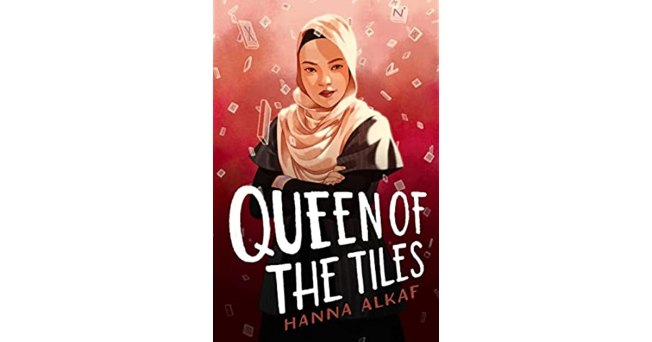
This 320 page YA book is hard to put down and middle school readers and up that love words, a good mystery, and fantastic writing are in for a treat.  I can’t recall the last whodunit that had me absolutely sure that I knew who was guilty, while simultaneously doubting myself until the reveal.  I mean, maybe there wasn’t even a crime to unravel? And fear not, I’m not going to spoil anything in this review.  Just know that this Muslim authored, Muslim character filled, Malaysian set, Scrabble feast is worth a space on your shelf as it will undoubtedly make a place in your heart and beg to be read again and again to see what you missed.

SYNOPSIS:

It has been one year since Najwa has competed in a Scrabble tournament, one year since her best friend, Trina Low, died playing Scrabble at the very same tournament, at the same hotel, with many of the same participants.  And with Najwa battling her angry negative thoughts, splotchy memory, nerves, and grief, she is walking a fine line of functioning and faltering.  When Instagram posts and messages start popping up from Trina’s account, everyone becomes a suspect in unraveling what really happened and doing it fast enough to prevent it from happening again.

The backdrop is the Scrabble games that are still taking place, the play on words, the scoring, the plotting, the twists, the scrambling, and unraveling of so many characters that are more connected than they first appear.

WHY I LIKE IT:

I love Scrabble, my mom and I used to play weekly when I was in junior high through college, and while the games were “friendly,” and neither us very good, the game holds wonderful memories. Usually chess is referenced for strategies in real world approaches, so to see Scrabble on a competitive level and have it being in many ways a metaphor for the larger storyline truly had me giddy.  I’m still grinning in fact as I write this review.  The mixing of the two story lines is flawless, with the word play, and scoring, and definitions, that I am just beyond impressed with the writing, the clarity, the intensity, and the way it holds the readers attention.

Many of the characters are Muslim and they mention their hijabs, waking- or rather trying to wake each other up for fajr. At one point Najwa and Mark, Trina’s ex-boyfriend are meeting to talk and she acknowledges the halal gap left as they sit down and how they are both always mindful of her Muslimness and his non Muslimness.  Islam is there, but is not a big part of the story. I beamed when it popped up, but if doesn’t influence the story much, for example one night Najwa plans to sleep in her hijab incase she has to run for her life, so you know, she won’t be slowed down by trying to cover her head.  Yeah, the book has some dry humor too.

There is a large mental health role in the book, as it seems in all of the author’s books: The Weight of Our Sky and The Girl and the Ghost.  Najwa is coping with her grief and trauma and working closely with her doctor to improve her situation.  Other characters mention going to therapists and likewise getting professional help.  I love that it isn’t just a character trait, but that it is a big part of the story, and not in a negative way, but in an actively working to manage it way.

I like how the gender neutral character is handled and pronouns are used.  It is not opined upon, it is not in your face, it is a side character, they have a preference of how to be referred to as, a quip is made that if they win they don’t want to be queen of the tiles, but a more less gendered term perhaps monarch, and that is it.  It is not a judgement, it is not a big part of the story, and no one makes it a huge issue, the character isn’t fleshed out much, but they are respected and have more to their personality than this one facet.  I think that provides a great approach in seeing something in literature that can perhaps spark important conversations in real life in need be.

The only slight pauses the book gave me were when it talks about how incredibly wealthy and distant Trina’s parents were, but then for much of her life she lived in a modest town house style house.  Also, despite Mark and Najwa’s awareness of boundaries, and Najwa being called out for crushing on Mark, at one point he hugs her and I don’t know if that is an oversight or was intentional.

FLAGS:

There is death, murder (?), poisoning, deceit, plotting, cheating in multiple ways, kissing, crushes, relationships, multiple mental health threads, intense competition, danger.

TOOLS FOR LEADING THE DISCUSSION:

I would love to do this as a book club selection.  I think as long as no one spoils the outcome there would be so much to chat about: the twists and turns, the way Islam and Malay culture is shown, the influence of western culture, concept of competitive Scrabble, pronoun sensitivities, and healthy friendship.  Girls and boys in middle school will be drawn to the story, and I can’t wait to share.

The Katha Chest by Radhiah Chowdhury illustrated by Lavanya Naidu

Standard
The Katha Chest by Radhiah Chowdhury illustrated by Lavanya Naidu

katha

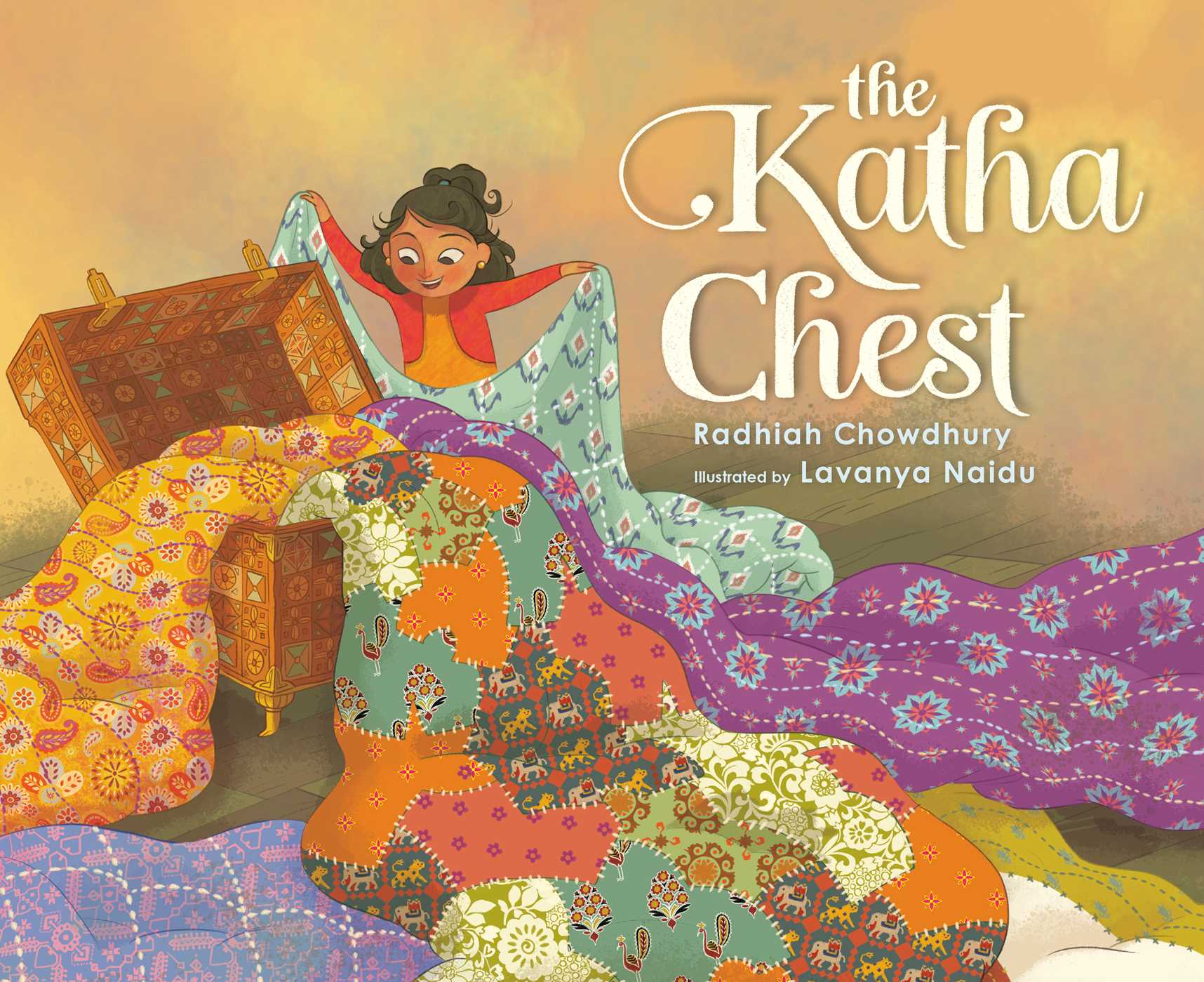
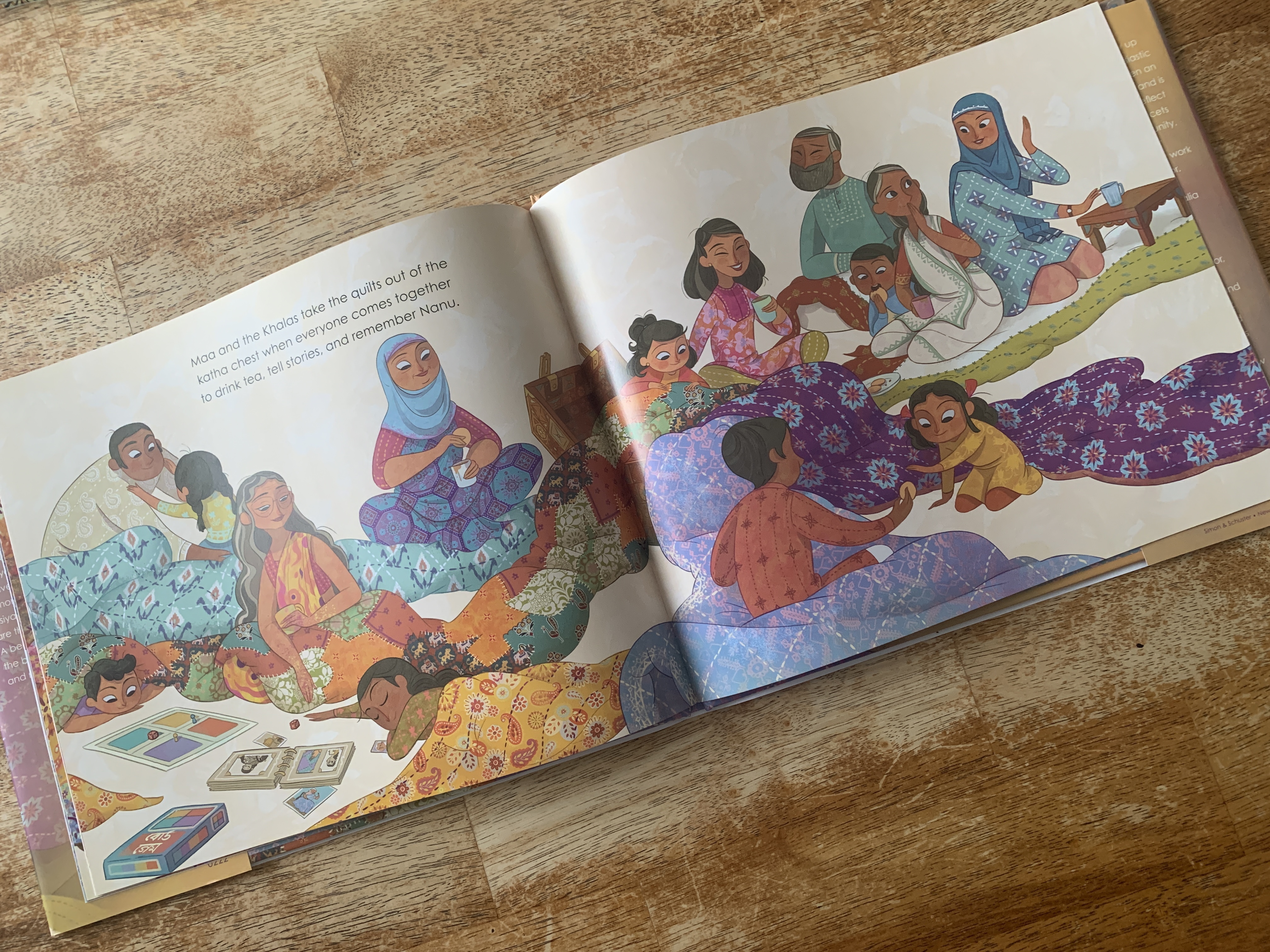
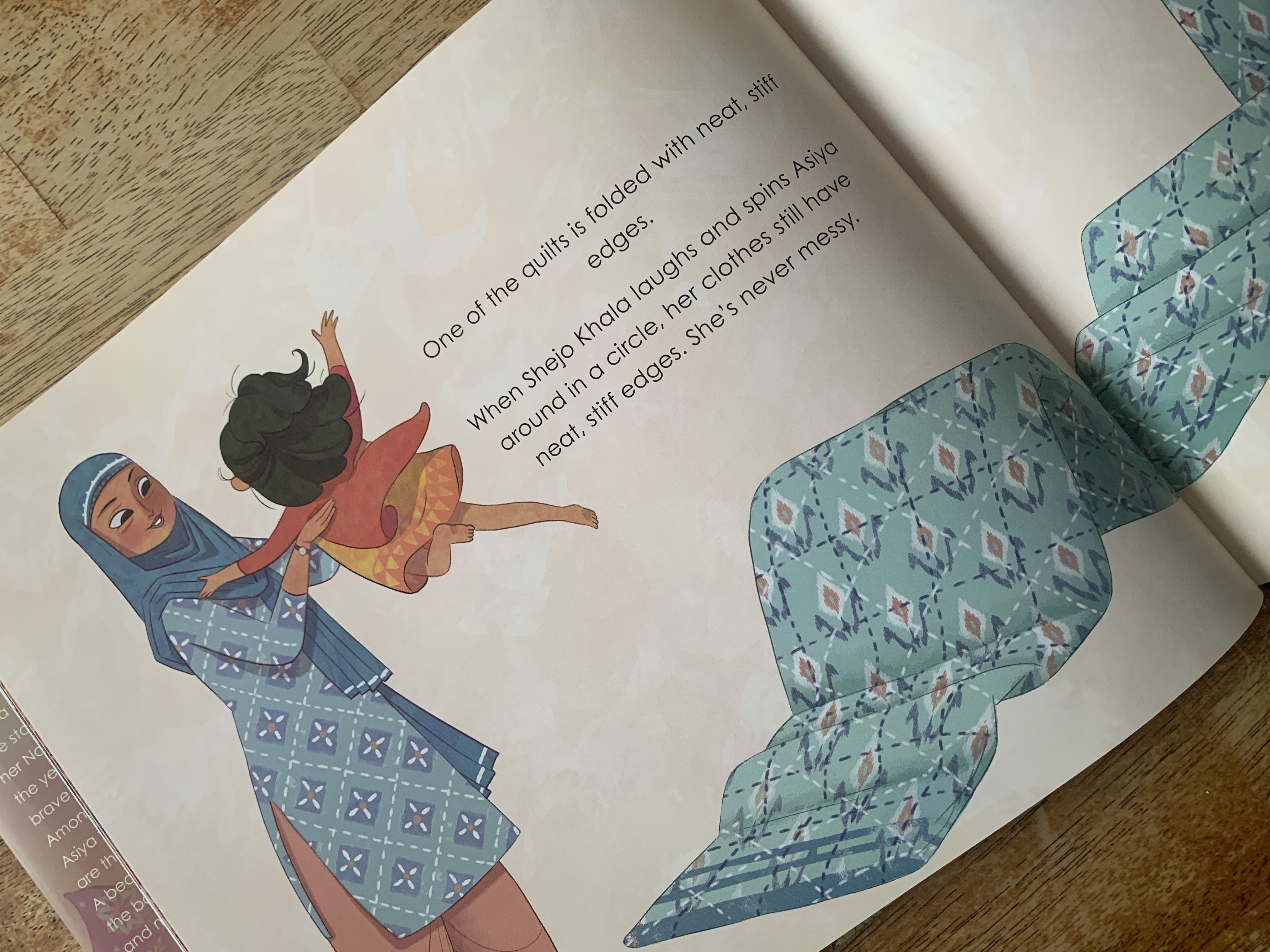
This 40 page picture book for preschoolers and up shows connection to family, memories, and Bangladeshi culture as a little girl explores the quilts made from her Maa and aunts’ worn out saris.  This book has been on my radar for a while and while there is nothing wrong with the slow and thoughtful story, it didn’t sweep me up in a hug and wow me, as I had hoped it would.  The illustrations are as critical as the words in conveying the message, and the illustrations are indeed beautiful, I guess I just needed more.  More connection to the emotion the little girl was feeling recalling the strong women in her life, more impact to the fact that her Nanu is no longer with them, and more understanding about the history of Bangladesh that seems to shape the memories.  I worry that most readers simply won’t get anything other than the surface level of the book, which is ok, the memories woven through generations manifesting in quilts, is tangible and perhaps enough.  I feel like, however, the framing of the story and the textless illustration pages attempted to add more layers to the story, and I think to anyone not Bangladeshi, those layers might not be understood.  I wish their was an afterward with notes about the pictured references, inclusion of such backmatter would really open the book up to a wider audience, and give the book discussion and staying power in my opinion.  If you are Bangladeshi this book will be a treasure I’m sure, and I’d love to hear your thoughts on it.

img_7721

Asiya loves going to her Nanu’s house, there are treasures there.  Her favorite treasure is the katha chest.  An old trunk full of the quilts made from the old worn out saris of her Nanu, Maa, and khalas. She snuggles in their warmth and listens to the stories they tell. Stories of hardship, joy, skills learned, moves made, loss, death, love and family.

img_7720

Boro Khala’s looks like Khalu’s medal, from a sad time when he was away.  Mejo Khala bright oranges and yellow like her fingers.  Shejo Khala’s is stiff and neat, she is never messy.  Choto Khala’s has a white streak like the white saris she wears since Khalu died.  Maa’s katha is patchworked and different than the others, and Nanu’s is paper thin and smells of tea, old books, porcelain and wood.

img_7718

There is an author’s note and illustrator’s note detailing the construction and value of kathas, but nothing about Bangladeshi wars, wearing white after a husband’s death, or the textile skills and artistry shown.  The book would read well with context or activities about family heirlooms, connections, and traditions.

img_7719


After Iftar Tales arranged by Bismillah Buddies

Standard
After Iftar Tales arranged by Bismillah Buddies

after iftar tales

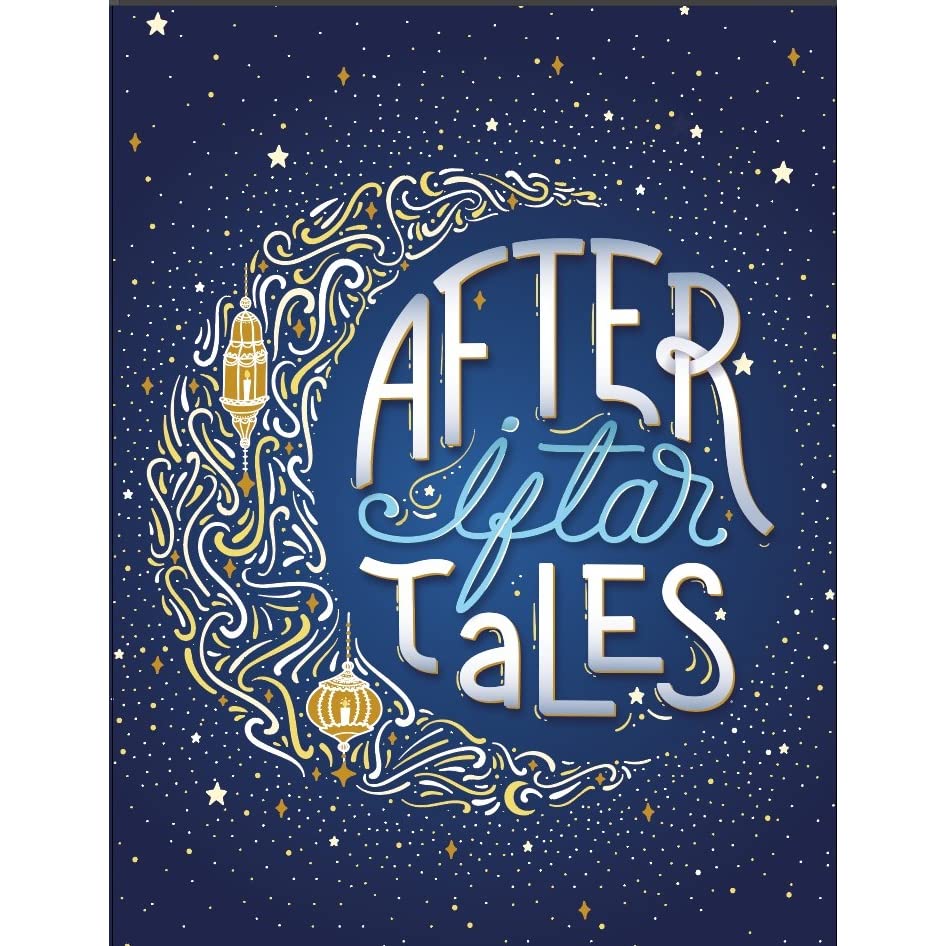
This book’s beautiful dark blue cover with sparkly stars feels good in your hands and looks lovely on the shelf.  It is a collection of 10 short stories presumably to be read by an adult to a child or children during Ramadan and has its highs and lows.  As often is the case in anthologies, some are written better than others and while I particularly liked two of the stories contained, I couldn’t help wishing that the entire collection would have been better edited.  I don’t know any of the authors, or their ages, and there is not an intro or conclusion detailing how the stories were selected or compiled, but as a whole, the grammar errors (spaces before and after commas and periods), failure to spell out numbers less than ten, and the overall plot holes in so many of the stories, makes it hard to love this book.  Something about judging a book by it’s cover would seemingly apply here, the illustrations are decent, the topics and themes covered are important, but the finishing is lacking, and the book really had a lot of potential.

SYNOPSIS:
The ten stories cover Ramadan in different ways, and do not get repetitive.  With different authors and illustrators and pictures on every other page at a minimum, the books presents well.  Many of the stories are adequate, but largely forgettable as the plot holes just made me and my kids dismiss them.  A few are too lengthy and wandering, but there are two that even despite writing obstacles, thematically were memorable:  “A Ramadan Surprise” by Malika Kahn and “Iftar in Space” by Tayyaba Anwar.

“A Ramadan Surprise” is written in rhyming verse and discusses the need for wheelchair accessibility at masjids.  Focusing on a young girl it also hints on the importance of accessibility for the elderly.  This is such a needed and important reminder and I love that it is present in a book that is positioned to be read and thus hopefully discussed.

“Iftar in Space” similarly opens itself up to be discussed and marveled at between a child(ren) and an adult: how would you fast and pray if you were on the International Space Station. This connection could then be made for people that live near the poles, and how science is valued in Islam and so much more.  I love that Islamic information is seemingly sourced, but I would have loved a line or two at the end clearly articulating that in fact this is what this scholar or these scholars have declared.

WHY I LIKE IT:

At first it didn’t bother me that the text was so small, but mid way through, it started to because the pictures are so inviting and regular.  If a child is snuggled up with a reader looking at the pictures it is impossible for them to follow along. I get that that is kind of the point, but with huge margins, the text size can easily be increased.

I don’t know why the book doesn’t seem to have been edited.  The cover and illustrations and binding are all decent to high quality, the cost of the book for consumers is high, so I don’t know why an editor was not (seemingly) involved in the process.  Sure I am picky, but it isn’t one or two grammar errors, it is a lot, and when it is a regular concern, it ruins the flow and feeling of the book.

Overall, honestly there is also very little Islam present in most stories except for the timing of Ramadan, and many of the stories seem to have gaps.  In the first story, a boy is found by a stranger and gifted a lamp, and the family never even tries to find the person who saved their son to thank him? They live in a small village?  In one of the stories where a little girls is fasting for the first time she is also making a salad independently and pulling a cooked tray of lasagna out of a hot oven. A child in one story eats moldy candy, and in a contemporary story kids donate their money to an orphanage.  Are there still orphanages? In one story it opens with a banner being made that is crooked, but the accompanying illustration does not match.  One error or two is easy to overlook, but again, when it is every single story, it is incredibly disappointing.

FLAGS:

Clean

TOOLS FOR LEADING THE DISCUSSION:

I think while reading it you would find plenty to discuss with your children.  On stories where your children seem bored you could skip them, if sentences don’t make sense you can alter them.  I doubt children will read the book independently, so there is some wiggle room to add or subtract from the text to make the points you want to make and keep the stories engaging.  There are a few stories that discuss Covid and the frustration that it has caused to daily activities, which might help add another layer of connection to the text.

Ramadan Rocket by Emma Halim illustrated by Stephen Tucker

Standard
Ramadan Rocket by Emma Halim illustrated by Stephen Tucker

ramadan rocket

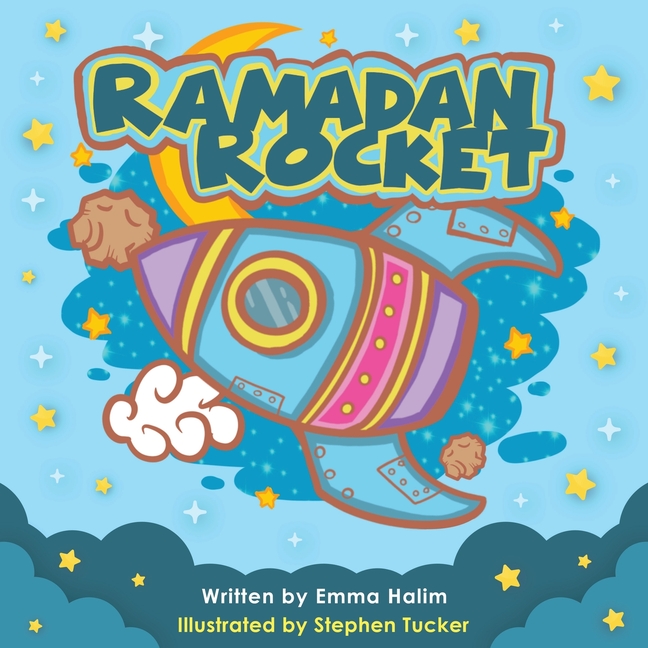
The banter in this 36 page Ramadan moon book is fun and engaging, and as the mom of five kids who was once a kid herself, the struggle is real to try and spot the Ramadan moon.   Most years, frustration abounds and nothing is seen. Haarith has the same problem, but last year he did something about it.  In this 36 page book for preschoolers and up, the faceless pictures will have kids giggling and their imagination’s soaring as they try and determine if Ramadan is about to begin.

img_7572

Haarith loves listening to stories about Ramadan, but always has trouble seeing the Ramadan moon. Last year, he decided to get a closer look.  He set out to build a rocket, but his best friend Hakeem had one he could borrow, so Haarith recruits two other friends, Jawaad and Khaleel, and plans are underway.  Jawaad will pilot since he flew out of a swing last week, and Khaleel will be in charge of food because his mom makes awesome cakes.  The boys head to space, passing, satellites, drones, and NASA rockets, before they see the moon and head back home.  After maghrib the community heads to search the sky and when they see nothing, it is Haarith that can locate exactly what they are looking for.

img_7571

I wish the moon was shown as super thin and hard to see in the illustrations, instead of as a thick crescent so that kids that might not have personal experience could at least understand why Haarith is struggling.  Also, I’m not sure why the line spacing on one page is double what it is on the others.  Many of the pages are text heavy and could have used some editing to tighten it up, but overall the story is fun.

img_7573

The premise though sent my head spinning, and yes I’m going to show my ignorance here, you can judge me. If you go to space, the moon is spherical, the earth and shadows are no longer at play right? So wouldn’t a new moon, a full moon, or a waxing gibbous all look the same? Clearly my confidence in this matter is non existant, and while I have no problem with the characters borrowing a friend’s rocket, it has been sitting unused for a year after all, I’ve been struggling to get this point clarified in my head.  And I believe it would all depend on where the rocket is and thus the boys’ point of view.  According to the University of Maryland, “The reason that we do not always see a Moon which is half lit is because of our position relative to the Moon and the Sun. As the Moon moves in its orbit, different portions of it appear (to us!) to be lit up as we look at it from Earth. This is why we see lunar phases.” So I suppose that depending on the rocket’s position in space would determine if the moon looked like a “Ramadan moon” or say a third quarter moon.  I’ve linked a NASA video that explains that the International Space Station sees the same phases as earth, so umm yeah, maybe I should take a break from fiction and go read some nonfiction basic science books. 

Eid Empanadas by Wendy Diaz illustrated by Uthman Guadalupe

Standard
Eid Empanadas by Wendy Diaz illustrated by Uthman Guadalupe

empanadas

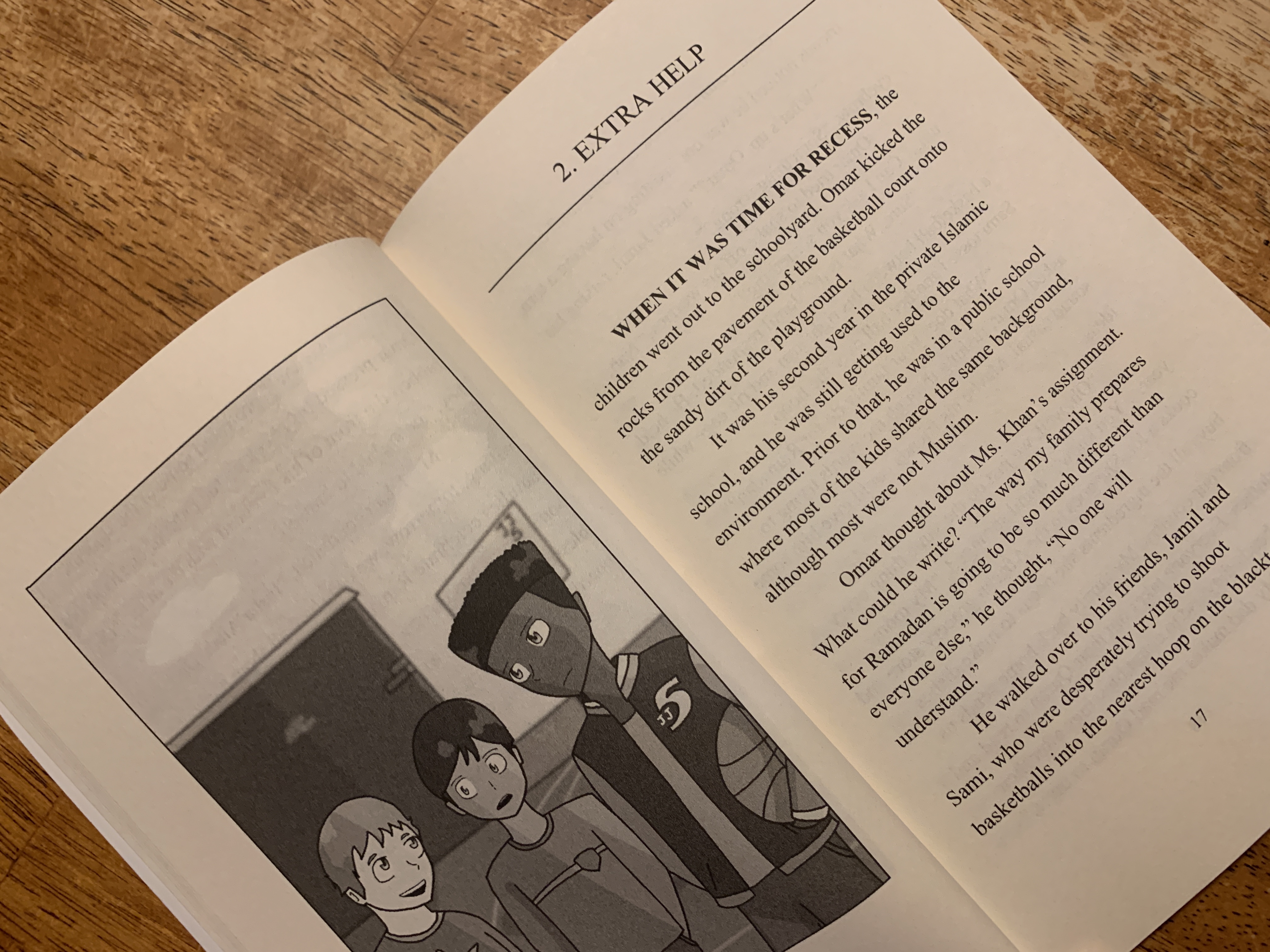
I love books that show, not tell how diverse Muslims are and celebrate the unique ways that Islam and culture come together.  This early elementary chapter book beautifully blends, Islam with Spanish words and phrases that all come together to celebrate Ramadan and Eid in America.  At 79 pages, with illustrations sprinkled in, this is a great book to share all year long.

img_5450

SYNOPSIS:

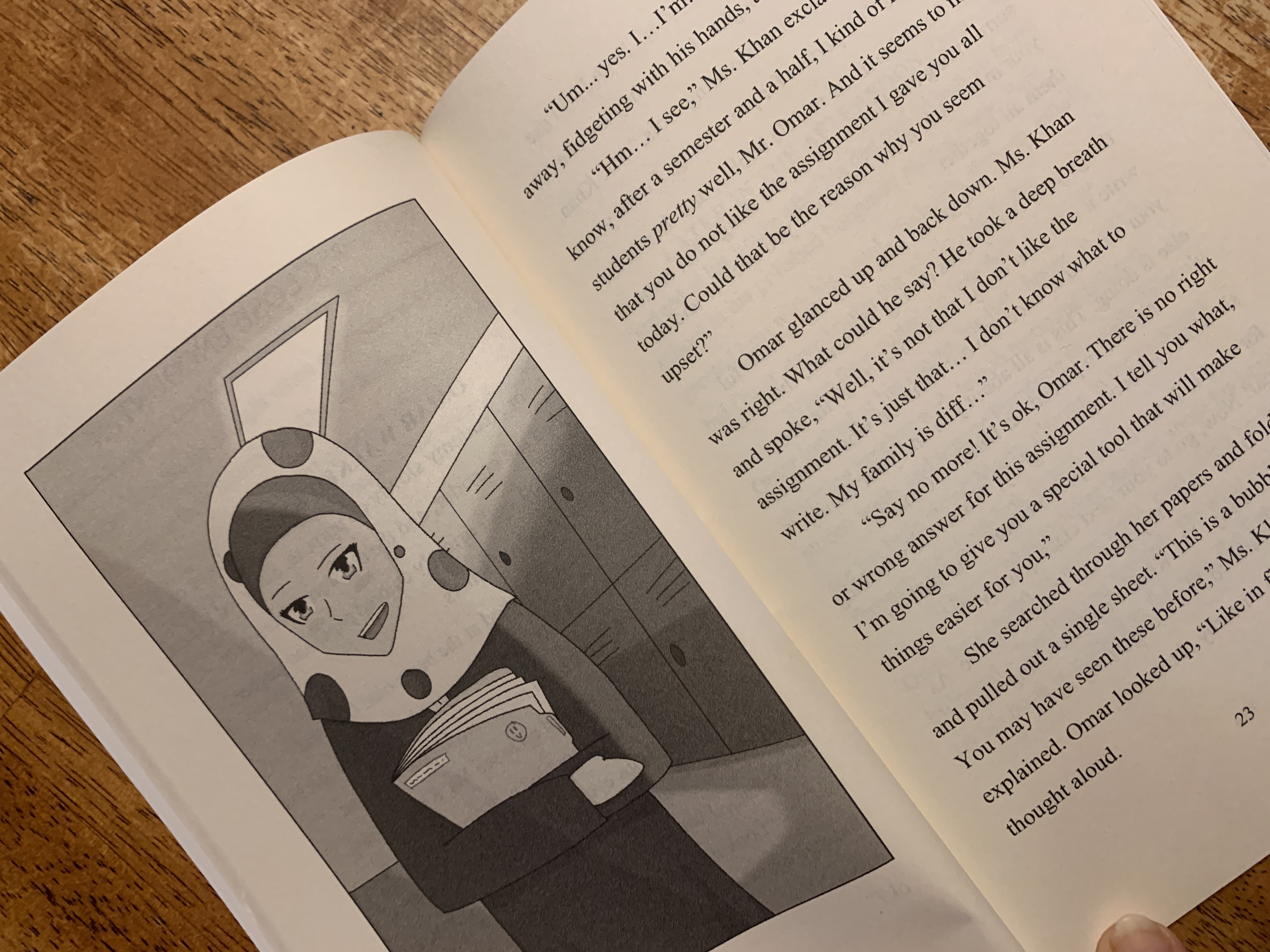
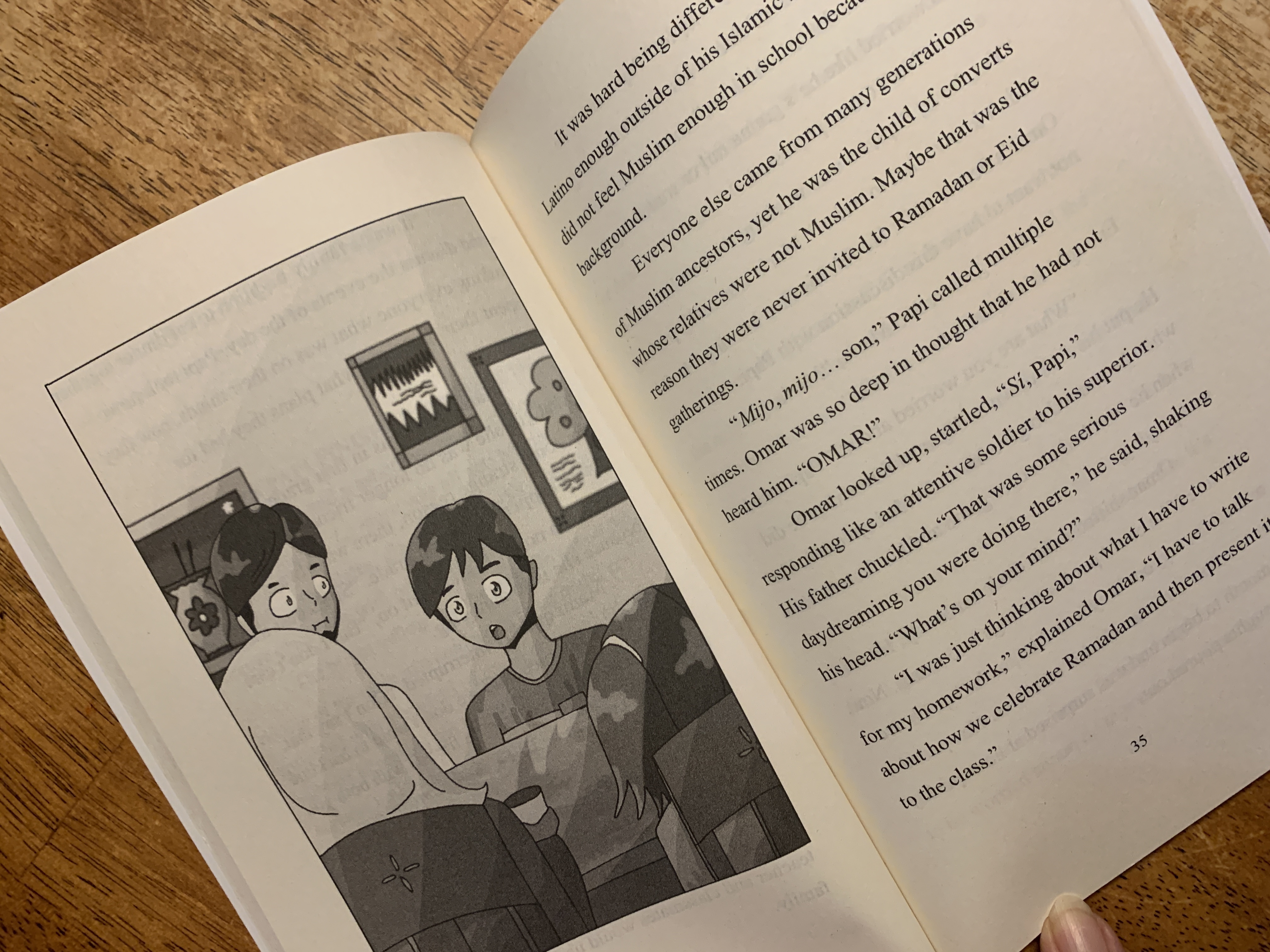
Omar is in 5th grade and when his teacher assigns the entire class to write an essay about their Ramadan and Eid traditions he is nervous that his family’s way of celebrating is very different than everyone else’s.  Omar’s mom is from Puerto Rico and his dad’s parents immigrated from Ecuador, even after a year and a half at the Islamic school, though, he still feels like the new kid, and doesn’t want to draw attention to himself.

Sensing that Omar is nervous, his teacher Ms. Khan offers ways to brainstorm and organize his thoughts.  Once home, in his casa, his little sister and parents join in to give him enough ideas, if only he can be brave enough to share them.

img_5449

WHY I LIKE IT:

I love that there is so much joy and love in this little book.  The twist of having a kid not feel like he is fitting in at an Islamic school, is also so fabulous to read.  The OWN voice narrative and recipe at the back will help kids like Omar everywhere feel confident to share their culture, and those that know kids like Omar (even if only fictiously) anxious to learn more about Latino Muslims.

The only thought that did cross my mind, when Jummah was being explained as the congregational prayer on Friday, was why not use the word Jummah, just like all the Spanish words were used, and then defined.  I would love to ask the author who the intended audience is, and how that shaped her word choice, what was defined and what wasn’t.

img_5448

FLAGS:
None

img_5447

TOOLS FOR LEADING THE DISCUSSION:

I’m hoping to get copies to the first grade and second grade teacher to read in Ramadan to their classes. This book has the potential to really excite kids, expand their understanding, and show them how beautiful and diverse Islam really is.

Wake Up! It’s the Ramadan Drummer by Mariam Hakim and Dalia Awad

Standard
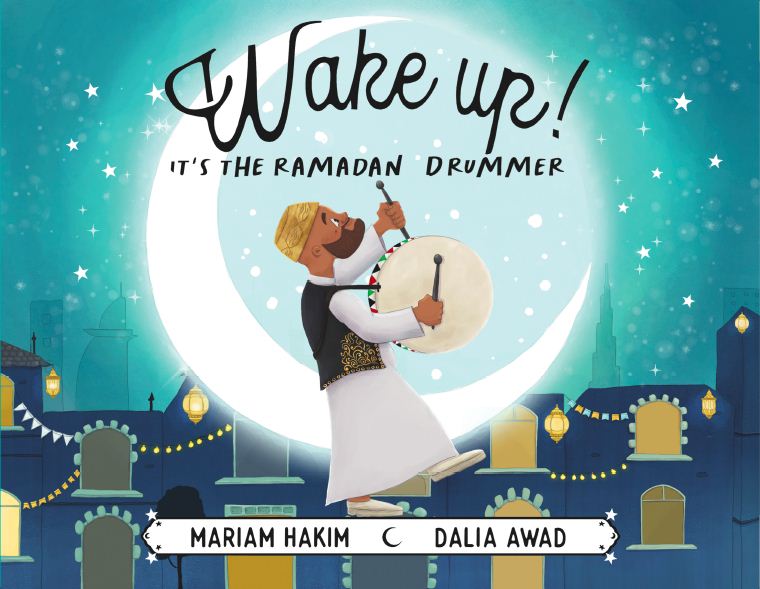
Wake Up! It’s the Ramadan Drummer by Mariam Hakim and Dalia Awad

wake up

The beautiful shimmering cover of this new Ramadan book drew me in from the first few pages with the emotional impact of the father in the story losing his job.  Unfortunately the fun illustrations and overall story are not quite enough to make the book an enjoyable read over multiple readings.  By the time you read the book a second time, the missing punctuation, the assumptions and continuity holes, make the book unravel.  It has merit and highlights, I just really hope that an editor is brought in before a second printing takes place to clean up the sentences, patch the holes, and polish it to make it shine.  It has so much potential, but it is disappointing especially if you have been waiting, perhaps a bit impatiently, to share this with children to get them excited for Ramadan.  Even more so if you had hopes of reading it again and again throughout the month.

img_7075

The book summarizes Ramadan on the first page, presumably making the ideal reader a Muslim already familiar with Ramadan significance, and then jumps into revealing that the Baba has lost his job.  The optimistic mama isn’t deterred and sends the Baba and kids to the store so she can cook up something special.

img_7077

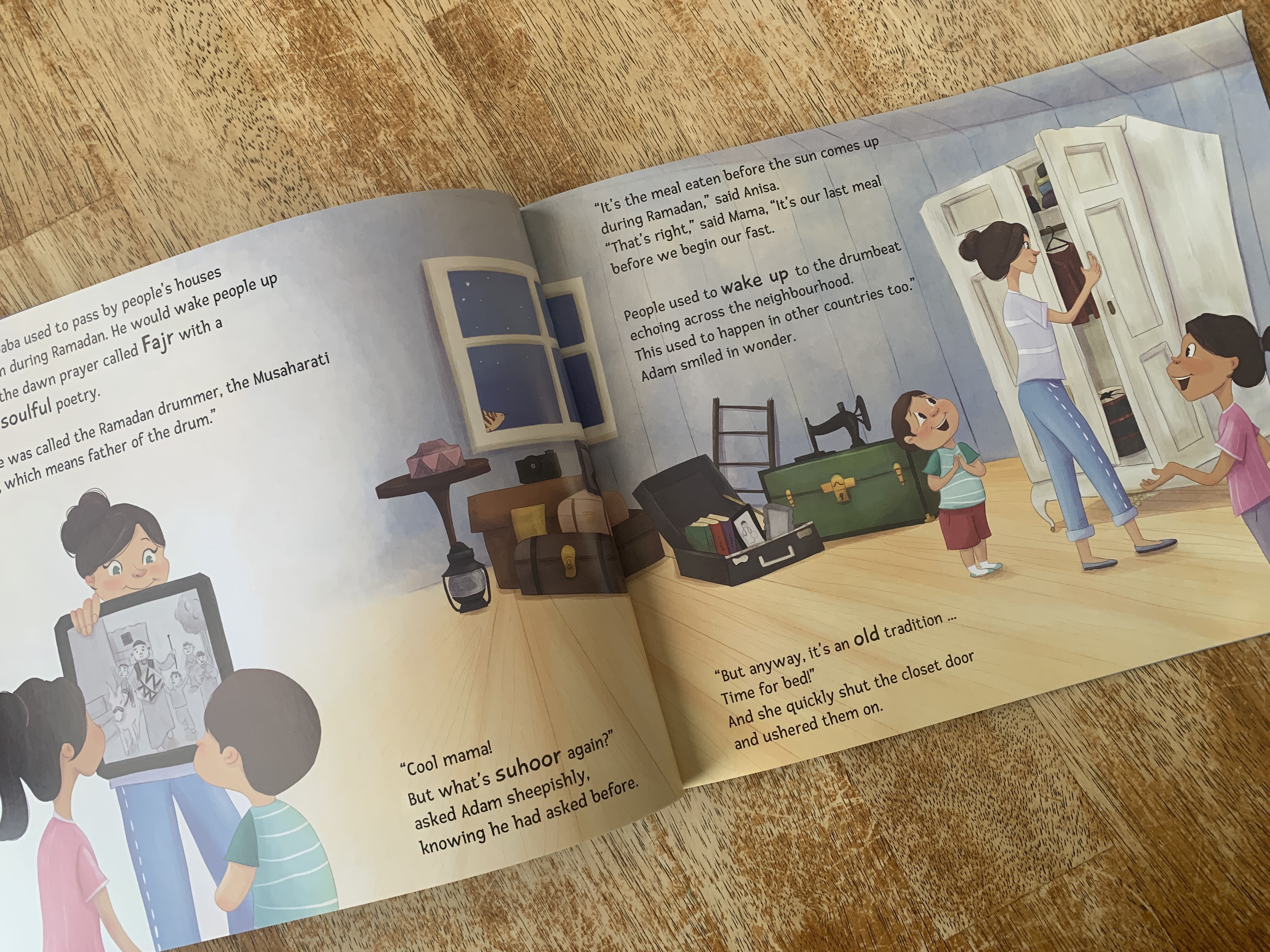
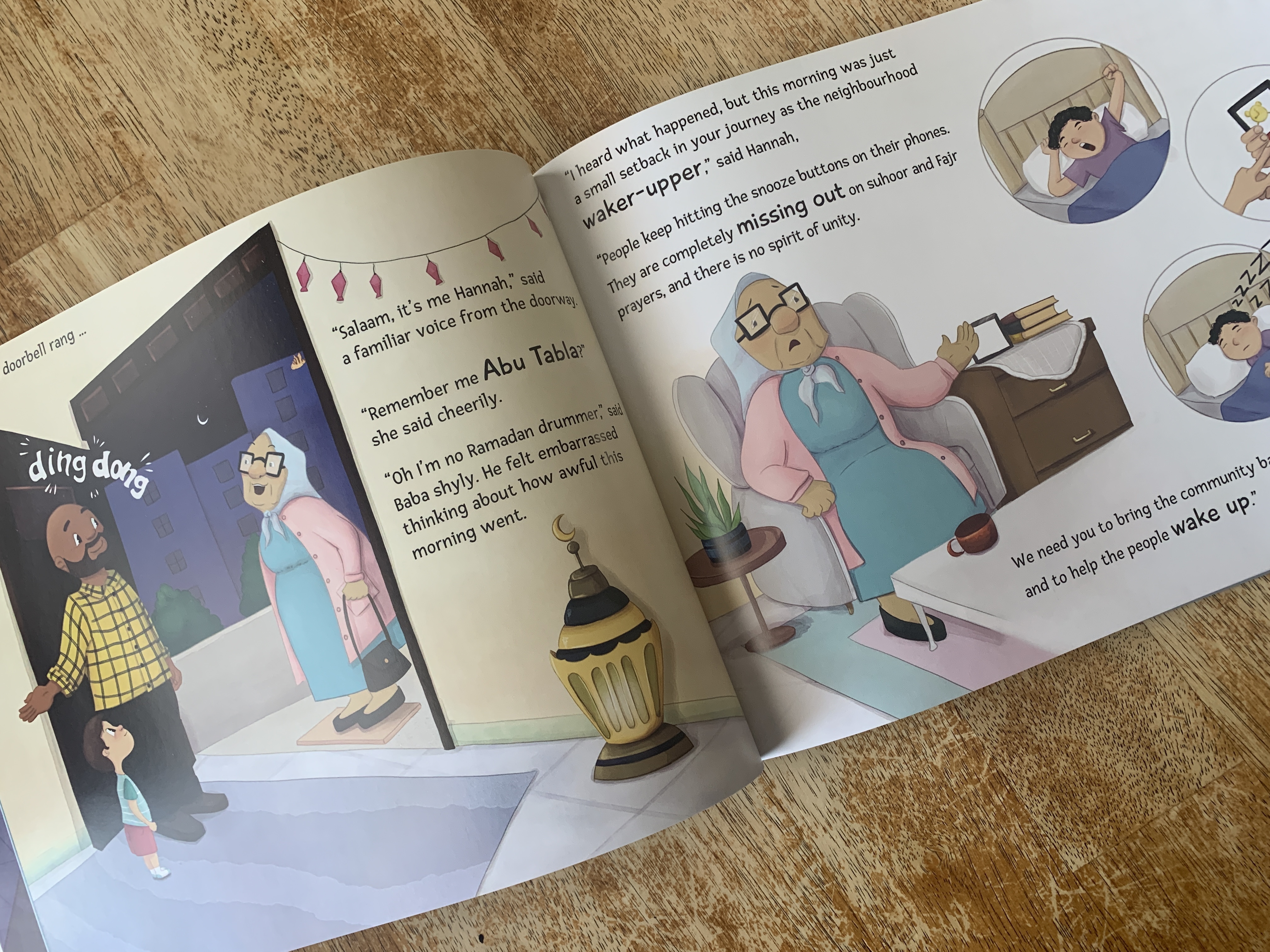
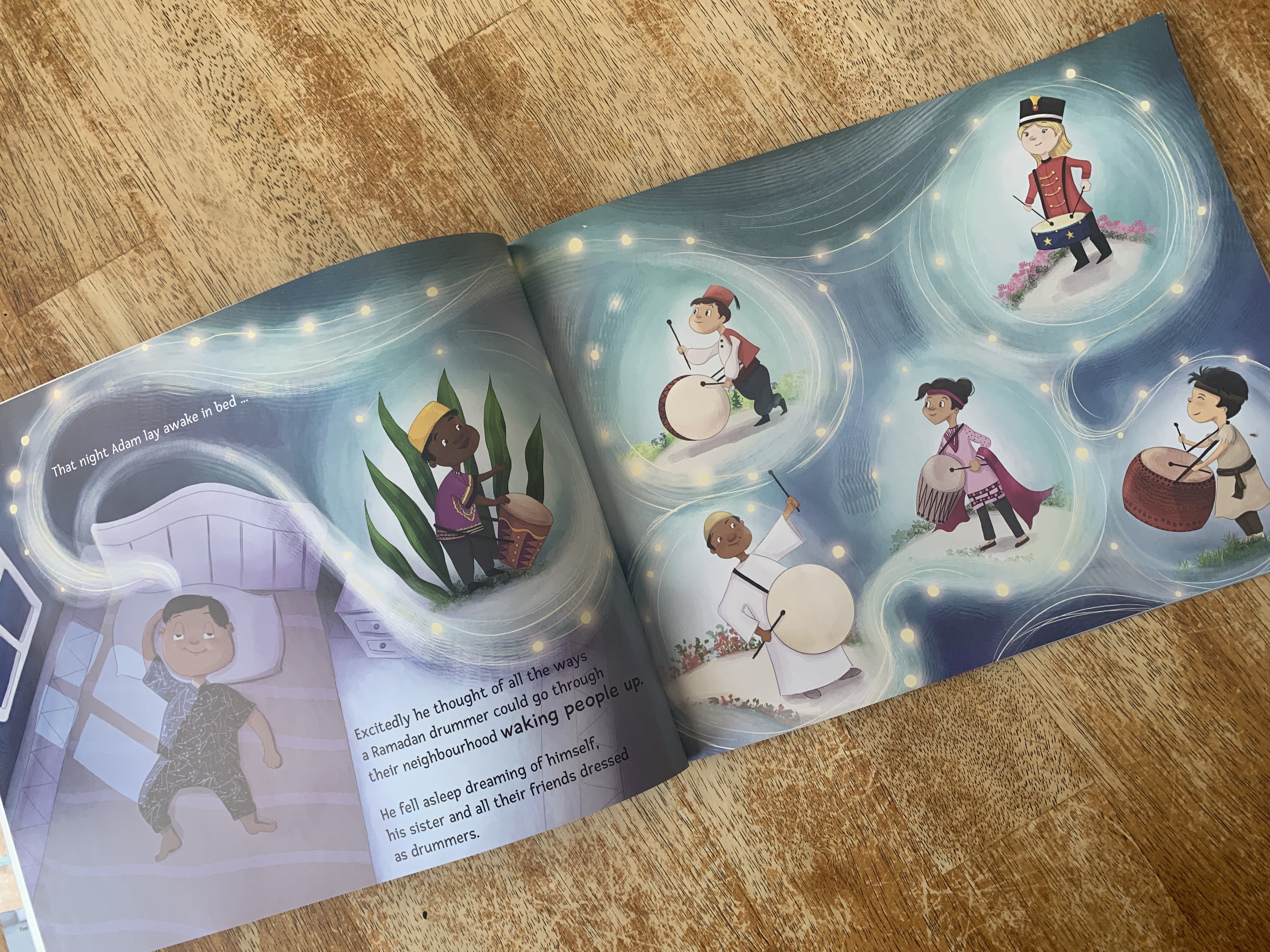
While at the store an elderly woman greets the kids and their father as, “Abu Tabla.” The son dismisses it until later that night when Baba has gone to the mosque and Mama surprises Adam and Anisa with the story of their Baba’s baba walking the streets before dawn to wake people up for suhoor.  She even digs out an old photograph, and with that, Adam is determined to get his father to revive the tradition.

img_7076

I love that Adam and his Baba work together to figure out lyrics and a beat.  I also like that it isn’t an instant success, but rather takes some grit, determination, and perseverance.  I also like that the whole family and eventually neighborhood come together, and that men and women go to the masjid for fajr.

There are some concerns I have though as well.  There are a lot of missing commas, the text uses mosque instead of masjid which reads inauthentic, and the whole old lady character, Hannah, is all sorts of underdeveloped.  She has to introduce herself, yet she knows where Abu Tabla lives, a drum magically appears in her hands, and her prodding is based on the premise that she knows what is going on inside people’s homes, what they are thinking, and what their intentions are.  I get that it is a kid’s story, but by the second or third reading it is hard to unsee how erroneous the logic is.  Especially when fasting like so many acts in Islam, are between a person and Allah swt, not for everyone else to judge.

img_7078

Presumably the story takes place in an Islamic majority setting and the neighbors are all Muslim, which offers a great discussion starter for readers in non Muslim majority places to find ways to maybe share Ramadan or to imagine living where everyone is fasting.

I feel like the last few pages about the drummer going viral is unnecessary, and the story could have, and probably should have, ended with the family and parade entering the masjid.  I particularly found it odd that a line reads, “News of the Ramadan drummer tradition starting up again reached as far as Pakistan, Egypt, Somalia, Turkey and even Indonesia,” why is Indonesia called out like that? Seems off putting somehow, not inclusive. The book concludes by circling back to the Baba getting paid to wake people up and finding jobs through the people also coming to fajr, which seems a bit raw for a children’s book.  A simpler, “even though Baba found another job, being the drummer was still the one he loved most,” would have tied everything up a little better for the demographic.  I’m hoping to include this story during one of my weekly Ramadan story times in my local community, and will probably skip the last few pages and just read the hadith at the end about waking up for suhoor.

Zahra’s Blessing by Shirin Shamsi illustrated by Manal Mirza

Standard
Zahra’s Blessing by Shirin Shamsi illustrated by Manal Mirza

Screen Shot 2021-11-18 at 11.57.45 AM

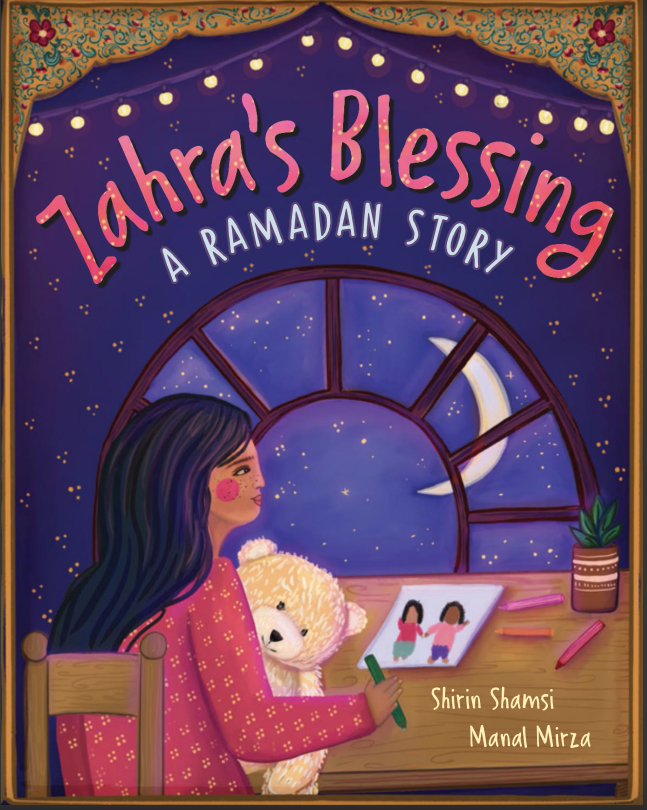
Just when you think all the Ramadan stories have been told, you flip open a new book, hold your breath as the stage of predictability is set, and alhumdulillah in this case, you squeal with delight when the big reveal in a children’s book swept you up and surprised you too.  This 32 page richly illustrated story for elementary readers is heartfelt, culture rich, informative, and embracing.  The book doesn’t dwell on the details of Ramadan, fasting, and Eid, but intentionally focuses on some of the feelings, blessings, and acts that make the month extra special.

Screen Shot 2021-11-18 at 11.58.04 AM

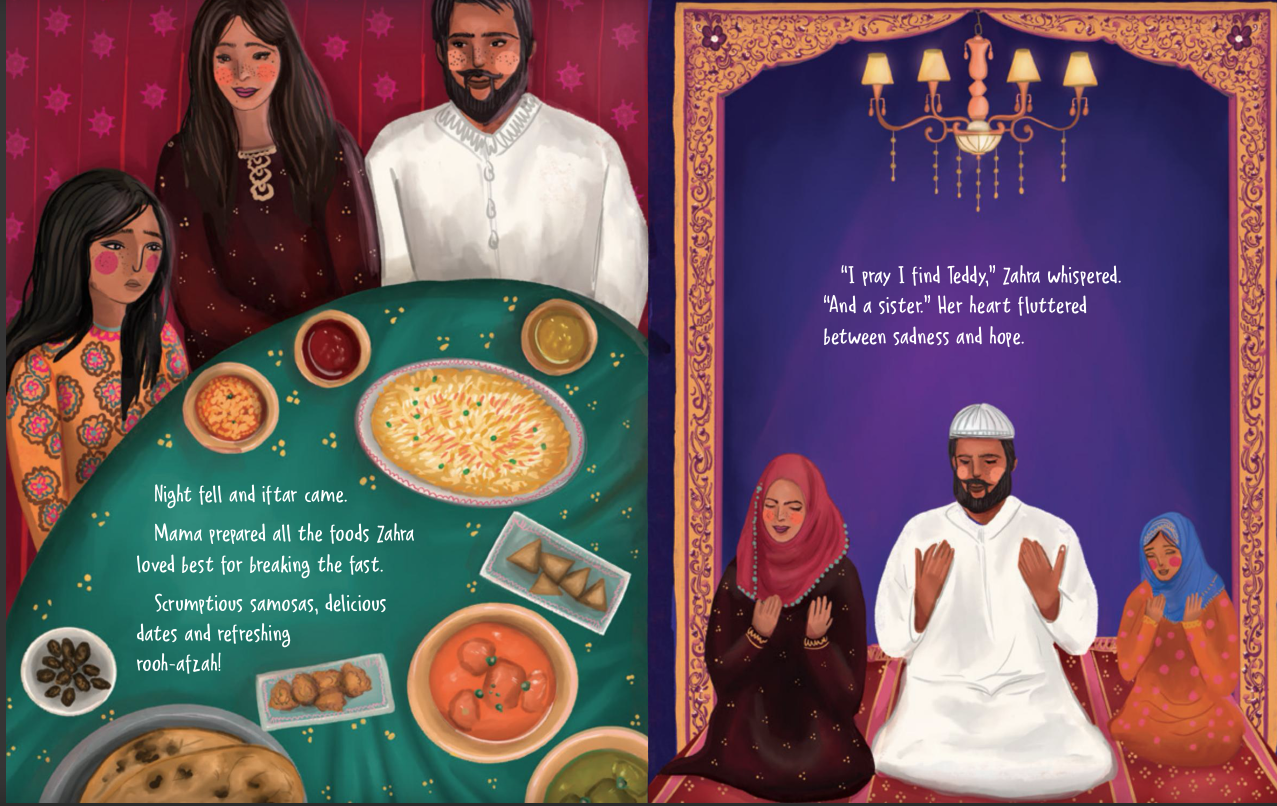
Zahra looks up at the Ramadan moon as she hugs her teddy bear and sends a prayer up asking for a little sister. The next day Mama is packing up beloved clothes, and ones that the family has out grown to be donated.  They discuss giving without hoping for anything in return and once again Zahra asks her mama for a little sister. To which her mother lovingly replies that she should be patient.

Screen Shot 2021-11-18 at 11.58.11 AM

When Teddy goes missing, Zahra can’t help but think a little sister would help her find it.  Iftar that night are all of Zahra’s favorite desi foods and prayer after is her asking for a sister and Teddy.  The following day Mama and Zahra take the collected donation items to the shelter and Zahra realizes how sad she is about losing Teddy and these refugees have lost everything.

Screen Shot 2021-11-18 at 11.58.28 AM

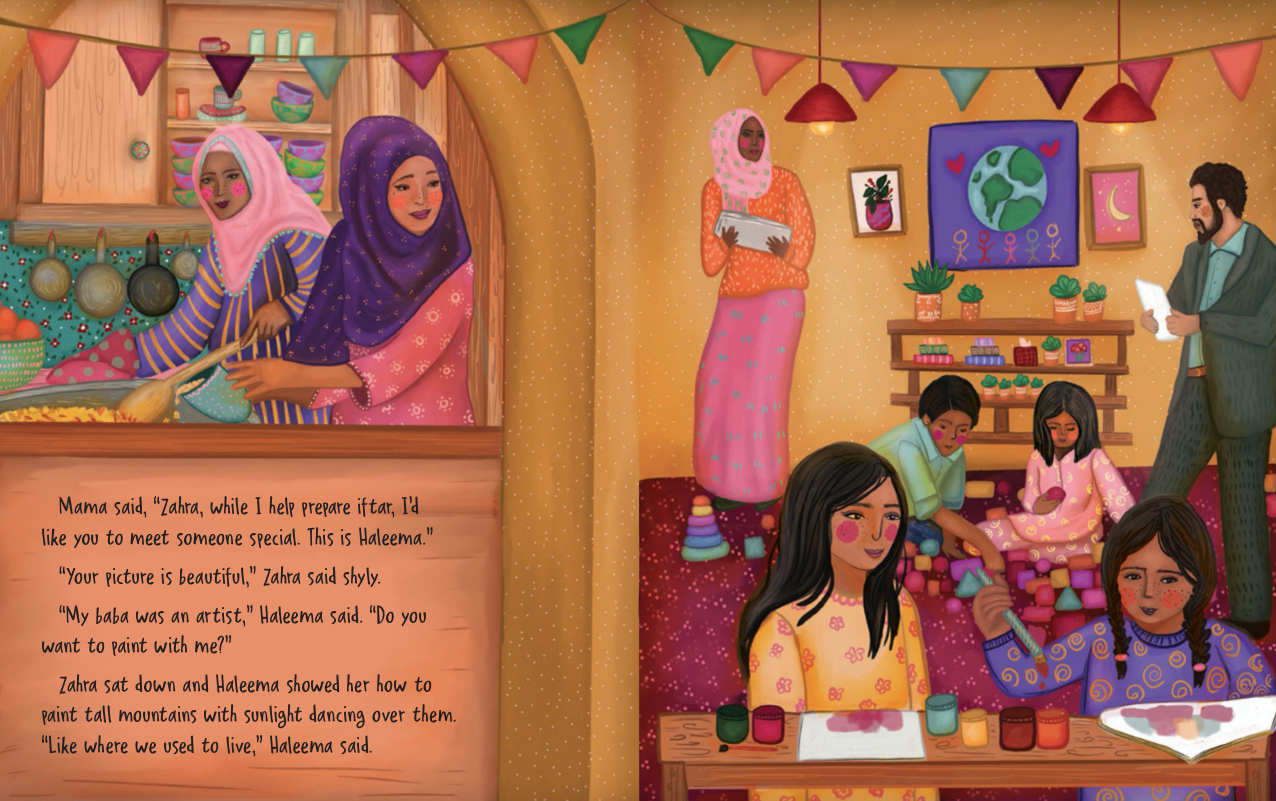
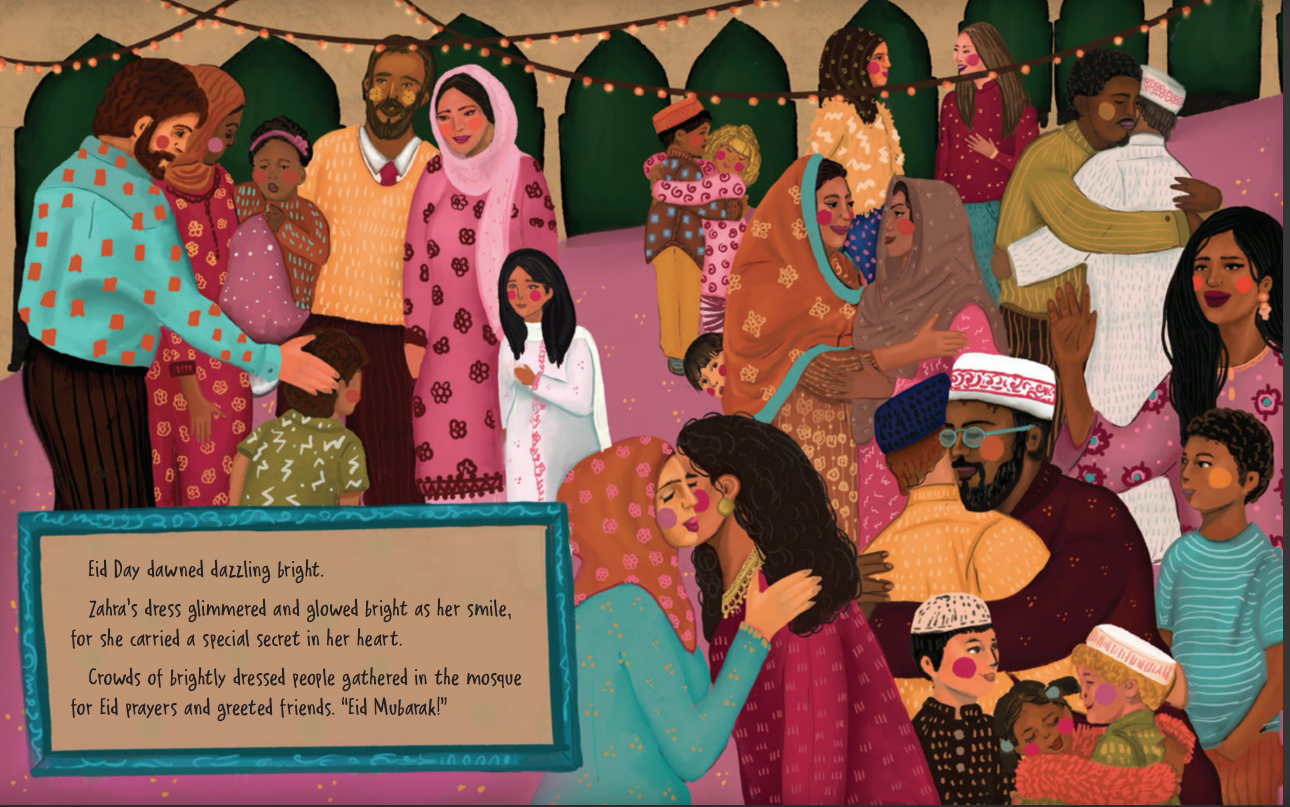
Zahra spends time with the children at the shelter and gets to know them.  She wishes she could find Teddy to gift to a young girl named Haleema.  Some days Ramadan crawls slow, and other days fast.  The family reads Quran together, fasts during the day and prays at night.  The night before Eid, Zahra’s dad whispers a secret to Zahra, one that she keeps close to her all through Eid prayers the next day.

Not going to spoil it, although I’m sure you can guess what is going to happen.  There are hints in the remaining illustrations, but I think kids will enjoy not having the heads up.  The book concludes with some informational blurbs and details about the Muslim author and Muslim illustrator.

Screen Shot 2021-11-18 at 11.58.35 AM

I enjoyed the illustrations, they are bright and bold and festive and unique.  They compliment the text completely as they show praying, reading Quran, making duas, etc.  The text doesn’t get preachy, it doesn’t even mention Allah swt or God, but talks of prayer and blessings.  The combination of the text and illustrations, however, definitely convey a strong unapologetic Ramadan/Muslim centered story.  Overall, it is universal and warm and sweet, and both Muslim and non Muslim children would benefit from reading it.

Screen Shot 2021-11-18 at 11.58.48 AM

My only concern is the page that the family is making dua together, it seems odd that they are all sitting in a line as if they have just prayed, but not prayed with the dad in front and the mom and Zahra behind. I read an electronic arc of the book and I look forward to purchasing a physical copy to add to my bookshelf.

Horse Diaries #6: Yatimah by Catherine Hapka illustrated by Ruth Sanderson

Standard
Horse Diaries #6: Yatimah by Catherine Hapka illustrated by Ruth Sanderson

yatimah

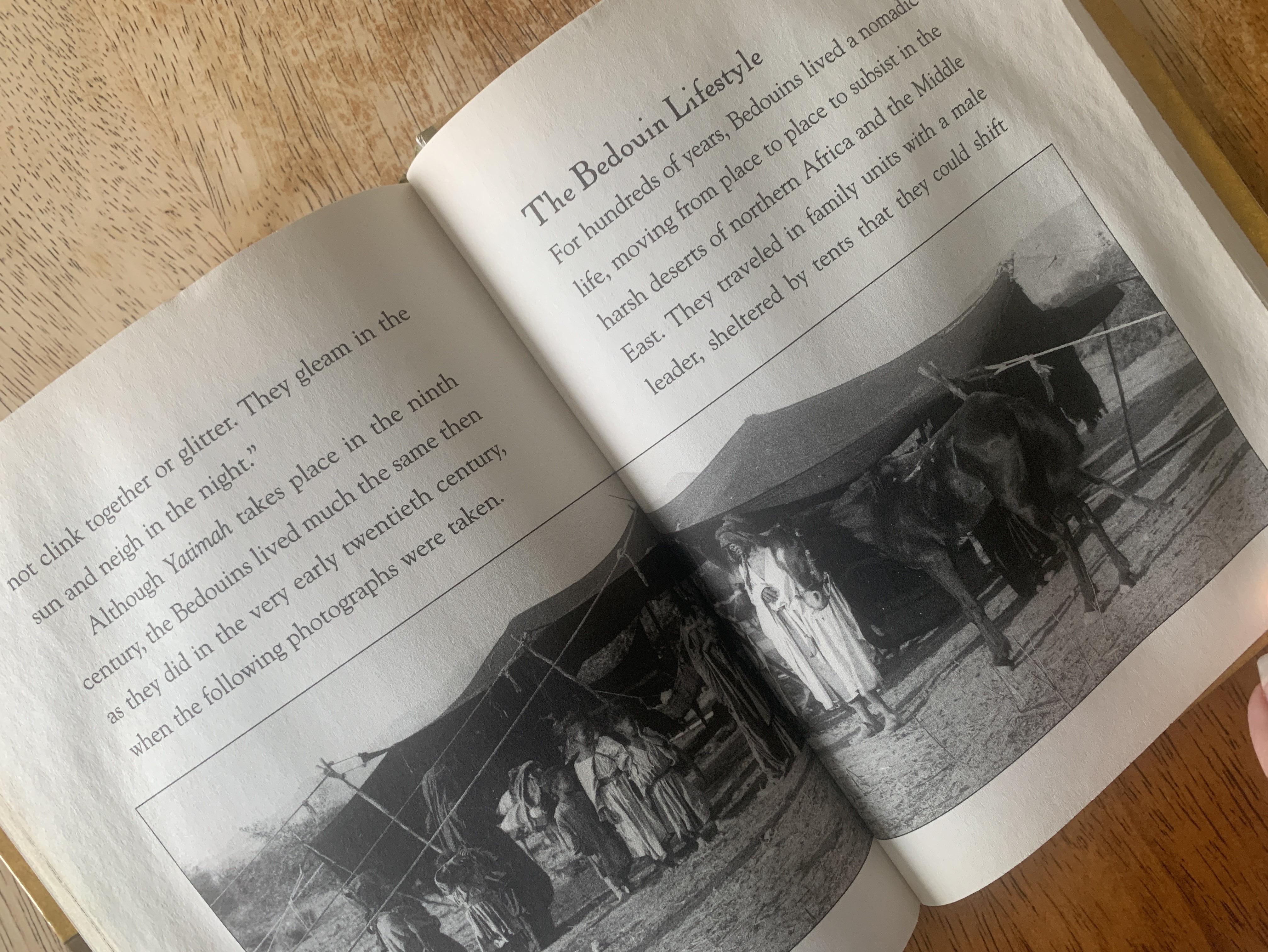
I love that a reader talked to her mom about this book, and then they brought it to my attention. Published in 2011 it is book six in a popular middle grade series told from the horse’s perspective where each book features a different culture from around the world and is set in different time periods. This book is told from an Arabian horse’s perspective in the 9th century and details her growing up an orphan, trying to understand the Bedouin humans around her, and establishing herself as a war mare.  Allah swt is mentioned quite often, as is Arab hospitality, and some guests at one point are briefly mentioned as they are on their way to Hajj.  My problem with the story is the portrayal of the raids.  I don’t know enough about Bedouin culture in the 9th century to opine on the accuracy of the raiding that would occur between tribes, but when juxtaposed with the humble God fearing, grateful religious people, blatantly stealing from the neighbors, it is hard to cheer for Yatimah and her humans at being thieves.

SYNOPSIS:

The birth of Yatimah takes the life of her mother, the beloved war mare of Nasr.  Her loss puts distance between the Bedouin leader and the foal.  Nasr’s daughter Safiya, however, has a soft heart for Yatimah and the two form a close bond. As Yatimah is accepted to nurse from another mare and grows with the companionship of her colt, Tawil, the two young horses show the reader how when the grazing starts to disappear in the desert, they are fed dates, and when those start to deplete they move to more fertile lands.  Always on the move, they raid other camps to steal sheep, and camels, and horses as needed, and work to prevent other’s from stealing from them.  Since the death of Yatimah’s mom, Nasr has not found a proper war mare, and thus the training of Yatimah begins. The climax is a raid that will give Yatimah a chance to prove herself and win over the still distant Nasr.

WHY I LIKE IT:

I love the illustrations and the detail that often accompanies them.  I also really appreciate the appendix at the end that gives information about Arabian horses, Bedouins, and war mares.  I learned a lot about the specific strengths of Arabian horses, and why the Bedouins favored riding mares over stallions. 

I liked that many of the exhausting stereotypes were not present in this book in regards to women.  Safiya is a young girl at the beginning and then starts to wear hijab as she grows, but she is still free to come and go as she pleases it seems.  Her father respects her and shows affection and kindness to her throughout.  I just find the premise a little off that we readers, are hoping that Yatimah becomes the lead thieving horse.  It mentions that it doesn’t make sense to the horses, but to have that be the whole point of the story, leaves a bad taste in my mouth, especially when the story could have been developed in so many other ways to focus on something a little bit more positive.

img_6527

FLAGS:

Stealing, thieving, death, loss.

TOOLS FOR LEADING THE DISCUSSION:

I think the book would be fine on a classroom bookshelf, but I wouldn’t highlight it unless I was prepared to discuss with young readers the culture and why perhaps this was such a part of the lifestyle.  I would not want to perpetuate any stereotypes of Muslims, or provide a negative impression on readers that are drawn to these books because of their love of horses.  I learned a lot by reading the books, but I worry what a 8 to 10 year old would take away about a culture and religion after reading such a story, I fear the word barbaric may arise.