Tag Archives: death

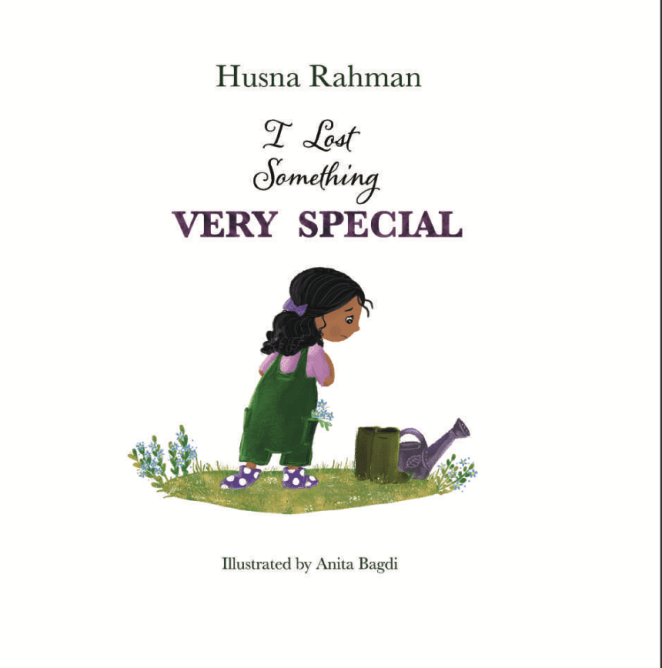
I Lost Something Very Special by Husna Rahman illustrated by Anita Bagdi

Standard
I Lost Something Very Special by Husna Rahman illustrated by Anita Bagdi

Screen Shot 2021-11-04 at 11.08.02 AM

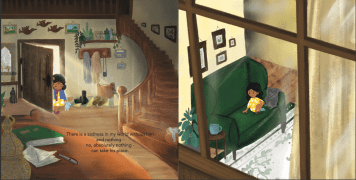
This beautifully illustrated 34 page story about the loss of a beloved grandfather is universal and heartfelt.  It is not an Islamic fiction book as there is no mention of the duniya or akhira or accepting Allah’s decree, the family however, is visibly Muslim and it shows women in hijab and the little girl narrator praying salat with her now deceased grandfather.  Similarly, there are no cultural words or references in the text, but the illustrations show Bangladeshi culture, writing, and warmth.  The author is a psychotherapist and counselor, and all readers, young children and up, will benefit from the tenderness and emotion-filled paperback book.

Screen Shot 2021-11-04 at 11.08.58 AM

A young girl starts the book stating that she has lost something.  She recalls other things she has lost, a scarf, a toy, her voice, a tooth, and how after a while the item was found or it came back and she was able to carry on.  Today, however, is not the same, she has lost her grandfather, and he isn’t coming back, and she doesn’t know if she can carry on.

Screen Shot 2021-11-04 at 11.09.36 AM

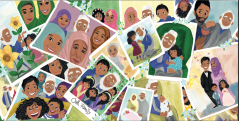
She goes to his house, and he isn’t there, and the heartbreak is palpable.  She knows in time she will forget the lost scarf and lost voice, but she doesn’t want to ever forget her grandfather.  She finds some pictures and recalls him teaching her to ride her bike, them praying together, and planting a garden, his stories, his smell, his laugh, his hugs.

Screen Shot 2021-11-04 at 11.10.21 AM

As she assembles the pictures in a scrapbook, she is filled with memories and warmth and his wisdom.  The book ends with her seemingly coming to accept her new reality and then the book asking the reader if they have felt loss, what memories they carry, and what they miss the most about those that are gone.

Screen Shot 2021-11-04 at 11.10.01 AM

The sparse text and amazingly expressive illustrations make the book a beautiful addition to help children cope with their own feelings, and to learn empathy for others going through their own trials of loss.

Screen Shot 2021-11-04 at 11.08.18 AM

House of Glass Hearts by Leila Siddiqui

Standard
House of Glass Hearts by Leila Siddiqui

glass hearts

This 278 page magical realism YA book featuring a Muslim family grabs your attention and heart in the prologue, unfortunately it quickly releases it, and until you get over a third of the way in to the story, it is a struggle to read.  Once you accept that half of the book, the storyline set in the present, is going to be terrible, you enjoy the historical narrative and appreciate that the short book with a quick pace spends more time in the subcontinent during partition, than it does with the painfully underdeveloped characters trying to make sense of past secrets and their present day manifestations.  The book doesn’t have any major flags in terms of religious representation, it is just ritual acts of praying and reading Quran, nothing detailed or explored, and relationship-wise there is nothing high school readers can’t handle (spoilers and more details can be read in the FLAGS section).  Despite being a first time author, she works as an editor, so one would really expect the climax to hit harder with clearer writing, the characters to be developed, the details written to serve a purpose, and the protagonist teen’s voice not to read overwhelmingly at the beginning as a five year old.  The overall story concept and historical fiction component are exciting, the development of the characters just really failed an otherwise engaging read. 

SYNOPSIS:

Maera’s brother Asad goes missing in 2011 from their grandfather’s home in Pakistan while they are visiting.  They search and cannot locate him or a body, the loss devastates Maera’s family.  Ten years later, her grandfather passes away, and the next morning a greenhouse appears in their backyard in America.  Not just any greenhouse, her grandfather’s greenhouse from Pakistan.  Maera thinks she is going crazy, her mother doesn’t acknowledge the structure, she doesn’t acknowledge much, not about the reality in front of them, not the night Asad disappeared, or the needs of her daughter. Maera’s aunt (mom’s twin) and cousin come from Pakistan to mourn the loss of the grandfather together, he passed in Pakistan, not sure why Maera and her mom didn’t go there, but I digress.  Cousins Jamal, aka Jimmy, and Maera are the only two that seems determined to figure it all out.  Their grandfather’s journal turns up and with Maera’s friend Sara and Rob, the neighbor and former best friend of Asad, the four of them set out to understand what is going on in the greenhouse.

The greenhouse seems to be alive, and entering it dependent on the whims of something within, a churail,  a shape shifting creature of myth that is more than a witch, a succubus that targets men.  A woman who died violently and was wronged by men, whose feet are turned backward, and who is neither alive or dead.  As the four work through the journal, venture in to the greenhouse, and confront those within, secrets will be unearthed, exposed, and finally dealt with.

The historical interwoven story is that of the grandfather during colonial British rule and partition.  As a young boy Haroon is searching for his father fighting in Burma and the adventures he has along the way. Shah Jehan’s father takes Haroon in at one point, and the girl with an emperor’s name sneaks him out to watch the village deal with the churail who are killing the men in their village.  The incident scars Haroon, but his affection for Shah Jehan and the role she will continue to have in his life is established. The understanding that the subcontinent is being carved up and starved by the colonizers in the name of freedom is made clear in the characters that Haroon encounters and the quickly maturing boy grows in to a young man as he starts to understand the world around him and the larger powers at play.  When the migration and violence between Hindus getting to India and Muslims going to Pakistan occurs, the pieces in the past and present come together to reveal the terrors that the greenhouse houses. 

WHY I LIKE IT:

I loved the commentary both in the text, and explicitly detailed in the afterward about how culturally the past is handled.  How little generations discuss what they have endured and been through.  I have been asked by my father-in-law a few times to try and coax my mother-in-law to detail her journey with their oldest son from India to Pakistan.  She has apparently never clearly told what happened, what she saw, and what they experienced.  She waves it off now, but her own children didn’t even know there was more to the story, and as my inlaws approach their 90s I have little hope of them recalling or sharing their stories.  Recently my son needed to hear some first person accounts of war, so he contacted my American grandfather to learn about his time in the Korean War, much of it I knew, Americans, generally speaking, talk about this type of experience in passing.  My son, also wanted to compare his story to someone who lived as a civilian through a war, and asked my mother-in-law, his Dadi, about her experience living through the Indo-Pakistan War of 1971, not that long ago, and we all sat spellbound as she recalled the sirens and how they kept the children fed and calm and whatnot.  They were stories no one had thought to ask it seemed.  She has seven children and almost thirty grandchildren.  This book struck such a chord with me, I need to actively seek out these stories before it is too late.   Chances are no one else in the family will. Not speaking the language fluently has cost me my chance to learn my own father’s family’s stories and I need to find a way to gather my husband’s family’s stories before it is too late. I love that in the book, The Past is capitalized as if it is a named living person shaping the lives of so many.  It is, and these stories are wonderful reminders and motivators to ask the elders to share their memories.

The present day story thread, however, is chalked full of holes, one dimensional characters, and pointless tangents.  Sara and Maera read like they are early elementary aged.  They are so terribly voiced in the beginning, I have no idea, how an editor author and mainstream publisher did not require correction.  The dialogue, the action, the role of the parents, it is terrible.  Speaking of terrible, the mother and aunt are absolutely flat and useless.  They mope, sleep and sit in the corner.  I don’t understand why you wouldn’t develop them to link the past story to the present one.  I’m not being picky here, it is that bad.  I also wanted to know why the dad left.  Seems like it would flesh out the mom a bit, justify her approach to life.  Sara and Rob are obviously brought in to serve as vessels for the action, and for Maera and possibly Jimmy to play off of.  But their backstories are so pathetic.  How do you not know or see your neighbor for ten years.  Ok, I get that he was Asad’s best friend and your family in their grief and denial pushed him away, but he never checked the mail or took out the trash, or was seen? And Sara offers absolutely nothing to the story other than to be part of the forced crush/romance line pairing off her and Jimmy and Rob and Maera.  Alhumdulillah, it stays tame with the angsty longing and hand holding.  

Random details that serve no purpose reach a pinnacle with the paragraph long time spent on Maera wearing Rob’s tank top.   I have no idea why we should care that she is wearing a tank top.  Sure as a Muslim reviewer it furthered the notion to me, that she is probably more culturally religious, and yes I know Muslim’s dress to different degrees of modesty, but I really couldn’t find any other reason for the emphasis on the black tank top. Overall, all the friendships in the story seem so off: Rob and Asad, and Sara and Maera.  They should be easy plot points, but they don’t connect, or read believable.  

Plot wise: if you had a building magically appear in your back yard along with a journal, would you not read that journal as fast as possible? Sure you would lose sleep and maybe skip a meal or two, but hello, a building just appeared in your back yard that is moving and growing, your grandfather died and your brother’s body was never found: stop what you are doing and read the journal.  It mentions that when Asad went missing there were a lot of other kids, cousins at the house, so where are they now? Why was there no mention of them, and only Jimmy seems to have a vested interest in the grandfather passing, and the growing need to remember Asad.  I did not understand the sacrifice and hair connection and how that was what Maera understand the Churail to be asking for.  I did not understand the end of chapter entitled “The Separation,” it says they entered together, so…. ya?Off and on in the greenhouse there are multiple churail, this seems inconsistent with what we learn from the one churail about leaving.  The whole climax needs a Cliff’s Notes synopsis.  I honestly have no idea what happened.  The churail was scared of the beast, but they all went off together, affectionately? I’m trying not spoil anything here.  Why was the churail so different at the beginning compared to the end, why did she get a growth arc, when the other characters didn’t? Shouldn’t there have been some cathartic reprieve verbalized between the mom and SPOILER (sorry I tried) Asad? I felt deprived.  

There were a few grammar errors, but because I read an ARC, I’m hoping they have been corrected

FLAGS:

There is a little bit of language (F word at least once).  Children are conceived, it isn’t explicit, but the fact that it happened is critical to the story.  There are crushes, angsty/longing, hand holding, hugging.  There is sexual assault implied as a major plot point, but not detailed.  There is death, and killing, often gruesome, some real, (hits harder), some far fetched.  The book is YA and  ok for high school readers and up in my opinion.

TOOLS FOR LEADING THE DISCUSSION:

I would be interested in seeing if some of the muddled passages are cleaned up in the published physical copy, the book’s characters are weak, but the historical fiction component is a story that needs to be shared more and more as we, collectively, seek to understand the past, the impact of colonization, and the emergence of telling our OWN voice stories.  For all the flaws, I haven’t completely written off the book, I’m hopeful that even if this one doesn’t make the cut for a book club, that inshaAllah the author will keep writing and filling in the blanks.
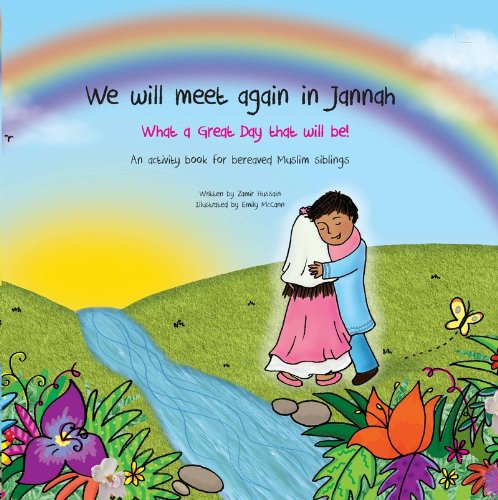
We Will Meet Again in Jannah: What a Great Day that will be! An Activity book for Bereaved Muslim Siblings by Zamir Hussain illustrated by Emily McCann

Standard
We Will Meet Again in Jannah: What a Great Day that will be! An Activity book for Bereaved Muslim Siblings by Zamir Hussain illustrated by Emily McCann

jannah

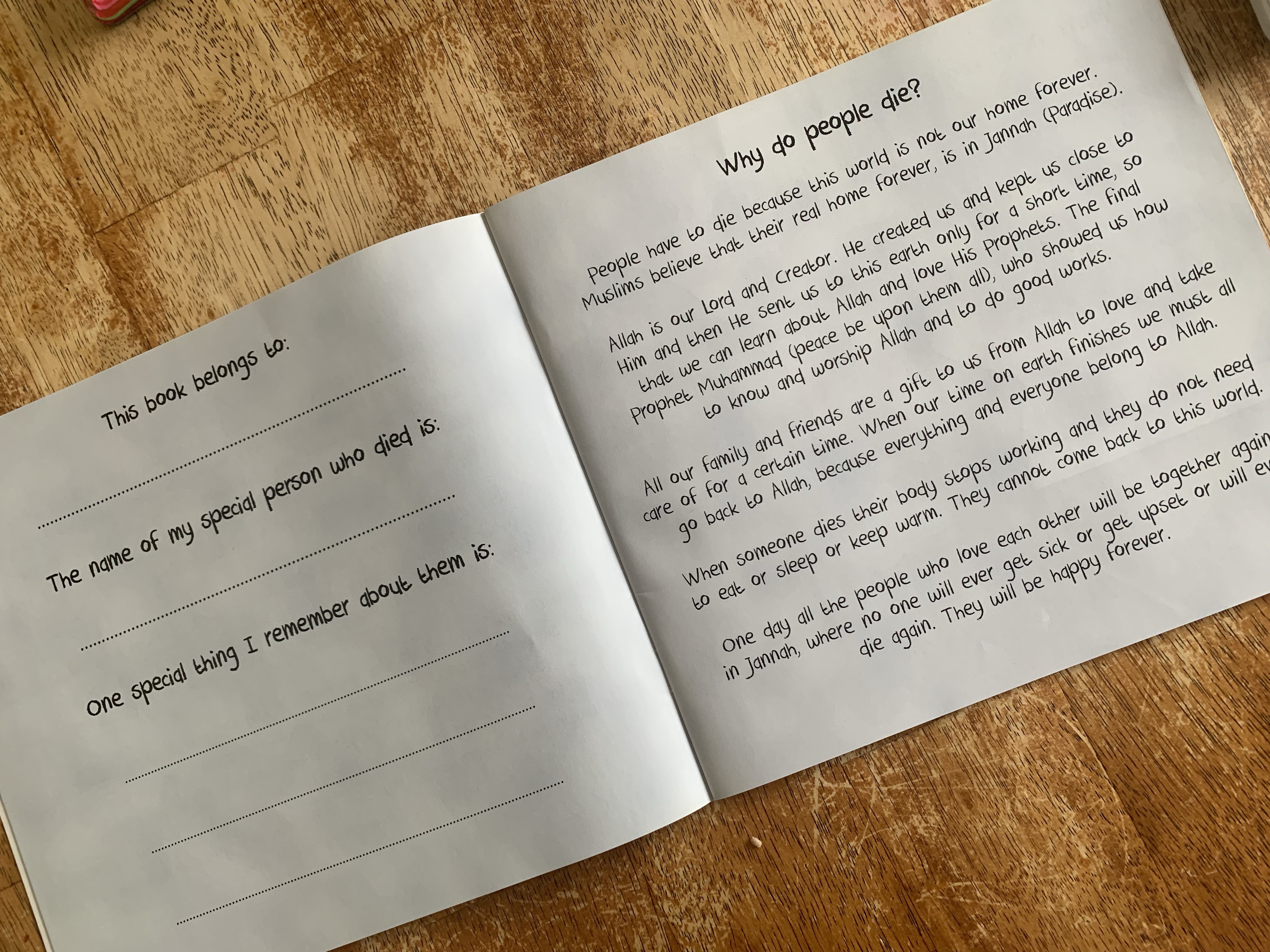
I don’t review workbooks, or a lot of non fiction books, but by far the most thematic requests I get asked about, are children’s books about bereavement.  The loss of a friend or loved one is just not a topic that you see covered very often, if at all.  Sure there are books about jannah, but they are more silly and framed as a reward, not about the loss felt that would precede paradise.  This 32 page paperback activity book is part reassurance, part encouragement, part discussion starter, and part remembrance all within a faith framework.  Much of the book is not sibling specific, perhaps a few tweaks and you could have a grandparent version, a parent version, an aunt or uncle version, etc.,  even as a parent you may consider adjusting the book as you share it if you are unable to find a specific book for your child’s needs.

img_3901

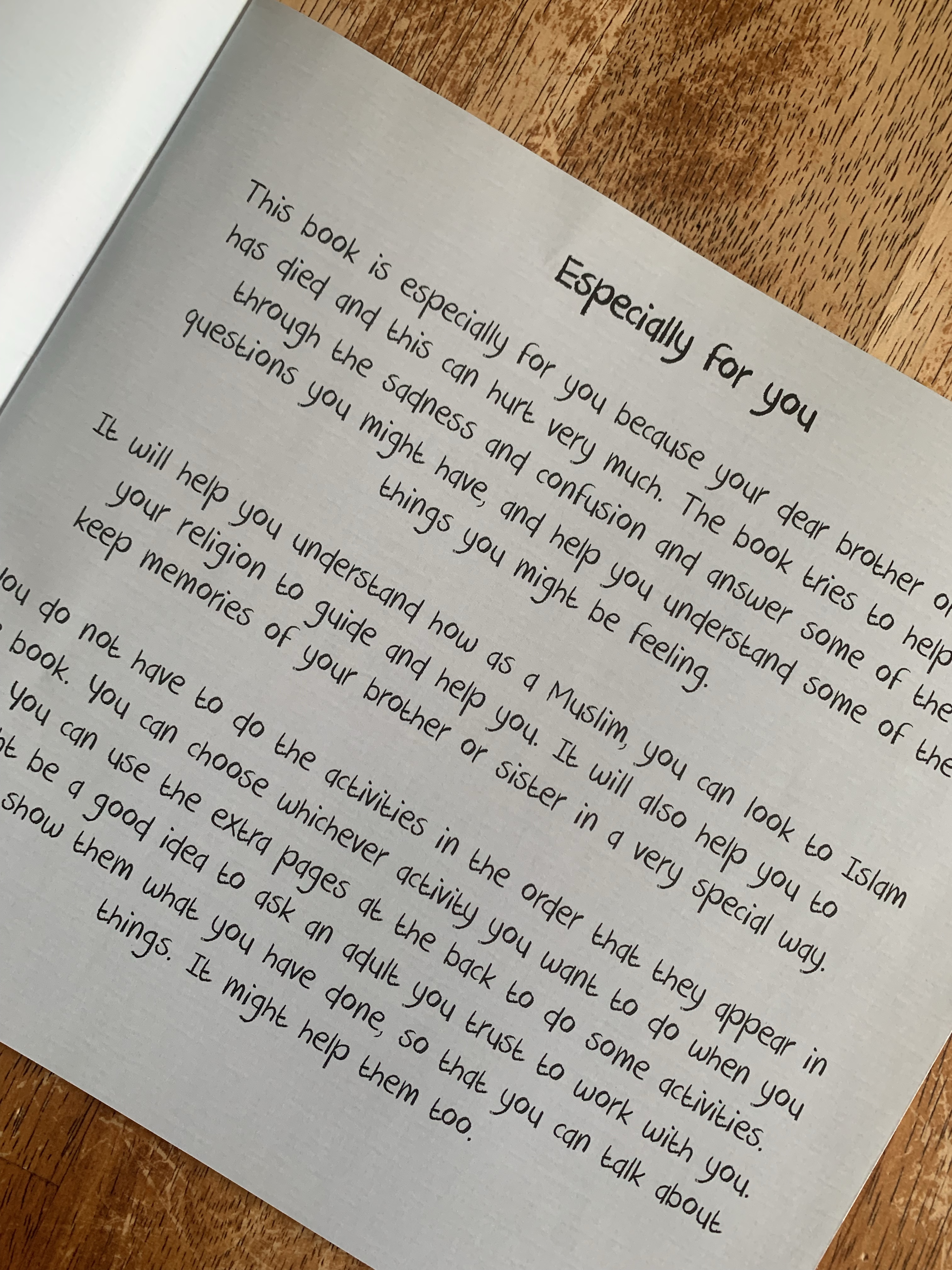
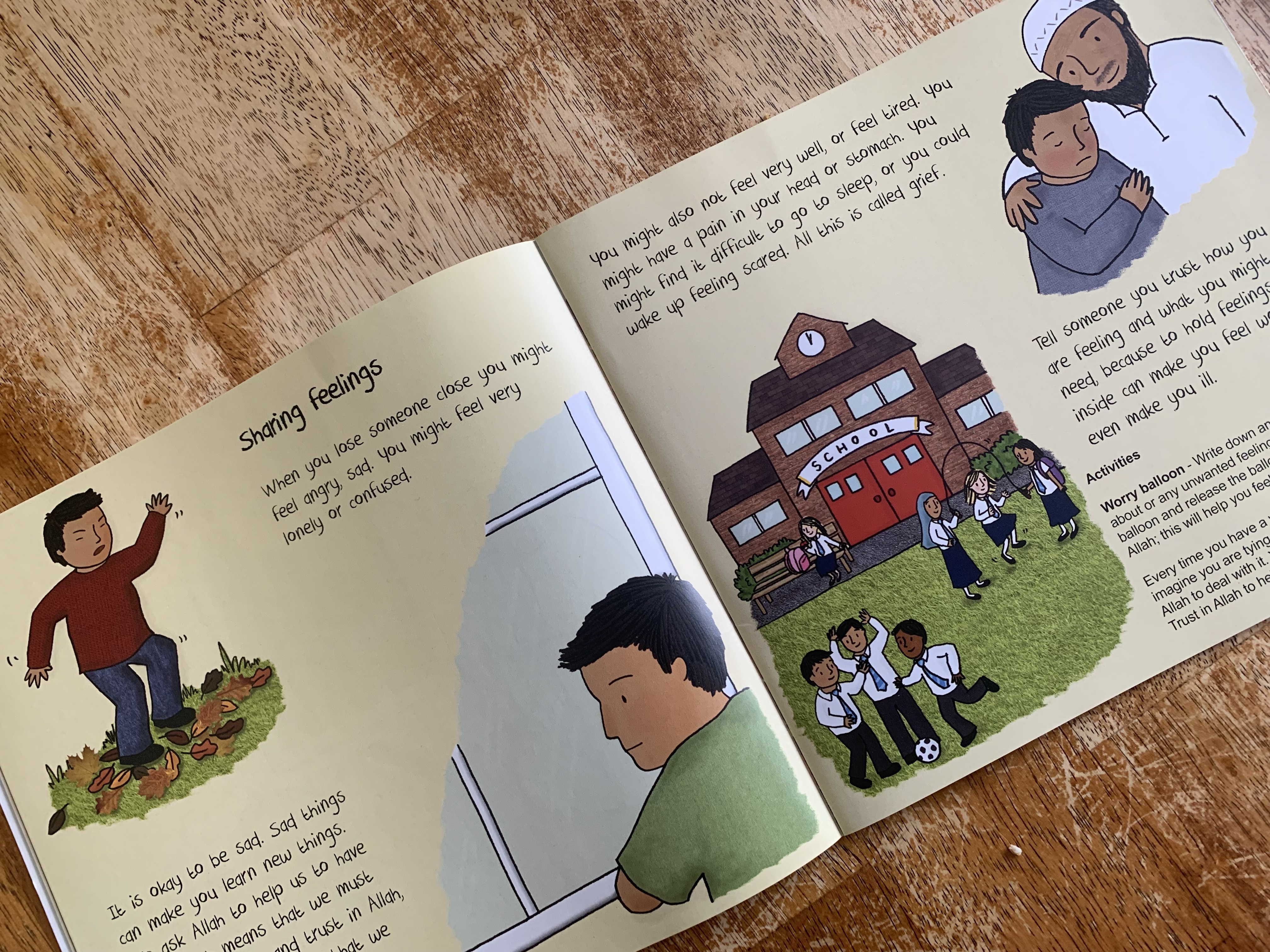
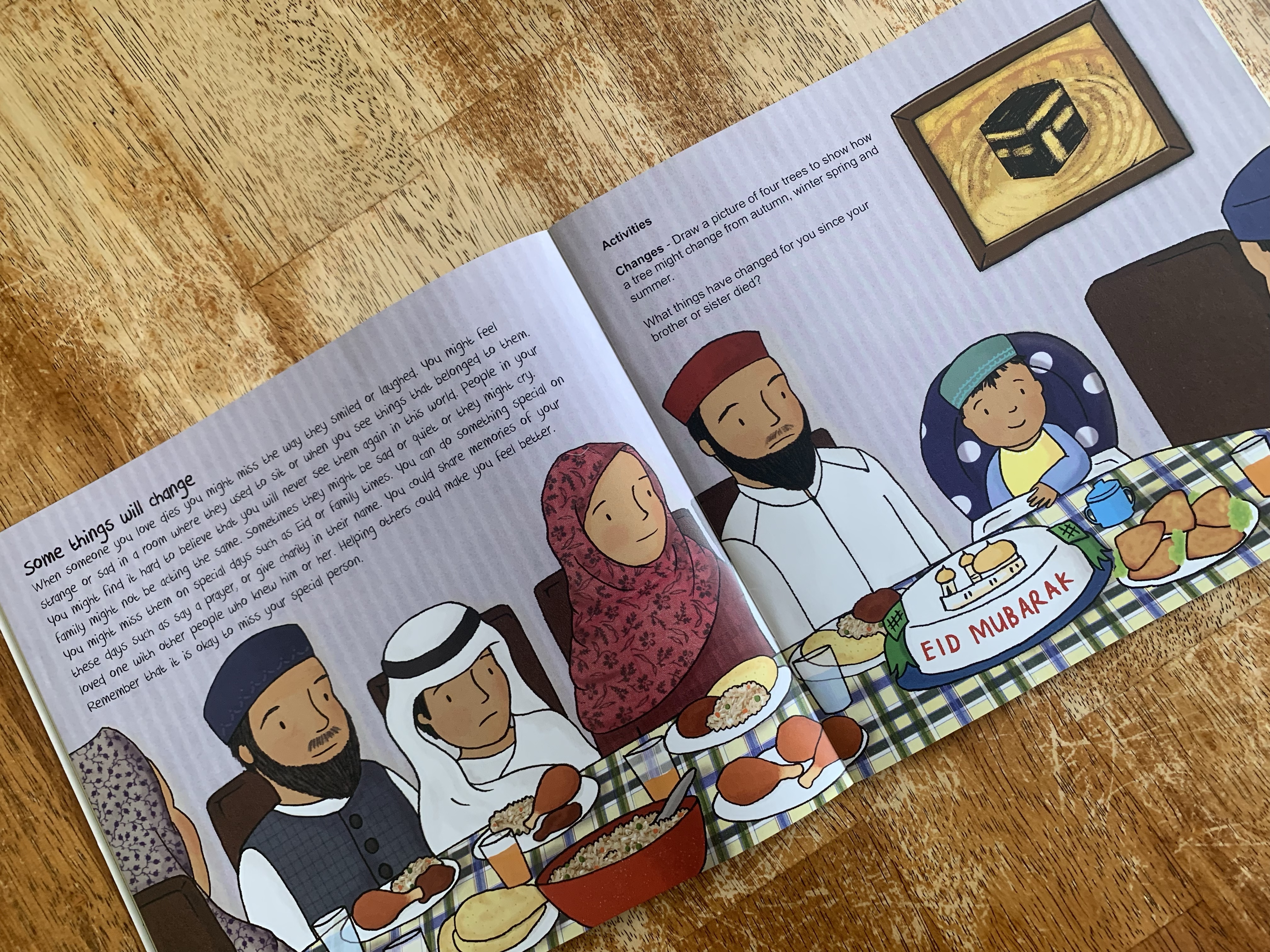
The book starts with the author talking to the reader and setting the tone about what has occurred and what is to follow in the book.  It then asks the reader to write or share who they are, who passed, and something special they remember about them.  It discusses why people die and then starts the two page spreads that address a theme and presents an activity to help you feel better, or to remember or celebrate the one who has died.  Topics include: You’re never too big to cry, It’s not your fault, Talking and sharing the pain, Some things will change other’s will stay the same, etc..  Some of the activities are wonderful and can be done in any order, at any time, and others, you may want to adjust.  The idea of releasing a balloon, for example, with your worries in it, is symbolically effective, but not so great for the environment.  The end of the book has additional resources on how to use the book, things to do with the child, further support,  additional resources, and Islamic guidance.

img_3902

I love that Islamic foundations and vocabulary are not just used, but explained in a very age appropriate, non condescending manner, through out.  I love that it is clear that you don’t have to talk if you don’t want to, that it is not the child’s job or responsibility to make the adults feel better, that nothing is anyone’s fault, and that there is no right or wrong way to grieve.

img_3903

I wish the book was larger in size and perhaps hardback so that the activities that require writing would have more space and ease in completing.  The text for the activities is also very tiny.  I also wish that the author’s qualifications for such advices was included.  I Googled the author to find out:  “Zamir Hussain is a Muslim Chaplain at Birmingham Children’s Hospital and has pioneered resources in Islamic health care. She has published several books for bereaved Muslim parents and siblings. She has also developed the first UK blended learning resource, including care plans and pathways for Islamic daily, palliative, end of life and bereavement care for paediatric staff. Zamir has worked as a Muslim Chaplain for both the Heart of England NHS Trust and Birmingham Children’s hospital for over five years, where she has also run training courses for the staff as well as delivering training and talks on care for Muslim patients to organisations around the country.”

img_3904

We need more books about coping, talking, dealing, understanding death for our children, inshaAllah this is a start, alhumdulillah.

Ruby in the Sky by Jeanne Zulick Ferruolo

Standard
Ruby in the Sky by Jeanne Zulick Ferruolo

ruby

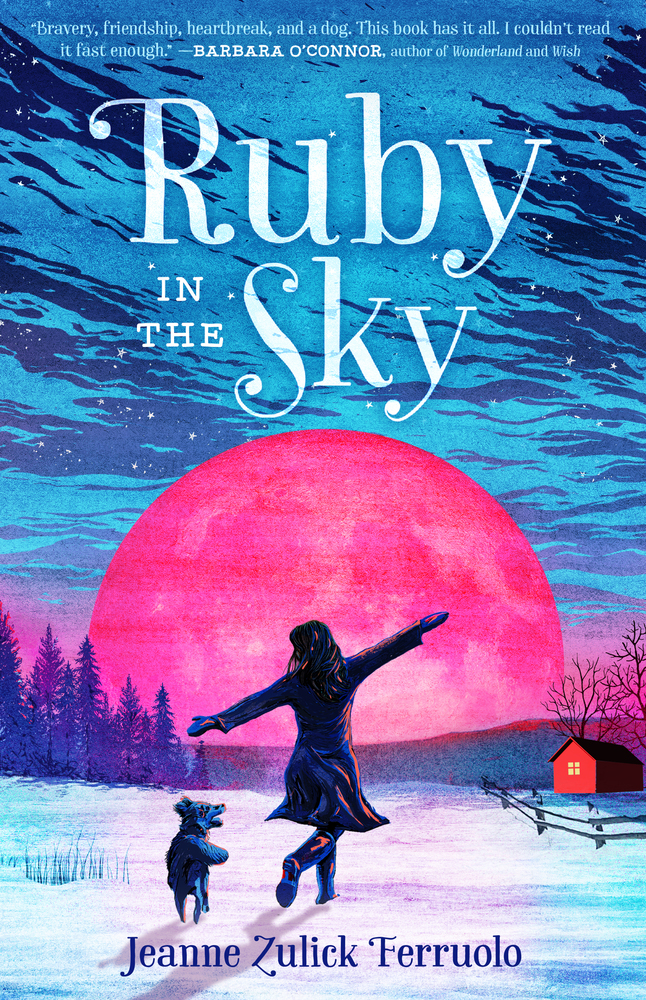
The author of this wonderful middle grades novel reached out to me after I reviewed her book A Galaxy of Sea Stars, to let me know that this book too has a Muslim character.  As we exchanged emails back and fourth I learned more about her work with Integrated Refugee and Immigrant Services in New Haven Connecticut (IRIS), and the impact the people she has met there have on her and her writing (the new paperback version of Galaxy has bonus content that reflects this).  Allies and advocates are gifts for Muslims and for our fictional representation.  The details and warmth of her Muslim character, Ahmad, a Syrian refugee, is seamless and accurate, and while this is not his story, his support of the main character helps normalize Muslims as friends and in daily life.  He takes time out for his five daily prayers, he refuses to shake a female’s hand, and he uses the word inshaAllah.  The story is Ruby’s though, and her journey pulls you in from the first chapter and leaves you cheering for her long after you close the book.  Over 295 pages (AR 4.1) you witness Ruby find her voice, dare to not be invisible, accept friendship, and help others.   

SYNOPSIS:

Ruby has just moved to frozen Vermont from their last “forever home” in Florida.  Originally from D.C., Ruby and her mom have been moving to places they have vacationed to try and find joy.  Since Ruby’s father, a police officer, died, the two of them have been broken and barely surviving.  The only constant is a cousin, Cecy, who helps them out and convinces Ruby’s mom to come back to her childhood town of Fortin, and to be closer to her.  The winter is bitter, the house is freezing, and even with Cecy arranging for Ruby’s mom to have a job, it only takes a day for Ruby’s mom to be arrested, fired, and for Ruby to be on her own.  With only a garbage bag full of belongings, and some thrift store finds for warmth, Ruby’s plan is the same as it has been in every other town they have landed in: keep her head down and be invisible.  Ruby’s dog, Bob, though has other plans, and when he takes off into a neighbor’s yard filled with ‘No Trespassing’ signs a meeting with Abigail takes place that will change Ruby.

Abigail Jacobs is known in Fortin as the “Bird Lady.”  She has a home, but lives in a shed on her property, dresses in layers of scraps and scarves, feeds the birds, and keeps to herself.  The rumor is that she killed her husband and daughter, everyone knows it, it could just never be proven.  There are also stories that she has a moon rock.  When Ruby meets her she is angry and cold, but the way she interacts with the animals and her knowledge of the moon, keeps her intrigued and even though Ruby’s mom forbids her from visiting Abigail, Ruby and her develop a friendship of sorts.

At school Ruby’s plan to go unnoticed is challenged by Ahmad Saleem, a refugee who lives with his uncle a grocery store owner and is teased by a few classmates for his accent and disappearances at lunch time when he goes to pray.  He is kind and and determined to help Ruby and immediately declares her his friend.  Ruby tries to avoid him, but eventually he starts to win her over.  With the upcoming wax museum, a Fortin favorite, drawing near, Ruby tries to explain to her teacher that they will be leaving back to D.C. before the final presentation, but Mr. Andrews isn’t letting her off and somehow she finds herself researching Michael Collins, the astronaut that stayed on the space shuttle alone to circle the dark side of the moon while Neil Armstrong and Buzz Aldrin took their historic walk. 

With the mayor singling out Abigail with his new ordinances, Ruby’s mom deciding not to take the plea deal and fight her case at trail, the short cold days, the desire to return to D.C., the wax museum approaching, and Ruby needing answers, Ruby at some point will have to stand up and speak out.

WHY I LIKE IT:

I love that the story unfolds in layers.  You don’t know where it is going, but the slow peeling away shows the complexity of people and situations.  The book doesn’t shy away from confronting stereotypes and looking beyond appearances.  I like that there is some discussion of Islamophobia, when Ahmad is overheard speaking Arabic for example, but the character that needs the most standing-up for is an elderly white woman.  The small pivot allows the book to avoid a familiar theme and shows the reader a Muslim shop owner helping the tattered woman that the town fears and resents. I enjoyed the strong reminder of how women and science and their careers have not been widely accepted until recently.  I think many readers will be surprised that much of Abigail’s rumors stem from her being a brilliant educated woman that society struggled to respect then and now.  I absolutely love the science and space aspects that bring Ruby Moon, her neighbor, and her class project together.

I wish there was a little bit more about her mom and her relationship at the end.  The disconnect in their relationship warranted the sparse information in the majority of the story, but I needed some hope for the two of them.  Same for the relationship with Cecy.  I get that Ruby doesn’t have a good relationship with her mom’s cousin, but as Ruby grew in so many ways, I wish that her appreciation of what Cecy has done for her and her mom would have also been realized in some capacity.

FLAGS:

Ruby being dishonest. Death, injury of a pet, physical assault, bullying, teasing, Islamophobia.  

TOOLS FOR LEADING THE DISCUSSION:

I probably wouldn’t focus an entire book club on this book, but I think it would be a great addition to a summer reading list.  The insight into a character trying to find herself within her own family and experiences with connections to history and science would be a benefit to any child to read and reflect upon.

Baddawi by Leila Abdelrazaq

Standard
Baddawi by Leila Abdelrazaq

Baddawi-cover

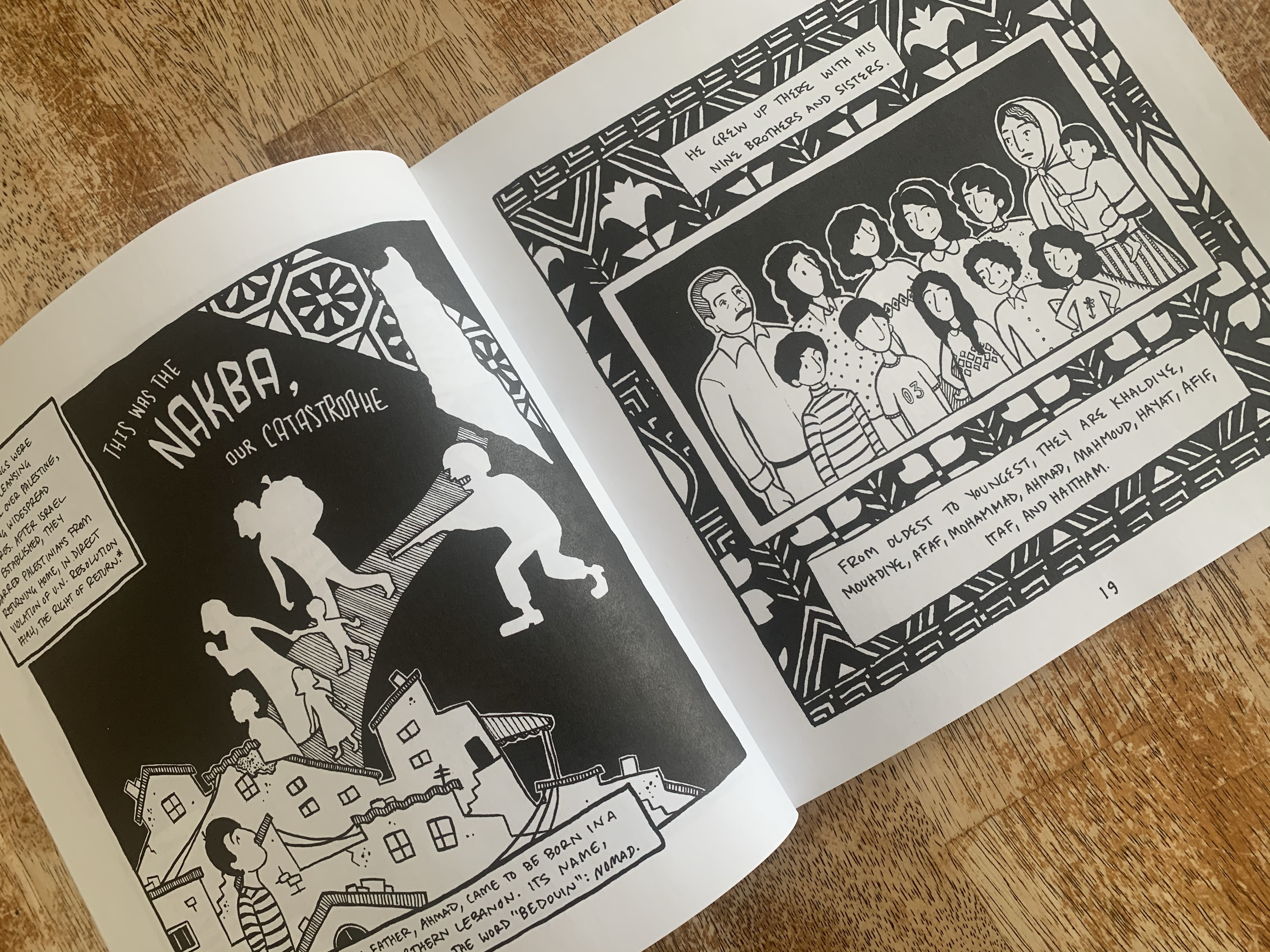
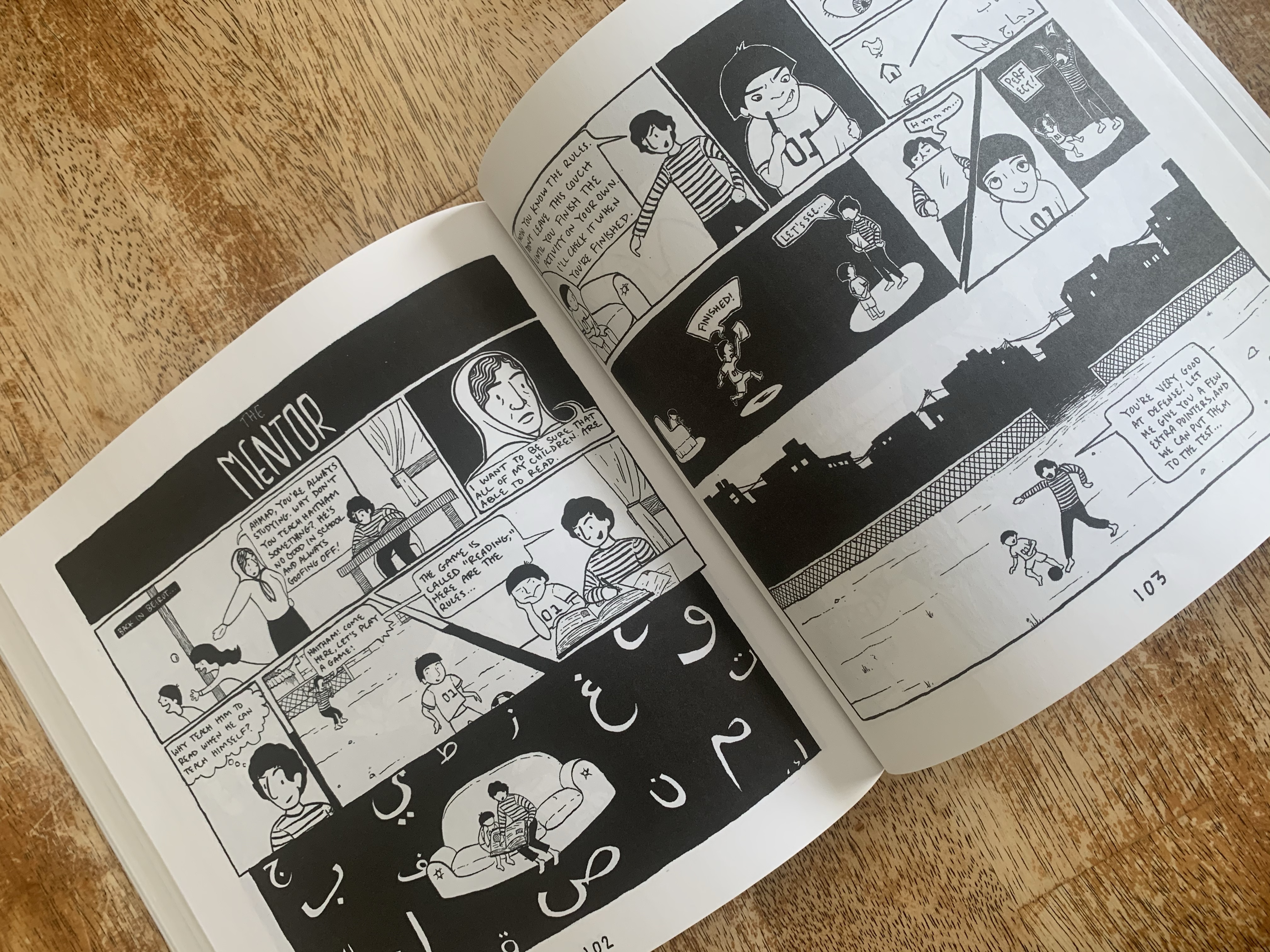
This 8.5 x 8.5 middle school graphic novel biography tells a powerful story of a young boy coming of age and striving to find his place in the chaos of the Nakba and its aftermath.  Over 128 pages the reader will learn and be outraged about the displacement and genocide of so many Palestinians as they see the events through Ahmad’s eyes and relate to his dreams and experiences despite the terror around him. The book has violence, destruction, death and mentions rape, yet the humanity shines through as it is also heartfelt and memorable.  I had my 14, 12, and 10 year olds read it and we have discussed it at length in context to what they already know about Palestine and the ethnic cleansing occurring.  It is a seamless mix of history and character driven narratives brought to life by the black and white illustrations of the author/illustrator’s family history.

img_1656

SYNOPSIS:

There are 10 children in the author’s father’s family, and her father, Ahmad, was born in a refugee camp in northern Lebanon, called Baddawi.  The story starts on October 29, 1948 when Safsaf was ethnically cleansed.  Ahmad’s father, the author’s grandfather had been in Akka at the time of the massacre, and her grandmother hid from the Israeli soldiers, the family, once reunited, would escape for a refugee camp, hoping that they would one day return.

We first get to know Ahmad as he starts first grade in Baddawi.  Things do not start well for the little guy as right away he gets teased by other students, his class is too large so he is selected to be joined with a girls class, and he doesn’t have soccer cleats so he isn’t allowed to play soccer, luckily he gets two good crayons, unlike his friend who gets a white one.  Ahmad is identifiable by his striped shirt that he wears throughout as a nod to Handala, the boy depicted with a striped shirt with his hands clasped behind his back and his face not shown.  The artist said his face would be revealed when Palestine was free, sadly the artist, Naji al-Ali passed away, and Palestine is still occupied.

Ahmad desperate to purchase soccer cleats devises a business plan that his mother takes as gambling and quickly puts an end to, in exchange she offers to pay him if he helps her collect and prepare za’atar.  It isn’t as fun, or as lucrative, but they family is busy packing up to return to Palestine.  Unfortunately the Naksa, the setback, the six day war occurs, and more Palestinians are ethnically cleansed and the families cannot return. Ahmad and all those in Baddawi carry on, playing, celebrating Eid, trying to claim normalcy.  The camp however, is not safe and soldiers raid the camp killing PLO leaders and innocent people in their way.  With no option but to keep on keeping on, these acts of violence are often taken in stride. It is so hard to believe, but what else can they do, the children still play, deal with bullies, and cope with universal struggles in addition to being shot by rubber bullets, and fearing cluster bombs and shellings.  At one point Ahmad and his siblings are left in Baddawi to finish school while his parents are in Beirut.

When the family is reunited in Beirut, Ahmad is in a better school, but violence follows as Mossad agents start raiding PLO homes in Lebanon.  Ahmad goes back and forth between Beirut and Baddawi, wherever he can go to school.  His favorite library is the one at the American University in Beirut and he hopes to attend school there, but without connections, he is at a loss to come up with funding.  His intellect finally lands him an opportunity to leave the Middle East to pursue higher education, he ends up in the United States, and when the story ends, readers are left hoping that everything works out even knowing it will be 10 years before he can return home to see his family.

img_1657

WHY I LIKE IT:

I love that the harsh horrific life is not shied away from in a war, but the little things are just as important in shaping and showing Palestinians to be resilient and culture rich.  I love how the concept of Handala is included and amplified.  The book is at times funny, and at other times devastating.  The connection to the characters is pretty remarkable, in such a relatively short book, and I am fairly confident it will be pulled off the shelf and thumbed through often.  I really wanted to know if the girl in the book that Ahmad left behind ended up being the author’s mother, or if he married someone else, but I couldn’t find it by Googling.  This book is truly powerful, and I highly recommend it.  There isn’t a lot of religion, the family is shown praying on Eid and celebrating.  It mentions the diversity in Beirut, but nothing too detailed.  Similarly, there isn’t a lot of political detail.  There is a glossary at the end, some actual photographs of Ahmad and his family.  At the beginning of the book there is a preface about Handala and how Ahmad represents more than just her father’s experience as well as information about the tatreez patterns on the pages and a map.

img_1658

FLAGS:

There is violence, torture, killing, death, bullying, and possibly gambling.  The book mentions that women were raped, but it isn’t detailed.  The war is ever present and depicted, but it isn’t sensationalized.  Ahmad and a girl study together and the family wants them to get married, but Ahmad opts instead to leave for school, nothing inappropriate.

img_1661

TOOLS FOR LEADING THE DISCUSSION:

This book might not work as a book club selection, but I hope middle school children and their teachers or parents will encourage them to read this book and think about it.  Imagine if it was their homes that were taken, imagine what they would do, and how they would manage, and to be aware that it is still going on and that we cannot be silent.

img_1660

City of the Plague Gods (Rick Riordan Presents) by Sarwat Chadda

Standard
City of the Plague Gods (Rick Riordan Presents) by Sarwat Chadda

I was excited to hear that another Rick Riordan/ Rick Riordan Presents books featured a Muslim character and was anxious to see how the multi god genre would account for Islamic tenants.  But I was completely giddy (that’s putting it mildly), when I found out that Sarwat Chadda is aka Joshua Khan, author of the Shadow Magic Series and that this book has practicing Muslim Characters front and center.  In his own words, “it has taken be twelve years and eleven books to get around to writing a Muslim tale.” That isn’t to say that it is Islamic fiction, there is gay romance that is there if you want to see it and has been confirmed by the author outside of the book, there are  numerous fake gods in Mesopotamian mythologies, there is death and violence, but it is fun, oh so fun.  It has salat, and going to the mosque, and an imam, and saying surahs and discussing jihad an nafs, and sadaqa and it says the shahada in Arabic and English, it presents Muslims authentically in their words and actions, and it isn’t just the characters’ backstories it is who they are and how they see the world.  The book is an AR 4.5 with 383 pages and like all Rick Riordan books, full of humor, sentiment, family, growth, and ancient mythology.

SYNOPSIS:

Sikander “Sik” Aziz is 13 and when not at school is at his family’s NYC deli working away.  The son of Iraqi immigrants, he is dedicated to helping his family especially since his older brother Muhammed, Mo, has passed away.  Mo’s lifelong friend Daoud has moved in to Mo’s old room and helps out in the deli, but is really an aspiring actor who does anything to get out of work.  When the book opens, Sik and Mo are closing up when the deli is attacked by rat faced men demanding to know where it is.  Sik has no idea what they are talking about and the two demons tear apart the family restaurant until a mysterious girl appears and sends them and their stream of insects, disease and destruction from the deli.

The next day at school Sik’s injuries are healing remarkably quick and he and the new girl, Belet, find themselves getting sent to the principal’s office together.  When he learns that Belet’s mom is Ishtar, goddess of love and war, or rather passion, and was the girl at the deli, he can no longer deny that the tales Mo used to tell him about Gilgamesh, Enkido, Nergal, Kasusu, and Mesopotamian mythology are very real.  

As Sik, Belet, Ishtar, Daoud, and an army of cats, Lamassu, learn that the plague god Nergal is behind what is going on and that he plans to destroy Manhattan, it is up to them to stop the destruction, save Sik’s parents who are in the hospital, and ultimately the world.

WHY I LIKE IT:

The book was written before Covid 19 and the idea of a plague or pandemic was not yet on everyone’s mind, but when it was published in 2021 it sure become that much more relatable and close to home.  I love that some of the reactions of the characters and community to being around infected people and the backlash was so accurate to what we have all seen since 2020.  

The way that the oneness of Allah swt and the multi fake gods is reconciled is that the Mesopotamian cast are old and powerful, but not ALL-powerful, as Ishtar tells Sik, someone had to create us.  She also says that today people might call them something else.  It seems to leave open the idea that they have abilities and because of their abilities people worshipped them and the name stuck, not that they are creators or even claim to be. The concept of being between alive and dead is explored when Sik visits Kurnugi, he asks where Muhammad Ali is and Mo tells him he isn’t there, he went straight to Jannah.  It might not be a clear explanation, but it at least hints that Muslims in real life have a different view than the mythological one being explored.

I love the snark, and the humor, it flows so well and incorporates pop culture with ancient references very smoothly. I love that they say InshaAllah and AllahuAkbar and when Sik is presumed dead at one point and awakens he can’t go to the mosque because they are having his janaza and it would be awkward.  I love that there is a glossary that denotes if words are Arabic, Islamic, or Mesopotamian.  Muslim kids reading this will feel so seen and proud to be openly Muslim and inspired that they too can be heroes.

FLAGS:

Mythology, fighting, death, the use of the term badass.  Daoud and Mo’s relationship.  Daoud and Mo became friends in 5th grade and when Sik sees some photos of his brother that Daoud had taken, he says that he sees love.  When Sik and Mo are reunited in Kurnugi, Mo hints that there is more to the friendship, it is subtle.  In online interviews Chadda says they were in a romantic relationship.  It is not explored or heavily detailed.  The only other romance mentioned is that Gilgamesh in his prime refused Ishtar.

I think fans of Rick Riordan already know that there is going to mythological characters, creatures, battles and violence and a character or two that are LGBTQ+, some possible romantic angst between main characters, death, and unfaithful flirty gods.  This book is much “cleaner” than most, so 4th graders and up that are fans, will be fine reading this.  

TOOLS FOR LEADING THE DISCUSSION:

I don’t know if I could do this as a book club selection.  The romance is minor, but once you sense it and know it is there, it is a factor.  I don’t know if it would have to be discussed and how an Islamic school would want me to handle it, because both Mo and Daoud are practicing Muslims.  I think the book does a sufficient job of not committing shirk and shirk like messages with the mythology, but as always with these types of books it is a judgement call if the children (and their parents) can understand where the lines of fiction are and where they stand.

Fandom: https://riordan.fandom.com/wiki/City_of_the_Plague_God

An Emotion of Great Delight by Tahereh Mafi

Standard
An Emotion of Great Delight by Tahereh Mafi

emotion

This 256 page YA OWN voice book is a real and raw look at a character and the many layers of life weighing down on her.  At the center of it all is a strong Muslim teen dealing with post 9/11 bigotry, the shattering of her family, toxic friendships, and a broken heart.  It is a love story, but it is so much more, as the protagonist’s voice draws you in to her crumbling world from the very first page and has you begging for more when the last page is read.  So often in Muslim-lead-mainstream-romance-themed novels, I want there to be introspection at the choices that the character is making and the internal processing of navigating their wants with their beliefs, and this book surprisingly does it.  There are some kissing scenes, cigarette smoking, cosmo magazine headlines, and waiting for her father to die, but not without introspection. Shadi reflects on her smoking quite often, she questions the repercussions of her actions, and she analyzes her father’s faith and approach to Islam as she forges her own relationship with the deen.  There is mention of a Muslim character drinking, doing drugs, hooking up, and it mentions he had condoms in his car, just those exact phrases, nothing is detailed or glorified, just stated.  There are also threads of mental health, self harm, death, and grief.  The characters are genuinely Muslim and some of their experiences are universal, and some specific to the faith, culture, and time.  Muslims and non Muslims will enjoy the book, and I would imagine relate to different things, but find it overall memorable and lingering.  For my Islamic school teens, I’d suggest this book for 17/18 year olds to early twenties.  It isn’t that they haven’t read more graphic books, but to be honest, Shadi has a lot going on, and if being close to Ali can lighten her load and help her find hope and joy, I’m all for it.  I know it is “haram,” but it is fiction, and it will have readers rooting for them to be together, not a message you may want to pass on to your younger teens.  As the author says in her forward, “we, too, contain multitudes.”

SYNOPSIS:

The layout of the book bounces between December 2003 and the year before.  In a previous time, Shadi’s life was easier, her brother was alive, she had a best friend, her Iranian immigrant Muslim family may have had stresses and issues, but they were a family. In 2003, Shadi is largely forgotten by her parents, her brother is dead, her father is close to death, her mother is self harming, her older sister preoccupied, and as a high school student Shadi is both falling and being crushed by her heavy backpack both metaphorically and literally.

The story opens with Shadi being approached by a police officer wondering why she is laying in the sun, he thinks she is praying, and she doesn’t have the energy to be angry by this assumption, she is exhausted, and doesn’t want to cause any waves that might get back to her fragile mother and cause any more stress than necessary.  So she drags herself up, and begins the walk to her college level math class miles away.  The sun is short lived and the rain begins to pour, she knows no one will come to pick her up.  Her parents have long ago stop being present in her life.  She once had a best friend, but that relationship, as toxic as it was, also has ceased to exist.  So she walks, and she is drenched, and she falls, so she is now soaking wet and bloody.  A car slows down to presumably offer her a ride, but then he speeds off drenching her in a tidal-wave.  The scene is set for the tone of the book. Shadi is drowning, we don’t know all the reasons why, they unfold slowly, but we know that it is going to get worse, her phone is nearly dead and her sister has just called to let Shadi know her mother is in the hospital.

I don’t want to detail my summary as I often do, because the way the story unfolds, would really make any additional information given act as a spoiler.  The book is short and a fast read, but along the way the introspection to the chaos that is Shadi’s life, makes it impossible to put the book down.  Shadi will have to confront her crumbling life and find away to reach toward hope.  She will have to keep walking to avoid drowning and along the way cling to the few precious things that give her joy: an emotion of great delight.

WHY I LIKE IT:

I really enjoyed this book.  I loved the Islam and real approach to her volunteering at the mosque and calling out racism within the community and diving deep in to understanding is Islam more than just rules and toeing the line.  It was a great mirror for so many nuances in real life, that I will probably re-read the book again in the near future, to enjoy it all.  I absolutely love the unpacking of the toxic friendship.  When women tear each other down under the guise of caring it is brutal, and the acceptance and growth that Shadi is struggling with in regards to her best friend of six years, Zahra. who is also Ali’s sister, is a reminder that sometimes walking away is the only choice.  

The two criticisms I have of the book are: one-that the book is too short, I wanted, no, I needed more.  And two I didn’t understand why Ali’s family and Shadi’s family were no longer close.  I get that Shadi cut Ali out of her life and Zahra and Shadi had a break, but Ali/Zahra’s family still care for Shadi and she for them, so what happened between the parents? It seems that the death of a child would draw the friends out and make them protective, not push them to being aloof.  It seemed off to me and major plot hole.

FLAGS:

As I mentioned above: kissing, smoking, drugs, hooking up, referencing condoms, cosmo headlines, self harming, grief, death, alcohol.

TOOLS FOR LEADING THE DISCUSSION:

I don’t think even high school could do this as a book club selection, because you really want to ship Shadi and Ali.  If you had like an MSA book club then I think this would be a great choice.  I would love to hear teens’/young adults’ thoughts about Shadi’s view of religion, her fathers approach, and how they view passing the deen on to their children.  I think it offer great role-play scenarios in empathy and how you’d react in real life to finding your mother struggling, your best friend taking off her hijab and being so jealous of you, the bullying, the assumptions, understanding your father and where to assign the blame for such a traumatic event that claimed your brother’s life.  There is so much to discuss, and I hope at some point I find the right forum to chat about this book and listen to other’s perspectives about it.

The Cat I Never Named: A True Story of Love, War, and Survival by Amra Sabic-El-Rayess with Laura L. Sullivan

Standard
The Cat I Never Named: A True Story of Love, War, and Survival by Amra Sabic-El-Rayess with Laura L. Sullivan

img_8275

This amazingly captive 370 page, nonfiction autobiography details life during 1992 through 1995 in Bihać, Bosnia through the eyes of a 16-year-old Muslim girl.  The horrors of war, her determination to survive, a lifesaving cat, and her coming of age, all come together to make for a compelling read that is both reflective and inspiring.  I had a hard time putting the YA/Teen book down even knowing that she would obviously survive and being vaguely familiar with the Serbian attacks and ethnic genocide that occurred.  In an easy to read flowing first person narrative, somehow the book avoids being overly political, while still managing to convey the role of the media, the international world, and the hateful mindset that turned friends and neighbors into enemies.  I think teens, 15 and up, should spend some time with this book as well as adults, it really serves as a wake up call to how fragile nations can be when we turn on one another.  We must know the past, to as not repeat it.

SYNOPSIS:

The book starts out with Amra on a train returning from Belgrade where she took tests as she is one of the brightest kids in the region.  Immediately it is made clear that she is incredibly smart, and independent as she travels alone into the heart of Serbia.  The war has not yet come, but on the return trip Serbian Nationalist soldiers board the train and she is desperately afraid that she will be sexually assaulted.  Fortunately, she does not “look Muslim” and the soldiers physically leave her alone.  Her naivety, however, is lost as she realizes the war is closer than her family thinks.

Her family lives in a beautiful home that they designed and saved for, they wear hand me down clothes and watch expenses as a result.  Amra has a younger brother Dino, her older brother seemed to have some disability and has passed away, her parents are honest and value education. Her family is everything to her, they are incredibly close knit.  They are ethnically Muslim, but do not practice.  She mentions it regularly, that they are being attacked for a religion they do not practice.  They wear bikinis and date, eat pork and drink alcohol, they identify first as Bosnian and then as Muslim.  But they do identify as Muslim and they suffer for it, over and over and over again.

The story sets the stage by showing how diverse Bihać is and how Serb, Croats, Bosnians, Muslims, Christians, Catholics all live together.  It is Amra’s birthday, it really isn’t, but they could not afford the food and gifts at the time of her 16th birthday, so they are celebrating it now with a sleepover with her closest life-long friends.  When Amra and her father go in to town to get the cake, they see tanks rolling in, refugees from other cities seeking safety and Amra and her father start handing out whatever money they have and take a couple home with them.  At the party, they don’t discuss what they have seen, but when Amra’s best friend, a Serb, cannot spend the night, the parties tone changes and the mood is set for the next chapter in Amra’s life.

At school she shares how Muslims are treated and forced to take Russian, while the Serbs are encouraged in English, while the children get along as many are mixed ethnicities, there is rampant favoritism from the adults.  When one day only the Muslims arrive at school, the Serbs have all secretly evacuated in the night, there is no more denying that the war has come to Bihać. With the comfort of her cat, who she simply calls, Maci, cat in Bosnian, and his “luck” to somehow delay her or warn her of bombings, she and her family endure the first wave of attacks by hunkering down in a cousins basement.

Ultimately they decide that they cannot stop living.  Death is striking at every turn and no one is more safe in one location than another and the family returns home.  They still have electricity at first, but it soon disappears, the phone lines stay, but food starts to get scarce.  At times the family goes out of the city to stay with family on a bee farm and survive off the honey, but it is not safe there either.  School resumes a few days a month, but all the Muslim’s records have been “lost” and paper is in short supply.

Over the four years of the war, Amra’s aging diabetic father is called to fight, an explosion at the house renders her mother deaf, friends and family are killed while somehow the day to day of surviving continues.  Amra graduates from high school, works as a tutor when she cannot pursue her own education, and finds work as a translator for international workers after she teaches herself english.  There are times she is so malnourished her hair is falling out, her gums are bleeding and she blacks out, and there are times when the family is able to trade honey for food and can open a small store in the corner of their house.

The resiliency and heartache is not something a review can capture, you feel for Amra at every turn, both in delight as well as in fear and devastation.

WHY I LIKE IT:

It has a map! Seriously, thank you.  I love that the book is so emotional, it doesn’t get hung up on dates and events, but how whatever is happening affects Amra and her view of the world.  As a character, ultimately a person, she doesn’t stay down, she is capable and strong, which is so remarkable in the best of times and absolutely heroic living through this war.  The cat is a remarkable character, and while at times it seems forced, it is a great thread that keeps her story being relatable on all levels.

There are a few chances for Amra to leave her family and get away to safety, the first time it is presented to her she would have to change her name, she decides she cannot.  This is a testament to her love of her family, but also to her identity.  She is proud of who she is, which is mind blowing to me.  I talked about it in my review of The Day of the Pelican, about how Bosnian refugees I got to know in the late 90s knew nothing about Islam, but were being slaughtered for being Muslim.  Repeatedly she talks about how in Bosnia there were some conservative traditional Muslims, but that most of them are not, her family is not.  Yet, my heart truly cried out when her and her mother are trying to get food from drunk soldiers and are certain that they are going to be raped or blown up by land mines and she says the only prayer she knows.  One that she learned after the war started: “Auzubillahi Minahs Shaitan ir Rajeem.  Bismillah ir Rahman ir Rahim.  Rabbi Yassir wa la Tua’ssir, Rabbi tammim bil khayr.  I seek refuge in Allah from Satan in the the Name of Allay the Most Gracious, the Most Merciful.  O God make it easy and don’t make it difficult, O’ God, complete this with good.”  

She explains the cover of the book at the end, “the book’s jacket presents my authentic self, a liberal Muslim teen, yet a Muslim who was still so profoundly hated.  The jacket illustration serves as a reminder that the hate is a product of its perpetrators rather a reflection of its victims.

FLAGS:

The book is about war, it has rape, sexual assault, death.  At times it is descriptive and detailed, not sensationalized, but powerful.  There is kissing, boyfriends and girlfriends, nothing lewd.

TOOLS FOR LEADING THE DISCUSSION:

I learned about this book from Lovely Books Podcast when she interviewed the author: https://lovelybooks.buzzsprout.com, it is a great introduction along with many of the interviews and articles that Dr. Amra Sabic-El-Reyess has done.

I would love to do this as a book club, but I think it would have be done on a high school level, not middle school.  The dialogue and understanding I would imagine surrounding this book would be compassionate and thoughtful.  I hope those leading book clubs for older students and even adults will consider this book.

Ahmed Aziz’s Epic Year by Nina Hamza

Standard
Ahmed Aziz’s Epic Year by Nina Hamza

img_7992

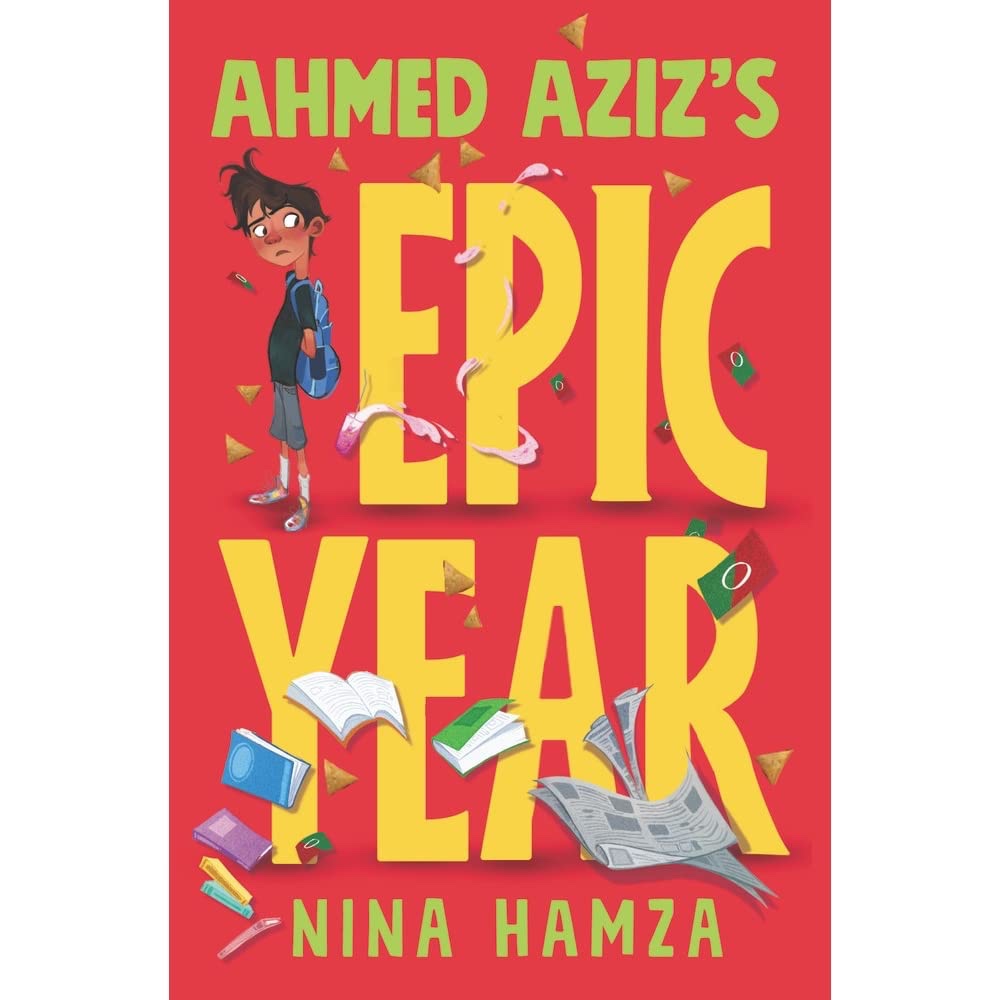
There is such a shortage of male Muslim protagonist middle grades books that I have been waiting quite impatiently to get my hands on this one, and alhumdulillah, it didn’t disappoint.  I’m not sure if it qualifies as OWN voice, being it has a female author, but the authenticity in the little religious and cultural details would suggest that it should.  The 320 page book is meant for ages 8-12, but the weight of Aziz’s father’s illness, the plot pivoting around three classic books (Holes, Bridge to Terabithia, and From the Mixed-Up Files of Mrs. Basil E. Frankweiler), and the clever reflections of Ahmed along with his quick wit and thoughtful choices, might make the book’s sweet spot be 5th to 7th grade readers (as well as us moms who are suckers for elementary literary references, teachers who are heroes, and kids realizing their potential).  The book has a bully, but is clean and wonderful, and I thoroughly enjoyed it.

SYNOPSIS:

Twelve-year-old Ahmed is leaving the only home he has known in Hawaii to move to Minnesota.  His dad has Cirrhosis, a result from a rare genotype of hepatitis C, and Minnesota is one of the top options for treatment.  The family is nervous to move in general, but more so to move to Minnesota.  It is where Ahmed’s dad Bilal grew up, and where his dad’s younger brother passed away at age 12. Ahmed’s younger sister, Sara, is perhaps the only one excited for the new adventure.

The family arrives and is greeted by Bilal’s old friends, and when school starts he realizes one of his dad’s best friends, is his English teacher, and somewhat of a legend at the school in getting kids to try and beat her at an end of the year quiz show like competition.  The school is also where Bilal and his brother Muhammed went to school and a picture of Muhammed hangs right above Ahmed’s locker.  The biggest stress at school is Jack. Jack who lives a few houses over, Jack who rides the same bus, Jack who is in Ahmed’s English group, and Jack who has a lot of followers at school.  Jack is a bully.  One who makes Ahmed’s life miserable at every turn, not just socially, but even the police.

Ahmed is a laid back kid that doesn’t like to read, but loves words, who wants to blend in yet is the only brown kid in a sea of white, who enjoys attending  Jummah salat, but ultimately hates going because of the shoe chaos afterwards.  Ahmed has no intention to read the books assigned in class, but some how the three classic books assigned do get read, and  Holes, Bridge to Terabithia, and From the Mixed-Up Files of Mrs. Basil E. Frankweiler tie together and weave in and out of Ahmed’s epic year.

I don’t want to spoil much, but Ahmed’s dad is in the hospital a lot, there is a lot of plotting to survive being bullied, as well as getting revenge on the bully in Ahmed’s own way without involving parents.  Ahmed slowly grows to love Minnesota, his small circle of friends, and his school while learning about his uncle and the kind of person he wants to be as he grows up.

WHY I LIKE IT:

Ahmed is Muslim and while his mom prays five times a day and his dad is an occasional prayer it doesn’t specify how often Ahmed prays or how he feels about religion, other than going for Jummah.  At first Ahmed thinks he is being bullied by Jack because he is brown, his mom is an immigrant from India, his father the son of immigrants from India, but learns that Jack picks on anyone new.  I like that for as much as Ahmed hates stereotypes and assumptions, he acknowledges that he makes them too.  I like that Ahmed doesn’t like to read, but is smart, and eventually comes around to reading.  He is tech smart and very mature in how he views the world and himself in it, cares for his sister and parents, handles things on his own, and builds others up.  Ahmed is a good kid, not in that he doesn’t make errors or is a teacher’s pet, but in that he has a really good heart and a good head, and I think would make anyone better for knowing him.  I love that the book is smart too.  If you have read the three books mentioned you will love the discussions and questions about the books, if you haven’t read them, you will be tempted to after you finish this book.  I wish there was a tad more religion, there is a sprinkling of culture, primarily the mom’s tragic cooking, but a bit more religion in a book that has illness and death would seem natural to me.  The storytelling is superb, I was so curious where the father’s parents were, but alas it did answer that, I would have liked it sooner, but I was glad it made it in none-the-less.  I would have liked a bit more from the parents about why they wanted Ahmed at his dad’s old school, or how they were comfortable constantly leaving the two kids home alone at night, but Ahmed like I said is pretty mature.  I particularly love the brother sister relationship.  Ahmed is a good older brother and it reminded me in some ways of my older brother, which made my heart warm, good siblings are a blessing.

There are multiple climaxes, but while I expected the dad’s health to be a big one and Jack getting what was due to be a close second along with the outcome of the literary contest, I was not prepared for the level of Jack’s torture to climb to, and was pleasantly surprised by the unresolved thread of Jack and Ahmed’s future relationship.  Things in life don’t magically resolve and I love when middle grade novels keep that in mind.

FLAGS:

None

TOOLS FOR LEADING THE DISCUSSION:

I would absolutely do this in a heartbeat for a middle school book club selection.  Even if the book is more middle grades, I think the students will enjoy it and be surprised by the emotional investment the dad character extracts.  I think they will also benefit from the literary references, relatable characters, and the overall great storytelling.

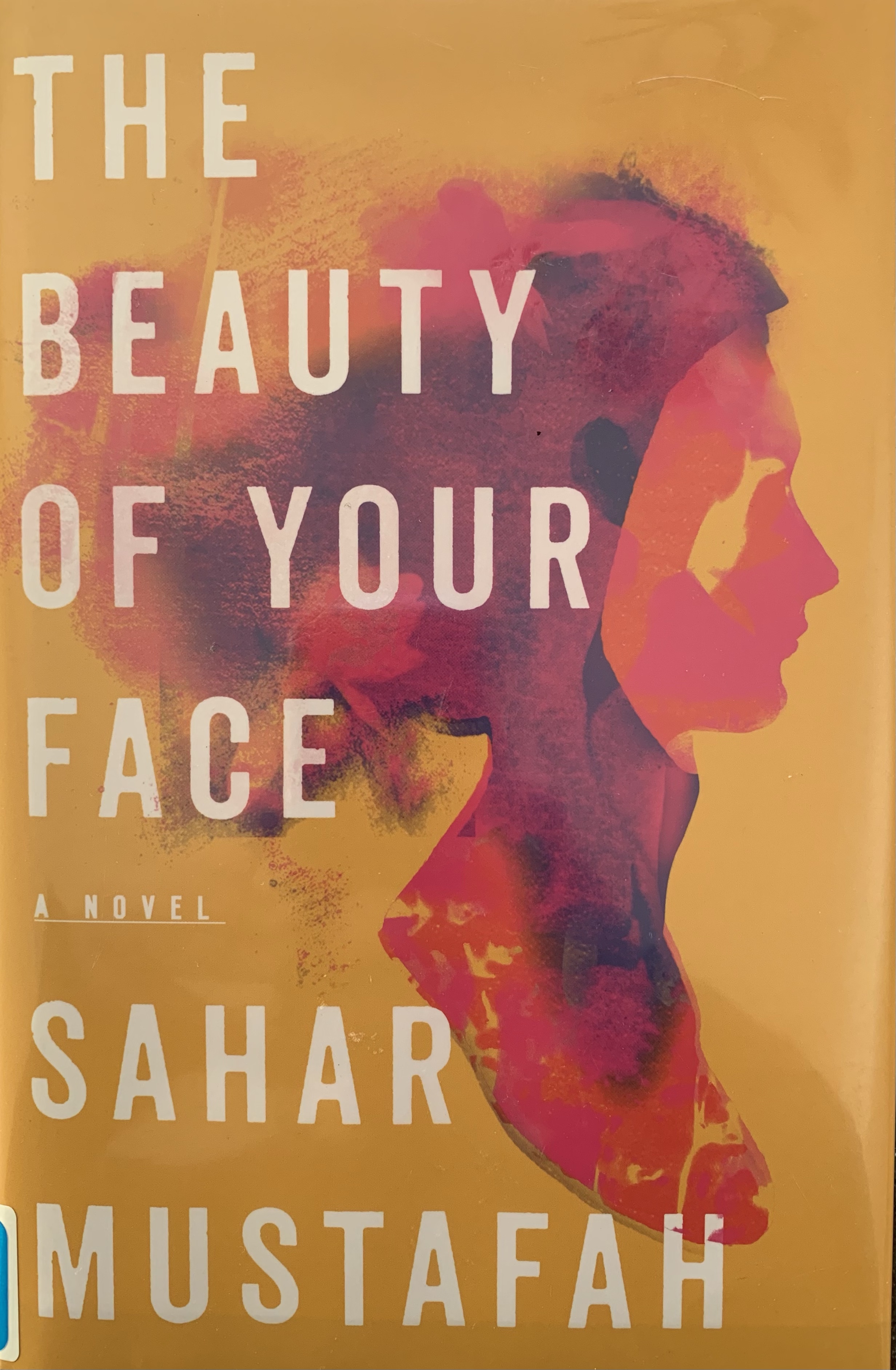
The Beauty of Your Face by Sahar Mustafah

Standard
The Beauty of Your Face by Sahar Mustafah

img_7145

I had debated picking up this book knowing that it isn’t labeled YA and I’m painfully behind on a stack of books I want to review, but after reading @muslimmommyblog’s review I opened the first page: that was 24 hours ago, I couldn’t put it down.  I’ve seen a lot of comments about this book being more YA than adult fiction because it tidies everything up so precisely at the end.  I’ve also seen critiques from non Muslims that it is overly preachy at times.  Many Muslims are so swept away by the rawness and presence in Islam in the book that they are making their teens read it.  So I wanted to read it and review it to determine if it is appropriate from my perspective for teens, and offer my take on it.  Ultimately I think while much of the Palestinian-American protagonist’s life story in the book occurs as a child and young adult coming of age, that the “flags” are so critical to the story and so numerous, that no matter how deftly and non specific she handles these issues and moments, that the book really is meant for more mature readers. I’ll detail it more below in the FLAGS section but to highlight a few mature spots mentioned in the book to varying degrees:  extra marital affair, alcohol, making out, groping, nudity, sex, voyeurism, killing, shooting, physical abuse, profanity, suicide attempt, bigotry, etc.  The writing is absolutely superb, and it isn’t sensationalized, but it is there and provides understanding as to why the characters often are as they are to a point that you need to understand them with a certain clarity.  I would think this 298 page book would most appeal to early college age readers where one is hopefully open minded enough to understand the characters relationship with religion whether they are Muslim or not, old enough to have some of their own life to reflect upon, and on the cusp of a new chapter that they realize the role their choices can make as they move forward.

SYNOPSIS:

Afaf’s life story unfolds out of order and with occasional interruptions from an outside point of view.  It opens with her at work, as a principal of an Islamic girls high school in Chicago as we see her dealing with parents upset with things taught at the school and the balance she tries to achieve in guiding her girls to be strong, confident, well-informed Muslims in a diverse America.  It then flips back to 1976 and begins the tale of Afaf’s life with her parents, immigrants from Palestine, her older sister and younger brother.  Not ever feeling like she fits in at school, she loses any sense of normalcy at home when her 17 year old sister Nada goes missing.   There were problems at home before: her mother never being happy, Afaf never feeling her mother’s affection, her father having having an ongoing relationship with another woman, but as days and months go by, and no clues can find Nada, it will be the event that seemingly tore the family apart.  Afaf’s mother has a mental breakdown, Afaf’s father takes to drinking, and thus Afaf and her younger brother Majeed have to navigate much of their life on their own.  In high school Majeed finds baseball and becomes the ideal student and son.  Afaf lets white boys feel her up and has a reputation for being easy.  She doesn’t cross the line, but her reputation and name on the back of bathroom stalls is fairly accurate.  When their father is involved in a car accident, he finds Islam.  The family is very cultural, but not religious at all.  Eventually Afaf and her brother accompany their father, much to their mother’s protests to the Islamic Center and while Majeed has no interest in religion let alone Islam and never returns, Afaf feels an instant peace and the opportunity to redefine herself and continues to go and study Islam.

The book jumps regularly in sections, not every other chapter, and at some point it shows Afaf as an elementary school teacher making the commitment to wear hijab and preparing to wed a Bosnian man with a broken war filled past.  It jumps and has her brother home from law school visiting and her mother attempting suicide by drinking drano and being found laying naked in a bath tub.  After recovering, her mother returns to Palestine and never returns.  In yet another vignette, it has Afaf and her husband and father preparing to go for Hajj, where her father passes away, and has her returning to find she is expecting her third child a little girl.  There are other surprises that I’ll not reveal, but some of these jumps are interrupted by a voice of a radical alt right mant who walks into the girls school and starts shooting, finding himself face to face with the principal, Afaf.

WHY I LIKE IT:

I am seriously blown away at the quality of writing, and the interweaving of religion and culture.  It is a main stream book and it has a lot of religion in it.  It isn’t so much long passages of preaching, the father would like it to be that way, but the other characters keep him in check.  But the quiet transformation of Afaf and having Islam save her from a life she was not content with.  I love that it has joy and happiness despite all the tests and obstacles.  The book could have been really heavy and drag, but it wasnt, it was compelling and hard to put down.  The characters will be with me a while and I can see myself rereading the book just to visit them again.  

I was a little confused with Afaf’s limited Arabic and her mom’s limited English.  How did they communicate? I get that perhaps it was symbolic of their broken relationship, but seriously when Afaf is seven and not understanding Arabic and her mom is not understanding the police and neighbor in basic English, something is a bit off.  I like that insight is given as to why Afaf is fooling around with any boy that wants her and that it shows it isn’t about the acts themselves.  I also like how it showed her conflicts in reporting an Arab child in her class being abused at home by her father and how the response was so sad by the community.  While Islam saves her and holds her to a higher standard, it doesn’t appeal to her brother, it doesn’t remove the hypocrisy of people who are Muslim: abuse, owning liquor stores, and it doesn’t make everything better for her.  She has to suffer consequences of her choices, she just feels that Islam gives her the tools to persevere and understand and have hope.  

I love the food, oh man, hearing all the dishes being cooked and served and cleaned up after, really made me very hungry.  The cultural elements of the music and songs and oud really ground the book and make the OWN voice value ring so true and strong.  The racism and bigotry feels very real as well.  The author is the daughter of Palestinian immigrants and the way that she articulates such pointed examples of not being given the chance to move up in the elementary reading group, side comments the high school coach makes to her, and the general stereotypes thrust upon her, are very powerful.

FLAGS:

So there is a lot, as stated in the intro, but I want to articulate a bit of why I maintain older teens for the book even though it isn’t overtly sensationalized. I’ll walk through some of the major flag themes.:

Take the drinking. The father is an alcoholic, but the mother and children hate it, Majeed drinks beer with his friends, but isn’t Muslim, yet the Khalti is somewhat religious and they pour amber drinks at Thanksgiving. So there is some moral lesson, which I think you could argue is fine in YA or even middle grades.

Relationships/sex/body: The father is having an affair with a much younger woman, they refer to her as sharmoota and everyone knows about it, no other details are given. Afaf lets boys touch her naked body, but draws the line at intercourse, she says she on some level doesn’t want to do that to her parents or something of that nature. Right before proposing marraige, her and Bilal do kiss. Once they are married it mentions them making love in the mornings. It mentions masterbating and blow jobs. The shooter and his girl friend have sex, the shooter watches an Indian neighbor nurse her baby through the door and sees her exposed breast with some detail and then goes home and masterbates. When the mother is pulled out from the tub after attempting suicide it doesn’t just mention she was naked, it comments on her pubic hair.

Violence: An Arab Muslim male classmate, drives Afaf away from her bike and the slaps her telling her basically that she should not be such a slut. Afaf punches another girl in a fight at school. A child in Afaf’s class is being hit by her father. Mother lashes out at Afaf, she ends up burned. The climax is a mass shooting where 14 students and a teacher are gunned down and killed. Self harm: car crash while drunk, suicide attempt with drano.

Minor: Yeah there is music, and Halloween,

TOOLS FOR LEADING THE DISCUSSION:

This would make a great book club selection for those in their early 20s and up. It is well done, just not for younger readers. The book is very popular and numerous author interviews can be found with a quick Google search.