Tag Archives: books

The City of Jasmine by Nadine Presley illustrated by Heather Brockman Lee

Standard
The City of Jasmine by Nadine Presley illustrated by Heather Brockman Lee

With a release date of May 6, I really wanted to wait to post a review because the images are gorgeous in the electronic version, and I can only imagine how moving and captive they will be presented in a physical format, but alas I know the importance of presales and am sharing to hopefully encourage you to preorder and/or request from your library, this gorgeous 40 page OWN voice book.  A love letter to Damascus, and the sights, sounds, smells, taste, and feelings that the author remembers despite the mountains and oceans that now separate her, are lyrically shared with readers on a journey through the city. The ethereal lilting of words draw readers of all backgrounds in, and the complimentary gorgeous illustrations convey a palpable sense of beauty, love, and memories of home.  Even on a screen, they force you to get lost in their beauty. The cadence of the words allow natural pauses that tug on your eyes and draw them toward something in the images not seen before, forcing the readers and listeners alike to hesitate before turning the page.

The book starts with a little girl telling where she comes from, “the City of Jasmine,” “the Umayyad Mosque,” “Ghouta,” “Damascus,” “Qasioun,” “Qala’at Dimashq,” headers for spreads rich with poetry, wonder, and longing.

Neighborhoods of diverse families gathering, and sharing the foods that bring people together, and quiet bookshops that facilitate travel through time. Family memories built around orchards and fountains and laughter and love.  So far away from the author now, the memories are not lost, they can be touched when the scent of jasmine is “breathed in, and breathed out.”

The book concludes with an author’s note and a glossary.  Those of us who are not Syrian, and who have never been, after spending time with this book will undoubtedly be tempted to add Damascus to our bucket list of travel plans, and inshaAllah as the country rebuilds such trips will come to fruition.

Eid for Nylah by Nizrana Farook illustrated by Zelma Firdauzia

Standard
Eid for Nylah by Nizrana Farook illustrated by Zelma Firdauzia

I have read this book dozens of times and I honestly don’t know how I feel about it. If you remove the title and second to last page and just READ the words, the book could be about any holiday that you might clean and decorate for, that would involve giving gifts, putting on henna, wearing new clothes, praying, and sharing food at. The illustrations imply that it is a Muslim holiday with about half the women in the pictures wearing hijab, and a few decor items that say Eid Mubarak in English and Arabic, but readers that are unaware or unfamiliar might not grasp that it is faith based at all, and the Author’s Note mentions, but doesn’t detail much about the religious significance either. During one reading, I felt it also could almost seem like a mystery, that the title just happens to ruin. The cat Nylah goes to different houses on the street seeing and hearing the tidying and banner hanging and gift wrapping occurring, but doesn’t know why no one has time for her, until the big reveal that it is Eid. I think for little non reading kids that actually might be my approach, to share the book without the title and back blurb and see if they can figure out why everyone is too busy to play with Nylah.  I don’t know that it is tokenism, or that Islam is left out to make the book palatable for the Western gaze, I could be wrong though, I really just think this is the author’s style.  Having read her chapter books that always center animals, feature community, and include Muslim names, I think this is just an extension of her lyrical writing in her debut picture book. The book would work for either Eid, but the backmatter is the author’s reflection on Ramadan and Eid al Fitr.  I know I’m the minority that struggles with Islamic holiday books that leave out the Islam, so for those of you that do not find it disappointing, the book is sweet.  Nylah is a cat that is welcome and known to the entire neighborhood, to come and go as she pleases, the age engaging illustrations complimented by the cadence and rhythm of the structure, lines, and diction are easy to read aloud to groups of all sizes, and hold the attention of 3 year old children and up.

The book starts with a family “wiping and scrubbing, tidying and sorting, everything in sight.”  When no one has time to play with Nylah, she heads outside under the crescent moon, and goes next door to Bilal’s house, where he and his family are decorating.  When she tries to play with the ribbon, she is once again told they are too busy to play, so she slips into Reem’s house where they are doing henna.  This continues from one house to another until the next morning when her family all dressed wakes her up to go to the park with them for prayers and Nylah realizes it is Eid.  Now the children are not too busy and everyone plays with Nylah.

Yeah, I know, taking a cat to Eid prayers sounds wild to me too, kids love imagining though what chaos might ensue.  There is enough hinted at that Muslim families can find the clues and make the book more religious or holiday centered, but I wish it showed the cat seeing praying or reading Quran, hearing the athan or thikr, or something that would ground the book in Islam, but alas, it does not.

The book concludes with an Author’s Note and scanable QR Code for a free audio reading.

Cookies and Crescents: An Eid Story by Nada Shawish Dutka illustrated by Zelma Firdauzia

Standard
Cookies and Crescents: An Eid Story by Nada Shawish Dutka illustrated by Zelma Firdauzia


We can always use more Eid al Fitr stories, but to stand out in an increasingly crowded field, really requires something special, impeccable story telling, and repeatability.  Unfortunately for me, this book just comes up short.  Food centered books are already so over done, toss in small font that nearly bleeds into the binding where you would hold the book for story times, top it off with a vague story lacking the OWN voice charm that a religious holiday centered book, by a Muslim, that is noted to be slightly autobiographical should have, and the recipe is just going to feel lacking.  There isn’t anything “wrong” with the book, it just doesn’t really seem like it will be memorable or asked for again. Focusing on a mom and daughter moving the night before Eid, the book has elements of adjustment, new traditions, change, nerves, salat, iftaar, looking for the moon and making a new friend- layers that should resonate with readers, but somehow for me, stayed on the surface of this 32 page book for preschool to early elementary aged children.

The book starts with the protagonist talking about the city where she was born, the community, the family atmosphere, and her mama’s famous Eid cookies.  But this year will be different, it is almost Eid and Reem and her mama are moving away from the city to a house with a yard. Reem is not excited, in fact, she spends much of the drive feeling carsick.  Once they arrive it is time to unpack, break their fast, pray and look for the moon.  The excitement of making making cookies with her Mama sustains her, until she notices the walnuts are missing. Change is inevitable, and Mama is determined to show Reem that they can make do with what they have.  When neighbors come over to welcome them to the neighborhood, a new friend might be just what Reem needs to settle in.

The book seems to be deliberately vague, and I don’t know that it will bother children, but it bothered the journalist in me.  Why are they moving, what city are they leaving, is Sarah Muslim or just knows to say Eid Mubarak, but doesn’t say walaikumasalam.  I also feel like the publisher didn’t properly invest in the book.  The text is tiny, when ample space is available on nearly every spread.  Blocks of text on the lower inner binding make one’s hand cover the words when reading to a group, and certain paragraphs seem to be erroneous or at the very least awkward.  Take for example this paragraph when they are unpacking, that I stumbled over every time I read it. “Tonight, it’ll be just me and Mama who look from between tall boxes.” Maybe it is in reference to looking for the moon, but the next page does have her and Mama planning to look for the moon.  Similarly, when the walnuts can’t be found, Reem wants to go back, but Mama says the store is too far. The mother in me was fuming that she didn’t see it was more than about the nuts, go give the girl a hug. Earlier Reem remarks that “Finally, Mama kept her promise,” in regards to the cookies, but is it finally they are making cookies or does Mama not normally keep her promises. I know I’m being picky, but it starts to add up, the reader doesn’t feel that Mama and Reem are in this together. That they listen to each other. So it is hard to get emotionally invested. And when I review I try and unearth why a book doesn’t work for me, and all these little hiccups for me, become obstacles that keep the book from being great.  Sadly all it needs is some good editing and my critiques really could have been resolved, sigh.

Even though the book is set at Eid, and shows the mom and daughter praying, they say salaam, they look for the moon, there is no real Eid as a religious holiday stressed, the focus is the cookies and the new friend.  Culture also seems to be noticeably absent, the cookies are Arab, the phrase “Al Harakah Barakah” is Arabic, but it isn’t sourced, the reader is never told where that sentiment comes from and it isn’t explored as much as the inner flap would suggest. The book concludes with an author’s note and a recipe for ma’amoul.


How to Free a Jinn by Raidah Shah Idil

Standard
How to Free a Jinn by Raidah Shah Idil

This 276 page book drew me in from the first page and held my attention until the last. I can’t recall ever reading a fantasy book in a single sitting.  The Islam, heart, Malay culture, and family dynamics have me hoping that maybe there will be a sequel, and that hopefully this debut novel is a first of many from the author. Of course I have minor critiques, the book definitely in the middle had some repetition and pacing hiccups, the rising action and climax could have been stronger, and there are a few noticeable loose threads, but Insyirah is a loveable protagonist that you really hope can sort through her family secrets, save the day, and be at peace with her decisions.  There is a lot of Islam, and it is well woven into the characters’ identities, the plot, and the lens of the book.  If you are Muslim reading it, you will see the fasting on Monday and Thursday, and staying in wudu a little different than non Muslim readers, but no matter who you are, you will enjoy the plot, the adventure and fun ride that will undoubtedly become a beloved favorite.

SYNOPSIS:

Twelve year old Insyirah and her mom are moving back to Malaysia to care for her elderly grandma.  Insyirah is anxious and not thrilled to be leaving Australia.  She hardly has time to miss her old life though as family secrets, discovering she can see and interact with jinn, and learning that an old jinn with a big grudge is after her.  Navigating the seen and unseen words, the rules of her mother opposed to those of her grandmother, and figuring out what she wants will take time to ponder, learn, and reflect upon.  Unfortunately, Syirah doesn’t have that kind of time, as she keeps falling into the unseen world, realizing that a jinn bound to her blood line will soon be under her control, and that pesky jinn haunting her school is trying to get her to leave Malaysia.

WHY I LIKE IT:
I am intrigued by the the way the book holds space for Islam, culture, and fiction, and interweaves the three.  Islam is adhered to, along with the worship, and uncompromising faith in Allah swt, and while the jinn are kept as being real, as understood by Muslims,  their day to day antics cultural and fictional positioning, is richly developed and not put in conflict with deen, seemingly trying to keep everything halal.  I am not a scholar, I would not venture to proclaim that this does or does not cross lines, but the author is very aware of the threads at play, and has a solid awareness of writing craft, so the result is a great story, that feels authentic, without being “shirk-y.”

There are some pop cultural references that might age the book a bit, but I love the shootouts to Hanna Alkaf books.  For me, a Western reader, that really is my only other Malay juvenile literature reference, and the vibes are similar, so it was nice to see the connection.  

FLAGS:

Jinn, loss, death, fear, murder, threats, lies, enslavement, haunting, scaring, secrets, fighting.

TOOLS FOR LEADING THE DISCUSSION:

This book is solid middle grade, but I think older kids will enjoy the story and find plenty to relate to, learn about, and be captivated by.  I think this book will be a great addition to home, school, and library shelves, and while my copy is from Australia, I believe a US version will be available in 2025, inshaAllah.

Prince Among Slaves by N.H. Senzai illustrated by Anna Rich

Standard
Prince Among Slaves by N.H. Senzai illustrated by Anna Rich


462575630_1072301494218509_2457799047040333197_n

This 48 page biography tells a story that we all should know, yet are probably hearing for the first time.  The story of how West African Prince, Abdulrahman Ibrahim Ibn Sori, was forcefully taken and sent to America to be a slave on a plantation, what he endured for decades, and how he made his way back to the African continent.  The large emotional illustrations and poignant text tell of his his life in Fouta Djallon, the painful journey to Mississippi, the trials as a slave, the joy of being a husband and father, and his attempts to return home a free man.  With each challenge and at each stage, him additionally showing amazing strength and trust in Allah swt.  The heartbreaking tale unearths so much evil, ignorance, and faith, that the story is not meant to be read once, it begs to be reflected on, pondered over, and shared far and wide. The treatment of Prince Abdulrahman shown in some of the illustrations are difficult to look at, as they should be, there is also a very passionate kiss shown up close between him and his wife.  I think the story’s words and illustrations emphasize the anguish, the strength and the humanity, but I mention the illustrations for each to decide on their own.  There is not a biography or sources in the book, but rather mentions in the Author’s Note the source matter being a film by Unity Production Foundation.  It is not unusual to adapt a biography from a film, and I read an ARC, but I do hope the final copy will be sourced.  The book is for middle grade readers, and I cannot wait to add a physical copy on my own bookshelves, and gift numerous ones to teachers to share in their classrooms.

WARNING: SPOILERS: THE SYNOPSIS CONTAINS A FULL RETELLING, as it is historical, I hope that is ok, but in no way shape or form is my summary taking away from the details, emotion, and writing the actual book contains. 


In 1762, the Fulbe enjoyed prosperity and peace under the king, and when Abdulrahman was seven he started school in Timbo. He loved learning about the Prophets in the Qur’an, and excelled at his studies.  So much so that his father sent him to Timbuktu to continue his studies at age 12. Five years later he returned to train as a warrior, when the first white man, a surgeon, Dr. John Cox appeared injured and lost, they helped heal him and sent him back home to Ireland.

By age 26, Prince Abdurrahman was a warrior, a scholar, soon to be king, a husband and a father of a son.  One day while on patrol, he was captured. He and 170 others were loaded on a ship, for eight months, and sent over 3,000 miles across the Atlantic Ocean.

On August 16, 1788 he arrived starved in Natchez, Mississippi, for $930 he and another man became the property of Colonel Foster.  Resigned that this was his fate, he helped share his knowledge of cotton, and the plantation prospered. In 1975 he married, Isabella.  They had nine children and eight grandchildren.  

In 1807 while selling goods in the market, Abdurrahman sees Dr Cox (subhanAllah), and the doctor pleads with Colonel Foster to free the Prince.  Foster could not be moved and when the doctor died, Abdurrahman once again accepted his fate. 

His story though had started to spread, and a printer, felt a softness to the Prince turned slave and printed often embellished stories trying to help his cause.  He asked the Prince to write a letter, the Prince wrote an ayah from the Quran and the printer passed it to Mississippi senator Thomas Reed explaining the Prince’s desire to return to Africa.  Senator Reed got the letter to Henry Clay, the Secretary of State under John Quincy Adams, who then got the message to the President of the United States.

The letter was written in Arabic, and they assumed Prince Abdurrahman was thus from Morocco.  The Sultan of Morocco was touched by his plight and petitioned for his release, and the Prince kept quiet not wanting the truth of where he was from to remove the help he was receiving.

He was finally freed and able to purchase the freedom of his wife Isabella with the help of those who had heard his story, but the efforts to free his children were not as successful.  The truth about him not being Moroccan became known, and despite extensive travels and pleas, his declining health forced him to leave America with out his children.  He arrived in Monrovia, Liberia, but would die before he could reach his home of Fouta Djallon.

462563778_440473032154161_1815006209353878188_n


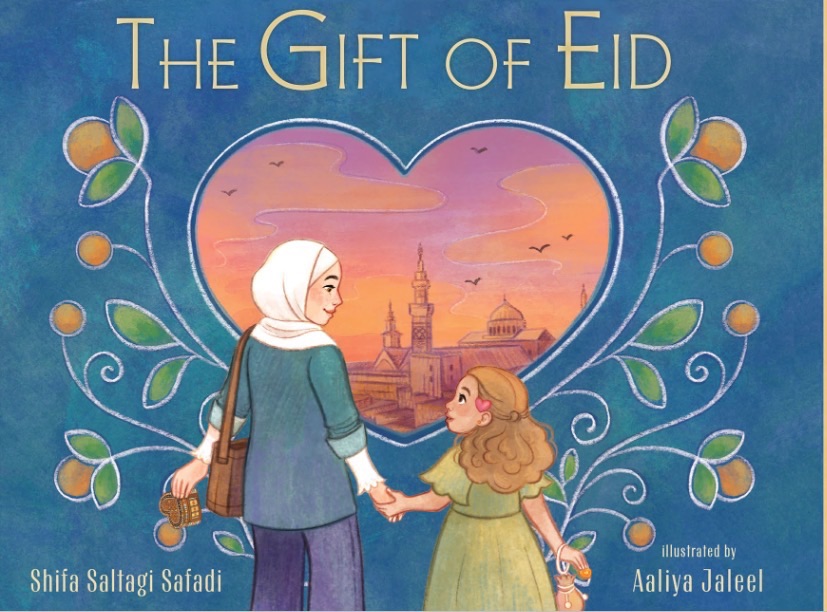
The Gift of Eid by Shifa Saltagi Safadi illustrayed by Aaliya Jaleel

Standard
The Gift of Eid by Shifa Saltagi Safadi illustrayed by Aaliya Jaleel

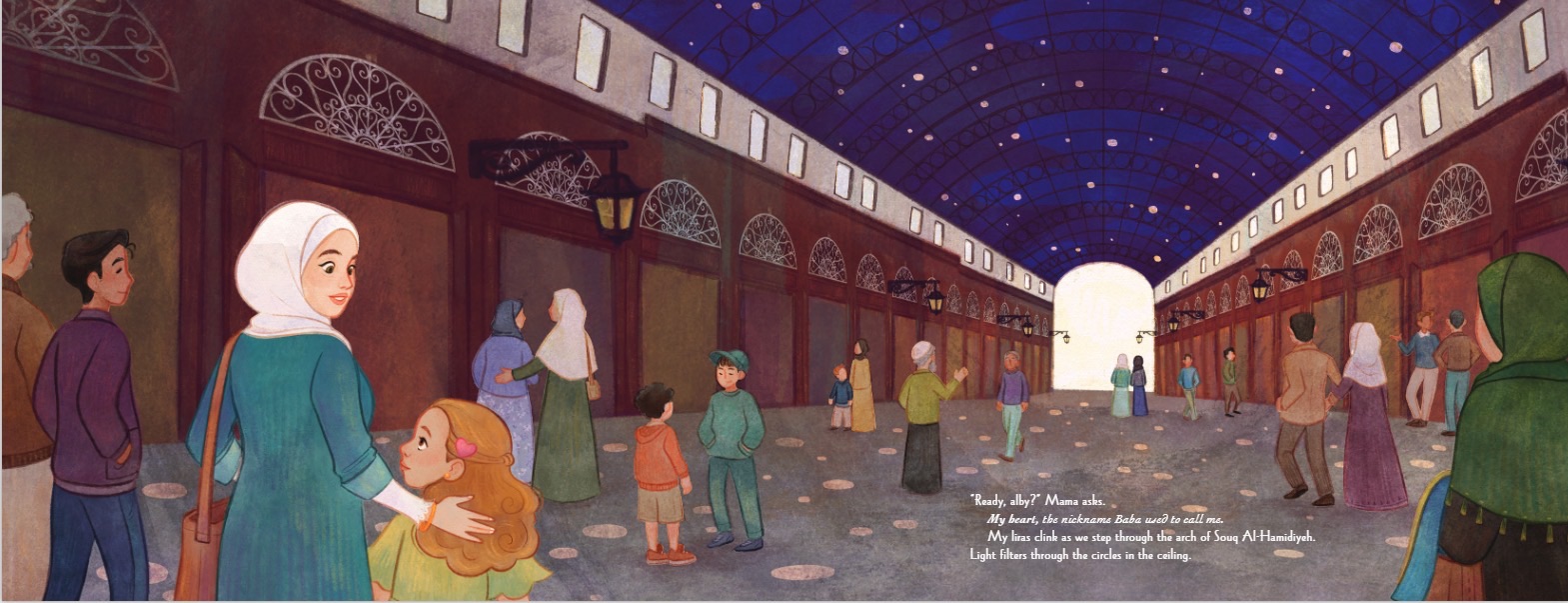
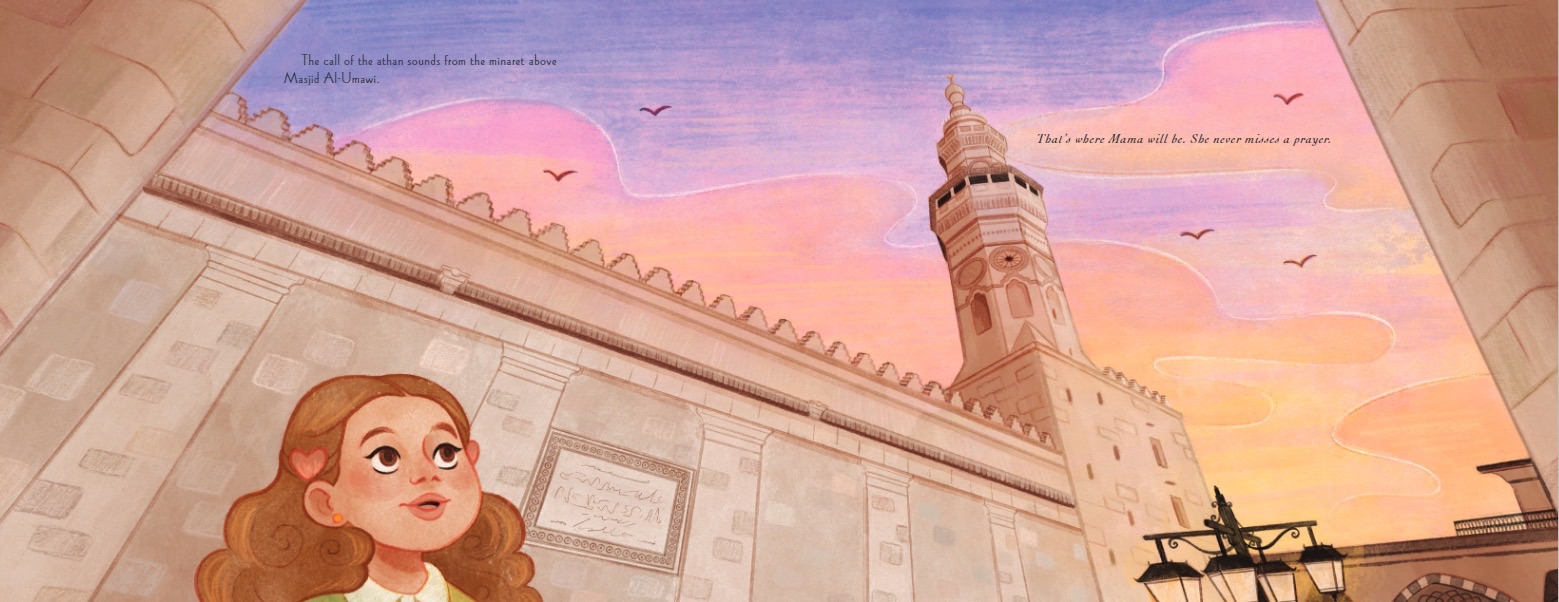
With heartfelt words and large two-page spread illustrations, this beautiful book shares a mother and daughter finding the perfect Eid gift for one another while bringing the reader into the Souq Al-Hamidiyeh, before sending them off to Masjid Al-Umawi for a warm hug.  A retelling of the classic, A Gift of the Magi, the story poignantly presents threads of love, gifts, loss, and Eid to fill the reader with joy, peace, and gratitude.  I’m admittedly very bias, as a close friend of the author, but this beautiful book doesn’t need lip service or marketing, it will appeal to all readers in all settings, and be cherished and asked for, over and over again, all throughout the year. Alhumdulillah.

The book starts with Yasmine and her mama entering the souq through the archway, and Yasmine remembering her father and her imagining the circles in the ceiling to be twinkling stars.  He is no longer with them, the magic is gone and money is tight now, but with liras jingling in her pocket, Yasmine is determined to find an Eid gift for her mother that will make her smile.

Yasmine looks around the shops as her mother counts out liras to buy za’atar, and tries to find something cheaper than sfeeha at the bakery.  She finally knows what to get her mother, but it is more lira than she has.  With determination and selflessness she makes a decision to get her mama the perfect gift.

The process separates the two, and when they reunite at the masjid for maghrib salat, it isn’t the gifts themselves, but rather what they mean, that make the laughter, tears, and love overflow.

I love the emotional depth the book conveys so deftly, never explaining or pulling the reader out of the story, thus allowing the connection to linger long after the book is closed, a rare treat in a picture book.

The Prophet;s Sunnah by Ayesha N. Rahmaan illustrated by Laila Ramadhani Ritonga

Standard
The Prophet;s Sunnah by Ayesha N. Rahmaan illustrated by Laila Ramadhani Ritonga

This joyful 20 page board book shows our littlest (and biggest) Muslims some of the Prophet’s sunnahs in a way that they can also do in their lives.  The adorable illustrations appeal to kids and the simple text showing the acts are relatable and engaging.  I did cringe at times with the changing size of the basic font and the perspective of some of the lines being told to the reader as “your” and others as “our,” but I’m a bit of a sucker for kid’s books about Rasulullah.  Some of the vocabulary might need some explaining, but overall my little ones enjoyed the book when I read it, and I have caught them looking through it on their own, so yes I’m aware that I’m over looking a few basics.

The book starts with a hadith on the dedication page and is then followed by an ayat in Arabic and English meaning of the translation about following Prophet Muhammad (saw) if you love Allah swt.  It  introduces Prophet Muahmmad saw to the little readers, not stressing the call to Prophethood and revelation, but him as a “neighbor, friend, father, husband, leader and teacher.” Starting with Bismillah, sharing, and helping, visiting the sick, being humble, some pages are filled with multiple images, and others a single scene.  Some have Arabic transliteration and one has Arabic script accompanying the English.

The illustrations show different sizes, colors, abilities.  Some of the girls wearing hijab, some not.  Readers are bound to find someone in the book that looks like them.  The binding quality and page thickness is well done and the 8.5 square size makes it great for story time or reading in small groups.

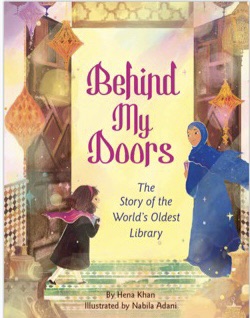
Behind My Doors: The Story of the World’s Oldest Library by Hena Khan illustrated by Nabila Adani

Standard
Behind My Doors: The Story of the World’s Oldest Library by Hena Khan illustrated by Nabila Adani

img_3557-1

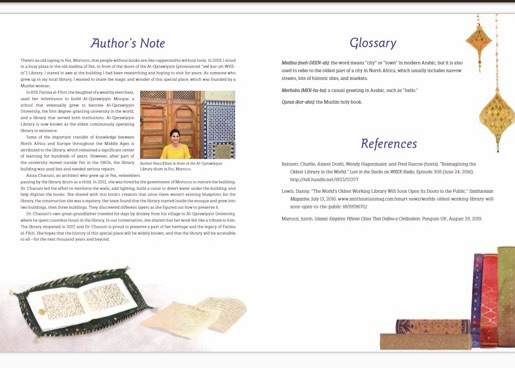
The world’s oldest library proudly stands in Fez, Morocco: started by a Muslim woman, restored by a Muslim woman, and in this 40 page book the library itself tells its own story in a book authored by a Muslim woman.  The personified library shares a few highlights from its early start as a corner in Fatima Al-Fihri’s masjid and university to collections spanning multiple buildings, from a bustling center of learning and knowledge to a place of disrepair and neglect.  Staying on an early elementary level, the informative author’s note and references make the book engaging for older readers as well, and an incredible addition to bookshelves everywhere.

img_3558-1

The book starts with the library introducing itself and welcoming the reader. “Merhaba! I am Al-Qarawiyyin Library–the oldest library in the world.” At over a thousand years old, the library begins at the hands of Fatima Al-Fihri in 859 who dared to dream big and created a space of learning and worship in Morocco.

img_3559-1

As the courtyards and collections grew, seekers of knowledge, from all backgrounds, gathered to discuss, debate, and learn.  Special rooms with special locks kept books safe: a Quran written on camel-leather, a philosophers drawings in gold ink.

img_3561-1

Nearly destroyed once by a fire, the library endured, but over time the rooms were no longer filled with the bustle of people.  One day a small girl, Aziza, paused at the door, but did not enter for many years.  When she did return, she came as an architect with a team to restore the library and invite people back in to read, learn, and dream.

img_3565-1

It delights me that such an important story is available to be widely learned from and appreciated.  You can preorder a copy here from Amazon.

img_3566-1

Nour’s Secret Library by Wafa’ Tarnowska illustrated by Vali Mintzi

Standard
Nour’s Secret Library by Wafa’ Tarnowska illustrated by Vali Mintzi

library

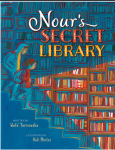
Set in Daraya, and based on a real events in Syria, as well as the author’s own life in Lebanon, this 32 page elementary and up story does an amazing job of showing relatable childhood adventures and ingenuity shining through even in the most horrific of environments.  The book is inspiring and warm, but the backdrop of war is very much present.  Some young children may be bothered by the images and text, while others will benefit from understanding the humanity that is affected by such violence.  I know the book says the pages are not final, but I wanted to put it out to help drum up interest.  I feel this story would best work in intimate settings where discussion, compassion, and gratitude can all intuitively transpire.

library1

Nour’s best friend is her cousin Amir, they love to read and imagine adventure and secret societies.  As their dream to create a secret club, complete with a secret password and handshake, for them and their friends starts to come to fruition, war arrives first. 

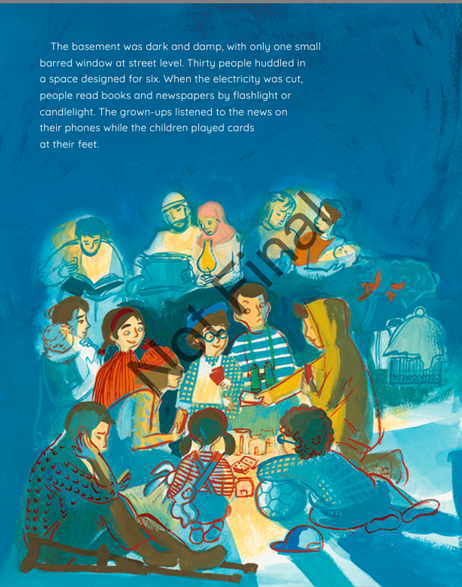
Families are forced to seek shelter away from the bullets at night in their basements, and only are allowed to venture out when absolutely necessary.  Every time Amir goes out, he collects any books he finds, and encourages his friends to do the same.  

library2

They begin sorting the books, and trying to decide what to do with them, when Nour has an idea to create a secret library.  Everyone pitches in when an empty, half destroyed basement is located, and the books are moved and set up on discarded planks of wood.  A boy next door is entrusted with the secret handshake and becomes the deputy librarian.

As word spreads, everyone from boys and girls to soldiers and rescuers, collect books to stock the shelves and checkout books to keep their minds busy.  The library, named Fajr, is open every day from morning to evening and closed during Jummah.  It becomes the city’s best kept secret and a source of hope for the community.

library3

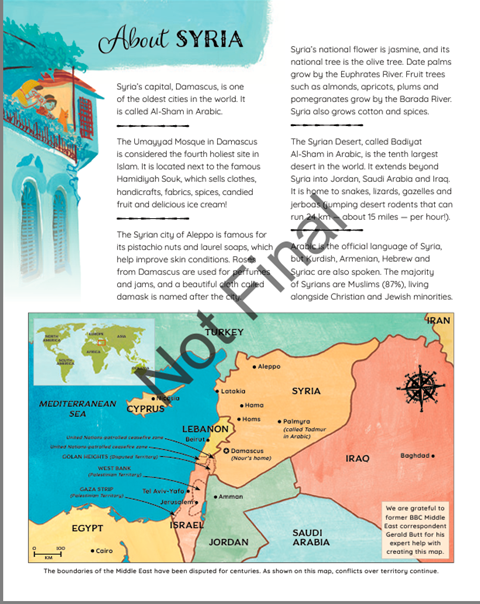
There are references at the back that tell about the true story of the Secret Library in Syria, the author’s memories of hiding in the basement in Lebanon, a glossary of terms, information about Syria, the illustrator’s research, information about the war, and famous libraries in the Middle East.

library4

Alia’s Mission: Saving the Books of Iraq by Mark Alan Stamaty

Standard
Alia’s Mission: Saving the Books of Iraq by Mark Alan Stamaty

alia

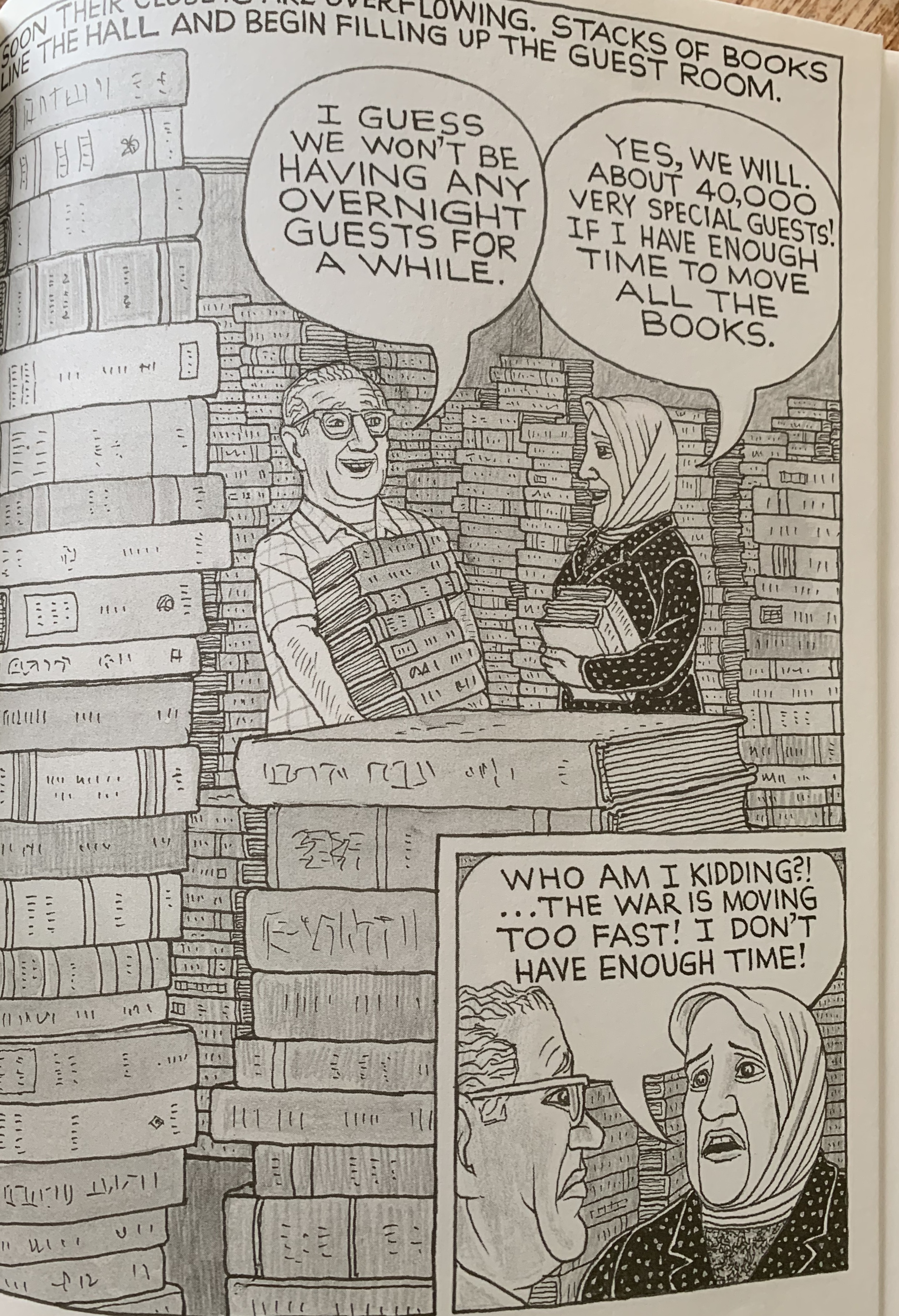
Based on the true story of Alia Muhammed Baker, the Basra librarian who saved 30,000 books in 2003 from the destruction during the Iraq War, this 32 page graphic novel, is an AR 3.9 and while it isn’t a chapter book and isn’t just a picture book, it works well for 2nd through 4th grade readers that will enjoy a bit of history, a lot of excitement, and detailed panels that make the story come to life.  The story, as it is based on fact, is very similar to The Librarian of Basra, but with it’s different presentation style, might appeal to a larger audience to appreciate and celebrate what she did to save such precious books, naturally, I’m a huge fan!

5532A37C-C4DF-46FA-8334-5F4AA3A06AB5

SYNOPSIS:

Alia is the Chief Librarian of Basra Central Library and has always loved books and learning.  As war draws closer, she tells her husband she is worried that the library could be bombed or set ablaze.  She goes to the government to voice her concerns and ask that the books are relocated, but her request is denied.  So she takes matters in to her own hands, and starts smuggling books under her shawl and in to her car, and stacks them in her home.  Every day she does this for a week, soon closets are over flowing and she starts stacking the books in her guest room.  Worried that she isn’t making fast enough progress, she gets the restaurant owner next door to help her when looters start taking the pencil sharpeners and furniture from the library.  She has a plan to have everyone possible come together to move the books, and many people come to help.

Eventually the library is set on fire, the news gives Alia a stroke.  When she recovers she learns she saved 30,000 books, and up next for this real life super hero? Building a new library, inshaAllah.

A3A17616-7940-4E80-8CA1-9798A8BA4FC8

WHY I LIKE IT:

I love that it shows the value of libraries and books, the determination of one person, and the support of a community.  People are awful during a war, yet, sometimes they are pretty amazing too.  The illustrations are detailed and varied, with inviting text and clear concise language.  It really is well done.

B0FB5A2A-7376-4F20-BCD1-6D64956B77C6

FLAGS:

Destruction of property, sneaking, looting.

TOOLS FOR LEADING THE DISCUSSION:

I think it would be great to have kids read this story and the librarian of Basra and discuss