Category Archives: strong women

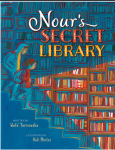
Nour’s Secret Library by Wafa’ Tarnowska illustrated by Vali Mintzi

Standard
Nour’s Secret Library by Wafa’ Tarnowska illustrated by Vali Mintzi

library

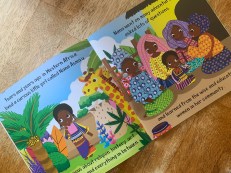
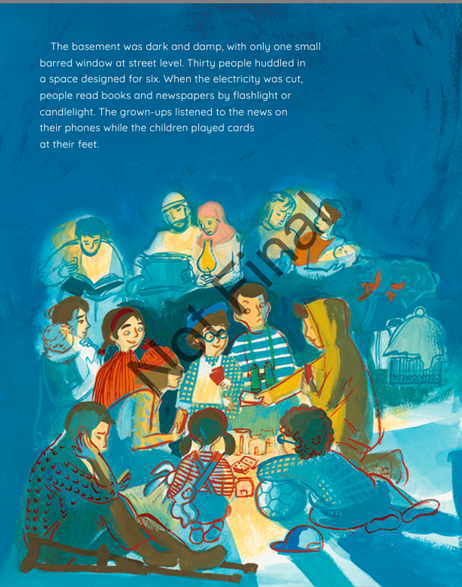
Set in Daraya, and based on a real events in Syria, as well as the author’s own life in Lebanon, this 32 page elementary and up story does an amazing job of showing relatable childhood adventures and ingenuity shining through even in the most horrific of environments.  The book is inspiring and warm, but the backdrop of war is very much present.  Some young children may be bothered by the images and text, while others will benefit from understanding the humanity that is affected by such violence.  I know the book says the pages are not final, but I wanted to put it out to help drum up interest.  I feel this story would best work in intimate settings where discussion, compassion, and gratitude can all intuitively transpire.

library1

Nour’s best friend is her cousin Amir, they love to read and imagine adventure and secret societies.  As their dream to create a secret club, complete with a secret password and handshake, for them and their friends starts to come to fruition, war arrives first. 

Families are forced to seek shelter away from the bullets at night in their basements, and only are allowed to venture out when absolutely necessary.  Every time Amir goes out, he collects any books he finds, and encourages his friends to do the same.  

library2

They begin sorting the books, and trying to decide what to do with them, when Nour has an idea to create a secret library.  Everyone pitches in when an empty, half destroyed basement is located, and the books are moved and set up on discarded planks of wood.  A boy next door is entrusted with the secret handshake and becomes the deputy librarian.

As word spreads, everyone from boys and girls to soldiers and rescuers, collect books to stock the shelves and checkout books to keep their minds busy.  The library, named Fajr, is open every day from morning to evening and closed during Jummah.  It becomes the city’s best kept secret and a source of hope for the community.

library3

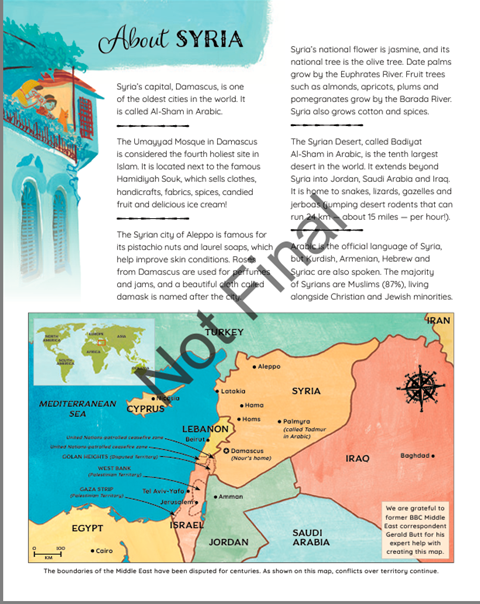
There are references at the back that tell about the true story of the Secret Library in Syria, the author’s memories of hiding in the basement in Lebanon, a glossary of terms, information about Syria, the illustrator’s research, information about the war, and famous libraries in the Middle East.

library4

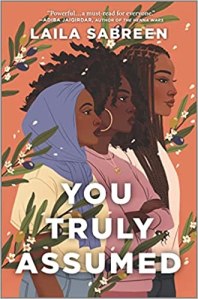
You Truly Assummed by Laila Sabreen

Standard
You Truly Assummed by Laila Sabreen

We need more diverse books, especially within Islamic rep stories.  So I was so excited to receive an arc of this 352 page YA/Teen Black Muslim authored and featured OWN voice story.  I was prepared for rawness and grit and insight and all the feels.  Sadly to say, it is not that.  It is surface level plot points that are unexplored, disjointed, emotionless, and overshadowed by poor writing, contradictory details, and errors. Admittedly I saw an early copy and there is hope that the spelling errors, continuity mistakes and numerous contradictions can be fixed, but I highly doubt the narrative, character arcs, and holes, will or can be rewritten.  It is such a shame, because every time I was ready to put the book aside and claim I could not finish it, a powerful beautiful paragraph or sentence would pull me in and give me hope that the book would turn around and be what its own blurb claimed the book set out to do: “shatter assumptions” and “share truth.” In full disclosure, this book centers the intersection of being Black and Muslim, an experience I do not share firsthand nor claim to know in all of its multitudes and complexities.

SYNOPSIS:

Sabriya, Zakat, Farah: three Black female Muslim 17-year-olds in different parts of America, with different passions, different life experiences, and different dreams, take one alternating chapter at a time to tell their stories with occasional blog posts scattered between.  A terrorist attack in the in the D.C. metro, lots of serendipitous technology events, and a need to find community and the girls come together to create a blog that gathers followers and haters alike in the summer before their senior year.

Sabriya “Bri” is a ballet dance, and often one of two black ballerinas in class.  The book opens with her preparing for the summer intensive audition process when news of the nearby metro attack makes time stand still.  Her mom cannot be reached, and multiple people are killed and many more injured.  Bri and her younger sister Nuri identify like their father, as Muslim, but their mother is not.  It doesn’t seem to be much of an issue, except in that Bri’s mother often cannot relate to experiences her daughter is going through.  Bri asks Allah swt to keep her mom safe, but throughout the entirety of the book it does not mention her praying salat or actively showing she is Muslim aside from wearing an Allah swt necklace and her sorting through her desire to prove to others she is a Muslim versus eventually being content to be enough for her own self.  She does at one point refuse to cook bacon, but she does have a love interest, and Islam reads more of a label to her, than a practiced way of life.  Bri journals as a way to let off steam, and her younger sister Nuri encourages her to move to an app to blog.  Reluctantly Bri agrees, after being reassured that she can keep it private, she names her journal/blog ‘You Truly Assumed’ and accidentally sets it to public.

With the city reeling, the family commits to volunteering every day to provide food to those directly affected.  Bri is placed in a group with her father’s new boss and Hayat, a Muslim boy that she thought was a popular showoff, but is quickly falling for.  The micro aggressions from her father’s boss, who is also the volunteer group leader elevate, and the more she learns about him and his connection with an alt right group, the more she writes about in her journal.  By the time she realizes that it has all gone public, she decides based on the comments that she should keep it up, recruit more contributors, and get someone on board that is tech savvy.

Farah Rose lives in California with her mom.  Even though she knows who her father is, she has never had a relationship with him.  When her mom decides that this summer she should go to Boston to meet him and get away from the tensions following the DC attacks, she reluctantly agrees.  With a passion for tech, Tommy, her father persuades her by registering her for an intro computer science college course and a chance to meet her siblings.  Farah is nervous to leave her boyfriend, and worries about being a summer babysitter, but out of love to her mother, agrees to go.  When she learns about the blog, she joins to help with the tech side.

Once in Boston she struggles to connect with her father and his wife, but is immediately drawn to the children.  Her story provides some insight into the concept of privilege within black communities.  Her father and his family are not Muslim, nor did they seem to know that she was. Presumably the only reason it even comes up is when they serve bacon at breakfast and she mentions she is Muslim and a pescaterian  Farah meets a lesbian Muslim girl in her college class and learns that there has a been a hate crime and taken the life of her new friend’s friend.  Farah offers to help with the vigil and her commitment to the blog increases as hate crimes, and Islamophobes seem to be on the rise.

Zakat “Kat” seems to present the more “conservative” Muslim.  She lives in an idyllic town and attends an all girls Islamic school.  There is also an all boys Islamic school and they are big rivals of the public high school.  Kat loves art and often takes art classes in the Islamic school with music pumping through the halls, unfortunately her parents don’t want her majoring in art at school.  They were the victims of predatory college loans and want her to be more pragmatic in her chose of school and direction of study.  She is more sheltered and even has to go behind her parents’ backs to be a part of You Truly Assumed.  She shares her sketches and comics and art work and loves knowing that people are connecting with her work and messages.

When her quaint town becomes the victim of hate crimes, she has to decide if she is going to step up and use her voice, or blend in as she has always done.  Zakat prays regularly, often at the gender neutral mosque behind a female identifying imam, wears hijab, and deals with jealousy as her best friend becomes friends with a girl who years earlier bullied Kat.

The three girls’ stories intertwine as they become friends, share their own personal lives with one another, and thus the reader, and create a space to be seen and heard through the blog.

WHY I LIKE IT:

The book honestly reads sloppy.  I don’t know why it seems the growing trend is to not properly edit these Islamic OWN voice YA novels, but this is another book that indicates a troubling trend.  I love that these voices are emerging, but it sadly feels that editors are nervous or afraid to question things and demand better.  The book is so much telling and so little showing.  I don’t want to be told that the blog posts are powerful, and moving, I want to read them and feel moved.  I don’t want to read that you had to understand that you had to stop proving your religiosity to others and just live for yourself, I want to see the incidents and reflection that brought on that growth. I don’t want to be told that you are becoming friends with the other two bloggers, I want to see that they understand you when no one else does.  The whole premise of the book is to connect with the reader, but the emotion isn’t in the pages, so there is nothing to connect with unfortunately.  Saying there is a terrorist attack, saying that hate crimes are occurring, does not bring forth an investment to the story if details, context, and cathartic releases are not also included.

There are some basics errors.  Wudu is described in the wrong order, Zakat talks of living in Georgia in a fictitious town, but the landmarks and colleges are all accurate until she mentions looking out over Lake Erie.  I Google mapped it, there is no Lake Erie in Georgia (just the Great Lakes one on the Canada US border), it is only mentioned once, so presumably an oversight, not a fictitious landmark.  There are some spelling errors and grammar errors as extra words enter a few sentences (3%), dinner replace the word diner.  At one point it mentions the girls meeting on a Zoom call, and then the next line refers to it as a Skype call (54%).  The plushness of the Georgia mosque is often commented on, but they have to put down their prayer rugs to pray, this is pre covid, so a little off.

The book contradicts itself at 11% saying that they can drive to North Carolina or New York for auditions, while the rest of the chapter is convincing Bri to volunteer because they cannot. One of the reasons Farah left California was because of the tensions, but Boston is closer to the place of the attacks and also a large diverse bustling city.  When Farah is wanting to talk to Tommy and his wife about the vigil, she walks in to a room and comments on who is there, in the next line, it mentions that it isn’t a good time to have the conversation since Jess is not there.  Jess was just mentioned as being there and the conversation does end up taking place (84%).  When Bri has a blow up with her dad’s boss, Hayat is worried that she hasn’t been delivering meals all week as a result, later in the chapter it mentions that the conversation happened yesterday (77%).   When Bri introduces her friend to Hayat she doesn’t mention that the two girls know his little sister very well, and it seemed unnecessarily awkward.  Zakat stares off in to space and imagines a sketch and remarks that she has never shared a sketch before and it is something she wants to explore.  This is 81% of the way in to the book, she has been sharing her sketches on the blog since she joined.

In terms of Islamic representation, Zakat’s mosque has one entrance and doesn’t divide based on gender, there is a female imam, the steps of wudu are in the wrong order, the girls all seem to focus on their “Islamic” necklaces or rings as if they are such an integral part of the religion.  The girls never pause or hesitate to have boyfriends, kiss them, bring them around their Muslim family.  Even Zakat who reads really naive and young and goes to an all girls Islamic school decides that a logical event is to have a mixed gender party with music and none of the parents have an issue.  It is even held in a Muslim girl’s basement. There are very few salams or mashaAllahs or inshaAllahs, or bismillahs in the book.  There is music, dancing and dating.  Not naive to say that Muslims don’t participate in all these activities, but to not offer any pause, reflection, or clarification, in a book trying to show the life of some one who identifies as Muslim is a little puzzling.  At the beginning it mentions that Black Muslims are “othered” in Islamic gatherings, and I really wish this thread would have been a larger part of the book.  To see where the larger community is racist and lacking, to see where the engagements occur and where they fall short is a very unique lived experience that the book seemed to tease, but ultimately abandoned completely.

Plot points were not fully developed, a book of secrets was not built up or stressed and then became a huge issue without sufficient understanding as to why offered.  The hate crime in Boston that took the life of a young black Muslim girl was also not given enough weight in the story, or how she helped organize the galvanizing vigil.  The blog aspect was just not believable, so much happening by happenstance and then the material not being shown.  Show us the comics, the sketches, the passages.  Let us read the comments and show us your texts back and forth to see your friendship growing.  I loved the parts about Bri and her dad’s boss, about Farah’s father’s family and her interacting, the parts that mentioned Juneteenth and bean pie.  I wanted more immersion in to these characters lives.  To know their back stories and their struggles.  I wanted to feel like I was seeing something that for too long has not been given the space to be authentic and real, but ultimately I finished the book just glad it was over and I no longer needed to exhaust myself trying to imagine the book that it could have been.

FLAGS:

Domestic terrorism, hate crimes, death.  Relationships mentioned, straight and queer.  Transgendered and ungendered masjids, female imams.  Boyfriends both Muslim and non Muslim.  Mixed parties, dancing, music, art with faces, lying, cursing.

TOOLS FOR LEADING THE DISCUSSION:

I don’t think there is enough content to discuss in a book club setting, neither to relate to nor open ones’ eyes to.  I would like to discuss the book if any one has read it, if I am simply so ignorant of the Black Muslim female experience that I don’t get the book, I am happy to learn and listen and change, inshaAllah.

This Woven Kingdom by Tahereh Mafi

Standard
This Woven Kingdom by Tahereh Mafi

woven

At 512 pages this teen/YA fantasy book immerses you in the lives of two characters pitted against one another that are inevitably, drawn to each other.  The world building is slow, as it seems to spend more time character building and shaping the magical Jinn filled world around the characters, through their eyes, and their interactions, than simply building a world, and then dropping characters in it.  It never seems to drag, but the rising action is not concluded, it in fact ends on a cliff hanger raising the expectation for the next book in the series to take the story toward more action, emotion, and twists.  I absolutely love and applaud the author’s note that articulates and clarifies that this book is not religious in nature and that threads of Islam and Persian culture are just reference points for this completely fictionalized tale.  There is a passionate kiss, and violence, but this book is remarkably clean and an enjoyable read for ages 14 and up.

SYNOPSIS:

The story opens with Alizeh sitting by the fire sewing.  She is freezing, she is always freezing, she is a Jinn, but her veins are ice.  Completely alone, she is working as a maid, but as she is on probation, she lodges in a tiny closet away from the other service members, and is deathly afraid of the dark.  Her loving parents raised her and nourished her, she is educated and strong, but since their deaths she has been on the run, trying simply to survive in a world where Clays forbid Jinn from using their magic.  Alizeh is no ordinary Jinn though, the earth has chosen her to be the future Queen, her ever-changing eyes prove it, but for now, she has no kingdom, no family, no friends, no hope to lead.  Only cryptic riddles given to her by Iblees that she dreads and fears, but warn her of impending dangers.

Kamran is the second storyline that builds the world of Ardunia.  As the crown prince, and future king, he has returned from touring the country and has had his eyes opened to the forces threatening the empire, the inevitable war that is looming, and the shortage of resources that threaten them all.  He is irritable and brooding and acting out of character when he intervenes in an altercation in the streets between a servant girl and a young boy.  This sets off a series of events that will bring Alizeh and Kamran into direct conflict as their worlds intertwine and their passions build.

WHY I LIKE IT:

I love the clarification at the beginning, stating that this is not Islamic and that religious and cultural inspiration was just that, inspiration. It allowed me to get comfortable and enjoy the tale for what it is.  I wasn’t worried about checking things, or worrying about religious impressions and accuracy, it was so freeing, thank you.  I really hope that there is a map in the final physical copy, because I just really like maps.  I liked the Persian numbers and script on the chapters and the references make the book that much richer and fleshed out.

I am admittedly fairly new to fantasy, so I enjoyed the slower pace and character building.  I found it enveloping and smooth, there were small conflicts, but the subtle world building through understanding the characters, and their perspectives, was a nice framing for a story that very easily could have dragged, but in reality flew by.  The only point that I found unrefined, was how much Alizeh knew of her past and the impact it had on her current situation.  There seemed to be a bit of a disconnect in teasing that thread.  The reader knows who she is, so I’m not sure why she seems to not know, and then proves that she does, there is no subtlety in that regard.  And the only character, that seemed underdeveloped was that of Hazan, his banter with the Kamran grated on my nerves, and I didn’t understand the abruptness of his and Alizeh’s relationship, it seemed forced.  Nearly everything else in the book was very organic and gently referenced and established very deliberately, but it almost seemed like I missed a chapter or two, when all of a sudden Hazan emerges as being such a main character in Alizeh’s life.  Undoubtedly it was a surprise for the reader, but some nuance in the revelation through Alizeh’s eyes, would have assisted in the continuity of the character and tone of the book.

FLAGS:
A kiss, and attraction, talk of illegitimate children.  There is killing and violence, attempted assault: physical and sexual, not detailed, but referenced as a fear as she walks alone at night.  There is darkness and talk of the devil, deceit, lying, plotting.  Nothing an early teen could not handle.

TOOLS FOR LEADING THE DISCUSSION:

I would have to delay deciding if I could do this as a book club selection until I read the next book.  There is so much potential, that I truly hope that I can introduce the series to young readers to enjoy, get lost in, and discuss.

Loujain Dreams of Sunflowers by Uma Mishra-Newbery and Lina Al-Hathloul illustrated by Rebecca Green

Standard
Loujain Dreams of Sunflowers by Uma Mishra-Newbery and Lina Al-Hathloul illustrated by Rebecca Green

loujain

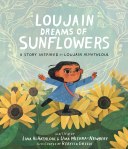
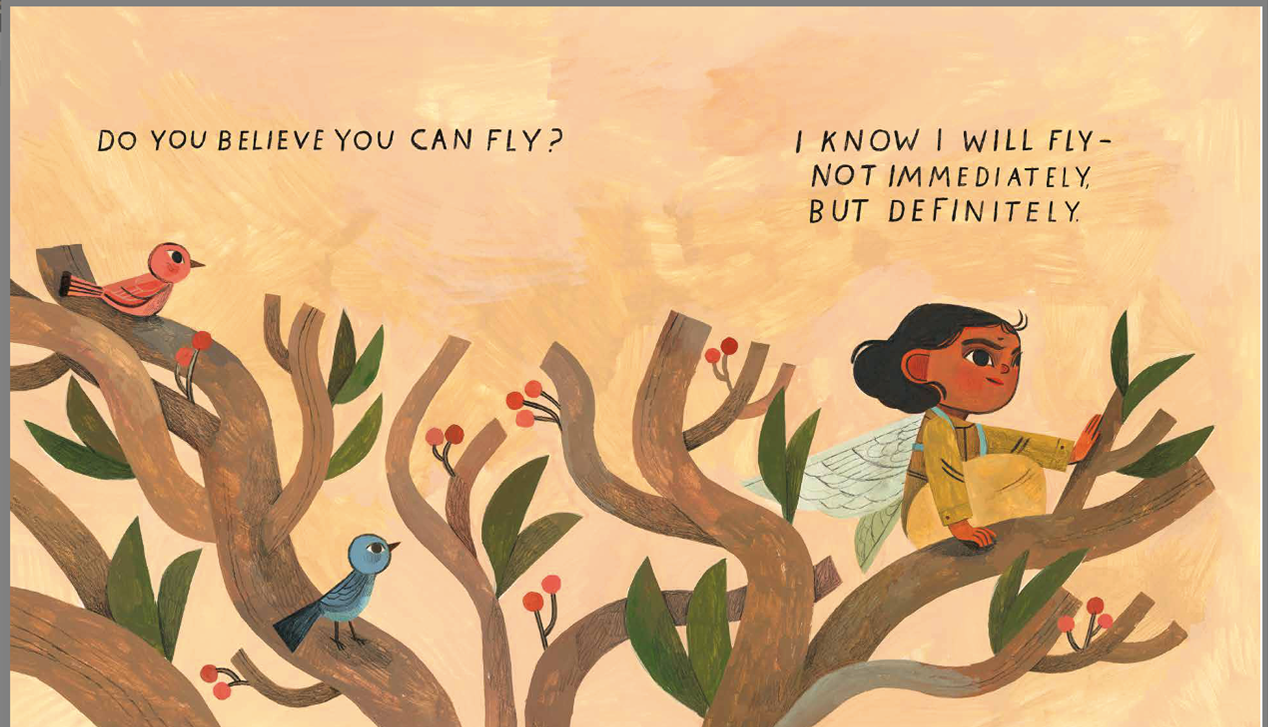
This 40 page early elementary book based on the efforts of the real life woman, Loujain AlHathloul, and her work to change the laws regarding women driving in Saudi Arabia, had a lot of promise.  Unfortunately, the symbolism connecting flying and driving, just didn’t work for me.  No one can flap their arms and fly, so to demand gender equality for an unrealistic action, is a big stretch that ultimately stretches itself too thin.  There is nothing Islamic, except women wearing a hijab in a few illustrations, or even Saudi specific in the book.  It talks of the desert, but the country is unnamed.   Overall, I just had so many questions such as: if she was flying before sunrise- how was she not seen returning from the sunflower patch, can women then never leave an area, are there ways they can fly as passengers, are there other modes of transportation, at what age are children allowed to fly, and so many more, that they prevented me from being inspired by the story.

loujain1

The book starts with Loujain believing in her self and knowing that one day she will fly.  She dreams of a place of a million sunflowers, a picture her dad has given her inspires her to seek out bright colors, capture them on film, and hang them in her room.

loujain2

In the morning her father straps on his wings, and flies off.  Loujain is not allowed to fly because she is a girl.  Her family tells her that one day she will.  When she tells the kids at school, they laugh at her.  When she pushes her dad to teach her, her mother advocates that he should.

loujain3

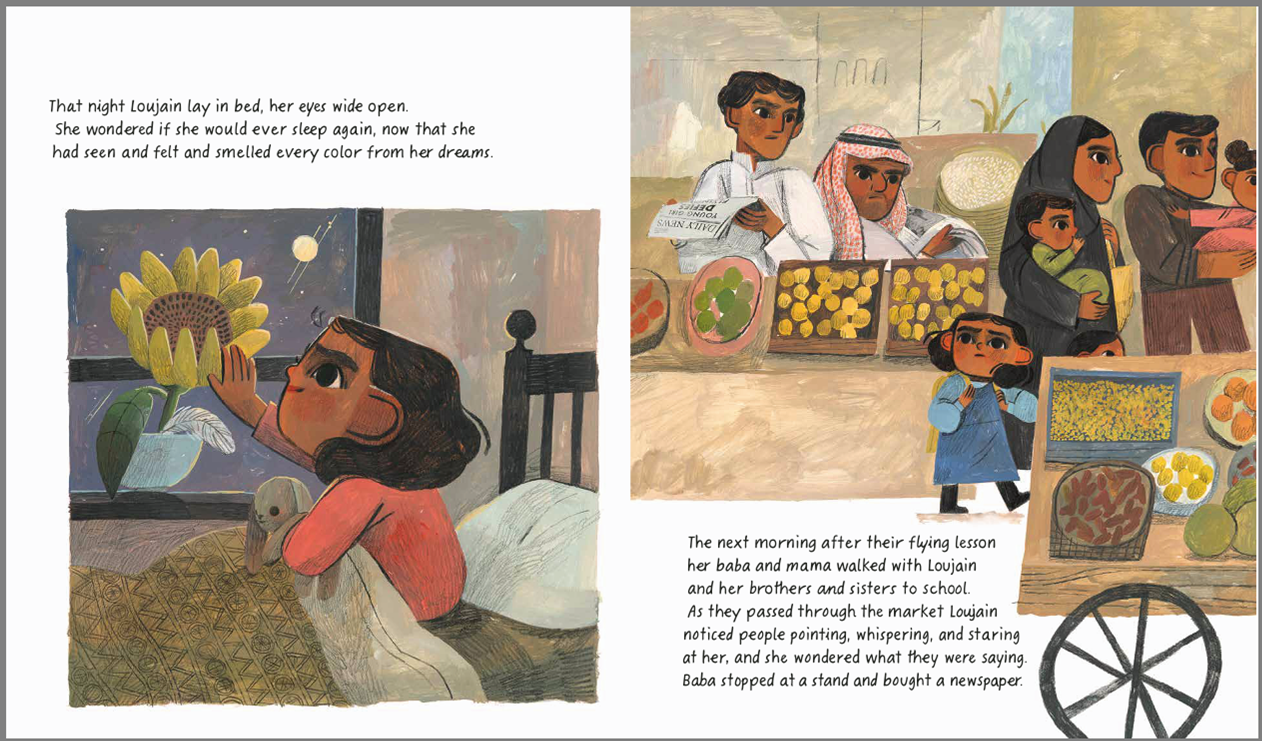
Loujain and her father practice flying before the sun rises, and finally they make the long journey to see the sunflowers.  Her father takes a picture of Loujain, and it appears the next day in the newspaper.  Other girls are inspired and begin to demand the right to fly too.

loujain4

I love the mom in the book, and her encouraging of Loujain’s dad to teach her.  She asks him, “if you don’t support her, who will?” I don’t know why the mom isn’t wearing a hijab on the last page though.  It seems like there is a subtle message there about hijab being legally required as well.

loujain5

The book is a reach, and for me it didn’t connect or leave an impression.  The information about the prison sentence and push back to achieve the legal change was far more interesting and memorable, but only a few paragraphs long at the end.

Girls Who Code by Stacia Deutsch and Michelle Schusterman

Standard
Girls Who Code by Stacia Deutsch and Michelle Schusterman

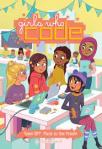
I sadly think that it is safe to say that whenever you see a book that features a cast of characters meant to include multiple minority groups, certain representation is going to read more generic and formulaic than others.  Translation: just because you see a hijabi on the cover, do not rush out to obtain, purchase, and read the entire series.  Chances are if a scarf wearing Muslim is being featured, the details will be simplistic, the rep mediocre, and the OWN voice emotion lacking.  Also know, that other minority groups will have similarly been included for their surface level representation and not necessarily for any real depth.  This includes the boxes to be checked for Black, Hispanic, Asian, and LGBTQ+ storylines, characters, and/or side references.  This is a sweeping generalization, and inshaAllah when I am proven wrong, I will happily point those books out too.  This series hopes to appeal to middle grade female readers (AR 4.0-4.6) with an emphasis on coding, but not so much on how it is done or how they learn it, but how it helps them in their other passions and dramas.  I read books two and four, since the Muslim character is not introduced until book two and I wanted to see how she is developed as the series advances.  Each book is told from a different girl’s perspective so it is assumed that book five, could be Leila’s, but honestly with the focus on crushes, dances, and relationships, I won’t be sticking around to find out.

SYNOPSIS:

BOOK 2: TEAM BFF: RACE TO THE FINISH! is told from Sophia’s perspective.  She is hispanic, has lots of little sisters, loves sports and has a lot of responsibility.  The original four girls reach out to Leila, a new girl from Pakistan to join their coding team and even end up naming their robot Zahira.  When Soph is forced to take care of her siblings instead of go to the hackathon, she will have to learn to ask for help and lean on others when she can’t do everything herself.  It also means she will have to take charge with the upcoming dance and ask Sammy out herself.

BOOK 4: SPOTLIGHT ON CODING CLUB:  The school is doing a new virtual format for the talent show and that means that the coding club has to design a website, an app, and collect all the data.  They don’t have much time, and with everyone’s time stretched thin with other obligations, Erin keeps volunteering to do more.  Her hope is that if she is so busy she can’t think, her anxiety won’t flare up  and she won’t stress too much about her dad who is deployed on a secret mission.  When their teacher announces that she is leaving, the group seems to be falling apart as well, and something will have to give.

WHY I LIKE IT:

The first two books are written by one author, and then three is written by someone else, as is book four.  The writing quality of book four is much better, and the insight in to mental illness, divorced parents, a parent actively deployed, and being stretched too thin, will resonate a lot stronger with readers, than the more whiney presentation of the second book.  Each book seems to also present with a new crush storyline: in the second book it is Sophia recognizing changing feelings for a friend, and in book four it is a lesbian crush that has the side characters angsty.  I wish more about the girls as individuals was stressed rather than having them all be defined by their hundreds of hobbies and extracurriculars.  I was exhausted just imagining all the places they have to be in a week and the frantic pace they must keep to ensure they get there. I get that the demographic is probably giggly over crushes, but honestly they seem so forced and unnecessary in books that already have a lot of moving parts.

FLAGS:

Lying, crushes (gay and straight), anxiety triggers, stress.

TOOLS FOR LEADING THE DISCUSSION:
I don’t know that I would even shelve these in an Islamic School, the idea is good, the execution not so much.

Golden Girl by Reem Faruqi

Standard
Golden Girl by Reem Faruqi

golden

I began reading this book not having any idea what it was about. All I knew, or all I cared to know, was that the incredibly amazingly talented Reem Faruqi wrote it, so I wanted to read it. While I know it will be hard for most to avoid knowing the plot, I think it was a blessing that I was able to be swept away so completely and so fully in a story that is wonderful and memorable, and truly sets a higher standard for the way that a story can be told. Faruqi’s voice and authenticity had me in tears. I didn’t even realize my eyes were dripping until my son asked me if I was ok. It wasn’t the plot that had my emotions spilling over, sure it helped, but it was the storytelling, the hadith and deen and snapshot of a life so unlike my own that simultaneously is exactly my own that a physical reaction emerged. It is the power of OWN voice storytelling. It is the power of brilliant writing. It is not just a book about a Muslim character, this book blurs the lines for me between Islamic fiction and fiction with Muslim characters. Middle school readers (mature middle grade readers) will enjoy the book, older readers will enjoy and appreciate the 336 page story told in verse. You can pre-order the book and I hope you will, it helps convey the message to publishers that this book is highly anticipated and that we need voices like this. Additionally, Goodreads currently is hosting a giveaway, you can head there to try and win a free copy.

(If you don’t want to know what the story is about, maybe skip the next section.)

SYNOPSIS:

Aafiyah’s name means well-being, protection, health, money, happiness, everything good, but Aafiyah has secrets too. She is privileged and loved, and she knows it, but sometimes when she sees something she likes she accidentally borrows it. Sometimes it isn’t an accident. Sometimes she doesn’t just borrow. Much of her life is wonderful, a best friend that lives next door, doting parents, tennis, vacations, trips to Pakistan to visit grandparents, and a love of “weird but true facts.” So what happens when all that changes. When her grandfather gets sick and the family wants to bring him to America for treatment, when Aafiyah’s dad gets detained and imprisoned on the way home, and Aafiyah’s secret may be a way to help her family?

WHY I LIKE LOVE IT:

I absolutely love that the characters are so well rounded and developed. Yes, Muslims have vices, and even young practicing Muslims have tests and struggles. The bar has been raised, we aren’t just a monolith, and our only struggles aren’t girl/boy issues, alcohol, not being oppressed and getting an education, we are complex people, we are human. The bulk of the story is Aafiyah growing up: her responsibility within her family, her changing body and appearance, her friendships, her responsibility for her actions, her desire to want to help and improve and step in to her own. I love that all these layers of life somehow are explored in such sparse lines. It doesn’t drag, but it gives the necessary pauses to involve the reader in her logic and view of the world. Aafiyahs’ kleptomaniac tendencies, her father being detained, her grandfather’s illness. they all move the story along, but they are foils for a much more intimate character story. A story that is surprisingly funny and light and impossible to put down.

I absolutely love how Islam is woven in, how she exudes Islam in all that she is, because she is a Muslim completely, the good and the bad. The guilt she feels, the desperation to be forgiven, the knowing that Allah swt sees all. The book is never even close to being preachy, but she proudly owns her identity and the details of her faith are not watered down, or even justified, it is who she is and it isn’t up for debate.

Culture is presented unapologetically as well. She is critical of things she sees in Pakistan, and similarly celebrates and admires good things about Pakistan and Pakistani culture. The book does not seem to have an agenda in presenting Muslims or Pakistan as good or bad, just as Aafiyah sees them. Which isn’t revolutionary on the surface, but it really is refreshing because it highlights how many books simply don’t. It makes the contrast painfully obvious between books that are shy about certain things, when they have their characters deflect and disassociate from certain “realities” and books that confidently uphold their identity and demand that the reader steps up and truly see the characters and their experiences.

There is a beautiful and raw author’s note at the end that shares some of the inspiration for the threads of the book, a glossary, a recipe for Aloo Gosht and resources for help with kleptomania.

FLAGS:

Stealing, lying, chatter about crushes, music, dancing. Being attractive and the reactions that it gets is woven through out.

TOOLS FOR LEADING THE DISCUSSION:

If I have a majority girl group, I will teach this. It isn’t a girl only book, but I think some of the more subtle themes would need a safer girl space to discuss.

A Sari for Ammi by Mamta Nainy illustrated by Sandhya Prabhat

Standard
A Sari for Ammi by Mamta Nainy illustrated by Sandhya Prabhat

sari

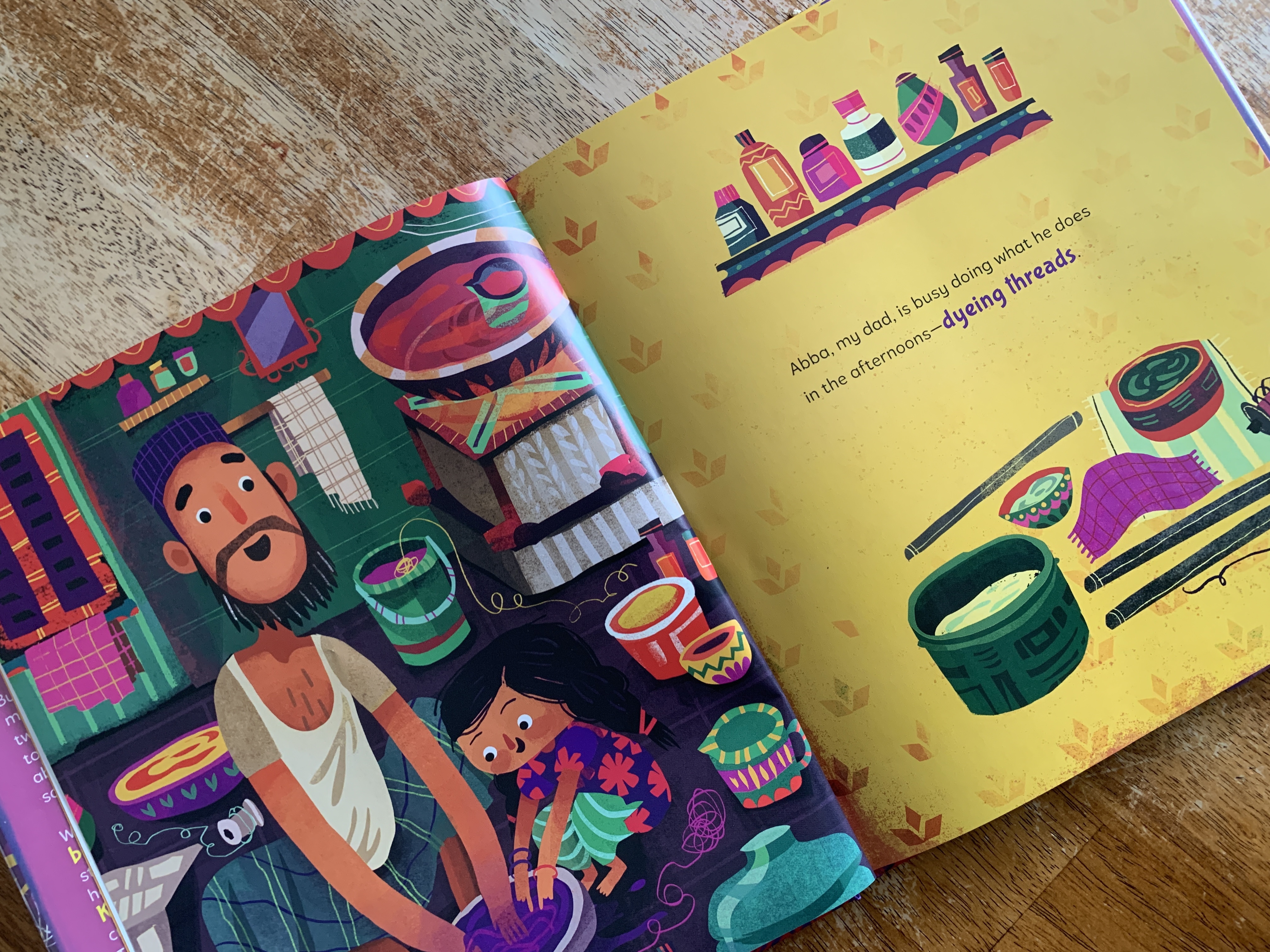
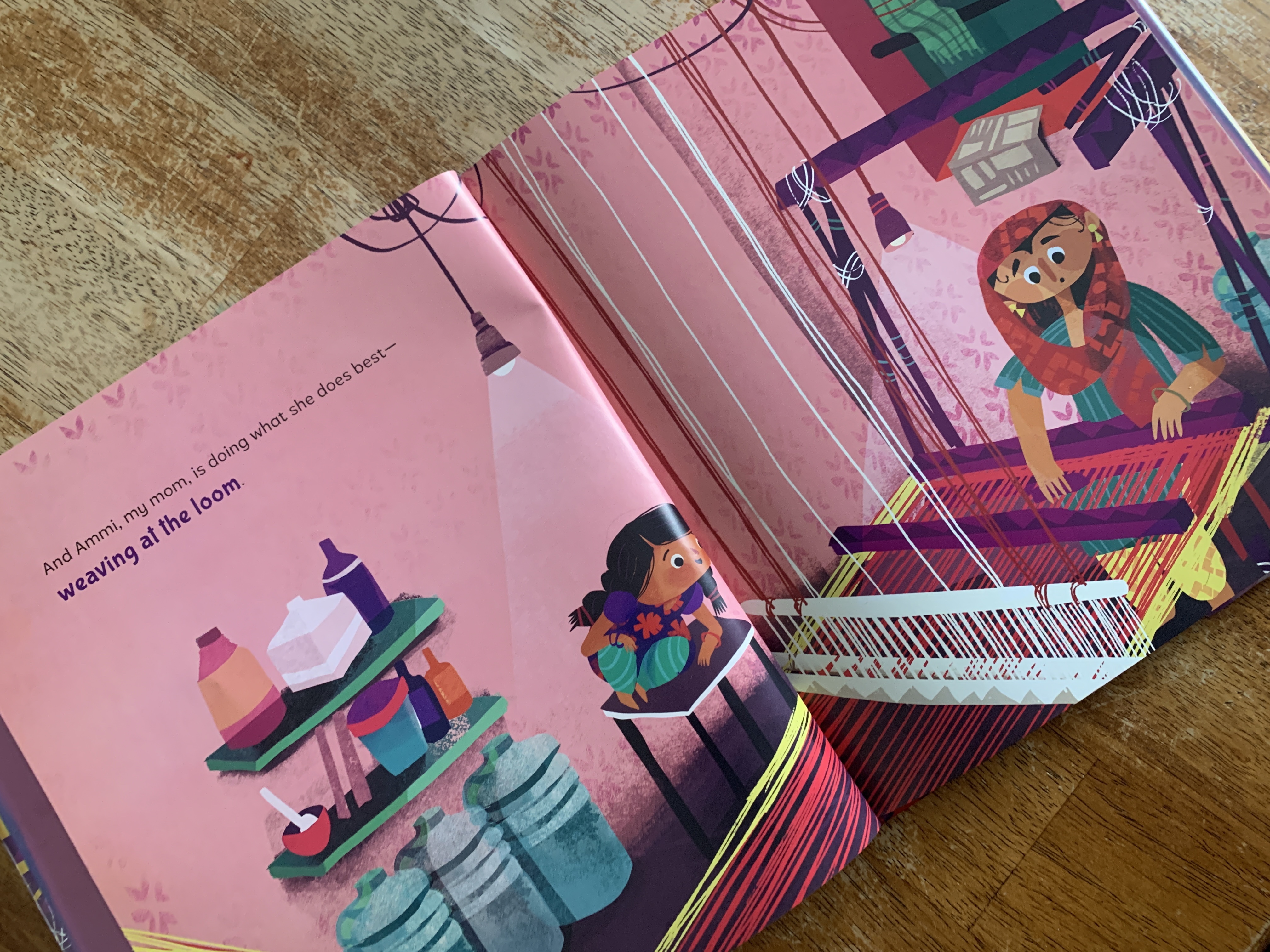
This book combines knowledge with a sweet story and a spunky narrator.  Over 32 brightly illustrated pages the reader learns about the art of dyeing yarn, weaving, and the tradition of weaving saris in India moving from Mysore to Kaithoon in Kota.  The little girl loves it all, helping her father dye the threads, and watching her mother work the loom.  It often takes a month to make a sari, and her mother makes beautiful saris, but she never wears them.  With the help of her older sister Sadaf, the little girl hopes to earn enough money to gift her mother a beautiful sari to wear.  It will take a lot of work, some community help, and some sacrifice, but Ammi is worth it and the girls are up for the challenge.  Preschool to early elementary readers will enjoy learning about the daily life of these amazing Indian Muslim artisans and a craft that they perhaps were not aware existed.

img_4662

The buffalo are sleeping, but in the afternoon Abba is busy dyeing threads, and mama is weaving colors into prints of mangoes, peacocks, birds, leaves, and flowers.  The whole family helps.  Abba goes to the haat to sell the completed saris.  Sometimes Mama goes as well, but she doesn’t wear the saris, she wears worn-out salwar-kameezes.

One day, when Ammi finishes a particularly beautiful sari the little girl asks her to keep it, but her Ammi says, “If we keep the saris, how will we eat?”  The little girl doesn’t understand, they don’t eat saris.

img_4663

Sadaf explains to her little sister that the only way their Ammi will wear a sari is if they buy her one.  So the little girl breaks her bank apart to count the money she has and convinces Sadaf that the things they wanted with the money are nothing compared to how much they want something for their mother.

But Sadaf says they only have enough money for a towel, not a sari, so the girls gather some items to sell to the junk man.  They have enough to buy Ammi a duputta, but still not a sari.

img_4665

They wander home through the wheat field trying to come up with other money raising ideas.  The wheat remind the little girl of worshippers on Eid day- all praying together at the mosque.  The little girl remembers that sometimes their neighbor Amina Khala purchases dyed threads from them and they rush over to see if she has any work for them.  Luckily she does, and they have just enough to buy a sari for Ammi and be rewarded with a smile and tears from their beloved and talented mother.

img_4664

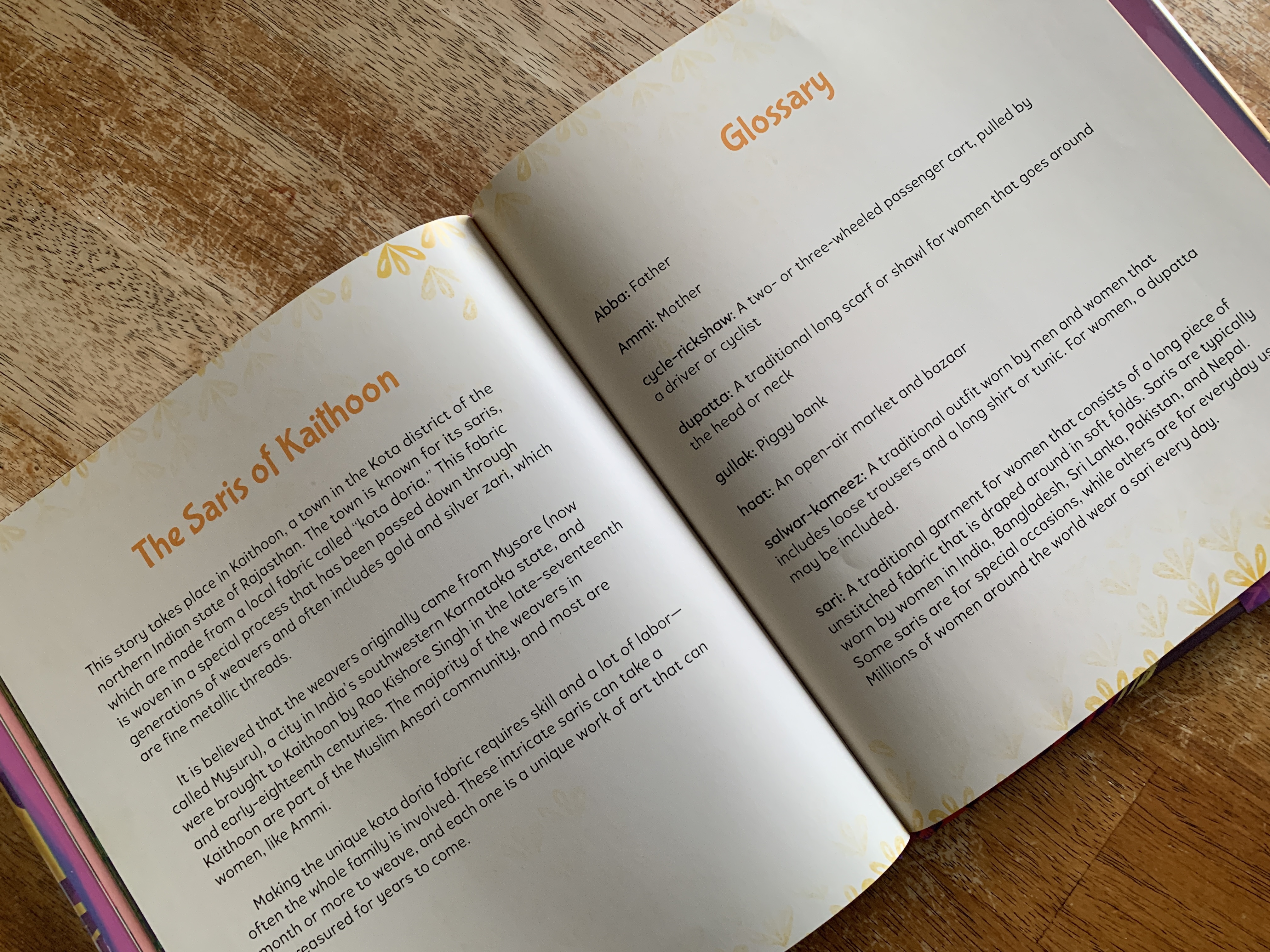
The book has an information page at the end about The Saris of Kaithoon, as well as a glossary.  The story ends a bit abruptly, but the teardrop in the illustrations, the hugging, and the smile, do provide a universal relatability to parents everywhere when their children gift them something so genuinely from the heart.  The illustrations also show women with their heads covered going about their daily life.

img_4666

My Name is Bana by Bana Alabed illustrated by Nez Riaz

Standard
My Name is Bana by Bana Alabed illustrated by Nez Riaz

bana

OWN voice books are always important, and while we see a rise in minority voices claiming their own stories, to read a child’s story about war and hope by a child, is particularly impressive.  Bana Alabed was born in 2009, she is an activist, a Syrian refugee, and now an author.  Her clear voice doesn’t stumble and her perspective is unapologetic, yet hopeful.  Over 40 pages she tells her story in her own words with beautifully warm and complementary illustrations filling the pages.  For kindergarten and up, this book stands out in a crowded field of refugee inspired stories for its authenticity, strong author, and overall emotional connection.

img_4629

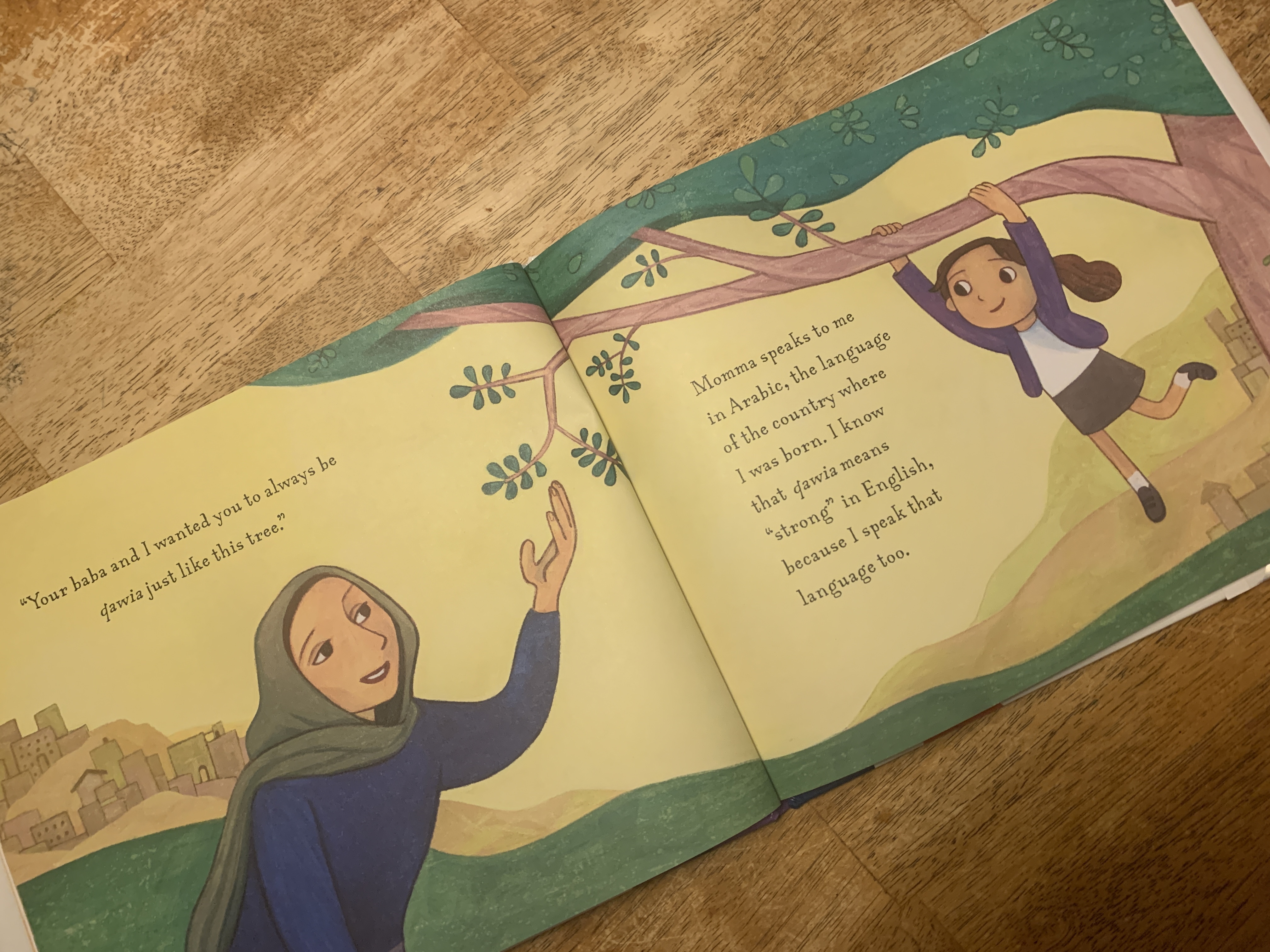
Bana begins her picture book memoir by asking her mother why she was named Bana.  Her mother explains that she was named after a tall bushy tree that grows in Syria.  Her favorite tree.  A tree that is qawai, Arabic for strong.

img_4630

Bana then asks what it means to be strong.  And once again her mother lovingly explains, that strong is to be brave even when you are scared, and to be sturdy so others can lean on you.  It also means you use your mighty voice to speak up when something is wrong, you read, study, and exercise your body.

img_4631

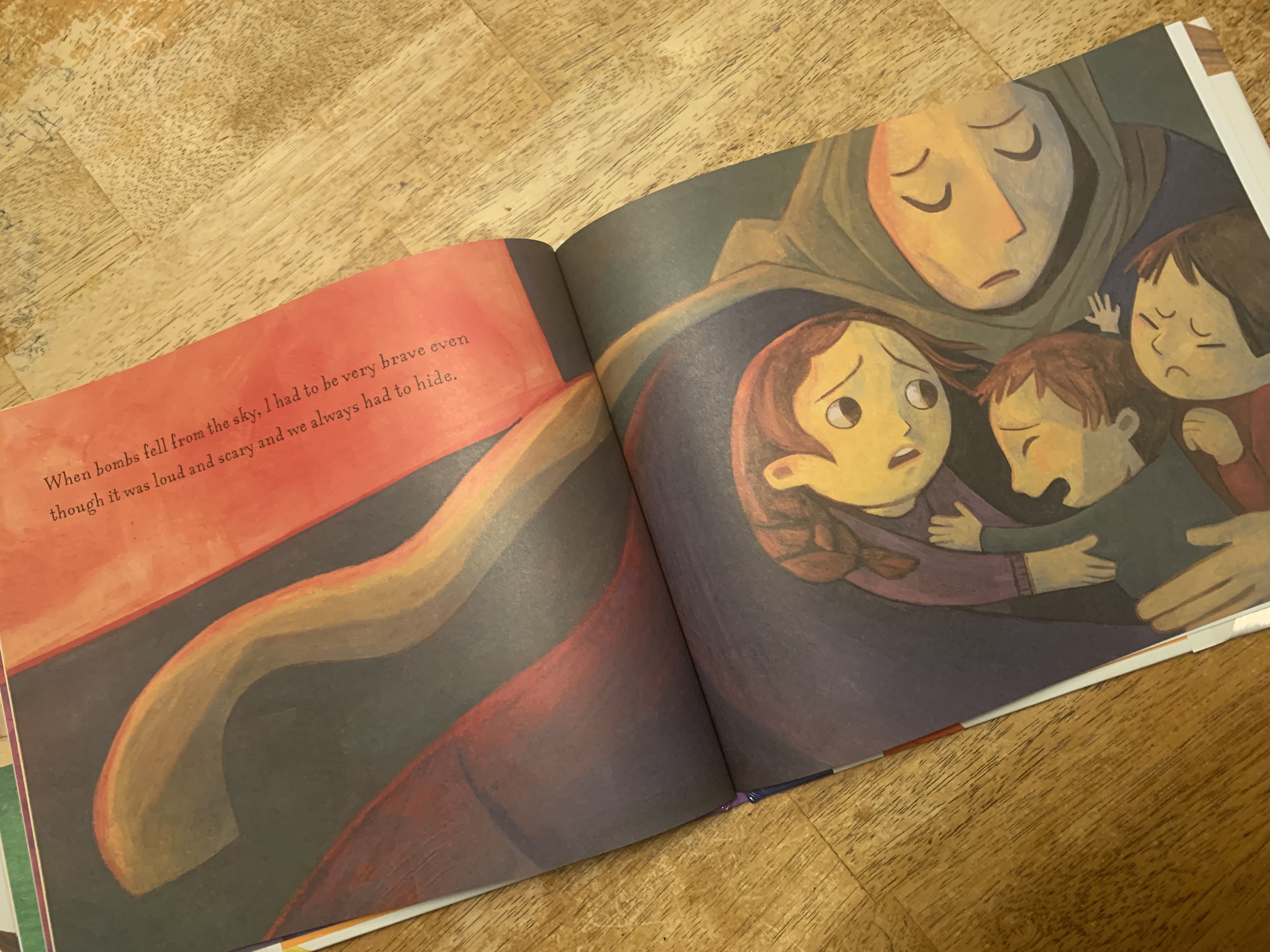
Bana appreciates her name, and being strong, because war came to her country.  When bombs fell they had to hide, when her brothers were scared, she had to keep them distracted, when they moved to a new place where they didn’t know the language or any people, she had to be strong still.

img_4632

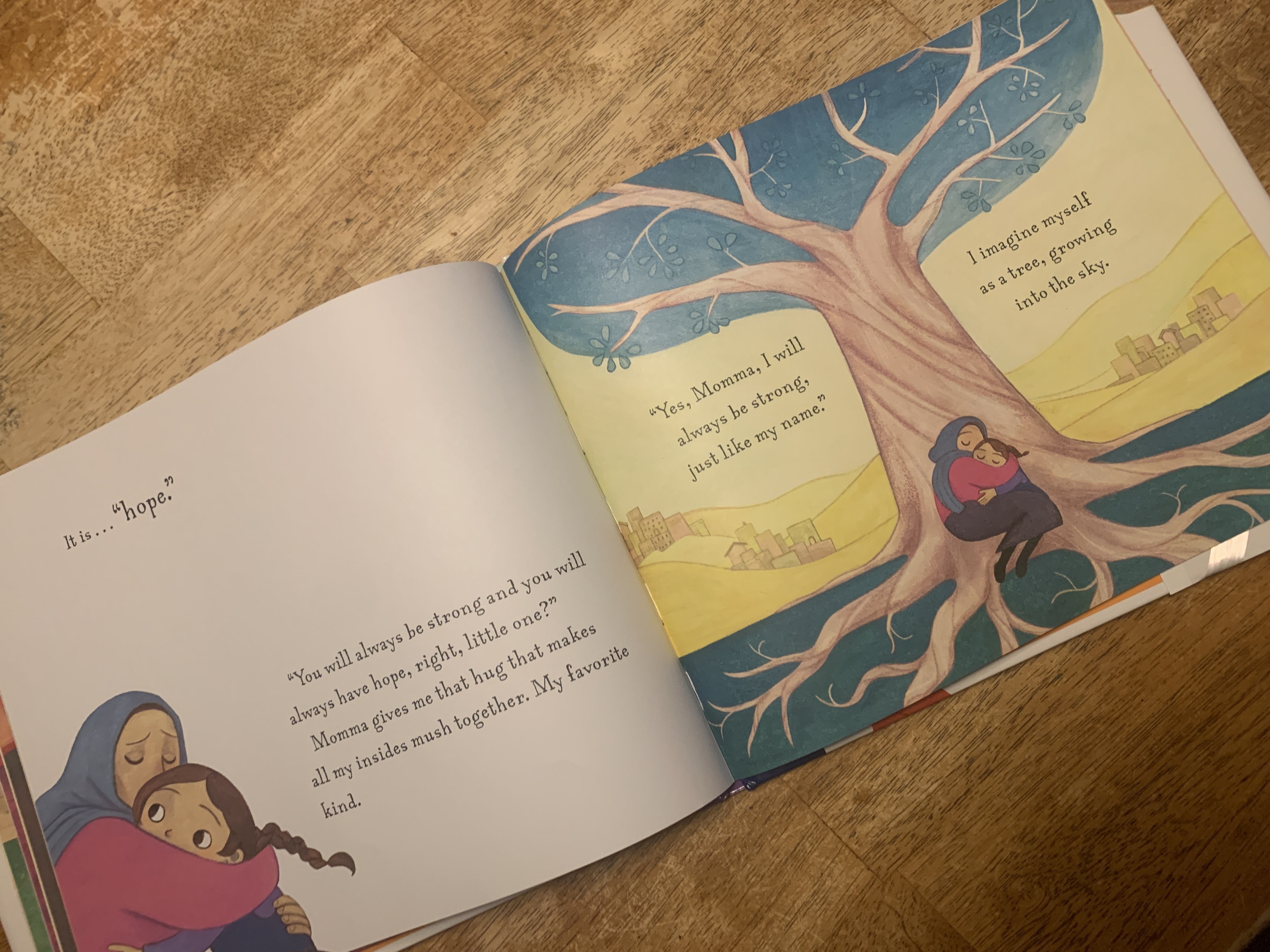
As a young girl, Bana tweeted about the war, the book doesn’t touch on that, but it does show her being strong as she shares her story all over the world.  It then returns to her and her mother discussing amal, Arabic for hope, and Bana imagines herself strong, reaching into the sky.

img_4633

The book ends on a simpler note of acknowledging her little brothers’ names: Laith and Noor, lion and light.  The Author’s Note at the end is just as powerful as the text of the book and provides more information about Bana’s experience and outlook. The way that war is handled is not overpowering for young readers, and will provide a great starting point of discussion.  The relationship between Bana and her mother is warm and supportive and equally deserving of mention with the little people you share the book with, alhumdulillah.

“Kids shouldn’t have to always be strong.  Every child deserves to live in peace.” Bana Alabed

A Sky-Blue Bench by Bahram Rahman illustrated by Peggy Collins

Standard
A Sky-Blue Bench by Bahram Rahman illustrated by Peggy Collins

sky cover

I know many of you are thinking, another book about school for girls in Afghanistan, and given the reception by most to the author’s first book, The Library Bus,  I can sense the rolling eyes.  I was in the minority on that one, as I enjoyed it, but, this one is simpler, sweeter, more universal while being complimented by culture, and I hope it is a more authentic and accurate OWN voice portrayal.  I know I have a lot to learn about white washing narratives and breaking down colonial paradigms, so I promise if you disagree I will listen.  But I genuinely enjoyed the illustrations and little Aria finding a way to make a bench so she could sit comfortably at school with her prosthetic leg.  The girls go to school, and the furniture was burned to keep warm in the winter, a concept that the author verifies at the end as something experienced in his own life.  Aria has to find a way to sit in class because she wants to learn, and lack of wood working experience, resources, and doubt that a girl can do it from her classmates, isn’t going to stop her.  Over 32 pages, early elementary age children will meet a determined young girl as she pieces together scraps to build a bench.

Screen Shot 2021-10-22 at 10.49.20 PM

Aria has been in the hospital for a while after an accident took her leg.  She is excited to be back at school, but quickly realizes it is hard to sit on the floor with her new helper leg.  She tries leaning on the wall, standing even, but just getting up and down off the floor is really difficult.  At home when she mentions it to her mom, her mom reassures her that she can get through it and her little brother offers to help her carry her things.

Screen Shot 2021-10-22 at 10.51.12 PM

That night Aria considers how much she would miss school if she isn’t able to figure something out.  Then she has an idea, she’ll build a bench.  At school the next morning, classmates tell her “Girls don’t build benches,” but Aria responds, “I can do anything a boy can.”

With that, a single friend joins Aria as they comb the city for discarded wood, broken furniture, screws, and nails.  They assemble the resources and when they have enough Aria and her mom head across town, past the Blue Mosque, to visit the carpenter, Kaka Najar.  He shows them how to fit the pieces together like a puzzle and loans them the tools needed to be successful.  He even gifts her some sky-blue paint, “the color of courage, peace, and wisdom.”

Screen Shot 2021-10-22 at 10.52.30 PM

That weekend Aria and her mom and little brother build a bench, paint it blue, and get it to school.  When the other students see it, their excitement bubbles and they imagine building tables, book cases, and more.  Anything is possible after all, there is paint left in the can and they are willing to work together.

Screen Shot 2021-10-22 at 10.53.08 PM

There is nothing religious in the text, save the mention of walking past a mosque, but in the illustrations the women are all covering their heads when they are out, and are uncovered at home, the school uniform seems to be a white hijab and black abaya.  I wish there were some Pashto words sprinkled, and it was a bit off that she was building a bench, but the finished project was a bench and table. The end has an Author’s Note and I enjoy seeing the smiling faces and bright illustrations in a book set in Afghanistan.

Screen Shot 2021-10-22 at 10.54.15 PM

Daring Dreamers Club: Piper Cooks Up a Plan by Erin Sodenburg illustrated by Anoosha Syed

Standard
Daring Dreamers Club: Piper Cooks Up a Plan by Erin Sodenburg illustrated by Anoosha Syed

piper

This is book two in the series, I couldn’t get the first book from the library, and I wasn’t willing to wait for the one that focuses on Muslim character, Zahra’s story to be published, it could be a few years.  At 224 pages this middle grades book is fairly formulaic with five diverse girls becoming friends, each book featuring one girl’s story with the others serving as supporting characters, and with the tie-in to Disney Princesses, I really didn’t expect much. Imagine my surprise when I found myself enjoying the characters and their lessons and struggles, sigh.  The book is sweet, the characters like-able, and the author really doesn’t try and force all the characters into every scene.  The book focuses on Piper and the other girls add to her story where it helps, they don’t all have equal time and it doesn’t get confusing because of it.  You can even read the books out of order.  Zahra wears hijab and her Islam is mentioned in a journal entry where she discusses the five pillars, the importance of charity, and getting dirty looks.  There is nothing preachy, but none of the other character’s are defined by their faith and I truly don’t know if I’m bothered by the singling out of Islam being her identity or flattered by it.

img_4279

SYNOPSIS:

Five girls are grouped together at school in an advisory class to help prepare them for middle school: Milla, Piper, Ruby, Mariana, and Zahra.  Their advisor loves Disney Princesses and in their weekly journal entries has them write about their assigned Princesses as they explore their similarities and how they would tackle challenges, face fears, and the like.  The girls are diverse in family dynamics, race, religion, ability, etc.  Milla is African American with two moms and food allergies.  Zahra is good at art, Muslim, and likes to sew.  Ruby is a twin, her parents are divorced and she is great at sports.  Mariana is hispanic, and is an amazing swimmer.  Piper is Jewish, has dyslexia and loves to cook.  In the book she is struggling with school, while she excels in her food science creations.  She gets accepted to appear in a kids cooking show competition, but will need the help of her Daring Dreamer friends to prepare for the challenges about to be thrown at her during the competition, and to help her from falling behind in school.

Each girl has their journal entry presented in the book which helps to understand more about the different girls, as well as a little bit of introspection to the events happening in the larger story.

WHY I LIKE IT:

I like that the characters are really supportive, and the lessons aren’t so on the nose.  Piper isn’t just told that she doesn’t have to win the competition to have value, you feel it long before she accepts it herself.  Her personality really comes through and it isn’t for attention or for sympathy, she helps a competitor, there is no giant round of applause or moral reflection, she just helps.  I love that even though the story is Piper’s and her dream, there are larger issues woven in and felt, not necessarily preached. Piper is the middle child and feels she has to prove herself, she remarks on how being pulled out of class in early elementary school to get help has made it hard for her to ask for academic help now, the role of confidence and how charity and giving back is important, even while her own family’s financial situation isn’t clear.  I like the role of Piper’s siblings, they are quirky, but loving, and they work through their annoyances to help each other.  It is heartwarming.

I have my own mixed feelings about Disney Princesses, as a child of the 80’s, the 90’s brought all the glory of Jasmine, and Ariel, and Belle, and Mulan, and my friends and I definitely identified with different characters.  I may or may not have tied my hijab up many a days and claimed that I was Mulan in high school, but somehow with my own daughter I didn’t really bring the Princesses in to her day-to-day existence, I don’t think she has even seen all the movies, we read books (we didn’t even have a tv when she was little), she’s 14 now.  It had become too commercialized, I worried about the messaging more.  This book reminded me of what my friends and I as older “kids” channeled the Disney Princesses to be.  It wasn’t all about pink and sparkles, it was battling the bad guy, hanging on to your dreams, and persevering when things were tough.  This book channels those thoughts, it isn’t in your face Disney, it is more muted, and I appreciate that.  It is a solid middle grade read and I think an enjoyable one at that.

img_4283

FLAGS:

In this particular installment, there are no crushes, no holidays, no music, one character has two moms, but in this book, I don’t know that a casual reader would pick up on it. It says “Moms” once, it might be a bigger deal in the story that focuses on Milla, but I haven’t read it to comment.  There is lying and Piper tries to justify it, but I think it is clear and has its own resolution.

img_4284

TOOLS FOR LEADING THE DISCUSSION:

It is much too young for a middle school book club, but I think because it is such an easy engaging read, that in a home, or classroom, the book would be appealing to 3rd graders and up.

The author’s website: https://www.erinsoderberg.com/daring-dreamers-club.html

img_4280