Category Archives: Non Fiction

Craft it Up This Ramadan and Eid by Zayneb Abdullatif photography by Sidoie Djunaedi

Standard
Craft it Up This Ramadan and Eid by Zayneb Abdullatif photography by Sidoie Djunaedi

This book is not new, but I saw it at my library and thoroughly enjoyed looking through it.  I’ve hosted, helped, and attended numerous Ramadan craft fairs and story and craft times over the years, and I know everything can be found online.  Yet somehow this 79 page, 2015 published book was kind of fun to look at with my toddler.  It wasn’t overwhelming or super complicated, it was just a nice roundup of simple crafts that you could easily do with items around your home, while dropping little informative bits about Islam, Muslims, Ramadan, and Eid.  I doubt young parents today would even think to look in a library book for Ramadan craft ideas, it is a bit of an antiquated concept in todays day and age.  I highlight it today to remind us that so many have worked very hard to advance Muslim representation in books in all its forms, alhumdulillah, so that we can continue to see ourselves, make strides, and raise the bar.

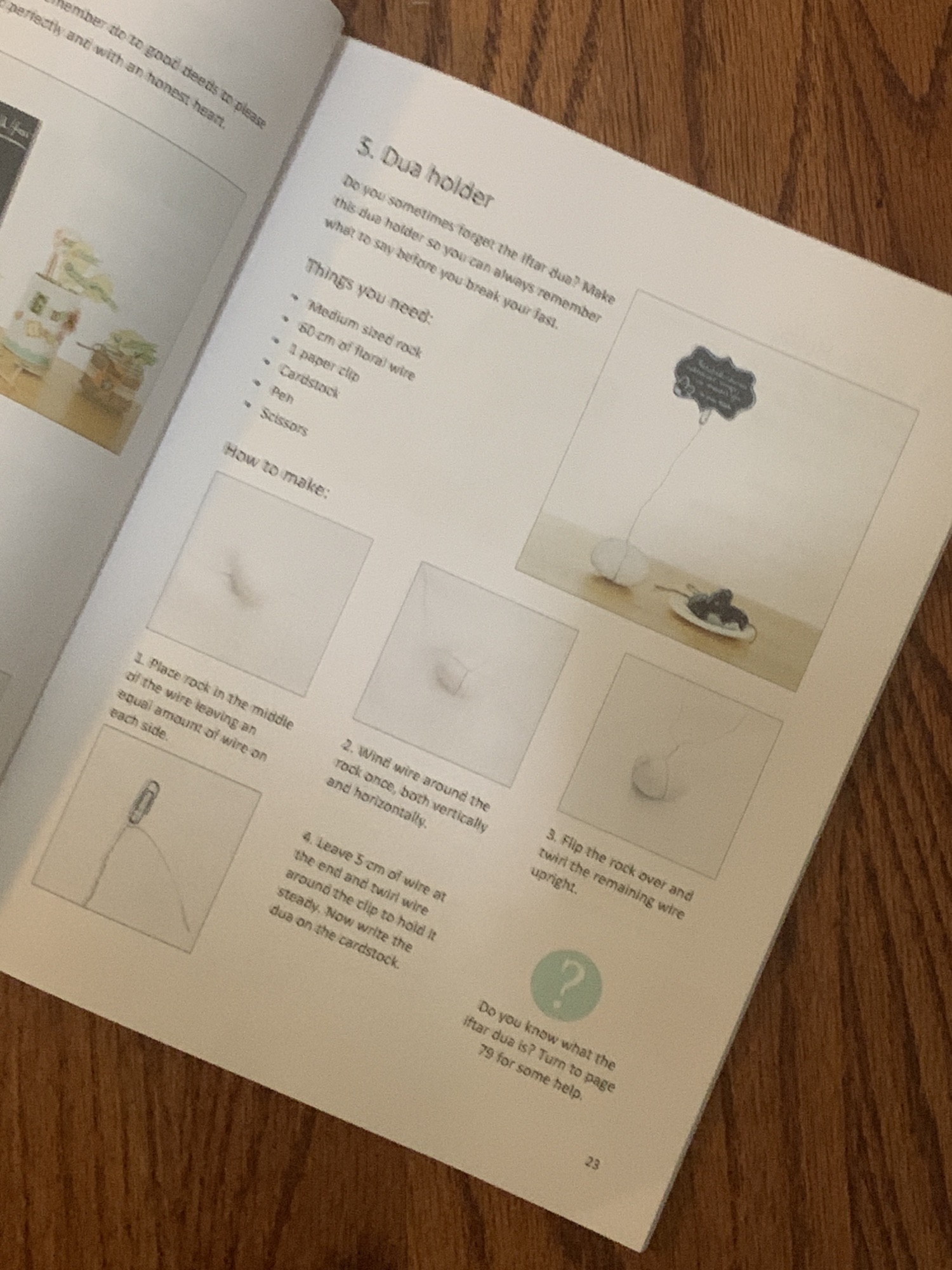
The book starts with tips for parents and guardians, followed by the basics, crafts for the joyous month, crafts for Eid, a special festival, and concludes with templates, good deeds activity list, and a glossary.

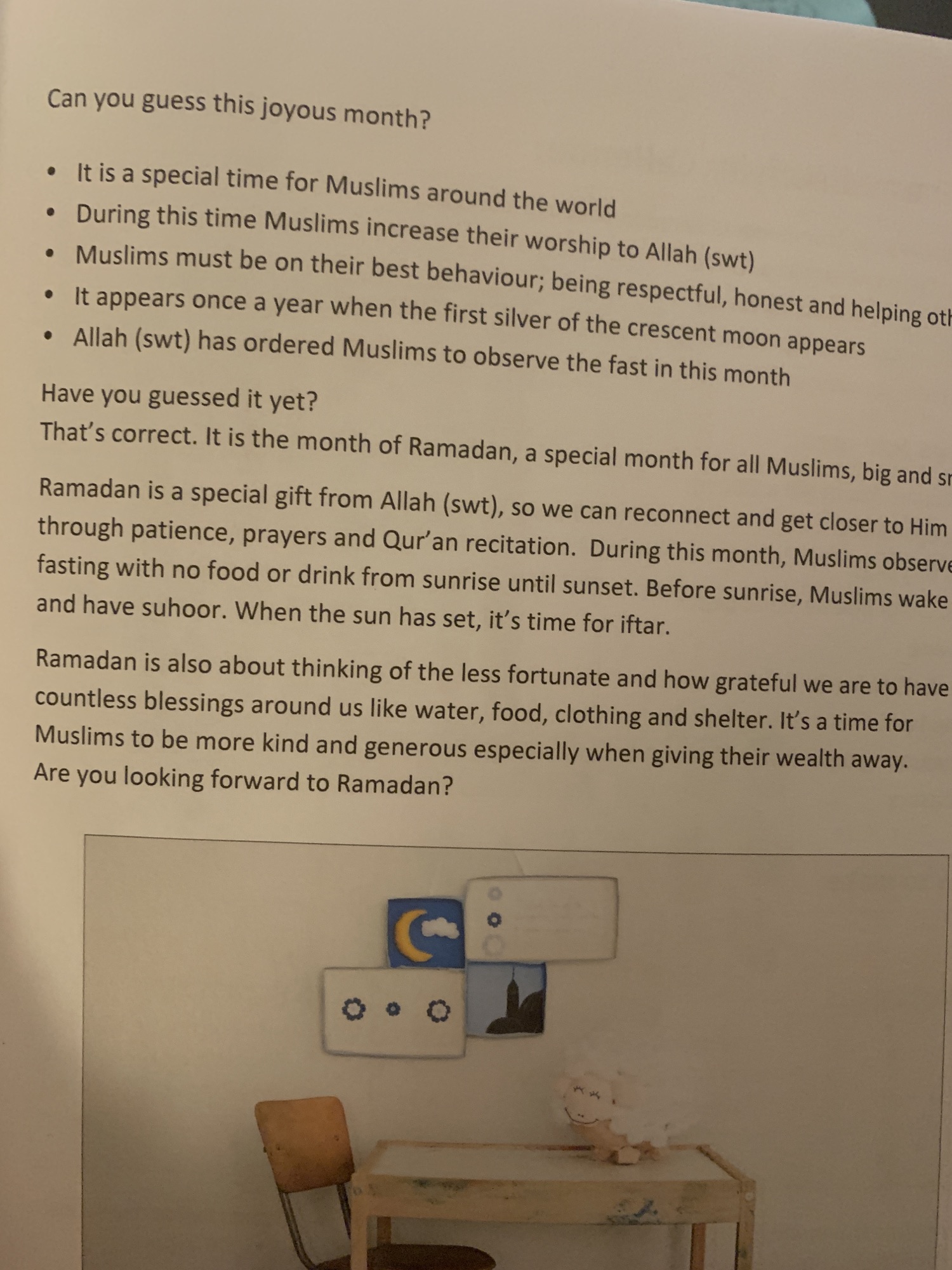
It erroneously says we fast from sunrise to sunset, but does get right that we increase our worship and that fasting was ordered for us by Allah swt.  On the Eid section it discusses the takbirat and gives Eid al Adha a paragraph explanation as well.

A fun library find, that kept us off a screen and able to plan some little activities to do this Ramadan.
Eliyas Explians Ramadan by Zanib Mian illustrated by Daniel Hills

Standard
Eliyas Explians Ramadan by Zanib Mian illustrated by Daniel Hills

This is the fifth book in the Eliyas Explains series, and it really is what you would expect and hope, a book about Ramadan from Zanib Mian would be.  Eliyas’s voice is funny, relatable, engaging, and yet somehow manages to find a clear way to inform too.  The framing is fictional, but the book is meant to be lesson, moral, and information filled.  The voice did seem to break when Eliya’s didn’t know what “Ramadan Mubarak” meant, but it is clear that the book is meant to teach and remind middle grade kids about Ramadan from moon sighting to Eid, so I don’t think anyone other than an old reviewer would notice.  Parents might notice though that Eliyas loses his cool at one point and starts to presumably call his sister stupid, it stops at “st,” but then says he “started to cuss” which in America would be taken to mean a profanity much stronger than stupid, so just be aware, so you don’t panic if your child asks.  Overall the book is great, it is a solid 80 pages before the guided journaling begins and concludes at 115 pages.  The illustrations, changing font, and humor really make it perfect for the age group.  I gave it to my eight year old to read and I could hear him laughing, saying a few dua’as aloud, and he even came and asked me a few questions making sure he understood new information correctly.  This book would work as an independent read, a read aloud, or even an elementary reading assignment in an Islamic or weekend school.  The book is remarkable for the simple fact that it starts by naming the scholar that proofed the book, truly this is revolutionary, please can we normalize sourcing already.

The book is divided into chapters, with chapter one reintroducing Eliyas and his family to the reader. They are out on a bike ride and Eliya’s wants to know why everyone is so excited for Ramadan and giving up food and water.  Mom and dad explain taqwa and good deeds being multiplied and prayers being answered and big shaytans being locked up and Eliyas is excited (to put it mildly) to get closer to Allah swt and be a better version of himself.

Chapter two explains the moon, making intention, and waking up for suhoor.  With nine chapters before the journaling, the book discusses doing good deeds, fighting, forgiveness, shaytan being locked up, taraweeh, Laylatul Qader, and Eid.

The journaling guides readers through forgiveness, ibadah, goals, duas, kindness, feelings, connecting with Allah swt and more.  The beauty of this book is that it does pack a lot of information, but it shows a lot too, and gives kids a way to see Ramadan in action.

You can order your copy here at Crescent Moon store 

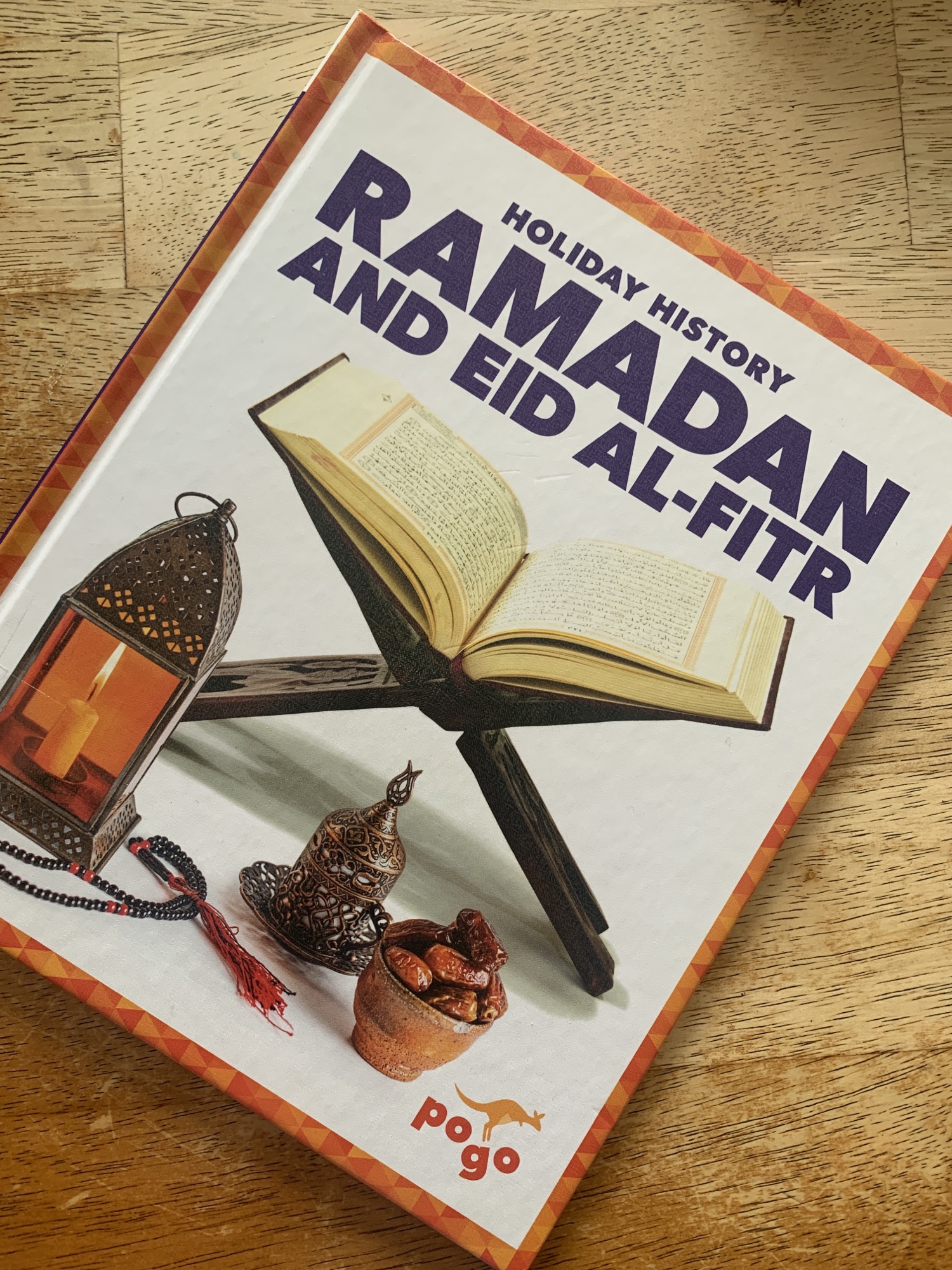
Holiday History Ramadan and Eid Al-Fitr by Marzieh A. Ali

Standard
Holiday History Ramadan and Eid Al-Fitr by Marzieh A. Ali

img_2952-1

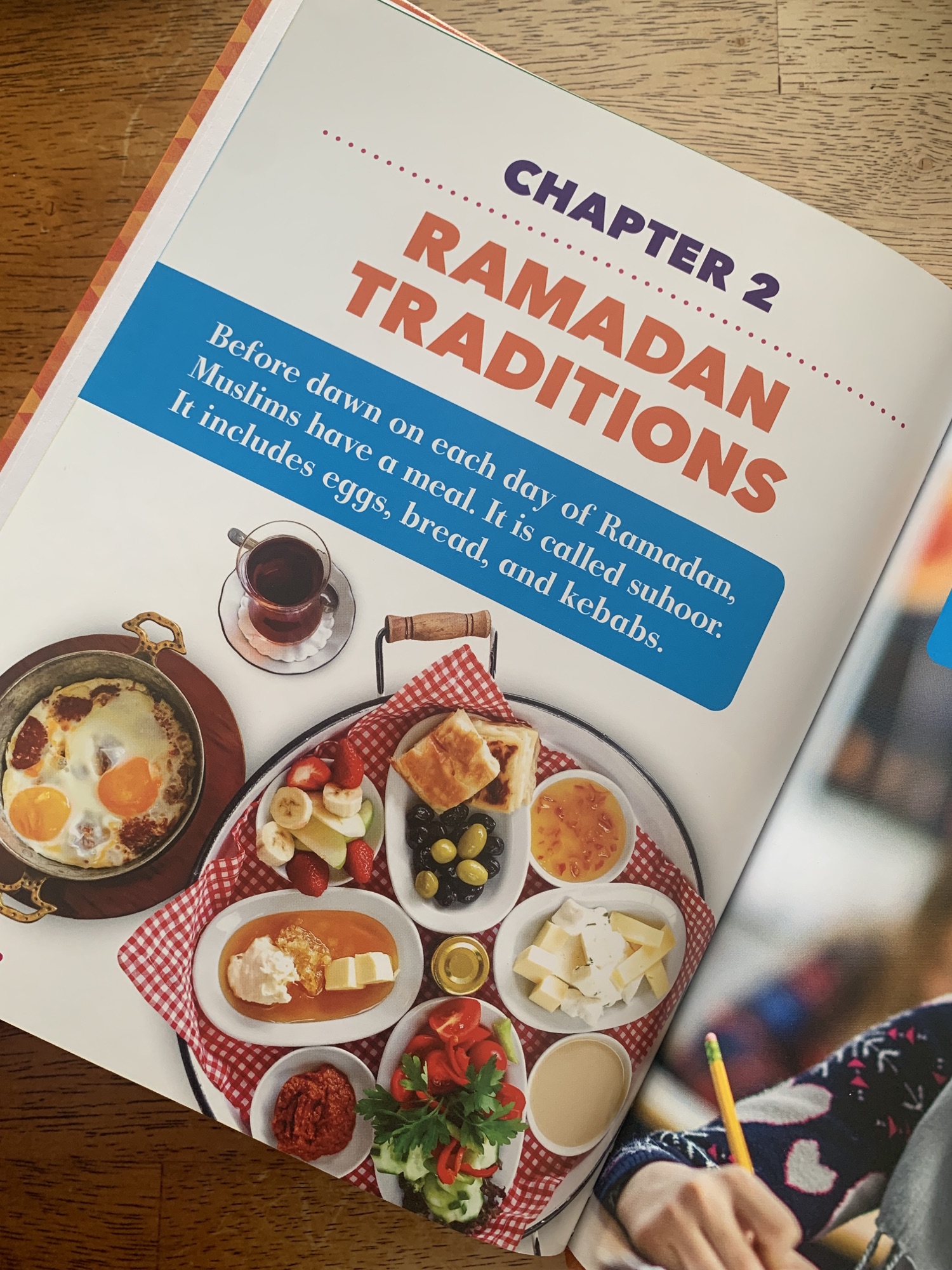
Traditionally published non fiction Ramadan and Eid books have more errors than they should.  I was hopeful with this one, the author is a Muslim and accomplished author, and it started out good, but then it hyper fixated on the foods eaten which can never be accurate.  Muslims are everywhere in the world, and no two people like the exact same foods anywhere, not even siblings  So why it would so clearly articulate, without qualifiers, what Muslims eat for suhoor or iftar is beyond me.  I do not eat eggs, bread, and kebabs for suhoor, we tend to enjoy brownie sundaes and pizza, and dates, broth, and fruit for iftar, sure makes me wonder if my nachos or pesto, rendered my fasts invalid?  Snark aside, it takes away from the quality information in the book that highlights that while fasting Muslim kids go to school and adults to work.  I also don’t like the suggestion that Ramadan is a time to reflect, pray, cook for others, and help those in need. It truly reads that this is when we do it, as if it is the only time we do it, and not that we do these acts all year, but do it MORE in Ramadan.  I know, I’m being picky, but these types of books are standards in public and school libraries, and in a world where Muslims are by-and-large having to prove their humanity, words have power, and need to be conveying that we pray five times a day, and more in Ramadan.  That we help those in need all year long, and more in Ramadan. The book is only 23 pages long, so when it spends so much space on these items worded in this way, it really becomes the takeaway message.

img_2953-1

The book starts pretty well, with clear precise sentences telling that “Islam is a religion practiced by Muslims” and that “they believe in one God” (note in the book God is not capitalized). It has that “Ramadan is the ninth month in the Islamic lunar calendar,” which I am ok with in non fiction books. And tells that “more that 1,400 years ago, the Prophet Muhammad received the first verses of the Quran” and that “they were sent by Allah through angel Gabriel.” 

img_2954-1

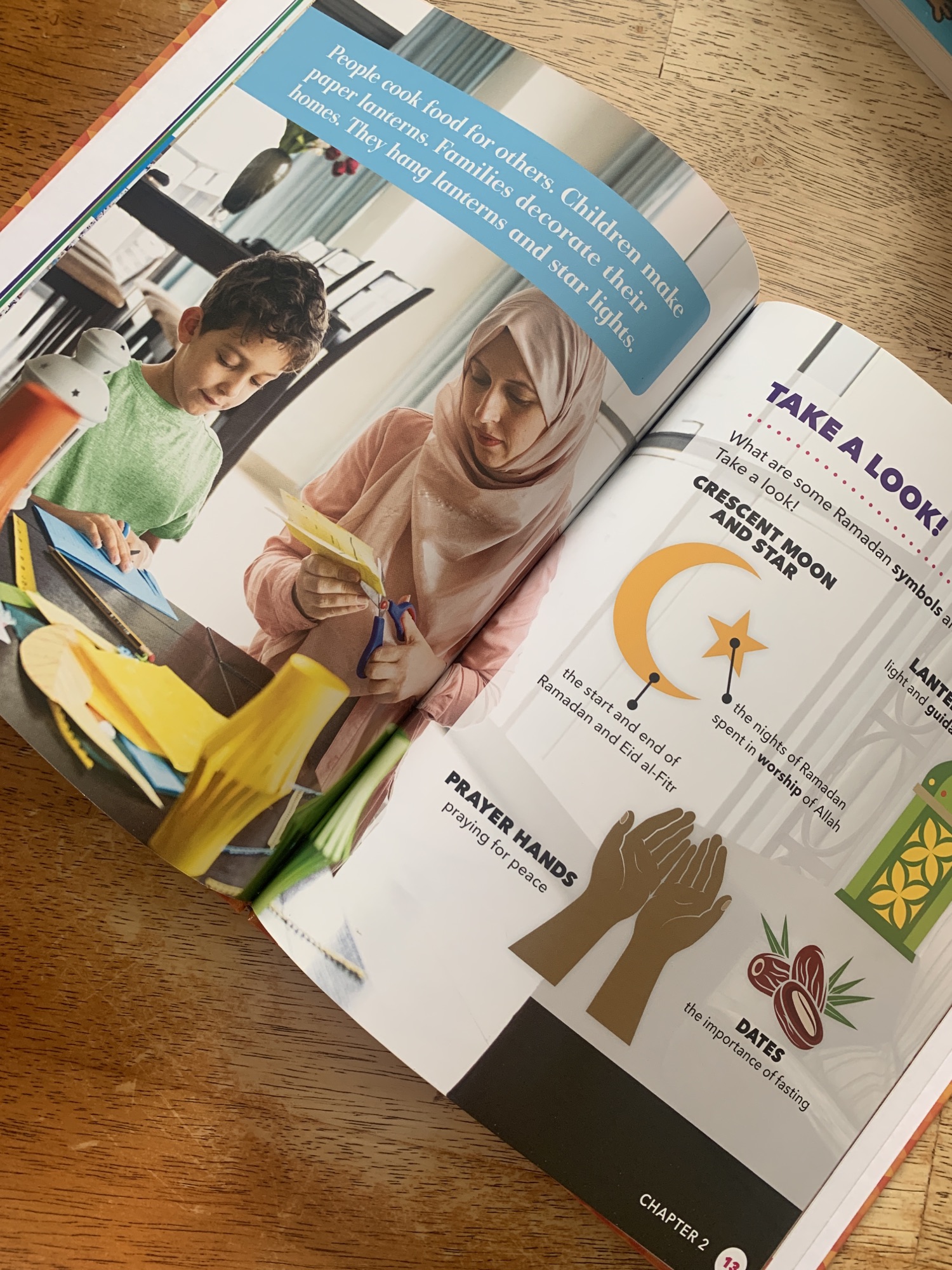
We then get two pages about specific foods, and told “Ramadan is a time to help.”  “It is also a time to pray and reflect.  People go to mosques.  They read the Quran.  They talk about Islam.” Stated just like that.  Making it seem that only in Ramadan are these things done. The unqualified statements make it seem that just as “They read the Quran” “Children make paper lanterns.” Apparently it isn’t optional, or a fun craft, it is just what is done.

I like that the five pillars are included, I wish it gave the terms of shahada, and sawm, and salat, and zakat and hajj, “journeying to Mecca” is a bit vague, and not at all sufficient.  I don’t know about they weight of the symbols either.  Dates show the “importance of fasting.” No they are the sunnah.  The star on the crescent symbolizes “the night of Ramadan spent in worship.” I think the symbols are a stretch to be honest.

img_2957-1

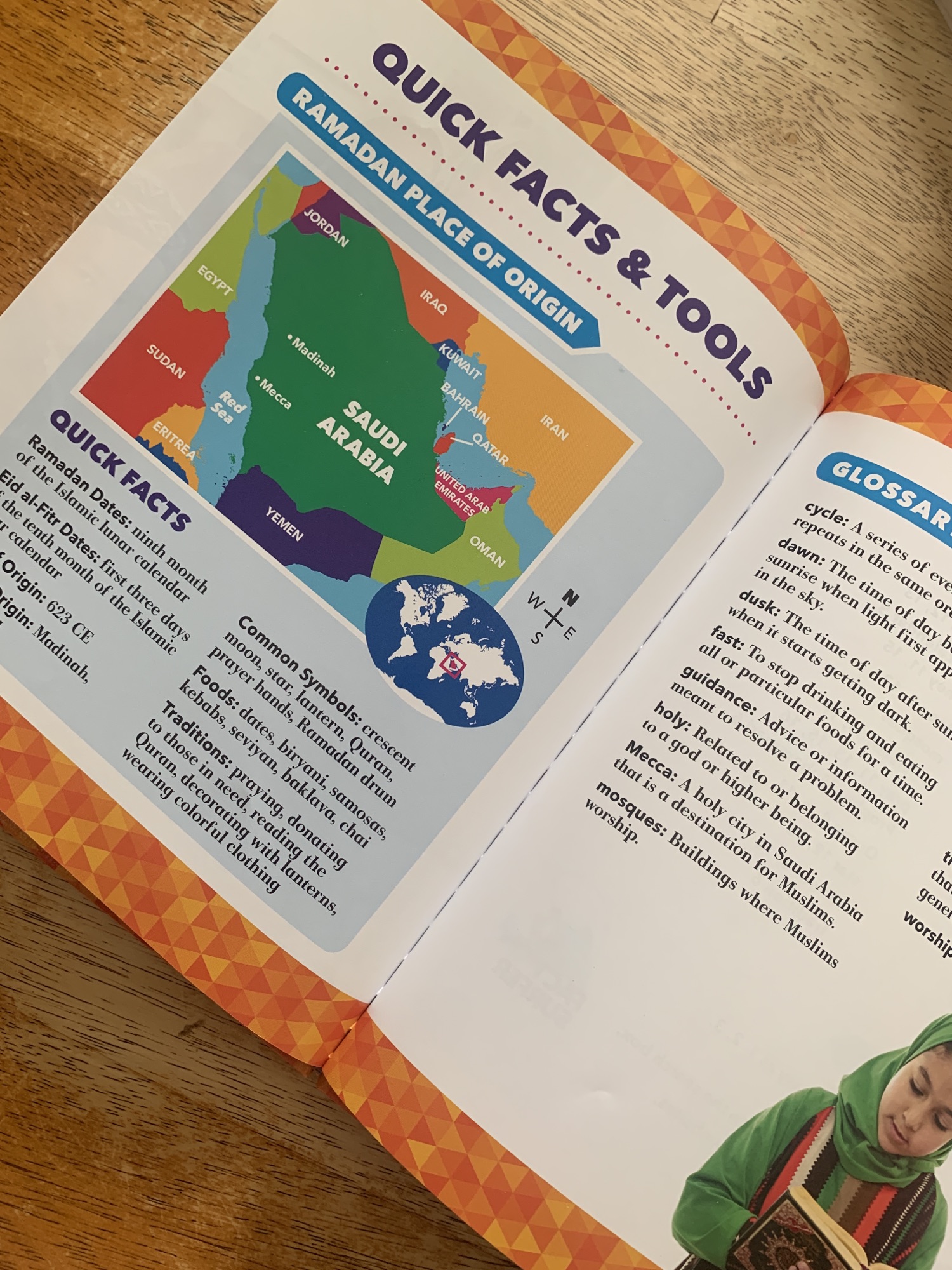
Eid al Fitr is one day not three as the book states.  The next spread then revisits the food, as if Biriyani is only eaten on Eid and all Egyptians make baklava.  The end is a one page Quick Facts and Tools and a glossary.  I have once again sent an email to the publisher asking them to edit future reprints of the book. 

img_2958-1


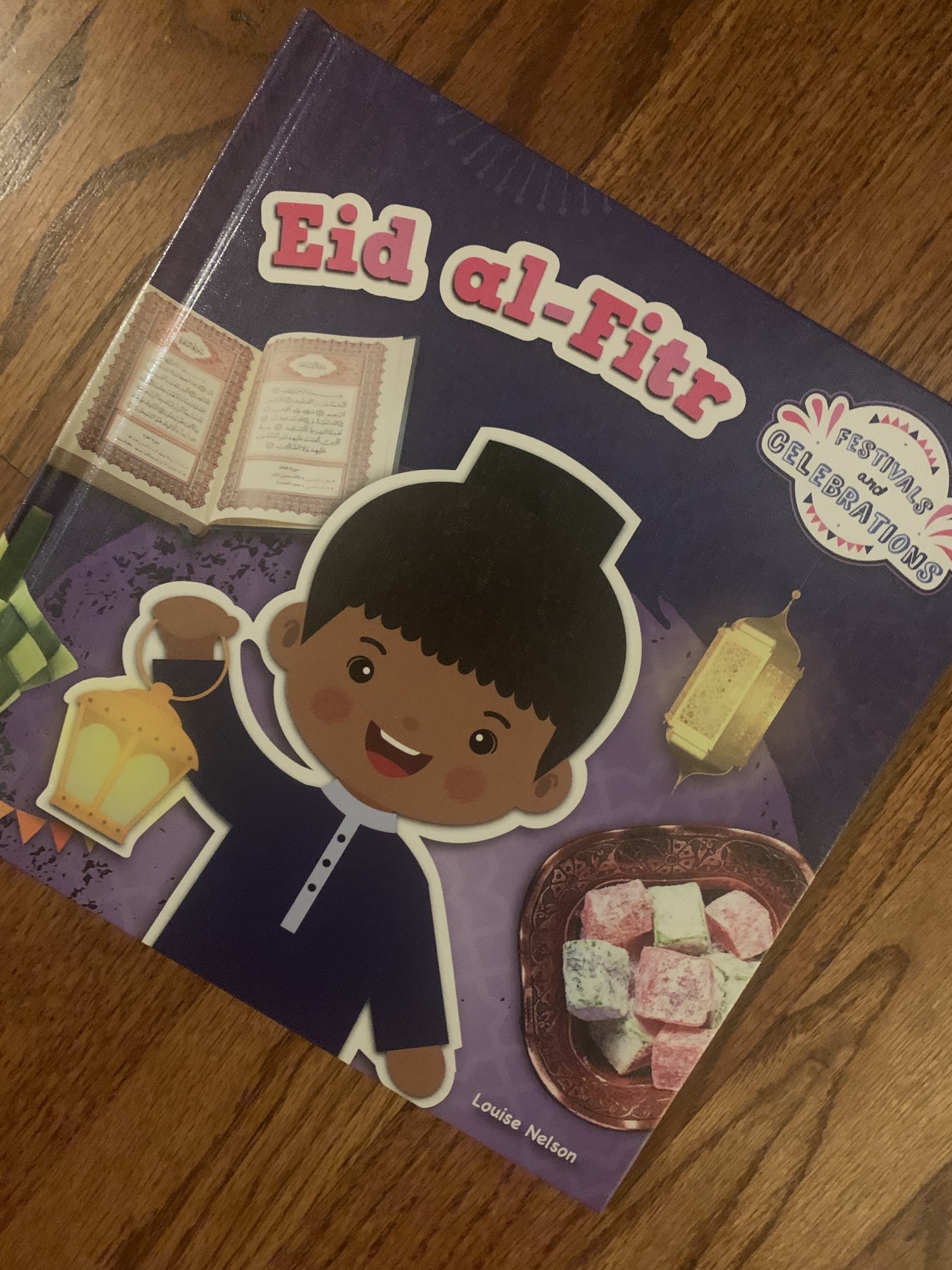
Festivals and Celebrations: Eid al-Fitr by Louise Nelson

Standard

This non fiction Eid book is not accurate, detailed, engaging, or something I would recommend schools or libraries shelve. It used to baffle me, but it now infuriates me that books like this continue to be published as non fiction, when they unfortunately perpetuate many of the same errors of similar earlier books, Muslim beta and sensitivity readers exist, why do publishers not seek them and out? At least Google the subject before you write and publish a book.

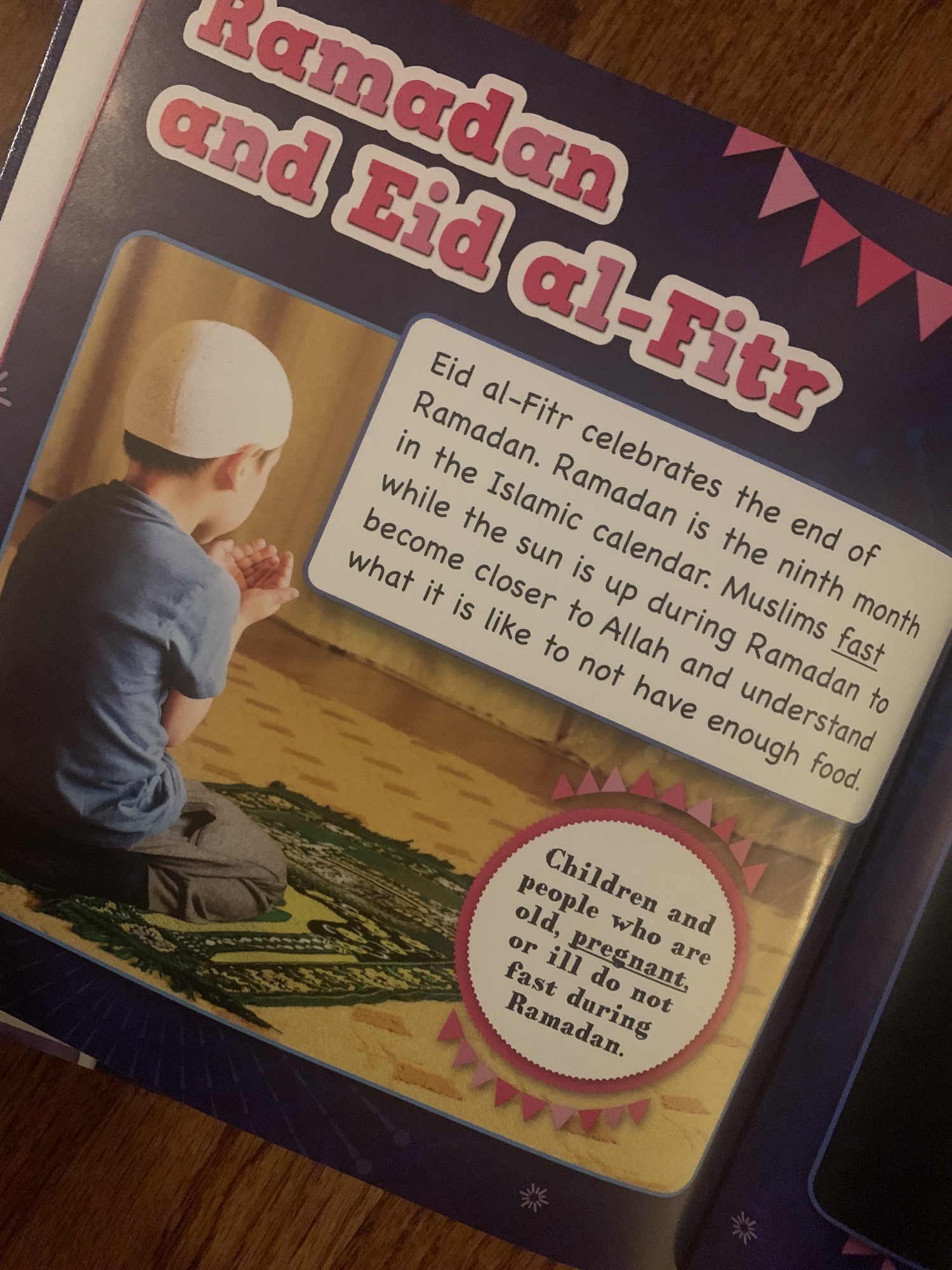
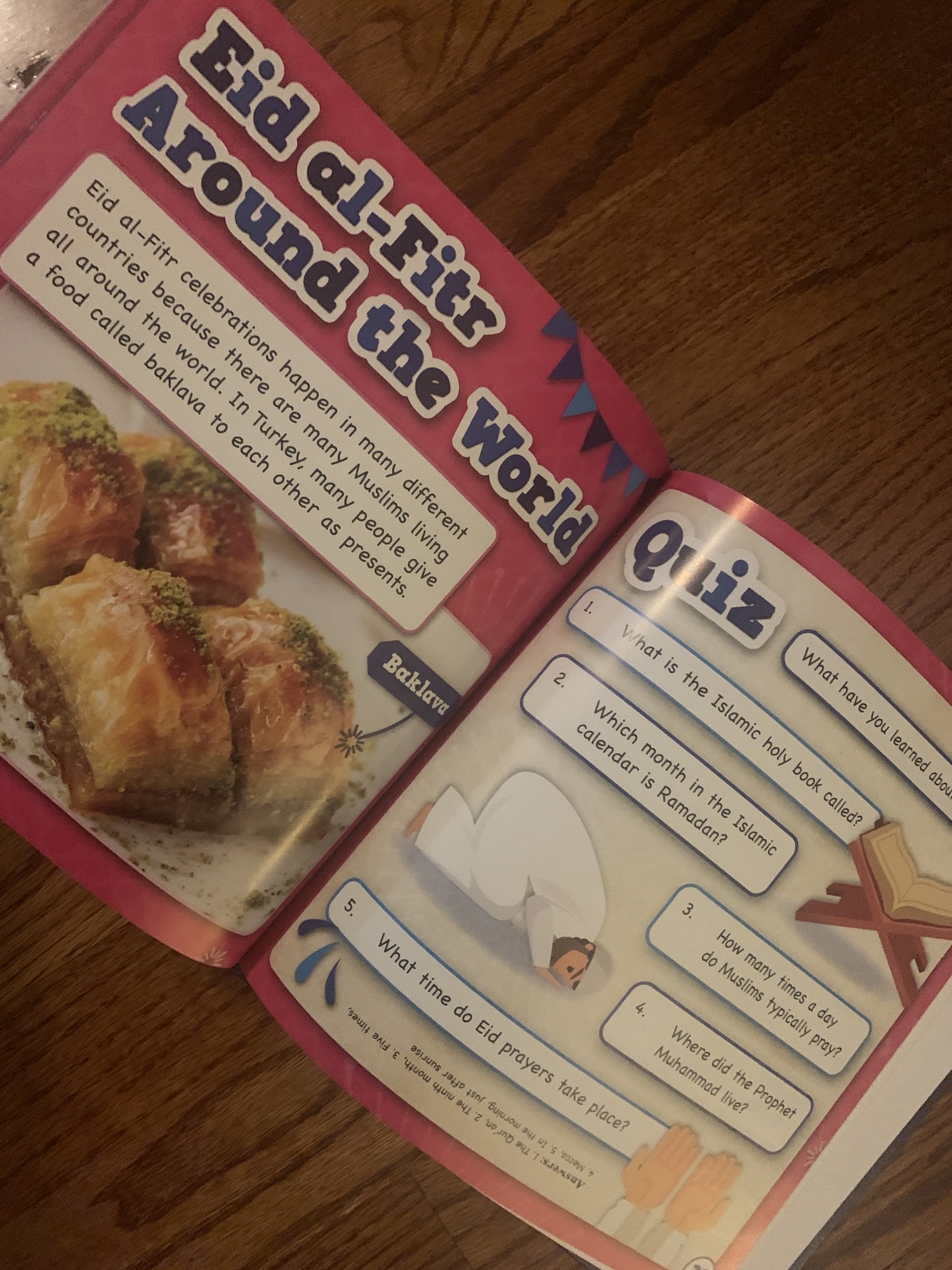
Lets begin with my favorite: Muslims fast because Allah swt has commanded it, yes it helps us “become closer to Allah,” but it is not so that we, “understand what it is like to not have enough food.” Sure that might be a resulting lesson, but it is not the reason. It states that “children and people who are old, pregnant or ill do not fast during Ramadan,” which isn’t always true and needs clarifying to say they may not be “required” to fast. Many children do fast, many pregnant women fast, by simplifying it to such a degree, students fasting may feel less seen when presumably reading a book like this in a school, classroom, or library setting. The exact places meant to help provide windows and mirrors and foster understanding and an inclusive environment.

Eid al Fitr is celebrated on the first of Shawwal, some countries, cultures, or families may extend the festivities for three days, but unlike Eid al Adha, Eid al Fitr is only one day. There is nothing about white being a holy color and there are no requirements to wear white on Eid.

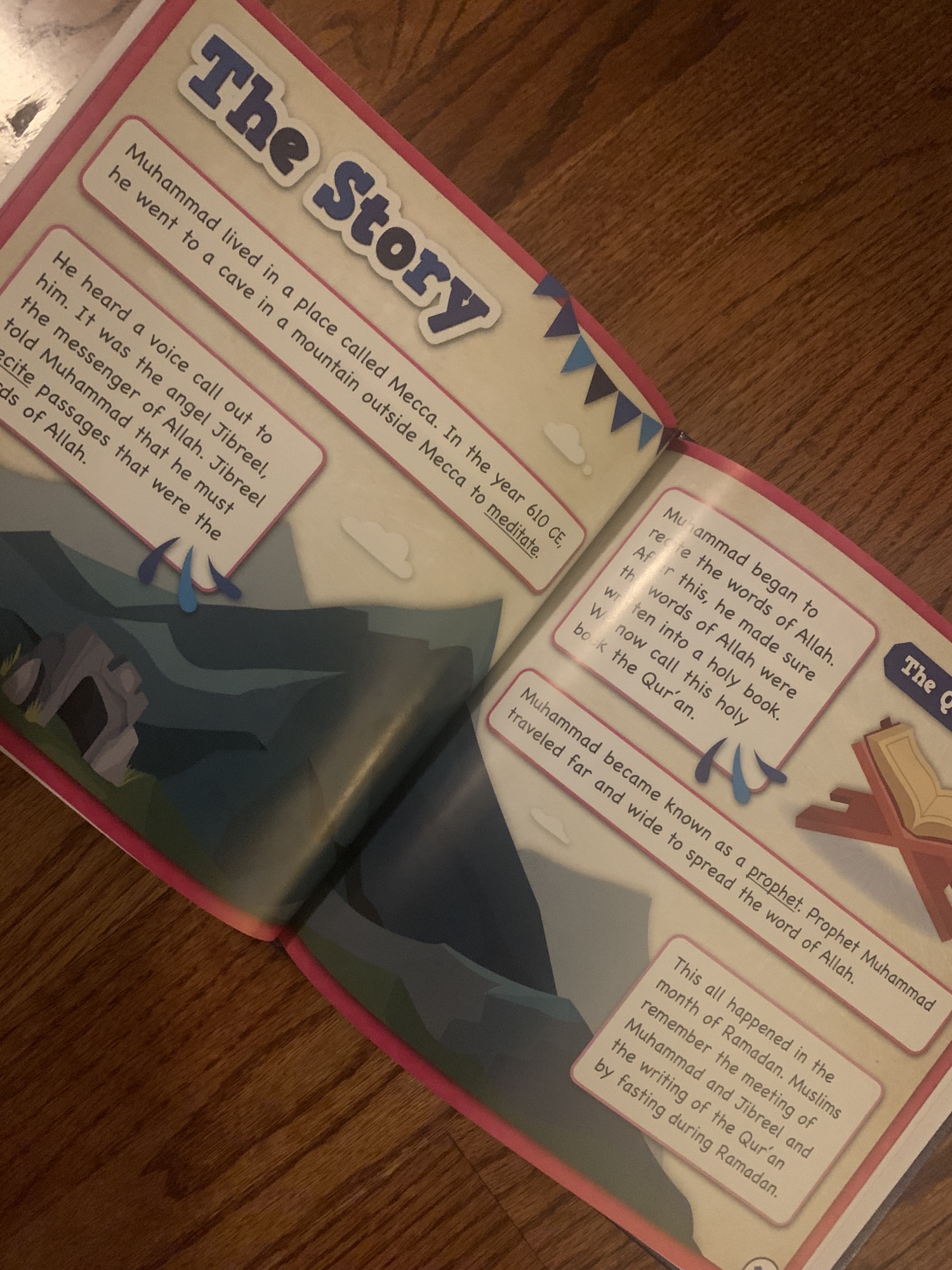
The brief history of Prophet Muhammad ﷺ receiving the revelation from Angel Jibreel would be even better with proper salawat and respect given. It also seems to imply that he traveled far and wide spreading the message and became a Prophet all within the month of Ramadan. It completely erroneously states that “Muslims remember the meeting of Muhammad and Jibreel and the writing of the Qur’an by fasting during Ramadan.” How does remembering translate to fasting? Muslims make an extra effort to read more Qur’an in Ramadan, as blessings are multiplied, but the causation is incorrect.

The information about Zakat and charity is vague, not clarifying that Zakat al Fitr is required on all to pay not just adults. Unfortunately it clearly mistakenly states that Eid prayers is prayed, “just after sunrise.” It is not, it is prayed in the morning, but not “just after sunrise.” The phrasing about Muslims reciting prayers together to feel closer to Allah also seems off, why not just say Eid prayers are prayed in congregation. And while sure in some places the community might eat together after the khutbah, it doesn’t happen everywhere and is not required, nor is eating sheer-khurma. That is simply one of many sweet dishes made in the sub continent that has no religious role whatsoever. The remainder of the book is poorly written. “people play games and eat.” It then says that Eid is celebrated in many different countries because Muslims live all around the world, but only gives one example that “in Turkey, baklava is given as presents.” That does not show people in different countries all over the world, the legit, shows one country.

How is this terrible writing making it into a book? I am truly baffled that this is the quality of a book to be published. It is a disservice to anyone seeking information, and the time of Muslims just being happy to be included has long passed. Books written this poorly keep stereotypes about Islam and Muslims as other and backward going. I am very disappointed.

The book is not sourced, and I have sent an email to the publisher asking for corrections in future reprints.

Tipu’s Roar: A Freedom Fighter’s Tale by Subia J. Ali illustrated by Gabriel Sorondo

Standard
Tipu’s Roar: A Freedom Fighter’s Tale by Subia J. Ali illustrated by Gabriel Sorondo

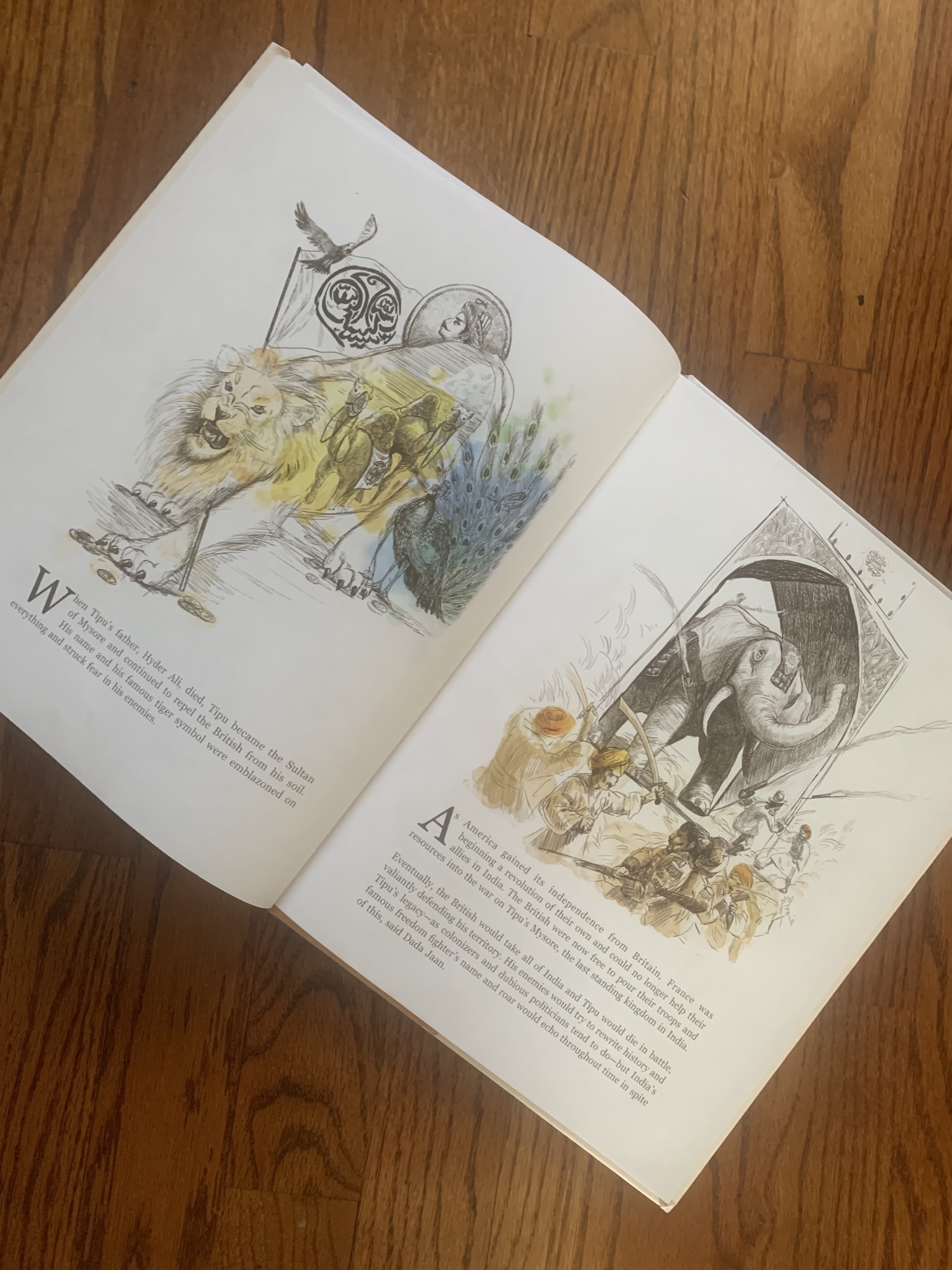
This large (9×11) hardback book is for the most part gorgeously illustrated in sepia tones, but the story is only 11 pages long; a pretty steep price point for 11 pages.  A story nestled with in a story, the premise of bringing to light a not well-known historical figure is admirable, but with no sourcing, it is hard to know what is real, and what is legend.  The concept and angle of being a freedom fighter and resisting colonization is timely, sadly it lacks the inspiration that I feel the author set out to convey.  I read the book a few times, and still had to Google a map of Mysore, Tipu Sultan and the role of the French in the subcontinent in the 1700s.  It would seem a book dedicated to the children of Palestine, defining words of freedom fighter, colonization, and imperialism before the book even begins, would answer the basic questions about the hero at hand.  

The book starts with an old man feeling gentlemanly wearing a bush shirt, chatting with his grand daughter who is being corrected to call him Dada Jaan instead of Grandpa. He then gets lost in thought and begins to tell his grand daughter the power of names to emphasize his point.  Tipu Sultan, known as the Tiger of Mysore, he tells her, “fought the British, who had come to colonize the Indian subcontinent.”

He doesn’t so much as convey the information in an entertaining way, as he lists off details and then pulls out to make sure she is still listening.  He tells her about the British East India Company draining the wealth of the subcontinent by taking tea, cotton, gems and spices.  He tells how Tipu “studied Islam, spoke many languages, and was a pioneer in rocket artillery.”  He credits Tipu’s rockets as revolutionizing warfare all around the world, and connects India, France and America as fighting off their Imperial colonizers, with the French being close allies in India’s struggle against the British.

Once her Dada Jaan’s retelling is through, and Tipu has lost, and Mysore falls, the little girls ponders over the story and years later appreciates her Dada Jaan in his traditional tunic rather than his bush shirt from before.

The book is in many ways needs to be fleshed out, sourced, and the messages articulated for today’s readers. 

Palestine: The Special Edition by Joe Sacco

Standard

img_2164-1

Written between 1993 and 1995, and compiled as a complete set in 2001, this 285 page adult non-fiction graphic novel is not really something I can review, even if I knew how.  As we have passed 100 days of the escalation in Gaza, on top of the ongoing horrors of Israeli occupation, I am hoping to broaden my literary awareness to include not just children’s fiction and non-fiction about Palestine, but also adult works by those living it, those moved by it, and those reporting on it.

This particular “special edition” has a forward by Edward Said, and an introduction by the author and illustrator.  Once I started the actual story, I’ll be honest it took a few attempts to hook me, with the starting being in Cairo and being a little aggressive with alcohol and talk of women, but once I decided to just keep going, the book finds a bit of a rhythm.  It shows the author himself shaping his own opinion as he interviews, and sees, and reports on the events around him.  It is non-fiction, it is written by a journalist, at some points he acknowledges his bias, but the overall picture presented, is heart wrenching.  That the humiliation and torment and occupation of a people has been so well known and documented and ignored, in light of current events, and even in isolation, is devastating.  The exhaustion the writer feels just witnessing it, is palpable, and the complete ignorance of Israeli, former IDF soldiers none-the-less is stark.

The book is both a reflection of the time with internal political factions playing roles differently than they do in todays conflict.  There are also views about Iraq and Saddam Hussein, which might surprise readers today.  But the power of this book is what hasn’t changed, the torture, the imprisonment of children, checkpoints, illegal settlements, humiliation, restrictions from working, from moving, from being treated as equal.

I’m glad I read it, and spent time among the the ink filled pages. I am certain that many of the stories, particularly the ones from inside the prisons will stay with me and haunt me as I read headlines and scroll endlessly through the statistics occurring in real time.  How can we be so blind, for so long, how can a people endure so much and keep fighting, how does any of this make sense?

We are Palestinian: A Celebration of Culture and Tradition by Reem Kassis illustrated by Noha Eilouti

Standard

img_1887-1

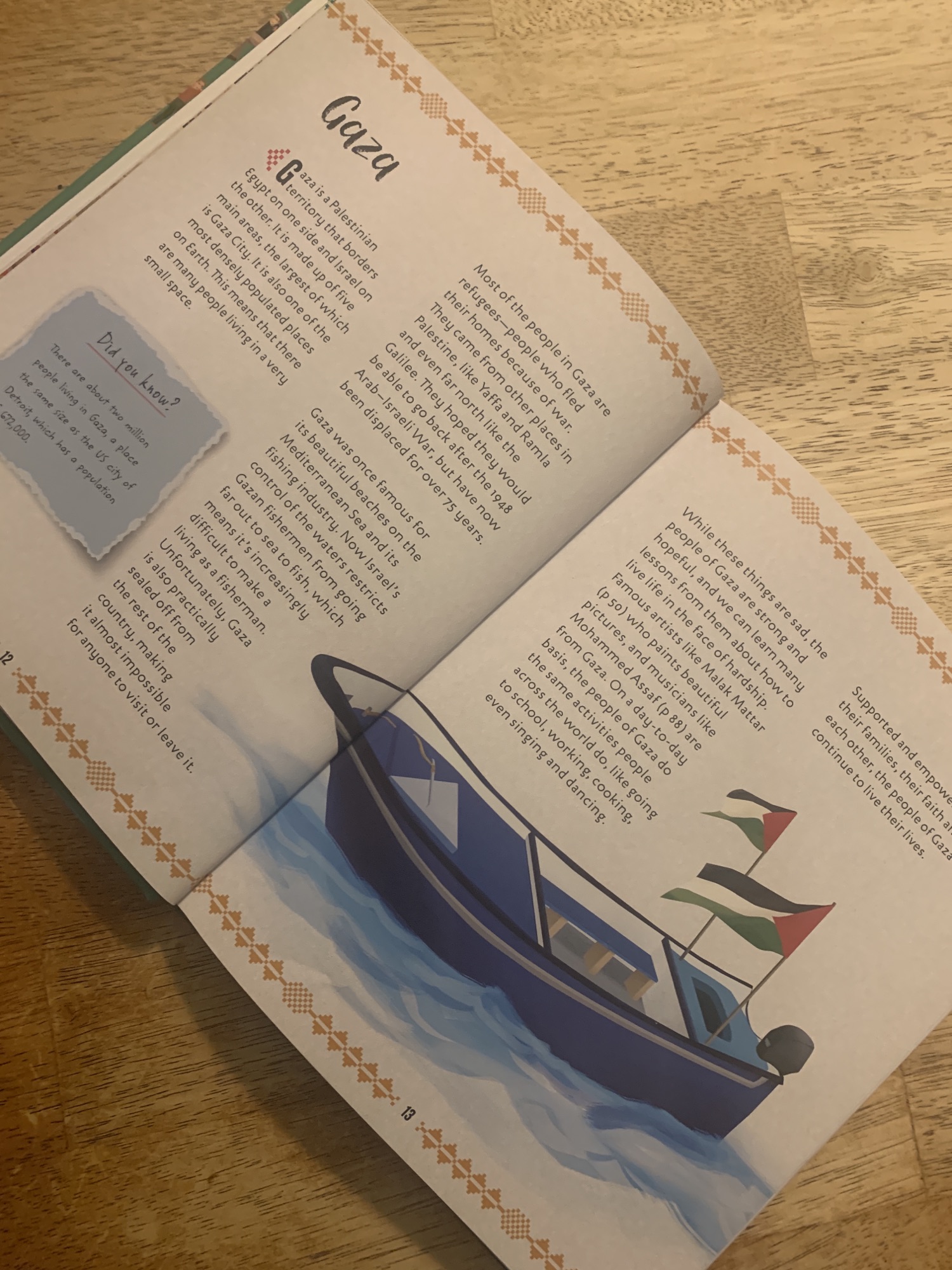
The book is non fiction, the author not Muslim, but here I am reviewing this book because, we are all Palestinian and my heart enjoyed reading this 112 page book that covers Geography, Cultural Symbols, Creative Minds, Agriculture, Cuisine, Performing Arts, and History and Religion for middle graders and up.  The book is a celebration rooted in information and expressed with beautiful illustrations, fun facts and text blurbs to break up the text.  I do wish it was sourced, and I desperately wanted a map, particularly in the section on geography- it seems odd in fact that it doesn’t have one.  The book contains information about the nakba, but doesn’t let it control the narrative or overshadow the culture that thrives in Palestine and in all Palestinians. Undoubtedly, this is an important book to spend time with and share, especially as the global media is currently working overtime in attempts to erase the richness, joy, and even basic humanity of an entire population.

img_1888-1

The section on Geography covers Jerusalem, Gaza, Jericho, Akka, Haifa, Yaffa, Nazareth, Hebron, Nablus, Bethlehem, and Ramallah.  Some cities are combined and are featured on a full two-page spread after an introductory page for the section.

img_1889-1

Cultural Symbols covers the national anthem and flag, Handala, tatreez, thobes and gold hat, hatta and egal.  I enjoyed learning more about cultural items that have become increasingly familiar, but whose origins, importance, and displays were new.

img_1891-1

The Creative Minds section focuses on people both currently still living and deceased.  I always struggle with books that highlight important people because how they are chosen is always such a mystery, and this book at least acknowledges that this is just a tip of the iceberg cross-section of people influential, talented, and noteworthy.

The Agriculture and Cuisine sections are a celebration of food and resources that most of us who have been privileged to have Palestinian friends sharing their lunch and dinner with will find particularly enjoyable.

img_1892-1

Performing Arts was informative and new to me, and I think further shows the depth and richness of the culture.  It highlights specific people, dances, cinema, and instruments in this section.

The final section of History and Religion starts with ancient history, followed by the Nakba, al Naksa, and then a two page spread on Islam and a two page spread on Christianity.

img_1893-1

Notably not mentioned in the entire book is Israel, and in the religion section there are no other faiths shared except Christianity and Islam.  The author seems to be making a point, by what is included, and what is focused on, and keeping the light shined on Palestine. There is an index, but no sources.

We Know What to Say: Phrases Commonly Used by Muslims by Sabria Chao

Standard
We Know What to Say: Phrases Commonly Used by Muslims by Sabria Chao

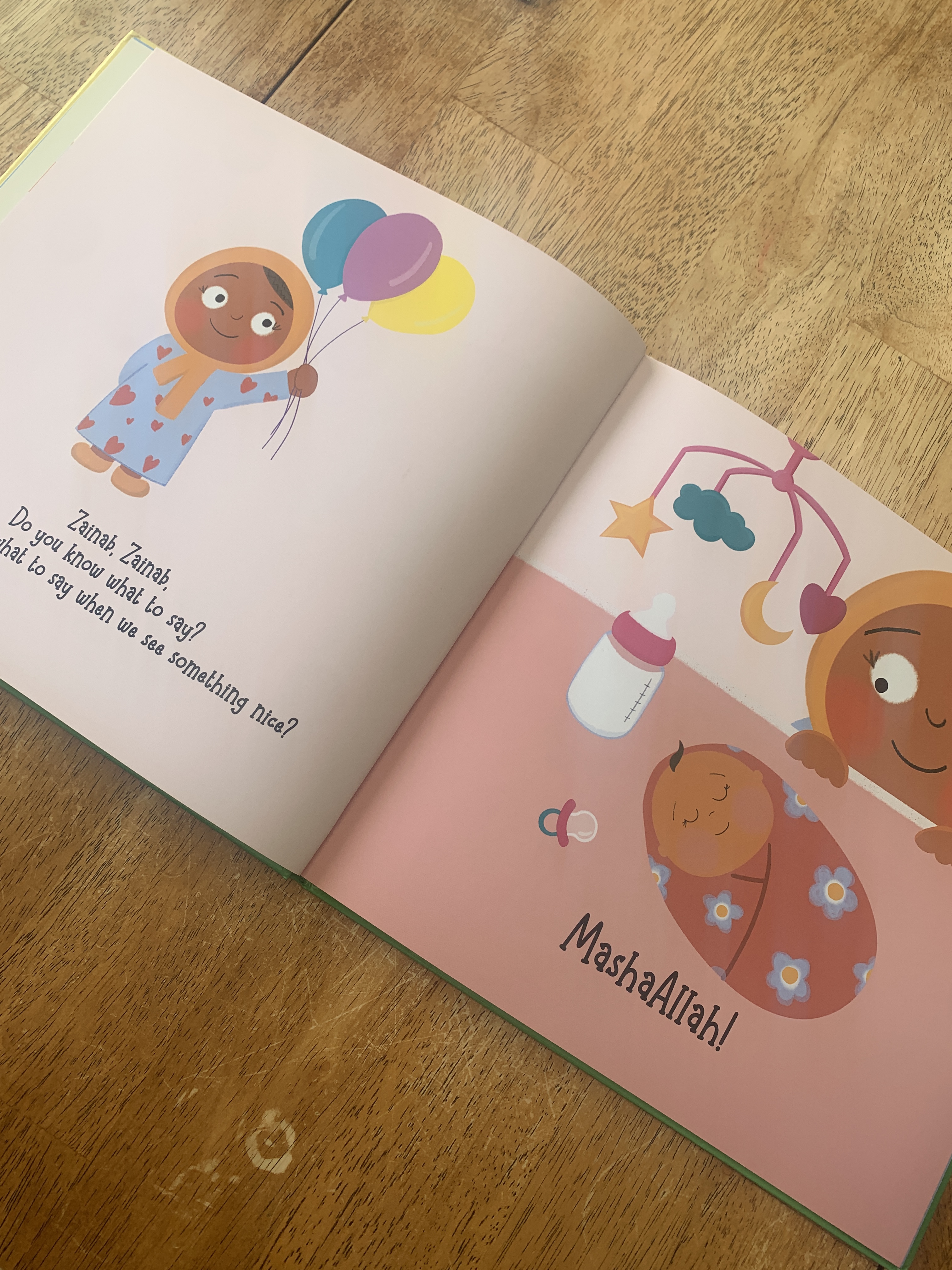
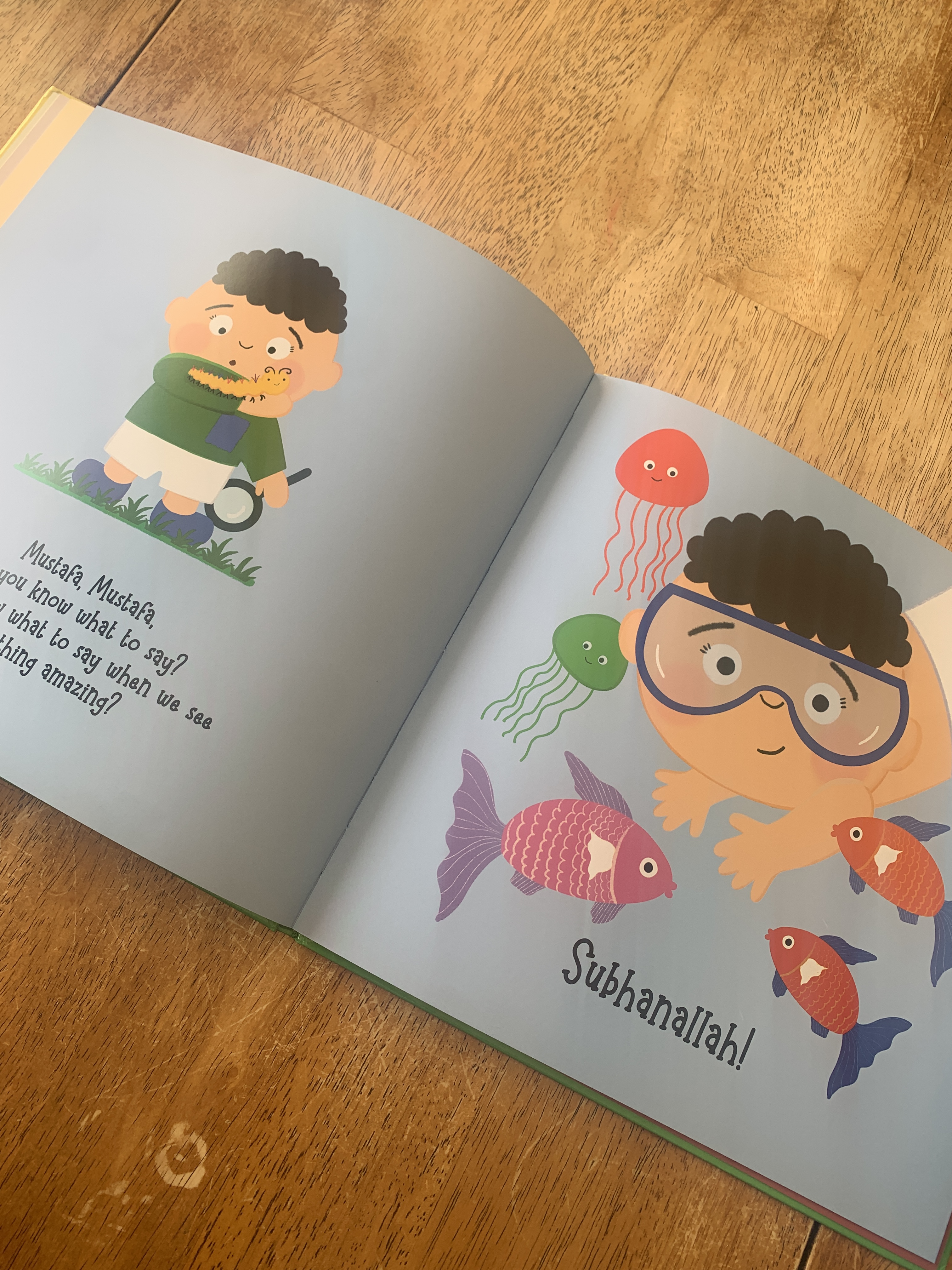
The concept behind this 42 book is really nothing new, but the presentation is wonderful.  The large hardback size, the clear inviting illustrations, and the repetition allow the book to be a delight at story time and bedtime alike.  Each Islamic term is introduced by a diverse character with a common Muslim name being asked if they know what to say in a situation.  The child gives the word, the following two-page spread restates the term and when to use it. All the terms are shown at the end in a two page spread along with a glossary and a Note to Parents.

I love the relatable scenarios: zoom calls, rain, getting sick, etc..  I also like the rhythm of the book, it reminds me a little bit of Brown Bear, Brown Bear.  The bright colors, the simple engaging illustrations and the big size make me ecstatic to share this at story time.  So many of the books that focus on Islamic terms for toddler to preschool level are small board books.  They serve a purpose, but we have long needed a large clear book for groups of children to learn, practice, and review together.

This book was nominated for the 2023 Muslim Bookstagram Awards, but you can purchase a copy here

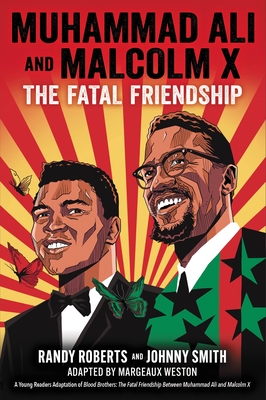
Muhammad Ali and Malcolm X: The Fatal Friendship by Randy Roberts and Johnny Smith adapted by Margeaux Weston (A Young Readers Adaptation of Blood Brothers)

Standard
Muhammad Ali and Malcolm X: The Fatal Friendship by Randy Roberts and Johnny Smith adapted by Margeaux Weston (A Young Readers Adaptation of Blood Brothers)

bloodbrothers

A lot of us Muslims name drop Muhammad Ali and Malcolm X in discussions about civil rights quite often, and at least, speaking for myself, I thought I had the general idea about the relationship between these two iconic figures. I have read a fair amount of books in my quest to identify books that show how Islam shaped the men as opposed to those that tend to gloss over their eventual conversion to Sunni Islam, but I read this book as if it were fiction and I didn’t know what was going to happen next.  I have not read the original Blood Brothers, but this young readers adaptation is well done in conveying the politics, environment, struggles, and humanity of these two men.  Their flaws and growth, their tests, their friendship, it really is a compelling read. The focus on their friendship puts Nation of Islam as the focus, but the book does a good job of identifying it as being different than Islam.  As their friendship falters, Malcolm X goes for Hajj and is seen to change, and choices made by Cassius Clay show the men quite distant at the time of el-Hajj Malik el-Shabazz’s assassination, even though eventually their paths proved quite similar. The 240 page book is MG, but I think middle school readers (in classrooms, book clubs, and on their own) will better appreciate the intersection of these two giants, the events of their time, and the legacy they have left for us all.

SYNOPSIS:

The book is a snapshot in time, sometimes focusing on Malcolm X, sometimes on Cassius Clay, sometimes of their time together.  It starts with background insight and then shares the rise of both of them in their respective worlds, Nation of Islam and boxing.  Threaded through it all is the influence that Elijah Muhammad had on them, and key events they experienced that shaped their thoughts and opinions on race relations, politics, religion, and life.  It shows Malcolm X as the teacher, and leader taking in Clay and believing in him against the Nation’s wishes and thus when Muhammad Ali pushes him away the reader sees the Champ in a different light.  It shows deception and manipulation, as deep and riveting as the best fiction out there, but is very vulnerable in showing regret and both individuals’ ability to keep learning and growing.  The conclusion highlighting Muhammad Ali reaching out to Malcolm X’s daughter Attallah, and the forgiveness that took place in restoring the love between the two men and their families, really was a cathartic release that reminds readers that for as idolized as these two figures are in pop culture and history, they were very real people.  The book has a Biography at the end that breaks down sources by Government Documents, Archival Collections, Newspapers, Magazine Articles, Books, and Websites.  It is a “Selected Biography” that is seven pages long.

FLAGS:

Racism, manipulation, assassination, hate crimes, stereotypes, propaganda, oppressions, abuse, police brutality, assault, bombing, arson, attempted murder, fear, threats, killing.

TOOLS FOR LEADING THE DISCUSSION:

I have preordered a book for my own children to read and one for the school, I really think this book needs to be easily accessible for middle school students in libraries, classrooms, and homes.  I would love to do this as a middle school book club, I think the authentic perspective will give our youth who have heard of Malcolm X and think they know Muhammad Ali some insight into really spending time with what they did, what they faced, and how remarkable their friendship was.

A Sensational Journey “Medina” by Jenny Molendyk Divleli illustrated by Seda Cubukbi Antli

Standard
A Sensational Journey “Medina” by Jenny Molendyk Divleli illustrated by Seda Cubukbi Antli

img_8808

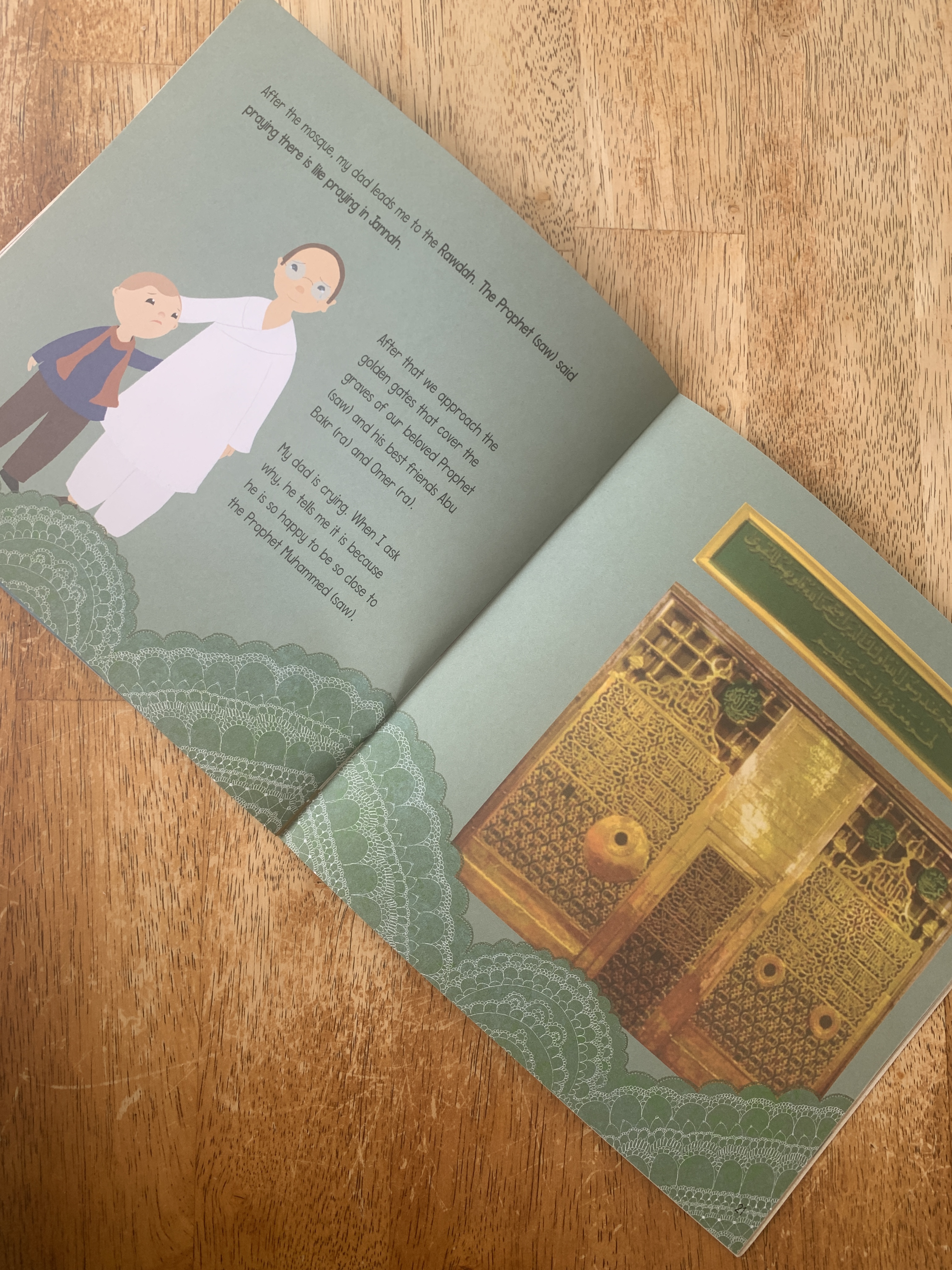
A journey to and through Medina with a focus on the five senses is a lovely concept for a book and the book is an enjoyable read for young children with the internal map, details about he Rawdah, the inclusion of Masjid Quba, Masjid al-Qiblatian, Mount Uhud, Archers Hill, and ajwa dates. The book is a little text heavy, as a decent amount of information is shared, but the illustrations are enjoyable and will help hold the attention of early elementary children.  The use of sight, smell, taste, feel and sound are woven into the story, they are not highlighted or the organizing format of the book.  Bonus material includes a QR code to listen to “Tala ‘al Badru ‘Alayna,” a glossary, and follow up activities.

The book starts with a little boy headed from Mecca to Medina, “the city of Prophet Muhammed’s (saw) mosque and grave, and a hope to find out why “everyone says Medina feels ‘special.'”  As he sees Bedouins in the desert he wonders what they eat and how they survive.  He then sees a gas station lit up like an amusement part.

img_8809

As they get closer to Medina they listen to “Tala’al Badru ‘Alayna.” When they arrive at the hotel they smell oud and fall asleep.  The next morning he wakes up to the sound of the athan and they walk the streets taking in the sights and smells. The color of the green dome is noted and the rose smell of the carpet when they make sujood included.  

The Rawdah and the umbrellas each get their own two page spread, and then a tour guide takes them to Masjid Quba, Masjid Al-Qiblatayn, and Mount Uhud. The tour finishes with a visit to the date orchards and playing and napping in the mosque.

img_8811

I wish it used the word Masjid every time, it uses both, and I’m not sure why it doesn’t just say Fajr instead of the morning prayer.  I appreciate framing it as a story, but the beginning with the Bedouins and the gas station seemed to slow the story down and my littles wanted answers as to why there were so many lights and how the people in the desert survived.  I also would have liked if the backmatter detailed more about Masjid al Quba and Qiblatayn, and Uhud, ultimately I wish there was more showing the little boy feeling why Medina is special and not just saying he now understands.  

 I’m not sure why I only ordered the Medina book and not the Mecca one as well, they are stand alone reads, but the Medina one references that that they have come after being in Mecca so consider if you are getting one to get both.  I ordered mine here. Use code ISL (Islamic School Librarian initials) at checkout to save 10%.

img_8810