Category Archives: Muslim Author

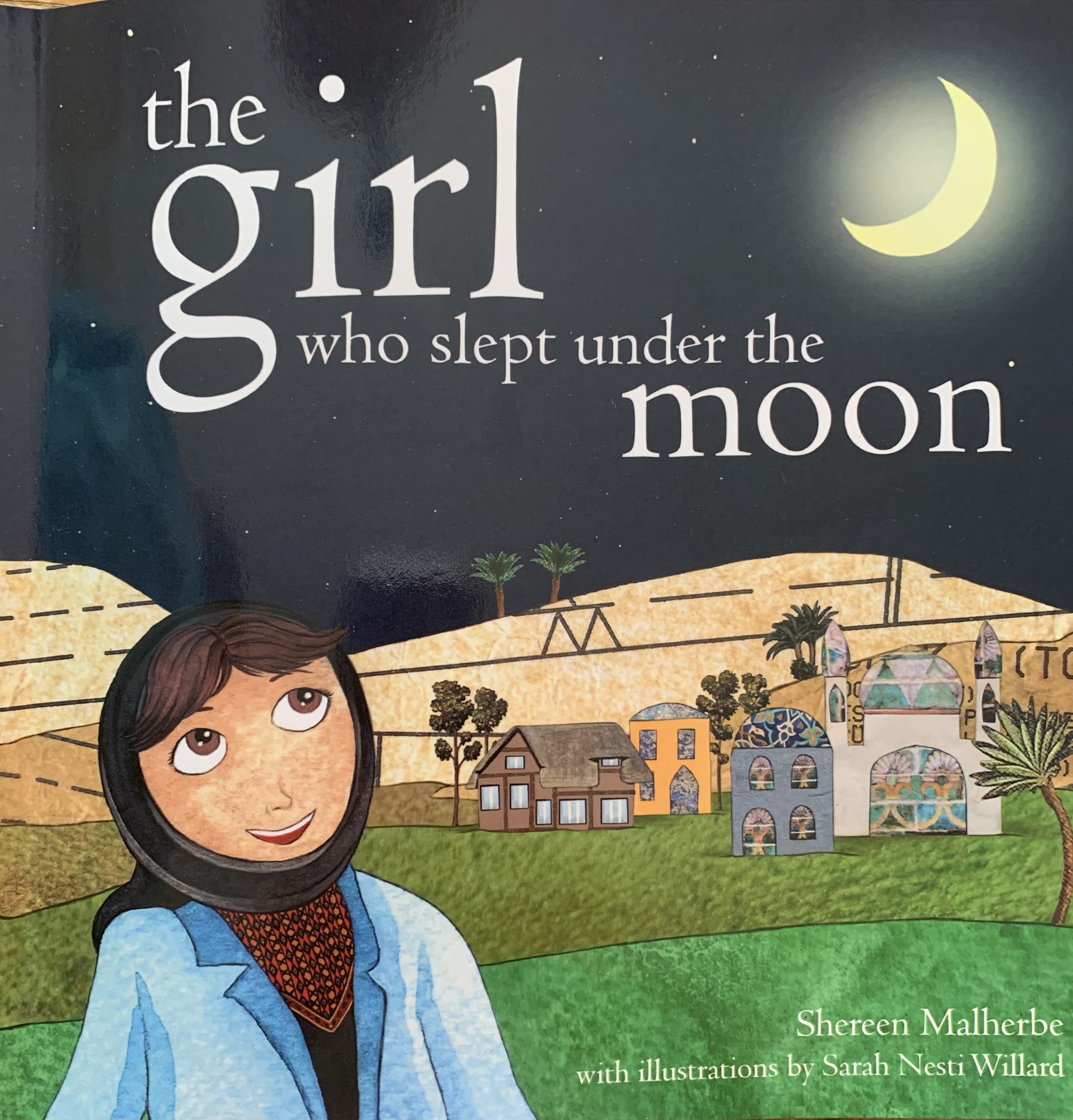
The Girl Who Slept Under the Moon by Shereen Malherbe illustrated by Sarah Nesti Willard

Standard
The Girl Who Slept Under the Moon by Shereen Malherbe illustrated by Sarah Nesti Willard

img_8044

I was really surprised by the number of gaps in this 46 page story that is so adorably illustrated and seemingly planned out. I thought perhaps I was being overly critical, so as always I tested it on my kids, and they too were confused by the main character’s rational and choice of words, the holes in the narrative, and the inconsistency of the characters. The book is wordy, so conciseness cannot be the reason for the holes, and it is published by a publishing company, so I would assume it has been proofed. Really the point of stories connecting us and giving us comfort when we need it, is sadly lost. I had hoped to love this fictional story of a Palestinian girl using prayer to give her comfort in her new home, but alas it seemed to be trying to weave in too much, and as a result the story isn’t fabulous for me unfortunately.

img_8038

Noor is new at school and stands out. She finds comfort in remembering the things that are the same. 1-Allah could still see and hear her. 2- The Angels were still by her side, and 3-She still slept under the same moon. She also wears clothes that remind her of home and provide an unspoken clue as to where home is for her.

img_8039

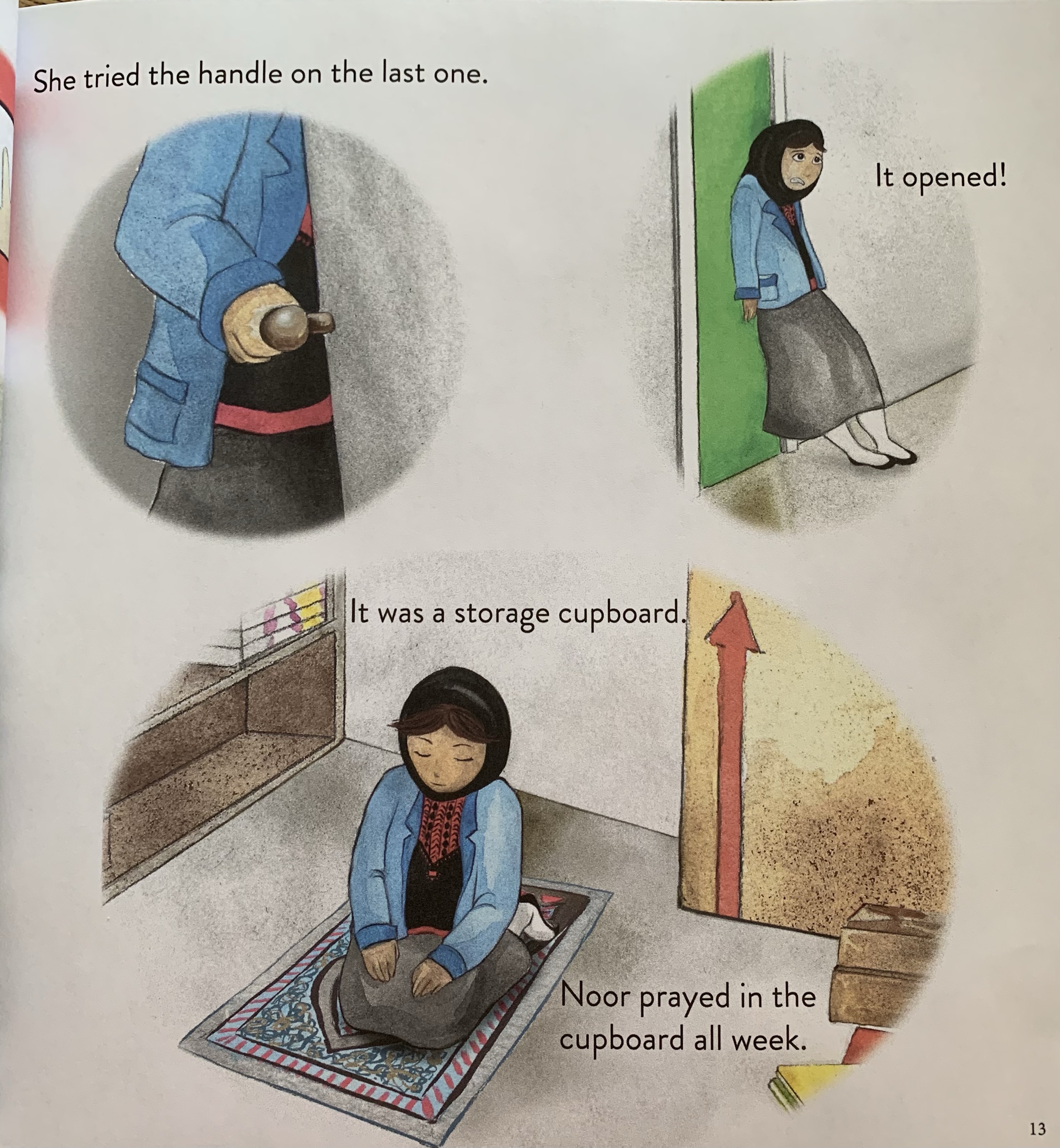
At school Noor has a problem, she needs a place to pray, but at lunch time the kids are not allowed to go inside and the dinner lady guards the door. Noor needs a distraction to sneak in the building and it isn’t clear if she provides the distractions, or just benefits from a baby bird falling out of a nest, a snake being in the grass, and a classmate getting hurt. Either way, when the teacher is occupied, Noor enters the building and finds a closet to pray in.

img_8040

On one such visit to the closet she finds someone already in there, Hannah. Hannah is there because she doesn’t like being on the playground because she is different. Noor never asks why Hannah feels different, so the reader isn’t made aware either. Hannah asks her why she is there and Noor says she comes “to pray because it reminds me of where I’m from.”

img_8041

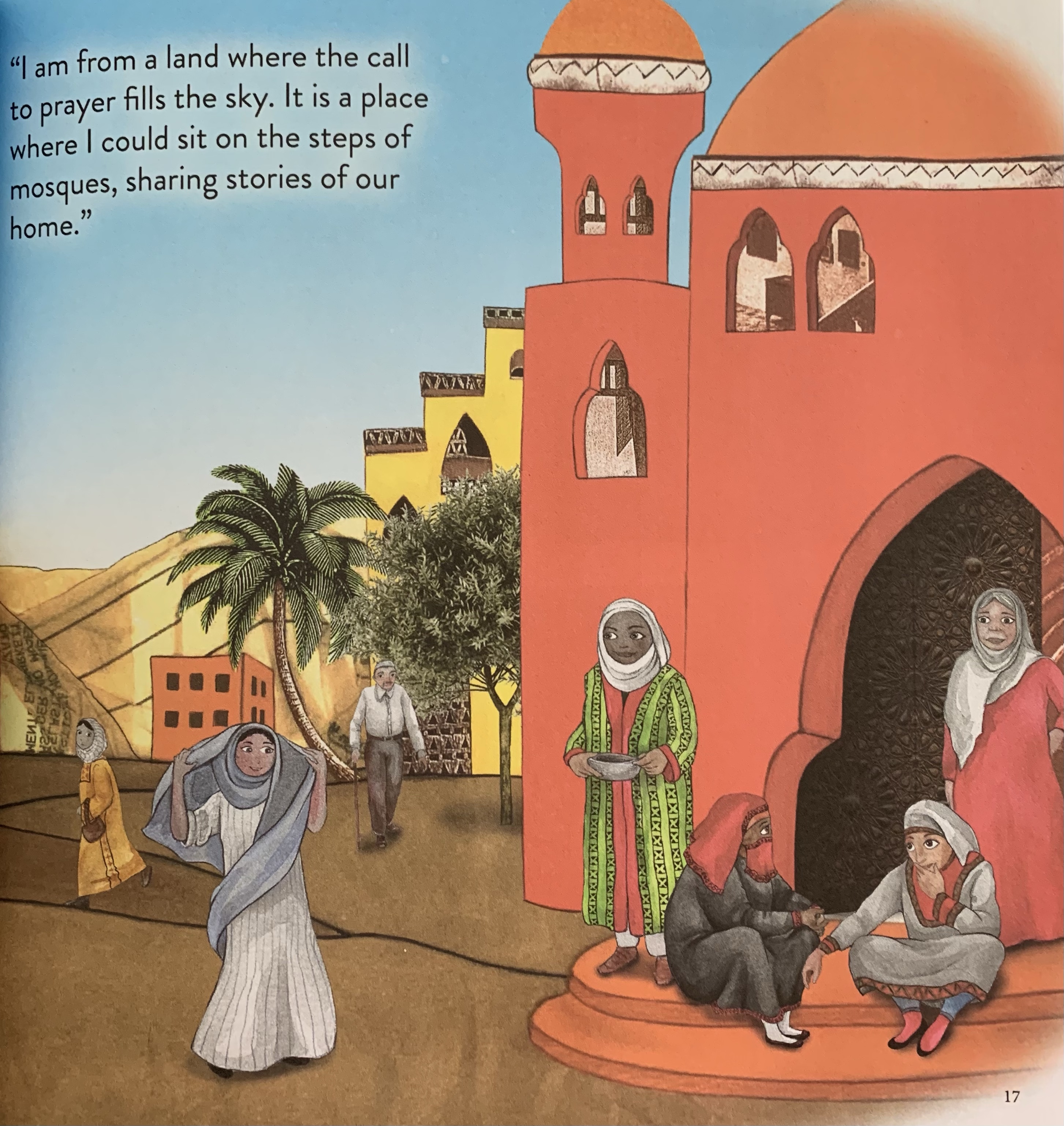
When Hannah asks where she is from, Noor doesn’t just simply answer, she tells her stories about her homeland, the mountains, olive trees, where the athan floats in the air and fisherman return to the shore with their catch. The next day Hannah is there again, and Noor tells her more stories and legends about her culture and lessons of the Prophets. Noor learns that through her stories she feels connected to her old home.

img_8042

Weeks pass, and one day when she sneaks in to the school, she finds the door locked. With no where to go she heads back to the playground and starts to cry that she won’t be able to pray. She then sees Hannah disappear and she follows her in to the drama studio. When she enters she sees sets built that look like the setting of her stories, of her home. Hannah knew she missed home and built her sets to look like Palestine.

img_8043

Other kids miraculously enter, and Noor begins telling them her stories, without praying first. The other kids seem to enjoy her stories and Noor learns that she can pray anywhere while holding on to her three reassuring thoughts.

The illustrations are engaging, although I’m not sure where the prayer rug seems to magically come from for Noor to pray on in the closet the first time. Had the book just been about prayer and finding a way to pray, or just about the stories connecting us to our past I think it would have been more powerful. I’m glad that Noor loves salat and that Hannah is a good friend, but I feel like by trying to do too much, the poignancy of the little things was lost.

And as for my questions: Can’t Noor ask for a place to pray? Can’t she pray outside? How is Hannah making the sets all by herself? Noor says she prays because it reminds her of home, she doesn’t pray for the sake of Allah or because it is required of her? Why did Hanna feel different, and why didn’t Noor bother to ask? It says that she needed to distract the dinner lady, isn’t that dishonest even for a good cause? Did she harm the baby bird so that it would need rescuing? Put the snake in the grass? Hurt the little girl so that she could get by the teacher? How was Hanna getting inside at lunch time? How is the school ok with a kid coming inside to build a whole set with school materials, but can’t let another child inside to pray for less than 5 minutes? And if Noor didn’t feel comfortable asking for a space to pray, clearly Hannah had connections to get permission to create a huge scene, couldn’t she have asked, or helped Noor ask?

The City of Brass by S.A. Chakraborty

Standard
The City of Brass by S.A. Chakraborty

This series is adult fantasy written by a Muslim author for her ummah and contains Muslim characters. I think the series as a whole is definitely not YA, as the main characters would age out of the target demographic, but I think that book one could qualify. I’ve contacted the author to get her perspective on the matter, and will update this if I hear back. So why am I reviewing it? Because it is so good, and I’ve heard of a lot of people letting/encouraging their teens to read it, and honestly, I did as well. There is complex world building, implied physical interactions, one hinted at gay romance, alcohol, concubines, violence, djinn, ifrits, killing and one kiss/slight make out session. There is also Middle Eastern culture, Islam, and a fiery protagonist that make the 530 pages in the first book fly by. I’m only reviewing the first book, and I think 14 years and up can handle it, I know my 14 year old and I haven’t stopped talking about it, and it has been quite fun to fan girl with her over it.

SYNOPSIS:

Nahri is living in 18th Century Cairo. She is completely alone and always has been. To survive she relies on her healing abilities and her ability to steal, cheat, and con her way to food and shelter. She knows nothing of her past, but is able to pick up any language after hearing a few words. At a performance to con a family needing help healing their daughter, she accidentally summons a djinn, Dara, which in turn awakens a graveyard full of ifrit, and sends Nahri on the run. Not trusting Dara they are travel companions none-the-less as they make their way to Daaevabad, a protected home of the fire beings, and the only place Dara thinks she will be safe. Along the way on the month long journey, Nahri tries to learn about the djinn, called Daeva, and the creatures they are running from. She also learns that she is the last surviving Nahid, healer, and while she may be a shafit, a half blood, she has powers and lineage the kingdom desires. Dara isn’t forthcoming with information, as a result his dark past and incredible powers keep Nahri on edge. She is constantly plotting her escape from the magic carpet carrying them and the future that she doesn’t understand let alone know if she wants.

The book is told from Nahri’s perspective and from Ali’s as well. Ali is the second born son to the king of Daevabad and has been raised away from the palace at the citadel. With a soft spot for the shafit, second class citizens of Daevabad, he gets tangled up in a plot to free child slaves and gets called back to the palace to be watched and tested as his brother’s future Qaid, the top military official that he has been preparing for his entire life. Ali is already an outcast to his family, as a devout Muslim in practice, belief, and actions, unlike his family who identify as Muslim for political unity.

Once Nahri and Dara cross in to Daevabad and the two narratives come together, the politicking, deception, deceit, and historical complexities get intense. The king demands that Ali get to know Nahri so that she can be persuaded to marry the emir, Muntadhir, but Nahri is in love with Dara and struggling to learn how to be a healer in the mythical world. To say that the story gets messy with the djinn tribes, and the manipulation of power and historical atrocities would be a simplification. But the writing is superb, and the world building encompassing. The book doesn’t drag and even after reading all three volumes, you’ll find yourself thrilled to know that the author has some additional points of view online.

WHY I LIKE IT:

The author takes a lot of liberties with Prophet Suleiman’s story, but it is fiction and I don’t think that anyone would be mislead by the information given about him and his control over the djinn. The “Islamic” elements in the book are really just that, elements, they aren’t plot lines, or more than just a layer to the setting and the characters. The history and the cultural richness is made more complete by the foods, clothes, and salat times mentioned, but there is nothing Islamic fiction about the text.

I love the writing. Period. It is engaging and doesn’t lag or feel repetitive. The characters are very fleshed out: no one is good or bad, the entire cast is shades of gray, and their motives and intentions are often debatable. My daughter and I have argued and I don’t think we have tried this hard to convince each other about characters since Harry Potter, and it is so great!

FLAGS:

SPOILERS: Dara and Nahri have chemistry and they kiss and long for each other, but it isn’t the bulk of the story line. Ali starts to fall for Nahri, but he has poor judgement so it is by and large dismissed. Muntadhir is always drinking wine and courting courtesans and is never in his own bed, nothing is detailed, it is said in passing, or implied. It is also hinted that Muntadhir is in love with his best friend, a male, and pretty much everyone knows, and they just look the other way. It does not state anything explicitly about them, but it is hinted at, implied, and mentioned by the other man’s father that the prince has broken his son’s heart numerous times.

Wine is always present, as is stealing, and lying. There is a lot of violence, not overt gore, but occasionally graphic as Nahri is a healer and there is a war simmering in the current time line, and a historical one that wiped about a whole tribe that is discussed throughout.

TOOLS FOR LEADING THE DISCUSSION:

I wouldn’t be able to do this for middle school, but perhaps closer to the end of the school year, I would suggest that the high school book club consider it. There is a ton online for this award winning debut novel, so I’ll just include the author’s website: http://sachakraborty.com

Happy Reading!

Fatima Al-Fihri by Aaliyah Tar Mahomed illustrated by Winda Lee

Standard
Fatima Al-Fihri by Aaliyah Tar Mahomed illustrated by Winda Lee

img_7927

This adorable simple nonfiction highlight of the founder of the world’s first university still existing, The University of Al-Qarawiyyin, is perfect for preschool/kindergarteners and up.  The brightly illustrated, large minimal text passages spread out over 16 glossy pages breathes life in to a remarkable character and celebrates an accomplishment that every one should be familiar with and inspired by, inshaAllah.

img_7928

The story starts by establishing little Fatima’s love of learning.  She learns from books, her family and from the people in her city.  When her family moves from Tunisia to Fez in Morocco, Fatima is excited to learn new things.

img_7929

Every day she goes to the mosque to read and meet new people. Her father supports her, and when he passes away she is left with his wealth.  She decides to use the money to rebuild the mosque.

img_7930

She recalls that ‘iqra’ is not just about gaining knowledge, but is also sharing what you have learned with others.  She purchases the land around the mosque and builds a university.   It is documented as being the first institution to issue educational degrees.

img_7931

I wish the story was slightly more fleshed out with detailing more about her family and her influences, about her overcoming some obstacles and even how long she lived for.  I know the target audience has a short attention span, but a few details even little ones can relate to will connect them to such an important figure and inspire the readers to dream big and make a difference.

img_7932

This book is the first in the WomanKind series.   A new series to tell stories about Muslim women who made history.

img_7933

Unsettled by Reem Faruqi

Standard
Unsettled by Reem Faruqi

img_7503

This book is a great OWN voice, middle grade coming of age book that rings with truth and hope in its poetic lines that sweep you up and keep you cheering.  Over 352 pages the author’s semi-autobiographic story of coming to Peachtree City, Georgia from Karachi, Pakistan beautifully unfolds.  I absolutely loved this book and the way it is told, in verse.  The details, often small, ring with such sincerity that even those that have never moved to a new country, or been to a new school will feel for young Nurah Haqq and be inspired by her success, touched by her hardships, and disappointed in her mistakes.

img_7544

SYNOPSIS:

Nurah’s best day is spent on the beach with her best friend Asna, playing in the warm waves and riding camels.  However it ends up also being her worst day, when she returns home to her father’s news that they are moving to America.  Strong, confident Nurah who spends time with her grandparents, swimming with her older brother Owais, and excelling at math in school is reluctantly leaving it all behind to start anew.

When they arrive in Georgia the family of four settles in a hotel until they find a house.  Everything is different and new, and the transition with no friends and family difficult for the entire family.  The way words are pronounced, the way the air feels and the birds chirp all make Nurah long for home.  When they find a swimming pool at the rec center, things start to slowly change.  Owais was a medal winner in Karachi, and will be one here too, people start admiring him, and Nurah tries to bask in his light.

School starts and math is a relief, but people are white, so white, and a boy reaches out to shake her hand.  She feels betrayed that she has been told the schools in America are better, and lunchtime, with no one to sit by is a huge stress.  She questions her clothing, her appearance, and the weather.

Her and Owais try out for the swim team and make it, and Nurah makes her first friend, Stahr. Stahr lives a few houses down from their new house and when Nurah’s mom has a miscarriage, it is Stahr’s mom who comes to show support and give comfort.  The support is reciprocated when Stahr and her mom need help escaping from her abusive father.

As Nurah works to win swimming races and be more like her brother, she works to find her voice and use it to defend others and herself.  A terrorist attack committed by someone claiming to be Muslim sets the family up to be targets.  In a moment of jealousy, Nurah doesn’t intervene to help her brother and the consequences are huge.

img_7502

WHY I LIKE IT:

I love the details and how they are articulated.  I related to so much of Nurah’s feeling and impressions, that I reached out to the author and found her to be just as endearing as her character.  The feeling of being different when swimming because of your decision to be modest, the role of food to comfort you and make you feel at home, the older brother that you so desperately want to resemble and be like: All of it hit close to home for me.  I love how religion and culture are so much a part of the story and about the character’s identity, not to be made preachy, just to understand her and her experiences.  She goes to the masjid, she prays, she starts to wear hijab. I love how she finds her voice and defends those that can’t, but that her path is not easy.  She makes mistakes and she has to challenge herself to do what is right.  The backdrop is always trying to “settle” in a new place, but the story has it’s own plot points that are interesting and simply made more impactful by Nurah’s unique perspective.

There are lots of little climaxes and victories for Nurah that show her to be well-rounded and relatable.  You cheer for her early on and enjoy the journey.  The only slight hiccup I felt was the name confusion of her Nana and Nani (Nana), it is explained, but it was a little rocky for me, it might be based on a real thing in her family, but once that is resolved, the book flows beautifully and smoothly.

img_7545

FLAGS:

Nothing a 3rd/4th grader would find alarming, but none-the-less:

Crushes: Nurah has a crush on a boy at school when he shakes her hand and picks her for a lab partner, but she moves on from him while still maintaining a crush on her brother’s friend Junaid.  Nothing happens, she just thinks they are cute.

Miscarriage: Her mother has a miscarriage and it details a blighted ovum and the mental strain on the mom and family in the aftermath.

Abuse: Stahr’s father is abusive

Hate: There are bullies, discrimination, physical violence.

TOOLS FOR LEADING THE DISCUSSION:

The book is a little below level for my middle school book club, but I think it it was on a bookshelf and a middle schooler picked it up, they wouldn’t set it down until they were done reading it.

Punching the Air by Ibi Zoboi and Yusef Salaam

Standard
Punching the Air by Ibi Zoboi and Yusef Salaam

img_7268

Four hundred pages of painfully powerful verse that you will have to force yourself to slow down and not rush through.  Yes, you want to know what happens to the young, black, muslim teen writing his truth, but to read it too quickly will deprive you of feeling and contemplating and absorbing the message that if, you, like me are a white (ish) person of privilege, need to surround yourself regularly with to understand.  The OWN voice narrative is co-written by one of the Central Park Exonerated Five and should be required reading for everyone 14 and up.

img_7263

SYNOPSIS:

Amal Shahid is 16 years old, and maintains he is being wrongfully accused of a crime that has left a white boy unconscious.  He acknowledges he threw the first punch, but is adamant that he didn’t throw the last.   From his trial to his incarceration in a juvenile detention facility, the narrative pushes forward as he adapts to confinement with flash backs to pivotal moments in his life.  He is a gifted artist and writer and his creativity and ability to express himself is what will hopefully provide him a way to survive.

I know I’m leaving this vague, because truly I cannot do it justice.  I started taking pictures of powerful sections, and when I found myself taking pictures of nearly every page, I realized that the book is something to be experienced in its entirety and will include just a few internal pages to tempt you.


WHY I LIKE IT:

The book is impactful in that it claims only to share the protagonist’s truth, it doesn’t get off tangent from that, but allows for the reader to add to the narrative their own understanding to make it personal and resonate most profoundly.  His situation involves so many injustices plagued upon him only because of his skin color, and a system that is designed to keep racism alive and powerful.  He was at the wrong place at the wrong time perhaps, but while the book is heavy, hope is ever present.  I’d like to believe it is because of those that refuse to give up on Amal. I was swept away by the power of a mother’s love.  Truly, what strength for a young man in Amal’s situation to have the world betray him so often in his young life, to find unflinching love, support, belief, and determination in his mother.  

I love that his mother is a practicing Muslim, his grandmother attends church, and he loves them both and values their spirituality.  Allah, the Quran, and Islam are mentioned regularly.  It never is preachy, or gives much doctrine, but it is present, and is a tangible part of how Amal sees the world.

img_7266

FLAGS:

There is language and violence.  He has a crush on a girl and she writes him letters, nothing obscene.  There is racism, bullying, racial slurs.

img_7261

TOOLS FOR LEADING THE DISCUSSION:

There is so much to discuss in this book, and so many resources online.  I think the book might be too mature for my middle school book club, but I am suggesting it to the high school book club.  This book needs to be read, discussed, breathed in, and experienced.  Plus the author’s real life experiences should be incorporated into the discussion as well as the student’s understanding of how present racism is and how they can use their voices and influence to create real, lasting, change, inshaAllah.

Good Little Wolf by Nadia Shireen

Standard
Good Little Wolf by Nadia Shireen

wolf

I have way too many conflicting thoughts for this 32 page AR 2.1 Muslim authored picture book.  The good little wolf, with a cast of familiar story book characters getting cameos, is choppy in its simple story telling to the point I thought pages had been skipped more than once, funny in asking the three little pigs permission to blow their houses down, slightly moral in elevating good behavior and having the courage to hold to your goodness, and ultimately, possibly really dark, as the end gives reason to believe that wolves will be wolves and the good little wolf is no more, as in he has been killed along with an old granny too.  

245BE710-2A53-41AF-A01A-6EA9596D3370

Rolf is a good little wolf that likes to bake, eat his vegetable and be nice to his friend.  His best friend Mrs. Boggins has warned him that not all wolves are as nice as he is and Rolf hopes he will never meet a big bad wolf.

D48EE32F-8952-4A52-9F30-F0EC5AF408D5

Alas, he does meet the Big Bad Wolf, and he questions if Rolf is a wolf at all.  To prove that he is a wolf he accepts the big bad wolf’s challenges:  He howls or rather whistles at the moon and he tries to blow his friend pig’s house in.  Eventually he resolves that he isn’t mean enough to be a wolf, then the Big Bad Wolf gives him one more chance as he holds out a fork and knife to the wolf while restraining Mrs. Boggins. D31DC212-C85D-439B-BBCF-2A1CEA6F1FF8

Rolf feels something deeply and ties up the Big Bad Wolf feeling more wolf like than ever.  He just happens to be a good little wolf.  To celebrate they all sit down for a snack and the Big Bad Wolf decides to stop eating people…tomorrow.

FE2D38B5-AA49-4AEE-B111-61FACD9D9436

Yeah, it isn’t clear and could be up for debate, but Rolf and Mrs. Boggins are no longer at the table, and the Big Bad Wolf looks pretty happy.

42DAF30D-66BD-4FA9-A871-F7AC1717DC0F

There is nothing religious in the book, it could be debated if the book is dark or just silly and aside from the choppiness of the transitions, overall the book is a fun turn on classic characters and concepts.

6DDCE0AB-FFBF-471C-9DBB-35B7320425EB

The Theft of Sunlight by Intisar Khanani

Standard
The Theft of Sunlight by Intisar Khanani

img_7254

Breathe, deep breaths, exhale, phew.  This book is good, like really good, but it ends on a cliff hanger and I was not prepared for it because I read a digital copy and didn’t think 528 pages had gone by.  Needless to say I was not emotionally prepared for there not to be a resolution.  Then the afterward said it was a duology, and I may have freaked out and contacted the wonderfully patient author and had her talk me down, because such words could imply that Thorn was book one.  Also, when I’m frantic I don’t read clearly, but now all is well, she assured me there will be a conclusion, inshaAllah, to Rae’s story.  Picking up chronologically where Thorn left off, this book is a companion in the Dauntelss Path series, but follows a different protagonist and while I highly suggest reading Thorn first, it is not necessary to understand this original tale.  So, phew, I am breathing again, and happy to venture back to Menaiya to share my review of a lovely story, written by an amazing Muslim who once again weaves such an engulfing tale that doesn’t drag or have holes in the narrative, is filled with strong female characters, and text that reads so effortlessly it just sweeps you away.  Truly it is fun for middle school and up (13+), and clearly I’m not passionate about books and fictional characters and don’t need to get a reality check.  

SYNOPSIS:

The book opens in a small village where Rae is in the market with her littlest sister Bean and their friends, Ani and Seri, when the unspeakable happens: Seri goes missing.  This isn’t a tale of a child who has wandered off, it is about a child taken by the snatchers and the materialization that the rumors and horrors they have been hearing of children being taken, becoming very real.  Niya, Rae’s middle sister is a secret mage who tries to track Seri, but can’t break through the mark that keeps her hidden.  As the townsfolk exhaust all resources and resolve she is just another child lost, Rae gets an opportunity to find answers.  Her pregnant cousin has invited her to spend the summer at the royal court and attend the wedding of Prince Kestrin and Princess Alyrra.  Convinced that the palace must have more information about the snatchers, Rae reluctantly agrees to go and investigate what is being done to stop the country’s loss of children.  Rae is nervous to leave her horse ranch, afraid of the teasing she will receive because of her twisted clubbed foot, but above all desperate to help her friend’s family.  

Everything about Tarinon baffles Rae: the extreme poverty on the outer skirts of the palace, the vacant stares of the children, the ignorance of the courtiers, the politicking and secrets.  She doesn’t get much time to ease into this new role though, because she is thrust head first in to it when asked to be one of Princess Alyrra’s attendants. She once again reluctantly agrees, with the hope of getting answers to help recover Seri and other lost children.  After tests to gage if the princess can trust Rae, the two join together to secretly unravel what is going on.  This work in and of itself is incredibly dangerous as those that ask questions often go missing.  Her work is compounded when the princess sends her to get information from the head of a thief ring, Red Hawk, and his informants.  The closer Rae gets to answers, the more perilous situations she gets in and out of, often having to count on her bravery, determination, and wit to stay alive.  She finds an unlikely ally in Red Hawk’s right hand man Bren, help and friendship in an employee in the tax office, Kirrana, and the need for favors from a Fae mage and his Cormorant.  As the investigation progresses, it leads to battles with neighboring thief rings, Rae held hostage at one point, getting her finger chopped off at another, the Circle of Mages seeming guilty, and royalty within the palace duplicitously involved.  All this while a week long royal wedding is underway and the princess’s brother is attempting to kill the princess.  No wonder 500 plus pages still ends with a cliffhanger, eh?

WHY I LIKE IT:

I love the world building and detail and speed of the story, but I’ve really delayed writing this review as I try and pinpoint and articulate what it is about the characters that I truly am invested in.  And the answer is, I really don’t know, it probably it isn’t just one thing.  They are believable, and flawed, yet so very strong.  Rae in particular has her own self doubt and questioning, but she is a force and she makes mistakes, yet is still gracious and humble, she really is well rounded. There might be some romantic twinges between Rae and Bren, but she isn’t going to compromise one bit of who she is for him or anyone for that matter, which doesn’t mean though that she isn’t still growing and learning.  The book absorbs you right away, there aren’t dull parts that you skim over, or character’s that you mess up and have to go back and clarify.  Unequivocally, the writing is superb.    

The snatchers are inspired by the slave trade and child trafficking that unfortunately is not fiction and is all too real.  I think the edginess and intensity is heightened when that realization occurs for the reader to see that it isn’t just a fictitious conflict within a fantasy plot.

There is nothing Islamic in the book, the characters have their own religion that pops up as Speakers are involved in healing the recovered children and Alyrra goes to pray at one point, but it doesn’t detail what that looks like.  The author is Muslim.

FLAGS:

The book is remarkably clean, especially for the genre.  It does mention that some of the girls snatched end up in brothels, and the guards sent to investigate take advantage.

TOOLS FOR LEADING THE DISCUSSION:

I think I would absolutely do this for a middle school book club book.  To open the students eyes to quality writing, taking a real problem and nesting it in fiction to be sorted out, and just to see their response to the journey that Rae under takes would make for a great lunchtime discussion.  The book has not been released yet, so there aren’t a lot of reader’s guides or author interviews about it, but I suspect there will be soon.

Eliyas Explains: Angels by Zanib Mian illustrated by Daniel Hills

Standard
Eliyas Explains: Angels by Zanib Mian illustrated by Daniel Hills

img_7130

This last Ramadan I tried every day to listen to Sheikh Omar Suleiman’s Angels in your Presence series with my kids and discuss Angels with them.  I learned so much and got to wondering, why other than the 10 or 15 facts we all learn as children do we not talk about Angels more.  So when I saw the first in a new series by the absolutely fabulous Zanib Mian was about Angels I was so excited, then I forget to review it, and here we are.  The book embodies her sweet spot for personas as she writes as Eliyas, a little boy telling about what he knows about Angels with sincerity, clarity, excitement and humor.  Perfect for ages six and up, I think all children should spend a few minutes with this 81 page doodle filled book to remind us of Allah’s magnificence, Alhumdulillah.

img_7132

SYNOPSIS:

Eliyas starts the book by introducing himself and some things about him before diving in, or rather encouraging you to go put socks on so that what he is about to tell you can blow your socks off!  It starts off with him not being able to sleep so he sneaks out of bed to get cookies, because cookies solve everything, and then his dad joining him and them discussing aliens, which leads to outer space, and the knowledge of outer space being filled with angels.

Eliyas then learns about the number of wings the angels have, how strong the angels are, and some of the specific angels that do specific tasks ordered upon them by Allah swt.  The task of protecting us, appeals to Eliyas and the concept of angels the size of mountains praying with us, blows his mind.

We learn through Eliya’s dad about angels coming to Earth in human form and about angel Jibreel (as) specifically.  We also learn a dua to say when leaving the home so that the angels protecting you respond.

img_7131

WHY I LIKE IT:

I love the way that the information is presented.  It is a mix of fact and story and tied together with humor and relatability.  If you haven’t read Zanib Mian, please do, her Migo and Ali books, Hadith and Duas are all great Islamic resources, and her Planet Omar and Alien book are hilarious and warm.  I pray that the series continues, it really is a lot of fun.

img_7133

FLAGS:

None

img_7134

TOOLS FOR LEADING THE DISCUSSION:

I think this would be great to have a Sunday school class read and discuss or an Islam class offer up as extra credit.  It probably wouldn’t work as a book club selection, but it definitely has a ton of value in a classroom and in a home library.

Spell it Like S-A-M-A-R by Shifa Saltagi Safadi illustrated by Saliha Caliskan

Standard
Spell it Like S-A-M-A-R by Shifa Saltagi Safadi illustrated by Saliha Caliskan

img_7225

This 36 page book for kindergarten and up shows the role perseverance, confidence, and believing in yourself can play in conquering bullies, carving out a space for yourself and finding success.  While the book is a little predictable on the surface, older kids will understand that by winning the spelling bee, Samar didn’t just benefit by standing up to the bully, but in proving to herself what she is capable of and ultimately being more confident of her place in a new country.  The book is presented on large 8.5 by 11 full color glossy pages and features discussion questions at the end.

img_7227

Samar is in 3rd grade after recently moving to America from Syria, where she was the best student in her class.  ESL wasn’t difficult, but mainstream class is proving to be a challenge, mostly because of Jenna, the class bully.

img_7228

Jenna, snickers when it is Samar’s turn to spell words in front of the class, she teased her about her jump rope songs not being in English, and she makes fun of her for her accent.  With the help of a kind friend, Angela, the two girls decide the school spelling bee will be the best chance to prove how smart Samar is, by winning.

img_7229

The first step Samar must do is convince her teacher, Ms. Bryan to help her study.  To  show her commitment she offers to give up her recess to study.  The teacher agrees, but on the way home Jenna teases her saying she’ll never win when she can’t even speak English properly.  Deflated, when Samar gets home, she doesn’t study the flashcards and opts to watch cartoons instead.

img_7230

When later in the week her teacher quizzes her, Samar admits she didn’t study.  Ms. Bryan encourages her by sharing her own story of coming to America and having to learn English.  When Samar gets home she sees her mother, a former dentist in Syria, studying for the exams to be a dentist in America. This is the spark she needs and she studies hard, everywhere, and with anyone who will help.

On the day of the bee, Samar spells word after words correctly and after saying bismillah before spelling the final word, wins the competition and beats Jenna. The audience cheers and the next day Samar and Angela are jumping rope and Samar is singing in Arabic.

img_7231

I love that Samar and her mom wear hijab while out, but not at home, that they speaks Arabic, and Samar says bismillah.   Samar’s mom is clearly highly educated and determined and mom and dad are supportive.  I love that Samar’s drive, however, comes from her own determination, no one forces her or guilts her, it is her leading the way and understanding what her mother is going through and her teacher has gone through, and using that as inspiration.  I love that at the end she doesn’t rub it in Jenna’s face that she won, and the symbolism of Jenna just disappearing from the story makes this clear as Samar steps in to her own.  I truly love that for every Jenna in the wold there is also an Angela.  Be kind, be supportive, be a good friend!

I got this book from http://www.Ruqayasbookshelf.com and it can also be found at my favorite book store http://www.crescentmoonstore.com as well.  Happy Reading!

The Beauty of Your Face by Sahar Mustafah

Standard
The Beauty of Your Face by Sahar Mustafah

img_7145

I had debated picking up this book knowing that it isn’t labeled YA and I’m painfully behind on a stack of books I want to review, but after reading @muslimmommyblog’s review I opened the first page: that was 24 hours ago, I couldn’t put it down.  I’ve seen a lot of comments about this book being more YA than adult fiction because it tidies everything up so precisely at the end.  I’ve also seen critiques from non Muslims that it is overly preachy at times.  Many Muslims are so swept away by the rawness and presence in Islam in the book that they are making their teens read it.  So I wanted to read it and review it to determine if it is appropriate from my perspective for teens, and offer my take on it.  Ultimately I think while much of the Palestinian-American protagonist’s life story in the book occurs as a child and young adult coming of age, that the “flags” are so critical to the story and so numerous, that no matter how deftly and non specific she handles these issues and moments, that the book really is meant for more mature readers. I’ll detail it more below in the FLAGS section but to highlight a few mature spots mentioned in the book to varying degrees:  extra marital affair, alcohol, making out, groping, nudity, sex, voyeurism, killing, shooting, physical abuse, profanity, suicide attempt, bigotry, etc.  The writing is absolutely superb, and it isn’t sensationalized, but it is there and provides understanding as to why the characters often are as they are to a point that you need to understand them with a certain clarity.  I would think this 298 page book would most appeal to early college age readers where one is hopefully open minded enough to understand the characters relationship with religion whether they are Muslim or not, old enough to have some of their own life to reflect upon, and on the cusp of a new chapter that they realize the role their choices can make as they move forward.

SYNOPSIS:

Afaf’s life story unfolds out of order and with occasional interruptions from an outside point of view.  It opens with her at work, as a principal of an Islamic girls high school in Chicago as we see her dealing with parents upset with things taught at the school and the balance she tries to achieve in guiding her girls to be strong, confident, well-informed Muslims in a diverse America.  It then flips back to 1976 and begins the tale of Afaf’s life with her parents, immigrants from Palestine, her older sister and younger brother.  Not ever feeling like she fits in at school, she loses any sense of normalcy at home when her 17 year old sister Nada goes missing.   There were problems at home before: her mother never being happy, Afaf never feeling her mother’s affection, her father having having an ongoing relationship with another woman, but as days and months go by, and no clues can find Nada, it will be the event that seemingly tore the family apart.  Afaf’s mother has a mental breakdown, Afaf’s father takes to drinking, and thus Afaf and her younger brother Majeed have to navigate much of their life on their own.  In high school Majeed finds baseball and becomes the ideal student and son.  Afaf lets white boys feel her up and has a reputation for being easy.  She doesn’t cross the line, but her reputation and name on the back of bathroom stalls is fairly accurate.  When their father is involved in a car accident, he finds Islam.  The family is very cultural, but not religious at all.  Eventually Afaf and her brother accompany their father, much to their mother’s protests to the Islamic Center and while Majeed has no interest in religion let alone Islam and never returns, Afaf feels an instant peace and the opportunity to redefine herself and continues to go and study Islam.

The book jumps regularly in sections, not every other chapter, and at some point it shows Afaf as an elementary school teacher making the commitment to wear hijab and preparing to wed a Bosnian man with a broken war filled past.  It jumps and has her brother home from law school visiting and her mother attempting suicide by drinking drano and being found laying naked in a bath tub.  After recovering, her mother returns to Palestine and never returns.  In yet another vignette, it has Afaf and her husband and father preparing to go for Hajj, where her father passes away, and has her returning to find she is expecting her third child a little girl.  There are other surprises that I’ll not reveal, but some of these jumps are interrupted by a voice of a radical alt right mant who walks into the girls school and starts shooting, finding himself face to face with the principal, Afaf.

WHY I LIKE IT:

I am seriously blown away at the quality of writing, and the interweaving of religion and culture.  It is a main stream book and it has a lot of religion in it.  It isn’t so much long passages of preaching, the father would like it to be that way, but the other characters keep him in check.  But the quiet transformation of Afaf and having Islam save her from a life she was not content with.  I love that it has joy and happiness despite all the tests and obstacles.  The book could have been really heavy and drag, but it wasnt, it was compelling and hard to put down.  The characters will be with me a while and I can see myself rereading the book just to visit them again.  

I was a little confused with Afaf’s limited Arabic and her mom’s limited English.  How did they communicate? I get that perhaps it was symbolic of their broken relationship, but seriously when Afaf is seven and not understanding Arabic and her mom is not understanding the police and neighbor in basic English, something is a bit off.  I like that insight is given as to why Afaf is fooling around with any boy that wants her and that it shows it isn’t about the acts themselves.  I also like how it showed her conflicts in reporting an Arab child in her class being abused at home by her father and how the response was so sad by the community.  While Islam saves her and holds her to a higher standard, it doesn’t appeal to her brother, it doesn’t remove the hypocrisy of people who are Muslim: abuse, owning liquor stores, and it doesn’t make everything better for her.  She has to suffer consequences of her choices, she just feels that Islam gives her the tools to persevere and understand and have hope.  

I love the food, oh man, hearing all the dishes being cooked and served and cleaned up after, really made me very hungry.  The cultural elements of the music and songs and oud really ground the book and make the OWN voice value ring so true and strong.  The racism and bigotry feels very real as well.  The author is the daughter of Palestinian immigrants and the way that she articulates such pointed examples of not being given the chance to move up in the elementary reading group, side comments the high school coach makes to her, and the general stereotypes thrust upon her, are very powerful.

FLAGS:

So there is a lot, as stated in the intro, but I want to articulate a bit of why I maintain older teens for the book even though it isn’t overtly sensationalized. I’ll walk through some of the major flag themes.:

Take the drinking. The father is an alcoholic, but the mother and children hate it, Majeed drinks beer with his friends, but isn’t Muslim, yet the Khalti is somewhat religious and they pour amber drinks at Thanksgiving. So there is some moral lesson, which I think you could argue is fine in YA or even middle grades.

Relationships/sex/body: The father is having an affair with a much younger woman, they refer to her as sharmoota and everyone knows about it, no other details are given. Afaf lets boys touch her naked body, but draws the line at intercourse, she says she on some level doesn’t want to do that to her parents or something of that nature. Right before proposing marraige, her and Bilal do kiss. Once they are married it mentions them making love in the mornings. It mentions masterbating and blow jobs. The shooter and his girl friend have sex, the shooter watches an Indian neighbor nurse her baby through the door and sees her exposed breast with some detail and then goes home and masterbates. When the mother is pulled out from the tub after attempting suicide it doesn’t just mention she was naked, it comments on her pubic hair.

Violence: An Arab Muslim male classmate, drives Afaf away from her bike and the slaps her telling her basically that she should not be such a slut. Afaf punches another girl in a fight at school. A child in Afaf’s class is being hit by her father. Mother lashes out at Afaf, she ends up burned. The climax is a mass shooting where 14 students and a teacher are gunned down and killed. Self harm: car crash while drunk, suicide attempt with drano.

Minor: Yeah there is music, and Halloween,

TOOLS FOR LEADING THE DISCUSSION:

This would make a great book club selection for those in their early 20s and up. It is well done, just not for younger readers. The book is very popular and numerous author interviews can be found with a quick Google search.