Category Archives: Elementary Fiction

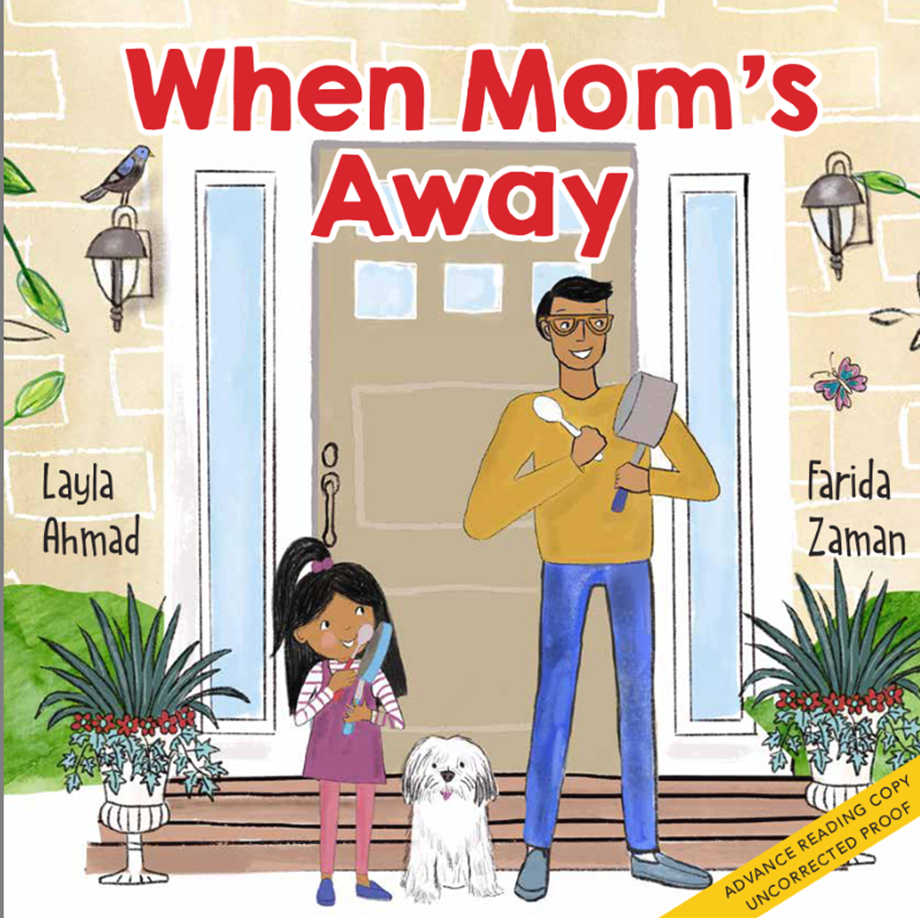
When Mom’s Away by Layla Ahmad illustrated by Farida Zaman

Standard
When Mom’s Away by Layla Ahmad illustrated by Farida Zaman

This 24 page, timely children’s book focuses on life with Covid-19 from the point of view of a little girl whose mom is a doctor and must quarantine in the garage to keep her family safe. The reassurance of such a book to remind our children that they are not the only ones going through such disruptions with virtual learning, staying away from grandparents, wearing a mask and not seeing a parent for a few days, is a powerful one. I couldn’t find anything stating if the author or illustrator identify as Muslim (I know, I know, assumptions based on names is rather pathetic), and there is nothing religious in the story, but the book shows a diverse family and as this pandemic rages on, kids and parents will benefit from feeling less alone and sharing this resource I hope is a benefit.
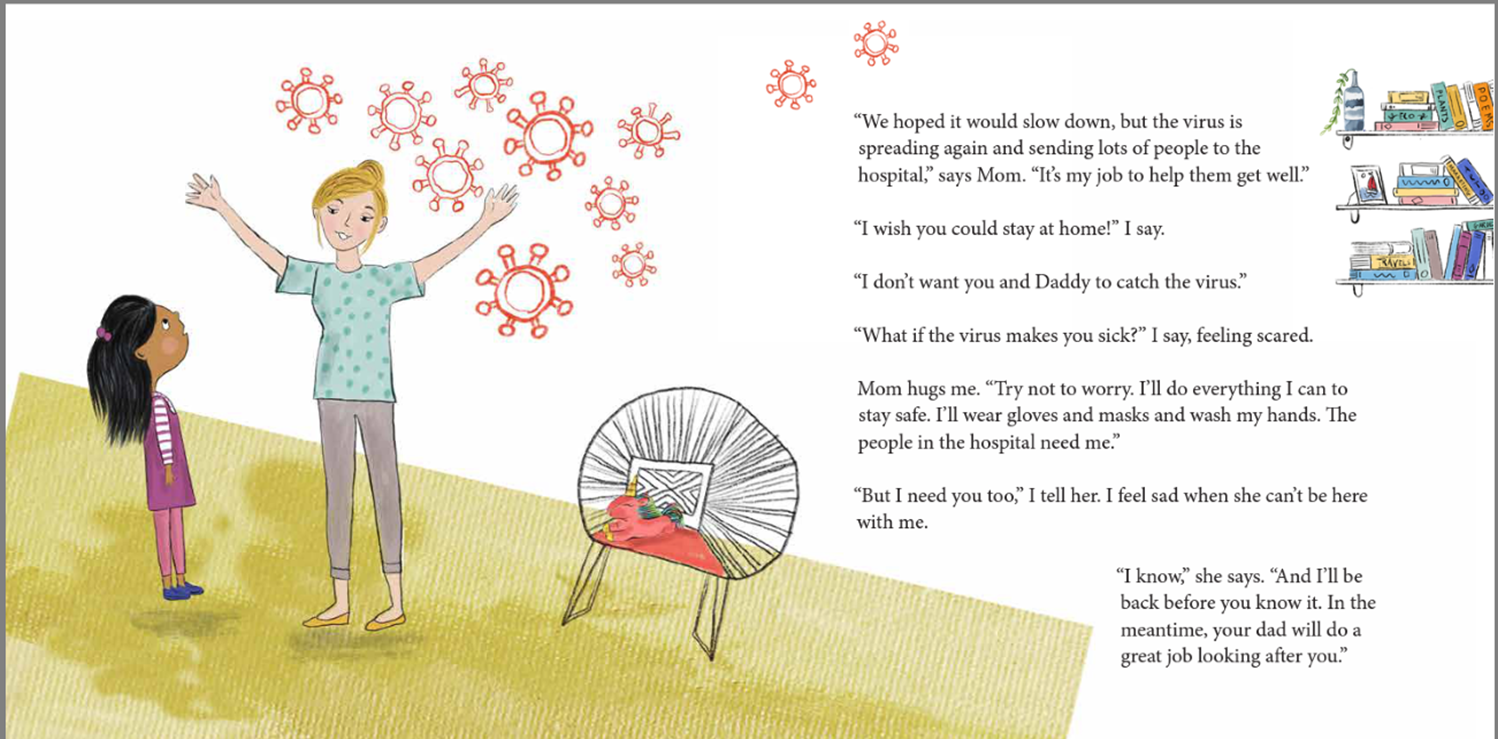
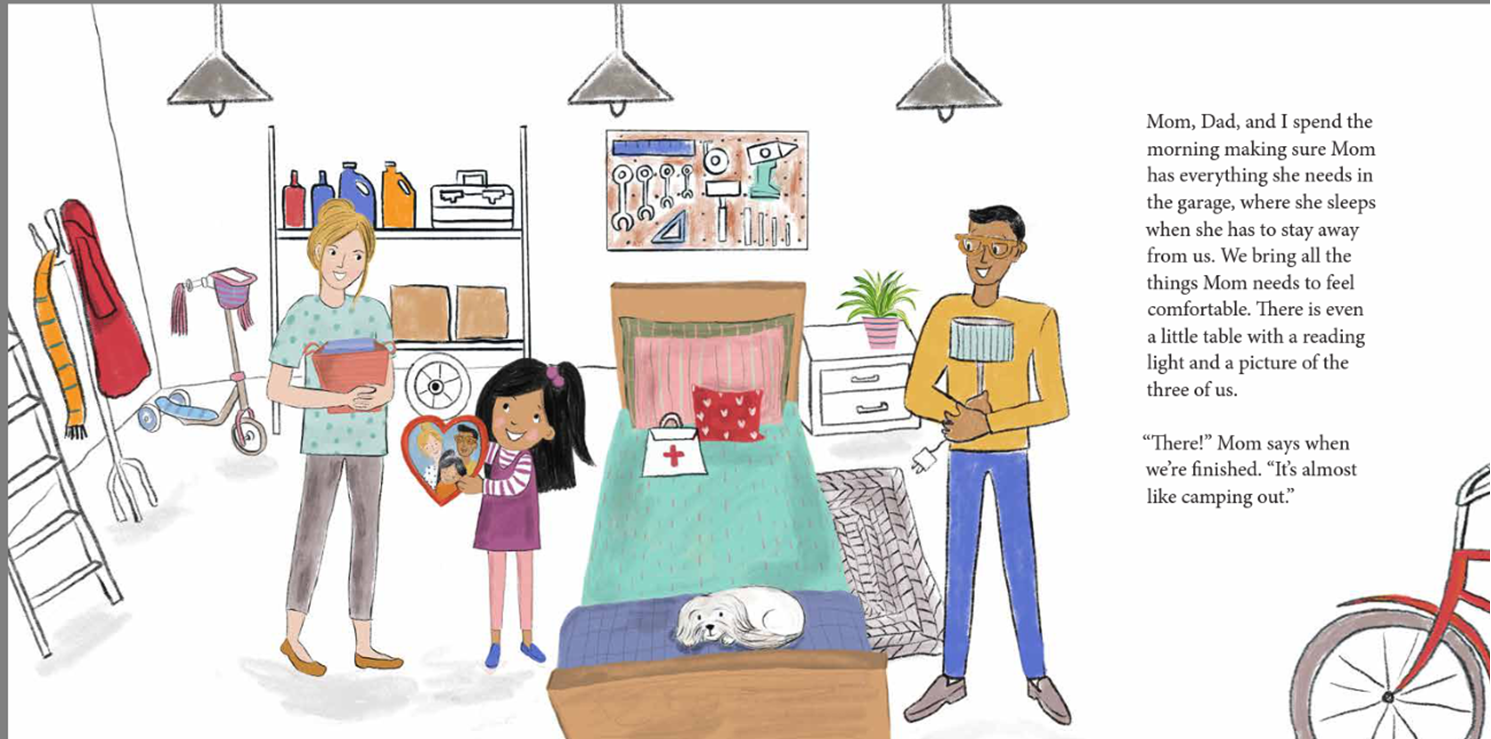
The book starts out with the little girl learning that her mom is going away, well not really away, but will not be in the house with her and her dad. That the virus isn’t slowing down and her mom has to go help people. The family of three then sets up the garage to make sure mom has everything she will need when she comes home from work. A bed, a little table, even a picture of the three of them.
The dad calls the mom a superhero and gets the little girl on board with helping mom as she helps others. They wash their hands to a special song, they wear masks when they go out, they shop for a neighbor, and try to use things to make dinner that they already have.
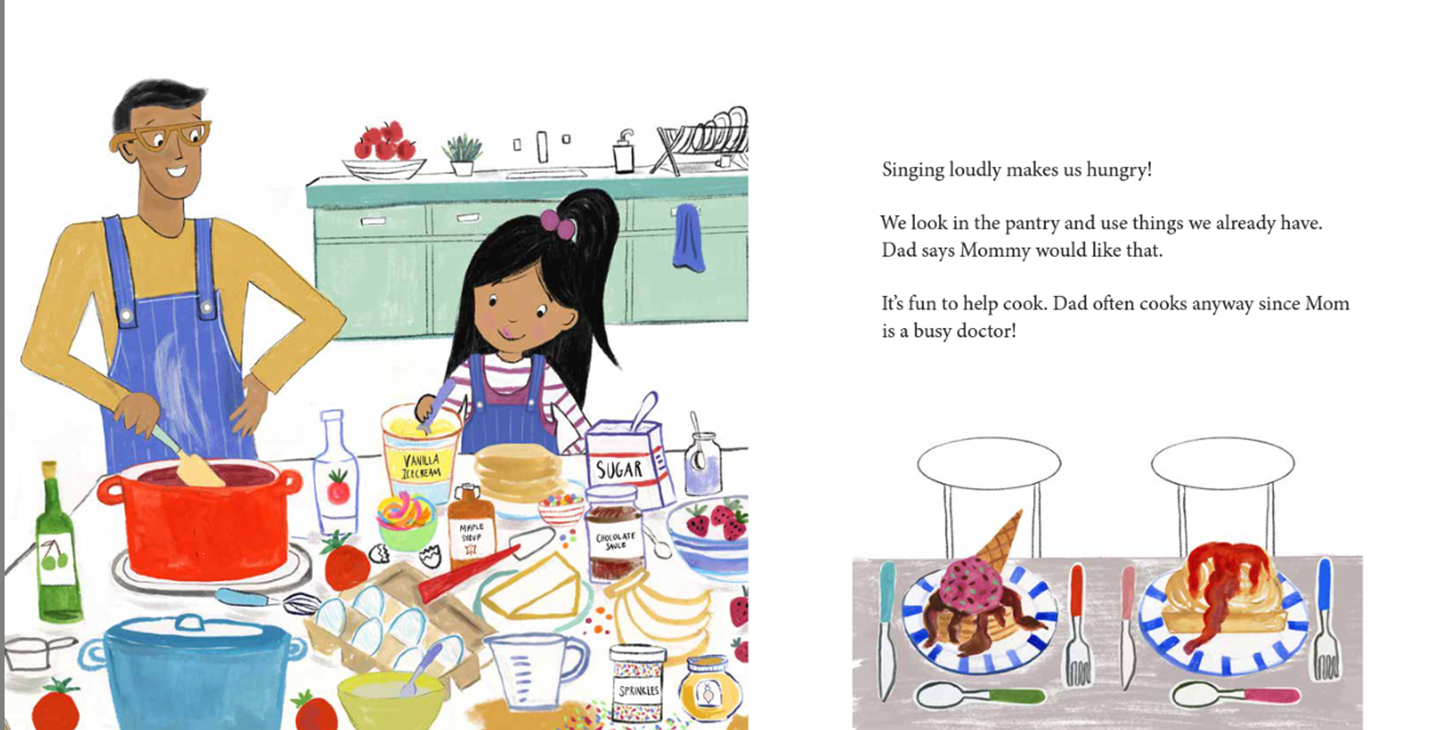
The book then articulates that mom is a busy doctor and dad cooks often. The little girl plays games with her dad and video chats with her mom feeling proud that she is making her mom’s job easier. Every morning the dad does the little girls hair before virtual learning begins, and every evening she waits by the window to wave to her mom. The little girl misses her teacher, friends, and mom.

The little girl and her dad go grocery shopping for Grandma and Grandpa and deliver the groceries to them outside with masks on as they wave from afar. Sometimes before dinner the neighbors all stand outside banging pots and pans cheering for all the heroes coming home.

When her mom returns from quarantine, the little girl asks if the virus is gone, and the mother says no, but that things are getting better. When her mom thanks her for doing such a good job while she was away, the little girl says, “No problem, Mom. That’s what superheroes do!”

I love that the concept of super heroes is presented as real people on the front line doing their jobs even when it requires tremendous sacrifice. I also like that all of us working together to curb the pandemic is also heroic work.
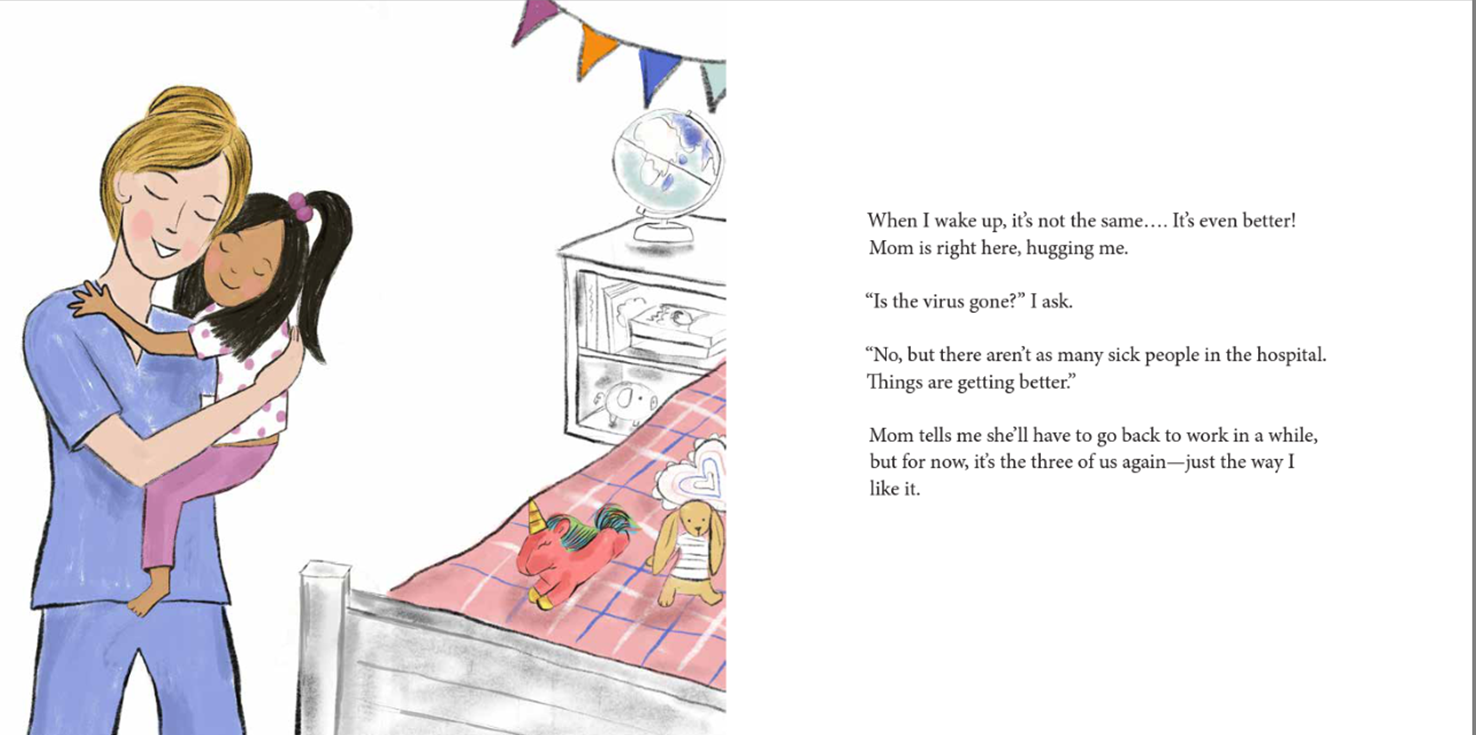
I love that it shows a mom capable and professional and loving, as well as a father loving and capable and supportive. Yes, she likes how mom does her hair better, but it shows competency from both parents, which sometimes in books is lost when it makes one parent the brunt of misguided humor.

I don’t know if years from now the book will be as relevant, but certainly children today are living this story and will relate to the characters. I think children in preschool and up will enjoy the illustrations and storyline.

Float Like A Butterfly by Ntozake Shange illustrated by Edel Rodriguez

Standard

img_8250

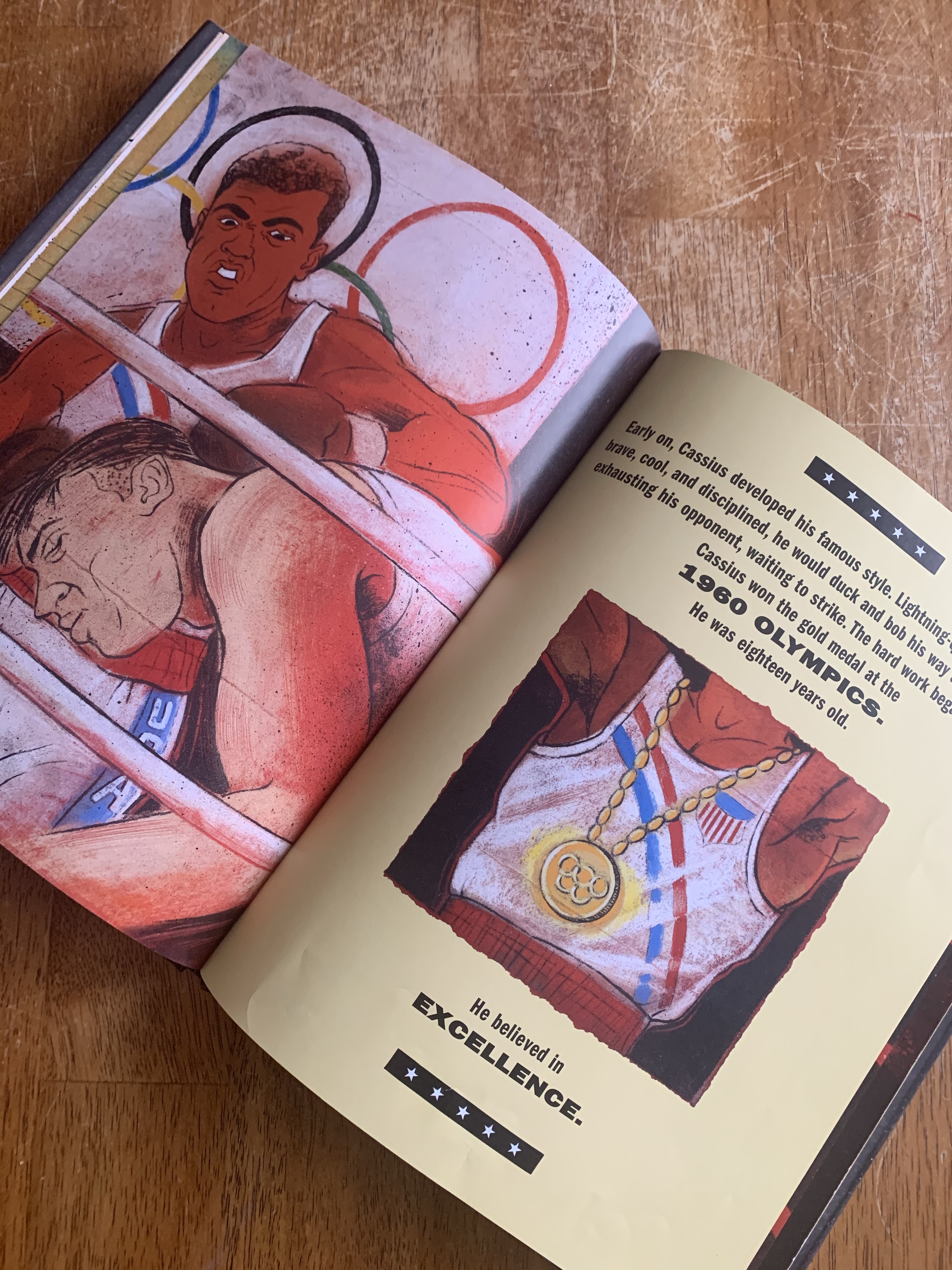
This 40 page biography beautifully presents major events of the famous boxer’s life without going in to much explanation. While it is an AR 4.7, it is still a picture book, and might work better for younger kids with some conversation and context, than for middle grade readers looking for anything in-depth about the beloved hero. While following his life, the reader sees him as a child growing up before he becomes famous, and sees that even after he retires, he is so much more than just a boxer, he is a compassionate leader, icon, and humanitarian.

img_8251

Born in Louisville, Kentucky in the Pre-Civil Rights South as Cassius Clay, he struggled to understand why there was only a white superman, and questioned if heaven was divided up by color and income like Smoketown.

img_8252

Cassius loved the power of words and would help his father make rhymes as a sign painter. When his bike gets stolen he is motivated to learn to fight so that nothing else is ever taken from him and his. He may not be the colored superman, but he is determined to be lightening fast and have fists that fly.

img_8253

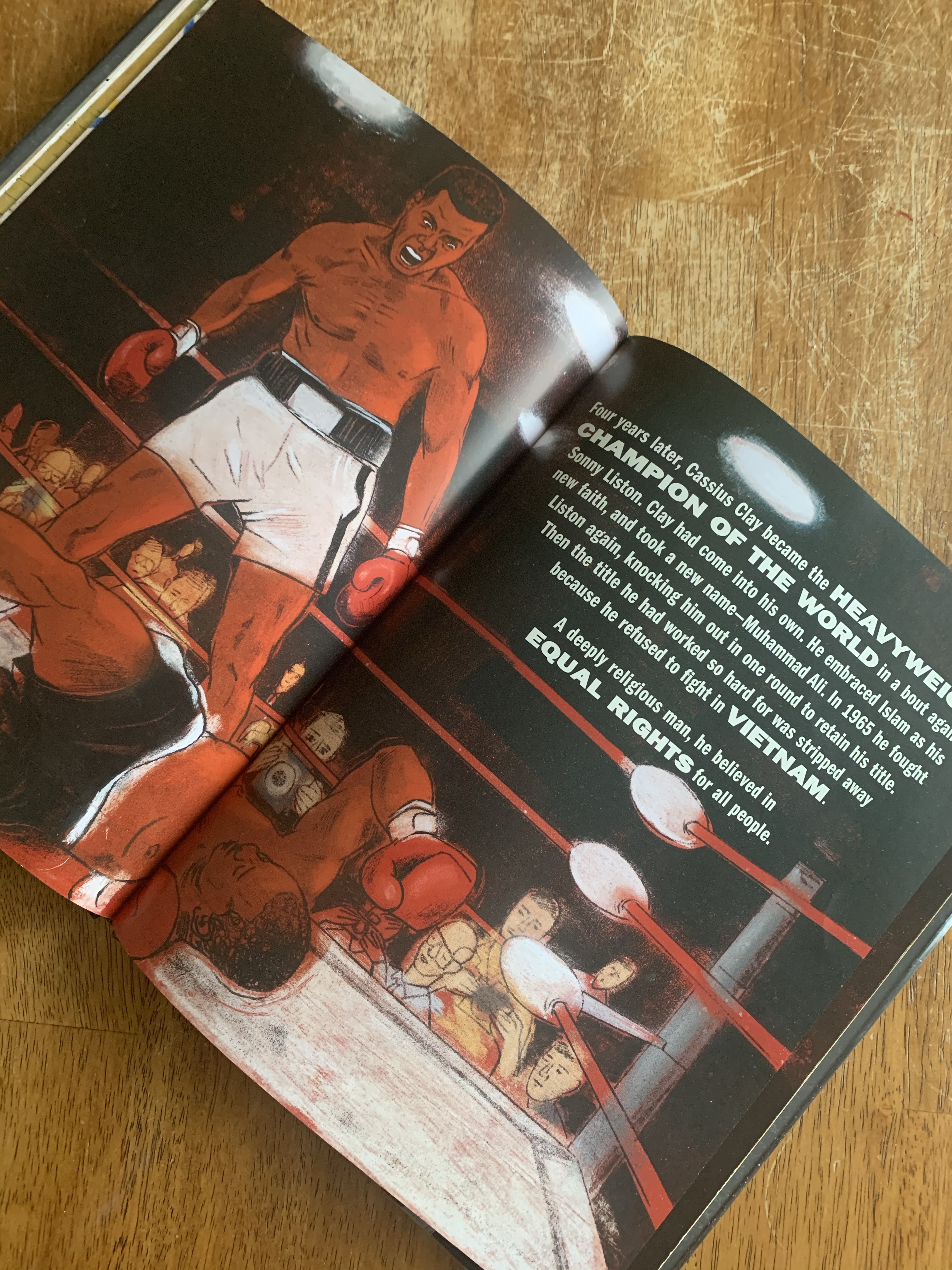
In 1960 at age 18 he won Olympic Gold. In 1964 he converted/reverted to Islam and changed his name to Muhammad Ali days after becoming the Heavyweight Champion of the World. His titles were stripped from him, however, when he refused to fight in Vietnam.

img_8254

Years later in 1971, the Supreme Court reversed his convictions for not fighting and in 1974 he reclaimed his title by beating George Foreman in “The Rumble in the Jungle.” In 1981 after winning, keeping and losing the title, Muhammad Ali retired from boxing for good.

img_8255

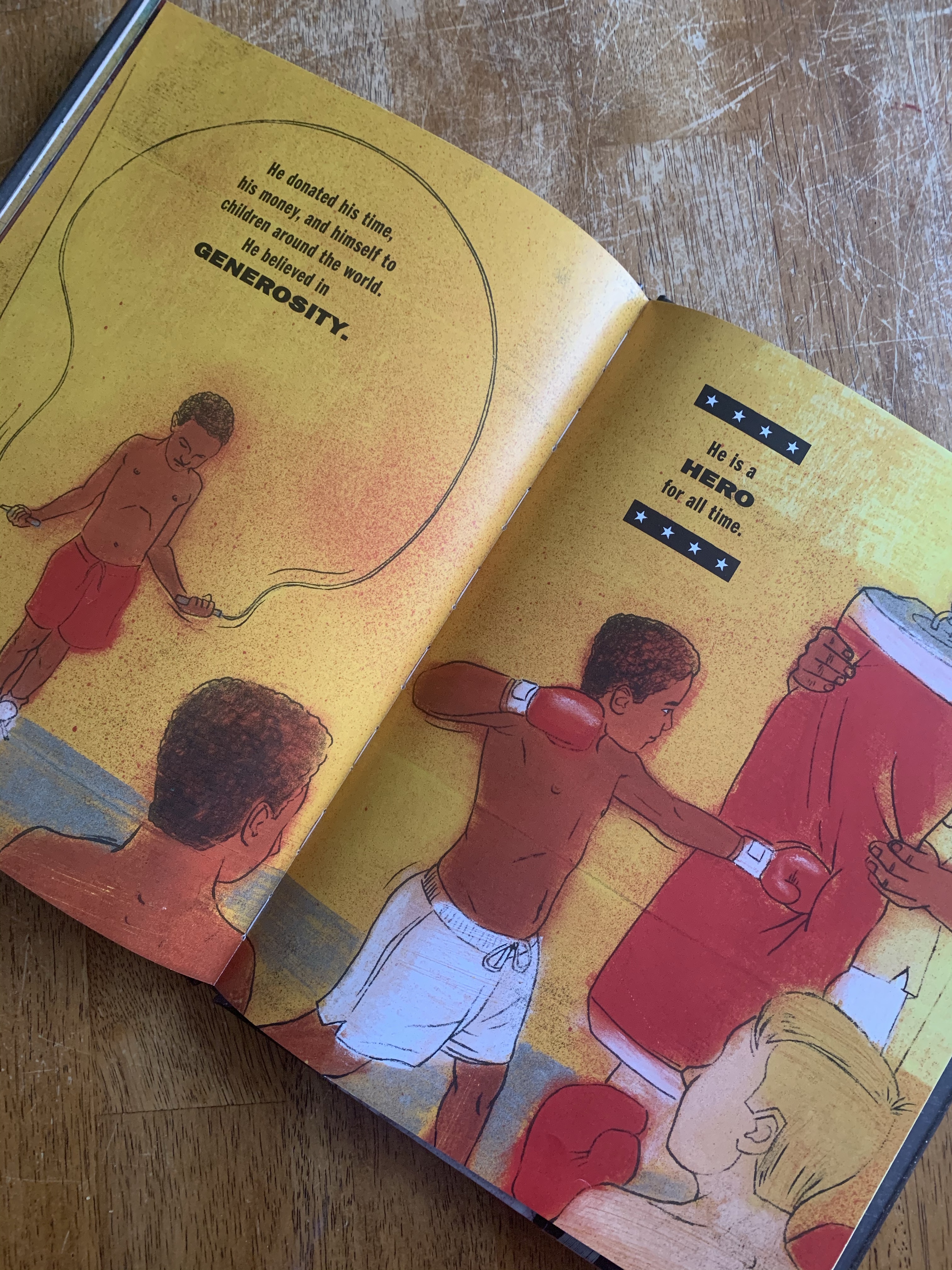
Muhammad Ali suffered from Parkinson’s disease but still donated his time, his money and himself. He believed in perseverance, and equality, and fought for what he believed in. He passed away in 2016 at the age of 74.

img_8256

This is an updated edition from the 2002 originally published book, it now includes his death. I wish it was more than a fleshed out timeline and showed him as a person, or what it was like to lose everything when standing up for something you believe in, or explained what some of his catch phrases meant, or really just as a more high energy celebration of his life.

img_8257

The Girl Who Slept Under the Moon by Shereen Malherbe illustrated by Sarah Nesti Willard

Standard
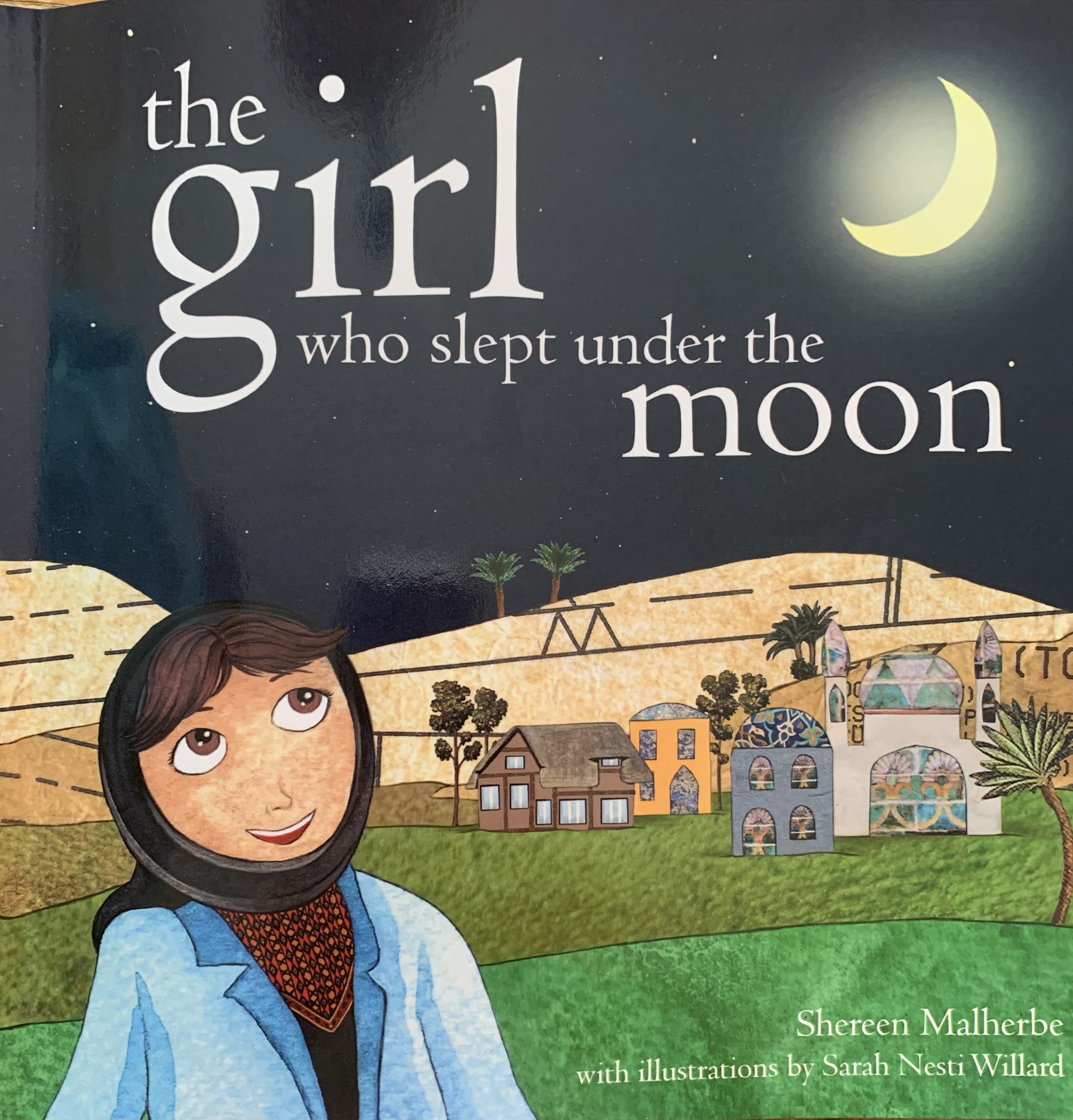
The Girl Who Slept Under the Moon by Shereen Malherbe illustrated by Sarah Nesti Willard

img_8044

I was really surprised by the number of gaps in this 46 page story that is so adorably illustrated and seemingly planned out. I thought perhaps I was being overly critical, so as always I tested it on my kids, and they too were confused by the main character’s rational and choice of words, the holes in the narrative, and the inconsistency of the characters. The book is wordy, so conciseness cannot be the reason for the holes, and it is published by a publishing company, so I would assume it has been proofed. Really the point of stories connecting us and giving us comfort when we need it, is sadly lost. I had hoped to love this fictional story of a Palestinian girl using prayer to give her comfort in her new home, but alas it seemed to be trying to weave in too much, and as a result the story isn’t fabulous for me unfortunately.

img_8038

Noor is new at school and stands out. She finds comfort in remembering the things that are the same. 1-Allah could still see and hear her. 2- The Angels were still by her side, and 3-She still slept under the same moon. She also wears clothes that remind her of home and provide an unspoken clue as to where home is for her.

img_8039

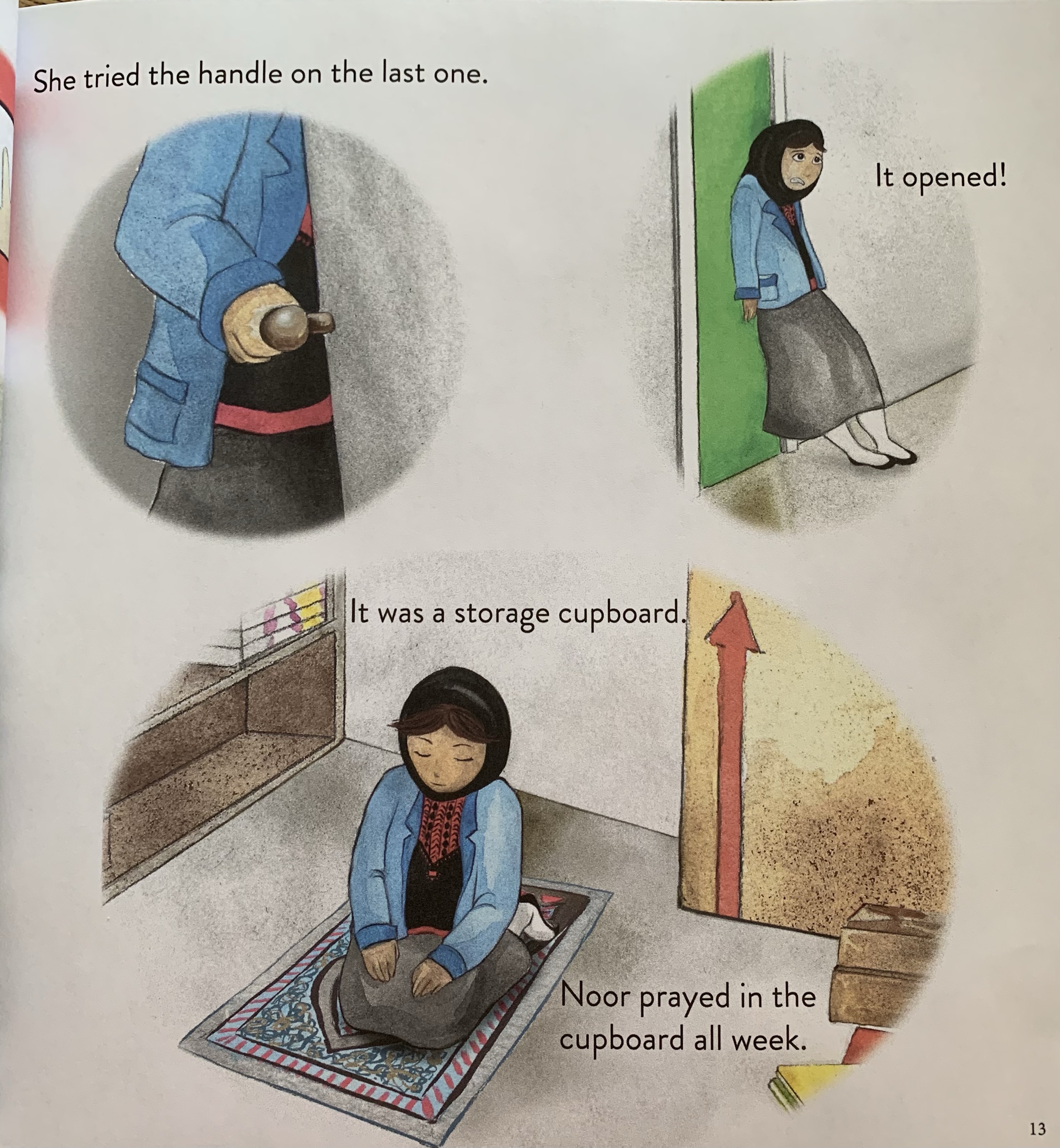
At school Noor has a problem, she needs a place to pray, but at lunch time the kids are not allowed to go inside and the dinner lady guards the door. Noor needs a distraction to sneak in the building and it isn’t clear if she provides the distractions, or just benefits from a baby bird falling out of a nest, a snake being in the grass, and a classmate getting hurt. Either way, when the teacher is occupied, Noor enters the building and finds a closet to pray in.

img_8040

On one such visit to the closet she finds someone already in there, Hannah. Hannah is there because she doesn’t like being on the playground because she is different. Noor never asks why Hannah feels different, so the reader isn’t made aware either. Hannah asks her why she is there and Noor says she comes “to pray because it reminds me of where I’m from.”

img_8041

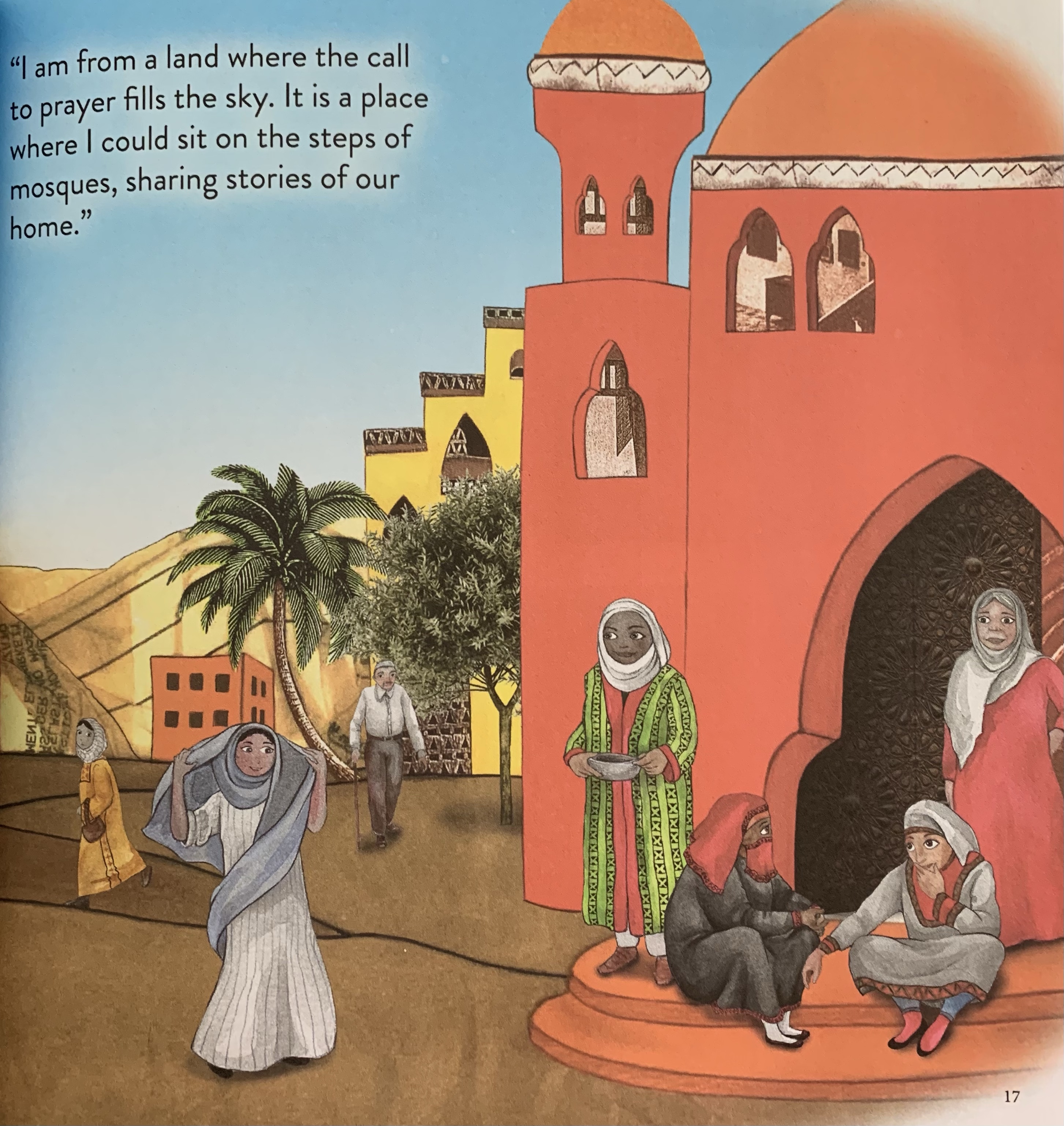
When Hannah asks where she is from, Noor doesn’t just simply answer, she tells her stories about her homeland, the mountains, olive trees, where the athan floats in the air and fisherman return to the shore with their catch. The next day Hannah is there again, and Noor tells her more stories and legends about her culture and lessons of the Prophets. Noor learns that through her stories she feels connected to her old home.

img_8042

Weeks pass, and one day when she sneaks in to the school, she finds the door locked. With no where to go she heads back to the playground and starts to cry that she won’t be able to pray. She then sees Hannah disappear and she follows her in to the drama studio. When she enters she sees sets built that look like the setting of her stories, of her home. Hannah knew she missed home and built her sets to look like Palestine.

img_8043

Other kids miraculously enter, and Noor begins telling them her stories, without praying first. The other kids seem to enjoy her stories and Noor learns that she can pray anywhere while holding on to her three reassuring thoughts.

The illustrations are engaging, although I’m not sure where the prayer rug seems to magically come from for Noor to pray on in the closet the first time. Had the book just been about prayer and finding a way to pray, or just about the stories connecting us to our past I think it would have been more powerful. I’m glad that Noor loves salat and that Hannah is a good friend, but I feel like by trying to do too much, the poignancy of the little things was lost.

And as for my questions: Can’t Noor ask for a place to pray? Can’t she pray outside? How is Hannah making the sets all by herself? Noor says she prays because it reminds her of home, she doesn’t pray for the sake of Allah or because it is required of her? Why did Hanna feel different, and why didn’t Noor bother to ask? It says that she needed to distract the dinner lady, isn’t that dishonest even for a good cause? Did she harm the baby bird so that it would need rescuing? Put the snake in the grass? Hurt the little girl so that she could get by the teacher? How was Hanna getting inside at lunch time? How is the school ok with a kid coming inside to build a whole set with school materials, but can’t let another child inside to pray for less than 5 minutes? And if Noor didn’t feel comfortable asking for a space to pray, clearly Hannah had connections to get permission to create a huge scene, couldn’t she have asked, or helped Noor ask?

Unsettled by Reem Faruqi

Standard
Unsettled by Reem Faruqi

img_7503

This book is a great OWN voice, middle grade coming of age book that rings with truth and hope in its poetic lines that sweep you up and keep you cheering.  Over 352 pages the author’s semi-autobiographic story of coming to Peachtree City, Georgia from Karachi, Pakistan beautifully unfolds.  I absolutely loved this book and the way it is told, in verse.  The details, often small, ring with such sincerity that even those that have never moved to a new country, or been to a new school will feel for young Nurah Haqq and be inspired by her success, touched by her hardships, and disappointed in her mistakes.

img_7544

SYNOPSIS:

Nurah’s best day is spent on the beach with her best friend Asna, playing in the warm waves and riding camels.  However it ends up also being her worst day, when she returns home to her father’s news that they are moving to America.  Strong, confident Nurah who spends time with her grandparents, swimming with her older brother Owais, and excelling at math in school is reluctantly leaving it all behind to start anew.

When they arrive in Georgia the family of four settles in a hotel until they find a house.  Everything is different and new, and the transition with no friends and family difficult for the entire family.  The way words are pronounced, the way the air feels and the birds chirp all make Nurah long for home.  When they find a swimming pool at the rec center, things start to slowly change.  Owais was a medal winner in Karachi, and will be one here too, people start admiring him, and Nurah tries to bask in his light.

School starts and math is a relief, but people are white, so white, and a boy reaches out to shake her hand.  She feels betrayed that she has been told the schools in America are better, and lunchtime, with no one to sit by is a huge stress.  She questions her clothing, her appearance, and the weather.

Her and Owais try out for the swim team and make it, and Nurah makes her first friend, Stahr. Stahr lives a few houses down from their new house and when Nurah’s mom has a miscarriage, it is Stahr’s mom who comes to show support and give comfort.  The support is reciprocated when Stahr and her mom need help escaping from her abusive father.

As Nurah works to win swimming races and be more like her brother, she works to find her voice and use it to defend others and herself.  A terrorist attack committed by someone claiming to be Muslim sets the family up to be targets.  In a moment of jealousy, Nurah doesn’t intervene to help her brother and the consequences are huge.

img_7502

WHY I LIKE IT:

I love the details and how they are articulated.  I related to so much of Nurah’s feeling and impressions, that I reached out to the author and found her to be just as endearing as her character.  The feeling of being different when swimming because of your decision to be modest, the role of food to comfort you and make you feel at home, the older brother that you so desperately want to resemble and be like: All of it hit close to home for me.  I love how religion and culture are so much a part of the story and about the character’s identity, not to be made preachy, just to understand her and her experiences.  She goes to the masjid, she prays, she starts to wear hijab. I love how she finds her voice and defends those that can’t, but that her path is not easy.  She makes mistakes and she has to challenge herself to do what is right.  The backdrop is always trying to “settle” in a new place, but the story has it’s own plot points that are interesting and simply made more impactful by Nurah’s unique perspective.

There are lots of little climaxes and victories for Nurah that show her to be well-rounded and relatable.  You cheer for her early on and enjoy the journey.  The only slight hiccup I felt was the name confusion of her Nana and Nani (Nana), it is explained, but it was a little rocky for me, it might be based on a real thing in her family, but once that is resolved, the book flows beautifully and smoothly.

img_7545

FLAGS:

Nothing a 3rd/4th grader would find alarming, but none-the-less:

Crushes: Nurah has a crush on a boy at school when he shakes her hand and picks her for a lab partner, but she moves on from him while still maintaining a crush on her brother’s friend Junaid.  Nothing happens, she just thinks they are cute.

Miscarriage: Her mother has a miscarriage and it details a blighted ovum and the mental strain on the mom and family in the aftermath.

Abuse: Stahr’s father is abusive

Hate: There are bullies, discrimination, physical violence.

TOOLS FOR LEADING THE DISCUSSION:

The book is a little below level for my middle school book club, but I think it it was on a bookshelf and a middle schooler picked it up, they wouldn’t set it down until they were done reading it.

Good Little Wolf by Nadia Shireen

Standard
Good Little Wolf by Nadia Shireen

wolf

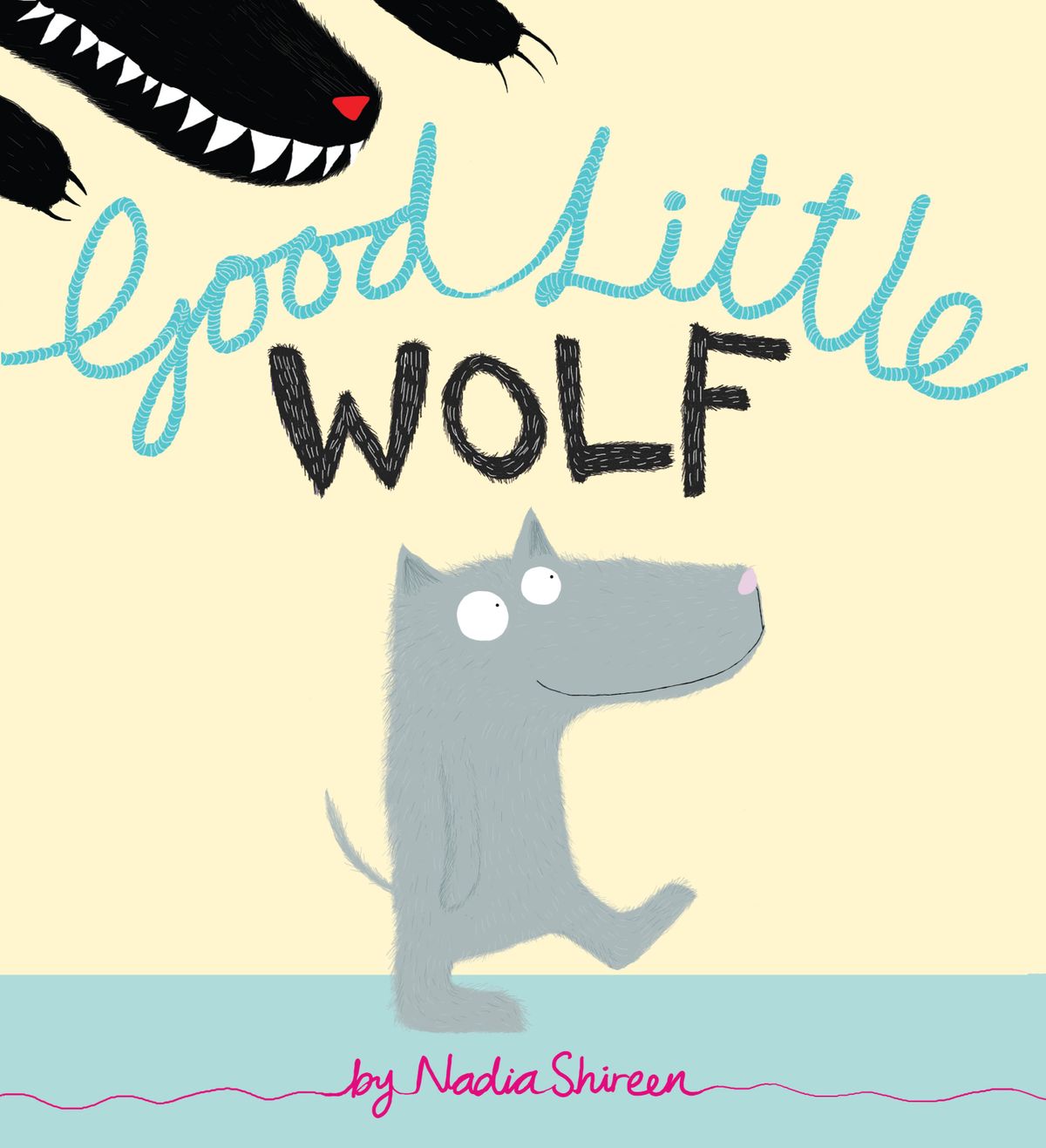
I have way too many conflicting thoughts for this 32 page AR 2.1 Muslim authored picture book.  The good little wolf, with a cast of familiar story book characters getting cameos, is choppy in its simple story telling to the point I thought pages had been skipped more than once, funny in asking the three little pigs permission to blow their houses down, slightly moral in elevating good behavior and having the courage to hold to your goodness, and ultimately, possibly really dark, as the end gives reason to believe that wolves will be wolves and the good little wolf is no more, as in he has been killed along with an old granny too.  

245BE710-2A53-41AF-A01A-6EA9596D3370

Rolf is a good little wolf that likes to bake, eat his vegetable and be nice to his friend.  His best friend Mrs. Boggins has warned him that not all wolves are as nice as he is and Rolf hopes he will never meet a big bad wolf.

D48EE32F-8952-4A52-9F30-F0EC5AF408D5

Alas, he does meet the Big Bad Wolf, and he questions if Rolf is a wolf at all.  To prove that he is a wolf he accepts the big bad wolf’s challenges:  He howls or rather whistles at the moon and he tries to blow his friend pig’s house in.  Eventually he resolves that he isn’t mean enough to be a wolf, then the Big Bad Wolf gives him one more chance as he holds out a fork and knife to the wolf while restraining Mrs. Boggins. D31DC212-C85D-439B-BBCF-2A1CEA6F1FF8

Rolf feels something deeply and ties up the Big Bad Wolf feeling more wolf like than ever.  He just happens to be a good little wolf.  To celebrate they all sit down for a snack and the Big Bad Wolf decides to stop eating people…tomorrow.

FE2D38B5-AA49-4AEE-B111-61FACD9D9436

Yeah, it isn’t clear and could be up for debate, but Rolf and Mrs. Boggins are no longer at the table, and the Big Bad Wolf looks pretty happy.

42DAF30D-66BD-4FA9-A871-F7AC1717DC0F

There is nothing religious in the book, it could be debated if the book is dark or just silly and aside from the choppiness of the transitions, overall the book is a fun turn on classic characters and concepts.

6DDCE0AB-FFBF-471C-9DBB-35B7320425EB

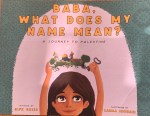
Baba, What Does My Name Mean? A Journey to Palestine by Rifk Ebeid illustrated by Lamaa Jawhari

Standard
Baba, What Does My Name Mean? A Journey to Palestine by Rifk Ebeid illustrated by Lamaa Jawhari

img_7233

This lyrical journey through Palestine’s major cities, shares historical facts, geographical information, cultural richness, and love for a homeland that will inspire and educate all readers. There is a lot of information pressed in to 32 pages and at times the rhyming text, illustrations, and maps are powerful, and at other times overwhelming. The 8.5 x 11 horizontal paperback bound book needs to be bigger to hold all that the pages contain, and hard back to hold up to the details that need to be poured over to be appreciated. The content about the names and places in Palestine is priceless and well done, but I really wanted to love the book a bit more than I ended up feeling for it. I think trying to make it all rhyme was just a bit too much for my liking, but I would buy this book again in a heartbeat to share with my children. Even though we are not Palestinian, I think all Muslims have a piece of Palestine in our hearts and feel a deep need to celebrate the culture, fight for their freedom, and demand a quality of life that they are brutally being denied by their oppressors.

img_7234

The book starts out at bedtime with a little girl, Saamideh asking her baba what her name means. He explains to her that it means “one who is patient, persistent and one who perseveres.” She is named this because she is Palestinian, he explains and then he shows her the key to their ancestral home in Palestine. He asks her to close her eyes and imagine a white dove, named Salam, taking her on tonight’s journey.
img_7235

Salam and Samamidah prepare to journey across Palestine’s mountains, hills, deserts, and plains. They start in Areeha, one of the oldest cities in the world, and one one of the lowest points on Earth.

img_7236

They journey next to Al-Quds, the capital. They see the old city, Al-Aqsa, and more, before heading off to Nablus, Yafa, Haifa and the Akka. Learning about the cities, the food, and the history of each.

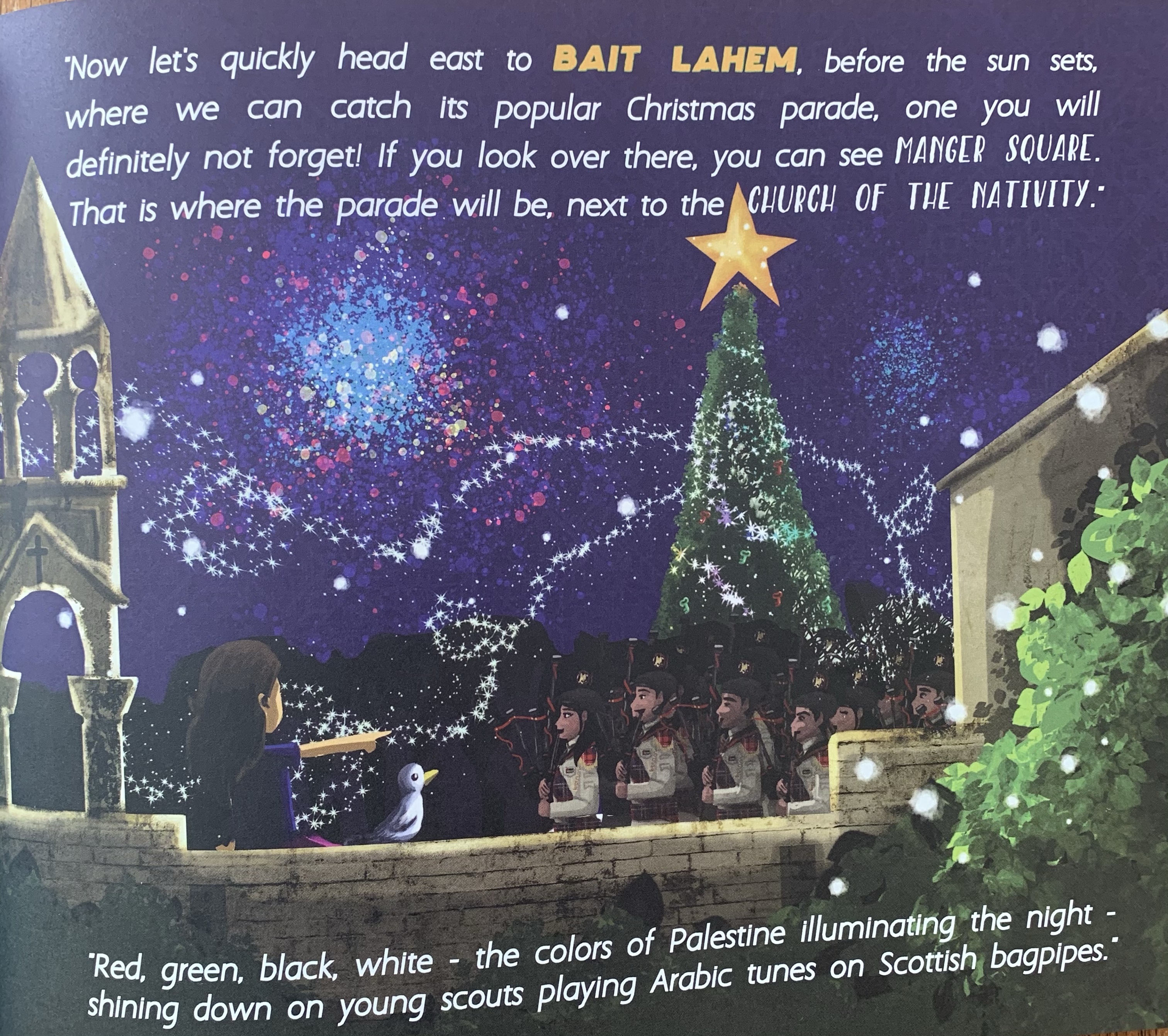
They learn about the dabkah, and the weaving in Gaza and head to Bait Lahem too. They learn about glass blowing in Al-Khalil at the Ibrabhimi Mosque, and finally they conclude their journey with the little girl dreaming of flying around the world to use her key and open people’s hearts and minds.

img_7239

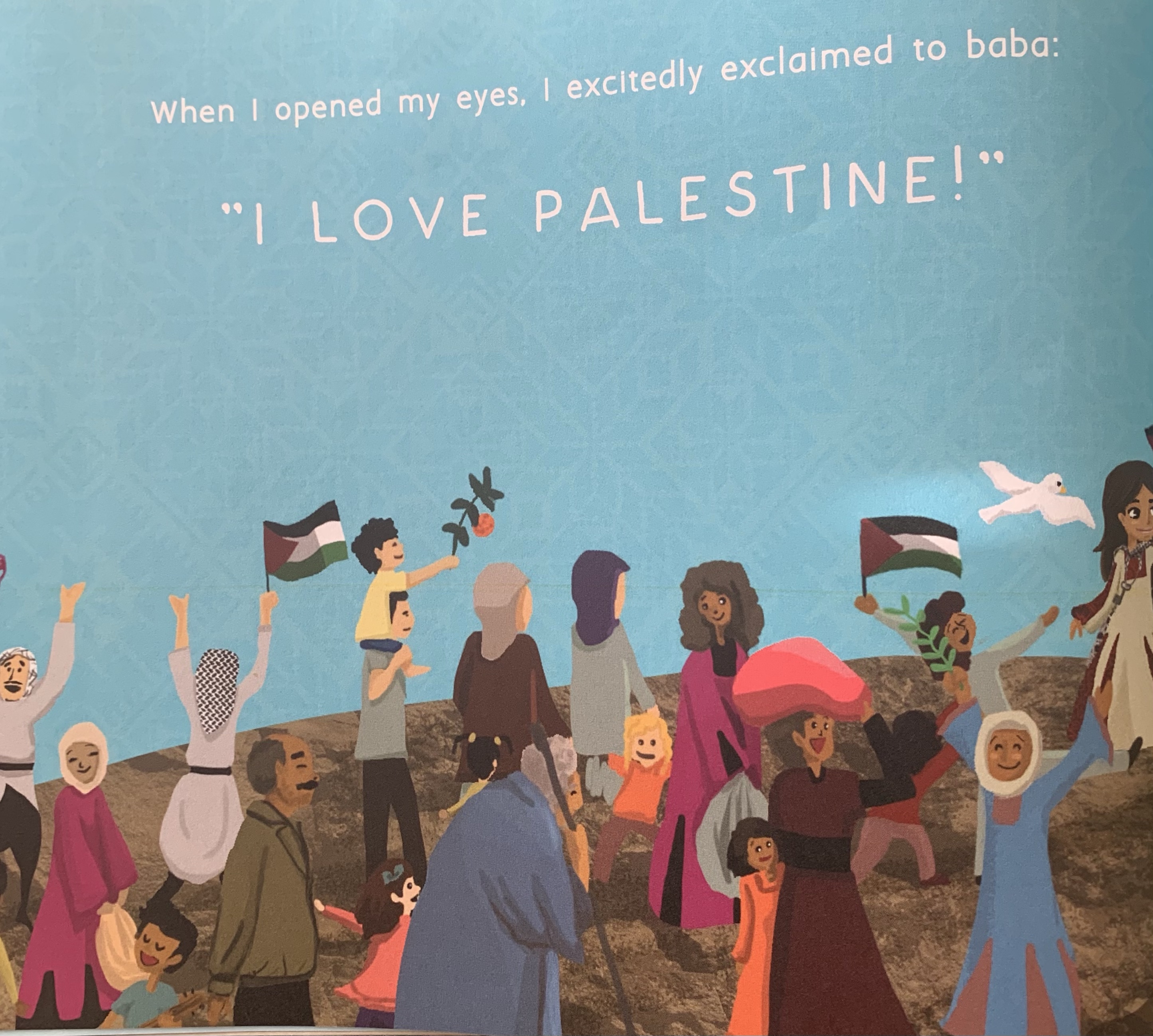
She proudly exclaims her love of Palestine and her and her baba pray that one day they will be able to return. Saamidah then asks her baba why they are refugees, and he promises to save that conversation for tomorrow’s beditme story.

img_7240

The book concludes with a list of the city names in Arabic, trasliterated in English, and then the English names. It then has discussion questions at the end.

The book is not outwardly political, nor critical. It is a celebration of a people, a culture, and land. Happy Reading!

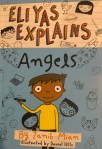
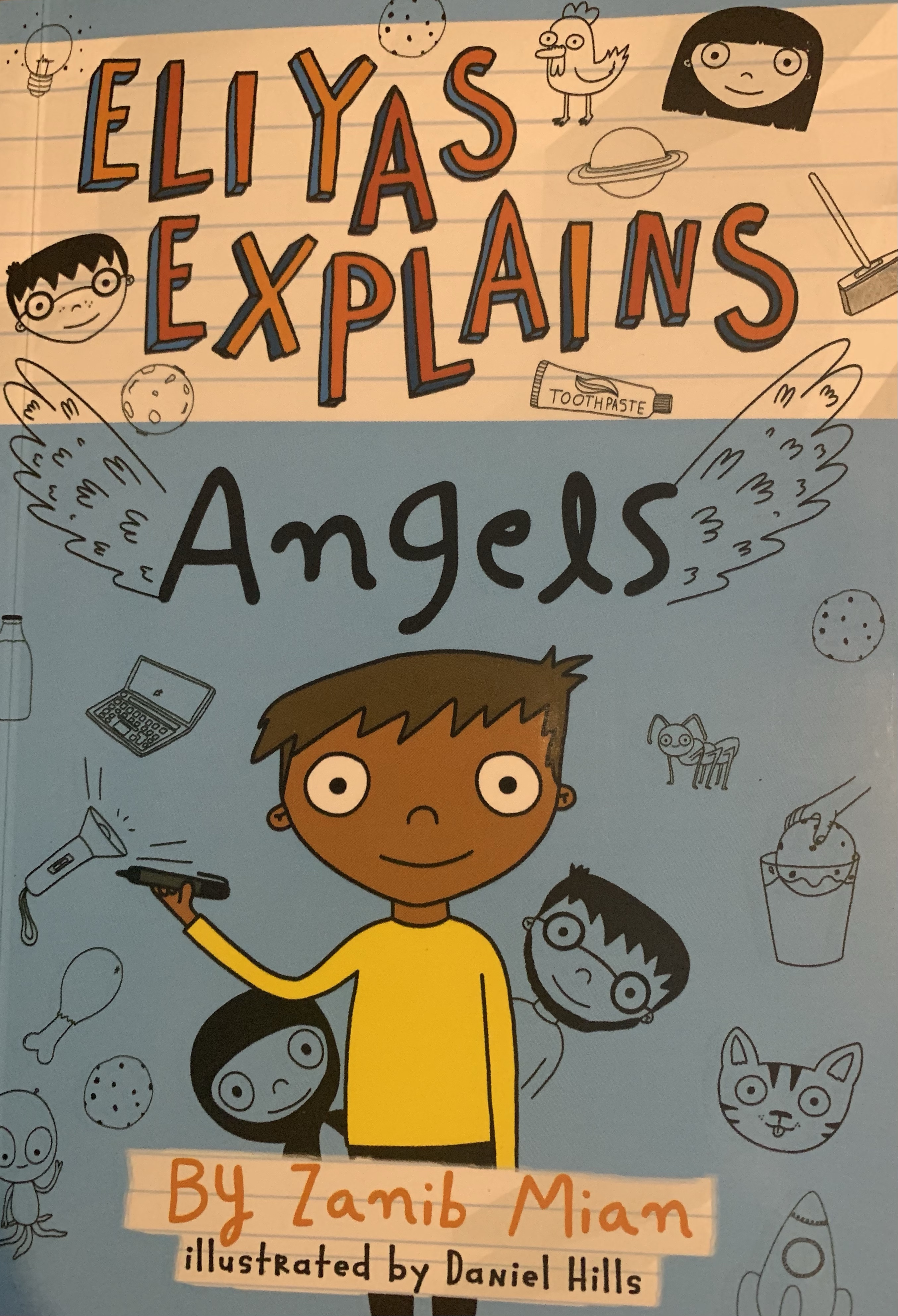
Eliyas Explains: Angels by Zanib Mian illustrated by Daniel Hills

Standard
Eliyas Explains: Angels by Zanib Mian illustrated by Daniel Hills

img_7130

This last Ramadan I tried every day to listen to Sheikh Omar Suleiman’s Angels in your Presence series with my kids and discuss Angels with them.  I learned so much and got to wondering, why other than the 10 or 15 facts we all learn as children do we not talk about Angels more.  So when I saw the first in a new series by the absolutely fabulous Zanib Mian was about Angels I was so excited, then I forget to review it, and here we are.  The book embodies her sweet spot for personas as she writes as Eliyas, a little boy telling about what he knows about Angels with sincerity, clarity, excitement and humor.  Perfect for ages six and up, I think all children should spend a few minutes with this 81 page doodle filled book to remind us of Allah’s magnificence, Alhumdulillah.
img_7132

SYNOPSIS:

Eliyas starts the book by introducing himself and some things about him before diving in, or rather encouraging you to go put socks on so that what he is about to tell you can blow your socks off!  It starts off with him not being able to sleep so he sneaks out of bed to get cookies, because cookies solve everything, and then his dad joining him and them discussing aliens, which leads to outer space, and the knowledge of outer space being filled with angels.

Eliyas then learns about the number of wings the angels have, how strong the angels are, and some of the specific angels that do specific tasks ordered upon them by Allah swt.  The task of protecting us, appeals to Eliyas and the concept of angels the size of mountains praying with us, blows his mind.

We learn through Eliya’s dad about angels coming to Earth in human form and about angel Jibreel (as) specifically.  We also learn a dua to say when leaving the home so that the angels protecting you respond.

img_7131

WHY I LIKE IT:

I love the way that the information is presented.  It is a mix of fact and story and tied together with humor and relatability.  If you haven’t read Zanib Mian, please do, her Migo and Ali books, Hadith and Duas are all great Islamic resources, and her Planet Omar and Alien book are hilarious and warm.  I pray that the series continues, it really is a lot of fun.

img_7133

FLAGS:

None

img_7134

TOOLS FOR LEADING THE DISCUSSION:

I think this would be great to have a Sunday school class read and discuss or an Islam class offer up as extra credit.  It probably wouldn’t work as a book club selection, but it definitely has a ton of value in a classroom and in a home library.

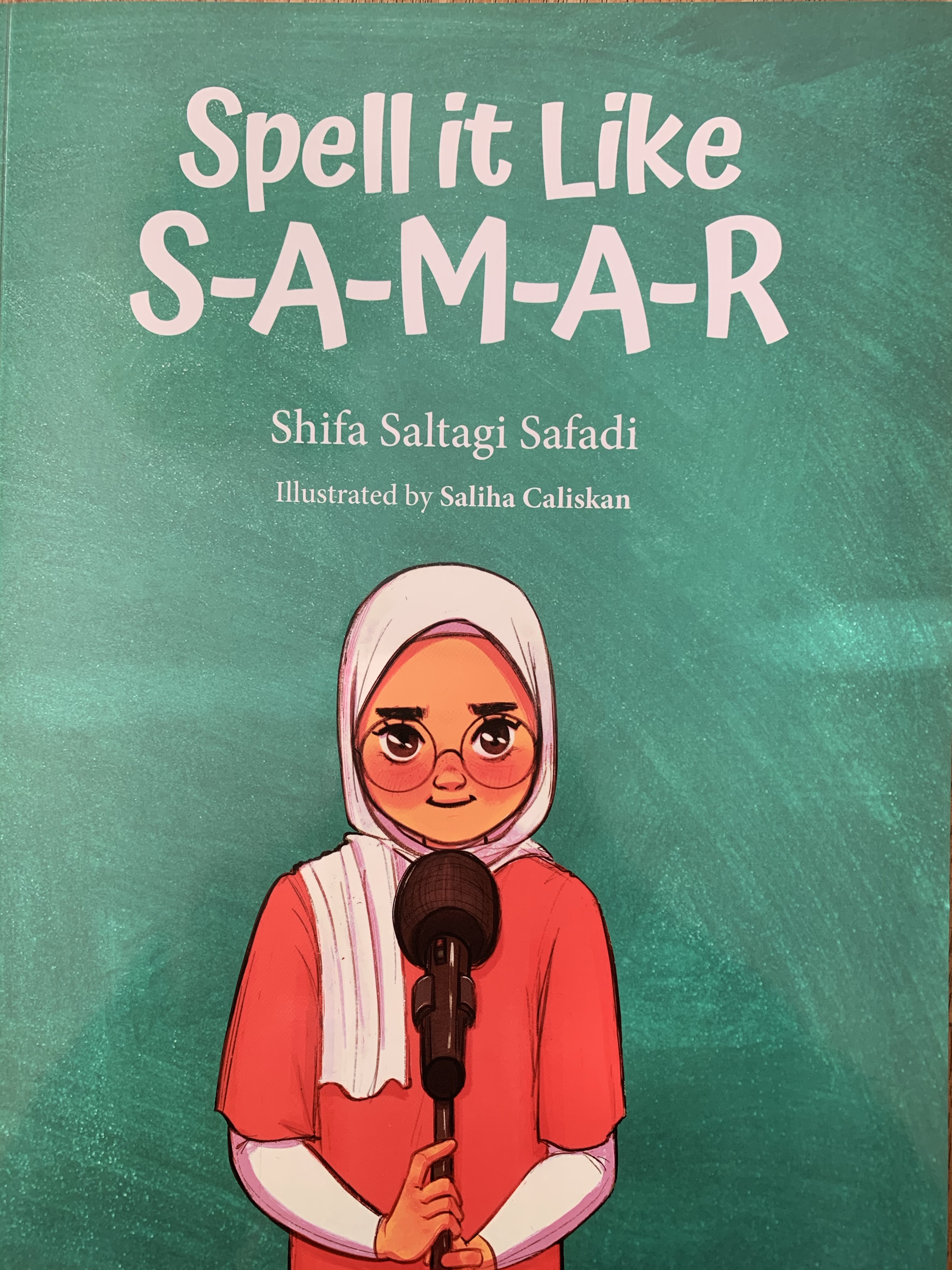
Spell it Like S-A-M-A-R by Shifa Saltagi Safadi illustrated by Saliha Caliskan

Standard
Spell it Like S-A-M-A-R by Shifa Saltagi Safadi illustrated by Saliha Caliskan

img_7225

This 36 page book for kindergarten and up shows the role perseverance, confidence, and believing in yourself can play in conquering bullies, carving out a space for yourself and finding success.  While the book is a little predictable on the surface, older kids will understand that by winning the spelling bee, Samar didn’t just benefit by standing up to the bully, but in proving to herself what she is capable of and ultimately being more confident of her place in a new country.  The book is presented on large 8.5 by 11 full color glossy pages and features discussion questions at the end.

img_7227

Samar is in 3rd grade after recently moving to America from Syria, where she was the best student in her class.  ESL wasn’t difficult, but mainstream class is proving to be a challenge, mostly because of Jenna, the class bully.

img_7228

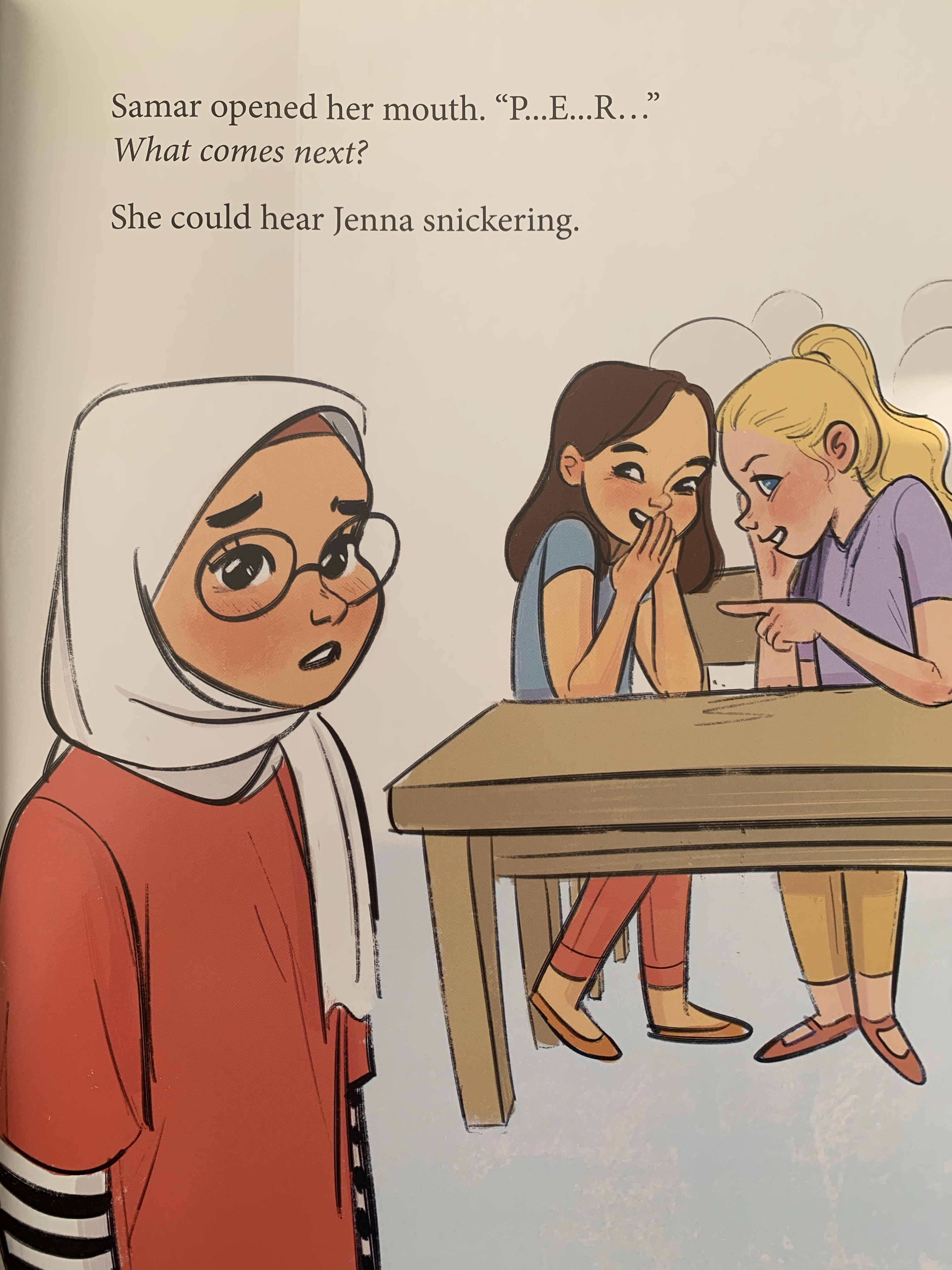
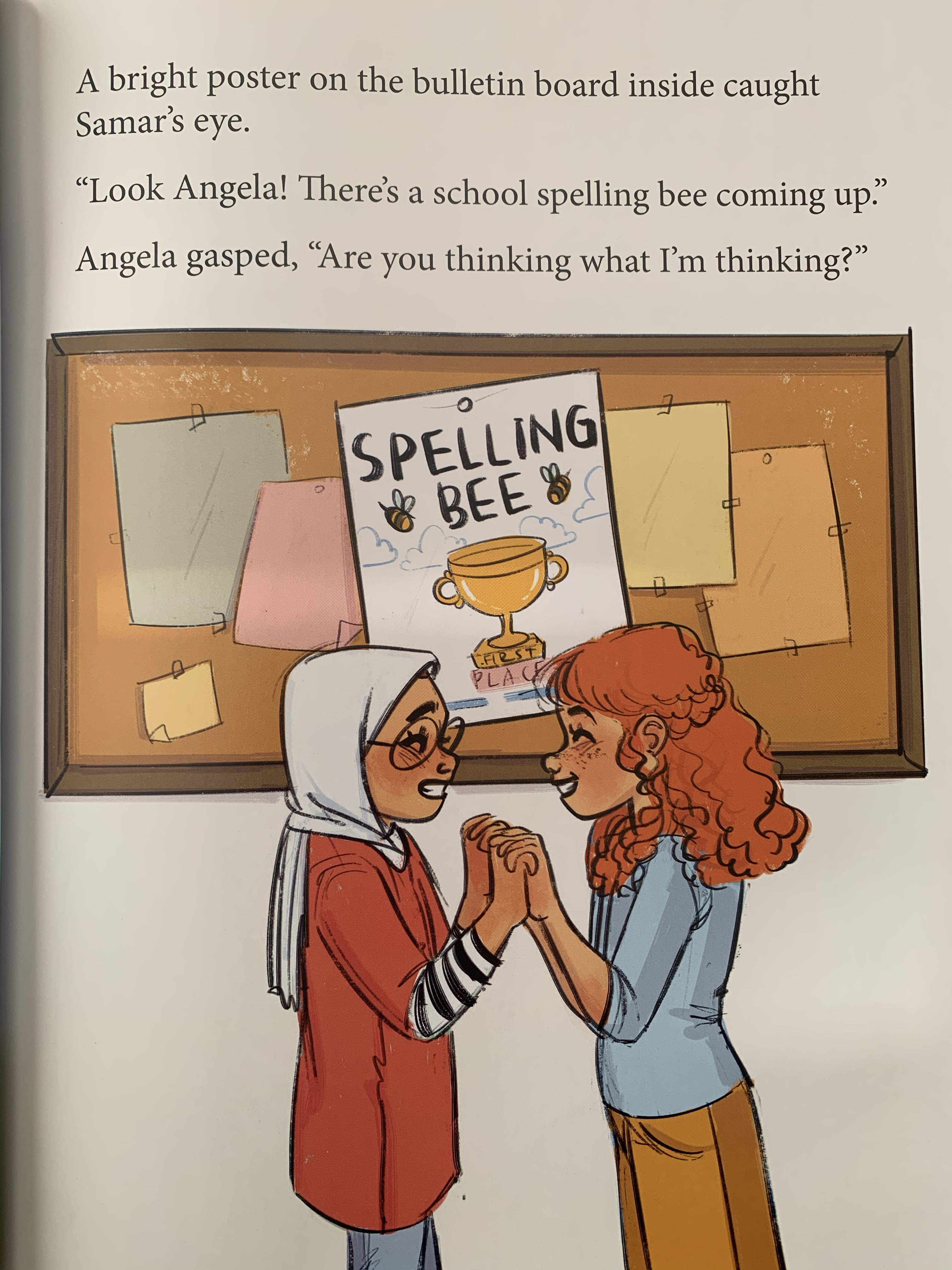
Jenna, snickers when it is Samar’s turn to spell words in front of the class, she teased her about her jump rope songs not being in English, and she makes fun of her for her accent.  With the help of a kind friend, Angela, the two girls decide the school spelling bee will be the best chance to prove how smart Samar is, by winning.

img_7229

The first step Samar must do is convince her teacher, Ms. Bryan to help her study.  To  show her commitment she offers to give up her recess to study.  The teacher agrees, but on the way home Jenna teases her saying she’ll never win when she can’t even speak English properly.  Deflated, when Samar gets home, she doesn’t study the flashcards and opts to watch cartoons instead.

img_7230

When later in the week her teacher quizzes her, Samar admits she didn’t study.  Ms. Bryan encourages her by sharing her own story of coming to America and having to learn English.  When Samar gets home she sees her mother, a former dentist in Syria, studying for the exams to be a dentist in America. This is the spark she needs and she studies hard, everywhere, and with anyone who will help.

On the day of the bee, Samar spells word after words correctly and after saying bismillah before spelling the final word, wins the competition and beats Jenna. The audience cheers and the next day Samar and Angela are jumping rope and Samar is singing in Arabic.

img_7231

I love that Samar and her mom wear hijab while out, but not at home, that they speaks Arabic, and Samar says bismillah.   Samar’s mom is clearly highly educated and determined and mom and dad are supportive.  I love that Samar’s drive, however, comes from her own determination, no one forces her or guilts her, it is her leading the way and understanding what her mother is going through and her teacher has gone through, and using that as inspiration.  I love that at the end she doesn’t rub it in Jenna’s face that she won, and the symbolism of Jenna just disappearing from the story makes this clear as Samar steps in to her own.  I truly love that for every Jenna in the wold there is also an Angela.  Be kind, be supportive, be a good friend!

I got this book from http://www.Ruqayasbookshelf.com and it can also be found at my favorite book store http://www.crescentmoonstore.com as well.  Happy Reading!

The Adventures of Adam and Anisah: The Flying Carpet by Zahra Patel illustrated by Reyhana Ismail

Standard
The Adventures of Adam and Anisah: The Flying Carpet by Zahra Patel illustrated by Reyhana Ismail


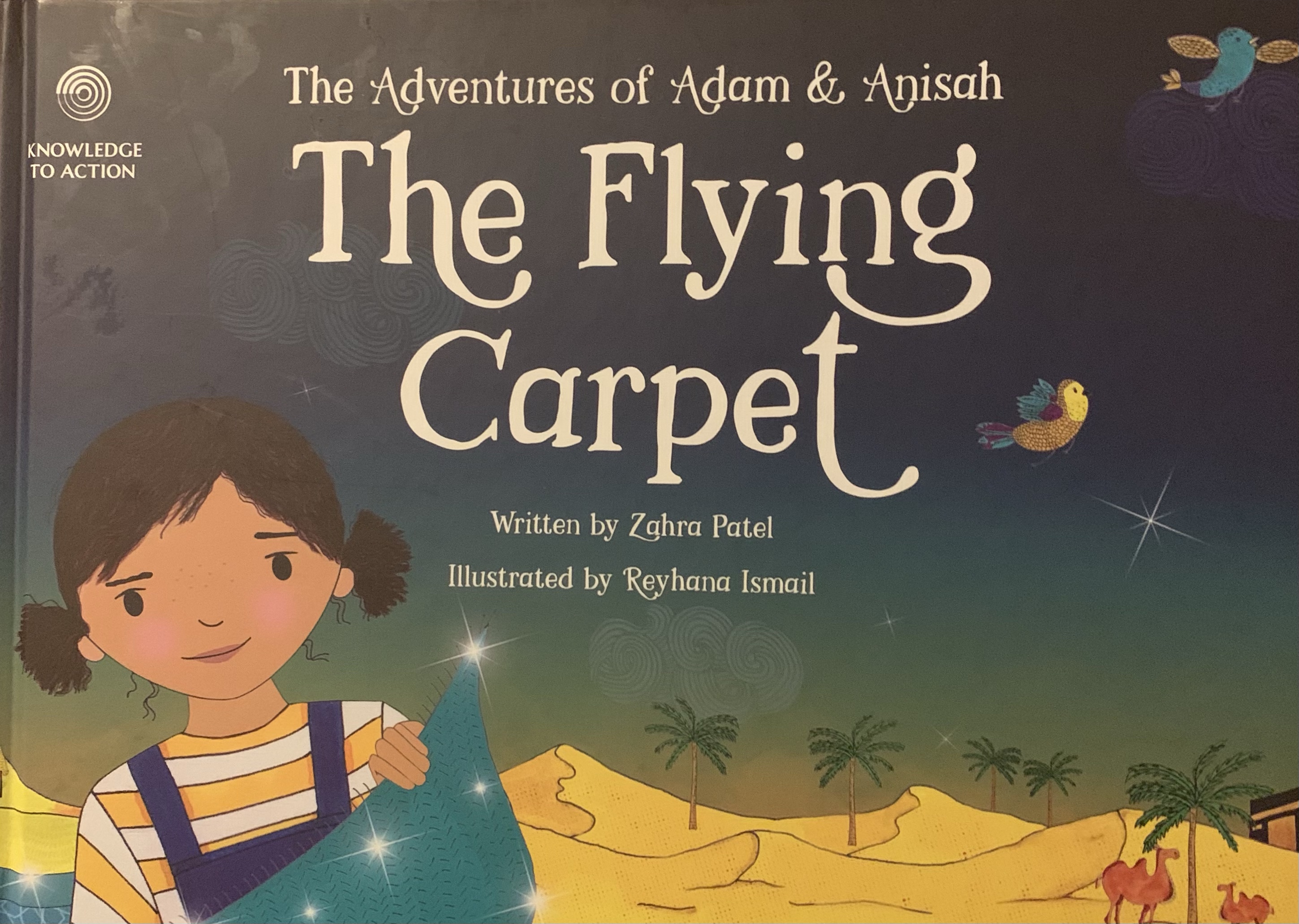
img_6995I am confident that every Muslim child has imagined their prayer rug at one time or another to be a flying carpet, so how absolutely heart filling as an adult to find a book that embraces this idea, roots it in Islamic fact and presents it so beautifully for our littlest Muslim believers.

img_6996

The occasionally rhyming and constantly cadence filled picture book features a big brother preparing for and performing salat as his enamored little sister puts imagination and celebration to the act of worship.

img_6997

I absolutely love the admiration that Anisah has for her big brother and am delighted how prayer is presented not as an obligation but as an opportunity to soar and marvel in amazement.

img_7002

The book concludes with a section that provides context to the story, questions to discuss, and ways to extend the learning.  The hardback binding, 8.5 x 13 horizontal orientation and high glossy illustrations make the book a joy in small groups and at bedtime.

img_6998

This book is really, really well done in its simplicity, and I need to order the other book in the series, My Brother’s Shield from Crescent Moon Book Store, as soon as possible.  

Agent Zaiba Investigates: The Missing Diamonds by Annabelle Sami illustrated by Daniela Sosa

Standard
Agent Zaiba Investigates: The Missing Diamonds by Annabelle Sami illustrated by Daniela Sosa

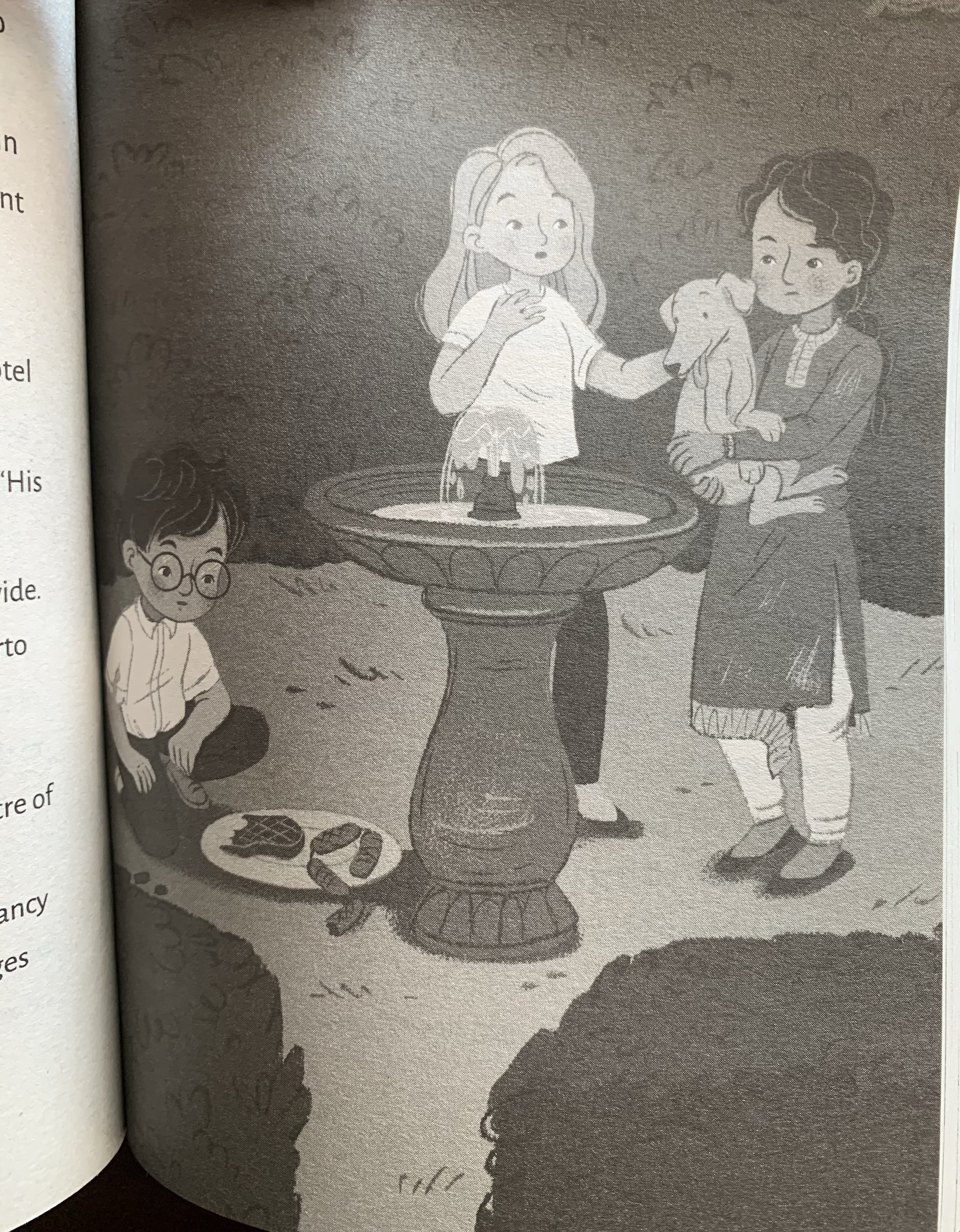
img_7104This engaging and fun early middle grades detective story set in England, features a female protagonist of Pakistani origin who stumbles on a crime at her cousins mehndi party.  Over 231 pages with illustrations and flourishes, Agent Zaiba along with her younger half brother Ali and best friend Poppy will have to solve a case, avoid a nosy cousin, try not to ruin their clothes and so much more while stuffing their pockets with samosas and pakoras, and making sure they make it back for all the traditional events as well.  There is nothing Islamic in this culture rich book, but with names like Fouzia, Samirah, Tanvir, Mariam, Maysoon, and Hassan, Muslim children or readers with sub continent familiarity, will feel an immediate reflection of themselves in the story.  I have no idea what religion the author identifies as either, but from what I can Google, it seems to be an OWN story book and the richness and integrity of the minor details would suggest first hand knowledge.  Anyone looking to see a strong minority female lead with good friends, an open mind, and impressive sleuthing skills, should hold on tight as the agents assemble to get to the bottom of a theft and save the day for a beloved cousin.
img_7101

SYNOPSIS:

Zaiba idolizes her Aunt Fouzia who is a real detective and owner of the Snow Leopard Detective Agency in Karachi, Pakistan.  Aunt Fozia’s daughter Samirah is getting married and with the Eden Lockett mystery books Zaiba inherited from her mom when she passed away, this party at The Royal Star Hotel is the perfect venue to test out her observation skills and other lessons she has learned from devouring the famous books.

When Zaiba, Ali, and Poppy learn that there is a VIP guest staying in the same hotel, the team gets a chance to explore the hotel and find out who the guest is.  What starts out innocently enough quickly elevates when a secret staircase is discovered, the VIP’s dog is set off his leash, and a jewel encrusted dog tag goes missing.   The three kids work together and set off to find the dog that has terrified Sam and ruined her mehndi, once that is done, the stakes get higher as Maysoon explains that the good luck charm is not just expensive, but a lucky token she needs to move her career from singing and hosting, to acting.  As the children work to find the diamonds and work their way through the list of suspects at the hotel, they have to make sure not get in too much trouble for missing key events of their cousins big day and getting in trouble with the tattling cousin Mariam.

img_7102

WHY I LIKE IT:

I love that it is really for younger readers, second through early fourth grade, and shows the fun bits of a culture to a larger audience without being daunting.  I love the idea of a mehndi as a back drop for a whodunit, seriously, it has the perfect energy and vibe.  The family is amazingly supportive, Zaiba has a step mom, Jessica, that she adores, and a half brother that she loves.  Aunt Fouzia and Sam encourage Zaiba to go solve the crime and give her respect when she does her big reveal to the police.  It really is empowering to see the grown ups support.  I love that Zaiba grows even in such a limited time as she learns about her mom and we even see  Zaiba’s heart soften for Mariam.

Maysoon is a celebrity that is really flat and weak and whiney, at the end she shines a bit, but I really felt she was lame and under developed.  I’m not sure what a champagne reception is, but the fact that Maysoon is  having one would suggest she isn’t Muslim, not sure, I guess I’ll have to keep searching for clues.

The end of the book has a whole section to test the reader if they have what it takes to join the Snow Leopard Detective Agency:  an excerpt from Eden Lockett’s book, her detective tips, things to practice, code writing, and info about the Agency, including Aunt Fozia’s record amounts of chai consumed.

img_7103

FLAGS:

There is lying and stealing, it is a mystery after all, and the presence of champagne, both as part of the mystery solving and at the celebrity’s celebration.

TOOLS FOR LEADING THE DISCUSSION:

I don’t think I’d do it as a book club book, because there wouldn’t be a lot to discuss.  I do, however, plan to suggest and gift the two book series to some young mixed ethnic Pakistani girls I know that would love to see a strong desi girl in the lead.