Category Archives: Arabic

Eleven Words for Love: A Journey Through Arabic Expressions of Love by Randa Abdel-Fatteh illustrated by Maxine Beneba Clarke

Standard
Eleven Words for Love: A Journey Through Arabic Expressions of Love by Randa Abdel-Fatteh illustrated by Maxine Beneba Clarke

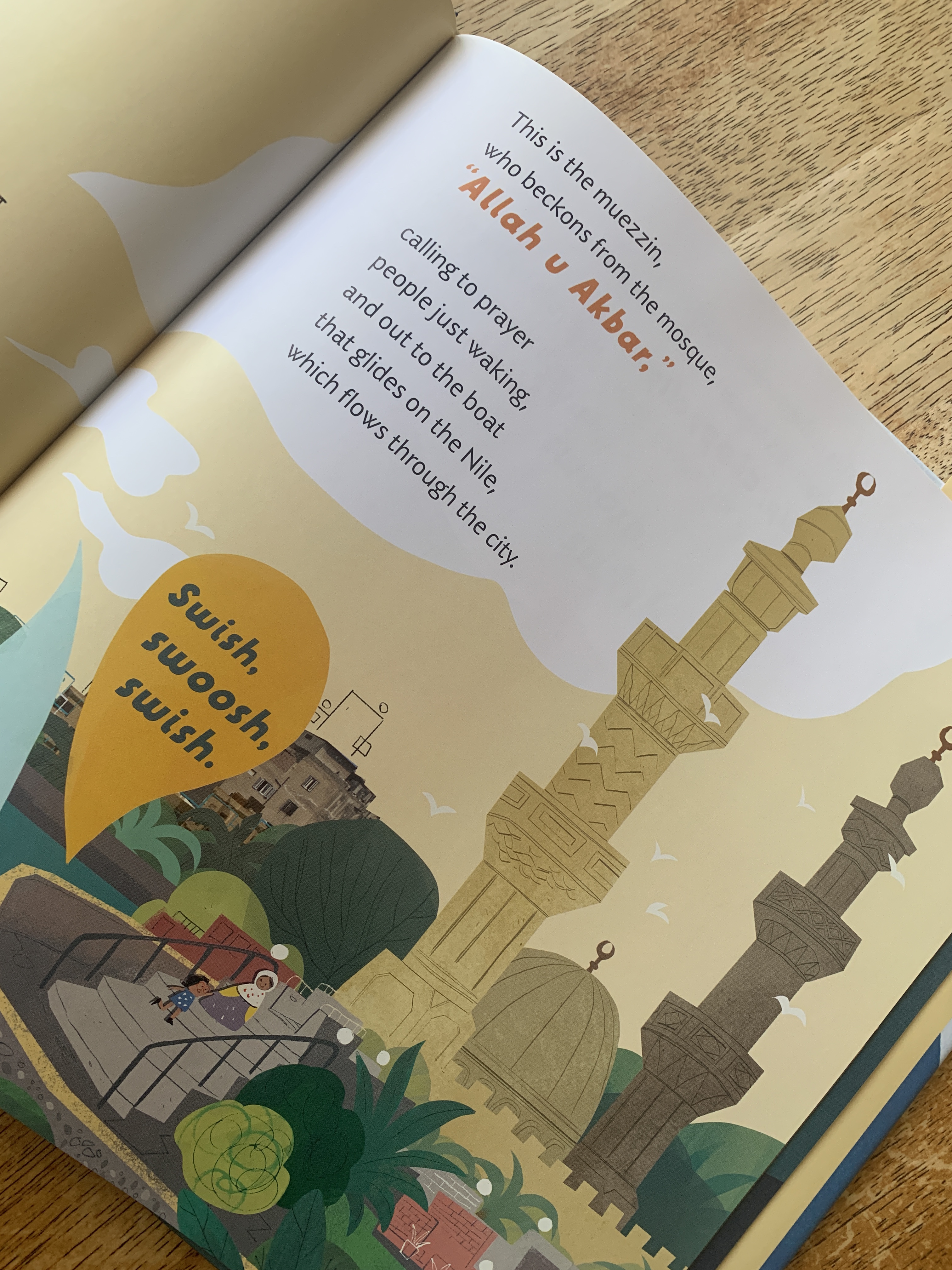
img_7491

It has been a long time since I took Arabic in college, so I read the book, then read it again, then wrote down all the Arabic words and realized that there are 11 words in addition to “al Hob” the word for love, and that al Hob is mentioned three times in the manner of a poetic refrain.  I also didn’t grasp the first time that the book is a journey of a refugee family and the types of love are them in different phases of their journey.  Once I got it, I’m not sure how I missed it, but I think the layers that the book allows for actually widens the appeal to a larger audience.  I know for many Muslims seeing a 40 page picture book about love will raise some eye brows and wonder about what relationships are shown.  There are a few phrases that imply romantic love most illustrated abstractly, one shows a bride and groom on their wedding day (al-Ishq), there are also an elderly hetero couple in front of the Dome of the Rock (Showq). The story follows one family and their suitcase is rainbow colored and when depicting loving one’s neighbors (al-Mahabba), there are rainbow stripes on the fence, if a rainbow means or doesn’t mean something to you I simply share what is there. There is friendship love (al-Wud) and familial relationship love, and love from pets (al- Walaa’) and love felt for those gone too soon (al-Haneen).  The Arabic script for each word of love and the lyrical English string together the concept of different forms of love with the illustrations telling the story.  There is nothing particularly Islamic in the book, but there are visible Muslims in the illustrations and the masjid in Palestine.

I’m obviously not an Arab speaker, so if I misunderstood a term, forgive me, I don’t want to list all the terms, because that would give away too much of the book, but as a non Arab the book is heartfelt and moving and I’m sure for Arab speakers the feelings would be amplified.

The book was released in Australia in 2022 you can purchase it from Book Depository and will be released in America in 2023, you can preorder it here.

Book One: Thunderbird by Sonia Nimr translated by M. Lynx Qualey

Standard
Book One: Thunderbird by Sonia Nimr translated by M. Lynx Qualey

img_7178

My public library had this book and so I picked it up seeing that it was Palestinian authored fantasy, and I am always on the lookout to support OWN voice Palestinian stories.  The book cover is gorgeous, the inside text unfortunately is tiny making this middle school aged book only 110 pages.  It is translated from Arabic and published by a university, so my expectations were pretty meager which assisted in me being fully swept away by the story at hand.  Sure the book has a few glitches in point of view,  often it feels a bit abrupt and djinn stories are a dime a dozen, but what elevated this book and made it stand out was the Palestinian history interwoven into the plot: snippets about the Mamluk soldiers and Ottomans, the Ayyubid rulers and walls around Jerusalem.  There isn’t enough history touched upon in my opinion, but I look forward to see, now that the world building is established, if the rest of the series will highlight the historical thread.  I have no idea if the characters or author are Muslim, there are references to praying and hearing the athan, but they could just be cultural.  There is magic, fantasy, djinn, prophecies, and reading of tea leaves, as well as fighting, assault, and talk of oppression under Israeli rule.  I’d assume it is advanced Middle Grade or lower YA, but to me it seems 11 and up would enjoy the quick fast paced read.

img_7175

SYNOPSIS:

Noor’s parents are dead, and she lives with a grandmother who loves her, and an uncle and his family who don’t.  When her grandma dies, Noor is alone and with things combusting in to flames around her and no one left to defend her claims that it wasn’t her, Noor is trying to piece together a ring left to her, her mother’s research, and her flame creation abilities.  Her search leads her to a colleague of her mother’s and an old archaeological site.  While staying with an aunt in Jericho over the holidays, a mysterious cat guides her to the same archeological site where the cat reveals that she is really a djinn.  The barrier between the seen and unseen world is failing, and Noor is prophesized to be the only one that can ensure it doesn’t happen.  With a trait of the mythical phoenix Noor must find ways to travel in time and retrieve a feather before the bird is reborn.  Along the way she will have the help of the djinn and of her doppelgänger from that time period.

img_7176

WHY I LIKE IT:

The story is clever, fast paced, and the character endearing.  I wish the details were fleshed out and of course I wish there was more history when she travels back in time.  The climaxes are quick builds and even quicker resolutions, but despite all the flaws I really enjoyed the story and look forward to the rest of the series.  The book ends on a cliff hanger that feels rather abrupt, but being it is clearly established as book one in a trilogy, I don’t think readers will be too upset at the sudden end.

img_7177

FLAGS:

Magic, time travel, prophesies, fortune telling, assault, oppression, fighting, loss, arson, arguing, djinn, fighting

TOOLS FOR LEADING THE DISCUSSION:

The book probably is too short for a book club read, but I think a teacher could definitely use it as a reference in story writing, historical fiction fantasy, culture inclusion lessons.  If you wanted to use the book, you’d be able to find plenty to draw on for teachable moments in literature, history, and writing style.  There would also be a lot to discuss in terms of occupation, myth, legend, and culture.

If your library doesn’t have it you can find it on Amazon

The Next New Syrian Girl by Ream Shukairy

Standard
The Next New Syrian Girl by Ream Shukairy

next new syrian

This culture rich, American set, upcoming 416 page YA book proudly shows the characters’ Islam as it shares a story of pain, privilege, guilt, adversity, hope, and family dynamics.  The book is an easy read that is hard to put down, and is remarkably clean for the threads of romance, war, and mental health that permeate the pages (note that here are triggers of loss, separation, death, suicide, drowning, trauma, hate, and bullying).  There, however, are also some plot holes, contradictions, and weak threads that I feel obligated to note, but ultimately don’t make the book a bad read.  I think 16 year old readers, both Syrian and not, as well as Muslim and non Muslims will benefit from the characters sharing their lives and peeling back surface layers to show an intimate account of expectation and obligation for Syrian American girls in today’s world with the backdrop of war in Syria.  The book’s first few pages are powerful in their Islamic centering and unapologetic normalizing of salat and hijab and identity. The Islam in the forefront fades as the story progresses and I don’t think I can sign off on the relationship between two characters as being “halal,” but starting the story with fears of praying on the side of the road as a mom’s concern is next level.  Most book parents are trying to get their kids to pray, in this family- prayers are happening five times a day and on time, so the worry is knowing where you are when Maghrib time hits, because it obviously won’t be missed or delayed, alhumdulillah.

SYNOPSIS:

Khadija’s mom is queen bee in the tight knit Syrian community in Detroit and Khadija does not fit the mold of what the queen’s daughter should be.  It isn’t that Khadija is a rebel, she loves her mother, her faith, her roots, and well, boxing.  Khadija is wealthy, and privileged and so much of what is expected is for appearance sake only.  Khadija knows this, and takes boxing lessons for free in exchange for helping keep the gym clean as to establish this as her own thing, no strings attached.  When Khadija’s mom takes in a Syrian refugee and her daughter, Leene, Khadija has to figure out if she is threatened, jealous, or impressed by the new arrivals and what that means about her own family.

Leene shares the narrative with Khadija and shares her transition to life in America and in the Shaami home along with her past.  The loses she has faced, the obstacles overcome, and the secrets she keeps in order to face each new day show glimpses into the destruction of the Syrian war on a way of life and the beauty lost. 

The two girls are at odds with each other for much of the book, but as their stories start to intertwine, they find themselves with similarities and strengths that show they are a benefit to each other, despite their stubbornness and fiercely independent personalities.  In a race to reclaim what was once lost, the girls start to trust each other, and when family is further threatened the two girls allow themselves to be vulnerable and work together to save what matters.

Clearly I am trying not to spoil the book, nor takeaway from the climax, but I think most that start the book, will find themselves glued to the pages and will understand why I am choosing not to disclose too much.

WHY I LIKE IT:

The first chapter completely blew me away, I loved the idea of such a strong hijabi girl boxing and being so unapologetic about her Islam and culture.  I must admit I cried at the end as well.  It was tied up very neatly, arguably too perfectly, but there were tears none-the-less and no matter what I critique about the book, I was moved by it. The writing is engaging, and entertaining, no doubt, but alas, I have some questions, lots of questions in fact: How did the mom’s meet? One is super posh and high class, the other refugee with very little, how did their paths cross? How did Leene convince her mom to let her travel even if the ‘why’ was kept hidden? After everything they have been through wouldn’t being left to travel to the Middle East be a huge obstacle that needed to be overcome, it reads inconsistent and unbelievable. How hard was it for the “girls” to leave the “boys,” I would imagine it was devastating, yet it didn’t even get a mention.  

What changed so much about the family dynamic when they stopped going to Syria, the author shows the joy of Syria and being together for the family, but I think if you are not Syrian and do not know Syrians well, some of this thread, is going to fall short.  I talked to @muslimmommyblog and could see the reflection of the characters for her, but if I didn’t have her shared experience to flesh out the characters, I don’t know that I would have understood the weight of the guilt, the helplessness, and the frustration.  Similarly, only through talking to Shifa did I understand the pressures of being an American Syrian girl, if I’m being honest, Khadija the majority of the time, just reads whiney. Other family dynamic questions involve the dad and brother.  Was the dad always so absent? It must not have happened overnight, right? And exactly how old is Zain? He reads like he is 12, but he is in high school? Additionally, high school graduation is very important for both girls for very different reasons, but their is no talk of college or career plans, which was noticeably missing from the book.

Then there is the angsty storyline of Younes.  The perfectly selfless guy who doesn’t center his Islam as much, but does want to have a prolonged engagement.  What does that even mean, and how will that be ok Islamically, with them already laying on the 90s Bollywood style glances and loving confession?  Also why does Khadija frame morality through an Islamic lens for most things, but for the relationship resorts to worrying about what her mother will be ok with?  And was the family ok with Younes? How is he at the BBQ? Speaking of places he shouldn’t be, how was he at the party Nassima isn’t Arab enough for, when she at least speaks Arabic and he does not?

I think it best to just enjoy the story for what it is, not look too deep, not ask questions, and just enjoy the rep, the story, the characters, and the emotions released with the climax and conclusion.

FLAGS:

Romance, crushes, road rage, bullying, Islaophobia, mental health, death, killing, war, destruction, suicide, drowning, abandonment, separation, loss, grief, rebellion, angst, lying.

TOOLS FOR LEADING THE DISCUSSION:

This would not work for a middle school book club, and I really should say that this wouldn’t work for a high school book club either, but I know many older high school girls that would absolutely love this book and I think it might be possible to convince them that the relationship is more than the text shared, and was approved by the families and made halal.  Considering so many holes exist, it might be possible to control the narrative in a book club setting on the permissibility of the relationship.  It would definitely depend on the girls reading the book and I would strongly suggest that whether you read this book in a group or hand it to a teen, that you make it clear what a halal relationship looks like and that this is a work of fiction.

The book releases in March 2023 and as always to show support for OWN voice Muslim character filled stories please consider pre-ordering the book: you can do so here on Amazon.  And once the book releases please purchase, checkout from your library, and encourage your schools to shelve titles to encourage similar books to be published and made available, thank you.

As Long As the Lemon Trees Grow by Zoulfa Katouh

Standard
As Long As the Lemon Trees Grow by Zoulfa Katouh

as-long-as-the-lemon-trees-grow

Anything I write about this YA book will fail miserably in conveying how powerful, beautiful, lingering, moving, emotional, and overall masterfully written every one of the 432 pages are; it just might be my favorite book of the year.  I do know that this will be my new standard for Muslim OWN voice stories, as the authenticity was absolutely engulfing, I’m not Syrian and I could feel it and naturally, I also verified it.  There is no pandering to a western gaze, the story and characters pull you in and show you Syria from the ground, there is no telling, there is no lecturing, it is mesmerizing storytelling at its finest.  The book has mental health issues, war, and a sweet “halal” romance, that I think upper YA, 16 plus, can handle and appreciate.  I hope every adult will spend time with this book, it truly is incredibly well done, alhumdulillah.

SYNOPSIS:

Homs is under the protection of the Free Syrian Army, but that isn’t enough to keep pharmacy student Salama and her family safe.  Her mother is killed, her father and brother taken, and so she moves in with her best friend Layla, her pregnant sister-in-law, her only family left.  Working as a doctor in the hospital where anyone remaining is given responsibilities far above their skill level, education, and experience- every day is a struggle to survive.

Haunted by the physical manifestation of her fear, “Khawf,” who urges her to fulfill her promise to her brother of keeping Layla safe and getting them out of the country, Salama at eighteen years old has to find a way.

Before all the pieces come together to escape, a boy enters the picture, Kenan, who gives Salama hope, who distracts her from the death and destruction that has consumed their lives.  A boy unwilling to leave his beloved homeland.

WHY I LIKE IT:

I’m a crier, but this book brought out ugly angry tears, shocked tears, heartbroken tears, sentimental tears, you get the point, this book held me in its grasps and never let go. I.COULDN’T. PUT. IT. DOWN. If this is the author’s debut novel I can’t even fathom what is yet to come.

I love that the characters are Muslim, and that they pray together, that they plead with Allah (swt) and meet at the mosque.  It is who they are, it is not up for debate or in need of explanation, it is what it is and it is not anything to discuss.  The parts where a character pleads with Allah for death over being taken, absolutely wrecked me.  Just as efforts to keep everything halal between Salama and Kenan made me beam.  (If I’m completely honesty, I did on occasion get frustrated, I mean come on they are being shot at, bombed, nearly sexually assaulted, scoop her up in your arms and console, her, I know haram, but it is fiction and I was invested, and there is a war.  Thankfully, I am not an author and she kept it all clean and her characters much stronger and mindful of the shortness of this world.)

I love that there are political voices, but that it isn’t a political book trying to give back story to the conflict.  In so many ways the news has failed to keep a light shining on Syria and books such as this, remind those of us outside Syria without strong connections to the land, that the conflict is still raging.  If this was a journalistic article it would be a human interest piece, it is character driven.  Readers see themselves in the characters that live lives that most of us of privilege could never imagine, yet here we are spellbound by the characters, their choices, their dreams, and their safety.  This book shows the power of fiction in opening our eyes to the horrors that are happening in our time, by giving us a face and a character to care so deeply about, that we are spurred to action and determined to not remain apathetic.

FLAGS:

Death, torture, physical abuse, sexual assault, fear, loss, coercion, war, murder, torture, child abuse, crimes against humanity, starvation, mental health, PTSD.

TOOLS FOR LEADING THE DISCUSSION:

I would love to use this book in a high school book club.  The story and themes of the book would open themselves up to discussion so effortlessly and the beauty of the writing would be a gift to share with students.

Where Butterflies Fill the Sky: A Story of Immigration, Family, and Finding Home written and illustrated by Zahra Marwan

Standard
Where Butterflies Fill the Sky: A Story of Immigration, Family, and Finding Home written and illustrated by Zahra Marwan

butter

This 48 page picture book shows the journey of a young girl from one desert to another.  The soft water colors in this author illustrated book tell so much of the story and illuminate the prose.   For me the most powerful part of the book was the backmatter.  The learning why the family had to move from Kuwait to New Mexico was new and interesting and gave the story a lot of depth.  I read it to my 6 and 3 year old and it couldn’t hold their attention, the book is not text heavy, but is is long.  I think had I read the author’s note at the end first, before sharing it with my kids, we could have discussed the pages a bit more.  I think the added framing and context would have increased connection and engaged them.  The book shows one aunt in hijab, Allah swt written in Arabic and a picture of the kaba hanging on the walls of their home, a hand of Fatima as well.  There is music and dancing and connections between family, strangers, cultures, and people.

The book starts by establishing the rich and loving life the little girl enjoys in her home: butterflies, swimming in the sea, family.  It then fades to being held close and the stress of people saying they don’t belong.  The next step is the family having to leave their extended family and say their good-byes.

They arrive in a new place, not talking like others, questioning the connections of their ancestors in this far away land.  Eventually there are some similarities, and then the music of a guitarron is heard and people dance and there is joy.

The shift opens up a feeling of home, and connections are not lost, and a new comfort is felt in a place where hot air balloons fill the sky.

As an adult I appreciated the paradigm shift of not being welcome in their home elsewhere and being welcome in America, it is subtle but a nice change.  I love a lot of details come full circle.  I think the book would be a good tool not for the intended 4-8 crowd, but for older kids in a teaching setting.  There are a lot of subtle story telling techniques that could be discussed, stereotype assumptions challenged in a nudging way, and offer social studies and political discussions.

Lina, the Tree and the Woodcutter by Eman Salem

Standard
Lina, the Tree and the Woodcutter by Eman Salem

lina

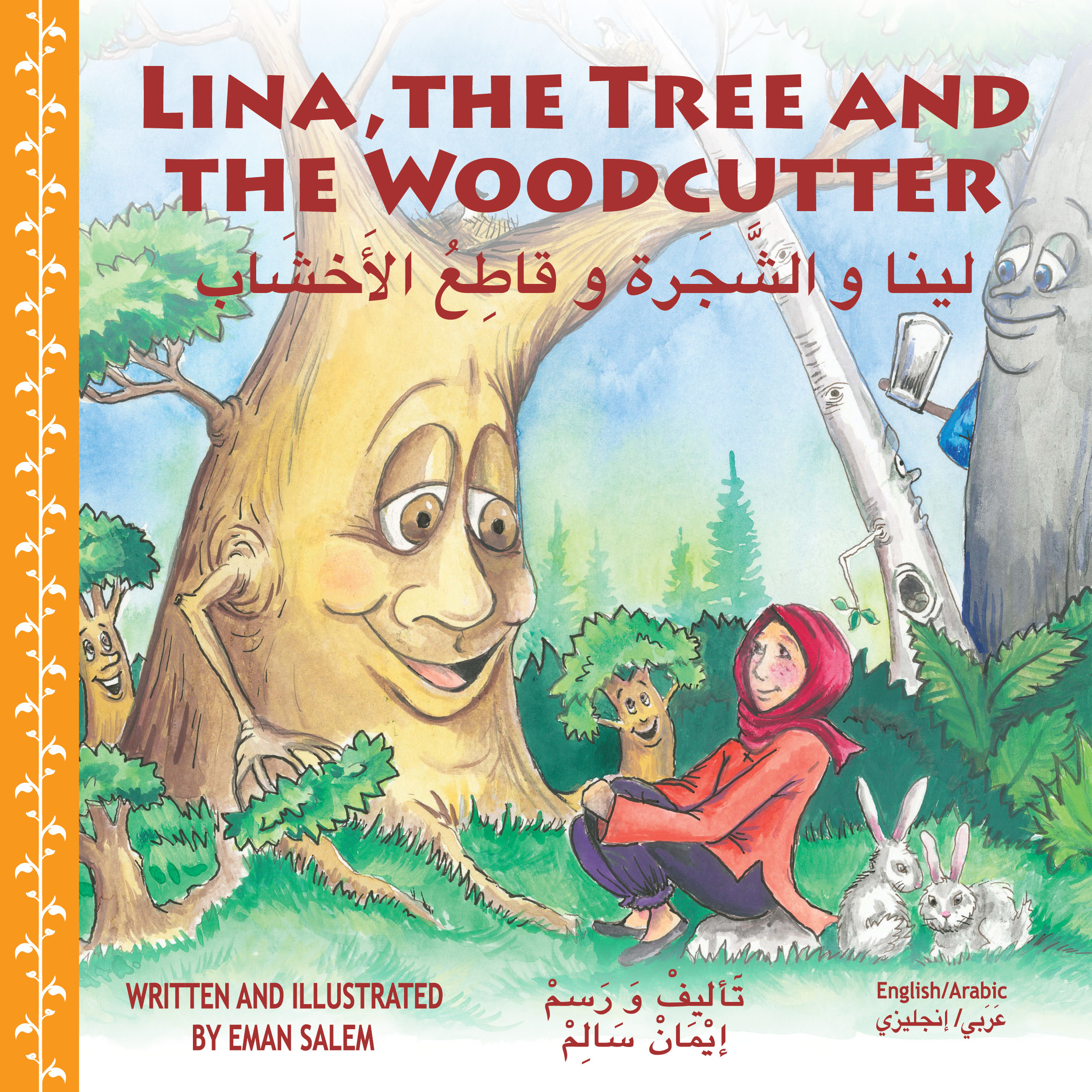
I’ve enjoyed another book in this bilingual series, Little Tree Goes for Hajj,  and was excited to see little tree all grown up and the focus of a book on the environment.  The 22 pages in Arabic and English start out promising, setting the stage, establishing the familiar characters, discussing caring for trees and not harming them for no purpose, but then the book just kind of ends.  It is wordy, the English anyway, I cannot comment on the Arabic, but it is sweet and warm in its own Islamic fiction way.  I didn’t feel like a glossary was needed, it mentions Allah in the text and seems meant for Muslims, so why the definitions of Allah, Hajj, and Mecca are included is a bit odd especially when it uses Christianity and Judaism in the explanation of the oneness of Allah.

img_9825

Little tree is now an old tree and was a friend of Lina’s grandfather, they had traveled to hajj together.  As they sit chatting, they hear a horrible noise and discover it is a woodcutter chopping down a tree.  When the young man stumbles upon the talking tree and Lina they question his motives.

img_9826

He wasn’t chopping wood for fuel, or to build a home, he was just chopping it because he could.  Lina and the old tree explain what was lost with the destruction of the tree and teach him that Allah swt has made people the earth’s caretakers.  The woodcutter learns from his mistakes and apologizes.

I wish the book maybe would have made a stronger point that trees take a while to grow and that sorry is well and good, but not enough to restore what was lost.  I like that the woodcutter wants to learn more, but a few lines detailing what he learns or that he came every day to sit with them or some sort of ending would have been nice.

You are the Color by Rifk Ebeid illustrated by Noor Alshalabi

Standard
You are the Color by Rifk Ebeid illustrated by Noor Alshalabi

you are the color

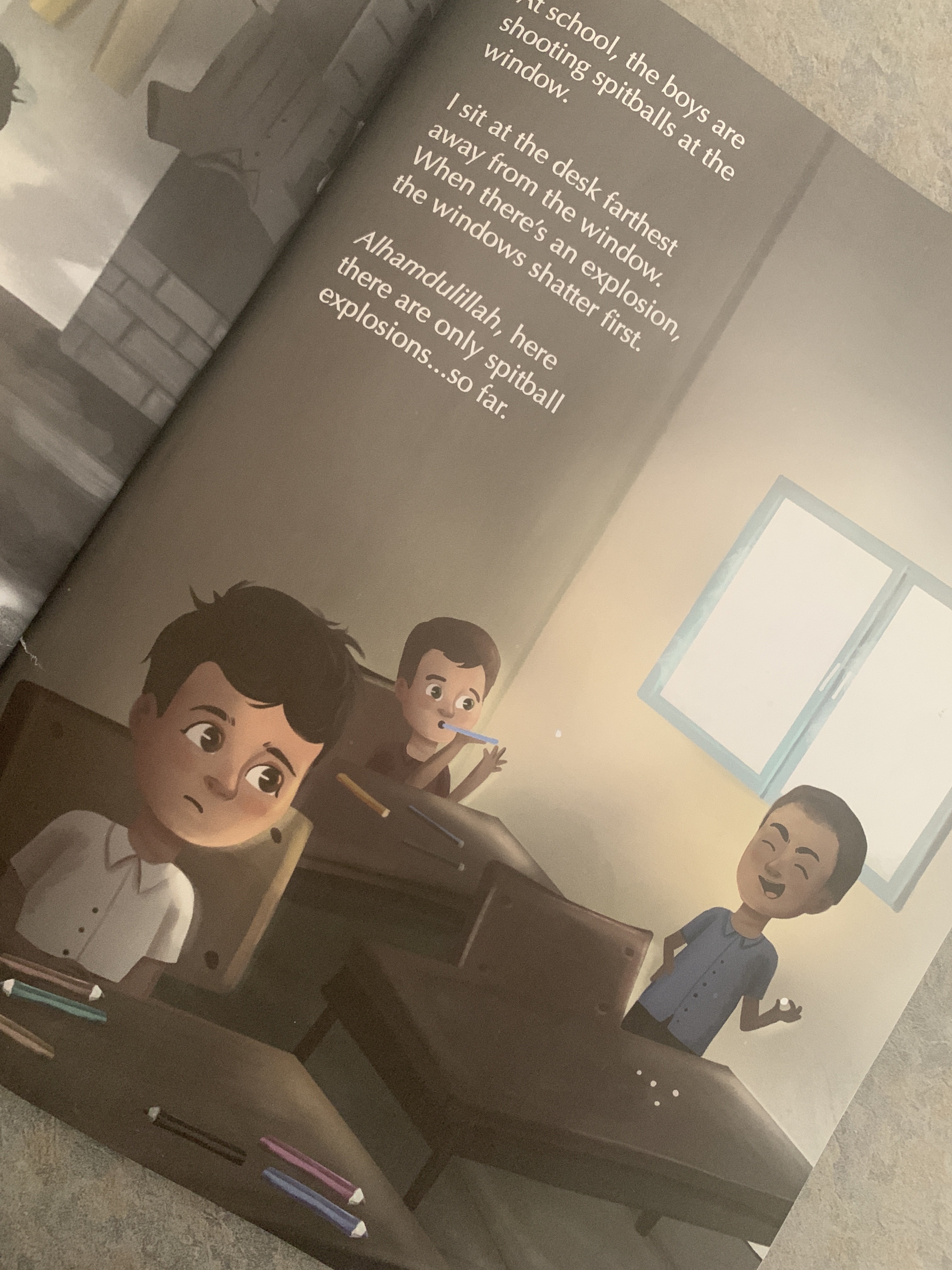
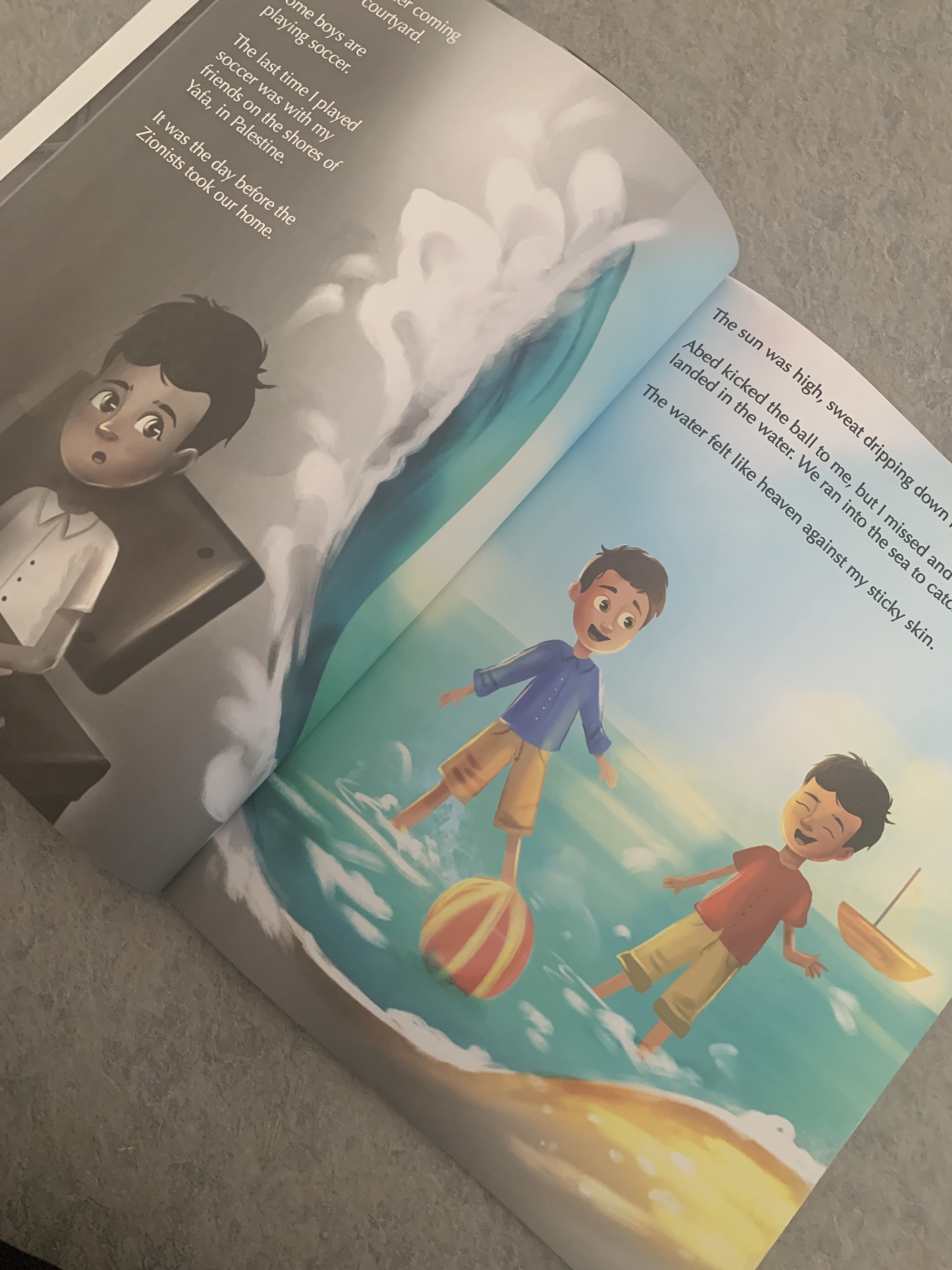
Books like this are hard for me to review, and I have gone back and forth on whether I should post anything or not.  On the one hand, we need books that are unapologetically Palestinian written by Palestinians.  They need to be celebrated and elevated and I want to offer my support to the stories, to the voices, to the authors, illustrators, everyone involved.  On the other hand, if I didn’t love it, why should I shy away from saying so, when I have purchased the book (pre-ordered and changed the shipping address even, to have it delivered to me on vacation because I didn’t want to wait to read it).  The book is emotional, but the last six pages unraveled the whole book for me, and in a picture book particularly of this nature, when you finish- if you don’t have a cathartic pull, you start to find holes in the story as you feel deflated.  The book, I would go out on a limb to say, needs to be discussed and given context even if you are Palestinian.  As someone who is not, I recognize my arrogance in such a statement and am happy to be corrected, but from a literary reviewer standpoint the book needs discussion and additional context.  The Nakba is only articulated in one paragraph in the author’s note.  In the story itself there is no indication that what happened to Thaer happened to so many Palestinians in 1948.  The use of color and how it is depicted in the illustrations is tangible and powerful, but as odd as it is to say, the words got in the way of the story.

img_0713

The book starts with Thaer trudging to school in dull sepia filled pages to begrudgingly sit at a desk and begin an art lesson.  He is glad the spitballs are just spitballs and not real explosions, but the tone is still melancholy.  When he sees boys playing soccer he recalls the last time he played soccer, and the memory comes alive in color.  He was in Yafa, it was the day before the Zionists came and took his family’s home.

img_0714

The teacher, back in muted tones, asks him to draw what has made him smile, and Thaer gives it a try.  Blue for the color of the sea, green for zeit and za’tar, brown for taboon to get fresh bread, etc..  When he takes the drawings home to his mother, she is not impressed.  Drawings are silly and colors aren’t going to bring Baba and Susu back.

img_0716

Defeated, the next day in class, Thaer recalls the men pounding down the door and Baba being shoved in a truck and Susu falling.  The next day at school they hang up some of their pictures and Thaer talks about his sister.  (SPOILER) On the way home Thaer paints the alleyway and brings color to his and his mom’s world.  His mama says that he is the color, and when the following day’s prompt is to draw what you want to be when you grow up it shows Thaer (presumably) on the beach as an adult painting.

img_0715

The disconnect for me occurred with the painting of the alleyway.  I was incredibly invested in the story, my heartstrings were being tugged, I was breaking for this character and his experiences, and it all came to a screeching halt because I couldn’t understand where the paint and the alleyway and the mama’s change of heart all manifested from.  As for the ending, I think I know what the author was going for, but it didn’t connect with any of my kids aged 2-15 nor my mother, a 40+ year early elementary veteran teacher.  I wish I could have taken a picture of their faces as she read the book to them.  The frozen expressions of huh and confusion at the end, until my 11 year old to broke the awkward silence to ask if the boy wants to be a painter or a father or an adult?  Those facets coupled with the often advanced vocabulary, makes the book an important one, but one that needs a lot of outside commentary to connect with the readers and to further the conversation about Zionism, al-Nakba, the occupation, and the continued oppression of Palestine.

There are flags of loss, kidnapping, sorrow, violence, etc., that parents will have to gauge if their children can handle. I’m not sure what age group is the best fit, the murder of a young girl, the forced displacement from one’s home, the removal of the father are all heavy themes.  I appreciate that it isn’t “watered down” for a western gaze so to speak, but I wish there was more about what happened to the dad, is there hope he is alive? I wish there was something about this not being an isolated reality for the protagonist and his family.  I wish there was some conversation or connection between the mother and son, because the loss of continuity really derailed the story.

As for the idea of the story, and the use of the illustrations to physically show two worlds I think is a great idea, it just sadly fell apart for me at the end: the faltering conclusion and the loss of emotional buildup that the first two thirds of the story worked so hard to create.

The Turtle of Michigan by Naomi Shihab Nye

Standard
The Turtle of Michigan by Naomi Shihab Nye

turtle

This is not a religious story, it is part cultural, but it is really all heart.  The sweet relationship between a boy and his sidi stole my heart in The Turtle of Oman, and in this stand alone companion book, I once again was swept away by the admiration and relationship of the two.  This lyrical middle grade book is slow and enveloping with its cadence and detail.  There is no real climax, but the character driven story will linger long after the last of the 322 pages are read.  The book is clean, and never states the characters are Muslim, but it hints at it.  It celebrates Oman and America, and would be a great read aloud in a classroom or at bedtime with its poetic passages, lists, and emails back and forth across the ocean.

SYNOPSIS:

Aref has finally left Oman for Michigan and as he and his mother board the plane and start their adventure to America to join their father who has gone ahead to set everything up, Aref’s heart aches for all he has known in Oman, and for his beloved grandfather.  Once in Michigan, his days are filled with tagging along with his parents to their university classes, exploring Ann Arbor, making friends, and getting to know the neighbors.  Everything in America is new and different, but sometimes the same too.  He writes messages catching his Sidi up on all that he is taking in, and Sidi writes back, but it isn’t the same.  From new flavors of ice cream, the first snow, celebrating Christmas for the first time, and giving a speech on Martin Luther King Jr Day in an Omani hat, there are so many new things Aref feels his Sidi is missing, if only he would come and visit.

Sidi on the other side of the world is lonely.  He is trying to take computer classes so he can email his grandson, he can’t figure out how to message on his smart phone, and tries to avoid going anywhere that reminds him of Aref.  But he and Aref went everywhere in his jeep, so Sidi doesn’t go out, and is not doing well as a result.  It will be three long years before they return to Oman, and Sidi might need to be brave and board a plane.  The reunion is not a surprise for the reader, only for Aref, but it is tender and warm and worth the journey for them both.

WHY I LIKE IT:

I wish there was some clear Islam, there is mention of not celebrating Christmas normally, a prayer room at the airport, peace be upon him when there is a death, and prayer beads, so it is possibly there if you search, but it isn’t at the same time.  I know I say this a lot in books like this, but it seems that when the religion and culturally religious words are withheld it seems a bit hollow.  A family coming straight from Oman to America doesn’t say Assalamualaikum ever, or make dua when hardships arise, or say InshaAllah or MashaAllah? It seems watered down and overly dismissed. I guess the way Christmas is framed is understandable, they are trying so many new American things they decide to give each other one gift to try it too, I wish though Ramadan would have been mentioned or Eid.

All that being said, I absolutely love Aref and the world through his daily actions.  He is endearing and his love for his grandpa is goals.  I love that Aref’s new school is so diverse and that everyone is celebrated and accepted, it isn’t a story of him being the new kid, but rather them all bringing something unique to the school experience.  The first graders as conflict resolvers is either a bit hard to believe or based on something real and absolutely brilliant, I am still undecided about that. Also as an adult reader, I couldn’t help but notice how money never seems to be a problem, and while I don’t know if children will pick up on it, it seemed a little surprising for two parents that are professors to never stress about it.

The language and emotional pull the story has is remarkable, and I think the slower pace would be hard for kids to get used to initially, but it will win them over and the rhythm of the story will hook them and make it hard for them to put the book down once they get going.

FLAGS:

Some bullying discussions

TOOLS FOR LEADING THE DISCUSSION:

Too young for any book clubs I host, but definitely want it on the library shelf.

One Wish: Fatima al-Fihri and the World’s Oldest University by M.O. Yuksel illustrated by Mariam Quraishi

Standard
One Wish: Fatima al-Fihri and the World’s Oldest University by M.O. Yuksel illustrated by Mariam Quraishi

one wish

This book is so long overdue, yet at the same time it was worth the wait.  The writing is simply superb: Fatima al Fihri is celebrated, Islam is centered, there are references, and the story compelling.  We, Muslims, as a whole know so little about the beautiful impact fellow Muslims have had on the current world and our way of life, that to see this book being celebrated in public libraries, in Islamic schools, at masjids, and retail bookstores, truly makes you sit up a little straighter, and reach confidently to get this book in your hands to share with those around you.  Thank you Mindy (@moyuksel.author) for these 40 pages of absolute delight, ages 5 and up will read it to learn, read it again to enjoy, and inshaAllah read it repeatedly to be inspired.

img_7723

The book begins with a Hadith regarding seeking knowledge and leaving knowledge behind.  It then begins the biography of Fatima as a small girl curious about the world around her starting with the word Iqra, read, from the Qur’an.  It sets the stage of her living in the desert in the early ninth century, a time where some boys went to school and some girls learned at home. Her connection to Islam and it teaching her the value of knowledge caused her wish, to build a school, to grow stronger.

img_7726

When war destroys her town her family flees to the busy city of Fez, Morocco.  She begins to accompany her father to the souk and enjoys listening to talk of planets, distant lands and different languages and wishes these scholars could educate everyone. She grows and gets married and her and her family become wealthy merchants.

img_7725

Tragically, her father and husband die, and Fatima must decide what to do next for her family.  She decides to help her community as a form of sadaqah jariyah and make her wish a reality.  She sets out to build a school where everyone can live and study for free.  She purchases land, and the building begins.  Fatima oversees each detail and names it the al-Qarawiyyin after her hometown in Tunisia.  It takes two years to build and it still functions today.

The back matter is just as compelling as the story with an Author’s Note, information on The University of Al-Qaryawiyyin, a Glossary, Bibliography, and a Timeline.  The only complaint I have about the book, are the illustrations.  I really don’t understand why half of her hair is showing when based on the time and her connection to her faith, she most likely was a niqabi.  I don’t understand the continuity of the hijab from a young child to adulthood.  I get that it shows her influence moving forward at the end, but it could have been a small print on an outfit for token representation of symbolism, I don’t get it as being a complete outfit her whole life.

img_7724

I absolutely love the role of Islam in both Fatima’s life and in this book.  It is so much a part of her and her wish, that every reader will recognize how connected her faith and the creation of the University were and I’m confident both Muslim and non Muslim readers will be in awe of her devotion and accomplishments, inshaAllah.

The Tale of Princess Fatima, Warrior Woman: The Arabic Epic of Dhat al-Himma translated and edited by Melanie Magidow

Standard
The Tale of Princess Fatima, Warrior Woman: The Arabic Epic of Dhat al-Himma translated and edited by Melanie Magidow

princess fatima

I’m not sure how to really review this 167 page book.  It is the translated YA work of an Arabic Epic that took place somewhere between the seventh and 10th centuries and began possibly being compiled in the 1100s.  It was told orally, but when written, comprised some 6000 pages.  The translator notes that the choices of what to include and how to translate, all potentially alter and reshape the narrative, so as a reviewer I’m simply going to review the text in my hands.  I have no outside knowledge of this epic woman, and approached the book as I would have in high school when reading The Odyssey or Beowulf: some of the history is accurate, the characters fictitious, the culture possibly representative.  As a result, I find the comparisons to Wonder Woman and Katniss Everdeen on the back cover, very odd choices.  At times the contemporary diction, in my opinion cheapens the narrative.  Sure I appreciate the modernization of the text to make it an easy read, but throwing in modern slang seems too much.  I found the book’s framing unfortunately counterproductive of what it hoped to achieve.  I have no idea what the other 5,900 pages include and what the translator had to choose from, but the majority of the book focuses on marriage, being raped by her husband, and working to prove who the father of her Black son is when her and her rapist husband are white.  I was prepared for battles, and conquering, and fighting misogyny, and saving the down trodden, not every one just wanting to marry her.  Many of the characters are Muslim, some convert to Christianity to escape Dhat al-Himma, the Quran is quoted, prayers are made, the Kaaba visited.  I do however, take issue with the explanation of the child’s skin coloring being attributed to intercourse (rape) occurring while Fatima is menstruating and a case of Prophet Muhammad (saw) being used as proof of this occurring.  So much of the text is footnoted, this instance is not, and I find it disturbing.  The book also contains a lesbian character who ends up marrying a man, violence, death, and many other potential flags (see below) that might make it better suited for older college age readers.

SYNOPSIS:

The story doesn’t begin with the birth of Fatima, but rather with her great great grandfather.  It sets the stage a bit to show culture, how women and honor are treated, and the line of her ancestry.  When we get to know Fatima a few chapters later she is being born and her gender is a disappointment, so she is hidden away.  As she grows away from her tribe she becomes an accomplished warrior and captures her father in a raid.  When she returns to her people, her cousin, Walid, born the same time as her, is struck by her beauty and wants to marry her.  She refuses.  Repeatedly.  Finally she agrees to battle him and if he wins, she will marry him.  She wins, and he still doesn’t back down, finally she is forced/tricked in to marrying him by the Caliph’s agent.  The two are pronounced wed, but little changes for Fatima, she is a warrior and does not seek intimacy or companionship.  Eventually, her husband Walid enlists the help of Fatima’s milk brother and friend, Marzuq, to have him drug Fatima, so that he can rape her.  He acknowledges the rape, the whole community does, but allows it, because he is her husband.  When the child is born he is Black and Walid and his family refuse to accept that the child is his.  Amira Fatima is socially put on trial for being a whore and that the child is illegitimate.  As Walid works to have them killed, Fatima works to prove her innocence and carry on with her life trusting in Allah swt completely, all while the Arab-Byzantine battles are raging in the borderlands.  As Abdelwahhab, Fatima’s son, grows he too becomes a formidable warrior and the two have continued adventures.

WHY I LIKE IT:

I love the richness of the culture coming through a compelling story. Fatima is incredibly devout in her worship of Allah, swt.  She does not falter, ever.  When she is being tested she needs only her faith, at one point a man converts to Islam upon having a dream as a result of her conviction in praying.  That being said, I genuinely don’t understand a few critical points.  How can a woman who single handedly destroys tribes not be listened to, to make her own decisions to lead her own life.  I get that that is perhaps the poignant point of the story in today’s context, but there are a lot of strong women in this book, so why does her marriage and being defined by her not wanting to marry get so much of the spotlight? Her father didn’t want her, but they don’t resolve anything, they just reunite and all is well.  I need more.  I want to know what happened to Walid once he became Christian, was it a permanent thing, a temporary fix? What ended up happening between her and Marzuq? He was her trusted advisor and immediately regretted drugging her, what happened to him.  I want more about her mother, maybe even her Aunt or other women to see how their lives compared and contrasted to the powerful women highlighted.  How did they view her, was she inspiration, an anomaly, beloved, loathed?

I appreciate the footnotes, the introduction, the Note on the Translation, the further reading list, help with pronunciation and the character list.  A map would have been nice.

FLAGS:

There is violence, killing, rape, talk of sexual intercourse and menstruation.  There is misogyny, racism, flirting, sexual temptation, a lesbian character, magic, jinn.

TOOLS FOR LEADING THE DISCUSSION:
I would not be able to lead a proper discussion on this book, I am just not knowledgeable enough on the larger story.  I think I would like to be a student or be able to join a discussion led by someone well versed in The Tale of Princess Fatima and all the subtext that brought her story to life and maintained it over time.  It would be fascinating.