Category Archives: 6th grade and up

The Prince of Stars: Ulugh Beg’s Quest to Map the Stars and Seasons by M.O. Yuksel illustrated by Zelma Firdauzia

Standard
The Prince of Stars: Ulugh Beg’s Quest to Map the Stars and Seasons by M.O. Yuksel illustrated by Zelma Firdauzia

This gorgeous 40 page picture book biography is both flowing in its storytelling and informative in its sourced details of a fairly unknown, underappreciated figure.  I was humbled reading this book and learning about the accomplishments of someone I had never heard of before.  Truly this book, bringing to the attention of our young and old ones alike, such a remarkable figure, is a much needed gift.  The publisher suggests the book for 4-8 year olds, but I think it also will appeal to older readers familiar with Copernicus, Galileo, and Ptolemy and who will appreciate the efforts driven by curiosity from someone so long ago. The diction in a few lines did give me pause, but nothing that overshadows how well the author has once again proven to master the storytelling of non fiction Muslim accomplishments in an engaging, accessible, exciting way for today’s audiences.

The book opens with a map of the Timurid Empire in 1405, before showing the reader a young prince, Ulugh Beg, gazing out and the stars and wondering how many there are.  The next spread makes no sense to me, but I acknowledge others might not be bothered, how can the young boy be watching days fade into weeks, into months, into years, and then wonder how many days are in a year? Seems that either those terms weren’t yet around, or some details about the generalized meaning made him curious about the specifics.  Either way, him wanting to know how many days in a year and the changing of seasons, along with counting the stars are the questions he wonders about as a child and works to answer throughout his life.
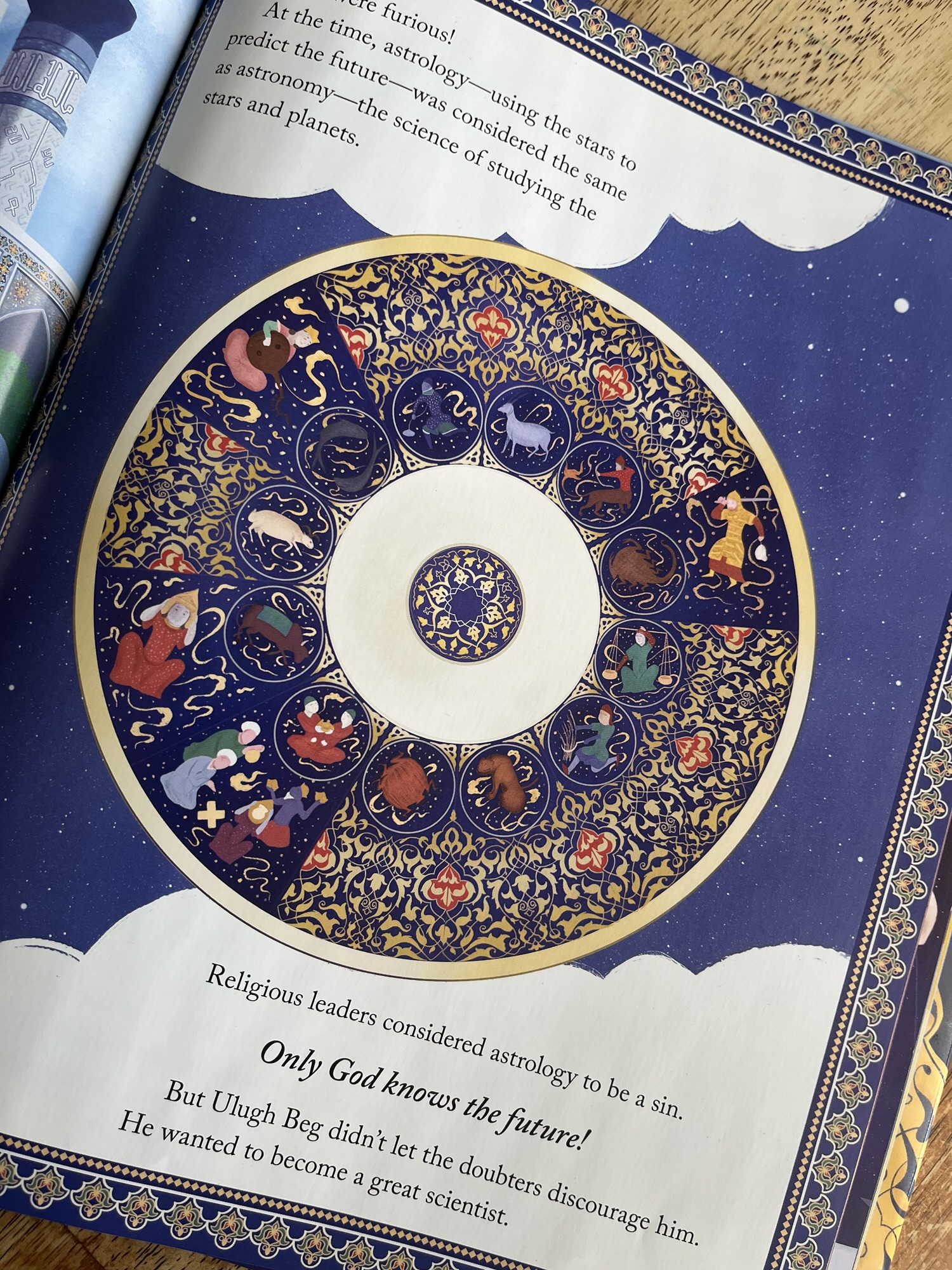
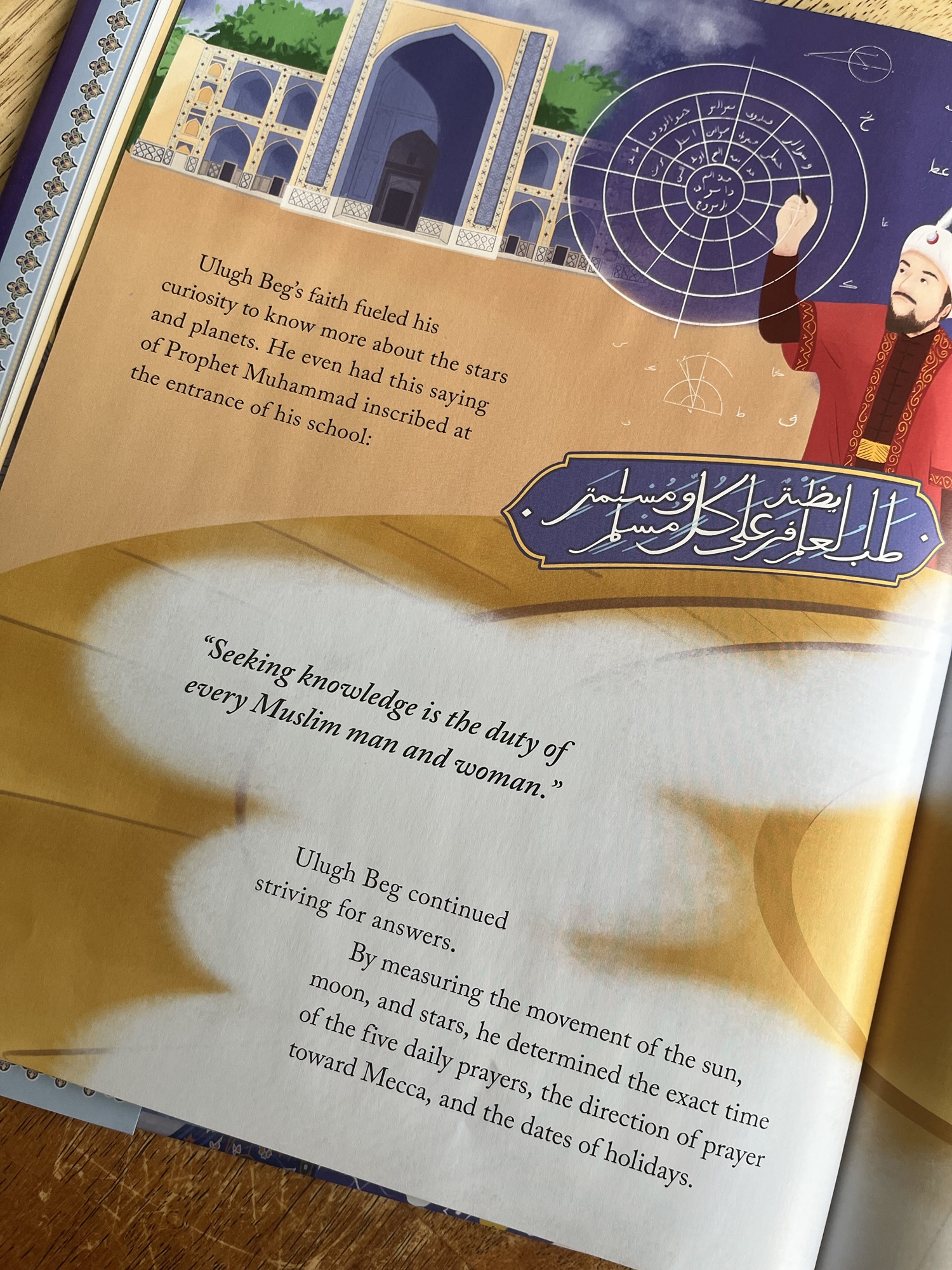
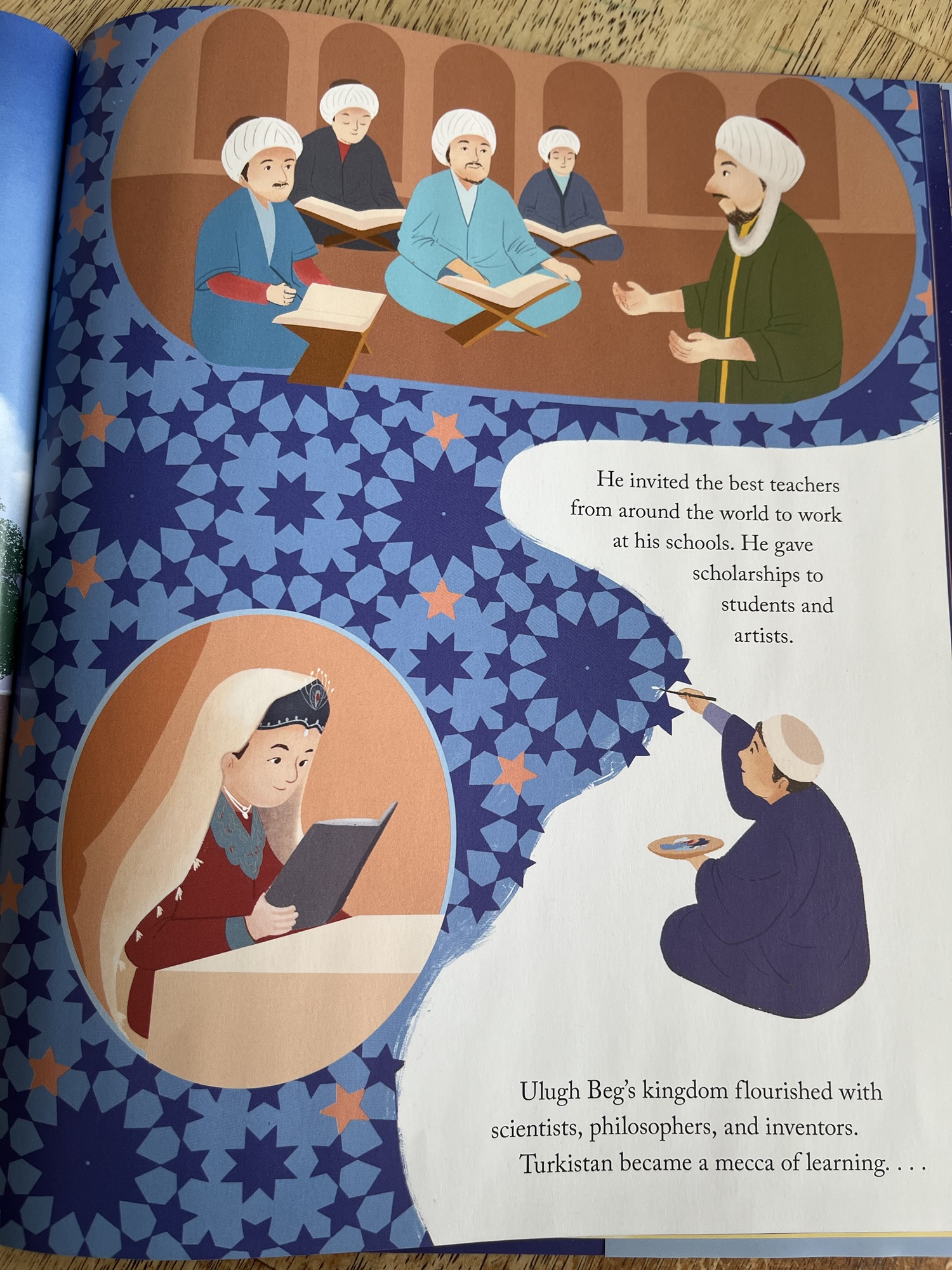
The king of the Timurid Empire, Ulugh Beg’s grandfather, insured his intelligent grandson had the best teachers and was allowed to travel, learn, and follow him curiosity.  At 15, when Ulugh Beg became the ruler of Turkistan, he built a madrasa and invited scholars, artists, students, philosophers, and inventors to attend making Turkistan “a mecca of learning.”  Yes, the usage of mecca here made me laugh.  I know it is appropriate, but it seemed a little on the noise in a book where Mecca, the direction we pray is also mentioned.  The book then details the controversy of studying the stars, as astrology and astronomy at the time, were seen as one and the same.  And with only God knowing the future, he had to assert that he was curious about the science of the stars and planets.
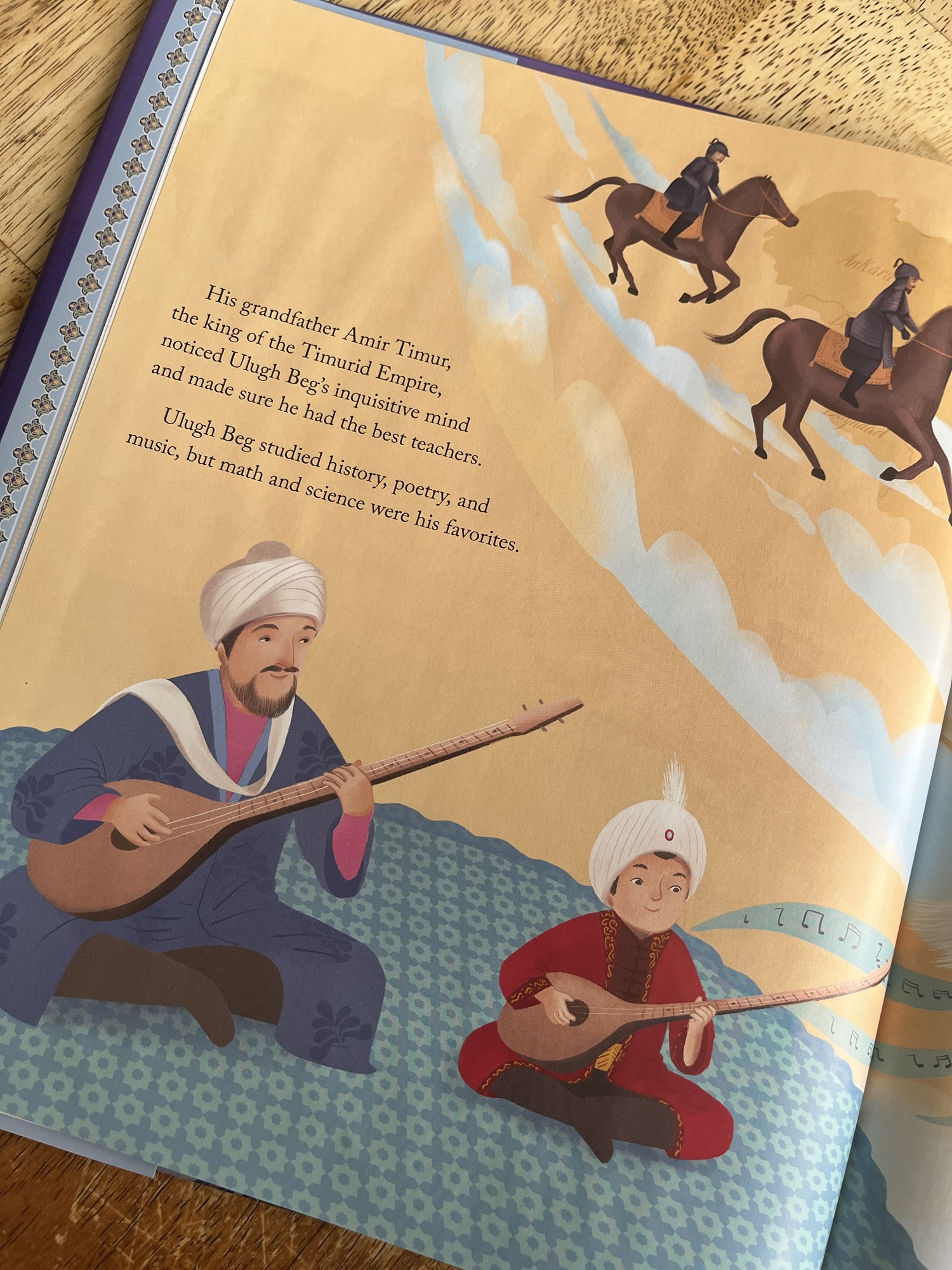
I love that faith and Islam is centered and that the inscription on his school is “Seeking knowledge is the duty of every Muslim man and woman.” But it alludes that this is a hadith, and while I agree it is inspired by a saying of Prophet Muhammad (saw), I think adding the man and woman part, where to the best of my knowledge the hadith is just “every Muslim,” is something that should be clarified. None-the-less, that it was Ulugh Beg’s motto, so to speak, and that he made a point to articulate “woman” is remarkable.  He determined the exact time of the five daily prayers, the direction to Mecca, and the dates of holidays.
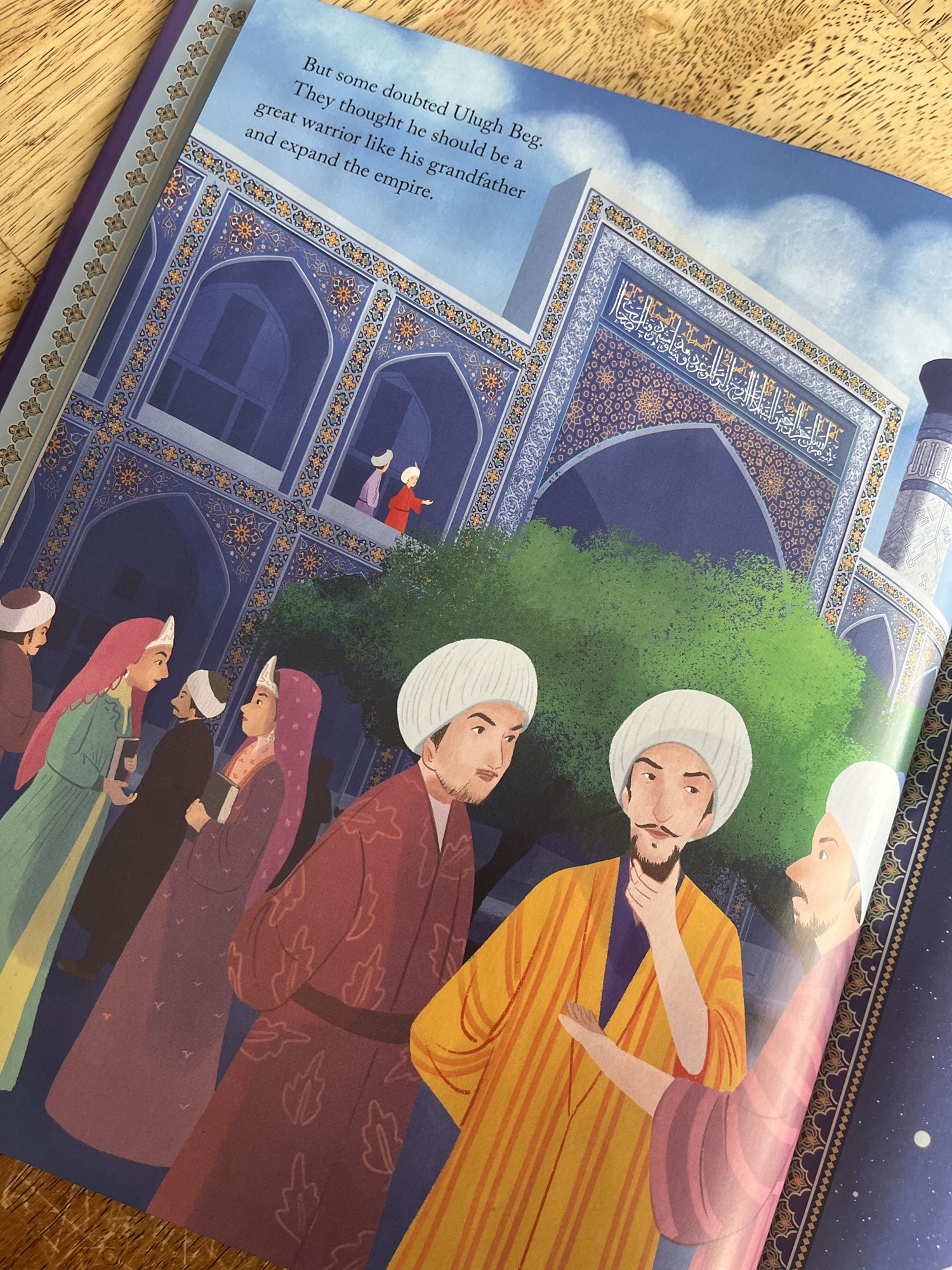
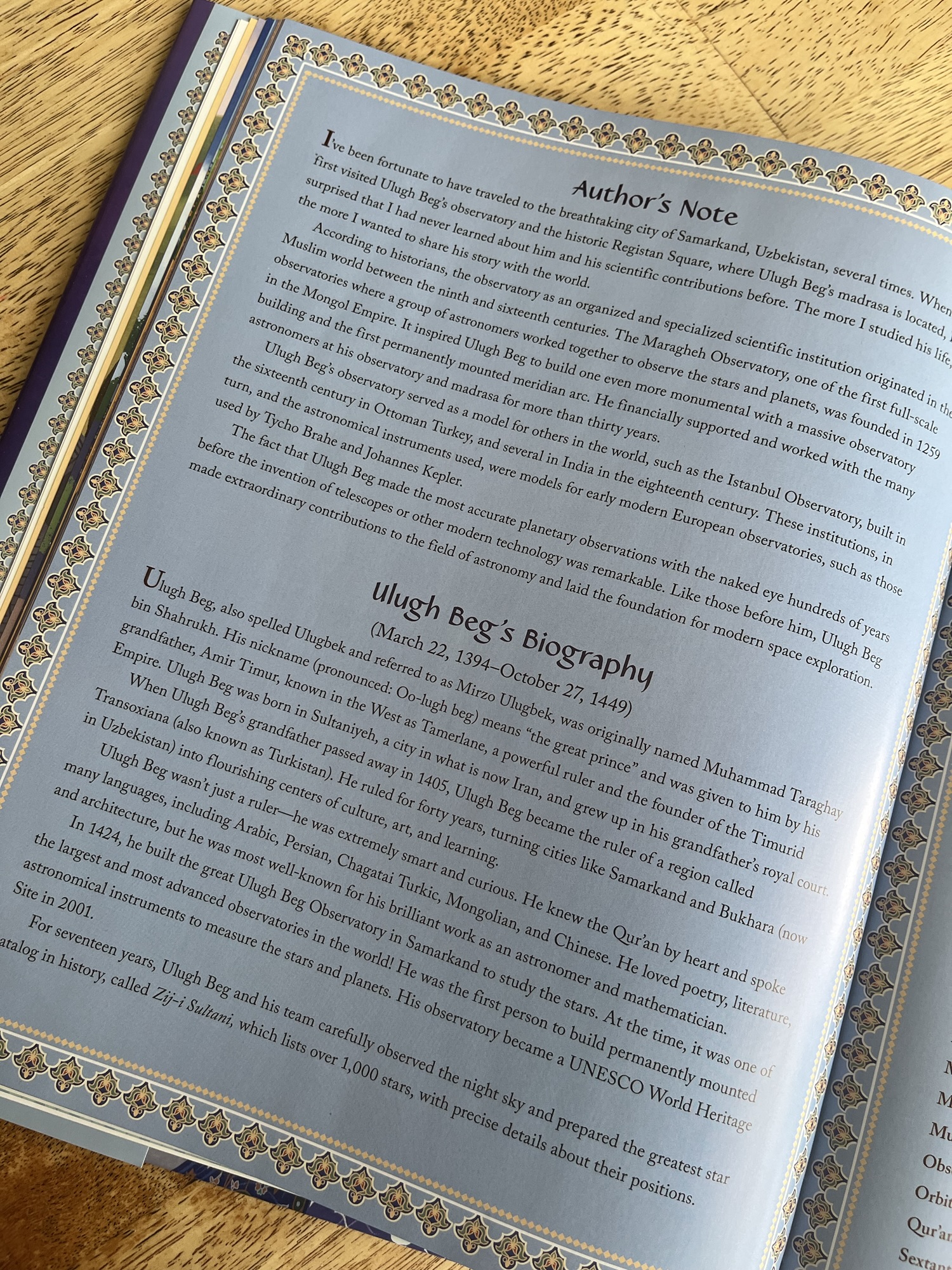
He also built the world’s largest observatory, and numerous tools, including the Fakhri sextant to measure the location of the stars and movement of planets.  He encouraged being challenged and challenging others’ findings, and over 17 years wrote a star catalog of more than 1,000 stars. He answered how many days in a year, down to the seconds, why the seasons change, and inspired future astronomers and scientists.

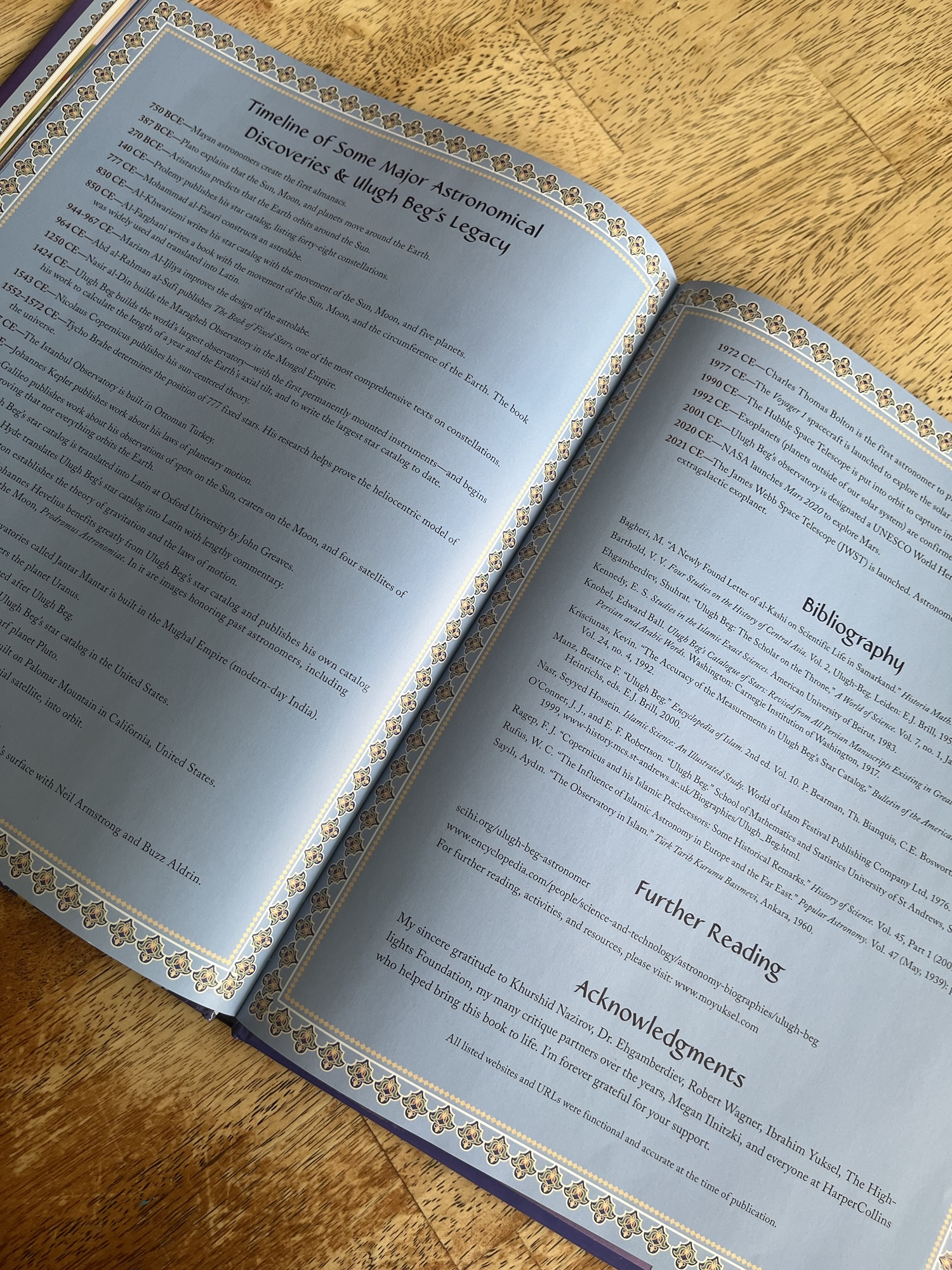
As incredible as the story is, the backmatter is equally impressive with an Author’s Note, Ulugh Beg’s Biography, a Glossary, Astronomical Timeline, Bibliography, Further Reading, and Acknowledgements.
The illustrations are the cherry on top, somehow I don’t love the cover, but the inside spreads are nice and match the tone of the words and the detail of what he was accomplishing.  The book is on preorder and I hope, teachers, librarian, and families will prioritize learning about him, and giving him credit for what he helped us to understand, about our world.

Auntie Aisha Answers: The Tween Muslim’s Ultimate Guide to Growing Up by Aisha Hussain Rasheed illustrated by Magdelena Zareba

Standard
Auntie Aisha Answers: The Tween Muslim’s Ultimate Guide to Growing Up by Aisha Hussain Rasheed illustrated by Magdelena Zareba

Kids have questions, and in today’s world it is easier than ever to get answers, however parents need to parent and help provide CORRECT answers for their children. This 100 page book is a great resource to facilitate conversation, hand to tweens to read independently, or just have on the shelf for when a child is curious and knows the internet might not be the best resource.  For boys and girls, this book takes a conversational tone of answering questions that tweens are thinking about, and maybe some that they should be thinking about.  I love that it is not just a body or maturation or puberty book, it discusses boundaries, emotions, hygiene, wellness, it weaves Islam in for context and reassurance and direction, and also has workbook type activities to engage the reader.  The balance of facts and conversation keep it from not being dry, or overly heavy handed, which is also quite impressive.  The text, illustrations, size, and pacing make the information available in pieces or cover to cover.  We tend to have more female focused “growing up” books for our Muslim girls, and this one really is for both.  It provides insight into one’s own body and as well as understanding and compassion for the opposite gender.  If nothing else it normalizes that changes are nothing to be ashamed or embarrassed by and allows real conversation with proper terminology to be discussed in an age appropriate and Islamically rooted manner;  yeah, the Islamic references are sourced! If you have kids, go order this already, you will be glad you did, alhumdulillah.

The book starts with discussing the blessing of one’s body and moves into discussing abilities and disabilities before moving into male and female bodies.  The first section really focuses on the body: privacy, care, autonomy, healing.  The second section is called “Growing Pains” and discusses the changes the body undergoes.  Before opening the book, I for some reason, assumed it would be framed as questions and answers, and it is not, it is chapters, but the chapters have illustrations, activities, bolded words, and are visually engaging.

Ultimately I love that the book is easy.  The topic matter can seem intimidating when you are faced with discussing some of these topics with tweens, and this book really will put parents and children at ease in the way it approaches, discusses, and walks readers through concepts that Islam has provided resources and answers for in the Quran and Sunnah, in a contemporary tween friendly way. 

Book One: Thunderbird by Sonia Nimr translated by M. Lynx Qualey

Standard
Book One: Thunderbird by Sonia Nimr translated by M. Lynx Qualey

img_7178

My public library had this book and so I picked it up seeing that it was Palestinian authored fantasy, and I am always on the lookout to support OWN voice Palestinian stories.  The book cover is gorgeous, the inside text unfortunately is tiny making this middle school aged book only 110 pages.  It is translated from Arabic and published by a university, so my expectations were pretty meager which assisted in me being fully swept away by the story at hand.  Sure the book has a few glitches in point of view,  often it feels a bit abrupt and djinn stories are a dime a dozen, but what elevated this book and made it stand out was the Palestinian history interwoven into the plot: snippets about the Mamluk soldiers and Ottomans, the Ayyubid rulers and walls around Jerusalem.  There isn’t enough history touched upon in my opinion, but I look forward to see, now that the world building is established, if the rest of the series will highlight the historical thread.  I have no idea if the characters or author are Muslim, there are references to praying and hearing the athan, but they could just be cultural.  There is magic, fantasy, djinn, prophecies, and reading of tea leaves, as well as fighting, assault, and talk of oppression under Israeli rule.  I’d assume it is advanced Middle Grade or lower YA, but to me it seems 11 and up would enjoy the quick fast paced read.

img_7175

SYNOPSIS:

Noor’s parents are dead, and she lives with a grandmother who loves her, and an uncle and his family who don’t.  When her grandma dies, Noor is alone and with things combusting in to flames around her and no one left to defend her claims that it wasn’t her, Noor is trying to piece together a ring left to her, her mother’s research, and her flame creation abilities.  Her search leads her to a colleague of her mother’s and an old archaeological site.  While staying with an aunt in Jericho over the holidays, a mysterious cat guides her to the same archeological site where the cat reveals that she is really a djinn.  The barrier between the seen and unseen world is failing, and Noor is prophesized to be the only one that can ensure it doesn’t happen.  With a trait of the mythical phoenix Noor must find ways to travel in time and retrieve a feather before the bird is reborn.  Along the way she will have the help of the djinn and of her doppelgänger from that time period.

img_7176

WHY I LIKE IT:

The story is clever, fast paced, and the character endearing.  I wish the details were fleshed out and of course I wish there was more history when she travels back in time.  The climaxes are quick builds and even quicker resolutions, but despite all the flaws I really enjoyed the story and look forward to the rest of the series.  The book ends on a cliff hanger that feels rather abrupt, but being it is clearly established as book one in a trilogy, I don’t think readers will be too upset at the sudden end.

img_7177

FLAGS:

Magic, time travel, prophesies, fortune telling, assault, oppression, fighting, loss, arson, arguing, djinn, fighting

TOOLS FOR LEADING THE DISCUSSION:

The book probably is too short for a book club read, but I think a teacher could definitely use it as a reference in story writing, historical fiction fantasy, culture inclusion lessons.  If you wanted to use the book, you’d be able to find plenty to draw on for teachable moments in literature, history, and writing style.  There would also be a lot to discuss in terms of occupation, myth, legend, and culture.

If your library doesn’t have it you can find it on Amazon

Hamra and the Jungle of Memories by Hanna Alkaf

Standard
Hamra and the Jungle of Memories by Hanna Alkaf

hamra1

This 400 page middle grade retelling of Little Red Riding Hood bursts with Malaysian culture, magic, action, and adventure.  The main character and her family are Muslim and hijab, duas, zikr, halal, Qur’an and salat are included throughout.  The mix of legends and characters from Malaysian culture in building the fae world is not contrasted with religious faith, but assumed to both coexist without issue.  The book is clean for ages nine and up and the only concepts worth noting are some intense life and death situations, close male and female friendships, dementia, and the element of fantasy.  The book is set during the Covid-19 pandemic which will ultimately date the book as it doesn’t convey the tone for readers unfamiliar with the curfews, social distancing, controversies, and masking.  Those who have just lived through it, will not need the framing, but in a few years I do fear that the book will be lacking in fully understanding why the tourists, parents, and markets are so absent.  As with all of the author’s books there are also dated pop culture references, that slow the narrative down for today’s readers.  The book grabs you from the start and the second half flies by smoothly, but the middle quarter is a bit slow as the world building is not robust, and the reader is thrust into a magical world that is just accepted without pause, and the reader is asked to accept it at face value as well.

SYNOPSIS:

It is Hamra’s birthday, but the independent 13 year old is not being celebrated- everyone has forgotten: her mother is a front line worker, her father helping those with limited resources, and her aging grandfather and her are left to care for her memory slipping grandmother.  When Hamra, Little Red, storms off to the jungle to collect some herbs, in an act of spite, she defies the rules drilled in to her 1- Always ask permission before you enter.  2- Don’t challenge what you can’t even see. 3- Never use your true name. 4-Never take what isn’t yours. 5-If you hear someone calling your name, never, ever look behind you. She also doesn’t listen to the regular reminders to tie her shoes.  Simple rules, that when broken set the story in to motion.  Along with her best friend Ilyas, the two will strike a deal with a weretiger for their transgressions that takes them on a journey to try and save Opah, themselves, and prove their quest a success.  The characters they meet, the clues they unravel, the legends they understand, and the scenic islands they explore are as lush as the love Hamra has for her family and the drive she has to return home safely.

WHY I LIKE IT:

I love the way Islam is truly part of the characters, and a natural extension of how they see the world and act within it.  I wish there was stronger world building blending the world of the known and the fantasy for the reader.  The writing of the Malaysian setting is beautifully unapologetic and I love that there is not a glossary or overly explained descriptions, it is immersive and I appreciate that, but the framing of the two worlds I felt was a bit disjointed and needed some fleshing out.  At times it feels more telling than showing in detailing the depths of the legends or the superstitions that are true for the story.  I did enjoy the characters’ quirks and stubbornness, there is not a lot of arc and growth, but with the intensity of the adventure and culture, I didn’t feel it lacking in development.  For much of the book I didn’t quite appreciate the Covid-19 framing, but by the end I understood that it was a way to have the tourist spots void of people, the parent’s out of the way; a little more development though would have had the uncertainty of so much more fully realized.

FLAGS:

Fear, trickery, danger, loss, death, music, musical references, dammit is said.  There is some violence, close male and female friendships, and a possible trigger of dementia in a loved one.  There is myth, legend, magic, fairies, fae, and fantasy, if you are ok with the concepts in general the presentation is clean even with mixing religion and these concepts.  If you are uncomfortable of fantasy and Islam coexisting, this book draws the two worlds very close.

TOOLS FOR LEADING THE DISCUSSION:

I have taught two of her books in middle school book club discussions, and I would teach this one as well.  It is enjoyable to see Malaysian Muslim characters so confident in their identity and having adventures that are enhanced by their faith and culture while focusing on larger themes of friendship, family, forgiveness, and adventure.

The book comes out in March of 2023, I’ve preorderd mine HERE and I hope you will as well.

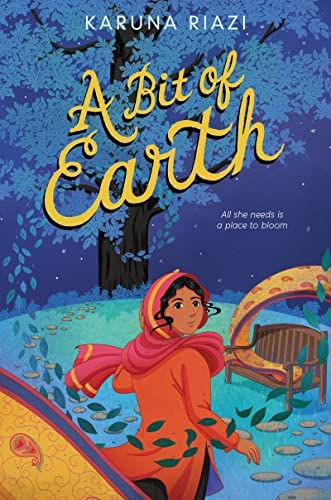
A Bit of Earth by Karuna Riazi

Standard
A Bit of Earth by Karuna Riazi

earth

This Secret Garden retelling mixes the heart of the original with a dash of modernity, the flavor of desi culture, and the lyricism of a good writer.  Over 368 pages the slow plot but rich imagery will draw readers in, hold their attention, and leave them thinking about the characters they have been fortunate to spend time with on Long Island.  Islam is practiced and normalized and naturally woven into the Muslim characters’ daily lives without othering or over explaining.  I did struggle a bit trying to keep the relationships of who was supposed to be caring for the protagonist at various points since her parent’s died clear, but once I abandoned stressing about it I was able to be swept away.  I recently reread The Secret Garden with my own children and the original is not plot heavy, nor action packed, but I watched as my own children were drawn to the slower, more grounded (pun intended) nuanced tale, and I think this book, in the same vein, will find its way in to the hearts of middle grade readers.  The book is clean, there is a possible crush hinted very slightly at the end, periods are also endured, and I do have reservations of the terrible marital relationship between Mr. and Mrs. Clayborne, but it establishes that change will occur, so at least it isn’t normalized.  There are sprinkles of magic implied regarding the house, but it is always framed without clarity and in a subtle way to set the tone and the emotions the characters are feeling more than centralizing something rooted (see I did it again) in fantasy.

SYNOPSIS:

The book updates and mirrors the original fairly well with an obstinate orphan arriving at a sprawling house, finding a prickly boy, and setting off to form a tentative toleration of one another with friendly neighbor kids in a garden that is unquestionably off limits.

Maria Latif arrives from Pakistan against her will to be taken in by a distant relative (I’m not sure how she is related), but Asra has been called away and she is forced to stay with Lyndsay, the new wife of Mr. Clayborne.  The first wife was a friend of Maria’s family, but Lyndsay is just as emotionally overwhelmed and lost as the child in her charge.  With Mr. Clayborne away on businesses, his mother Charlotte keeps them all on edge.  When Colin Clayborne is expelled and returns home, more tension erupts and the two children find themselves in an off limits garden trying to make the most of a difficult situation.

WHY I LIKE IT:

I love the mix of poetry and standard novel format.  It is beautifully written and clearly the author does a remarkable job of making her very unlikeable characters worm their way in to the reader’s heart.  Both Maria and Colin are thorny and difficult, stubborn and rude, but you seriously cheer for them, and I did shed a few tears at the end.  With the author’s writing ability apparent, I’m still not sure why the foundation of the relationships and getting Maria to the Clayborne home is so cumbersome.  It is too muddled and it drags the book down every time it is revisited.  The Dadi having the aunt’s phone number was too easy, the inconsistency of the neighbors having no relationship to the Clayborne’s for so long and Lyndsay not even pausing to think another Bangladeshi family living a few houses down might be my husband’s first wife’s friends, seems inconsistent.  Honestly Lyndsey in general needed to read like a competent woman struggling, not a teenager in over her head. I disliked her and Mr. Clayborne’s relationship and I would hate to think any reader would find it ok or normal.

I love the Islam and how it presents when the character has to pray, she goes and prays, it is part of the story and it is seamless.  I don’t think the culture is handled quite as well.  Lyndsay is a foot writer who is always cooking, yet knows nothing of desi foods? If Colin’s mom is desi, wouldn’t she at some point tried to cook familiar foods for him.  Half the neighborhood is Bangledeshi, so it seems everyone has a parent or step parent or distant relative that is desi and I loved the normalizing, but it seemed a bit assuming.  I don’t think kids will wish it was more clear, but as an adult reading it, I felt like it needed to be interjected more without explanation, or if left as is, adding some context. I also wanted to know what Maria’s parents did and a little introspection from Maria.  Again as an adult I see how her anger and grief changes how she remembers them, but from them always being away, to such soft poignant memories at the end, I think kids will need a little hand holding to understand the grief process and her understanding of them.  As it is, they just seem terrible and then all of the sudden great, and the pacing gets thrown off in the process.

FLAGS:

It seems to hint at the end that Maria might have a bit of a crush on Colin, I honestly thought up until a single line that they were making a chosen family with the people who cared for them, but that line seemed to suggest it might be more of a romantic feeling than friend or brotherly.  I read an early copy, so this is subject to change.

Maria gets her period and it is detailed what she is feeling.  I think boys and girls can and should read it.  It is presented on age and appropriately: cramps, achy, dry about blood leakage, having it start young like her mother, etc..

Implied magic (possibly), music and musical instruments being played, milaad, lying, sneaking, being kicked out of school for physical assault, close male and female friendships, ADHD stigma.

TOOLS FOR LEADING THE DISCUSSION

I think this book would work in a classroom and would appeal to readers in an Islamic or public library.  I would consider it for a middle school book club, I think readers will connect and feel empathy for Maria, Colin, and Lyndsay and be better for it.

I preordered my copy HERE and I hope you will do the same

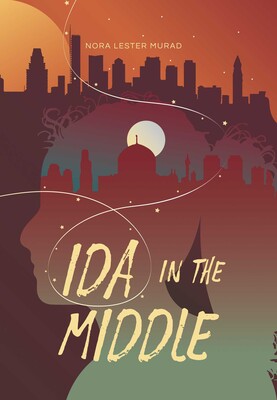
Ida in the Middle by Nora Lester Murad

Standard
Ida in the Middle by Nora Lester Murad

ida-in-the-middle-9781623718060_lg

Ideal for middle school readers (upper mg/lower ya), this magical realism book takes readers from middle school in American to a Palestinian village outside of Jerusalem through the consumption of some magical olives.  Written by a Jewish author married to a Palestinian Muslim who raised their three daughters in Palestine, the book features a lot of Islam, but is Palestinian centered in its insight, critique, culture, and dreams.  Over 224 pages, Ida starts to find where she fits in both in understanding her self within her family, her place in America, her passion in life, and what it means to be Palestinian.  The story is important, and is told in a way that will encourage readers to learn more about the occupation.  Nuances are shown in characters and groups, but the line that the occupation is oppressive is never compromised.  I appreciate that the author writes from her own experiences and openly acknowledges that she is not trying to take away from Palestinian born and raised OWN voice stories, but she is an advocate, she has raised her children and lived in the West Bank, and her characters reflect a sense of intimate knowledge, love, and appreciation.  Even with Ida having to decide to stay in America or Palestine, the two countries are not pitted against each other or seen as black or white, as to which is better or worse, the middle is where much of the story takes place, and appreciating your culture no matter how much others are trying to erase your existence, is always stressed.

SYNOPSIS:

Ida is the middle child of her Palestinian immigrant family and isn’t artistic like her younger sister, a ballet dancer like her older sister, or a soccer player like her father.  She wishes she was invisible.  Especially when her classmates turn on her every time there are conflicts in the middle east.  When it seems that everyone wants to diminish her heritage, she finds herself at a new school, unsure of where she fits in.  With anti Palestinian attitudes and Islamophobic people, Ida just wants to go unnoticed, unfortunately middle school requires a passion project to be presented and Ida has no idea what her passions are, and how she will face the crowds.

One day when looking for a snack she finds a jar of olives stuffed in a cupboard- olives brought by a family friend from her now deceased aunt in Busala, one bite and she is magically transported to the familial village.  It is an alternate reality of what life would be if her parents never came to America.  Not only is she in a country she has never seen before, meeting family members she has never met before, but even her own parents and sisters are somehow different.  She enjoys the warmth, the communal activities, the extended family.  Her mom in hijab, the athan being heard, the men all going for jummah, but then they sit down for a meal and the same olives are served and Ida accidently takes a bite and is whisked back home.

Once home, she longs for so much of Palestinian life, but relishes in the convenience and ease of America as well.  Her passion project still looms and she finds herself hoping to escape it by going back to Palestine.  When she finds herself back near Jerusalem she ventures out with her Aunt, who isn’t dead in this reality, and learns more about the occupation and oppression, and how the families interact with the various Israelis: some sympathetic to Palestinians, some actively working to help Palestinians, and some settlers- forcefully killing and bulldozing Palestinian homes.

When Israeli military troops enter their village, the families meet to discuss the best course of action, the families do not agree, there is no clear way to prepare, there is no guarantee of survival.  Ida starts to find her voice, and when the soldiers enter, Ida finds herself rushing out to help a small boy. Guns, demolition, rocks, tear gas, fear, so much fear, what can one person do? What can one village do?  What will Ida do?

WHY I LIKE IT:

The book is relatable and moving, not just for those with a tie or interest in Palestine.  It is a coming of age story that shows a girl grappling with forces so much bigger than herself, while at the same time dealing with homework and friends and stereotypes.  Ida has a lot to figure out and the book doesn’t sugar coat a happy ending, it simply provides a moving story based on reality, through a character whose quirks and personality you find yourself rooting for.

I love the presence of Islam and the way it is apart of Ida and her surroundings, even though she makes it clear early on that her family is not religious.  The Quran is mentioned, the athan, various salat, hijab, Hajj, Ayatul Kursi, Ramadan, Eid, wasting food as being haram.  In Boston her friend knows she doesn’t eat pork, she went to Sunday school to learn Arabic at the mosque when she was younger.  It doesn’t gush with Islam, but it is present, for example Ida’s sister and her joke about a good Palestinian girl shouldn’t have a boyfriend, it isn’t tied to their religion. The story is a Palestinian one, and as someone who is not Palestinian, the images, the foods, the smells, the love all seemed to embrace everything I’ve ever heard Palestinian friends talk about, and it feels like a warm hug to read the effects being in Palestine has on Ida.

I love that the author is upfront about her perspective, and I love that she is putting this story out there.  The writing is sufficient: I was invested in the story, and it was an easy read. I don’t know that I’ll remember it months from now for it’s imagery or power, but I’m certain I’ll remember the commentary about life under occupation and the struggle to not be erased by a world that doesn’t seem to care about the settlers still taking Palestinian homes and their way of life away by force.

FLAGS:

Fear, crushes, death, injuries, loss, magic, bullying, racism, Islamophobia, guns, physical assault, threat of force, destruction.

TOOLS FOR LEADING THE DISCUSSION:

Our school is majority Palestinian.  Years ago when we read Where the Streets Had a Name, I learned so much about the students, their families, their own experience living under oppression, that I can’t wait to present this book with the middle schoolers and take notes on their thoughts.  I would not lead the discussion, I would let them, their voices will not be erased by me.

Preorder available here: Amazon

Fight Back by A.M. Dassu

Standard
Fight Back by A.M. Dassu

fight back

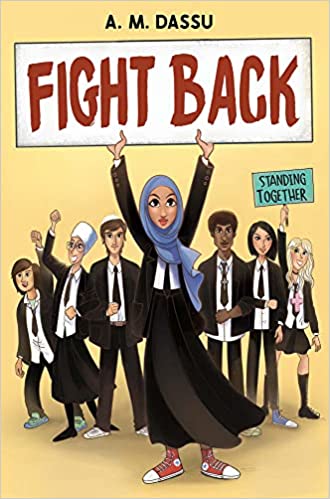
At 384 pages, this middle grades book takes on hijab, terrorism, Islamophobia, finding your voice, and fighting back.  At times the book was insightful and smoothly written, at other times the voice seemed childish and the writing directionless.  The inconsistencies don’t ultimately make the book good or bad for me, but rather very forgettable.  I read the book over the span of three days, but honestly remember very little about the book without looking at my notes.  The writing just isn’t particularly strong.  I never connected with the main character, and no it wasn’t because I didn’t agree with her wearing hijab out of solidarity, I accept that people make the decision for a variety of reasons, somehow I just never felt sympathetic to her as a person, or found myself cheering her on.  Her naivety vacillated too much for me to find her believable, and the pacing of the book made it hard to get revved up.  I think upper MG and middle school readers will be a better fit for the book with hate speech, assault, school bans, concert, musical references, and alt right indoctrination.  I think the book is worth shelving in a classroom/school library and I’m considering it for a book club selection, but I’m skeptical that the book would be finished, even if started, by most readers without some incentive to see it through.

SYNOPSIS:

Aaliyah and her friends are at a K-pop concert when a terrorist attack kills and injures numerous people.  A Muslim takes responsibility and with it coming on the heels of numerous London attacks, Islamophobia is at an all time high.  For 13-year-old Aaliyah, it is a stranger yelling at her mother in a parking lot, her best friend Lisa ignoring her, and her brother getting riled up in retaliation, that gets her to wonder why her mother wears hijab, when she started, and decide to start covering herself, in solidarity. As a result for Aaliyah there is now increased bullying at school which results in physical assault, and teachers turning a blind-eye.  It reaches an all time high when a religious display ban goes in to effect.  Still dealing with trauma from witnessing horrific violence, Aaliyah decides to push back.  Finding her inner strength and finding allies in a few good friends, and a secret cat adoption, she finds enough motivation to keep her plugging forward against the growing hate in her world. When she finally finds her voice will it be enough to overturn the ban and save her brother? Nope, not going to spoil it.  The fight is not a one-and-done, as anyone who has gone up against racism and systemic oppression knows, and this fictional book keeps that integrity and doesn’t give a happy ending, but rather hope and motivation.
WHY I LIKE IT:

I like that the Islam is centered in a consistent and empowering way.  At times it is a perspective that I’m not completely onboard with, but a few pages later the insight is powerful and the messaging clear.  I found it odd that Aaliyah doesn’t know when her mom started covering or why, or anything about hijab, it comes off very immature. The book keeps culture and religion separate, hijab a choice, and I like that it was Aaliyah who wants to cover even when her parents try to talk/force her out of it.  I find it a little off that she doesn’t go to the mosque, but her father consulted with masjid folks when looking for advice for handling the alt right groups.  She prays a few times in the book and it being mentioned is nice.

I like that the kids in the book think for themselves, and that the adults don’t have all the answers.  I enjoyed the passages asserting why the family came to the UK generations ago and why they have stayed, is powerful.   A few of the characters that are really strong at the start don’t ever get mentioned again.  Which is fine, but I did wonder about Harpreet and why Yusuf’s friends weren’t contacted when Aaliyah was sleuthing about.

Loved the literary shout-outs, and the hypocrisy of allowing swim caps and hats but not hijab, but sigh, didn’t love the cat thread.  I think I just don’t like fictional cats, I sound like a broken record.  I think the inclusion was to show how much Aaliyah had to keep hidden in her life and how she needed comfort, but I don’t know, sigh, I found the contrast of tone jarring to the pacing.

There is a glossary at the end, and the definition of Hijab is a bit odd, highlighting Western and South Asian terminology and not the Middle Eastern or even global use of the Arabic word.  I don’t know that the glossary is even needed as the book really tries to establish that the characters are a part of their society and don’t need footnotes and differential treatment, so the inclusion of a glossary for me, diminished the point a bit.

FLAGS:

Assault, hate speech, bullying, fear, death, injuries, bombing, terrorist attack, lying, music, mention of a transgender/gender neutral student, a rainbow pin. sneaking out.  Criticism of police, alt right indoctrination.

TOOLS FOR LEADING THE DISCUSSION:

The book is unique in showing affects of the alt right and not having it all work out in an MG book.  It shows the anxiety and fear that Muslims often feel and the determination of not becoming victims. It also does a good job of showing that something like a religious symbolism ban doesn’t just affect Muslims, but people of various faiths and culture, and thus when common ground is found, there are more allies that one often thinks.  I think it could work for a middle school book club and undoubtedly the discussions would be great, but I am given pause with the main characters view of hijab as not being something in the Quran, but rather done in protest and in solidarity.  I think once I see which kids are interested in book club I can gauge if it is something that we can work through and discuss or not.

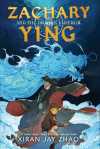
Zachary Ying and the Dragon Emperor by Xiran Jay Zhao

Standard
Zachary Ying and the Dragon Emperor by Xiran Jay Zhao

zachary ying

It is hard to believe that this book is middle grade- the world building, the social and political commentary, the authenticity, the history, the humor, the writing quality, the richness, really makes me embarrassed that as a child I never gravitated towards books like this.  Everything I love about contemporary fiction seems to be done so well in the handful of fantasy books I’ve read of late, add in layers of adventure, imagination, and nuance, and I don’t know why I took so long to embrace this genre.  Not to say every MG fantasy is written this well, but why settle for only friendship, family, and identity issues when you can have all of it and dragons?  This 352 page book about a Chinese American Hui Muslim kid is action packed, culture rich, unapologetically Muslim, and a gripping good time.  While I think lower MG could handle and enjoy the book, there is nothing explicit, it does in passing mention eunuchs, concubines, and adult entertainment, along with the main character stating that he is not attracted to girls a few times and that he acts like a girl, but presents as a boy, thus making me think middle school aged might be a better fit.  If younger kids read it, they may or may not even pause or notice the aforementioned possible flags, I only highlight them, so that my readers are aware and can be prepared to explain and discuss if needed.  As an adult reading it, I can see clearly that Zach is gay, but I don’t know that most kids will catch it.  The author skillfully hints at it, but doesn’t make it the focus of the story, ultimately making me feel like if you want to see it you will, if you don’t, you probably won’t. Oh and the chapter titles, they are awesome!

SYNOPSIS:

Zachary Ying is twelve and while he isn’t comfortable in his Maine school, he manages.  He dumps the delicious Chinese food his mom makes every day so that no one teases him for the smell it carries.  He tries to impress the other members of the Mythrealm club, a vr video game, without rocking the boat, and he loves his single mom who works hard since his father was killed in China advocating for the rights of Uyghurs.  He knows little about Chinese history, the language, or myths, but that all starts to change when his VR gaming headset becomes the host for the spirit of the First Emperor of China, Qin Shi Huang. 

His mom becomes the target of demons and when her soul is taken, Zachary is off to China to secure the barrier that divides the worlds and keeps the spirits at bay.  To do that though he is going to need to learn Chinese history, the power of artifacts, and the role of myths in keeping stories alive.  With two friends, also possessed by past emperors, joining him, the adventure is non stop.

WHY I LIKE IT:

I love that Ramadan is mentioned on the very first page, that Zach’s mom wears hijab, that he only eats halal, and that details about life in China for Muslims is shared.  It isn’t the main part of the story, but it adds such a powerful layer, that I found myself looking up Hui Muslims and trying to rectify how little I know about Islam in China.  

The social commentary about which individuals from history are remembered and why some are celebrated and others vilified was so impressive to see in a MG fantasy book.  It doesn’t ask you to agree with the narrative, nor does it preach anything, it just presents it in all its beautiful shades of gray glory albeit often shrouded in humor.  I truly feel that most MG authors talk down to their readers, if these themes can be so strongly presented and consumed, what superficial fluff did I waste my time reading as a preteen?  Thankfully I’m an adult that loves juvenile fiction, so there is still hope for me yet.

FLAGS:

Magic, mythical gods, fighting, violence, lying, deceit, killing, crushes, same sex attraction, concubines are mentioned as are eunuchs, but nothing more is said about them.  Affairs and mistresses in context to myths and past emperors are mentioned.  

TOOLS FOR LEADING THE DISCUSSION:

I don’t know if I could teach this.  Once you sense that he is gay it is hard to unsee, and in an Islamic school, that would be problematic.  I will have my own kids read the book, I don’t think there would be any concerns for me there.  A few weeks ago concubines were mentioned in a khutbah, so I’ve already had to explain that to one of my kids. 

PRE-ORDER BEFORE MAY 10, 2022 or PURCHASE AFTER HERE

Queen of the Tiles by Hanna Alkaf

Standard
Queen of the Tiles by Hanna Alkaf

queen

This 320 page YA book is hard to put down and middle school readers and up that love words, a good mystery, and fantastic writing are in for a treat.  I can’t recall the last whodunit that had me absolutely sure that I knew who was guilty, while simultaneously doubting myself until the reveal.  I mean, maybe there wasn’t even a crime to unravel? And fear not, I’m not going to spoil anything in this review.  Just know that this Muslim authored, Muslim character filled, Malaysian set, Scrabble feast is worth a space on your shelf as it will undoubtedly make a place in your heart and beg to be read again and again to see what you missed.

SYNOPSIS:

It has been one year since Najwa has competed in a Scrabble tournament, one year since her best friend, Trina Low, died playing Scrabble at the very same tournament, at the same hotel, with many of the same participants.  And with Najwa battling her angry negative thoughts, splotchy memory, nerves, and grief, she is walking a fine line of functioning and faltering.  When Instagram posts and messages start popping up from Trina’s account, everyone becomes a suspect in unraveling what really happened and doing it fast enough to prevent it from happening again.

The backdrop is the Scrabble games that are still taking place, the play on words, the scoring, the plotting, the twists, the scrambling, and unraveling of so many characters that are more connected than they first appear.

WHY I LIKE IT:

I love Scrabble, my mom and I used to play weekly when I was in junior high through college, and while the games were “friendly,” and neither us very good, the game holds wonderful memories. Usually chess is referenced for strategies in real world approaches, so to see Scrabble on a competitive level and have it being in many ways a metaphor for the larger storyline truly had me giddy.  I’m still grinning in fact as I write this review.  The mixing of the two story lines is flawless, with the word play, and scoring, and definitions, that I am just beyond impressed with the writing, the clarity, the intensity, and the way it holds the readers attention.

Many of the characters are Muslim and they mention their hijabs, waking- or rather trying to wake each other up for fajr. At one point Najwa and Mark, Trina’s ex-boyfriend are meeting to talk and she acknowledges the halal gap left as they sit down and how they are both always mindful of her Muslimness and his non Muslimness.  Islam is there, but is not a big part of the story. I beamed when it popped up, but if doesn’t influence the story much, for example one night Najwa plans to sleep in her hijab incase she has to run for her life, so you know, she won’t be slowed down by trying to cover her head.  Yeah, the book has some dry humor too.

There is a large mental health role in the book, as it seems in all of the author’s books: The Weight of Our Sky and The Girl and the Ghost.  Najwa is coping with her grief and trauma and working closely with her doctor to improve her situation.  Other characters mention going to therapists and likewise getting professional help.  I love that it isn’t just a character trait, but that it is a big part of the story, and not in a negative way, but in an actively working to manage it way.

I like how the gender neutral character is handled and pronouns are used.  It is not opined upon, it is not in your face, it is a side character, they have a preference of how to be referred to as, a quip is made that if they win they don’t want to be queen of the tiles, but a more less gendered term perhaps monarch, and that is it.  It is not a judgement, it is not a big part of the story, and no one makes it a huge issue, the character isn’t fleshed out much, but they are respected and have more to their personality than this one facet.  I think that provides a great approach in seeing something in literature that can perhaps spark important conversations in real life in need be.

The only slight pauses the book gave me were when it talks about how incredibly wealthy and distant Trina’s parents were, but then for much of her life she lived in a modest town house style house.  Also, despite Mark and Najwa’s awareness of boundaries, and Najwa being called out for crushing on Mark, at one point he hugs her and I don’t know if that is an oversight or was intentional.

FLAGS:

There is death, murder (?), poisoning, deceit, plotting, cheating in multiple ways, kissing, crushes, relationships, multiple mental health threads, intense competition, danger.

TOOLS FOR LEADING THE DISCUSSION:

I would love to do this as a book club selection.  I think as long as no one spoils the outcome there would be so much to chat about: the twists and turns, the way Islam and Malay culture is shown, the influence of western culture, concept of competitive Scrabble, pronoun sensitivities, and healthy friendship.  Girls and boys in middle school will be drawn to the story, and I can’t wait to share.

Golden Girl by Reem Faruqi

Standard
Golden Girl by Reem Faruqi

golden

I began reading this book not having any idea what it was about. All I knew, or all I cared to know, was that the incredibly amazingly talented Reem Faruqi wrote it, so I wanted to read it. While I know it will be hard for most to avoid knowing the plot, I think it was a blessing that I was able to be swept away so completely and so fully in a story that is wonderful and memorable, and truly sets a higher standard for the way that a story can be told. Faruqi’s voice and authenticity had me in tears. I didn’t even realize my eyes were dripping until my son asked me if I was ok. It wasn’t the plot that had my emotions spilling over, sure it helped, but it was the storytelling, the hadith and deen and snapshot of a life so unlike my own that simultaneously is exactly my own that a physical reaction emerged. It is the power of OWN voice storytelling. It is the power of brilliant writing. It is not just a book about a Muslim character, this book blurs the lines for me between Islamic fiction and fiction with Muslim characters. Middle school readers (mature middle grade readers) will enjoy the book, older readers will enjoy and appreciate the 336 page story told in verse. You can pre-order the book and I hope you will, it helps convey the message to publishers that this book is highly anticipated and that we need voices like this. Additionally, Goodreads currently is hosting a giveaway, you can head there to try and win a free copy.

(If you don’t want to know what the story is about, maybe skip the next section.)

SYNOPSIS:

Aafiyah’s name means well-being, protection, health, money, happiness, everything good, but Aafiyah has secrets too. She is privileged and loved, and she knows it, but sometimes when she sees something she likes she accidentally borrows it. Sometimes it isn’t an accident. Sometimes she doesn’t just borrow. Much of her life is wonderful, a best friend that lives next door, doting parents, tennis, vacations, trips to Pakistan to visit grandparents, and a love of “weird but true facts.” So what happens when all that changes. When her grandfather gets sick and the family wants to bring him to America for treatment, when Aafiyah’s dad gets detained and imprisoned on the way home, and Aafiyah’s secret may be a way to help her family?

WHY I LIKE LOVE IT:

I absolutely love that the characters are so well rounded and developed. Yes, Muslims have vices, and even young practicing Muslims have tests and struggles. The bar has been raised, we aren’t just a monolith, and our only struggles aren’t girl/boy issues, alcohol, not being oppressed and getting an education, we are complex people, we are human. The bulk of the story is Aafiyah growing up: her responsibility within her family, her changing body and appearance, her friendships, her responsibility for her actions, her desire to want to help and improve and step in to her own. I love that all these layers of life somehow are explored in such sparse lines. It doesn’t drag, but it gives the necessary pauses to involve the reader in her logic and view of the world. Aafiyahs’ kleptomaniac tendencies, her father being detained, her grandfather’s illness. they all move the story along, but they are foils for a much more intimate character story. A story that is surprisingly funny and light and impossible to put down.
I absolutely love how Islam is woven in, how she exudes Islam in all that she is, because she is a Muslim completely, the good and the bad. The guilt she feels, the desperation to be forgiven, the knowing that Allah swt sees all. The book is never even close to being preachy, but she proudly owns her identity and the details of her faith are not watered down, or even justified, it is who she is and it isn’t up for debate.

Culture is presented unapologetically as well. She is critical of things she sees in Pakistan, and similarly celebrates and admires good things about Pakistan and Pakistani culture. The book does not seem to have an agenda in presenting Muslims or Pakistan as good or bad, just as Aafiyah sees them. Which isn’t revolutionary on the surface, but it really is refreshing because it highlights how many books simply don’t. It makes the contrast painfully obvious between books that are shy about certain things, when they have their characters deflect and disassociate from certain “realities” and books that confidently uphold their identity and demand that the reader steps up and truly see the characters and their experiences.

There is a beautiful and raw author’s note at the end that shares some of the inspiration for the threads of the book, a glossary, a recipe for Aloo Gosht and resources for help with kleptomania.

FLAGS:

Stealing, lying, chatter about crushes, music, dancing. Being attractive and the reactions that it gets is woven through out.

TOOLS FOR LEADING THE DISCUSSION:

If I have a majority girl group, I will teach this. It isn’t a girl only book, but I think some of the more subtle themes would need a safer girl space to discuss.