Category Archives: 3rd grade and up

The Prince of Stars: Ulugh Beg’s Quest to Map the Stars and Seasons by M.O. Yuksel illustrated by Zelma Firdauzia

Standard
The Prince of Stars: Ulugh Beg’s Quest to Map the Stars and Seasons by M.O. Yuksel illustrated by Zelma Firdauzia

This gorgeous 40 page picture book biography is both flowing in its storytelling and informative in its sourced details of a fairly unknown, underappreciated figure.  I was humbled reading this book and learning about the accomplishments of someone I had never heard of before.  Truly this book, bringing to the attention of our young and old ones alike, such a remarkable figure, is a much needed gift.  The publisher suggests the book for 4-8 year olds, but I think it also will appeal to older readers familiar with Copernicus, Galileo, and Ptolemy and who will appreciate the efforts driven by curiosity from someone so long ago. The diction in a few lines did give me pause, but nothing that overshadows how well the author has once again proven to master the storytelling of non fiction Muslim accomplishments in an engaging, accessible, exciting way for today’s audiences.

The book opens with a map of the Timurid Empire in 1405, before showing the reader a young prince, Ulugh Beg, gazing out and the stars and wondering how many there are.  The next spread makes no sense to me, but I acknowledge others might not be bothered, how can the young boy be watching days fade into weeks, into months, into years, and then wonder how many days are in a year? Seems that either those terms weren’t yet around, or some details about the generalized meaning made him curious about the specifics.  Either way, him wanting to know how many days in a year and the changing of seasons, along with counting the stars are the questions he wonders about as a child and works to answer throughout his life.

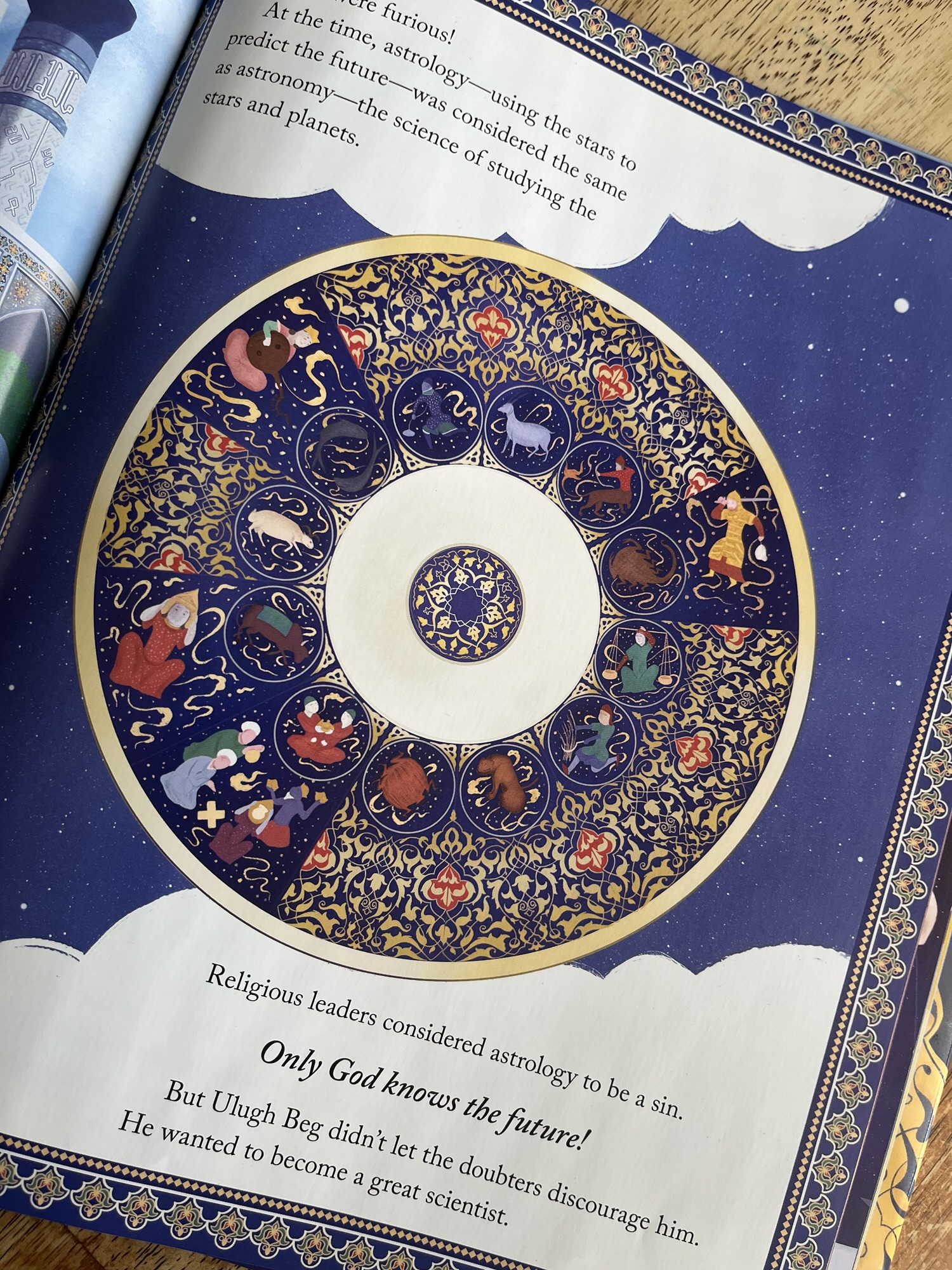
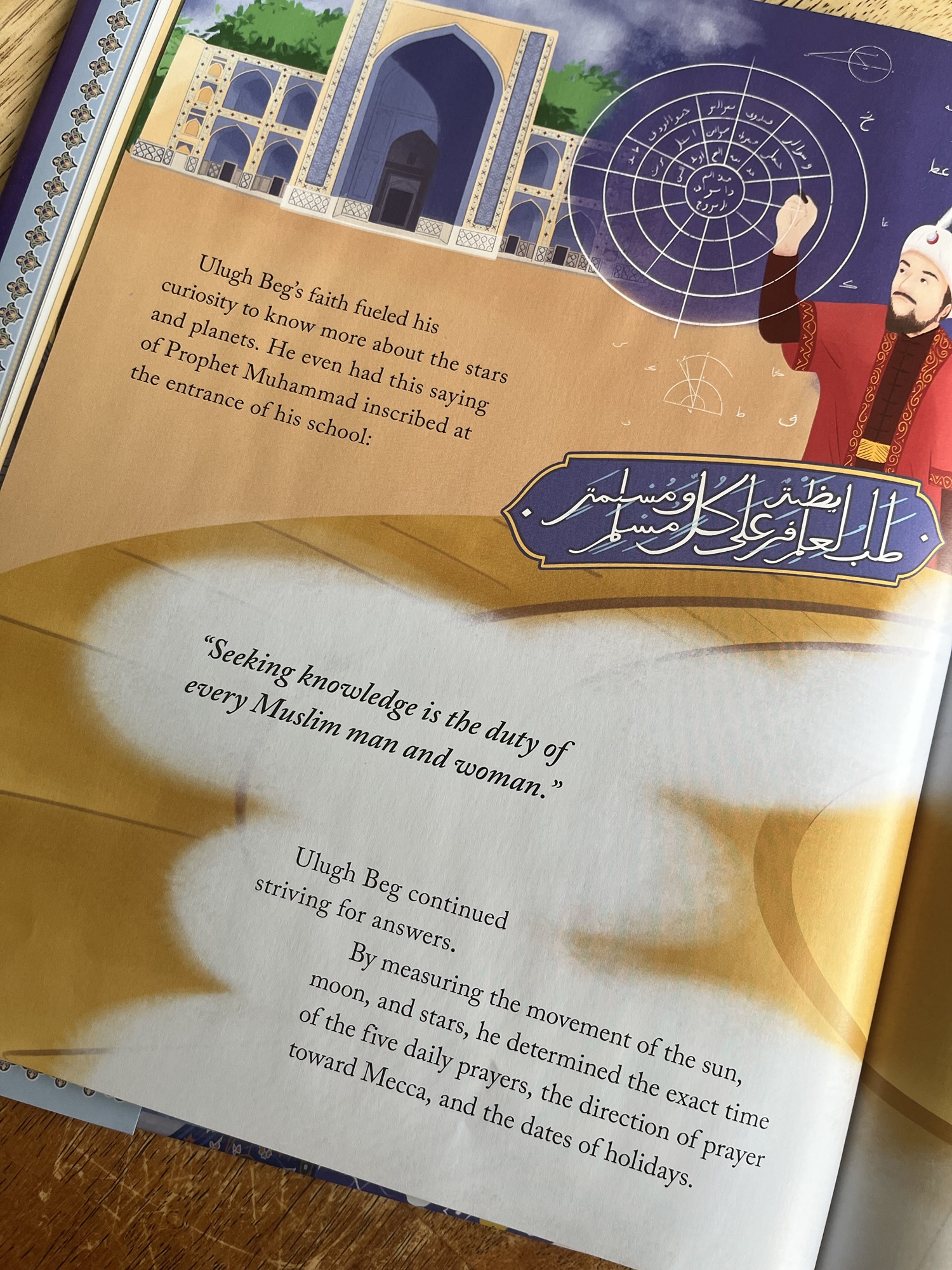
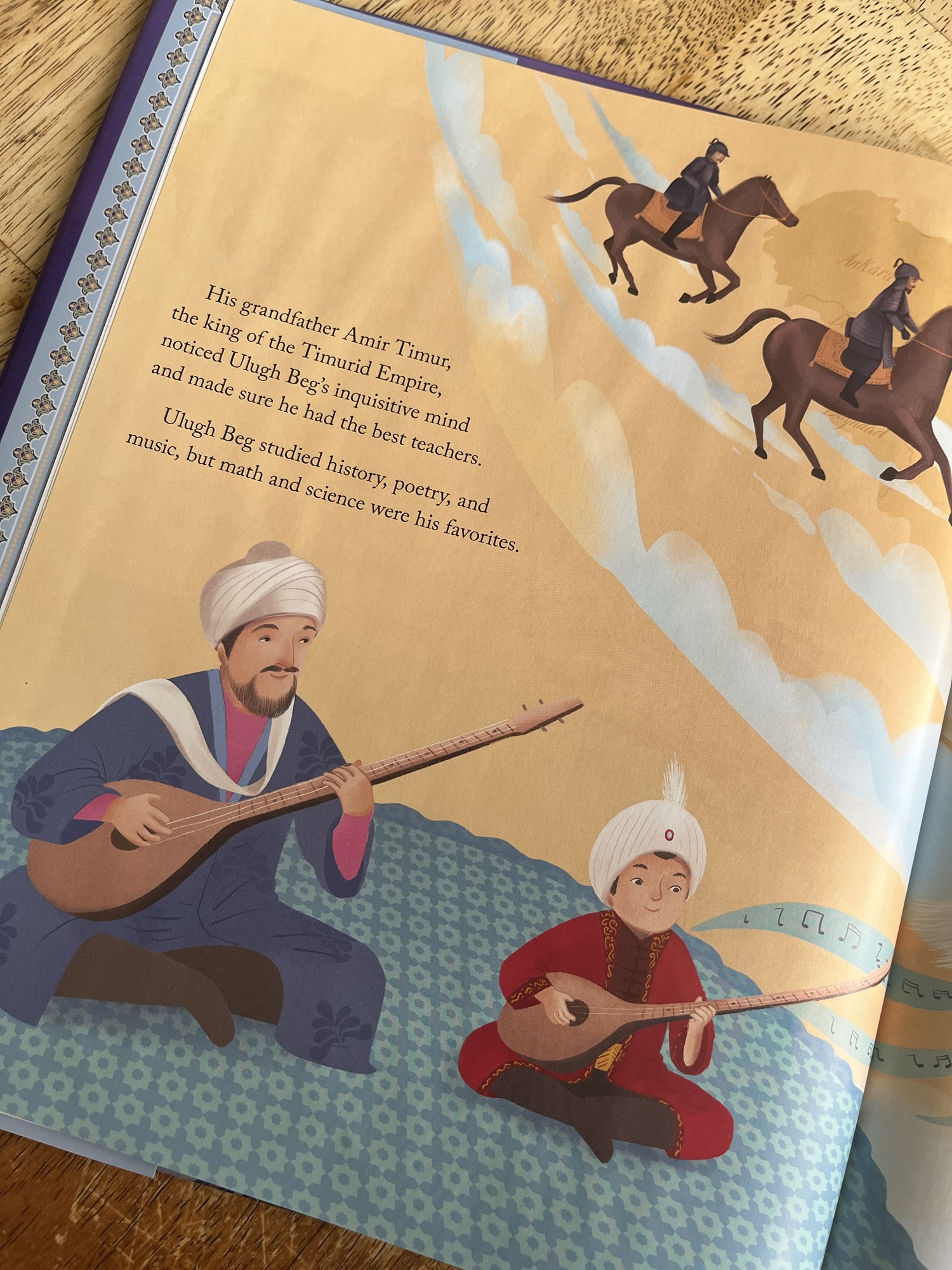
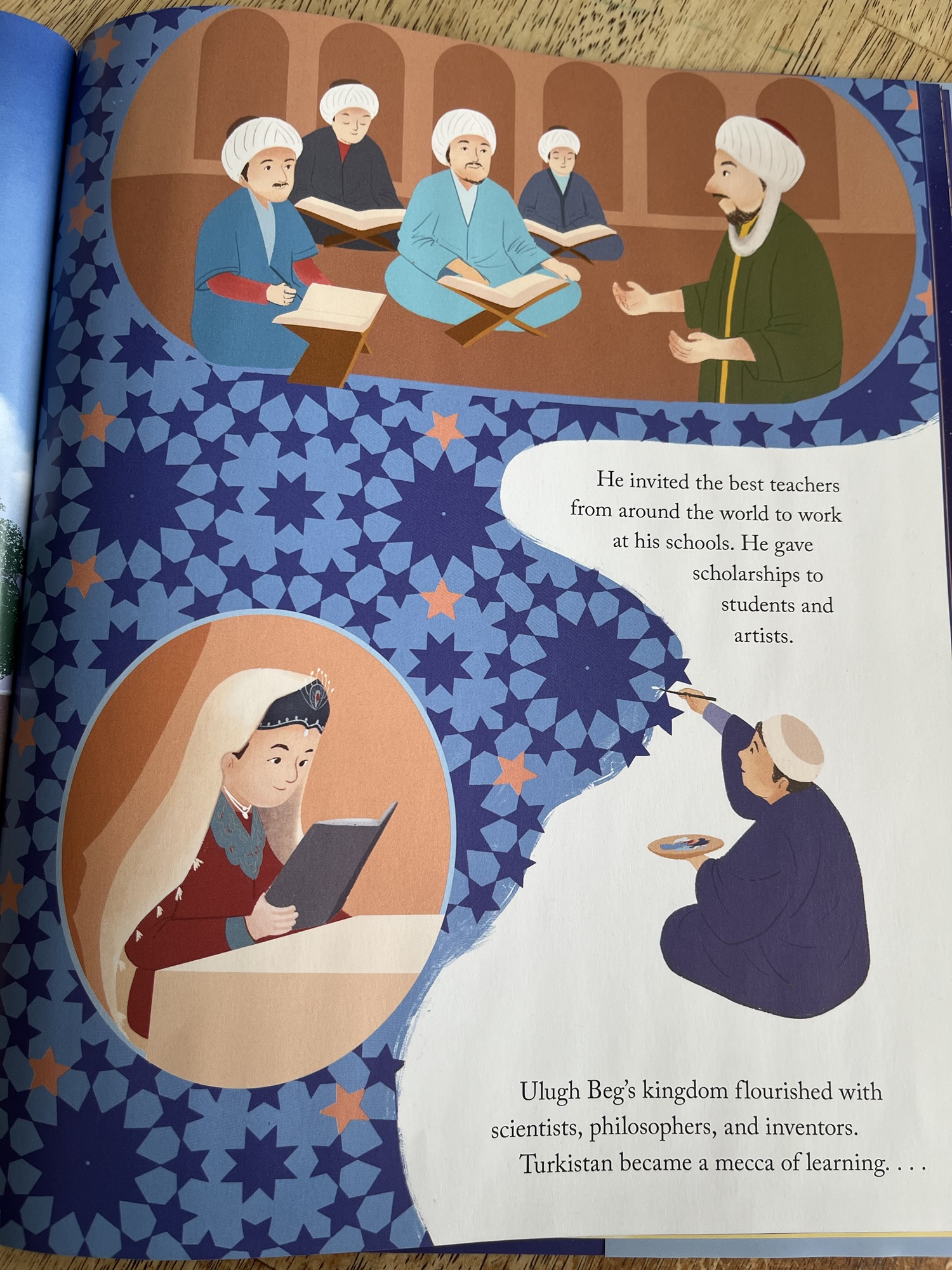
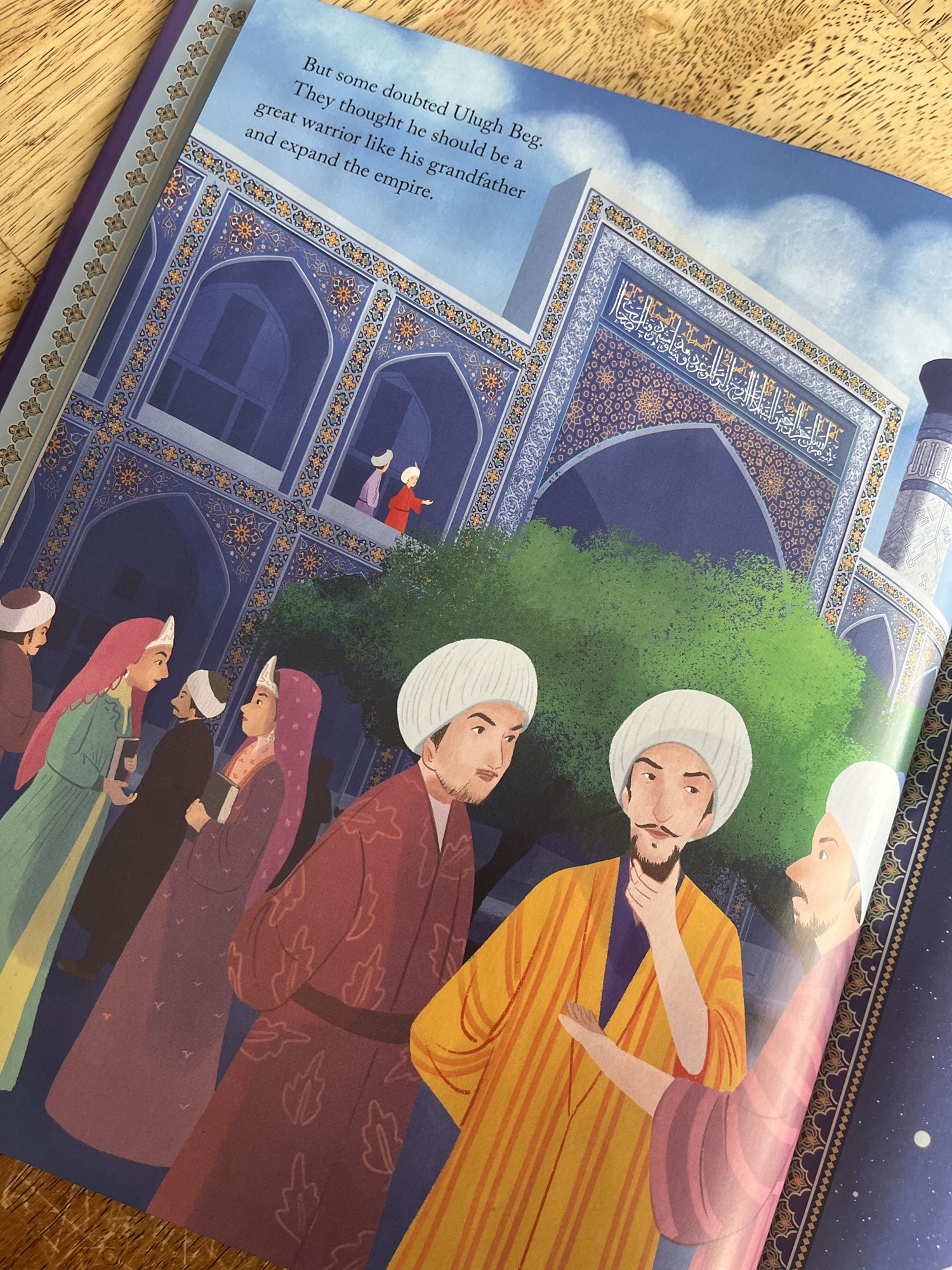
The king of the Timurid Empire, Ulugh Beg’s grandfather, insured his intelligent grandson had the best teachers and was allowed to travel, learn, and follow him curiosity.  At 15, when Ulugh Beg became the ruler of Turkistan, he built a madrasa and invited scholars, artists, students, philosophers, and inventors to attend making Turkistan “a mecca of learning.”  Yes, the usage of mecca here made me laugh.  I know it is appropriate, but it seemed a little on the noise in a book where Mecca, the direction we pray is also mentioned.  The book then details the controversy of studying the stars, as astrology and astronomy at the time, were seen as one and the same.  And with only God knowing the future, he had to assert that he was curious about the science of the stars and planets.

I love that faith and Islam is centered and that the inscription on his school is “Seeking knowledge is the duty of every Muslim man and woman.” But it alludes that this is a hadith, and while I agree it is inspired by a saying of Prophet Muhammad (saw), I think adding the man and woman part, where to the best of my knowledge the hadith is just “every Muslim,” is something that should be clarified. None-the-less, that it was Ulugh Beg’s motto, so to speak, and that he made a point to articulate “woman” is remarkable.  He determined the exact time of the five daily prayers, the direction to Mecca, and the dates of holidays.

He also built the world’s largest observatory, and numerous tools, including the Fakhri sextant to measure the location of the stars and movement of planets.  He encouraged being challenged and challenging others’ findings, and over 17 years wrote a star catalog of more than 1,000 stars. He answered how many days in a year, down to the seconds, why the seasons change, and inspired future astronomers and scientists.

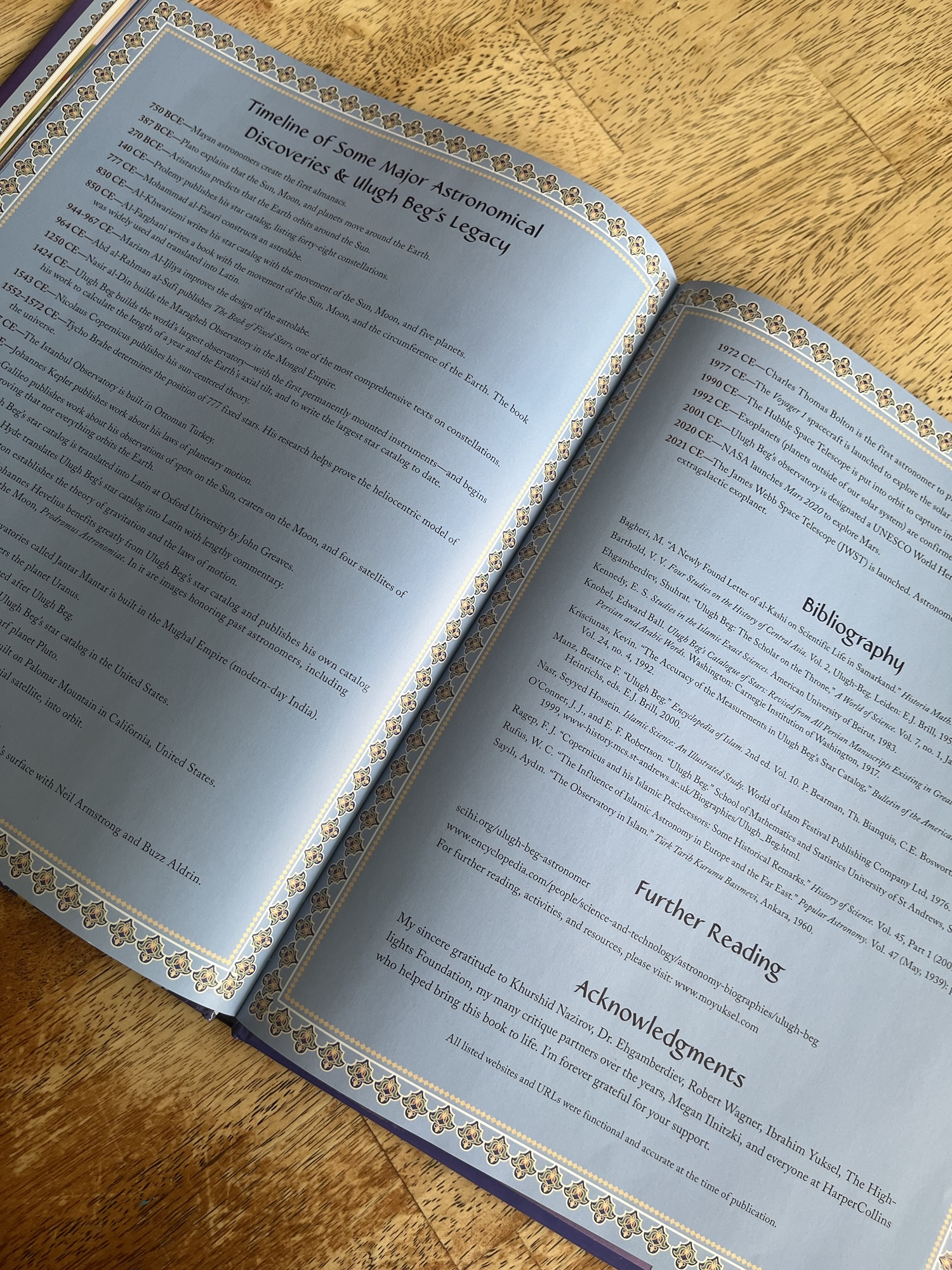
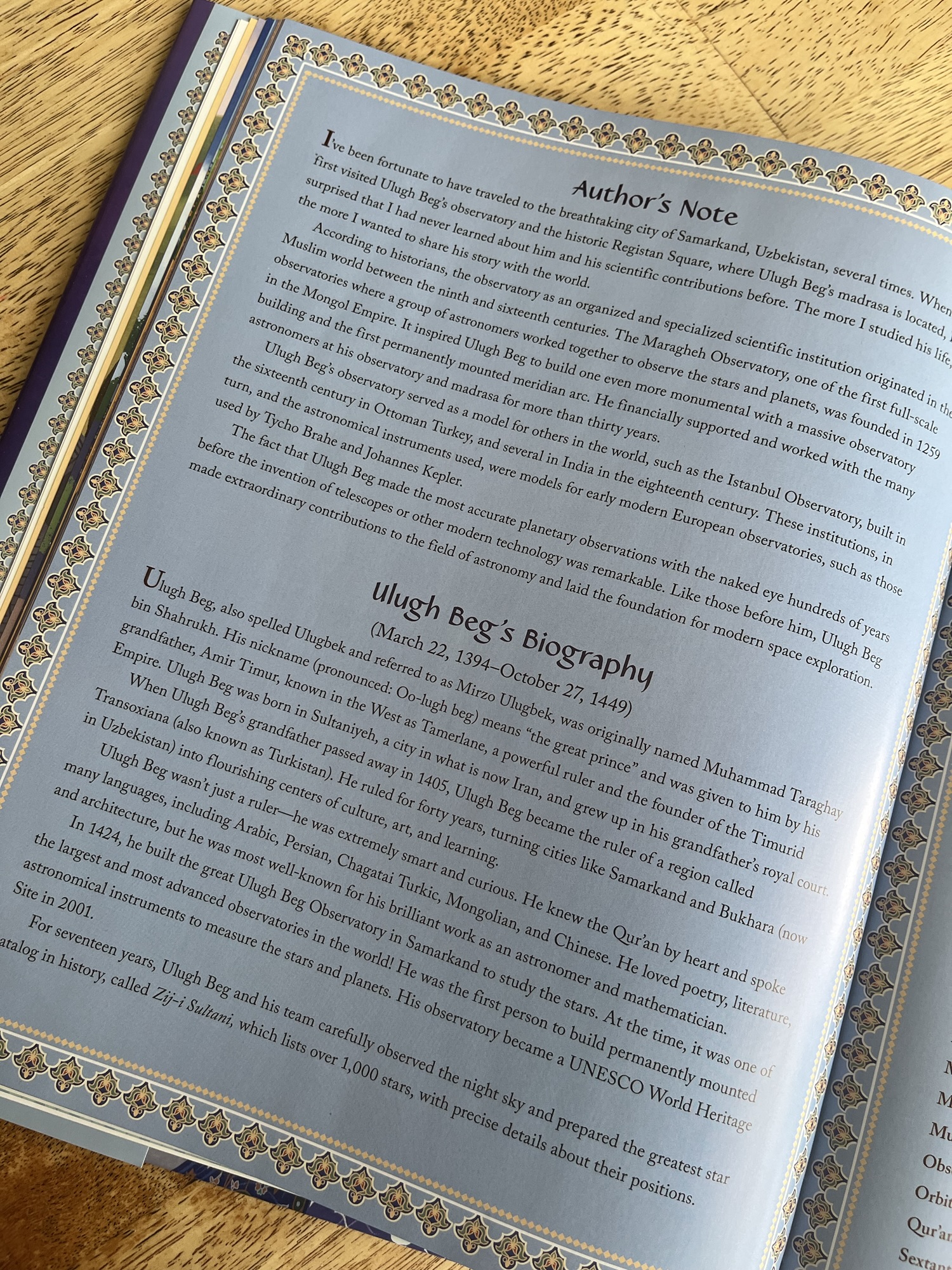
As incredible as the story is, the backmatter is equally impressive with an Author’s Note, Ulugh Beg’s Biography, a Glossary, Astronomical Timeline, Bibliography, Further Reading, and Acknowledgements.

The illustrations are the cherry on top, somehow I don’t love the cover, but the inside spreads are nice and match the tone of the words and the detail of what he was accomplishing.  The book is on preorder and I hope, teachers, librarian, and families will prioritize learning about him, and giving him credit for what he helped us to understand, about our world.

Aarzu All Around by Marzieh Abbas

Standard
Aarzu All Around by Marzieh Abbas

I was hesitant starting this 384 page middle grade novel in verse, because the stereotype of having to disguise yourself as a boy to make things happen, seems like a western performative troupe that reinforces stereotypes, and has been done a fair amount in literature.  Pushing down my disdain, I opened the book to numerous pages of cricket terminology and rules, which further served as a barrier.  I do not understand the info dumping, literally, at the start of the book, and to top it all off it is not needed.  The book is blurbed as being a cricket loving, girl dressing as a boy in a patriarchal society, but really those are the most forced aspects of the all over the place narrative.  Cricket is underdeveloped and her actually playing is very minimal and lacking. Aarzu disguising herself as a boy is a blip that she admits to a few pages after she gets the job, and thus the story that remains is an orphaned girl with a mean uncle trying to find a way to help pay for her younger sister’s medical bills. Which isn’t a bad story it is all just so very disjointed.  And the verse is not written well, there are no beats or flow, it just seems to be a few decent poems in a sea of jumbled ones.  About 40% when the Islam starts to shine, I felt a brief connection to the book and the characters, but the loose threads and telling over showing, found skimming the pages to find out if the sister survived, if Aarzu got in trouble, and how cricket fit into it all.  The weak climax and sloppy resolution, combined with the premise, marketing, and info dumping, makes me recognize that I am not the target audience as a cynical Pakistani American reader, but truly makes me wonder who is.  I don’t know that the words on the page or the story at hand are going to resonate with middle graders.  I appreciate that Islam and culture are separated, that the mean uncle is confined to him and him alone, not a label on Pakistani men, but it feels like the editor took a day off or didn’t want to help the author make the story cohesive, which is unfortunate.

SYNOPSIS:

Aarzu and her younger sister have come to live with her poor maternal aunt’s family in Karachi after her parents are killed in an earthquake.  She is treated like a servant by the family, not allowed to watch cricket let alone play, and her government public school is hardly a challenge.  When Sukoon’s kidney failure worsens and dialysis is needed, as they wait for a kidney transplant match, Aarzu decides to find a way to make money.  She starts frying onions and selling them at the local market, the labor intensive and odorous job helps, but not enough.  When a nearby bungalow preparing for a wedding, needs laborers, her friend Nazia encourages her to cut her hair to look like a boy and apply.  Lying to her aunt about where she is, she spends her time after school getting to know the kids that live at the bungalow, confessing that she is a girl, and playing cricket.  The money helps her sister and things are starting to look up, until the truth comes out, Sakoons health worsens, finances at home hit rock bottom, and friendships frazzle.  Luckily though SPOILER the wealthy family likes her and solves all her problems and bribes the right people for her to make the cricket team.

WHY I LIKED IT:

Some parts, mostly the Islam, really spoke to me. I love that distinctions were made between religion and culture, that she taught the wealthy girl how to pray, that Aarzu is Muslim and loves her faith and relies on her relationship to Allah swt in handling every aspect of her life. The rep feels real and sincere and while it made me force a friend to read the book, it also highlighted how weak the other aspects were.  We, the reader, see so little of what Aarzu’s world is, we are just told. There are no flashbacks to her life with her parents juxtaposing her current situation that would have connected us to her.  The poverty, the mean uncle, the cricket, the sick sibling, they all just seem like plot points, not pieces to this girl. She compartmentalizes them in a way that make it hard for the reader to see the overlap, or that she is keeping all of these parts close to her heart at all times.

The resolution was disappointing, it felt half hearted. Why have wealthy saviorism? Dreams coming true from bribery? It took the grit out, and made the messaging fall less on hard work and perseverance, and more on, don’t be poor.

I did appreciate the kidney disease representation, having seen a loved one endure failure and daily dialysis, I appreciated the mention of dietary changes, and swelling, and lethargy, it was well done.  I wish the emotional impact, though not just the sibling love, but the fear of demise, could have come through stronger.

FLAGS:
Lying, physical abuse, theft, fear, illness

TOOLS FOR LEADING THE DISCUSSION:
I don’t know of a kid I would recommend the book to, but I would shelve it, let nine and up read it, and happily discuss with whoever wants to chat about it.

Sabrena Swept Away by Karuna Riazi

Standard
Sabrena Swept Away by Karuna Riazi

The gorgeous cover of this 205 page middle grade fantasy is a great motivation for kids to pick up the book and dive into a story filled with characters from the One Thousand and One Nights. Descendant from Sinbad, Sabrena’s ailing grandma is sometimes present, and sometimes suffering from dementia, but her stories have power, they always have. As Sabrena battles her own self doubt at her new Islamic school, her ability to find her voice and speak up, and her desire to protect her grandma from being taken from her home, she will be swept off to a world far away, where she must be the hero of her own story to help her new friends and find her way back.  I was nervous to embark on an Alice in Wonderland world building framed story, but the short book, the enjoyable characters, and the consistent presence of Islamic representation actually made me forget that I don’t like that style, until the text itself drew the correlation.  In many ways the story and the predictability should also have been a turn off for me, but I absolutely loved the writing of the prologue and the first two chapters, and then I switched to the audio book, and the story just pulled me in and flew by.  The characters pray, call out to Allah swt when scared, greet one another with salaam, discuss qadr, encounter jinn and ifrits, the women wear hijab, there are mentions of Bangladeshi foods and clothes, but the book is for everyone, it isn’t preachy, it is just who Sabrena is, and in the quick paced fairytale like adventure, you will be glad you spent time with her on her adventure in both worlds.

SYNOPSIS:

The Bhuiyan family loves stories, Sabrena’s grandma spins them, and her father studies and teaches them.  Sabrena feels connected to them, but when water keeps appearing, calling out to her, and showing her visions of palaces and gates, she starts to wonder what is truth and what is just family lore about Sinbad the Sailor.  As grandma’s memory slips, Sabrena and her parents move to be closer, the new Islamic school is nice, but Sabrena seems to get tongue tied when her kind classmates try and include her.  When her mom and aunt fight about what to do about grandma, she hides away dreading their arguments.  When the sea sweeps Sabrena to a new world though, she finds herself “so alone” and forced to step up.  With new friends, a longing to return to her family, and her growing confidence, Sabrena is swept away, but determined to find her voice, save the day, and find her way home.

WHY I LIKE IT:

There weren’t really any twists or surprises for me, other than the beautiful Islamic rep inclusion and the cleanliness of the book.  I think I’ve become so cynical that the bar has dropped, and it was nice to read a tale that was decently written, with characters owning their Islam in way that made them just part of who they are and how they view the world.  Sabrena doesn’t have an identity crisis, or internalized Islamophobia, everyone is just Muslim doing their things and living their lives.  I also felt the voice and tone of the grandmother dealing with her dementia was accurate.  Having my father-in-law in our home battling memory issues, I often find rep in children’s books to be performative and saccharine, this felt grounded and used to serve an important plot point in the text, which I appreciated.

The adventure was ok, honestly nothing super memorable, but I really enjoyed the voice actor on the audio book, and was not worried if the holes were big, or adequately overcome, or probable. I was just enjoying being in the story.

FLAGS:

Mention of music, there is magic, jinn, ifrit, a talking head, some trickery and deceit, and it uses the word harem a few time without going into detail.  Disclaimer with audio books I may have missed something, but I think for the genre there is nothing too ,red flag, it is a fantasy adventure.

TOOLS FOR LEADING THE DISCUSSION:

I think discussion and maybe reading of the original One Thousand and One Nights, and then talking reading, and discussing some of the retellings, and character inspirations of Aladdin, Ali Baba, Scheherazade, Sinbad, Marjana, Duban, etc would be a delightful class or book club plan.  This book is solid middle grade, but depending on the framing, could be used for discussion in broader conversations and enjoyed by readers of all ages.

Say Something, Poupeh Babaee!: A Graphic Novel by Haleh Massey illustrated by Ghazal Qadri

Standard
Say Something, Poupeh Babaee!: A Graphic Novel by Haleh Massey illustrated by Ghazal Qadri

I had planned to just flip through this 176 page middle grade graphic novel to see primarily if there was any Islam mentioned, and if so, to see how it was framed. The blurb makes it clear it is culturally Iranian immigrant in focus, and set during the Muslim ban.  The heightened intrigue is that it isn’t just metaphorically about finding your voice, the character is labeled as having selective mutism and the author who is a clinical psychologist truly has her protagonist voiceless in nearly every setting for the majority of the book. The bright illustrations, and easy read though, had me reading the book front to back and finding that Islam is by-and large-not present. The flashbacks to her life in Iran show her wearing a scarf, and praying, and the memories are warm and inviting, with no internalized Islamophobia or political commentary, or Islamic practices at all following Poupeh to America. In fact when sought after news is finally heard the family exclaims, “it’s a Christmas miracle.”  It is hinted that the female cousin has a girlfriend, and the book features a lot of stereotypes about aggressive men, name mispronunciation, bullying for ethnic foods, and anti immigrant ideologies.  On the plus size it normalizes therapists, shows character arcs for the main and minor characters, and shows that inability to speak, doesn’t mean someone doesn’t understand.  While the book was better than I thought it would be in many ways, it ultimately didn’t have a climax, all the build up for two questions, really fell flat for me.  I also felt like while the Muslim ban was a fairly unique premise (shout out to Kareem Between!) all the other tropes are overly done, and render the book forgettable even though the format of a graphic novel should make it a standout.

SYNOPSIS:

Poupeh Babaee has come to America from Iran alone, her parents were held up settling their affairs, and they didn’t want her to miss more school, so she is sent ahead to stay with her aunt, uncle, and cousin. She understands English, but when she messes up the national anthem on her first day of school and is teased, she simply stops talking, not even to correct when everyone starts calling her “poopy baby.”  When the Muslim ban blocks travel for her parents to come, the fate of her family rests on being able to plead their case in an immigration interview. Yes, she is 10 and will be asked two questions to determine if her parents are terrorists or not.  There is teasing, tension with the cousin she has to share a room with, and a sympathetic therapist that flesh out the story of trying to get Poupeh to say something.

WHY I LIKE IT:

I like many of the pieces, and I like the format, but I really felt that the build up to the interview, the pressure she was under, was not warranted by the interview itself.  Had some commentary existed about the brevity of the interview or the chaos of America’s immigration policies perhaps it would have been worth the anticipation.  As written though, it felt rushed.  Same for the portrayal of the men in the story: from Poupeh’s own father, her uncle, to Trevor’s dad, all are aggressive, and I’m glad her own father apologizes, but again, it felt rushed and anti-climatic.  I don’t expect literary masterpieces from most mg graphic novels, but some of the “meanness” seemed abrupt for shock value, and made the cousin, the dad, the uncle read very inconsistent.  I had hoped a therapist author would have brought not just a storyline of mental health, in this case, selective mutism, but some nuance to the immigrant experience, moving beyond food, clothes, and names.  Speaking of names, I googled what Poupeh’s name means in English, and it really should have been in the book, or at least the backmatter.

FLAGS:

Stereotypes, racism, hate speech, hints and relationships, mental health, anger, homesick, bullying,

TOOLS FOR LEADING THE DISCUSSION:

The level and format would not make it a good choice for a book club read.  I probably would not unshelve this book, but I wouldn’t seek it out either.

Rainbow Fair by Diana Ma

Standard
Rainbow Fair by Diana Ma


If you see this 224 page middle grade book, the title might hint that the content is LGBTQ+ as the rainbow often symbolizes such, but if you look closely at the cover you don’t see a rainbow flag, just a Chinese scene on one side and on the other you will see crescent moon lights being hung up above a masjid silhouette, merging together with a little girl holding a rehal, a book and some art supplies. If you then turn the book over, or search the internet, and read the blurb, you will learn that the book is about Sophie, a Chinese Muslim girl learning and sharing her heritage at the school’s Rainbow Fair. As a result, I requested an arc to read and review. No where does it reveal that the book centers queer characters, LGBTQ+ support and allyship, consistently parallels Islamic faith with sexual and gender identities, and prioritizes intersectional identities and agenda over plot and insight. Had I known this, I wouldn’t have read the book, I share this review simply as a heads up to its contents, so families can decide for themselves if it is for them. The book is MG and honestly, it feels misleading and intentional that it is not articulated in a book meant for nine to 12 year olds.  With identity exploration of being Chinese, a child of immigrants, a main character being bisexual, the protagonist repeatedly claims to want to learn about her Muslim identity, but very little information or interaction with the knowledge is sadly ever shown.  The plot seems to just become a forced juxtaposition of two marginalized communities: Muslim and LGBTQ+, to make the point that we are all more than one label. I understand that my view and practice of Islam, is not every Muslims, but trying to have a faith identity and sexual/gender identity parallel one another by having the protagonist “coming out as Muslim,” and being “outted” as Muslim by her bisexual friend before she is ready, is an awkward read. It continues in this approach comparing a trans character being misgendered in a locker room to a Muslim character not having a space to pray, and likens the diversity of a mosque BBQ to the pride parade. I support finding common ground, but when questions about Muslims stoning gays are left hanging, the reader never getting a convincing answer to why her parents hide their Islam, and there is no real rising action, climax, or character arcs- I feel like the labels and the author’s agenda, even if OWN voice, are the point of the book, and it doesn’t make for a compelling read.

SYNOPSIS:

Sophie and Katie did their school’s Chinese booth together last year at the Rainbow Fair, they are best friends and do everything together, but since Katie has come out as bi, she has new friends and is petitioning to add an LGBTQ+ booth, and the rules say she can only be at one booth.  When a sleep over breakfast calls attention to Sophie not eating bacon, it comes out that she is Muslim, not something she meant to keep secret all these years, but something not even Katie knew about.  When discussions about being Muslim spill over into class when booths are being assigned, Sophie decides to do the Muslim booth. She is afraid her parents will be disappointed, and even though she knows nothing about Islam, she is ready to learn.  A new kid at school, Anna, is Muslim and joins Sophie at the booth, and as the two become friends, Anna tells Sophie there “is more than one way to be Muslim” and of course she is a “real Muslim.”  Empowered by not having to pick one identity, Sophia and Katie and all the other kids change Rainbow Fair and show how everyone is more than just one label.

WHY I LIKE IT:

The premise on the back of the book is promising, I just feel like the book missed meeting its own stated intention. The characters are not developed, there are no moments of growth or self reflection, they have no arc or relatability outside of a label.  Sophie paints her parents to be strict, but the precious little that is shown, never backs that up. As a result the reader has no idea why Sophie doesn’t just tell her parents she is doing the Muslim booth and ask them about Islam. After they see the booth at the fair, they say they don’t talk about Islam because of Islamophobia in America and feeling othered in China, but that is it.  Exploration of that would be a far more interesting story: Why did they leave China for Taiwan? When did they migrate to America, was it recent, or did they slowly start to hide their Islam? Dad learned to read Arabic in Taiwan, what was the Chinese community like? Why don’t they celebrate Eid, but have a Christmas tree, did something happen? Why do they not eat pork but drink alcohol? Sadly the two dimensional parents are not fleshed out and Sophie faults them, while constantly trying not to let Chinese stereotypes define them, but the repetitive contradiction, just leans into the labels and fails to make them feel real and relatable.

The book is all talk and no show, and with no real plot, the talking gets repetitive. Breaking the fourth wall we are taken in circles of the same talking points that more than once had me checking if I had bumped the screen and gone back to pages already read. Threads are introduced and then abandoned: what is the point of the whole roller derby thread aside from showing Sophie makes powerpoints, and her parents give in? The girls never go roller skating, it is not something that bonds them. We only know they are close because we are told they are. The beginning and end show Sophie can smell food and decipher its contents, so why isn’t that part of the story as she is trying to figure out Eid foods, cooking, the lunch offerings at the mosque? It hints that the Black culture booth is being suppressed, but it never develops it, nor articulates any real push back, it just skirts the issue. Why the judge-y competitive aunt and uncle? Is their inclusion meant to make Sophie’s parents more or less likeable? Does it reinforce or dispel Asian stereotypes?

From the very start the book feels forced.  Sophie has never gone to a sleep over, her best friend plans a sleepover birthday, but is willing to change it if Sophie can’t come.  What kind of stilted set up is this, why wouldn’t these bffs plan the birthday together, and get Sophie’s parents on board first? It makes no sense that if she can’t come it will be changed and not be a problem because they are so close and she has to be there. It also immediately contradicts the looming conflict of the book, that the parents are strict.  They gave in to roller derby, they give in to this sleep over, and have no problem that two of the girls are dating that sleep over, and “Shane is non binary and doesn’t identify as a girl or a boy.” Clearly the parents are very supportive.

Consistently Sophie drops words, or cultural practices, but doesn’t explain them or engage with them, both the Chinese historical and cultural rep, and Islamic, quick example, she has a Quran but never reads it, we don’t learn about the immortals her dad wants her to feature at the Chinese booth.  It makes it seem superficial and further distances the reader from connecting with Sophie, with culture, with faith, with the book.  Speaking of books, it really bothered me that two books mentioned as being intersectional, Black Muslim Author, Autumn Allen’s All You Have to Do, and Queer Muslim Author Adiba Jaigirdar’s Hani and Ishu’s Guide to Fake Dating are YA books, isn’t that off to mention repeatedly books that your target audience won’t know, or be in the demographic yet to read?

I could go on and on, but I will stop, I think it is clear I didn’t enjoy the book. 

FLAGS:

Islamophobia, alcohol, LGBTQ+, microagressions, racism, labels, stereotypes

TOOLS FOR LEADING THE DISCUSSION:
There is no way I could shelve this in an Islamic School.
Ramadan on Rahma Road: A Recipe Storybook by Razeena Omar Gutta recipes by Faaiza Osman illustrated by Atieh Sohrabi

Standard
Ramadan on Rahma Road: A Recipe Storybook by Razeena Omar Gutta recipes by Faaiza Osman illustrated by Atieh Sohrabi


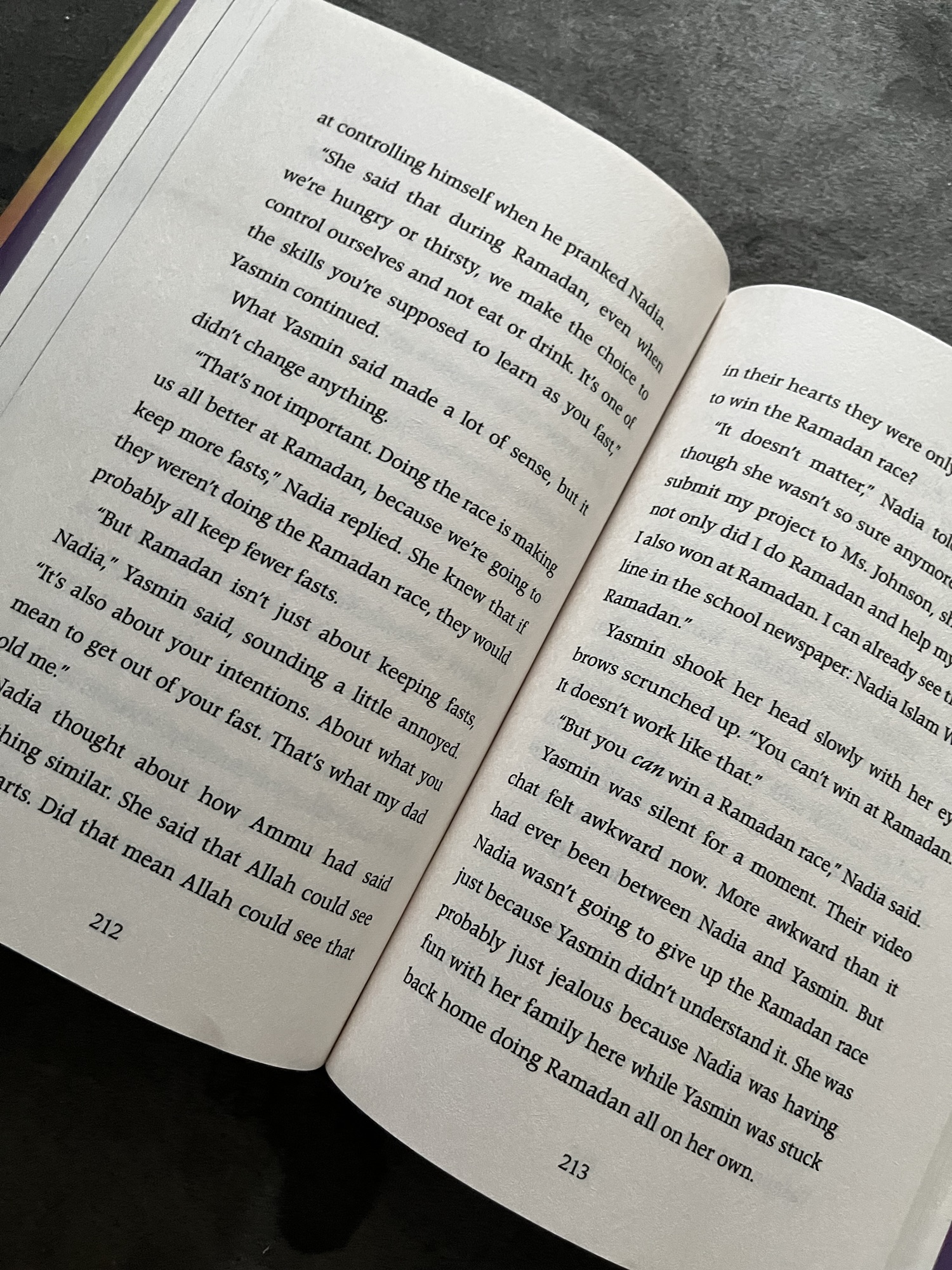
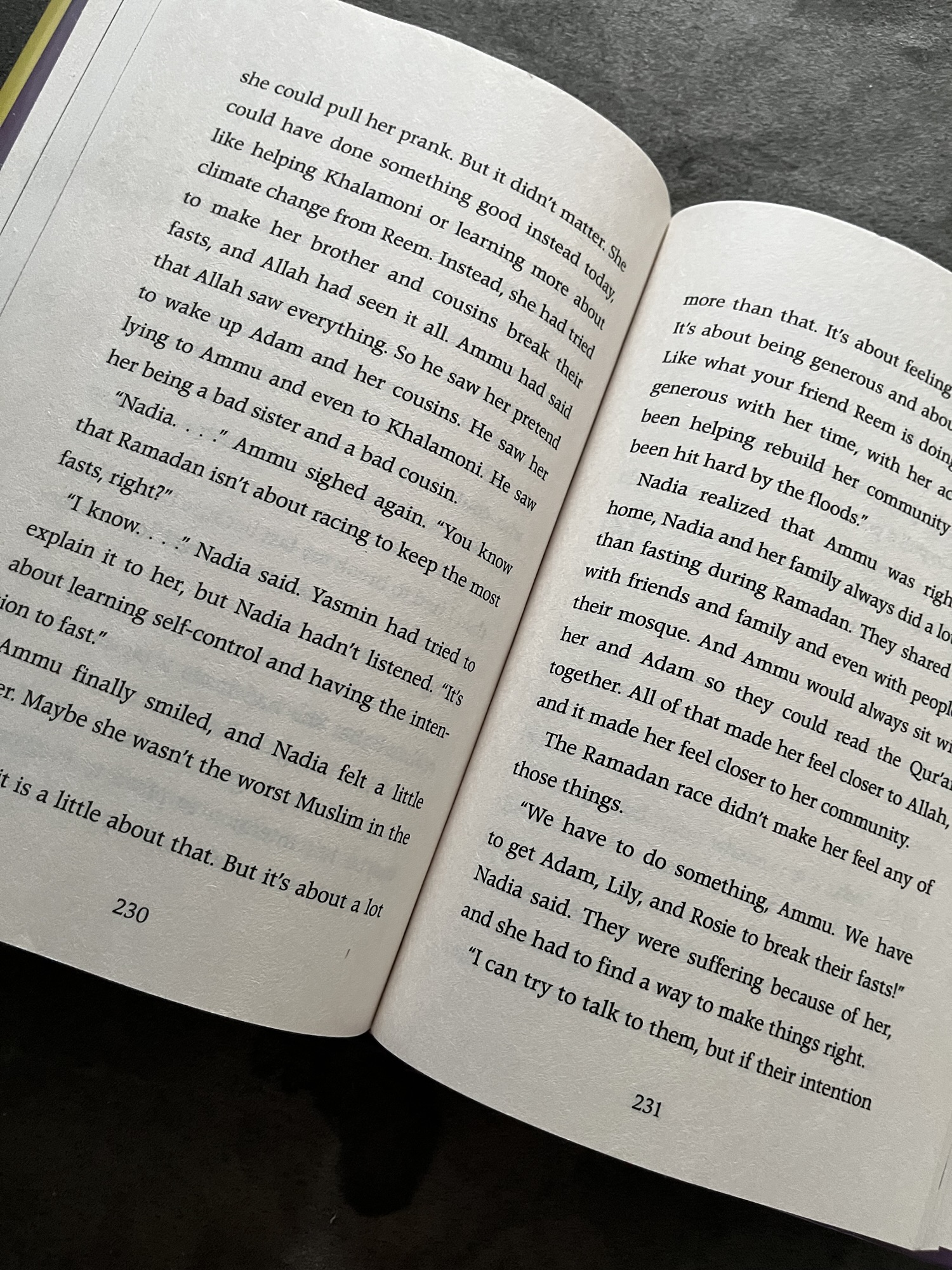
I would not know where to shelve this 40 page in a library, it has beautiful pictures, it is informative, resourceful, useful, and interesting- I’ve only delayed sharing it because I really have had to think, how best to use this book to its maximum potential, to make it truly effective. It is formatted externally as a picture book, but it reads much like an chapter book anthology with the stories connected by the road the diverse folks live on, Rahma Road, all coming together for a communal iftar, with some fasting and some not.  The spreads feature vignettes on the left of what each house is making, including tidbits of culture, facts about Ramadan, insights about method or ingredients, with the facing page being the recipe.  The book is incredibly meticulous and intentional in appealing to Muslims and non Muslims alike, as well as a variety of ages.  It works as a book for Muslims to see themselves in, non Muslims to get a peek at iftaar excitement through, messages about community and diversity celebrated, foodies to see new recipes that they can try, cultures to explore through food and native words, a story framing to feel connection, I really could go on and on with the layers and inclusions this book provides, alhumdulillah.  I think the best way to use and share the book is going to be for me to read it with my 5 and 9 year old children a week or so before Ramadan.  Where I can read the story portion, getting us excited for Ramadan, slipping in some reminders, appreciating Islam’s global presence, and then talking about the recipes so that they can pick dishes to try in Ramadan and add needed ingredients to the shopping list (I wish I made the effort to be this organized all year long).  I then will plan to leave the book out and have my teens flip through to find any recipes that they think sound good and will commit to making.  The book would work all year long, but as a new release, I’m sharing my plan with hopes that it can help your family as well. 

The book contains 25 globally inspired recipes, featuring 11 with accompanying stories.  I absolutely love that at the bottom of the recipes are page numbers for additional items that would pair nicely, or be condiments or beverages or desserts for the dish.  This allows easy personalization, fusion meals, and more importantly a way for different age groups to be able to help each other in the preparation.  Maybe koshari is a bit advanced for your kid, but the mint lemonade paired with it might be something they can tackle a bit more independently. 

The framing of everyone on the road coming together book ends with the neighbors sharing a meal at the end,  I love the backmatter explaining Ramdan, about the recipes, even about Rahma Road.  The message to the reader and the naming of consultants really is a credit to the time and effort put into this book.

A few of the dishes and countries featured are: Atayef from Palestine, African American Sweet Potato Pie, Nigerian Puff Puff, Japanese Temaki Sushi, Morrocan Harira, Uyghur Lamp Stir-Fry, Guatemalan Dobiadas, Turkish Chicken Gozleme, Malaysian Teh Tarik, Australian Mini Strawberry Pavlovas, South African Bunny Chow, Mexican Elotes  .I can’t wait to report back if my plan was successful, if the dishes prepared were a hit, and ideas for further maximizing the use of the contents it contains.

Sam(ira)’s (Worst) Best Summer by Nina Hamza

Standard
Sam(ira)’s (Worst) Best Summer by Nina Hamza

img_5254-1

The first 15% of this 336 page book were rough, the internalized Islamophobia/othering, the excessive discussion of Halloween and being toilet papered, but then I don’t know, something suddenly changed, and I was hooked.  There really is no plot, the reader just spends the summer with Samira, the highs the lows, you see it all through her tween eyes, which worked great for me because I truly loved her voice.  Her dry witty humor, the short choppy chapters, once the forced Islamic rep faded (I know, the irony is not lost on me), the book was hard to put down.  It has Muslamic flags: music is a HUGE part of the book, there is lying, mention of beer, parties with boys, Halloween, dancing, bullying, racism, ageism, Islamophobia, stereotypes, but it also has a lot of heart, finding yourself and voice, amazing sibling support, community, a super grandma, a little brother who is on the spectrum and absolutely a star who holds his own. It is very idyllic even for middle grade, but I think if you are ok with the aforementioned flags and have a middle grader trying to find their place or has had some friend trouble, this book will resonate and be well loved.

SYNOPSIS:
Sam/Sammy/Samira is wrapping up a school year that did not go as planned even though she found she loved being a photographer for the yearbook. She had a huge falling out with her best friend Keira, and she cannot wait for a summer of never leaving her room.  Her parents and older sister are heading to India, leaving her with her little brother Imran, and Umma, their Grandma who came from India to watch them. The end of school culminates with the yearbooks being delayed, her house being toilet papered, the talent show performance that she quit- being completely changed and incredibly racist, Keira spreading lies, and a new girl moving in to the neighborhood.  It is a lot for Samira, and summer is just getting started.  Umma knows the whole neighborhood before the week is out, and starts building a community that rallies around the three of them.  Samira becomes a roadie for a band, Imran gets an old artist to teach him to paint, parties are planned, voices are found, friendships are established, and videos are made celebrating the success and obstacles of it all.  Every time they call the rest of the family in India, even the reader realizes just how much they all have grown.

WHY I LIKE IT:

I just love Samira, she is relatable, funny, and you just cheer for her. I wish her lens though was Islamic.  She doesn’t wear a swimsuit because she misread the dress code, but had no Islamic perspective hesitation of going to a swimming party with boys.  She gets blamed for sneaking beer to a gathering and it says she doesn’t drink, but doesn’t stress, that it would be a huge, huge deal Islamically, not just because she is underage.  Music and dancing aren’t even blips on the radar. Umma prays, Sammy finds it annoying that her prayers seem to take longer when Sammy is waiting for her.  Once it mentions that Sammy was told to pray, but it never shows her praying.  Islam seems very forced, just enough for the character to mention Islamophobia in other instances where the label creates stress for the family.

The character development of Imran and Umma, even though they don’t change at all, has depth and grounds the story. I read a digital copy that doesn’t have any backmatter, but I do hope that the autistic rep is accurate.  Imran’s perspective and heart are so engaging and his and Samira’s relationship is very tender.  There is no pity, or looking down, he legit is fully fleshed out and awesome.  Umma is incredible too, her magic network of getting things done really is a super power.  She connects with people, has a huge heart, and picks her battles.  I wish I could take an internship from Umma.

I can’t figure out if the resolution to the “climax” is intentionally understated because Samira has moved on and grown, and having a big explosion doesn’t fit her character, or if it was just not written strong enough.  That is why I put climax in quotations, because there really isn’t a lead up, or rising action, it is a progression, but it is like the rest of the smaller ups and downs, it is just a stress of the day-to-day living of the protagonist.  The other thread of the “climax” being Alice’s grandma coming home from the hospital, really just seemed weak.  She should have come to the party in her wheelchair, I really didn’t get why it centered the party for being for her, but then let her leave.

I like that Keira wasn’t given redeeming qualities, and her treatment of Samira was never justified.  Often the bullies are shown to have hard lives, which is fine, but sometimes they are just mean.  Samira really takes the high road in handling Keira and what she wants their interactions to look like in the future, which is much better messaging than most books about bullies contain, and I really appreciate that.  

FLAGS:

Bullying, racism, stereotypes, lying, Islamophobia, agism, mocking, teasing, music, dancing, vandalism, mention of Halloween and beer.

TOOLS FOR LEADING THE DISCUSSION: It wouldn’t be possible to do this as a book club selection in an Islamic school because of the music element, but depending on the school, it might still be ok to shelve in classrooms and the library.

The Door Is Open: Stories of Celebration and Community by 11 Desi Voices: Hena Khan (Editor), Sayantani DasGupta, Reem Faruqi, Veera Hiranandani, Simran Jeet Singh, Supriya Kelkar, Rajani LaRocca, Maulik Pancholy, Mitali Perkins, Aisha Saeed, N.H. Senzai

Standard
The Door Is Open: Stories of Celebration and Community by 11 Desi Voices: Hena Khan (Editor), Sayantani DasGupta, Reem Faruqi, Veera Hiranandani, Simran Jeet Singh, Supriya Kelkar, Rajani LaRocca, Maulik Pancholy, Mitali Perkins, Aisha Saeed, N.H. Senzai

img_5078-1

I cannot in good conscience at the current time support this book as a whole, as many of the contributing authors have not used their platform to speak up, spread awareness, and draw attention to the genocide occurring in Palestine. As recent South Asian history involves colonization, I find this silence deplorable, disappointing and shameful, we need to do better. That being said, I am reviewing the book none-the-less because a few of the authors have spoken out, some quite a lot, and I hope those that have remained silent, will speak out. Our voices have power, and while it feels like it might be too late to take a stand, it is not. Lives might yet be saved.

img_5079-1

The 328 page middle grade book is a collection of 11 Desi voices, four of which are Muslim (Hena Khan, Reem Faruqi, Aisha Saeed, and N.H. Senzai). All 11 are threaded together by a fictional community center that houses badminton games, ameens, cooking classes, dancing for Navratri, chess tournaments, spelling bees, celebrating an aqiqah, and everything in between. The majority of the stories are joyful with threads of overcoming stereotypes being a frequent mention in a book filled with different cultures, religions, and perspectives. Potential flags and triggers: there is mention in one story of domestic violence, there are a few hetero crushes and one same sex identifying boy who isn’t ready to discuss his attractions, there is ostracizing of a single woman choosing to adopt, and a few mentions of divorce. As with all anthologies some are better written than others, but as a whole the book is pretty consistent in spotlighting something specific to religion or Desi culture, and having a hobby or family conflict push the character to problem solve, find their voice, and then be supported in a happy ending.

My favorite story is N.H. Senzai’s piece, I might be bias seeing as I check her Instagram numerous times a day for Palestine updates, but her story, with the domestic violence mom and daughter surviving and flourishing, is powerful, on level, and memorable. Framed around a mom’s prayers, duaas, she named her daughter Duaa. Duaa is a gamer that tries to make her mom happy by helping with her catering business. When she helps set up for a domestic abuse banquet at the community center she faces what her and her mom overcame by leaving in the middle of the night, and starting over.

I’m not going to review each story, but I will highlight the remaining Muslim authored ones. Aisha Saeed’s story doesn’t have any Islam specific mentions, her story is set during a mehndi at the community center. Her khala is getting married to Brian and moving to Kenya, and she is not happy, throw in cousins who are still mad at her for ruining their furniture with chocolate last year, and Maha just wants to hide in the back and pout.

Reem Faruqi brings her characters together through old fashioned letter writing. Orchestrated by Rahma’s nani, second cousins who will be meeting for the first time at an aqiqah at the community center, start corresponding to get to know one another, and gripe about siblings. When they finally do meet, in matching outfits no less, the girls decide their siblings, like their favorite candy, can be both sweet and sour.

Hena Khan’s story brings everyone together for an ameen six years in the making. Halima has finally finished the Quran and the family is throwing a party. Halima wanted a carnival type party, mom wants a formal affair, but when the community center is on the brink of being closed down, the family decides to invite everyone to show what the center offers the community.

Shiny Misfits by Maysoon Zayid and Shadia Amin

Standard
Shiny Misfits by Maysoon Zayid and Shadia Amin

img_4083-1

I admittedly wanted to read this book because the author is of Palestinian descent. I have seen clips of her standup and I’m not a huge fan, although I do appreciate that she doesn’t deny her culture and Islam, doesn’t let her cerebral palsy keep her from working toward her dreams, and that she is successful.  All good messages for a 256 page middle grade graphic novel that is not autobiographical, but draws on her life none-the-less.  I was surprised, though, that there are no Palestinian references in the book, very few Arab cultural touchstones either, and yet swearing on the Quran and not eating pork are presented fairly often, almost as “bits” to be laughed at.  I truly understand that the character is presented as culturally Muslim more than centering Islam in her identity, but perhaps because the protagonist, Bay Ann, is rather unlikeable, it just rubbed me the wrong way.  I love that the people in Bay Ann’s life do not caudle her, and that she is fierce and dramatic and driven, but she is an awful friend, her obsession with Alyee Maq (yes full names are used throughout) gets annoying, and I worry that some of the humor will be missed for the younger target audience and be taken as Muslim or Arab norms.  The presentation of a disability in a well illustrated graphic novel is empowering, an amazing Arab dad is nice to see, a divorced family co-parenting is important, but the foundation for much of the story is Bay Ann’s crush on Alyee Maq, he does kiss her on the cheek for social media likes, the book starts with Halloween Idol, features dancing throughout, and concludes with a Nondenominational Holiday Spectacular.  Bay Ann’s mom is not very kind or involved, and Alyee Maq’s mom, the only hijabi in the book, also is rather rough.  This is a book where I acknowledge my own overthinking, as both an adult reader and reviewer.  If you are ok with the (random) Islamic rep, kids will benefit from seeing Bay Ann as a fully capable person who happens to have a disability.  I’d suggest seeing if your local library has the book and looking through it first to see if you are comfortable passing it on to your kids.

SYNOPSIS:

Bay Ann is a tap dancer and with Halloween Idol coming up, she plans to win.  Her best friend Michelle is going to do her make-up as a zombie bride, and be her zombie bridesmaid with Davey Matt, the third in their trio, being the dead ring-bearer dog.  They can’t be her backup dancers because she is a one woman show, but she needs them to cheer her on.  When she wins, she has the spotlight stolen from her by Alyee Maq kissing her claiming he is making “a sick girls dream come true.” The clip goes viral, as Alyee Maq is a bit of a celebrity and the competition is on.  Whether it is science fair, social media posts, or the class debate, Bay Ann is determined to knock Alyee Maq down, claim the online spotlight, and  prove her talent is more than her disability.  With each attempt failing, her resolve grows stronger and her tunnel vision pushes those closest to her away, as she joins Alyee Maq with the hopes that if she can’t beat him, she will join him and achieve the fame she seeks.

WHY I LIKE IT:

I know the book is rather intentionally ridiculous, but I wanted to cheer for Bay Ann, and I never really liked her.  I don’t like how she treats Davey Matt, or even Michelle.  If she was better to them at the beginning, I think it would have shown how disconnected her mom Malak is as well as the school administrators, and made it more funny, but it truly just makes her seem like she is awful to everyone, and thus you don’t really find yourself invested in her stardom, her friendships, or her defining her own narrative.

I wish their was some Arab rep, not just a few Arabic words tossed in here and there.  I also wish there was more Islamic centering, or honestly even less. The swearing on the Quran really bothered me, Friday prayer is mentioned in passing, but there is no impact on the characters or the story, so it seemed misplaced.

The pacing of the story is rushed, and at times a bit chaotic.  I think it is intentional, but it makes it hard to connect to the characters or to grasp their motivations.  I don’t know that I truly ever understood why Bay Ann wants the spotlight, or why Alyee Maq is famous, or why Davey Matt hangs around Michelle and Bay Ann when they belittle him. It doesn’t need to be thoroughly explained, but when you finish the book, and feel exhausted, but can’t even articulate what the book was really about other than a girl that wants to be famous for her talent not her shaking, and won’t let anything or anyone get in her way, it seems like some opportunities were missed.

FLAGS:

Close male and female friendships with touching, an unwanted kiss, lying, manipulation.  Swearing on a Quran, disrespect. Using people.

TOOLS FOR LEADING THE DISCUSSION:

I don’t know that I would seek this book out to own, but in an Islamic school library if it found its way in, I would probably not object to it being shelved.

Kareem Between By Shifa Saltagi Safadi

Standard
Kareem Between By Shifa Saltagi Safadi

img_3395-1

It doesn’t matter how many Word documents you read, Goggle docs you add comments to, and screen shots you revise; to hold a physical book in your hands that you have been blessed to observe from the sidelines through numerous revisions, is mind blowing.  Reading the final version from page 1 to page 324, plus the backmatter, has left me at a loss for words with tears streaming down my cheeks. I truly cannot imagine the book any other way. All past drafts and storylines, were just stepping stones to get the book to this version, and as a fan of literature my whole life, to see this metamorphosis in real time has added to my respect and admiration of authors.  Enough about me though, this review is of the middle grade novel in verse that tells the story of Syrian American Kareem, a loveable boy caught in between choices, siblings, friends, labels, and global acts beyond his control.  He makes mistakes, he tries to make things right, and at the center of it all is his Islamic identity, love of football, and genuinely good heart.  I am biased in that I have self appointed Kareem as my nephew, but even after dozens of readings, I was moved to tears three times during the course of this reading.  I made my teens read the book and they loved it, and like them, we hope we get more Kareem in the future.
img_3541-1

SYNOPSIS:

Kareem loves football, particularly the Bears, and dreams of seeing his Arabic name on an American jersey one day in the NFL.  Unfortunately, he hasn’t made the school team, his best and only friend Adam has moved away, and the coach’s son is offering to talk to his dad for Kareem in exchange for some school help.  Add in a new Syrian kid at school, his mom going to Syria to take care of his grandfather, and the fruition of Executive Order 13769 aka the Muslim Ban, and seventh grade has Kareem scrambling on every down to say the least.

img_3543-1

WHY I LOVE IT:

The football framing, the literary inclusions, the Arabic, the Islam, all combine with such tangible heart to create a seamless read both as a compelling story and as an example of literary craft.  The language is on point and intentional, that even if you don’t know the character or novel referenced, the Arabic words included, or football terminology used, you will be invested in the characters and plot, and find yourself cheering for Kareem.  Often debut authors show promise, but their stories have plot holes, or pacing issues, or inconsistencies, that is not the case with this book.  The crumbs are there that tie everything together, the depth of the characters’ personalities reveal how developed they are, and the timeline keeps the book moving forward.  There are no dry or slow spots in the entire novel, it is easily read in one sitting as you find yourself nervous for Kareem, and curious how it will resolve.

Boys and girls, Muslims and non Muslims, Arabs and non Arabs, all will find themselves drawn to this book, and thinking about the characters, particularly Kareem, long after the final page is read.

img_3544-1

FLAGS:

Some stress and anxiety with missing parents.  Death, bullying, cheating, fighting, lying, racism.

img_3540-1

TOOLS FOR LEADING THE DISCUSSION:

The book is a solid middle grade, but the quality of writing and engaging plot makes it work for a middle school book club read as well.  I cannot wait to share this book widely.
Preorders speak volumes and I truly hope if you are able that you will preorder a copy, you can do so here.  Requesting your local public library to shelve the book is also a tremendous help to signal to publishers what type of stories and OWN voice authentic representation consumers will support.