Category Archives: 2nd through 4th grade

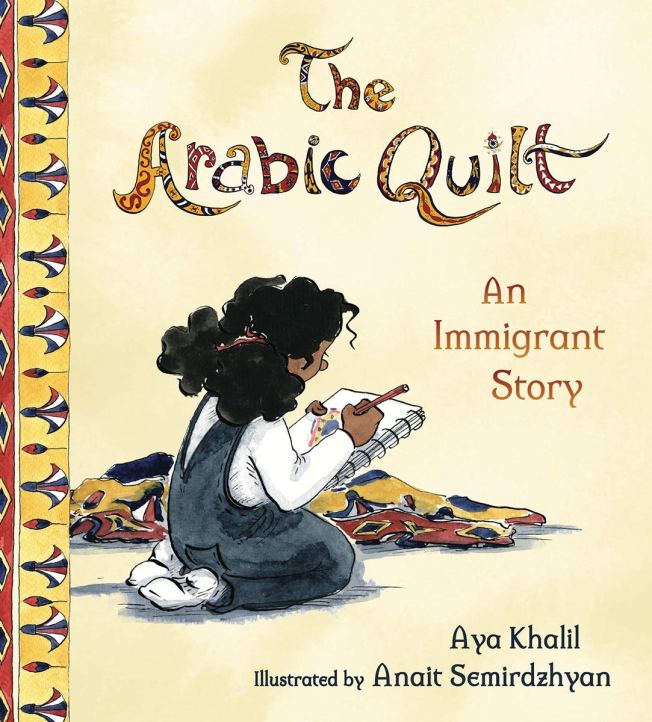
The Arabic Quilt: An Immigrant Story by Aya Khalil illustrated by Anait Semirdzhyan

Standard
The Arabic Quilt: An Immigrant Story by Aya Khalil illustrated by Anait Semirdzhyan


arabic quilt

This 36 page picture book tells a beautifully presented story that incorporates events from the author’s real life that convey a story of loving your culture, finding similarities and giving people a second chance.  Ideal for students between 2nd and 4th grade, younger children will enjoy having the story read to them, and older kids will benefit from the message as well.
7C03525B-A26D-427F-A7EA-591BB3095F10

Kanzi is about to start her first day of 3rd grade in a new school.  It doesn’t specify if she has just come from Egypt, but being she seems to speak English well, knows that she’d rather have peanut butter and jelly instead of a kofta sandwich and mentions that she got a quilt when she visited her grandmother, in Egypt, she possibly is just starting a new school, not her first in America, but it is considered an immigrant story, so I’m not certain. E403D261-438B-4263-A2FB-C3F8693C9D3E
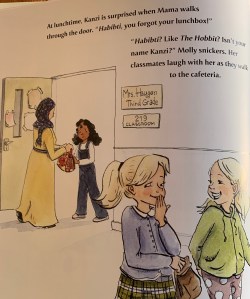
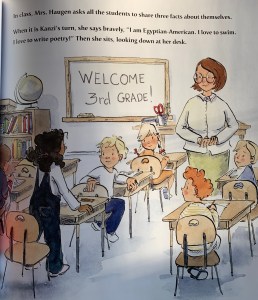
When she arrives in class and introduces herself she bravely says that she is Egyptian-American, but on the way to school she turns down the Arabic music in the car, so the reader sees that she is a little nervous about being seen as “different.”  When her hijab wearing mom brings her forgotten kofta sandwich and calls Kanzi ‘Habibti,’ classmate Molly teases her that she is being called a hobbit.

A crying Kanzi tells her teacher and Mrs. Haugen reassures her that “being bilingual is beautiful.”  That night Kanzi asks her mom to send her a turkey sandwich for lunch the next day, and before beds she writes a poem as she snuggles in her beloved quilt.

76FCD440-0D81-4893-80F3-1CC6033E8461

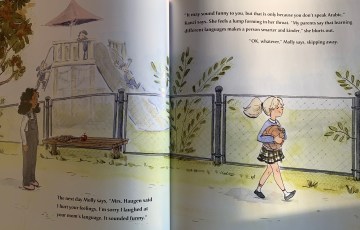
At school Molly apologizes to her and says that it just sounded funny.  Kanzi tells Molly it is because she doesn’t speak Arabic and that her mom says that “learning different languages makes a person smarter and kinder.”  Molly dismisses the comment and smugly walks off.

Mrs. Haugen sees Kanzi’s poem about her quilt from her grandma in Egypt and asks her to bring her quilt to school. The kids love it, and Friday Kanzi’s mom shows up to help with a special project: an Arabic quilt with the kids names.
98E875AE-0FD1-4827-BF39-1CA7B1172843

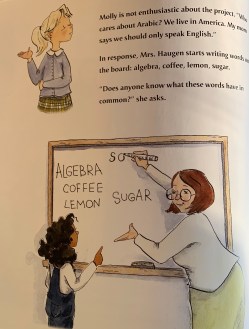
Molly is not enthusiastic and Mrs. Haugen writes English words that come from Arabic on the board: coffee, lemon, sugar, algebra.  Telling the kids that “we can speak non-English languages and still be American.”

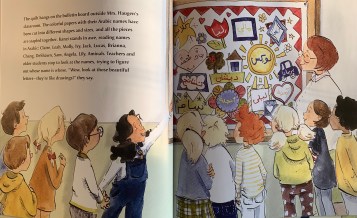
Kanzi and her mom write the kids names down and the children copy them.  The teacher cuts them out and makes a quilt to hang in the hall.  On Monday when everyone sees the quilt, they love the beautiful letters and colors.  Even Molly sincerely apologizes and asks Kanzi to write her mom’s name in Arabic as a gift.  The two hug and seemingly will become friends.
832244F2-1F7E-4C4A-9778-40E0EEC6BE82

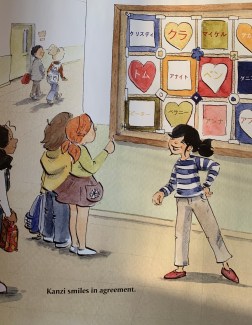
Across the hall another quilt is hung with names in Japanese, as another student and teacher were inspired by Kanzi and her quilt.  The last page of the story is a letter Kanzi has written to her parents telling them how grateful she is that she has two languages and that she will speak them without guilt.
BB6797A4-05C9-4CDC-AC70-88273ED3997B

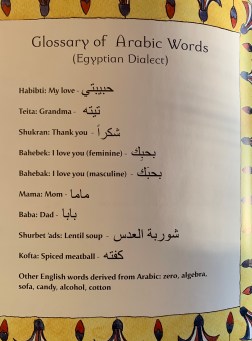
The story is beautifully told and exquisitely illustrated on well-sized 9.5 x 10.5 pages in a hardback binding.  The mom wears hijab and it mentions it, but there is nothing religious about the text.  It is a universal story of coming to be proud of your roots and inviting those around you to learn and grow.  There is a Glossary of Arabic Words at the end and a bit about the author and illustrator.
9AF3D465-F5DA-4F25-8FC1-5BEE16FD9B21

My kids favorite page by far was reading the names written in Arabic and they all enjoyed the story (ages 13, 10, 9, 4).  I actually had an issue when Molly apologized the first time, feeling that Kanzi’s response was a bit pretentious to what seemed like an 8 year old being told to go say she was sorry, but my older three unanimously and fervently disagreed with me, saying that she was obviously insincere and Kanzi knew it.  I’d love to hear from other readers if they felt like Molly was sufficient in saying sorry and admitting that it sounded funny and that Kanzi was arrogant in saying that people that know two languages are smarter and kinder, or if Molly was being rude and racist and Kanzi was sticking up for herself.
CF16ACA2-8EC4-443B-AA8B-2B9EA3D05D6D

Irregardless, the book is well done, enjoyable, and will get repeated reads by a large range of readers.  My children keep pulling it off the book shelf, and for that I need to thank Gayatri Sethi (@desibookaunty) who generously sent me the book the same day I checked it out from the public library.  Her generosity once again is a gift that I hope to pay forward in the future.  This book also highlights how amazing teachers can be and often are in facilitating inclusion, understanding, and respect.

ED8D19BC-96FE-4B8F-8B35-87A1AA885B7F


Planet Omar: Unexpected Super Spy by Zanib Mian illustrated by Nasaya Mafaridik

Standard
Planet Omar: Unexpected Super Spy by Zanib Mian illustrated by Nasaya Mafaridik

planet omar

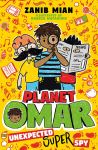
Omar is back, and the nine year old kid with a huge imagination, proves that his heart is even bigger.  Middle graders that loved the first version, The Muslims, and the reboot, Planet Omar: Accidental Trouble Magnet, will undoubtedly love this book’s adventures and the real, relate-abl, presentation of Islam in a Muslim family.  While it references the first book, it can work as a stand alone book too, and can and will be enjoyed by kids and adults, girls and boys, Muslims and non Muslims.  At 217 pages, the large spaces, doodles, playful fonts, and illustrations, make the book fly by and beg to be read again and again.

C95DB8C6-9652-4EB8-8008-112361FAE8DF

SYNOPSIS:

Omar’s family still has their Science Sundays, but they don’t visit a new mosque every Saturday, as they have found a mosque near their home that gives his parents, “secret smiles” and them all a sense of community.  Omar and his sister still bicker, and his little brother Esa is still lovable, and the former bully, Daniel, is now a great friend to Omar and Charlie.  Life is good, Alhumdulillah, but in the midst of the boys planning how to get laser guided Nerf guns and have an all out battle, Omar learns the mosque’s roof is in need of repair and that the congregation will need to come up with 30,000 pounds to cover the costs, and fast.  In an act of selflessness, Omar abandons his dream of a foam gun and donates to the masjid.  Seeing that is not going to be anywhere close to enough he plots and schemes with his friends, his non Muslim friends, on how to raise the funds.  They bake cookies, make origami birds, and get their school to host a talent show to raise the money.  Their teacher and the head teacher coordinate the hall and judges and winning prizes all to help out Omar and the mosque, in the end though, they raise just under 1,500 pounds.  Not enough by themselves, but a great contribution to what other people hopefully are scrounging up.  The worst part however isn’t that they didn’t make enough, but that what they did make, goes missing.  Omar, Charlie, and Daniel, along with the parents and police and school personnel, try and find the money and who might have taken it before time runs out.
0030B40D-17F8-415C-A54A-7874768A5B5D

WHY I LIKE IT:

I love how effortlessly the author adopts a nine-year-old’s voice and persona.  So many of the details, for example, about how the school administration signed off on a fundraiser for a religious building, and how tickets were sold, and the planning took place are left out, as a nine year old, probably wouldn’t know, or be concerned with the logistics of such endeavors.  It seemed like some details should be given, but I doubt readers would feel that way, so I pushed it aside and went along for the ride.

Omar has amazing friends, from the unpredictable old neighbor lady, to his non Muslim friends being so enthusiastic and supportive of saving a mosque.  I love it, and that they are that way because Omar is so unapologetically Muslim first.  They even discuss a hadith about how building a mosque, builds you a house in Jannah, and a mainstream book published this, and it is AMAZING! It isn’t just a kid and his family, who happen to be Muslim, the whole plot of the book is to save a mosque, and the fact that this book exists, seriously is so beautiful, and powerful, and hopeful, Alhumdulillah.

This book has a lot of layers, most kids won’t pick up on the interfaith aspects being so ground breaking, or the beauty of teachers and parents believing and supporting young kids, but will just read it as a funny story with anecdotes and inside jokes that they get as kids, as Muslims, and maybe even as Desis.  It truly is the culmination of an author who can write well, characters that our kids can see themselves in, and an opportunity to tell our OWN stories that make this book work for kids, adults and everyone in between.

3C3DA84E-29F6-4A6D-90FE-0BC134E7E615

FLAGS:

Omar and his sister are mean at times, but alas love each other and look out for each other too.

TOOLS FOR LEADING THE DISCUSSION:

I don’t do an elementary book club, but if I did, I would do this book in a heartbeat.  For middle school it would be too quick of a read, but I think all classrooms and all libraries should have the book, up through middle school.

https://www.alaraby.co.uk/english/society/2020/2/7/planet-omar-pushing-for-muslim-characters-in-childrens-literature

I got my copy here in the US at www.crescentmoonstore.com and as always you cannot beat their customer service and prices.  If you don’t have the first book, you can get it there, too.  Thank you Noura and Crescent Moon Store.

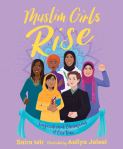
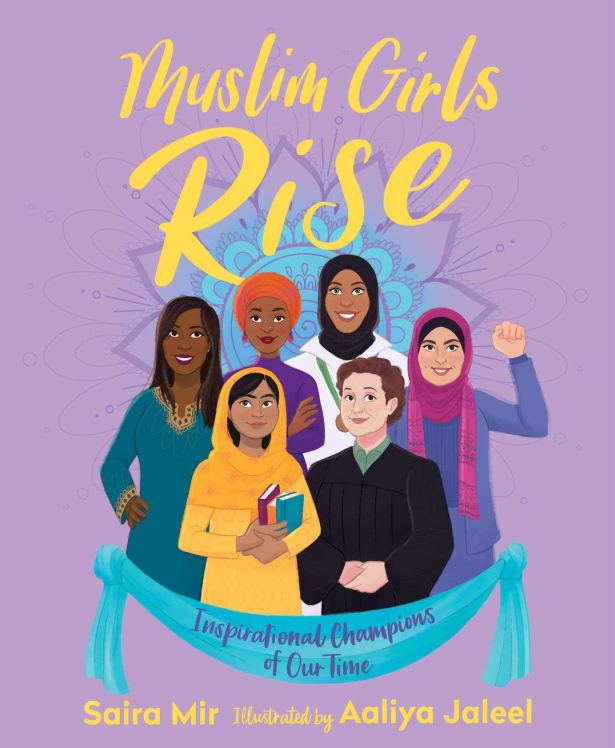
Muslim Girls Rise: Inspirational Champions of Our Time by Saira Mir illustrated by Aaliya Jaleel

Standard
Muslim Girls Rise: Inspirational Champions of Our Time by Saira Mir illustrated by Aaliya Jaleel

rise

Women you have heard of, some you are meeting for the first time. Some you like, some you disagree with, women that cover, women that don’t, some young, others older, some athletic, some academic, some a little bit of both.  One fictional, a few political, but in the end, all strong women of today, all Muslim, all unique, from all over the world, all known for paving the way for others to follow.

C51C5834-B3C5-4D19-94B3-99B21ADF83EA

In 42 pages, 19 females are highlighted and illustrated to inspire Muslim and non Muslim boys and girls alike, but really Muslim girls will get the most out of it.  Sure a female gets mentioned here or there in other compilations of influential people of our time, but this one, well, this one seems mostly for us.

2D8175C8-0798-4AC1-BF15-D0A9C284AEA9

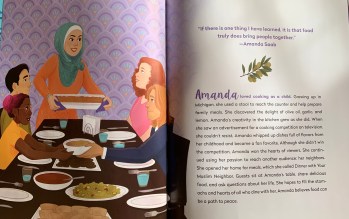
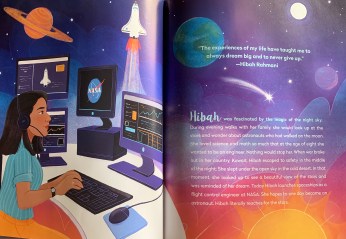
There are famous females in science, activism, fashion, film, sport, education, media influencers, make-up artists, you name it, and Muslim’s participate, so finally a book shining a light on the best of the best.  With each person getting a full two page spread, a few tidbits about who they are and what they are “famous” for are detailed in easy to read sentences that inspire, and if you haven’t heard of them before, enough general knowledge to get acquainted.  A few felt a little generic, but once you have a name, Googling them or researching them, is obviously, not difficult.

6D798E55-709C-442A-8DFF-4BA184C960E1

I wish there was a bit more information detailing who was chosen and why.  At first I thought it was  US or “western” movers and shakers, but then you have Maria Toorpakai Wazir, the tennis player in Pakistan, and Shirin Ebadi from Iran.  So then I thought ok, they are all contemporary, but Maryam Mirzakhani passed away in 2017.  Needless to say, one could argue that the list is arbitrary, and I think I would agree.

85FF7A9C-FD80-4F37-A1DE-B8726762E9CB

One could also argue, that these women may make history for notable things, but that they might say or do things that you might take issue with, and again, I agree.  They are people, they are fallible, and diverse, and have different perspectives and life experiences, but that’s ok, infact I think that might even be the point.  We all have different passions, and paths, and views and yet at the end of the day we should be able to lift each other up and inspire.  I think every person who reads this book will find someone that sounds or feels or looks like them, and that is a good thing, no, a great thing!

9C6EB606-F612-40BF-A947-092D2B76F1FE

My favorite was the Kamala Khan entry, because I didn’t realize the G. Willow Wilson was Muslim.  I erroneously assumed the other co-creator, Sana Amanat gave Kamala’s back story and home life its sense of OWN Voice, and I love that I learned I was wrong from a book.

2EC5EAF4-87F4-406C-B4D1-C95341536B66

The illustrations are right on and do an amazing job of conveying the character and the inspiration of the collection.  The book is much needed and I hope they do a similar style book for Muslim women in other time periods.

Special gratitude and appreciation to Gayartri Sethi (IG @desibookaunty) for gifting me this book for no other reason than to share the power and strength of women, and being a leader in that, by sending me a beautiful book.  May I learn from your generosity and pay it forward! Thank you.

Mr. Wolf’s Class by Aron Nels Steinke

Standard
Mr. Wolf’s Class by Aron Nels Steinke

wolf

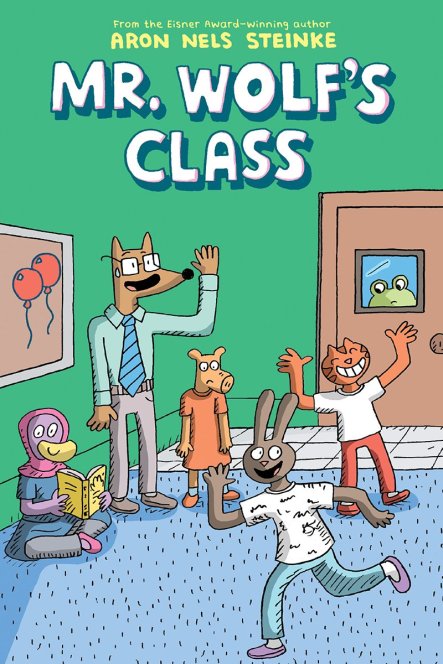
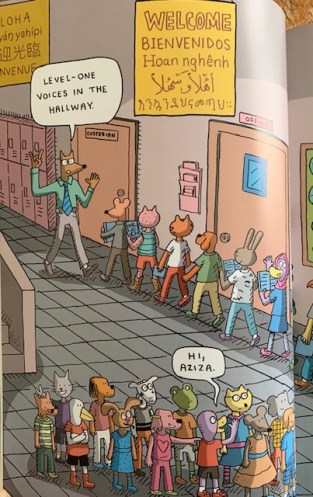
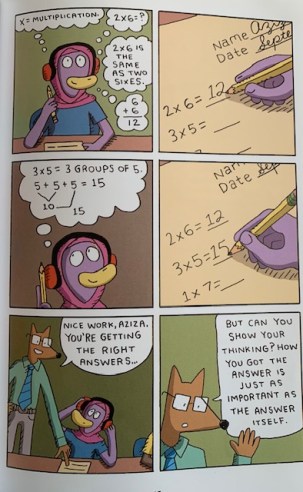
I know this AR 2.1, 156 page graphic novel probably doesn’t deserve a review, but for as important as OWN voice books are, books with Muslim characters thrown in the mix are important for representation too.  Yes sometimes we are the star and we definitely need to tell our own stories, but we are also friends, and side-kicks and supporters too.  In this case we are a purple duck with a headscarf named Aziza, that thinks she is smarter than the other 4th graders in Mr. Wolf’s class, but fits right in with the quirkiness of the anthrmorphized cast too.  There is nothing mentioned about the scarf or about Aziza’s faith, there is also a boy named Abdi in the class that is a cat and could also be Muslim, but really, in this silly book which is the start of a series, I was just so giddy to see a Muslim included and grateful for the representation.

IMG_0487

SYNOPSIS:

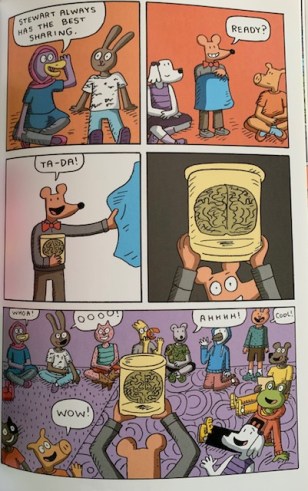
It is the first day of 4th grade and Mr. Wolf is nervous.  Margot is new too, but the other kids seem to know each other already.  Aziza, Abdi, Randy, Sampson, Henry, Penny, Bobby, Lola, Oliver, Stewart, Miguel, Noah, Molly, Lizzy, Oscar, and Johnny are all different animals and all unique.  The book is really just a handful of the characters trying to survive the first day of school.  Whether it be confronting another teacher about stealing your stapler, making a friend on the bus, having rats steal your lunch, falling asleep in a box because your new baby brother kept you up on all night, or trying to figure out why you have to show your work when on a math assessment.  The book will resonate with kids 2-4th grade and make them giggle at the silliness of it all.

IMG_0488

WHY I LIKE IT:

I love that the teacher is more nervous than the kids about the first day of school and that they all seem to be doing the best they can.  Aziza is earily irritated by her classmates who don’t seem to want to do their work, but she is no more annoying than the other students and all seem to have diverse backgrounds and issues at hand.  The author was an educator and the book reads true to any one who has littles or has been in a school environment, making it all the more charming.  There are four books thus far in the series and my kids say Aziza features prominantly in the second book too.  I have had this book in my house for a while now, and for some reason just now paid attention to the cover today when begrudgingly scolding my kids about leaving books out everywhere.  I asked if the duck had on a hijab and two of my boys without budging to put away said book, replied, “yeah it is Aziza.” As if seeing a muhajaba duck is the norm, who knows maybe it is.  So, I sat down to read the book with enthusiasm and 20 minutes later, thought how great it is to be included. Representation does shape perception, and non Muslim kids may not think anything of it, or my own kids who are flooded with Islamic fiction books, but I can only imagine how ecstatic I would have been as a kid to be included as the norm without fanfare or explanation given.

IMG_0489

FLAGS:

They talk about if farts are better or ice cream in the creation of a venn diagram.

IMG_0490

TOOLS FOR LEADING THE DISCUSSION:

Wouldn’t do it for a book club, but would definitely have it in a class library and school library.  Fun book, seemingly fun series, and easy reading for all levels.

https://www.mrwolfsclass.com/interviews-and-press

Teach Us Your Name by Huda Essa illustrated by Diana Cojocaru

Standard
Teach Us Your Name by Huda Essa illustrated by Diana Cojocaru

name cover

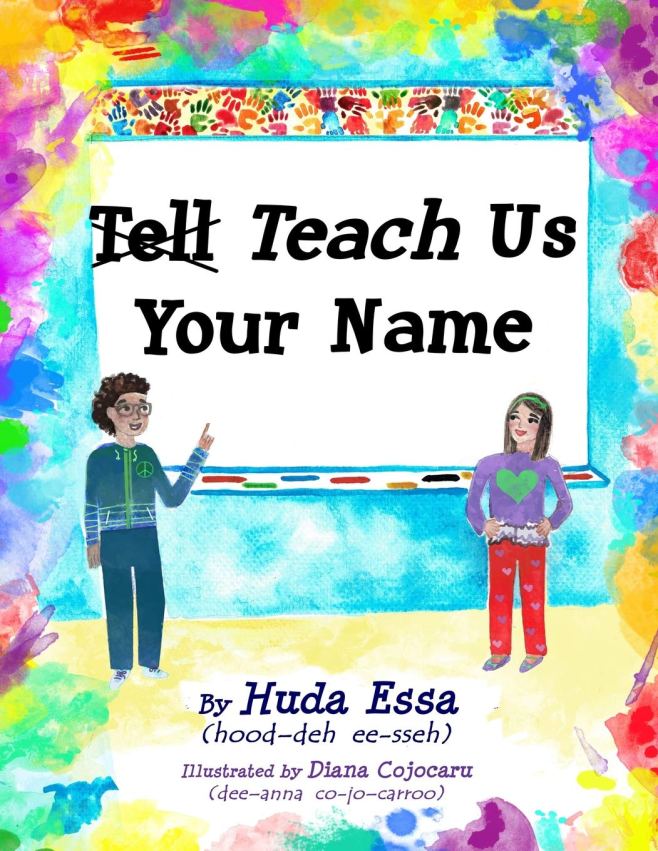
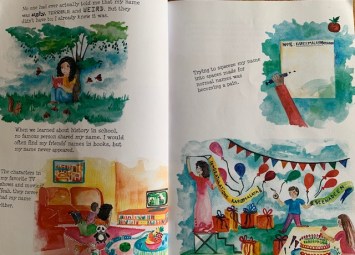
This book will resonate and empower anyone who has a “different” name, and hopefully provide insight and awareness for us all.  This 32 page picture book for grades 1st and up has a self empowering message, a confidence building approach, and problem solving tips to achieve a desired goal in a respectful way.  Written by a Muslim author, the book’s text is well done, unfortunately the pictures are inconsistent to me, some are beautiful and detailed, others seem rushed and unfinished.

IMG_0476

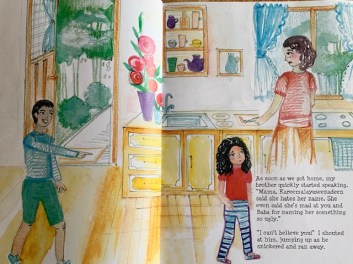
There are 20 letters in Kareemalayaseenadeen’s name, and the first day of school is such a stress for her.  She fears the teacher stumbling over her name, the other children laughing, and her unable to tell them how to pronounce her name correctly.  Her mom tries to explain that for some people the kids at school have hard names, and that for some people her name is easy.

IMG_0477

She reflects that in fact no one has ever made fun of her for her name, but that in history class she never sees her name, or on TV or in movies or on key chains.  She can hardly fit her name on her worksheets, and fitting it on banners is impossible too.  Eventually the kids kust call her Karma-Deen and even though she dislikes it, she is too shy to speak up.

IMG_0478

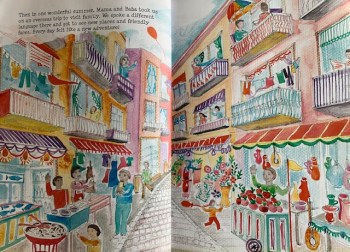
Over the summer, Kareemalayaseenadeen goes on vacation to visit family.  She doesn’t even think much about her name where everyone can pronounce it and say it with ease. Her Sittee though, has heard about her anxiety and sits with her to help her work through it.

IMG_0479

Sittee asks Kareemalayaseenadeen if she knows that her name means “excellent guidance” and that her name is a big part of her.  If she doesn’t like her name she isn’t liking an important part of herself.  She then urges her grandaughter to guide others on the proper way to pronounce her name.

IMG_0480

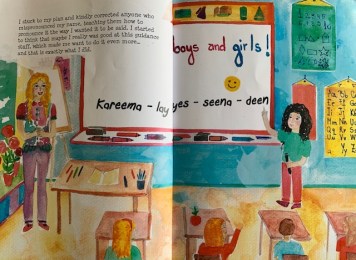
On the flight home, she ponders her grandma’s words and how to guide others to proper pronouncation, without being rude or settling on them shortening her name.  When she gets home she puts her plan in to action. And it works!

IMG_0481

When Kareemalayaseenadeen grows up, she becomes a teacher and each year she reads this book she has written (the one I’m reviewing) and asks her students to teach her how to say their names.

IMG_0482

The importance of how valuing someones name values the person and their family and culture is really one that as a society we have to keep working on.  We can say  names from Lord of the Rings, and Star Wars and Game of Thrones with no problem, so why can’t we try and pronounce someone’s name who is real and next to us and important to us? We have become lazy, and we need to do better, this book is sweet and kind and should really be read regularly as a reminder to us all, that names are beautiful.

IMG_0483

There is nothing religious about the book or even culture specific. There is a hijabi in the illustration of the market place in the unspecified “overseas country” and the name Kareemalayaseenadeen has Arabic bits, but a lot of names do as well, grandma is refereed to as Sitti, but isn’t defined, so the book is definitely meant for eveyone, especially those who will never find their name on a mug at a gift shop!


Amira Can Catch! by Kevin Christofora illustrated by Dale Tangerman

Standard
Amira Can Catch! by Kevin Christofora illustrated by Dale Tangerman

amira_can_catch

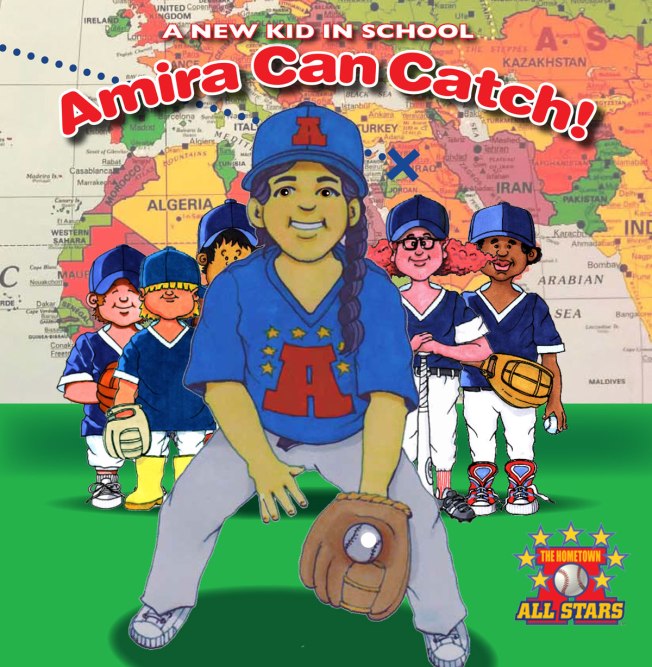
This is book four in the Hometown All Stars series aimed at 4-7 year olds.  The purpose of the series is to teach real coaching skills to help children learn about baseball, get out of the house to play, and have fun.  The 34 page book is baseball technique heavy with a fictional storyline to move it along.  Most sports books focus on team work and being a good sport, but this one takes it a step further by emphasizing the basic skills needed to play the game, as well as sneaking in lessons about inclusion and acceptance.  If your child is American and likes sports, the book will be a hit, pun intended, but there is a lot of text on each page and as America’s pastime, there is a lot of space dedicated to what it means to be American.

IMG_0410

A refugee Muslim girl from Syria, Amira, is invited to play on the after school baseball team, but first needs some help at school with spelling and adding.  Luckily the kids in class are super nice and accepting and help her learn about life in America, while similarly listening to her tell about life in Syria and at the refugee camp.  Not only do they all become friends, she also gets everyone to appreciate how much food they have, and the variety, as well as gets everyone to try pickles. Yum! They like them.

IMG_0411

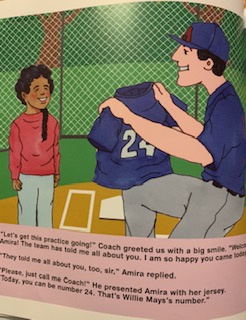
The kids at baseball practice are also incredibly welcoming as they get Amira a jersey, and teach her all about #24 Willie Mays.  From here, it is like a virtual baseball practice, the kids warm up with stretches, running the bases, and practicing their stances.  There are little info headers explaining things such as what hand to wear your mitt on and explaining how to squat, why the coach is using foam balls, and reminding the reader not to throw balls in the house.

IMG_0412

The kids learn three different types of catches.  How to stand, how to position their hands and how to be ready.  They run drills and practice, practice, practice. They find out Amira is really good, and she tells them that they had a lot of time to practice catching and throwing in the refugee camp.

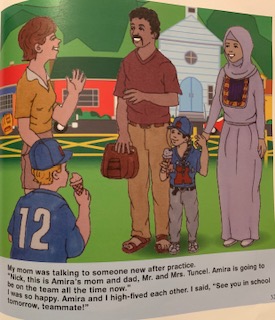
The coach then asks the kids and readers questions before Amira’s parents arrive to pick her up.  With big smiles on their faces, the mom is wearing a hijab and chatting with the narrators mom.

IMG_0415

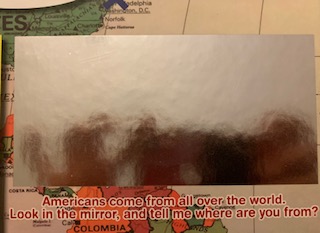
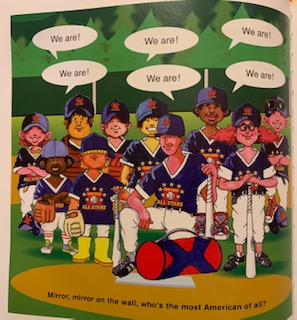
The book ends with a whole page on “What Does It Mean to be American,” a review of new words learned in the book, and all the kids answering who’s the most American of all, with “We are!”  The back cover has a reflective patch with the statement “Americans come from all over the world.  Look in the mirror, and tell me where are you from?”

IMG_0416

The book and series are a great way to learn about a game, that really a lot of kids today may not know much about.  Some of the terms, the skills, and just familiarity is clearly conveyed, with the illustrations providing the visuals and diagrams for what the coach is talking about in the text.  The fact that the author chose to add a refugee to such an “American” book and have the supporting  characters so welcoming, really does show the best of what Americans can be.

IMG_0417

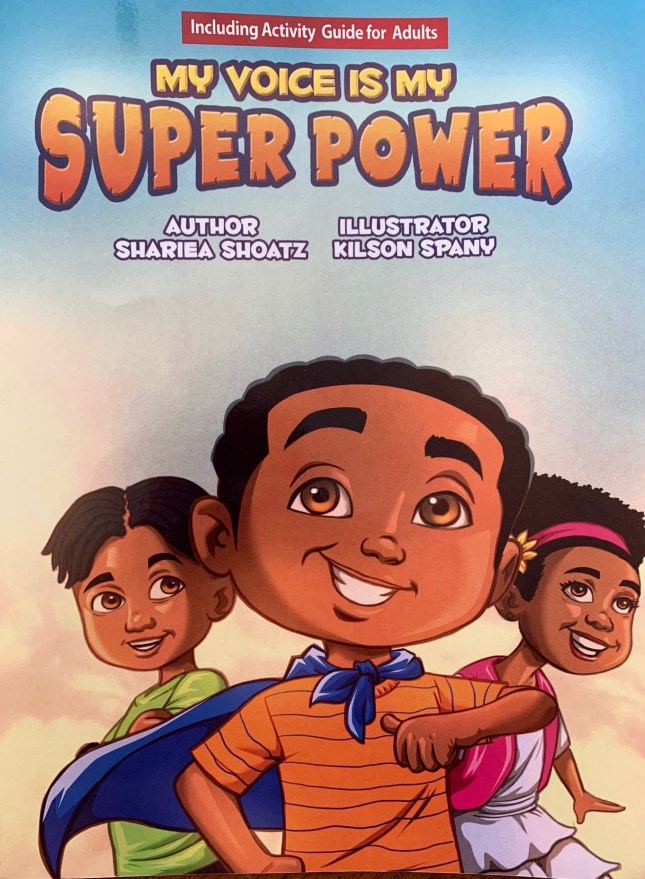
My Voice is my Super Power by Shariea Shoatz illustrated by Kilson Spany

Standard
My Voice is my Super Power by Shariea Shoatz illustrated by Kilson Spany

IMG_0210

I want to believe most parents and/or caregivers discuss body boundaries and what’s appropriate and what’s not, with their children regularly.  But if you don’t, or haven’t, or just glossed over it while at the doctors office, this book is a great discussion starter and road map.  The author comes from a place of educational and personal experience and the 33 page book tells a story that children can read independently with a discussion guide for parents to follow at the end.  Even if you don’t feel comfortable letting your children read the story independently or with you, there is a page depicting male and female private parts, I still think the book is a way for adults to face their own squeamishness of discussing it, and get ideas of how to present to their children.  Being nervous or uncomfortable is not an excuse to not discuss sexual abuse against children with our children.  For their voice to be their super power, we must first be willing to use ours to open the subject with them, educate them, and empower them.  Abuse happens in every culture, religion, socio economic bracket, period, to think differently is naive and dangerous.

IMG_0120

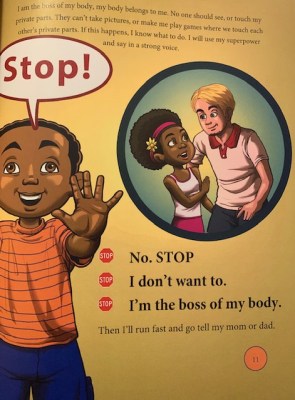
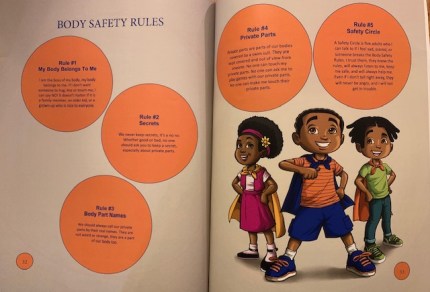
Nine-year-old Buddy is heading to his cousins’ house for a sleepover, but before heading out, he addresses the readers to make sure they know the body safety rules and to make sure his super power, his voice, is ready.  His voice is what he can use if he feels unsafe, or to help his friends if they feel unsafe.  He can say “Stop” or “No” if someone breaks one of the Body Safety Rules.

IMG_0121

His mom, a muhajaba, has being teaching him since he was three to use his voice to let people know his body belongs to him.  He knows he can say no when he doesn’t want to hug or kiss or touch someone, even if they are a family member.

IMG_0122

The book then talks about body parts that everyone can see and labels them with a diagram before explaining private parts and labeling them as well.  The book also discussing using the proper names, not nicknames or “cute” names, such as hotdog and cookie, to describe anatomy and body parts.

IMG_0123

If someone breaches or doesn’t listen to the “No” or “Stop” the book encourages everyone have a safety circle of adults you trust and like and that you feel safe and comfortable talking to.  It also mentions that if one person doesn’t listen or believe you to go to another person in the circle until someone does.

IMG_0124

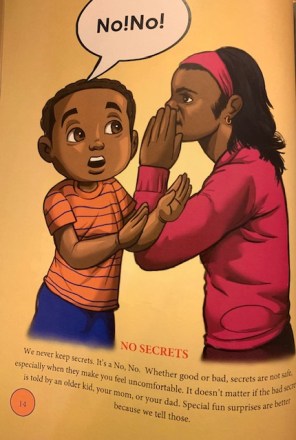
Another rule is No Secrets, and the book explains the difference between a secret and a surprise, which does eventually get told.

IMG_0125

When Buddy gets to his cousins house, the kids play and have fun, when a friend of the aunt’s stops by and gives only Keisha a treat before leaving.  When Buddy asks about the friend, his cousin talks about how they play pretend and tickle and how they have a secret touch game.  Buddy explains the rules to his cousin and then goes with her to help her talk to her mom about the breaking of Body Safety Rules.

IMG_0126

The story ends with the mom calling “people” to take the friend away and the kids feeling empowered that they kept their bodies safe.

IMG_0127

The Activity Guide for Adults gives information for each of the pages in the story to help the adult understand why that part of the story is included (i.e. grooming, disclosure, etc.) and activities to ensure understanding and mastery.

IMG_0128

The book is not religion specific, and would be a great benefit to all children, everywhere with parental involvement and dialogue.

May Allah swt keep all our children safe, ameen.


The Chronicles of Bani Israil: The King, Queen, and the Hoopoe Bird by Dr. Osman Umarji illustrated by Sama Wareh

Standard
The Chronicles of Bani Israil: The King, Queen, and the Hoopoe Bird by Dr. Osman Umarji illustrated by Sama Wareh

the king

At 134 pages the fictionalized retelling of Prophet Sulaiman’s (AS) kingdom and interaction with Queen Bilqis comes to life from the point of view of a Hoopoe bird.  The book is marketed as a “Quranic fantasy adventure,” which I found a bit misleading.  The book is rooted in Quran and Hadith facts according to the author, and colored in to try and tie a story together, but even for 3rd and 4th graders I don’t know that there is much adventure or suspense.  As a prophet story it is pretty solid, but as an adventure book it seemed a bit scattered in its attempts to give history, draw in unrelated anecdotes and make it seem intense, when the dialogue suggested otherwise.

IMG_9137

SYNOPSIS:

The book starts with the narrator setting the stage to tell his story of being in Prophet Sulaiman’s army nearly 3,000 years ago in the land of Sham.  Told in first person and  limited to what he saw, the Hoopoe bird (Hud-hud) addresses the reader and begins his tale.  He first gives some information about Hoopoe birds and Prophet Dawud (Prophet Sulaiman’s father), before lovingly describing Jerusalem and how the Bani Israil came to the land of Sham.

The first real glimpse of what kind of ruler Prophet Sulaiman is, is given with the detail allotted to how he repaired Masjid Al-Aqsa.  The bird then tells of Prophet Sulaiman’s many powers and gifts from Allah (swt), the ability to control the wind, control liquid metal, speak with animals, and of course the Jinn.  Slowly, the reader begins to understand how impressive Prophet Sulaiman’s kingdom is, not just by being told, but being shown, so to speak, and reminded pointedly by the Hoopoe that despite so much power how humble towards Allah swt, Prophet Sulaiman remained.

There is a tangent about his love of horses, before the Hud-hud takes center stage again as a spy in the powerful army of men, jinn, and animals. The story of the ants is shared and about half way through the book it is on one of the bird’s scouting missions that he sees a Queen and her people worshipping the sun.

The back and forth between Prophet Sulaiman and Queen Bilqis as Prophet Sulaiman urges the Queen to allow her people to worship Allah or risk invasion is a familiar tale and one the author asserts he tried to use only Islamic sources to include.

The book ends after the Queen has visited, embraced Islam, more anecdotes about Prophet Sulaiman’s wisdom are shared and how even in his death he attempted to show the doubting people the power and oneness of Allah swt.  The revelation of the termite breaking his walking stick and the retirement of the bird who had lived a most wondrous life, conclude the story before an Author’s Note at the end of the book.

IMG_9117

WHY I LIKE IT:

I love Prophet stories and especially ones that are easy to read, memorable, and factual.  I think the book does a decent job in a fictionalized retelling of getting a lot of the important information in, albeit sometimes a bit forced, but keeping it on level for upper elementary and being clear and concise.  I didn’t stumble on grammatical mistakes or find parts confusing, it was well told and presented.  More than once in the book, I felt like it would have made a better oral story than written one.  The bird had to articulate how he knew stuff if he wasn’t there, and he kept asking the reader questions or telling them to pay attention.

The book is meant for Muslim kids and I wish there would have been footnotes or sources.

The illustrations were nice, they are full color but I am admittedly bias as I grew up writing letters to the illustrator who was my penpal for a few years.

IMG_9043

FLAGS:

None

IMG_9092

TOOLS FOR LEADING THE DISCUSSION:

Doesn’t fit my book club criteria, but definitely think kids would benefit from reading the story and discussing how the author shared the information, what they think the Hud-hud’s life was like and then maybe trying to retell a story of their own from a different perspective.


Azad’s Camel by Erika Pal

Standard
Azad’s Camel by Erika Pal

camel

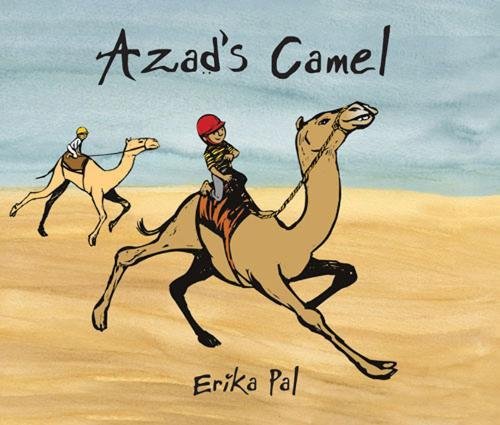
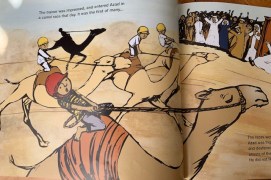
This beautifully illustrated picture book takes the reader in to the world of camel racing, children jockeys, mistreatment by adults, children being sold by their families and running away, all in a span of 40 pages and on an AR 3.5 level.  Yeah, its a lot for a kid’s book, but it has a happy ending and it does draw attention to an atrocity not often discussed or thought about.

IMG_8781

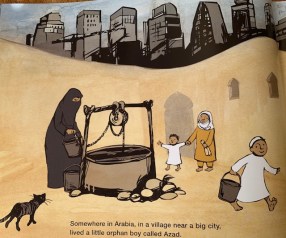
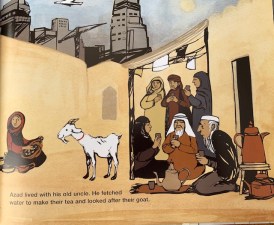
Young Azad lives with his old uncle in a village outside the city.  He helps take care of the goat and fetches water for tea in the mornings,  in the afternoons he plays with his friends.  One day he is doing handstands on a soccer goal post when a rich Sheikh drives by and sees him.

IMG_8780

The Sheikh comes back and convinces the uncle to let him take the boy to be trained as a camel rider to one day be famous.  The uncle agrees saying he can’t afford to keep him.

IMG_8782

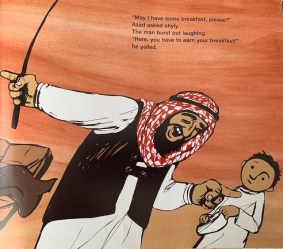
The Sheik takes Azad to the desert with other boys to live and be trained.  Azad learns that food is earned and chores are a must.  The races are dangerous and Azad doesn’t like them, but he is good and is forced to keep racing.

IMG_8783

One night the camel, Asfur, talks to Azad and the two plan to keep running past the finish line at their next race.  The pair are so fast that, they do just that, and no one can catch them.  They run through the city, and back to the desert.

IMG_8784

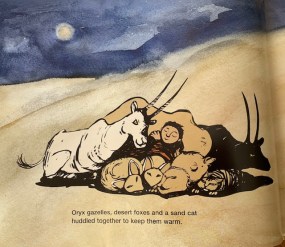
The other animals of the desert keep them warm when it gets cold and until a Beduin tribe discovers them and takes them in.  At last Azad and Asfur find a home.

IMG_8785

There is information about camel racing at the end including how robots are replacing child jockeys in some countries and how many young children are being returned to their families, school and a normal life.

IMG_8786

I like that the book takes on a real and sad occurrence, bringing camel racing and forced child labor in to light.  The story is truly written for younger elementary kids with short paragraphs on each page, large engaging illustrations, quick jumps in events and glossing over any truly graphic details.

IMG_8787

I do worry that stereotypes are reinforced with the use of calling the rich man who bought Azad a “Sheikh” and the Bedouins dancing at the end.  Culturally the book is a generic Middle Eastern country and doesn’t mention or emphasize religion at all with the exception of the women in the pictures being veiled.

I found the book at the library and think it has good information to discuss with your children, but I don’t know that I can see it being anyone’s favorite book, or a regular night time request.  While, yes, it does have a happy ending, you don’t really “feel” what Azad is going through, you are just glad he finds people that want him.


My Grandma and Me by Mina Javaherbin illustrated by Lindsey Yankey

Standard
My Grandma and Me by Mina Javaherbin illustrated by Lindsey Yankey

grandma and me

I absolutely love that this 32 page picture book for children five and up breaks so many stereotypes and highlights so many commonalities between all people, everywhere.  I strongly believe that books like this, can change people’s perspective, and as a children’s books can prevent negative biases from forming in the first place.

IMG_8078

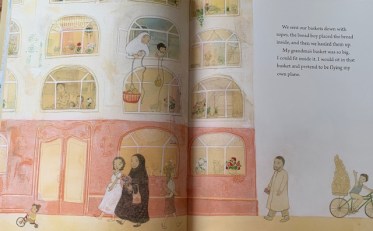
Set in Iran, a little girl absolutely loves and adores her grandma.  They pray together, they buy bread together and they share that bread with their best friends, their Christian neighbors next door.  While the little girl and her friend Annette play, the two grandmas chat, drink coffee and knit blankets to donate to the mosque and Annette’s Grandma’s church.

IMG_8079

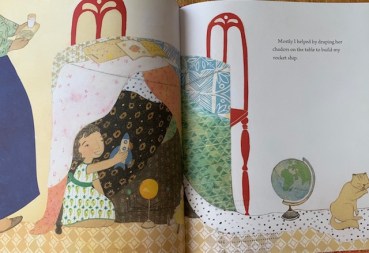
Grandma sews chadors to wear, and Mina helps.  But, mostly she uses the scarves to make rocket ship forts, and capes to fly to outer space in.  When she returns to base camp grandma has cookies for her and wants to hear about her adventures.

In Ramadan, the little girl wakes up early to eat with grandma even though she is too young too fast.  When she gets older, they go to the mosque together at night too, after they have broken their fast.

IMG_8082

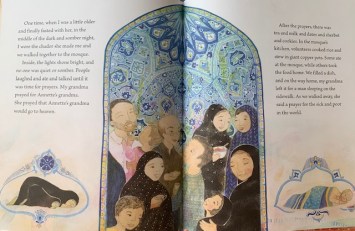
One time she hears her grandma praying for Annette’s grandma to go to heaven.  The next day Annette tells Mina she heard her grandma praying at church for her grandma to go to heaven.  The little girl imagines the two grandmas knitting and laughing together in heaven, on Mars, on Earth, anywhere.

IMG_8081

The book ends with the little girl stating past tense how wonderful her grandma was and  that she still wants to be like her.

The book touches on family, interfaith, love, helping others, faith, religion, friendship, culture, and is just really really sweet.  I wish I loved the pictures, as much as I love the story, but I don’t.  I think I like most of them with their texture and details, unfortunately the faces in some just seem a little off to me.

I absolutely love that there is no over explaining, and no glossary, the author seamlessly brings words like namaz, and Ramadan and chador in to the story, normalizing them as the pretend play, and familial bonds are so universal.

IMG_8083