Author Archives: islamicschoollibrarian

The Chronicles of Bani Israil: The King, Queen, and the Hoopoe Bird by Dr. Osman Umarji illustrated by Sama Wareh

Standard
The Chronicles of Bani Israil: The King, Queen, and the Hoopoe Bird by Dr. Osman Umarji illustrated by Sama Wareh

the king

At 134 pages the fictionalized retelling of Prophet Sulaiman’s (AS) kingdom and interaction with Queen Bilqis comes to life from the point of view of a Hoopoe bird.  The book is marketed as a “Quranic fantasy adventure,” which I found a bit misleading.  The book is rooted in Quran and Hadith facts according to the author, and colored in to try and tie a story together, but even for 3rd and 4th graders I don’t know that there is much adventure or suspense.  As a prophet story it is pretty solid, but as an adventure book it seemed a bit scattered in its attempts to give history, draw in unrelated anecdotes and make it seem intense, when the dialogue suggested otherwise.

IMG_9137

SYNOPSIS:

The book starts with the narrator setting the stage to tell his story of being in Prophet Sulaiman’s army nearly 3,000 years ago in the land of Sham.  Told in first person and  limited to what he saw, the Hoopoe bird (Hud-hud) addresses the reader and begins his tale.  He first gives some information about Hoopoe birds and Prophet Dawud (Prophet Sulaiman’s father), before lovingly describing Jerusalem and how the Bani Israil came to the land of Sham.

The first real glimpse of what kind of ruler Prophet Sulaiman is, is given with the detail allotted to how he repaired Masjid Al-Aqsa.  The bird then tells of Prophet Sulaiman’s many powers and gifts from Allah (swt), the ability to control the wind, control liquid metal, speak with animals, and of course the Jinn.  Slowly, the reader begins to understand how impressive Prophet Sulaiman’s kingdom is, not just by being told, but being shown, so to speak, and reminded pointedly by the Hoopoe that despite so much power how humble towards Allah swt, Prophet Sulaiman remained.

There is a tangent about his love of horses, before the Hud-hud takes center stage again as a spy in the powerful army of men, jinn, and animals. The story of the ants is shared and about half way through the book it is on one of the bird’s scouting missions that he sees a Queen and her people worshipping the sun.

The back and forth between Prophet Sulaiman and Queen Bilqis as Prophet Sulaiman urges the Queen to allow her people to worship Allah or risk invasion is a familiar tale and one the author asserts he tried to use only Islamic sources to include.

The book ends after the Queen has visited, embraced Islam, more anecdotes about Prophet Sulaiman’s wisdom are shared and how even in his death he attempted to show the doubting people the power and oneness of Allah swt.  The revelation of the termite breaking his walking stick and the retirement of the bird who had lived a most wondrous life, conclude the story before an Author’s Note at the end of the book.

IMG_9117

WHY I LIKE IT:

I love Prophet stories and especially ones that are easy to read, memorable, and factual.  I think the book does a decent job in a fictionalized retelling of getting a lot of the important information in, albeit sometimes a bit forced, but keeping it on level for upper elementary and being clear and concise.  I didn’t stumble on grammatical mistakes or find parts confusing, it was well told and presented.  More than once in the book, I felt like it would have made a better oral story than written one.  The bird had to articulate how he knew stuff if he wasn’t there, and he kept asking the reader questions or telling them to pay attention.

The book is meant for Muslim kids and I wish there would have been footnotes or sources.

The illustrations were nice, they are full color but I am admittedly bias as I grew up writing letters to the illustrator who was my penpal for a few years.

IMG_9043

FLAGS:

None

IMG_9092

TOOLS FOR LEADING THE DISCUSSION:

Doesn’t fit my book club criteria, but definitely think kids would benefit from reading the story and discussing how the author shared the information, what they think the Hud-hud’s life was like and then maybe trying to retell a story of their own from a different perspective.


I Say Bismillah by Noon H. Dee Iput translated by Shera Diva Sihbudi

Standard
I Say Bismillah by Noon H. Dee Iput translated by Shera Diva Sihbudi

i-say.jpg

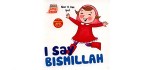
Another adorable board book teaching the concept of saying Bismillah to the littlest Muslims. The illustrations are really sweet, and the text large and playful on their 5.5 square pages.  The story is simple, but because there is a story, and the word repeated, it does just what it intends to do and shows Bismillah being said before you start something.  It is worth noting though, that it never articulates why you say it.

IMG_8870

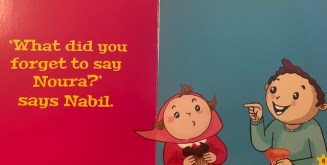
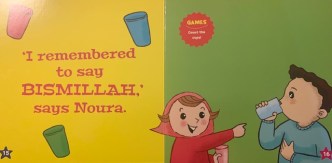
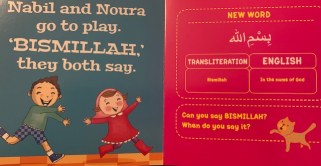
In this 20 page story brother and sister, Nabil and Noura are about to eat some yummy cupcakes.  Noura forgets to say Bismillah and her brother Nabil reminds her.  They both say Bismillah and then Noura says it before she drinks her milk.  Proud of herself for remembering, Nabil praises her as well, and they both head off to play after saying Bismillah again.

IMG_8871

I like that the siblings encourage each other and no one gets in “trouble” for not saying it, but rather they are gentle in their approach and it comes not from a parent or authority figure but from one another.

IMG_8872

There are a few “games” sprinkled in on two of the pages: say the colors of the cupcakes, count the cups.  There is also the word Bismillah written in Arabic at the end along with the English transliteration, English meaning and two questions: can you say Bismillah, and when do you say it, to verify comprehension.

IMG_8873

Thanks once again to Crescent Moon Store (www.crescentmoonstore.com) for their fast and friendly service and great prices.  There are four books in the series and they carry them all.

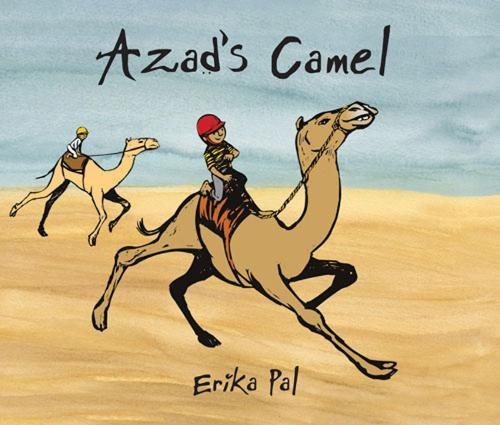
Azad’s Camel by Erika Pal

Standard
Azad’s Camel by Erika Pal

camel

This beautifully illustrated picture book takes the reader in to the world of camel racing, children jockeys, mistreatment by adults, children being sold by their families and running away, all in a span of 40 pages and on an AR 3.5 level.  Yeah, its a lot for a kid’s book, but it has a happy ending and it does draw attention to an atrocity not often discussed or thought about.

IMG_8781

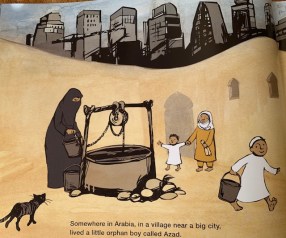
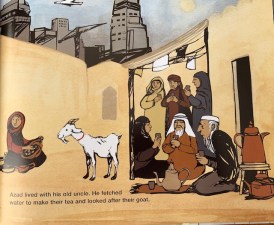
Young Azad lives with his old uncle in a village outside the city.  He helps take care of the goat and fetches water for tea in the mornings,  in the afternoons he plays with his friends.  One day he is doing handstands on a soccer goal post when a rich Sheikh drives by and sees him.

IMG_8780

The Sheikh comes back and convinces the uncle to let him take the boy to be trained as a camel rider to one day be famous.  The uncle agrees saying he can’t afford to keep him.

IMG_8782

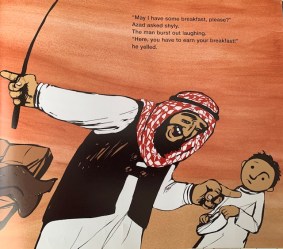
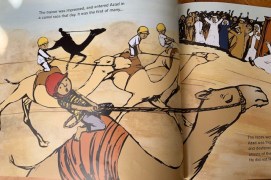
The Sheik takes Azad to the desert with other boys to live and be trained.  Azad learns that food is earned and chores are a must.  The races are dangerous and Azad doesn’t like them, but he is good and is forced to keep racing.

IMG_8783

One night the camel, Asfur, talks to Azad and the two plan to keep running past the finish line at their next race.  The pair are so fast that, they do just that, and no one can catch them.  They run through the city, and back to the desert.

IMG_8784

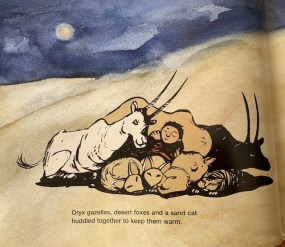
The other animals of the desert keep them warm when it gets cold and until a Beduin tribe discovers them and takes them in.  At last Azad and Asfur find a home.

IMG_8785

There is information about camel racing at the end including how robots are replacing child jockeys in some countries and how many young children are being returned to their families, school and a normal life.

IMG_8786

I like that the book takes on a real and sad occurrence, bringing camel racing and forced child labor in to light.  The story is truly written for younger elementary kids with short paragraphs on each page, large engaging illustrations, quick jumps in events and glossing over any truly graphic details.

IMG_8787

I do worry that stereotypes are reinforced with the use of calling the rich man who bought Azad a “Sheikh” and the Bedouins dancing at the end.  Culturally the book is a generic Middle Eastern country and doesn’t mention or emphasize religion at all with the exception of the women in the pictures being veiled.

I found the book at the library and think it has good information to discuss with your children, but I don’t know that I can see it being anyone’s favorite book, or a regular night time request.  While, yes, it does have a happy ending, you don’t really “feel” what Azad is going through, you are just glad he finds people that want him.


Lissa: A Story about Medical Promise, Friendship, and Revolution by Sherine Hamdy & Coleman Nye illustrated by Sara Bao & Caroline Brewer

Standard
Lissa: A Story about Medical Promise, Friendship, and Revolution by Sherine Hamdy & Coleman Nye illustrated by Sara Bao & Caroline Brewer

lissa-1440x2122

When I first started teaching I wasn’t a big fan of graphic novels, slowly I saw their benefit for struggling readers, and eventually I came to appreciate them as an enhanced tweak in story telling for everyone.  This book however takes the concept to the next level, for me anyway.   As the inside flap claims, it is a book “that brings anthropological research to life in comic form, combining scholarly insights and accessible, visually-rich storytelling to foster greater understanding of global politics, inequalities, and solidarity.” As a coming of age story of two friends at its core, yet taking on breast cancer, kidney failure, parental loss, different cultures, different religions and with a back drop of the Egyptian revolution, I’d say the book is meant for high school and up.  Not so much for content as for understanding and appreciation of all that went it to creating this ethnographic book.

SYNOPSIS:

Unlikely friends Anna and Layla cross economic, religious, and cultural differences to build a life long friendship.  The book is divided into three parts: Cairo, Five Years Later, and Revolution.  In the first part we see Layla’s family serving as the caretakers of a building and the two young girls bonding over pranks, arrogant tenants, and just being silly.  Anna’s family is American and the father works for the oil companies, thus they are financially very well off, however, the father is rather distant and the mother is dying of cancer.  The section concludes with the passing of Anna’s mom and the family going to Boston for the funeral.

Five years later finds the girls in college.  Layla in medical school and Anna at a university in Boston.  Layla’s father is suffering from renal failure and is unwilling to consider a transplant.  While Anna is trying to see if she carries the same genes as her mother and if insurance will cover it.  She also has to decide if she would want to have a complete double mastectomy, if she would want her breasts reconstructed, if she should do it now or later.  She gets a lot of opinions, but ultimately decides to find a way to pay for it and have it done.  Her father doesn’t understand, and Layla dismisses it forcing Anna to have to handle it alone.  But when news come that Layla’s father isn’t going to make it, she rushes back to Egypt to offer her support.

In the final section, the revolution has spread and Dr. Layla is helping those injured in Tahrir Square during the protests, and Anna is helping to identify bodies despite being attacked for being a foreigner and part of the problem.  Anna has kept the secret of her mastectomy from Layla and Layla assumes she has cancer.  At odds with their roles in the revolution, and with keeping secrets from each other and their differences in financial opportunities coming to a head, Anna returns to Boston.  When Layla’s brother is shot and loses an eye, however, Anna returns to Egypt and the two friends work to keep their relationship.

IMG_8951

WHY I LIKE IT:

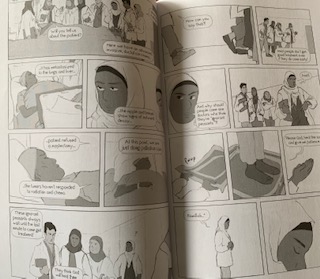
The book is grounded in so much conflict and turmoil, but fights hard to keep a character based narrative.  With two illustrators and two authors trying to convey medical approaches, two cultures, two religion, two friends, and a revolution, the last 70 pages of the 302 page book are details about how the book came about, interviews with the various contributors, a timeline of the revolution, discussion questions, key references and a teaching guide.  The book at times was confusing to me, and I’m not sure why, it quickly resolved itself or a flip back a few pages would clarify it, but I think some of the illustrations were just off enough that it complicated things.  Anna by and large is depicted oddly on a few pages along with her family as well.
IMG_8950

Layla’s family is definitely religious and at times has to challenge their thoughts to understand Anna and their own circumstances too.  I think it is handled really well and allows the reader to consider things without answers being clear cut, is it Allah’s will to not have a transplant and accept death as being written for you or to have the transplant and ask Allah to make it successful?  By and large the book poses questions through the juxtaposition of the two characters and the experiences they endure, and while it shows the choices they made, it draws the reader in to wonder what they would do in their shoes without judgement.  The book provides a lot of facts and leaves them there making it more thought provoking than a simple story.

The characters are often composites of real characters the academic author’s learned about, yet some are directly based on activists and leaders of the revolution.  The graffiti artwork is attributed and powerful.  There is a lot of information in the notes after the comics end.

FLAGS:

There is death and revolution, Layla’s brother is taking Tramadol, and their are sketches of breasts as Anna learns about her disease and prognosis.

TOOLS FOR LEADING THE DISCUSSION:

I wouldn’t do this as a book club as I don’t know how much middle schoolers would get out of it and the book is pretty pricey.  I would recommend people read it though as it gives a different perspective on numerous things many of us take for granted.

Home


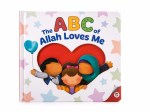
The ABC of Allah Loves Me by Learning Roots

Standard
The ABC of Allah Loves Me by Learning Roots

abs-of-allah-loves-me.jpg

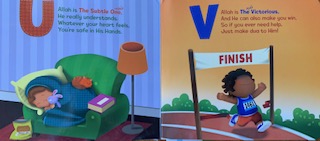
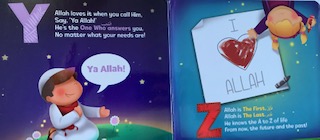
You really wouldn’t think there is much to review in an alphabet board book, but this particular one tries to do more than just pluck a random Islamic word or concept for each of the 26 English letters.  It attempts to give each of the letters one of Allah (swt)’s beautiful names explained in English, but written in Arabic too.

IMG_8773

Each 5 x 10 page features a four line description in a rhyming format to flesh out the highlighted word or phrase.

IMG_8774

Some letter to corresponding Asma al Husna are spot on, but some are a little more of a stretch and some don’t even seem to try.  Overall though it is well-done and delightful.

IMG_8778

The people illustrated don’t have visible eyes, but many have smiles, noses, or closed eyes.  They are bright and warm and engaging.  The binding and thickness of the pages is sturdy.

IMG_8777

Perhaps my favorite part of the book is that the while the rhyming is forced, as is nearly always the case in these type of books, the diction stays on level.  Little kids will understand the words used and emerging readers will be able to sound out and read many on their own as well.

IMG_8776

A great book for your toddler to preschool collection and a reasonably priced book from Crescent Moon Store http://www.crescentmoonstore.com.

Allies by Alan Gratz

Standard
Allies by Alan Gratz
allies.jpg

This is the second Alan Gratz multi-perspective historical fiction novel I’m reviewing for its inclusion of a Muslim character.  While in Refugee it seemed a natural choice to include a Muslim family, I was completely shocked that he would feature one in a WWII D-Day novel.  With numerous storylines spread over 322 pages the book is quick, fast paced, intense and emotional.  An enjoyable read for history lovers and curious kids fifth grade and up, it is an AR 5.6 and older kids will benefit from it too.

SYNOPSIS:

The characters and timeline are fictionalized to all take place on D-Day, June 6, 1944, as the Allied forces and French resistance come together to storm German occupied France on the beaches of Normandy.  Many of the details do come from history though as detailed in the Author Notes at the end of the book.

The book starts out following Dee, a German national who left for America to escape the Nazi’s and is now returning in a Higgins boat to fight them. Knowing no one will understand, including his friend Sid, a Jew from New York, he keeps this knowledge to himself and focuses on the task ahead.

Samira and her mother are the focus of the next mission and highlight the role of the French Resistance, the Maquis.  What makes their story more meaningful is that they are spies with the French Resistance, but they are French Algerians, not really a part of France at all, and they are Muslim.  In Samira’s back story we learn how she must remove her hijab and how she is treated different at school because Algeria and France are at odds.  When her mother is taken by the Nazis before she can deliver the message to the Resistance, Samira vows to do it and get her mother back as well.

19-year-old James from Winnipeg Canada is a paratrooper who volunteered for combat to feel empowered after years of bullying. His buddy in the story Sam is a Cree Indian from Quebec, who has few rights at home, and hopes to have more success in the military.

Medic Henry is scrambling along on the beach helping anyone and everyone he can.  Having left behind a segregated US, even the military has reservations about African Americans saving and serving. As he performs one heroic act after another being questioned and doubted and insulted all along the way, readers see how ridiculous and infuriating racism is on every level.

We meet Private Bill Richards who drives a Sherman tank and is following in his fathers WWI footsteps.  But who is unfortunately killed before reaching Bayeux.   And finally we meet Monique Marchand, a French 13 year old girl, who gets caught up in the invasion because she left her swim suit in the beach hut the day before and has returned to retrieve it. Determined to do something other than cower in fear, she starts helping fallen soldiers and meets up with American journalist Dorothy, a strong woman determined to not be stopped on the basis of gender.

All the story lines criss and cross as the invasion is a chaotic mess and everyone is dropped, disembarked, or arriving in the wrong place at the wrong time.  Surviving the day is an immediate challenge and not one that everyone will succeed at.  The larger success of the mission will depend on some lucky breaks and a whole lot of teamwork.

WHY I LIKE IT:

I love that the story somehow isn’t political at all in the traditional war story, war strategy sense.  But the strength at least for me, wasn’t the horrific battle at hand, which is truly violent and abhorrent, but the relationships between the people.   The realizing what is driving them, what matters and more importantly how hard our prejudices are.  The larger story of the Allies shows British, Americans, and Canadians coming together to defeat he Nazis, but yet, a girl, an African American, and a Cree are treated as “other” irregardless of how beneficial they are even in matters of life and death.

As for the story of Samira, she is a tough girl, both clever and brave.  To have a Muslim in  an American/westerm story of D-Day and a young girl at that, to me was pretty remarkable.  There isn’t mention of faith or anything other than that she is told to take off her scarf and continues to wear a small kerchief on her head anyway, but for Muslim kids all over, this character and how she behaves will spark a sense of extra pride in the Allies success over Hitler, just as the other minority characters will for their representation in such a dramatic event.
FLAGS:

There is a bit of mild profanity.  There is violence and death, and blood, not too bad, but the point is clear, the beach isn’t pretty.

TOOLS FOR LEADING THE DISCUSSION:

I think this book would be a great supplement to any WWII history lesson.  There are great resources at the end, and maps at the beginning and a high energy, short chaptered book that doesn’t skimp on character building or war intensity.

Author’s website: http://www.alangratz.com


Bibi’s Blessing by Lela Usama Goldsmith illustrated by Samantha Morazzani

Standard
Bibi’s Blessing by Lela Usama Goldsmith illustrated by Samantha Morazzani


IMG_8209

A wonderful lesson packaged in a sweet story about a girl learning to thank God for blessings, especially ones that don’t seem like blessings at all.  The 36 page book is meant for children age 4 and up and with its large 8.5 x 11 glossy full color pages it works well at bedtime and in small groups at story time.

IMG_8211

On the island of Lamu, Mwana lives with Bibi, her grandma who’s livelihood depends on making Mofa bread every day.  It is Mwana’s job to sell the sorghum ground bread in the streets for people to enjoy at tea time.

IMG_8210

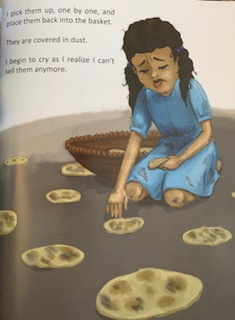
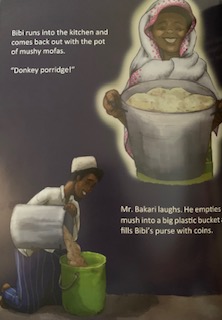
One morning a braying donkey frightens Mwana and she trips, spilling all the mofas on the ground.  When she tells her grandma what happened and how they have not made any money for the day, her grandma responds, “Thank God for this blessing.”

IMG_8212

Not believing Bibi, but being too excited to visit a friend, she doesn’t argue.  But then the power goes out and she can’t visit her friend and she gets grumpy. Grandma tells her to “Thank God for this blessing” and explains that sometimes not getting what you want is also a blessing.

IMG_8213

With nothing else to do, Mwana goes off to soak the rice pot, but instead accidently soaks the dusty mofas, to which her grandma again says it is a blessing.  She starts to feel she can do nothing right, and can’t believe there is any blessings in a pot of mushy mufas.

IMG_8217

But, with the power out many shops close and the owner of the donkeys has nothing to feed his animals.  He knocks on his neighbors door and Bibi and Mwana have just the thing.  He pays them for the food and alhumdulillah all is well, so many blessings from God.

IMG_8216

I love that the setting is a place many of us have never heard of and that there is information about Lamu at the end of the book along with a glossary.  The author is Muslim, the characters dress Islamically in the illustrations, and have Muslim names, but there is nothing Islamic specific in the text.

IMG_8214

Some of the sentences are worded awkwardly, for example, “We live in a small island by the Indian Ocean called Lamu.”  You typically say you live “on” an island not “in” it, and islands are in the ocean, not by them.  And some sentences read almost as run ons because of multiple conjunctions and their lack of punctuation.  I don’t love the illustrations.  The faces on many of the pages are really distracting and inconsistent, but the overall story is well done that I’m willing to over look my own critical opinions, and encourage y’all to give the book a try.


Satoko and Nada 1 by Yupechika

Standard
Satoko and Nada 1 by Yupechika

satoko.jpg

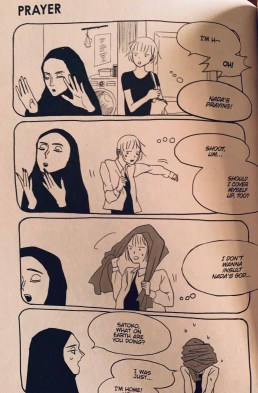
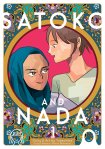
A manga series about two college roommates who have come to America to study, Nada from Saudi Arabia and Satoko from Japan.  Written by a Japanese author and translated into English, there is a lot about Muslims, particularly Muslims from Saudi, as the two characters get to know each other and become friends.  Their interactions work to dispel a lot of stereotypes and promote how rewarding getting to know people different from your self can be.  Volume one (there are three) is 127 pages, read right to left in four panel pages, and is fairly clean for all ages (they do buy underwear and bras at one point), but would most likely appeal to female readers in 4th or 5th grade and up.
8CE09DE5-2BEB-48C0-9157-96B13CC78CD9

SYNOPSIS:

The book is about two girls getting to know each other, learning about each other’s culture, and navigating life in America.  There isn’t really a plot or a story line outside of this basic framework, and with a heading every page or two it reads like a quick scene about the topic expressed in the heading.  So, for example there are headings of Veils, Ramadan, Birthday, MashAllah Choice, etc, and then a few panels showing the girls having an interaction about it, resulting in understanding, humor, or a lesson.

In a bit of a stereotype twist, Nada is more street savvy then Satoko when approached by a stranger for a ride, and thus Nada hasto educate her a bit.  The book brings in a Christian American character and a third generation Japanese character learning Japanese, to further show how assumptions plague as all and how simple conversation and an open mind, can lead to some amazing friendships.

WHY I LIKE IT:

The book is really choppy, but you get used to it and soon you forget that it isn’t a typical story.  I admittedly haven’t read a lot of manga so, I have no idea if this is the norm, or something unique.  I love that its upfront about stereotypes, if it was an American writing it, or a even a Muslim it would probably come across as preachy or arrogant, but somehow it doesn’t seem like the two characters have much baggage, nor feel a need to defend their culture by putting another’s down.  They deal with issues such as women driving in Saudi, differences between hijab, burka, abaya, niqab, being around alcohol,  the joy of a fatwa allowing soy sauce and its alcohol content to be permissible, etc.  Some things are cited for clarity and something are very Saudi, but it really contains a lot of information, about Islam that I am pretty impressed by.  There isn’t a ton about Japanese culture since I would assume it was written for Japanese readers, so it would be redundant, but I did learn, according to Satoko, how religion is viewed by Japanese, how putting age and gender and race on forms seems incredibly personal, and some information about food.

FLAGS:

There is a possible failed abduction, not sure what the guys intention was, but the girls treated it as such.  The girls do go buy undergarments, so they are visually depicted.  There is mention of alcohol.

2DF66805-A246-4150-89BA-E7E1EAF90E90
TOOLS FOR LEADING THE DISCUSSION:

I wouldn’t do this as a traditional book club, but I think I am going to get a copy of the series to pass around my daughters middle school group of friends, to

one- give them a taste of manga

two- see what they think of the Islamic rep from a Japanese paradigm and

three- give us all something to chat about

The book is fun, I got it at the public library and think it might open up a new book type for kids to try and a new point of view for many of us to consider.

My Grandma and Me by Mina Javaherbin illustrated by Lindsey Yankey

Standard
My Grandma and Me by Mina Javaherbin illustrated by Lindsey Yankey

grandma and me

I absolutely love that this 32 page picture book for children five and up breaks so many stereotypes and highlights so many commonalities between all people, everywhere.  I strongly believe that books like this, can change people’s perspective, and as a children’s books can prevent negative biases from forming in the first place.

IMG_8078

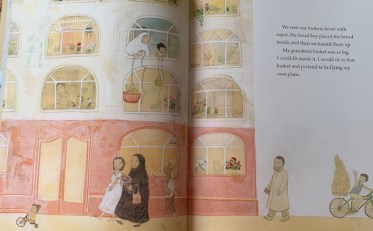
Set in Iran, a little girl absolutely loves and adores her grandma.  They pray together, they buy bread together and they share that bread with their best friends, their Christian neighbors next door.  While the little girl and her friend Annette play, the two grandmas chat, drink coffee and knit blankets to donate to the mosque and Annette’s Grandma’s church.

IMG_8079

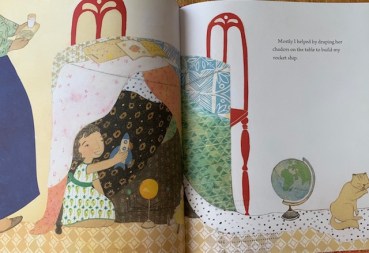
Grandma sews chadors to wear, and Mina helps.  But, mostly she uses the scarves to make rocket ship forts, and capes to fly to outer space in.  When she returns to base camp grandma has cookies for her and wants to hear about her adventures.

In Ramadan, the little girl wakes up early to eat with grandma even though she is too young too fast.  When she gets older, they go to the mosque together at night too, after they have broken their fast.

IMG_8082

One time she hears her grandma praying for Annette’s grandma to go to heaven.  The next day Annette tells Mina she heard her grandma praying at church for her grandma to go to heaven.  The little girl imagines the two grandmas knitting and laughing together in heaven, on Mars, on Earth, anywhere.

IMG_8081

The book ends with the little girl stating past tense how wonderful her grandma was and  that she still wants to be like her.

The book touches on family, interfaith, love, helping others, faith, religion, friendship, culture, and is just really really sweet.  I wish I loved the pictures, as much as I love the story, but I don’t.  I think I like most of them with their texture and details, unfortunately the faces in some just seem a little off to me.

I absolutely love that there is no over explaining, and no glossary, the author seamlessly brings words like namaz, and Ramadan and chador in to the story, normalizing them as the pretend play, and familial bonds are so universal.

IMG_8083


The Star Outside My Window by Onjali Q. Rauf

Standard
The Star Outside My Window by Onjali Q. Rauf

star outside.jpg

Woah! Domestic abuse, foster care, murder, astronomy, and above all hope and bravery. It is so, so much, and so beautifully dealt with from the perspective of a child, that I’m still living in Aniyah’s world and praying she is doing ok.  As the beginning of the book states, it is a story written for everyone, but it then goes on to say that there could be triggers and difficult things to read. So please, while it may be written for ages nine and up, you should know what your child can handle before suggesting they read such a heartbreaking 306 page book, and if they aren’t able to handle it yet, make a mental note to have a discussion when they are ready, it is important.

SYNOPSIS:

The book starts with a map of London and the chapters start with constellations, maps to the stars, and a little girl who wants to be a star hunter.  Drawing on Simba from the Lion King and wholeheartedly believing that stars are people who’s hearts were so big that when they die they light up the night, she maps the stars outside her foster house window, on the lookout for a new star, her mom.  Not remembering all the details that brought her to this foster home, she and her little brother Noah are trying to figure out their new life, the foster home rules, the loud pain they felt, and if they are winning the game of hide-and-seek with their father.

Unable to speak, Aniya, breaks her silence when a news story on TV tells of a star breaking the rules of gravity and flying by Earth.  Convinced it is their mom, Aniyah and Noah with the help of fellow foster kids Travis and Ben hatch a plan to go 73.6 miles from Waverly Village to the Royal Observatory in Greenwich, to make sure the star hunters name the star the correct name, and not the random computer generated one the contest rules dictate.

WHY I LIKE IT:

The book is inspired by the author’s aunt who was a victim of domestic abuse and killed by her husband.  The love and pain she feels at her loss, I believe is conveyed through the pages and felt by readers of all ages.  I had my 10 year old son and my 12 year old daughter read the book, because this book’s topics are heavy and weighty, but handled with such sensitivity and childlike innocence that it is a great introduction to the topic, without being overly heavy and weighty.  The author is amazing, and I was curious how she would follow up her amazing debut novel The Boy at the Back of the Class, and I think this one is just as powerful, if not more so. 

All of the foster kids suffer from some form abuse and there is even a note at the beginning about how the author does not like the term “domestic abuse” and there are resources and information at the end of the book for children or adults suffering or how to help someone they know suffering abuse.  There is also a page about Herstory, the constellations, and some personal anecdotes about the author’s aunt.

The book is truly heartbreaking because as an adult reading the book I could easily figure out what happened, that the father killed the mother, and that the games the mom would have the kids play were not games at all, but ways to mask what was going on. The book is very subtle in how it talks about what the mom and kids endured and some kids will not get it, and others will, either way, parents should be aware and available to discuss that abuse is never ok and that if their friends or someone they know is suffering/surviving, there is help.

The book is powerful also in the way the foster kids for the most part stick together, I think the way they are so willing to help and risk their own chances at adoption is selfless and memorable.  Also the way they put up with Noah, a little kid, who gets annoying, but handled lovingly,  because family means so so much when you don’t have one. 

On the surface though, it is an adventure story, can a ragtag diverse group of kids with little money, injuries and a deadline travel nearly a hundred miles to name a star?  Its fast paced, interesting, and emotional on many levels.

There is nothing Islamic in the book, not even a Muslim name in passing, but the author is Muslim and the story universal.

FLAGS:

Halloween is when they run away.  There is a lot of lying, but they know it.  Lying when the mom covers her bruises and marks, and how she is doing, lying when the kids run away and steal the bikes and sneak on a bus without paying, and break in to the observatory.  The kids feel guilty and know right from wrong in every instance, but when they opt to do something uncouth they rationalize it because they have to name that star!

TOOLS FOR LEADING THE DISCUSSION:

I’m seriously considering reading this as a middle school book club selection.  It is written for a younger audience, but I think I want to open up the topic of abuse and have the school counselor come and listen to the discussion.  The book is that good, and that important, and that powerful, that a discussion and lessons, will keep these characters’ stories in the middle schoolers’ minds as they grow and hopefully teach them empathy, compassion, appreciation, and patience.