Tag Archives: strong women

Spell it Like S-A-M-A-R by Shifa Saltagi Safadi illustrated by Saliha Caliskan

Standard
Spell it Like S-A-M-A-R by Shifa Saltagi Safadi illustrated by Saliha Caliskan

img_7225

This 36 page book for kindergarten and up shows the role perseverance, confidence, and believing in yourself can play in conquering bullies, carving out a space for yourself and finding success.  While the book is a little predictable on the surface, older kids will understand that by winning the spelling bee, Samar didn’t just benefit by standing up to the bully, but in proving to herself what she is capable of and ultimately being more confident of her place in a new country.  The book is presented on large 8.5 by 11 full color glossy pages and features discussion questions at the end.

img_7227

Samar is in 3rd grade after recently moving to America from Syria, where she was the best student in her class.  ESL wasn’t difficult, but mainstream class is proving to be a challenge, mostly because of Jenna, the class bully.

img_7228

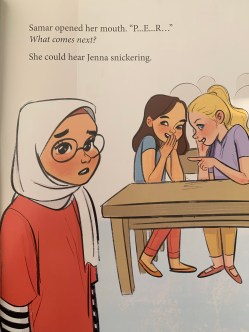
Jenna, snickers when it is Samar’s turn to spell words in front of the class, she teased her about her jump rope songs not being in English, and she makes fun of her for her accent.  With the help of a kind friend, Angela, the two girls decide the school spelling bee will be the best chance to prove how smart Samar is, by winning.

img_7229

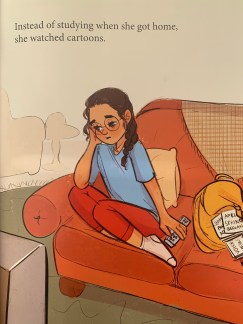
The first step Samar must do is convince her teacher, Ms. Bryan to help her study.  To  show her commitment she offers to give up her recess to study.  The teacher agrees, but on the way home Jenna teases her saying she’ll never win when she can’t even speak English properly.  Deflated, when Samar gets home, she doesn’t study the flashcards and opts to watch cartoons instead.

img_7230

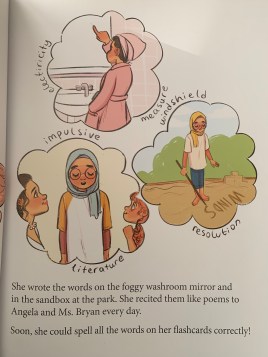
When later in the week her teacher quizzes her, Samar admits she didn’t study.  Ms. Bryan encourages her by sharing her own story of coming to America and having to learn English.  When Samar gets home she sees her mother, a former dentist in Syria, studying for the exams to be a dentist in America. This is the spark she needs and she studies hard, everywhere, and with anyone who will help.

On the day of the bee, Samar spells word after words correctly and after saying bismillah before spelling the final word, wins the competition and beats Jenna. The audience cheers and the next day Samar and Angela are jumping rope and Samar is singing in Arabic.

img_7231

I love that Samar and her mom wear hijab while out, but not at home, that they speaks Arabic, and Samar says bismillah.   Samar’s mom is clearly highly educated and determined and mom and dad are supportive.  I love that Samar’s drive, however, comes from her own determination, no one forces her or guilts her, it is her leading the way and understanding what her mother is going through and her teacher has gone through, and using that as inspiration.  I love that at the end she doesn’t rub it in Jenna’s face that she won, and the symbolism of Jenna just disappearing from the story makes this clear as Samar steps in to her own.  I truly love that for every Jenna in the wold there is also an Angela.  Be kind, be supportive, be a good friend!

I got this book from http://www.Ruqayasbookshelf.com and it can also be found at my favorite book store http://www.crescentmoonstore.com as well.  Happy Reading!

The Beauty of Your Face by Sahar Mustafah

Standard
The Beauty of Your Face by Sahar Mustafah

img_7145

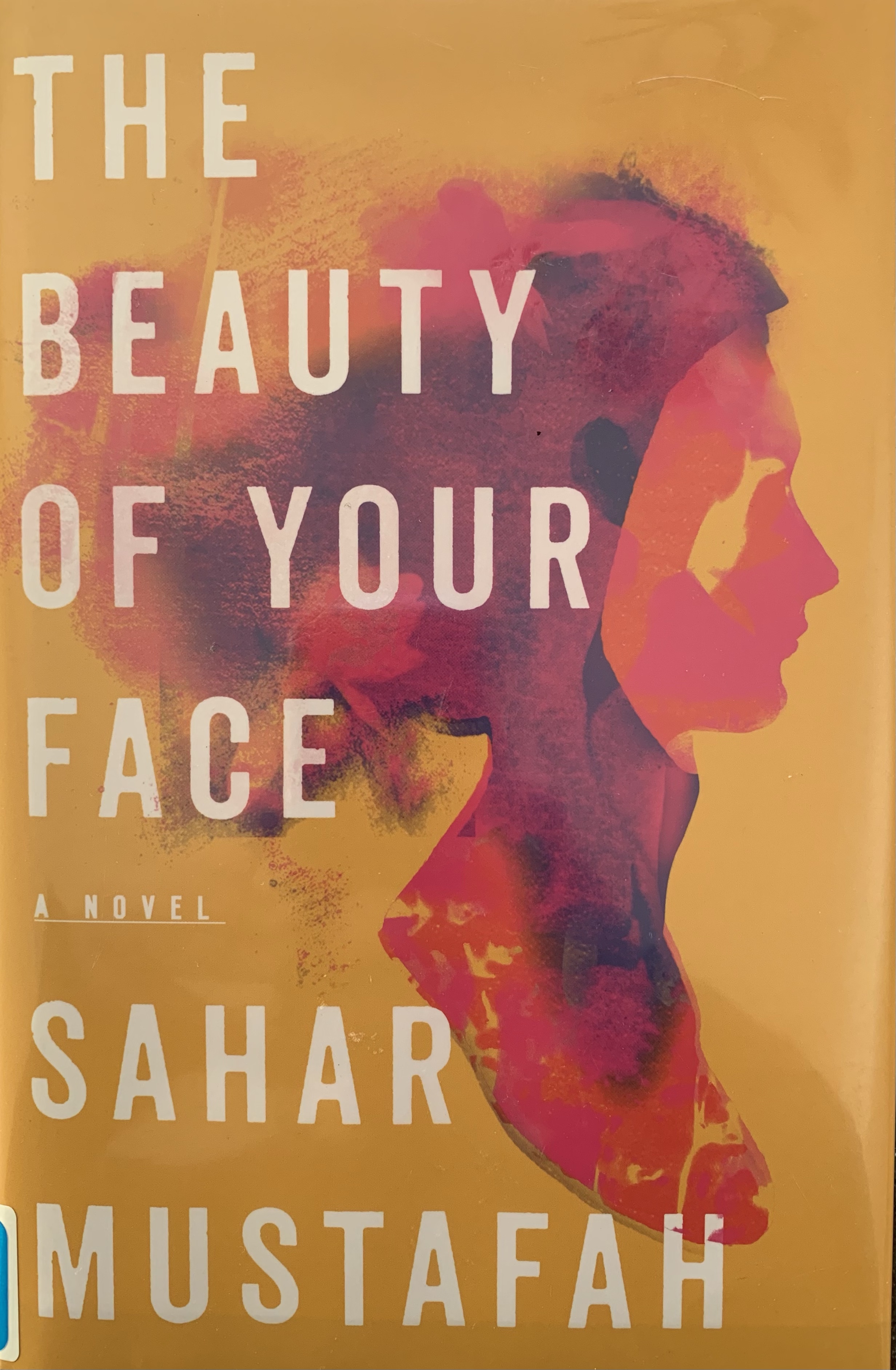
I had debated picking up this book knowing that it isn’t labeled YA and I’m painfully behind on a stack of books I want to review, but after reading @muslimmommyblog’s review I opened the first page: that was 24 hours ago, I couldn’t put it down.  I’ve seen a lot of comments about this book being more YA than adult fiction because it tidies everything up so precisely at the end.  I’ve also seen critiques from non Muslims that it is overly preachy at times.  Many Muslims are so swept away by the rawness and presence in Islam in the book that they are making their teens read it.  So I wanted to read it and review it to determine if it is appropriate from my perspective for teens, and offer my take on it.  Ultimately I think while much of the Palestinian-American protagonist’s life story in the book occurs as a child and young adult coming of age, that the “flags” are so critical to the story and so numerous, that no matter how deftly and non specific she handles these issues and moments, that the book really is meant for more mature readers. I’ll detail it more below in the FLAGS section but to highlight a few mature spots mentioned in the book to varying degrees:  extra marital affair, alcohol, making out, groping, nudity, sex, voyeurism, killing, shooting, physical abuse, profanity, suicide attempt, bigotry, etc.  The writing is absolutely superb, and it isn’t sensationalized, but it is there and provides understanding as to why the characters often are as they are to a point that you need to understand them with a certain clarity.  I would think this 298 page book would most appeal to early college age readers where one is hopefully open minded enough to understand the characters relationship with religion whether they are Muslim or not, old enough to have some of their own life to reflect upon, and on the cusp of a new chapter that they realize the role their choices can make as they move forward.

SYNOPSIS:

Afaf’s life story unfolds out of order and with occasional interruptions from an outside point of view.  It opens with her at work, as a principal of an Islamic girls high school in Chicago as we see her dealing with parents upset with things taught at the school and the balance she tries to achieve in guiding her girls to be strong, confident, well-informed Muslims in a diverse America.  It then flips back to 1976 and begins the tale of Afaf’s life with her parents, immigrants from Palestine, her older sister and younger brother.  Not ever feeling like she fits in at school, she loses any sense of normalcy at home when her 17 year old sister Nada goes missing.   There were problems at home before: her mother never being happy, Afaf never feeling her mother’s affection, her father having having an ongoing relationship with another woman, but as days and months go by, and no clues can find Nada, it will be the event that seemingly tore the family apart.  Afaf’s mother has a mental breakdown, Afaf’s father takes to drinking, and thus Afaf and her younger brother Majeed have to navigate much of their life on their own.  In high school Majeed finds baseball and becomes the ideal student and son.  Afaf lets white boys feel her up and has a reputation for being easy.  She doesn’t cross the line, but her reputation and name on the back of bathroom stalls is fairly accurate.  When their father is involved in a car accident, he finds Islam.  The family is very cultural, but not religious at all.  Eventually Afaf and her brother accompany their father, much to their mother’s protests to the Islamic Center and while Majeed has no interest in religion let alone Islam and never returns, Afaf feels an instant peace and the opportunity to redefine herself and continues to go and study Islam.

The book jumps regularly in sections, not every other chapter, and at some point it shows Afaf as an elementary school teacher making the commitment to wear hijab and preparing to wed a Bosnian man with a broken war filled past.  It jumps and has her brother home from law school visiting and her mother attempting suicide by drinking drano and being found laying naked in a bath tub.  After recovering, her mother returns to Palestine and never returns.  In yet another vignette, it has Afaf and her husband and father preparing to go for Hajj, where her father passes away, and has her returning to find she is expecting her third child a little girl.  There are other surprises that I’ll not reveal, but some of these jumps are interrupted by a voice of a radical alt right mant who walks into the girls school and starts shooting, finding himself face to face with the principal, Afaf.

WHY I LIKE IT:

I am seriously blown away at the quality of writing, and the interweaving of religion and culture.  It is a main stream book and it has a lot of religion in it.  It isn’t so much long passages of preaching, the father would like it to be that way, but the other characters keep him in check.  But the quiet transformation of Afaf and having Islam save her from a life she was not content with.  I love that it has joy and happiness despite all the tests and obstacles.  The book could have been really heavy and drag, but it wasnt, it was compelling and hard to put down.  The characters will be with me a while and I can see myself rereading the book just to visit them again.  

I was a little confused with Afaf’s limited Arabic and her mom’s limited English.  How did they communicate? I get that perhaps it was symbolic of their broken relationship, but seriously when Afaf is seven and not understanding Arabic and her mom is not understanding the police and neighbor in basic English, something is a bit off.  I like that insight is given as to why Afaf is fooling around with any boy that wants her and that it shows it isn’t about the acts themselves.  I also like how it showed her conflicts in reporting an Arab child in her class being abused at home by her father and how the response was so sad by the community.  While Islam saves her and holds her to a higher standard, it doesn’t appeal to her brother, it doesn’t remove the hypocrisy of people who are Muslim: abuse, owning liquor stores, and it doesn’t make everything better for her.  She has to suffer consequences of her choices, she just feels that Islam gives her the tools to persevere and understand and have hope.  

I love the food, oh man, hearing all the dishes being cooked and served and cleaned up after, really made me very hungry.  The cultural elements of the music and songs and oud really ground the book and make the OWN voice value ring so true and strong.  The racism and bigotry feels very real as well.  The author is the daughter of Palestinian immigrants and the way that she articulates such pointed examples of not being given the chance to move up in the elementary reading group, side comments the high school coach makes to her, and the general stereotypes thrust upon her, are very powerful.

FLAGS:

So there is a lot, as stated in the intro, but I want to articulate a bit of why I maintain older teens for the book even though it isn’t overtly sensationalized. I’ll walk through some of the major flag themes.:

Take the drinking. The father is an alcoholic, but the mother and children hate it, Majeed drinks beer with his friends, but isn’t Muslim, yet the Khalti is somewhat religious and they pour amber drinks at Thanksgiving. So there is some moral lesson, which I think you could argue is fine in YA or even middle grades.

Relationships/sex/body: The father is having an affair with a much younger woman, they refer to her as sharmoota and everyone knows about it, no other details are given. Afaf lets boys touch her naked body, but draws the line at intercourse, she says she on some level doesn’t want to do that to her parents or something of that nature. Right before proposing marraige, her and Bilal do kiss. Once they are married it mentions them making love in the mornings. It mentions masterbating and blow jobs. The shooter and his girl friend have sex, the shooter watches an Indian neighbor nurse her baby through the door and sees her exposed breast with some detail and then goes home and masterbates. When the mother is pulled out from the tub after attempting suicide it doesn’t just mention she was naked, it comments on her pubic hair.

Violence: An Arab Muslim male classmate, drives Afaf away from her bike and the slaps her telling her basically that she should not be such a slut. Afaf punches another girl in a fight at school. A child in Afaf’s class is being hit by her father. Mother lashes out at Afaf, she ends up burned. The climax is a mass shooting where 14 students and a teacher are gunned down and killed. Self harm: car crash while drunk, suicide attempt with drano.

Minor: Yeah there is music, and Halloween,

TOOLS FOR LEADING THE DISCUSSION:

This would make a great book club selection for those in their early 20s and up. It is well done, just not for younger readers. The book is very popular and numerous author interviews can be found with a quick Google search.

Diana and the Island of No Return by Aisha Saeed

Standard
Diana and the Island of No Return by Aisha Saeed

dianaThis Wonder Woman story of Princess Diana as a young girl is not noteworthy because of its groundbreaking storytelling, but more for the fact that the series and story is by a Pakistani-American Muslim author.  I am not sure how authors are assigned or chosen to  write these reimagined character series, but I think it is a great compliment to her writing and a great mainstream representation of diversity that we should celebrate.  Even more exciting is the subtle addition of Diana’s best friend, Princess Sakina, daughter of Queen Khadijah to the story, and that while they are citizens of fictitious world of Greek gods, they seem to spout Islamic wisdom on occasion, and be equally strong and important to the adventure at hand.  The book is meant for middle grades and at 288 pages is a fun light read for girls and boys of all ages.

SYNOPSIS:

Young Diana is anxiously waiting for the start of the yearly Chara Festival, when strong women from all over the world come to her island home of Themyscira to celebrate their different cultures and strengths.  Most of all Diana is waiting to spend the week with her best friend Sakina.  Frustrated that her mother is not allowing her to train with the other Amazonian women, Sakina listens to her and they hope to persuade Queen Hippolyta that this is the year.

As the women are arriving and gathering in the palace, Diana discovers a boy near the ships, Augustus.  Boys are not allowed on Themyscira.  There is no exception, but when all the women in the palace are drugged to sleep, her and Sakina are forced to trust him to try and save their loved ones.

Augustus confesses that a demon has hypnotized everyone on his island home, and that he was told to break the spell he needed to bring Princess Diana to the demon.  With no options and determined to prove her self, Diana and Sakina and her trusty bird fly off on a chariot to another world.

With tests around every corner, literally, the trio has to work together, to stay alive, gather the ingredients to make a potion to save the people on both islands, and push themselves to be brave.

WHY I LIKE IT:

So the story is ok, it is fun, I’m sure most kids that like superheroes and even many that don’t will enjoy the quick paced plot of the story.  There are definitely little nuggets of inspiration and motivation that make the book a positive influence on the reader.  The trio discuss bravery and how being scared doesn’t make you less brave, they encourage one another to push themselves and they forgive each other when they make mistakes.

Sakina and her people are scholars and on occasion says deep thoughts.  She says at one point, “My mother always says we are supposed to enjoin the right and forbid the wrong.” Which is a general principal, but the word choice sounds a lot like Surah 3 verse 110 “enjoining what is right, forbidding what is wrong,”

FLAGS:

There is talk of Zeus and the other gods.  There is lying.

TOOLS FOR LEADING THE DISCUSSION:

I probably wouldn’t do this as a book club book, but I would definitely encourage kids to read it.  I think muslim kids will get a kick out of seeing the names Sakina and Khadijah in the book and feel like its a bit of a shoutout, which I think is awesome.  It seems like it is book one in a three part series, so I hope to have my kids read them all and make sure the 3rd-5th grade teachers at their school have them as well.


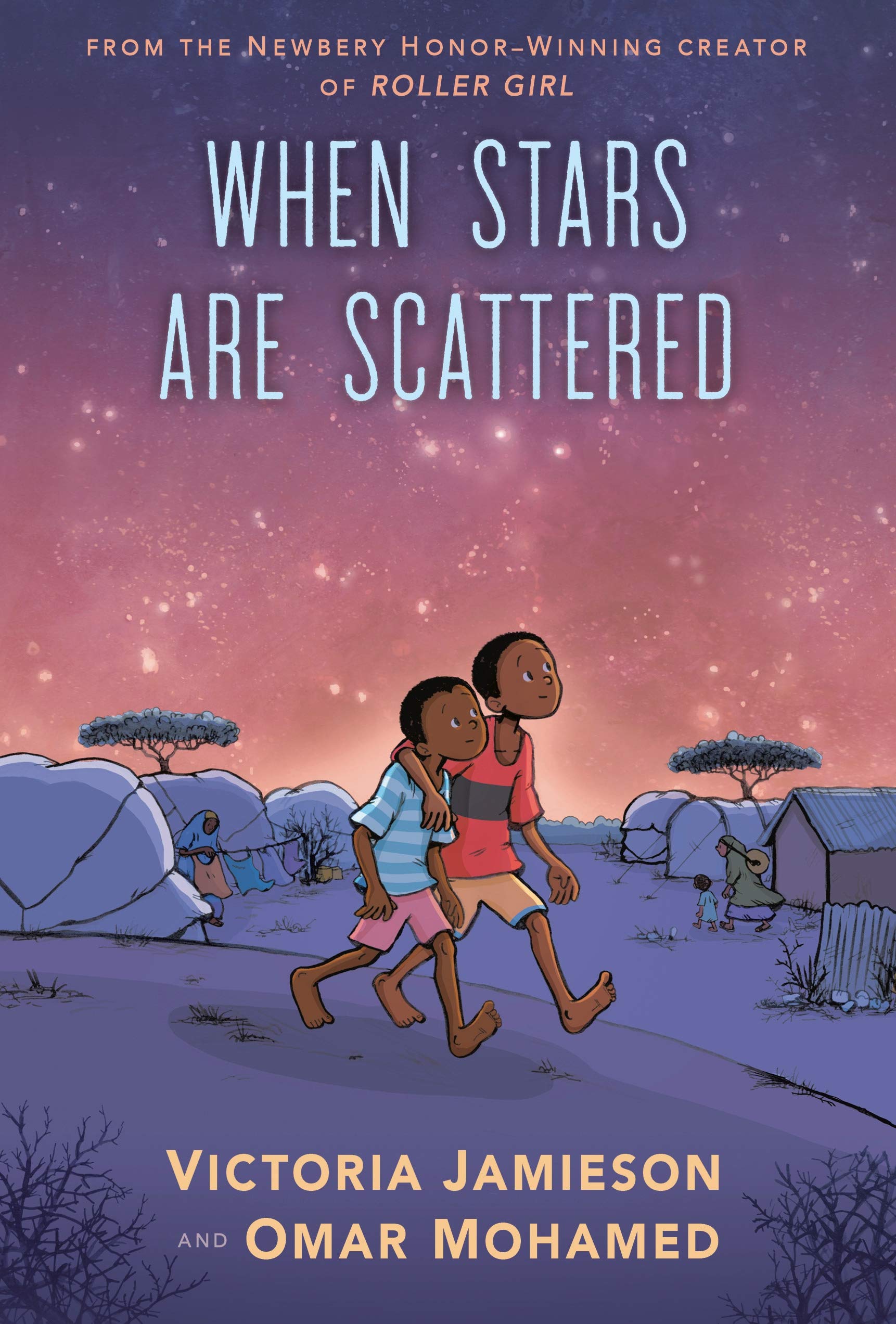
When Stars are Scattered by Victoria Jamieson and Omar Mohamed

Standard
When Stars are Scattered by Victoria Jamieson and Omar Mohamed

starsThis graphic novel swept me off my feet and left me in tears, not because of the hard life and sadness that life in a refugee camp entails, I had braced myself for that, but because of the hope and humanity and beauty that is so powerfully expressed and conveyed in this 264 page book.  Meant for 3rd graders and up, I think kids through middle school should be encouraged to read it.  The illustrations and colors are incredibly well done and the story is based on a true story that needs to be told and shared.  It is definitely in the top 10 books I’ve read this year and I keep catching my 11 year old re-reading this book repeatedly (like 5 or 6 times).

52BE6C8B-4246-4A92-BA66-004378A21862

SYNOPSIS:

Omar Mohamed lives in Dadaab refugee camp in Kenya.  His father was killed in the Somali war and his mother has not been seen after she sent Omar and his younger brother Hassan to run with the neighbors to escape the violence.  Hasan suffers from seizures and doesn’t speak, save one word, Hooyo, mother in Somali.  The two boys have an adopted mom Fatuma, who looks after the boys in the camp as if they were her own.  Unable to go to school, Omar spends his days looking after his brother, playing soccer with plastic bags, and waiting in lines for water, food, and news of a better opportunity.

When Omar gets the chance to go to school (5th grade) he has to make the difficult decision of pursuing his own opportunities, with the hope of helping Hassan later, or living day to day and taking care of his younger brother.  He is finally convinced that education will help them both, and that if the girls can find a way to do their chores and attend class, he can too.

Each transition from primary, to middle to secondary school requires testing, and only the top get to continue.  Determined to stay in school, Omar studies while dealing with life’s many challenges and the daily additional challenges of living with little food and resources.

When Omar and Hassan’s names finally appear on a UN interview lists for resettlement, hope seeps in, but the wait and the uncertainty prove to be yet another test.  Along the way there are side characters from the United Nations that show compassion, other families that show how generous and loving humans can be, female classmates show him how to take advantage of his privilege and friendships that move friends to family.

D74285FB-CBDC-4C4A-BD7B-070439BB08EF

WHY I LIKE IT:

The book is gripping and has heart.  I don’t know what I expected, but I truly could not put it down.  The character’s stresses are felt and emotions are conveyed so powerfully, that I don’t know that you can read the book and forget it.  The most emotional part for me was his honesty in dealing with his brother, the strength of his friends, particularly female, and the bond to Fatuma.  Truly their living arrangements and loss of family is gut wrenching, but it was the little things that touched me the most.  The honesty of Omar having to decide if he was tempted to not go to school because he was scared. Was he using his brother as an excuse to stay with something he knew.  The emotional tipping point of no return for me was when he realized Fatuma would not be able to go to the second interview with the UN and would not be a part of what came after.  Of course I knew that, but by that point I was so connected to the character, that when Omar realized it, I broke for him.  To feel that connection in a graphic novel was new for me, perhaps a first, and alhumdulillah I am better for it.

The characters are Muslim and behave traditionally with praying and Ramadan and Eid.

F9E64F9D-1722-4CBD-B905-BE754BCE6C77

FLAGS:

There is talk of khat, something the men chew on the side of the road to forget things.  There is some violence, bullying, a young girl getting married before 6th grade and having a baby.

CDD12698-52CE-4FFD-9444-29A666980797

TOOLS FOR LEADING THE DISCUSSION:

Yes! I am hoping if and when we resume school I am starting with this book inshaAllah, for my middle school book club.  There is so much to talk about and understand and empathize with.

Mad, Bad, and Dangerous to Know by Samira Ahmed

Standard
Mad, Bad, and Dangerous to Know by Samira Ahmed

mad bad

I really should give up reading Samira Ahmed books.  This is the third one I’ve read, and while she is definitely getting better, I still don’t know why her editors don’t fix her flat notes.  Like in Internment, the premise in this book is amazing, but other parts are just cringe-y and painful and really, really unnecessary.  My guess is, she would identify herself as a romance YA author, and yet consistently in her works, that is the most lacking part: the character building and forced romances.  The art history mystery, the inspiration and “real” life of the characters from the past, the setting of Paris in the summer, the fight for woman to be heard are all so well done and compelling and interesting that this romp that blurs fact and fiction might deserve a read, but you have to overlook the forced love triangle, excessive kissing, be willing to suspend reality regarding Alexandre Dumas, Eugène Delacroix, and Lord Byron, artifacts and sleuthing, but if you can do all that, this 337 page book for 9th grade and up, is definitely fun and hard to put down.

SYNOPSIS:
The protagonist is 17-year-old French-Indian-Muslim-American Khayyam, who is spending her summer in Paris with her professor parents like they do every year.  But this year is different as she is being ghosted by her boyfriend Zaid back in Chicago and has just been humiliated by her poor research attempts to link a missing painting from artist Delacroix to author Dumas in an entrance essay competition to her dream school.  Khayyam’s story is really just beginning though as she steps in dog crap and bumps into a descendent of Alexandre Dumas as she wipes it off.  A cute descendant, who shares the name with his distant grandfather, and viola’ the two of them are off on a whirlwind adventure of clues and attraction and mystery solving.

Khayyam’s story is interwoven and told between small glimpses of Leila’s story.  Leila is a Haseki, a chosen concubine of the Pasha in Ottoman Turkey, but the lover of Giaour and friend of the jin.  As we learn her story from 200 years earlier and her struggle to break free of her gilded cage in the harem, only to be defined by the artist and poets and author men around her, her story and Khayyams collide.

WHY I LIKE IT:

I know precious little of art history, I can name drop a few artists and paintings, but that is being generous, so the fact that I have no clue what is real and what is fake and what is possible, made this story all the more fun and engaging.  Yes, I researched, aka Googled, stuff as I read and am perfectly content to accept the fictional what ifs that the book offers.  I love how the art world and literary world are one in the book and that they inspired each other. The way the sleuthing, the finding of artifacts, and unraveling of it all is presented is indeed a romp.  Realistic? Not a chance, but fun.  I also love how both Khayyam and Leila had to define themselves and ultimately not do it in the reflection of a male.

The rest of the book, is a bit of a stretch.  Leila’s story naturally has holes in it as it is told in broken pieces, but Khayyam’s story does too.  I just didn’t care about her past boyfriend/ex-boyfriend/friend, whatever Zaid is or was, and clearly after moping about him for 300 pages and then not even giving him a proper goodbye, means that the author and character didn’t really care either, which made the already forced, cringe-y annoyingness all the more grating.  As for the relationship, the other piece in the triangle, with Alexandre, was fine in that there was angst, but they put it aside to solve the mystery, so it didn’t bother me too much.  Of course the fact that Khayyam is a practicing Muslim who seems to have no problems with boyfriends, and making out and that her parents don’t mind either, makes the faith aspect all the more befuddling.  I guess practicing might be a stretch, her mom and her go to Jummah prayer on Friday, thats about the extent, and she mentions she doesn’t drink.  Zaid, sets up a tutoring program at the masjid, but his instagram has him hanging all over girls too, so not sure why the characters are even Muslim.  I suppose it is good to have that diverse representation, but it doesn’t seem to make much necessary sense to the overall story.

FLAGS:

Implied concubine activities, with the Pasha and the lover.   Lots and lots and lots of kissing, nothing graphic, but annoying amounts of it being mentioned.

TOOLS FOR LEADING THE DISCUSSION:

I want someone to discuss it with me and point out where the facts end and the speculation starts and when the full on fiction takes over.  I don’t think I could use this book as a book club book because of the center stage of the haram romances in both Khayyam’s time and Leila’s.  But if you have read it, talk to me about it, I’m curious!

NPR’s Review: https://www.npr.org/2020/04/11/831873365/in-mad-bad-dangerous-romantic-sleuths-uncover-a-byronic-secret


The Little Green Drummer by Taghreed Najjar retuld by Lucy Coats illustrated by Hassan Manasrah

Standard


A485FA5B-6839-4720-9E5B-BA2D9AB71901

This book is perfect for early readers that are more fluent than picture books, but not quite ready for a full on chapter book.  With five chapters, pictures on every one of its 73 pages, this book is a joy to read both on your own or out loud to a group.  It is fun for Muslim children and non Muslim kids, and a great addition to bedtime or story time at Ramadan, or any other time of the year for that matter.

3BC30F96-8F88-48D3-8963-99E9EFA5BE44

SYNOPSIS:

Samia and her Yaba live in Lifta, Palestine and her dad’s job in the month of Ramadan is is to wake the whole village up as the dawn waker-upper.  Samia loves his important job, and hopes one day to do it too, but her dad says a girl has never done it before.  Samia doesn’t understand why, girls can shout and bang drums as well as anyone else.

The day before the start of Ramadan, Yaba is not feeling well and doesn’t know what he will do.  Samia sees her chance and says she can do it.  Her drum is loud, her lantern is bright, and her dog, Barkie, will keep the wild wolves away.

As she sets out in the dark, she sees orange scary eyes in the woods and sings a song to herself to keep her brave as Barkie defends her.  When she gets to the first house, they are surprised to see her, but the children of the home rush out to join her with their own drums.  When the three children and Barkie get to the next house, their friend Omar wants to join in with his tambourine.  This continues as the village children join together with whatever instruments, even pots and pans, they have to make sure everyone gets up in time for suhoor.  For five is louder than four, all the way up to nine being the loudest of all.

The children all sing and the villagers reward them with candy and treats.  On the way back home the wolves stay away and when they reach home Samia’s dad is feeling better and can’t wait to hear of her adventure.

44520351-F7CC-4FAA-A643-936E6858FD73

WHY I LIKE IT:

The book is based in truth which is detailed at the end of the story on three pages that tell about Lifta, and how after a war the people were not able to return.  It also tells about Ramadan as the story text itselft mentions it very little.  Yes, it takes place in Ramadan, and the people need to be woken up to eat before the day starts to fast, but the afterword gives a bit more about the holiday and Eid that follows.

I love that the book is about a girl doing something because she can, I was afraid it was going to be like Hiba Masood’s Drummer Girl, but it takes a different turn in showing Samia having to be brave, showing team work and cooperation in getting the job done, and the village not even really caring who wakes them up, her being a girl doing a “man’s job” is never even mentioned again.

The book is fun with the sound effects and inclusion of everyone and the illustrations are incredibly well done.

8A2F6DC8-8573-46E1-8CD0-364E46DDB1AC

FLAGS:

The book is clean, the “scary part” is quick and while it adds a little tension, not enough to scare even sensitive little ones.  The dog stands his ground and becomes the Dog King of the Village.

A658F1B7-5975-42C1-822A-90F652CA668D

TOOLS FOR LEADING THE DISCUSSION:

I’m trying to see if I can do this as an online story time during Ramadan amid Covid 19.  It is a super quick read, and is a lot of fun, but the small (8×5) size might make the pictures hard to see.  I think all kg through 2nd grade classes should have this story.  It explains a cultural celebration of Ramadan in a universal way that will make Muslims feel proud and non Muslims excited to learn about something new.

5871BBBF-1802-4A33-A387-A9B3C91020F6


You Must Be Layla by Yassmin Abdel-Magied

Standard
You Must Be Layla by Yassmin Abdel-Magied

layla

This OWN story, upper middle grades book, is heavy on the pop culture, relatable on the Islamic family presentation and honest in its portrayal of Islamaphobia, yet somehow the tidiness in which everything wrapped up seemed too forced and a bit flat.  At 293 pages, including a three page glossary, the book is a quick read meant mainly for girls.  It involves robotics, academic achievement, and invention, while also discussing crushes, a character coming out to his family and friends, and mention of girls not praying at certain times of the month.

SYNOPSIS:

Layla lives in Australia and goes to the Islamic School of Brisbane. Her Sudanese family: older brother, younger twin brothers, and parents, her Doctor mom and medical machine tech dad, are active Muslims and proud of their culture.  They assimilate to Australian norms in varying degrees, but with all the kids at ISB, Layla doesn’t feel all that different in her school and social life.  Unfortunately she wants more, she wants to be an adventurer, and when she meets Adam over the break and learns about the various opportunities he has it his school, Layla decides she wants to prove herself on a larger stage.  Going in to “shut down” mode Layla has tunnel vision to ace the scholarship and entrance exam and go to a new school.

She gets in to Mary Maxmillion Grammar School and when she goes to meet the board they let her know that the decision to accept a girl like her was not unanimous.  Layla is an immigrant, she is black, she wears hijab, she is loud and proud, and apparently very smart, but as one trustee asks, is she brave?  On the first day of school she arrives late to first period, insults the teacher repeatedly and also makes friends with a group of slightly diverse boys.  At the end of the day however, Peter, a boy who had insulted her earlier, reinforces his disapproval of her being allowed at their school and pushes her.  Standing her ground, she verbal attacks and then head butts the boy in front of a large portion of the school at dismissal.  No one offers any help, nor speaks up when she is suspended for a week, her scholarship and admission put on probation, no one even asks for her side of the story, Peter, is let off completely free, as he is also the son of the Board Chairman.

Layla decides to prove she belongs at the school she is going to win a prestigious robotics competition and since everyone already is on a team, she decides to go for it solo.  The only problem, is she doesn’t know what to invent.  When she returns to school, her friend that she is crushing hard on is acting weird, and she gets caught up in a lie of sorts that serves as both the idea and silliness turned cleverness of the book.  While choking on gummy worms, she says she is working on an edible actuator for her robot, and somehow has to make that come to fruition.

The rest of the book is Layla making a lot of silly errors of judgement: missing classes being in SD mode in the workshop, forgetting to file the paperwork and registration to actually compete in the competition, and leads up to the resolution between her and Peter, learning her crush is gay, and deciding to be herself and proud of it.

WHY I LIKE IT:

I actually like the majority of the book, I really like how Islam is presented and lived.  They pray and say salam and cover, and recite tasbeeha to reflect, and quote hadith very naturally, even how others attack them, and the anger that Layla’s brother Ozzie feels at his inability to get a part time job reads and feels very authentic.  I also like how one of the teacher’s own experience as being a descendant of the forgotten generation and being a first nations ethnicity is woven in.  I felt the side character being gay was added and forced in as an after thought and I don’t know why, as it didn’t show Layla to be a particularly good friend.  She handled his coming out well, but when he was miserable she was wrapped up in her own stuff and didn’t reach out very well, even though he ended up being the spark for her invention.  Her friend at ISB is also an under developed character, that while I get is used to show another side of Layla, in many ways also showed her to be a rather poor friend.

I found the pop culture references annoying, not in and of themselves, but in knowing that they will date and make the book irrelevant in a few short years.  There is a lot of repetition of phrases and ideas that a few times when I put the book down I struggled to re-find my place (I know bookmarks, right?) but certain refrains and paragraphs seem so very similar.  I

There is a lot of good information about Sudan and their food and culture and traditions.  There is also a decent amount about Muslims in Australia.  I like that even within her family there are different views on how much to assimilate, and how much to fight back against perceptions, the fact that there is a lot of gray makes non Muslims and non immigrants reading the book hopefully realize how diverse all people are and to not assume anyone is only one way.  I would have liked more about Layla’s mom and being recruited to come to Australia, and how she was perceived at work, by patients and colleagues.  I also would have liked some sort of resolution about Ozzie and his job search.  Really though my biggest complaint is Layla, herself.  What does it even mean to want to be an adventurer? I like that she is fallible and human and in some ways she does grow, but I felt like her being smart and a go-getter is the foundation of the story, but that she didn’t seem to have much common sense seems a bit off.  Yes she is loud and funny and puts in hard work, but the way she talks to teachers, and misses classes and deadlines, and behaves seems like a disconnect from the pages constantly telling me how smart she is.  To me, part of being smart is knowing when to lash out and when to listen, I don’t feel like her growth arc was all that great, in a nut shell, she changed schools and confronted a bully, that is the story, while not a bad story, it could have been so much more.

FLAGS:

There is crushing, violence, a gay character, mention of alcohol at a party Layla didn’t attend, talk of hooking up in passing and some language.  There is lying but it is acknowledged guiltily, and not familiar with Australian slang, regular use of the phrase, Janey Mack, which according to google is a replacement for Jesus Christ.

TOOLS FOR LEADING THE DISCUSSION:

I don’t know why I wouldn’t use this book as a book club selection.  It just didn’t strike me as something they would benefit from.  I wouldn’t be opposed to someone picking it up and reading it in my house, but I doubt I’ll recommend it to my daughter and she is the ideal reader: she wears hijab, is in 8th grade at an Islamic school, and loves to read.  The book is really not memorable as good or bad, it just fell flat and I doubt I’ll read it again, luckily it only took two sittings to read, so I don’t feel like it was a waste of time, but seeing as I had to pay cover price and international shipping, I kind of regret rushing to buy it.

Teacher guide: https://www.penguin.com.au/content/resources/TR_YouMustBeLayla.pdf

The Candle and the Flame by Nafiza Azad

Standard
The Candle and the Flame by Nafiza Azad

flame

It takes about 124 pages to be swept away to the city of Noor, but once it happens, it is hard to come back.  The 391 page fantasy story takes a while to get going, but the character driven plot filled with amazingly strong and diverse women is worth the slow start.  Middle school readers and up (AR 5.8) will enjoy the blend of Islamic imagery, sub-continent Asian culture, fire, Ifrits, Djinn, family, relate-ablity and good quality story telling.  The fact that it is a main stream book, with so much religion and culture makes it all the more remarkable in its universal appeal.

SYNOPSIS:

Fatima is a Muslim girl adopted by a Hindu family, only everyone in the entire city was killed eight years ago except for Fatima, her adopted sister, and an elderly lady, when the Shayateen attacked.  The orderly Ifrit were asked to defeat the Shayateen and protect the city, and when they did, the wealthy returned along with people from other cities.  Thus Noor is now a vibrant city of different backgrounds, cultures, religions, and languages repopulated and ruled in halves by the Maharaja, Aarush and Ifrit Emir, Zulfikar.

Fatima works as a messenger and her favorite place to deliver packages to is an old book shop owned by Firdaus, an Ifrit she regards as a fatherly figure.  He has taught her languages and provides her a place to learn and grow.  When he dies in front of Fatima, she is forever changed, literally, he transfers his powers to her, and she is now not only part human, part Ifrit, but also the Name Giver, an incredibly powerful and important being in bringing the smokeless Djinn from their wold to her hers.

With rebel forces threatening the Maharaja’s rule, Ghul and Shayateen entering the city, a taint threatening the leader of the Ifrit, a traitor in each palace, and a budding romance between Fatima and Zulfiqar, the characters pull you in and create an enjoyable story that is vivid, fantastic, and hard to put down.

WHY I LIKE IT:

The story doesn’t have a neat and tidy plot culminating in a climax, but the character arcs and vivid world building pull you in and keep you interested.  I love that the characters are different and complex and unique, and that women are so so strong and celebrated for their strength in all spheres, not at the expense of the males, but solidly in their own right.  It is refreshing and glorious to see the matriarchal Ifrit world contrasted with the human world, and the strong females that emerge in both.

I love that there is so much diversity and tolerance and the book doesn’t shy away from presenting faith practices and acceptance in such an honest manner.  There is a four page glossary and it is needed, yet not overwhelming at the same time.  The most read page in the book for me however, was the Dramatis Personae page listing the characters.  Until that 124 page mark, I was constantly flipping back trying to keep everyone straight, not so much because the characters are confusing, but “what” they are took a little while to stick.

I got sucked in by this book truly, I ignored my children during our Corona virus quarantine one day to read the second half, and I don’t regret it one bit.  The romance, was a bit cheesy at the end, but it was clean, and sweet and presented as a way forward, not as a settling or sacrificing choice for either character which was greatly appreciated.

FLAGS:

There are a few kisses once the two main characters are married.  There is stalking and attempted sexual assault by a character, but Fatima more than took care of that with the support of many strong females.  There is mention of a homosexual relationship, but not dwelled on, and I think one could argue that there is  possibly something more going on between two of the females, but it isn’t explored.  There is death and killing and violence, but nothing extreme.

TOOLS FOR LEADING THE DISCUSSION:

I had hoped to sneak this in for book club next month, but with school closed indefinitely, it might have to wait until next year. I think girls will gravitate more to it than boys, but I think that is ok, because often girls need more of a nudge, in my experience, to give fantasy a try.  I am trying to convince my daughter to read it, but the first 100 pages are pretty slow, so if I can’t force her through it, I don’t know what chance I’ll have, here’s hoping.

NPR Review: https://www.npr.org/2019/05/18/724120066/language-has-magic-in-the-candle-and-the-flame

Interview with Nafiza Azad and Hafsah Faizal (We Hunt the Flame) https://www.slj.com/?detailStory=hafsah-faizal-and-nafiza-azad-interview

Muslim Girls Rise: Inspirational Champions of Our Time by Saira Mir illustrated by Aaliya Jaleel

Standard
Muslim Girls Rise: Inspirational Champions of Our Time by Saira Mir illustrated by Aaliya Jaleel

rise

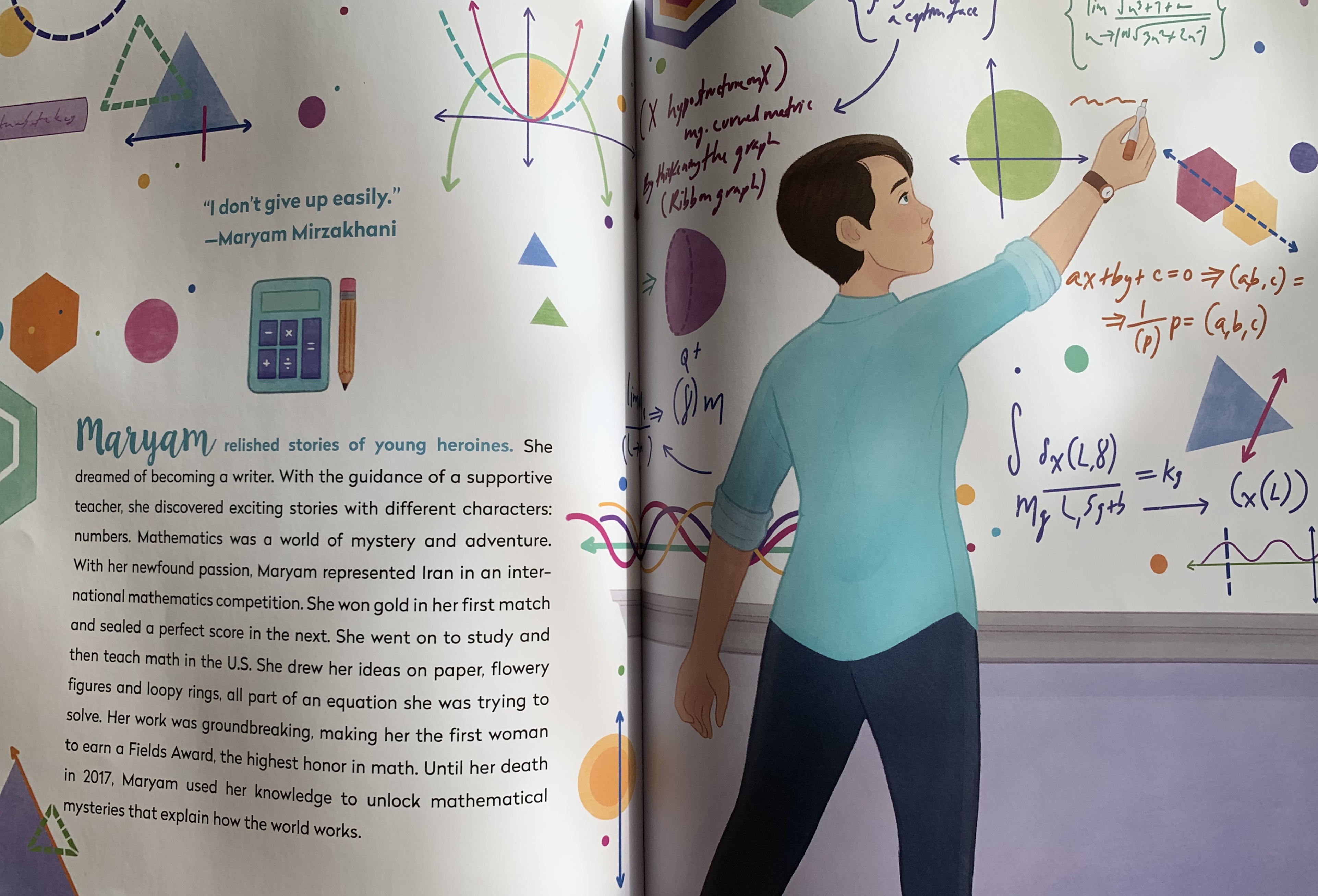
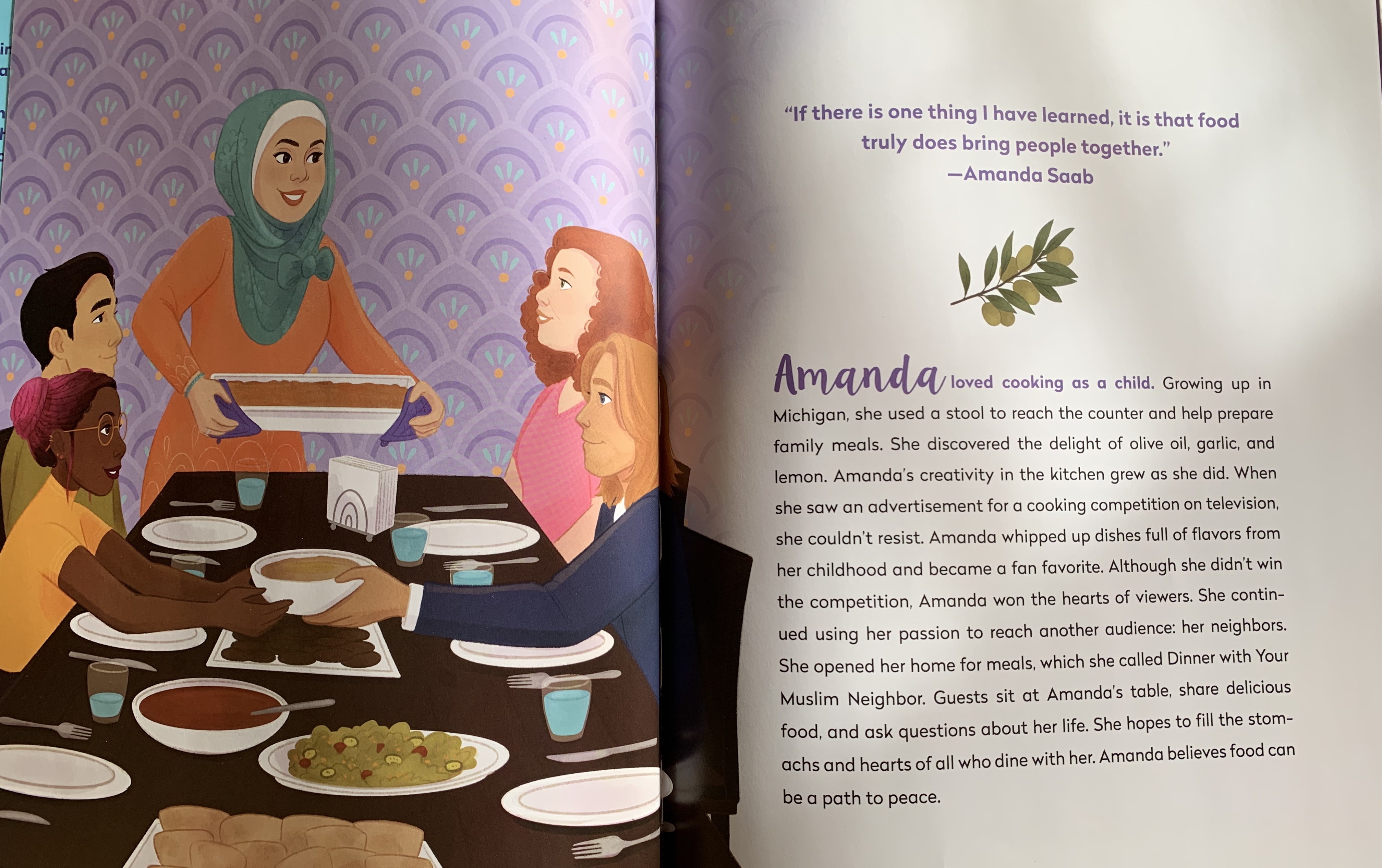
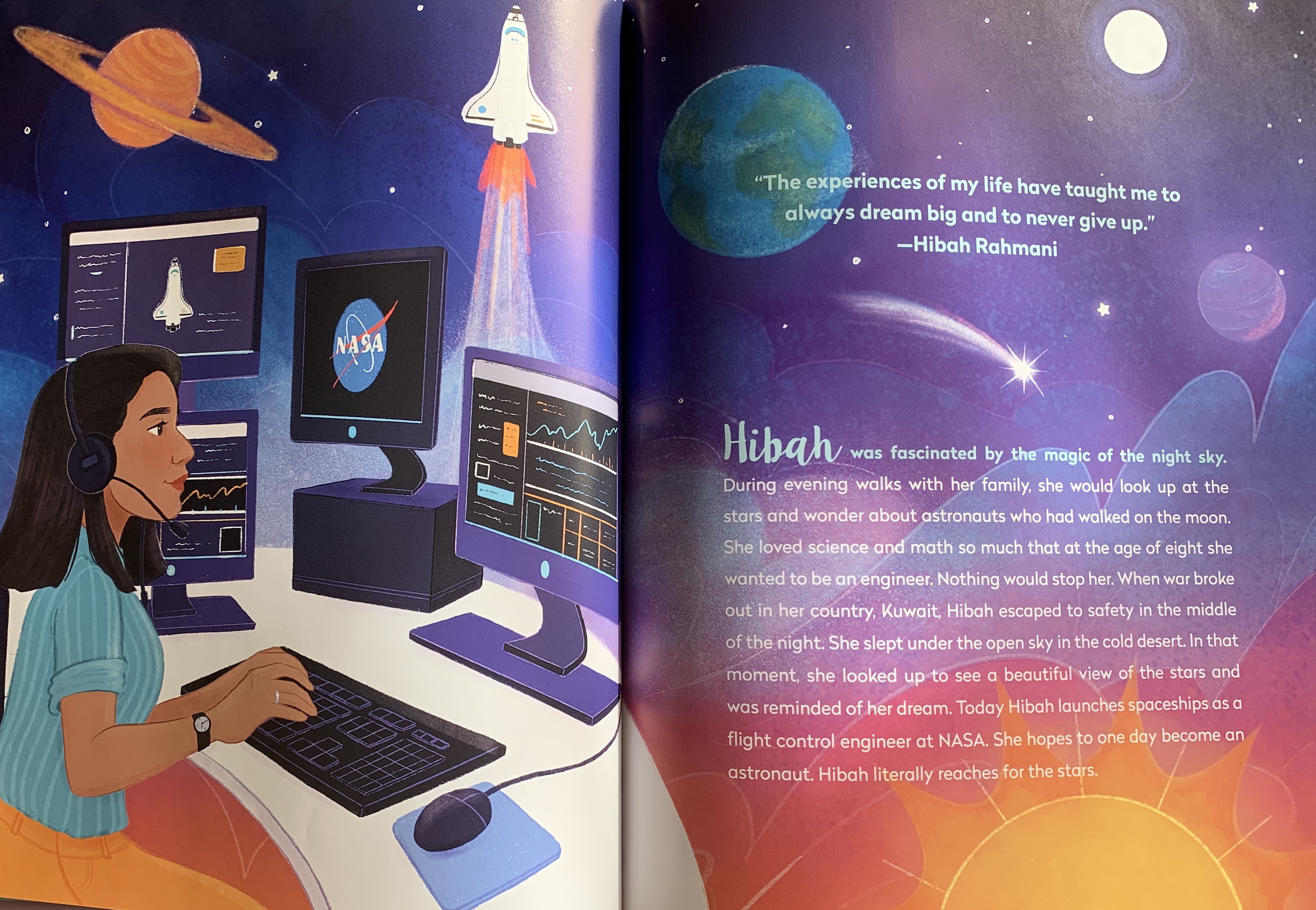
Women you have heard of, some you are meeting for the first time. Some you like, some you disagree with, women that cover, women that don’t, some young, others older, some athletic, some academic, some a little bit of both.  One fictional, a few political, but in the end, all strong women of today, all Muslim, all unique, from all over the world, all known for paving the way for others to follow.

C51C5834-B3C5-4D19-94B3-99B21ADF83EA

In 42 pages, 19 females are highlighted and illustrated to inspire Muslim and non Muslim boys and girls alike, but really Muslim girls will get the most out of it.  Sure a female gets mentioned here or there in other compilations of influential people of our time, but this one, well, this one seems mostly for us.

2D8175C8-0798-4AC1-BF15-D0A9C284AEA9

There are famous females in science, activism, fashion, film, sport, education, media influencers, make-up artists, you name it, and Muslim’s participate, so finally a book shining a light on the best of the best.  With each person getting a full two page spread, a few tidbits about who they are and what they are “famous” for are detailed in easy to read sentences that inspire, and if you haven’t heard of them before, enough general knowledge to get acquainted.  A few felt a little generic, but once you have a name, Googling them or researching them, is obviously, not difficult.

6D798E55-709C-442A-8DFF-4BA184C960E1

I wish there was a bit more information detailing who was chosen and why.  At first I thought it was  US or “western” movers and shakers, but then you have Maria Toorpakai Wazir, the tennis player in Pakistan, and Shirin Ebadi from Iran.  So then I thought ok, they are all contemporary, but Maryam Mirzakhani passed away in 2017.  Needless to say, one could argue that the list is arbitrary, and I think I would agree.

85FF7A9C-FD80-4F37-A1DE-B8726762E9CB

One could also argue, that these women may make history for notable things, but that they might say or do things that you might take issue with, and again, I agree.  They are people, they are fallible, and diverse, and have different perspectives and life experiences, but that’s ok, infact I think that might even be the point.  We all have different passions, and paths, and views and yet at the end of the day we should be able to lift each other up and inspire.  I think every person who reads this book will find someone that sounds or feels or looks like them, and that is a good thing, no, a great thing!

9C6EB606-F612-40BF-A947-092D2B76F1FE

My favorite was the Kamala Khan entry, because I didn’t realize the G. Willow Wilson was Muslim.  I erroneously assumed the other co-creator, Sana Amanat gave Kamala’s back story and home life its sense of OWN Voice, and I love that I learned I was wrong from a book.

2EC5EAF4-87F4-406C-B4D1-C95341536B66

The illustrations are right on and do an amazing job of conveying the character and the inspiration of the collection.  The book is much needed and I hope they do a similar style book for Muslim women in other time periods.

Special gratitude and appreciation to Gayartri Sethi (IG @desibookaunty) for gifting me this book for no other reason than to share the power and strength of women, and being a leader in that, by sending me a beautiful book.  May I learn from your generosity and pay it forward! Thank you.

Shatter Me by Tahereh Mafi

Standard
Shatter Me by Tahereh Mafi

shatter

In many ways this 338 page dystopian YA fiction book focuses more on romance than the super human powers the 17 year old protagonist has and the role she will play in the resistance.  That isn’t to say the book is bad, just that it isn’t as high action, or reform-a-broken-world, or even use-my-super-powers-to-save-myself-and-those-around-me as I had hoped. It is more a lot of self loathing, desire, and anger.  That being said, I am on the fence about reading the rest of the series, as this is the start of a six book series, with two “half” novellas interjected in and being told from other characters’ perspectives.  If this was a show pilot, however, I would let Netflix automatically start the next episode until I had binge watched the entire season, not necessarily because the story is great, or the characters amazing, or the writing stellar, but because it is easy and fun and you really want to suspend belief and know who all these attractive mutated teens running a broken world are, and yes you will roll your eyes at the syrupy sweet lust filled pages, but it is YA so maybe I’m just overly cynical and 15 year olds and up will enjoy it.  It is an AR 4.3, but the language, violence, and romantic build ups should not be read by 4th graders.

SYNOPSIS:

The book starts with Juliette counting how many days she has been locked up in a cell, 264, void of human interaction of any sort and hinting at the reason her parents feared her and turned her in.  She is then joined by a male cellmate, Adam, one she slowly realizes she remembers from her youth and is in love with.  As he asks her questions we learn a bit about her power and the state of the world.  Juliette can kill people with her touch and apparently has killed someone, a child.  Her parents, along with everyone else, have always feared her, and not being hugged or touched her whole life has definitely been a painful existence for her.  Adam is a soldier and can touch her, he is also planted to learn about her as part of his job.  Warner, another teen, is in charge of a soldiers in the Reestablishment and has been following Juliette for a long time trying to see how they can weaponize her and use her for their cause.  Adam was playing a role, and now Juliette will have to play one in a world where the food is fake, the clouds the wrong color, and artifacts of culture and life before it all fell apart are destroyed and deemed illegal.  Along the way she will have to see the world in shades of gray and be willing to forgive and understand that people are not just for or against the way things, are, that sometimes you just have to do things to survive and protect the ones you love.

WHY I LIKE IT:

With all the talk of Iran in the news, I felt compelled to read a book with a Persian character, or at least by a Persian author, so I revisited the works of Iranian-American Muslim Tahereh Mafi.  The book reminds me of a Bollywood drama from the 90s where the hero and heroine do everything suggestive, except kiss, in this book they do a lot, but I guess don’t quite cross a line.  The scenes with Adam and Juliette are too much at times, where the story building about her understanding herself, her world, and what her powers can be, too little. The stage however, is set for the book and characters to grow in the series and with that optimism of knowing that the story stretches on, I have to hope the twists and turns make for a more interesting ride than this first book presents.  Most of the drama is already spelled out on the back cover, she can kill people just by touching them, she wrestles with seeing herself as a monster, or as being more than human.  It really doesn’t start getting good until she finds others like her, but then she is bored of them and the book ends.  The book has a huge following, so much like perhaps the Twilight series, maybe I’m just too cynical, and not in the target demographic, or maybe I need to keep reading.

FLAGS:

There is violence, *SPOILER* Juliette accidentally kills a child.  There is language, there is suggestive talk, there are romantic passages with kissing and touching.  For a book about a character who can’t touch, I feel like the majority of the book is about her touching and being touched.

TOOLS FOR LEADING THE DISCUSSION:

I wouldn’t do this as a book club, because I feel like it really is just a book setting the stage for what more is to come and because it ends so abruptly it feels almost like a teaser, yes a 300+ page teaser.  I was hoping that I could at least suggest it to readers of Hunger Games, City of Ember, The Giver, etc., but I don’t think it spends enough time on the crisis of the world at hand, and the adjustments made by a select few to appeal to the same readers.  It really is a romance, at least thus far, and the destruction of life and the environment just a back drop for their storyline.