Tag Archives: strong women

Behind My Doors: The Story of the World’s Oldest Library by Hena Khan illustrated by Nabila Adani

Standard
Behind My Doors: The Story of the World’s Oldest Library by Hena Khan illustrated by Nabila Adani

img_3557-1

The world’s oldest library proudly stands in Fez, Morocco: started by a Muslim woman, restored by a Muslim woman, and in this 40 page book the library itself tells its own story in a book authored by a Muslim woman.  The personified library shares a few highlights from its early start as a corner in Fatima Al-Fihri’s masjid and university to collections spanning multiple buildings, from a bustling center of learning and knowledge to a place of disrepair and neglect.  Staying on an early elementary level, the informative author’s note and references make the book engaging for older readers as well, and an incredible addition to bookshelves everywhere.

img_3558-1

The book starts with the library introducing itself and welcoming the reader. “Merhaba! I am Al-Qarawiyyin Library–the oldest library in the world.” At over a thousand years old, the library begins at the hands of Fatima Al-Fihri in 859 who dared to dream big and created a space of learning and worship in Morocco.

img_3559-1

As the courtyards and collections grew, seekers of knowledge, from all backgrounds, gathered to discuss, debate, and learn.  Special rooms with special locks kept books safe: a Quran written on camel-leather, a philosophers drawings in gold ink.

img_3561-1

Nearly destroyed once by a fire, the library endured, but over time the rooms were no longer filled with the bustle of people.  One day a small girl, Aziza, paused at the door, but did not enter for many years.  When she did return, she came as an architect with a team to restore the library and invite people back in to read, learn, and dream.

img_3565-1

It delights me that such an important story is available to be widely learned from and appreciated.  You can preorder a copy here from Amazon.

img_3566-1

Every Rising Sun by Jamilya Ahmed

Standard
Every Rising Sun by Jamilya Ahmed

The lush writing and ever present threads of Islam captivated me from the first page of this Shaherazade retelling.  I truly could hear my own voice in my head reading each word, and falling into the masterful story-telling of the protagonist/author.  With about a third of the book left though, I was sadly stopped abruptly in my tracks.  I found myself annoyed by Shaherazade, and having to convince myself that even though this is an adult read, she is very much coming of age and finding herself, only she doesn’t evolve and grow, and doesn’t have a character arc, and by the end I felt deflated.  Is the book good? Yes.  Would I recommend it to readers 18 and up that enjoy OWN voice, strong female, historical fiction? Absolutely.  But I find myself frustrated, because when the book was good, it was so good, but as the end drew closer, I realized there were holes, big ones, that could so easily have been fixed.  The author has the skill, the knowledge, all the tools, but alas, I didn’t appreciate Dunyazade because she is largely absent.  I didn’t know the interworking of her assistants and friends so I didn’t care about them, side characters were so painfully underdeveloped. And with 50 pages left, I was for the first time perhaps ever, glad that the narrative moved from showing to telling (I know, who am I even). I needed the articulation to connect the dots particularly of Shahryar and Shaherazade’s relationship.  The 423 page book could have, and should have, been a hundred pages longer to not feel so rushed at the end, and there should have been a map.  The book has adult themes but they are handled in almost a YA manner.  The beheadings, affairs, wedding nights, battles, war, are not detailed, but rather identified and moved on from even though they are so central to the plot.

SYNOPSIS:

In twelfth-century Persia the daughter of the Malik’s adviser stumbles on the Khatoon and her lover, she anonymously alerts the King to the affair and the beheading of wives begins.  To keep the country from revolting at their mad king, Shaherazade offers to become his next wife, to assuage her guilt for what she set in motion, on the hope that her storytelling will keep her alive come morning.  Life doesn’t pause however, as Shaherazade spins her tales, but rather amplifies.  She accompanies her husband, Malik Shahryar as they join Saladin in the Third Crusade.  The caravan, the journey, the battles, the romance, all bring the climax of returning home to a Kirman under siege will test Shaherazade’s story-telling abilities to the brink and with it the Seljuk Empire.

WHY I LIKE IT:
The prose is on point, time stood still while getting lost in a world of history, imagination, and the author’s skill.  The constant presence of Islam in the characters life was incredible. It was not established and then left to the side: the times are marked by prayers, the athan is ever-present, the duas are heartfelt.  Yes the characters drink wine, and sleep around, but they also fast and treat their prisoners of war with compassion.

I really struggled with how little I cared about people dying, there should have been more connection and more emotion for the side characters, and as the story progressed, I became increasingly irritated that I wasn’t forced to care about them, to know them, to appreciate what they meant to Shaherazade.

I also felt that the majority of the story took place over one year.  How do you forget that you are telling stories to save your life and (SPOILER) start sneaking around with some other guy.  You have a guard detail that follows you everywhere, you are in a caravan and you live in a tent, everyone knows everything!  Shaherazade is also clueless a lot of the times asking soft questions and then told how intelligent she is and allowed to plot and scheme with various rulers.  I love that she has a voice, she isn’t silenced, that she is never apologetic for being opinionated and her very presence is never a kindness, she takes up space and doesn’t look back, but the inconsistencies in her judgement needed some smoothing out.  Show her understanding grow, and increase her intellect to wisdom, don’t have her charming and manipulating leaders one minute and then being so naive the next.  She should have been so much smarter by the end of the book than she was shown to be in her personal dealings.  Her political knowledge was strong, and she was a force, and that level of insight into her own life would have been a character arc to see.

The book is adult, but it almost reads YA and I’m not sure why, it is sourced, the historical presence is exciting, the words and flavors intoxicating.  I normally love when the characters are shown and the reader doesn’t have to be told things, but the only reason I finished to the end was honestly because I got some telling.  I was relieved to hear from Shahryar what he knew, what he felt, what he could own up to.  Perhaps had there been more showing of the intricacies of palace life with the side characters the book would not have gotten to that point, but the lush writing could only carry the book so far.

FLAGS:

Relationships. sex, kissing, fornication, killing, beheading, lying, hangings, war, battle, drinking wine, scheming, kidnapping, attempted rape, it is Adult, but nothing is overly detailed or glamorized.

TOOLS FOR LEADING THE DISCUSSION:

I would love to chat about this book, I think I could be swayed to love it, or play the devils advocate and argue for the sake of arguing.  Being how highly recommended this book came to me from a dear friend, I’m ready to battle and anxious to discuss!

I got my copy from the library, but can be purchased here.

Love from Mecca to Medina by S.K. Ali

Standard
Love from Mecca to Medina by S.K. Ali

mecca to medina

This book is a game changer, or better yet: an industry changer.  It is about Muslims, for Muslims, by a Muslim- but it is MAINSTREAM and a huge panoramic window for anyone and everyone to see a “halal” fictional Muslim love story in action.  With every page proudly mirroring various Muslim experiences this sequel-ish standalone-ish book is unapologetically real, without compromising good storytelling, interesting characters, and engaging plot points.  In much the same way Reem Faruqi’s Golden Girl raised the bar for upper MG/lower YA, this book shows that upper YA Muslamic stories can be told.  That the publishing world isn’t always limiting OWN voices, and that it is up to us, the consumers, to purchase these particular books, pre-order them when announced and spread the word so that the message is loud and clear that we want more books like this.  I have no doubt S.K. Ali had to fight for her vision and advocate for her book at every turn, but now that it is here, we need to step up and show support with our purchasing power.  I’ve pre-ordered mine, and I hope you will do the same before the book releases on October 18, 2022, if you cannot, please purchase it when you can, and if that is not an option please request your libraries to shelve the book (and all of her books) and put them on hold so that the gate further opens for mainstream Islamic fiction.

Preorder link on Amazon

SYNOPSIS:

Adam and Zayneb are back after falling in love in Love from A to Z and getting their nikkah done.  They aren’t living together yet, though, and they are worlds apart with Adam jobless in Doha, and Zayneb homeless in Chicago.  When communication breaks down, exes show up, and a trip to Umrah is underway with the couple divided into gender segregated groups, the couple might fall apart in the same fashion that brought them together in the first place.  The steps of Umrah are beautifully highlighted and experienced, and characters from Misfits and A-Z come back to tie it all together and help the couple, keeping hope alive.  Throw in some marvels and oddities, artifacts and interpretive labels, a unifying cat, and a whole lot of love, and you have a sweet conclusion to a Muslamic love story.

WHY I LIKE IT:

So, I obviously love the standard of unapologetic Islam that this book offers on every page while still being accessible to the larger audience.  It took a little bit for me to be sucked in to the 352 page story, but by page 100 or so, I couldn’t put it down.  The steps of Umrah brought tears to my eyes and the awesome Sausun is fierce feminist friendship goals.  I honestly didn’t love the cat narrative that frames the story, but luckily it is sparse so I could see past it. I love that this book exists, I think I love the Misfit based duology a tiny bit more, but loved that this book had crossover characters and gave many of them a final bow of sorts as well. I read the book in two days and will probably re-read it when I receive my physical copy.  It really is remarkable how much Islam is present in a fictionalized story: not a oppressed Muslim story, or biographical memoir, or refugee story, but in a solid fiction story.   There is no “othering,” this is us, and this a love story about a Muslim couple trying to make it work with outside support and stresses, and beautiful writing.  Alhumdulillah, very well done.

FLAGS:

I’d encourage mature, older YA because the characters are married and sexually active and while it isn’t graphic or depicted it is often just the words mentioning them kissing, and sleeping together and sexting.  Nothing titillating or anywhere near inappropriate, but I think a bit of maturity would help it better reflect the values of Islamic marriages and relationships.  There is some minor language and hate speech.

TOOLS FOR LEADING THE DISCUSSION:

I would absolutely use the book for high school book club if it is mostly juniors and seniors.  I think it gives a good look at what a relationship can look like; the characters’ religious lens and lives will resonate with Islamic school students.

A Darkness at the Door by Intisar Khanani

Standard
A Darkness at the Door by Intisar Khanani

darkness

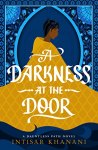
Y’all I was devastated when Theft of Sunlight ended on a cliffhanger, but Alhumdulillah, this conclusion was well worth the wait.  My heart is at ease, even if I am trying to figure out how to get the “Blessing” so that I can forget I read the book, and enjoy it all over again for the “first” time.  I don’t normally review second books in the series, and this won’t be a typical review, but truly if you have not read Thorn or Theft, what are you waiting for, go get those books and start reading.  I don’t know a lot about the publication drama of this fantastic book, but I do know that it was not published in the USA by the same publisher as the first book in the duology, and the thought that we, the readers, could have stepped up the pre-sales and shown our love for the series, the author, and the characters weighs heavy on me.  Thankfully, the UK publisher kept the book and the author found a way to get Darkness to us in the US (it publishes later this summer), but truly we have the power to support good, quality stories, and we must actively show it so that they get published, rather than simply complain about what options are made available to us. This is the author’s website: http://booksbyintisar.com/ if you sign up for her newsletters you can get all the bookishly delicious info.  She is not asking me to promote her or her books, but I happily share and direct support to her, because her stories really are great, and from what I can fangirl find out about the author, so is she.

The book picks up where Theft leaves off, and manages to remind readers what might have been forgotten in the interim.  It had been over a year since I read book one and while I fumbled a little at the beginning, the author caught me up to speed and didn’t let me lose a beat in Rae’s latest and ongoing adventures.  It starts with Rae aboard a slavers ship with children bound for a horrible fate.  More than just her life is at stake, as the information she has recently discovered implicates palace officials, the Circle of Mages, an heir to the throne and so much corruption.  With the help of street thief Bren, Rae gets herself in and out of trouble quicker than most expect.  Her clubfoot, sharp brain, and genuine values, force anyone who underestimates Rae to find themselves scrambling to keep up.  She has grown to love her body and the strengths that it affords her, and in her actions and dedication to changing the world she becomes a formidable river Pirate Queen that you genuinely care for, cheer on, and hope gets a happy ending.

Yes, if you have read Theft and are wondering why I didn’t mention Princess Alyrra, Red Hawk, the Cormorant, Niya, Stonemare, Artemian, and everyone else, fear not, they are all present, and get their story arcs, I just don’t want to risk a single spoiler.  If you’ve waited for this conclusion, you will find yourself desperately dreading the final pages, and wishing the story would never end.  The fantasy, action, characters, world building is all incredible and so hard to put down.  The author is Muslim, but there is no Islam present in the stories, although hints of desi culture do seem to present in the Sweetening atleast. 

The book is YA, but I think 15 and up or so would be a good fit. Like the others in the series, it has magic, murder, killing, lying, thieving, alcohol, corruption, implications of sexual abuse, assault and threat of rape, but this book also has some language, talk of infertility, and some implied banter about marital relations. The romance is very halal and clean, but the violence is graphic as dealing with the implications of murder and slavery are grappled with and thus a thematic element of the story.

Thank you Netgalley UK for the arc, if the book looks interesting and fun for you, please preorder the book wherever you are.

The Button Box by Bridget Hodder & Fawzia Gilani-Williams

Standard
The Button Box by Bridget Hodder & Fawzia Gilani-Williams

img_8336

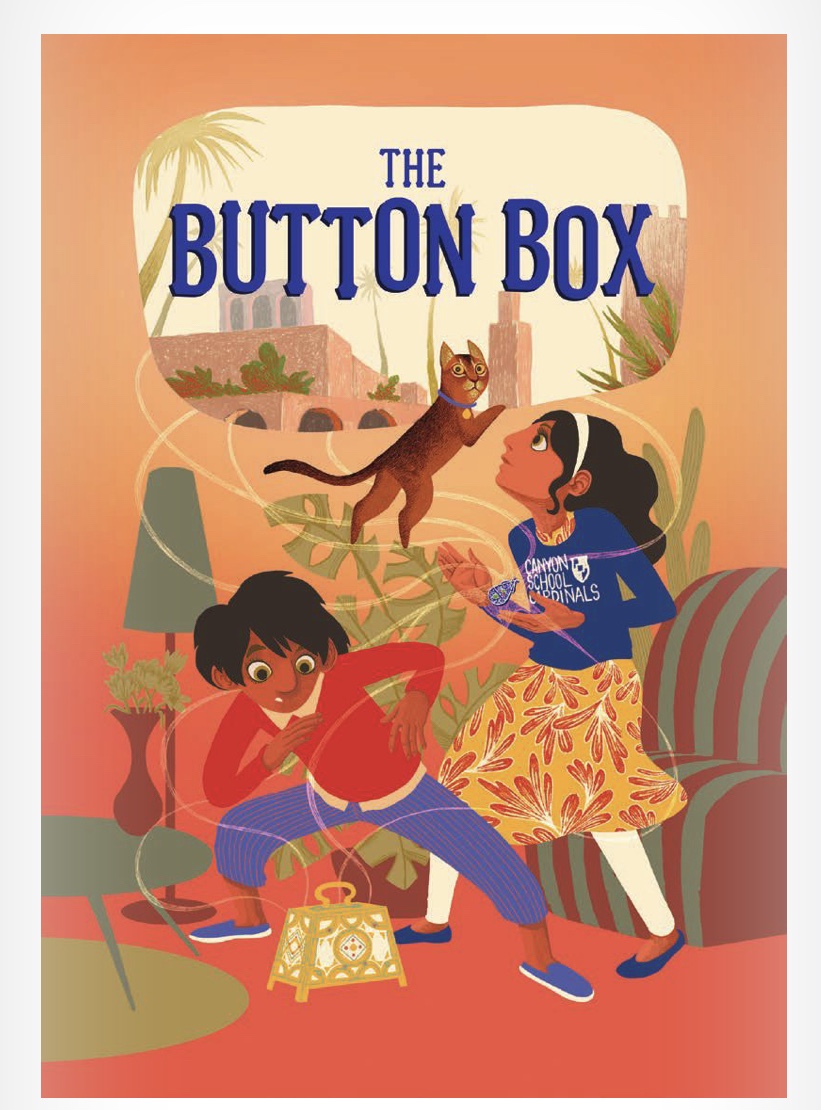
This 152 page book reads like a historical fiction interfaith Magic Treehouse for middle grades tale, and I thoroughly enjoyed it! I learned about Sephardic Jews, the language of Ladino, Prince Abdur Rahman, and a tiny bit about the Abbasids overthrowing the Ummayads.  I love that it starts with a map and ends with sources, facts about what information is real in the book and what is fiction, and a bit about Muslims and Jews and how to be an ally if you witness prejudice.  The book is co-authored, and in many ways the Jewish narrative does take the majority of the focus, but the Islamic phrases sprinkled in, the Islam practiced by a major character, and the setting, allow for both religions to shine and combine to make a compelling magical time traveling story for third graders (and their parents) and up.

SYNOPSIS:

Cousins Ava and Nadeem are in fifth grade and spend their afternoons afterschool with their Granny Buena.  Granny and Ava are Jewish and Nadeem is Muslim, though they believe differently, they always seem to find more that is the same, and respect is always given.  When they face bullying at school Granny Buena pulls out a crystal box full of buttons and tells the children, and the cat Sheba a tale about their ancestor Ester ibn Evram.  When she stops the story short, the two kids exam the button closer and find themselves back in time tasked with saving Prince Abdur Rahman and getting him from Africa to Spain.  They aren’t sure if that will be enough to get them back to their own time though, but they don’t have time to overthink it because if they fail, the Golden Age of Islam won’t happen, peace won’t come to Muslims, Jews, and Christians in the region, and their Jewish ancestors may face the backlash of helping the Muslim escape.  Along the way, they learn about their own family traditions, beliefs, and gain wisdom to handle their bullying problem at school.

WHY I LIIKE IT:

I love that I learned so much, and from what I could Google and ask about from those more knowledgeable, the facts about the time period and cultures all seem to check out.  Only one passage comparing Jewish belief and the text of the Quran is phrased oddly in my opinion, the rest of the Islamic sprinkling is well done.  There are numerous bismillahs, mashaAllahs, stopping for salat, quoting of the Quran and more.  The narrative is primarily Jewish, but the setting Islamic with athans being called and Salams being given.  The book does have a lot of Jewish detail, but I don’t think it was preachy, and the further uniqueness of Ladino words and culture I think would appeal to all readers no matter how familiar or unfamiliar they are with the two religions.

There are some questions that as an adult reader I wanted to know more about: how Nadeem and his mom are practicing Muslims in a strong Jewish family, how making sure history happened as it happened the first time sent the two kids back…then why were they sent there at all, is there going to be more button adventures, were their two cats or was it the same cat?   Honestly, a lot of the more obvious fantasy plot holes were accounted for and done quickly and simply: how their clothes changed but the button remained, how they could speak the language, how confused their aunt would be when her real niece and nephew arrived, etc.. The writing quality kept it all clear for the reader, and did so without the pacing of the story suffering.

FLAGS:

Near death experience, magic, mention of killing, fear, deception, bullying, fighting, physical altercation, misogynistic assumptions.

TOOLS FOR LEADING THE DISCUSSION:

This would be a great story to share if I return to the classroom. The history, the religions, the storytelling would provide so much to connect to and learn about.  As a book club selection though, it would be too young for our middle school readers and ultimately too short.  I would consider it for a read a loud with fourth and fifth grade.

To Purchase: Here is the Amazon link: https://amzn.to/3D9LyxI

Nana Asma’u by Aaliyah Tar Mahomed illustrated by Winda Lee

Standard
Nana Asma’u by Aaliyah Tar Mahomed illustrated by Winda Lee

nana asmau

This book may only have 14 pages of text and be meant as an introduction for early preschool aged children and up, but I learned so much, or rather was made aware of so much that I knew nothing about, that I’m now eager to research her and the Sokoto Caliphate and the impact of Jajis.  The beautiful, bright, engaging pictures, the simple deliberate text, and the inspiring content matter make this a great book to share with little ones, and to keep on the shelf for repeated readings and reminders to learn more about this remarkable woman for older children.  My only wish was that there were some reference notes or sources included to give that extra reassurance of authenticity.

img_6076

The book tells about Nana Asma’u’s life starting from being a curious child and asking questions to the wise women in her community.  By the time she grew up she had memorized the Quran and spoke four languages amongst many other things, and Nana loved to write poetry.

img_6077

During this time, there was a lot of conflict in Western Africa, and Nana’s father, Shehu Usman resolved the issues and created the Sokoto Caliphate.  With peace, Nana wanted to help educate the people. She thought long and hard about how to do it.

img_6078

She eventually brought together women from different regions of the Caliphate and taught them through poetry, she then sent the women back to their homes to share what they had learned.  These women were known as Jajis, and this tradition still exists today.

img_6079

I didn’t love the phrasing that she had learned all about Islam, seeing as one can always learn more.  And I would have like Prophet to have been capitalized and salawat given for respect.  Overall, a great book that alhumdulillah I was able to purchase from Crescent Moon Store.

This Woven Kingdom by Tahereh Mafi

Standard
This Woven Kingdom by Tahereh Mafi

woven

At 512 pages this teen/YA fantasy book immerses you in the lives of two characters pitted against one another that are inevitably, drawn to each other.  The world building is slow, as it seems to spend more time character building and shaping the magical Jinn filled world around the characters, through their eyes, and their interactions, than simply building a world, and then dropping characters in it.  It never seems to drag, but the rising action is not concluded, it in fact ends on a cliff hanger raising the expectation for the next book in the series to take the story toward more action, emotion, and twists.  I absolutely love and applaud the author’s note that articulates and clarifies that this book is not religious in nature and that threads of Islam and Persian culture are just reference points for this completely fictionalized tale.  There is a passionate kiss, and violence, but this book is remarkably clean and an enjoyable read for ages 14 and up.

SYNOPSIS:

The story opens with Alizeh sitting by the fire sewing.  She is freezing, she is always freezing, she is a Jinn, but her veins are ice.  Completely alone, she is working as a maid, but as she is on probation, she lodges in a tiny closet away from the other service members, and is deathly afraid of the dark.  Her loving parents raised her and nourished her, she is educated and strong, but since their deaths she has been on the run, trying simply to survive in a world where Clays forbid Jinn from using their magic.  Alizeh is no ordinary Jinn though, the earth has chosen her to be the future Queen, her ever-changing eyes prove it, but for now, she has no kingdom, no family, no friends, no hope to lead.  Only cryptic riddles given to her by Iblees that she dreads and fears, but warn her of impending dangers.

Kamran is the second storyline that builds the world of Ardunia.  As the crown prince, and future king, he has returned from touring the country and has had his eyes opened to the forces threatening the empire, the inevitable war that is looming, and the shortage of resources that threaten them all.  He is irritable and brooding and acting out of character when he intervenes in an altercation in the streets between a servant girl and a young boy.  This sets off a series of events that will bring Alizeh and Kamran into direct conflict as their worlds intertwine and their passions build.

WHY I LIKE IT:

I love the clarification at the beginning, stating that this is not Islamic and that religious and cultural inspiration was just that, inspiration. It allowed me to get comfortable and enjoy the tale for what it is.  I wasn’t worried about checking things, or worrying about religious impressions and accuracy, it was so freeing, thank you.  I really hope that there is a map in the final physical copy, because I just really like maps.  I liked the Persian numbers and script on the chapters and the references make the book that much richer and fleshed out.

I am admittedly fairly new to fantasy, so I enjoyed the slower pace and character building.  I found it enveloping and smooth, there were small conflicts, but the subtle world building through understanding the characters, and their perspectives, was a nice framing for a story that very easily could have dragged, but in reality flew by.  The only point that I found unrefined, was how much Alizeh knew of her past and the impact it had on her current situation.  There seemed to be a bit of a disconnect in teasing that thread.  The reader knows who she is, so I’m not sure why she seems to not know, and then proves that she does, there is no subtlety in that regard.  And the only character, that seemed underdeveloped was that of Hazan, his banter with the Kamran grated on my nerves, and I didn’t understand the abruptness of his and Alizeh’s relationship, it seemed forced.  Nearly everything else in the book was very organic and gently referenced and established very deliberately, but it almost seemed like I missed a chapter or two, when all of a sudden Hazan emerges as being such a main character in Alizeh’s life.  Undoubtedly it was a surprise for the reader, but some nuance in the revelation through Alizeh’s eyes, would have assisted in the continuity of the character and tone of the book.

FLAGS:
A kiss, and attraction, talk of illegitimate children.  There is killing and violence, attempted assault: physical and sexual, not detailed, but referenced as a fear as she walks alone at night.  There is darkness and talk of the devil, deceit, lying, plotting.  Nothing an early teen could not handle.

TOOLS FOR LEADING THE DISCUSSION:

I would have to delay deciding if I could do this as a book club selection until I read the next book.  There is so much potential, that I truly hope that I can introduce the series to young readers to enjoy, get lost in, and discuss.

Loujain Dreams of Sunflowers by Uma Mishra-Newbery and Lina Al-Hathloul illustrated by Rebecca Green

Standard
Loujain Dreams of Sunflowers by Uma Mishra-Newbery and Lina Al-Hathloul illustrated by Rebecca Green

loujain

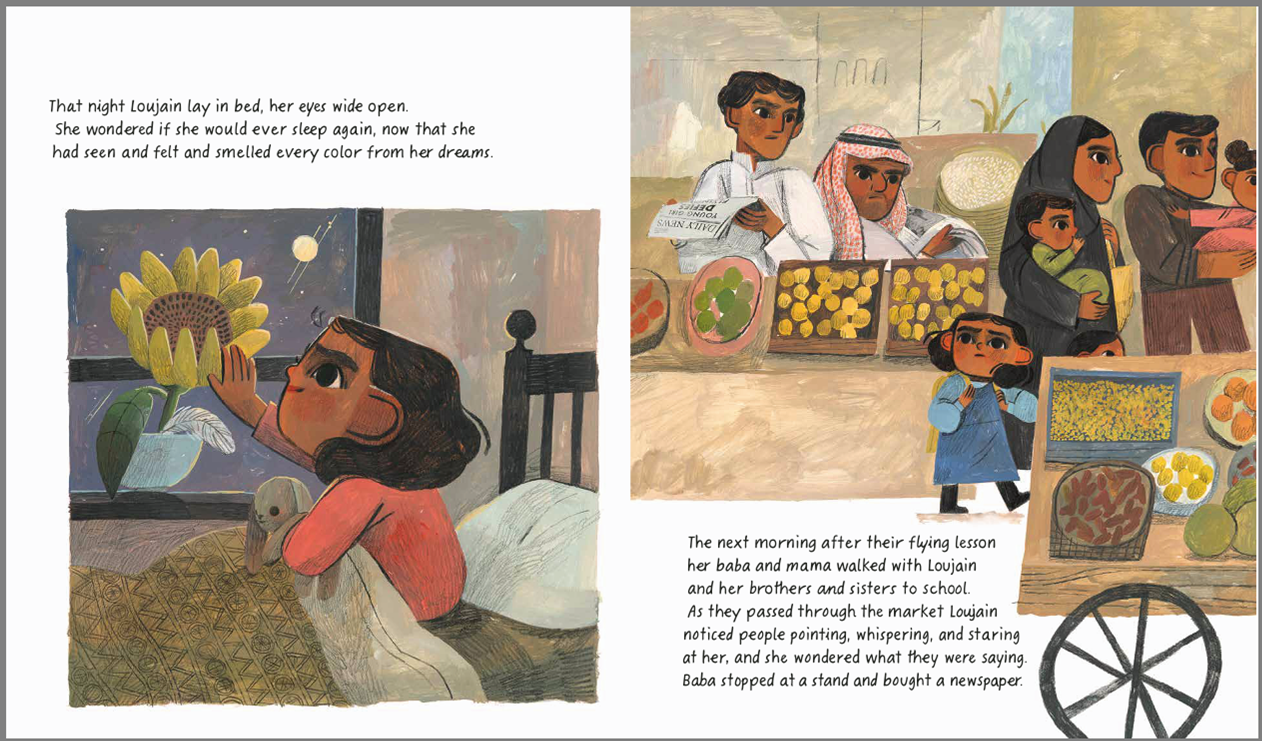
This 40 page early elementary book based on the efforts of the real life woman, Loujain AlHathloul, and her work to change the laws regarding women driving in Saudi Arabia, had a lot of promise.  Unfortunately, the symbolism connecting flying and driving, just didn’t work for me.  No one can flap their arms and fly, so to demand gender equality for an unrealistic action, is a big stretch that ultimately stretches itself too thin.  There is nothing Islamic, except women wearing a hijab in a few illustrations, or even Saudi specific in the book.  It talks of the desert, but the country is unnamed.   Overall, I just had so many questions such as: if she was flying before sunrise- how was she not seen returning from the sunflower patch, can women then never leave an area, are there ways they can fly as passengers, are there other modes of transportation, at what age are children allowed to fly, and so many more, that they prevented me from being inspired by the story.

loujain1

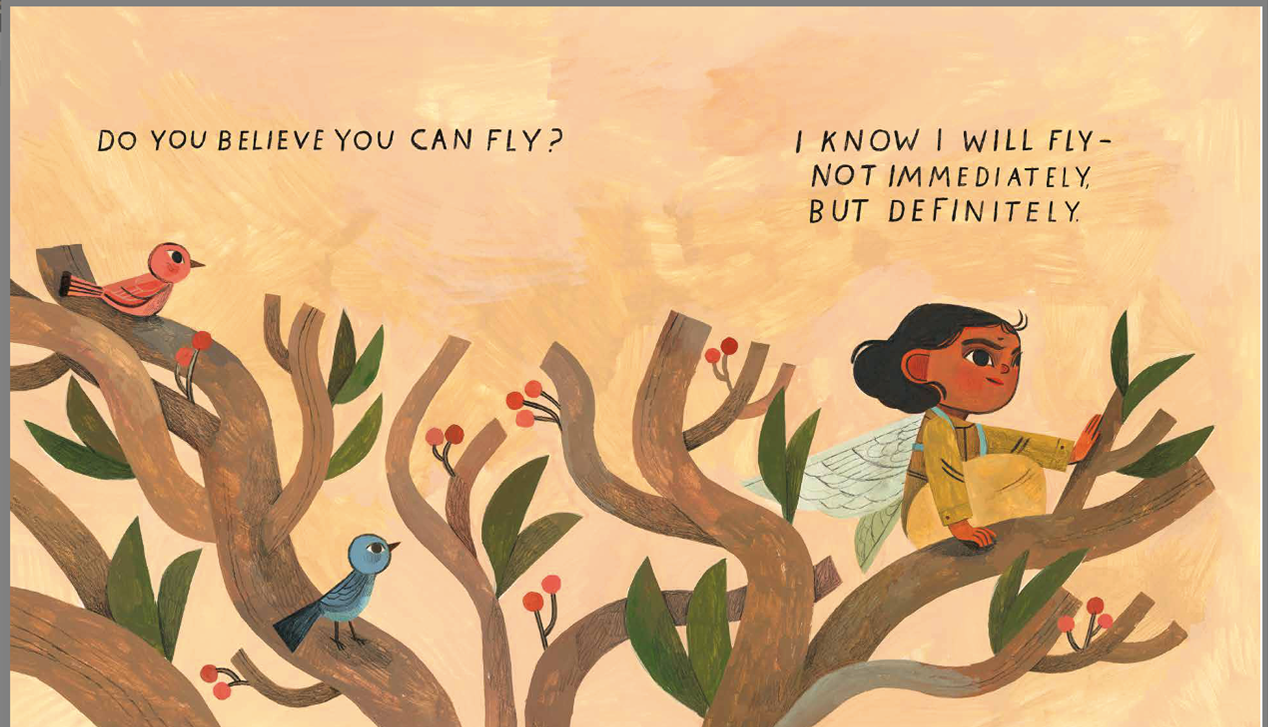
The book starts with Loujain believing in her self and knowing that one day she will fly.  She dreams of a place of a million sunflowers, a picture her dad has given her inspires her to seek out bright colors, capture them on film, and hang them in her room.

loujain2

In the morning her father straps on his wings, and flies off.  Loujain is not allowed to fly because she is a girl.  Her family tells her that one day she will.  When she tells the kids at school, they laugh at her.  When she pushes her dad to teach her, her mother advocates that he should.

loujain3

Loujain and her father practice flying before the sun rises, and finally they make the long journey to see the sunflowers.  Her father takes a picture of Loujain, and it appears the next day in the newspaper.  Other girls are inspired and begin to demand the right to fly too.

loujain4

I love the mom in the book, and her encouraging of Loujain’s dad to teach her.  She asks him, “if you don’t support her, who will?” I don’t know why the mom isn’t wearing a hijab on the last page though.  It seems like there is a subtle message there about hijab being legally required as well.

loujain5

The book is a reach, and for me it didn’t connect or leave an impression.  The information about the prison sentence and push back to achieve the legal change was far more interesting and memorable, but only a few paragraphs long at the end.

A Sky-Blue Bench by Bahram Rahman illustrated by Peggy Collins

Standard
A Sky-Blue Bench by Bahram Rahman illustrated by Peggy Collins

sky cover

I know many of you are thinking, another book about school for girls in Afghanistan, and given the reception by most to the author’s first book, The Library Bus,  I can sense the rolling eyes.  I was in the minority on that one, as I enjoyed it, but, this one is simpler, sweeter, more universal while being complimented by culture, and I hope it is a more authentic and accurate OWN voice portrayal.  I know I have a lot to learn about white washing narratives and breaking down colonial paradigms, so I promise if you disagree I will listen.  But I genuinely enjoyed the illustrations and little Aria finding a way to make a bench so she could sit comfortably at school with her prosthetic leg.  The girls go to school, and the furniture was burned to keep warm in the winter, a concept that the author verifies at the end as something experienced in his own life.  Aria has to find a way to sit in class because she wants to learn, and lack of wood working experience, resources, and doubt that a girl can do it from her classmates, isn’t going to stop her.  Over 32 pages, early elementary age children will meet a determined young girl as she pieces together scraps to build a bench.

Screen Shot 2021-10-22 at 10.49.20 PM

Aria has been in the hospital for a while after an accident took her leg.  She is excited to be back at school, but quickly realizes it is hard to sit on the floor with her new helper leg.  She tries leaning on the wall, standing even, but just getting up and down off the floor is really difficult.  At home when she mentions it to her mom, her mom reassures her that she can get through it and her little brother offers to help her carry her things.

Screen Shot 2021-10-22 at 10.51.12 PM

That night Aria considers how much she would miss school if she isn’t able to figure something out.  Then she has an idea, she’ll build a bench.  At school the next morning, classmates tell her “Girls don’t build benches,” but Aria responds, “I can do anything a boy can.”

With that, a single friend joins Aria as they comb the city for discarded wood, broken furniture, screws, and nails.  They assemble the resources and when they have enough Aria and her mom head across town, past the Blue Mosque, to visit the carpenter, Kaka Najar.  He shows them how to fit the pieces together like a puzzle and loans them the tools needed to be successful.  He even gifts her some sky-blue paint, “the color of courage, peace, and wisdom.”

Screen Shot 2021-10-22 at 10.52.30 PM

That weekend Aria and her mom and little brother build a bench, paint it blue, and get it to school.  When the other students see it, their excitement bubbles and they imagine building tables, book cases, and more.  Anything is possible after all, there is paint left in the can and they are willing to work together.

Screen Shot 2021-10-22 at 10.53.08 PM

There is nothing religious in the text, save the mention of walking past a mosque, but in the illustrations the women are all covering their heads when they are out, and are uncovered at home, the school uniform seems to be a white hijab and black abaya.  I wish there were some Pashto words sprinkled, and it was a bit off that she was building a bench, but the finished project was a bench and table. The end has an Author’s Note and I enjoy seeing the smiling faces and bright illustrations in a book set in Afghanistan.

Screen Shot 2021-10-22 at 10.54.15 PM

Amira & Hamza: The War to Save the Worlds by Samira Ahmed

Standard
Amira & Hamza: The War to Save the Worlds by Samira Ahmed

amira and hamza

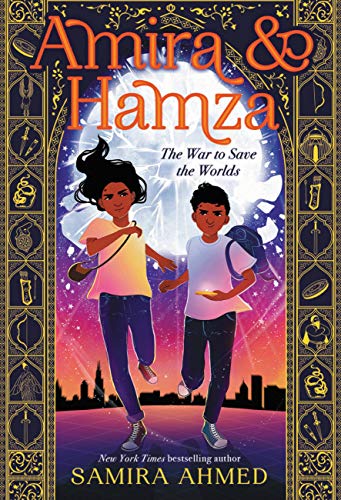
Make sure you are sitting in a comfy spot when you crack open this middle grades fantasy adventure, because it hits the ground running from the very beginning and doesn’t let up over 368 pages.  The like-able and relatable brother sister duo snarkily banter and bicker about everything from cultural Indian (Desi) folklore, religious stories, Marvel, Lord of the Rings, He-Man, Arabic Sesame Street, Star Wars, hygiene, fears, potential science fair projects, and food, all while battling jinn, devs, peris, and reality as they work to save the worlds.  The book is chalked full of STEM concepts, cultural touchstone, Islamic footholds, pop culture, and fun, as one character remarks, it is the ultimate fan fiction. I regularly Googled people, references, and concepts, and ended up learning quite a bit.  And don’t fret if you ever get lost or confused, or something doesn’t make sense, you don’t have to worry that you missed something or that the author left a gap in the narrative, the book moves quick and Amira’s constant dialogue and commentary points out all the ridiculousness of what they are experiencing and the questions that she wishes she had time to ask, explore, and discover.  The author never loses control of the narrative, and keeps the world building on level without skimping on details and understanding.  I have not loved any of the author’s previous books in their entirety, I think this one, however, is her best one yet, and the switch to middle grades is a good fit.  

SYNOPSIS:

Twelve-year-old Amira and her 10-year-old brother Hamza are heading to the Shriner’s Madinah Temple in their hometown of Chicago to explore the exhibit of Ancient Astronomy artifacts, or as Hamza calls it “tools that belonged to dead Muslim Astrologers.”  Hosted by the Islamic Society of Ancient Astronomy corresponds with the eclipse viewing party of the incredibly rare super blood blue moon.  In typical Hamza fashion however, a Nerf gun is brought and things are touched.  When Amira is tasked with bringing her brother up to the roof to learn how to use the telescopes, the two scuffle over a small box with a tiny moon inside, a series of snatching and tussling between the siblings cause the Box of the Moon to break, or rather start working.  As day turns to night, the moon seems to be breaking a part, and everyone in the world is suspended in sleep except for Amira and Hamza, and an entire jinn army is heading their way.

When jinn leaders Abdul Rahman and Maqbool reach the children they must convince them that they are not there to harm them, but rather to recruit them as the chosen ones to save the worlds: Qaf and Earth and the barrier, the moon, that keeps the realms separate from destruction at the hands of Ifrit.  The confusion over there being two of them creeps up, but is squashed as Suleiman the Wise left tests to prove that the chosen one is properly equipped to battle Iftrit as it has been prophesized.  The children must work together to prove themselves they must then actually seek out and defeat Ifrit.  As tests and challenges arise, it becomes clear (pun intended) that the two are not the chosen ones, but with no option of turning back they must forge ahead none-the-less.

“What? We’re Indian, dude, we were basically born half doctor.”

WHY I LIKE IT:

I love Amira and Hamza’s banter.  The references are at times laugh out loud funny.  Similarly, I was impressed by all the historical and STEM concepts intertwined in the story, there is even a tiny bit about mental health.  I learned about parts of the moon, historical figures, folklore, and more.  The characters are Muslim, Amira wears Ayatul Kursi around her neck and they talk of Sunday school.  The book isn’t religious though, in they aren’t saying Bismillah before they embark on things, or supplicating when in danger, but they greet different beings with peace, and the framing is clearly from an Islamic paradigm.  I think the high speed pacing works for most of the book, and somehow you still get to know and connect with the characters, but at times a slight pause to clarify a point would have been nice.  I would have liked to have the kids proving they were the chosen ones a bit more articulate and dramatic before hand rather than in retrospect.  I feel like the jinn transportation of cauldrons could have used a bit of backstory as well.  And a little fleshing out of the scroll, the government structure and communication methods of Qaf, would have helped some of the transitions between the action.  I read a digital ARC and it had a page reserved for a map, and I think when the physical book comes out that will be really helpful, as I didn’t quite fully understand the 18 realms and their locations  in comparison to the locations the children encounter.  

FLAGS:

UPDATE:  I TOOK THIS BOOK AS COMPLETE FICTION. THAT THE ISLAMIC PREMISE WAS A STARTING OFF POINT, AND DIDN’T DWELL TOO MUCH ON THE ACCURACY.  I READ AN ADVANCED READER COPY OF THE BOOK THAT DID NOT HAVE ALL THE SUPPLEMENTAL AUTHOR’S NOTES AND RESOURCES AT THE END.  I WAS UNAWARE THAT THE AUTHOR FELT SHE WAS INCOPERATING FACT AND ACCURACY IN THIS INCREDIBLY FICTIONALIZED BOOK. AND AS A RESULT I AM NERVOUS TO SUGGEST THIS BOOK TO THE MIDDLE GRADE INTENDED AUDIENCE.  IF YOU HAVE A MUSLIM CHILD THAT IS WELL VERSED ON PROPHET SULAIMAN, THE CONCEPT OF FICTION, AND IS OLDER THAN THE IMPRESSIONABLE EIGHT OR NINE YEAR OLD INTENDED AUDIENCE, ONLY THEN PERHAPS WOULD THIS BOOK WORK FOR YOU.  IT WOULD BE VERY MISLEADING IF YOUR CHILD TAKES THE TWISTED STORY AS FACTUAL AND BASED ON THE NOTES AND RESOURCES AT THE END, THIS VERY WELL COULD HAPPEN. To read more about the concerns you can click here and head over to Muslim Mommy Blogs take on the book.

There is magic and magical beings. A transgendered jinn.  It mentions Amira and Hamza celebrating Halloween. Death and fighting.

TOOLS FOR LEADING THE DISCUSSION:

I think this would be a great audio book to listen to with the family or a read aloud in a middle grades classroom.  It is too young for middle school readers to not find it slightly predictable, but if you had it on a classroom or home shelf I am sure it would be picked up, read, enjoyed by middle grades and middle schoolers alike.  It reads much like the Rick Riordan Presents series and I hope that there are more books featuring Amira and Hamza in the future.