Tag Archives: school friends

Drawing Deena by Hena Khan

Standard
Drawing Deena by Hena Khan

This 232 page middle grade read with a beautiful cover, has a beautiful heart as well.  A Muslim girl in a Muslim family is struggling with anxiety and family financial stresses, remarkably the book avoids tropes of blaming immigrant parents, culture, or religion.  It also doesn’t have any relationship crushes, or catty friends, bullies, or annoying sibling squabbles.  It was refreshing to see a strong character that seemed to not lack a voice, really find her voice,  advocate for herself and those she loves, apologies when in the wrong, and be surrounded by friends and family members that truly love one another.  I also appreciate that a licensed school psychologist was consulted and named in the backmatter.  As with nearly all Hena Khan chapter books, there is Islam and culture, but as an Islamic school librarian, I long for more.  There are a few inshaAllahs, mashaAllahs, salams, and references to praying, there is one solid paragraph that mentions dua, dhikr, and the Quran, but that is about it in a book that focuses a lot on fashion, make-up, social media, drawing portraits and hanging them in the home.  The protagonist is in middle school, but this is a solid middle grade read that teachers and librarians can feel confident having on the shelves and sharing with students.

img_2301-1

SYNOPSIS:

Deena loves art and to draw, she’s also really good at it.  She longs to take extra classes outside of school, but she knows it isn’t a priority with her bite guard already causing a lot of stress on the already financially strapped family.  Overhearing her parents fights about money adds to her anxiety and makes her nauseous every morning before school.  Determined to help her mom grow her basement clothing boutique, and increase the family income, she dabbles in social media, designs a logo, and sets up a website.  One of the new customers is a real life artist, who encourages Deena to look at art differently, and offers to take her under her wing to teach her about the power of art and decolonizing her mind. Things are starting to look up for Deena, but a disagreements with her cousin Parisa, feeling like she let a close friend down, and being overwhelmed at an immersive Van Gogh exhibit culminate with her having a panic attack at school.  The school counselor wants her to attend some therapy sessions at the school, but first Deena will have to convince her parents that this is something she needs and wants.

WHY I LIKE IT:

I mentioned a lot of my likes and loves above, but really it is a solid middle grade read where the character just happens to be Pakistani American and Muslim.  I like that Deena is just a sweet girl.  I think a lot of kids that have the emotional intelligence to know how fortunate and privileged they are, often push down their emotions and troubles, because they know others have it worse, don’t want to worry their parents, and/or seem ungrateful, and that this book can normalize getting help, advocating for yourself, and communicating with your parents, is really quite impressive.  Deena has a diverse group of friends, religion doesn’t come up much or seem to shape her perspective which is unfortunate, but it doesn’t make things harder for her either.  She isn’t bullied, there is no Islamophobia, or self-othering or stereotypes.  Deena is who she is, with a good head on her shoulders, and throughout the book you find yourself cheering for her and her success.

FLAGS:

She does draw faces, and they talk of hanging up the images in the living room.  There isn’t lying, but it kind of skirts the line at times. Anxiety.

TOOLS FOR LEADING THE DISCUSSION:

For even a young middle school book club, I think this book would be a quick read, but open the door for some quality discussion about anxiety that would benefit middle graders and up.  The book on the shelf will tempt readers, and handing it to kids will yield results.

The book goes on sale February 6, 2024 and you can preorder/order it here.

Yusuf and Yusra’s Spooky Dilemma by A. Dawood illustrated by Fatimah Farooqi

Standard
Yusuf and Yusra’s Spooky Dilemma by A. Dawood illustrated by Fatimah Farooqi

This 54 page early chapter book about a Muslim kid being tempted by Halloween somehow didn’t really center Islam much, it didn’t explain the origins of Halloween, and it meant well, but I didn’t get the messaging, it actually felt othering.  Young Yusra lies to her parents, gets a costume, attends a school Halloween party, and then once caught goes out to lunch and taken to a museum with her brother and friend Fatima. At the museum the vibrant room is the “From Around the World” exhibit, and the depressing room is “The World Around Me.” the dichotomy is stereotypical and presumptuous without sufficient insight.  The book’s concluding lesson being, don’t give in to peer pressure and feel like you have to celebrate something that isn’t right, “think of all the millions of Muslims in the world not celebrating.”  Wait? What? That is the exact same thing- do or not do something because other people are doing or not doing it! Literary wise there were numerous paragraphs and pages I had to reread to know who was talking, the side characters were underdeveloped as they would get mad and storm off and then be chatting shortly after, and at the end, Umar completely ceased to exist.  Having already reviewed the other title in the series Merry Dilemma, I’m going to allow myself a little forgiveness in comparing the two books, as I would imagine many consumers will buy both, and I found the messaging and presentation in the Christmas book, a lot stronger in facilitating conversation and reflecting Muslim kids’ stresses, than this Halloween book was able to do.  The discussion of Isa (A.S.) and the messaging of what Christmas means and why it is problematic for Muslims was more clear and allowed me to overlook some of the literary inconsistencies and weaknesses; I’m glad I read it first.  If you read this with your kids plan to supplement and discuss because the book does not leave you feeling like you really know why Yusra, or Muslims, don’t celebrate Halloween.

SYNOPSIS:

Halloween is here and Cedarcrest Elementary is throwing a huge party.  Yusuf isn’t going, he knows Halloween isn’t for him as a Muslim.  Family friends, Fatima and Umar, aren’t going either.  But Yusra’s best friend Amanda is really excited, and Yusra thinks she can just help Amanda celebrate, it is just for fun any way right? It isn’t like she is celebrating, she will just be there.  She tells her parents she can’t miss school, her dad buys her a costume, not for Halloween, just for dress-up, and now she is at the school party with glitter and candy and a whole lot of guilt.

WHY I LIKE IT:

I like that the parents try and meet the kids where they are.  I think a lot of Muslim parents buy candy and costumes on clearance the day after Halloween so their kids can still have treats without partaking in trick or treating and enjoy imaginative play after the holiday.  The book having the costume being purchased before the holiday, thus is a relatable occurrence.  Yusra wanting to go is also believable.  But, the parent’s letting it play out to their fourth grade daughter actually lying about a quiz and going to school is a bit of a stretch.

I struggled with the lack of explaining why Muslims don’t celebrate Halloween and what the origins of Halloween are.  It said I don’t do it because I’m Muslim, I don’t celebrate because my parents told me not to, and thank you for explaining it aunty- but in fact, there was no explanation.

The writing wasn’t great.  At one point it says, “Let’s go to the frozen food section we need milk and cereal.”  There were multiple places I didn’t know if Yusra or Yusuf were talking, they sound the same age and I don’t think they are twins, but maybe they are, they are family friends with a brother sister: Umar and Fatima at their school, but Fatima is not in Yusra’s class either, the school vibes feel more junior high than elementary. Back to Fatima though, she gets mad when Yusra doesn’t take a firm “Muslim’s don’t celebrate Halloween position” with Amanda and she walks off being labeled a party pooper, but after school everything seems fine. The plan is all four Muslim kids will hang out instead of going to school for the party, but Umar is not with Yusuf and Fatima when they bust Yusra, or at the museum, so where did he go?

The messaging hinges on Yusra’s guilt.  I don’t know that the book explores it enough, doesn’t have her struggling with it a lot, so it comes across that it is more the getting caught that caused the realization.  She remembers Allah swt when caught, she apologizes to her mom, which is good, but not celebrating Halloween then seems more a family expectation not a religious no-no.  Ultimately the book felt a bit like a missed opportunity to explain the origins of Halloween and let the child decide what to do based on their understanding of Islam and the holiday.

FLAGS:

Lying, going to a Halloween party.

TOOLS FOR LEADING THE DISCUSSION:

I have a few teenagers and a 3rd grader and a toddler, I don’t think this book will do much to foster communication and deepen their understanding about Muslims and Halloween.  For my oldest three when they were in early elementary, we would listen to a NoorArt CD Qu’an for Little Muslims it had a track about Halloween that seemed to work when they were young: you can listen to it here.

If you think this book will work for your needsthough, you can order it here.

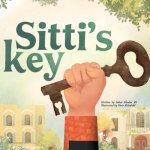
Sitti’s Key by Sahar Khader Ali illustrated by Noor Alshalabi

Standard
Sitti’s Key by Sahar Khader Ali illustrated by Noor Alshalabi

sitti key

I try and buy, read, and review every children’s book about Palestine that is published, it is the least I can do.  I also try not to compare them to each other as they present different aspects of oppression, perspectives of strength, examples of joy, and messages of hope, even among many similar themes of food, keys, traditions, and culture.  I really appreciate that this book though is incredibly blunt.  It isn’t lyrical, it isn’t poetic, and as Israel is bombing Jenin as I write this I’m glad it doesn’t mince words about the Nakba. I do think caregivers though, should probably read it first as it might be a little triggering for sensitive children.  The story is OWN voice and probably best suited for middle elementary aged children.  It is perhaps also worth noting that the book could be seen as making Jews synonymous with Zionists.  The characters are Muslim, Islamic phrases and Arabic terms are sprinkled throughout, and even despite the pain the family has endured, the book stays hopeful and proud.
Sitti is coming and Amal is excited, it has been two years since she last saw her.  She loves how excited her mom and grandma are to unpack gifts of olive oil, dates, and zataar from friends.  Amal isn’t sure what to do with the “old lady thoub” she has been gifted, but she smiles in appreciation none-the-less.  When Sitti pulls out an old key, Amal starts to ask her about it, but her mother shuffles her off to bed.

The next day at school, Amal has to work on a presentation about “culture,” but there are no Palestinian books in her school library, so she just watches the other kids.  At home they eat and listen to Sitti’s stories of long ago in Haifa, and Amal asks her why she left Palestine.  Despite her mother trying to redirect, Sitti says it is time she knew about the Nakba.
Sitti tells about living on the land for generations and how the Jews believed the land belonged to them.  In 1948 the British decided Palestine would be the homeland for the Jews.  Armed men came and arrested anyone who tried to stay in their homes. Sitti’s brother was handcuffed and never seen again.  The family grabbed what they could including the key to their home as they made their way to a refugee camp in Lebanon.  They stayed for three years, before making their way to America.

When Sitti concludes her story she hands the key to Amal and her hope that she will return to their home inshaAllah.  Feeling the pride and warmth of home, Amal has a determination to reclaim her heritage and share her “culture” with her classmates.

The illustrations are sweet, the mom and Sitti wear hijab even in the home, and the inshaAllahs and salams come naturally. The book does not stop to define zataar or marimya, which helps the flow. I also like how it shows that there aren’t books about Palestine in the school library, it is strong and important detail.  I don’t understand where Sitti is coming from though, it would seem Palestine as she is bringing gifts from friends, but in the story it says after Lebanon they made their way to America, so I’m not sure where Sitti lives, and how the logistics of the family work to be honest.  I also kind of wish there was a  recipe for zataar in the book and lyrics with translation for the song the family sings.

Book is available on Kindle or can be ordered from www.littlehibba.com

Yusuf and Yusra’s Merry Dilemma by A. Dawood

Standard
Yusuf and Yusra’s Merry Dilemma by A. Dawood

img_8876

We need more books like this. Books that don’t dismiss the pressures of celebrating holidays that don’t belong to us and that facilitate conversation. Is this 36 page early chapter book incredible literature, no it is not, but it is important. And I strongly suggest reading this book with your children and discussing the contents sooner rather than later. Not the first week of December, when holiday music and decorations are already in full force, but when in fact, they are not. Talk to your kids before it is an emotional defensive assertion of power. Talk to them when calm thoughtful conversation can occur without being in response to an invitation to a party, or a school/community event. Equip your children and guide them where they are in their understanding. Yes, that means that you the parent will have to read this book first, and then ask your child to read it, or read it with them. It is not long, it is not deep, or a complex story, it is a relatable scenario of a a practicing Muslim kid who weighs his options, makes a choice, gets caught, and is gently talked to by his father. There is openness, their is dialogue, and yeah, it gets a bit preachy at the end, but that is kind of the point. The book does not come out for a few more months, but I hope you will preorder it, and I hope the author may consider releasing it before October. I’m the daughter of a convert, born and raised in America. We need to talk to our kids about holidays, not just demand avoidance or give in to peer pressure and imitate. It isn’t simply saying they have Christmas we have Eid, it needs to be understood, we are Muslim and we do what we do to please Allah swt. In some ways I wish the book was stronger, but every family is different, and this book gives space for you to tailor the conversation for your family about Islam, in relation to both the religious aspects and commercialization of the Christmas holiday.

SYNOPSIS:
Yusuf and his friends love video games, the book opens with them playing at a friend’s house when the conversation turns to the new Nintendo MAAX that will be out for the holidays. It is on all the boys’ wish list, Yusuf doesn’t celebrate Christmas, and the friends know that, but he feels left out thinking he will have to wait six more months until Eid. When his mom picks him up early to take him to the mall to get boots with his sister Yusra, he see’s a raffle for the gaming station and enters. There is just one catch, you have to take a picture with Santa. Yusuf knows Prophet Isa is important in Islam, and is not the son of God (astugfirallah), he also knows that Santa is a fictious character. He hesitates, but then complies, when his sister sees the proof hanging out of his pocket after he makes wudu, their dad decides to talk to them as they walk to the masjid for maghrib.

WHY I LIKE IT:
I like that the kid and his friends know that he doesn’t celebrate Christmas, that the internal debate is coming from a kid who knows his faith, it is not an identity crisis. He knows what is right and wrong, but yet the debate as to whether a picture with Santa crosses the line or not is still had. I’m sure a lot of Muslims would be fine with it, but a lot wouldn’t, and the conversation about preserving our imaan and imitating others and doing something that stems from a belief we do not share, I think is important to have with kids. Is it ok to do a gift exchange for Christmas if we are Muslim? This family says no, and dad explains it to Yusra and acknowledges that it made her sad to miss out on it. I think these are questions that families wrestle with and often instead of discussing we just ignore. We know gift giving is important and kindness is important, but when it is tied to celebration of God having a child, is that ok? The book does not give fatwas or hadith or get heavy handed, it is a gentle discussion from the father with his young children that is presented in the book and can easily be continued in real life afterward. There isn’t judgement or othering of Muslims and non Muslims, the tone allows for you to think about the concepts both in the fictious scenario, and inshaAllah also in your real life. I think whether you are strong in keeping away from Christmas activities or a little more lenient, you will find this book a benefit and not be offended or annoyed. While I wish the book was a little longer and a bit more polished on the literary side, I appreciate that the book will resonate with families facing similar situations, and that it does so for early elementary kids that are starting to have to make their own decisions when they are at school, with friends, and in front of Allah swt.

I do with the pictures were better and maybe the font a little bigger.

FLAGS:
Christmas and posing with Santa, secrets

TOOLS FOR LEADING THE DISCUSSION:
The book is for younger kids, but I think a weekend school teacher could read it aloud and lead a discussion just as well as a parent doing it at bedtime. Again though, I would present it before December, start the dialogue early so it can be referenced with situations arise.

Preorder/Order here https://amzn.to/3Jrzlsi

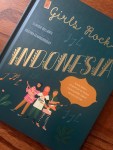
Girls Rock: Indonesia by Claudia Bellante illustrated by Josefina Schargorodsky

Standard
Girls Rock: Indonesia by Claudia Bellante illustrated by Josefina Schargorodsky

img_8112

This book is part of a series that claims to want to bring the world closer to American children.  It is based on a true story, with noted liberties taken regarding the protagonists, and yet the Author’s Note says she went to Indonesia and was unable to meet with the characters whose lives the book is about.  I am not against non Muslims and non Indonesians per se writing a book about Muslims in Indonesia, nor am I naïve to the fact that music inspires many and radicalism is a real threat, but to conflate ideas without explanation, and not containing that OWN voice authenticity or biography feel, really leaves this book fighting against self made stereotypes and trying to seem woke and relevant while maintaining a very Western American paradigm of what it means to be happy and fulfilled.  The book (and series) may have had good intentions, but it just felt off to me, and with a publisher suggested reading age of 5-8, I think this book assumes too much about the readers prior understanding of hijab, Quran, Indonesia, music, heavy metal, radicalization, small village life, culture, Islam, Quran, imams, and prejudice and fails to assist in connecting the concepts, opting to use them interchangeably and ultimately making the 32 page book rather pointless.  I think if older children read it, it is one of those books that makes one feel like they are cultured and supportive of those breaking stereotypes, but I think Indonesian and Muslim readers will just be confused about why a book is supporting sneaking and lying and why music is ok, but loud metal is not, and why a Muslim teacher could have a band years before, but the current characters are receiving backlash now, amongst so many other things.

img_8105

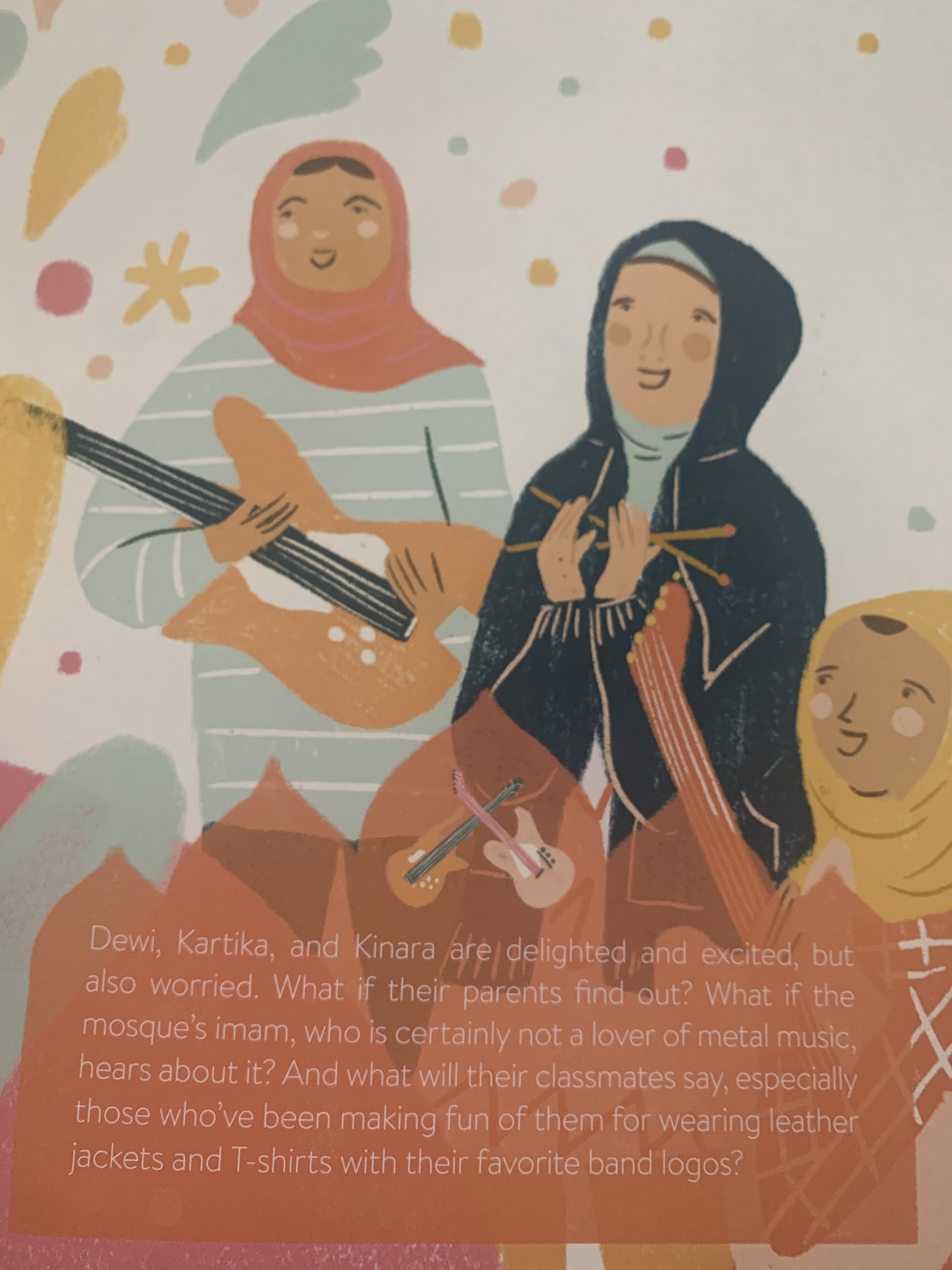
The book starts with basic information about Indonesia: Java, Jakarta, religion, and the motto.  It also includes hijab as something some Muslims wear but does not detail why or what it entails.  It then introduces the reader to three girls that go to school and study Quran, as the pride of their parents and village. The girls feel something is missing and while they are “studying” they in reality are often secretly watch YouTube videos after learning about the heavy metal band Metallica from their teacher.

img_8106

The girls want to learn to play, but fear their parents will get mad, why they would get mad is not articulated, so they go to their teacher and whisper their passion for heavy metal “as if they are confessing a sin.” Their teacher, Pima, says she used to play in a metal band, and that they can use the instruments in her garage to learn and practice.

img_8107

So while their parents think they are studying, they are playing music.  The book says music is not against their dreams, not against Islam, they choose to wear hijab, they start to write their own lyrics, and their teacher arranges for a producer to come listen to them. The girls worry the imam will get mad and so will their parents. When a local interview airs, the teacher asks negative folks, “who says a girl in a hijab can’t play loud music? Does the Quran forbid following your dreams?”

img_8109

Pima regrets letting the naysayers deter her from her music dreams, but earlier said her band broke up when the members moved or got married.  The parents seem fine when a festival in Jakarta is about to happen and presumably they live happily ever after.

img_8108

The backmatter then throws in radicalism and Muslim feminist groups, and I’m not sure what the takeaway would be for Muslim or non Muslim children reading this book.  I admittedly haven’t read the other books in the series, but I would be skeptical of their portrayal of cultures and religion after reading this one, it isn’t so much that it is wrong, but it just seems to water the reality down to make it more “palatable” and “acceptable” to American children which results in strong themes of “othering” and dismissal.

Mr. Grizzley’s Class: Rahma’s Gift by Bryan Patrick Avery illustrated by Arief Putra

Standard
Mr. Grizzley’s Class: Rahma’s Gift by Bryan Patrick Avery illustrated by Arief Putra

rahma

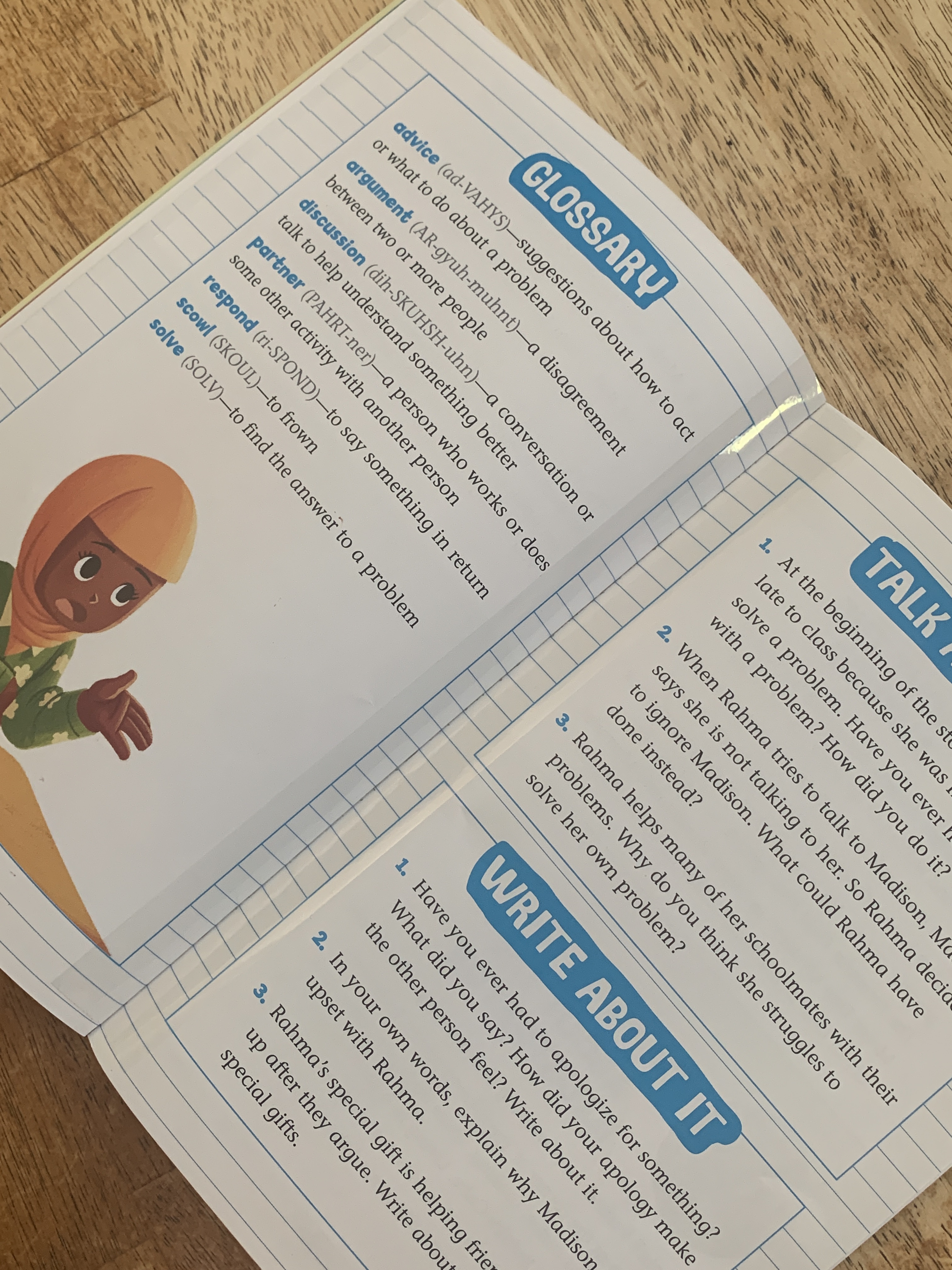
This 32 page early reader is part of Mr. Grizzley’s class, a series that sets out to help promote social and emotional skills in real life settings for ages five to seven.  The diverse class is featured in all the books with one student being the focus of each individual book.  This book highlights Rahma, a visibly Muslim girl of color, who has a gift of helping others with their problems.  The richly illustrated story shows what happens when she is having troubles with a friend, and what Mr. Grizzley and fellow classmates can do to help her find a solution.  I like the premise, I like the focus, I like the illustrations, but I did not understand the messaging.  I don’t understand why Rahma had to own the entire apology.  Sure, friendship is more important than a small misunderstanding and moving on by saying your sorry, even when it isn’t all your fault, has merit- but the book doesn’t take all that in to consideration.  It has Rahma taking responsibility for Madison not talking to her, Madison misinterpreting something Rahma did and getting jealous, and Rahma owning all the lacking communication, when clearly both of them failed to do so.  I found myself confused reading the book the first time, clearly I must have missed something, right? No.  And now writing this, I’m actually quite upset.  So, while the idea of the book and series might be sweet, I don’t feel like this particular book was well executed.  I have not read any others in the series, and thankfully checked this out from the library.  There is nothing particularly Islamic or religious in the book other than the hijab Rahma wears.

img_3111

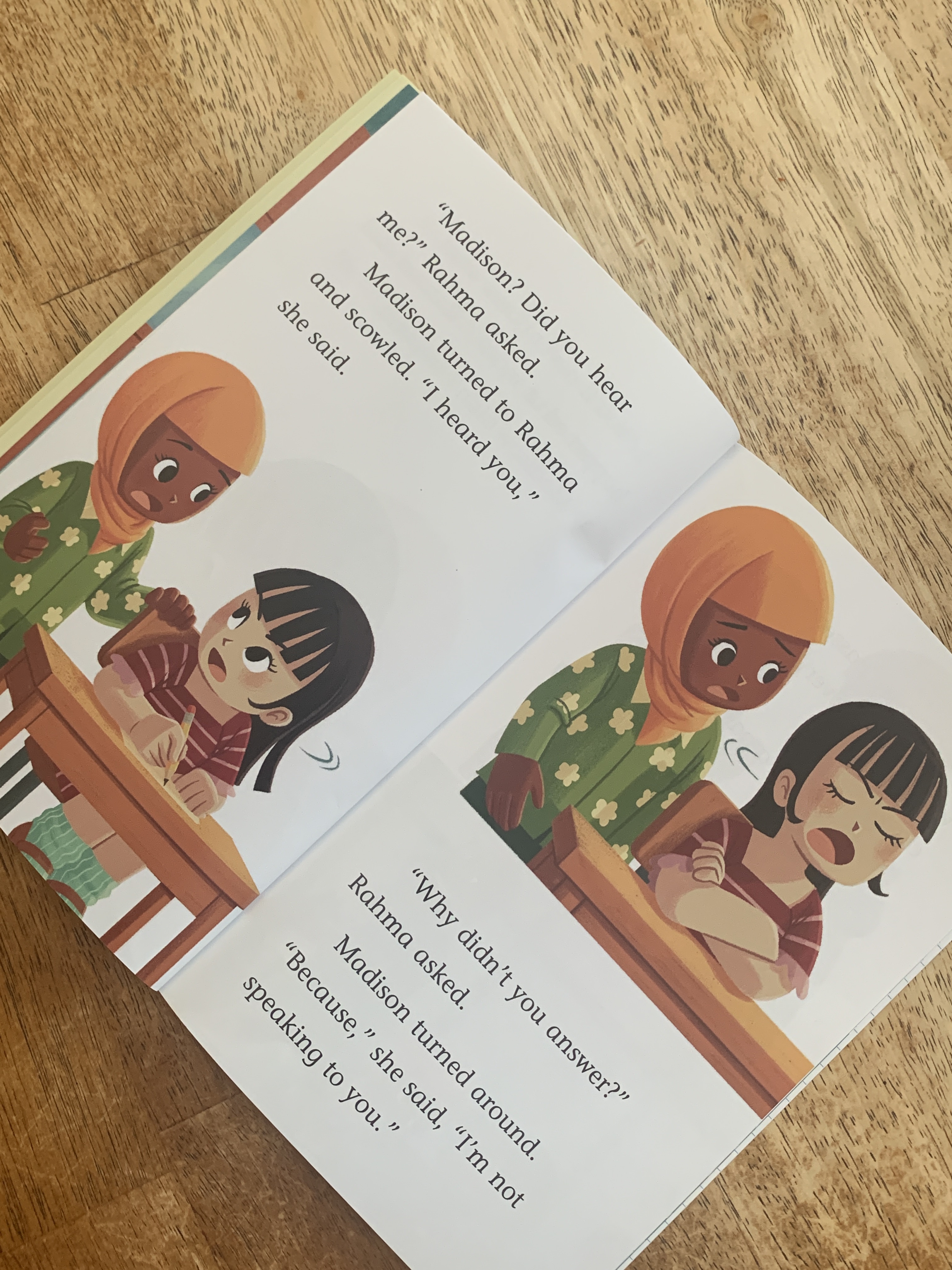
The book starts out with Rahma nearly late for class because she was helping other kids resolve an argument.  It is a gift of Rahma’s to help others work out their problems.  When she tries to tell her best friend Madison about it, Madison doesn’t respond.  When Rahma tries again, Madison says, “I’m not speaking to you.”

img_3112

As a result when they pair up for math, Rahma works with Annie.  She tells Annie she isn’t working with Madison because she is mad at Madison for not speaking with her. Annie prods a bit and Rahma says, “I’m not talking to her if she won’t talk to me.”  Annie encourages Rahma to find out what is wrong.

Mr. Grizzley is then told, and he also tells her to find a way to find out why she is mad. At recess, Chad comes to thank Rahma for helping him and Ashok, and when she tells him her problem he gives her, her advice back, “listen to the other person.”

img_3113

Rahma definitely is in a pickle since Madison won’t talk to her, but with incredible maturity she tells Madison she doesn’t know what she did to make her angry, but she is sorry that she feels bad.  Madison caves and tells her she is jealous because Rahma made a necklace for Semira and she understood it to mean that because she didn’t make one for her, she didn’t want to be her best friend any more.  Semira and Rahma explain that Semira’s dog was sick and she was sad, so Rahma made it for Semira to cheer her up. The girls hug and all is well.

img_3114

The book concludes with directions on how to write an apology letter, a glossary, questions to talk about, and prompts to write about.

I loved Rahma’s phrasing of her verbal apology and wish that would have been the focus of the book: how to take someone’s feelings in to account even if you don’t know how you contributed or even if you feel you did not do something wrong.  As it is written with the two page spread at the end on how to write an apology note though, I feel like Rahma took on a lot of the blame unnecessarily.  I know I’m reading in to it a lot, but I don’t like the vibes that the book gives.  Madison in my opinion was in the wrong multiple times throughout, and Rahma each time took ownership and worked through it.  Yes, truly that is a gift, but I really hope people don’t take advantage of Rahma in the future.

img_3115

Tittle Tattle Talia: A Story about Gossiping by Salwah Isaacs-Johaadien illustrated by Zeyneb Yildirim

Standard
Tittle Tattle Talia: A Story about Gossiping by Salwah Isaacs-Johaadien illustrated by Zeyneb Yildirim

tattle

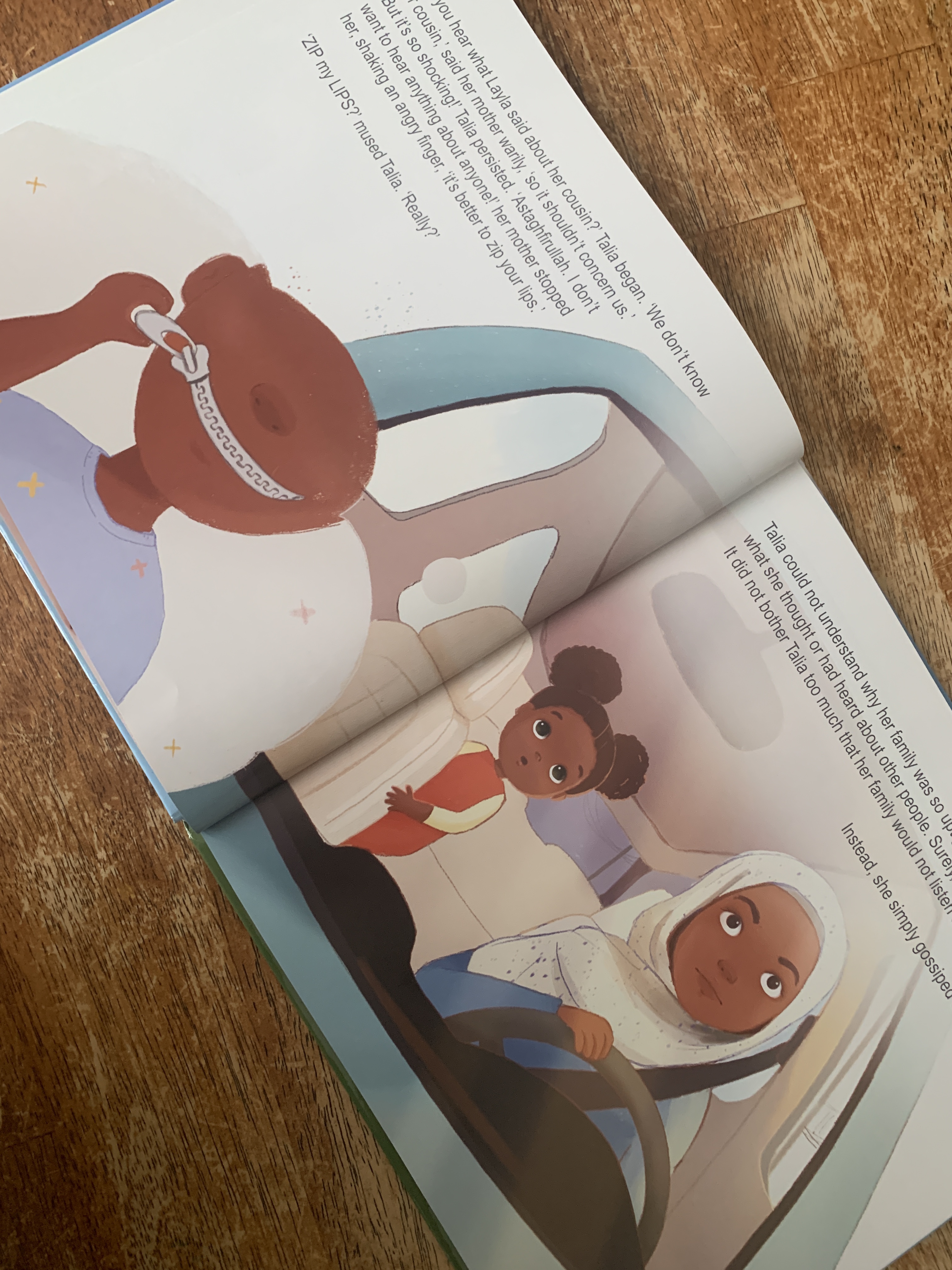
I really enjoyed this Islamic moral book about gossiping.  Over the years I’ve taught a few Sunday school lessons, class lessons, and even hosted story times on the Islamic cautions regarding backbiting, and honestly I don’t think kids really grasp how easy it is to commit the act and be a part of it.  They understand they shouldn’t do it, what the punishment is, and that it is bad, but I don’t know that the materials I’ve used and seen, have really connected with younger kids without a lot of supplementing; and this book highlighted that we really can be messaging better on a child’s level.  The pages are incredibly text heavy, but neither I nor my audience seemed to mind until close to the end, because of the comedy and relatability of the story up to that point.  I think the coach getting overly involved took it back to being a lesson from adults and broke the child perspective tone.  I do love that the kids that listen to the gossip are also held accountable, the importance of the coach’s message clearly is important, but the story telling quality would have benefitted from a few tweaks.  The illustrations are cute, unfortunately the font is not very appealing.  I do like that the salwat is given in Arabic, and that Hadith are mentioned in the text as well as in the backmatter with an author’s note.

img_2774

The story starts with Talia owning that she loves to share tales about the people around her, before telling one to her older sister.  Her sister tries to stop her and tells her that she needs to watch what she says or she might one day have to eat her words.  Talia wonders what eating your words means.  Similar situations occur between Talia and her brother, her mother, as well as her father.  Each time the story is reprimanded and a funny euphuism remarked upon and then giggled about by Talia.

img_2775

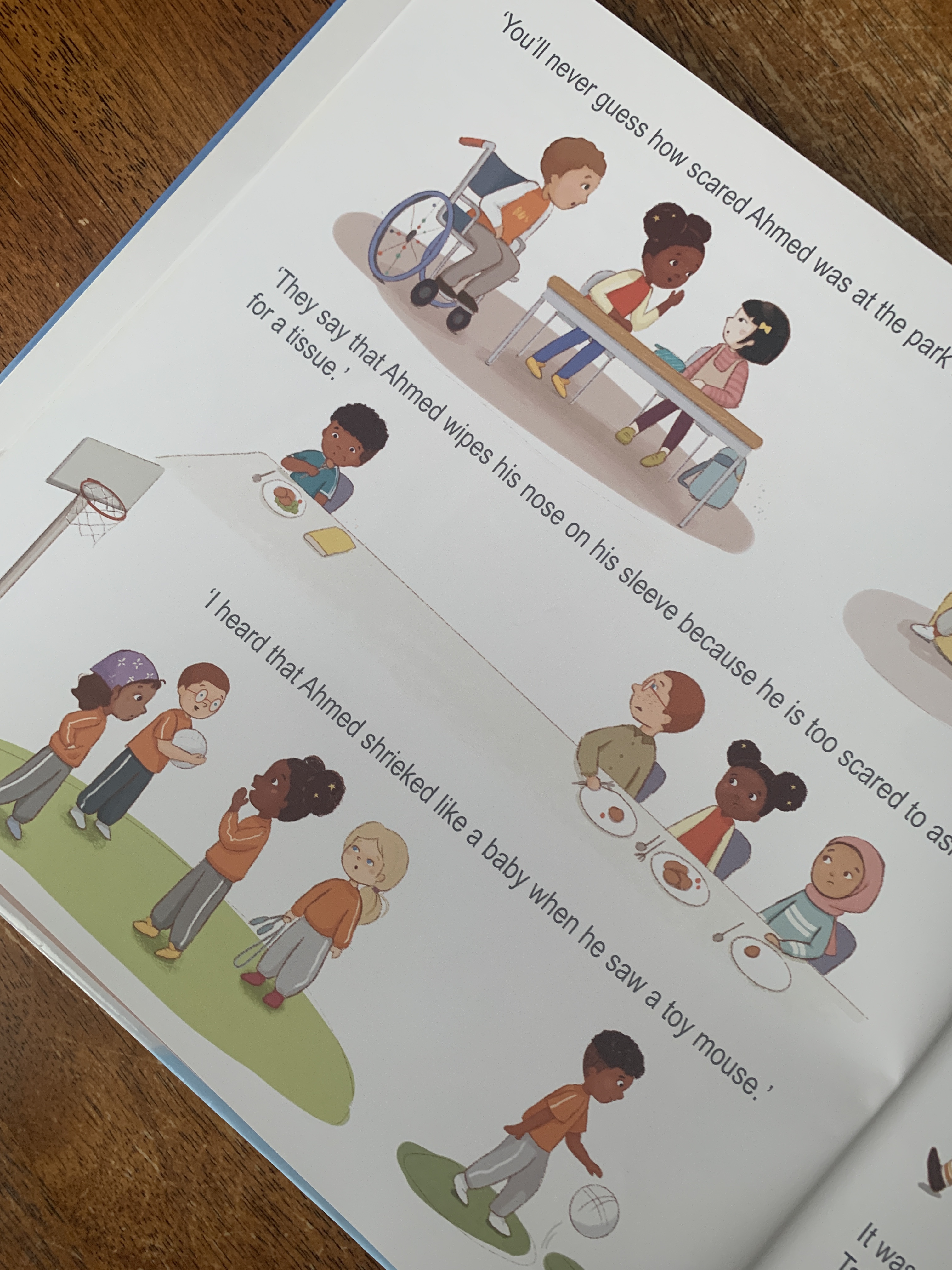
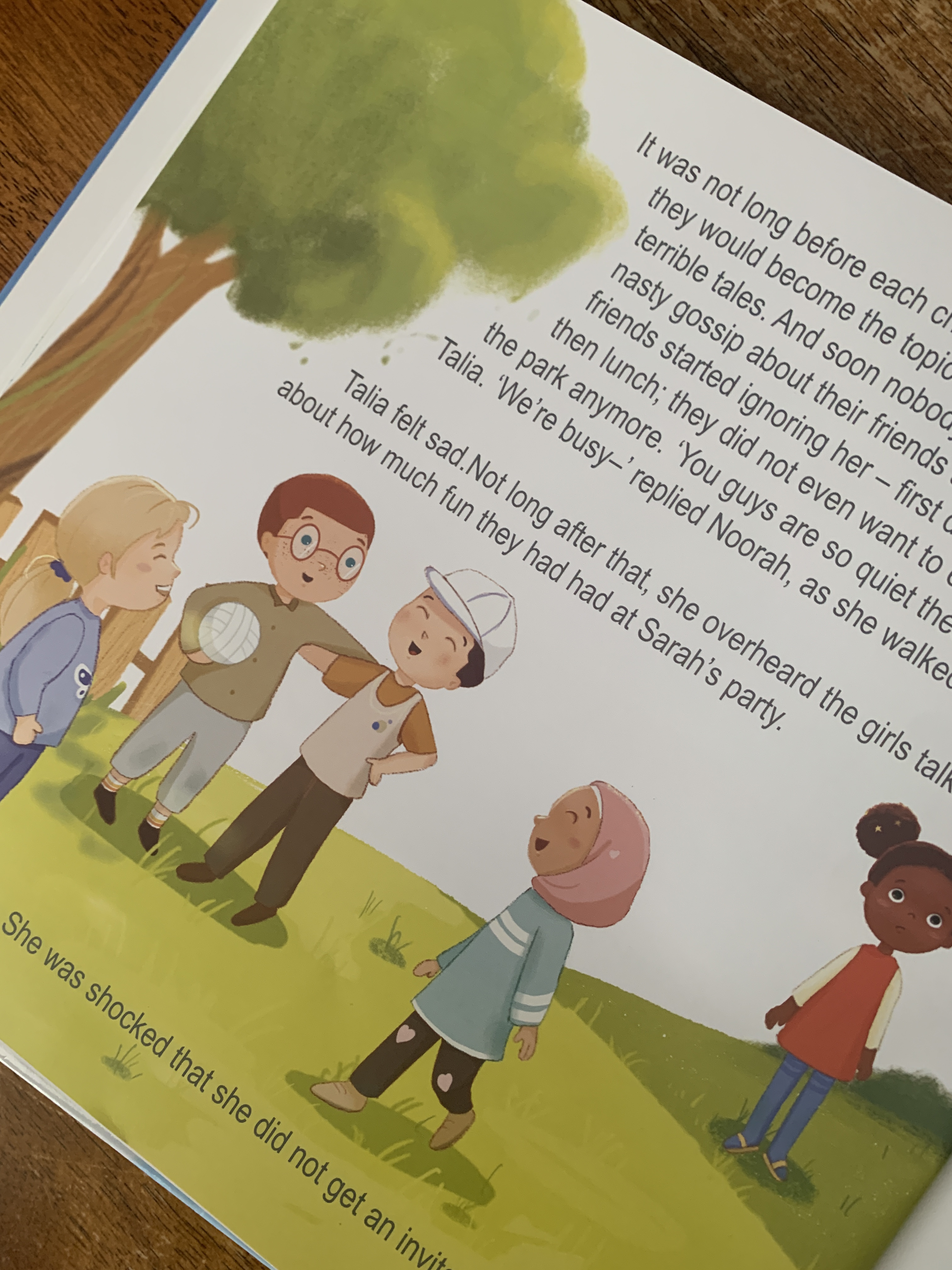
At school she does the same, telling stories, often at the expense of a boy named Ahmed, and the more interest the other kids show, the more outrages her tales become.  She soon starts telling them about everyone, and her classmates and friends grow weary and fearful that they might be next.

It all comes to a climax when Talia’s classmates say enough is enough and stop talking to her, and go as far as refusing to pick her when picking teams, and playing with her at all.  The coach concludes then that the match should be cancelled and Talia should apologize.  The cancellations seems extreme, and the forcing to apologize almost takes away from the emotional realization that her “tales” have become bullying.

img_2776

As Talia leaves, her classmates gather up and she sees Ahmed not joining them.  When she gets to her front gate, her friends catch up to her and apologize and acknowledge their roles in perpetuating the gossip.  Talia then goes to find Ahmed and get him some ice cream to apologize.

I don’t quite think the friends needed to apologize, I think they should have just realized their role, I think with discussion it might be clarified, but I worry that it defers Talia’s ownership of wrong doing, and could send some mixed messages.

img_2777

It is also a little pausing that Talia makes up a story about why a girl wears hijab, when her own mother wears hijab and she is clearly Muslim.  On the one hand, I like that it shows how ridiculous her tales have gotten, but it also could seem like she is falling for a stereotype as well.  There is good rep in the illustrations of those that cover and those that don’t, there is a child in a wheelchair and lots of shades of skin colors and hair types.  The text also contains traditional Islamic names and some that are not.

img_2779

The book helps our children to be better and the story engaging enough to be memorable, that while I wish it was cleaned up a better to strengthen the writing, I do find it a benefit on a shelf to be shared at bedtime, in classrooms, in story times and as a reminder to not participate in gossip or listen to it.

img_2778

That’s Not My Name by Anoosha Syed

Standard
That’s Not My Name by Anoosha Syed

not my name

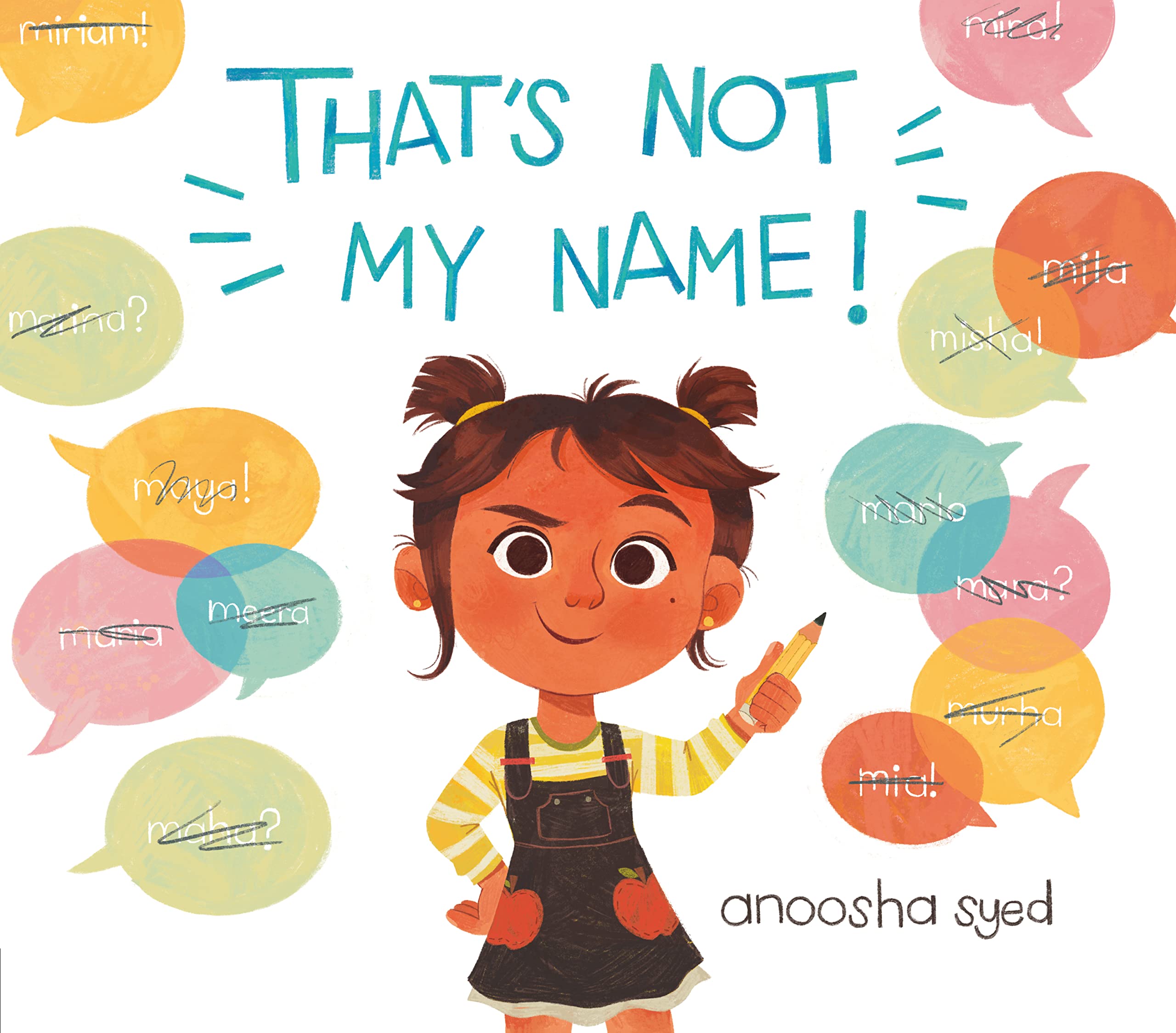
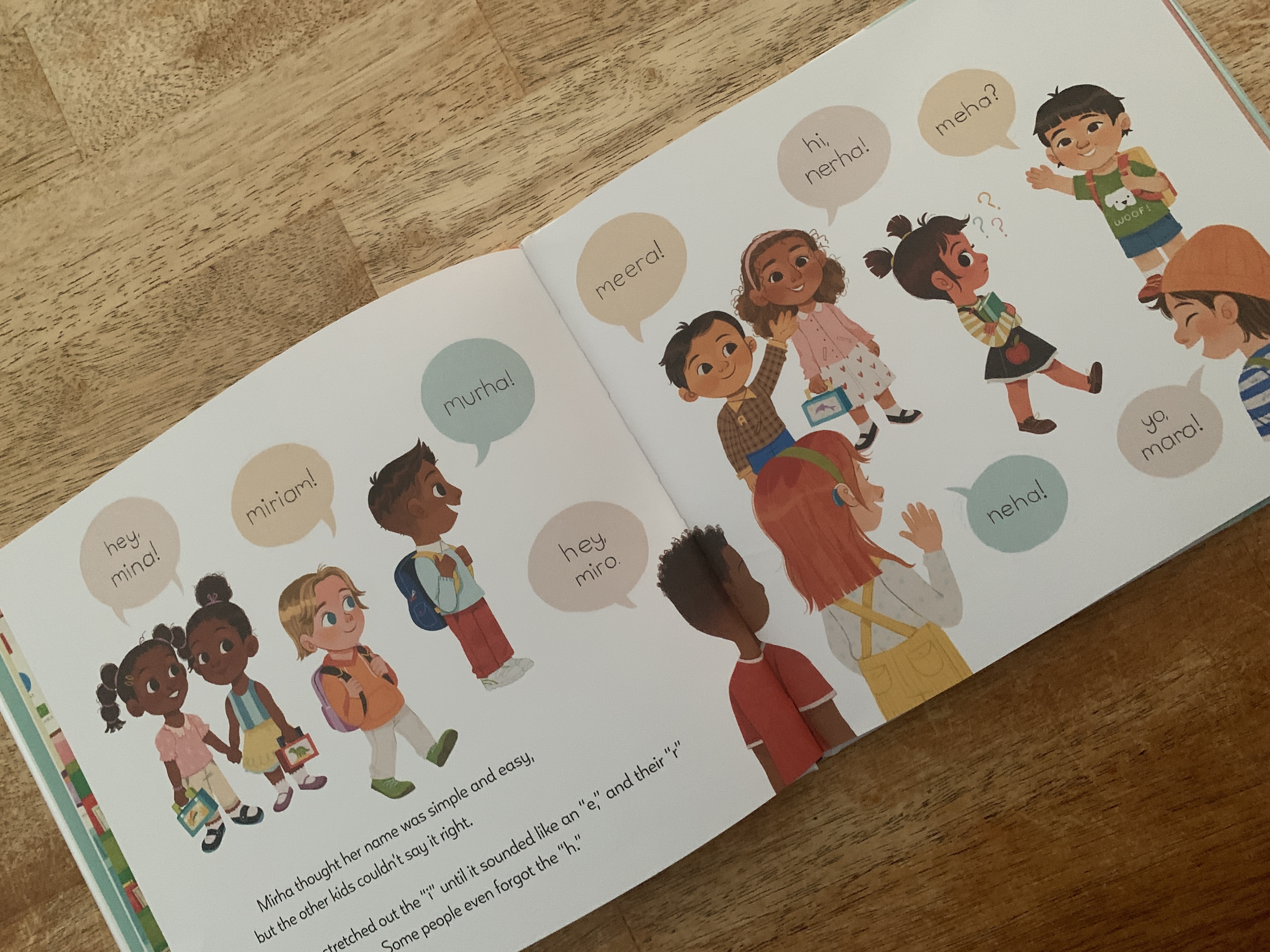
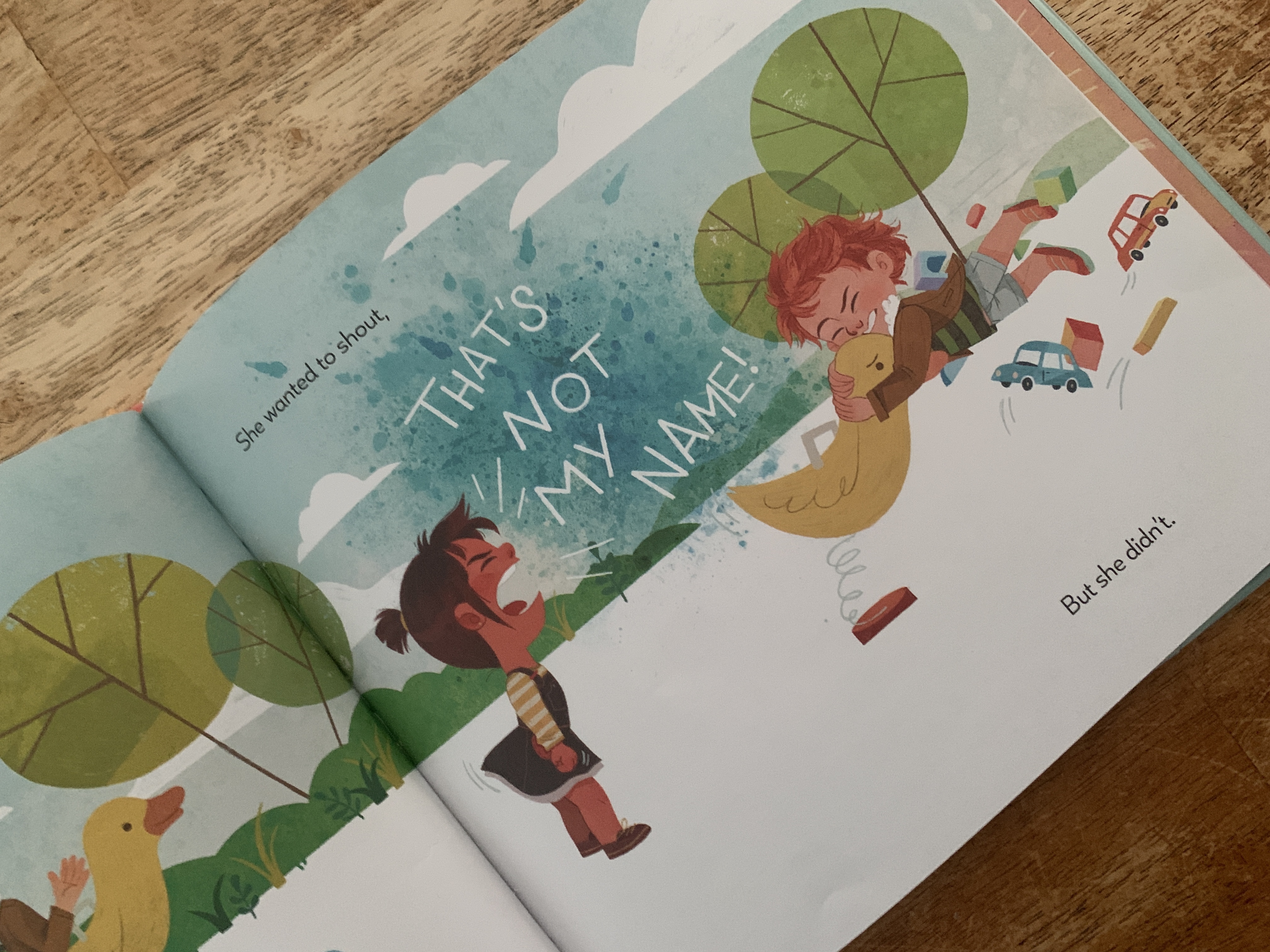
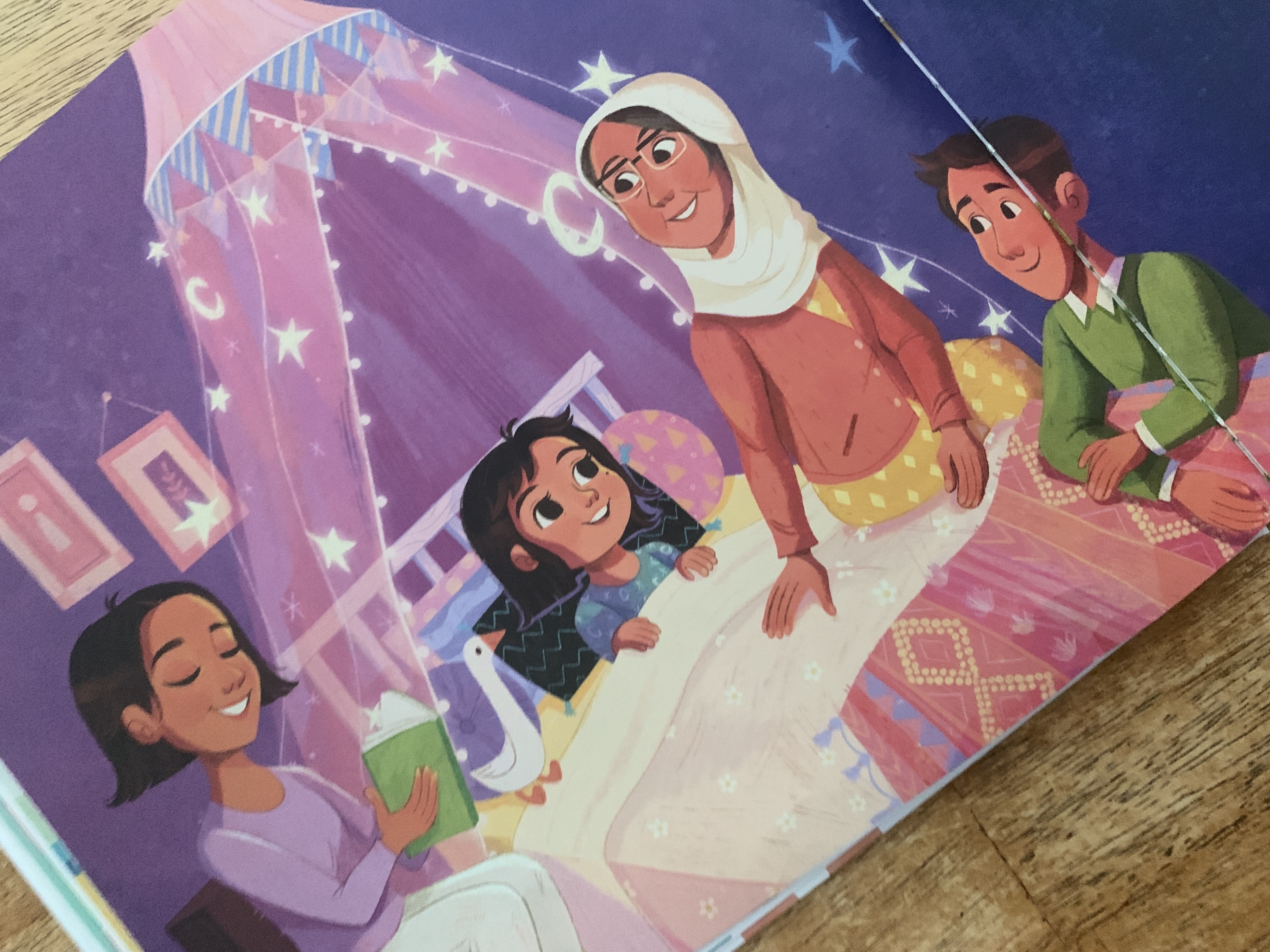
I have been looking forward to this book, as I’ve enjoyed so many of the illustrations the author has created for other authors, and was anxious to see what kind of story she would write for her own authorial debut.  Unfortunately, the book didn’t wow me.  It is rather forgettable, the book conflates notions of not being able to pronounce someone’s name with not being memorable and with not having a “normal” name, and then recognizing how so many classmates have unique names too.  A bit scattered in messaging, and overall reading like an adult talking, not a young girl of four or five, on her first day of school.  No doubt the illustrations are beautiful, and the book isn’t “bad” or a “waste of time,” but it isn’t a strong clear story.  I’ve seen reviews where people find the little girl rude, and I don’t know that I’d agree with that, she is frustrated and wants to scream, “that’s not my name” when people say it wrong, but I do agree that she could model what to say better and how to handle it.  Not that I expect those with uncommon names to have to carry the weight of making things easy, but the little girl at the end remarks that she has so many new friends at school with “unique, beautiful names, and she always makes sure she says them right,” implying that some dialogue, both about her name and about theirs, takes place to ensure pronunciation is correct, and some “showing” of how that is achieved would be nice.  Before the story starts, on the title page, there is a pronunciation breakdown of Mirha, but not in the text itself. There is nothing Islamic in the book, the Grandmother wears a scarf loosely draped over her head, there is a crescent and moon wall hanging in an illustration, and the girl’s name is claimed to be Arabic in origin.

img_2433

The book starts with it being Mirha’s first day of school.  She is excited to learn, to play, and to make friends, but when no one seems to be able to say her name, she starts to feel shy. Frustrated and sad she decides to change her name, and tells her mom when she gets home.  Her mother tells her, her name is beautiful and why she was named what she is named.  She builds her up and the next day armed with her mother’s words she is ready to make friends and teach them how to say her name. By the end of the book Mirha has friends, and wants to be your (the reader’s) friend too.

img_2434

The voice of the book is inconsistent at times it feels very older kid, almost adult, even though the 40 page book is meant for three to five year olds.  The examples read like an adult reflecting on their childhood struggles with their name, not as a young girl finding her voice and appreciation for the name she has.

img_2435

When Hayden asks if he can call her Maya instead of Mirha it is because Maya is easier.  Kids are hearing all sorts of names for the first time when they enter school, that conversation seems so forced.  Whether the kids are in preschool or daycare or kindergarten, most of the names they are hearing of their classmates are being heard for the first time.  If they watch a lot of tv and YouTube and movies, they have heard a whole variety of names, they are not going to have a dialogue that sounds like that, at that age, just not realistic.  Similarly after the first day of school she wants to change her name to something “normal?” What is a “normal” name even, then the mom even reinforces that notion when saying she knows she named her something “unique and different.”  A concept that returns at the end when asserting that Mirha has friends with lots of unique names.  Seems to go in circles.

img_2436

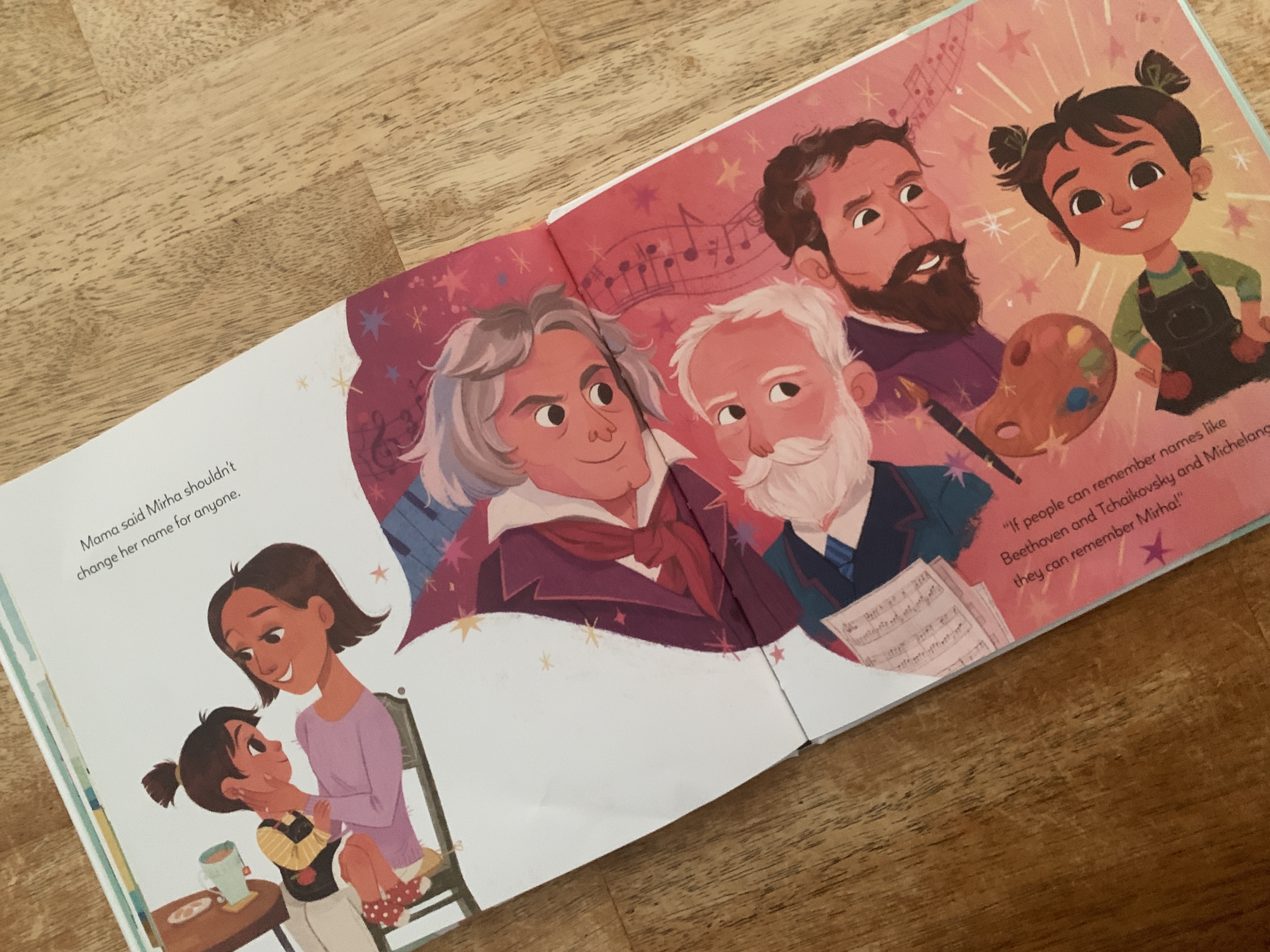
I appreciate that examples are given about not seeing your name on keychains or having the barista get it right, but again, she is under the age of five, are these really her points of reference for having a less common name than those around her?  When her mother is making the case that she shouldn’t change her name she references that names such as Beethoven and Tchaikovsky and Michelangelo are memorable.  First of all, what (under) five year old knows those names or who those people are, and second of all, now her name is not memorable? I thought it was hard to pronounce? Has she done something worthy of history books and admiration? I get what the author is trying to do, I often tell my students that they need to demand people say their names right.  If they can rattle off names from Pokemon, Star Wars, Lord of the Rings, and Beyblades, they can say the beautiful names they have been given.  But the kids I am saying it to are not in preschool, nor am I conflating the pronunciation of their names with being names of famous people that are memorable. Additionally, I do not speak Arabic, but a quick Google search does not show that Mirha means happiness in Arabic, and I have heard from native Arab speakers that they also found the meaning off.

img_2437

The illustrations are engaging, the broader message of getting people’s name right and demanding people get your name right is important, it just needed a more age aligning voice and connecting with the reader.

img_2438

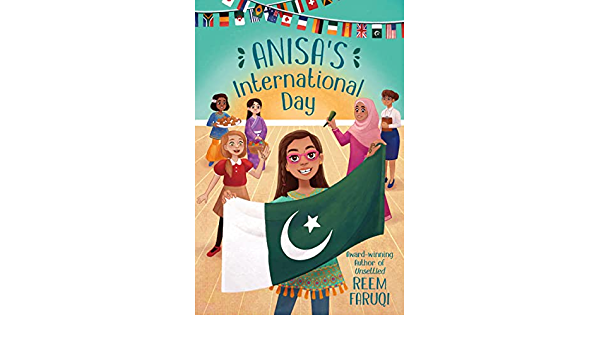
Anisa’s International Day by Reem Faruqi

Standard
Anisa’s International Day by Reem Faruqi

international

Full of determination, creativity, culture, misunderstandings, and learning from your mistakes, this story will resonate with readers 6-10 who want to solve problems on their own, stand out and be special, and who must own up to their mistakes when they happen.  In just under a hundred pages of story, the characters are developed and made memorable, the voice realistic, and the story engaging and enjoyable.  I love that there is no cultural or religious identity crisis, no parental fixing of problems, and no preachy moral overtones.  There are many lessons learned, explored, and threaded through the book, but the incredible writing never lets the threads overpower the story.  The emotional attachment to Anisa has you cringing when she messes up, cheering for her to solve a problem, and sighing in relief when amends are made.  The backmatter is quite robust with recipes, a glossary, numerous activities, and notes from the author.  I know the book says it is meant for grades 3rd through 7th, but I think early chapter book readers will enjoy it the most.  There is not a lot of Islam in the book, but enough that Muslim readers will appreciate the representation and OWN voice authenticity.

SYNOPSIS:

Anisa is an artist, a baker, and pushes herself to be ingenious in all she does.  With her aunt’s wedding coming up, her and her sister and their A-Z Bakery are tasked with making cookies for a party, and her Nani in Pakistan has even sent clothes for her to wear.  Included in the package is a beautiful kurta that Anisa decides to wear to school.  Inspired by her pride in her culture the teacher, Miss Torres, decides the class will have an international day.  Anisa can’t wait to bring samosas, but Prerna from India commits to bringing them first and ingenious Anisa can’t copy her.  To make matters worse, Anisa’s best friend Katie doesn’t seem to like the mehndi Anisa got put on at the dholki.  Misunderstandings, assumptions, and hurt feelings get amplified when Anisa takes action, and when everything gets put out in the open, she will have to find a way to make things right.

WHY I LIKE IT:

I love that the drama is not over sensationalized, it is on par for 3rd grade and the solutions are as well. The teacher and Anisa’s parents are supportive and present, but they don’t solve the problems or force reflection, the children in the story do.  I love the subtle backstory of Anisa and Prerna seeming to be in competition, but finding support in one another as the story moves through.  I also love that no one puts pressure on Anisa to be the most creative or the best at anything, it genuinely feels like her personality and a standard she expects for herself.  I was glad that there was no cultural (or religious) self doubting.  The problems with a friend is communication, approval, and misunderstanding.  The mehndi is the catalyst, but it is not meant or perceived to be a symbol of a whole culture and identity.  It is just mehndi. Of course I also love that the apologizing is not just saying sorry, but rather making things right.

There is mention of the aunt wearing hijab and taking it off because Anisa’s dad is not home, that is tucked in and appreciated.  There are black and white illustrations sprinkled throughout that show women in hijab (#muslimsintheillustrations) as well.  The pictures are not finalized in the arc I received, so I will update the included images in this review at a later time.

FLAGS:

There is mention of music, not sure if it is just drums, or other instruments as well. Makeup is also worn by the adult women and mentioned a few times.  Anisa is mean, but she does apologize.

TOOLS FOR LEADING THE DISCUSSION:

I think fans of the Yasmin series (Saadia Faruqi) will move on to this book, and also enjoy the upcoming Marya Khan series also by Saadia Faruqi. The book fills a gap for this reading demographic, and will add relatability, representation, and warmth to whatever shelf it is placed on.

Sitti’s Bird: A Gaza Story by Malak Mattar

Standard
Sitti’s Bird: A Gaza Story by Malak Mattar

img_2562

I hate that this book is so timely.  It was written by the author/illustrator recalling the 2014 airstrikes, but alas, has anything changed for the Palestinians’ suffering at the hands of the Israeli occupiers amid the  apathetic silence of the world?  This 32 page picture book shows family love and daily life while Gaza is under siege.  The heartbreak of a young girl’s reality and perception shows the reader, in a simple empathetic, heart-wrenching, real-life example how her dream was limited and caged because she is not free.  The book is not sensationalized, nor graphic, it is written by someone who endured this as a child, and has written the book for children. The theme is not even political, but more hopeful as art is found as a respite and way to keep dreams from completely dying.  May Allah swt ease the suffering of those under occupation and free Palestine, ameen.  

img_2557

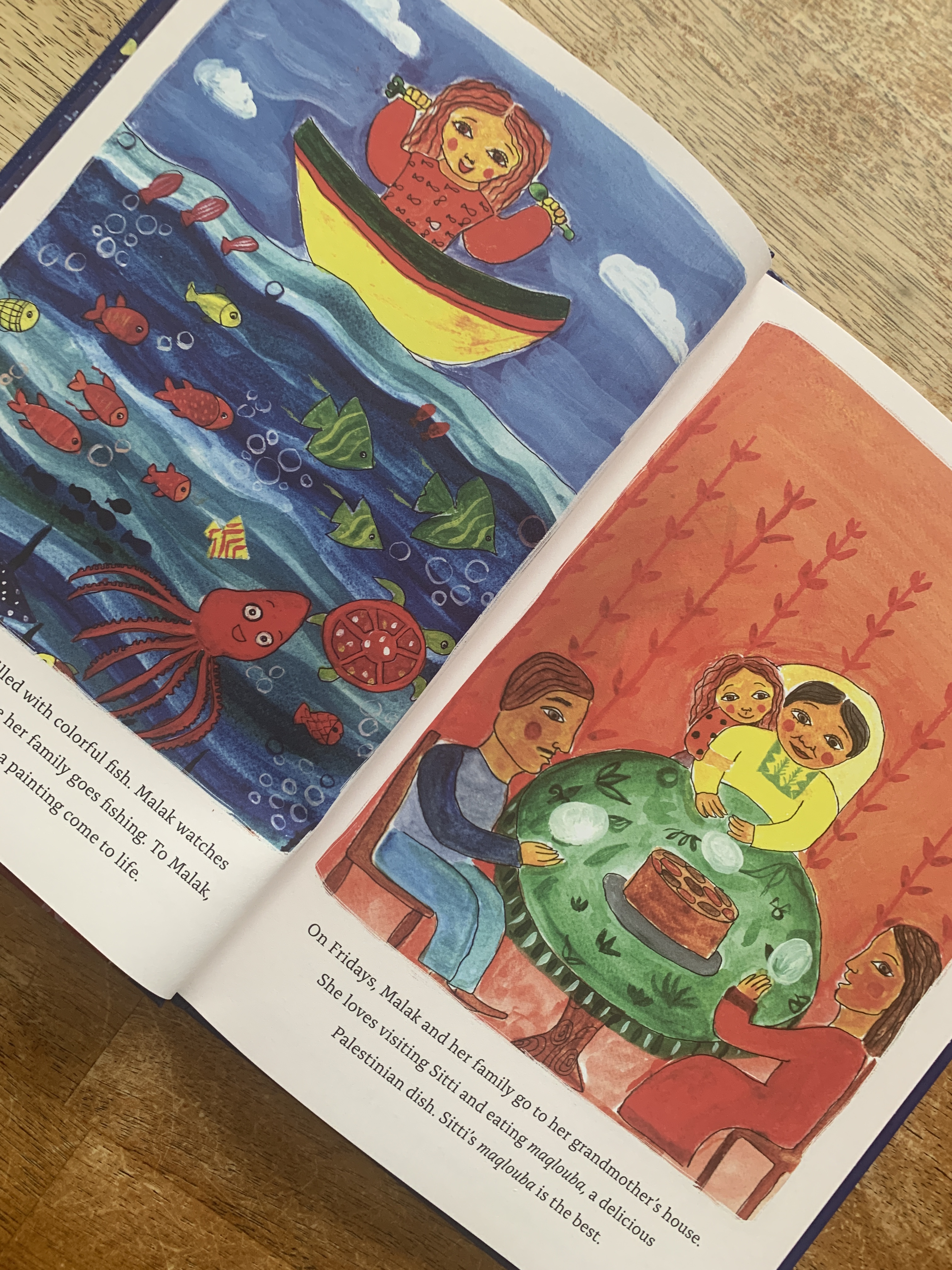
The book starts with a little girl and her parents going to Sitti’s house for the best maqlouba.  Sitti has a beloved bird, Malak wonders if she too is in a cage.  Her grandmother encourages her to fly in her dreams.  At school she is happy with her friends, playing games, listening to stories, but when an explosion sends them all home, she won’t get to return for 51 days.

img_2559

Constant airstrikes keep the family home and in fear.  Malak finds some paints and starts to create.  Sitti’s bird is lost when Sitti’s home is destroyed, but somehow shows up at Malak’s home.  Eventually Malak returns to school and she shows her teacher all her paintings. Her teacher decides to host an exhibit. 

img_2560 

People show up and marvel at her art work.  Months later an international exhibit invites her to attend with her parents, but sadly she must decline.  Gaza is closed.  She cannot leave.  

The book is hopeful, but does not have a happy ending, and I think the weight of that makes this book all the more powerful: because it is timely, because occupation persists, because dreams cannot be made into reality, generation after generation, this story inshaAllah will inspire some change and lots of compassion.

img_2558

There is nothing Islamic in the book, save some #muslimsintheillustrations, the author is Muslim.

Available here at Crescent Moon Book Store https://crescentmoonstore.com/products/sittis-bird?sca_ref=1601585.fIPhoqtScY