Tag Archives: Picture book

The Gift of Ramadan by Rabiah York Lumbard illustrated by Laura K. Horton

Standard
The Gift of Ramadan by Rabiah York Lumbard illustrated by Laura K. Horton

IMG_3804

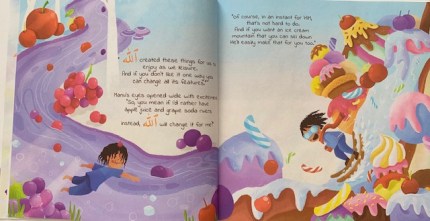
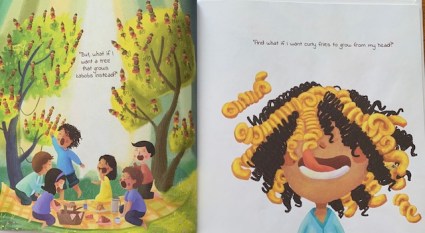
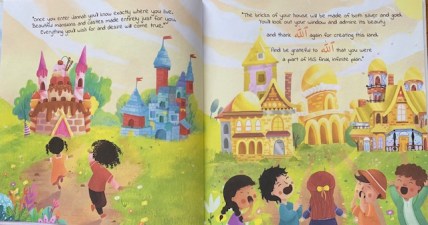
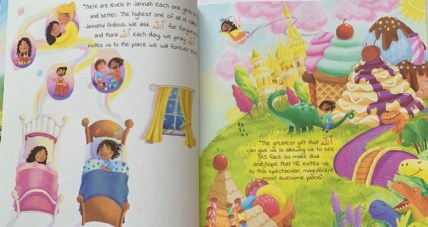
A new 32 page hard back Ramadan book that shows a little girls excitement isn’t enough to get her to abstain from food and drink for the whole long day of fasting, but that there are other ways to enjoy the gift of the blessed month.  A great book that shows how Ramadan is a month of growing and learning and sacrificing and coming together too.  Perfect for ages 4 and up to be read in small groups or at bedtime.  The pictures are delightful and show diversity, and while the little girls love of sparkles might appeal more to little girls, I think the message will allow boys to enjoy and benefit from the book as well.

IMG_3806

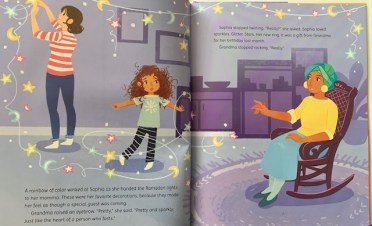
Sophia is helping her family decorate for Ramadan and when they see the crescent moon, they know that fasting will start tomorrow.  Excited to be included Sophia can’t wait.  Sahoor, however, is really early and she is really tired.  She eats a little, but by fajr time she can’t even keep her eyes open and falls asleep in sajood.

IMG_3807

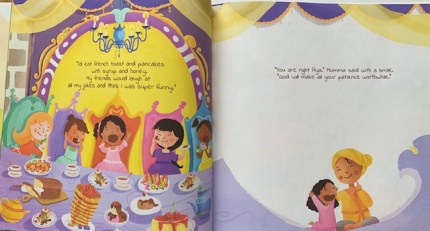
When she wakes up it is almost noon, and even though she is hungry she decides keeping busy will help the time pass.  Reading, cleaning, drawing, nothing is working.  Her little brother runs around waving a cookie, and Sophia can’t get away fast enough. 

IMG_3808

She caves and starts eating cookies, her grandma finds her and consoles her.  “There’s always tomorrow and the day after and the next.  You have a full month to keep trying.” The two then discuss other ways to enjoy the month.  Sophia knows her mom reads Quran, but Sophia can’t on her own.  Her father helps others and gives charity, but Sophia doesn’t have any money.  She is about to give up, but then sees her grandma’s hands covered in flour and realizes she can help her make iftar for those that are fasting.

IMG_3809

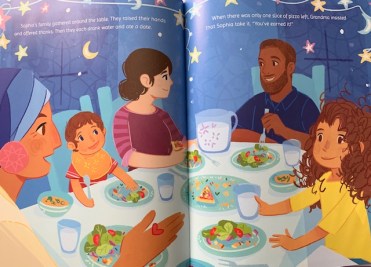
She helps with the salad and the pizzas for iftar, but when some of the pizzas burn, Sophia will have to show what she has learned and understood to make iftar a success and make everything sparkle.

IMG_3810

There are a lot of Ramadan books out there, but I like that this one doesn’t have the adults saying she can’t fast, but just the same grandma is there to encourage her to do what she can and take advantage of other parts of the month.  I also like that she doesn’t succeed.  Fasting especially on these long summer days can be hard and acknowledging that, and encouraging kids to persevere I think is a very valuable lesson.  Sophia also comes up with a way to help on her own.  Parents are tired and entertaining ways for the kids to be engaged in Ramadan is great, but can be exhausting.  This shows that kids with the right understanding of the month, inshaAllah can find ways on their own too.

IMG_3811

There is an Author’s Note at the end explaining Ramadan, and the book would work and appeal to Muslim and non Muslim kids alike.  Sophia reminds me a bit of Pinkalicious and Fancy Nancy and will probably appeal most to kids that also like those characters. The grandma covers her head, the mom does not, but does when praying and reading Quran.  It mentions and shows praying and breaking one’s fast with water and dates, yet stays focused on the story and does not get preachy or dry.


The Jinni on the Roof: A Ramadan Story by Natasha Rafi illustrated by Abdul Malik Channa

Standard
The Jinni on the Roof: A Ramadan Story by Natasha Rafi illustrated by Abdul Malik Channa

IMG_3592

This 37 page culturally Pakistani Ramadan story is super sweet and fun.  There is so much I feel like my critical self should not like about the story, but by about page 15 each time I read it, I find my self full on smiling and thoroughly enjoying little Raza’s antics and his endearing grandma’s method for dealing with him.

IMG_3594

Raza is too young to fast, but with a house full of relatives gathered for Ramadan, Raza awakens to the sound of his uncle snoring before the siren to signal the start of fasting and the azan calling the worshippers to pray echo through Lahore.  Before he can go back to sleep, however, he hears the cook heading up the stairs to wake up grandma and then the smell of the food hits him and he wants a paratha more than anything.

IMG_3595

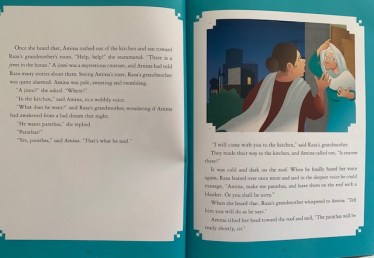
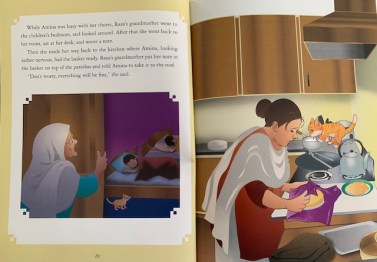
Raza embarks on a mission that involves him sneaking up to the roof, pretending to be a jinni and scaring Amina the cook through the chimney to convince her to send up food and a blanket.  

Scared out of her wits, Amina gets the grandma, culturally wards off evil, and delivers the goods to the jinni on the roof.  But the joke is on Raza who is out-witted by his grandma and gets the punishment of washing dishes for the rest of Ramadan, and learning that fasting a whole day will take a lot of will power, if he couldn’t even wait a few hours to get his beloved parathas.

IMG_3596

The book informs the reader that the following year Raza is able to successfully fast, that he is rewarded with gifts and that all is well and forgiven.  There is a glossary, information about Ramadan and a recipe at the end of the story as well.

I love that the plan just happens, it isn’t premeditated or considered, so it takes the reader along for the ride as it is unfolding.  It isn’t a deep story, but there is room for discussion as to whether Raza was naughty, or just caught up in the moment.

IMG_3597

The book is illustrated well and with big 8.5 x 11 pages, the book is engaging for first and second grade readers and listeners, as there is a lot of text on the pages.  The book takes a bit to find its stride as the author tries to use Urdu words, show their Arabic counterparts and then describe them in English. 

IMG_3598

There is a lot of cultural stage setting with everyone in grandmas house, the traditions of the family, of Ramadan, etc.  I think Desi familiar kids will get the most out of the book, but theoretically Muslim kids and non Muslims too could learn and enjoy it too.  I wish jinn and jinni were explained just a bit in the text, not just in the glossary, along with why an 8 year old wouldn’t be fasting or be required to do so. 

IMG_3599

My own kids, aged 8, 9, and 12, struggled on the first two pages, but when I told them to keep reading they zoomed through the rest smiling and ended saying it was good while giggling and shaking their heads.  We are Pakistani American and I think they enjoyed seeing familiar words and phrases in the book and sympathizing with Raza as well, and his sneaky plan that almost nearly worked.


Under the Ramadan Moon by Sylvia Whitman illustrated by Sue Williams

Standard
Under the Ramadan Moon by Sylvia Whitman illustrated by Sue Williams

under-the-ramadan-moon.jpg

I’ve been reading this book to groups of children for years, and how I’ve managed to not post a review is beyond me, but alas, this sweet book is perfect for preschool to kindergartners and works great at story time or bedtime with its sparse words, comforting illustrations, and predictable refrain that makes the book read like a lullaby.

IMG_3406 

The book gives glimpses of emotions felt during Ramadan and activities participated in, but in very toddler friendly way.  With between 10-15 words on each two page spread, the lyrical words paint pictures of families worshipping together, laughing together, eating together, helping the needy and working on being kind.  

IMG_3407

It mentions Quran, but no other Arabic specific words are mentioned, and it is through the pictures that it shows how Muslims pray.  Some of the women are in hijab, some are not.  At the end of the book is a full page with information about the blessed month of Ramadan, but the vagueness of Ramadan and Islamic requirements keeps the book open to both Muslim and non Muslim readers, and allows the feeling of Ramadan to permeate the few details given in a rich and soothing manner.

IMG_3408

The 8 x 10 size and 24 full color glossy pages make this book a regular during the month and a great choice to repeatedly curl up with your little ones and enjoy, alhumdulillah.

IMG_3409

Be Kind by Pat Zietlow Miller illustrated by Jen Hill

Standard
Be Kind by Pat Zietlow Miller illustrated by Jen Hill

be kind

I usually post chapter books on Fridays, but on this one week anniversary of the horrific Mosque attacks in New Zealand, my fragile heart is being kept together by the pictures and notes shared on social media about the kindness people are bestowing on one another.  Company’s setting up prayer spaces for Muslim employees, communities standing guard outside masjids, friends leaving flowers for their Muslim acquaintances, strangers donning hijabs in solidarity, individuals carrying signs of welcome and unity, truly the list goes on and on.  Muslims and non-Muslims reaching out to one another, Kiwis and the rest of the world coming together.  And yet I know so many people are at a loss at what to do, and how to respond to their feelings in an appropriate manner.  I know I often am.  Thats why books like this one are so important for children to learn how to be kind.  We often tell them to be nice or kind, but what does that mean? What does that look like? How do we know if it worked? As adults we often don’t know, so while this book isn’t written or illustrated by a Muslim, there are Muslims in it, and that is why after seeing another blogger a few weeks ago mention it, I want to share it with all of you.  The illustrations show a little girl saying hi to a desi garbed man named Omar, and two hijab clad girls in her view of the world, amongst so many other diverse faces and characters, because that’s the point right? We are one, each of us responsible to one another to be kind.  

IMG_3389

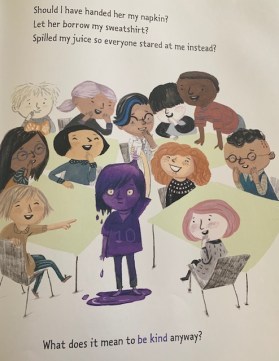
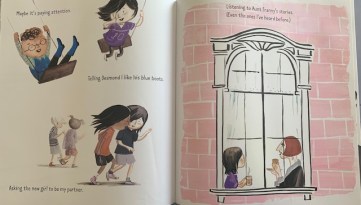
The book starts off with Tanisha spilling grape juice all over her new dress and a classmate being at a loss as to how to console her.  She makes what she thinks is a reassuring comment to Tanisha, but it isn’t received that way, and the little girl ponders and reevaluates what it will take to be kind to Tanisha and what kindness is in general.

IMG_3386

As she works to unravel what kindness is, she explores also what it can look like.  I love that it is seen in terms of action, giving ideas to stay with the reader.  It discusses that sometimes it is easy like saying hello, or not littering, and how important just using a persons name can make someone feel.

IMG_3388

But, it also talks about how sometimes kindness can be hard, requiring patience and a little bravery. I can only imagine how brave people had to be to enter a mosque for the first time and step out of their comfort zones to offer their support.  

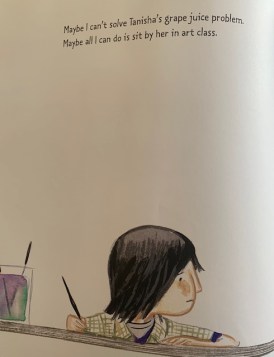
The book then takes an important pause when it acknowledges that maybe all this little girl can do to help Tanisha is to sit by her.  I think Muslims around the world are in awe of the Prime Minister of New Zealand for all she is doing, but also for just showing up and hugging people and listening.  A rare gift in todays wold of soundbites.  

IMG_3390

The little girl then imagines her small acts of kindness joining others and making the world a better place.  My favorite part is actually the end.  Tanisha never smiles and tells the little girl thank you, there is no big praise for being kind.  In fact, I bet the little girl doesn’t even know the power her actions had on the little girl.  We the reader know because we see Tanisha hanging the picture up in her room.  But, that let down is real life.  We can’t be kind because of the reward, we must learn to be kind because it is the right thing to do.  And often when people are kind to us, the effect isn’t instantaneous, its weight manifests in the dark when we are looking for hope and reassurance and for this book to contain all of that, in 32 pages with only few words (AR 2.2) is truly amazing.

IMG_3391

The illustrations are gorgeous and engaging.  The hardback 9×10 format makes this book a great addition to any library and should be read regularly.  It isn’t enough to not be mean, action and intention need to be taught so that we all might be more kind, inshaAllah.


Purity & Prayer: A Rhyming Picture Book of Sacred Rulings by Ameena Bint Abdir Rahman illustrated by Reyhana Ismail

Standard

IMG_2921

This book is definitely non fiction, and I’m reviewing it because I figure some of you like me, have looked at it online and wondered how it can do everything it claims.  The book is 50 pages, fully illustrated (with faces), meant for children before the age of accountability, written in rhyme about fiqh (wudu and salah) according to the Hanafi madhab, and everything is scholar supervised and checked.  I’ve read it a few times now, and yeah, it does all it claims to, and is a great tool and resource, and book to have around for kids of all ages, plus I think they’ll really enjoy it.

IMG_2922

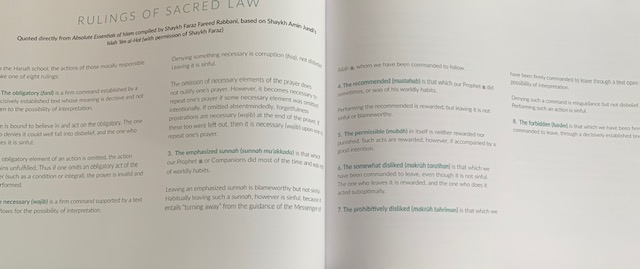
The book has a lot of information and disclaimers about how the author wrote the book and verified the information, there is a dua, preface, and Author’s Note at the beginning, and Rulings of Sacred Law by Shaykh Faraz Fareed Rabbani, an Appendix, References, Glossary of Arabic Terms, messages from the Fiqh Teachers, Author, and Illustrator at the end.

IMG_2925

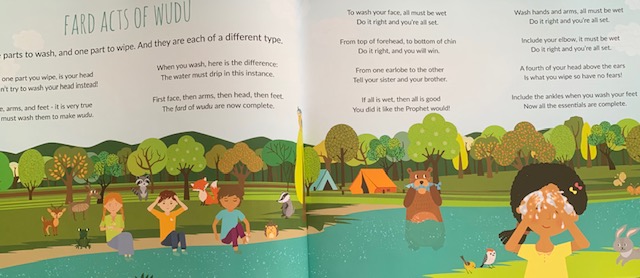
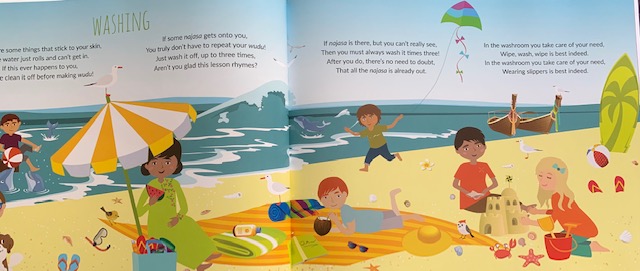
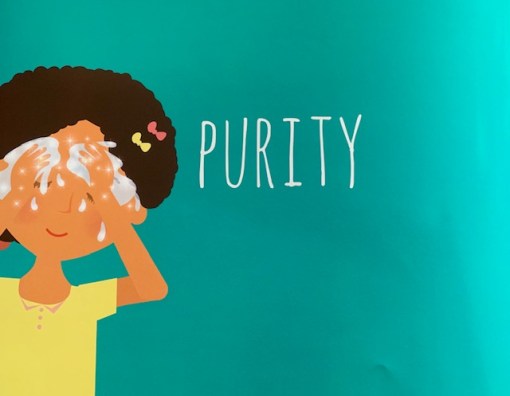
The 8.5 x 11 hard bound horizontal glossy book is divided into sections.  The first section is Du’a and Salah, followed by Purity which covers things like fard parts of wudu, what breaks wudu, etc..  The next section is Prayer and covers the fard conditions and integrals within prayer, wajib things you say, how you recite, postures, what breaks your salah, and incorporated in to the sections are what would need to be redone to make your salah valid.

IMG_2923

Each subheading is a two page spread with a title and either rhyming couplets or quatrains to convey the information.  While naturally at some parts the rhyme is incredibly forced, but because I found myself learning things, I wasn’t as bothered by it as I thought I would.  The repetition sometimes got jarring, but again, because the complex facts are being brought down to a child’s level ,and yet isn’t belittling, I’m willing to overlook a lot. 

I like that it isn’t just facts, the Appendix is there for that, but also similes and metaphors that will help put the concept in perspective.  Du’as can be made at any time like making a call to Allah.  Prayer is like visiting a friend, you have to go at the time you were invited, dressed nicely, wear appropriate clothing.  

IMG_2924

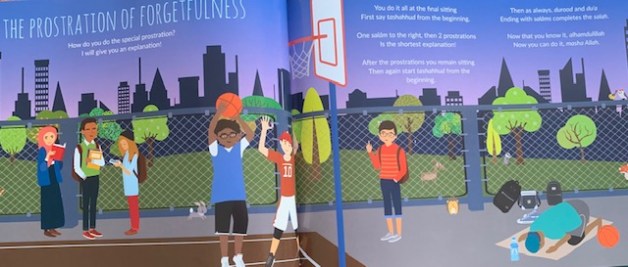
The breakdown of when you have to repeat the whole salah, or do a special prostration is incredibly helpful.  As is knowing what laughter breaks wudu and what breaks wudu and salah.  It is so great that children will see how detailed our religion is, and how everything has an explanation.  Yes, you shouldn’t laugh while praying, but clearly it happens, so when it does this is what you do.  The approach makes the book grow with children as their knowledge and awareness increases.

IMG_2926

I hope to read a two page spread each night with my kids, and have them discuss.  My kids range in age from 3-12 and while my 3 year old won’t add a lot, he will be entertained by the rhyme, fascinated by the pictures, and be included in the early introduction to fiqh.  InshaAllah the older kids will learn or review something and know how to find such knowledge if they have questions in the future.

IMG_2927

Undoubtedly, such a book, was a huge undertaking, may Allah swt reward all those involved, I was pleasantly surprised and greatly impressed at how the book reads, presents the information, and still connects to younger children, mashaAllah.


We’re off to make ‘Umrah by Sana Munshey illustrated by Eman Salem

Standard
We’re off to make ‘Umrah by Sana Munshey illustrated by Eman Salem

img_2719

Its surprising how few books about Umrah there are for children.  As a religious act that many children are included in, there really should be more, but alhumdulillah this fun one exists, and conveys the steps of Umrah in rhyming fashion for ages 4 and up.

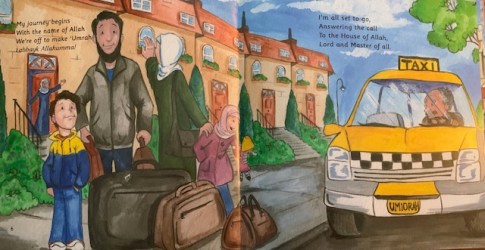
Told from a little boy’s perspective about his family’s journey, a little history is given, before the major parts of Umrah are explored.  The book prefaces the story with a note to parents and teachers making sure they know the book is a semi-fictional narrative meant to reinforce learning, it isn’t a comprehensive guide. 

img_2720

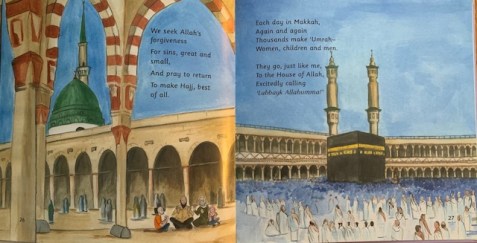
Full page pictures with four line stanza groups detail the steps about the journey and flight to Mecca, including defining and using the arabic words for the talbiyah, putting on ihram, crossing meeqat and praying rak’atayn.  The step-by-step approach is warm and exciting, as the pictures show smiling faces and the words balance information and enthusiasm of being in Mecca for the first time.

img_2721

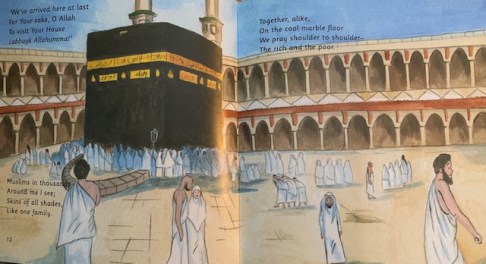
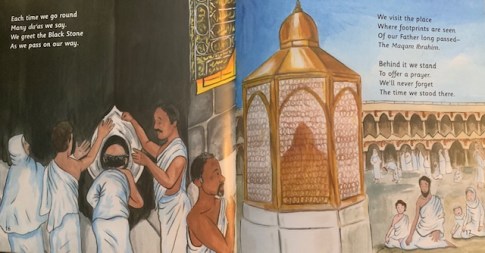
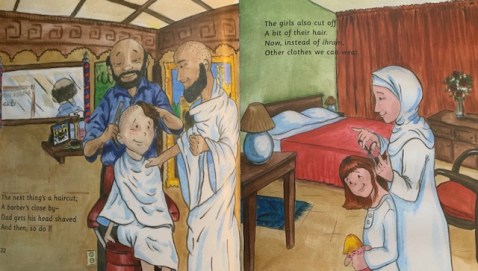
Details about praying, rich and poor, side by side are included, making tawaf, seeing the black stone, seeing Maqam Ibrahim, drinking Zamzam water, a bit of history about Sa’i, and the little boy feeling tired going back and forth between Safa and Marwa are all given in a well paced narrative that is neither rushed, nor overly forced (just a little to keep the rhyme scheme :)).  The steps of Umrah conclude with the family members getting hair cuts and then a quick trip to Madinah.

img_2722

There is a glossary at the end of the 32 page book, that is nice for older kids, or as a way to reinforce words used to describe the journey.  I think the strength of the book is really that it shows what to expect during Umrah.  Children about to go will benefit from the mapping of the events and getting a heads up on what awaits them.  Children that have gone will have a handy way to remember what they did.  Children learning about Hajj perhaps, will be able to see how Umrah is shorter and be able to see what the similarities and differences are in a simple manner.  Even children who have no connection yet to Umrah will benefit from the vocabulary and excitement shared in the story.  While the story is aimed at younger kids, even middle elementary age kids will enjoy reading it once or twice.

img_2723

The book claims to come with a poster and paper dolls to reinact the steps of Umrah, but I purchased my book second hand and they weren’t present.  Hence, I didn’t comment on their quality, but it sounds like a wonderful supplement to the book.

img_2724


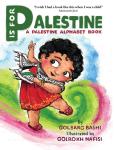
P is for Palestine: A Palestine Alphabet Book by Golbarg Bashi illustrated by Golrokh Nafisi

Standard
P is for Palestine: A Palestine Alphabet Book by Golbarg Bashi illustrated by Golrokh Nafisi

p for pale

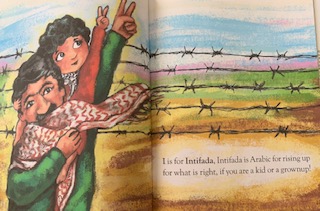
I first heard about this book maybe a year ago when it was making waves for including such passages as “I is for Intifada, Intifada is Arabic for rising up for what is right, if you are a kid or a grownup!” The book was in limited supply however and hard to find.  Recently a 2nd edition came out and is widely available in major outlets. 

IMG_2401

The book follows the well established genre of giving each letter in the alphabet a page to depict in picture and words details about a given subject.  The form usually rhymes and appeals to little kids learning about something specific, and adults, who enjoy the topic at hand.  

IMG_2399

While this book is fabulous because it exists, and praiseworthy because it celebrates Palestine, Christmas and Eid and the birthplace of Jesus and Lebneh and Quds and olives and grape leaves and everything else that makes Palestine so close to one’s heart, the stanzas themselves are really forced and inconsistent in rhyme and meter.

IMG_2400

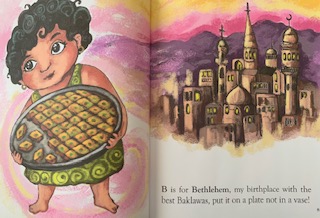
Granted, one doesn’t buy or even pick up a book like this for its literary merits, but the text is really a bit all over the place.  “Can we sing the ABC anywhere? With a woolly bear or in thin air? L is for Labneh is like yogurt.  I eat it for lunch, wearing my loafer! B is for Bethlehem, my birthplace with the best Baklawas, put it on a plate not in a vase! K is for Kuffiya, the best kind you can hang on a hook in Hebron souk! E is for Eid, it means Festival, like the Muslim Eid al-Fitr when we eat enticing eats, get excited over gifts, and enjoy seeing out extended families. J is for jesus, Jesus was born in my hometown (Bethlehem), not Jamestown!”

IMG_2403

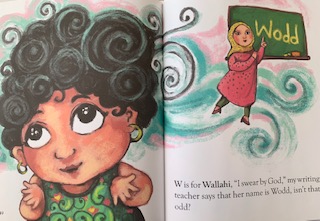
I of course overlooked some of the awkwardness because the illustrations are lively and beautiful and the parts I thought needed explaining, I chalked up to me not being Palestine, nor having visited there.  

Many of the passages are touching and memorable and make the book so important.  M is for Miftah, Key of Return…Mama’s Mama, and my Jiddah’s Mama’s, for which I yearn! T is for Thob, a traditional dress wtih tatreez (embroidered pieces).  Takes time to make, with thousands of tiny threads, if you please!

IMG_2405

There is an Appendix in the back, giving a tad more information on the main idea mentioned for each letter.  There is also a Publisher’s note.  While there was some controversy that the book is anti Semitic or spreading propaganda, I think the book comes from a place of love and culture.  There is Christian and Muslim concepts and a character named David making grape leaves.  It does not mention Israel or Zionism blatantly, which I think shows that Palestine has its own culture and isn’t solely defined  by the crimes committed against them.  Interestingly, the author is from Iran.


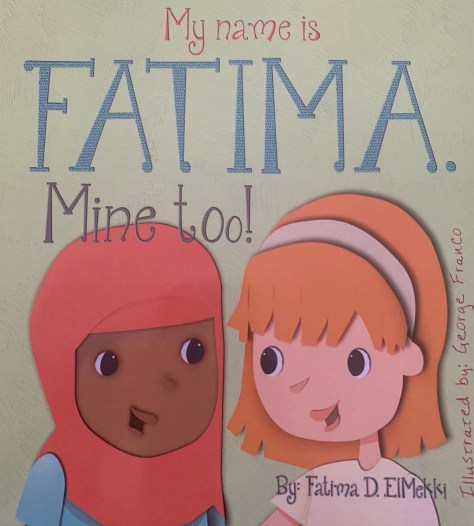
My Name is Fatima. Mine Too! by Fatima D. ElMekki illustrated by George Franco

Standard
My Name is Fatima. Mine Too! by Fatima D. ElMekki illustrated by George Franco

IMG_1926

This book is interfaith, and learning your own roots, and asking questions about your heritage and faith all rolled in to a cute little package for children.  But despite it’s length, 28 pages, and cute little girls on the cover, the book is for more first grade/second grade and older children, rather than toddlers. 

IMG_1927

The message that we are more alike than different is a great message, even for the littlest of readers, but this book goes a little deeper, and the didactic approach will bore them a bit.  Older kids for sure 2nd and up will benefit from the exchanges between Fatima and Fatima and learning both valuable religious lessons about their namesakes as well as respect and friendship for those with different beliefs.

IMG_1928

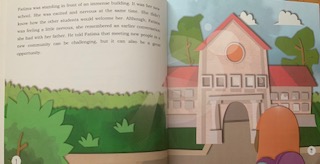
Fatima is from the Democratic Republic of Congo and on her first day of school in a America she tries to remember her father’s advice, that meeting new people can be a challenge, but also an opportunity.  

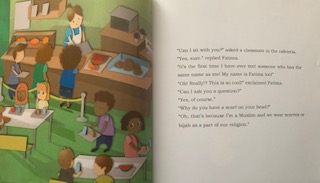
At lunch a little girl asks to sit with her, excited to meet someone with her same name.  Fatima asks her why she wears a scarf, and listens to her explain it is because she is Muslim and the hijab is part of her religion.  

IMG_1929

At recess, Muslim Fatima tells non Muslim Fatima that she is named after Prophet Muhammad (saw)’s daughter and asks her who she is named after and if asks she is Muslim, too.  The other Fatima says that she is Catholic and that she doesn’t know why her parents named her Fatima, but that she will find out and let her know.

IMG_1930

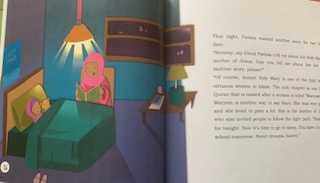
That night Catholic Fatima learns that her mom had gone to Fatima, a city in Portugal, a famous city for all the miracles that have happened there and the apparition of Mary, the Mother of Jesus.  Fatima’s mom had gone there to pray for a baby and promised if she got pregnant that she would name the baby Fatima.

IMG_1931

The next day Catholic Fatima tells Muslim Fatima and also asks her if she has heard of Mary, the mother of Jesus.  Muslim Fatima says she has heard of her, but doesn’t know much and that she will ask her parents and let her know.

Muslim Fatima learns that Mary is one of the four virtuous women in Islam and that there is a chapter in the Quran named after her.  When she tells Catholic Fatima the next day at school, the girls marvel at how much they have in common.  They are BFFs despite their differences and beautiful ones at that.

IMG_1932

I love that the book is framed in opposites to show similarities.  I also love that it shows women in our respective faiths with similar values, similar names, and Mary’s role in both our traditions.  So often, when we are building bridges we discuss how Yusuf is Joseph and Musa is Moses, Yahya is John and we go through the old Prophets, this was a nice change in perspective.

IMG_1935

The illustrations are nothing to get excited by, but they do show smiling warm characters and family members.  They serve as a distraction from the text heavy pages that do nothing to grasp the reader with their plan font and majority white backgrounds.

IMG_1933

This book would work for Muslim children, Catholic children, really all children.  It talks about faith, but as the characters view it, not in a one is better or more right than another.  There is a second book in the series about Fatima inviting Fatima to an Iftar party  that I look forward to checking out soon.  I hope it is a little more rich in dialogue and character building instead of just a foil to disseminate the information between the two faiths, but even if it isn’t I still think the book has value and you should check it out.

IMG_1934


A Whale of A Wish by Razana Noor illustrated by Rahima Begum

Standard
A Whale of A Wish by Razana Noor illustrated by Rahima Begum

IMG_2254

I’ve seen this book on Amazon countless times, and not really been interested in a Prophet story written in rhyme.  It seemed like it would be overly forced and  there’s enough slightly creepy songs out there trying to be clever in their retellings, that I never added it to my cart.  But, when Noura over at Crescent Moon Store convinced me to take a look and hooked me up, I trusted her, and am glad I was so terribly wrong.

IMG_2255

The story of Yunus (AS) is told from the whale’s perspective.  And shows how he always wanted to do something unique and swims around helping those in need.  He even befriends his foe, a giant squid.

IMG_2256

When he feels compelled to swim to the surface in the middle of the storm, Allah commands him to swallow Prophet Yunus and later commands him to return him to land.

The whale listens to Prophet Yunus praying all day and night and feels blessed to be part of Allah’s big plan.  His dua is also included at the end in english and arabic and arabic transliteration.

IMG_2257

The 18 page book is 8×10 inches in size and the illustrations are sweet, soft, happy and well done.  Children two and up will enjoy the story, and while it is meant for Muslim children, I believe Christian and Jewish children will recognize the story and with some oversight would enjoy it too.

IMG_2258

The rhyme is surprisingly not as forced as I feared.  On only one occasion the rhyme is a  stretch: squid, bit, but the meter is regular and flows easily making the story great for  story time and bedtime alike. 


Imagine by Shoohada Khanom illustrated by Faiza Benauvda and Vicky Amrullah

Standard

IMG_2052

A bright and colorful, well illustrated book for preschoolers to stretch their imaginations with and giggle at, while never straying too far from an Islamic concept or reference.  The book mentions something  Islamic on nearly every one of the 32 pages: dhikr, Quran, Ramadan, Prophet Yunus, salah, saying salam, Eid. 

I absolutely love the premise of the book, asking whales about Prophet Yunus, having an octopus help serve iftaar, it really is a lot of fun. The illustrations are great.  The 8.5 by 8.5 book size completely filled with colors and friendly faces, are well done and engaging.  The amount of text on the page is appropriate for the age group and the binding and weight is adequate, nothing to get excited about at a $13 price point.

The book is written in four line stanzas, but I really struggled to not get tongue-tied on nearly every page.  I think the loose rhyme is fine, it just seems really forced in some places, and non-existent in others.  And even when it isn’t forced, the rhythm is a tad off.  I read it to myself and struggled, so I scooped up my 3-year-old and tried twice to read it to him before making a final attempt to make it flow, and feeling somewhat successful.  I think part of it is me, I try to read it like I’m doing a story time, and not like a bedtime story.  But here: read this page and see if you agree.

IMG_2054

I think it is me, and now I’m projecting all my issues on you the reader, and this cute book, I apologize, but here’s one more.  I feel like I’m becoming a broken record when I complain about the price of books and lacking editors.  I promise I have atrocious grammar myself, and make a ton of mistakes typing these reviews, texting my friends and posting on Facebook.  I can’t even blame auto-correct half the time.  So, when I spot errors, and can’t get through a stanza in a children’s book, I get grumpy.  I paid money for this, the author spent a ton of time on it, and the illustrators too, and the publishers…maybe that is the problem.  I love the idea of small publishing companies and self publishing, but why am I once again sitting here with a beautiful children’s book in my hands shaking my head at a really silly mistake.

“I’d try climb on top of another,”

IMG_2047

Sigh.