Tag Archives: Muslim Character

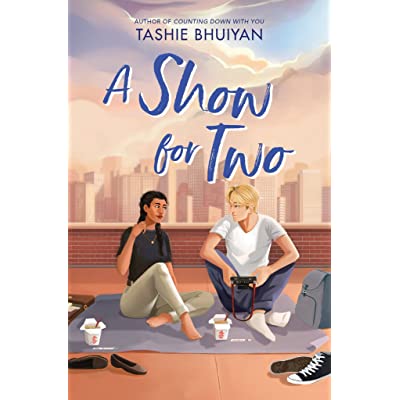
A Show for Two by Tashie Bhuiyan

Standard
A Show for Two by Tashie Bhuiyan

a show for two

I didn’t love the author’s debut novel, but wanted to see what a second novel would offer, and sadly it really is a lot of the same: light funny romcom surface story featuring a Bangladeshi Muslim character lead mixed in with layers of mental health, a toxic family, high school stress, and cultural expectations driving the plot.  There is crude language, hetero, lesbian, bi, and pansexual relationships discussed, but nothing more than kissing is detailed in any of the scenes.  There is a lot of cultural trauma from the parents and to the book’s credit, it does establish pretty early on that the main character is not religious, but that she does believe in Allah swt.  Similarly, there is a Bangladeshi loving family in the story, so it is not making a critique on the entire culture, it is just the character’s family that is cruel.  Ultimately, at 416 pages I was surprised that there were gaps in character arcs and plot.  I never really liked the protagonist, Mina, but because of how underdeveloped and pivotal the best friend and younger sister were, when it all came to a climax, I found myself rooting for her, which is a very shallow reasoning in an OWN voice book. Additionally, the parents are terrible, and had I dnf-ed it (I was tempted until about 30% through it) I doubt I would have ever known that there was a time that they weren’t terrors.  The peeling back of the layers of the family came too late, too slow, and the progression was muddled.  I probably will not actively seek out further books from this author if the same themes and tropes are present, if she changes it up, I probably could be persuaded.  The book is marketed 7th grade and up, but with the triggers, hate, language, content, genre, language, length I would say 17 and up, if at all.

SYNOPSIS:
Samina “Mina” Rahman is waiting to leave New York and her hateful parents, and start her life at USC as a film student.  All she needs to do is win the Golden Ivy Film Competition, and get excepted to USC.  Her parents dismissing her dreams, passions, and abilities agree to only let her leave if she wins the competition, doubting that it would ever happen, they even put it in writing.  Co-president of the high school film club and best friend, Rosie is equally determined to win, there is just one big problem, every year the winning film has a cameo by a famous actor.  Cue accidental meeting of Mina and Emmitt Ramos, up and coming indie movie heart throb that is cast in the new Firebrand blockbuster.  Sent to Mina’s high school to research for his upcoming role, Mina is tasked with convincing him to make an appearance in their film.  It is a romance story, so you can see where it is headed in this enemies to lovers book.

As family, friends, and college admission stresses mount, the simplicity of what Mina wants and how to go about getting it will be called in to question as her walls crumble and she will have to evaluate people in her life and how they will be affected by her actions.

WHY I LIKE IT:

I like that the story is based on real events in the author’s life, not just the religion, culture, mental health threads, but that an actor came to her high school in preparation for a part: Tom Holland.  I also like that while her parents don’t value her, she has found a support group of sorts that do.  At times Mina reads a lot older than she is, particularly when she is admonishing the freshman, but at other times she storms off pouting and seems to be very childish.  I vacillate between this being intentional and it being an inconsistency in the writing. The younger sister Anam is painfully written.  She is bold and confrontational, yet at the same time so clingy and needy and all over the place.  At one point I thought she perhaps was suicidal and was braced for a really dark twist in the story, but no it was just Anam being Anam, I suppose, and the stress was never revisited let alone resolved.

I truly dreaded the passages about Mina’s home life and her family, they all were just awful to each other and rather than taking Mina’s side because I was shown, I found myself questioning what I was missing in the before and after dynamic.  It is clear they are wretched, the victim doesn’t need to justify the abuse. The transformation of the family dynamic just felt lacking and in fiction when parts are explored it could have really showed some of the micro aggressions and changes that existed and made the relationship salvageable so that the reader would understand why saving and fixing the family were no longer options.  Generational trauma is real and serious and a little more attention I think could have provided an amazing mirror to readers dealing with similar elements.

If the book was half the length I would assume that details would be glossed over, but this book had room, and I don’t understand why so few photography and director references seem to find their way into the text to show that these characters truly are passionate about what they are claiming to desire.  I know the story isn’t a film story or a culture story, but they don’t spend hours editing the film or working on props? Emmitt is regularly pulled away from shoots, but always seems to have enough photos to choose from?  Mina talks of her dad cooking, but foods aren’t detailed, the connection of food to love to family and that being severed seemed like a gaping hole in the crumbling home scenes.  If halal food and no pork can make it into a love relationship, that much cultural/religious depth should have made it inside a families home.

As mentioned in the intro, it didn’t bother me from a religious perspective that Mina was off kissing a boy, that Anam had boyfriends, etc. because Islam was accounted for and the characters are not practicing, so I do appreciate that it didn’t become a stereotypical rebelling against religion book.  Truly, thank you.

FLAGS:

Language, relationships (straight, bi, lesbian, pan), kissing, making out, hand holding, lying, mental health, hate, deception, cruelty, emotional abuse, angry ex boyfriend, triggers.

TOOLS FOR LEADING THE DISCUSSION:
Would not shelve or encourage young readers at our Islamic school to read this.
Lowriders to the Rescue by Cathy Camper illustrated by Raúl Gonzalez III

Standard
Lowriders to the Rescue by Cathy Camper illustrated by Raúl Gonzalez III

lowriders

This is my first Lowriders book, so admittedly there was a lot going on that I really don’t feel confident that I understood, but even with that, it was a sweet story of first love (crush), Arab and Latinx joy, humor, social activism, environmentalism, gentrification, and fun.  I don’t know that the other books in this middle grades series explain the characters or their world any more or less, so I think it can be read as a standalone book, and I think the 140 page detailed illustration filled pages will tempt even the most reluctant readers to give it a try.

SYNOPSIS:

Sokar is an Arab Muslim monarch butterfly, and the fires have taken so many of her family, and cut the survivors off from being able to safely migrate.  She comes to town with a broken wing and in desperate need of help, only to find prejudice against her at every corner, until she meets the Lowriders:  Lupe, Flapjack, and Elirio.  Lupe is an impala, Elirio a mosquito, and Flappy a land octopus with brand new glasses who falls for Sokar at first sight.  Sokar, however, has concerns with the environmental impact the lowrider car has knowing that the fires and pollution are all related.  Add on that the Upscale Business Association gentrifying the neighborhood, and everyone is going to need to work together to save the monarchs, the neighborhood, the environment, and a tender friendship.  As characters find connections between Arab and Latin foods, Arabic and Spanish words, the readers will find similarities from the real world with this crazy one with people, animals, insects, and flying cars.

WHY I LIKE IT:

The author saw my review of Arab Arab All Year Long! and let me know that this book also had Islamic representation, and that I should check it out.  I love that there are Islamic phrases (inshaAllah, salam), a possible hijab on Sokar, connections to Moors of Spain, and Arab culture.  Part of me doesn’t love the love interest, crush thread, but it is between a land octopus and a butterfly and there is only a kiss on the cheek, so, I’m not sure it is that big of a deal.  I love that environmental concerns, discrimination and activism are the heart of the story, yet somehow it doesn’t read preachy.

The similarities of words, foods, and my favorite throwing of a chancla/throwing of a shabashib are all amazing for readers of all backgrounds to see and be made aware of.  I love the teamwork, altruism, and compassion that so many of the characters show, while not sacrificing the humor and quirkiness of it all.

I was a bit concerned with the posters going up everywhere, that seems like a lot of waste and excess, in every other instance they were so mindful: making the car solar powered, reducing plastic in the ocean, etc..

FLAGS:

Racism, discrimination, crush, kiss on the cheek, death, loss, destruction.

TOOLS FOR LEADING THE DISCUSSION:

I don’t think this would work for a full on book club selection, but I think it would be a popular book to give to a kid to read and then chat about it with them when they finish.  The book has a lot to discuss and maybe in small groups it would be a good selection.  I’m hoping to get it in the library when it releases and I’ll come back and report on how it works with reluctant readers, avid readers, and in getting the kids reading, thinking, and laughing.  You can pre-order yours to show support for the author by clicking HERE.

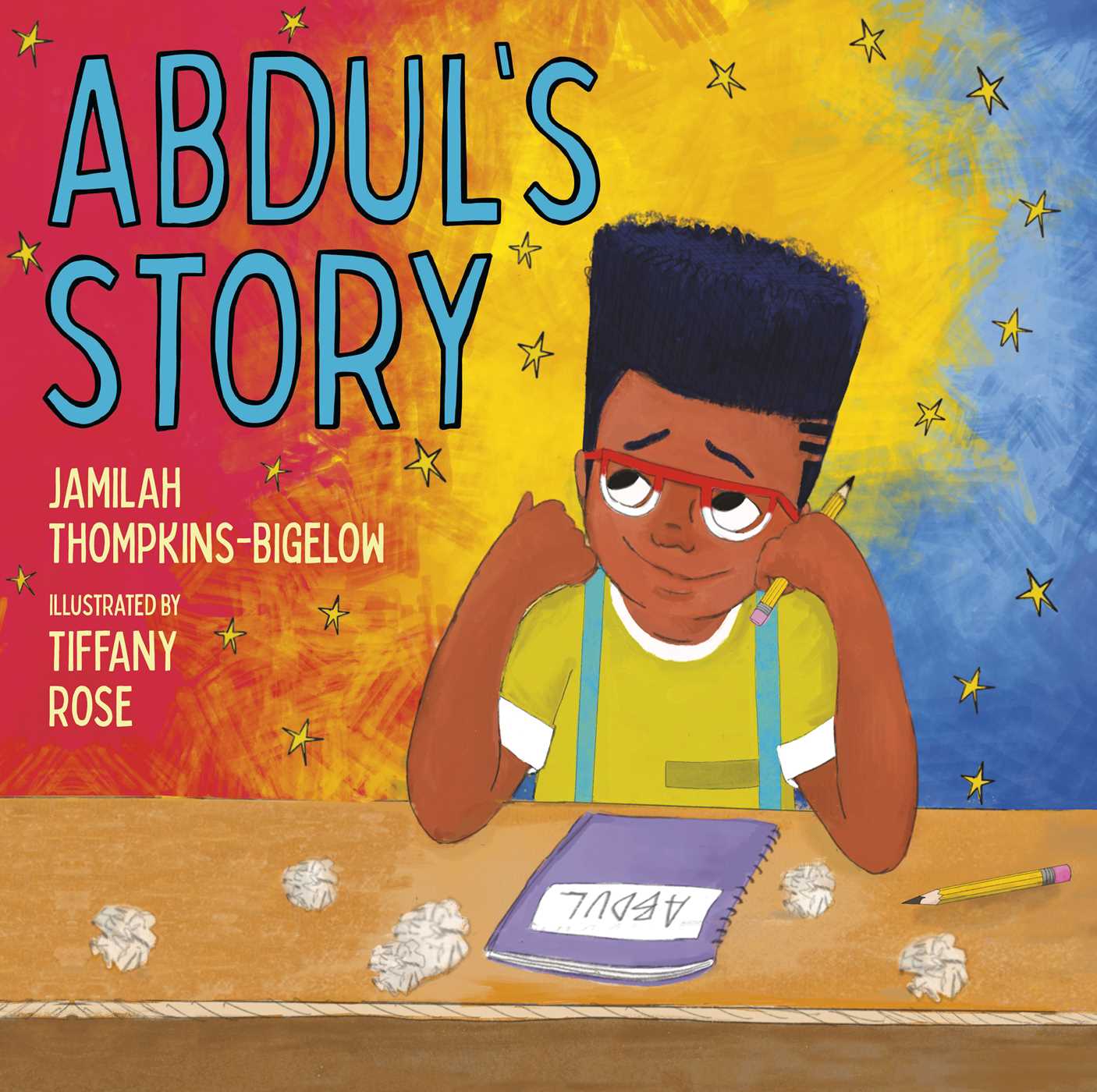
Abdul’s Story by Jamilah Thompkins-Bigelow illustrated by Tiffany Rose

Standard
Abdul’s Story by Jamilah Thompkins-Bigelow illustrated by Tiffany Rose

abduls story

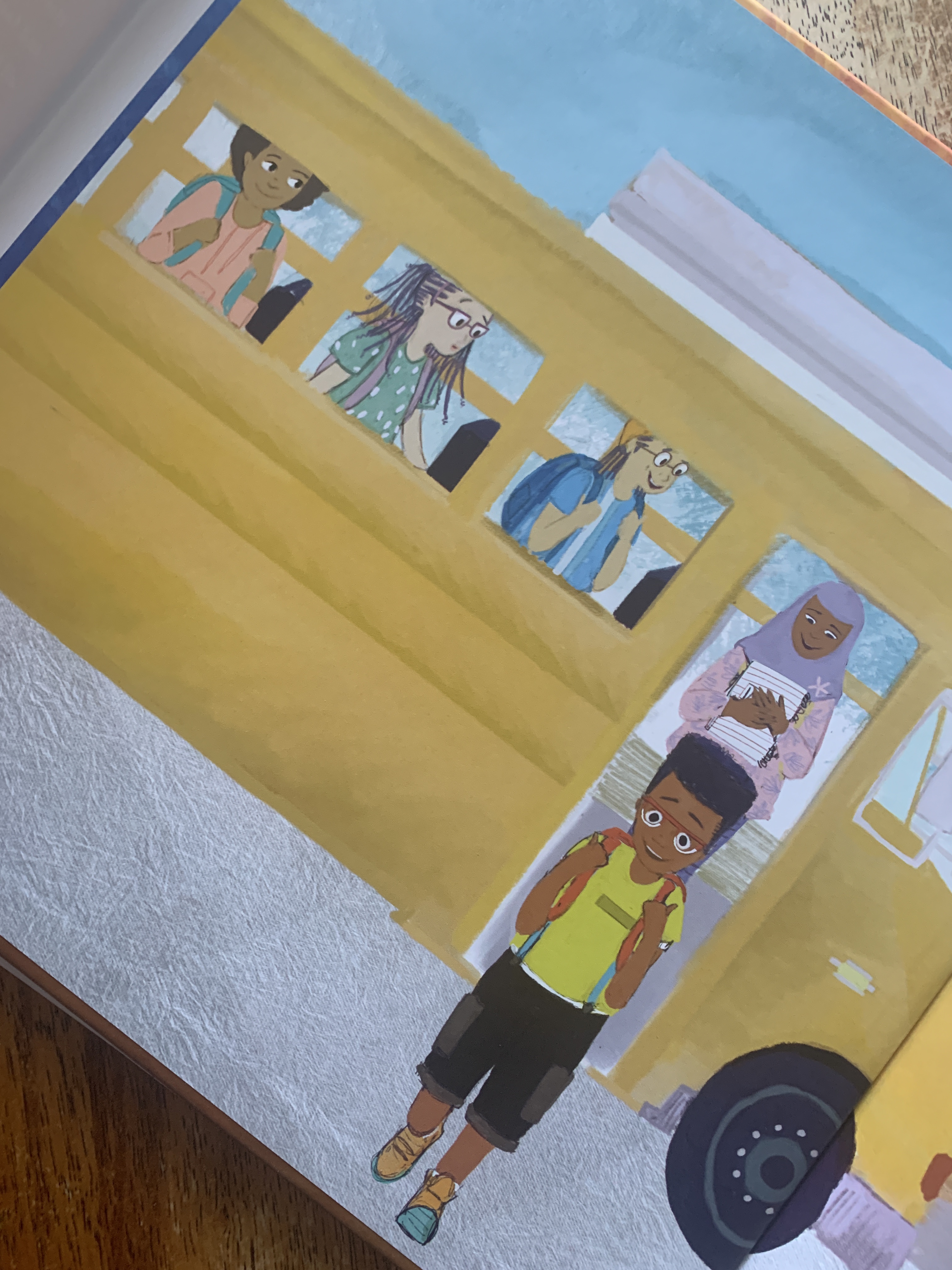
I really don’t know what more you could want from a 40 page brightly illustrated picture book for ages 5 and up.  I felt seen, I got a little emotional, I was inspired, I smiled, I felt compassion and empathy, hope and nervousness.  I was reminded of the power of role models, of getting down on a child’s level, literally.  I was reassured that we all make mistakes, learn differently, and can still thrive. Suffice it to say the book is moving.  The OWN voice lyricism will resonate with children of all colors, but that the messaging is from a Black Muslim boy and is so unapologetic and proud and beautiful, makes the emotions Abdul feels palpable.  Every classroom bookshelf needs this book, every child needs to hear it, read it, and explore the layers contained within.  Alhumdulillah.

img_8766

The book starts out with absolute joy.  Abdul loves to tell stories.  Writing stories, however, is something else.  The letters are tricky, they get turned around, they aren’t straight and crisp like the one’s the barber cuts.   His pages don’t look like the neat lines of his classmates.

He decides that maybe his stories aren’t for books.  It isn’t like he even sees stories like his in books:  stories about the people and places that he knows.

img_8767

Then one day a visitor comes to class, Mr. Muhammad, and he is a writer.  He encourages the children to, “write new stories with new superheroes.”  Abdul tries, but he keeps making mistakes, and then he has to erase, and before long his paper is covered in smudges and holes.

img_8768

Mr. Muhammad encourages Abdul to keep trying and fix the messes later, Abdul has an idea, and with a “bismillah,” he gives it another go.  There is no perfection, there is just determination.  The struggles, success, and support of his peers and Mr. Muhammad, just might change Abdul’s mind about his stories.

img_8769

I love that the book is Black centered and Muslim centered.  There is praying salat, mention of bean pies, a classmate in hijab, and saying of Bismillah.  I’ve read the book seven or so times and it has yet to get old.  The characters burst with personality, even the side ones, that I’m positive it will be a favorite at story time and bedtime alike.

img_8770

Can be purchased at Crescent Moon Store or Amazon

Ali and the Gladiators by Farheen Khan illustrated by Evgeniya Erokhina (Ali Series Book #1)

Standard
Ali and the Gladiators by Farheen Khan illustrated by Evgeniya Erokhina (Ali Series Book #1)

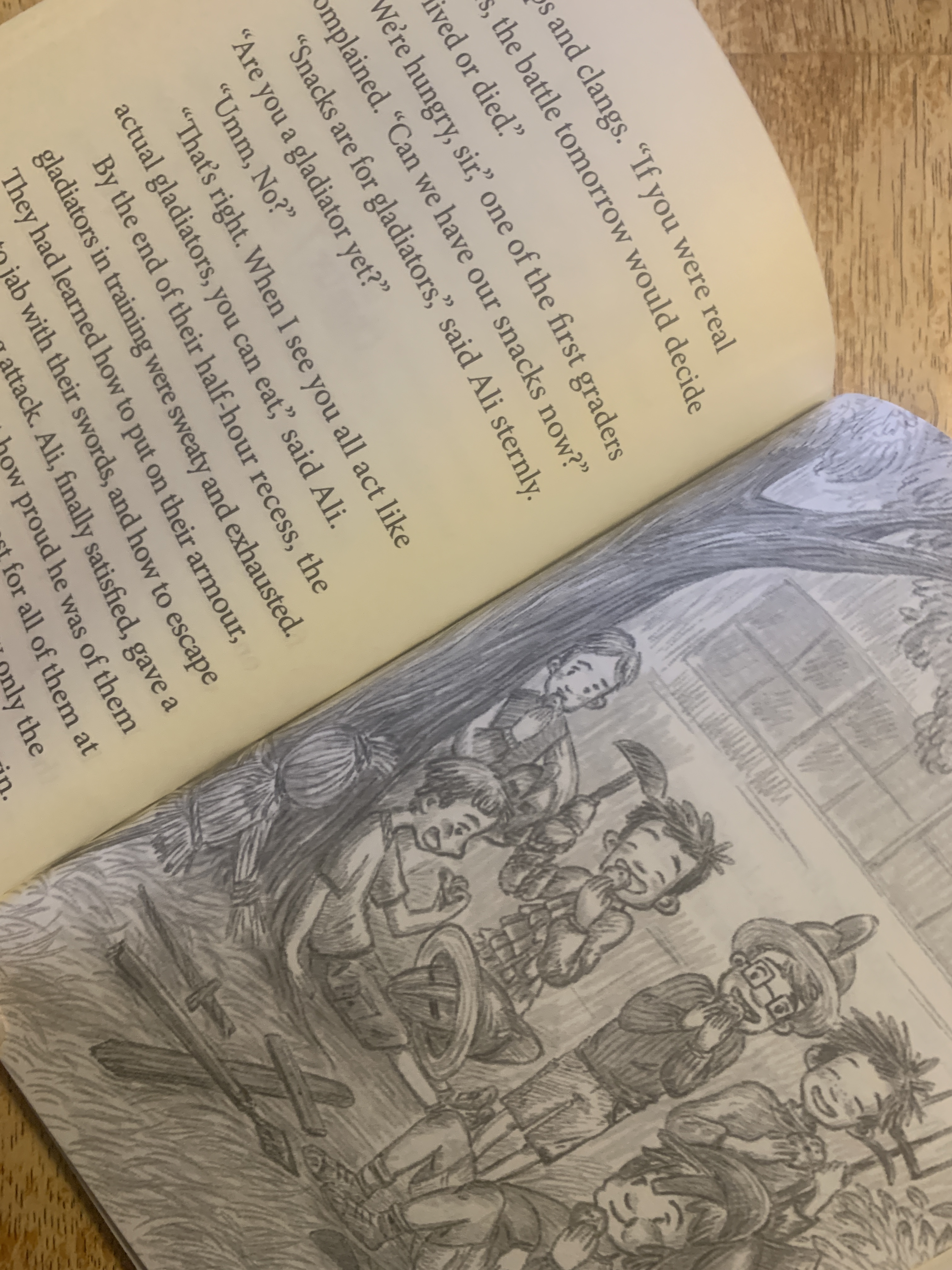
This new early chapter book series from Ruqaya’s Bookshelf comes as a boxed set (Books 1-5), so I wasn’t sure if I should review all of them as a collection, or just the first book.  I don’t typically review additional books in a series, but these books can be read out of order and stand alone just fine.  Ultimately, I’m just going to review the first book, but know the entire series is silly, clean and engaging for ages 7 and up (2nd grade will love these), they will connect with boys, girls, Muslims, non Muslims, and get readers of all ages smiling, if not laughing, at Ali’s outrageous adventures and choices.  Ali is presumably Muslim, the author is Muslim, the publisher is Muslim, but there is nothing religious at all in the text.  Even the one about Eid is very culture framed, not “I’m Muslim and this is what we do and why,” so to speak.  In Ali and the Gladiator there is a friend named Abdullah, his parents are referred to as Mama and Baba, they eat at Moe’s Shawarma Shop, and eat daal and roti at home, so there are hints of culture and religion that will further mirror a Muslim reader’s experience, but the focus is on the hilarious situations that Ali finds himself getting in to and out of with good friends, kindness, enthusiasm, and bravery.  All the books are about 60 pages long with short chapters, detailed pencil style drawings every few pages, inviting text, and an activity at the end.

TODAY (3/25/22) IS THE LAST DAY TO PREORDER AT THE SPECIAL PRICE, and THE BEAUTIFUL BOXED COLLECTION RELEASES APRIL 1st, JUST IN TIME FOR RAMADAN!

SYNOPSIS:

Ali really wants to impress his teacher, Mr. O’Reilly and a big project on Rome will be a great opportunity to do so, but he isn’t anxious to get started.  He has his April Party to prepare for, his friends to hang out with, and plus he knows he works best under pressure.  When he finally realizes he should get started, all the books on Rome are checked out, save a small book on the floor, yes Ali is on the floor in the library.  The book is about how to become a gladiator and that gives Ali an idea.  As his imagination works out the details he is off to his favorite store, the hardware store.  He has weapons to make and actors to train, and beasts to tame.  The assignment is supposed to be written, but Ali is extra and he does not want to be boring.  When he raises his hand to go first in the presentation, Mr. O’Reilly is confused, no one is presenting, they are just handing in their reports, but when gladiators and a “ferocious” cat enter the room, it is clear that Ali has his own way of doing most everything.

img_8157

WHY I LIKE IT:

I love that it is fun and well written.  The characters grow and the writing and descriptions smooth, the illustrations add detail and the books are perfectly silly for their intended audience.  So many books for this demographic resort to brattiness or potty humor, and I love that these are outrageous shenanigans, but they don’t cross into being obnoxious

I do wish there was more Islam in the books, or really any.  It doesn’t need to be Islam centered of preachy, but to add a bit of depth to the characters and flesh out their backgrounds would have been nice.  The desi foods are included, why not mention halal or toss in some inshaAllahs or that Ali gets to work on his weapons after fajr.

I absolutely love the presentation of all five books in a hard glossy case.  They look lovely on a shelf and would make wonderful gifts for Eid, or any time really.

img_8156

FLAGS:

none

img_8155

TOOLS FOR LEADING THE DISCUSSION:

I hope to have these in our school library, and encourage the 2nd and 3rd grade teacher to look in to having them on their classroom shelves.  Kids will be tempted to pick them up off the shelf, they will thumb through them and be drawn in, inshaAllah once they read one, they will read the whole series, and if that isn’t praise for a book series, I don’t know what is. Happy Reading!
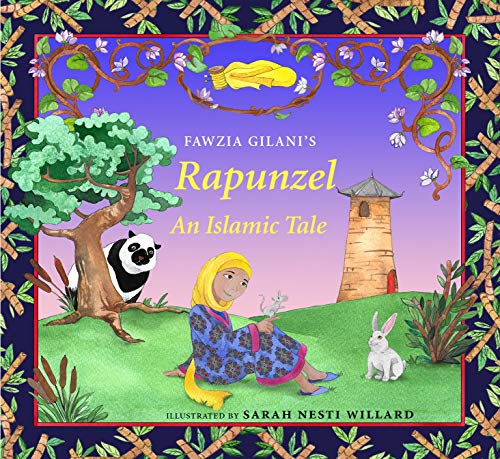
Rapunzel: An Islamic Tale by Fawzia Gilani illustrated by Sarah Nesti Willard

Standard
Rapunzel: An Islamic Tale by Fawzia Gilani illustrated by Sarah Nesti Willard

rapunzel

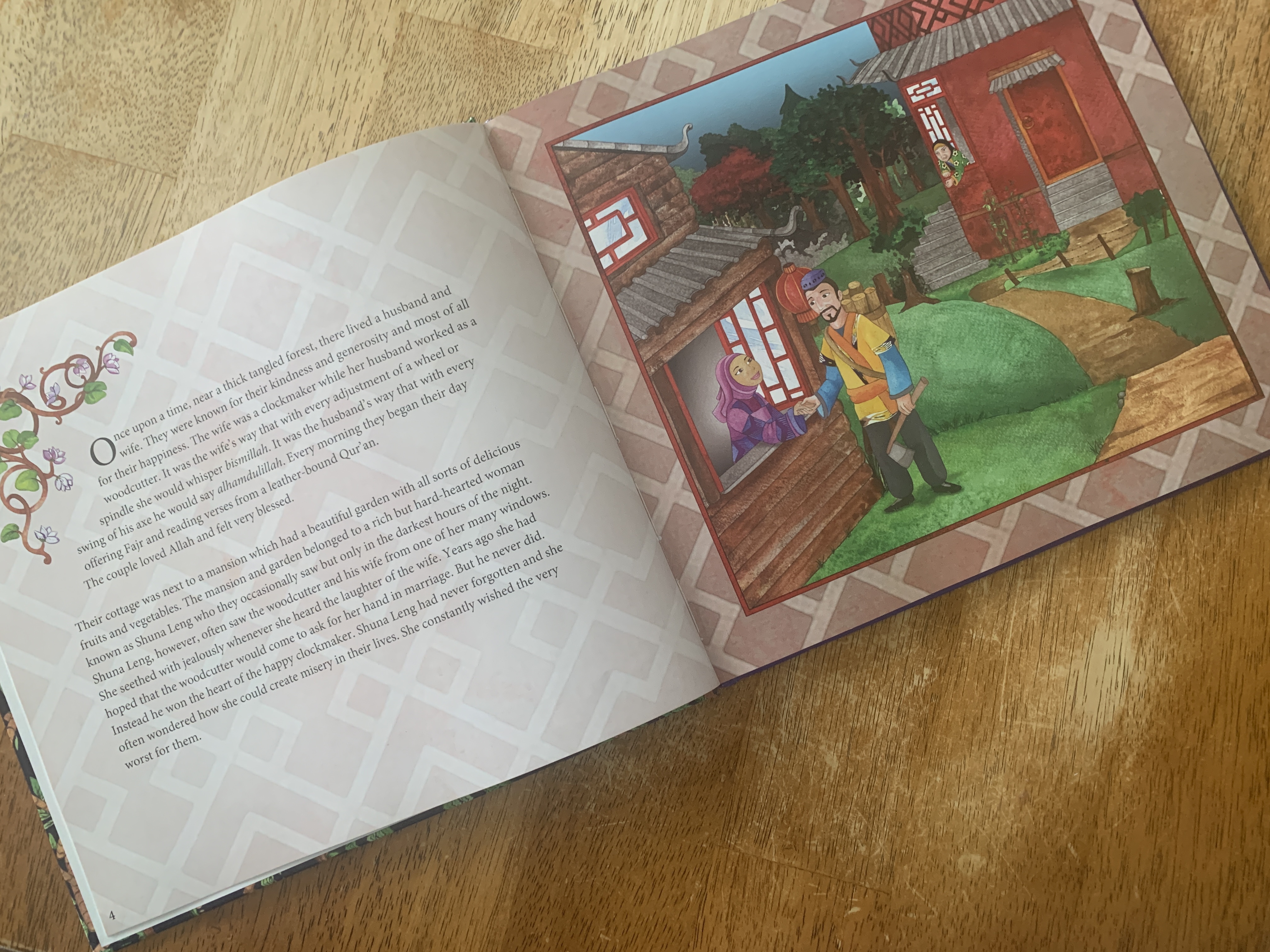
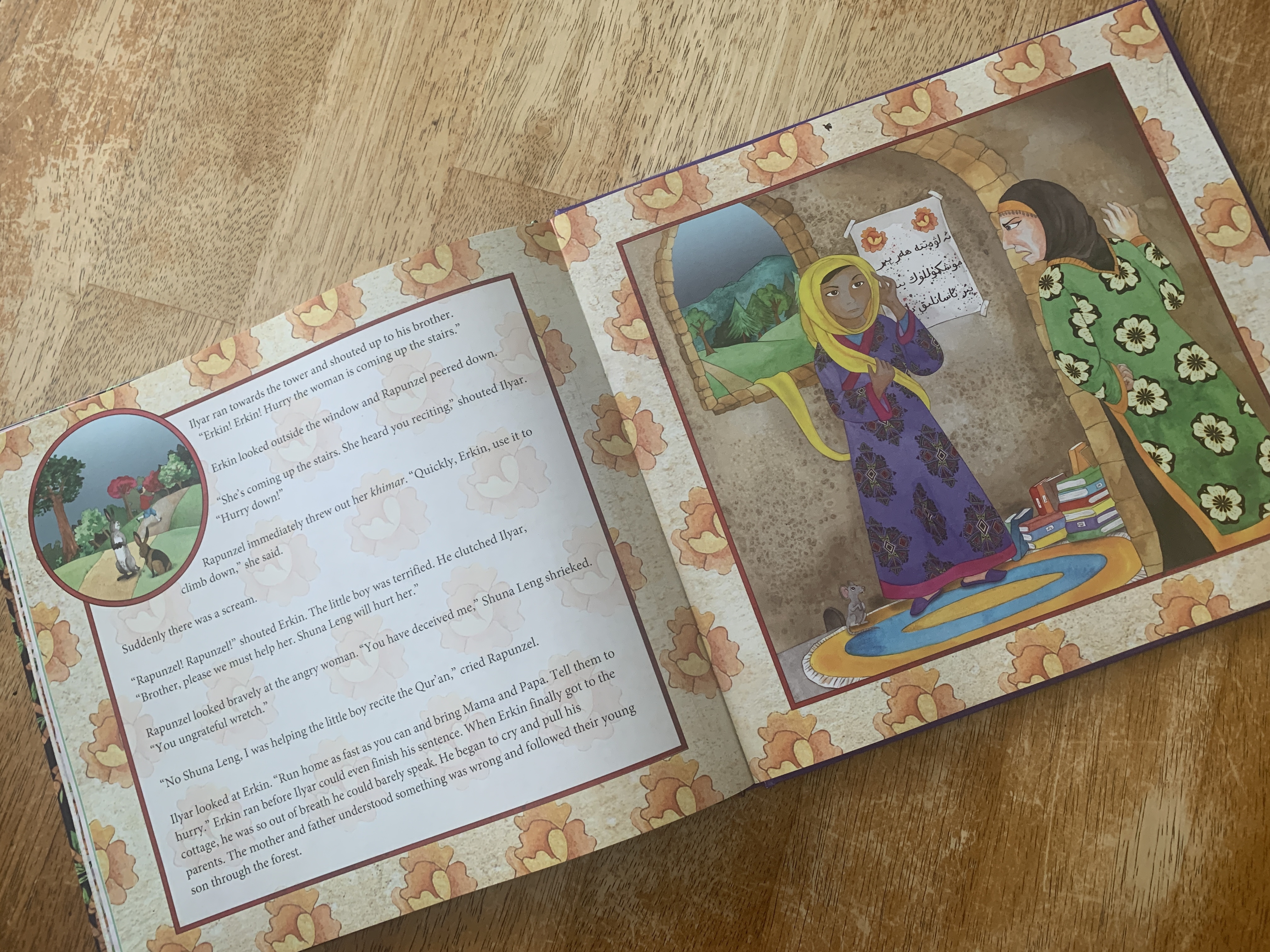
Having read the other “princess” retellings by Fawzia Gilani I didn’t rush out to acquire this book, but when a friend said it was available at the public library, I was surprised and admittedly curious.  This book just like the others in the series are very much in my eyes “Islamic fiction” for how centered Islam is for the characters and how it is used to frame the story toward a religious message.  The fact that a small city library in a Southern state purchased and shelves it, is pretty impressive.  As for the story, well it is really long, and wordy, and every page is filled with tiny text filled lines that I doubt most kids will be able to sit through.  The Islamic content is very present, the Uyghur setting appreciated, but wow do the 41 pages pack a lot of text in to a fairytale re-telling. There is a lot of Islam and Quran and at times it fits well, at other times incredibly forced.  The book claims it is for ages 5-8, but truthfully I don’t know that any age would be able to sit through it and be engaged.
img_7479

In a tangled forest lives a wife and her husband, a clockmaker and a woodcutter.  Before they married, the wealthy and cold Shuna Leng had hoped to marry the woodcutter, but he never asked, and she never forgot.  As a result seeing her neighbors happy keeps her jealous heart plotting and conniving to bring the couple misery and pain.

img_7481

One day, while pregnant, the wife has a strong craving for rapunzel greens.  Some just happen to grow on Shuna Leng’s property.  The husband is nervous to ask, but when his wife falls weak he makes an effort.  She doesn’t answer, so he picks some growing along the path and leaves coin for payment.  This wife regains her strength and then begins craving them again.  He decides to do what he did last time, but is caught.  The evil woman agrees that he can have all the rapunzel greens he wants but if the baby is a girl she shall be given in payment.

img_7480

Once born the baby is taken and kept hidden from her parents.  Various governesses are employed over the years to tend to Rapunzel and who teach her Islam and kindness.  Ever so often they have to up and move and abandon their routine when people start asking questions, but the lessons learned from the Quran stay with Rapunzel and she endures what she must.

img_7483

Eventually she ends up in a tower, she offers to help a stray boy recite Quran, and the evil plot of keeping her locked up unravels.  Yes SPOILER she is returned to her parents.

It is a decent retelling in theory, it just is really long, and there isn’t quality character building to invest the reader to the side stories being presented.

img_7482

The Clever Wife: A Kyrgyz Folktale by Rukhsana Khan illustrated by Ayesha Gamiet

Standard
The Clever Wife: A Kyrgyz Folktale by Rukhsana Khan illustrated by Ayesha Gamiet

the clever wife

It has been nearly 10 years since a new Rukhsana Khan book has been published, and alhumdulillah, she is back with a delightful folktale.  This story starts off like many popular fairy tales, but it doesn’t simply end with a wedding and living happily ever after.  The story is just getting started, once the clever Danyshman and Khan Bolotbek start their lives together.  Over 40 richly illustrated pages brimming with character, culture, and hints of what might happen, the ending will sweep readers aged 5 and up into smiles and giggles and leave them begging to hear the story again and again.

img_7220

When the old Khan is on his deathbed, he leaves the future rule to be decided upon by his beloved white falcon.  The bird lands on the shoulder of a young shepherd and the subjects begrudgingly accept him as their leader.  As his kindness and compassion over the years wins the people over, their only concern is that he hasn’t yet taken a wife.

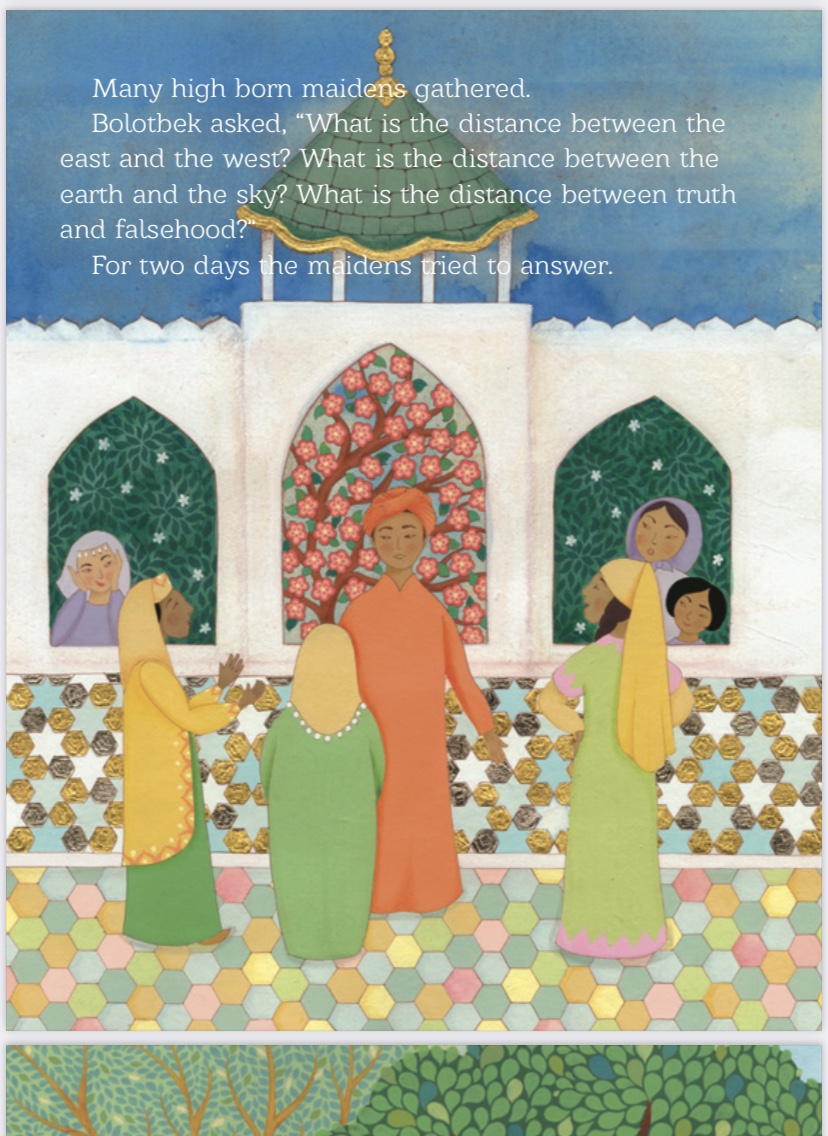
So, many high born maidens gather and try and solve the questions Khan Bolotbek sets before them.  When one poor maiden learns what is happening and accompanies them, they are surprised with her clever answers, and the khan asks her to marry him.

img_7223

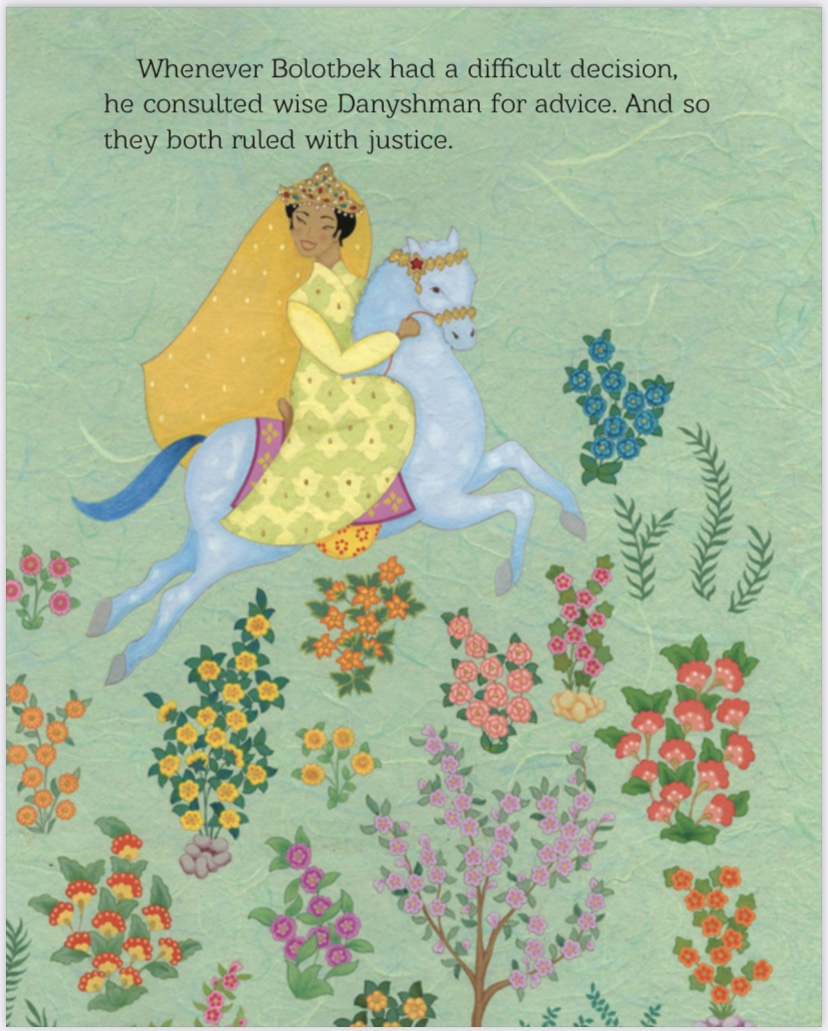
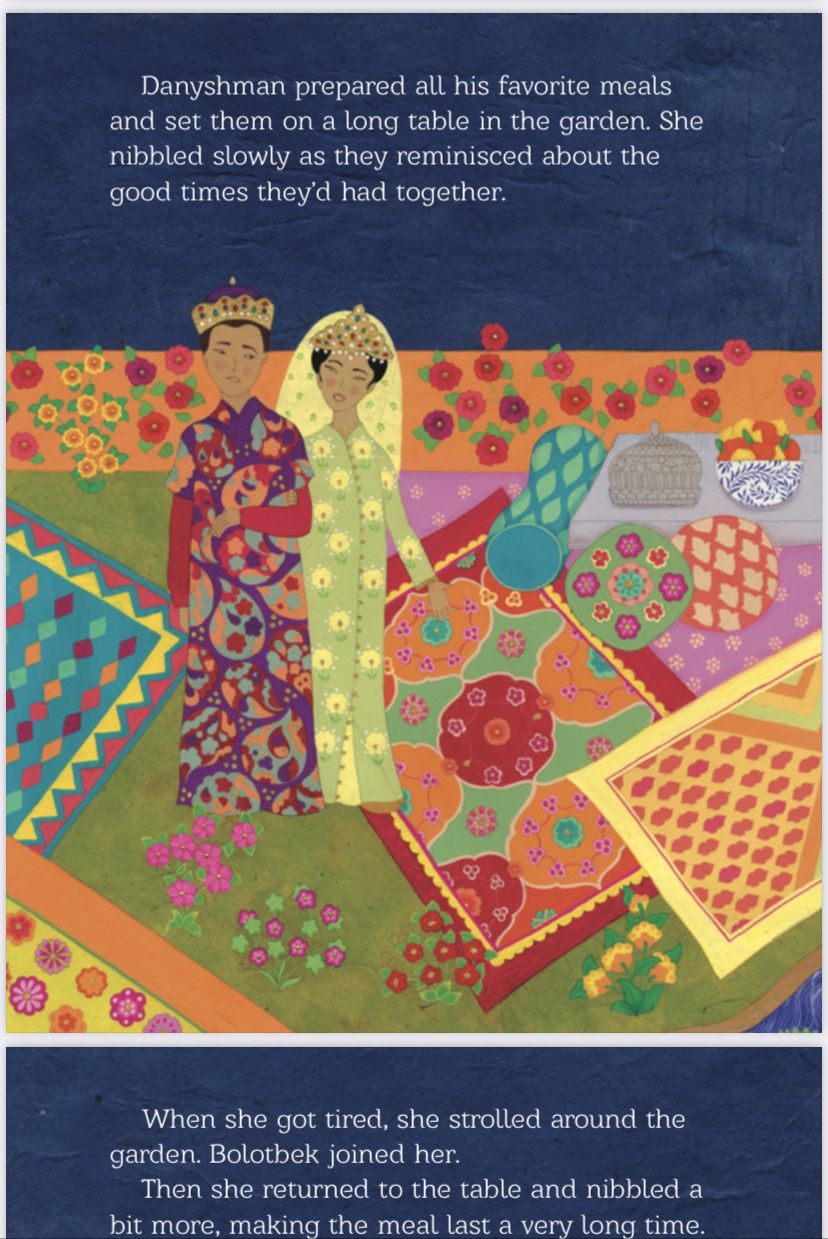
The khan discusses and consults with Danyshman and they essentially rule together.  There is just one promise the khan asked of his bride, and that is to “not share her wisdom with anyone, but him.”  The story continues, but with a clever wife being held to that promise, it is only a matter of time before her wisdom is shared, and it will take true cleverness for her not to lose everything as a result.

I love the strength of Danyshman, the levelheadedness of both her and the khan in ruling, and in remembering their humble roots.  The story is timeless, and this retelling ensures that more families with be familiar with this tale from Kyrgyzstan.

img_7222

Ramadan Rocket by Emma Halim illustrated by Stephen Tucker

Standard
Ramadan Rocket by Emma Halim illustrated by Stephen Tucker

ramadan rocket

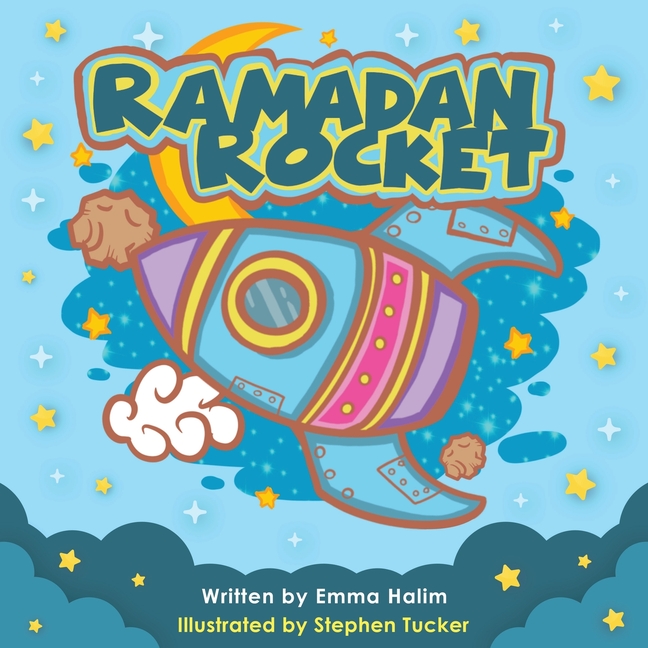
The banter in this 36 page Ramadan moon book is fun and engaging, and as the mom of five kids who was once a kid herself, the struggle is real to try and spot the Ramadan moon.   Most years, frustration abounds and nothing is seen. Haarith has the same problem, but last year he did something about it.  In this 36 page book for preschoolers and up, the faceless pictures will have kids giggling and their imagination’s soaring as they try and determine if Ramadan is about to begin.

img_7572

Haarith loves listening to stories about Ramadan, but always has trouble seeing the Ramadan moon. Last year, he decided to get a closer look.  He set out to build a rocket, but his best friend Hakeem had one he could borrow, so Haarith recruits two other friends, Jawaad and Khaleel, and plans are underway.  Jawaad will pilot since he flew out of a swing last week, and Khaleel will be in charge of food because his mom makes awesome cakes.  The boys head to space, passing, satellites, drones, and NASA rockets, before they see the moon and head back home.  After maghrib the community heads to search the sky and when they see nothing, it is Haarith that can locate exactly what they are looking for.

img_7571

I wish the moon was shown as super thin and hard to see in the illustrations, instead of as a thick crescent so that kids that might not have personal experience could at least understand why Haarith is struggling.  Also, I’m not sure why the line spacing on one page is double what it is on the others.  Many of the pages are text heavy and could have used some editing to tighten it up, but overall the story is fun.

img_7573

The premise though sent my head spinning, and yes I’m going to show my ignorance here, you can judge me. If you go to space, the moon is spherical, the earth and shadows are no longer at play right? So wouldn’t a new moon, a full moon, or a waxing gibbous all look the same? Clearly my confidence in this matter is non existant, and while I have no problem with the characters borrowing a friend’s rocket, it has been sitting unused for a year after all, I’ve been struggling to get this point clarified in my head.  And I believe it would all depend on where the rocket is and thus the boys’ point of view.  According to the University of Maryland, “The reason that we do not always see a Moon which is half lit is because of our position relative to the Moon and the Sun. As the Moon moves in its orbit, different portions of it appear (to us!) to be lit up as we look at it from Earth. This is why we see lunar phases.” So I suppose that depending on the rocket’s position in space would determine if the moon looked like a “Ramadan moon” or say a third quarter moon.  I’ve linked a NASA video that explains that the International Space Station sees the same phases as earth, so umm yeah, maybe I should take a break from fiction and go read some nonfiction basic science books. 

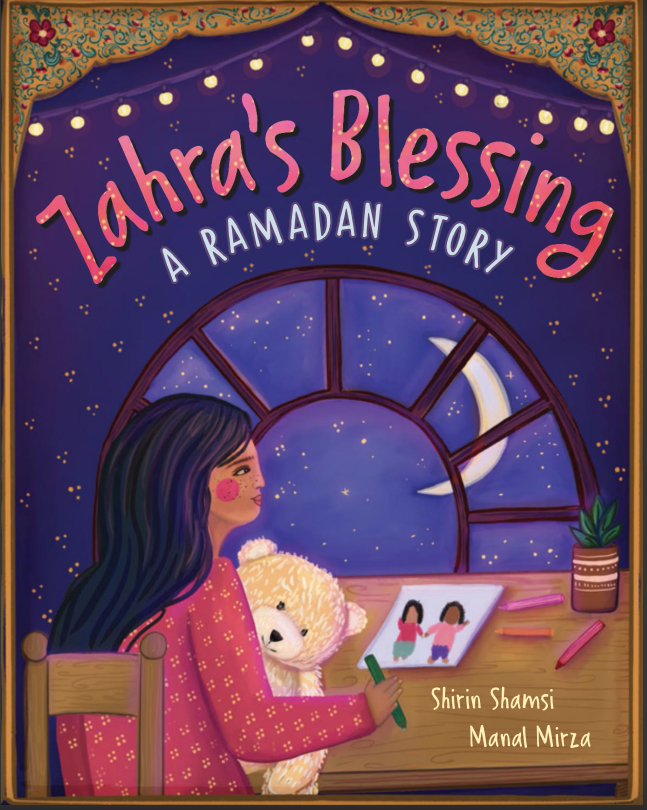
Zahra’s Blessing by Shirin Shamsi illustrated by Manal Mirza

Standard
Zahra’s Blessing by Shirin Shamsi illustrated by Manal Mirza

Screen Shot 2021-11-18 at 11.57.45 AM

Just when you think all the Ramadan stories have been told, you flip open a new book, hold your breath as the stage of predictability is set, and alhumdulillah in this case, you squeal with delight when the big reveal in a children’s book swept you up and surprised you too.  This 32 page richly illustrated story for elementary readers is heartfelt, culture rich, informative, and embracing.  The book doesn’t dwell on the details of Ramadan, fasting, and Eid, but intentionally focuses on some of the feelings, blessings, and acts that make the month extra special.

Screen Shot 2021-11-18 at 11.58.04 AM

Zahra looks up at the Ramadan moon as she hugs her teddy bear and sends a prayer up asking for a little sister. The next day Mama is packing up beloved clothes, and ones that the family has out grown to be donated.  They discuss giving without hoping for anything in return and once again Zahra asks her mama for a little sister. To which her mother lovingly replies that she should be patient.

Screen Shot 2021-11-18 at 11.58.11 AM

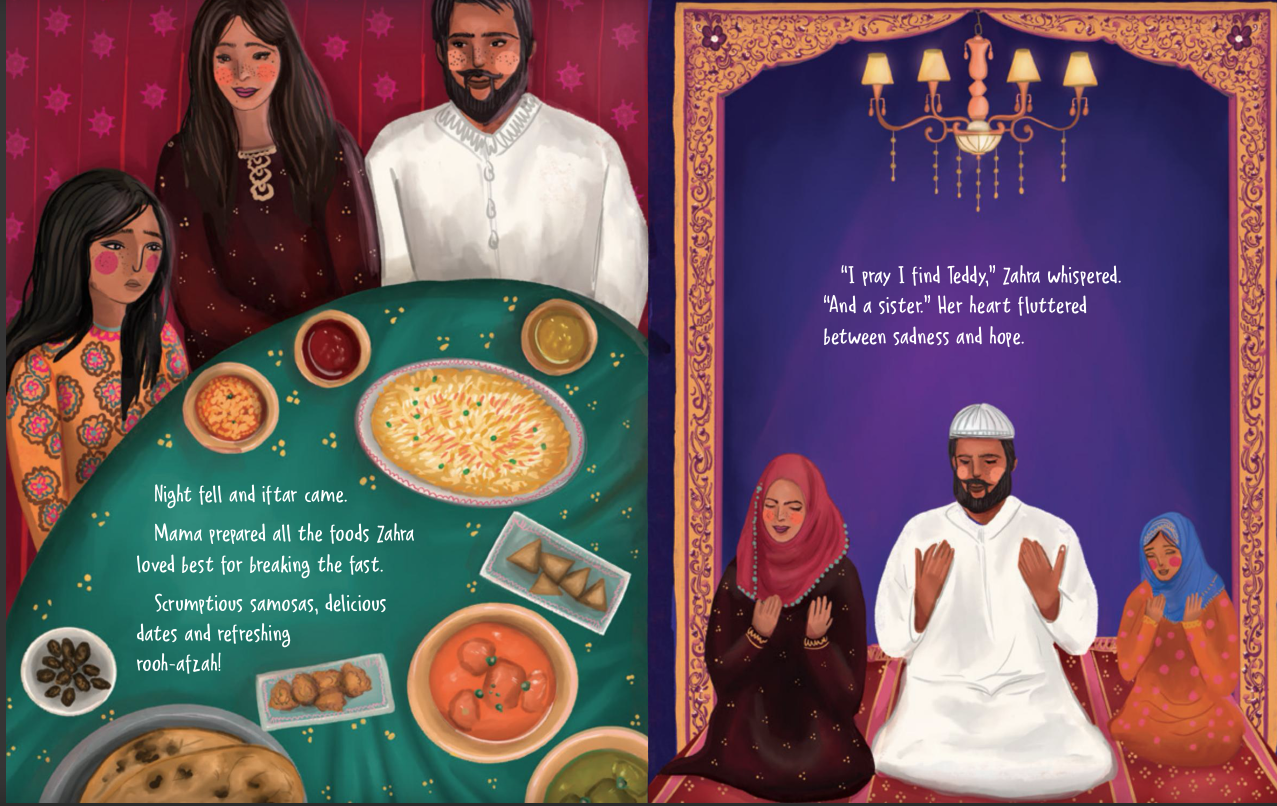
When Teddy goes missing, Zahra can’t help but think a little sister would help her find it.  Iftar that night are all of Zahra’s favorite desi foods and prayer after is her asking for a sister and Teddy.  The following day Mama and Zahra take the collected donation items to the shelter and Zahra realizes how sad she is about losing Teddy and these refugees have lost everything.

Screen Shot 2021-11-18 at 11.58.28 AM

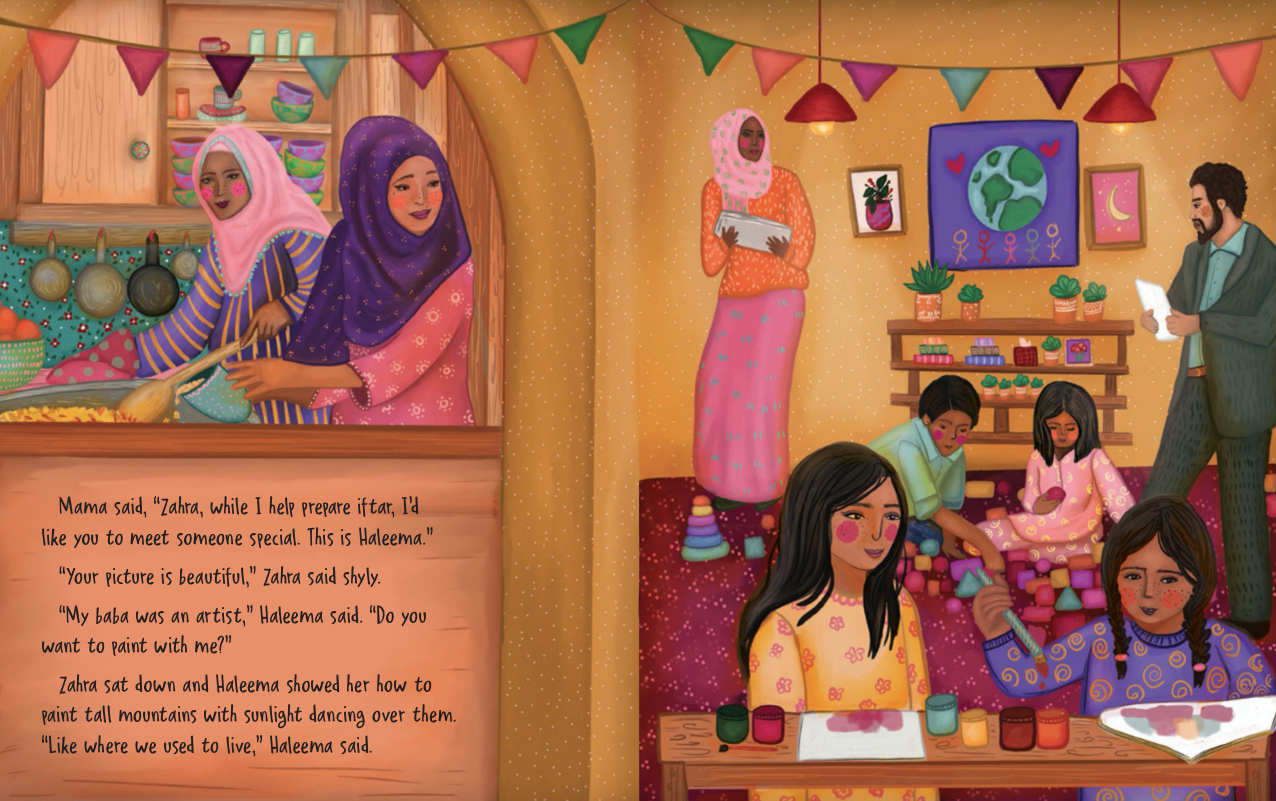
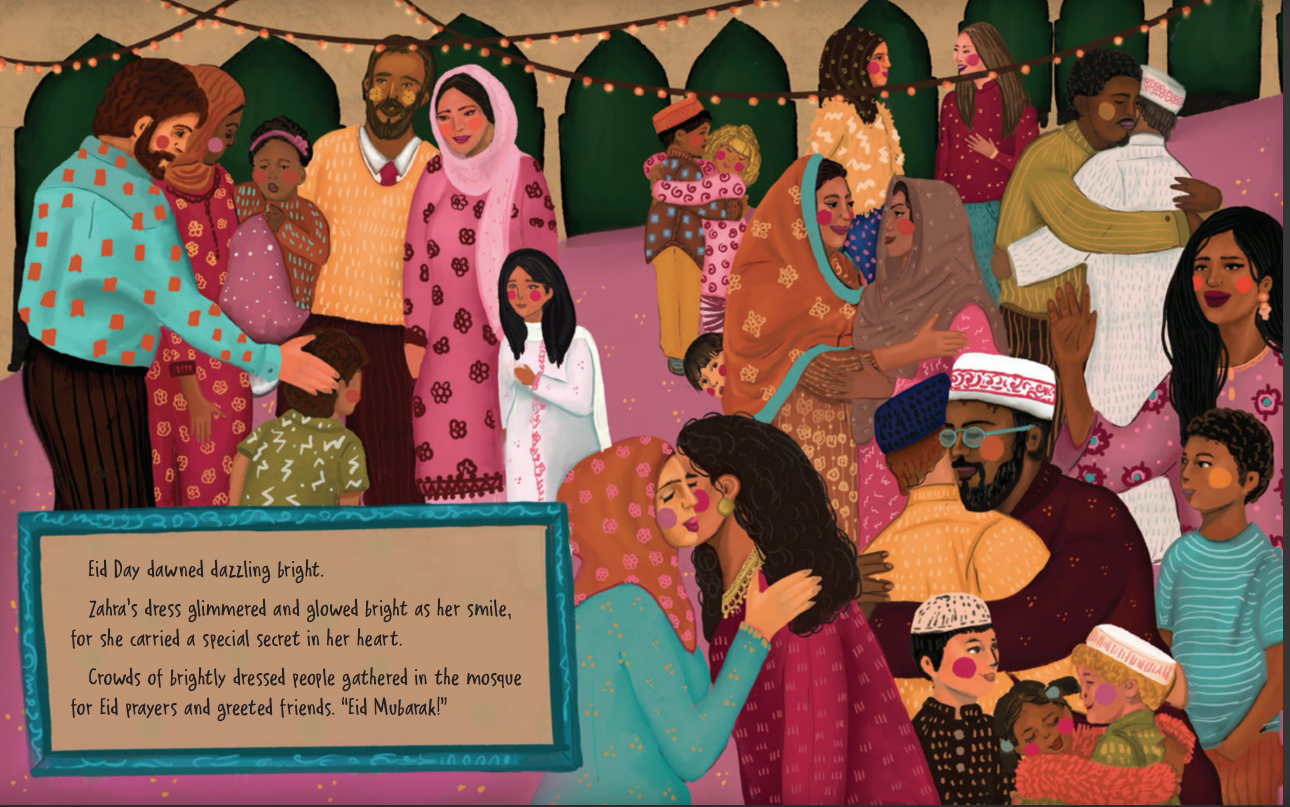
Zahra spends time with the children at the shelter and gets to know them.  She wishes she could find Teddy to gift to a young girl named Haleema.  Some days Ramadan crawls slow, and other days fast.  The family reads Quran together, fasts during the day and prays at night.  The night before Eid, Zahra’s dad whispers a secret to Zahra, one that she keeps close to her all through Eid prayers the next day.

Not going to spoil it, although I’m sure you can guess what is going to happen.  There are hints in the remaining illustrations, but I think kids will enjoy not having the heads up.  The book concludes with some informational blurbs and details about the Muslim author and Muslim illustrator.

Screen Shot 2021-11-18 at 11.58.35 AM

I enjoyed the illustrations, they are bright and bold and festive and unique.  They compliment the text completely as they show praying, reading Quran, making duas, etc.  The text doesn’t get preachy, it doesn’t even mention Allah swt or God, but talks of prayer and blessings.  The combination of the text and illustrations, however, definitely convey a strong unapologetic Ramadan/Muslim centered story.  Overall, it is universal and warm and sweet, and both Muslim and non Muslim children would benefit from reading it.

Screen Shot 2021-11-18 at 11.58.48 AM

My only concern is the page that the family is making dua together, it seems odd that they are all sitting in a line as if they have just prayed, but not prayed with the dad in front and the mom and Zahra behind. I read an electronic arc of the book and I look forward to purchasing a physical copy to add to my bookshelf.

Compass, Vol. 1: The Cauldron of Eternal Life by Robert MacKenzie & Dave Walker illustrated by Justin Greenwood 

Standard
Compass, Vol. 1: The Cauldron of Eternal Life by Robert MacKenzie & Dave Walker illustrated by Justin Greenwood 

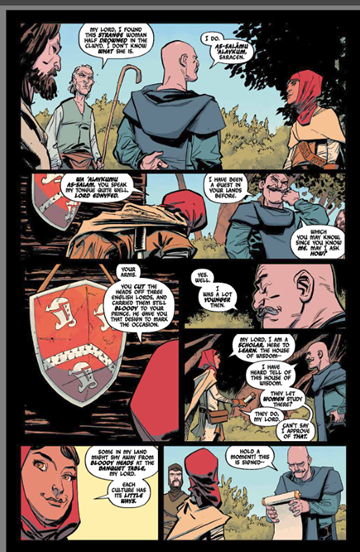
compasscoverDo you ever find yourself in the middle of an amazing historical fiction fantasy adventure graphic novel, reading as fast as you can to find out what happens next, while simultaneously having absolutely no clue what is going on? Yeah, I am was confused often in this upper YA/Teen (16+) 136 page book set in Europe during the Islamic Golden Age and starring a female from the renown House of Wisdom.  I’m fairly positive it is my own limitations that made the book confusing, but for those wiser and more versed in graphic novels, I would recommend this book.  It has action, adventure, science, history, philosophy, a strong Muslim character, friendship, wisdom, ingenuity, a bibliography, Mongols, Druids, and a dragon.
compass1

SYNOPSIS:
Shahidah El-Amin is a Compass from the House of Wisdom, she is not a thief, she seeks knowledge which means that she is incredibly educated, fierce, and scrappy: part Indiana Jones, part Tomb Raider perhaps.  She is a hijab wearing, dua invoking, Qur’an quoting, don’t give me alcohol even as you are about to kill me, strong confident Muslim. 

The book opens with her finding an artifact and being betrayed by a fellow scholar and friend, Ling Hua, a Chinese scholar.  The two race to Wales to get to the possibly rumored Calderon of Eternal Life for different reasons and using different methods.  Along the way Shahidah shows her skills in surviving, understanding what her priorities are, and learning about friendship.  She will battle Master Hua, the Khan, a dragon, a bear, the Druids, a leper just to name a few as the fantasy world is developed and built up with historical accuracies thrown in.

compas

WHY I LIKED IT:

I love that the lead is a fierce female Abbasid Muslim from Baghdad and that there are a variety of religions and cultures mentioned and depicted.  It refers to Shahidah as an Arab witch by the enemy and calls Muslims “Mohammedans” which takes a bit of getting used to and I never got comfortable with.  I love the inclusion of ayats in transliterated text of the Arabic, and the concept is wonderful.  I got lost though in some of the world building and plot.  I think the action and illustrations are clear, but the text needed a little clarity in my opinion.  Again, I acknowledge my lack of familiarity with the concepts and format of the book.

I loved the bibliography and the notes included at the beginning and end.  I actually would have liked more information on the House of Wisdom and as always, a map.

FLAGS:

The concept and references make it for more mature readers.  There is also violence, a mention to love making, and depicted death, gore, killing, etc..

compass2

TOOLS FOR LEADING THE DISCUSSION:

Even though it is for older readers, I think it would be great on a library shelf for middle grades and up.  It probably isn’t for everyone, and many wouldn’t be tempted by it even, but the few kids that like this kind of content, will absolutely love the book.

Samir and Yonatan by Daniella Carmi

Standard
Samir and Yonatan by Daniella Carmi

samirandyon

I saw this book at the library and was shocked: a Palestinian pov story written by an Israeli.  I checked it out, braced myself, and got ready to rage.  Except it isn’t blatant, and I can’t just chop it up to obvious hate, but that isn’t to say that the 183 page middle school book should be shared and deemed harmless: it subtly minimizes the occupation of an entire people, it in many ways glosses over the apartheid taking place.  It gives the inequity lip service, and I’m sure many western non Muslim, non Palestinian readers will find the book balanced, but I never could quite shake the looming shadow throughout, of trivializing the oppressive regime that is Israel.  I don’t know if the undermining is intentional, and I couldn’t find anything with a Google search to see how the book was received by Israelis in 1994 when it was published (it was translated in 2000), but either way it provides a great example as to why OWN voice books are so much more powerful.  This is not the oppressors’ story to tell.  I’m not saying the author isn’t sympathetic to the Palestinian struggles or that she actively supports encroachment of Palestinian homes, I honestly don’t know her stance.  I do know that the lived experiences of Palestinians though, is best left to be told by people that live it, have lived it, and those that feel loss because of it.  It is not a narrative to be told by the force that is causing the pain.  My biggest worry is that readers will take away from the story that the situation isn’t that bad, that Israelis are taking care of this poor injured Palestinian boy out of the goodness of their hearts so they must be nice, and at the end of the day the two sides are just two opposing forces, but the people once they get to know each other, bond over the fact that they pee the same and can be friends.  It waters down that it is, and was, major international powers backing the Israelis and that it is not, nor has it ever been, a simple disagreement between two equal sides. No I don’t expect every book about the region to detail the specifics, but don’t tell me that killing of children, a life of checkpoints, curfews, and fear can all disappear over a few months when the “enemy” provides medical care, regular meals, and arts and craft times. I’m not Palestinian and I can see the short-sided reality of that real quick.  It leaves young impressionable readers with a very skewed view, no matter how diplomatic the author attempts to be on the surface.  And I cannot support it.

SYNOPSIS:

Palestinian boy Samir injures his leg in a bicycle accident, quite seriously, and his mother who cleans for an Israeli lawyer is able to get him a special permit to be taken to the Jew’s hospital to be cared for by a visiting American surgeon.  He speaks broken Hebrew, but understands quite a bit as he has worked in a Jewish grocery store in the past.  When he gets to the hospital, he is placed in a room with other children to wait.  He stays there for weeks until the doctor can arrive and then even after the procedure he stays for physical therapy for weeks before he can return home.

While he is there, he gets to observe and know, in some ways, the other patients.  Yonatan is always buried in a book, but at night, when the other kids go to sleep he talks to Samir and plots with him a trip to Mars.  Yonatan’s mom lives in American, he lives with his dad who is an astronomy professor.  He also ethically is a vegetarian and saves his kabobs and chicken from his meals to give to Samir.  There is a girl that was hit by her father and refuses to see him, and one that is like a princess that doesn’t like to eat.  Tzahi wears a colostomy bag and is always jumping around and causing trouble.  His brother is a paratrooper in the Israeli army and he hates Palestinians.  It is hard for Samir when the brother comes to visit, the fear is real.

Samir’s younger brother Fadi was recently killed by Israeli soldiers and the memory, horror, and anguish is still very fresh for Samir and his entire family.

WHY I LIKE IT:

At first I really couldn’t articulate the saccharin taste the book was causing to form in my mouth as I read.  The curfews, and check points and loss of Fadi was being discussed and contrasted to the luxury of the Israeli hospital, and then it began to occur to me that, it was almost worse than just being blatantly hateful.  The placating and sugar coating slowly diminishes the horrors of reality.  At the beginning Samir doesn’t want to go to the hospital, he would rather have a limp, but the narrative slowly becomes about the kids in the hospital also have stressing and hard lives, and that seems sweet, except, their issues while specific, are universal.  Samir’s leg is as well, but the oppression of his people is systemic and helping him doesn’t erase that the same people running the hospital killed his brother, dictate his reality, and his future opportunities.  It is not enough for the “anti Palestinian child” to have a surgery that corrects his ability to urinate and at the very end, they pee in to the planters.  It might work on the surface, but it trivializes too much. If Samir would have gotten to tell them about his life and his pains, and his experiences, and they would have accepted them as valid, maybe I could see bridges being built, but bonding over basic human functions, and celebrating that an Israeli boy finally talks to a Palestinian, isn’t compassion, it is arrogance.

The only real positive takeaway I had of the book was that even in the tiniest human kindnesses Yonatan showed Samir it was something for Samir to contrast with his life long friendship with Adnan.  That growth of realizing what makes a good friend was more humanizing and affectionate than any other storyline in the book.

FLAGS:

Murder, fear, harassment, oppression, bullying, teasing, violence, gun violence, abuse, talk of urinating, showering in front of others.

TOOLS FOR LEADING THE DISCUSSION:

No way, I will never have Palestinian children read about their life experiences from an Israeli person speaking through a Palestinian character.