Tag Archives: Loss

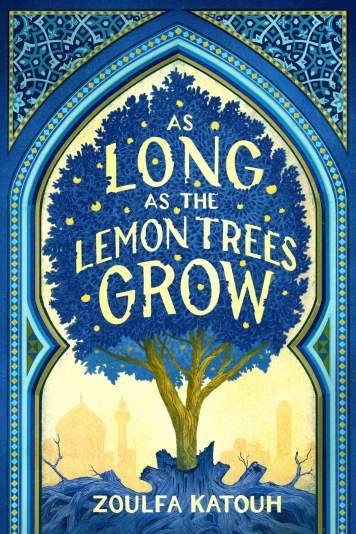
As Long As the Lemon Trees Grow by Zoulfa Katouh

Standard
As Long As the Lemon Trees Grow by Zoulfa Katouh

as-long-as-the-lemon-trees-grow

Anything I write about this YA book will fail miserably in conveying how powerful, beautiful, lingering, moving, emotional, and overall masterfully written every one of the 432 pages are; it just might be my favorite book of the year.  I do know that this will be my new standard for Muslim OWN voice stories, as the authenticity was absolutely engulfing, I’m not Syrian and I could feel it and naturally, I also verified it.  There is no pandering to a western gaze, the story and characters pull you in and show you Syria from the ground, there is no telling, there is no lecturing, it is mesmerizing storytelling at its finest.  The book has mental health issues, war, and a sweet “halal” romance, that I think upper YA, 16 plus, can handle and appreciate.  I hope every adult will spend time with this book, it truly is incredibly well done, alhumdulillah.

SYNOPSIS:

Homs is under the protection of the Free Syrian Army, but that isn’t enough to keep pharmacy student Salama and her family safe.  Her mother is killed, her father and brother taken, and so she moves in with her best friend Layla, her pregnant sister-in-law, her only family left.  Working as a doctor in the hospital where anyone remaining is given responsibilities far above their skill level, education, and experience- every day is a struggle to survive.

Haunted by the physical manifestation of her fear, “Khawf,” who urges her to fulfill her promise to her brother of keeping Layla safe and getting them out of the country, Salama at eighteen years old has to find a way.

Before all the pieces come together to escape, a boy enters the picture, Kenan, who gives Salama hope, who distracts her from the death and destruction that has consumed their lives.  A boy unwilling to leave his beloved homeland.

WHY I LIKE IT:

I’m a crier, but this book brought out ugly angry tears, shocked tears, heartbroken tears, sentimental tears, you get the point, this book held me in its grasps and never let go. I.COULDN’T. PUT. IT. DOWN. If this is the author’s debut novel I can’t even fathom what is yet to come.

I love that the characters are Muslim, and that they pray together, that they plead with Allah (swt) and meet at the mosque.  It is who they are, it is not up for debate or in need of explanation, it is what it is and it is not anything to discuss.  The parts where a character pleads with Allah for death over being taken, absolutely wrecked me.  Just as efforts to keep everything halal between Salama and Kenan made me beam.  (If I’m completely honesty, I did on occasion get frustrated, I mean come on they are being shot at, bombed, nearly sexually assaulted, scoop her up in your arms and console, her, I know haram, but it is fiction and I was invested, and there is a war.  Thankfully, I am not an author and she kept it all clean and her characters much stronger and mindful of the shortness of this world.)

I love that there are political voices, but that it isn’t a political book trying to give back story to the conflict.  In so many ways the news has failed to keep a light shining on Syria and books such as this, remind those of us outside Syria without strong connections to the land, that the conflict is still raging.  If this was a journalistic article it would be a human interest piece, it is character driven.  Readers see themselves in the characters that live lives that most of us of privilege could never imagine, yet here we are spellbound by the characters, their choices, their dreams, and their safety.  This book shows the power of fiction in opening our eyes to the horrors that are happening in our time, by giving us a face and a character to care so deeply about, that we are spurred to action and determined to not remain apathetic.

FLAGS:

Death, torture, physical abuse, sexual assault, fear, loss, coercion, war, murder, torture, child abuse, crimes against humanity, starvation, mental health, PTSD.

TOOLS FOR LEADING THE DISCUSSION:

I would love to use this book in a high school book club.  The story and themes of the book would open themselves up to discussion so effortlessly and the beauty of the writing would be a gift to share with students.

A Darkness at the Door by Intisar Khanani

Standard
A Darkness at the Door by Intisar Khanani

darkness

Y’all I was devastated when Theft of Sunlight ended on a cliffhanger, but Alhumdulillah, this conclusion was well worth the wait.  My heart is at ease, even if I am trying to figure out how to get the “Blessing” so that I can forget I read the book, and enjoy it all over again for the “first” time.  I don’t normally review second books in the series, and this won’t be a typical review, but truly if you have not read Thorn or Theft, what are you waiting for, go get those books and start reading.  I don’t know a lot about the publication drama of this fantastic book, but I do know that it was not published in the USA by the same publisher as the first book in the duology, and the thought that we, the readers, could have stepped up the pre-sales and shown our love for the series, the author, and the characters weighs heavy on me.  Thankfully, the UK publisher kept the book and the author found a way to get Darkness to us in the US (it publishes later this summer), but truly we have the power to support good, quality stories, and we must actively show it so that they get published, rather than simply complain about what options are made available to us. This is the author’s website: http://booksbyintisar.com/ if you sign up for her newsletters you can get all the bookishly delicious info.  She is not asking me to promote her or her books, but I happily share and direct support to her, because her stories really are great, and from what I can fangirl find out about the author, so is she.

The book picks up where Theft leaves off, and manages to remind readers what might have been forgotten in the interim.  It had been over a year since I read book one and while I fumbled a little at the beginning, the author caught me up to speed and didn’t let me lose a beat in Rae’s latest and ongoing adventures.  It starts with Rae aboard a slavers ship with children bound for a horrible fate.  More than just her life is at stake, as the information she has recently discovered implicates palace officials, the Circle of Mages, an heir to the throne and so much corruption.  With the help of street thief Bren, Rae gets herself in and out of trouble quicker than most expect.  Her clubfoot, sharp brain, and genuine values, force anyone who underestimates Rae to find themselves scrambling to keep up.  She has grown to love her body and the strengths that it affords her, and in her actions and dedication to changing the world she becomes a formidable river Pirate Queen that you genuinely care for, cheer on, and hope gets a happy ending.

Yes, if you have read Theft and are wondering why I didn’t mention Princess Alyrra, Red Hawk, the Cormorant, Niya, Stonemare, Artemian, and everyone else, fear not, they are all present, and get their story arcs, I just don’t want to risk a single spoiler.  If you’ve waited for this conclusion, you will find yourself desperately dreading the final pages, and wishing the story would never end.  The fantasy, action, characters, world building is all incredible and so hard to put down.  The author is Muslim, but there is no Islam present in the stories, although hints of desi culture do seem to present in the Sweetening atleast. 

The book is YA, but I think 15 and up or so would be a good fit. Like the others in the series, it has magic, murder, killing, lying, thieving, alcohol, corruption, implications of sexual abuse, assault and threat of rape, but this book also has some language, talk of infertility, and some implied banter about marital relations. The romance is very halal and clean, but the violence is graphic as dealing with the implications of murder and slavery are grappled with and thus a thematic element of the story.

Thank you Netgalley UK for the arc, if the book looks interesting and fun for you, please preorder the book wherever you are.

You are the Color by Rifk Ebeid illustrated by Noor Alshalabi

Standard
You are the Color by Rifk Ebeid illustrated by Noor Alshalabi

you are the color

Books like this are hard for me to review, and I have gone back and forth on whether I should post anything or not.  On the one hand, we need books that are unapologetically Palestinian written by Palestinians.  They need to be celebrated and elevated and I want to offer my support to the stories, to the voices, to the authors, illustrators, everyone involved.  On the other hand, if I didn’t love it, why should I shy away from saying so, when I have purchased the book (pre-ordered and changed the shipping address even, to have it delivered to me on vacation because I didn’t want to wait to read it).  The book is emotional, but the last six pages unraveled the whole book for me, and in a picture book particularly of this nature, when you finish- if you don’t have a cathartic pull, you start to find holes in the story as you feel deflated.  The book, I would go out on a limb to say, needs to be discussed and given context even if you are Palestinian.  As someone who is not, I recognize my arrogance in such a statement and am happy to be corrected, but from a literary reviewer standpoint the book needs discussion and additional context.  The Nakba is only articulated in one paragraph in the author’s note.  In the story itself there is no indication that what happened to Thaer happened to so many Palestinians in 1948.  The use of color and how it is depicted in the illustrations is tangible and powerful, but as odd as it is to say, the words got in the way of the story.

img_0713

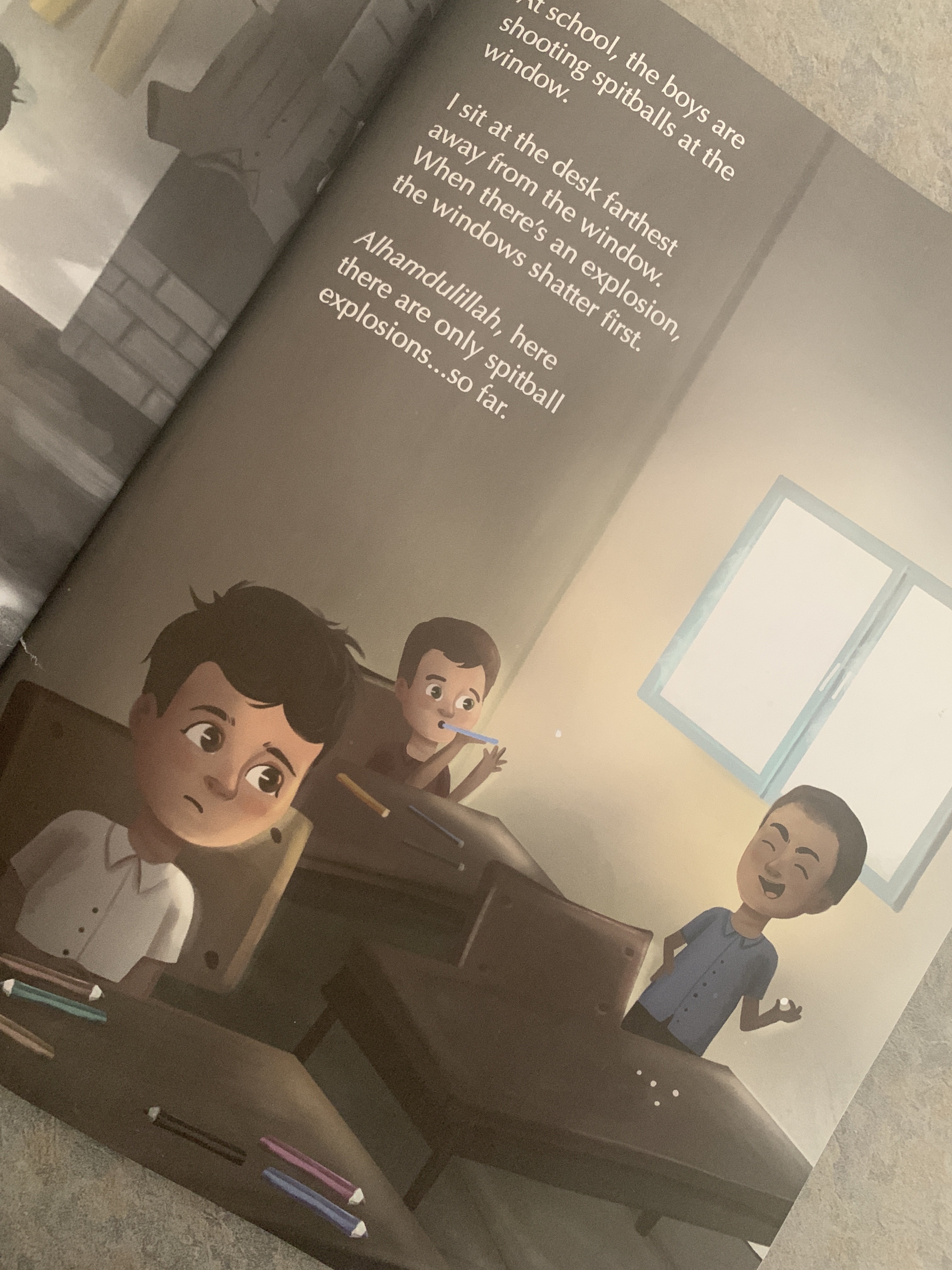
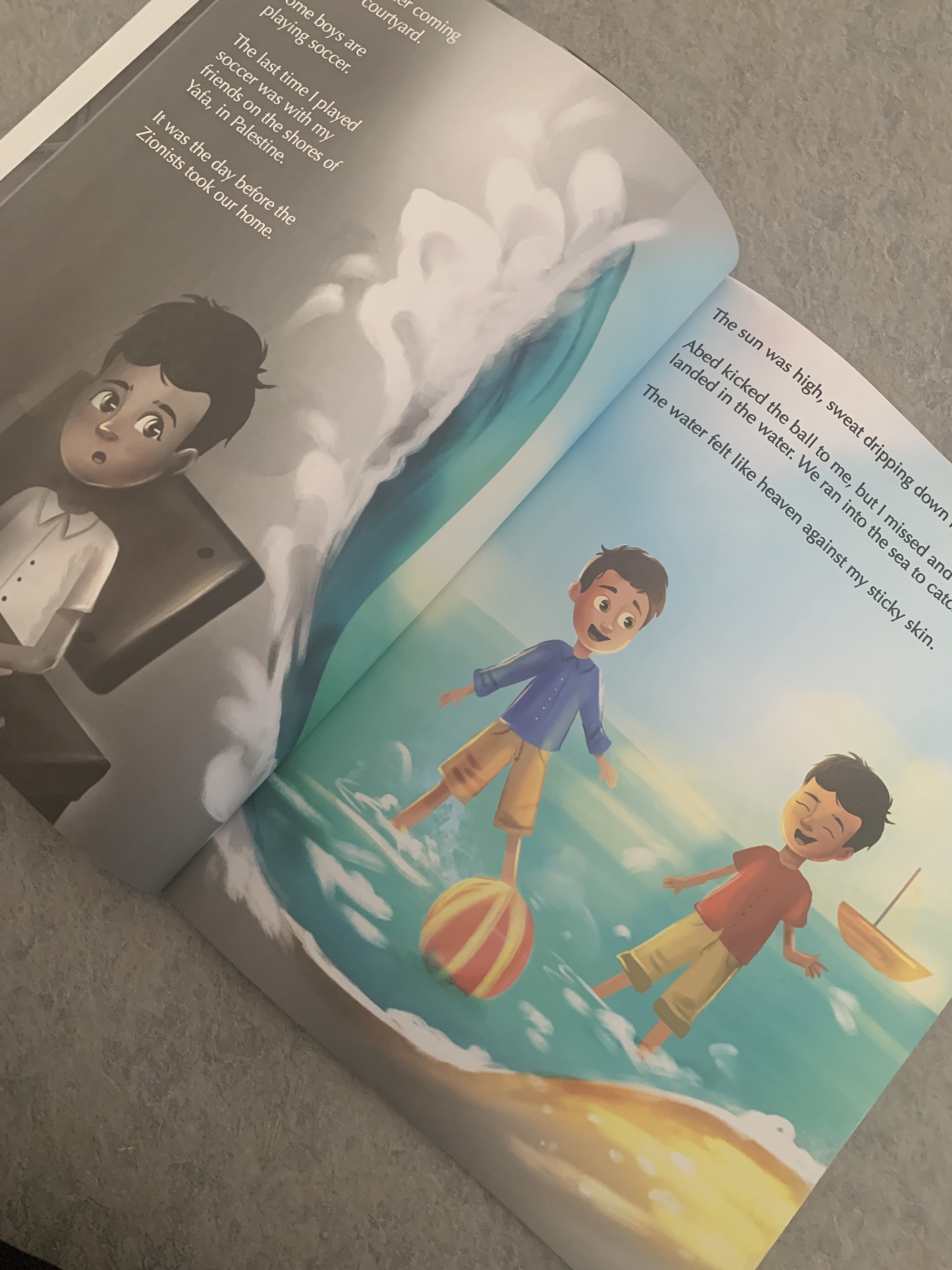
The book starts with Thaer trudging to school in dull sepia filled pages to begrudgingly sit at a desk and begin an art lesson.  He is glad the spitballs are just spitballs and not real explosions, but the tone is still melancholy.  When he sees boys playing soccer he recalls the last time he played soccer, and the memory comes alive in color.  He was in Yafa, it was the day before the Zionists came and took his family’s home.

img_0714

The teacher, back in muted tones, asks him to draw what has made him smile, and Thaer gives it a try.  Blue for the color of the sea, green for zeit and za’tar, brown for taboon to get fresh bread, etc..  When he takes the drawings home to his mother, she is not impressed.  Drawings are silly and colors aren’t going to bring Baba and Susu back.

img_0716

Defeated, the next day in class, Thaer recalls the men pounding down the door and Baba being shoved in a truck and Susu falling.  The next day at school they hang up some of their pictures and Thaer talks about his sister.  (SPOILER) On the way home Thaer paints the alleyway and brings color to his and his mom’s world.  His mama says that he is the color, and when the following day’s prompt is to draw what you want to be when you grow up it shows Thaer (presumably) on the beach as an adult painting.

img_0715

The disconnect for me occurred with the painting of the alleyway.  I was incredibly invested in the story, my heartstrings were being tugged, I was breaking for this character and his experiences, and it all came to a screeching halt because I couldn’t understand where the paint and the alleyway and the mama’s change of heart all manifested from.  As for the ending, I think I know what the author was going for, but it didn’t connect with any of my kids aged 2-15 nor my mother, a 40+ year early elementary veteran teacher.  I wish I could have taken a picture of their faces as she read the book to them.  The frozen expressions of huh and confusion at the end, until my 11 year old to broke the awkward silence to ask if the boy wants to be a painter or a father or an adult?  Those facets coupled with the often advanced vocabulary, makes the book an important one, but one that needs a lot of outside commentary to connect with the readers and to further the conversation about Zionism, al-Nakba, the occupation, and the continued oppression of Palestine.

There are flags of loss, kidnapping, sorrow, violence, etc., that parents will have to gauge if their children can handle. I’m not sure what age group is the best fit, the murder of a young girl, the forced displacement from one’s home, the removal of the father are all heavy themes.  I appreciate that it isn’t “watered down” for a western gaze so to speak, but I wish there was more about what happened to the dad, is there hope he is alive? I wish there was something about this not being an isolated reality for the protagonist and his family.  I wish there was some conversation or connection between the mother and son, because the loss of continuity really derailed the story.

As for the idea of the story, and the use of the illustrations to physically show two worlds I think is a great idea, it just sadly fell apart for me at the end: the faltering conclusion and the loss of emotional buildup that the first two thirds of the story worked so hard to create.

My Baba’s House: A Poem of Hope by Dr. Amani Mugasa illustrated by Eman Salem

Standard
My Baba’s House: A Poem of Hope by Dr. Amani Mugasa illustrated by Eman Salem

my babas house

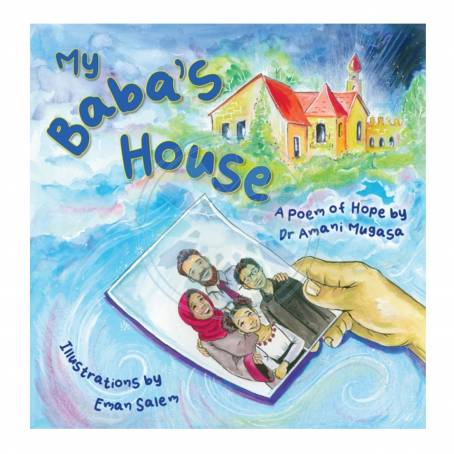
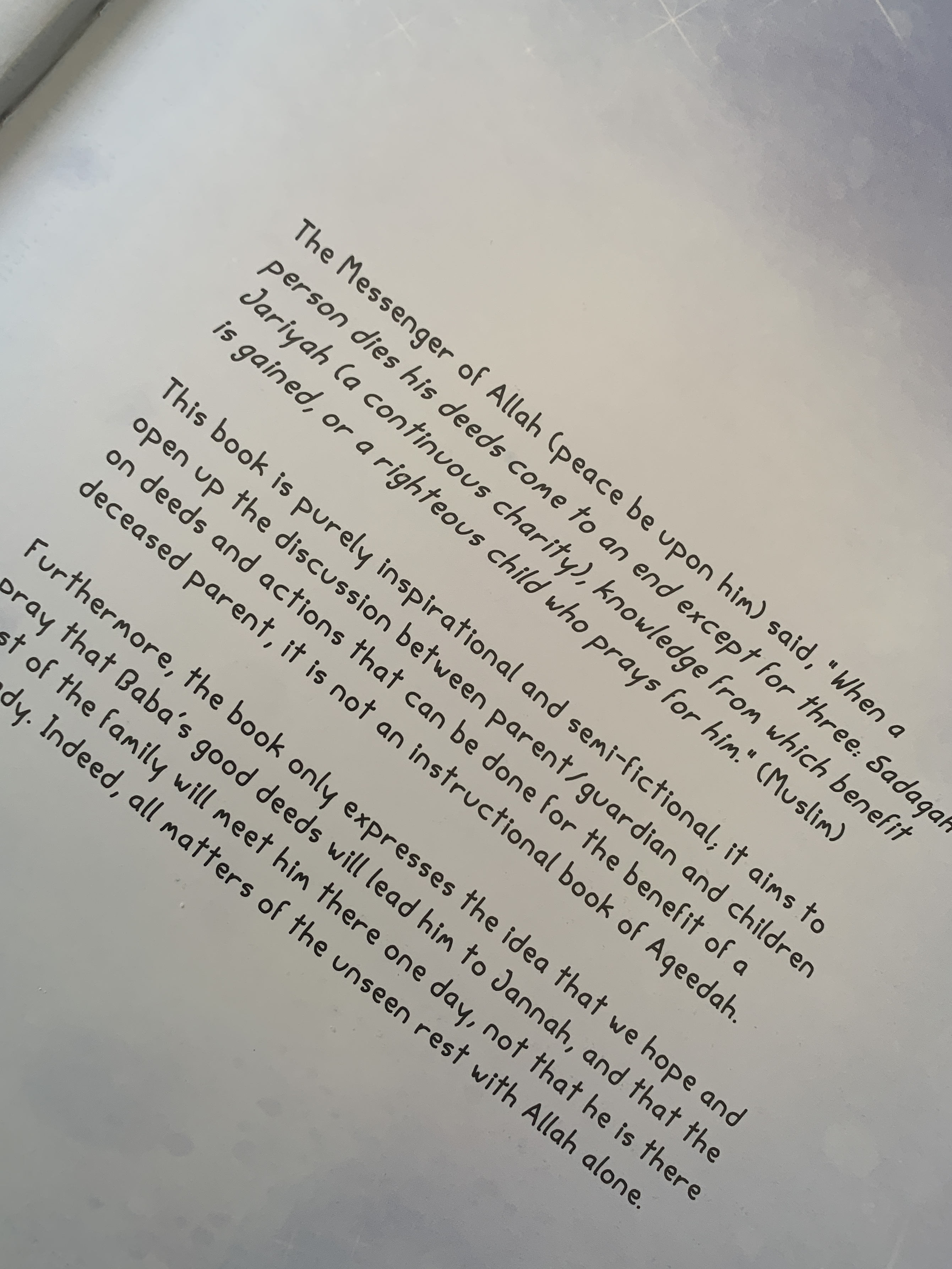
I wanted to love this Islamic centered children’s book about grief, but I found it a bit problematic and misleading.  I am by no means an expert in Islamic matters of death or in psychological bereavement, but the note at the beginning of the book- if I wasn’t already going to look at it critically- really raised some warning flags.  It says that the book is not an instructional book on Aqeedah, that even though the title and whole story is about a house being built that “the book only expresses the idea that we hope and pray that Baba’s good deeds will lead him to Jannah, that that the rest of the family will meet him there one day, not that he is there already.” So, before you even start the story, it seems that the disclaimer is making it clear that this book is not religiously accurate, and that it is just meant to soothe and provided hope.  After taking all that in to consideration, and reading the 26 pages of text over a dozen times, I think I finally pinpointed why the book further reads problematic for me.  It is the repeating phrase, “Your Baba has been building a beautiful house for you,”  because he hasn’t right? He has built a house for himself through his good deeds in this duniya, he benefited HIS parents by being a righteous Muslim.  The words “for you” completely take the book in my head from being a slight suspension of timing where the deceased are, in to be misleading.  So if the book is not accurately framed and only to be taken as something “to open the discussion,” what is the point? Why fill it with Islamic references and concepts, if they will then have to be clarified, corrected, and re taught?  Sigh, I’m happy to listen to those that want to change my mind, truly I am.

img_9013

The rhyming book starts out with a mom and two kids being consoled by the text that their Baba has been building a house for them with Allah’s help.  That it is amongst the flowers, made with Allah’s powers. That with every good deed he did, their Baba becomes a builder, that there are pure rivers and trees, and that the house is hidden through Allah’s gate.

img_9014

To find their Baba’s house they will walk with Prophets, and see ripe fruits, and smell sweet musk.  There will be rivers of milk and he will carry them above his head.  The illustrations on this page are a little off in my opinion the shadows of a person elevating and even the girl looks a little concerned.

img_9015

I like that the next spread addresses that only Allah knows when the day will come that we reunite. And then the next pages tell how the children can help decorate their Baba’s house by calling adhaan, reading Qur’an, being kind, giving charity, and making duas.

img_9016

The book concludes with encouraging patience and finding reassurance in knowing we belong to Allah and to Him we return.

With the exception of the one page, the illustrations are adequate and show a mixed racial family.  The rhyming lines are rather weak, and ultimately there are just better books out there about grief that don’t have to be so qualified for accuracy.

Must Love Pets: Friends Fur-Ever by Saadia Faruqi

Standard
Must Love Pets: Friends Fur-Ever by Saadia Faruqi

pets

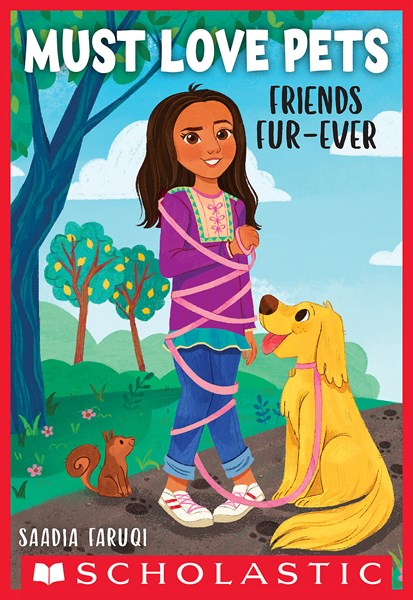
This 208 middle grade novel by a Muslim author features a desi family and the protagonist’s love of pets.  Iman Bashir is on summer break and is determined to convince her mom and grandfather that she is responsible enough for a pet dog.  The internal realization of selfishness, her ability to problem solve, be a good friend, and know the limits around her, keep the story from being whiny and annoying.  The writing is superb and the characters relatable.  I wish there was a bit more Pakistani culture, or some indication of the characters faith (there is one Salaam), not because all books need it, but rather because it almost seems that text goes out of its way to not contain it.  The story is clean and the first in a series that I think most kids will enjoy. The father in the story has passed away and at times Iman struggles with sharing her thoughts on him, I don’t think it would be triggering, it is subtle and adds depth to the story, but it is worth noting incase it hits too close to home.

SYNOPSIS:

Iman has been begging, or rather asking her mom for a dog at every chance she can get, but after 43 rejections she is thinking she needs a new plan.  When she meets the new neighbor, Olivia, who is the same age as her and her best friend London, an idea is hatched to start a pet sitting business.  Iman’s mom is always stressing how important it is to help others after all.  Opportunity strikes when Sir Teddy’s owner has to rush out of town, the girls offer their services to watch the beloved dog.  But how do you share caring for a dog at three different houses? How do you let your parents know what you have committed to? What do you do when your brother is allergic to dogs, or you have a cat that doesn’t like dogs, or your house is still in boxes? What do you do when your first customer goes missing?

WHY I LIKE IT:

I like the side stories the best: the grief of losing a parent, the Dada Jee and his lemons, the soccer team helping search for the missing dog.  The story itself is fine, albeit predictable on the surface.  Where it really shines is in the point of view of Iman.  I love that her internal dialogue knows that she is being selfish, that she is being a bad friend, but that she is still feeling these very real feelings adds depth to the book, character, and plot.

I like that the mom is a strong single mom, and I hope that as more books in the series are written we get to see some emotional unpacking and connection between her and Iman.  I do like that the meaning of Iman’s name is explained in Arabic, and desi foods are featured, but I couldn’t help but feel that the writing would set up for something more, and then abruptly pull back.  There really is no explanation about why Dada Jee doesn’t like dogs other than saying in Pakistan they aren’t allowed in the house.  So finish the though, face palm, they are not let in because religiously which has influenced culture- dogs are generally not brought inside, it is a bit of a contentious point.  I get because Muslims feel differently about dogs it was probably kept out, but she is a talented writer, she could have still acknowledged the hole in the rationale without committing to a side.  Sure in my Islamic School Librarian head, I would have loved the characters taking their shoes off when they enter the house, eating halal, and pausing to pray, but I accept that isn’t the story.  At times though it didn’t feel OWN voice, it felt very watered down on the cultural rep and it makes me wonder why it was really included at all.

FLAGS:

Clean.  Loss of a parent.

TOOLS FOR LEADING THE DISCUSSION:

This is a solid MG book and would be a great addition on a school or classroom library shelf.

The Katha Chest by Radhiah Chowdhury illustrated by Lavanya Naidu

Standard
The Katha Chest by Radhiah Chowdhury illustrated by Lavanya Naidu

katha

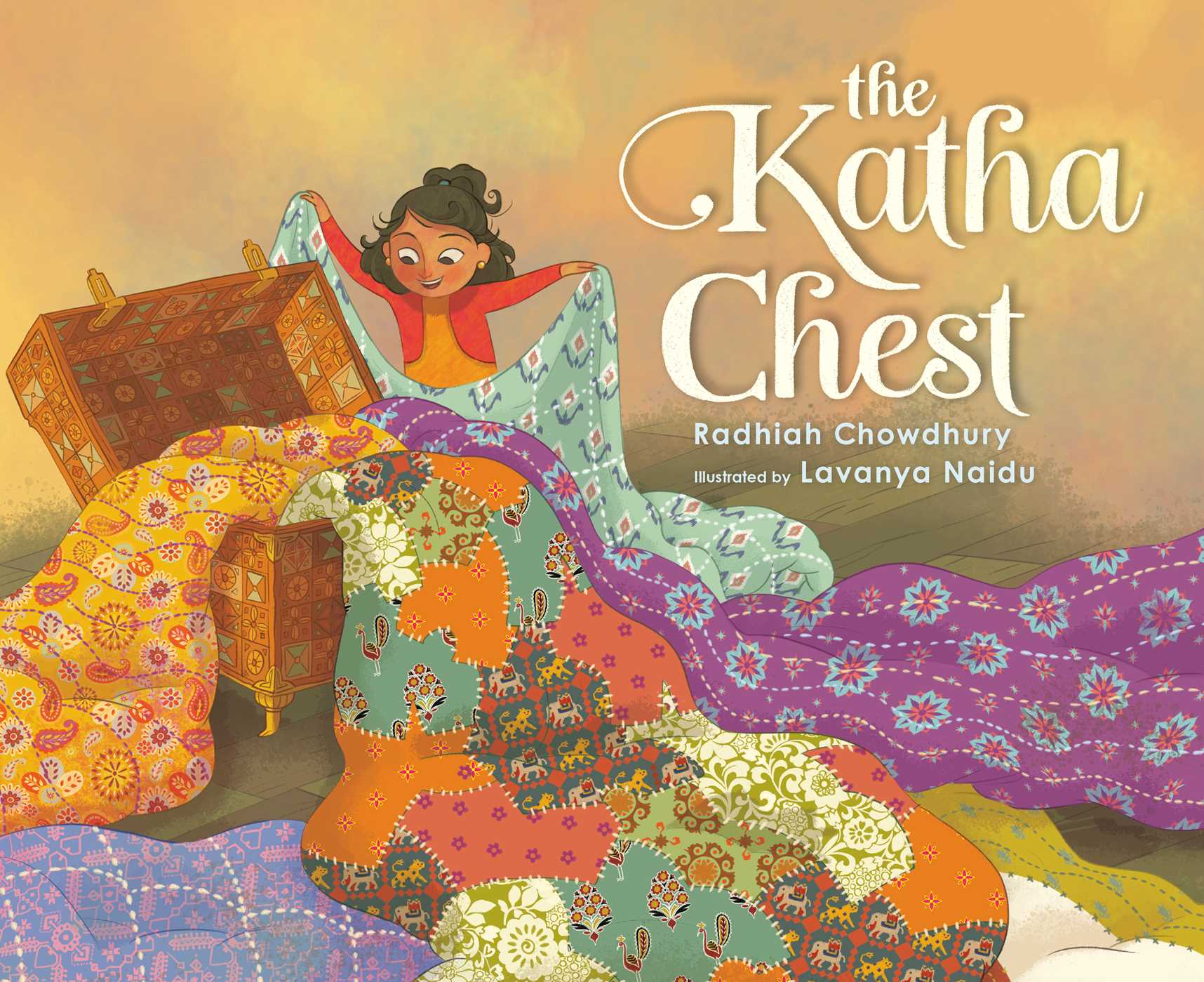
This 40 page picture book for preschoolers and up shows connection to family, memories, and Bangladeshi culture as a little girl explores the quilts made from her Maa and aunts’ worn out saris.  This book has been on my radar for a while and while there is nothing wrong with the slow and thoughtful story, it didn’t sweep me up in a hug and wow me, as I had hoped it would.  The illustrations are as critical as the words in conveying the message, and the illustrations are indeed beautiful, I guess I just needed more.  More connection to the emotion the little girl was feeling recalling the strong women in her life, more impact to the fact that her Nanu is no longer with them, and more understanding about the history of Bangladesh that seems to shape the memories.  I worry that most readers simply won’t get anything other than the surface level of the book, which is ok, the memories woven through generations manifesting in quilts, is tangible and perhaps enough.  I feel like, however, the framing of the story and the textless illustration pages attempted to add more layers to the story, and I think to anyone not Bangladeshi, those layers might not be understood.  I wish their was an afterward with notes about the pictured references, inclusion of such backmatter would really open the book up to a wider audience, and give the book discussion and staying power in my opinion.  If you are Bangladeshi this book will be a treasure I’m sure, and I’d love to hear your thoughts on it.

img_7721

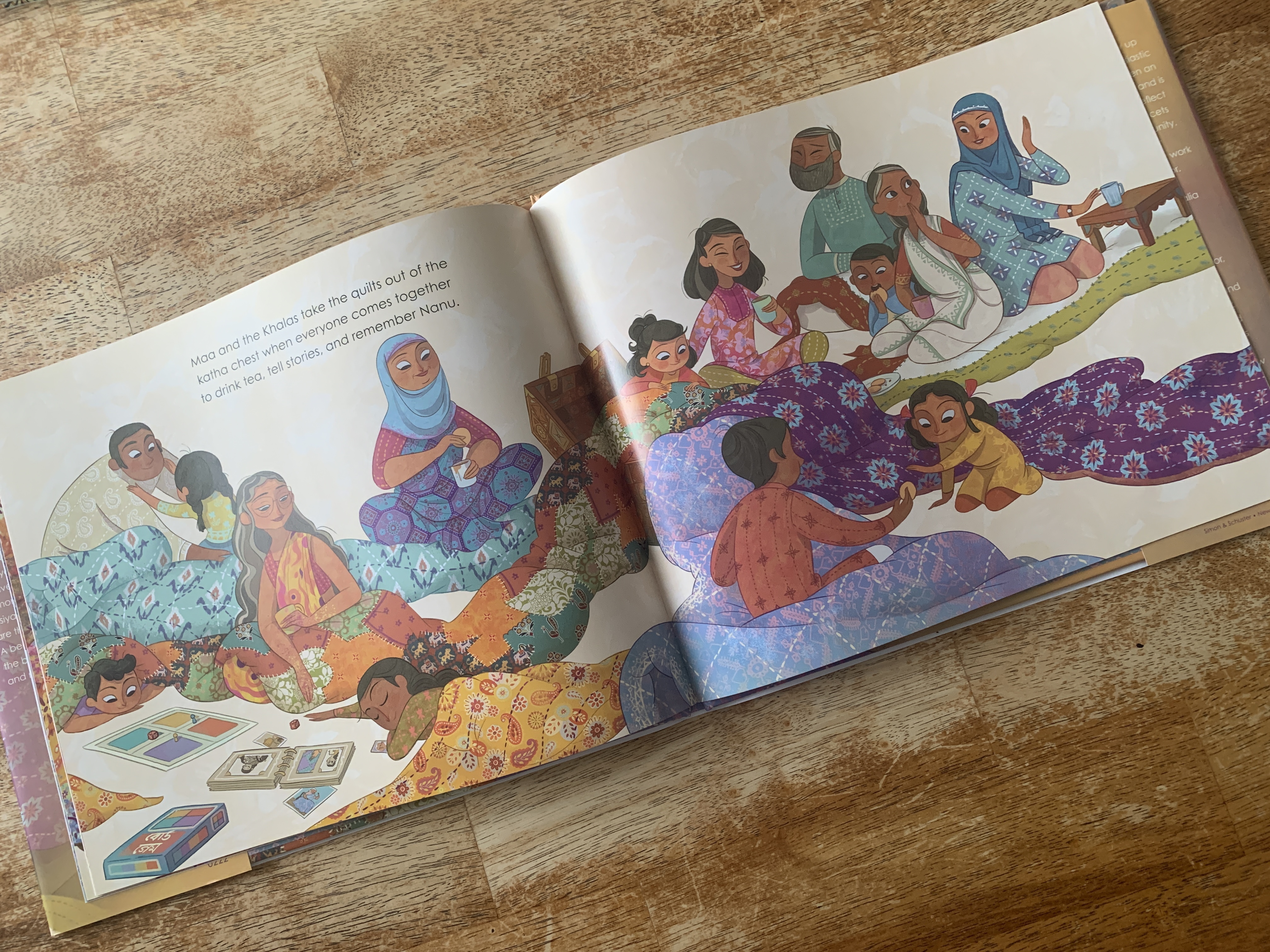
Asiya loves going to her Nanu’s house, there are treasures there.  Her favorite treasure is the katha chest.  An old trunk full of the quilts made from the old worn out saris of her Nanu, Maa, and khalas. She snuggles in their warmth and listens to the stories they tell. Stories of hardship, joy, skills learned, moves made, loss, death, love and family.

img_7720

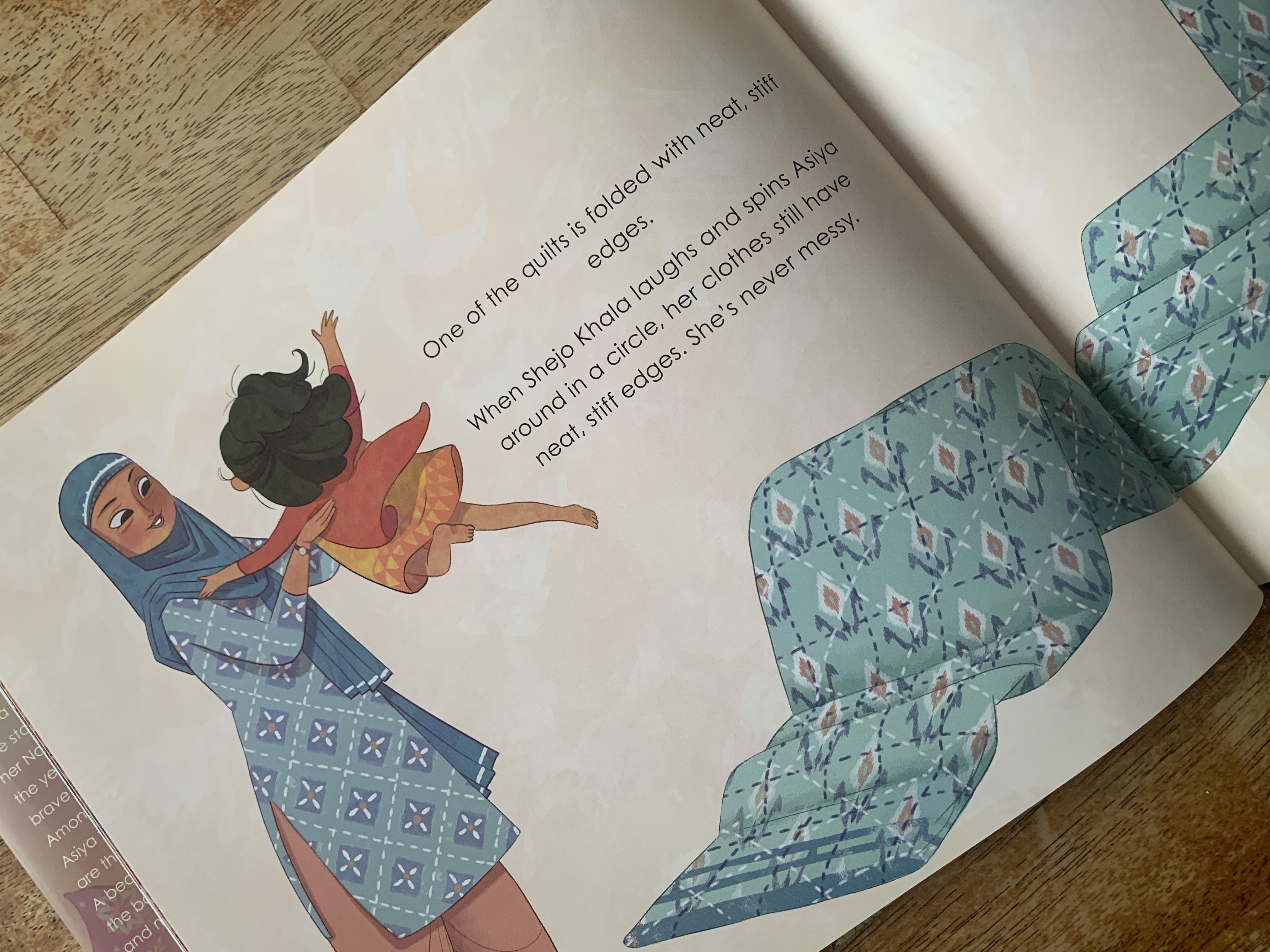
Boro Khala’s looks like Khalu’s medal, from a sad time when he was away.  Mejo Khala bright oranges and yellow like her fingers.  Shejo Khala’s is stiff and neat, she is never messy.  Choto Khala’s has a white streak like the white saris she wears since Khalu died.  Maa’s katha is patchworked and different than the others, and Nanu’s is paper thin and smells of tea, old books, porcelain and wood.

img_7718

There is an author’s note and illustrator’s note detailing the construction and value of kathas, but nothing about Bangladeshi wars, wearing white after a husband’s death, or the textile skills and artistry shown.  The book would read well with context or activities about family heirlooms, connections, and traditions.

img_7719


Moonlight Hope: A Muslim American Coming of Age Story by Nora Salam

Standard
Moonlight Hope: A Muslim American Coming of Age Story by Nora Salam

moonlight hope

This 354 page New Adult read is truly Islamic fiction, and as long as you know what you are getting in to, you probably will thoroughly enjoy it.  It is Islamic centered, it is preachy, it is idyllic, it counters many stereotypes about Muslims and various cultures, while simultaneously falling into other tropes that define the genre, it has mature framing that is not suitable for younger readers, but doesn’t detail anything that is super “haram.”  If you are looking for a potentially halal romance between YA and Adult ages with Islamic messaging this book is a solid choice.  If however, you will be annoyed by any of the aforementioned labels, this book will not hold your attention or beg to be finished.  It reminds me a lot of Umm Zakiyyah’s If I Should Speak and A Voice books where the story has its own twists and character arcs but it spends a lot of time preaching and setting itself up to tout an Islamic perspective, or concept as well.  I wanted to read two books in the “New Adult” category and see if I could spread my reviews to include them, and with this being the second,  I think I should resist the temptation, and stick to what my library background familiarized me with.

SYNOPSIS:

Told in alternating voices of Intisar and Majed, two individuals in New York City, at different places in their life, but finding that when they hit rock bottom, Islam is the answer.

Intisar is graduating nursing school when the story opens and has only one goal in mind, get married.  She has strict Sudanese parents and has put all of her dreams on finding freedom in the perfect spouse.  She meets a guy at a friend’s house and they secretly date, kiss, and hold hands.  When he ghosts her, she is devastated and reluctantly finds herself agreeing to marry a much older man of her parent’s choosing.  Loosing herself in the idea of marriage, she finds herself heartbroken, ostracized and falling apart.  She starts to put herself back together slowly by finding Islam, her confidence, and some much needed perspective.

Majed has a famous family: his mother a model, his father and siblings singers, and he manages their careers.  After passing out from drugs and alcohol more than once he really starts to examine his life and the road he is on.  He sneaks away to rehab and in the process stumbles on to Islam.  He is Egyptian, but the family is not religious at all, and infact stop talking to him when he converts.  The trials of being a Muslim in New York with no family are not easy, but he feels it is worth it and his journey to Hajj and through loss brings him closer to Allah (swt).

The two stories are parallel and collide slightly in the periphery, but the book ends with them finally coming together and the ever dreaded words of “to be continued,” leaving the reader hanging.

WHY I LIKE IT:

I do like that the story shows struggles when one comes (back) to Islam, it isn’t always a walk in the park, it has challenges and stresses.  The book starts each chapter with a verse from the Quran and is very open about what it is.  So, while at times, the preachiness did get to me, it was very clear what type of book it was from the beginning and I kept reading.

Some of the side characters I felt needed to be fleshed out a bit.  I didn’t understand many of the random friends, how they affected the main character often seemed off, or completely underdeveloped in what was revealed about them: particularly Izzedine, Parita, the girl that married Mansour, the uncle at the Masjid that thought Majed was a spy, etc..  I also really struggled with the presentation of Uncle Munir and his calling Majed, baby, and how he just happened to bump in to him outside the bar, and the kisses.  I’m guessing it was meant to show him as over the top affectionate, but it just read as odd.

I like that the book addresses hypocrisy, mental health, and expectations.  It doesn’t paint all Muslims as good or bad, nor society at large.  The book reads as a journey, and many characters are given a chance to correct their errors and be seen in a new light.

The majority of the book is written well, but right away the book gave me pause as Intisar and her friends chat all through the Jummah khutbah, I get that it is trying to show her disregard for intentional practice of her faith and her “boy crazy/marriage” obsession, but you cannot speak during the khutbah, it isn’t just dirty looks, you truly cannot talk for it to count, and it isn’t even remarked upon, and it made me skeptical of the book for a while.  There is a word missing from a sentence on page 161 and at one point a brother in the prayer hall aims a shoe to throw.  But you wouldn’t be wearing shoes in the room where you pray, and the mosque has hallways and a glassed off section for women, so this seemed like an obvious oversight that should be fixed.

FLAGS:

Drugs, alcohol, lying, overdose, sneaking out, kissing, hooking up, physical affection, violence, temptation, sexual predatory behavior, it is an adult book, so I’m not going to continue listing everything. Nothing haram is overtly detailed or glorified. Ages 17 and up, could handle it.

TOOLS FOR LEADING THE DISCUSSION:
Too mature for my book club crew, but I wouldn’t mind it on a shelf in the school library.

The Boy Who Met a Whale by Nizrana Farook

Standard
The Boy Who Met a Whale by Nizrana Farook

whale

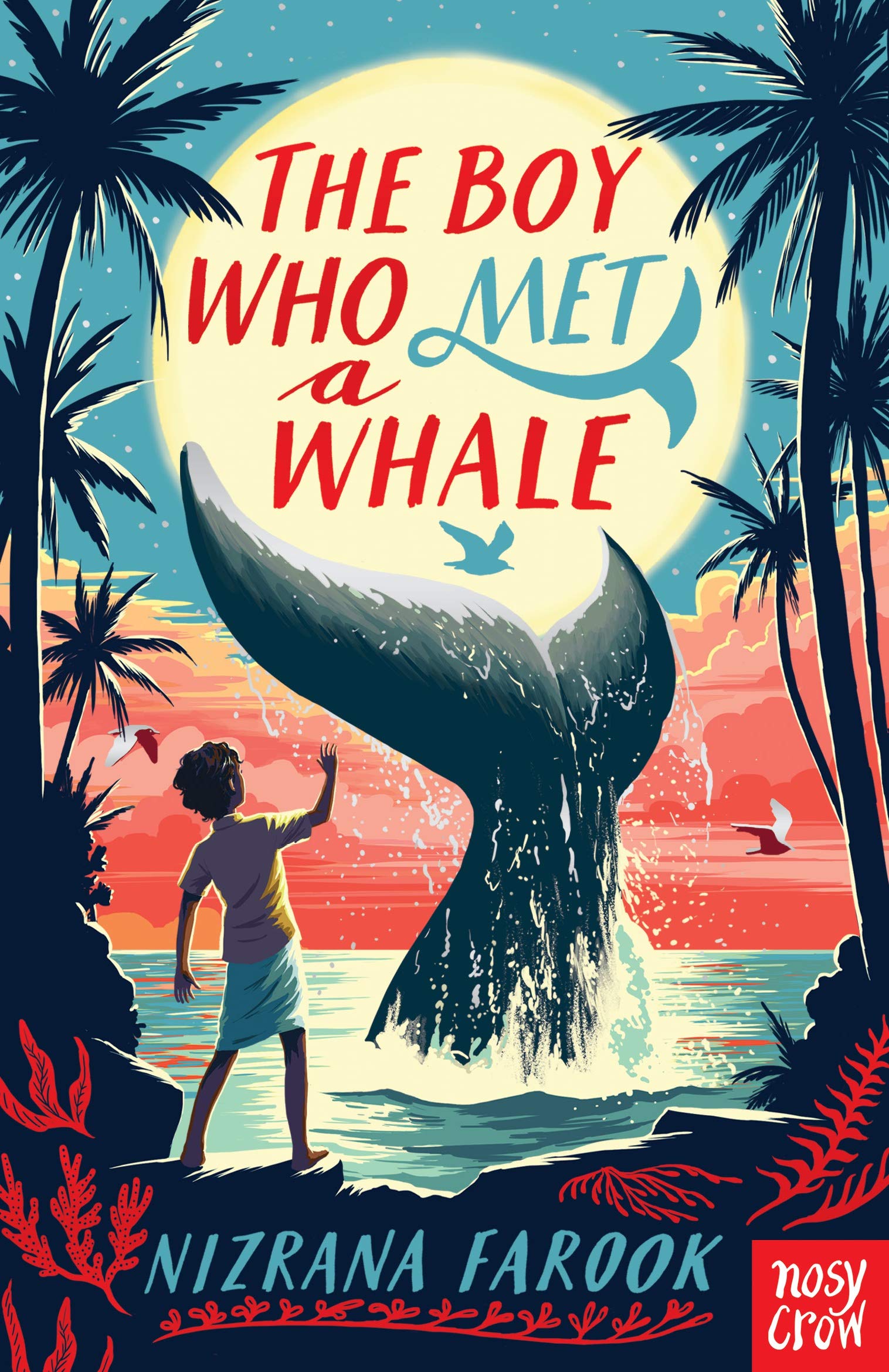
I have a vague memory of being told that this book features a Muslim family when I reviewed the author’s first book, but I can’t find the message, nor recall who sent it and to where.  The text does not suggest any religion by any of the characters, but that being said there are “Islamic” names present in this 195 page middle grades book by a Muslim author and set in Serendib, the old Arabic name for Sri Lanka.  The fast paced story pulls you in and sets three kids up for adventure, overcoming fears, outsmarting adults, and becoming heroes along the way.  I didn’t love this book as much as The Girl Who Stole an Elephant, but it probably isn’t fair to compare them.  The book was released last year in the UK and will release shortly here in the US, I don’t know that I would rush out to purchase it, but I would definitely put it on hold at the library.  It is an adventure filled read from a boy protagonist perspective, it starts with a mutiny, features treasure, plotting, close encounters with a whale, and bringing justice to murderers and thieves.

SYNOPSIS:

Zheng has never had much of a family, and when his Captain’s First Mate and the cook poison their merchant ship crew and leave them to die, Zheng escapes.  He washes up on the shore of Serendib, not far from Galle, and is found by local fisherboy Razi.  Razi is a fisherboy that doesn’t fish, or rather no longer fishes, not since his father was killed by the sea.  Razi just tries to help get Zheng some food and get him out of the sun, but when Marco and Cook question him about the whereabouts of Zheng, he protects the boy and gets himself involved.  Promising not to tell anyone about Zheng, he immediately tells his twin sister Shifa.  Shifa is the rational one int he group and doubts Zheng’s adventure stories.  Her quick thinking and clever sneakiness provides time-and-time again in the book, a chance for the three kids to rescue each other, find the treasure, and return it.  

WHY I LIKE IT:

I love that the book is so fast past and unapologetic.  The descriptions of the island, and the plants and sea life, really is impressive and insightful into a country and culture not often explored in children’s books.  My mommy heart did not like that the kids would just leave for days at a time, and they never even thought that she might be worried, spoiler, she was! 

I like how subtly the grief and loss of the father manifested in Razi.  How he had to reconcile his emotions and start to move forward.  It isn’t in your face, but I would imagine that any child who has gone through something similar, would be reassured by seeing a fictional character experiencing something similar.  It is reinforced by Zheng’s lack of family and his need to find a “home.”

I felt like a few plot holes were too quickly glossed over in the heat of action.  I don’t know that it is a result of carelessness, I think it was more to keep the story fast moving and appropriate for the target audience, but I could have used a little filling in of the gaps: the ease of pulling people in to boats, where Zheng was going at the end and how it was all figured out, how Cook and Marco found Zheng, how everyone in Galle immediately recognized the dagger, why the kids were never killed even though numerous people were drugged at the beginning without a second thought, what the praise was for the returning of the dagger, what the oxen cart owner’s response was to the damaged cart, etc..

I wish there would have been a prayer to Allah swt at some point, or a bismillah, or an Assalamualaikum. The sister’s name, Shifa, and the medicine man that she trains under, Abdul Cader, imply a tinge of Islam, but I would have liked a tiny bit more, the book sets itself for lots to be sprinkled in, the children nearly die multiple times, but it was never there.  

FLAGS:

Death, lying, sneaking, near death experiences, grief, loss, theft.

TOOLS FOR LEADING THE DISCUSSION:

This would be a fun elementary read-a-loud with the short chapters and fast paced action.

Click to access The-Girl-Who-Stole-an-Elephant-Comprehension-worksheet.pdf

I Lost Something Very Special by Husna Rahman illustrated by Anita Bagdi

Standard
I Lost Something Very Special by Husna Rahman illustrated by Anita Bagdi

Screen Shot 2021-11-04 at 11.08.02 AM

This beautifully illustrated 34 page story about the loss of a beloved grandfather is universal and heartfelt.  It is not an Islamic fiction book as there is no mention of the duniya or akhira or accepting Allah’s decree, the family however, is visibly Muslim and it shows women in hijab and the little girl narrator praying salat with her now deceased grandfather.  Similarly, there are no cultural words or references in the text, but the illustrations show Bangladeshi culture, writing, and warmth.  The author is a psychotherapist and counselor, and all readers, young children and up, will benefit from the tenderness and emotion-filled paperback book.

Screen Shot 2021-11-04 at 11.08.58 AM

A young girl starts the book stating that she has lost something.  She recalls other things she has lost, a scarf, a toy, her voice, a tooth, and how after a while the item was found or it came back and she was able to carry on.  Today, however, is not the same, she has lost her grandfather, and he isn’t coming back, and she doesn’t know if she can carry on.

Screen Shot 2021-11-04 at 11.09.36 AM

She goes to his house, and he isn’t there, and the heartbreak is palpable.  She knows in time she will forget the lost scarf and lost voice, but she doesn’t want to ever forget her grandfather.  She finds some pictures and recalls him teaching her to ride her bike, them praying together, and planting a garden, his stories, his smell, his laugh, his hugs.

Screen Shot 2021-11-04 at 11.10.21 AM

As she assembles the pictures in a scrapbook, she is filled with memories and warmth and his wisdom.  The book ends with her seemingly coming to accept her new reality and then the book asking the reader if they have felt loss, what memories they carry, and what they miss the most about those that are gone.

Screen Shot 2021-11-04 at 11.10.01 AM

The sparse text and amazingly expressive illustrations make the book a beautiful addition to help children cope with their own feelings, and to learn empathy for others going through their own trials of loss.

Screen Shot 2021-11-04 at 11.08.18 AM

House of Glass Hearts by Leila Siddiqui

Standard
House of Glass Hearts by Leila Siddiqui

glass hearts

This 278 page magical realism YA book featuring a Muslim family grabs your attention and heart in the prologue, unfortunately it quickly releases it, and until you get over a third of the way in to the story, it is a struggle to read.  Once you accept that half of the book, the storyline set in the present, is going to be terrible, you enjoy the historical narrative and appreciate that the short book with a quick pace spends more time in the subcontinent during partition, than it does with the painfully underdeveloped characters trying to make sense of past secrets and their present day manifestations.  The book doesn’t have any major flags in terms of religious representation, it is just ritual acts of praying and reading Quran, nothing detailed or explored, and relationship-wise there is nothing high school readers can’t handle (spoilers and more details can be read in the FLAGS section).  Despite being a first time author, she works as an editor, so one would really expect the climax to hit harder with clearer writing, the characters to be developed, the details written to serve a purpose, and the protagonist teen’s voice not to read overwhelmingly at the beginning as a five year old.  The overall story concept and historical fiction component are exciting, the development of the characters just really failed an otherwise engaging read. 

SYNOPSIS:

Maera’s brother Asad goes missing in 2011 from their grandfather’s home in Pakistan while they are visiting.  They search and cannot locate him or a body, the loss devastates Maera’s family.  Ten years later, her grandfather passes away, and the next morning a greenhouse appears in their backyard in America.  Not just any greenhouse, her grandfather’s greenhouse from Pakistan.  Maera thinks she is going crazy, her mother doesn’t acknowledge the structure, she doesn’t acknowledge much, not about the reality in front of them, not the night Asad disappeared, or the needs of her daughter. Maera’s aunt (mom’s twin) and cousin come from Pakistan to mourn the loss of the grandfather together, he passed in Pakistan, not sure why Maera and her mom didn’t go there, but I digress.  Cousins Jamal, aka Jimmy, and Maera are the only two that seems determined to figure it all out.  Their grandfather’s journal turns up and with Maera’s friend Sara and Rob, the neighbor and former best friend of Asad, the four of them set out to understand what is going on in the greenhouse.

The greenhouse seems to be alive, and entering it dependent on the whims of something within, a churail,  a shape shifting creature of myth that is more than a witch, a succubus that targets men.  A woman who died violently and was wronged by men, whose feet are turned backward, and who is neither alive or dead.  As the four work through the journal, venture in to the greenhouse, and confront those within, secrets will be unearthed, exposed, and finally dealt with.

The historical interwoven story is that of the grandfather during colonial British rule and partition.  As a young boy Haroon is searching for his father fighting in Burma and the adventures he has along the way. Shah Jehan’s father takes Haroon in at one point, and the girl with an emperor’s name sneaks him out to watch the village deal with the churail who are killing the men in their village.  The incident scars Haroon, but his affection for Shah Jehan and the role she will continue to have in his life is established. The understanding that the subcontinent is being carved up and starved by the colonizers in the name of freedom is made clear in the characters that Haroon encounters and the quickly maturing boy grows in to a young man as he starts to understand the world around him and the larger powers at play.  When the migration and violence between Hindus getting to India and Muslims going to Pakistan occurs, the pieces in the past and present come together to reveal the terrors that the greenhouse houses. 

WHY I LIKE IT:

I loved the commentary both in the text, and explicitly detailed in the afterward about how culturally the past is handled.  How little generations discuss what they have endured and been through.  I have been asked by my father-in-law a few times to try and coax my mother-in-law to detail her journey with their oldest son from India to Pakistan.  She has apparently never clearly told what happened, what she saw, and what they experienced.  She waves it off now, but her own children didn’t even know there was more to the story, and as my inlaws approach their 90s I have little hope of them recalling or sharing their stories.  Recently my son needed to hear some first person accounts of war, so he contacted my American grandfather to learn about his time in the Korean War, much of it I knew, Americans, generally speaking, talk about this type of experience in passing.  My son, also wanted to compare his story to someone who lived as a civilian through a war, and asked my mother-in-law, his Dadi, about her experience living through the Indo-Pakistan War of 1971, not that long ago, and we all sat spellbound as she recalled the sirens and how they kept the children fed and calm and whatnot.  They were stories no one had thought to ask it seemed.  She has seven children and almost thirty grandchildren.  This book struck such a chord with me, I need to actively seek out these stories before it is too late.   Chances are no one else in the family will. Not speaking the language fluently has cost me my chance to learn my own father’s family’s stories and I need to find a way to gather my husband’s family’s stories before it is too late. I love that in the book, The Past is capitalized as if it is a named living person shaping the lives of so many.  It is, and these stories are wonderful reminders and motivators to ask the elders to share their memories.

The present day story thread, however, is chalked full of holes, one dimensional characters, and pointless tangents.  Sara and Maera read like they are early elementary aged.  They are so terribly voiced in the beginning, I have no idea, how an editor author and mainstream publisher did not require correction.  The dialogue, the action, the role of the parents, it is terrible.  Speaking of terrible, the mother and aunt are absolutely flat and useless.  They mope, sleep and sit in the corner.  I don’t understand why you wouldn’t develop them to link the past story to the present one.  I’m not being picky here, it is that bad.  I also wanted to know why the dad left.  Seems like it would flesh out the mom a bit, justify her approach to life.  Sara and Rob are obviously brought in to serve as vessels for the action, and for Maera and possibly Jimmy to play off of.  But their backstories are so pathetic.  How do you not know or see your neighbor for ten years.  Ok, I get that he was Asad’s best friend and your family in their grief and denial pushed him away, but he never checked the mail or took out the trash, or was seen? And Sara offers absolutely nothing to the story other than to be part of the forced crush/romance line pairing off her and Jimmy and Rob and Maera.  Alhumdulillah, it stays tame with the angsty longing and hand holding.  

Random details that serve no purpose reach a pinnacle with the paragraph long time spent on Maera wearing Rob’s tank top.   I have no idea why we should care that she is wearing a tank top.  Sure as a Muslim reviewer it furthered the notion to me, that she is probably more culturally religious, and yes I know Muslim’s dress to different degrees of modesty, but I really couldn’t find any other reason for the emphasis on the black tank top. Overall, all the friendships in the story seem so off: Rob and Asad, and Sara and Maera.  They should be easy plot points, but they don’t connect, or read believable.  

Plot wise: if you had a building magically appear in your back yard along with a journal, would you not read that journal as fast as possible? Sure you would lose sleep and maybe skip a meal or two, but hello, a building just appeared in your back yard that is moving and growing, your grandfather died and your brother’s body was never found: stop what you are doing and read the journal.  It mentions that when Asad went missing there were a lot of other kids, cousins at the house, so where are they now? Why was there no mention of them, and only Jimmy seems to have a vested interest in the grandfather passing, and the growing need to remember Asad.  I did not understand the sacrifice and hair connection and how that was what Maera understand the Churail to be asking for.  I did not understand the end of chapter entitled “The Separation,” it says they entered together, so…. ya?Off and on in the greenhouse there are multiple churail, this seems inconsistent with what we learn from the one churail about leaving.  The whole climax needs a Cliff’s Notes synopsis.  I honestly have no idea what happened.  The churail was scared of the beast, but they all went off together, affectionately? I’m trying not spoil anything here.  Why was the churail so different at the beginning compared to the end, why did she get a growth arc, when the other characters didn’t? Shouldn’t there have been some cathartic reprieve verbalized between the mom and SPOILER (sorry I tried) Asad? I felt deprived.  

There were a few grammar errors, but because I read an ARC, I’m hoping they have been corrected

FLAGS:

There is a little bit of language (F word at least once).  Children are conceived, it isn’t explicit, but the fact that it happened is critical to the story.  There are crushes, angsty/longing, hand holding, hugging.  There is sexual assault implied as a major plot point, but not detailed.  There is death, and killing, often gruesome, some real, (hits harder), some far fetched.  The book is YA and  ok for high school readers and up in my opinion.

TOOLS FOR LEADING THE DISCUSSION:

I would be interested in seeing if some of the muddled passages are cleaned up in the published physical copy, the book’s characters are weak, but the historical fiction component is a story that needs to be shared more and more as we, collectively, seek to understand the past, the impact of colonization, and the emergence of telling our OWN voice stories.  For all the flaws, I haven’t completely written off the book, I’m hopeful that even if this one doesn’t make the cut for a book club, that inshaAllah the author will keep writing and filling in the blanks.