Tag Archives: humera malik

Saif’s Special Patches by Humera Malik illustrated by Ravan Sader

Standard
Saif’s Special Patches by Humera Malik illustrated by Ravan Sader

I really had no idea what this book was going to be about, and the first page or so seemed a little off with the child not knowing about the quilt he was wrapped up in, but. oh. my. heart! Every subsequent turn of the page was a hug from Saif’s patch made quilt straight to my cynical soul.  The infusion of Islam as such a part of his daily activities, his loving family and environment, and the reminder that labels can both hurt and inspire is beautifully done. The illustrations, the tone, and the messaging, is great for kids that have been called “just shy” and everyone who has ever doubted themselves (i.e. everyone) with it’s relatable emotions, and reminder that like a quilt, we are still growing.  I cannot wait for this book to be released and I can enjoy a physical copy to share in classrooms, libraries, and bedrooms. One of the best picture books I’ve read in a while, thank you.

The book starts with Ami asking Saif why he isn’t outside playing basketball with his friends.  He replies, that he “is shy.”  His mother shows him that the quilt is made of patches of Saif: experiences he has had. She shows him a patch and helps him recall the memory attached to it,  starting with last Eid when he was brave and went down the big slide. As he joins in the recollection, he then owns the label that he is brave.  It isn’t that easy though, he tries to be smart like his brother and read a lot, but reading is hard, his brother reminds him he is smart and points out the patch from when he won the scavenger hunt.  Swimming, helping at the masjid, reading Quran, calling the athan, all help Saif to realize he is more than just shy, more than one label, and that he is still growing.

I love the relatability of what Saif is going through, and even though so many of the settings and examples are Muslim centered, the book will resonate with all readers, of all ages.  A tear or more two may have stumbled out as I saw little me in the illustrations and the scenarios, and I have never been called shy. The book releases in March and is traditionally published, meaning plenty of time to pre-order a copy and request your library to shelve it, as it will be available wherever books are sold.

The Story of Hajj and Eid Al-Adha by Humera Malik illstrated by Basmah Syadza

Standard
The Story of Hajj and Eid Al-Adha by Humera Malik illstrated by Basmah Syadza

img_5367-1

This early chapter book discusses some of the key parts of Hajj and Eid al-Adha in a fictionalized manner.  A young girl, Sumayyah, spending the weekend with her grandparents finds an old photo album of their trip to Hajj, and bed time, walks to the park, and baking muffins, all provide great opportunities for grandma and grandpa to share their experience, the Islamic concepts, and the historical roots of this pillar of Islam.  The book is presented in a gentle way with concepts explained in broad terms, some related to experiences Sumayyah can relate to, and kept light and age appropriate.  The book is not particularly detailed, or even as informative as many picture books, but allows early independent readers to emerge themselves in the story, pick up on familiar and new facts, and hopefully gain a bit of an overview about Hajj and Eid al Adha.  Their isn’t a plot, it is characters and their dialogue providing a framing for the concepts to be shared.  The illustrations are sweet and make it accessible to the target audience, and while the author’s note acknowledges that further information can and should be sought from people of knowledge.  I really wish this book would have sources or a scholars approval, or where to go for more information.  Overall, a good book for our kids, and an easy read that they will benefit from, alhumdulillah.

The book starts with establishing the characters, the photo album, and the curiosity surrounding it all.  There are nine chapters in the book: The Photo Album, Prophet Ibrahim, Ihram, Tawaf, Sayy, Mina, Arafah, Muzdalifah, and The Ka’bah.  The titles really outline the book and what it covers.  The rituals are explained and the historical concept given and often linked to something Sumayyah and her grandparents are doing.  For example, Sumayyah is inspired by Hajarah’s bravery running between As-Safah and Al-Marwah and uses that to fuel her determination to tackle the zip line at the park.

I enjoyed the approach to the content, it doesn’t just list everything as steps or facts.  The history, the acts of hajj, blend together to make it read like a story, even with the predictable framing of teaching the character to teach the reader.  My 8 year old knows a lot of the facts and details, but could chat about them a bit more after reading this book, alhumdulillah.

The Great Henna Party by Humera Malik illustrated by Sonali Zohra

Standard
The Great Henna Party by Humera Malik illustrated by Sonali Zohra

img_3465-1

This 32 page story shares a desi family at a henna party before a wedding.  There is nothing Islamic in this book by a Muslim author, it is simply cultural.  The story on its own is fine.  It is sweet and joy filled, as a girl tries to decide who’s name to have hidden in her henna design.  I do wonder though, if the book is meant to be a window into desi culture, why the Urdu word “mehndi” isn’t used instead of henna.  It mentions it in the backmatter, that mehndi is the Urdu word, but it seems a little inauthentic and western gaze presenting throughout the story, and honestly I really struggled to get past it.

img_3466-1

The book starts with Noor entering the henna party, the night before her cousins wedding, to sing with the ladies of the family and have their hands painted.  Her mother asks her if she knows about the name game, where the bride hides the grooms name on her hands, and if he finds it, he wins, and if he does not, the bride wins. Noor asks if she can hide someone’s name and her mom says yes, just tell the artist.

img_3467-1

She watches her dad setting up decorations and wonders if she should have his name hidden.  She then sees her Mama playing the dholki and singing and wonders if she should hide her mother’s name.  She continues through various family members before making her decision.  Along the way the reader learns about the music, the food, the clothes, and how the paste dries and leaves a color.

img_3468-1

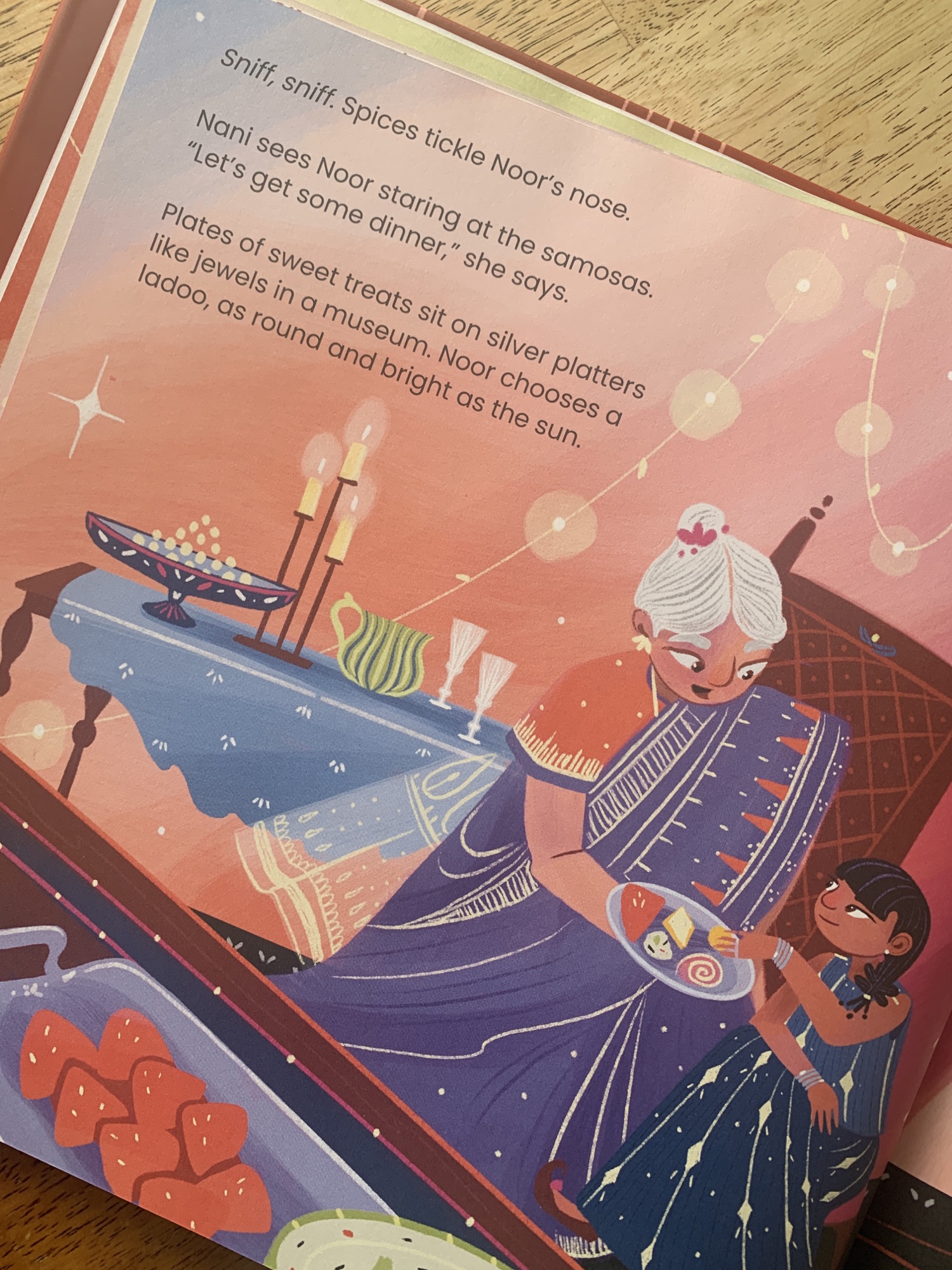
The page on food starts with spices, then talks of samosa and then they are eating ladoo, and while I’m glad there is not a glossary, I don’t know that the lacking context clues make any of those scrumptious foods known. I do like that her grandfather helped her pick out her lehenga, and her father is shown decorating to show full family involvement.

Ultimately, though I think the tricky thing about cultural weddings, is that every family has their own traditions, and while in a desi wedding some things might be widespread, when presenting them to readers outside your culture, it is hard to know how they will be perceived.  I almost feel like this book makes it seem that every family hides names in the mehndi as a staple of the festivities. And based on other reviews I’ve read, people seem to feel that this is insightful into the culture, or that hiding and finding names has more weight, a stress even, than just being fun.

img_3469-1

I could be over thinking it, but it feels like even the backmatter is trying to cast a wide net over every religion and culture that uses henna and ends up being oddly vague in this specific example.  Like I said the book is adequate, I like that the little protagonist Noor, loves so many people and solves her dilemma on her own, it has plot, and conflict and resolution, it just seems to lack the exciting tone and thus fails in immersing the reader into the henna party.

Allah and My Heart by Humera Malik illustrated by Basmah Syadza

Standard
Allah and My Heart by Humera Malik illustrated by Basmah Syadza

img_7583

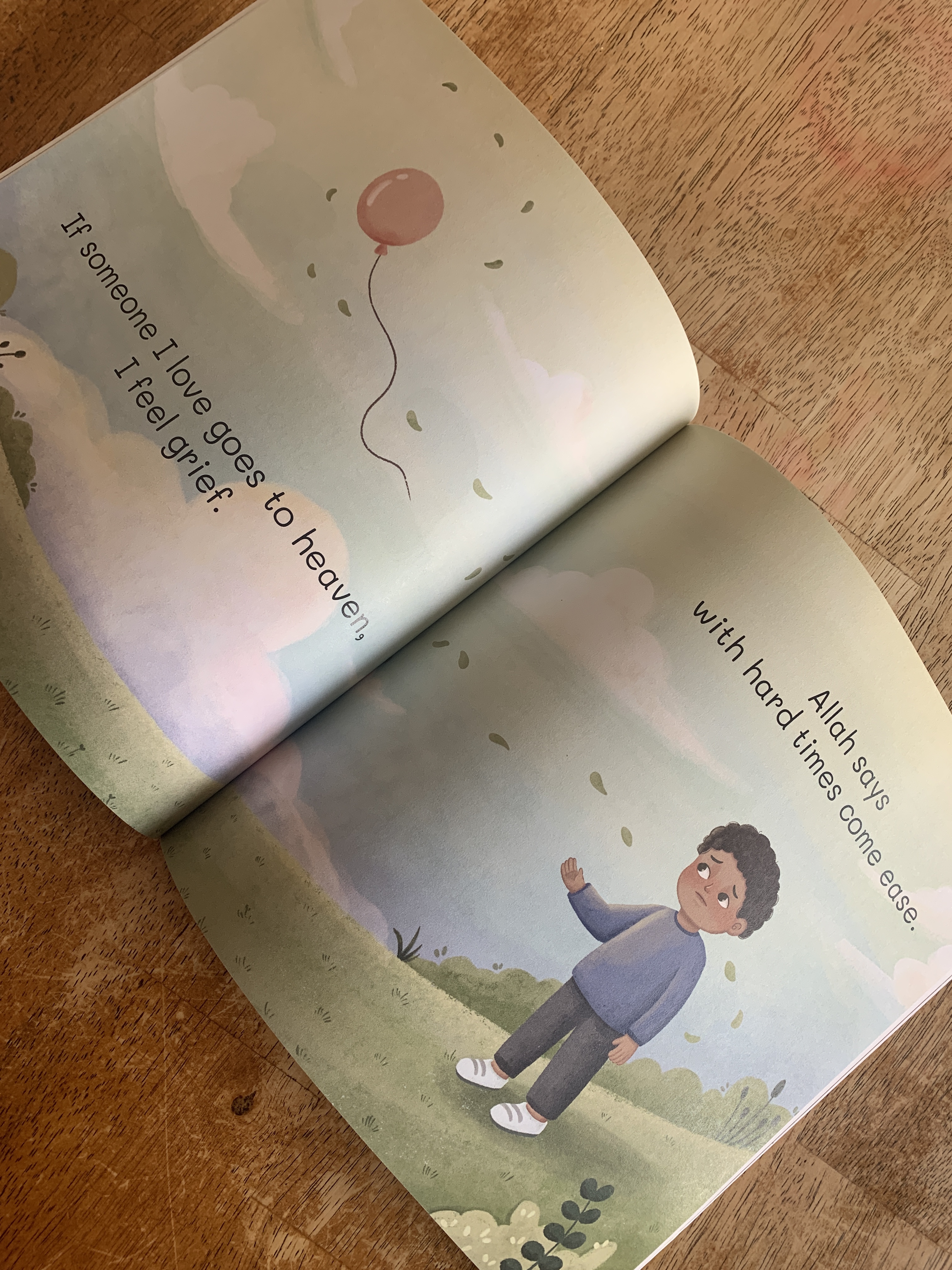
This 47 page book of feelings and reassurances shows Muslim kids that they are not alone and that Allah swt is always there for them providing love.  The book is not a story, and at times it might sit unopened on a shelf, but when it comes out as a needed tool, I think the resource it provides will be much appreciated, powerful, and useful.  The book offers scenarios with emotions: fear, excitement, anger, sadness, and then reassures the reader with Allah’s promises, and then with what we can do or say.  There are only a few words on each page, with a simple illustration that changes with each scenario and is reflective and inclusive to skin colors and abilities.  The book if rushed, will just seem like a list, it really needs to be discussed and shared with children in a way that leads to internalization, application to their own life, and appreciation that Allah swt is aware of everything.  The book is not sourced, but the sentiments are familiar.

img_7584

Here are a few samples of how the book is tied together: “When it is dark outside, I feel scared, Allah says don’t be scared I am with you.  I can say ‘Allah is my protector,’ and read the last three surahs of the Quran.” This plays out over four pages. “When I have too much to do, I feel overwhelmed.  Allah says He does not give me more than I can handle.  I can say ‘Allah I am overcome, help me’ and I can do dhikr to calm my body.

img_7586

I like that the book is well done for what it is.  The repetitive format and Islamic centering make it is a useful tool and the guidance gentle on a child’s level.  If nothing else knowing that what you are feeling is normal and common and accounted for in our deen is a tremendous reassurance in feeling big emotions.  The reasonable price and the Islamic centering makes me hope this book is shared and shelved in places that little Muslims will have access to with adults to help facilitate the messaging.

img_7588

The book can be purchased here from Amazon or from Crescent Moon Store here if you use my initial ISL (Islamic School Librarian) at checkout you will save 10%.

img_7587

Salaam: Mindfulness for Muslims by Humera Malik illustrated by Najwa Awatiff

Standard
Salaam: Mindfulness for Muslims by Humera Malik illustrated by Najwa Awatiff

img_3300

I had planned to wait until the physical book comes out on the 15th to offer up my thoughts, but the Kindle version has released and I want to help put it on everyone’s radar.  My own kids went back to school today and emotions and feelings are all over the place: excitement, nerves, anxiety, worry.  Changes in general cause heightened feelings, throw in Covid cases on the rise, puberty, friends, more open discussions about mental health, etc., and kids need tools to be successful.  Alhumdulillah, the Qur’an and Sunnah offer guidance, reassurance, and direction, and this book helps organize and present coping tools for ages seven to adult.  Thirteen emotions over 85 pages follow a pattern of a title page, a “Remember” page with an ayat from the Qur’an (except in one case it is a hadith), then an affirmation to be said that is either a verse, a dua, or dhikr, followed by an adorably illustrated spread of simple activities to do and try in a checklist manner.  Not only will young Muslims find reassurance and direction in the text provided, but inshaAllah, they will also be comforted knowing that what they are experiencing is very human and that Allah swt and Prophet Muhammad saw have provided insight and acknowledgement of such emotions.

The 13 emotions highlighted are: afraid, angry, disappointed, grief, jealous, lonely, overwhelmed, sad, shy, sorry, upset worried, grateful.  There is an author note to parents at the beginning that mentions that the book is meant to be read “cover to cover in peaceful times and to be dipped into to find specific advice” when needed, and I couldn’t agree more.  There is also a note for the readers normalizing big emotions and reassuring them that Allah swt does not want them to despair.

The diverse character illustrations are absolutely heartwarming and I hope that they will be made in to pictures or charts to be purchased so they can be hung.  They are really well done, and the visual mapping will help kids retain and put the tips in to practice.  I’m not sure what the sizing will be in the physical paper back book, but I hope it is large enough for them to be properly enjoyed.


Be Sure to Pray, Zain! By Humera Malik illustrated by Gonmuki

Standard
Be Sure to Pray, Zain! By Humera Malik illustrated by Gonmuki

1636FC1C-82AA-48FD-9904-10616FD9CB55

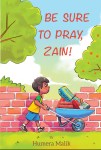
A very relatable 31 page early elementary chapter book about not only establishing salat, but doing it for the right reasons.  The book is not preachy or reprimanding, and even with a moral purpose, Zain manages to connect with readers and be funny and likable along the way.  Told from the view of the young narrator, realization is achieved, confessions made, understanding gained, and inshaAllah regular prayer established.  A great book to share with your own children when salat integrity is in question, and a great reminder of the power of salat that kids will enjoy reading even when it is not, alhumdulillah.
3FE2BB19-9372-4292-A0AE-B091D66B8F1D

SYNOPSIS:

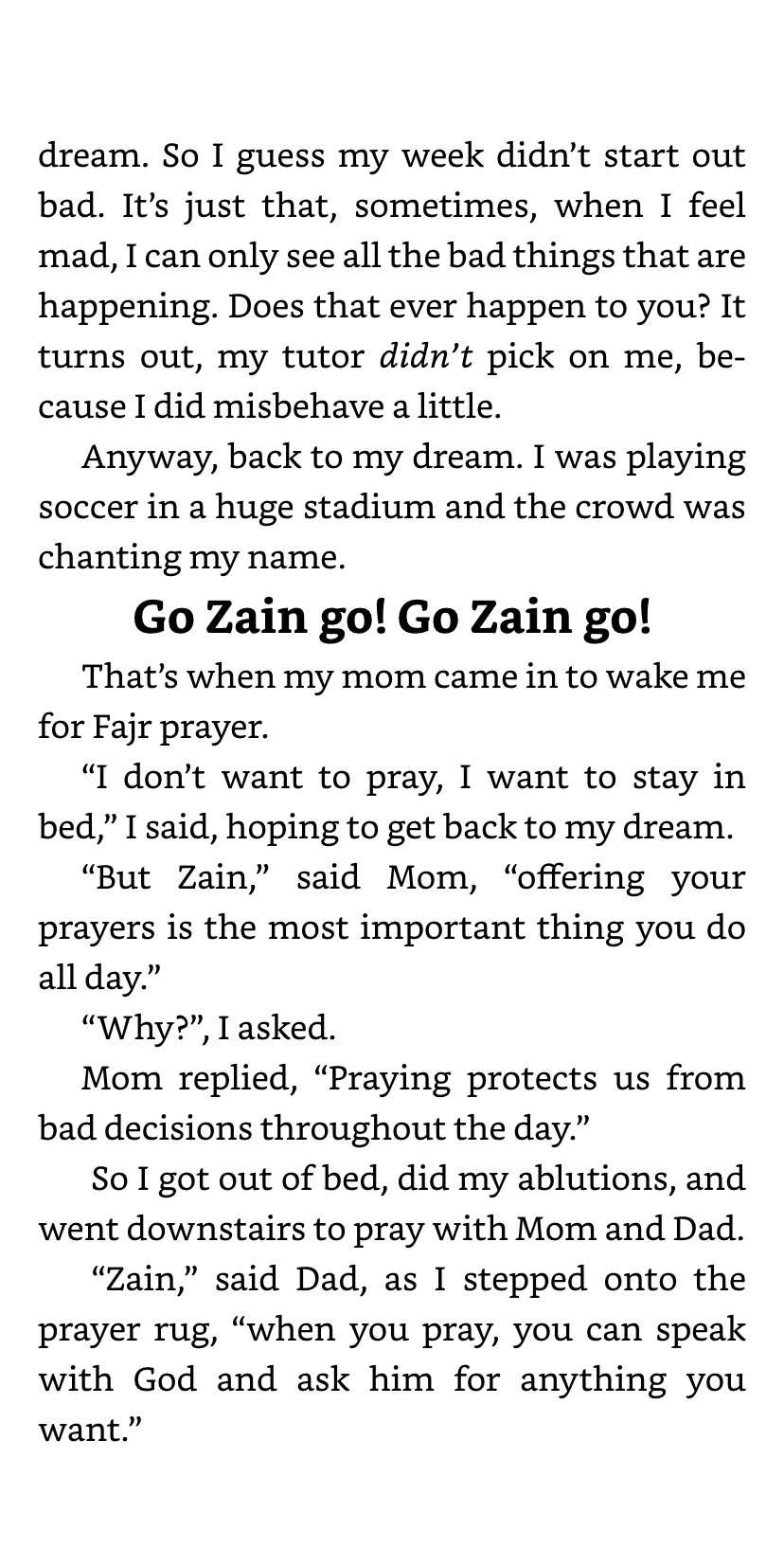
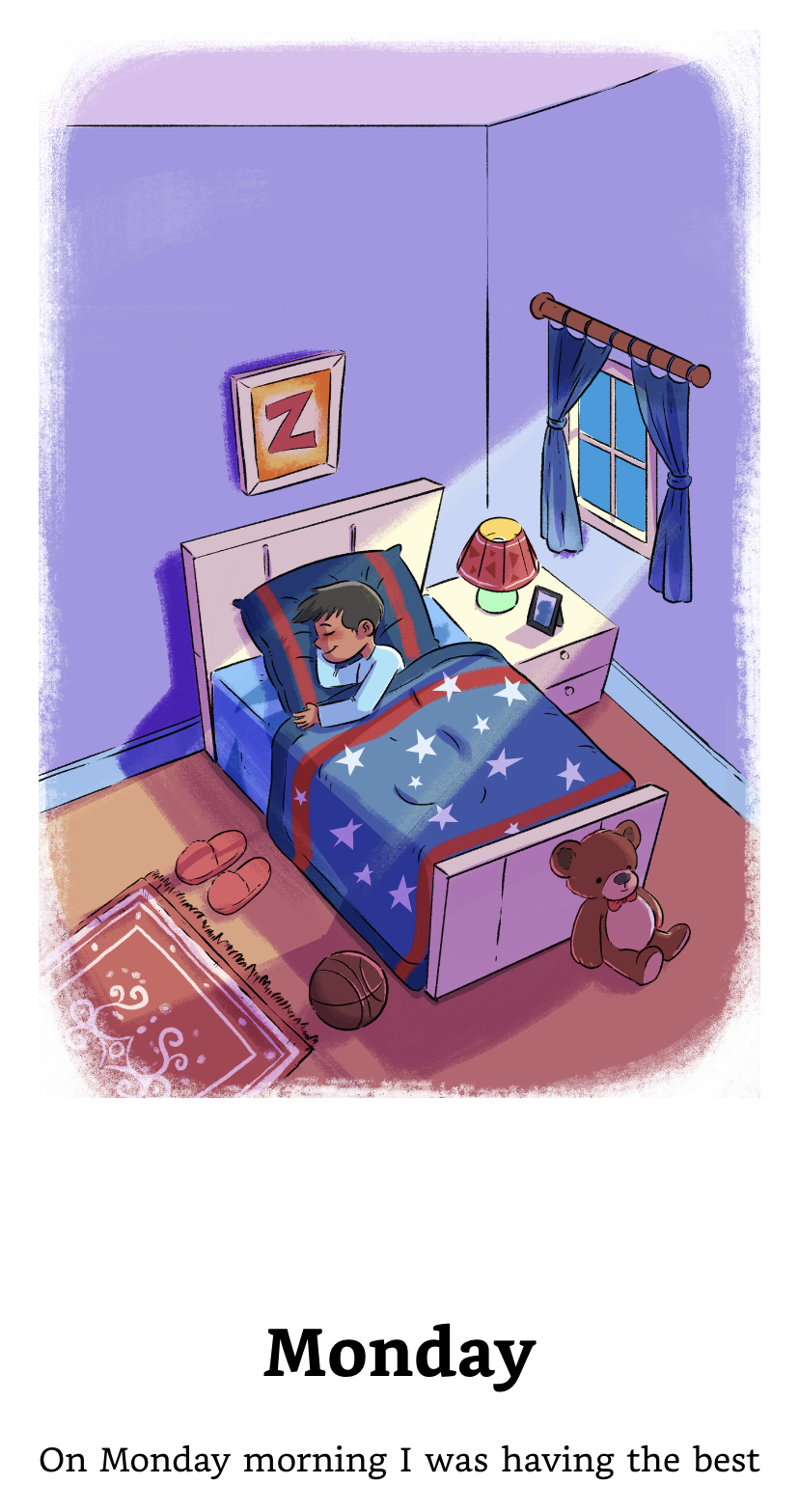
Zain starts off by introducing himself as a kid who lives with his parents and is having an  awful week.  He rewinds and begins with recapping Monday.  Right away he acknowledges that Monday actually started out ok as he was having an awesome dream, but that sometimes when he is mad he only sees and remembers the bad things.  Because of his awesome dream he didn’t want wake up and pray Fajr, but his parents reminded him that when you pray you can ask anything you want from God and that praying protects us from bad decisions.  He drags himself up to pray and asks God to help him on his spelling test.  Later that day he took his test, said Bismillah, and aced it.  So he concludes that maybe Monday wasn’t so bad, and Tuesday wasn’t either.

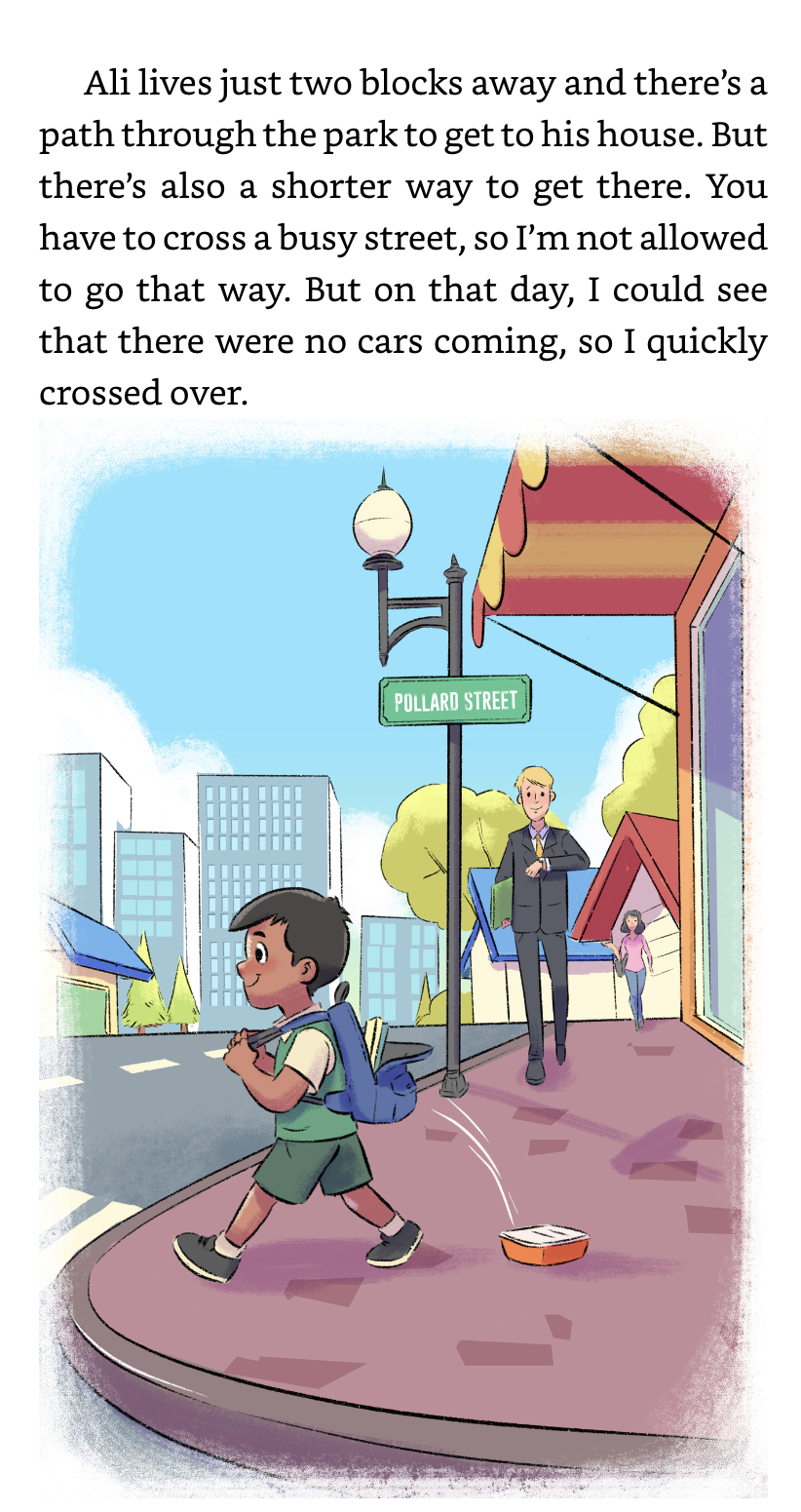
On Tuesday, Zain sticks up for his neighbor Joey who is being picked on by some older bullies.  Later that night Joey’s parents come over to thank him and take him out for ice cream in appreciation.  Wednesday, starts out great at school, and after school he gets to bake blueberry muffins with his mom.  When the muffins are done he was suppose to pray Asr and then take the muffins to his friend Ali’s house.  His mom reminds him to take the safe way and not cross the busy street.  But, Zain forgot to pray Asr and sees no cars coming and chooses to take the short cut across the road.  When he gets to Ali’s house his backpack is open and the muffins are missing.

The rest of the week continues with highs and lows.  Many of the lows coming when he doesn’t pray.  At one point a friend comes to tell him to come to the park to play soccer, and he knows his mom is going to ask him to wait a so they can pray together, so he pretends not to hear and rushes out the door.  Another day he chooses to not miss the end of a show he is watching to pray and heads off to tutoring without praying at all.

When the book rejoins Zain in the present he is feeling bad about kicking a friend playing soccer, cheating on a math test, and not getting to taste his muffins.  He unloads everything that has happened over the week, and his parents calmly and patiently ask him if he has been praying.  When Zain realizes he has been neglectful his mom likens prayer to bricks in a wall that help keep bad things out.  His parents tell him that when we miss our prayers, we end up with holes in our wall and bad ideas can sneak in.  Resolved to stay strong, Zain wakes up the next morning to pray Fajr and have a good day, inshaAllah.
31F4B3A3-12AE-493B-80DA-E93FC0F75AEB

WHY I LIKE IT:

I love that it stays with a young kids perspective and doesn’t get weighed down with hadith and ayats and lectures.  The parents let him learn from his mistakes and he comes to his own realization, not through their reprimanding or catching him in his deceitfulness.  The book is a great way to remind kids that it is their responsibility to pray and that Allah swt knows everything, so that connection has to be made between the person and their creator, it isn’t something you do only when someone is watching or telling you to do it.  I do wish that when he did resolve to pray that there would have been a bit of an outpouring to Allah.  I love that he had tears in his eyes when he told his parents everything, but I think it would have been really powerful to see Zain ask Allah to forgive him and to help him keep his wall strong.

The book reads smoothly, and the illustrations are well done and inviting.  Early chapter book readers will enjoy the font and format and knowing where the story is going with the days of the week chapters.  On one occasion I wish the word “wudu” would have been used instead of ablution, and I’m not sure what Zain has against carrots, but nothing too major will keep kids from enjoying the story and understanding it.

4AE0291F-2915-4F34-BA1C-D625DC0B97D6

FLAGS:

none.

EA28C866-45A0-47D6-B446-AF196504321E

TOOLS FOR LEADING THE DISCUSSION:

This book is for children learning to pray and realizing how important salat is.  So while it won’t work for a book club, I really hope teachers in Islamic Schools and Sunday Schools will read the book aloud or assign it to their students.  It is a great teaching tool, a great reminder, and a fun story too.


The Story of the Holy Prophet Muhammad (peace and blessings of Allah be on him): Ramadan Classics: 30 Stories for 30 Nights by Humera Malik

Standard
The Story of the Holy Prophet Muhammad (peace and blessings of Allah be on him): Ramadan Classics: 30 Stories for 30 Nights by Humera Malik

the story of prophet muhammad

I debated posting about this book for so long that Ramadan is more than half over.  But as a reference for years to come, I thought I should go ahead and throw my late support toward this Ramadan tradition and a book deserving of space on your shelf for children 4th grade and up.  I’ve seen people praising it for a few years, and finally I ordered it this year, however, I wanted to not only read it, but also test it out first: reading a story a day, discussing and asking the correlating questions with my own children, before reporting back.  I cannot and thus won’t comment on the accuracy of authenticity of the book, nothing stood out as erroneous to me and there is a bibliography at the back, but there is a reason I try and steer clear of non fiction, I’m just not qualified to comment.
SYNOPSIS:

The book starts with the birth of Prophet Muhammad (saw) and ends with the selection of Abu Bakr (ra) as the first Khalifah.  Each chapter is between one-and-a-half to two-and-a-half pages and the 30 chapters plus one Eid day chapter (so a total of 31), covers 103 pages in all.  There are a few pictures of where the Battle of Badr took place, the Cave of Hira, not many.  There are three questions at the back of the book for each of the chapters, but no answers.  The book is pretty linear, just the second chapter bounces back to Prophet Abraham (as) and Hagar and the story of Zamzam and then the rebuilding of the Ka’bah.  It is a glorified timeline, which in this case is a good thing.  It doesn’t go off on tangents or provide a ton of outside references, it is concise and general, but hits the key parts: marriage to Khadijah, first revelation, migration to Abyssinia, Taif, Hijrah, treatment of slaves, year of sorrow, Battle of Badr, Battle of Uhud, Treaty of Hudaibiyah, it talks of tensions with various tribes, coming to an agreement about the Khalifah, and more.

I think younger children might possibly be able to have the short chapters read to them and then explained, but really, it would be a lot to process.  The words are simplified and the gist of situations are conveyed, but topics aren’t necessarily shied away from.  It discusses that Prophet Muhammad (saw) had more than one wife, and that there were slaves, and there were tensions with the Jews, and Bilal was tortured, all things that picture books might skip over.

WHY I LIKE IT:

I like that even my young teen could read and involve herself without feeling like the exercise was childish.  Many of the answers are open ended in nature and require more than just a one word answer.  It allows for children to add other facts that they know about RasulAllah to the dialogue and make connections to our history with our current life very easily.  Even children that know the story of Prophet Muhammad (saw) will find the book engaging and smooth enough to read through again (and hopefully again each Ramadan) and learn new tidbits, understand concepts more clearly and be reminded about the beauty of our Prophet.

FLAGS:

Nothing

TOOLS FOR LEADING THE DISCUSSION:

If I was a teacher, I would definitely start each morning reading a chapter and doing the Q and A, whether it was Ramadan or not.  I think we need to be more connected to our Prophet and grow our love and appreciation for him, so books like this are such a great tool in accomplishing that goal.