Tag Archives: hope

Your Friend From Palestine by Nabila Adani

Standard
Your Friend From Palestine by Nabila Adani

This book is absolutely gorgeous, from the raised text on the cover, the sweeping illustrations with tangible details, the Islamic threads, and the heart, but…yeah you knew something critical was coming, the rhyme is not consistent, and the biggest hurdle for me, is that there is no backmatter.  I can’t say that I’m “bringing this up again,” because I don’t know that the debate ever dies down: can you write a book about something personal that you have not lived through? In this case can a non Palestinian write a book from a Palestinian perspective? As a former journalist and long time reader, I still maintain that you can, but backmatter detailing your own limitations, what efforts were made to have the book verified by those with OWN voice experience, and background information on why this is pertinent and relevant are mandatory. And this book does not offer them.  Nothing feels off about the contents, and anyone with a heart, has seen and felt everything on the pages about our brothers and sisters living under occupation and through genocide. So is it a good book, yes. Do I think it has value, yes. But, is it authentic? Is it accurate? Is it enough? Does the focus on hardship and destruction open eyes or diminish Palestinian joy? Why wasn’t a Palestinian brought in to cowrite the book with the author illustrator? Was it sensitivity read? I am not able to answer these questions, I simply bring up my concerns for you to decide for you and your children. While the book ends on hope for a free Palestine, and a safe Gaza, the oppressor is unnamed.

The book starts with children on a beach playing when they find a message in a bottle.  The message is from Khalid, a child in Gaza telling the finder about his life and asking about theirs. He likes to play football, but sometimes it isn’t safe, he likes to read stories but often can’t because there are no lights, and he dreams of swimming in a swimming pool, because they often don’t even have water to drink.

Khalid then tells the finders of the bottle, and thus the readers, to not lose hope, “to hold on to your imaan.” And it highlights what we can all do to help.  “You can pray for us! Send charity! Spread the news!” and tell people about Palestine. So that one day we can meet at the Dome of the Rock, pray at Masjid Al-Aqsa, and be together in a free Palestine, inshaAllah.

The illustrations are beautiful and the framing effective in connecting with readers, and highlighting the similarities before revealing the obstacles. Again why I wish there was backmatter, so that it didn’t feel simplistic, but rather bringing it down to a younger audience level.  With dialogue, explanation, and context, the book can be powerful, but on its own, I feel the lacking authenticity, transparency, and details about Palestine, make the book in need of an update before future reprintings.

The City of Jasmine by Nadine Presley illustrated by Heather Brockman Lee

Standard
The City of Jasmine by Nadine Presley illustrated by Heather Brockman Lee

With a release date of May 6, I really wanted to wait to post a review because the images are gorgeous in the electronic version, and I can only imagine how moving and captive they will be presented in a physical format, but alas I know the importance of presales and am sharing to hopefully encourage you to preorder and/or request from your library, this gorgeous 40 page OWN voice book.  A love letter to Damascus, and the sights, sounds, smells, taste, and feelings that the author remembers despite the mountains and oceans that now separate her, are lyrically shared with readers on a journey through the city. The ethereal lilting of words draw readers of all backgrounds in, and the complimentary gorgeous illustrations convey a palpable sense of beauty, love, and memories of home.  Even on a screen, they force you to get lost in their beauty. The cadence of the words allow natural pauses that tug on your eyes and draw them toward something in the images not seen before, forcing the readers and listeners alike to hesitate before turning the page.

The book starts with a little girl telling where she comes from, “the City of Jasmine,” “the Umayyad Mosque,” “Ghouta,” “Damascus,” “Qasioun,” “Qala’at Dimashq,” headers for spreads rich with poetry, wonder, and longing.

Neighborhoods of diverse families gathering, and sharing the foods that bring people together, and quiet bookshops that facilitate travel through time. Family memories built around orchards and fountains and laughter and love.  So far away from the author now, the memories are not lost, they can be touched when the scent of jasmine is “breathed in, and breathed out.”

The book concludes with an author’s note and a glossary.  Those of us who are not Syrian, and who have never been, after spending time with this book will undoubtedly be tempted to add Damascus to our bucket list of travel plans, and inshaAllah as the country rebuilds such trips will come to fruition.

Everything Grows in Jiddo’s Garden by Jenan A. Matari illustrated by Aya Ghanameh

Standard
Everything Grows in Jiddo’s Garden by Jenan A. Matari illustrated by Aya Ghanameh

This sweetly illustrated 32 page rhyming book starts off introducing a little girl living in one place, and having a home in Palestine that she has never been to, but loves.  The book then becomes pretty universal with her and her grandfather talking about what grows, his “green thumb superpowers,” and the magic of planting small trees that change and produce. The pages then add in more Arabic words of what is grown, and then when Jiddo is drying his eyes recounting why he had to flee his home and his roots, I too, found I was emotionally invested in light of everything current and past, and the simple words weaving a heartfelt story of family, connection, and home. I do wish that there was some Islam in the text or illustrations: a dua, a plea to Allah swt, a hijab on a main character not just on background memories, but there is not. There is also nothing overtly political or named in the text. The backmatter does discuss the Nakba without naming names and highlights the author’s inspiration, but inshaAllah nothing that will get the book banned or kept off shelves. The rhyme and cadence are pretty good, it doesn’t feel overly forced, but when reading aloud in a group, as always, I suggest practicing a few times to make the flow consistent.

The book starts with a beautiful spread of a mother and daughter looking through a photo album, and imaging going to Palestine one day, the subsequent pages show how Jiddo’s garden helps bring Palestine to them. The “sour green janarek plums,” “crunchy green khiyar,” and “plump red bandora.” Mama makes warak enab and Teta sings for more.

One day the little girl wonders how her Jiddo learned to grow everything and he shares that he learned from his father how to care for the land.  She then wants to know why they left Palestine, and he says, “our land was taken from us…and our family had to flee.” The hope is to return, the illustrations show the key to their occupied home being held on to, and reinforces the symbolism that Palestinians are like seeds that will flourish wherever they are, reaching toward the light.

The book contains a glossary with words written in English and in Arabic script, and an author’s note in the backmatter with presumably personal photographs of the author and her family.  I read a digital ARC and look forward to release day for my preorder to arrive.

The Donkey who Carried the War on her Back by Hooda Al Shawa illustrated by Sienny Septibella

Standard
The Donkey who Carried the War on her Back by Hooda Al Shawa illustrated by Sienny Septibella

This 44 page story told from Zahra’s perspective, a donkey in Gaza, juxtaposes her life and what she sees before the bombardment of Gaza with after, and the determination and hope that drives her and her owner Sami to help. I love that it shows the daily joy, beauty and the resilience in the face of attempted erasure. By using the donkey as the protagonist, the book is able to explain and show realities in a manner that remains simplified, removed, apolitical, but informative none-the-less, for young children. The book was created with the collaboration of the Tamer Institute for Community Education who’s vision is, “Towards a Free and Safe Palestinian Learning Society,” so, I’m not sure that my opinion counts for anything, but I do worry that the “telling” comes with the words the donkey hears of “sanctions, closures, embargoes, blockade,” but the “showing” comes when “one day, a war came to my city.” It feels like it could be interpreted that life was fine and then one day it wasn’t, and yes, the backmatter defines the words, but it doesn’t “show” the donkey at checkpoints, or show any previous destruction, or struggles.  Presumably the book wants to show the joy and beauty of Gaza to humanize a population that the global media is endlessly working to dehumanize, but the framing and the memorability paints a picture that to my acknowledged outsider, non Palestinian heart, feels dismissive of years of oppression, and aligns with the erroneous narrative that it started in October 2023. That isn’t to say the story is not important,  I think that with guided conversation and contemplation, the book will show children what Gaza looked like before the attacks by the occupation, the importance of pack animals such as donkeys, and why the people of Gaza dream of freedom.

The book starts with Zahra the donkey standing on green grass with buildings and the ocean in the background, acknowledging that Gaza is not an “ordinary city.”  She hears words in the market place that the greengrocers call out “sanctions,” “closures” “embargoes, “blockade,” and hears that the people cannot travel or leave, “that life is difficult and RESTRICTED!” But despite that, she enjoys carrying things in her wooden cart as she makes deliveries, food, solar panels, strawberries, stopping with Sami to get ice cream.

Then when the war hits, the city is turned to rubble, and people must live in tents. Zahra and Sami’s daily routine changes, they transport ration supplies, serve as an ambulance, transporting families to refugee camps, and the border with Egypt to try and leave. The sounds of crying are devastating, but she also hears laughter, and music, and stories from the hakawati.

I like that what they deliver is defined to explain what she is carrying “mahshi kousa,” although it seems like a translation error perhaps and should be “kousa mahshi” with the noun coming first, but again, what do I know. It appears the author is Palestinian Kuwaiti, but there is no mention in the text of the book about any religion, or indication online of the author or illustrator’s faith identity,  I share this not for its Islamic rep, but for solidarity and awareness.  There are visible Muslims in the illustrations.

Mariam’s Dream: The Story of Mariam Al-Shaar and her Food Truck of Hope by Leila Boukarim illustrated by Sona Avedikian

Standard
Mariam’s Dream: The Story of Mariam Al-Shaar and her Food Truck of Hope by Leila Boukarim illustrated by Sona Avedikian

This 44 page biographical picture book set in the Palestinian refugee camp, Bourj Al-Barajneh in Lebanon, centers the story of Mariam Al-Shaar and her determination to start a restaurant and food truck despite the restrictions of refugees and women. Her drive and persistence leads to the creation of Soufra, the home of not just good food, but also community, hope, dreams, and change. the The illustrations, the heart of the story, the backmatter, are all well done, yet for some reason, the emotional impact seemed lacking for me.  I didn’t “feel” inspired, or moved.  I didn’t feel her pain, her grit, her joy when it all came to fruition. For a biography, I didn’t feel like I got to know Mariam, or why this was her dream.  The book explains being a refugee, and not having full rights, but it doesn’t show the reader. We are told Mariam wants to do “something,” but the “something” she finds, is what other women want. “We want to cook,” they tell her.  “We are good at it.” The reader though never is shown, why they want to cook, or what is stopping them from cooking, and even if Mariam wants to cook too.  It is clear the struggles Mariam faces when she wants to branch out and start taking the food to those outside of the refugee camp by way of a food truck, but lines such as “They tell her not to risk it,” fall flat when the reader doesn’t know what is at risk.  The absent context makes it hard to cheerlead and understand why this is so revolutionary.  Ultimately, it is a lot of telling, not showing. The story is fine on the surface, but I don’t think it will linger and illuminate refugee struggles, Palestinian struggles, or women’s struggles beyond the page because we are not show what those are, and how inspiring it is that Mariam Al-Shaaar overcame them.

The book starts with prose that describes that Palestinian refugees “live between worlds.”  The camp is not just physical walls, but also walls that keep her from living her dreams. She decides to do something about it, but doesn’t have to do it alone, she reaches out to others and “Soufra is born! A feast.  A table full of food.”  It is a way for women to come together to cook, earn a living, and be among friends.

People around the camp flock to Soufra and the women “have changed.  Their children have changed. Mariam has changed.” Mariam wants to take Soufra beyond the camp, and is determined to buy a truck, learn how to drive, and share their food.  More walls can’t keep Mariam down, after two years, the food truck is a reality. 

The book concludes with an Author’s Note about the author interviewing Mariam Al-Shaar, a beautiful Food Glossary, details about Refugees and Refugee Camps, and a Selected Bibliography.  The author is not Muslim, but Mariam is and she and many of the illustrated women wear hijab and are visibly Muslim. 


Huda F Wants to Know? by Huda Fahmy

Standard
Huda F Wants to Know? by Huda Fahmy

Huda Fahmy books always make me laugh, but this is the first one that made me cry. Centering mental health and her parents divorce, we see Huda grappling with change, loss, anger, and resolve in a raw vulnerable way. While ever hopeful, and at times comical, the book is also incredibly moving and insightful.  Whether as part of the Huda F series or her two graphic novels prior, her autobiographic books always tackle heavy topics in a joyful, hilarious, honest way that appeal to girls and boys from middle school and up.  I know at 263 pages, this book is a YA read, but in my house my kids (daughter and sons) have loved reading her perspective about hijab, arranged marriages, identity, and sibling relationships. The unapologetic Muslim authenticity is unparalleled, and that non Muslims champion her books as well, truly shows the value of good story telling, and gives me hope in an often bleak world. Huda’s books are staples: new books are anxiously awaited, previous books are regularly reread, and Huda F Wants to Know? continues in that tradition.  This book isn’t just fun, it is important- it normalizes mental health, empowers families shaken up by change, and makes us all feel seen and less alone. SubhanAllah.

The book starts with Huda’s plan for her junior year in high school, her friend Nabz and her are determined to buckle down and get scholarships.  When Huda’s parents call a family meeting, she thinks she just might be getting a car, but instead she and her sisters learn, their parents are getting a divorce. The book then rewinds to show a little lead up before Huda’s world shatters, and junior year’s blue print is tossed aside.  We see her going to the masjid for weekly halaqas where Sr Amal discusses topics like societal pressures, family expectations, gender bias in education, and other relevant topics.  At one such gathering, Dr Haifa came to talk about mental health.  We also see her crushing on a boy at school, fighting with her mom and sisters, and the girls going on a road trip to a Muslim convention.

Every storyline, every twist, every page really, has Islam woven in.  It is the way the characters see themselves, see their world, handle stresses, find peace.  Mental health is not separate from the hadith and sunnah, it is blended and approached in a holistic manner.  Divorce is understood Islamically, and the clarity in which it is articulated will, I imagine, be so reassuring for Muslims who have gone through it, and seen others go through it.  Just as my boys years ago read That Can Be Arranged, and became incredibly curious about marriage in Islam, I have no doubt that this book, will also be a powerful conversation starter for so many.  I don’t know if that is part of why Huda write, but it definitely is a result of her books.  I wish I could ask her, I’d also want to know how she decides what to share of her own life, where the line of reality and fiction for her is and how she sets and maintains those boundaries? I also desperately would like to ask her if she plans to write forever, because the world benefits from her books, needs her books, I know I do.  No pressure or anything.

 There are resources for mental health at the back of the book, some even specifically for Muslims. Please preorder this book and/or request it at your local public library as a show of support, it releases in April.

Kamal’s Key by Rifk Ebeid illustrated by Sophia Soliman

Standard
Kamal’s Key by Rifk Ebeid illustrated by Sophia Soliman

This 44 page hardback book gently, yet powerfully, focuses on the Palestinian resistance symbol of the key, by sharing a multi generational tale of new beginnings, heartache, hope, and resilience. The writing is moving, and flows with simple lines, beautiful illustrations, and maintaining a focus on a singular theme. So often well meaning books about oppression, war, politics, try and include numerous details that the picture book suffers in its appeal to younger audiences, the opposite is often true with books being so generalized that it isn’t clear exactly where refugees are from or what turmoil is being discussed. This book strikes a beautiful balance of calling the incoming occupiers a dark cloud and not giving them space or attention, while focusing on Palestinian experiences through a lens of hope, joy, and love.

The book starts with the key. It is a beginning to Kamal’s home. It is on his belt at his wedding, it is the beginning of his and Huda’s new life starting together, a symbol of their home when their son is born. It is the beginning of Jalal’s imaginative play of using it as a dhulfiqar. It is secured around Huda’s neck when they are forced to leave their home, and find refuge in tents. It is hung when the tents become walls.

One day Jalal takes it down, when the hurt in his father’s eyes is too much for him to witness. When Jalal becomes a father though to Salma, the key becomes her toy, her microphone, her connection. When Kamal gifts the key to his granddaughter it becomes her art, her poetry, her necklace, a symbol of her hope and a people’s right to return.

I’ve read this story a few times to myself, as well as with my children, and I only wish it was a little larger in size. It works well one-on-one or with a few, but it is a story that needs to be shared in large story time groups, and the 9 x 9 inch size makes it a bit difficult.

img_8454-1

The book concludes with an author’s note, an illustrator’s note and a glossary, not just of terms, but traditions, concepts, and information about the song. I purchased my copy from Crescent Moon Store.

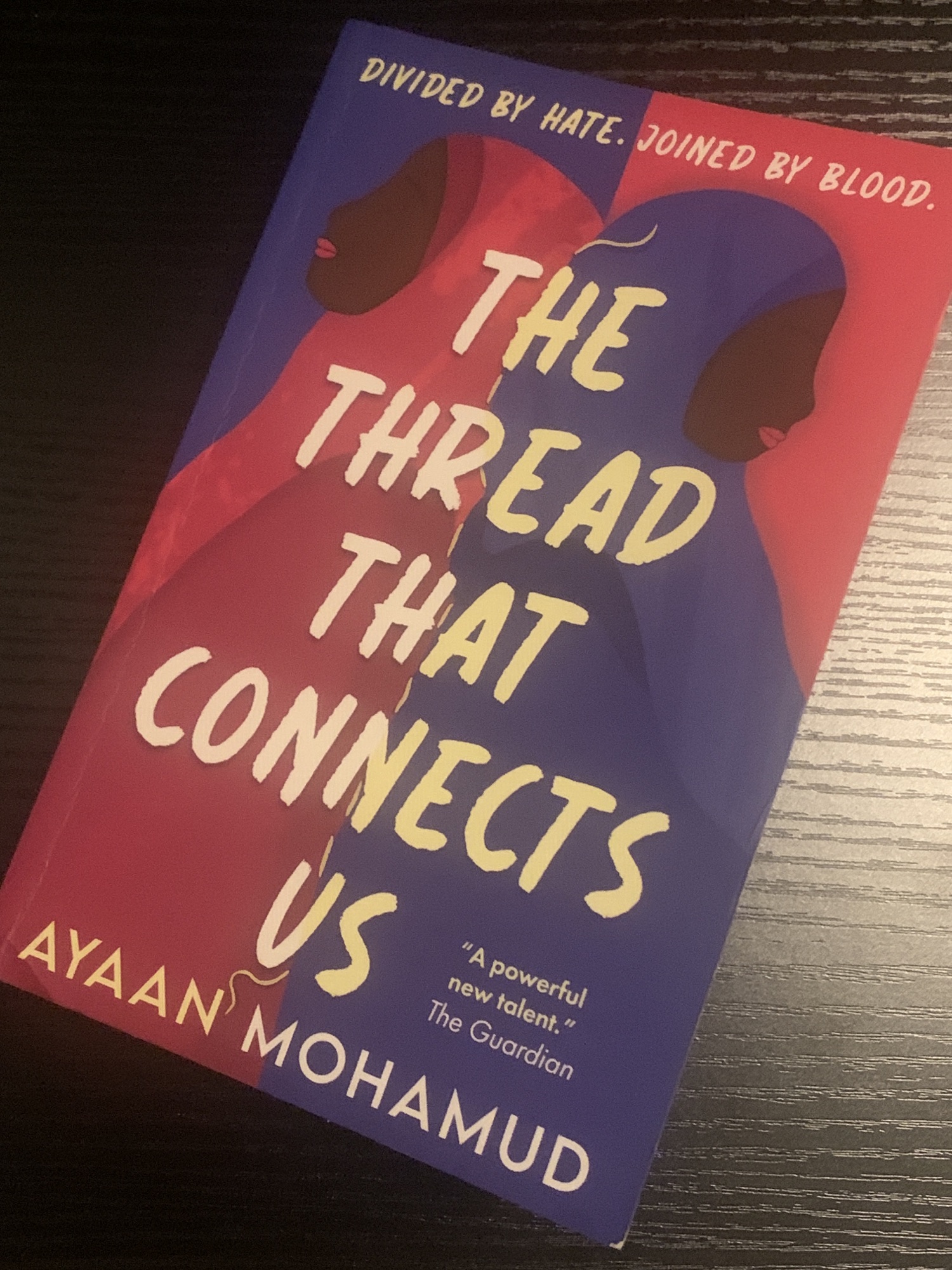
The Thread that Connects Us by Ayaan Mohamud

Standard
The Thread that Connects Us by Ayaan Mohamud


At just over 400 pages this book expertly blends the stresses of school, bullies, and friends in the UK with the twists and secrets of broken families, shattered hearts, and a past that needs to be reckoned with.  Told in dual perspectives from girls thrown together by the actions of their parents, Safiya and Halima maintain distinct voices that are rich with Somali culture, Islam, vulnerability, and ultimately love and hope.  The book is YA, but the premise is a bit mature and is better suited to older teens in my opinion, I think a high school book club would be wise to consider this book, as once you start reading, it is difficult to put the book down. 

SYNOPSIS:

Safiya is mature beyond her years.  Since her father abandoned her and her mother five years prior, she has managed the bills, the upkeep of the home, and for the most part her grades. Hooyo checked out and is rarely more than a silent being curled up unable to care for herself, much less her daughter.  With the the help from the community, particularly her best friends and neighbors Muna and Yusuf, Safiya has a found family that helps her weather the tough times.  When her dad moves back to London with his new family from Somalia, Safiya is forced to deal with not only all the painful memories of her past, but also the very real presence of her family living in her neighborhood, showing up to Eid prayers, and taking over the safe haven that school has often served as when home life has been so cold and lonely.

Halima’s father died when she was young, and life with her Hooyo in Mogadishu was good until her mother remarried, Safiya’s dad.  Her two younger half brothers that came further added to the rift between her and her mother, and now that they are moving to England with the husband, despite her protests, has her plotting a way to return to her home.  The language, the culture, the weather, are all added stresses to finding her way, and are compounded when she gets paired up to have Safiya show her around and help translate for her in school.  

The two girls hate each other, at least they have that in common, but their inability to avoid each other forces them to interact more than either wish to do.  As questions, and secrets are voiced, the two girls realize that they might have to work together to get what they want, and figure out their past.

WHY I LIKE IT:
I really enjoyed the owning of the characters’ language and culture and faith and how easy it was to be invested in their world.  Nothing pulls you out of the story, it is rich and lush and the reader can figure out why even though there is a crush, nothing is going to happen, and why they are wearing hijabs, and waking up to pray fajr, the balance is both inviting and educating, without the reader even realize it is happening, because hello, we are to busy trying to figure out what these two girls’ parents have done. 

The story has layers, and the emotional attachment I feel to both these girls, made me glad the story was over, they deserve some peace, but also desperate to know that they are going to be ok in the future too.  I can’t say too much without the risk of spoiling, but the writing is strong, the plot solid, the details intentional and relatable, and the characters very real.

FLAGS:

Lying, bullying, fighting, assault, crush, drug use, arrest, accusation, gossip, abandonment, relationships, edibles, affairs.

TOOLS FOR LEADING THE DISCUSSION:
This would be such a great upper high school read, the way the story unfolds will keep readers hooked from the first page and motivate those that start, to finish.  Students will see themselves in the characters, and be sleuths themselves trying to uncover what secrets are true and how do the pieces of the puzzle fit together.


Hidden Fires by Sairish Hussain

Standard
Hidden Fires by Sairish Hussain

I will not be getting over this book any time soon. It broke my heart, and all my other critical organs, in the most delightfully well-done way possible, and undoubtedly I am better for it. I don’t read a lot of adult fiction these days, and with some diabetic retinopathy concerns, I couldn’t read the 384 page adult book about generational trauma, partition, the Grenfell Tower fire, family dynamics, bullying, self-harm, and resilience, but was pulled in to the audio book version instead. The Desi-British voices of Yusuf, Rubi, and Hassan were refreshing to my American ears.  The multi-perspective book told in parts richly develops the characters, their relationships, and their current, past, and future struggles.  The author is Muslim, as are the characters, and while they all practice in their own way, it is undoubtedly who they are, and their Islamic identity is not questioned, feared, blamed, or apologized for.

SYNOPSIS:
The book weaves three distinct voices. Yusuf, is an 80 year old an immigrant who lived through partition, raised his family in the UK, has lost his wife a year prior, and is struggling with haunting memories of the past, failing health, regular loss of friends, and loneliness.  Hassan, Yusuf’s youngest son is a workaholic who is married to a non Muslim, non Desi who is suffering from fibromyalgia and who’s mother unexpectedly passes away in Spain.  Rubi, is Hassan’s 16 year old girl who is overweight, bullied, lonely and about to take her GCSE exams when she is dumped on her grandfather Yusuf’s door while her parents head to Spain.  The book opens in Ramadan the night of the Grenfell Tower fire and the horrific event affects them all, stirs memories, and shapes futures.  From there the layers of each character slowly unravel as they cope with the swiftly changing present as they desperately work to break free from the past.  As dementia plagues Yusuf, Rubi finds purpose in being needed, and Hassan is forced to re-prioritize his life before it is too late.

WHY I LIKE IT:
The book takes a slow approach to building up the characters and their back stories. It is almost feels like world building as a book would if it were a fantasy, it doesn’t info dump, but at some point the hooks are so deeply embedded that you really cannot leave the characters and their world and you have to finish the book, just to ensure they are ok.  Because I listened to the book, I feel like there might have been some Islamic content that was not completely ok, but again I was having vision issues and couldn’t note where to go back and check.  I think it is fine, and because it is an adult read, I think the audience can discern accuracy, but please know, I’m not 100% green lighting the Islamic rep.  It is undoubtedly well done and fasting and praying are a part of the characters, but their relationship to their faith and their understanding of it, is presented as theirs, it doesn’t get preachy or make broad statements about Muslims everywhere or Islamic doctrine.  

FLAGS:
There is body shaming, self-harm, trauma, death, torture, killing, lying, abuse, fear, guilt, dementia, bullying, assault, physical violence, drug use (mentioned), attempted suicide (mentioned), music, theft, make-up, close male and female relationships, Muslim marrying a non-Muslim, hallucinations.

TOOLS FOR LEADING THE DISCUSSION:
I think mature high school seniors or possibly even juniors could benefit from this book with discussions.  I think Rubi’s voice tied to her father and grandfather, will really open up youngsters perspectives, and provide a great vehicle to hear their thoughts, fears, worries, concerns about body image, self harm, aging grandparents, accessibility to parents, etc..

My Olive Tree by Hazar Elbayya

Standard
My Olive Tree by Hazar Elbayya

img_7154-1

I love that this author illustrator traditionally published book shows the ways that olive trees and their fruit connect people.  The little girl, Salam, can’t wait to grow her very own tree, but it takes a while, and when it finally sprouts, it is trampled by soldiers.  Heartbroken to lose her plant, her community shows her how they are like their beloved olive trees: their roots are deep, and they are a part of the land.  The tender illustrations, the poignant symbolism, and the love and unity that radiates through, makes this book an important read for children and adults of all ages and backgrounds.  There are no countries mentioned in the text (Palestine appears only in the author’s note), nor any religion, there are visible Muslims in the illustrations, even the soldiers are unnamed, but the setting is clear.  Picture books take years to be published and that it released at this point in history, shows how long the struggle for freedom has been taking place, and how strong and resilient Palestinians are.  This book that will be read over and over, shows even in the sadness, the feeling of hope abounds.

The book starts with Salam noting how old her grandpa is, and that only the olive trees are older than Sido.  Sido then explains to his granddaughter how the olive trees connect them all: farmed, picked, pressed, oil used to cook, olives sold to eat, added to dishes, and made into soap.  Salam goes to plant her seed and be part of the connection. She waters it and waits, but it doesn’t seem to be growing.

Finally a spout, and then a little plant, and then the soldiers march into their lands and destroy everything in their path, even Salam’s olive tree.  Sido reassures her that she will plant more olive trees in her lifetime, but Sido also wants to show her that she is not alone.  Friends, family, and neighbors, come together to show her, “just like the olive trees, when they try to break us, we grow back stronger.”

A truly beautiful hopeful book, subhanAllah.

img_7144-1