Tag Archives: helping

Sameer and Snazzy: Kindness Counts by Emma L. Halim illustrated by Herry Prihamdni

Standard
Sameer and Snazzy: Kindness Counts by Emma L. Halim illustrated by Herry Prihamdni

The 32 page faceless picture book for toddlers and up, is set in Australia and follows Sameer and his cat Snazzy on a bushwalk.  At first I felt like it might be a little bit like the classic, “And to Think that I Saw it on Mulberry Street,” but the structured story with a repetitive refrain adds in Islamic phrases, silly encounters, and examples of kindness that make it unique.  Add in a fun surprise at the end, and like many other books by the author, be prepared to have it memorized as your little ones ask for it over and over again.

The book starts with Sameer look forward to his grandpa coming to visit, but wishing he had something exciting to share with him.  Snazzy suggests he shares that he can talk to animals, but Sameer knows no one would ever believe that, so the two set off on a bushwalk to find something exciting.

When they hear an “A-choooooo!” in the trees, the fun is just getting started with Miss Koala sneezing and making eucalyptus leaves fall. The duo finds a way to help, but the fallen leaves mean ants are stuck in their home and can’t get out.  Once again, Sameer and Snazzy, find a way to help.  After each episode the refrain of, “‘Imagine if I told Grandpa this!”‘ I say to Snazzy.  ‘He’d never believe you! he smiles.  ‘NO-ONE WOULD!’ We laugh together and continue along the path, when suddenly…”

The book ends with a surprise, that I won’t spoil. The backmatter has a reference to Surah An-Naml and explains that Prophet Sulayman peace be upon him, really could speak to animals.  There is also a glossary of the Islamic phrases and a QR code to continue to the fun after the story ends.

The book is a bit more text heavy than some of her others, but the illustrations are fun, and will keep kid’s attention.  It does not rhyme, but has a cadence that makes reading it aloud easy. The small size makes the book better suited to bed time, but could work in a story time, and would be wonderful tuned into a story board/felt board read aloud.  The book is a universal story, but at some point in Islamic fiction self published and small published books, I think we will need to have open dialogue and discussions if having characters that are not the same race as the author or illustrator is appropriate and beneficial, or is misleading and better to avoid.

***EDIT: The author reached out to me asking me to remove this generalized opinion of me calling upon the need to have discussion, I opted to amend, as I think we need to have conversation and believe intention and purpose in whatever one decides is a benefit.  So, to avoid errors in interpreting her ask, I will simply post the screen shots, and my response.  Please note I did not tag the author in my Instagram post, she reached out to me.  I purchased the book, it was not gifted.

My First Book about Charity: teachings for Toddlers and Young Children by Sara Khan illustrated by Ali Lodge

Standard
My First Book about Charity: teachings for Toddlers and Young Children by Sara Khan illustrated by Ali Lodge

The newest board book in the My First Book series is a gentle and wonderful introduction to charity, both sadaqah and zakat. Sourced with ayats from the Quran, there is also backmatter that has Facts about Charity and Questions and Answers. I’m always amazed at how much information the series consistently contains in the 26 pages for our littlest Muslims.  With soft illustrations and smiling joyful faces, each page radiates warmth, information and simplicity in a way that grows with toddlers, to preschoolers, to early elementary aged readers, alhumdulillah.

The book starts with affirming that Allah has given us more blessings than we can count, and some of us have more than others.  To help those that have less, Allah wants us to give charity.  The book briefly explains that Zakat is one of the pillars that is required, and sadaqah is an extra reward that is not just money.

It talks about the sunnah of giving charity, and numerous ways that kindness can be carried out.  It shows respect and helping and concludes with Allah’s names of All-Knowing and All-Hearing before the final supplemental spread.

I don’t know how many books are planned for the series, but I love looking at them all lined up.  I share them with my own children and now that there are accompanying puzzles and a boxed set, I’m positive I’ll continue gifting them, not just to new parents as I’ve done in the past, but to toddler and preschoolers as well.

Doctor Bear and Helpful Bunny: The Travelling Dentist by Emma L. Halim & Her Mum Mary Tucker illustrated by Alissa Mutiara

Standard
Doctor Bear and Helpful Bunny: The Travelling Dentist by Emma L. Halim & Her Mum Mary Tucker illustrated by Alissa Mutiara

Sometimes you just need a sweet little story about a traveling (sorry one l I’m not British) dentist going under the sea to help a hammer head shark with a toothache.  This rhyming story for toddlers is perfect for the demographic as duas are said to get through the pain and fear and the reliance on Allah swt that all will be well.  The Muslim animals and the fun illustrations make the story appealing whether your child is afraid of the dentist or not, and the focus on the duas in the backmatter, makes the book a good tool for repetitive use.  It is worth noting that their are 32 pages in the book, but the story is only 20 pages.  There is a glossary, multiple dedications, scanable codes for activities, ads for other books, duas, sources for duas and author bios in the back.

The book starts with Doctor Bear and Helpful Bunny introducing themselves as traveling dentists for all animals, even those under the sea.  When they get a call from Sonny, they set an appointment time, gather their gear on a boat and then head underwater to the shark village.

Sammy is glad they are there, as he is in pain. They clean his teeth, but need to remove the wiggly one, and that scares him.  He says a dua and before he knows it the huge tooth is out, alhumdulillah.

The book then has a two page spread about duas that help when you are “feeling funny inside” in Arabic, English transliteration, and their meanings in English.  A fun book with a great mix of story, silliness, education, and heart.

More Hands by Jenny Molendyk Divleli illustrated by Ekinsu Kocaturk

Standard
More Hands by Jenny Molendyk Divleli illustrated by Ekinsu Kocaturk
img_6180-1

This 32 page picture book blends food and the concept that teamwork makes things better, when a young boy asks his grandfather why his pishmaniyah is so delicious, and Grandpa Yahya offers to share his secret ingredient. The book is a fun bedtime or story time read as the more hands needed builds and builds. As someone though who has now read the book over a dozen times, I do wish there was more backmatter. I would love a recipe for the cotton candy type sweet, maybe some history of what pishmaniyah is (I had to Google it), and how it is traditionally prepared. The text dances around the pages, and the fun illustrations will appeal to children and help explain the process. There is a “bismillah” in the book and it mentions “baraqah” on the back cover, athere are also a few hijabis in the illustrations, but the book is universal for all readers toddler and up.


The book jumps right in with Sami asking his grandfather about his pishmaniyah. It is unclear if grandpa was planning to make it, or if it was a question out of the blue, but either way, Grandpa Yahya offers to share the secret ingredient. The ingredients are pulled out, and then more hands are needed, and then more and more and more. Once the whole family, and neighbors, and their kids are all involved it is time to eat and enjoy the dessert together.


As an adult I wonder what would have happened if so many people were not available to help, and did they wash their hands, and how big is their house, but kids won’t care, kids will just think it is funny. And that is ok too, books that show family, community, and teamwork with humor are always great additions to share with our littles.

img_6185-1

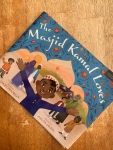
The Masjid Kamal Loves by Ashley Fraklin illustrated by Aaliya Jaleel

Standard
The Masjid Kamal Loves by Ashley Fraklin illustrated by Aaliya Jaleel

img_7811

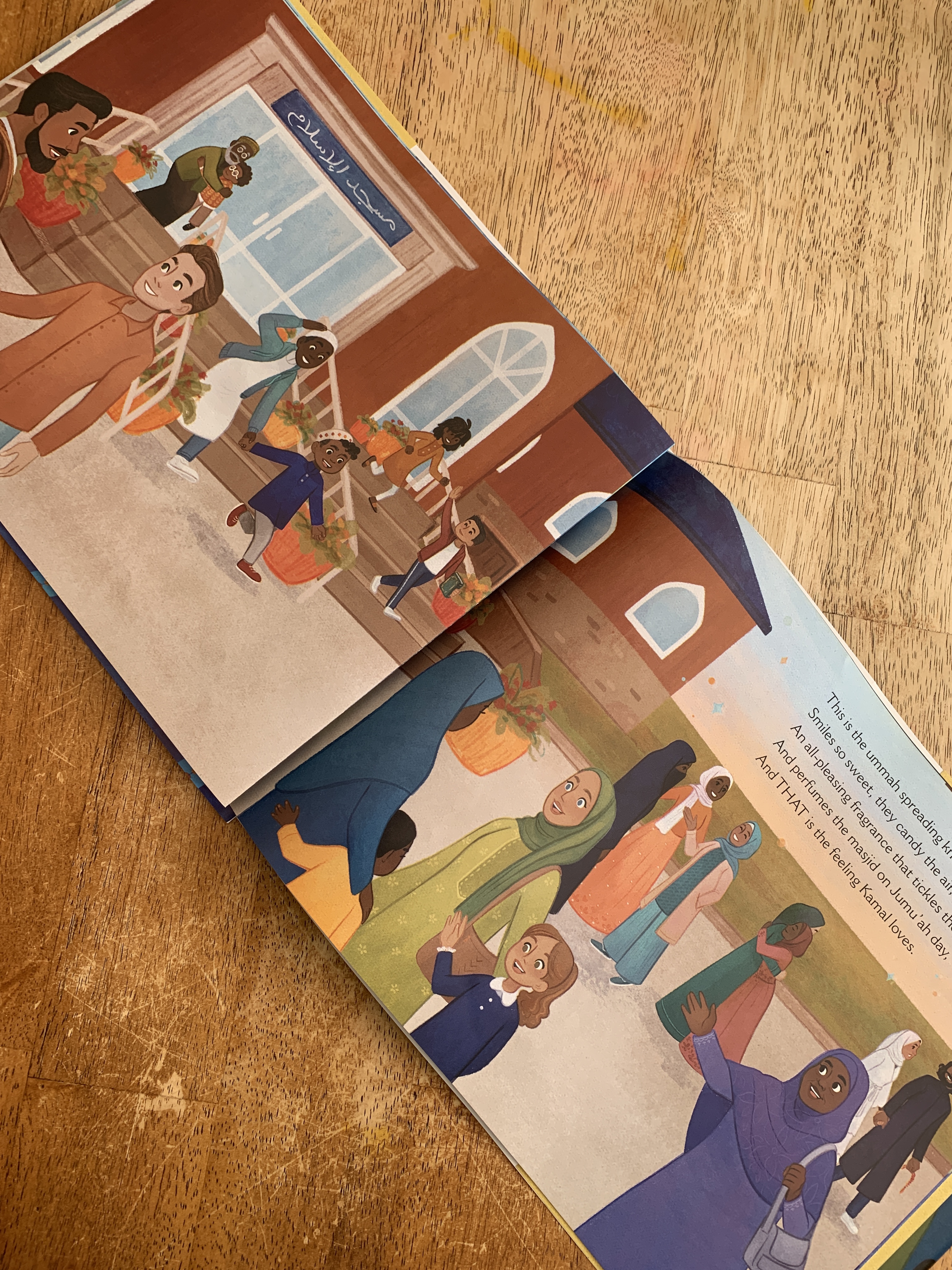
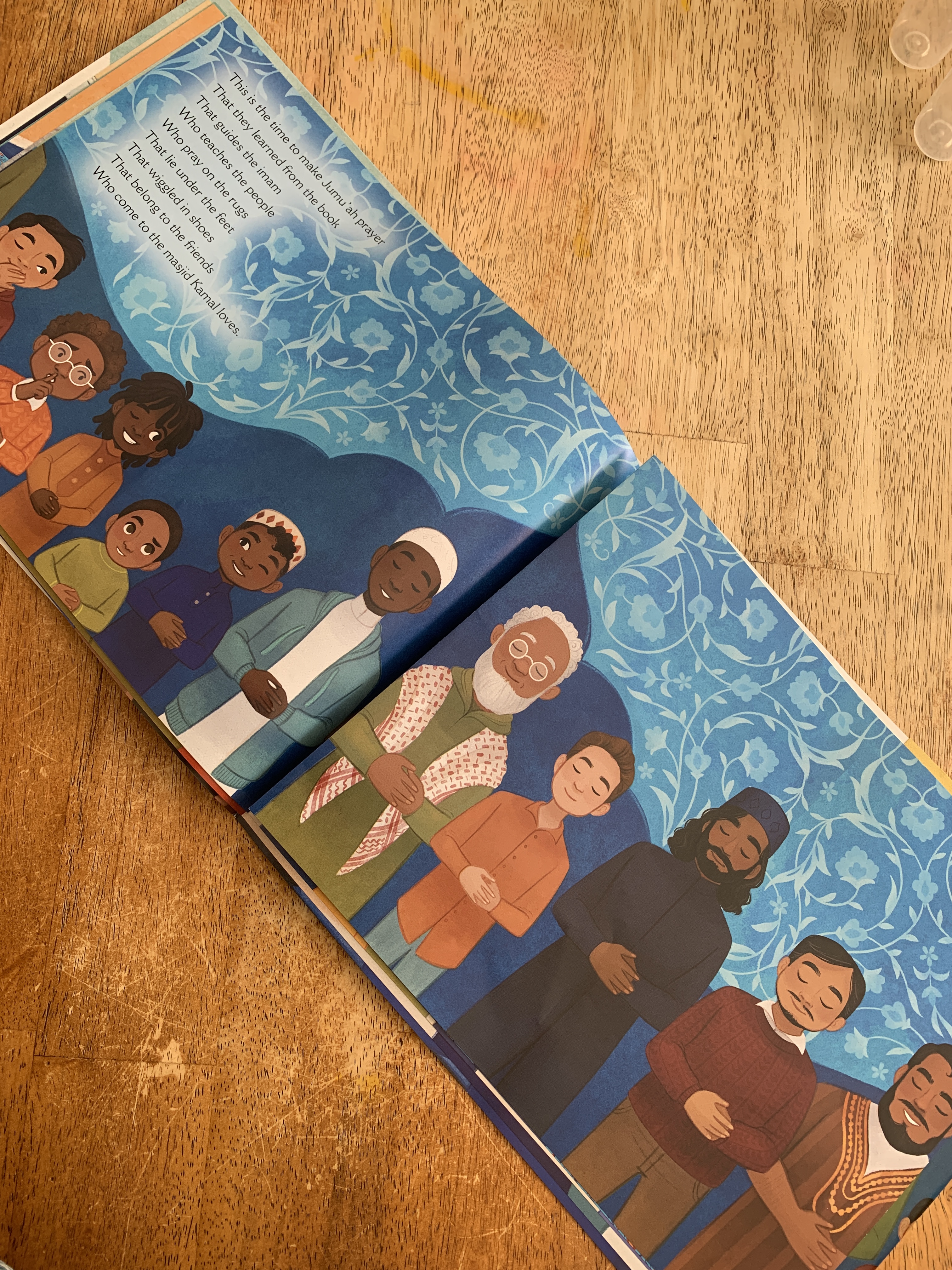
I don’t normally post about upcoming releases this far in advance (2.5 months), but I am hoping that if I share the link for preorders, I just might help in signaling to the traditional publishing world that books like this are so so so important and that we will support unapologetic, well written, Muslim centered, Muslim and Black joy featured books with our purchasing power.  This book is incredible for toddlers to early elementary in its “This is the House that Jack Built” format.  Muslim kids will giggle with excitement as they see themselves happy to see their friends at Jumu’ah, flinging shoes a little too hard before entering the musallah, splashing a bit when making wudu, playing while helping put out the prayer rugs, and getting a little wiggly or tired during the khutbah.  The happiness and love radiates off the pictures and through the text that even non Muslim readers will feel our connection to our Masjids and the prayers that occur within.  Muslim authored, Muslim illustrated, masjid not mosque, and a beautiful Author’s Note, makes this book a must have on every shelf where young children need books that mirror their experiences and provide windows into the beauty of Islam.

img_7814

The book starts out describing Kamal’s smile and offering the reason for such joy as being Jumu’ah at the masjid. It then starts with describing the masjid and all that is contained with the lines adding on the refrain of “the masjid Kamal loves.”  The friends, the shoes, the feet, the rugs, etc.. Terms such as imam, ummah, salaam are in the text and the illustrations show wudu, salat, khutbah, conveying a Jumu’ah experience.

img_7813

Each page is brightly illustrated across horizontal orientated scenes.  The expressions on the kids faces, are engaging and smile inducing and the lyrical text has a rhythm and strength that makes you feel proud to also have a masjid to love like Kamal.

img_7816

I have an arc, but have preordered a copy for myself here and hope you will do the same. Please also request your public libraries to order it, and if they have already you can place the book on hold, inshaAllah little steps to show support.

Mr. Grizzley’s Class: Rahma’s Gift by Bryan Patrick Avery illustrated by Arief Putra

Standard
Mr. Grizzley’s Class: Rahma’s Gift by Bryan Patrick Avery illustrated by Arief Putra

rahma

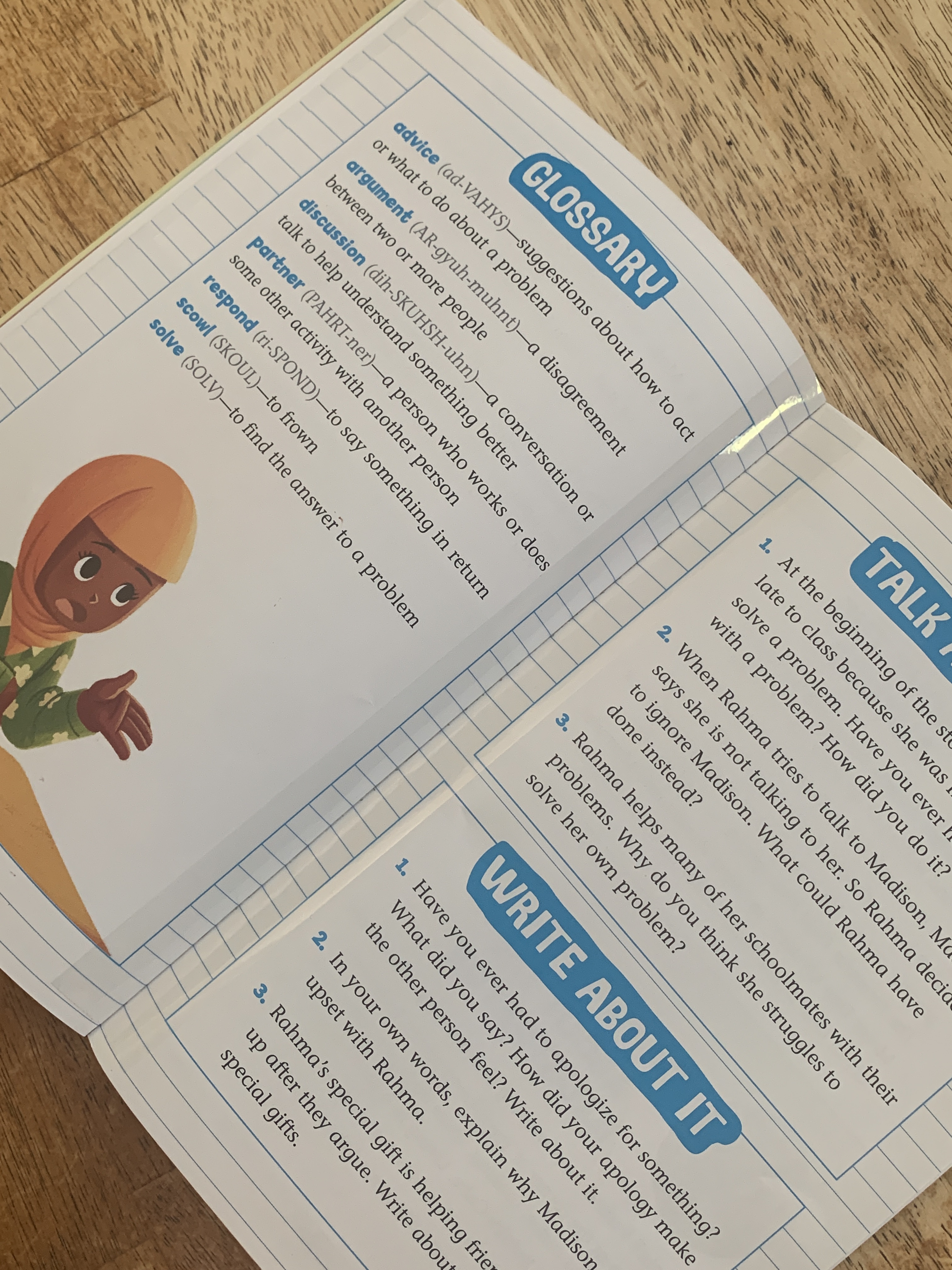
This 32 page early reader is part of Mr. Grizzley’s class, a series that sets out to help promote social and emotional skills in real life settings for ages five to seven.  The diverse class is featured in all the books with one student being the focus of each individual book.  This book highlights Rahma, a visibly Muslim girl of color, who has a gift of helping others with their problems.  The richly illustrated story shows what happens when she is having troubles with a friend, and what Mr. Grizzley and fellow classmates can do to help her find a solution.  I like the premise, I like the focus, I like the illustrations, but I did not understand the messaging.  I don’t understand why Rahma had to own the entire apology.  Sure, friendship is more important than a small misunderstanding and moving on by saying your sorry, even when it isn’t all your fault, has merit- but the book doesn’t take all that in to consideration.  It has Rahma taking responsibility for Madison not talking to her, Madison misinterpreting something Rahma did and getting jealous, and Rahma owning all the lacking communication, when clearly both of them failed to do so.  I found myself confused reading the book the first time, clearly I must have missed something, right? No.  And now writing this, I’m actually quite upset.  So, while the idea of the book and series might be sweet, I don’t feel like this particular book was well executed.  I have not read any others in the series, and thankfully checked this out from the library.  There is nothing particularly Islamic or religious in the book other than the hijab Rahma wears.

img_3111

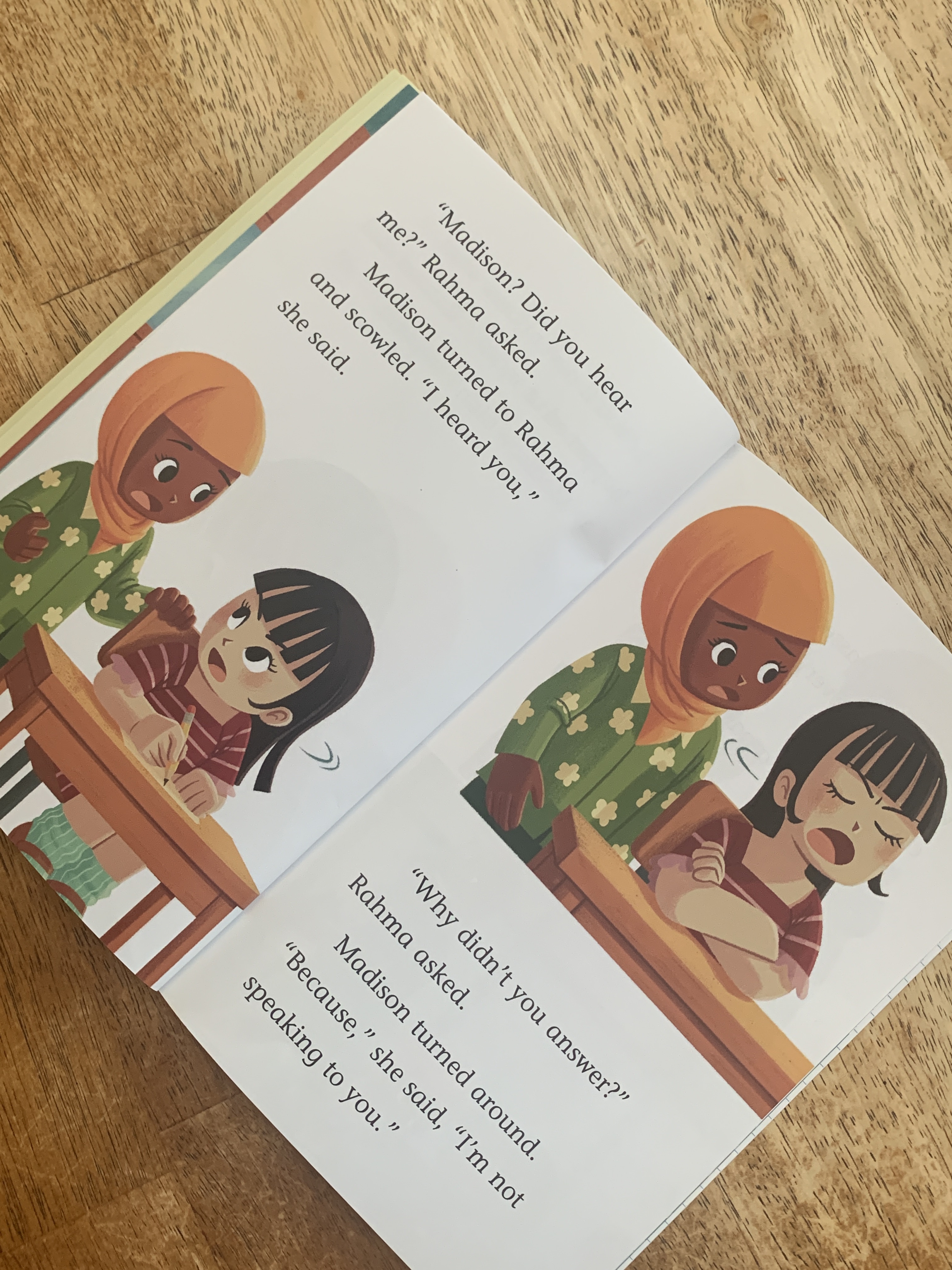
The book starts out with Rahma nearly late for class because she was helping other kids resolve an argument.  It is a gift of Rahma’s to help others work out their problems.  When she tries to tell her best friend Madison about it, Madison doesn’t respond.  When Rahma tries again, Madison says, “I’m not speaking to you.”

img_3112

As a result when they pair up for math, Rahma works with Annie.  She tells Annie she isn’t working with Madison because she is mad at Madison for not speaking with her. Annie prods a bit and Rahma says, “I’m not talking to her if she won’t talk to me.”  Annie encourages Rahma to find out what is wrong.

Mr. Grizzley is then told, and he also tells her to find a way to find out why she is mad. At recess, Chad comes to thank Rahma for helping him and Ashok, and when she tells him her problem he gives her, her advice back, “listen to the other person.”

img_3113

Rahma definitely is in a pickle since Madison won’t talk to her, but with incredible maturity she tells Madison she doesn’t know what she did to make her angry, but she is sorry that she feels bad.  Madison caves and tells her she is jealous because Rahma made a necklace for Semira and she understood it to mean that because she didn’t make one for her, she didn’t want to be her best friend any more.  Semira and Rahma explain that Semira’s dog was sick and she was sad, so Rahma made it for Semira to cheer her up. The girls hug and all is well.

img_3114

The book concludes with directions on how to write an apology letter, a glossary, questions to talk about, and prompts to write about.

I loved Rahma’s phrasing of her verbal apology and wish that would have been the focus of the book: how to take someone’s feelings in to account even if you don’t know how you contributed or even if you feel you did not do something wrong.  As it is written with the two page spread at the end on how to write an apology note though, I feel like Rahma took on a lot of the blame unnecessarily.  I know I’m reading in to it a lot, but I don’t like the vibes that the book gives.  Madison in my opinion was in the wrong multiple times throughout, and Rahma each time took ownership and worked through it.  Yes, truly that is a gift, but I really hope people don’t take advantage of Rahma in the future.

img_3115

I Can Help by Reem Faruqi illustrated by Mikela Prevost

Standard
I Can Help by Reem Faruqi illustrated by Mikela Prevost

i can help cover

This 44 page early elementary book is absolutely beautiful: the message, the relatability, the representation, the heartfelt author note.  Reem Faruqi is brilliant.  Once again she takes something so personal to her and allows the readers to see pieces of themselves in her OWN voice narrative.  This book at it’s core is about peer pressure, but the way it stays with the reader will resonates deeply and powerfully.  Readers will remember the choice Zahra made and the way it changed not only her relationship with Kyle, but also her own view of herself, while forgetting the names of the classmates that teased her and made her question herself.  It is not the outside reprimanding that gives this book it’s strength, but the guilty conscious that such a young character has to come to terms with as she moves forward.

  i can help 3

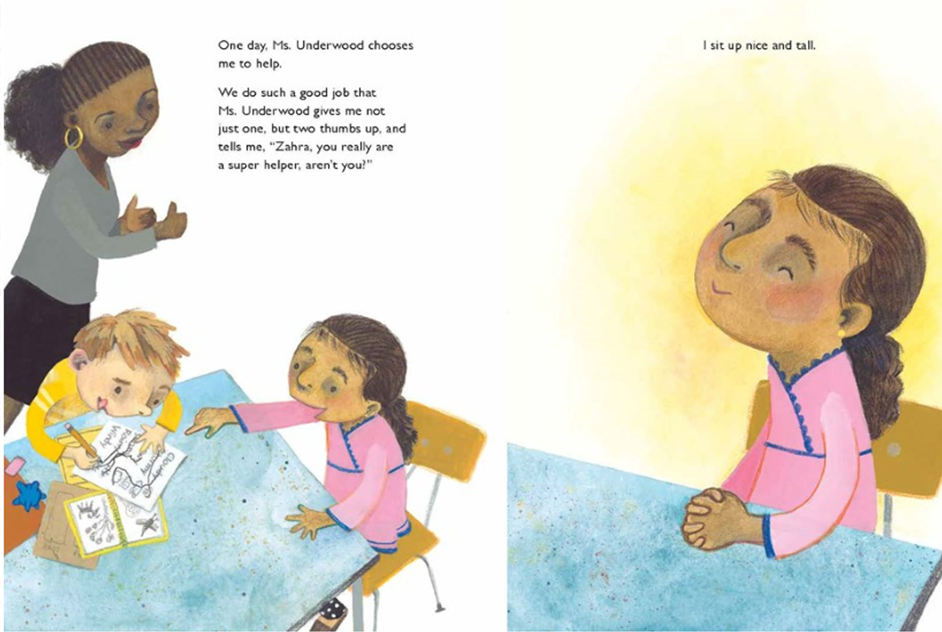
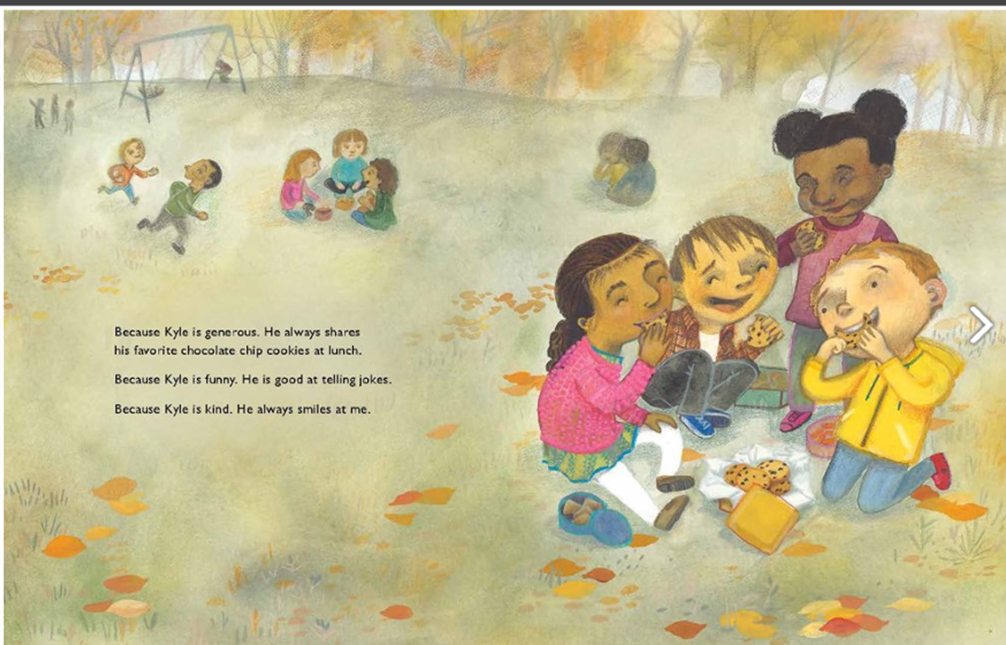
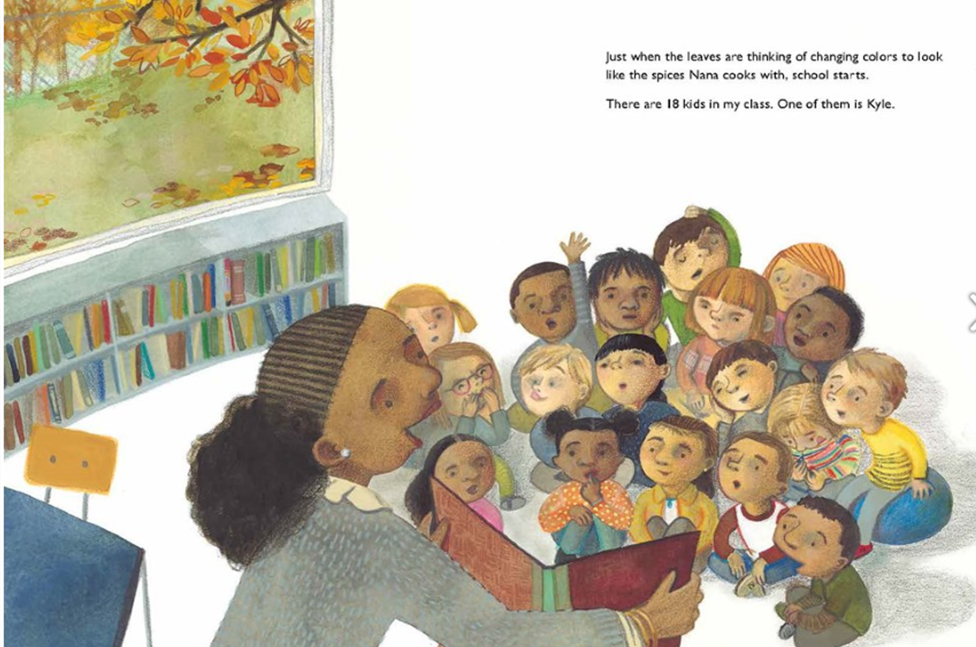
There are 18 kids in Zahra’s class in early fall, when the leaves are about to be the color of Nana’s spices.  One of the kids is Kyle.  Kyle often needs a helper, and Zahra is happy to help him with his cutting and gluing and writing.  The two have become friends.  Kyle is funny and nice and shares his cookies.

i can help 2

Zahra also likes the praise she gets for being such a good helper.  One day when the leaves have darkened, Zahra is climbing a tree and hears some of the girls making fun of Kyle.  She doesn’t want to listen, but her ears want to hear.  When she comes down, they ask her why she helps him.  She doesn’t really know.

i can help1

When she is helping him later, she sees the girls staring at her, and she snaps at Kyle.  The next day Ahmed helps Kyle instead.  Zahra misses being around Kyle, but he says that she is mean and he doesn’t know her any more.  Zahra doesn’t know herself any more either.

i can help 5

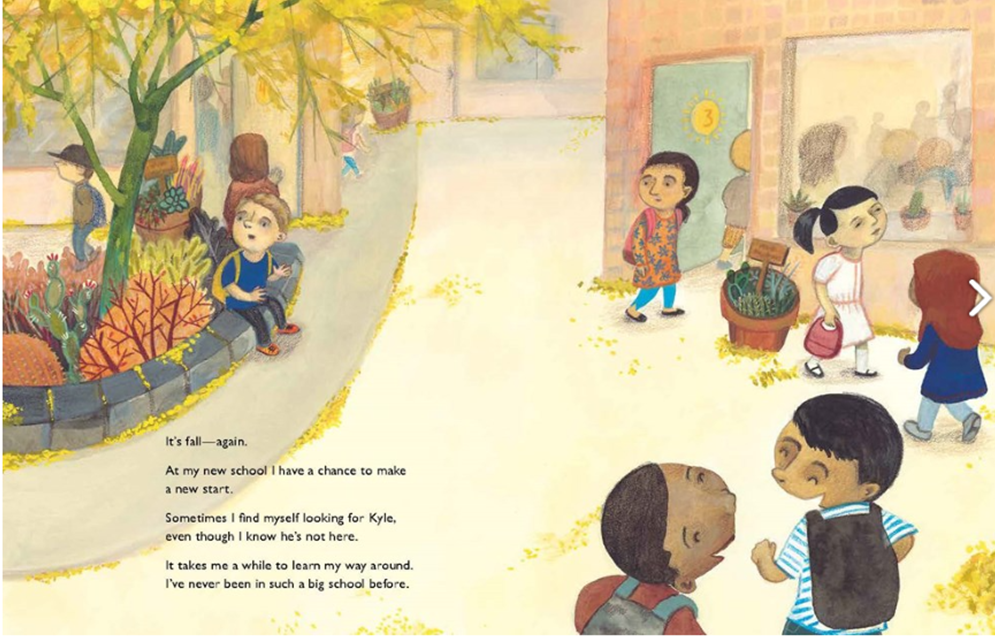
The next year finds Zahra at a new school, and when the opportunity presents itself for her to help someone, she jumps to offer herself as a helper remembering Kyle and finding her voice, one that she recognizes.

i can help8

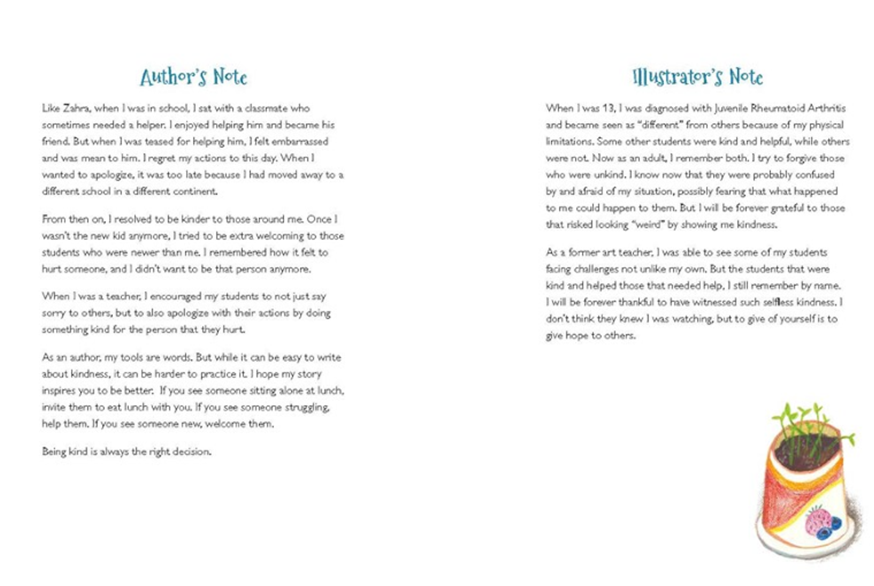
The book is inspired by the author’s own experience, and the rawness and relatability shines through.  The illustrator also relates to the book and needing help with physical limitations.  There is nothing overtly religious or cultural other than the mention of the spices, Zahra’s and Ahmed’s names, and the term for Zahra’s grandfather.  The diverse kids in the classroom and the universal messaging make this book a must read for every kid and big person.  Be kind, always be kind.

i can help 9

Never Give Up: A Story about Self-Esteem by Kathryn Cole illustrated by Qin Leng

Standard
Never Give Up: A Story about Self-Esteem by Kathryn Cole illustrated by Qin Leng

img_9838

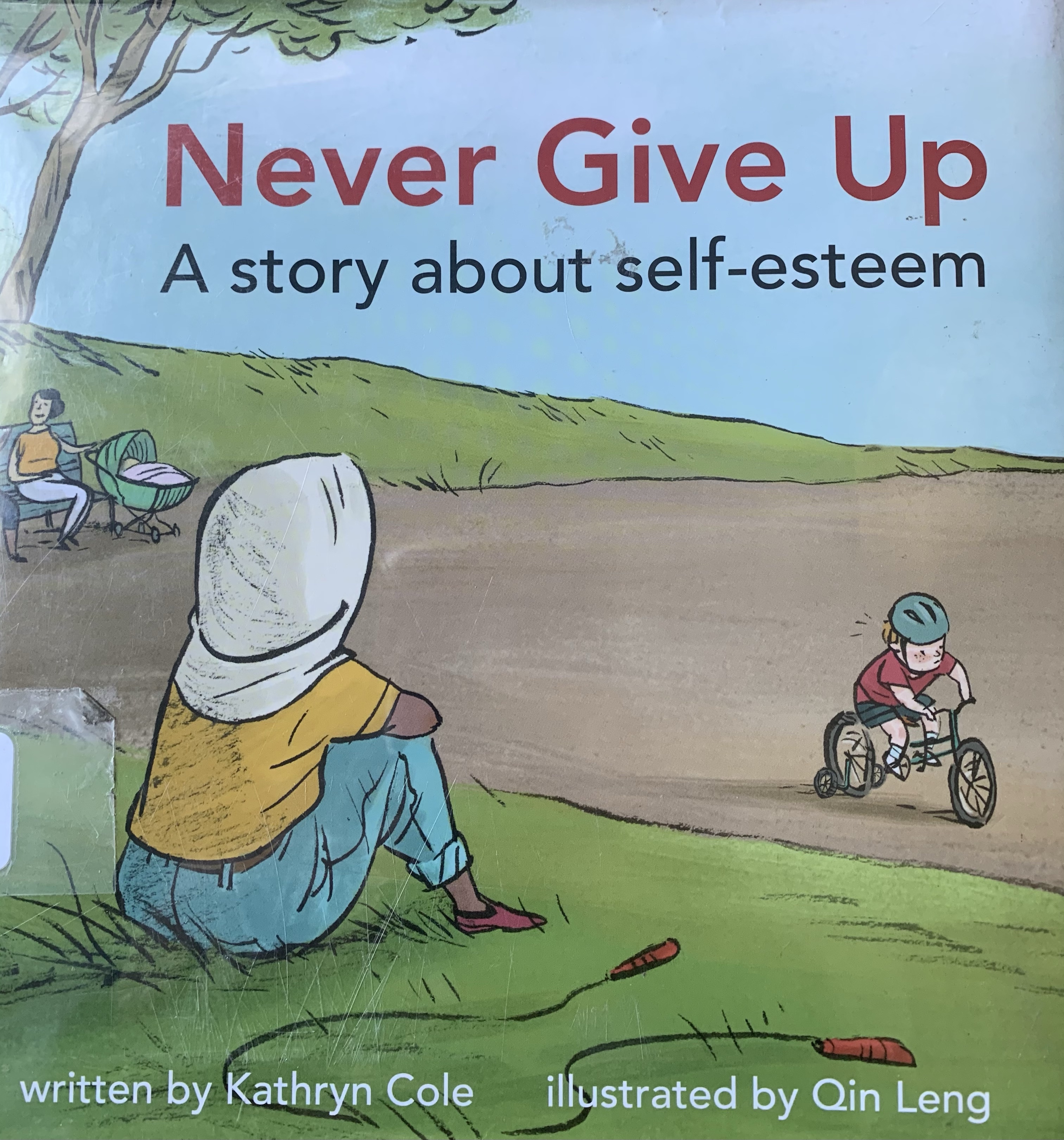
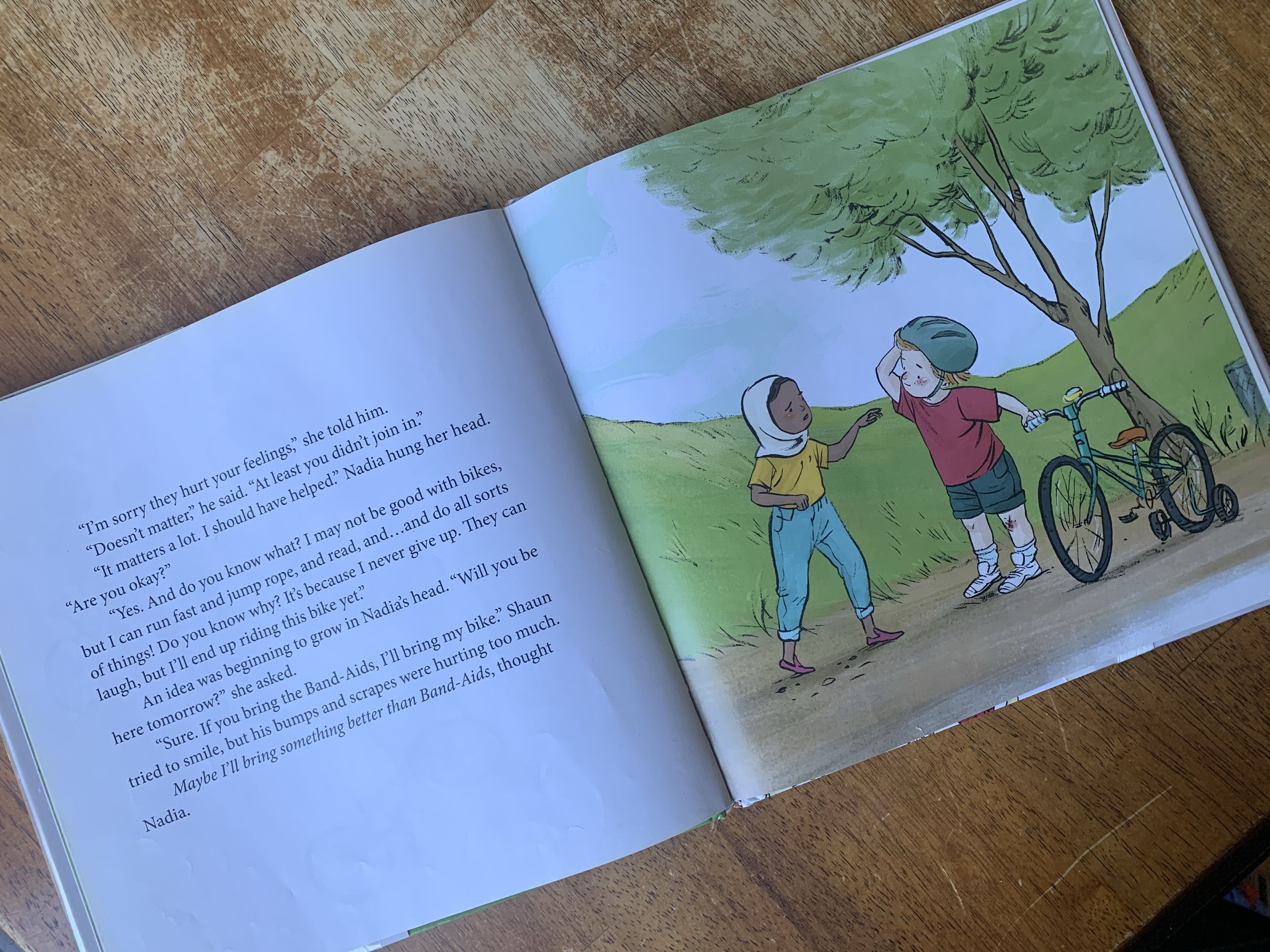
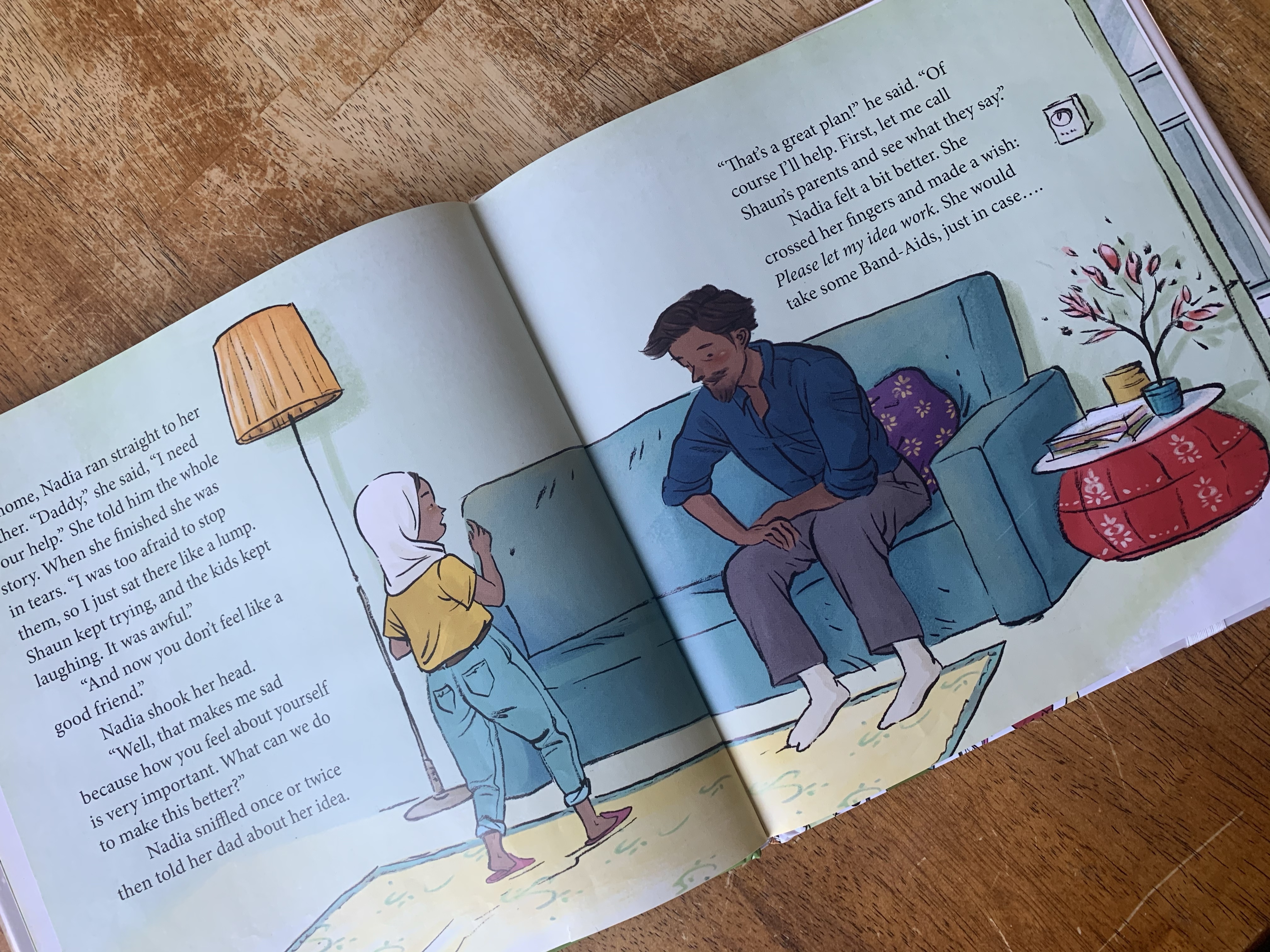
This first through third grade teaching series highlights different life lessons and concepts and features diverse characters. I reviewed a book in the series earlier with a Muslim character, not realizing that there was also one with Nadia in the lead. The 24 pages show her in hijab both at the park and at home although she wears short sleeves and is much younger than puberty, when covering becomes required. Neither the author, nor the illustrator seem to be Muslim, and religion is not present in the book, other than Nadia’s scarf. It is worth mentioning that Nadia crosses her fingers and makes a wish that her plan works, something most Muslims would say inshaAllah for and possibly want to be made aware of in a book like this. Overall the message is strong, and would be a great book to read and discuss with a child, Nadia and her friend Shaun have noteworthy traits that we can all learn from.

Nadia is heading to the park to practice jumping with her new rope. She stops when she sees her friend Shaun riding his bike with training wheels. She has been riding on two wheels for a while, and even on training wheels Shaun is struggling. Kamal, Joseph, Lin, and William start teasing Shaun, and Nadia is upset, but not brave enough to do anything about it.

After crashing a few times, the crowd grows tired of laughing at Shaun and Nadia goes down the hill to check on him. She apologizes that the other kids were teasing him, he takes it in stride and thanks her for not joining in. He also lists off things he is good at. He is determined, and Nadia has an idea. The two agree to meet back at the park the next day.

Nadia is upset when she gets home. She tells her dad the whole story and how she wishes she was a better friend. She then talks to her dad about her plan, and gets him to agree to help, her dad checks it off with Shaun’s parents and the next day they all meet at the park to take off the training wheels and teach Shaun how to ride with two wheels.
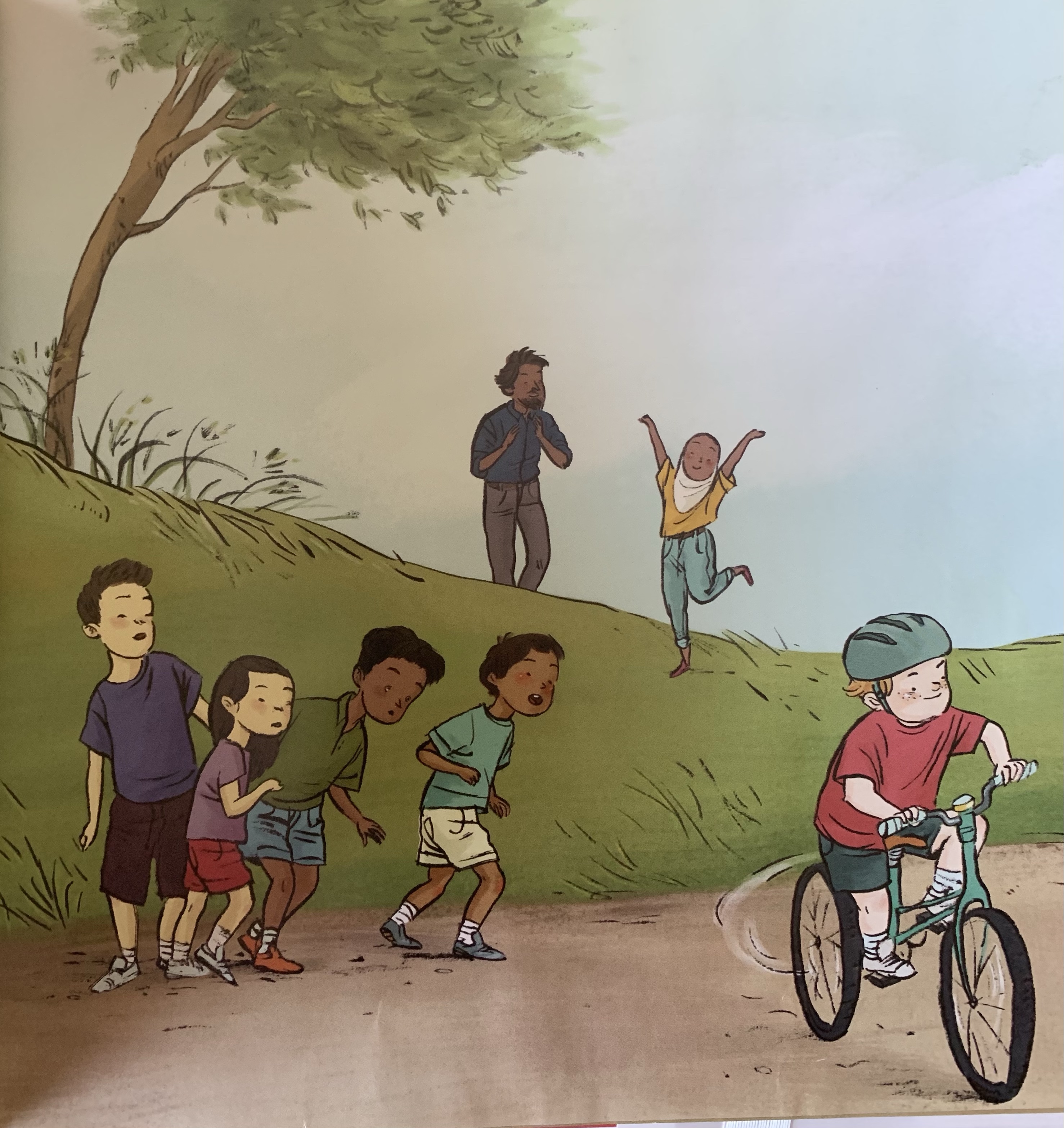
After multiple attempts and lots of cheering, Shaun is riding his two wheeler. He didn’t give up! Now it is Nadia and her dad’s turn to try jump roping, and after some struggles, it is the kids cheering on Nadia’s dad and encouraging him to try again.

The end of the book has Tips for Grown-Ups about how to develop and support children’s self-esteem.

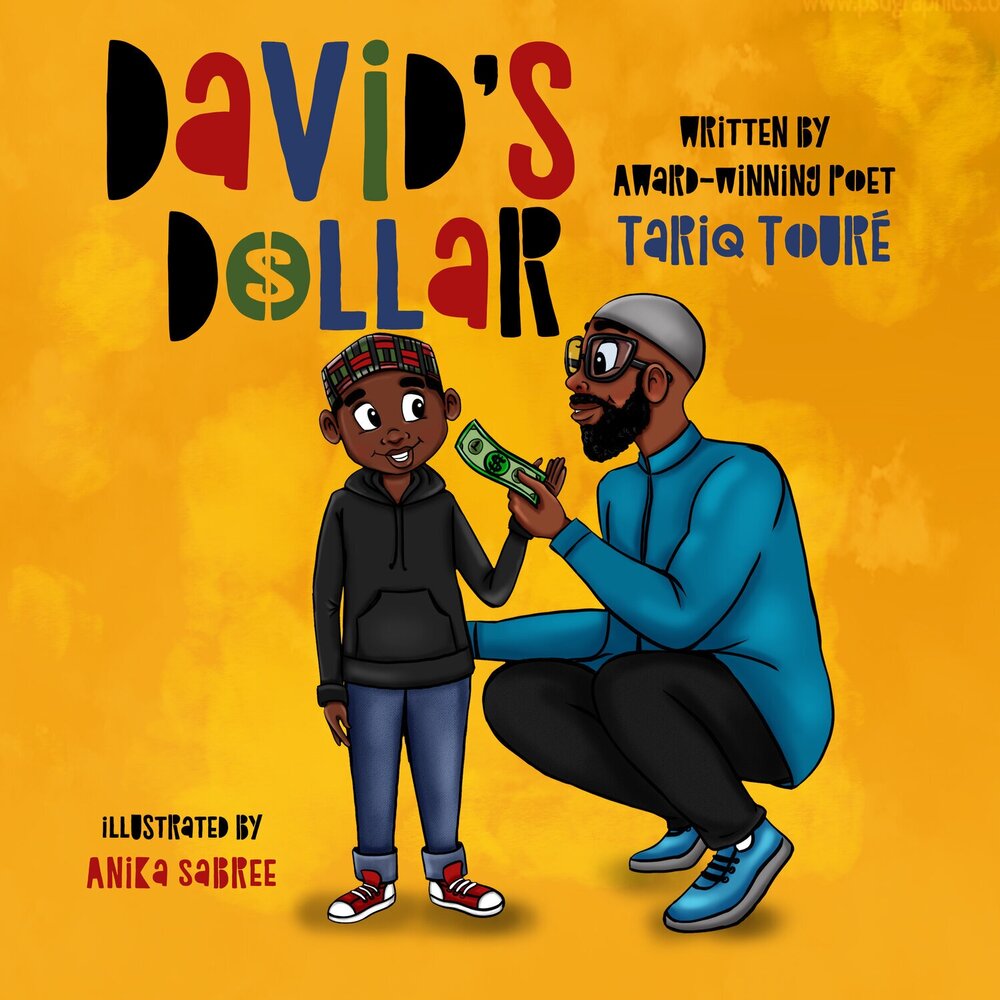
David’s Dollar by Tariq Toure’ illustrated by Anika Sabree

Standard
David’s Dollar by Tariq Toure’ illustrated by Anika Sabree

This early elementary 20 page story is an entertaining, yet informative look at community and economics on a kid’s level.  It features black Muslim characters, business owning women of color, commerce, charity, and relevance.  I loved the cadence of the book, the illustrations, and the simple text. Sure, maybe a dollar isn’t much and it is a transparent simplistic view, but it makes the point of how when you shop local everyone benefits, and how the path money takes impacts everyone it touches.

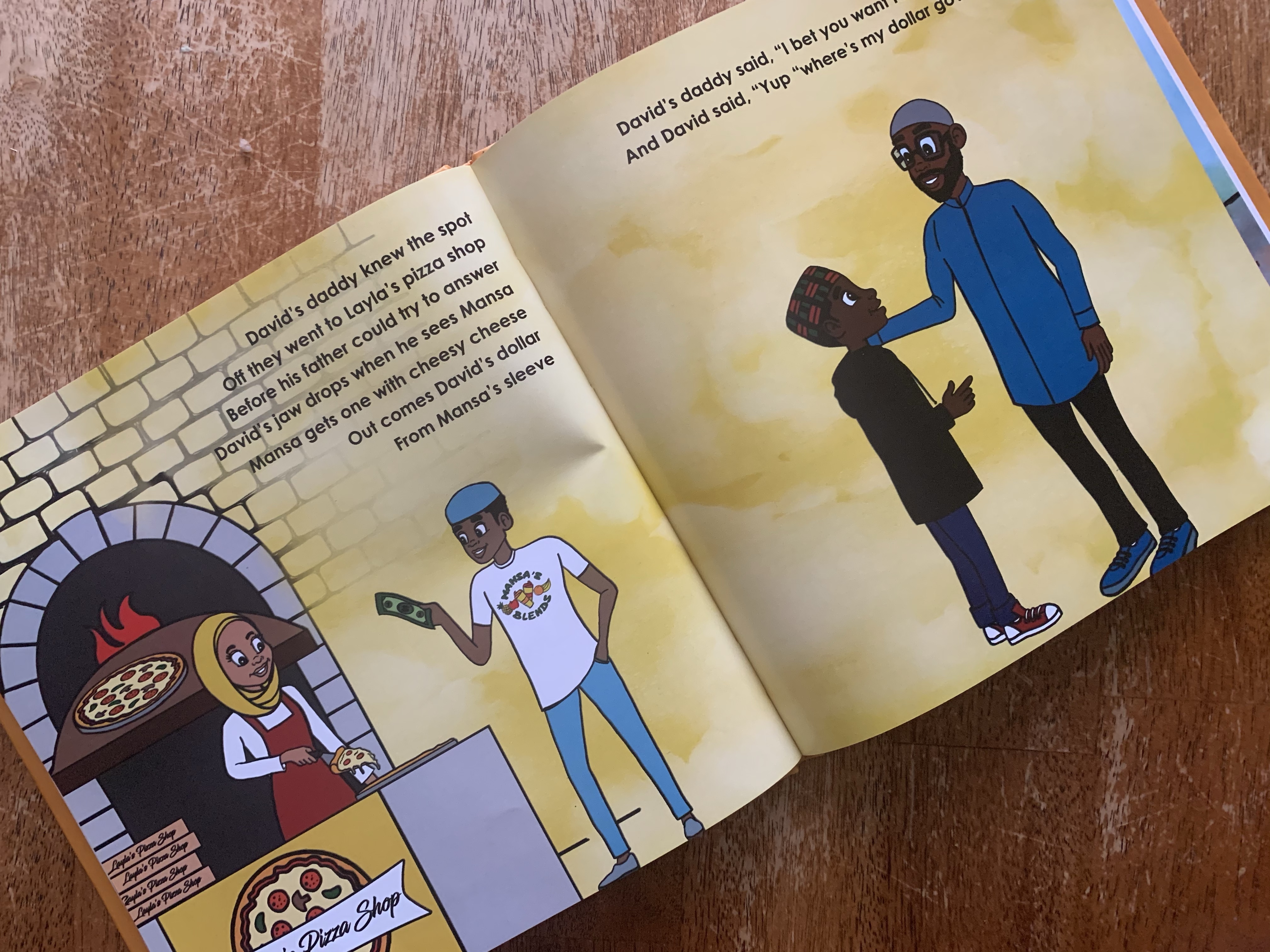
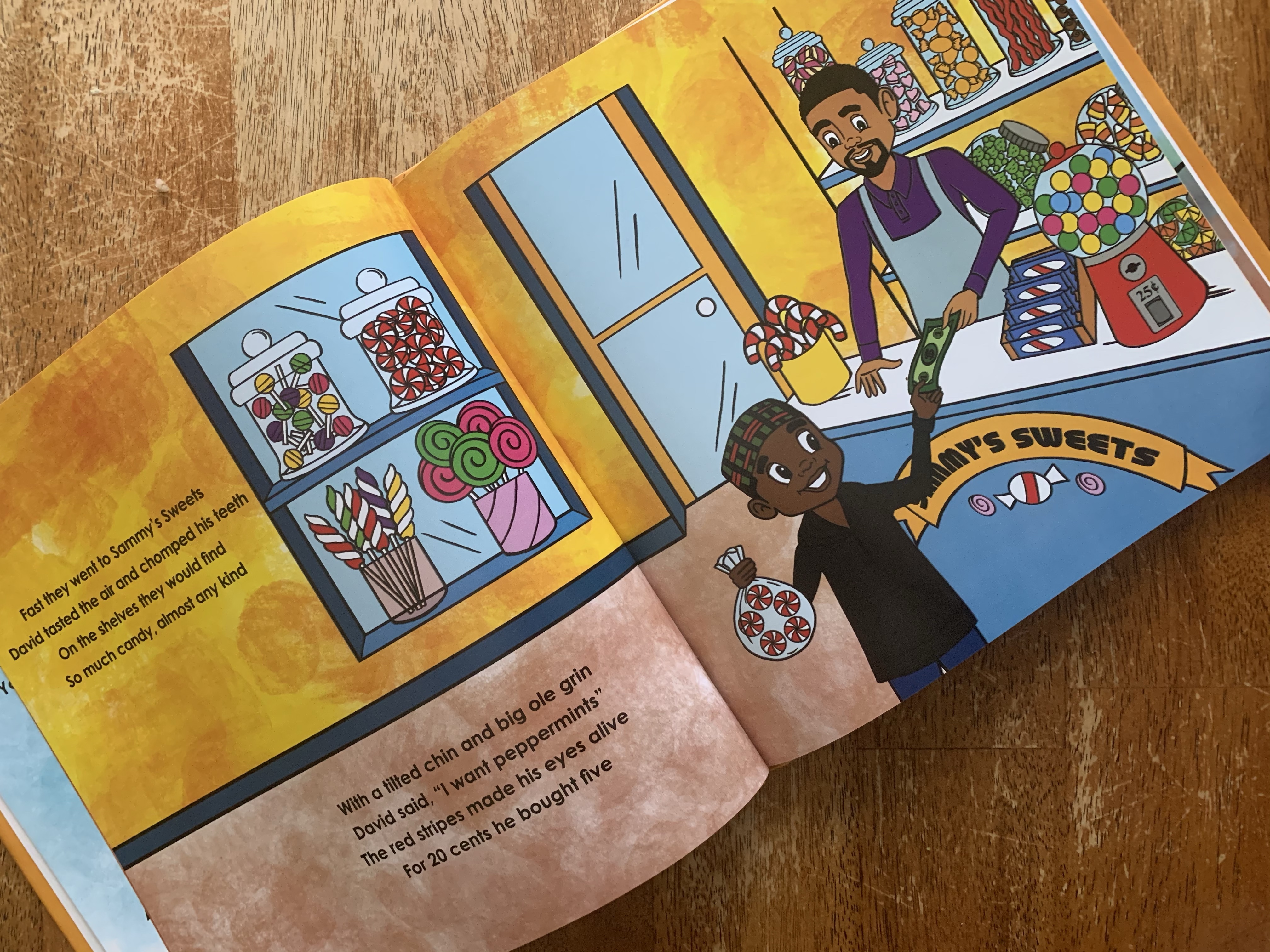
David is getting his dollar after doing his chores, and he is ready to head to the candy shop to see what to spend it on.  At Sammy’s sweets, he decides to get five peppermints, and just like that his hard earned money is gone.  He asks his dad where the money went and off they head to Mansa’s juice shop. When Sammy comes in and buys a drink, out comes David’s dollar and now it is in Mansa’s hands.

David and his Daddy follow the money and see it change hands at Layla’s Pizza Shop, and then Madame C’s Braids, before heading to Uncle Kareem’s hardware store where the dollar too has ended up.  It is time to pray so Uncle Kareem, Daddy, and David head to the mosque.

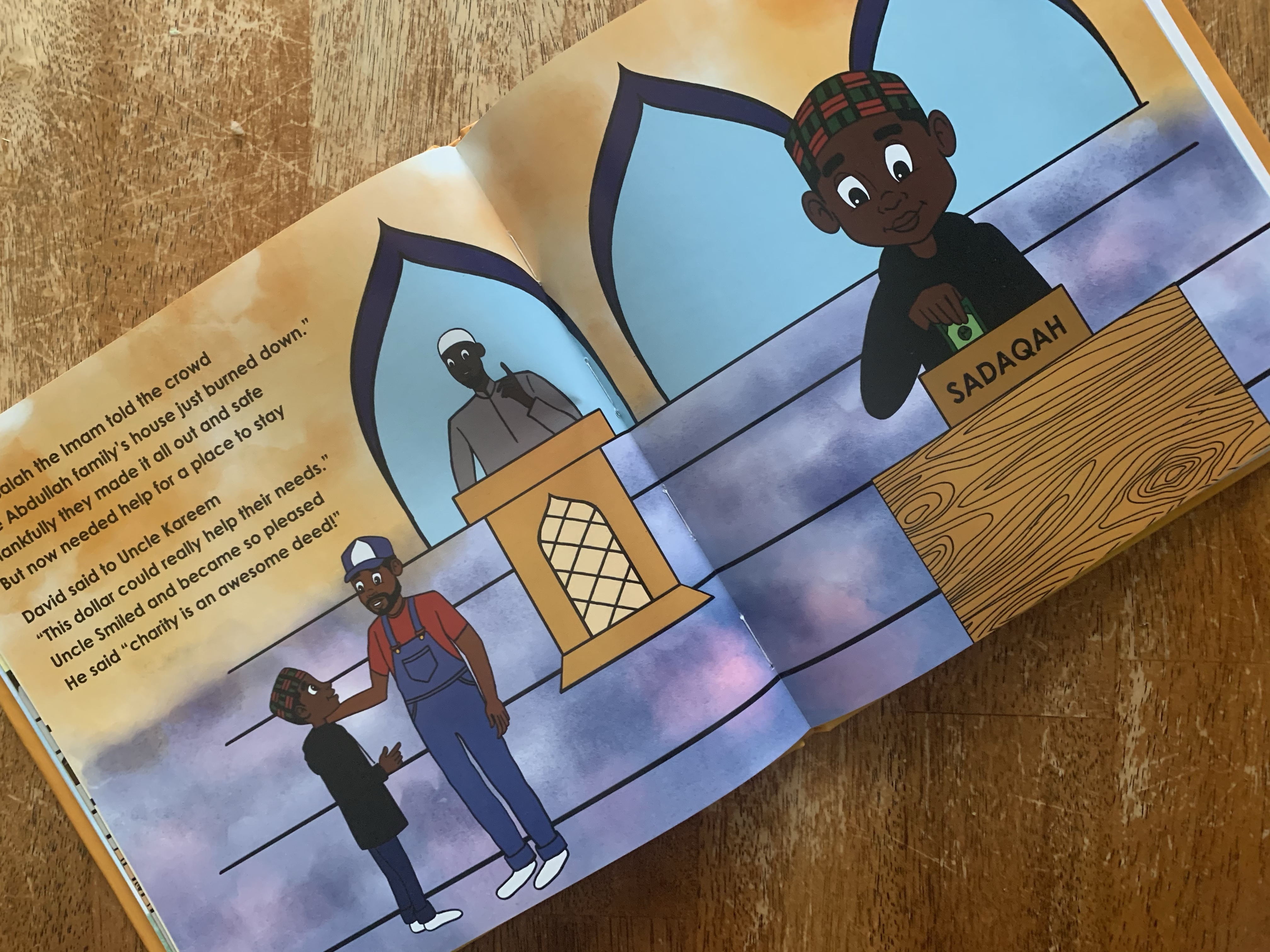
After Salah the Imam tells the crowd that a family’s house has burned down and they are collecting sadaqah.  David tells Uncle Kareem that that dollar should go to the family.  At night, David recalls all the places his dollar traveled and resolves to learn more math.

The book starts with a beautiful heartfelt gratitude message to Allah swt and the community of supporters.  The end of the book features a detailed bio of the book’s poet author and his successes and praises.

The story is rooted in an Islamic community, but is for all readers of all faiths.  There is no preaching or details about belief. many women have hijab on, there are Islamic names, they go to the mosque, they pray, and they give sadaqah.

Hannah and the Ramadan Gift by Qasim Rashid illustrated by Aaliya Jaleel

Standard
Hannah and the Ramadan Gift by Qasim Rashid illustrated by Aaliya Jaleel

img_0275

You may have seen this new 40 page Ramadan book that came out yesterday and thought, “another book about what Ramadan, is and a girl being told she is too young to fast, I’ll pass.”  And I’m here to tell you, please reconsider.  This book is wonderful and it is not the same-old-same-old.  I know the title and cover don’t hint at the heartfelt story within, but it really does an amazing job of showing, not just telling, about the feelings and purpose of Ramadan beyond the restraining of food and drink.  The text is a bit heavy, but the illustrations keep even four and five year olds engaged, and the story works for Muslim and non Muslim children alike.  The OWN voice book has a Desi slant with Urdu words, Pakistani clothing and featuring an immigrant family, but the cultural tinges are defined in the text and it flows smoothly.  This would be a great book to share with your children’s class to show how Ramadan is more than just going without food, or being just one day, or one act of kindness, it is an ongoing effort to show kindness to those near and far.  The book shows an authentic Muslim family and presents universal themes, making Ramadan and Islam more relatable and familiar to all readers, and inspiring Muslim children to find their own ways to save the world.

img_0276

The book starts with Hannah being woken up by her paternal grandfather, Dada Jaan, it is the first day of Ramadan, and she is excited.  She hopes that now that she is eight years old, she is old enough to fast.  Her heart sinks when she is told, “Fasting is for grown-ups, not for growing children,” but her spirits rebound when Dada Jaan tells her that she is going to celebrate Ramadan by saving the world.

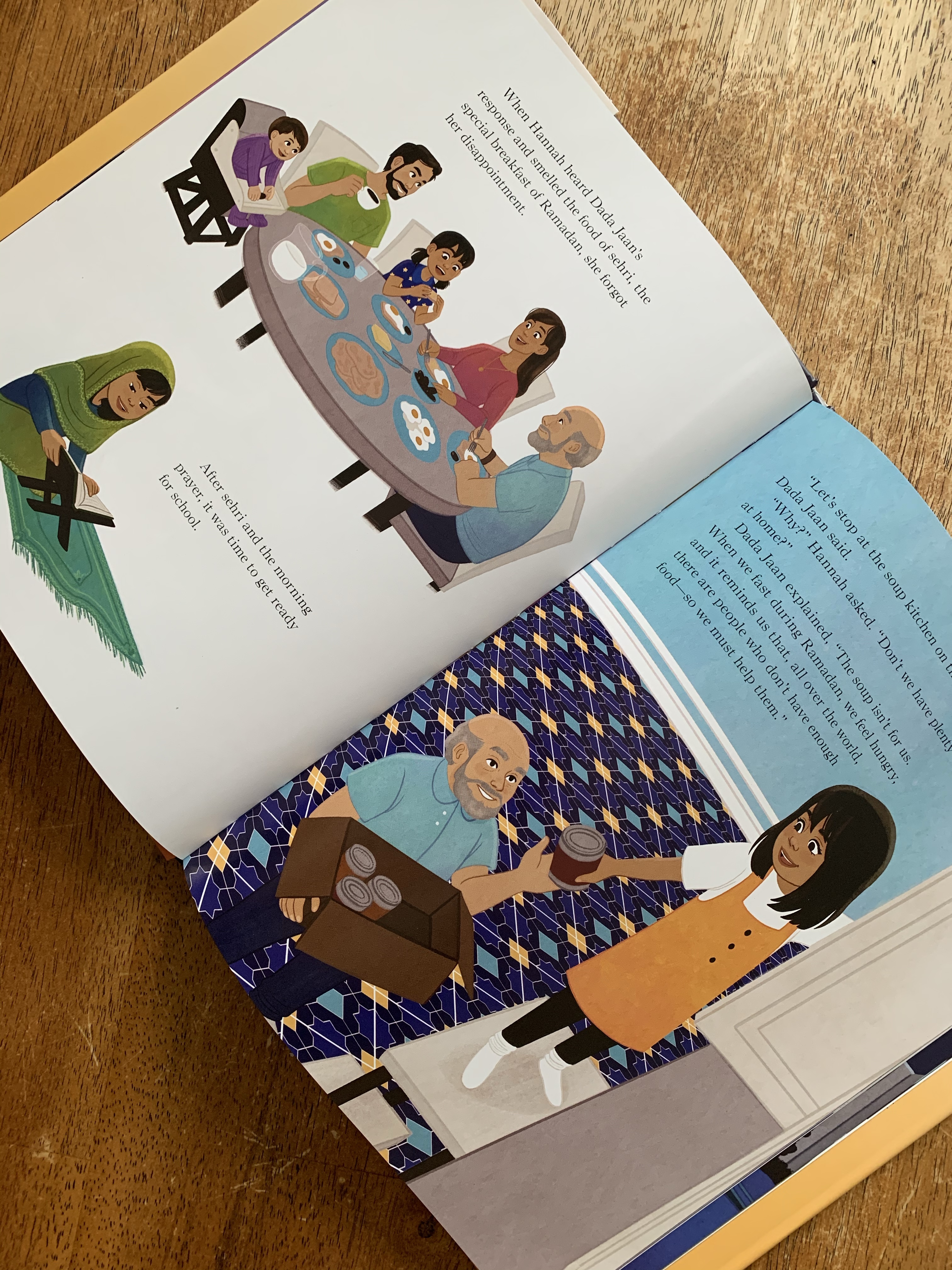
The first thing Hannah and Dada Jaan do is collect cans from the pantry to take to the soup kitchen.  Dada Jaan explains what a soup kitchen is, and why it is important to help those that don’t have enough food.  Hannah is worried they won’t be able to help everyone in the whole world, but Dada Jaan encourages her to start with her neighbors.

img_0277

Later in the day, Hannah’s friend loses a beloved family necklace, and when the bell rings she doesn’t want to be late for class, but she remembers that she is supposed to help, so she does.  Hannah finds the necklace, but her teacher is not happy when she comes to class late, and Hannah isn’t even given a chance to explain.

On the 11th day of Ramadan, Hannah and Dada Jaan decide to save the world again before they head off to the science fair.  They are packing up clothes to take to the shelter.  Hannah is worried that the people at the shelter won’t know that they are the ones that donated the clothes.  Dada Jaan says that it is enough to help people out of love and adds that the best superheroes work in secret.

img_0278

At the science fair Hannah sets up her model replica of Abbas ibn Firnas’s flying machine next to her friend Dani.  When Dani runs off to see a robot, his globe rolls off the table and Hannah saves it. Dani ends up winning and she is happy for him, but she is sad that no one knows she saved his project.

Twenty days in to Ramadan, Hannah has a play date with a girl she has never met before and Hannah does not want to go.  Sarah is new to the neighborhood and Hannah’s mom insists she goes.  Luckily Dada Jaan strikes up a deal that he will take her and they can leave when ever she wants.  Hannah and Sarah have so much fun together, Hannah doesn’t want to leave.

img_0282

When they get home, Dada Jaan shows Hannah old photographs of when he and Dadi Jaan had first come and didn’t even know the language.  They talk about how the kindness of others helped them, that and Dadi’s butter chicken.  The night before Eid, Dada Jaan asks Hannah if she helped make the world a better place, she doesn’t think she did, but he seems to think otherwise.

On Eid day they go to the mosque, then to the cemetery to pay respect to Dadi Jaan, and when they return home they find Hannah’s whole world there to celebrate with her.  Cousins, friends Maria and Dani from the church across the street and the synagog by the mosque, as well as the Sikh family that runs the soup kitchen.  Dada Jaan and Hannah enjoy gulab jamun, kheer, and jalebis as they discuss if Hannah really did help the world this Ramadan.

img_0280

It is hard in my heart to go wrong with a story that focuses on an amazing grandfather/granddaughter relationship that ends with them racing to get the last gulab jamun, so I might be a little bias.  But I was genuinely surprised and delighted by the direction the book took and the way it presented Ramadan in everyday situations that children can relate to and imitate. I was a little disappointed that the book wasn’t larger considering the phenomenal illustrations.  It is just 8.5 x 11.  I love that the characters pray and read Quran, and the mom covers and the neighbors are diverse.