Tag Archives: community

The Great (Food) Bank Heist by Onjali Q. Rauf illustrated by Elisa Paganelli

Standard
The Great (Food) Bank Heist by Onjali Q. Rauf illustrated by Elisa Paganelli

food bank

As an adult setting out to read this book, I imagined that the goal of the book was to bring awareness to a specific issue, food insecurity, and to rally support to help others with this basic need.  The beauty of Muslim author and activist Onjali Q. Rauf, however, is that even with such a clear intent, the storytelling, character building, and  enjoyment of the book makes you connect to the plot and issues and feel the message, not just be told it.  For children seven through 12  with no prior expectation of the book, they will be emotionally effected by the reality shown and feel empathy and compassion for characters that will hopefully translate into their real life.  My 10 and 12 year old boys read the book in about an hour, not realizing what the book was going to be about and hounded me to read it with glowing reviews.  This 103 page middle grades book has diverse characters (none are Muslim), and is a great story, a great educational tool, a great empathy check, and a great resource for how to get involved to start helping food banks, and breakfast clubs, all while being funny, relatable, kind, and engaging.

img_3836

SYNOPSIS:

Nelson, his younger sister Ashley, and their Mum work together to make hard “tricky” months manageable.  They are creative with their meals, they go to breakfast club, and they use their vouchers on Thursdays at the food bank.  Some times though, it isn’t enough, Mum has to pawn her jewelry, they go without meals, and generous friends share their snacks.  When the food bank starts running low, Nelson breaks his secrecy about breakfast club and his close friends Krish and Harriet are determined to help figure out why donated food isn’t reaching the bank and what they can do to make sure it does.
img_3837

WHY I LIKE IT:

I love that it shows how the family has food insecurities on a day-to-day basis and how never feeling full affects so much of the characters’ attention.  I also love that it shows their mom works, she is a nurse and works really hard, they don’t steal or load up on food that is donated, they are very grateful for all assistance given and their friends don’t judge them.  It shed light on a different narrative that many children perhaps don’t think about: that people they know and are close with, might be hungry.  I think the maturity of the kids is a lesson to adults reading the book too, that reminds us that kindness and assistance doesn’t need to come with judgement or arrogance.  The characters are all really likeable, they aren’t perfect, but even though the book is short, you feel your heart being affected by them in their handling of the mystery and the larger concept of hunger.

img_3838

FLAGS:

None

TOOLS FOR LEADING THE DISCUSSION:

I would read this book aloud in a classroom (2nd-5th), and if I get a chance to participate in Lunch Bunch (where a book is read to children while they eat their lunch) at our local Islamic School, I will start off with this book.  I think kids have bigger hearts than we often think they do, and while they might not recall the less fortunate when you want them to finish all the food on their plate, they often notice kids without lunches at school and share without prompting.  

Here’s a great clip and reading by the author: https://www.youtube.com/watch?v=NVYBLh0kODc

Happy Reading!
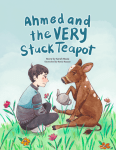
 

Ahmed and the Very Stuck Teapot by Sarah Musa illustrated by Rania Hassan

Standard
Ahmed and the Very Stuck Teapot by Sarah Musa illustrated by Rania Hassan

This 36 page early elementary book is packed full of choices and lessons packaged in a sweet story that kids and adults will enjoy reading and discussing over and over. My only real critique is the title. I’ve had this book sitting on my shelf for nearly a year thinking it was just a silly book about a calf with a teapot on her hoof that is stuck and would probably involve different people and methods and attempts to get it off. But the teapot is off by the tenth page, and the story is really just getting started. Like all Ruqaya’s Bookshelf picture books, the large thick shiny pages with a stiff soft cover binding make the story a great choice for storytime and bedtime alike. There are Islamic threads and references, but the story overall is universal.

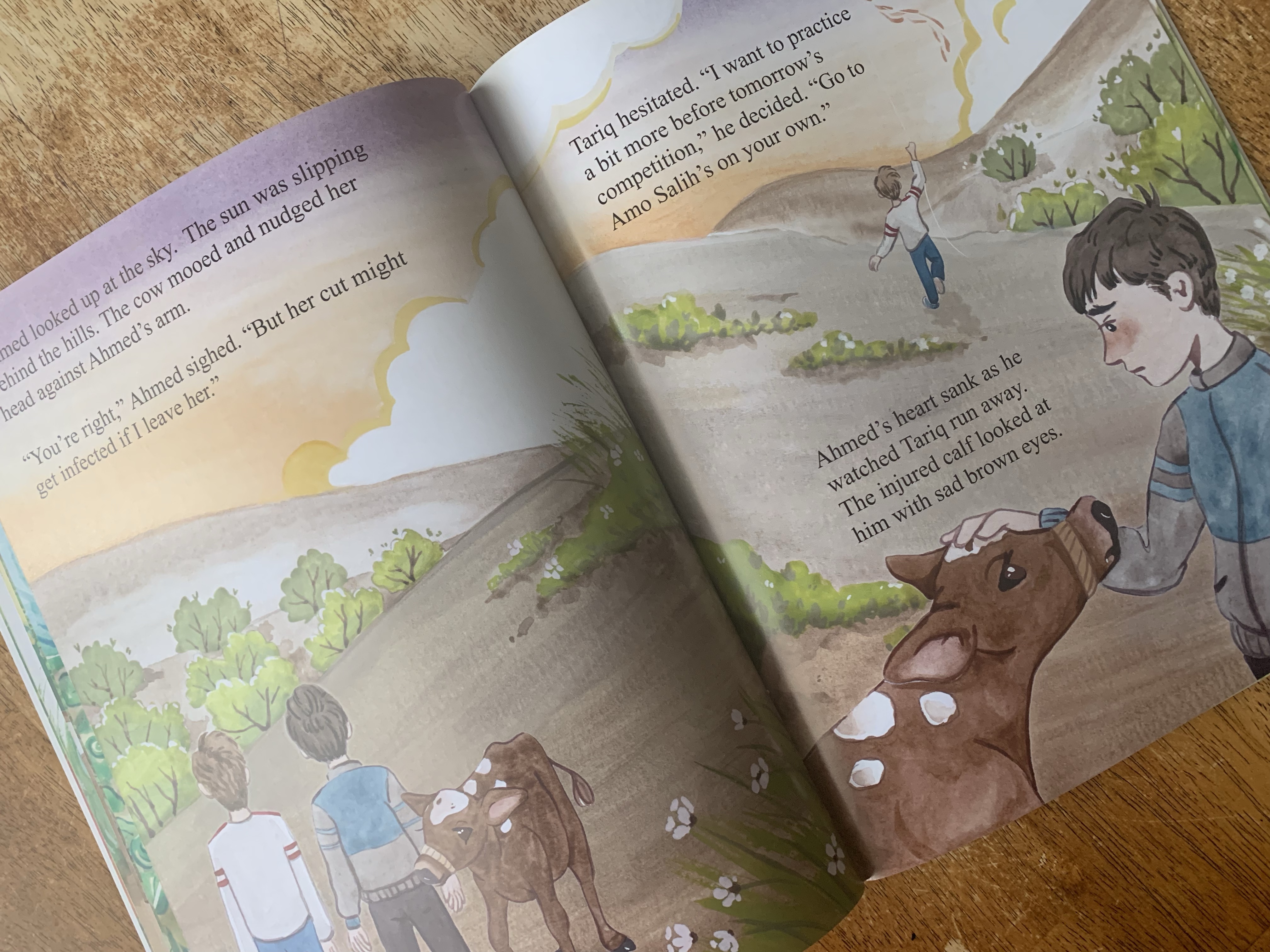
Ahmed and his friend Tariq are practicing their kite flying skills for tomorrow’s annual competition, when Ahmed’s kite gets destroyed in a tree. Heartbroken Tariq suggests he hurry to buy a new one before the store closes at Maghrib. As the boys rush off they come across a brown calf with a teapot on her hoof. Ahmad recognizes the teapot as his mother’s and feels like he should help the poor animal. Tariq keeps reminding him that the shop will close, but Ahmed decides to take the cow to Amo Waseem’s to get help.

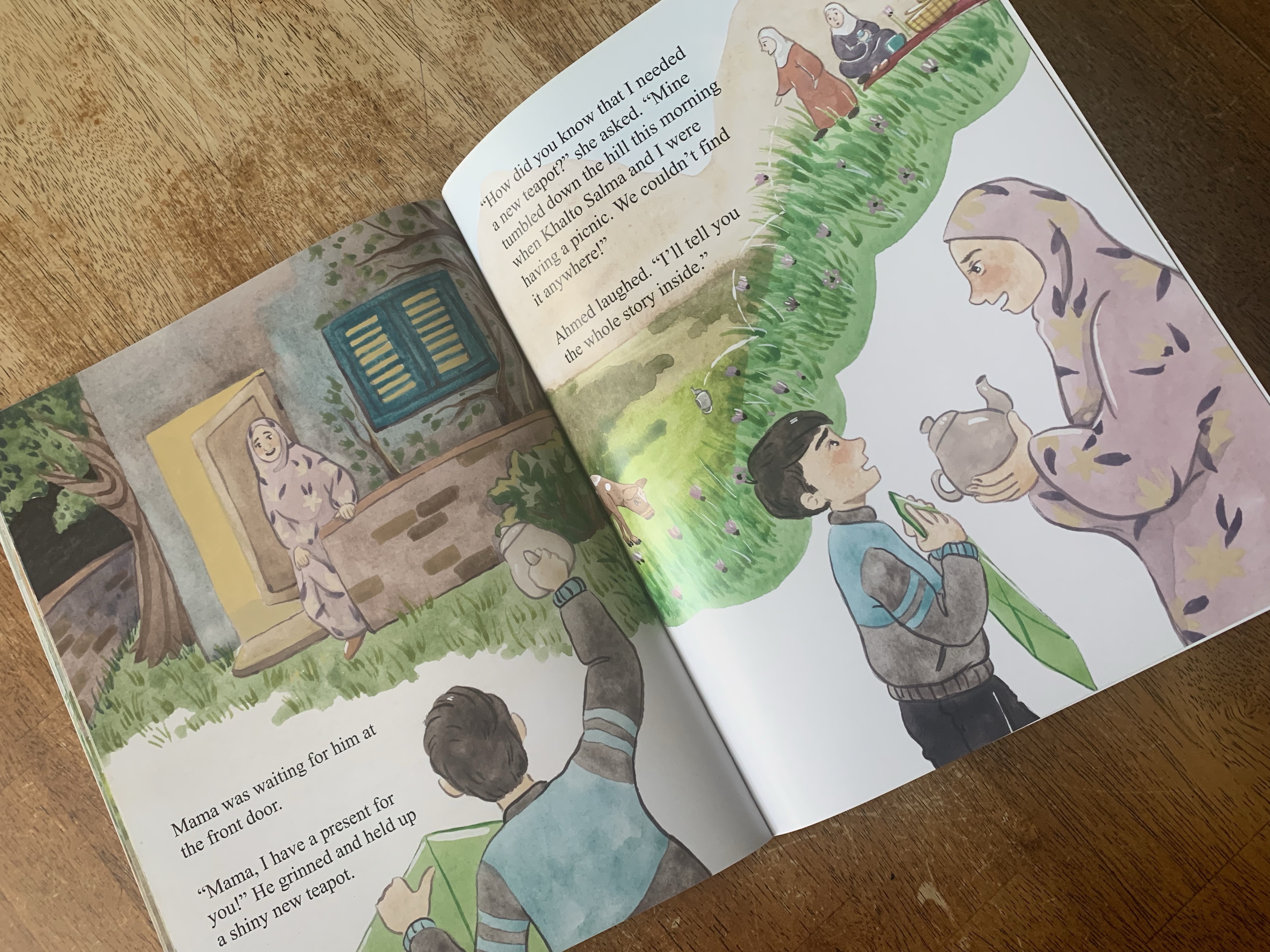
Amo Waseem, is able to help the cow get free, but in the process, the cow get’s hurt. The cow needs help from a shepard, Amo Salih, but Amo Waseem can’t go, and Tariq wants to practice more. Ahmed knows the cow can’t be left untreated, and takes the little cow to get help. The cow then needs to get to his owner, and the story continues until the shop is closed, and Ahmed realizes he won’t have a kite for the competition. He goes to the mosque for salat and starts to feel better, he knows that he did the right thing, and inshaAllah Allah will reward him in some other way. His reward comes quickly, however, much to Ahmed’s surprise and in gratitude he also manages to find a way to help his mother.

I love the gentleness of the lessons of doing what needs to be done, even when you don’t really want to, and your friends are not supporting you. Ahmed had chances to walk away, but he didn’t and he was at peace with the outcome. His friend wasn’t mean or bad, he just made different choices. There are discussion questions at the end as well. I think this book would foster great conversation with even the littlest listeners, and I can’t wait to share it at our masjid’s storytime.

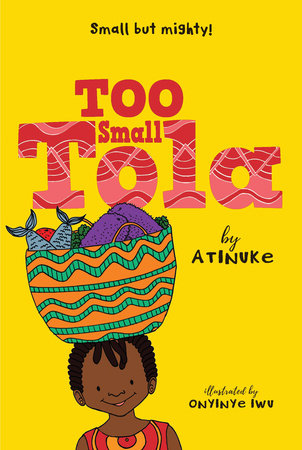
Too Small Tola by Atinuke illustrated by Onyinye Iwu

Standard
Too Small Tola by Atinuke illustrated by Onyinye Iwu

9781536211276

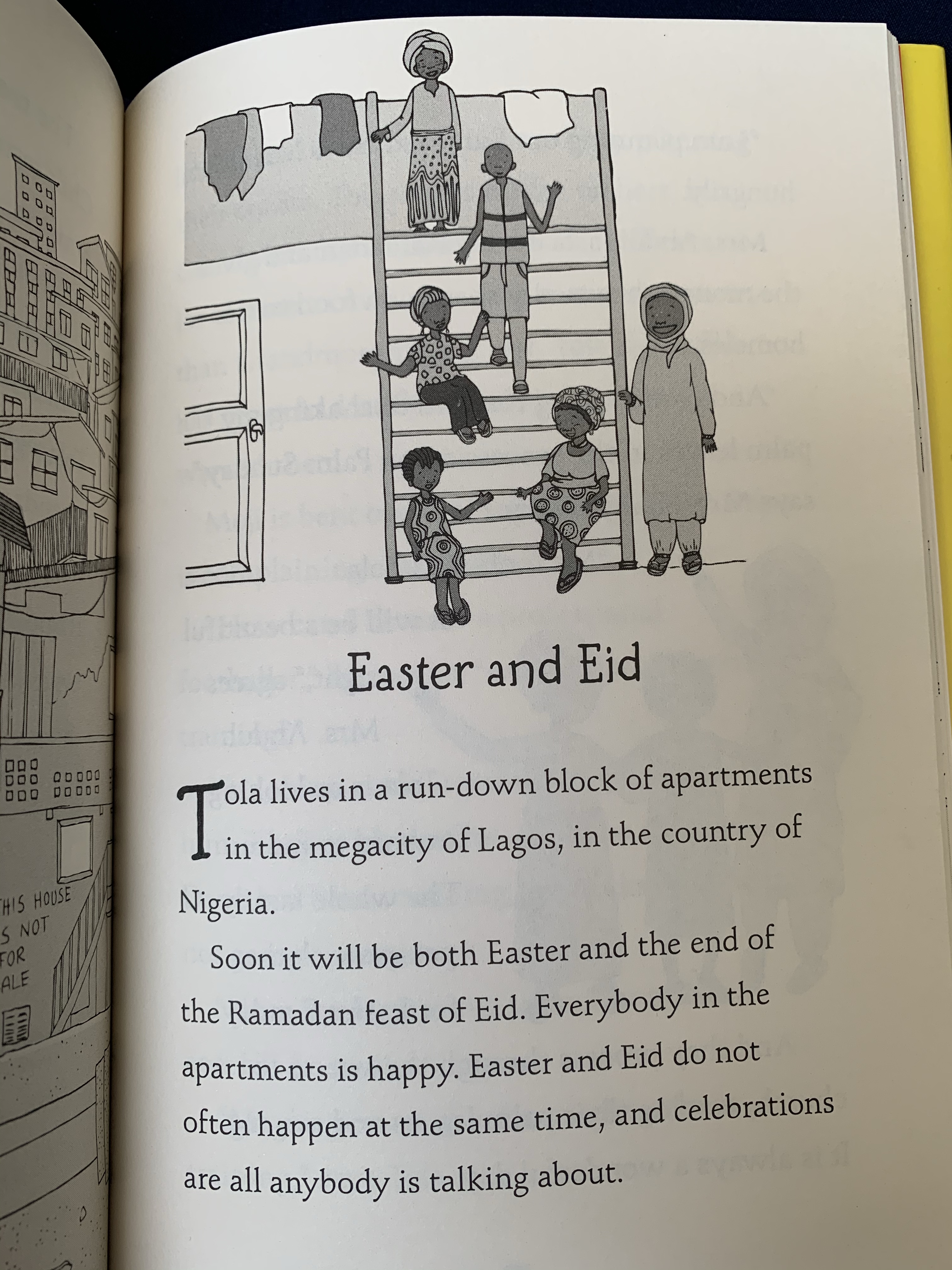
This AR 3.6, 89 page early chapter book features three stories set in Lagos, Nigeria.  The main character and her family are Christian, but many of the neighbors are Muslim, and the third story is set in Ramadan with Easter and Eid falling at the same time.  The sense of community throughout the book, the OWN voice detail and charm make this book silly, warm, and delightful for first through third grade readers.

img_9777

SYNOPSIS:

In the first story Tola heads to the market with her Grandmommy.  Not the fancy mall, but the muddy market further away.  Her older brother Dapo is too busy playing soccer to help, her older sister Moji is busy with homework, that leaves little Tola to carry the items on her head with her tough as nails little grandmother.  Everyone says she is too small, but Grandmommy knows she can do it.  As they purchase the items, and neighbors call to have them pick up items for them too, the duo have to take lots of breaks on their way home, but Too Small Tola does it and proves to herself and others that she might be small, but she is strong.

The second story once again focuses on life in Lagos and the one bedroom apartment the family shares.  One morning both the power and the water are out and the jerry bottles need to be filled at the pump.  When some bullies trip Tola and the water spills, an elderly neighbor lady patiently waits for the right time to get her revenge on Tola’s behalf, and when the bully challenges the woman, the entire line stands together.  Tola may be small, but she stood for something and made a difference.

The final story involves the neighbor, Mr. Abdul, the tailor who lives downstairs, coming to measure Tola and her family for their new Easter clothes.  He let Tola measure everyone last year and praises her as the best measurer in Lagos, and Tola is eager to take the measurements this year.  When the tailor breaks his leg, he is worried he will not be able to ride his bicycle to his clients and will not be able to prepare the Eid feast and pay rent.  Tola knows they have been fasting all Ramadan and between her, Grandmommy, and Dapo they come up with a plan to help.  Dapo will peddle the bike and take Tola to measure everyone for their orders.  Tola may be small, but she can save the day for the Abdul family.

WHY I LIKE IT:

I love little Tola and her sassy grandma.  The book would lend itself so wonderfully to be read aloud as it bursts with personality and dialogue.  I love the sense of community in such a day-to-day life that would seem to stark and hard to most western readers.  Tola’s draws on those around her to find her strength, from her Grandmommy, to her neighbors, they may tease her that she is too little, but they also build her back up and stand with her.  I love the diversity in Tola’s world.  She seems so excited that Eid and Easter will be aligned and that after her services they will be joining the Abdul’s feast, such a great lesson of tolerance and respect without being preachy about tolerance and respect.  Young readers will enjoy Tola and the insight into Nigeria.

FLAGS:

Grandmommy lies when a neighbor calls her in the market to ask her to pick up his TV, she pretends the battery dies as she and Tola laugh at how ridiculous them carrying a TV would be in addition to everything else they are carrying.  There is bullying when Tola is tripped and then when Mrs. Shaky-Shaky trips the bully.

img_9781

TOOLS FOR LEADING THE DISCUSSION:

This wouldn’t work for a book club, but would be ideal in small groups, or to be read aloud.  There would be a lot to discuss as children would relate to Tola and find themselves cheering her on.

Sadiq and the Ramadan Gift by Siman Nuurali illustrated by Anjan Sarkar

Standard
Sadiq and the Ramadan Gift by Siman Nuurali illustrated by Anjan Sarkar

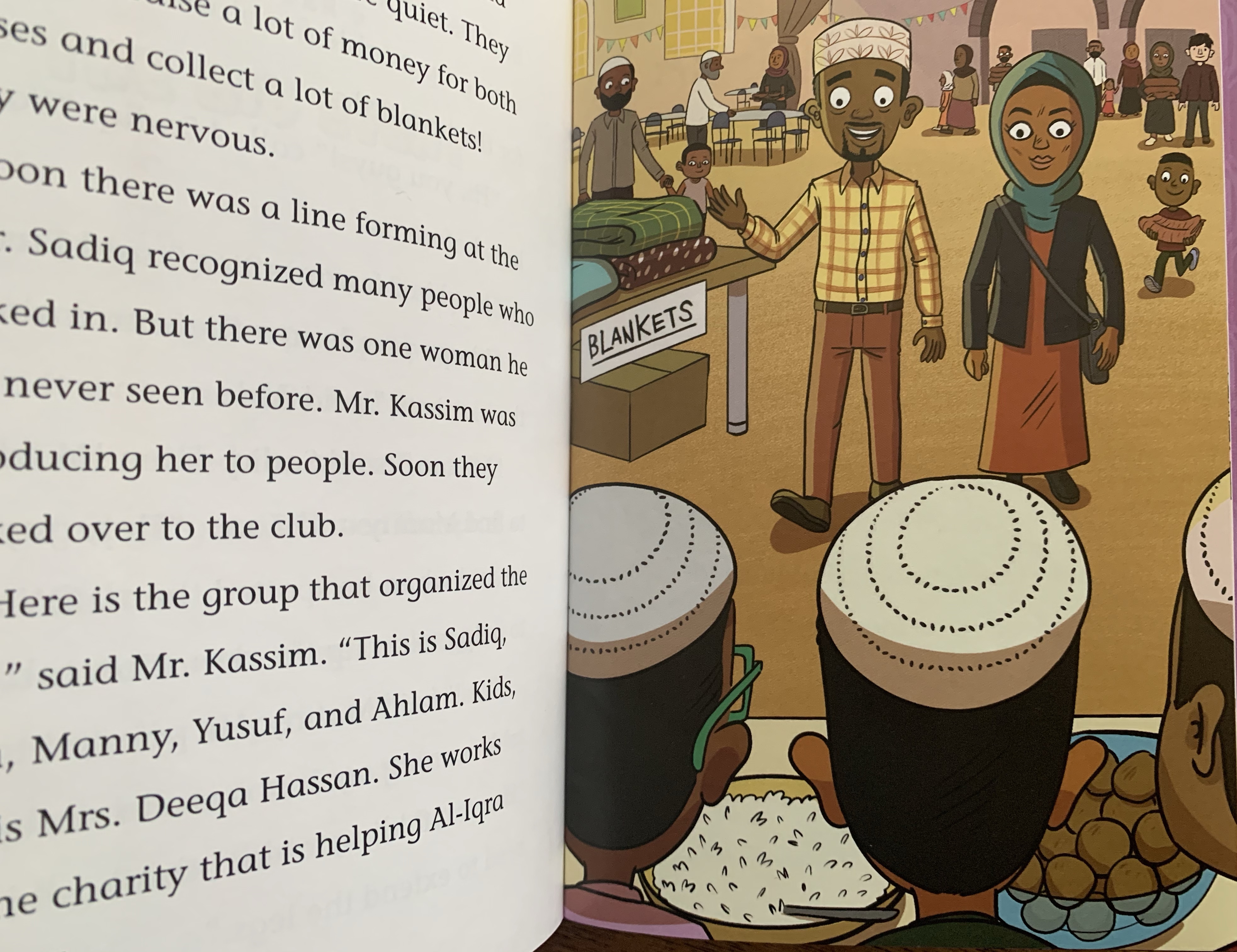
img_8554This 65 page early chapter book in the Sadiq Series does a great job of introducing Ramadan, giving a glimpse of Somali culture, and conveying a relatable and engaging story about friends with a lesson/reminder about the values of communication.  A group of boys hosting a fundraising iftar to help a school in Somalia have to figure out the logistics, the marketing, the cooking, and the execution, as they become socially aware and active in helping meet the needs of their community, both locally and afar.  This OWN voice tale doesn’t shy away from authentically drawing on religion and culture to make characters and a plot that all readers can enjoy.  The book is not preachy, but the characters know who they are in their manners, dress, speech, and environment.  A great book any time of year for first grade and up.

img_8555

SYNOPSIS:

With Ramadan starting in a few days, Sadiq and his friends at the Dugsi are reviewing the importance and values of Ramadan.  This year the masjid is raising money for a school in Somali and the students are encouraged to help, as sadaqah, or charity, is especially important during Ramadan.  The boys decide to host a fundraising iftar at the masjid and with parental help to coordinate with the Imam, the kids have to figure out how to get enough food, get the word out, get set up to take donations and more.  They make flyers, set up a website and shoot a small video.  The once excited Zaza, however, is no longer very enthusiastic in the Money Makers Club and Sadiq can’t figure out why, but with so much to do and little time to get it done, more friends and family are brought in to help, and things continue on.  When Zaza tries to tell Sadiq he wants to do his own fundraiser, Sadiq doesn’t want to listen.  I’m not going to spoil if the two friends work it out and how they handle the two ideas, but it is a good lesson in friendship, communication, and charity, Alhumdulillah.

img_8556

WHY I LIKE IT:

I love that the story starts with information about Somalia and words in Somali as well as a picture of the family.  There are activities and questions at the end as well as a glossary of religious, cultural, and English vocabulary words. The book doesn’t assume that the reader knows anything about Islam or Somalia, nor does it assumer that the readers don’t.  It strikes a balance of not talking down to the reader or getting too wordy.  It simply provides the information needed if you are curious, but allows the story and the boys dilemma to take center stage.  The whole series is remarkable in showing diversity and relatability with good quality story telling.  I think this is the only book in the series that has a religious theme, I could be mistaken.  The illustrations show the boys in kufis and the women in hijab.

img_8557

FLAGS:

None

img_8558

TOOLS FOR LEADING THE DISCUSSION:

Every elementary school library and every first through third grade classroom library should have this series.  I know my public library has it, and the copies I get from there seem to be worn and loved.  The age is too young for a book club, but would be great in small groups or for outside reading with the short chapters and engaging illustrations.

Alia’s Mission: Saving the Books of Iraq by Mark Alan Stamaty

Standard
Alia’s Mission: Saving the Books of Iraq by Mark Alan Stamaty

alia

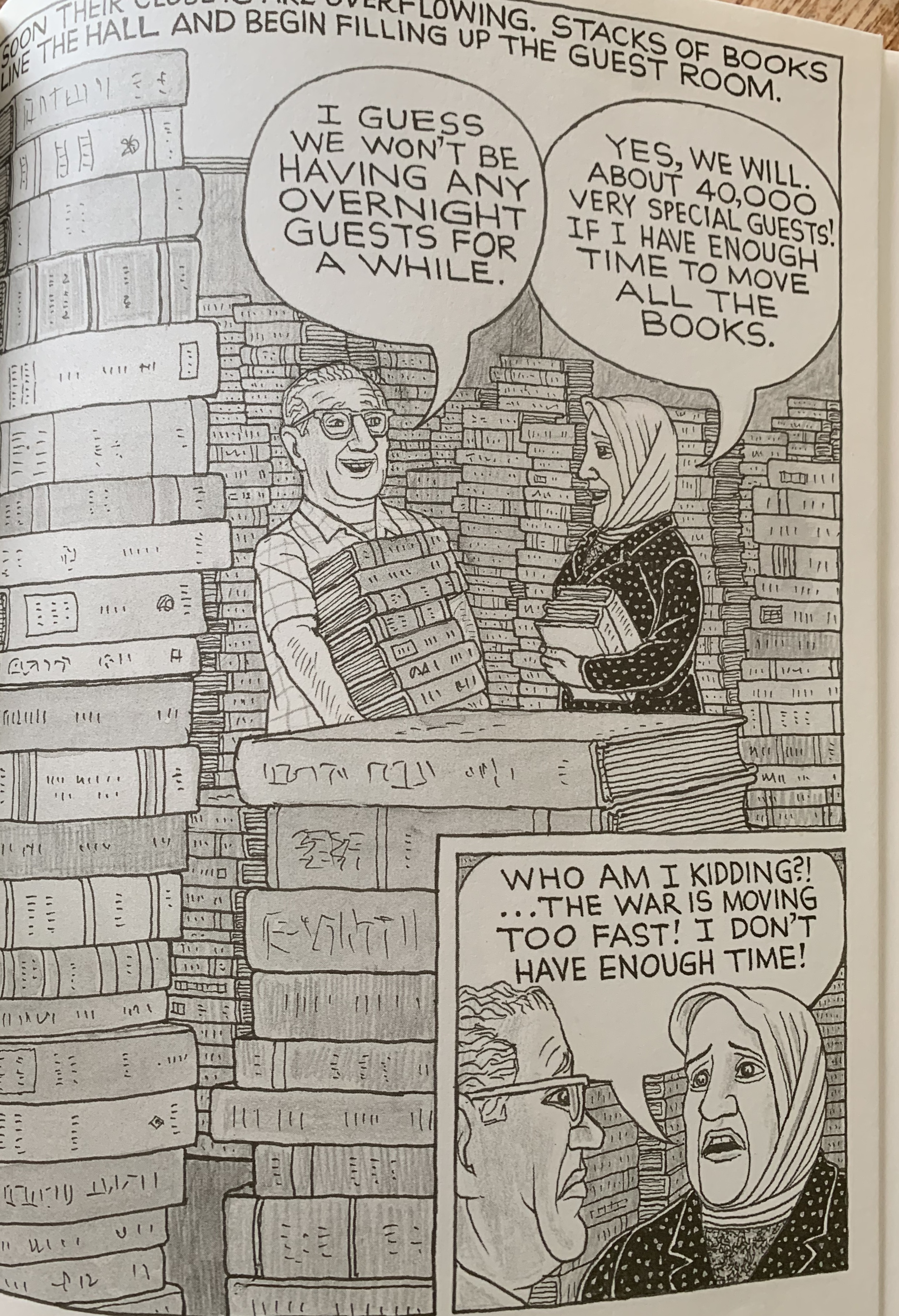
Based on the true story of Alia Muhammed Baker, the Basra librarian who saved 30,000 books in 2003 from the destruction during the Iraq War, this 32 page graphic novel, is an AR 3.9 and while it isn’t a chapter book and isn’t just a picture book, it works well for 2nd through 4th grade readers that will enjoy a bit of history, a lot of excitement, and detailed panels that make the story come to life.  The story, as it is based on fact, is very similar to The Librarian of Basra, but with it’s different presentation style, might appeal to a larger audience to appreciate and celebrate what she did to save such precious books, naturally, I’m a huge fan!

5532A37C-C4DF-46FA-8334-5F4AA3A06AB5

SYNOPSIS:

Alia is the Chief Librarian of Basra Central Library and has always loved books and learning.  As war draws closer, she tells her husband she is worried that the library could be bombed or set ablaze.  She goes to the government to voice her concerns and ask that the books are relocated, but her request is denied.  So she takes matters in to her own hands, and starts smuggling books under her shawl and in to her car, and stacks them in her home.  Every day she does this for a week, soon closets are over flowing and she starts stacking the books in her guest room.  Worried that she isn’t making fast enough progress, she gets the restaurant owner next door to help her when looters start taking the pencil sharpeners and furniture from the library.  She has a plan to have everyone possible come together to move the books, and many people come to help.

Eventually the library is set on fire, the news gives Alia a stroke.  When she recovers she learns she saved 30,000 books, and up next for this real life super hero? Building a new library, inshaAllah.

A3A17616-7940-4E80-8CA1-9798A8BA4FC8

WHY I LIKE IT:

I love that it shows the value of libraries and books, the determination of one person, and the support of a community.  People are awful during a war, yet, sometimes they are pretty amazing too.  The illustrations are detailed and varied, with inviting text and clear concise language.  It really is well done.

B0FB5A2A-7376-4F20-BCD1-6D64956B77C6

FLAGS:

Destruction of property, sneaking, looting.

TOOLS FOR LEADING THE DISCUSSION:

I think it would be great to have kids read this story and the librarian of Basra and discuss


The Arabic Quilt: An Immigrant Story by Aya Khalil illustrated by Anait Semirdzhyan

Standard
The Arabic Quilt: An Immigrant Story by Aya Khalil illustrated by Anait Semirdzhyan


arabic quilt

This 36 page picture book tells a beautifully presented story that incorporates events from the author’s real life that convey a story of loving your culture, finding similarities and giving people a second chance.  Ideal for students between 2nd and 4th grade, younger children will enjoy having the story read to them, and older kids will benefit from the message as well.

7C03525B-A26D-427F-A7EA-591BB3095F10

Kanzi is about to start her first day of 3rd grade in a new school.  It doesn’t specify if she has just come from Egypt, but being she seems to speak English well, knows that she’d rather have peanut butter and jelly instead of a kofta sandwich and mentions that she got a quilt when she visited her grandmother, in Egypt, she possibly is just starting a new school, not her first in America, but it is considered an immigrant story, so I’m not certain. E403D261-438B-4263-A2FB-C3F8693C9D3E

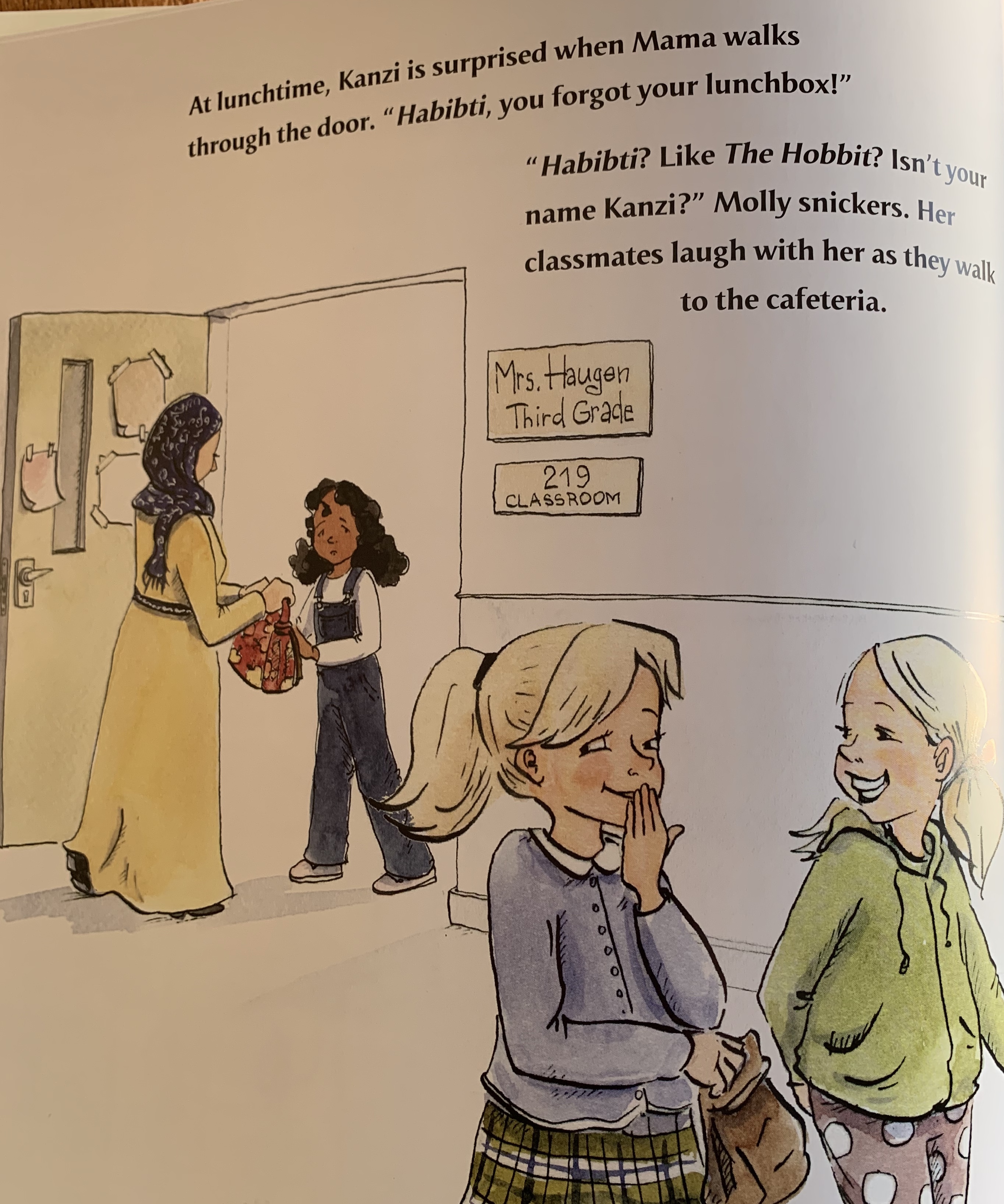
When she arrives in class and introduces herself she bravely says that she is Egyptian-American, but on the way to school she turns down the Arabic music in the car, so the reader sees that she is a little nervous about being seen as “different.”  When her hijab wearing mom brings her forgotten kofta sandwich and calls Kanzi ‘Habibti,’ classmate Molly teases her that she is being called a hobbit.

A crying Kanzi tells her teacher and Mrs. Haugen reassures her that “being bilingual is beautiful.”  That night Kanzi asks her mom to send her a turkey sandwich for lunch the next day, and before beds she writes a poem as she snuggles in her beloved quilt.

76FCD440-0D81-4893-80F3-1CC6033E8461

At school Molly apologizes to her and says that it just sounded funny.  Kanzi tells Molly it is because she doesn’t speak Arabic and that her mom says that “learning different languages makes a person smarter and kinder.”  Molly dismisses the comment and smugly walks off.

Mrs. Haugen sees Kanzi’s poem about her quilt from her grandma in Egypt and asks her to bring her quilt to school. The kids love it, and Friday Kanzi’s mom shows up to help with a special project: an Arabic quilt with the kids names.

98E875AE-0FD1-4827-BF39-1CA7B1172843

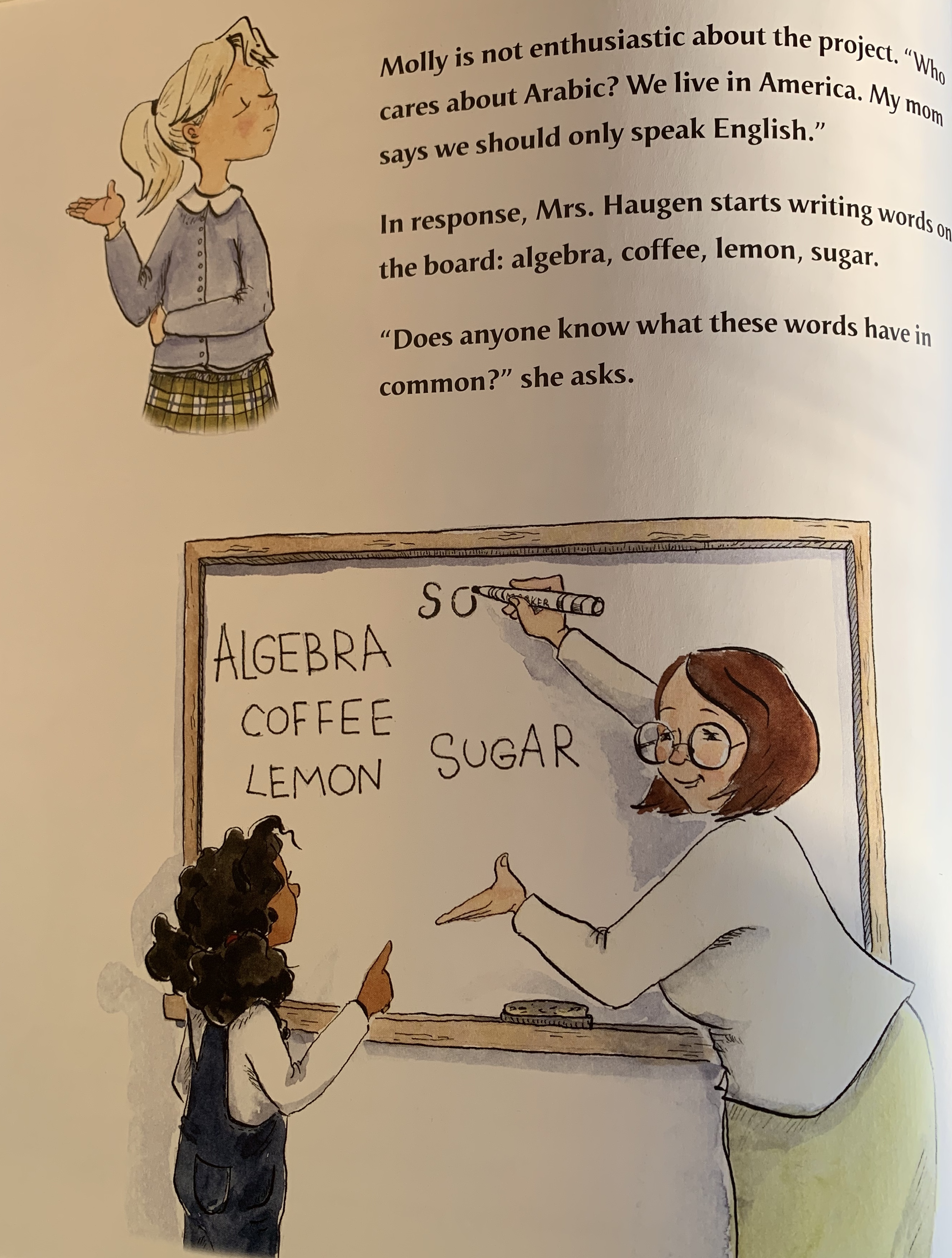
Molly is not enthusiastic and Mrs. Haugen writes English words that come from Arabic on the board: coffee, lemon, sugar, algebra.  Telling the kids that “we can speak non-English languages and still be American.”

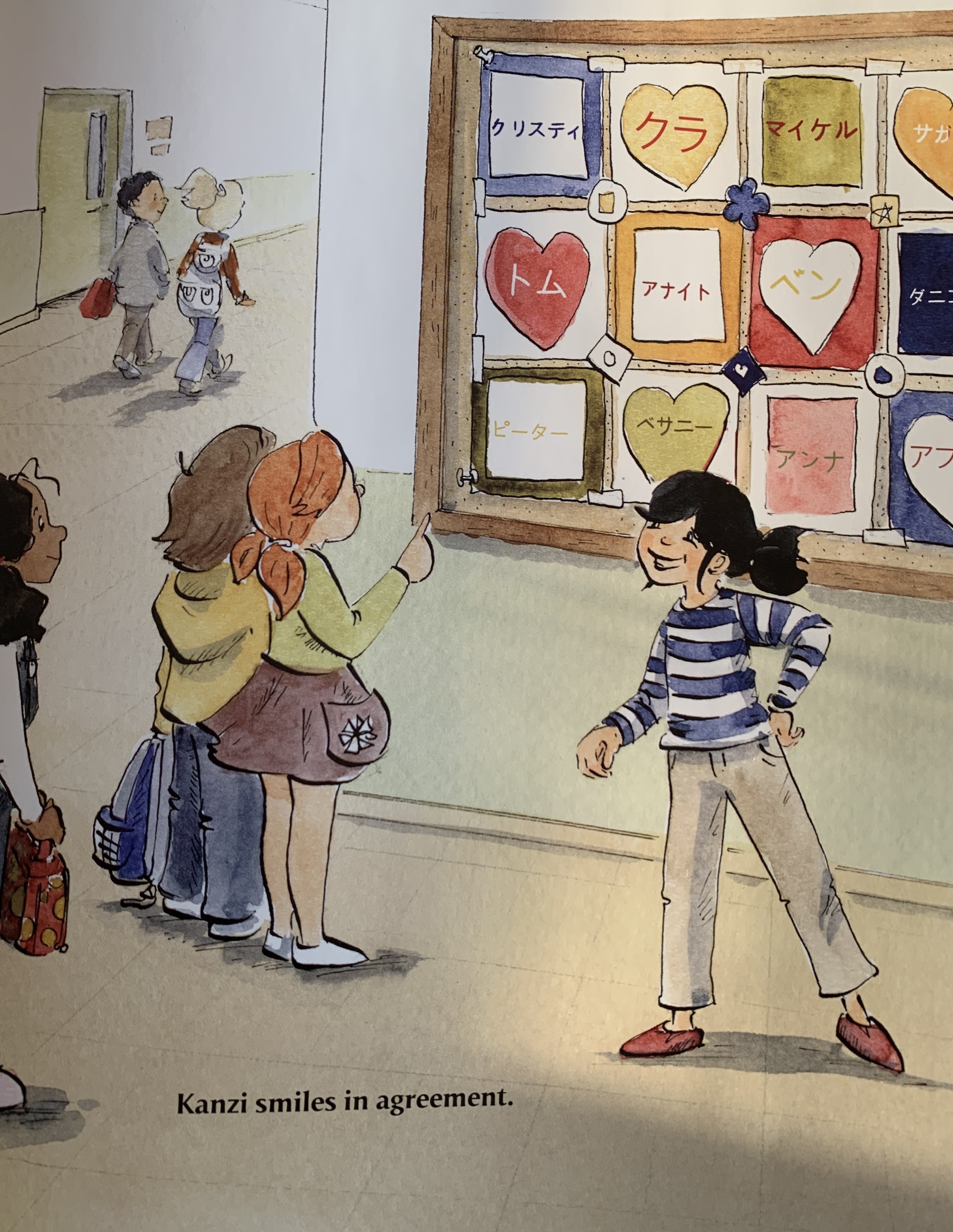
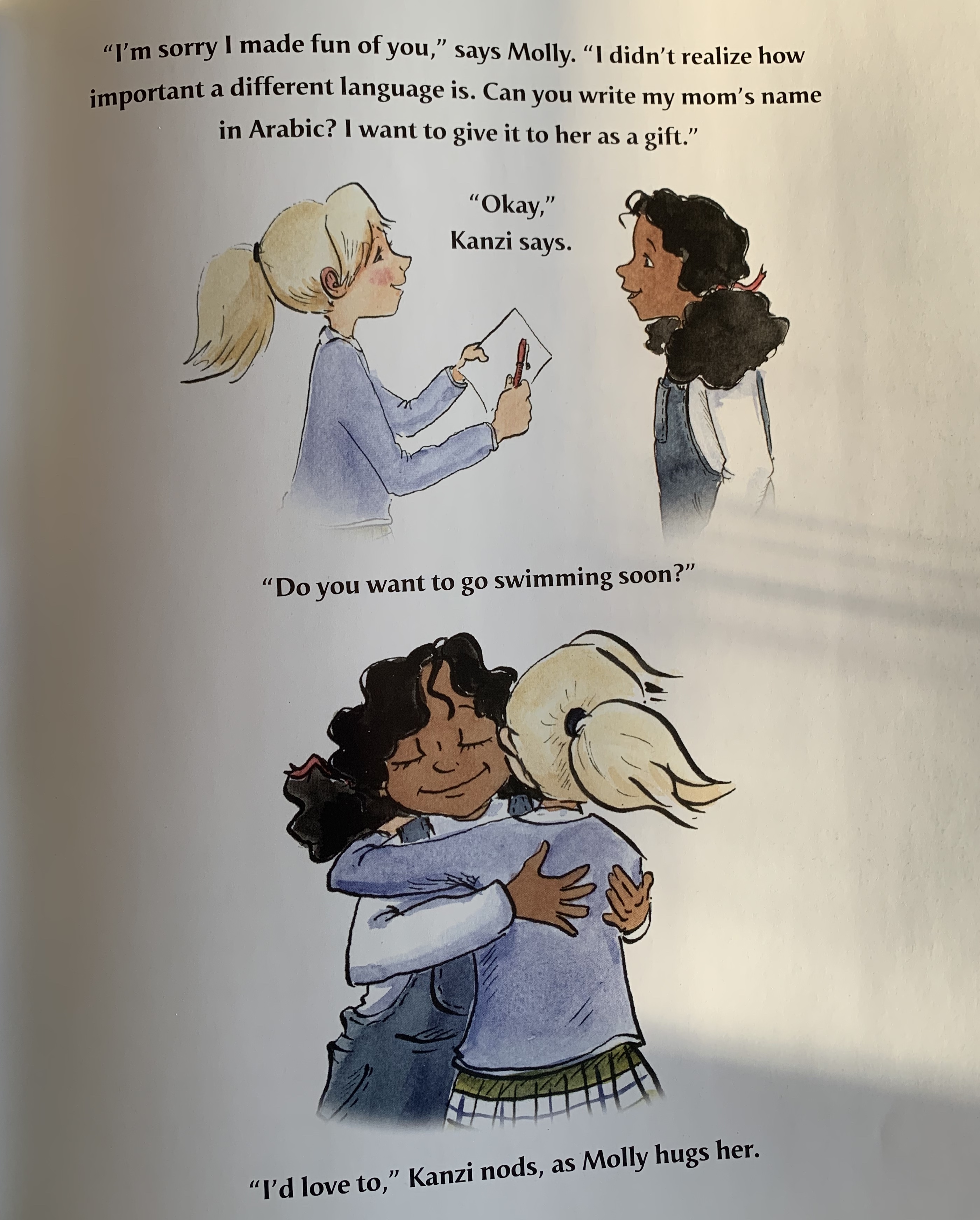
Kanzi and her mom write the kids names down and the children copy them.  The teacher cuts them out and makes a quilt to hang in the hall.  On Monday when everyone sees the quilt, they love the beautiful letters and colors.  Even Molly sincerely apologizes and asks Kanzi to write her mom’s name in Arabic as a gift.  The two hug and seemingly will become friends.

832244F2-1F7E-4C4A-9778-40E0EEC6BE82

Across the hall another quilt is hung with names in Japanese, as another student and teacher were inspired by Kanzi and her quilt.  The last page of the story is a letter Kanzi has written to her parents telling them how grateful she is that she has two languages and that she will speak them without guilt.

BB6797A4-05C9-4CDC-AC70-88273ED3997B

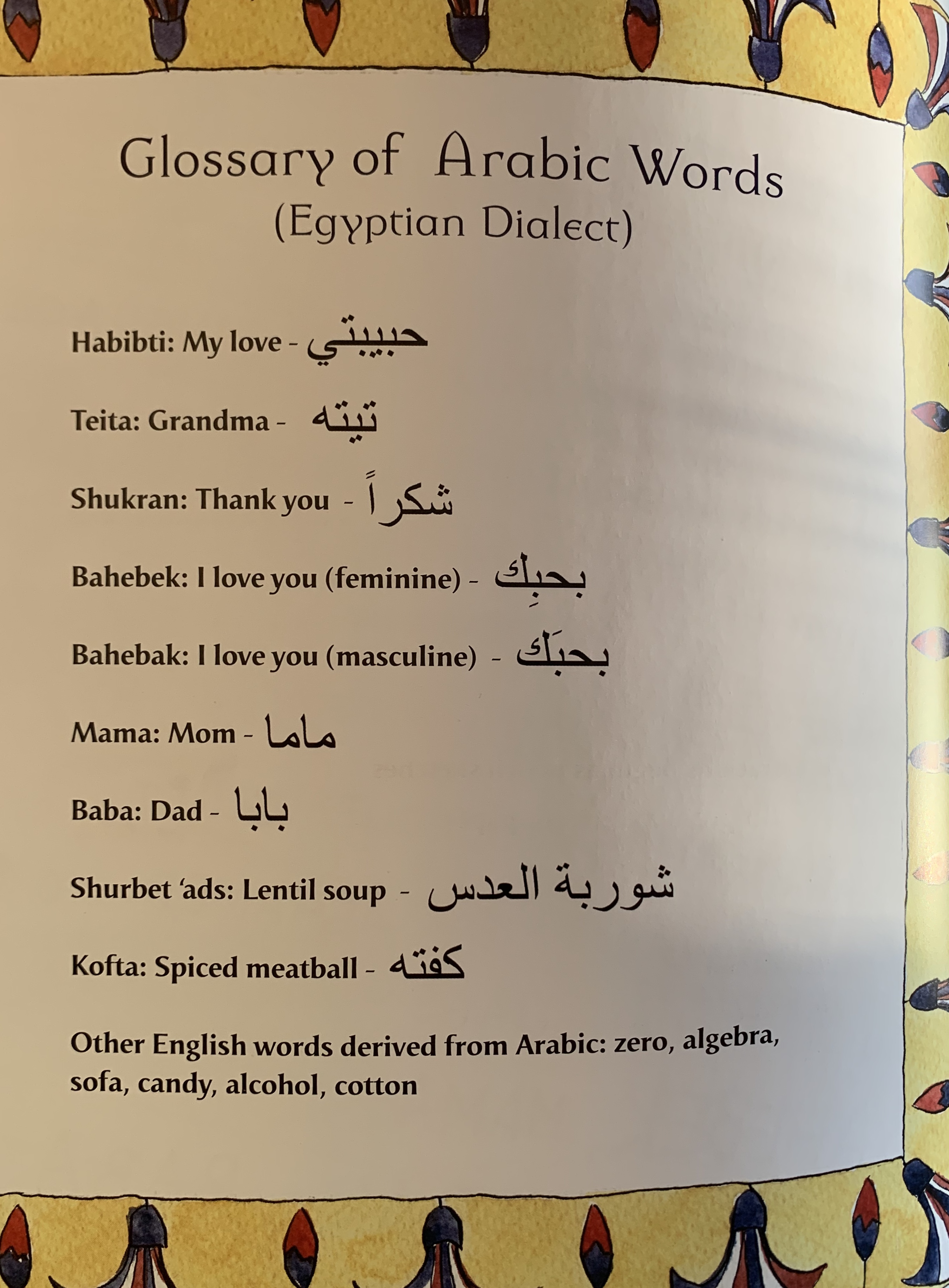
The story is beautifully told and exquisitely illustrated on well-sized 9.5 x 10.5 pages in a hardback binding.  The mom wears hijab and it mentions it, but there is nothing religious about the text.  It is a universal story of coming to be proud of your roots and inviting those around you to learn and grow.  There is a Glossary of Arabic Words at the end and a bit about the author and illustrator.

9AF3D465-F5DA-4F25-8FC1-5BEE16FD9B21

My kids favorite page by far was reading the names written in Arabic and they all enjoyed the story (ages 13, 10, 9, 4).  I actually had an issue when Molly apologized the first time, feeling that Kanzi’s response was a bit pretentious to what seemed like an 8 year old being told to go say she was sorry, but my older three unanimously and fervently disagreed with me, saying that she was obviously insincere and Kanzi knew it.  I’d love to hear from other readers if they felt like Molly was sufficient in saying sorry and admitting that it sounded funny and that Kanzi was arrogant in saying that people that know two languages are smarter and kinder, or if Molly was being rude and racist and Kanzi was sticking up for herself.

CF16ACA2-8EC4-443B-AA8B-2B9EA3D05D6D

Irregardless, the book is well done, enjoyable, and will get repeated reads by a large range of readers.  My children keep pulling it off the book shelf, and for that I need to thank Gayatri Sethi (@desibookaunty) who generously sent me the book the same day I checked it out from the public library.  Her generosity once again is a gift that I hope to pay forward in the future.  This book also highlights how amazing teachers can be and often are in facilitating inclusion, understanding, and respect.

ED8D19BC-96FE-4B8F-8B35-87A1AA885B7F


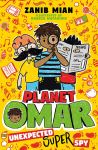
Planet Omar: Unexpected Super Spy by Zanib Mian illustrated by Nasaya Mafaridik

Standard
Planet Omar: Unexpected Super Spy by Zanib Mian illustrated by Nasaya Mafaridik

planet omar

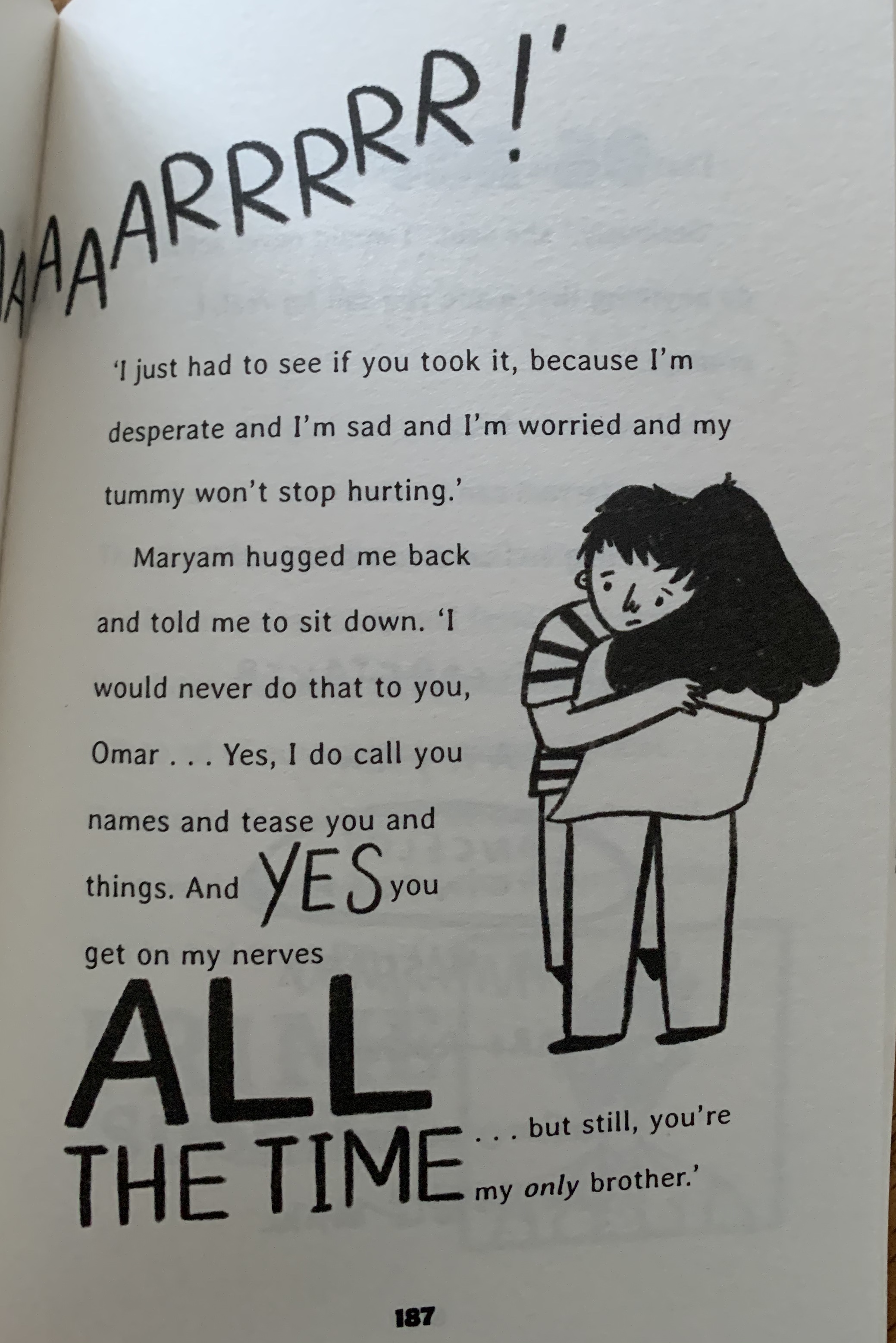
Omar is back, and the nine year old kid with a huge imagination, proves that his heart is even bigger.  Middle graders that loved the first version, The Muslims, and the reboot, Planet Omar: Accidental Trouble Magnet, will undoubtedly love this book’s adventures and the real, relate-abl, presentation of Islam in a Muslim family.  While it references the first book, it can work as a stand alone book too, and can and will be enjoyed by kids and adults, girls and boys, Muslims and non Muslims.  At 217 pages, the large spaces, doodles, playful fonts, and illustrations, make the book fly by and beg to be read again and again.

C95DB8C6-9652-4EB8-8008-112361FAE8DF

SYNOPSIS:

Omar’s family still has their Science Sundays, but they don’t visit a new mosque every Saturday, as they have found a mosque near their home that gives his parents, “secret smiles” and them all a sense of community.  Omar and his sister still bicker, and his little brother Esa is still lovable, and the former bully, Daniel, is now a great friend to Omar and Charlie.  Life is good, Alhumdulillah, but in the midst of the boys planning how to get laser guided Nerf guns and have an all out battle, Omar learns the mosque’s roof is in need of repair and that the congregation will need to come up with 30,000 pounds to cover the costs, and fast.  In an act of selflessness, Omar abandons his dream of a foam gun and donates to the masjid.  Seeing that is not going to be anywhere close to enough he plots and schemes with his friends, his non Muslim friends, on how to raise the funds.  They bake cookies, make origami birds, and get their school to host a talent show to raise the money.  Their teacher and the head teacher coordinate the hall and judges and winning prizes all to help out Omar and the mosque, in the end though, they raise just under 1,500 pounds.  Not enough by themselves, but a great contribution to what other people hopefully are scrounging up.  The worst part however isn’t that they didn’t make enough, but that what they did make, goes missing.  Omar, Charlie, and Daniel, along with the parents and police and school personnel, try and find the money and who might have taken it before time runs out.

0030B40D-17F8-415C-A54A-7874768A5B5D

WHY I LIKE IT:

I love how effortlessly the author adopts a nine-year-old’s voice and persona.  So many of the details, for example, about how the school administration signed off on a fundraiser for a religious building, and how tickets were sold, and the planning took place are left out, as a nine year old, probably wouldn’t know, or be concerned with the logistics of such endeavors.  It seemed like some details should be given, but I doubt readers would feel that way, so I pushed it aside and went along for the ride.

Omar has amazing friends, from the unpredictable old neighbor lady, to his non Muslim friends being so enthusiastic and supportive of saving a mosque.  I love it, and that they are that way because Omar is so unapologetically Muslim first.  They even discuss a hadith about how building a mosque, builds you a house in Jannah, and a mainstream book published this, and it is AMAZING! It isn’t just a kid and his family, who happen to be Muslim, the whole plot of the book is to save a mosque, and the fact that this book exists, seriously is so beautiful, and powerful, and hopeful, Alhumdulillah.

This book has a lot of layers, most kids won’t pick up on the interfaith aspects being so ground breaking, or the beauty of teachers and parents believing and supporting young kids, but will just read it as a funny story with anecdotes and inside jokes that they get as kids, as Muslims, and maybe even as Desis.  It truly is the culmination of an author who can write well, characters that our kids can see themselves in, and an opportunity to tell our OWN stories that make this book work for kids, adults and everyone in between.

3C3DA84E-29F6-4A6D-90FE-0BC134E7E615

FLAGS:

Omar and his sister are mean at times, but alas love each other and look out for each other too.

TOOLS FOR LEADING THE DISCUSSION:

I don’t do an elementary book club, but if I did, I would do this book in a heartbeat.  For middle school it would be too quick of a read, but I think all classrooms and all libraries should have the book, up through middle school.

https://www.alaraby.co.uk/english/society/2020/2/7/planet-omar-pushing-for-muslim-characters-in-childrens-literature

I got my copy here in the US at www.crescentmoonstore.com and as always you cannot beat their customer service and prices.  If you don’t have the first book, you can get it there, too.  Thank you Noura and Crescent Moon Store.

Common Threads: Adam’s Day at the Market by Huda Essa illustrated by Merce’ Tous

Standard
Common Threads: Adam’s Day at the Market by Huda Essa illustrated by Merce’ Tous

Common-Threads-Book-Cover.jpg

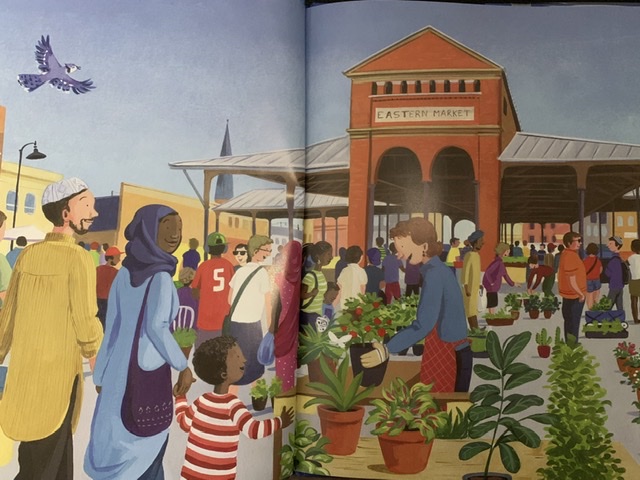
A lot of story is conveyed in this 13 word book for preschoolers about diversity, similarities, and love.  In 32 picture rich pages you meet a little family at an outdoor market, see Adam lose track of his parents as he follows a bird, and meet a lot of kind people as he mistakes them for his parents based on the clothing they are wearing.

A7AC0F6A-D891-4F4F-A537-0A10BA8F19A4

Naturally it has a happy ending, and it appears all the characters come together to get to know one another.  The pictures are beautiful and radiate with light and colors.

The market in general is diverse and the characters Adam meets show clothing similarities.  His mother wears hijab and he mistakes a nun in a habit for her, and then a lady in a kanga.  He thinks he sees his father, but it is a man with a yarmulke and a gentleman in a similar color shalwar kameez looks a lot like his dad’s kurta, but isn’t him either.

This is truly a picture book with sparse words of “Mama?” and “Baba?” being the bulk of the text.  It is visual and conversation sparking in its minimal and simplistic text.  By not having the author fill in the conversation, a preschooler gets to do it themselves, and hopefully broaden their mind in the process.

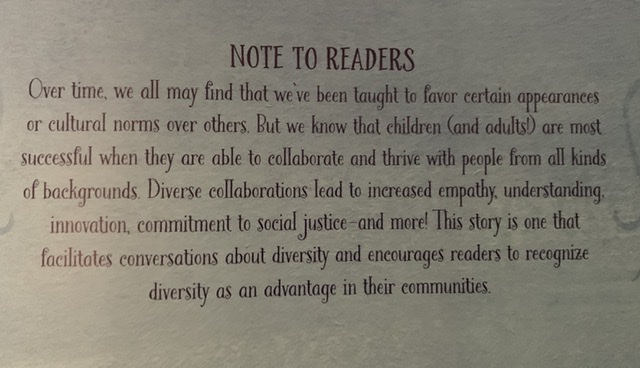
The beginning of the book has a beautiful Note to Readers urging children and adults to engage in diverse collaborations to increase empathy, innovation, social justice, and understanding to the benefit of us all.

6304D0EE-6710-44B9-9CF1-F6E5AD9359DC

The book concludes with a challenge to children to become cultural detectives.  It notes that what we wear sends a message about who we are, but it is just what you see on the outside.  It encourages us to ask questions respectfully and kindly to learn about one another.

E48812D3-A399-40B9-B903-3D366414827A

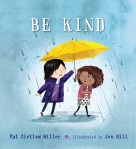
Be Kind by Pat Zietlow Miller illustrated by Jen Hill

Standard
Be Kind by Pat Zietlow Miller illustrated by Jen Hill

be kind

I usually post chapter books on Fridays, but on this one week anniversary of the horrific Mosque attacks in New Zealand, my fragile heart is being kept together by the pictures and notes shared on social media about the kindness people are bestowing on one another.  Company’s setting up prayer spaces for Muslim employees, communities standing guard outside masjids, friends leaving flowers for their Muslim acquaintances, strangers donning hijabs in solidarity, individuals carrying signs of welcome and unity, truly the list goes on and on.  Muslims and non-Muslims reaching out to one another, Kiwis and the rest of the world coming together.  And yet I know so many people are at a loss at what to do, and how to respond to their feelings in an appropriate manner.  I know I often am.  Thats why books like this one are so important for children to learn how to be kind.  We often tell them to be nice or kind, but what does that mean? What does that look like? How do we know if it worked? As adults we often don’t know, so while this book isn’t written or illustrated by a Muslim, there are Muslims in it, and that is why after seeing another blogger a few weeks ago mention it, I want to share it with all of you.  The illustrations show a little girl saying hi to a desi garbed man named Omar, and two hijab clad girls in her view of the world, amongst so many other diverse faces and characters, because that’s the point right? We are one, each of us responsible to one another to be kind.  

IMG_3389

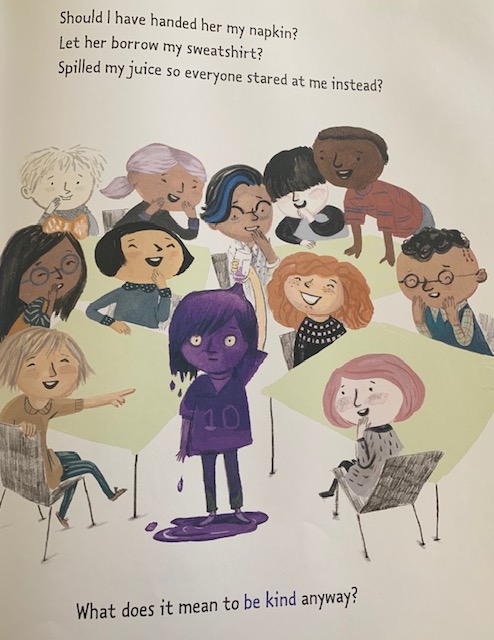
The book starts off with Tanisha spilling grape juice all over her new dress and a classmate being at a loss as to how to console her.  She makes what she thinks is a reassuring comment to Tanisha, but it isn’t received that way, and the little girl ponders and reevaluates what it will take to be kind to Tanisha and what kindness is in general.

IMG_3386

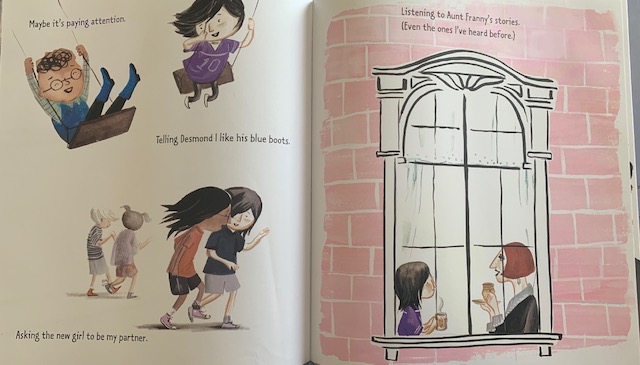
As she works to unravel what kindness is, she explores also what it can look like.  I love that it is seen in terms of action, giving ideas to stay with the reader.  It discusses that sometimes it is easy like saying hello, or not littering, and how important just using a persons name can make someone feel.

IMG_3388

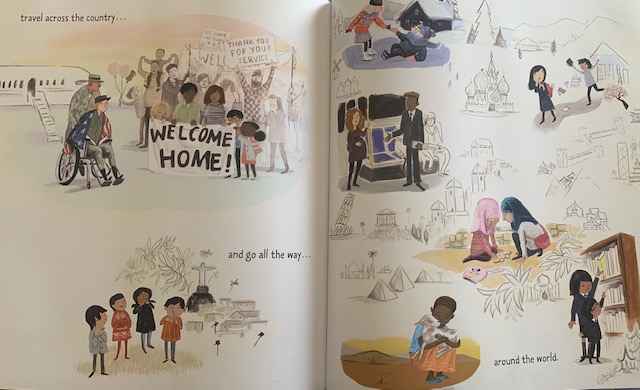
But, it also talks about how sometimes kindness can be hard, requiring patience and a little bravery. I can only imagine how brave people had to be to enter a mosque for the first time and step out of their comfort zones to offer their support.  

The book then takes an important pause when it acknowledges that maybe all this little girl can do to help Tanisha is to sit by her.  I think Muslims around the world are in awe of the Prime Minister of New Zealand for all she is doing, but also for just showing up and hugging people and listening.  A rare gift in todays wold of soundbites.  

IMG_3390

The little girl then imagines her small acts of kindness joining others and making the world a better place.  My favorite part is actually the end.  Tanisha never smiles and tells the little girl thank you, there is no big praise for being kind.  In fact, I bet the little girl doesn’t even know the power her actions had on the little girl.  We the reader know because we see Tanisha hanging the picture up in her room.  But, that let down is real life.  We can’t be kind because of the reward, we must learn to be kind because it is the right thing to do.  And often when people are kind to us, the effect isn’t instantaneous, its weight manifests in the dark when we are looking for hope and reassurance and for this book to contain all of that, in 32 pages with only few words (AR 2.2) is truly amazing.

IMG_3391

The illustrations are gorgeous and engaging.  The hardback 9×10 format makes this book a great addition to any library and should be read regularly.  It isn’t enough to not be mean, action and intention need to be taught so that we all might be more kind, inshaAllah.