Category Archives: Poetry

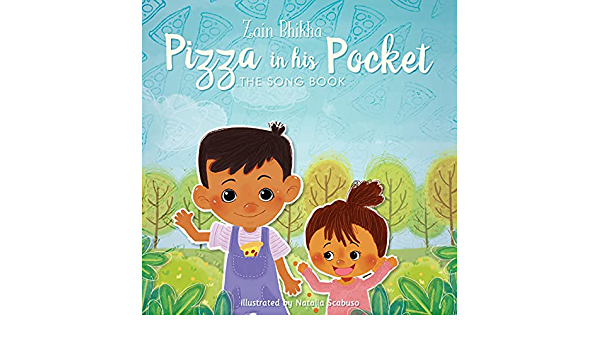
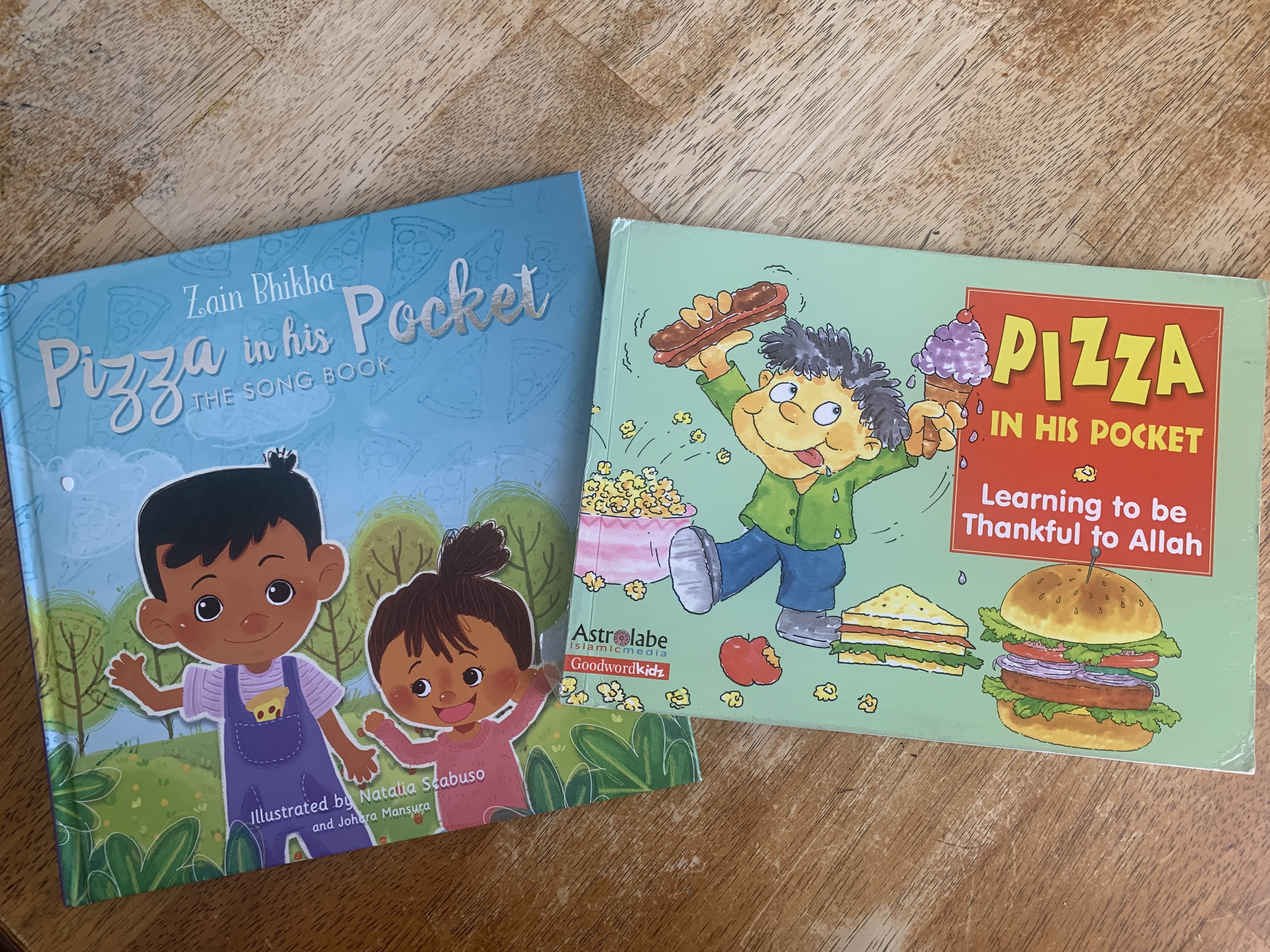
Pizza in his Pocket: Learning to be Thankful to Allah by Jawaad Abdul Rahman illustrated by Natalia Scabuso and Johera Mansura

Standard
Pizza in his Pocket: Learning to be Thankful to Allah by Jawaad Abdul Rahman illustrated by Natalia Scabuso and Johera Mansura

pizza in his pocket

I didn’t think the old version was falling short, but I had to have the new one, because well, I’m a mom.  And sometimes songs that have stood the test of time really do translate perfectly to story books that are engaging, memorable, and so fun.  I can’t get through it without singing it, but the new pictures do force me to slow down and look at the maps and the points of interest that have been included.  Ages two and up will love the book, older kids will enjoy the nostalgia, parents will beam at the words getting stuck in everyone’s head and the lessons making their way in to real actions.

img_4980

The new book is slightly different than the original, but more inline with the online videos by Zain Bhikha and his son.  The back of the book has an ayat from surah Al-An’am and reinforces that while the song is fun, the foundation of not wasting and sharing with the poor is an important part of Islam.

A great book to read over-and-over again and one that is universal enough to be shared with Muslim and non Muslim children alike.

Room for Everyone by Naaz Khan illustrated by Merce’ Lopez

Standard
Room for Everyone by Naaz Khan illustrated by Merce’ Lopez

room for everyone

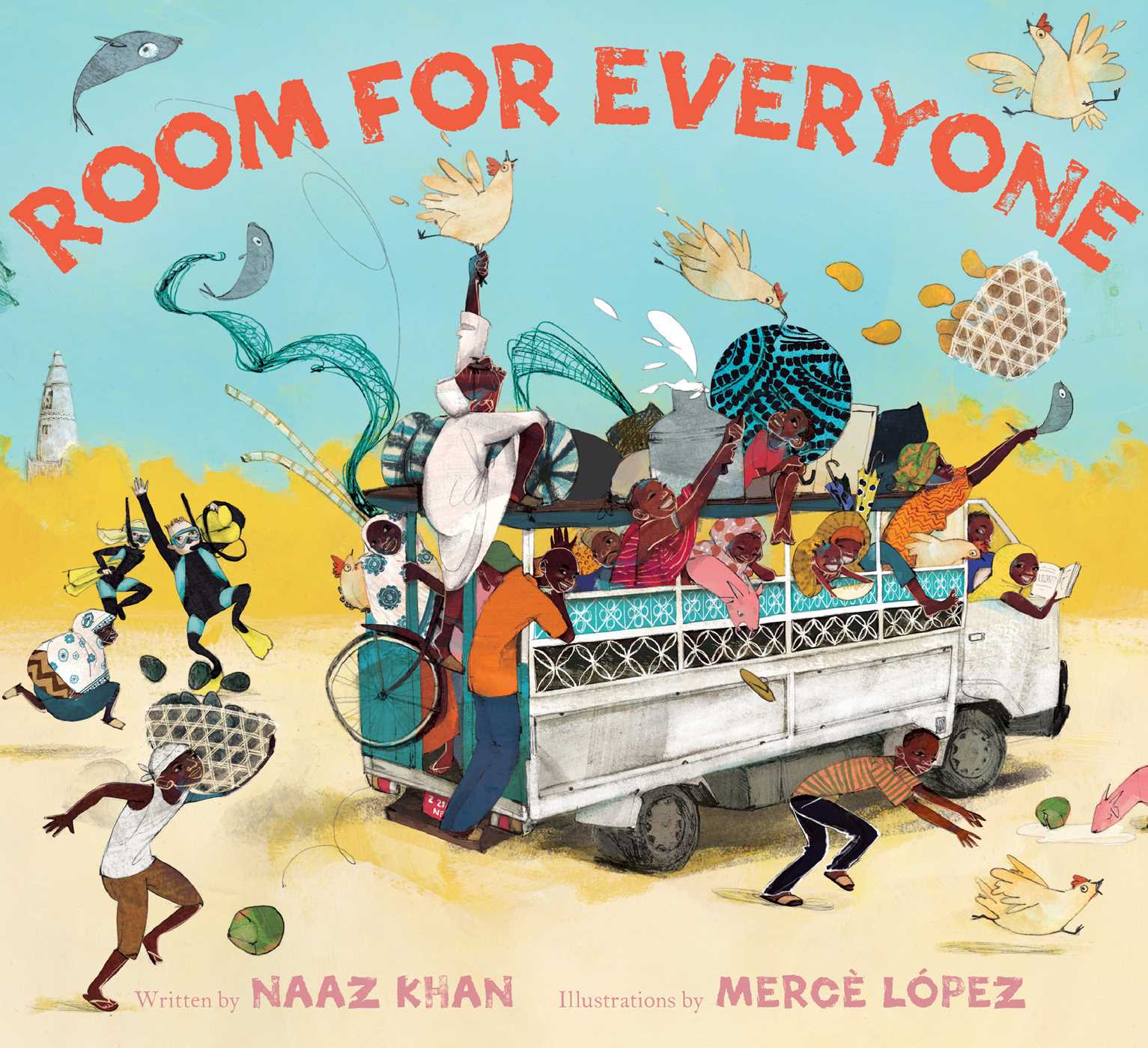
I started to read this book to myself, abruptly stopped, gathered my children around, and began again aloud.  This 40 page early elementary picture book isn’t just counting up and down with silly scenarios and outrageous details, it is familiarity with a culture often not represented with universal humor, appeal, and anticipation. This rhyming book begs to be shared: one-on-one, at story time, or in a classroom.  There is so much joy and connection that I’m ready to felt-board the story, march into my kid’s school and demand an audience.  I found mine at the library, but I think I am going to order it because it definitely deserves a place on the bookshelf to be read again and again.

Musa and Dada get in a daladala and are off to the crystal blue waters of Zanzibar.  But it is hotter than peppers out and the kind driver is offering everyone a ride.  First is the old man with his seatless bike, then it is two little goats and their herder, next is vendors with their three baskets of fruits.  Each time Musa cries and protests that there is not room for anyone else, let alone their stuff.  Yet when everyone wiggles and scoots and smooshes, there seems to be room for everyone.  This continues until there are ten scuba divers joining the smelly fish and stinky chickens, umbrellas and milk pails.

Alhumdulillah, they reach the beach.  Then one by one they all get out at Nungwi beach.  Giggles and wiggles and Musa and Dada are off the minibus and swimming in the cool waters. Alhumdulillah indeed.  The book concludes with a glossary and an author’s note.

“Find me on Twinkl’s list of best children’s books of 2021!” 

Golden Girl by Reem Faruqi

Standard
Golden Girl by Reem Faruqi

golden

I began reading this book not having any idea what it was about. All I knew, or all I cared to know, was that the incredibly amazingly talented Reem Faruqi wrote it, so I wanted to read it. While I know it will be hard for most to avoid knowing the plot, I think it was a blessing that I was able to be swept away so completely and so fully in a story that is wonderful and memorable, and truly sets a higher standard for the way that a story can be told. Faruqi’s voice and authenticity had me in tears. I didn’t even realize my eyes were dripping until my son asked me if I was ok. It wasn’t the plot that had my emotions spilling over, sure it helped, but it was the storytelling, the hadith and deen and snapshot of a life so unlike my own that simultaneously is exactly my own that a physical reaction emerged. It is the power of OWN voice storytelling. It is the power of brilliant writing. It is not just a book about a Muslim character, this book blurs the lines for me between Islamic fiction and fiction with Muslim characters. Middle school readers (mature middle grade readers) will enjoy the book, older readers will enjoy and appreciate the 336 page story told in verse. You can pre-order the book and I hope you will, it helps convey the message to publishers that this book is highly anticipated and that we need voices like this. Additionally, Goodreads currently is hosting a giveaway, you can head there to try and win a free copy.

(If you don’t want to know what the story is about, maybe skip the next section.)

SYNOPSIS:

Aafiyah’s name means well-being, protection, health, money, happiness, everything good, but Aafiyah has secrets too. She is privileged and loved, and she knows it, but sometimes when she sees something she likes she accidentally borrows it. Sometimes it isn’t an accident. Sometimes she doesn’t just borrow. Much of her life is wonderful, a best friend that lives next door, doting parents, tennis, vacations, trips to Pakistan to visit grandparents, and a love of “weird but true facts.” So what happens when all that changes. When her grandfather gets sick and the family wants to bring him to America for treatment, when Aafiyah’s dad gets detained and imprisoned on the way home, and Aafiyah’s secret may be a way to help her family?

WHY I LIKE LOVE IT:

I absolutely love that the characters are so well rounded and developed. Yes, Muslims have vices, and even young practicing Muslims have tests and struggles. The bar has been raised, we aren’t just a monolith, and our only struggles aren’t girl/boy issues, alcohol, not being oppressed and getting an education, we are complex people, we are human. The bulk of the story is Aafiyah growing up: her responsibility within her family, her changing body and appearance, her friendships, her responsibility for her actions, her desire to want to help and improve and step in to her own. I love that all these layers of life somehow are explored in such sparse lines. It doesn’t drag, but it gives the necessary pauses to involve the reader in her logic and view of the world. Aafiyahs’ kleptomaniac tendencies, her father being detained, her grandfather’s illness. they all move the story along, but they are foils for a much more intimate character story. A story that is surprisingly funny and light and impossible to put down.

I absolutely love how Islam is woven in, how she exudes Islam in all that she is, because she is a Muslim completely, the good and the bad. The guilt she feels, the desperation to be forgiven, the knowing that Allah swt sees all. The book is never even close to being preachy, but she proudly owns her identity and the details of her faith are not watered down, or even justified, it is who she is and it isn’t up for debate.

Culture is presented unapologetically as well. She is critical of things she sees in Pakistan, and similarly celebrates and admires good things about Pakistan and Pakistani culture. The book does not seem to have an agenda in presenting Muslims or Pakistan as good or bad, just as Aafiyah sees them. Which isn’t revolutionary on the surface, but it really is refreshing because it highlights how many books simply don’t. It makes the contrast painfully obvious between books that are shy about certain things, when they have their characters deflect and disassociate from certain “realities” and books that confidently uphold their identity and demand that the reader steps up and truly see the characters and their experiences.

There is a beautiful and raw author’s note at the end that shares some of the inspiration for the threads of the book, a glossary, a recipe for Aloo Gosht and resources for help with kleptomania.

FLAGS:

Stealing, lying, chatter about crushes, music, dancing. Being attractive and the reactions that it gets is woven through out.

TOOLS FOR LEADING THE DISCUSSION:

If I have a majority girl group, I will teach this. It isn’t a girl only book, but I think some of the more subtle themes would need a safer girl space to discuss.

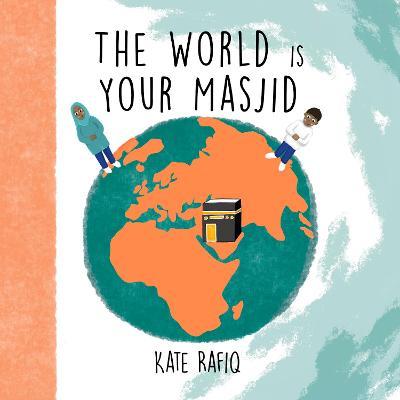
The World is Your Masjid written and illustrated by Kate Rafiq illustrated by

Standard
The World is Your Masjid written and illustrated by Kate Rafiq illustrated by

masjid

This 30 page preschool to early elementary aged book is a simple rhyming book that reaffirms all the places we can pray and touches on those that we shouldn’t.  The engaging illustrations and relatable scenarios make the book a great choice for bedtime stories and small group readings.  

Screen Shot 2021-11-17 at 11.33.41 AM 1

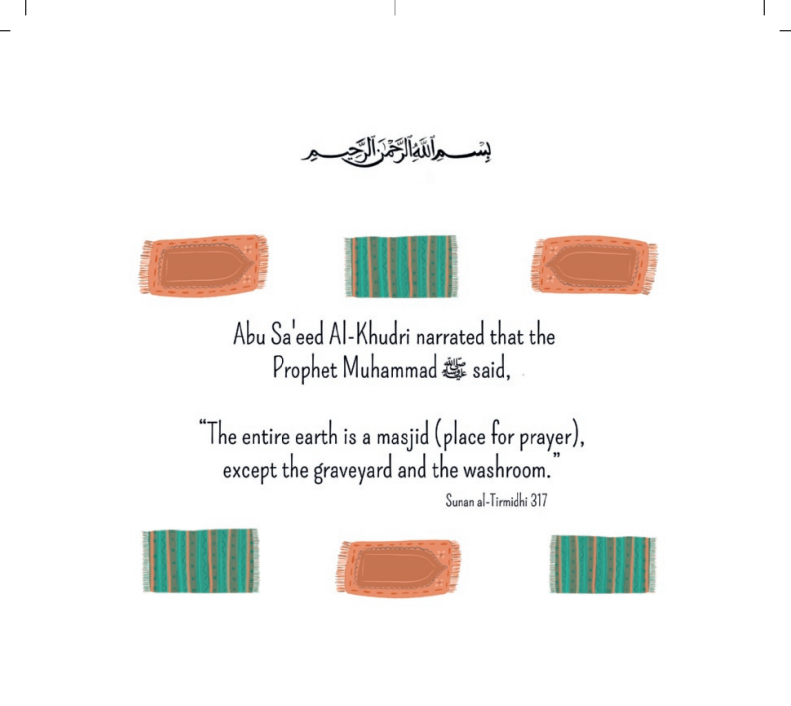
The book starts out with a hadith, “The entire earth is a masjid (place for prayer), except the graveyard and the washroom” (Tirmidhi-317) and points out that one must pray five times a day. Screen Shot 2021-11-17 at 11.37.00 AM

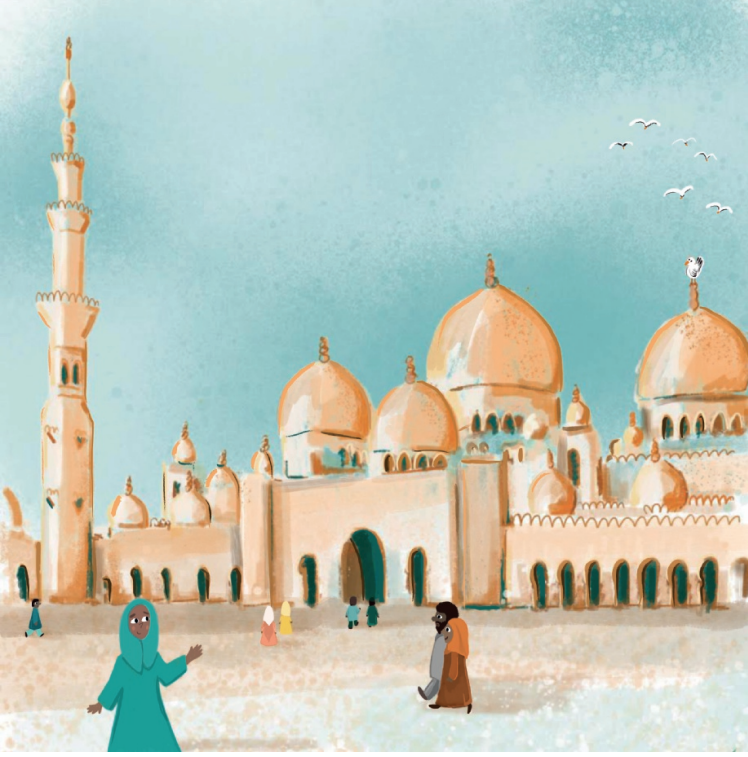
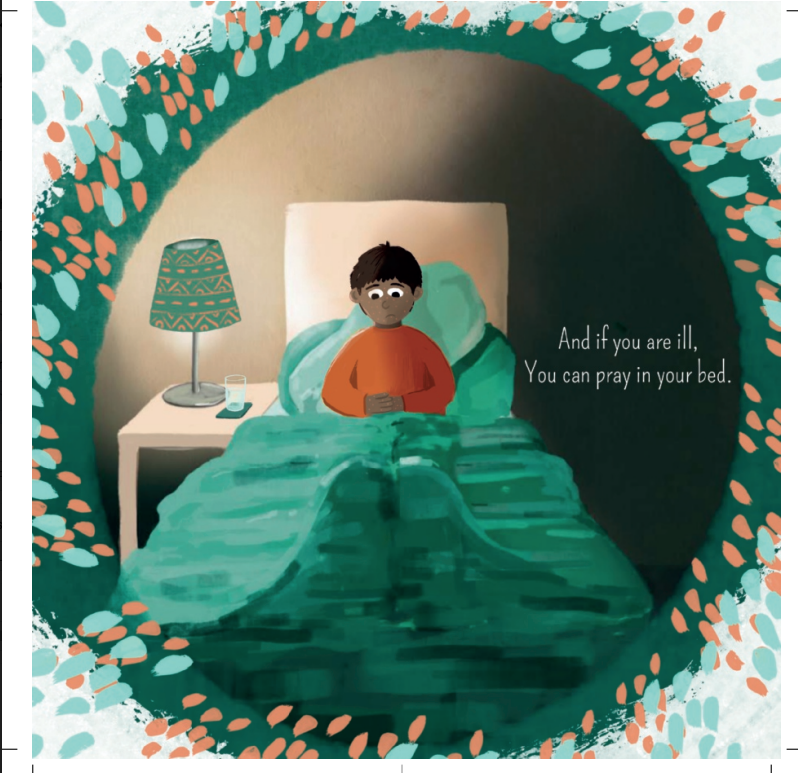
It establishes that if you pray it a mosque you can follow the imam, but not to worry if you cannot, because you can pray (nearly) anywhere: a field in the rain, school, a train, a garden, a shed, even when sick you can pray in your bed.

Screen Shot 2021-11-17 at 11.36.46 AM

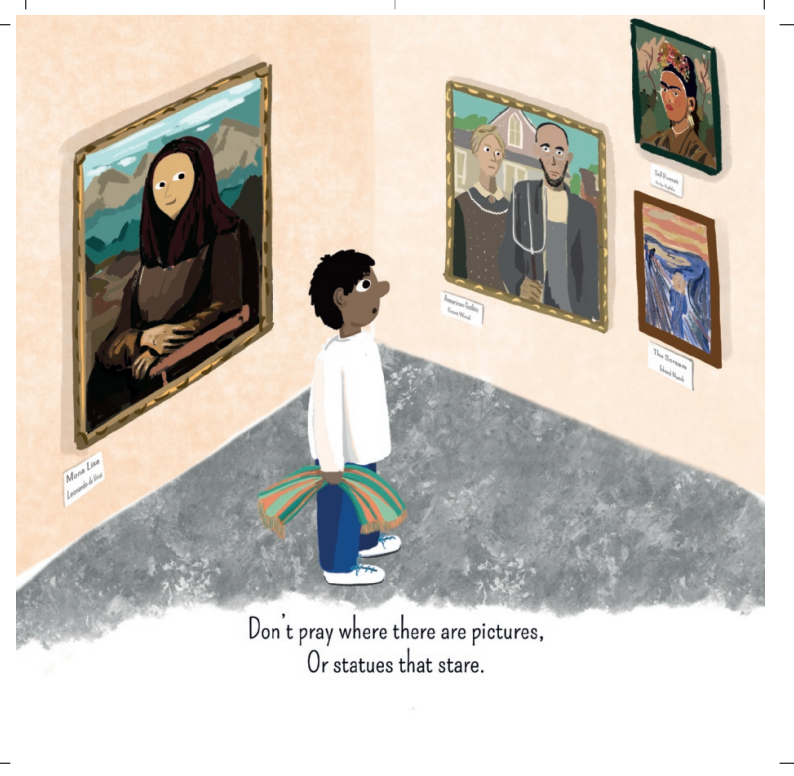
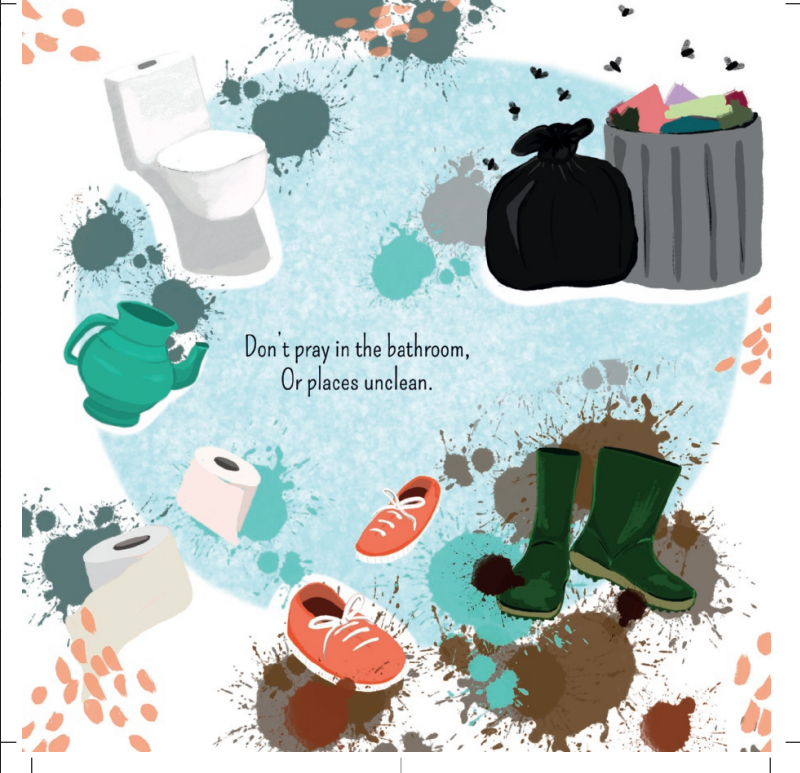
It then also turns to places you shouldn’t and can’t pray and sources a hadith about not praying where there are faces and statues that might distract you (Bukhari 374). The bathroom and graveyard are also included.  

Screen Shot 2021-11-17 at 11.35.05 AM

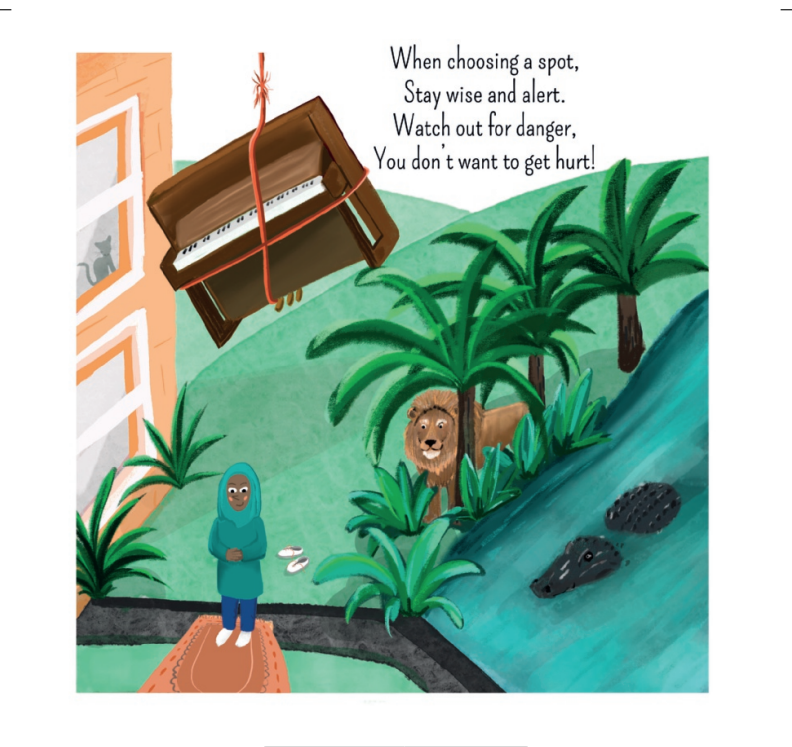
As an after thought, and for added laughs it reminds little readers to not pray in dangerous spots as well.

Screen Shot 2021-11-17 at 11.35.12 AM

Overall, I enjoyed the book and can see it pairing with In My Mosque to help create the foundation of a storytime theme about prayer and mosques.  The fact that it takes it a step further and doesn’t just list all the places serious and crazy that you can pray, elevates the book from being mediocre to being memorable and I appreciate that.  I also appreciate the Islamic sourcing, truly something that is required to show accuracy even in the “simplest” of all books.

Screen Shot 2021-11-17 at 11.35.30 AM

The Tale of Princess Fatima, Warrior Woman: The Arabic Epic of Dhat al-Himma translated and edited by Melanie Magidow

Standard
The Tale of Princess Fatima, Warrior Woman: The Arabic Epic of Dhat al-Himma translated and edited by Melanie Magidow

princess fatima

I’m not sure how to really review this 167 page book.  It is the translated YA work of an Arabic Epic that took place somewhere between the seventh and 10th centuries and began possibly being compiled in the 1100s.  It was told orally, but when written, comprised some 6000 pages.  The translator notes that the choices of what to include and how to translate, all potentially alter and reshape the narrative, so as a reviewer I’m simply going to review the text in my hands.  I have no outside knowledge of this epic woman, and approached the book as I would have in high school when reading The Odyssey or Beowulf: some of the history is accurate, the characters fictitious, the culture possibly representative.  As a result, I find the comparisons to Wonder Woman and Katniss Everdeen on the back cover, very odd choices.  At times the contemporary diction, in my opinion cheapens the narrative.  Sure I appreciate the modernization of the text to make it an easy read, but throwing in modern slang seems too much.  I found the book’s framing unfortunately counterproductive of what it hoped to achieve.  I have no idea what the other 5,900 pages include and what the translator had to choose from, but the majority of the book focuses on marriage, being raped by her husband, and working to prove who the father of her Black son is when her and her rapist husband are white.  I was prepared for battles, and conquering, and fighting misogyny, and saving the down trodden, not every one just wanting to marry her.  Many of the characters are Muslim, some convert to Christianity to escape Dhat al-Himma, the Quran is quoted, prayers are made, the Kaaba visited.  I do however, take issue with the explanation of the child’s skin coloring being attributed to intercourse (rape) occurring while Fatima is menstruating and a case of Prophet Muhammad (saw) being used as proof of this occurring.  So much of the text is footnoted, this instance is not, and I find it disturbing.  The book also contains a lesbian character who ends up marrying a man, violence, death, and many other potential flags (see below) that might make it better suited for older college age readers.

SYNOPSIS:

The story doesn’t begin with the birth of Fatima, but rather with her great great grandfather.  It sets the stage a bit to show culture, how women and honor are treated, and the line of her ancestry.  When we get to know Fatima a few chapters later she is being born and her gender is a disappointment, so she is hidden away.  As she grows away from her tribe she becomes an accomplished warrior and captures her father in a raid.  When she returns to her people, her cousin, Walid, born the same time as her, is struck by her beauty and wants to marry her.  She refuses.  Repeatedly.  Finally she agrees to battle him and if he wins, she will marry him.  She wins, and he still doesn’t back down, finally she is forced/tricked in to marrying him by the Caliph’s agent.  The two are pronounced wed, but little changes for Fatima, she is a warrior and does not seek intimacy or companionship.  Eventually, her husband Walid enlists the help of Fatima’s milk brother and friend, Marzuq, to have him drug Fatima, so that he can rape her.  He acknowledges the rape, the whole community does, but allows it, because he is her husband.  When the child is born he is Black and Walid and his family refuse to accept that the child is his.  Amira Fatima is socially put on trial for being a whore and that the child is illegitimate.  As Walid works to have them killed, Fatima works to prove her innocence and carry on with her life trusting in Allah swt completely, all while the Arab-Byzantine battles are raging in the borderlands.  As Abdelwahhab, Fatima’s son, grows he too becomes a formidable warrior and the two have continued adventures.

WHY I LIKE IT:

I love the richness of the culture coming through a compelling story. Fatima is incredibly devout in her worship of Allah, swt.  She does not falter, ever.  When she is being tested she needs only her faith, at one point a man converts to Islam upon having a dream as a result of her conviction in praying.  That being said, I genuinely don’t understand a few critical points.  How can a woman who single handedly destroys tribes not be listened to, to make her own decisions to lead her own life.  I get that that is perhaps the poignant point of the story in today’s context, but there are a lot of strong women in this book, so why does her marriage and being defined by her not wanting to marry get so much of the spotlight? Her father didn’t want her, but they don’t resolve anything, they just reunite and all is well.  I need more.  I want to know what happened to Walid once he became Christian, was it a permanent thing, a temporary fix? What ended up happening between her and Marzuq? He was her trusted advisor and immediately regretted drugging her, what happened to him.  I want more about her mother, maybe even her Aunt or other women to see how their lives compared and contrasted to the powerful women highlighted.  How did they view her, was she inspiration, an anomaly, beloved, loathed?

I appreciate the footnotes, the introduction, the Note on the Translation, the further reading list, help with pronunciation and the character list.  A map would have been nice.

FLAGS:

There is violence, killing, rape, talk of sexual intercourse and menstruation.  There is misogyny, racism, flirting, sexual temptation, a lesbian character, magic, jinn.

TOOLS FOR LEADING THE DISCUSSION:
I would not be able to lead a proper discussion on this book, I am just not knowledgeable enough on the larger story.  I think I would like to be a student or be able to join a discussion led by someone well versed in The Tale of Princess Fatima and all the subtext that brought her story to life and maintained it over time.  It would be fascinating.

There was an Old Auntie who Swallowed a Samosa by Asmaa Hussein illustrated by Milton Bazerque

Standard
There was an Old Auntie who Swallowed a Samosa by Asmaa Hussein illustrated by Milton Bazerque

samosa

I feel like such a broken record of late (and in the future), of my reviews of books published by Ruqaya’s Bookshelf; the stories are WONDERFUL, but I really struggle with the titles.  I truly thought this was a cultural/religious version of the classic, I Know an Old Lady who Swallowed a Fly.  But it isn’t.  It is an original clever, laugh-out-loud hysterical story for preschool to early elementary.  And one that parents and caregivers will not dread reading over and over again with the well done rhyme, expressive illustrations, a silly conclusion, religious framework, and universal appeal.  The book is on point, the title and cover illustration, sadly for me are not, and don’t, in my opinion, do the story justice.

img_4190

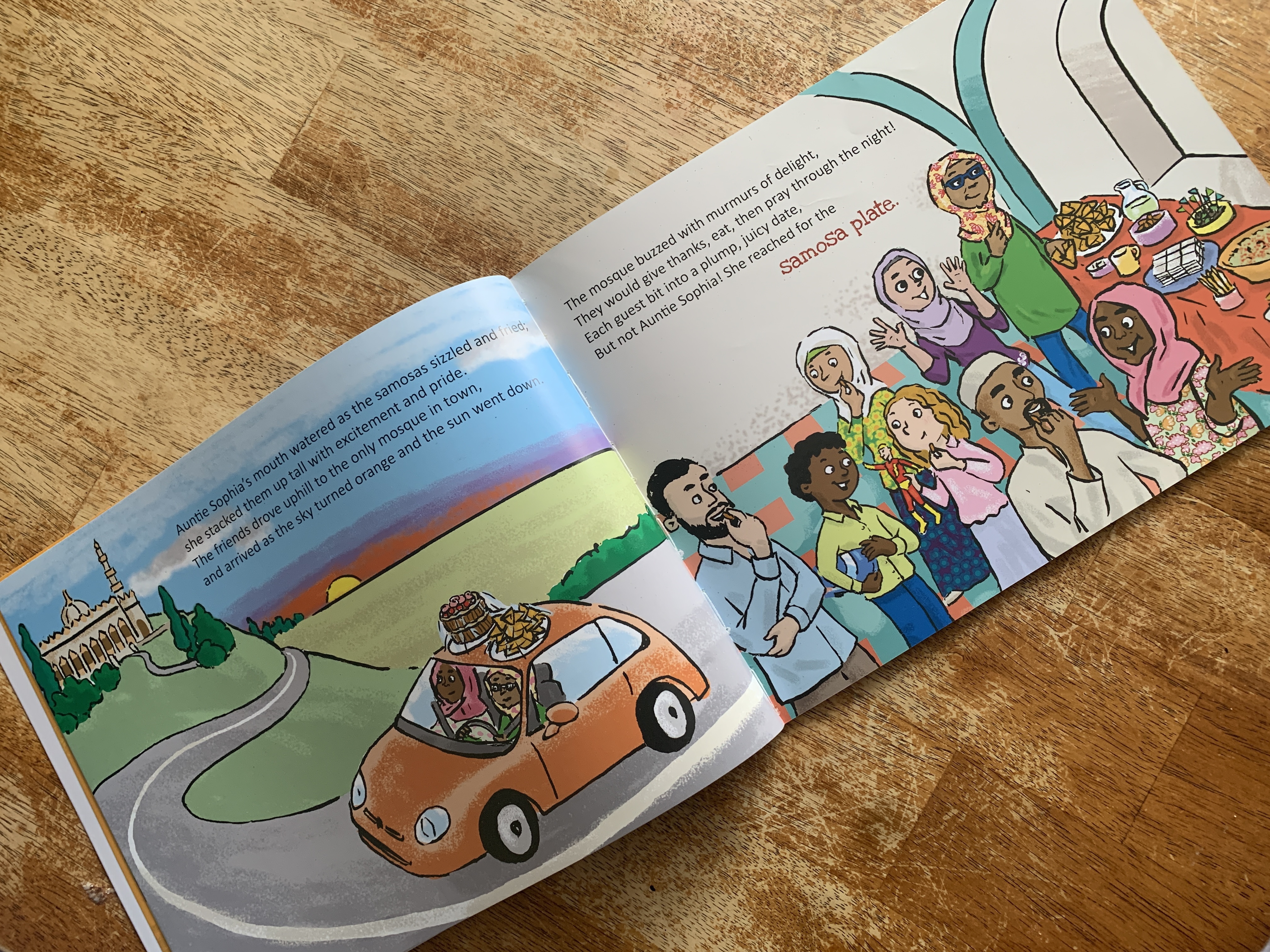
Auntie Sophie is making samosas with some peppers she grew herself.  Under the close company of her kitty, we learn how the Scotch bonnets were grown and cared for.  The doorbell rings and Auntie Eynara has arrived with her beautiful cake to take to the masjid for iftaar.  

img_4191

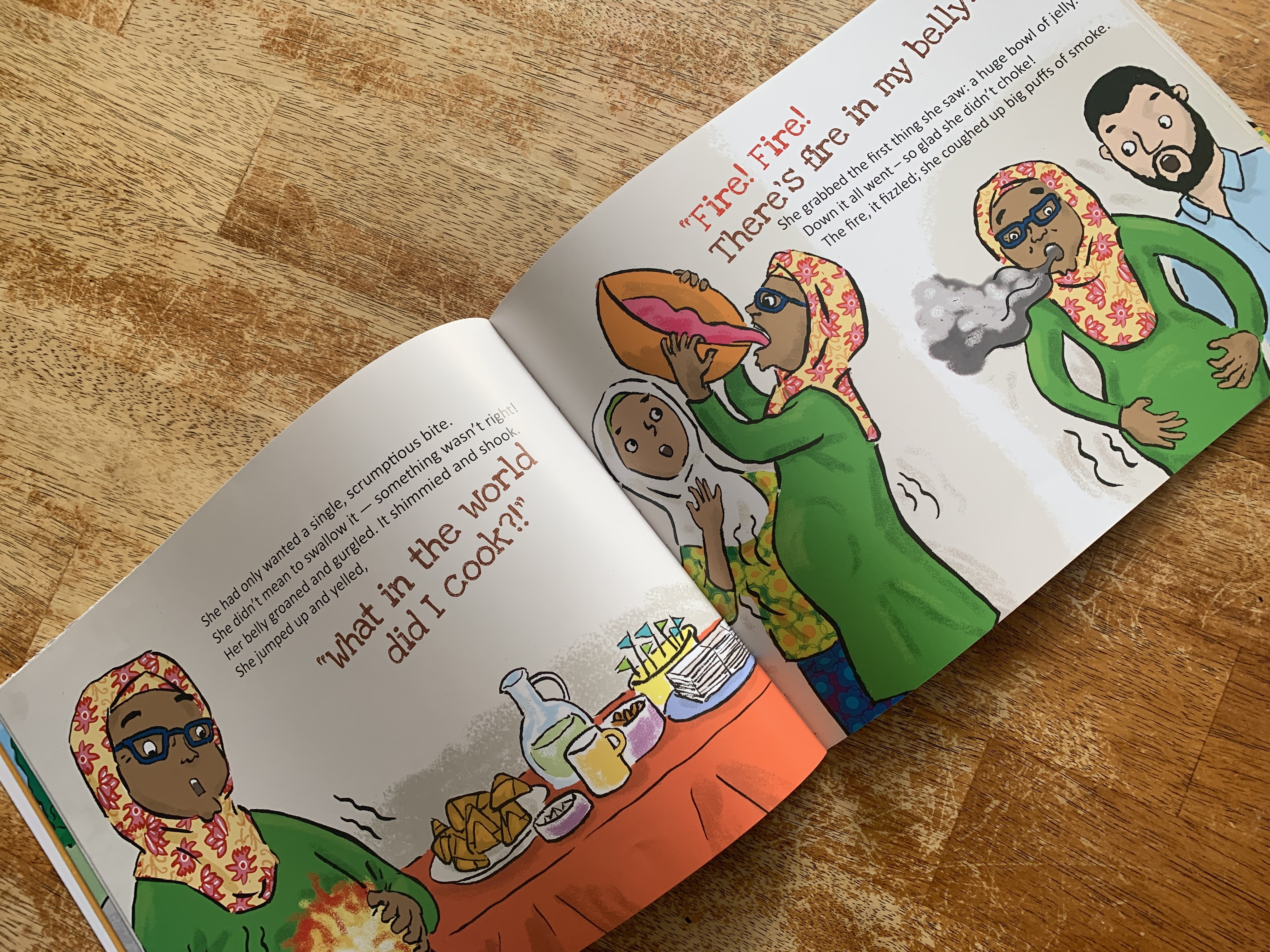
Auntie Sophie  hurries and fries her samosas and the ladies head up the hill to the only mosque in town.  Everyone breaks their fasts with a date, but Auntie Sophia dives in to her samosas.  When the imam’s mic crackles, she swallows the samosa whole and something is terribly wrong.  Her belly is on fire and jelly nor garlic knots nor mint lemonade not rice can cool it down.

img_4193

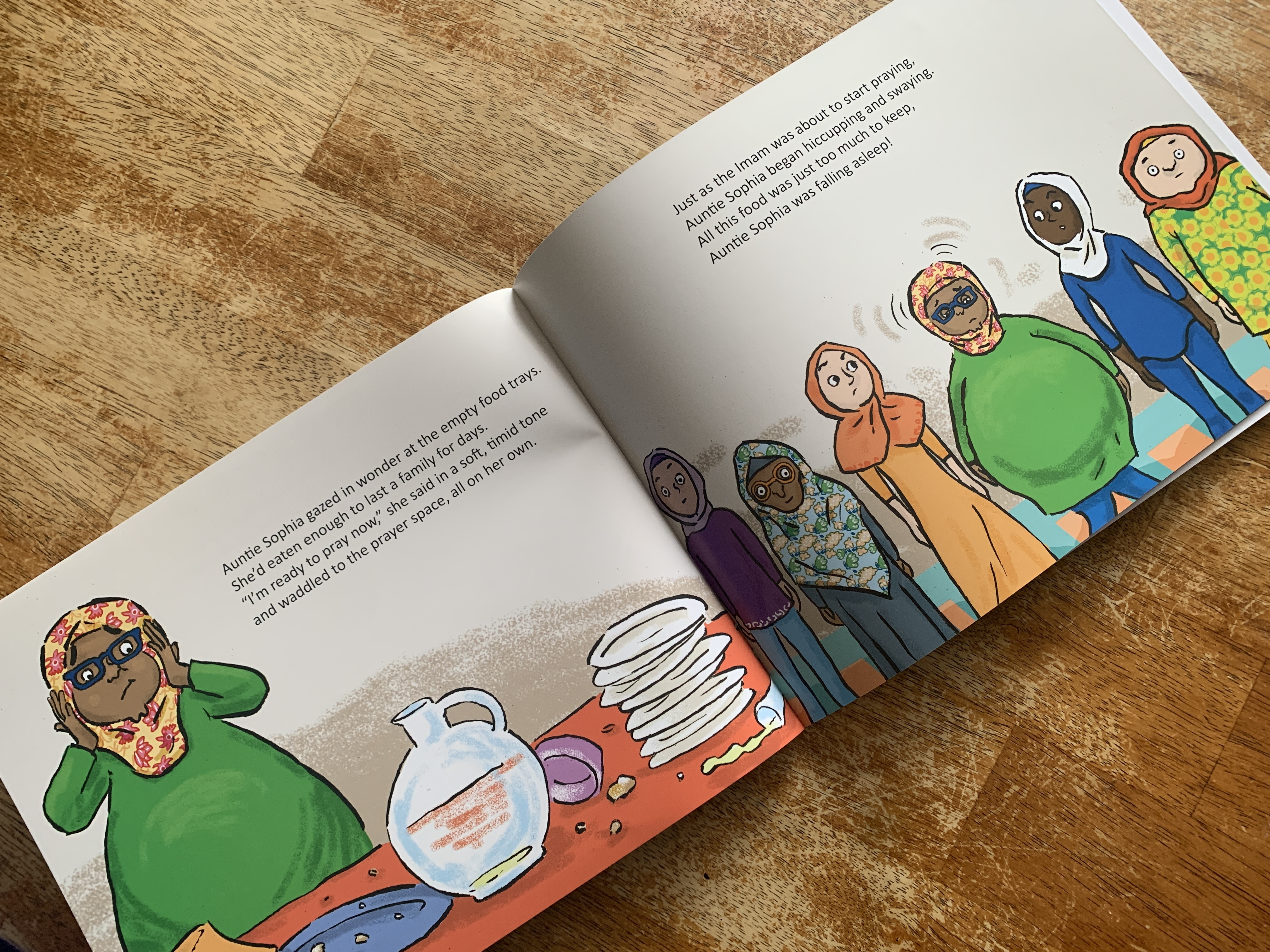
Just when she thinks she is ready to pray, it starts up again, and having eaten everyone’s dinner, Auntie Sophia is getting very tired. As she rolls out the door and down the hill to her house, she figures out what happened to her delicious samosa filling, and calls to have pizza and halal hot wings delivered to the mosque.  She also pledges to grow flowers next year instead!

img_4192

Kids will love the book as it is outrageous, while at the same time being so relatable.  The mosque, iftar, eating something spicy, the book is a favorite at our house for both the two and six year old and the horizontal 8.5 x11 orientation, keep eyes glued to the pages, while the rhyming lines move the story along.  I enjoy being able to talk about the peppers and different foods and smell of garlic with my kids after the 17th reading or so, and I love the diversity of the characters at the mosque. 

The Tale of a Tiny Droplet by Ally Daanish illustrated by Oana Cocheci

Standard
The Tale of a Tiny Droplet by Ally Daanish illustrated by Oana Cocheci

droplet

I would imagine if you were to pitch the idea of this book it would go very favorably.  A raindrop goes on an adventure to a desert kingdom after facing adversity for being small, an ocean wave wants to consume her, a chance encounter with a grain of sand and confidence in Allah swt to keep them safe leads to refuge being offered in an oyster who journeys them through the ocean to salam its inhabitants only to wash up near the palace and at the feet of a prince who has been searching for a treasure for his mother’s crown.  The problem comes in its delivery.  It is told in rhyme that is incredibly forced and trying to do too much.  It is a 32 page children’s picture book trying to blend religion, science, adventure, and two points of view.  It needs to be clear, not concerned with a rhyme scheme that muddles the themes.  The book has potential and with the QR code and online teaching resources I could see an Islamic school teacher using this to explain how a pearl is formed and the incredibleness of one of Allah’s creations, but it will take a lot of outside explanation.  I am confident that no four to six year old is going to independently understand clearly what is going on.  I myself had to read it multiple times to figure out what was going on, and even then I found more holes, inconsistencies, and head shaking then there should have been in a large, glossy, well illustrated, effort filled book.

img_3589

A tiny droplet wants to be free, but this personified little water being’s friends tell her only great things live in the kingdom and she is too small.  Not sure how greatness and physical size become synonymous, but they do apparently.  So, on a windy day, the raindrop jumps out of the sky to join the ocean as a means to reach the kingdom.  A hurricane, or wind gale, catches her and she collides with a grain of sand.  But the pov switches, and the sand collides with her and it hurts the sand.  Grain apologizes and Droplet says not to worry she she is heading to the ocean too.  Grain warns her that the ocean isn’t safe, that there is a big wave who will consume them.  Droplet says she isn’t afraid and trusts Allah swt will keep them safe.  The wave threatens to chase them with all its pride (?) if they dare to run and hide.  The pair find an oyster to hide in and they swim with the tide. The oyster is bothered by their tiny feet so he throws them a blanket.  The wave continues to give chase, but they trust Allah swt and after months and days they wash up on the kingdoms shore.

img_3590

The book then pivots and focuses on a young prince who is searching for a gem for his mother the Queen.  Her crown has lost its shine.  He has travelled for months and day through mountains and valleys to no avail. One day while walking, back home on the beach, he hears voices hoping for safety from the wave.  Droplet and Grain think the wave has perhaps finally got them, but it is the prince opening the oyster and finding just the gem he needs. The book concludes with the pearl saying “Alhumdulillah” to the distant stormy sky, “All things can live in the kingdom and its palace rising high.”

img_3591

So my questions, first I’m not sure how a droplet isn’t free, is there only one wave in the ocean? Who is talking at the end, obviously the anthropomorphism as a science lesson kind of hits a dead end, it went from two talking objects to one new talking object, so thats creepy.  Wouldn’t it have been better to end when the gem was found and then have an info or fact page highlighting how pearls are made, having two distinct characters morph into one is a bit jarring story wise. The concept of the kingdom not allowing in little things, and then concluding that all things are welcome, is also so painfully underdeveloped.  Even little readers are going to find that assumption so off the mark.  I like that they trust Allah, but Droplet keeps saying she isn’t scared, but continues to run? swim? The duo don’t want to be consumed, but essentially aren’t they consumed by the oyster? The Pearl feels like it beat the wave despite its size, but it was the other drops that were telling Droplet she was too small, not the wave.

img_3592

All confusion aside, my kids and I might just not be the ideal readers.  My six year old didn’t know what a pearl was, so he was incredibly confused.  I thought the book was going to be about the water cycle, so it took me a minute to realize that wasn’t where the story was going. There is a QR code on the front and if you go to the website a number of resources are available https://www.lotehouse.com/product-page/the-tale-of-a-tiny-droplet. I wish there was info within the binding though to explain the process of sand and water in an oyster making a pearl and I wish a heavy handed editor would have cleaned up the text.  Sadly, a potential great book mixing adventure, science and deen just really missed the mark.

Mabrook! A World of Muslim Weddings by Na’ima B. Robert illustrated by Shirin Adl

Standard
Mabrook! A World of Muslim Weddings by Na’ima B. Robert illustrated by Shirin Adl

mabrook1

This 32 page lyrical 9 x 11 hardback book with playful illustrations is a celebration on the similarities of all Muslim weddings and the cultural distinctions that make them unique.  Four countries are highlighted: Pakistan, Morocco, Somalia, and Great Britain, and I really wish there were more.  The book is written on an early elementary level, but would make a great wedding present, or even a text to be shared at interfaith gatherings that focus on traditions and women’s rights.  It is joyous and informative complete with a glossary and info blurb at the end.

img_3449

The book starts out with verse 30:21, Chapter ar-Rum in the Holy Qur’an and then jumps in to jubilations of mabrook, congratulations.  It establishes what countries will be explored and that Muslims get married sharing religious rites, but different celebrations.

img_3451

In Pakistan there’s a henna party and the groom rides in on a horse.  The brides are adorned with bangles of gold and guests enjoy biriyani and rasmalai.

img_3450

In Morocco the entire neighborhood helps prepare couscous and roasted lamb with olives and pickled lemons.  At the waleemah the bride is carried in on a chair, and changes outfits seven times.

img_3452

In Somalia, buraanbur is danced and blessings are sung to the mother of the bride.

img_3453

In England the ginger bearded imam marries the groom to his hijab wearing bride in white.  There are people of all faiths and backgrounds there to celebrate and wish them well.

img_3454

But before all of that, there are meetings with families, prayers, important conversations, agreement to the marriage contract, the woman is given a mahr and guidance is sought.

img_3455

Talaal and the Whispering Worrier by Shereeza Boodhoo illustrated by Khalif Koleoso

Standard
Talaal and the Whispering Worrier by Shereeza Boodhoo illustrated by Khalif Koleoso

talaal

This 38 page book addresses anxiety and self confidence with Islamic tips and tools to help kids cope and feel less alone in their struggles.  The rhyming text on some pages is flawless, and elsewhere falters and distracts from the text.  Similarly, the panda that personifies the “Whispering Worrier” is at times a compliment to the story, and at other times seems to muddle the seriousness being discussed (I don’t understand the ever-present watering can).  The book is long and the text small, but overall the message is good and presentation sufficient.  Books like this by qualified professionals are incredibly valuable and important.  The use of Quran and trust in Allah swt to feel confident and at ease is something we need to share with our young ones early, often, and regularly. 

img_2530

Talaal comes home from school and declares that he feels sick and is not going back to school.  His parents can’t seem to find anything wrong and send him to go do his homework.  He passes his older sister who is praying and seems so relaxed, when she is done she comes and talks to him.  He explains how he felt when the teacher asked them to share and how the fear and nerves felt like his heart was being beat on.  She reassures him that she feels the same way at times and that a Whispering Worrier whispers unhelpful thoughts to tear us down.

img_2531

She suggests countering the negative thoughts with helpful positive ones.  She also suggests reciting Qur’an.  She then has him practice some ayats.  He recites the begining of Surah Ikhlas, and starts to feel better.  Talaal excitedly goes to tell his parents what is going on, and the suggestions his sister has given him for coping and overcoming his stresses.  They let him know that they too get nervous.  His mom, goes a bit off topic and explains various wonders that Allah swt has created and they reassure Talaal that he too is beautifully made.  Talaal starts practicing and finds over time, in different situations, he starts to calm his Whispering Worrier.

img_2533

I like that the advice is rooted in Islamic concepts and that his sister, not an adult, is who coaches him and guides him, making it seem normal and not a punishment.  I like that it isn’t an instant fix, but something to work out and be consistent with over time.  The end has a note to caregivers and some tips.  I think reading the book and having discussions is the first step and inshaAllah if your child or student is struggling that professional help will be sought, so that children don’t have to suffer needlessly.  

img_2534

I read this to a group of early elementary students to try and normalize the topic and encourage them to talk to a parent or teacher if they felt similar to Talaal.  Unfortunately, the book had a hard time keeping their attention and I think, in retrospect, it might be a better selection for smaller groups or one-on-one so that discussion and feedback can safely occur.

img_2539

Little Rocket’s Imaan Boosting Journey by Ilm Bubbles

Standard
Little Rocket’s Imaan Boosting Journey by Ilm Bubbles

img_2180

This 32 page toddler to first grade picture book at first appears to be just another book praising Allah’s creation from the ground level up to the heavens as the main character is a personified rocket ship.  However, I was delighted to see that after a few pages the book goes deeper in both Islamic messaging and in literary action.  Told in rhyme, Little Rocket will face dangerous comets, make desperate humbled duas for help, be rescued by Officer Cosmo, show gratitude, and grow in his imaan and understanding of Allah’s creation and mercy.  With a guide at the end to further involve children in the lessons of the book, and a glossary; the bright glossy illustrations will give little Muslims important well woven in lessons in a fun story packaging.

img_2184

Little Rocket is about to take off from his little town, it is his first flight, so he is a little nervous.  A little dhikr calms his heart and bismillah he is off. He prayers for courage as he looks down and sees so many of Allah’s creations.

img_2181

As he enters space the colors of Earth become the dark sky full of stars and planets that do not fall.  Careful not to get too close to the burning sun.  Little Rocket wants to keep heading toward Neptune, but needs to take a rest on a rocky moon.  As he drifts off to sleep in the quiet of space he is abruptly awoken by comets hitting the surface.

img_2183

Little Rocket is hit and the ash is thick from the destruction.  He gets stuck from falling debris and prays to Allah swt for help.  A brave blue rocket, Officer Cosmo, hears something, and comes to Little Rocket’s aid.  SubhanAllah Officer Cosmo is able to save a very grateful Little Rocket.

img_2182

Little Rocket heads home feeling closer to Allah swt then he did when he left that morning and knows that “There is none worthy of Worship, but Allah.”

img_2185

The power of Dua saved the day and with concepts and vocabulary of space all combined in a story with a sweet plot, this book will be requested over and over, and inshaAllah help little ones to appreciate and trust Allah always.