Category Archives: OWN Voice

Sister Friend by Jamilah Thompkins-Bigelow illustrated by Shahrzad Maydani

Standard
Sister Friend by Jamilah Thompkins-Bigelow illustrated by Shahrzad Maydani

img_3521-1

After years of teaching, librarian-ing, and mothering, my reviewers are for adults, but with kids in mind. I read in different environments and try and balance what children will think with my more critical literary impressions. But honestly, my first reaction when I see Jamilah Thompkins-Bigelow has a new book out, is not about the children, or their parents, it is incredibly selfish, and I want to read the picture book for me.  It has been about a year since I first read my all time favorite, Salat in Secret, and I still feel all the feels, every time I read the book. I even enjoy handing the book to people and watching them read it for the first time.  So, I was both excited, and nervous to read this new book, not knowing if it would measure up to my expectations or rather hopes, so to speak.  I needn’t have worried, subhanAllah, this book in it’s own right is moving, heartfelt, layered, powerful, hopeful, relatable, tender, and while staying on a kindergarten to second grade level is also unapologetic with its centering of Islam, race, and feeling invisible, being new, and making a friend.  The illustrations and words blend beautifully, and by the second page of the 40 page book, I was already emotionally attached to the little protagonist Ameena.  Good writing is good writing, and as a result this beautiful book works for all ages and will be appreciated on multiple layers even after dozens of readings, alhumdulillah.

img_3522-1

The book begins with Ameena playing a game by herself.  She always plays by herself at school, where she tends to be invisible.  Maybe it is her hair in twists or her brownness, she doesn’t know.  One day a new girl comes, her name is Sundus, she wears hijab like Ameena wears to the masjid.

All day Ameena tries to talk to Sundus, but something always seems to keep them apart.  When they finally meet,  Ameena’s excited words get all tangled, and a misunderstanding occurs.  Ameena decides the next day to transform into a rockstar: red-orange hijab and matching boots. The other kids say she is copying the new girl.  Sundus doesn’t say anything.

img_3523-1

Ameena disappears again at school, but family night at the masjid is her happy place.  Where she doesn’t play alone, and there are lots of browns, and she is seen.  When Mama meets a new sister, and greets her with Assalamu Alaikum, Ameena sees how a greeting and a hug can be the start of sisterhood and friendship. And the next time Sundus and Ameena meet, they know just what to say.

img_3525-1

The joy at the end forces you to smile, just as Ameena playing alone at the beginning tugs at your heart.  It is a great book to see yourself and see others in a beautiful, authentic way.  The universal themes of not being seen, making a friend, and being the new kid, are woven in just as hijab, masjid and Assalamu Alaikum are, making the book powerful for Muslim and non Muslims alike.

img_3524-1

I particularly love that their is no glossary, and that the text uses the word masjid not mosque, hijab not scarf and Assalamu Alaikum not salam.  That the masjid is her safe place to laugh and play, and that this book is mainstream published and will find its way to public spaces and be widely accessible.

You can preorder your copy here on Amazon.

Eliyas Explains + Bite-Size Journal: Why Does Allah Let Bad Things Happen? by Zanib Mian illustrated by Daniel Hills

Standard
Eliyas Explains + Bite-Size Journal: Why Does Allah Let Bad Things Happen? by Zanib Mian illustrated by Daniel Hills

img_3601-1

The book stems from the genocide occurring in Gaza, but expands to cover the more general concepts of qadr (destiny), tests, and sabr.  The book assumes that what is happening in Palestine is known and does not discuss specific details, allowing the book to be both timely, yet universal.  As with all the books in the series, the conversational humorous approach appeals to children as foundational Islamic concepts are broken down and explained.  The book is 73 pages with the journal portion starting on page 33. In some of the other books, the journal feels more of a hands on to already shared information, or an accompanying workbook of sorts.  In this book however, I feel like the second half continues to explain the topic at hand, and convey key components in understanding why Allah swt, lets “hard” things happen, how we should view the tests, approach difficulties, and inshaAllah triumph. The book has been checked by a Shaykh, and I highly recommend this important book for elementary, middle grade, and even middle school children. The concept of qadr is difficult, I struggle to truly grasp what we can and cannot change, but this book helps readers focus on what we can change and how to view terrible things that happen to us and to others.

The book starts with Eliyas introducing himself and his family, and then wondering why “Israel is being able to do what they’re doing in Gaza.  Why isn’t Allah stopping it?” As with all Eliyas books, mom and dad are sought out, food is somehow worked in, and time and space are given to Eliyas and his siblings to be given an answer. His parents start by being glad that Eliyas’s heart is soft for the Palestinians and that he is bothered by what is happening to them, before explaining that a lot of understanding is trusting and truly believing that Allah swt knows best.

img_3625-1

The book uses hadith, ayats from the Quran, it even shouts out other Zanib Mian books, The Mindful Book of Wellbeing, for seeing the bigger picture and Eliyas Explains Why Should I Pray my Salat on how to make yourself strong to get through the struggles of this duniya.

The book talks about why Allah swt didn’t make everyone good, and it is clear in saying that being mad and sad are ok too, as long as we are not questioning Allah swt. There are prompts and questions (with answers) and the book is not heavy, despite the subject matter, the tone and approach stay on level and allow readers to connect, alhumdulillah.

You can get your copy here at Crescent Moon Store.

Allah Made Me Different by Maryam Abbas

Standard
Allah Made Me Different by Maryam Abbas

img_3535-1

There is nothing revolutionary about this 24 page picture book, but it answers a basic question that children always ask from an Islamic perspective in an engaging and adorable way.  Toddlers and preschoolers will enjoy the rhyming lines, thick pages, and playful illustrations as they learn why they might look different then others. The book concludes with a dua for gratitude and circles back to the reassurance that Allah swt made us each perfect every few pages.  After multiple readings the pages do crease open, and thus I wish it was a board book.  The small size of 8.5 x 8.5 also makes it a little difficult to read to groups, but ideal one-on-one with little Muslims, alhumdulillah.

img_3536-1

The book starts with a child asking mama about the color of eyes and height.  Mama responds that, “Allah made you how you were meant to be.” The remainder of the book is reassurance that He made us with eyes right for us, hair perfect for us, etc..

img_3537-1

That we are different colors, speaking different languages, as Allah made us all unique, but with hearts to be kind.  Celebrating our differences and our similarities both in the text and illustrations.

You can purchase the book here on Amazon or at Crescent Moon Store.

img_3538-1

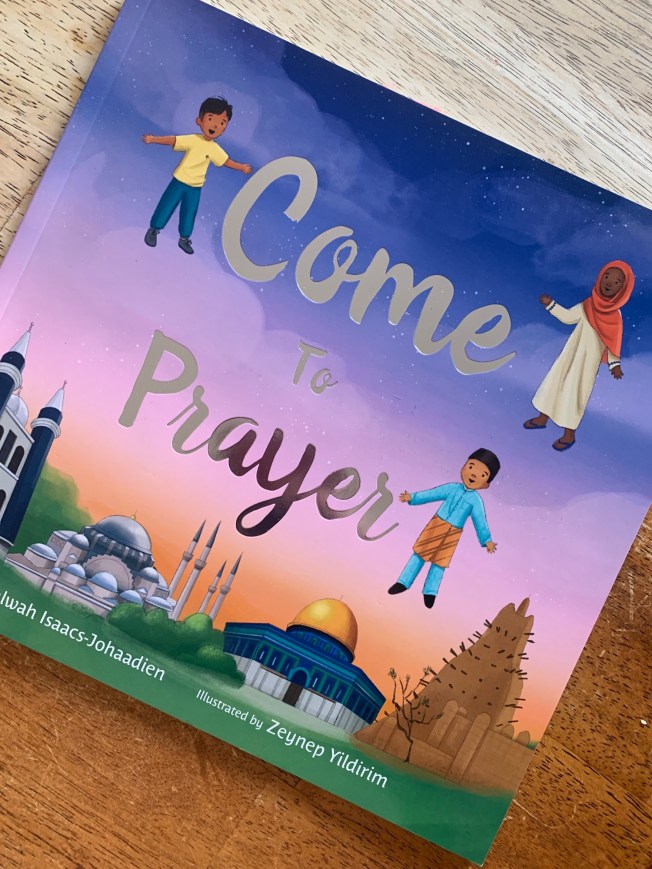
Come To Prayer by Salwah Isaacs-Johaadien illustrated by Zeynep Yildirim

Standard
Come To Prayer by Salwah Isaacs-Johaadien illustrated by Zeynep Yildirim

img_3530-1

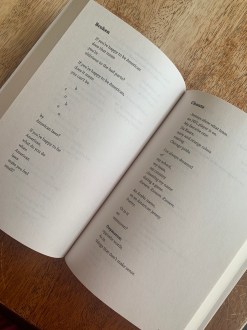
Framed around the five fard prayers, the rhyming 26 pages take readers all around the world with the refrain of “come to prayer, some to salah, come to success, come to falah” appearing after each two page spread.  Reykjavik, Honolulu, Rio, Timbuktu, Kuala Lumpur, and Makkah are shown as families gather to pray in each city.  It is hard to know if the locations were chosen for a specific reason, or to just help with the rhyming lines.  I appreciate the map at the end in showing 18 masjids in the world, but they are not the only ones pictured in the book, so honestly it was not intuitive why they were highlighted. Additional information about the masjids included and where they are located in the world would have been far more beneficial.  The rhyming at times is forced, but for the minimal lines on the pages, and the clear organization of the book, it didn’t bother me too much.  The illustrations compliment the text well and amplify the concept of Islam being a global faith through the connection of Muslims praying everywhere.  The Islamic fiction book is meant for toddlers to early elementary, and with the positive tone of salah being an invitation to success, I think it works well for the audience.

The book starts with little kids waking up in a snowy scene in Reykjavik and heading out with their parents to pray Fajr at the masjid.  Then it is rain in Honolulu that can’t stop a family of five from driving slowly to the masjid for Zuhr.  In Rio a family packs up at the beach to get to Asr salah on time.  For Maghrib, not even a sandstorm across the Sahara can keep a family in Timbuktu from getting to prayer.  And finally a family takes shelter in the masjid for Isha as thunder and lightning in Kuala Lumpur halt their tour. The story ends with everyone entering Makkah in ihraam to pray at the Kaaba.

The book is a thick paperback cover, with glossy 9 x 9.5 inch pages.  It works well for small group story times or bedtime.  It is available on Amazon here or from Crescent Moon Store here.

Kareem Between By Shifa Saltagi Safadi

Standard
Kareem Between By Shifa Saltagi Safadi

img_3395-1

It doesn’t matter how many Word documents you read, Goggle docs you add comments to, and screen shots you revise; to hold a physical book in your hands that you have been blessed to observe from the sidelines through numerous revisions, is mind blowing.  Reading the final version from page 1 to page 324, plus the backmatter, has left me at a loss for words with tears streaming down my cheeks. I truly cannot imagine the book any other way. All past drafts and storylines, were just stepping stones to get the book to this version, and as a fan of literature my whole life, to see this metamorphosis in real time has added to my respect and admiration of authors.  Enough about me though, this review is of the middle grade novel in verse that tells the story of Syrian American Kareem, a loveable boy caught in between choices, siblings, friends, labels, and global acts beyond his control.  He makes mistakes, he tries to make things right, and at the center of it all is his Islamic identity, love of football, and genuinely good heart.  I am biased in that I have self appointed Kareem as my nephew, but even after dozens of readings, I was moved to tears three times during the course of this reading.  I made my teens read the book and they loved it, and like them, we hope we get more Kareem in the future.

img_3541-1

SYNOPSIS:

Kareem loves football, particularly the Bears, and dreams of seeing his Arabic name on an American jersey one day in the NFL.  Unfortunately, he hasn’t made the school team, his best and only friend Adam has moved away, and the coach’s son is offering to talk to his dad for Kareem in exchange for some school help.  Add in a new Syrian kid at school, his mom going to Syria to take care of his grandfather, and the fruition of Executive Order 13769 aka the Muslim Ban, and seventh grade has Kareem scrambling on every down to say the least.

img_3543-1

WHY I LOVE IT:

The football framing, the literary inclusions, the Arabic, the Islam, all combine with such tangible heart to create a seamless read both as a compelling story and as an example of literary craft.  The language is on point and intentional, that even if you don’t know the character or novel referenced, the Arabic words included, or football terminology used, you will be invested in the characters and plot, and find yourself cheering for Kareem.  Often debut authors show promise, but their stories have plot holes, or pacing issues, or inconsistencies, that is not the case with this book.  The crumbs are there that tie everything together, the depth of the characters’ personalities reveal how developed they are, and the timeline keeps the book moving forward.  There are no dry or slow spots in the entire novel, it is easily read in one sitting as you find yourself nervous for Kareem, and curious how it will resolve.

Boys and girls, Muslims and non Muslims, Arabs and non Arabs, all will find themselves drawn to this book, and thinking about the characters, particularly Kareem, long after the final page is read.

img_3544-1

FLAGS:

Some stress and anxiety with missing parents.  Death, bullying, cheating, fighting, lying, racism.

img_3540-1

TOOLS FOR LEADING THE DISCUSSION:

The book is a solid middle grade, but the quality of writing and engaging plot makes it work for a middle school book club read as well.  I cannot wait to share this book widely.

Preorders speak volumes and I truly hope if you are able that you will preorder a copy, you can do so here.  Requesting your local public library to shelve the book is also a tremendous help to signal to publishers what type of stories and OWN voice authentic representation consumers will support.

Mimi & Unicorn Get to Know Allah by Zanib Mian illustrated by Laila Ramadhani

Standard
Mimi & Unicorn Get to Know Allah by Zanib Mian illustrated by Laila Ramadhani

img_3480-1

Creating understanding and love of Allah swt is perhaps the most important type of Islamic fiction book available for young children, so I love that we have options to choose from. The framing of this book is nothing new, a child asking various people about Allah swt to learn about Him, is found in numerous books.  But, this 32 page book is particularly engaging because of the large brightly illustrated pages, and the author’s signature style of conveying facts in a simple relatable manner.  The comic relief of the unicorn and the adorable protagonist are great, and the added layer of it being checked by two named scholars really make this one of the best in a very populated category.

The book starts with Mimi wondering about Allah swt after hearing people say things such as, “Allah will take care of it,” and “Allah knows.”  She asks her imaginary friend, Unicorn, but she doesn’t know either, so they head off to ask different family members.

img_3484-1

Summaya, Mimi’s big sister tells her that  “if you know Allah, you love Him, and He loves you.” It is followed up with details that Allah swt knows us, because he made us. From Nana, Mimi and Unicorn learn that Allah swt is One, and he explains why we don’t know what he looks like.  From Nani we learn that “Allah swt has no beginning and no ending.” Baba explains that we turn to Allah swt when we need help, Unicorn wonders if we need a phone or Imam to do that. Finally she talks to her Mama who explains trusting Allah’s plan.

Each stop is beautifully articulated and examples are given, resulting in a Mimi who’s heart becomes light and warm, and who works to know more about Allah swt every single day.

The backmatter includes notes from the author and illustrator and various bookish people sharing their early understanding of Allah swt and his attributes.

img_3487-1

The book is available from muslimchildrensbooks.co.uk in the UK and here from Crescent Moon Store in the USA (she ships globally)

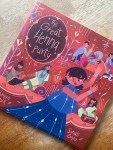
The Great Henna Party by Humera Malik illustrated by Sonali Zohra

Standard
The Great Henna Party by Humera Malik illustrated by Sonali Zohra

img_3465-1

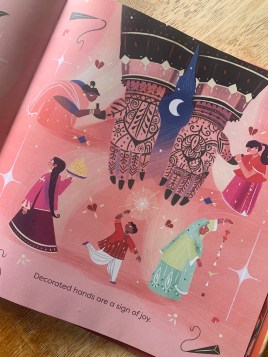
This 32 page story shares a desi family at a henna party before a wedding.  There is nothing Islamic in this book by a Muslim author, it is simply cultural.  The story on its own is fine.  It is sweet and joy filled, as a girl tries to decide who’s name to have hidden in her henna design.  I do wonder though, if the book is meant to be a window into desi culture, why the Urdu word “mehndi” isn’t used instead of henna.  It mentions it in the backmatter, that mehndi is the Urdu word, but it seems a little inauthentic and western gaze presenting throughout the story, and honestly I really struggled to get past it.

img_3466-1

The book starts with Noor entering the henna party, the night before her cousins wedding, to sing with the ladies of the family and have their hands painted.  Her mother asks her if she knows about the name game, where the bride hides the grooms name on her hands, and if he finds it, he wins, and if he does not, the bride wins. Noor asks if she can hide someone’s name and her mom says yes, just tell the artist.

img_3467-1

She watches her dad setting up decorations and wonders if she should have his name hidden.  She then sees her Mama playing the dholki and singing and wonders if she should hide her mother’s name.  She continues through various family members before making her decision.  Along the way the reader learns about the music, the food, the clothes, and how the paste dries and leaves a color.

img_3468-1

The page on food starts with spices, then talks of samosa and then they are eating ladoo, and while I’m glad there is not a glossary, I don’t know that the lacking context clues make any of those scrumptious foods known. I do like that her grandfather helped her pick out her lehenga, and her father is shown decorating to show full family involvement.
Ultimately, though I think the tricky thing about cultural weddings, is that every family has their own traditions, and while in a desi wedding some things might be widespread, when presenting them to readers outside your culture, it is hard to know how they will be perceived.  I almost feel like this book makes it seem that every family hides names in the mehndi as a staple of the festivities. And based on other reviews I’ve read, people seem to feel that this is insightful into the culture, or that hiding and finding names has more weight, a stress even, than just being fun.

img_3469-1

I could be over thinking it, but it feels like even the backmatter is trying to cast a wide net over every religion and culture that uses henna and ends up being oddly vague in this specific example.  Like I said the book is adequate, I like that the little protagonist Noor, loves so many people and solves her dilemma on her own, it has plot, and conflict and resolution, it just seems to lack the exciting tone and thus fails in immersing the reader into the henna party.

The Monkey, The Cow, and the Wolf (The Song Book) by Zain Bhikha illustrated by Amir Al-Zubi and Azra Momin

Standard
The Monkey, The Cow, and the Wolf (The Song Book) by Zain Bhikha illustrated by Amir Al-Zubi and Azra Momin

I was wondering when the book version of this song was going to be released.  It is a beloved at our house, and when the book arrived, I don’t know if the 4 year old or 13 year old was more excited.  Either way, none of us were able to read the book, we all, by about page two, were singing at full volume the story of the monkey, the cow, and the wolf.  If upon seeing this cover you didn’t immediately start humming the beloved kid’s song, then you are in for a treat with this book as three stories about animals teaching timeless lessons are shared.  The book is simply the lyrics of the song, so a parent might need to explain a bit, but the fun illustrations, and rhyming lines will make it a favorite for toddlers and preschoolers to sing and flip pages to, alhumdulillah.

The song/book is organized with a statement, a chorus highlighting the moral after each story and then repeating the opening framing statement.  The first story is about a business man who would cheat his customers, Allah swt sent him a monkey, and the monkey purified his wealth by disposing of half of it in the sea. The moral being that “Allah hates cheating, Allah hates lies, so give what’s due and receive what’s right.”

The next story is about a farmer and his cow.  The farmer works his animals way too hard, so Allah allows the cow to speak and tell his owner not to abuse him or the other animals.  The moral being that “Allah made animals, Allah made man, to all living creatures be kind and fair.”

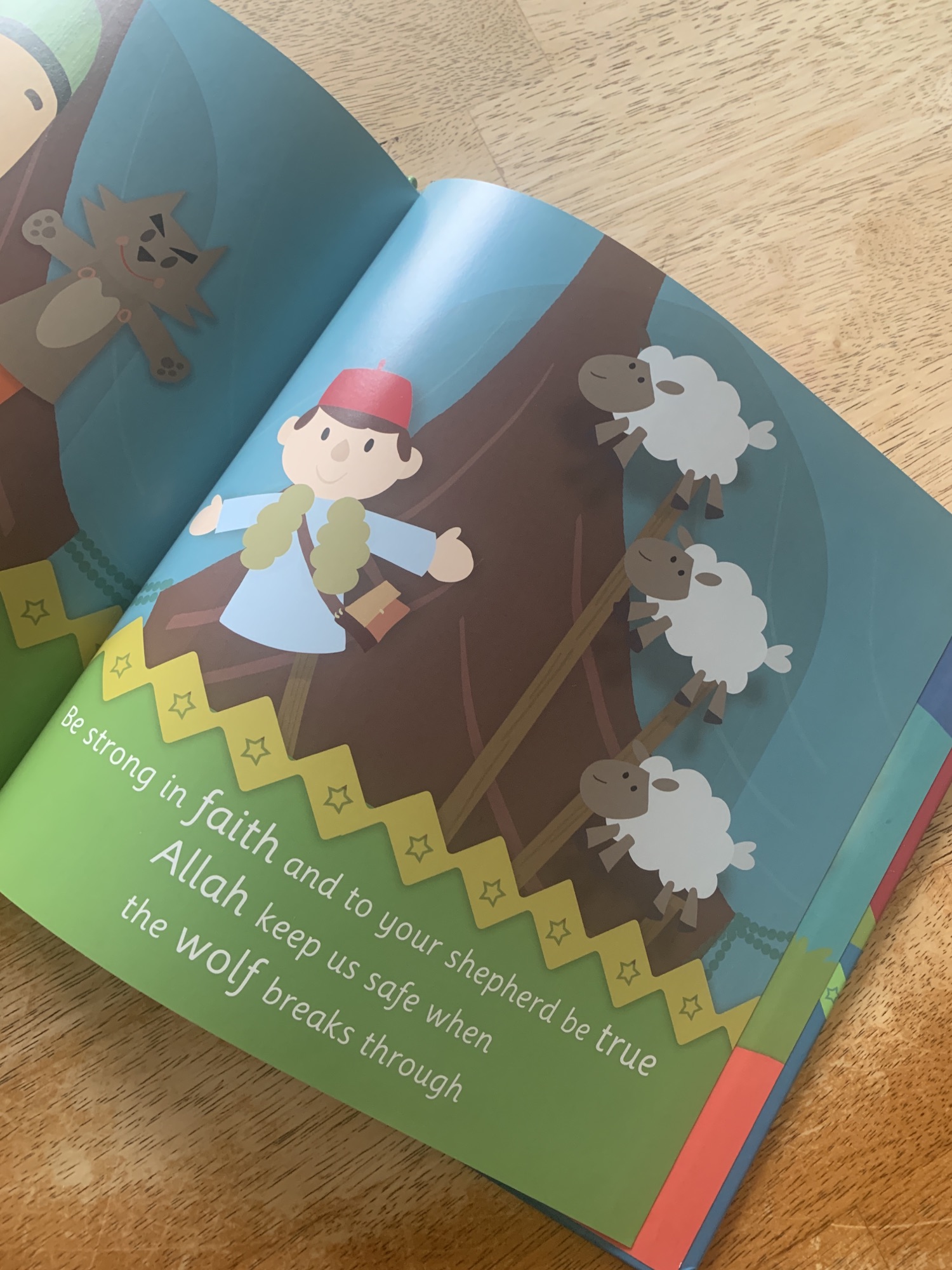
The final story is about the wolf trying to steal the sheep and the shepherd protecting them.  The warning is that the sheep must be strong in faith for the wolf will always be trying to take you.

The book and song are catchy and fun, and provide stories and morals to discuss with kids at story time and bedtime.  The only slightly odd thing about the book is that the last page is the inside back cover.  I’m sure it was a binding decision but it seems it could have balanced the title pages at the beginning to make it feel symmetrical.

Available to order HERE

Not Yet: The Story of an Unstoppable Skater by Zahra Lari and Hadley Davis illustrated by Sara Alfageeh

Standard
Not Yet: The Story of an Unstoppable Skater by Zahra Lari and Hadley Davis illustrated by Sara Alfageeh

img_2890-1

Despite my initial hesitancy, the book really won me over.  The inspiration behind the story is impressive, but even if it was complete fiction, it would still be a cute book.  Over 40 pages, the illustrations and simple text introduce you to Zahra, a young girl in the UAE with big dreams and a lot of determination.  And that is before she even sets foot on the ice.  Four to eight year old kids will enjoy the humor, with the older readers appreciating what she was able to overcome and accomplish.  Adults will appreciate the authors’ and illustrator’s notes at the end and seeing their kids being inspired to pursue their dreams.

The book begins with Zahra watching a movie at a theater and being inspired by the skaters on the screen.  She slides across the floor in her socks that night when she gets home, and declares she is going to be a figure skater.  Her brother points out that she doesn’t know how to skate. When she asks her friend to make her a costume, it is revealed that she isn’t even taking lessons. It seems everyone wants to point out the flaws in Zahra’s plans.  To which she responds, “not yet.”

Luckily her dad supports her, and takes her to the only ice skating rink in the country, where she promptly falls over again and again.  But there is something to be said for not giving up, and the true story of Zahra Lari shows that sometimes you have to be the one to break the barriers and remove the “not yets” on the path to achieving your dreams.

I found this book at my public library, but it can also be purchased here.

Until You Find the Sun by Maryam Hassan illustrated by Anna Wilson

Standard
Until You Find the Sun by Maryam Hassan illustrated by Anna Wilson

I don’t know that this book is particularly unique or mind blowing, but I read a digital copy a few weeks ago and was surprised when some tears fell, I read it when I got the physical copy to my kids and my throat caught again, and here I am writing this review and feeling all vulnerable.  It is as if I too am a little girl in a new place missing her grandfather on the other side of the world, which clearly I’m not.  The book is sweet, and moving, and I find myself emotionally invested every time I read through the 32 pages and get lost in the large sweeping illustrations.  The book is not Islamic, there are a few hijabis in the background and text that articulates friends saying salaam before the girl moves.  Additionally, the main character’s name is Aminah, and the author is of Pakistani decent, and has a Muslim sounding name.  The story though, at its core is universal, heartfelt, reassuring, hopeful, and lovely to share in all spaces. It begs to be read aloud and holds the attention of toddlers to early elementary aged children.

The book starts with a happy little Aminah in a bright sparkly environment of sunshine, mangoes, and salaams.  Every night she listens to Da’s stories of adventure as she snuggles next to her grandfather.  One day she finds out they are moving, going on an adventure.  Only Da won’t be joining them and Aminah is devastated.

The new home is gray, and cold, and no adventure at all.  She wants to go back, but Da reassures her during their nightly conversations that things will get better.  And sure enough, with a bit of bright yellow inspiration, she starts to discover the adventures awaiting in her new home.

Kids will find the end hopeful and resolved, but I somehow found it a little bittersweet.  Da loves his grand daughter and wants her happy, but the adult me, realizes their relationship will never be the same, and Da will miss her in many ways, alone, as she embarks on her own life.  I know I’m projecting, but the ability to see both perspectives adds a nice layer to the book.

The book is available here from Amazon and will be in local libraries in June 2024.