Category Archives: Muslim Character

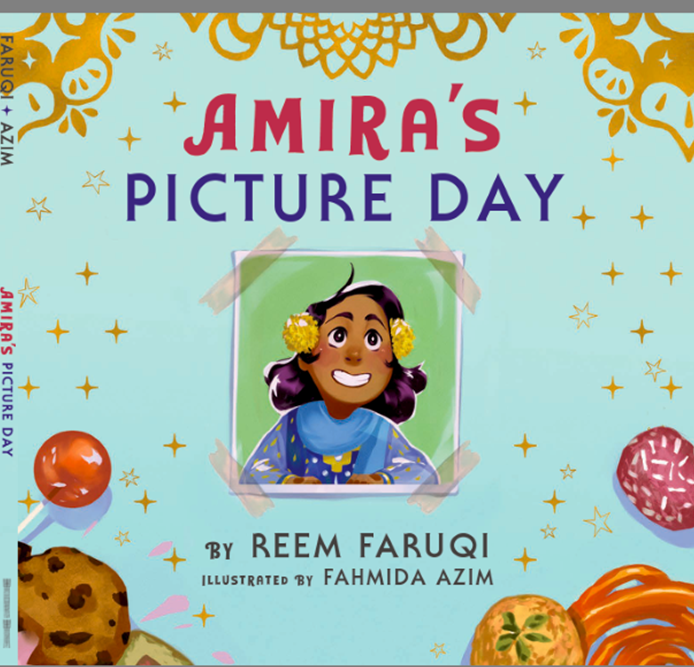
Amira’s Picture Day by Reem Faruqi illustrated by Fahmida Azim

Standard
Amira’s Picture Day by Reem Faruqi illustrated by Fahmida Azim

amira's picture day

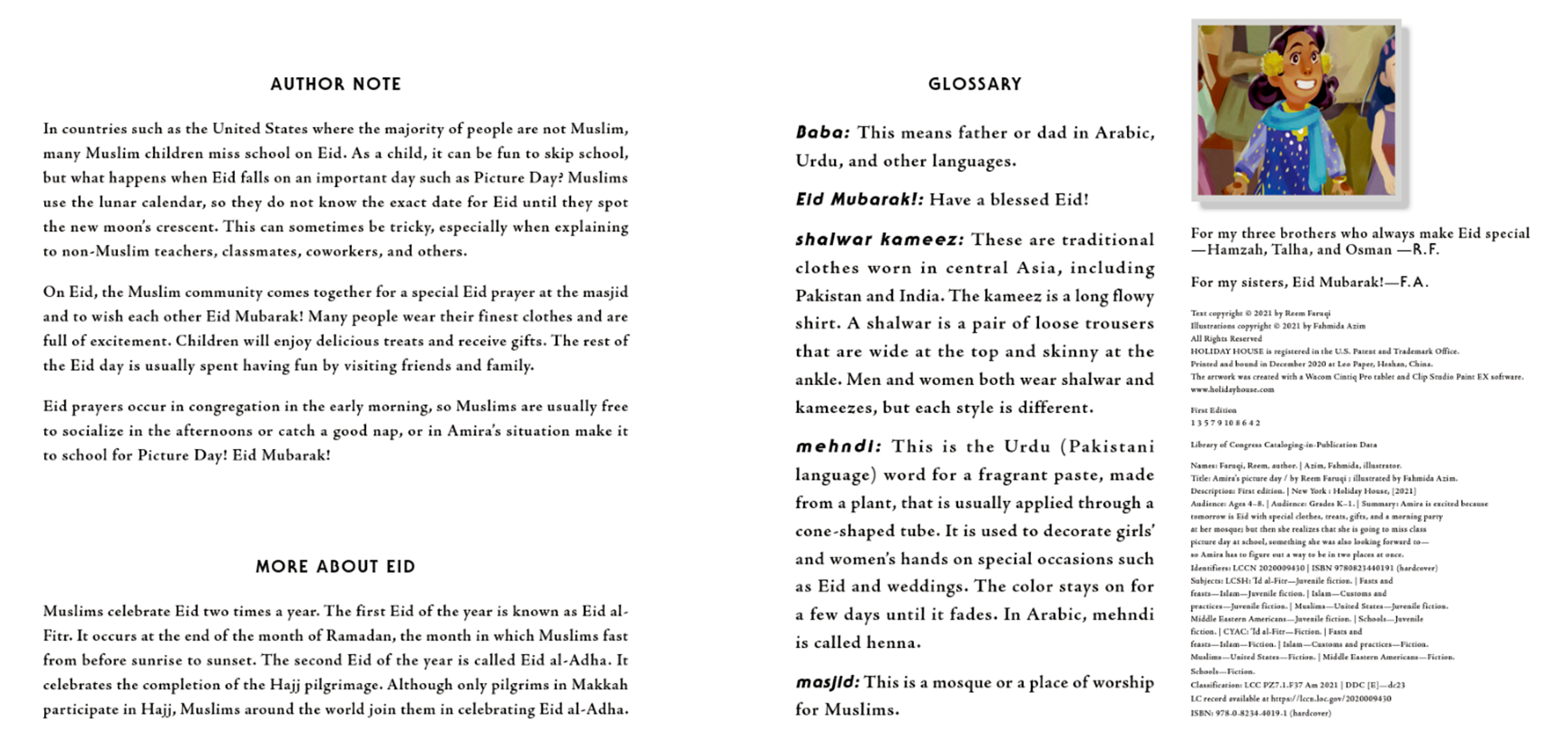
This book is the mirror so many kids are desperate to find in literature. A young Muslim girl is excited to celebrate Eid, while at the same time is sad knowing she is missing school picture day with her class. Not knowing what day Eid will be, not having it a scheduled day off in most school districts, and always feeling like you have your foot in two different doors starts early for children in non Muslim majority countries. This early picture book touches on those emotions, and even if you can’t always get a test rescheduled or a project due date moved, at least readers that face these dilemmas at any age and stage in life, will feel seen in this 32 page book perfect for ages 5 and up.

amira4

Amira and her brother Ziyad start the book looking out the window for the moon. They see it, which means Eid is tomorrow and Amira is going to have her mom put decorative Mehndi on her hands. She has her mom include a dolphin in the green swirls and hopes that by morning the color will be dark and beautiful. Ziyad is excited that they get to skip school.

amira1

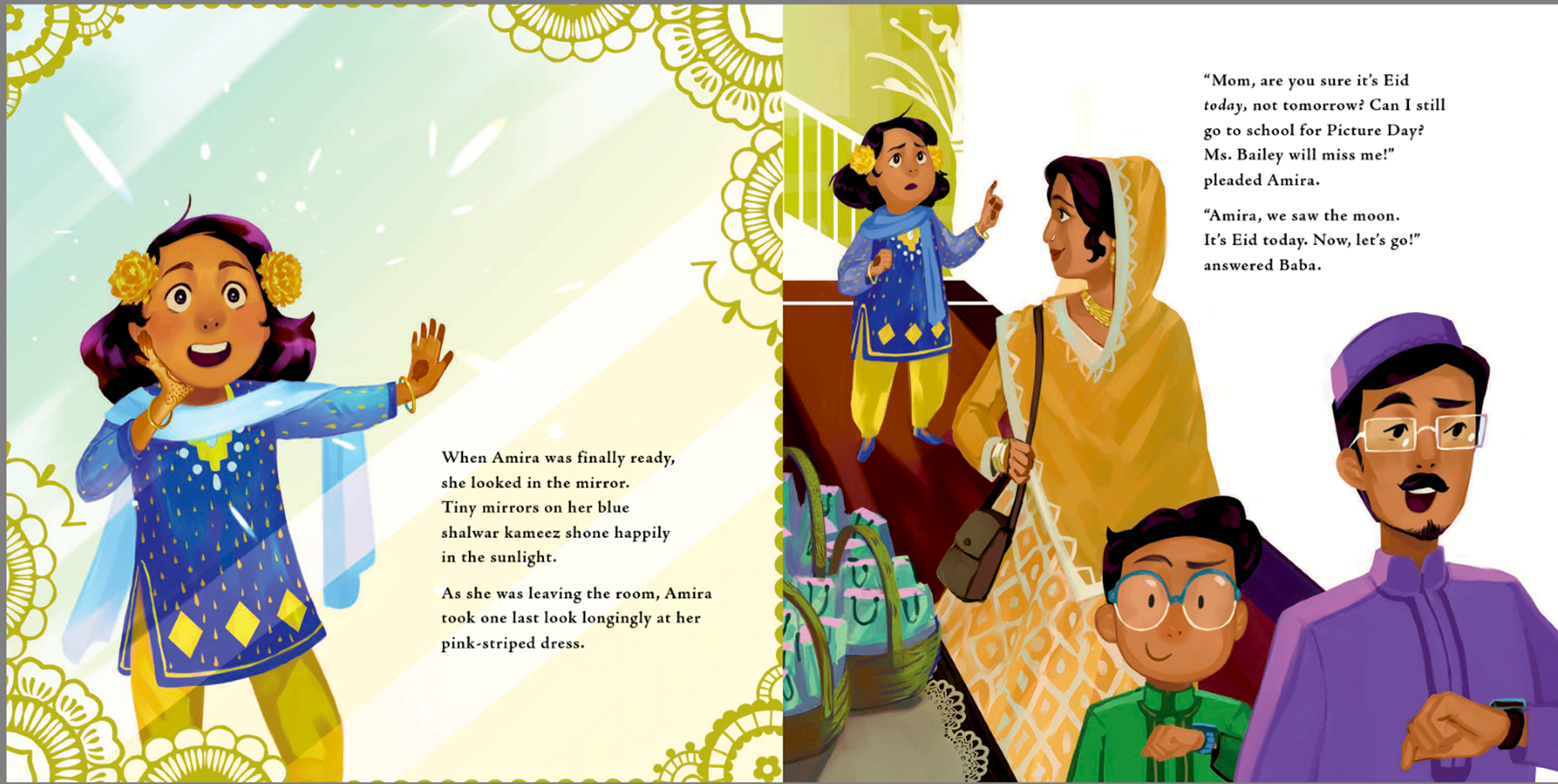
Mom recruits the two kids to make goody bags and count out lollipops for the kids at the masjid, when the flyer for picture day catches Amira’s attention. Devastated that she will miss the class picture having already picked out a pink-striped dress for the occasion, mom reassures her that she will get to wear her new shalwar kameez, and they will take lots of pictures at the masjid.

amira5

Amira loves going for prayers and the party after, but she is kept awake at night worrying how her classmates will remember her if she isn’t in the picture. The next morning she is excited, it is Eid, but seeing her pink dress hanging next to her blue Eid outfit makes getting dressed a heavy process.

amira6

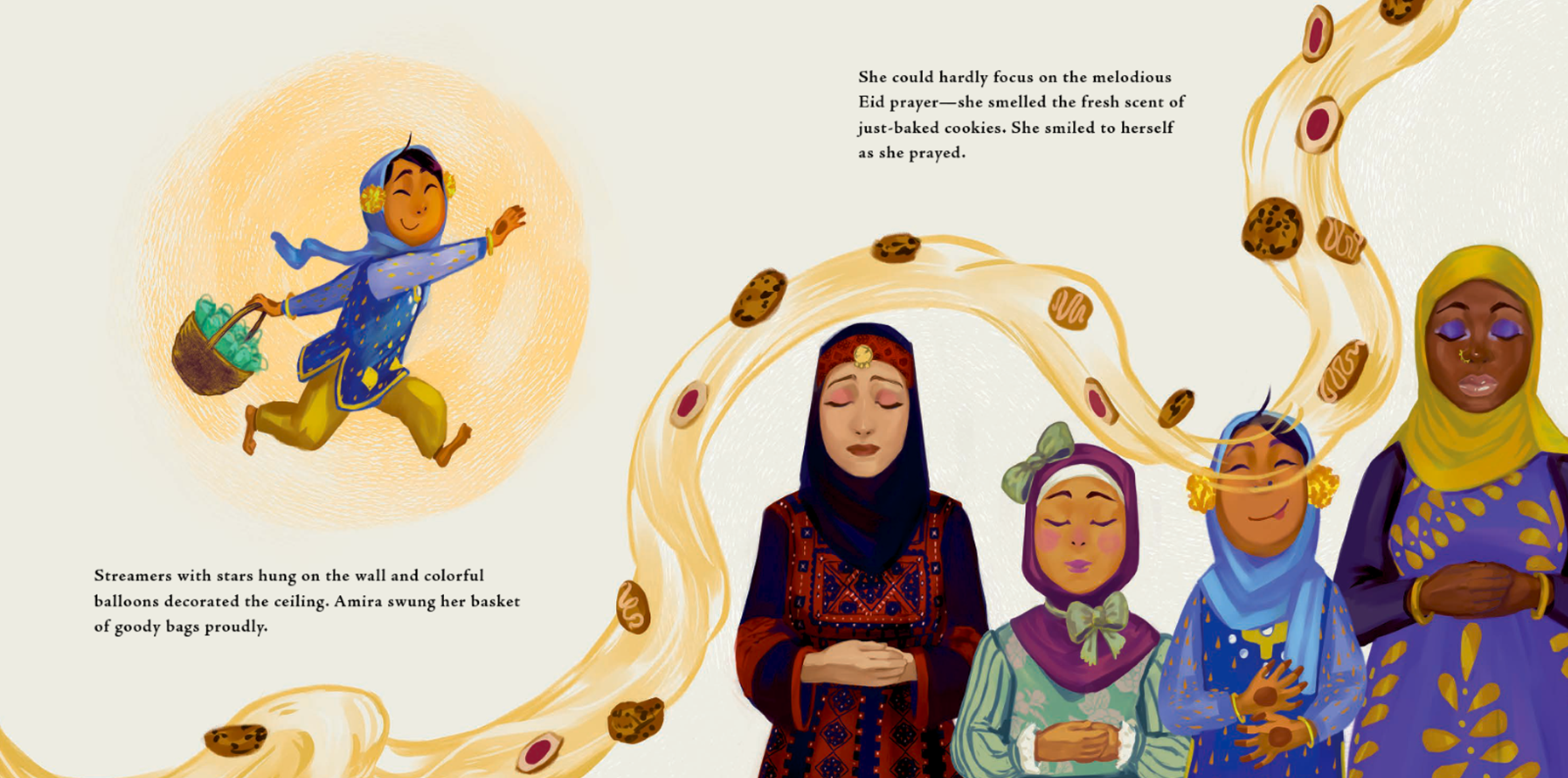
When they get to the masjid, Amira hardly recognizes it, it is all decorated and everyone looks beautiful. The smell of baked goods makes focusing on her prayers difficult, and after when everyone is taking pictures she remembers what she is missing and feels deflated.

amira3

On the way home Amira works to hold back the tears, when she suddenly has an idea to take the remaining goody bags to her classmates, and maybe catch her class pictures. Her parents agree and they stop at the school.

I won’t spoil if she made it in time, but the kids in her class love her clothes, and her mehndi designs. The book concludes with an Author’s Note, More about Eid and a Glossary.

amira2

I absolutely love the illustrations, little Amira is infectious and endearing. I wish the mom would have been a little more in tune with Amira’s feelings though, she definitely is upset and while I’m glad the family stopped after the Eid party, I feel like more could have been done beforehand to acknowledge Amira’s feelings, and see what could be done to accommodate both activities.

amira7

I love the diversity and brightness of the book to convey the absolute joy and happiness of Eid outside of presents. I think the book works for all children of all backgrounds and is a much needed addition to the repetitive Eid books available.

Sadiq and the Ramadan Gift by Siman Nuurali illustrated by Anjan Sarkar

Standard
Sadiq and the Ramadan Gift by Siman Nuurali illustrated by Anjan Sarkar

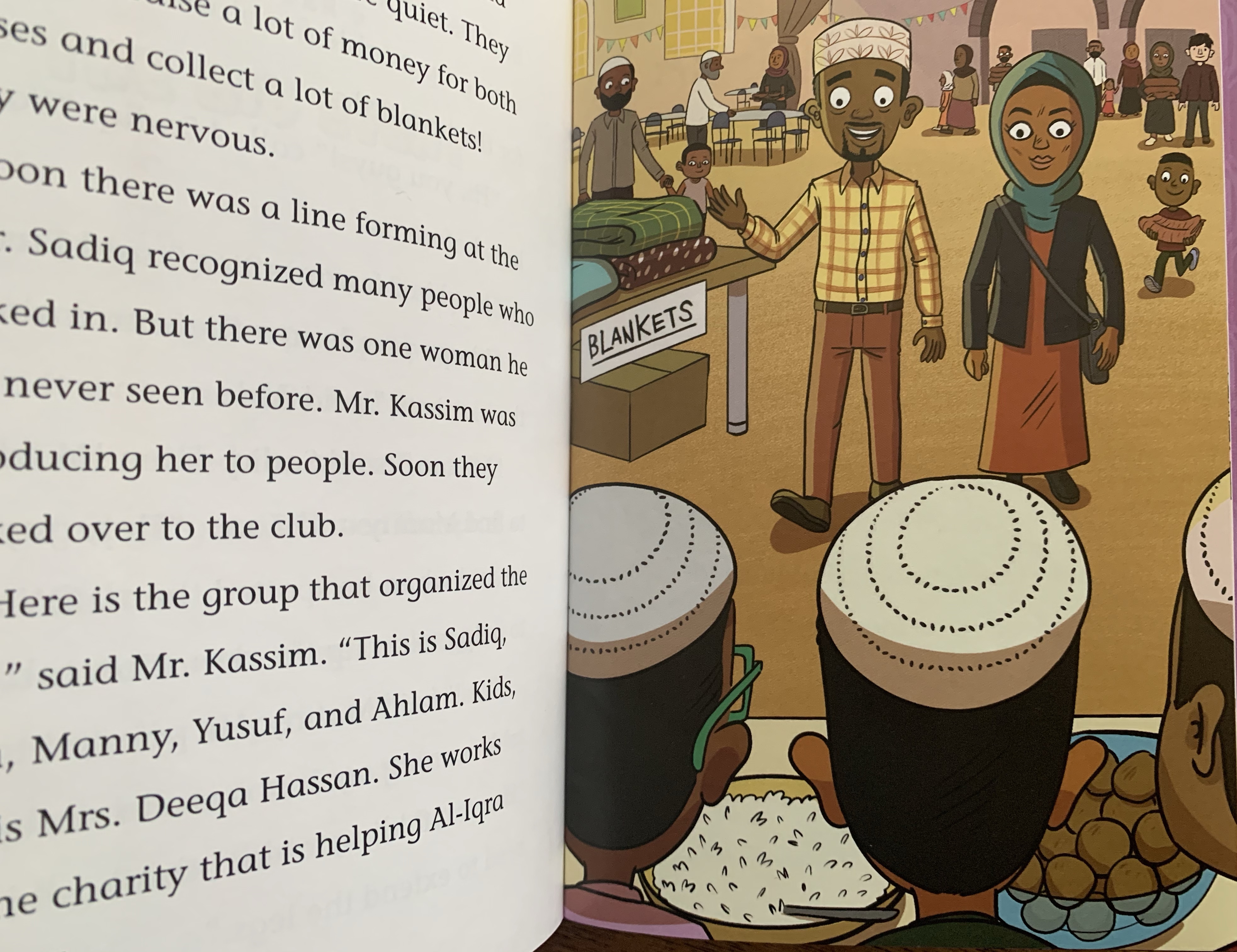
img_8554This 65 page early chapter book in the Sadiq Series does a great job of introducing Ramadan, giving a glimpse of Somali culture, and conveying a relatable and engaging story about friends with a lesson/reminder about the values of communication.  A group of boys hosting a fundraising iftar to help a school in Somalia have to figure out the logistics, the marketing, the cooking, and the execution, as they become socially aware and active in helping meet the needs of their community, both locally and afar.  This OWN voice tale doesn’t shy away from authentically drawing on religion and culture to make characters and a plot that all readers can enjoy.  The book is not preachy, but the characters know who they are in their manners, dress, speech, and environment.  A great book any time of year for first grade and up.

img_8555

SYNOPSIS:

With Ramadan starting in a few days, Sadiq and his friends at the Dugsi are reviewing the importance and values of Ramadan.  This year the masjid is raising money for a school in Somali and the students are encouraged to help, as sadaqah, or charity, is especially important during Ramadan.  The boys decide to host a fundraising iftar at the masjid and with parental help to coordinate with the Imam, the kids have to figure out how to get enough food, get the word out, get set up to take donations and more.  They make flyers, set up a website and shoot a small video.  The once excited Zaza, however, is no longer very enthusiastic in the Money Makers Club and Sadiq can’t figure out why, but with so much to do and little time to get it done, more friends and family are brought in to help, and things continue on.  When Zaza tries to tell Sadiq he wants to do his own fundraiser, Sadiq doesn’t want to listen.  I’m not going to spoil if the two friends work it out and how they handle the two ideas, but it is a good lesson in friendship, communication, and charity, Alhumdulillah.

img_8556

WHY I LIKE IT:

I love that the story starts with information about Somalia and words in Somali as well as a picture of the family.  There are activities and questions at the end as well as a glossary of religious, cultural, and English vocabulary words. The book doesn’t assume that the reader knows anything about Islam or Somalia, nor does it assumer that the readers don’t.  It strikes a balance of not talking down to the reader or getting too wordy.  It simply provides the information needed if you are curious, but allows the story and the boys dilemma to take center stage.  The whole series is remarkable in showing diversity and relatability with good quality story telling.  I think this is the only book in the series that has a religious theme, I could be mistaken.  The illustrations show the boys in kufis and the women in hijab.

img_8557

FLAGS:

None

img_8558

TOOLS FOR LEADING THE DISCUSSION:

Every elementary school library and every first through third grade classroom library should have this series.  I know my public library has it, and the copies I get from there seem to be worn and loved.  The age is too young for a book club, but would be great in small groups or for outside reading with the short chapters and engaging illustrations.

The Adventures of Adam and Anisah: My Brother’s Shield by Zahra Patel illustrated by Reyhana Ismail

Standard
The Adventures of Adam and Anisah: My Brother’s Shield by Zahra Patel illustrated by Reyhana Ismail

img_8580

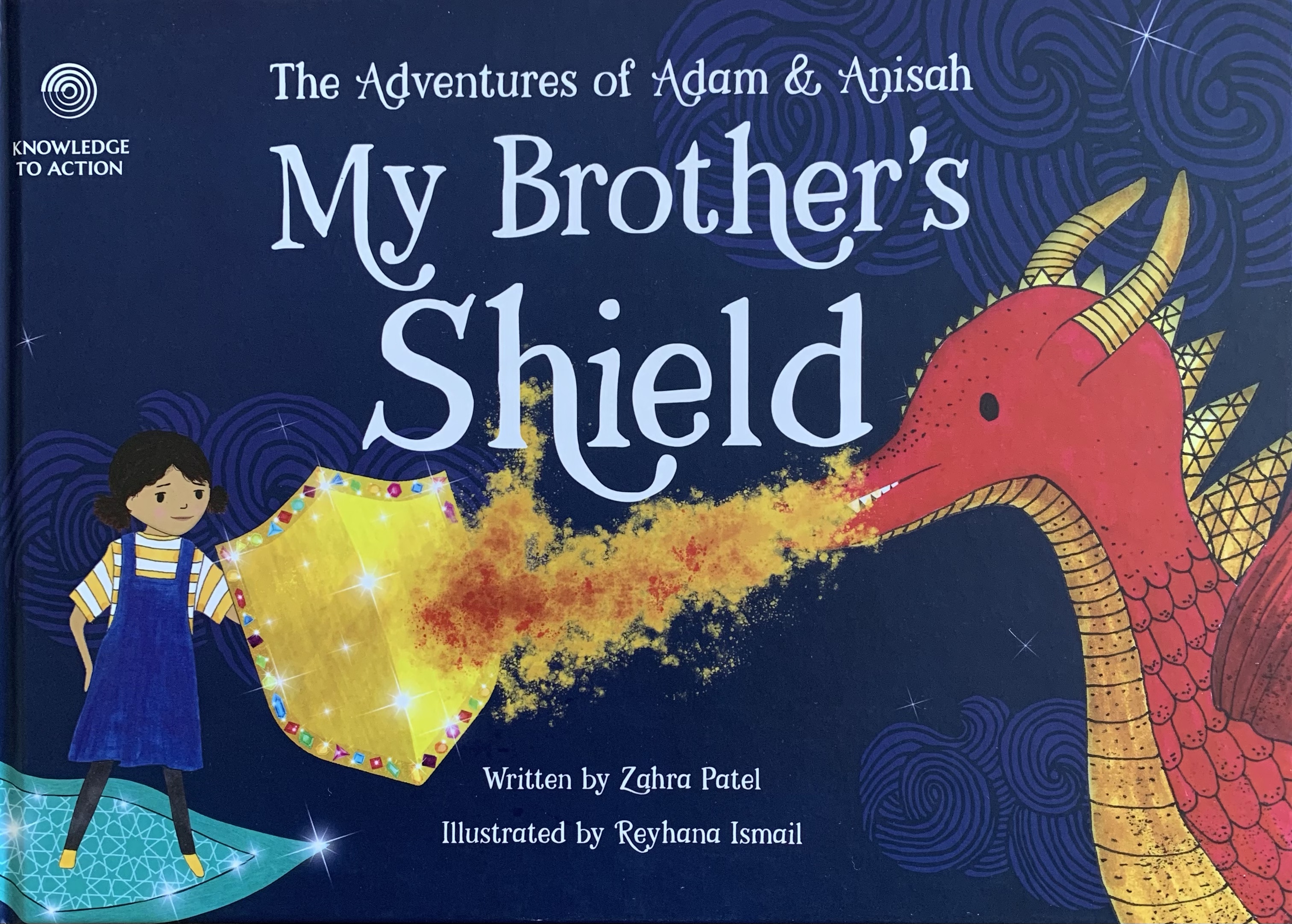
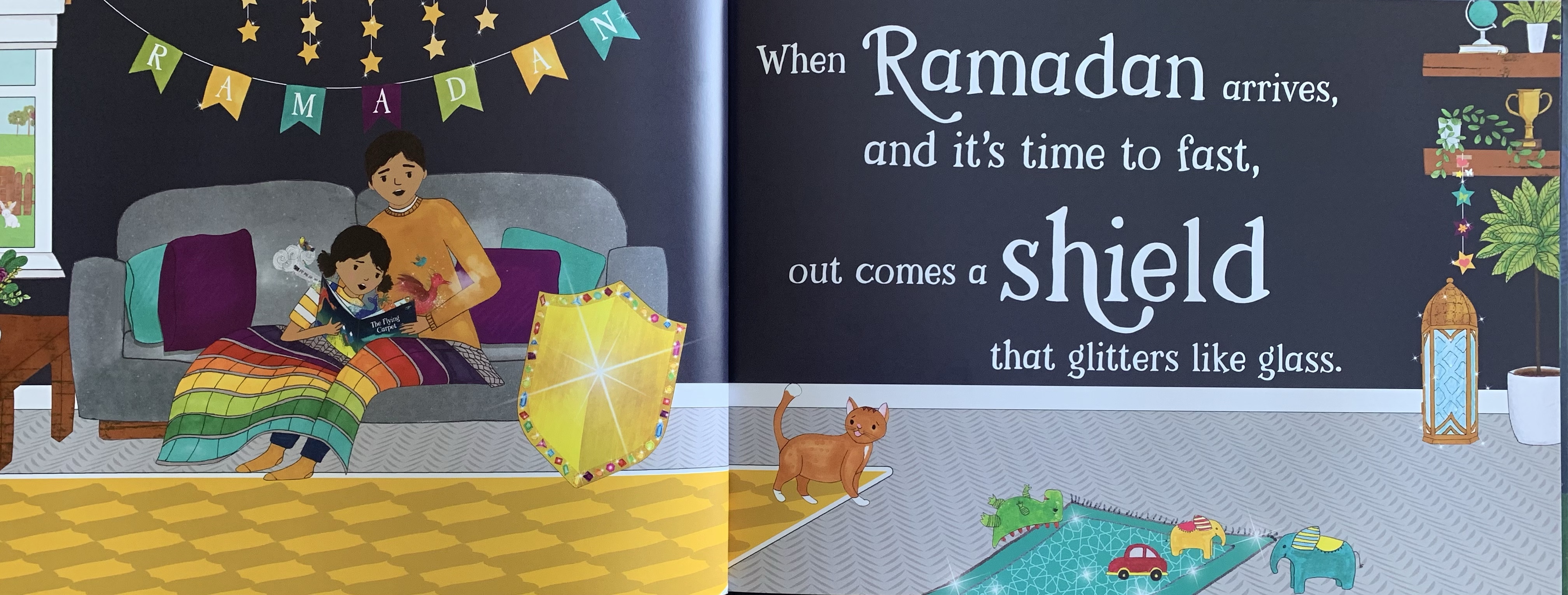
Based on the idea that “Fasting is a Shield (ibn Majah),” this adorable book brings Ramadan not just to life, but makes those that fast into absolute superheroes!  Over 32 pages of simple large rhyming words, little Anisah shares her wonder and amazement toward her brother, and his shield that he wields during Ramadan.  The beauty of her admiration for her older sibling combined with the message, illustrations, and presentation, make this book (there is also an accompanying workbook) perfect for ages three and up.

img_8581

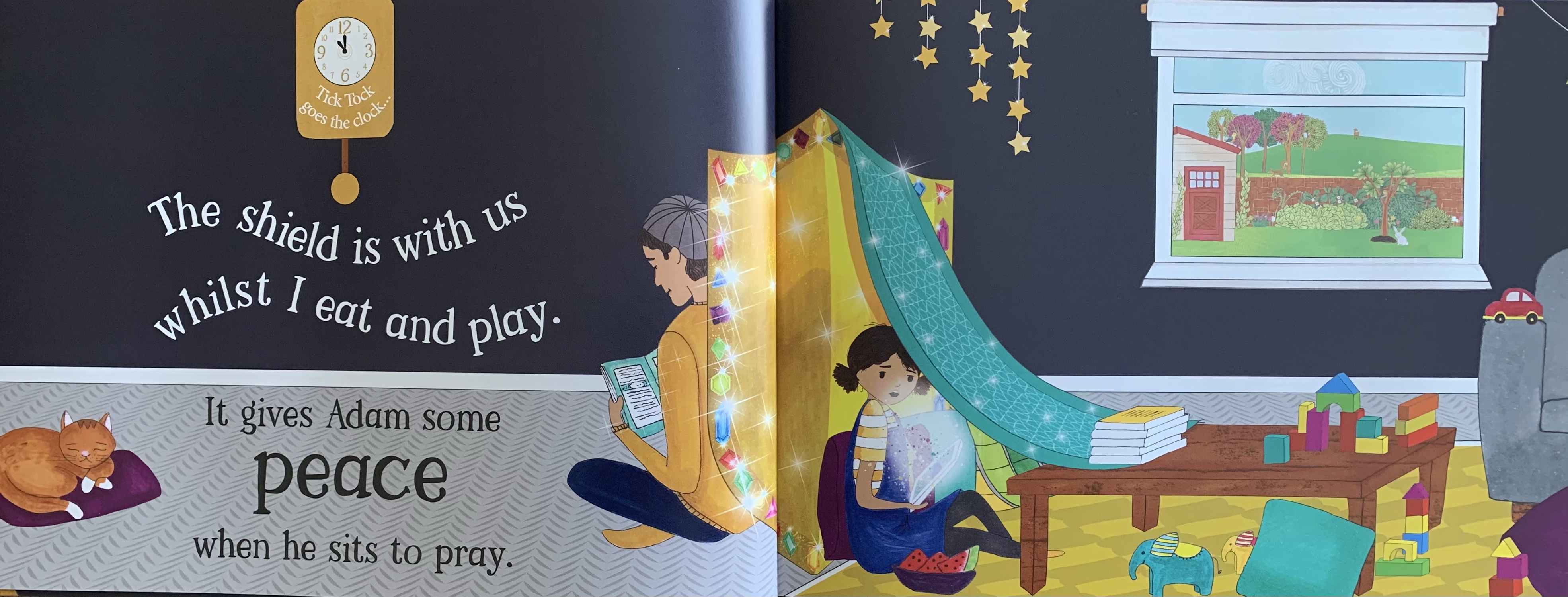
It starts with a secret.  Adam is a superhero.  When Ramadan arrives, the shield comes out and Adam carries it all day.  He doesn’t eat or drink when he has it.  It makes him brave and saves him from tempting biscuits.  It gives him peace when he reads Quran. It keeps him calm when there is a foul during a soccer game. It even keeps him away from gossip at the mosque.

img_8582

When they break their fast, they pull out their magic carpet to fly.  And when Ramadan is over the shield goes away until it is needed again. Anisah patiently marks off the days on the calendar until Ramadan will arrive, because she has another secret.  She is training to be a superhero too.

img_8583

The book concludes with how the story came about, discussion questions and some activities to help learn through practice. The illustrations show diversity and whimsy and toddlers and preschoolers, I’m certain will be begging for this story all year around.

img_8584


Red Shoes by Karen English illustrated by Ebony Glenn

Standard
Red Shoes by Karen English illustrated by Ebony Glenn

img_8529

This delightful 32 page picture book links two girls, two ends of the world, two cultures and two stories together with a pair of red shoes.  The short sentences pop with action and the perfectly illustrated two-page spreads convey relatable emotion and joy.  The beloved shoes travel on the feet of one character to a wedding, Christmas dinner, and birthdays, they are then are donated and journey to West Africa to be given as a gift for a little girl who fasted half of Ramadan.   The message I hope children ages three and up will get from the story, is that we are more alike than different, that we should take care of our things (amazingly the shoes weren’t worn out), and that we should donate things of good quality that we ourselves value.  I hope it doesn’t lend itself to perpetuate the stereotype that we can send our castaway items to Africa, being the author comments in her bio on the back flap that her husband is from West Africa and that she frequently visits there, I’m hoping that this is just me being overly cautious in the messaging, and nothing is being implied or negatively taken from a casual reader.

img_8530

Malika and her Nana see a pair of dazzling shoes perched in the window, and Malika is enamored. Her grandma later surprises Malika with the shoes.  She quickly tries them on and tests them out.  She keeps them safe from the rain and dances with them on at her Auntie’s wedding.  She kicks her cousin Jamal with them on, under the table at Christmas when he tries to steal her biscuit.

img_8531

She stomps away from her best friend in her red shoes, and jumps double Dutch with them on when she makes up with her friend at her birthday party. But at Nana’s birthday, “the shoes don’t let her forget that her feet have grown.” Nana and Malika take the shoes to the thrift store to be resold.  A sad Malika says goodbye to them, they were her favorite shoes ever.

img_8532

Inna Ziya sees the shoes in the window and knows just the little girl who will love them.  She squeezes them in to her suitcase and they are off to Africa. They wait under a table selling claypots in a market waiting for the girl who fasted half the month of Ramadan.

img_8534

When Amina comes holding her mother’s hand, Auntie Inna Ziya delivers the promised gift.  Amina thinks they are beautiful and lovingly carries them in the box on her lap as they fide the tro-tro home.  Amina’s little sister Halima, can’t wait to see the gift as she too hopes to one day fast in Ramadan.

img_8535

Amina lets her try them on and when she outgrows them she plans to pass them on to her.  Meanwhile, Malika is wondering whatever happened to her beautiful red shoes, and if someone else is wearing them.

img_8536

There is no mention of Islam nor is Ramadan explained.  There are women in hijab in America and in Africa, even in the books in a shop window there is representation.  I particularly love the shout-out in the illustrations to “Mommy’s Khimar.”

img_8533

The front of the book has Malika, and the back, Amira.

img_8537

Accused: My Story of Injustice (I, Witness Series Book 1) by Adama Bah

Standard
Accused: My Story of Injustice (I, Witness Series Book 1) by Adama Bah

adama

This is the first book in a new middle grades nonfiction series and is Adama Bah telling her own story about being detained as a 16 year old and falsely accused of being a suicide bomber.  A story that sounds like a movie plot is painfully real and terrifying and hearing it in her own words is powerful and impactful.  The writing is very basic in its linear format and straightforward presentation of the experience through her eyes.  It is not sensationalized or overly explanatory about how this situation came to be, how she got out of it, or what the family had to go to to find lawyers and pay for them, for example.  It is how she felt, what she understood at the time, and how the experience shaped her.  While the writing style is sufficient for middle grades, her story is intense.  A big part of her experience is being strip searched, exposed, and seeking asylum to avoid female circumcision.  The 128 page book is a great way to show the realities of our world.  It took place in the 2000, the recent past, to a New York teenager that enjoyed different colored sneakers, chatting with her friends, and spending time with her family, no different than the readers picking up her story to read.

SYNOPSIS:

Adama was born in Conakry, Guinea in 1988 and moved to America as a child.  She attended public school until high school when she was then sent to an Islamic boarding School in Buffalo, New York.  Her family was not particularly religious, but Adama become more visibly Muslim returning home after the attacks on September 11, wearing niqab and wondering why she was being treated with such hostility at the airport.  As she resumes her education in public school, she slowly makes the choice to take off her niqab, while maintaining her hijab and modest clothing.  In 2005 she and her father are taken in to custody early in the morning from their home and detained.  During the questioning at 16 years old, Adama learns that she is not a legal US citizen.  Her father is separated from her, to be deported, and she is moved to Pennsylvania as the youngest person swept up in a terrorist roundup.  She is being accused of being a potential suicide bomber and is detained for six weeks before a plea deal is brokered.  She will wear an ankle monitor for three years and have a nightly curfew.  During this time she is responsible to care for her family as her father has been returned to Guinea, her mother speaks very little english and she has four younger siblings.  Even after the bracelet is removed she finds herself still on no-fly lists and finally after one more time being denied and detained at the airport, she sues the Attorney General, FBI Director, and the Director of the Terrorist Screening Center. When they learn of this they offer to remove her from the no-fly list if she withdraws her case. She is granted asylum and while she had to drop out of school, she dreams of going back.  She has since married, her dad has been able to return to America, and she continues to study Islam and believe that things could have been worse.

WHY I LIKE IT:

I love that it is her story, from her eyes and perspective, but I worry that some of the details are misplaced.  She details enjoying talking bad about the government with a friend after she is released knowing that they are listening in, but maintains that she is constantly in fear of being returned to jail and that she considers America her home.  I’m not saying all of those things can’t be true and co exist, but some additional context would help the choppiness in this example and others.  I appreciated that the genital mutilation was clearly attributed to culture and not religion, I think when others tell stories about cultural and religious practices they often conflate the two.  I wish there was more information about where this mysterious list came from, what happened to the Bengali girl that was taken, how the Islamic community reacted.  The story is powerful and moving, and readers will be drawn in as they see themselves in her.  There are also questions at the end that help connect readers to her situation, and the reality that this is the unjust world we live in and can easily be consumed by as she nearly was.

FLAGS:

Detailing a strip search, detailing taking off her clothes, having orifices checked, and using the bathroom in the open.  There is talk of female circumcision although it doesn’t define it explicitly.

TOOLS FOR LEADING THE DISCUSSION:

I think in a high school Social Studies class or current events discussion this book would be a great topic to explore and voice to highlight.  The book is short and can be read very quickly.  It is an important story to know, to learn from, to sympathize with, and be acutely aware of for people of all ages.

The Shape of Thunder by Jasmine Warga

Standard
The Shape of Thunder by Jasmine Warga

shape of thunder

Usually when a book leaves me with a lot of questions, it is because the author’s writing was incomplete or flawed, this book however, left me with a lot of questions and I’m certain the author did this deliberately. Hence, I don’t know to be irritated or impressed that I care enough about the characters to want to know more. Considering I’m still emotionally attached to the two alternating voices in the book, I’m going to claim the latter, and just be grateful that I was privy to follow the two girls for 288 pages and let the impression the book left me with overpower the curiosity I have to know everything about their past and their futures. This middle grades read is absolutely wonderful and emotionally gripping. I think all kids will have a hard time forgetting the story and characters, and more importantly I think over time they will recall and re evaluate their own thoughts regarding the personal weight of school shootings, gun ownership, sibling loss, responsibility, and maybe even the possibility of time travel. I know this book will stay with me for a long time. This amazing, half-Middle-Eastern half-American author in her OWN voice book somehow manages to discuss a school shooting without being political or preachy and the result is memorable, heartbreaking, and powerful.

SYNOPSIS:

Told in alternating 12 year old voices: Quinn and Cora are neighbor girls that used to be best friends until Quinn’s brother stole his father’s guns and shot and killed students at his school before committing suicide. One of the classmates he killed was Cora’s older sister Mabel. It has been nearly a year since the incident, and since the girls last spoke, but on Cora’s 12 birthday, Quinn leaves a box on her door.

Cora is whip smart and grieving. She lives with her dad, a professor and immigrant from Lebanon who speaks little about his culture or religion to his kids, even though the kids want to know about their heritage and do identify as Arab American Muslims. She also lives with her grandma, her mom’s mom, despite the fact that her mom has left them. It never tells where she went or what happened, which I desperately wanted to know, but Cora doesn’t miss her, because Cora doesn’t remember her, and the family dynamic seemed to be working until Mabel is gunned down. The loss of Mabel is palpable as Cora recalls that she will one day be older than her older sister, and refuses to pack up or touch anything on her side of the room. Cora is in counseling and seems to have a supportive network of friends in her Junior Quiz bowl team, but she misses Quinn even though she can’t forgive her.

Quinn’s chapters begin with a small letter to her brother Parker: what she wants to say, what she feels, questions, memories, anger, disappointment, despair. They are short, but haunting and heartbreaking. Quinn’s home life is fraught with guilt and blame. Her mother has quit work and her father is always working. Her parents fight, a lot. Her mom blames her dad for owning the guns, her dad wants to move to give them all a fresh start, it isn’t pretty. Quinn often has a hard time getting her words out at the speed she wants, she calls it freezing. As a kid, Cora would help, but without Cora and with no one in the house willing or ready to listen to Quinn, Quinn is often left alone. At school Quinn is largely ignored as no one wants to be around the sister of the mass shooter, so she doesn’t try out for soccer, she has no friends, and no one to talk to get the help she so desperately needs.

Quinn has an idea about how to fix everything, and that is what is in the box. She is convinced that if she can go back in time, she can make everything right. The only problem is, she doesn’t understand all the science and needs Cora’s help. Together the two girls work to figure out a way to find a wormhole and fix the damage that occurred. Along the way the girls realize how much they need each other to heal, and the role forgiving yourself has in the process as well.

WHY I LIKE IT:

I am shocked at how deftly the book talks about a school shooting without talking about a school shooting. It is how the families feel in the day to day acts that follow a year later and how the girls are trying to carry on with the limited tools that exist for individuals dealing with the aftermath of such an act of terror. It doesn’t go in to the 2nd Amendment rights or detail the lack of legislation to curb such acts, it really stays on the two girls. The hope of finding a wormhole is really farfetched and perhaps unrealistic, but they are so desperate to believe, to find a way to make things right, that you hope for their sake that they are successful.

It is amazing to see from the sister of a shooter the isolation and pain she endures. I don’t know that I’ve really ever considered the larger families of the shooter when your heart is so devastated for the families of the victims. Occasionally you hear about the parents, but what about the siblings, cousins, distant relatives?

I desperately wanted to know where Cora and Mabel’s mom went. I was tempted to contact the author since it really was gnawing at me. I also wanted some answers as to why Parker did what he did, what hate he was spewing online, what were the signs, did he single out Mabel for being Muslim, while also appreciating that there is no satisfactory answers for any violence of this magnitude in fiction or real life.

Cora knows nothing of Islam and kind of wants to, I felt like this could have been explored a tiny bit more. Not in that she has to be religious, but I feel like after such a life altering event such as death, religion and what happens when one dies usually comes up and a person decides they are satisfied with an answer or not. The story isn’t in the immediate aftermath of dealing with the shock, but rather is a little after the event to presumably not have to deal with the raw emotion, and can focus on the pain and strength that comes with finding a new normal. I’d like to imagine at some point perhaps Cora and her dad talked about what happens after death, but the text doesn’t suggest that it was an issue of concern. She does wonder if Mabel was killed for being Muslim and asks Quinn about it. Quinn never defends or justifies what her brother does, nor does she pretend to know, she is grieving too. She is irritated that people try and define her religiosity to make themselves feel better and she does say the family occasionally fasts, makes duas, and they always celebrate Eid.

She talks a bit more about wanting to know more Arabic, saying that if you are 50% Arab you should at least know 50 words, and she only knows five. She wants to hear about her father’s life growing up, and know that side of her. It mentions that he wanted her to feel like she belonged in America, but I’d love to know more. Maybe what happened to his family, what brought him to America, why they opted not to give them more cultural names, etc..

I also enjoyed the slight science thread. It seems the author used to teach science and I love that the scientific method and various random facts find their way into the story.

POSSIBLE FLAGS:

The book talks about death, killing, suicide, and gun violence, but doesn’t relive the chain of events or detail what happened exactly. Quinn and another friend have crushes on boys in their class. There is a Fall Festival that the kids dress up for, but it isn’t called Halloween, and there is no mention of it. The book opens with Quinn’s birthday.

TOOLS FOR LEADING THE DISCUSSION:

I would definitely read this as a middle school book club selection. It is engaging and gripping and a great book to have as an introduction to hard conversations with children. The author has a note at the beginning about her own children doing active shooter drills and having to face this real fear, and I think kids talking about it through fiction is a powerful tool to get them thinking and talking.

Hana Khan Carries On by Uzma Jalaluddin

Standard
Hana Khan Carries On by Uzma Jalaluddin

hana khanTechnically this book is adult fiction because the protagonist is 24 years old, but the halal rom-com is so sweet and considering the YA options that exist in the same genre, I think high school juniors and senior would do better to dive in to this light, enjoyable, albeit predictable, read over so many of the other options out there.  I read the 368 page book in two days, I was hooked and impressed with the strength of all the female characters, the step away from all the stereotypical tropes and the smooth writing style.  The book is for everyone and while packaged as a light read, there are some themes of immigration, family, choice, and OWN voice realizations that are presented and explored in a thoughtful and impactful manner.

SYNOPSIS:

Hana Khan’s mother owns and operates Three Sisters Biriyani Poutine in Toronto, there are not three sisters, biriyani poutine is not on the menu and business is bad, really bad.  The 15 year old restaurant that Hana named when she was nine is struggling even though it is the only halal option in the close-knit, diverse, golden crescent community.  When news hits that a new upscale halal restaurant is opening a few doors down, Hana chooses to ignore that the business was struggling and instead blames the new proprietors.  They are wealthy, corporate and insufferable.  Well, the dad is anyway, the son Aydin, he isn’t so easily defined.

Hana balances shifts at the restaurant, her internship at Radio Toronto and her own anonymous brown girl podcast.  Hana, real name Hanaan, comes from a supportive and close family.  Her dad was injured in a serious car accident, her older sister is pregnant, and her cousin from India along with a cousin-aunt have just arrived under suspicious circumstances.

As the new restaurant gets closer to opening, Hana finds herself stooping to all new lows to sabotage their success.  Encouraged by an anonymous podcast listener who she has been chatting with for quite a while, and inspired by her rebel cousin-aunt, Hana is determined to secure a permanent job in radio, save her family restaurant, and destroy the competition.  But, an attack downtown draws attention to growing Islamophobia and forces Aydin and Hana to work together.

In a fictional story where everyone knows everyone both in India and Toronto, crazy family members are endearing and loyal, it is no surprise that the main characters are more connected than they think.  As Hana finds her strength to carry on amidst change, she also figures out what direction to focus her energy, her talents, and voice.

WHY I LIKE IT:

I absolutely love the writing.  I was invested in many of the characters, not just the protagonist, and absolutely cheered as she gave a nod to so many assumptions so that she could move past them: forced marriage, hijab, acceptable professions, inclusion, etc.. The family is all about choice and not getting hung up on stereotypes show the power that OWN voices have in telling stories that resonate with everyone.  The book is full of religion, from waking up for fajr, to listening to the khutbah at jumah, going to the masjid to find peace, and believing in destiny.  It is not a preachy book by any means, but the characters are Muslim inside and out.  The traditional family does not pressure Hana to get married, her sister’s marriage was a love one.  She is often alone with her male cousin or brother in law, or best friend Yusuf.  She knows who she is and her family trusts her.

I love the food, the insight of immigrants and family.  I was particularly moved by her articulation of being told by outsiders what it means to be Muslim in Canada, or an immigrant and then not being listened to when pushed back upon. Her challenging a teacher on what the fourth pillar of Islam is and not being heard, resonated profoundly.

Within the first 100 pages or so the reader figures out who everyone is and how they are connected, save one surprise, but it is like watching a favorite movie, you keep going because it is fun, and enjoyable and the point isn’t to figure it out, but to enjoy the ride.

FLAGS:

There are relationship threads, but nothing more detailed than a hand touch after a funeral.  Her best friend Yusuf marries their best friend Lily an Agnostic, knowing that both families are against it.  There is music and racist talk and vandalism.

TOOLS FOR LEADING THE DISCUSSION:

The high school book club usually tries to include a halal romance novel for the loyal participants that clamor for it in the group and I plan to suggest this one to them.  For as light and straightforward as the book is, there is a lot to discuss when the surface is peeled back.  There would be lot to explore from her podcast, internship experience, and her hate crime experience, that the romance part will be seen as simply a vessel to more profound issues to explore.

Samira’s Trip to the Masjid by Yara Kaleemah illustrated by Aveira Cartoon

Standard

img_8520

I’m a big fan of books featuring BIPOC leads in everyday situations, but when the quality of the product is subpar, I truly am conflicted if I should mention the book, or just tuck it away and pretend I never read it.  I’ve had this book tucked away for a while now, but I am pulling it out to bring attention to the importance of editors, proofers and revising.  The bar has been raised, Islamic fiction is becoming more and more mainstream.  The quality of many self published books rival and exceed traditionally published options, that to be putting out content that contains grammar errors (missing words, punctuation, random line breaks), spelling errors, voice and point of view inconsistencies, illustration errors, and content mishaps in a 26 page picture book, is not acceptable.  I feel like you are hurting the goal of representation and reflection, more than boosting it, when it is not well done.  I know that is harsh, but sadly minorities always have to do things better, it isn’t right, but it is the way it is.  You can argue my opinion that the story is too wordy or text heavy, but the technical components and final package in a $12 book, really need to be resolved.  The overall concept of the story is lovely: the Islamic details, the reminders about the sunnahs of Jummah, the little girl being excited to wear her favorite scarf and see a friend at the masjid, it really had a lot of potential.

img_8522

Samira greets the reader with As Salaamu Alaikum, as the fourth wall is breached and introduces herself as being a Muslim.  She then explains what being a Muslim is and tells the reader it is Jummah.  She asks her Ummi why we go to the masjid on Friday, before chiming in with all the information she in fact does know about Jummah.

img_8524

The next page details wudu as she prepares to go to the Masjid.  She then explains hijab as she tries to find her favorite green khimar with polka dots.  The words hijab, scarf and khimar are used interchangeable, causing a bit of confusion,  She explains that hijab is required by Allah swt to guard your chastity and that He also requires us to wear a khimar to the masjid.  I wish it would have clarified that we have to be covered when we pray, not necessarily just going to the masjid as she is a child, and many masjids are more than just places to pray, often having community halls and gyms.

img_8525

As the story continues she cannot find her favorite khimar no matter where she looks.  Ummi tries to give her some places to check, but in typical mom fashion, Samira can’t find it anywhere, and mom can find it immediately.  Samira shares some information about wearing your best clothes and they are off to the masjid not wanting to be late and hoping to get to the masjid first as the angels keep a record.  She finds her friend, and settles in to listen to the khutbah (misspelled as “Iman’s lecture” in the book).

img_8527

The conclusion of the book says “that even though Samira couldn’t find her favorite khimar, she was happy to take a trip to the masjid…”.  But she did find her favorite khimar? And on the very last page she is wearing the same shirts as she was at the masjid, but the polka dots have vanished from her green scarf?

img_8526

I’m hoping the author, illustrator, and publisher will clean up the book and someday republish it, we need these voices and images.

Sasquatch in the Paint by Kareem Abdul-Jabbar and Raymond Obstfeld

Standard

sasquatch

My tween boys read the first two books in the Streetball Crew Series and recommended I read book one because there is a Muslim character and I’m a fan of the basketball all-star author who draws on his own life and experiences growing up in the story.  It is 265 pages, an AR 4.5, and while the story is decent, and I enjoyed the majority of it, I didn’t love it.  I was not thrilled at the choppiness of the story telling and ultimately the way Islam was presented.  Obviously there are plenty of Muslims that will occasionally eat pork and who get violent as they get more religious, but I don’t think it is the norm and definitely isn’t a message most middle grade Muslim readers would identify with, nor want non Muslims assuming about Muslims as a whole.  The book randomly has a sudden Muslim chapter toward the end and attributes some threats on the main character as being from Muslims becoming more devout.  The main character is not Muslim, this is a side character and her family, and you don’t find out til the book is nearly over that she is Muslim. I worry how younger readers will be affected by the negativity toward Islam, as it really isn’t explored or even part of the story.  There is enough going on in 8th grade Theo’s life with out the insertion of religion.  I was glad I read it so that I could discuss it with my boys, but I would encourage the book for more middle school aged kids, if at all.  The book involves basketball as a subplot, but has larger life lessons and developments away from the game.  Do be aware one of the young characters smokes cigarettes, there is female objectification talk among the male characters, racism is discussed, there is some physical assault, and beer, R-rated movies, tattoos, branding, and dating are mentioned in this coming of age book.

SYNOPSIS:

Theo is 13, in 8th grade, and over the summer has grown six inches.  He identifies as a science nerd and a geek and is on the Academic Olympic team at his school.  He now, however, finds himself on the school basketball team, and has no idea what he is doing.  Towering over everyone, he is assumed to be good, but his lanky body and new found size brings him ridicule and teasing. His life long best friend, a fellow geek, can’t figure out why he won’t just quit the basketball team, but Theo is oddly enough,  enjoying the concept of team, and suddenly being recognized in the halls.  When he joins a pickup game to improve his skills however, he gets in a fight with another kid, get’s threatened by some guys on motorcycles, and teased by a weird girl named Rain.

Outside of school it is just Theo and his police officer dad. Theo’s mom has recently passed away and the two are creating a new normal, that is until Theo finds out his father is giving online dating a try.   After the first abysmal basketball game, Theo is forced to go visit his cousin in LA who is a tiny bit older than him, but much rougher.  He constantly teases Theo and puts him down.  He claims to be a great musician, but no one has ever heard his music, and suddenly on this visit, he seems a bit more insightful, which has Theo confused. 

With Theo being pulled in multiple directions, he risks being kicked off the basketball team, moved down to alternate on the Brain Game Team, killed on Friday by the motorcycle gang and to top it all off, a CD of his cousins music has been stolen from Theo’s backpack and band has gone viral with one of the songs.

WHY I LIKE IT:

I like that it is a coming of age book for boys.  I feel like there are a lot of girl books out there, but this one really does get into a young males head.  It isn’t always pretty, and while women/girls are at times objectified in his thoughts and while chatting with his friends, I think he realizes it and doesn’t treat or talk to women in a negative way.  I like that race is discussed as he is one of 14 black kids in his school of 600.  There are times when he or his family are treated different for their skin color, but his mom never allowed him to accept it to be a reason for not being the best ‘you’ and she would make them put money in a jar any time they blamed race for something bad happening, a tradition they continue even though she has passed.  I like the pop cultural references, a lot of books overdo it, this book makes it pretty smooth and relatable.

*Spoiler Warning* So Rain, turns out to be Matar, Arabic for Rain, she has convinced her aunt and uncle to let her change schools while her parents are in Iraq (her mom is Iraqi, her father a Quaker from Pennsylvania) and call her by her American name and let her wear American clothes (no hijab).  The motorcycle villains, are her cousins, who were trying to find her and were threatening  Theo to try and find out where she was.  Their frustration with her behavior and dress is what prompted them to hit Rain which made her run.  Rain and Theo discuss why after September 11, she was tired of being accused of being a terrorist and so she wanted a fresh start.  Her uncle and aunt are noted as being nice, but clearly the devout Muslim cousins are what will be remembered.  She also discusses sometimes eating pork, that hijab is modesty in the Quran, not a requirement to cover your hair, and that she is Muslim, but doesn’t know if she will be when she is older.

The book didn’t find its flow for me until nearly half way through, maybe about page 100 or so.  It seemed to struggle to get all the characters introduced, flesh them out, and then decide what the book should be about.  Once it got through all that it flowed better, but still left me confused as to why there was a spontaneous breakfast party, why a lawyer would so quickly get involved in the music case, why Theo was withdrawing from his friends, why Rain wouldn’t just talk to Theo, how Rain had friends she could stay with after just starting at the school, how Rain could switch schools without her parents there. Really the Rain character in general seemed really forced.

FLAGS:

I listed most of the potential concerns in the opening paragraph so that anyone, like me that would think, ‘oh fabulous a middle grade sports book by a Muslim author’ would be aware that there are a few potentially concerning elements.

TOOLS FOR LEADING THE DISCUSSION:

I wouldn’t do this as a book club selection, it is a little all over the place, my 11 year old disagrees and thinks it would be a great book club read, so I’ll leave it to you to decide.

Video interviews with Kareem Abdul-Jabbar about the book:

https://video.disney.com/watch/sasquatch-in-the-paint-with-kareem-abdul-jabbar-4e8f920a40dec5fcc9be6a5d


Amazing Muslims Who Changed the World: Extraordinary Stories of Incredible People by Burhana Islam illustrated by Reya Ahmed, Deema Alawa, Nabi H. Ali, Saffa Khan, Aaliya Jaleel and Aghnia Mardiyah

Standard
Amazing Muslims Who Changed the World: Extraordinary Stories of Incredible People by Burhana Islam illustrated by Reya Ahmed, Deema Alawa, Nabi H. Ali, Saffa Khan, Aaliya Jaleel and Aghnia Mardiyah

img_8359

The 30 stories presented over 197 pages are inspiring, and this compilation so desperately overdue. The book is not chronological it is completely random, and at first I was confused, but as I made my way through the book, I actually grew to love not knowing who I would be reading about next.  Yes, there is a table of contents, but the point being that you don’t have to be born into royalty, or be a warrior, or have lived a long time ago to be amazing, you just have to follow your passion.  I learned so much about people I thought I knew about, and was tickled to learn about people I have never heard of: bakers, athletes, actors, educated slaves, architects, spies, singers, scientists and politicians.

img_8360

At the end of each six page illustrated blurb is an “Interesting Fact” and at the end of the entire book are some activities in the “Amazing Extras” section.  Readers can crack a code like Noor Inayat Khan who helped the Allies decode and send secret messages from France to Britain or write a poem like Rumi, a song like Yusuf Islam (Cat Stevens), draw a superhero like G. Willow Wilson, make a camera following the science of Hasan Ibn Al-Haytham, or color a picture of Muhammad Al-Idrisi.

img_8361

My favorite biographies were those that I knew little or nothing about before hand.  If I had to pick two favorite among all of those sections, I’d pick Khawlah bint Al-Azwar and Ayuba Suleiman Diallo.

img_8362

In 600 CE Arabia, Khawah, the masked knight, learned how to fight along side her brother and eventually served with Khalid ibn Waleed in battle.  It is said that she killed the Byzantine leader that captured her and then asked for her hand in marriage.

img_8365

Ayuba Suleiman Diallo in the 1700s in modern day Senegal was a highly educated man who was captured and forced in to slavery in Maryland, USA, interacted with James Oglethorpe, found himself being sent to England and with the help of a Thomas Bluett was able to be freed and eventually return home a free man. SubhanAllah!

img_8363

This book has it all: famous Muslim men, famous Muslim women, Black Muslims, Arab Muslims, European Muslims, American Muslims, Asian Muslims, African Muslims, Muslims who lived a long time ago, Muslims who are still alive all jumbled up and beautifully presented by a Muslim author and a handful of Muslim illustrators. This book is wonderful for 3rd graders to adults and would be a benefit on any book shelf.  It is worth noting there are no sources given, and doesn’t explain how the people were chosen to be included in the book.